
Communication by Phone 中文版最新修改
以应用为目的,实用为主,够用
为度”为教学方向,培养学生 的英语实用能力,并为后续
的专业英语学习打下扎实基础。
本堂课的地位与作用
根据人才培养目标,以《新编实用英语综合教程》为载体,我们 共设计了16个实用听说训练项目,其中电话交流为我们第十一个训练 项目。 不管是日常工作还是生活中,掌握正确的电话用语和礼仪都是 非常重要的。该项目训练,还会帮助学生了解办公室程序性工作,培 养语言沟通能力和组织能力,提高团队合作意识。
把学生编成几个工作小组,每组4-6名学生, 并让每组选出各自的小组长。
小组编制原则
按照“组内异质,组外同质”原则,考虑到 学生的性别,兴趣,能力,学习成绩等主要 方面,进行合理搭配,并结合学生自愿结组 来构建小组
Step 2 任务准备(30m)
1.组长组织并分配角色,小组讨论、分析不 同工作情境可能遇到的问题以及对问题的 处理。
本堂课的训练目标
素质目标
专业人才 培养目标
知识目标
能力目标
文秘专业人才培养目标
三维目标
知识目标
1. 必备的英语语言基础知识。 2. 文秘专业基础理论知识 3. 文秘专业人才应有的基本技能知识
能力目标 素质目标
1. 合格的英文听说读写译能力 2. 良好的学习能力与反应能力。
3. 熟练使用现代办公系统的能力 4. 独立地处理办公室日常事务的能力; 5. 人际交往技能和沟通协调能力
2.提高英语听说交 际能力
3.培养自主学习和 合作学习能力以及 团队合作能力
1.培养英语学习兴 趣,增强求知欲和 自信心
2. 培养合作意识, 增强团队精神。
3.培养爱岗敬业精 神及良好的礼仪风 范。
本堂课重、难点
重点
1.电话交流用语 2. 电话礼仪 3. 语音语调
重点
项目训练
难点
难点
1. 电话英语的 灵活运用
Step 3 任务实施 (30m)
❖小组成员参与角色扮演 ❖老师和其他小组共同观摩 ❖ DV拍摄,记录任务完成情况。
DV辅助 体验教学 角色扮演
网络平台辅助
Step 4 考核评价 (15m)
❖ 各小组对其他组的任 务完成情况进行评价。
❖ 统计成绩,并评选出 最佳团队,成绩记录 在班级博客上
❖ 老师对各小组表现进
❖ 布置工作任务(总任务)
你是Nokia公司总经理Mr. Mark的助理,你公司 将于12月20日举办公司周年庆典。现要求你给 L加GB该.公D次e司sc庆ri总pti典o经n o。f理thMe cro.ntSenmts ith打个电话,邀请他参
C. Description of the contents
D. Description of the contents
任务驱动
❖ 设置工作场景(分任务)
1. 你拨打了错误的电话号码。 2. 你拨打114声讯台查询LG公司的电话号码。 3. Mr. Smith 在办公室,他的秘书将电话转接
给他。 4. Mr. Smith 不在,他的秘书接听了电话。
❖编制工作小组
2. 语音语调 3. 分层次教学
原有基础
学情分析
1.有较好的词汇基础,已掌握了基本的语法规则。 2.通过一个学期的实用英语听说训练,已具备一定的听力口语基础。 3.都有过用汉语电话交流的经验,对电话礼仪有粗略的认识。 4.对英语学习有浓厚兴趣
现实困难
1.语音语调基础比较薄弱 2.缺乏英语思维能力,常出现Chenglish的表达。
行点评,做出总结示
范。
小组讨论
以评促学
网络平台辅助
考核评价表
小 电 语 电 表 团 总体 组 话 音 话 演 队 得分
用 语 礼 技 合 (100) 语调仪巧作 (30) (20) (20) (15) (15) G1
G2
G3
G4
G5
Step 5 课外拓展(5m)
❖ 拓展项目一:观看电影
The Devil Wears Prada,
1.爱岗敬业精神和团队精神 2. 良好的职业道德、文化修养和礼 仪风范 3. 较好的心理素质和较高的情商指数
本堂课的三维目标
知识目标
能力目标
素质目标
1. 电话交流用语 和 电话礼仪
2. must have done 虚拟语气的用法
3. 不同情境下的语 音语调
1.能用英语进行电 话交流,完成相关 工作任务
自主学习 合作学习
2. 老师巡视、启发、指导,利用电影片段《电话情 缘》,进行案例分析,并导出本次课知识点。
寓教于乐 电影辅助 案例教学
知识点
1. Key Words
extension 电话分机 area code 区号
dial 拨(电话号码) operator 接线员
available 有空的
Communication by Phone
《实用英语》听说实践课
Taken from Unit 3 in NPE Book 2 Designed for Students Majoring in Secretary
教学内容
Contents
学情分析
教学设计
1.课程定位 2.课堂定位 3.培养目标 4.本次课重、 难点
1.原有基础 2.现实困难
1.教学方法 2.学法指导 3.教学步骤 4.考核评价
教学内容分析
1
本课程地位与作用
本堂课地位与作用
2
3
本堂课训练目标地位与作用
课程信息
课程名称:实用英语 课程性质:公共基础课 授课专业:文秘专业 选用教材:《新编实用英语》 总学分:8 总学时:136
本课程在专业人才培养中的作用
文秘专业人才培养目标
德、智、体全面发展的,具有 专业必需的理论知识和较强的综 合素质,获得文秘的基本训练和
职业技能,具备合格的英语 听说读写译能力,适应现代
化建设和市场经济的需要,能胜 任党政机关、社会团体、涉外机
构、企事业单位中英文秘工 作的复合型、应用型人才
本课程的作用
memo 备忘录
working/office hours 办公时间
emergency 紧急情况
2. Making a phone call (1) Hello, this is Tony Silver. May/can/ could I speak/talk to
Mr. Zhang Lihua? (2) Hello, I’d like to speak to Miss Huang. (3) Can you put me through to 23-5531? (4) Let me talk to Jack for that.
获取知识 明确任务
EVALUATION PRESENTATION/PRACTICE ACQUSITION TASK
实践教学步骤
Step1 任务布置(10分钟) Step2 任务准备(30分钟) Step3 任务实施(30分钟) Step4 考核评价(15分钟) Step5 课外拓展(5分钟)
Step 1 任务布置 (10m)
4. Taking/leaving a message
(1) Can I take a message for you, sir? (2) Do you want to leave a message? (3) Is there any message I can give her? (4) Do you want to leave a word for him to call you?
5. Passing a message to the person called
(1)Would you mind telling him that… (2)Please tell him that…
6. 电话礼仪 (1)及时接电话,适时打电话。 (2)用语规范,礼貌。 (3)态度友好。 (4)用左手接听电话,右手记录信息。 (5)通话时间遵循“三分钟”原则。
3.班级人数多,英语学习兴趣、方法、效率和成绩差异性较大。 4.自主学习能力和团队合作意识有待提高
教学设计
教学方法
任务驱动 以评促学 案例教学 角色扮演 多媒体、电影、DV辅助教学
教学步骤
自主学习 小组合作学习
TAPE模式
学法指导
考核标准
全方位考核,学生 互评,老师点评
TAPE 模式
综合评价 展示与实践
复习电话用语和电话礼仪 等,训练地道的语音语调。
寓教于乐 电影辅助
❖观看电影 Cellular ,模仿 电影中的求救电话,与寝室 同学设计一个紧急求救电话 对话。
The End!
3. Answering a phone call
(1) Hello, ABC company. May I help you? (2) Hello, who’s speaking, please? (3) Hello, this is Tony Silver, who is that? (4) May I have your name? (5) Hold the line, and I’ll see if he is in. (6) Hold on, please. I’ll get her.
本科毕业论文中英文翻译--Wireless-Communications无线通信【范本模板】
Wireless Communications*byJoshua S。
Gans,Stephen P。
King and Julian Wright1. IntroductionIn 1895, Guglielmo Marconi opened the way for modern wireless communications by transmitting the three—dot Morse code for the letter ‘S’ over a distance of th ree kilometers using electromagnetic waves。
From this beginning,wireless communications has developed into a key element of modern society. From satellite transmission, radio and television broadcasting to the now ubiquitous mobile telephone,wireless communications has revolutionized the way societies function.This chapter surveys the economics literature on wireless communications。
Wireless communications and the economic goods and services that utilise it have some special characteristics that have motivated specialised studies。
First, wireless communications relies on a scarce resource –namely,radio spectrum –the property rights for which were traditionally vested with the state. In order to foster the development of wireless communications (including telephony and broadcasting)those assets were privatised。
八年级英语北师大版上册Unit6CommunicationWorkshop(第一课时)教学设计
4.预习下一课的内容,提前了解关于旅行和交通方式的相关词汇和表达。
5.利用课余时间,观看英语原声电影或动画片,关注其中关于日常交流的场景,模仿其中的表达方式。
作业布置要求:
1.作业需按时完成,确保质量,以提高学习效果。
4.通过导入环节,激发学生的学习兴趣,为新课的学习做好铺垫。
(二)讲授新知
1.教师展示Unit6 Communication Workshop的课文,带领学生朗读并理解文本内容。
2.教师讲解一般现在时和一般过去时在描述交流行为时的用法,并通过例句进行解释。
3.学生跟随教师学习课文中的重点句型和词汇,如“I often call my friends.”、“She sent me an email yesterday.”等。
2.小组成员用英语讨论并记录下在该场景下如何使用不同的交流方式。
3.各小组展示讨论成果,其他小组进行评价和反馈。
4.教师巡回指导,关注学生的语言表达能力和合作意识。
5.通过小组讨论,提高学生的语言实践能力和团队合作能力。
(四)课堂练习
1.教师设计填空、选择、匹配等练习,帮助学生巩固所学知识。
2.学生独立完成练习,教师提供个别指导。
1.创设真实情境:通过图片、视频等多媒体资源,展示各种日常交流场景,让学生在真实语境中感知和运用所学知识。
2.任务型教学:设计小组讨论、角色扮演等任务,鼓励学生主动参与,提高他们的语言实践能力。
3.分层教学:针对学生的语言表达能力,设计不同难度的练习,使每位学生都能得到有效的锻炼。
4.情境听力:选取与日常生活密切相关的听力材料,帮助学生提高听力水平,同时关注关键信息的捕捉。
通信方式改变生活英语作文

通信方式改变生活英语作文英文回答:The proliferation of new communication technologies has irrevocably changed the way we live our lives, connecting us in ways that were once unimaginable. From the advent of the telephone to the widespread adoption of the internet and social media, these innovations have transformed the way we interact with each other, access information, conduct business, and experience the world around us.One of the most significant impacts of communication technologies has been on our social interactions. Social media platforms such as Facebook, Twitter, and Instagram have made it easier than ever for people to stay connected with friends and family, regardless of geographic distance. These technologies have fostered a sense of community and belonging, providing a virtual space where people can share their thoughts, experiences, and emotions. Additionally, messaging apps like WhatsApp and WeChat have revolutionizedthe way we communicate, enabling real-time conversations and the exchange of multimedia content with unprecedented ease.In the realm of education and work, communication technologies have also had a profound impact. The internet has become an invaluable resource for students and researchers, providing access to a vast repository of knowledge that was once only available through traditional libraries. Online learning platforms such as Coursera and edX have made it possible for people to pursue higher education from anywhere in the world, breaking downbarriers of time and space. Similarly, video conferencing tools like Zoom and Microsoft Teams have facilitated remote work and collaboration, enabling employees to participate in meetings and presentations from anywhere with aninternet connection.Communication technologies have also had a significant impact on the way we access and consume information. The rise of search engines such as Google and Bing has transformed the way we find answers to our questions,providing us with instant access to a wealth of knowledge. News websites and social media feeds have also become important sources of information, keeping us informed about current events and global affairs. However, it is important to note that the proliferation of information has also created challenges related to misinformation and fake news, requiring us to be discerning in our consumption of digital content.Furthermore, communication technologies have played a pivotal role in shaping our entertainment experiences. Streaming services like Netflix and Amazon Prime Video have revolutionized the way we watch movies and television shows, providing us with access to a vast library of content atour fingertips. Social media platforms have also become a major source of entertainment, with users sharing videos, short films, and other forms of digital content. The convergence of communication technologies withentertainment has created new opportunities forstorytelling and audience engagement.Despite the many benefits that communicationtechnologies offer, it is important to acknowledge their potential drawbacks. Excessive use of social media has been linked to feelings of isolation, depression, and anxiety. The constant bombardment of notifications and the pressure to present a curated online image can take a toll on our mental well-being. Additionally, the spread of misinformation and hate speech on social media platforms can have harmful consequences for society as a whole.To mitigate the negative effects of communication technologies, it is crucial to use them in a balanced and responsible way. Setting limits on screen time, engaging in face-to-face interactions, and being mindful of the content we consume and share are important steps we can take to harness the benefits of these technologies while minimizing their potential risks.In conclusion, the advent of new communication technologies has had a profound impact on every aspect of our lives, from the way we interact with each other to the way we learn, work, and experience the world around us. While these technologies have brought many benefits, it isimportant to use them wisely and responsibly to maximize their positive impact and mitigate their potential drawbacks.中文回答:通信方式改变我们的生活。
新编实用英语综合教程2第四版UnitTwoCommunicationbyEmail

Use concise language
Avoid using complex vocabulary and sentence structures, and try to express ideas in concise and clear language so that the recipient can quickly understand.
Elements of an email system
01
Email server
A dedicated computer responsible for receiving, storing, and
forwarding emails, and is a core component of the email system.
02
Email client
a software interface for users to interact with email servers,
used for writing, sending, receiving, and managing emails.
03
Email protocol
Reasonable layout
Properly layout the main content, such as using paragraphs, headings, lists, etc., to make the email more readable and understandable.
• Marketing and promotion: Email is also widely used in marketing and promotional activities. Enterprises can attract potential customers and promote sales by sending email advertisements, promotional information, and press releases.
新编实用英语综合教程2 -Unit 3 Communication by phone教案
Unit 3 Communication by Phone Unit GoalsWhat you should learn to do1.Make a phone call2.Answer the phone3.Leave and take a passage4.Pass the message to the person being called5.Extend a phone call6.Take/fill in a messageWhat you should know about1.Phone service in the USA2.Benefit or trouble of cell phones3.Business telephone etiquette for success4.The subjective moodSection I Talking Face to Face1.Imitating Mini-Talks2.Acting out the Tasks3.Studying Email Information on the Internet4.Following Sample Dialogues5.Putting Language to UseSection II Being All Ears1.Learning Sentences for Workplace Communication2.Handling a Dialogue3.Understanding a Short Speech / TalkSection III Trying your Hand1.Practicing Applied Writing2.Writing Sentences and Reviewing GrammarSection IV Maintaining a Sharp EyePassage 1 :Information Related to the Reading Passage1. cell phone 手机,移动电话A cell phone is a small telephone you can carry with you that operates through networks of radio antennas or space satellites. Other expressions of a cell phone:1) a cellular phone / telephone2) a mobile phone / telephone3) a handset2. ATM 自动取款机ATM is the abbreviation for automated teller machine. ATMs are found in business districts and shopping malls. People use them to get cash from their bank accounts and in many places, to pay for gas, groceries, and other things.3. voice mail 有声邮件A voice mail is a telephone answering system on which spokenmessages are left by one person for another.Text For Conversation Press # 1I’ve got a cell phone, e-mail and voice mail. But why am I so lonely?A funny thing happened on the way to the communications revolution: we stopped talking to one another.I was walking in the park with a friend recently, and his cell phone rang, interrupting our conversation. There they were, talking and talking on a beautifully sunny day and I became invisible, absent from the conversation.The park was filled with people talking on their cell phones. They were passing other people without looking at them, saying hello, noticing their babies or stopping to pet their puppies. Evidently, the cordless electronic voice is preferable to human contact.The telephone used to connect you to the absent. Now it makes people sittingnext to you feel absent. Recently I was in a car with three friends. The driver hushed the rest of us because he could not hear the person on the other end of his cell phone. There we were, four friends zooming down the highway, unable to talk to one another because of a gadget designed to make communication easier.Why is it that the more connected we get, the more disconnected I feel? Every advance in communications technology is a setback to the intimacy of human interaction. With e-mail and instant messaging over the Internet, we can now communicate without seeing or talking to one another. With voice mail, you can conduct entire conversations without ever reaching anyone. If my mom has a question, I just leave the answer on her machine.As almost every conceivable contact between human beings gets automated, the alienation index goes up. You can’t even call a person to get the phone number of another person any more. Directory assistance is almost always fully automated.Pumping gas at the station? Why say good morning to the attendant when you can swipe your credit card at the pump and save yourself the bother of human contact?Making a deposit at the bank? Why talk to a clerk who might live in the neighborhood when you can just insert your card into the ATM?I am no Luddite. I own a cell phone, an ATM card, a voice mail system, an email account. Giving them up isn’t an option —they are great for what they are intended to do. It’s their unintended consequences that make me cringe.Language Points1 Explanation of Difficult Sentences1. (Title) For Conversation Press # 1Analysis: In this sentence, for means with the purpose of. Press # 1 is in imperative mood. # stands for No., therefore #1 is read as No.1.Translation: 通话按1号键。
CommunicationwithStakeholders:与利益相关者的沟通
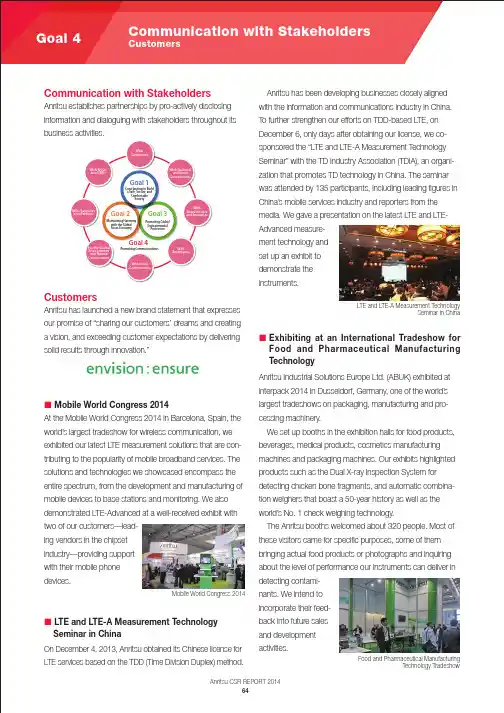
Anritsu will disclose accurate information at any time to every stakeholders with good faith and positive attitude by observing the related laws.
products such as the Dual X-ray Inspection System for
detecting chicken bone fragments, and automatic combina-
tion weighers that boast a 50-year history as well as the
Mobile World Congress 2014
L LTE and LTE-A Measurement Technology Seminar in China
On December 4, 2013, Anritsu obtained its Chinese license for LTE services based on the TDD (Time Division Duplex) method.
Shareholders and Investors
We are proactively disclosing information and encouraging interactive communication to more effectively meet the needs of shareholders and investors and applying their feedback to improve our business and IR activities.
Communication by phone 英文版
Aims of the Class
Ability Aims 1. Know well how to make, answer or extend a phone call; 2. Know how to get information from a phone communication and take a message; 3. Know how to pass a message to the person called
Communication by Phone
Listening and Speaking Practice
Taken from NPE Book 2 Unit 3
Designed for students majoring in secretary
Outline
1
Analysis of Students
Focal Points and Difficulties of the Class
新编实用英语综合教程二Unit3CommunicationbyPhone ppt课件
Following Sample Dialogues Imitate and Perform
Putting Language to Use
Speak and Complete
Speak and Translate
Speak and Communicate
6
Unit | Three
SECTION I Talking Face to Face
Jake: Great. Thanks a lot.
5) I Must have Dialed the wrong number. Tim: Hello. Jade: Hello. I’d like to speak to Dr. Heckler. Tim: Nobody here by that name. Jade: I’m sorry. I must have dialed the wrong number.
2ห้องสมุดไป่ตู้
Unit | Three
精品资料
• 你怎么称呼老师?
• 如果老师最后没有总结一节课的重点的难点,你 是否会认为老师的教学方法需要改进?
• 你所经历的课堂,是讲座式还是讨论式? • 教师的教鞭
• “不怕太阳晒,也不怕那风雨狂,只怕先生骂我 笨,没有学问无颜见爹娘 ……”
• “太阳当空照,花儿对我笑,小鸟说早早早……”
2) May I speak to ... ?
Joe: Hello. Is this the Chemistry Department?
Secretary: Yes, it is. What can I do for you?
Joe: May I speak to Mr. Mifflin?
沟通在工作中的作用英语作文
沟通在工作中的作用英语作文英文回答:Communication is the key to success in any workplace.It allows employees to share ideas, collaborate on projects, and resolve conflicts. Without effective communication, it would be impossible for businesses to function smoothly.There are many different types of communication that occur in the workplace. Verbal communication is the most common, and it includes face-to-face conversations, phone calls, and video conferences. Nonverbal communication is also important, and it includes body language, facial expressions, and tone of voice. Written communication is another important part of workplace communication, and it includes emails, memos, and reports.Effective communication is a skill that can be learned and improved upon. There are a few key things that you can do to improve your communication skills:Be clear and concise in your communication.Use active listening skills.Be respectful of others.Be aware of your body language.Use technology to your advantage.By following these tips, you can improve your communication skills and become a more effective communicator in the workplace.中文回答:沟通在工作场所中的作用至关重要。
Unit 3 Communication by Phone
Unit 3 Communication by PhoneI. Teaching Aims1. Teach the students some useful words and expressions for about making and answering a phone call.2. Train the students’ ability to understand the main idea and grasp important details of the listening texts.3. Give the students a chance to exchange views on the texts to enable them to have a deeper understanding of the texts and to let the students be acquainted with some new words.4.Teach the students some practical writing skills.II. Teaching Contents·SectionⅠTalking Face to Face·SectionⅡBeing All Ears·SectionⅢMaintaining a Sharp EyePassage I: For Conversation PressPassage II: Business Telephone Etiquette for Success·SectionⅣTrying Your HandIII. Teaching Time:6 class hoursIV. Teaching Focal Points1.Asking about making and answering a phone call2. Telephone messages writingV. Teaching Difficult Points1. Mastering the key words and expressions: advance, account,connect, preferable, deposit, insert, chain, consequence, intend, unable, check out, credit card, save the bother of (doing sth.), pretty soon” etc2. Grammar---The Subjective MoodⅥ. Teaching methodsInteractive approachSituational teaching approachTeamwork methodTask-based teaching methodVII. Teaching aidsPPTBlackboardVIII. Teaching Procedure1. The first two-class-hour session for SectionⅠTalking Face to Face and SectionⅡBeing All Ears.2. The next two-class-hour session for SectionⅢMaintaining a Sharp Eye.3. The last two-class-hour session for Section ⅣTrying Your Hand.The First SessionSection1 Talking Face to Face & Section2 Being All Ears Teaching Aims:Knowledge objects1 To study the focal expressions about making and answering a phone call by learning the dialogues of this part.2 To finish some oral exercises about making and answering a phone call.Ability objects1 To develop the Ss’ abilities of making and answering a phone call.2 To practice the Ss’ listening comprehension on the subject. Teaching Important Points:1 To help the Ss to communicate with each other.2 To enable the Ss to study in groups and cooperate skillfully.3 To develop the Ss’ inte rest in talking in English.Teaching Difficult Points:1 How to make the Ss express their thoughts freely and correctly.2 How to strengthen their listening abilities.Step1 Lead-in: The telephone message1 Warm-up questions: Questions for understanding the telephone message1) Who is calling?2) When does he make the phone call?3) What message does he leave?4) Who is the person called?5) What is he expected to do?6) Who passes the message to the person called?2 The Ss read the message again and then translate the message orally under the guidance of the teacher.Step2 Oral Activities: Talking Face to Face1 The teacher asks some questions and the Ss speak out the sentences for certain purposes under the guidance of the teacher.1) Do you know how to make a phone call?2) Do you know how to answer a phone call?3) Do you know how to take/ leave a message?4) Do you know how to pass the message to the person called?5) Do you know how to extend a phone call?2 The Ss read the sample dialogues after the teacher and try to find out the useful sentences and expressions for answering and makinga phone call or leaving a message.3 The Ss practice the dialogues in groups.4 Give the Ss several minutes to prepare short conversations in pairs by simulating the five small dialogues.5 The Ss role-play the similar situations they create, first in groups and then in front of the class.6 The Ss do Putting-Language-to-Use exercises in groups by reading out loud all the three dialogues they have completed.Step3 Listening Practice: Being All Ears1 Give the Ss a few minutes to read through the printed materials foreach listening item.2 Listen to the tape for the first time without looking at the book.3 Play the tape for a second time with a pause after each sentence, and ask the Ss to take notes of the key words.4 Play the tape for the third time, and ask the Ss to simultaneously repeat the passage while they are listening.5 Do all the exercises in this section.Step4 Assignments1 Pair work: Prepare conversations about making and answering a phone call.2 Recite the wonderful sentences picked out by the teacher.The Second SessionSection3 Maintaining a Sharp Eye: Passage1 For Conversation Press #1Teaching Aims:Knowledge objects1 To study the key words and expressions: “advance, account, connect, preferable, deposit, insert, chain, consequence, intend, unable, check out, credit card, save the bother of (doing sth.), pretty soon” etc. by learning the passage of this part.2 To understand Good and Bad of cell phones.3 To grasp the main idea of the passage.Ability objects1 To develop the Ss’ abilities of reading comprehension.2 To develop the Ss’ abilities of making sentences.Teaching Important Points:1 To enable the Ss to get a general understanding of the passage.2 To enable them to make sentences using the key words and expressions.Teaching Difficult Points:1 How to make the Ss translate the sentences by simulating the structures in the passage correctly.2 How to make the Ss understand some long or difficult sentences better.Step1 Lead-in: Warm-up questions:1 What are the advantages of the cell phone?2 What are the advantages of the email and voice mail?Step2 Listen and Read1 The Ss read the passage as quickly as possible.2 The teacher plays the tape for the first time and ask the Ss to listen.3 Play the tape for a second time and ask the Ss to repeat after the tape.Step3 Translation PracticeThe Ss are given several minutes to prepare for the translation of thelast three paragraphs in groups. Group presentation of the translation is required in the class.Step4 Language pointsThe Ss choose some useful expressions and sentences from the passage, and then the teacher demonstrates their usage. The following should be chosen and practiced. The Ss should make up at least two sentences using the chosen phrases in groups.1 advance: n. an improvement, a breakthroughe.g. There have been great advances in medicine in the last 60 years.in advance of: more highly developede.g. Their training facilities are far in advance of anything we have.in advance: ahead of timee.g. Everything had been fixed in advance.2 connect: v. attach, join together, reach sb. by telephonee.g. I connected the antenna to the TV set.3 preferable: a. better or more suitable, to be preferrede.g. Gradual change is preferable to sudden, great change.4 deposit: v. place sth. valuable, such as money, in a bank account; place valuables for safekeepinge.g. Sam deposited two hundred dollars in his savings account.5 insert: v. put sth. into/between/ amonge.g. The old lady carefully inserted the letter into an envelope.6 chain: n. a series of related things or events; a group of stories/restaurantse.g. The king’s murder started a chain of events that led to a war.7 check out: pay the bill and leave a hotele.g. The students had to check out at five in the morning.Step 5 Doing ExercisesGuide the Ss through Read and Simulate exercise. Try to let them find out and simulate the patterns and the expressions used in the sentences taken from the passage.Step 6 Assignments1 Recite the words as many as possible after class.2 Finish Exs.2-5 in the exercise book.3 Prepare for Passage 2 and Section 4.The Third SessionSection3 Maintaining a Sharp Eye: Passage2&Section4 Trying Your HandTeaching Aims:Knowledge objects1 To study the key words and expressions: “virtually, identify, contact, put…through, remind…of, prior, follow up” etc. by learning this part.2 To learn how to take/fill in a message.3 To know about the basic usages of subjunctive mood.4 To grasp the main idea of the passage.Ability objects1 To develop the Ss’ abilities of reading comprehension.2 To develop the Ss’ abilities of making sentences.Teaching Important Points:1 To enable the Ss to take and fill in a telephone message.2 To enable the Ss to use subjunctive mood correctlyTeaching Difficult Points:How to make the Ss master the basic rules of subjunctive mood well.Step1 Lead-in: Warm-up questionsHow much do you know about the business telephone etiquette? Step2 Listen and Read1 The teacher plays the tape and asks the Ss to listen.2 The Ss read the passage.Step3 Understanding1 The teacher asks the Ss to pick out the words and phrases used for business phone.2 Then the students do Ex. 7Step4 Language pointsThe Ss choose some useful expressions and sentences from thepassage, and then the teacher demonstrates their usage. The following should be chosen and practiced. The Ss should make up at least two sentences using the chosen phrases in groups.1. virtually ad. in fact or for all practical purposes 事实上e.g.It was reported that the city had been virtually paralyzed by the storm.Unemployment in this part of the country was virtually non-existent.2. identify v. to establish or recognize (sb. / sth.) as a certain person or thing 辨认, 鉴别e.g. The boy identified the bird as an eagle.The police officer refused to identify himself.They have already identified ten murder suspects.3. contact n. the condition of being in communication 联系e.g.We lost contact with our former neighbors after they moved.The polite was always in contact with an air traffic controller.Has your brother kept in contact with his friends from college?4. put …through v. to connect (a caller) to the person they have telephoned 接通e.g. She put the lady through immediately.Hold on, please. I’ll put you through to Mrs. Barnhart.Would you please put me through to your manager?5. remind …of v. to make sure that sb. does not forget sth. 提醒, 使想起e.g. Thank you for reminding me of the meeting I have to attend. This hotel reminds me of the one we stayed in last year.The tune reminds me of the the same play that we saw a few years ago.6. prior a. coming before in time, order or importance 在前的e.g. She denied prior knowledge of the meeting.He didn’t talk about his prior employment.7. follow up v. to act further on sth. 乘势采取行动e.g. The salesmen usually follow up a letter with a visit.As a news reporter, when something important happens, I have to follow it up.Step5 Applied Writing1 The teacher makes the brief analysis of the format of a telephone message.1) the calling time2) to whom3) from whom4) phone number5) the important content2 The Ss do Simulate and Create exercises.Step6 Grammar Review1 The teacher gives the following brief definition of the subjunctive mood:The subjunctive mood is used when we want to express a wish, request, recommendation or report of a command. Also, the subjunctive mood is used to express something that is contrary to the fact, highly unlikely or doubtful.2 The teacher helps the students to review the verb forms of the subjunctive mood through the following summary.In the conditional clause In the main clauseContrary to the present simple past tense would( should/could/might) + verbContrary to the past had + past participle would (etc.) + have + past participleContrary to the future were + to V / should +verb would( should/could/might) + verb2 The Ss do Exs.4, 5 and 6.Step7 Assignments1 Recite the words as many as possible after class.2 Do the grammar exercises in the Workbook.3 Prepare for speaking activities in Section 1of Unit 4.。