
英语介词用法详解
A.throughB.fromC.intoD.for
【答案】C
【解析】
【详解】
考查动词与介词的固定搭配。句意:传统中国农历把一年分成24个节气。动词固定搭配divide A into B意为“把A分成B”,搭配的介词为into,故选C。
【解析】
【分析】
考查介词短语辨析。句意:这些评论是对某些经常被当地新闻人问到的问题的回应。A. in memory of纪念,B. in response to回应,C. in touch with联系,D. in possession of拥有。分析句子成分知道空格处为介词短语起连接状语的作用,根据常识和句意,评论应该是对问题的回应。所以答案应该是B. in response to回应。
英语介词用法详解
一、单项选择介词
1.Most online classes let students learn _____ their own pace.
A.atB.toC.fromD.by
【答案】A
【解析】
试题分析:考查介词辨析。A.在,以;B.到、向;C.来自、从;D.通过、依据。句意:很多在线的课程让学生按照自己的节奏学习。at介词短语可表示以某种价格、速度等,at pace这里意思是按照,以某步伐,节奏。故选A。
考点:考查词组辨析
8.— How do you think of my composition?
— Almost perfect ________ one spelling mistake.
A.butB.exceptC.except forD.besides
【答案】C
【解析】
C考察连词辨析。句义:你认为我的作文怎么样?除了一些拼写错误,几乎很完美。Except for表示整体与局部的关系。如All the essays are well
考点:考查介词
【名师点睛】介词的考查一般与方位有关,也有的是一些习惯搭配,这题就是这样。take sb by the arm拉住某人的膀子,如果是“打某人的脸”就是hit sb in the face。如果是“打某人的后背”就是用hit sb on the back。
3.More and more high-rise buildings have been built in big cities______space.
A.in search ofB.in place of
C.for lack ofD.for fear of
【答案】C
【解析】
【详解】
考查介词短语辨析。句意:因为缺少空间,越来越多的高楼被建了起来。A. in search of寻找;B. in place of代替;C. for lack of因为缺少;D. for fear of唯恐;担心;经验。根据句意说明C正确。故选C。
10.Tom always goes jogging in the morning and he usually does push-ups too to stay ________.
A.in placeB.in orderC.in shapeD.in fashion
【答案】C
【解析】
试题分析:考查介词短语辨析及语境理解。A. in place在适当的位置;B. in order按顺序;C. in shape处于良好状态;健康;D. in fashion流行,时兴。句意:汤姆早上总是慢跑,他通常也做俯卧撑来保持良好身体。故C正确。
12.The Christmas gifts need to be ready next Friday.
A.byB.ofC.inD.at
【答案】A
【解析】
在表示时间时,by表示到……为止;of表示所有关系;in表示在一个时间范围;at表示在几点钟。句意:到下周五为止,圣诞礼物需要准备好。结合语境可知选A。
【答案】D
【解析】
【详解】
考查介词短语。句意:公民可以自由地行使自己的权利,但他们绝不能损害他人的权益。A. on track走上正轨;B. on schedule按时;C. at ease安逸;舒适;D. at liberty自由地。故选D。
7.Among customers there are different preferences __________ what is attractive.
13.It was obvious that the meeting was concerned ________ the housing reform and everyone present was concerned ________ their own interests.
A.with;withB.with;for
6.Citizens are _____ to exercise their rights, but under no circumstances can they violate other people’s rights.
A.on trackB.on schedule
C.at easeD.at liberty
9.Nowadays some hospitals refer to patients ________ name, not case number.
A.ofB.asC.byD.with
【答案】C
【解析】
考查介词辨析。句意“现在,有的医院直接登记患者的名字,而不是病号。”by name“以名字”。故选C。
A.amongB.alongC.acrossD.between
【答案】D
【解析】
试题分析:考查介词。句意:中国和欧洲之间的古代丝绸之路现在已经变成了一个学习、旅游的好场所。between...and...在……和……之间,故选D。
考点:考查介词
15.People who want the typist’s job will be judged ______ how accurate and fast they are.
16.We must fully obey traffic rules, otherwise everything would be ______ .
A.out of touchB.out of orderC.out of dateD.out of sight
【答案】B
【解析】
【详解】
考查固定短语辨析。句意:我们必须完全遵守交通规则,否则一切都会乱七八糟。A. out of touch不联系;不接触;B. out of order无序;乱七八糟;C. out of date过时的;D. out of sight看不见。由otherwise“否则”可知,不遵守交通规则一切都会乱七八糟。故选B。
【点睛】
请在此输入点睛!
5.(江苏)China’s soft power grows _______ the increasing appreciation and understanding of China globally.
A.in line with B.in reply to
C.in return for D.in honour of
【名师点睛】介词不能独立在句中做成份,介词后必须与名词、代词、或动名词构成介词短语在句中充当一个成份,表示人、物、事件等与其它人、物、事件等之间的关系。本题考查的介词短语结构是介词+名词+介词的形式,本句另外还含有一个过去分词(asked by local newsmen)作定语的用法。
【详解】
请在此输入详解!
【答案】B
【解析】
【详解】
考查词组。A. in control of控制;B. in line with与------一致;C. in contrast with与------形成对比;D. in advance of在------前面。句意:有人建议我们的生活费用应该与我们的经济条件相适应,这样我们才能量入为出。结合句意可知答案为B。
考点:考查介词短语辨析及语境理解
11.It is advised that our living expenses should be ________ our economic conditions so that we can live within our means.
A.in control of B.in line with C.in contrast with D.in advance of
【答案】A
【解析】考查介词短语词义辨析及语境理解。句意:中国的软实力增长与日俱增与全球对中国的赏识和理解相一致。A. in line with按照;与……一致;B. in reply to答复;C. in return for作为……的报答;D. in honour of为纪念,为庆祝。故选A。
点睛:本题侧重考查在特定的语境中辨析介词短语的能力。考生平时在学习中多积累之外还需要充分利用特定语境理解词义,还应注意多辨析意思相近的介词短语,重点关注它们用法上的区别。
4.These comments came ______________ specific questions often asked by local newsmen.
A.in memory ofB.in response to
C.in touch withD.in possession of
【答案】B
written except Nelson's. Nelson的文章(除去的)和All the essays(非除去的)是同类事物,所以用except。except for表示除去的和非除去的不是同类事物,并且从语气上通常表示遗憾。如:His essay is well written except for a few spelling mistakes. a few spelling mistakes (除去的)和His essay(非除去的)是不同类的事物。(3)but与except同义,但but多与every,any,no等或由这些词构成的复合词(如everything,anywhere,nobody)以及all,none之后,如:The children go to school everyday but Sunday.
40个英语介词用法总结
40个英语介词用法总结40个英语介词用法总结1. in: 表示在某个地方或时间内,例如:in the park, in the morning2. on: 表示在某个表面或时间点上,例如:on the table, on Monday3. at: 表示在某个地点或时刻,例如:at the cinema, at 9 o'clock4. by: 表示通过某种方式或在某个时间之前,例如:by car, by tomorrow5. for: 表示为了某个目的或一段时间,例如:for a party, for a week6. with: 表示伴随或使用某物,例如:with friends, with a pen7. to: 表示移动到某个地方或给予某人,例如:go to school, give it to me8. from: 表示起始点或来源,例如:from home, from China9. into: 表示进入某个地点或状态的转变,例如:jump into the water, turn into a butterfly10. out: 表示从某地点离开或移动到室外,例如:go out, look out of the window11. up: 表示向上移动或增加,例如:climb up the stairs,wake up12. down: 表示向下移动或减少,例如:walk down the hill, calm down13. about: 表示关于某事或在某个范围内,例如:talk about the movie, wander about the city14. off: 表示离开或关闭,例如:get off the bus, turnoff the lights15. on: 表示打开或激活,例如:turn on the TV, switch on the computer16. over: 表示越过或在某地上方,例如:jump over the fence, fly over the city17. under: 表示在某物下面或被控制或影响,例如:hide under the bed, live under his rules18. with: 表示具有某种特征或和某人一起做某事,例如:a man with blue eyes, dance with me19. without: 表示没有某物或在缺乏某物的情况下,例如:go without food, live without regret20. by: 表示通过某种方式,例如:learn by doing, go by bus21. through: 表示穿过某物或完成某事,例如:walk through the door, go through the documents22. across: 表示横穿某物或在某个范围内,例如:swimacross the river, all across the world23. between: 表示在两个事物之间或在某个时间段,例如:choose between two options, between 9 and 10 o'clock24. among: 表示在三个或三个以上事物之间或在某群人中,例如:share among friends, discuss among colleagues25. around: 表示在周围或在某个时间点附近,例如:walk around the park, around midnight26. through: 表示通过某事物或在某段时间内,例如:read through the book, work through the night27. against: 表示反对或靠在某物上,例如:fight against injustice, lean against the wall28. for: 表示代表或支持某人或某事,例如:vote for a candidate, fight for freedom29. towards: 表示朝向某个方向或对某人有好感,例如:walk towards the beach, feel towards someone30. within: 表示在某个时间或范围内,例如:arrive within an hour, within the city limits31. beyond: 表示超出某个界限或超过某个程度,例如:beyond expectations, beyond the horizon32. along: 表示沿着某个路线或伴随某人一起,例如:walk along the street, sing along with the song33. above: 表示在某物之上或高于某个程度,例如:flyabove the clouds, above average34. below: 表示在某物之下或低于某个程度,例如:swim below the surface, below freezing35. beside: 表示在某物旁边或和某人一起,例如:sit beside me, beside the lake36. near: 表示在某物附近或接近某个时间,例如:live near the beach, near the end37. past: 表示经过某个地点或在某个时间之后,例如:walk past the store, past midnight38. around: 表示在周围或大约某个数量,例如:look around the room, around 20 people39. after: 表示在某个时间之后或追求某人或某事,例如:after dinner, run after the dog40. before: 表示在某个时间之前或在某个事件之前,例如:before sunrise, before the meeting这些介词是英语中常用的一些基本介词,它们在表达地点、时间、方式等方面起到了重要的作用。
常见的英语介词及其用法

常见的英语介词及其用法英语介词的用法非常灵活,以下是常见的英语介词及其用法:1.表示地理位置的介词:•at:用于表示具体的位置,如at the table(在桌子旁)•in:用于表示在某个大地方或空间中,如in the house(在房子里)•on:用于表示在某个平面上或物体表面上,如on the table (在桌子上)•to:用于表示方向,如to the left(向左)案例:He lives in a small town near London.(他住在伦敦附近的一个小城镇里。
)2.表示时间的介词:•at:用于表示具体的时间点或时刻,如at noon(在中午)•in:用于表示在一个时间段内,如in the morning(在早晨)•on:用于表示在某个具体日期或时间范围,如on Monday (在星期一)•since:用于表示从某个时间点或时刻开始,如since last week(从上周开始)案例:I usually go to bed at 11 o'clock.(我通常在11点睡觉。
)3.表示方式的介词:•by:用于表示通过某种方式或交通工具,如by bus(乘公共汽车)•with:用于表示使用某种工具或方法,如with a knife(用刀子)•in:用于表示使用某种语言或穿着某种衣服,如in English (用英语)•on:用于表示在某种媒介上,如on TV(在电视上)案例:We usually communicate with each other by email.(我们通常通过电子邮件彼此沟通。
)4.表示原因的介词:•for:用于表示为了某个目的或原因,如for help(为了寻求帮助)•from:用于表示由于某个来源或原因,如from fear(由于恐惧)•about:用于表示关于某个话题或事件,如about the weather (关于天气)案例:She is studying for the exam.(她正在为考试而学习。
介词英语的用法总结
介词英语的用法总结介词英语的用法总结一、介词在英语中是一种重要的词,起连接词语之间的作用,连接它们表达语义;1. 介词“of”:表示所有格、归属等意思。
如:the cover of the book(这本书的封面)2. 介词“for”:表示目的、原因、对象等意思。
如:I'm here for you(我在这里是为了你)3. 介词“in”:表示在……中、在……时间段、里面等意思。
如:in the morning(在早上)4. 介词“on”:表示在某个表面、在某一天上等意思。
如:on Monday(星期一)5. 介词“at”:表示在某一地点、在某一时刻等意思。
如:at night (在晚上)6. 介词“by”:表示由……完成、靠近、在……旁边等意思。
如:by foot(步行)7. 介词“from”:表示从某一地方出发、来自……等意思。
如:from home(从家出发)8. 介词“with”:表示和……相关、用……做某事等意思。
如:with a pencil(用铅笔)9. 介词“to”:表示朝向某一处、前往等意思。
如:to school (上学)10.介词“for”:表示为了……、把……作为等意思。
如:for fun (为了好玩)11.介词“as”:表示作为、当……时等意思。
如:as a teacher (作为一个老师)12.介词“over”:表示在……上、穿过等意思。
如:over the bridge (过桥)13.介词“since”:表示从……起、既然等意思。
如:since then (从那时起)14.介词“into”:表示到……里面、转向等意思。
如:into the room(进房间)二、最后,需要强调的是,介词的使用要灵活搭配,以正确表达出英语句子的意思,以便达到更好的英语表达效果。
英语介词用法详解
“There is a thief among you.” The policeman shouted to the crowd.
警察向人群喊道:“你们中间有个小偷! He found his place among the crowd. 他在人群中找到了他的位置.
A hospital was built near the railway station. 在火车站附近建了一所医院. My home is near he school. 我的家离学校很近. (2) by = beside,靠近,在……旁边,比near距离更近 He just sat by/ beside me in the cinema. 在电影院他就坐在我旁边. He lay down beside the statuary. 他在雕像旁躺下了.
(三)其它用途的介词
(2) with用……工具 He broke the window with a stone. 他用石头把玻璃打碎了. He stopped the ball with his right foot. 他用右脚把球停住.
(3) on以……方式.多用于固定词组. They talked on the telephone. 他们通过电话进行交谈. She learns English on the radio/on TV. 她通过收音机/电视学英语.
(2) within“在……时间之内” I can finish it within an hour. 我不需一小时就可把它做完.(一) Nhomakorabea示时间的介词
(3) in 后面接过去的时间点表过去,若后面接一段时 间,则表示“在……时间之后”
英语介词用法详解
英语介词用法详解英语介词是连接词与词之间关系的重要语法成分,它们用于表示空间、时间、关系等概念。
正确的使用介词是英语学习的基础之一。
本文将详细介绍英语介词的常见用法。
一、表示方向和位置的介词1. In(在):用于大的地点范围之内,表示“在……里面”。
- There is a book on the desk.- I live in New York.2. On(在、在上、在……上面):用于平面、表面或边界之上。
- The cat is on the table.- The painting hangs on the wall.3. At(在、在……附近):用于特定的地点或位置。
- I met him at the park.- We will meet at the restaurant.4. Under(在……下面):表示相对高度或遮挡。
- The cat is under the table.- He found his keys under the sofa.5. Behind(在……后面):表示在某物后面。
- The car is parked behind the house.- She is hiding behind the tree.6. Beside(在……旁边):表示在某物的旁边。
- My house is beside the park.- She sat beside her friends.7. Inside(在……里面):表示在某物的内部。
- The wallet is inside the bag.- There is a surprise inside the box.8. Outside(在……外面):表示在某物的外部。
- The children are playing outside the house.- Don't forget to lock the door when you go outside.二、表示时间的介词1. On(在某天):用于特定的日期。
英语介词的用法总结(完整版)
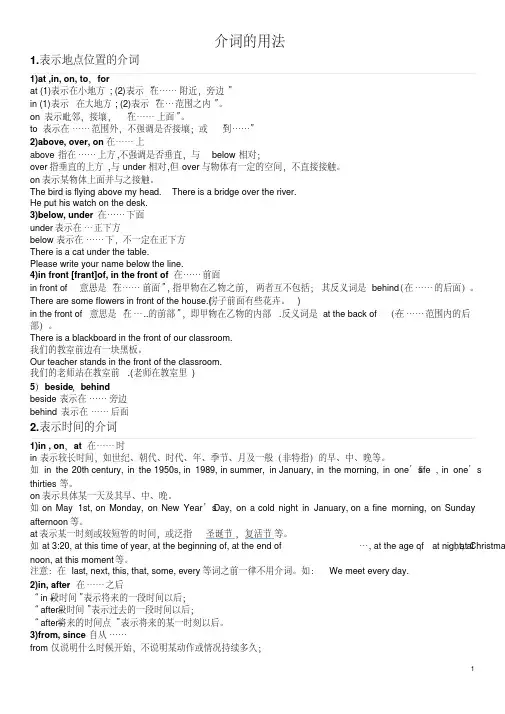
介词的用法1.表示地点位置的介词1)at ,in, on, to,forat (1)表示在小地方; (2)表示“在……附近,旁边”in (1)表示在大地方; (2)表示“在…范围之内”。
on 表示毗邻,接壤,“在……上面”。
to 表示在……范围外,不强调是否接壤;或“到……”2)above, over, on 在……上above 指在……上方,不强调是否垂直,与below相对;over指垂直的上方,与under相对,但over与物体有一定的空间,不直接接触。
on表示某物体上面并与之接触。
The bird is flying above my head. There is a bridge over the river.He put his watch on the desk.3)below, under 在……下面under表示在…正下方below表示在……下,不一定在正下方There is a cat under the table.Please write your name below the line.4)in front [frant]of, in the front of在……前面意思是“在……前面”,指甲物在乙物之前,两者互不包括;其反义词是behind(在……的后面)。
in front of…There are some flowers in front of the house.(房子前面有些花卉。
)in the front of 意思是“在…..的前部”,即甲物在乙物的内部.反义词是at the back of…(在……范围内的后部)。
There is a blackboard in the front of our classroom.我们的教室前边有一块黑板。
Our teacher stands in the front of the classroom.我们的老师站在教室前.(老师在教室里)5)beside,behindbeside 表示在……旁边behind 表示在……后面2.表示时间的介词1)in , on,at 在……时in表示较长时间,如世纪、朝代、时代、年、季节、月及一般(非特指)的早、中、晚等。
英语介词用法详解
英语介词是连接名词、代词或名词短语与其他词语的词,它们在句中不能单独作句子成分,需要与它们的宾语一起构成介词短语。
介词的用法多种多样,以下是一些常见英语介词的用法详解:1. 时间介词:- at:表示在某一具体时刻,如“At 6 o'clock”。
- on:表示在具体的某一天或某一天的上午、下午、晚上,如“On Monday”或“On the morning of July 4th”。
- in:表示在一段时间内,如“In the summer”或“In the 20th century”。
- by:表示在某一时间之前,如“By 5 o'clock”。
- before:表示在某一时间之前,如“Before lunch”。
- after:表示在某一时间之后,如“After the meeting”。
- since:表示自从某一时间以来,如“Since last month”。
- until/till:表示直到某一时间为止,如“Until 9 o'clock”或“Till the end of the day”。
2. 地点介词:- at:表示在某一地点,如“At the library”。
- in:表示在某一地区、城市或国家,如“In New York”或“In France”。
- on:表示在某一平面或表面,如“On the table”或“On the floor”。
- above:表示在某一地点的上方,如“Above the clouds”。
- below:表示在某一地点的下方,如“Below the bridge”。
- near:表示靠近某一地点,如“Near the river”。
- between:表示在两者之间,如“Between the trees”。
- beyond:表示超过某一地点,如“Beyond the horizon”。
3. 方式介词:- by:表示通过某种方式或手段,如“By car”或“By phone”。
英语中常见介词用法总结
英语中常见介词用法总结
1. in:表示内部状态
例如:in the room(在房间内);in good health(身体健康)2. on:表示表面状态
例如:on the table(在桌子上);on fire(着火)
3. at:表示位置
例如:at the station(在车站);at home(在家里)
4. with:表示伴随或附带
例如:with a smile(带着微笑);with my own eyes(亲眼看见)5. by:表示方式或经由
例如:by car(开车);by air(乘飞机)
6. to:表示方向或目标
例如:to the park(去公园);to the moon(到月球)
7. from:表示出发地或来源
例如:from Beijing(来自北京);from the magazine(从杂志中)
8. for:表示目的或用途
例如:for a birthday party(为了生日派对);for writing(用于写作)
9. of:表示属于或关系
例如:the book of Harry Potter(哈利·波特的书);the sister of Mary(玛丽的姐姐)
10. with:表示具有或伴随
例如:a man with a gun(拿着枪的人);a girl with long hair(长发女孩)。
(完整版)英语中介词的用法
介词的用法一、表示时间日期的介词1.at:主要表示方向、场所、时间的某一点at the corner of the street,at dinner,at sixty miles an hour,be sold at three yuan a dozen,come at us固定搭配:at one time,at the beginning of,at the post office,at the airport,at the weekend,at the age of25,at the same time,at present,at any time,表示原因,表示“见/闻……而”。
at the news at主要表示时间点表示特定的时间at night a.m.在九点钟表示不确定的时间at night,at that time,at Christmas 在圣诞期间当天on表示年龄段at the age of eight在8岁2.in:表示场所、时间与期限、状况、方向。
主要用来表示较长的时间单位,如月份、季节、年份等in the1990s in the late19th century形成“in+时段名词”的词组或固定搭配in those days,in the daytime,in a short while,in no time,in time.in主要表示时间段一般指相对较长的时间段里in the morning,in spring,in the past ten years在…时间之后,用于将来时He will be back in a month.介词in在短语或句型中的省略:1)某些形容词/过去分词后接v-ing形式时,v-ing形式前的介词in可以省略。
be busy(in)doing be engaged(in)doing(忙于……)2)某些动词如busy等,常与反身代词连用,其后的in也可以省略。
英语语法:介词用法
英语语法:介词用法介词在英语语法当中是非常常用的一种语法结构,那么作为常用的语法我们该如何学好呢,下面就是小编给大家带来的英语语法:介词用法,希望能帮助到大家!介词的用法一:一、介词to的常见用法1.动词+toa)动词+ toadjust to适应,attend to处理;照料,agree to赞同,amount to加起来达…,belong to属于,come to达到,drink to为…干杯,get to到达,happen to发生在某人身上,hold to紧握,lead to通向,listen to听,occur to想起,object to反对,point to指向,respond to回答,refer to参考;指的是…;涉及,reply to回答,see to负责,stick to坚持,turn to求助,write to给某人写信。
b)动词(+sth.)+to+sb.announce to通知某人, describe to向某人描述, explain to 向某人解释, express to对某人表达, mention to提及, nod to向某人点头,report to报告,say to告知,shout to对某人大叫,suggest to对某人提建议,speak to与某人交谈,talk to跟某人谈话, whisper to和某人低声耳语。
c)动词+sth./sb.+ to +sth./sb.add to增加, compare to比作, carry to运送至, devote to 致力于,introduce to介绍给, invite to邀请参加, join to连接到,leave to委托给,reduce to下降至, sentence to判处, take to带到。
2. be +形容词/过去分词+ tobe alive to觉察;晓得,be attentive to注意;留心,be awake to知晓,be blind to缺乏眼光,be close to紧挨着,be common to对某人来说很普通,be contrary to违反;反对,be devoted to致力,be deaf to不愿意听,be equal to有…的力量,be exposed to暴露;遭受,be fair to对…公平,be familiar to对某人来说熟悉,be grateful to对某人心存感激,be good to对…有好处,be harmful to对…有危害,be important to对…重要,be kind to友好对待,be known to周知于,be married to嫁给,be moved to转移到,be near to靠近,be necessary to对…有必要,be opposite to在对面,be opposed to反对,be pleasant to合某人之意,be proper to专属,be polite to礼貌待人,be rude to粗暴对待,be relative to与…有关,be strange to不习惯,be similar to类似,be suitable to适合,be true to忠实,be thankful to感激,be useful to对…有用,be used to习惯。