
大学英语听力题
A Cheap Parking Lot Before going to Europe on business, a woman drove her new
so the women handed over the keys to her Rolls-Royce.
The car was parked on the street in front of the bank. The bank
bank's president and its officers all enjoyed a good laugh at the woman for using a $250,000 Rolls-Royce as collateral
garage and parked it there.
Two weeks later, the woman walked through the bank's doors and
"Wait, Miss," the loan officer said, "
While you
were away, we checked you out and found that you are a
multi-millionaire. What puzzles us is why you would bother to borrow $5,000."
The women replied: "
(1) downtown
(2) loan
(3) security
(4) aggred
(5)
(6)
(7)
(8)
(9)
(10)
Before going to Europe on business, a woman drove her new Rolls-Royce to a downtown bank in New York City and went in to ask for a loan of $5,000. The bank officer said the bank would need some kind of security for the loan, so the women handed over the keys to her Rolls-Royce.
The car was parked on the street in front of the bank. The bank agreed to accept the car as collateral for the loan. The bank's president and its officers all enjoyed a good laugh at the woman for using a $250,000 Rolls-Royce as collateral against a $5,000 loan. An employee of the bank then proceeded to drive the Rolls into the bank's underground garage and parked it there.
Two weeks later, the woman walked through the bank's doors and asked to settle up her loan and get her car back.
"That will be $5,000 in principal, and $20.30 in interest," the loan officer said. The woman wrote out a check and started to walk away.
"Wait, Miss," the loan officer said, "We're very happy to have had your business, and this transaction has worked out very nicely, but we are a little puzzled. While you were away, we checked you out and found that you are a multi-millionaire.
What puzzles us is why you would bother to borrow $5,000."
The women replied: "Where else in Manhattan can I park my car for two weeks for only $20.30 and expect it to be there when I return?"。
2023年12月大学英语四级听力试题
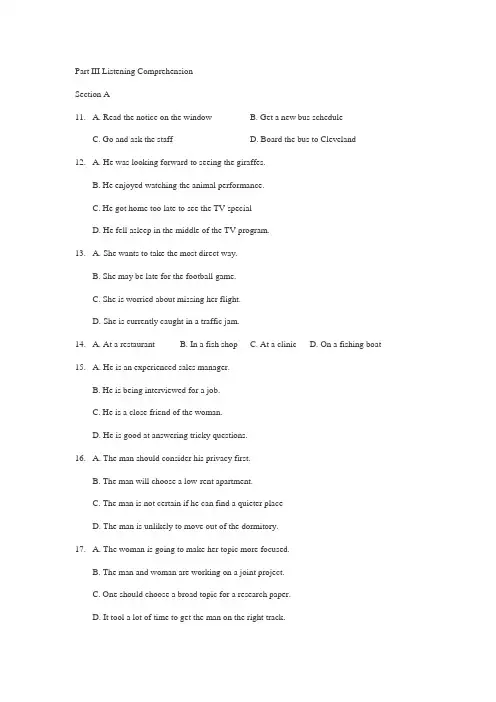
Part III Listening ComprehensionSection A11. A. Read the notice on the window B. Get a new bus scheduleC. Go and ask the staffD. Board the bus to Cleveland12. A. He was looking forward to seeing the giraffes.B. He enjoyed watching the animal performance.C. He got home too late to see the TV specialD. He fell asleep in the middle of the TV program.13. A. She wants to take the most direct way.B. She may be late for the football game.C. She is worried about missing her flight.D. She is currently caught in a traffic jam.14. A. At a restaurant B. In a fish shop C. At a clinic D. On a fishing boat15. A. He is an experienced sales manager.B. He is being interviewed for a job.C. He is a close friend of the woman.D. He is good at answering tricky questions.16. A. The man should consider his privacy first.B. The man will choose a low-rent apartment.C. The man is not certain if he can find a quieter placeD. The man is unlikely to move out of the dormitory.17. A. The woman is going to make her topic more focused.B. The man and woman are working on a joint project.C. One should choose a broad topic for a research paper.D. It tool a lot of time to get the man on the right track.18. A. They went camping this time last year.B. They didn’t quite enjoy their last picnic.C. They learned to cooperate under harsh conditions.D. They weren’t experienced in organizing picnics.Questions 19 to 22 are based on the conversation you have just heard.19. A. H e likes Sweden better than England.B. He prefers hot weather to cold weather.C. He is an Englishman living in Sweden.D. He visits London nearly every winter.20. A. The bad weather B. The gloomy winter C. The cold houses D. The long night21. A. Delightful B. Painful C. Depressing D. Refreshing22. A. They often stay up late reading B. They work hard and play hardC. They like to go camping in summerD. They try to earn more and spend more Questions 23 to 25 are based on the conversation you have just heard.23. A. English Literature B. Management C. French D. Public Administration24. A. English teaching B. Staff trainingC. Careers guidanceD. Psychological counseling25. A. Its generous scholarships B. Its worldwide fameC. Its well-designed coursesD. Its pleasant environmentSection BPassage One26. A. Characteristics of Japanese artists B. Some features of Japanese cultureC. The art of Japanese brush paintingD. The uniqueness of Japanese art27. A. To calm themselves down B. To enhance concentrationC. To show their impatienceD. To signal lack of interest28. A. How listeners in different cultures show respectB. How speakers can win approval from the audienceC. How speakers can misunderstand the audienceD. How different Western and Eastern art forms arePassage Two29. A. Directing personnel evaluation B. Buying and maintaining equipmentC. Drawing up plans for in-service trainingD. Interviewing and recruiting employees30. A. Some of his equipment was damaged in a fireB. The training program he ran was a failureC. Two of his workers were injured at workD. Two of his employees committed theft31. A. A better relationship with his boss B. Advancement to a higher positionC. A better-paying job in another companyD. Improvement in the company’s management32. A. She has more self-confidence than ChrisB. She works with Chris in the same divisionC. She has more management experience than ChrisD. She is competing with Chris for the new jobPassage Three33. A. They help us see the important values of a cultureB. They guide us in handling human relationshipsC. They help us express ourselves more effectivelyD. They are an infinite source of human knowledge34. A. Their wording may become different B. The values they reflect may changeC. Their origins can no longer be tracedD. They may be misinterpreted occasionally35. A. Certain values are shared by a large number of culturesB. Some proverbs are assuming more and more importanceC. Old proverbs are constantly replaced by new onesD. Certain values have always been central to a cultureSection CDictationOur lives are woven together. As much as I enjoy my own 36________. I no longer imagine I can get through a 37________ day, much less all my life, 38________ on my own. Even if I am on 39________ in the mountains, I am eating food someone else has grown, living in a house some else has built, wearing clothes someone else has 40________ from cloth woven by others, using 41________ someone else is distributing to my house. 42________ of interdependence is everywhere. We are on this 43________ together.As I was growing up, 44______________________________________________________. “Make your own way”, “stand on your own two feet”, or my mother’s favorite remark when I was face-to-face with consequences of some action: “Now that you’ve made your bed, lie on it!” Total independence is a dominant theme in our culture, I imagine that 45________________________ ________________________________. But the teaching was shaped by our cultural images, and instead I grew up believing that I was supposed to be totally “independent”and consequently became very reluctant to ask for help.46________________________________________________________________________.12月四级真题参照答案完整版听力Section A:11. B) Go and ask the staff。
大学英语听力练习题库

大学英语听力练习题库Section 11. Listen to the conversation and answer the following question. What does the man ask for?A. A penB. A pencilC. A calculatorD. A notebookAnswer: B. A pencil2. Listen to the monologue and answer the following question. What is the speaker talking about?A. His favorite bookB. His travel experienceC. His favorite musicD. His favorite movieAnswer: A. His favorite book3. Listen to the conversation and answer the following question. What does the woman want to do?A. Go to the moviesB. Have dinner at homeC. Have dinner at a restaurantD. Go shoppingAnswer: C. Have dinner at a restaurantSection 24. Listen to the monologue and answer the following question. What does the speaker suggest the listeners do?A. Take a vacationB. Work harderC. Exercise regularlyD. Eat healthierAnswer: C. Exercise regularly5. Listen to the conversation and answer the following question. Where does the conversation take place?A. At a hotelB. At a train stationC. At a bus stopD. At an airportAnswer: D. At an airport6. Listen to the monologue and answer the following question.What is the speaker's opinion about online shopping?A. It is convenientB. It is expensiveC. It is time-consumingD. It is unreliableAnswer: A. It is convenientSection 37. Listen to the conversation and answer the following question.What does the woman suggest they do?A. Go to the libraryB. Study togetherC. Have a partyD. Watch a movieAnswer: B. Study together8. Listen to the monologue and answer the following question.What does the speaker advise the listeners to bring when traveling?A. CashB. Credit cardsC. Travel guidebooksD. PassportAnswer: A. Cash9. Listen to the conversation and answer the following question. Where does the woman want to go?A. ItalyB. FranceC. SpainD. GermanyAnswer: B. FranceSection 410. Listen to the monologue and answer the following question. What does the speaker talk about?A. The importance of readingB. The benefits of exerciseC. The history of artD. The impact of technologyAnswer: C. The history of art11. Listen to the conversation and answer the following question.What does the man want to do?A. Visit a museumB. Go to a concertC. Watch a movieD. Have dinner at a restaurantAnswer: A. Visit a museum12. Listen to the monologue and answer the following question. What is the main topic of the monologue?A. Environmental pollutionB. Climate changeC. Renewable energyD. Sustainable livingAnswer: B. Climate changeSection 513. Listen to the conversation and answer the following question. What does the woman want to buy?A. A laptopB. A smartphoneC. A tabletD. A cameraAnswer: C. A tablet14. Listen to the monologue and answer the following question.What is the speaker's advice for improving English speaking skills?A. Watching moviesB. Reading booksC. Taking language coursesD. Practicing with native speakersAnswer: D. Practicing with native speakers15. Listen to the conversation and answer the following question.What time does the train leave?A. 5:15B. 6:15C. 7:15D. 8:15Answer: B. 6:15以上是大学英语听力练习题库的部分题目。
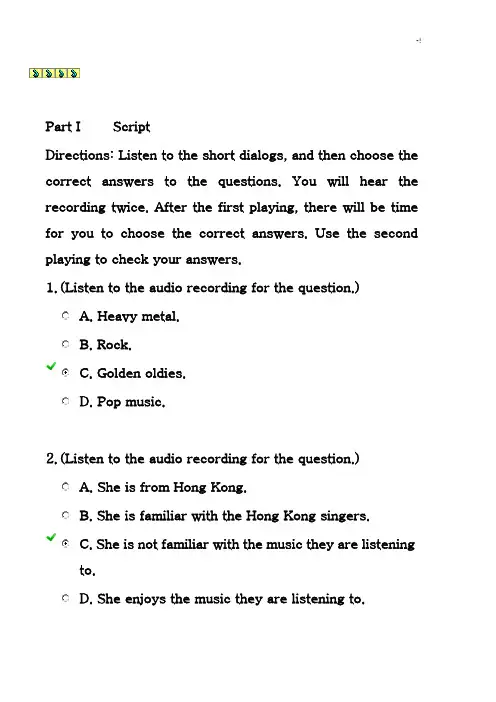
大学英语视听说英语听力
Part I ScriptDirections: Listen to the short dialogs, and then choose the correct answers to the questions. You will hear the recording twice. After the first playing, there will be time for you to choose the correct answers. Use the second playing to check your answers.1. (Listen to the audio recording for the question.)A. Heavy metal.B. Rock.C. Golden oldies.D. Pop music.2. (Listen to the audio recording for the question.)A. She is from Hong Kong.B. She is familiar with the Hong Kong singers.C. She is not familiar with the music they are listeningD. She enjoys the music they are listening to.3. (Listen to the audio recording for the question.)A. The man won't turn on the stereo for the woman.B. The woman loves fast music.C. Slow music can give people energy according toD. Fast music can give people energy according to the4. (Listen to the audio recording for the question.)A. The man thinks the tickets are inexpensive whileB. The man thinks the tickets are expensive while theC. They both think the tickets are expensive.D. They both think the tickets are inexpensive.5. (Listen to the audio recording for the question.)A. The man probably moved in not long ago.B. The woman probably moved in not long ago.C. The man is interested in the bass.D. The woman wants to finish the party as early asPart II ScriptDirections: Listen to the following recording, and then fill in the blanks with the missing words. You will hear the recording twice. After the first playing, there will be time to write the missing words. Use the second playing to check your answers.W:last year.M:W: so strong.of them.M: posters and bought every CD they ever made.W: I also went to almost every concert they had—even(6)t he one in Canada!M: Don't you think that was strange? (7)G oi ng cr azy over some strangers?W: (8)M aybe t o you. But students have too much(9)l essi ons. We have to spend a lot of timestudying...M: Which leads you to (10)get i t with pop stars? I don't (11)under st an.W: You see, under great pressure, we need relaxation(12)f r om t i m e t o t i m e. And...M: (13)G o on!W: In a sec! Let's watch this (14)m usi c CD first!Your answer Correct answer(1) favority bond favorite band(2) What any more Not anymore(3) no longer no longer(4) a big fan a big fan(5) collected collected(6) the one the ones(7) Going crazy Going crazy(8) Maybe to you Maybe to you(9) lessions pressure(10) get it fall in love(11) understand get it(12) from time to time from time to time(13) Go on Go on(14) music CD music videoPart III ScriptDirections: Listen to the following recording, and then choose the correct answers to the questions. You will hear the recording twice. After the first playing, there will be time for you to choose the correct answers. Use the second playing to check your answers.1. What has Williams recently said?A. Music piracy is costing the music industry a lot ofB. Music piracy is a good thing.C. Music piracy promotes the popularity of his songs.D. Music piracy should be banned.2. Why is Williams so rich now?A. He has recently inherited a lot of money.B. He has benefited a great deal from music piracy.C. He has got lots of money from the recordcompanies.D. He has received large donations from his fans.3. When Williams asked the record companies about theissue of music piracy, what responses did he get from them?A. They were angry but would not do anything aboutit.B. They found themselves helpless.C. They did not care since they could get lots ofmoney from over-priced CDs.D. They were angry and were trying to settle theissue in court.4. What examples of music piracy are mentioned in thepassage?A. Online song-sharing.B. CD copying.C. Downloading songs from the Internet.D. Both A) and B).5. What is the speaker's tone about music piracy?A. Neutral.B. Negative.C. Positive.D. Sarcastic.Part IVDirections: Choose the best answer to each of the following statements.1. When the audience cried "Encore", the singer wasoverjoyed with the _________ from the audience.A. answerB. replyC. responseD. return2. In 1781, he left for Vienna, where he was in great________ as both a performer and a composition teacher.A. necessityB. needC. wantD. demand3. Although Mozart lived only a short life, he _______ over600 works.A. composedB. composed ofC. composed inD. was composed of4. In 1916, Patty took legal action ________ Mr. Coleman.A. overB. againstC. withD. for5. His music from the next decade was not very popular,and he eventually fell back on his teaching jobs ______ a living.A. forB. toC. onD. with6. From that time _____, Mozart was performing inconcerts and writing music.A. aheadB. forthC. onD. down7. We sometimes danced _____ the music in a karaoke bar.A. atB. forC. withD. to8. Let's go for ______ before we go to _________.A. lunch ... concertB. the lunch ... the concertC. lunch ... the concertD. the lunch ... concert9. Before the age of four, Mozart ______ great musicaltalent.A. has shownB. had shownC. had been shownD. have showed10. After Patty Hill became the head of the Department ofKindergarten Education, a gentleman ________ Robert Coleman published the song.A. called the name ofB. at the nameC. by the name ofD. in the name ofScriptQuestion 1W:I love golden oldies. They are so fascinating.M:It's unimaginable! Girls at your age are all hooked by pop and rock music.You are out of the world.Q:What kind of music does the woman like?Question 2W:Who's this band we're listening to? I've never heard this track before.M:It's a new CD I got last week. I can't remember the name, but they're from Hong Kong.Q:Which of the following is true of the woman speaker?Question 3W:George, I feel depressed today. Could you please turn on the stereo for me?M:No problem, but no slow music this time. I'll give you some faster music to make you feel full of life.Q:What can we infer from the dialog?Question 4M:Did you see that the tickets for Bob Dylan's European tour are selling for over 200 Euros? Unbelievable!W:Wow, that's expensive—even for one of the grand old names of folk music.Q:Which of the following is true of the two speakers?Question 5M:Excuse me, could you turn your music down, please? I live downstairs and I can hear the bass thumping above me.W:Oh, I'm so sorry! But we're having a party. Why don't you come in and join us? It's about time I got to know some of the neighbors.Q:What can we infer from the dialog?ScriptW:Oh, Backstreet Boys! They were my (favorite band) last year.M:(Not anymore)?W:Yes, though my interest is (no longer) so strong. You see, I was once(a big fan) of them.M:I know you (collected) posters and bought every CD they ever made.W:I also went to almost every concert they had—even (the ones) in Canada!M:Don't you think that was strange? (Going crazy) over some strangers?W:(Maybe to you). But students have too much (pressure). We have to spenda lot of time studying...M:Which leads you to (fall in love) with pop stars? I don't (get it).W:You see, under great pressure, we need relaxation (from time to time).And...M:(Go on!)W:In a sec! Let's watch this (music video) first!ScriptRobbie Williams is a phenomenon in the pop music industry. He's only recently signed a new 120 million dollar contract with his British-based record company, EMI, after more than five years of continual album hits and number one singles. But neither EMI nor any of its rival companies are likely to be impressed by Williams' latest comments that music piracy is in fact a good thing, for they believe it is costing the industry millions of dollars every year.Robbie says that before renegotiating his new contract, he investigated the issue of Internet piracy, and he asked each of the record companies, "What are you going to do about it?" All he got back, he says, was a lot of angry words. Those record companies who have helped make Robbie Williams extremely rich have been taking legal actions against online song-swapping services and the growing phenomenon of domestic compact disc copying. Artists and companies have been united in their protest that millions of dollars are being taken away from the creative music process. But other people might say that this hasn't stopped either the artists or the companies becoming very rich indeed from the sale of overpriced compact discs.。
大学英语四级听力真题及答案
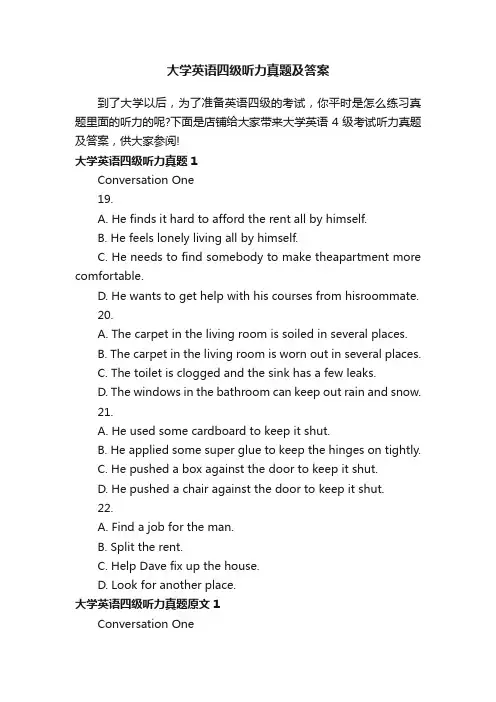
大学英语四级听力真题及答案到了大学以后,为了准备英语四级的考试,你平时是怎么练习真题里面的听力的呢?下面是店铺给大家带来大学英语4级考试听力真题及答案,供大家参阅!大学英语四级听力真题1Conversation One19.A. He finds it hard to afford the rent all by himself.B. He feels lonely living all by himself.C. He needs to find somebody to make theapartment more comfortable.D. He wants to get help with his courses from hisroommate.20.A. The carpet in the living room is soiled in several places.B. The carpet in the living room is worn out in several places.C. The toilet is clogged and the sink has a few leaks.D. The windows in the bathroom can keep out rain and snow.21.A. He used some cardboard to keep it shut.B. He applied some super glue to keep the hinges on tightly.C. He pushed a box against the door to keep it shut.D. He pushed a chair against the door to keep it shut.22.A. Find a job for the man.B. Split the rent.C. Help Dave fix up the house.D. Look for another place.大学英语四级听力真题原文1Conversation OneM: Hi, Shelley. Come on in.W: Uh, yeah, I stopped by to see if you were stilllooking for a roommate to share your house.M: Yep. I sure am. [19]Ever since I cut back on myworking hours to go to school, I've been reallystrapped for cash. Hey, let me show you around theplace. Uh, here's the living room.W: Oh. [20]It looks like you could use a new carpet... and those stains?M: Well. I've had a few problems with some former roommates. I know it needs to be cleaned,but I just don't have the money to do it right now.W: Oh. And what about the kitchen?M: Right this way. Look. It's completely furnished with all the latest appliances, except... [21]Well, the refrigerator door is broken... a little bit... and it won't shut all the way. It needsfixing, but don't worry. [21]I've pushed a box against it to keep it shut.W: Hmm. Great. Well, how about the bathroom? ... No, no. Don't tell me. The toilet is cloggedor the sink has a few leaks.M: No, those work fine. Well, there's another slight problem. The windows. I've put up a pieceof cardboard to keep out the rain and snow, and if it gets a little cold, you can always turn upthe heat.W: Hey, [22]I think I've seen enough. I can't believe you've survived under these conditions.M: So what do you think? You really can't beat a place like this for $450 a month. So it has itsproblems, but we can fix those.W: Uh, no, thank you. I think I've seen enough.大学英语四级听力真题答案解析1Questions 19 to 22 are based on the conversation you have just heard.19. Why does the man need to share his apartment with a roommate?[A]解析:对话开始,女士就提出了对话主题:看男士是否还需要人合租。
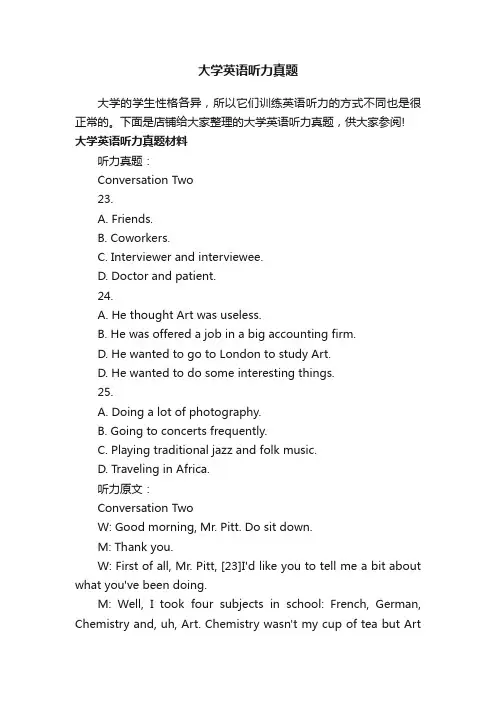
大学英语听力真题
大学英语听力真题大学的学生性格各异,所以它们训练英语听力的方式不同也是很正常的。
下面是店铺给大家整理的大学英语听力真题,供大家参阅! 大学英语听力真题材料听力真题:Conversation Two23.A. Friends.B. Coworkers.C. Interviewer and interviewee.D. Doctor and patient.24.A. He thought Art was useless.B. He was offered a job in a big accounting firm.D. He wanted to go to London to study Art.D. He wanted to do some interesting things.25.A. Doing a lot of photography.B. Going to concerts frequently.C. Playing traditional jazz and folk music.D. Traveling in Africa.听力原文:Conversation TwoW: Good morning, Mr. Pitt. Do sit down.M: Thank you.W: First of all, Mr. Pitt, [23]I'd like you to tell me a bit about what you've been doing.M: Well, I took four subjects in school: French, German, Chemistry and, uh, Art. Chemistry wasn't my cup of tea but Arthas always been.W: Art?M: Well, I really wanted to study Art. [24]It didn't turn out like that because a friend of my father's offered me a job-he's an accountant in London. A quite big firm, you know.W: I see. A firm of accountants. Interesting! [23]In your application, you say that you only spent nine months with this firm of accountants. Why was that?M: It was nearly a year actually. Well, to be quite honest, I didn't like it. I just couldn't seem to get interested in the job although there were fairly good prospects. So I got a place at the Art College to do a three-year diploma course.W: I see. Now, Mr. Pitt, what about hobbies and interests? Uh, what do you do in your spare time?M: I like jazz, traditional and folk music. I don't play, of course, [25]but I go to quite a lot of concerts, and I go to the theatre occasionally and act a bit myself. I'm in the local dramatic society.I read quite a lot and I've done a bit of photography. Also, I've traveled a lot-hitchhiked all over Europe-last year, that was...W: Very interesting, Mr. Pitt. I think that's all I wanted to ask about your back-ground.答案解析:Questions 23 to 25 are based on the conversation you have just heard.23. What might be the relationship between the woman and the man?[C]解析:应聘面试对话的一个重要特征是:面试人主要提问,受试人主要回答问题,对话内容以学习背景、工作经历为主,有时提到工作职责与报酬。
大学英语听力

一Who's faster, a horse or a human? Of course, we know horses are faster, but there's one race where humans sometimes win.In the UK, there has been a race between horses and runners every year since 1980. This race is about 22 miles long, and the runners compete with the horses with riders on their backs. Both the horses and runners go up and down hills which have a lot of rocks, and both also go across a river. Because the horses have the extra weight of their riders, crossing the river is more difficult for the horses than it is for the runners.The horses and runners have the same conditions except that the horses with their riders must stop every 15 minutes during the race to make sure the horses aren't getting too hot, but people who are running don't overheat easily like horses, so they don't have to stop. The horses also run two extra miles.It's not surprising that horses win most of the time, but it is surprising that two runners were able to beat the horses in past races.The following questions are based on what you have just heard.1. What kind of race in the UK is discussed in the news report?2. What is an extra challenge for the horses in the race?3. What is surprising?谁更快,马还是人?当然,我们知道马跑得更快,但有一场比赛人类有时会赢。
大学英语四级-听力12
大学英语四级-听力12(总分:100.00,做题时间:90分钟)一、Listening Comprehension(总题数:0,分数:0.00)二、Section A(总题数:8,分数:100.00)(分数:12.50)A.The bus stop is only two minutes" walk.B.The running made him short of breath.C.They might as well take the next bus. √D.The woman is late by a couple of minutes.解析:[听力原文]W: Hurry up, Mark. There"s a bus coming now.M: Why run? There"ll be another one in 2 or 3 mintues.Q: What does the man mean?[解析] 对话中女士催男士说公共汽车来了,男士以反问的语气回答说为什么要跑,过两三分钟就又有一班车了。
由此可知,男士的意思是,他们可以坐下一班公共汽车,故答案为C。
A.The washing machine is totally beyond repair.B.He will help Wendy prepare her annual report.C.Wendy should give priority to writing her report. √D.The washing machine should be checked annually.解析:[听力原文]W: Wendy"s in the basement, trying to fix the washing machine.M: Shouldn"t she be working on her annual report?Q: What does the man mean?[解析] 对话中女士说温迪正在地下室里修洗衣机,男士反问,难道她不是应该正在写她的年度报告吗?由此可知,温迪现在本应该在写她的年度报告,故答案为C。
大学英语听力试题
大学英语听力试题每一个人大学训练自己英语听力的方式都不一样,有的是利用试题,有的则是利用口语。
下面是小编给大家带来大学英语听力题,供大家参阅!大学英语听力试题听力真题:Passage One26.A. They were possibly caused by man.B. They were mostly caused by volcanoes.C. They were certainly caused by nature.D. We know nothing about their causes.27.A. Afraid.B. Excited.C. Curious.D. Indifferent.28.A. Copper and iron.B. Copper and tin.C. Iron and tin.听力原文:Passage One[26]We don't know how the first fire was made. Early fires on the earth were certainly caused by nature, not by man. Some were caused by lightning in a storm; others, perhaps by one hot material which came out of a volcano. Quite possibly, at times, the heat of the sun set light to some dry grass or leaves. [27]At first, man, like other animals, was probably afraid of fire. He saw that fire could destroy a forest; he knew that fire could hurt his body. So great was the power of fire that he feared it and worshipped it. Gradually, however, with his better powers of thinking, he overcame his fear. Probably he overcame most of his fear when he discovered how to make fire for himself. Throughout the ages he has learned more about fire, how to control it, and how to use it in many ways. Now fire is no longer a master or a god, it is a servant. Again, at some early date, man found how fire could be used to make certain metals from rocks. [28]Some time later, he found out how to make the metal which we now call bronze. This is a mixture of copper and tin. Bronze was a very useful metal. It was hard and tough, but he could shape it by hammering (probably with heavy stones). He could make atool with a sharp edge for cutting. It isn't so easy to get iron from its ore and this metal was probably not discovered until very much later.答案解析:Questions 26 to 28 are based on the passage you have just heard.26. What do we know about early fires on the earth?[C]解析:短文开头即说:“第一堆火是怎样生起来的,我们无从知道。
大学英语听力专题训练
大学英语听力专题训练对待英语听力,我们要像对待花朵一般,在大学我们才能够取得进步。
下面是店铺给大家整理的大学英语听力专题训练,供大家参阅! 大学英语听力专题训练听力真题:Passage One26.A. Banks, government agencies and credit unions.B. Banks, deposit unions and money market funds.C. Banks, savings-and-loans and deposit unions.D. Banks, savings-and-loans and credit unions.30.A. Teachers working in the same city.B. Professors attending the same seminar.C. Colleagues working for the same government agency.D. Experts studying the same subject.31.A. Certificates of deposit.B. Savings account.C. Money market funds.D. Credit unions.听力原文:Passage OneSaving money is a first step toward wealth. Puttingmoney away for the future also supports the bankingsystem. Banks need a supply of savings to providemoney for loans. In the United States, people whowant to start a savings have many choices.[26]Banks, savings-and-loans and credit unions aretraditional places to open an account. [27]Creditunions are cooperatives forpeople who are linked in some way. For example, the members maywork for a university or a government agency. Most credit unions are non-profit organizations.Savers have their money guaranteed up to one hundred thousand dollars. Banks and otherfinancial organizations pay interest on savings accounts. But the interest rates are low.Certificates of deposit are another way to save. They pay higher interest rates. With a certificateof deposit, a person agrees not to withdraw an amount of money for a period of time. Theterm could be three months, or it could be several years. Longer terms, and larger amounts,pay higher interest. People can withdraw their money early but at a cost. Another way to saveis through a money market fund. This is a kind of mutual fund. Mutual funds invest moneyfrom many people. Money market funds pay higher interest than savings accounts. The moneyis usually placed in short-term government securities. [28]Money market funds, however, maynot be federally guaranteed like other kinds of savings.答案解析:Questions 26 to 28 are based on the passage you have just heard.26. What are the traditional places to open an account in the United States?[D]解析:短文中说到:传统的可以开账户的场所是银行、储蓄与贷款协会以及信贷互助会。
大学英语三级全真模拟听力试题(共五套)及答案
大学英语三级全真模拟听力试题(一)Test OneP art I: Listening Comprehension (15%)Section ADirections: In this section, you will hear 10 short conversations. At the end of each conversation, a question will be asked about what was said. Both the conversationand the question will be spoken only once. After each question there will be apause. During the pause, you must choose the best answer from the four choicesmarked A), B), C) and D. Then mark the corresponding letter on the Answer Sheetwith a single line through the center.Example: You will hear: Where do you think the conversation most provably took place?You will read:A) At the office.B) In the waiting room.C) At the airport.D) In a restaurant.From the conversation we know that the two were talking about some work they had to finish in the evening. This is most likely to have taken place at the office. Therefore, A) “At the office” is the best answer. You should choose [A] on the Answer Sheet and mark it with a single line through the center.Sample Answer [A] [B] [C] [D]1. A) Fixing an engine. B) Repairing a car.C) Cashing a check. D) Buying some wheels.2. A) Visit Japan. B) Cook some food.C) Travel abroad. D) Eat out.3. A) One of a cheaper price. B) One of a different color.C) One of a fashionable style. D) One of a smaller size.4. A) He has changed his plan. B) He has canceled his trip.C) He is arriving this afternoon. D) He forgot to arrange his trip.5. A) They had lost their way. B) They were told it would rain.C) They were caught in the rain. D) They had taken an umbrella.6. A) They will take the bus at 11 o’clock.B) The bus is late.C) The bus has already arrived.D) The woman thought the bus would arrive at 11:20.7. A) The man shouldn’t drink either.B) Drinking is better than smoking.C) The man should switch to drinking.D) The man could smoke a little.8. A) In a bookstore.B) At a museumC) At a zoo.D) On a college campus.9. A) Teacher and student.B) Shop assistant and customer.C) Tourist and travel agent.D) Husband and wife.10. A) She will stop to take a rest.B) She will work for three hours.C) She will have her back checked.D) She will buy a computer in three hours.Section BDirections: In this section, you will hear a short passage. At the end of the passage, you will hear two questions. Both the passage and the questions will be spoken twice. Afteryou hear a question, you must choose the best answer from the four choicesmarked A),B),C) and D. Then mark the corresponding letter on the Answer Sheetwith a single line through the center.Questions 11 to 12 are based on the passage you have just heard.11. A. There are only 23 hours in a dayB. There are 8 days in a weekC. There are one more hour in a dayD. All of the above12. A. Set one hour ahead in each new time zone.B. Set one hour ahead for the whole trip.C. Set one full day back for the whole trip.D. Set 12 hours back.Section CDirections: In this section, you will hear a passage three times. Listen during the first reading.Then listen to carefully the passage again. When it is being read the second time,you should fill in the six blanks numbered form S1 to S6 with the exact words orphrases you have just heard. Finally, when the passage is read for the third time,you should check what you have written.Information has always been at the center of human communication. You may ask why. Well, communication between people involves giving and receiving information. The way we give and receive information today has S1____________ a revolution in the development of the mass media in the 20th century.The first truly mass communication medium was the newspaper. For the first time in history, people could read about S2____________ in their country and from around the world every day. However, there were two problems with newspapers of that time. S3____________, newspapers were available only in large cities, for getting newspapers to the countryside was a difficult and time-consuming task. Secondly, newspapers weren't always S4____________, as there was a limited range of opinions.Nowadays, we can S5____________ from a wide variety of sources to get information. Television and the Internet have given us the chance to be informed about everything theS6_____________ it happens. Numerous radio and TV stations, satellite channels and millions of websites help people keep up with the latest news. People live history and are part of it.大学英语三级全真模拟听力试题(二)Test TwoSection ADirections: In this section, you will hear 10 short conversations. At the end of each conversation, a question will be asked about what was said. Both the conversationand the question will be spoken only once. After each question there will be apause. During the pause, you must choose the best answer from the four choicesmarked A), B), C) and D. Then mark the corresponding letter on the Answer Sheetwith a single line through the center.Example: You will hear: Where do you think the conversation most provably took place?You will read:A) At the office.B) In the waiting room.C) At the airport.D) In a restaurant.From the conversation we know that the two were talking about some work they had to finish in the evening. This is most likely to have taken place at the office. Therefore, A) “At the office” is the best answer. You should ch oose [A] on the Answer Sheet and mark it with a single line through the center.Sample Answer [A] [B] [C] [D]1. A) Carol. B) Jim.C) Paul. D) The woman.2. A) 11:00. B) 11:30.C) 12:00. D) 12:30.3. A) 5. B) 12.C) 14. D) 16.4. A) Go to the post office. B) Go down the street.C) Cross the street. D) Go to the cinema.5. A) Denis. B) John.C) Mary. D) The woman.6. A)To get more advice. B)To get more exercise.C)To get married. D)To get a job.7. A) Mr. Johnson will be busy tomorrow morning.B) Mr. Johnson will be busy tomorrow.C).Tomorrow afternoon will be fine.D) The man can meet Mr. Johnson the day after tomorrow.8. A) A dentist. B) Her teacher.C) Her brother. D) Her friends.9. A) He’s a receptionist. B) He’s a tour guide.C) He’s a shopkeeper. D) He’s an accountant.10. A) At a theater. B) In a waiting room.C) In a supermarket. D) In a restaurant.Section BDirections: In this section, you will hear a short passage. At the end of the passage, you will hear two questions. Both the passage and the questions will be spoken twice. Afteryou hear a question, you must choose the best answer from the four choicesmarked A),B),C) and D. Then mark the corresponding letter on the Answer Sheetwith a single line through the center.Questions 11 to 12 are based on the passage you have just heard.11. A) Teachers made children sit still for a long time.B) Children must learn and discover things themselves.C) Children had to repeat things till they could remember them.D) School is like a prison to some children.12. A) They haven’t learnt anything in school.B) Their teachers don’t allow them to work.C) Their parents don’t allow them to workD) The law does not allow them to work.Section CDirections:In this section, you will hear a passage three times. Listen during the first reading.Then listen to carefully the passage again. When it is being read the second time,you should fill in the six blanks numbered form S1 to S6 with the exact words orphrases you have just heard. Finally, when the passage is read for the third time,you should check what you have written.One way to think about time is to imagine a world without time. There could be no movement, because time and movement cannot be S1____________. A world without time could exist only as long as there were no changes. For time and change are linked. We know that time has passed when something changes.In the real world -- the world with time -- changes never stop. Some changes happen only once in a S2____________; others happen repeatedly. Humans always have notedS3____________ events that repeat themselves. When people began to count such events, they began to measure time.In early human history, the only changes that seemed to repeat themselves evenly were the movements of S4____________ in the sky. The most easily seen result of these movements was the difference between light and darkness.The sun rises in the eastern sky, S5____________ light. It moves across the sky and sinks in the west, causing darkness. The appearance and disappearance of the sun was even and unfailing. The periods of light and darkness it created were the first S6____________ periods of time. We have named each period of light and darkness -- one day.大学英语三级全真模拟听力试题(三)Test ThreeSection ADirections: In this section, you will hear 10 short conversations. At the end of each conversation, a question will be asked about what was said. Both the conversationand the question will be spoken only once. After each question there will be apause. During the pause, you must choose the best answer from the four choicesmarked A), B), C) and D. Then mark the corresponding letter on the Answer Sheetwith a single line through the center.Example: You will hear: Where do you think the conversation most provably took place?You will read:A) At the office.B) In the waiting room.C) At the airport.D) In a restaurant.From the conversation we know that the two were talking about some work they had to finish in the evening. This is most likely to have taken place at the office. Therefore, A) “At the office” is the best answer. You sho uld choose [A] on the Answer Sheet and mark it with a single line through the center.Sample Answer [A] [B] [C] [D]1. A) A policewoman.B) A hotel clerk.C) A waitperson.D) A shop assistant.2. A) The lady bought the desk lamp when she was in Hong Kong.B) The lady bought the desk lamp in China last winter.C) The lady’s friend got it on the Internet for her.D) The lady’s friend bought it in China.3. A) He didn’t attend the lecture.B) He fell asleep on the train.C) He caught the early train to attend the lecture.D) The train broke down and he was late for the lecture.4. A) 08:00.B) 08:15.C) 08:30.D) 08:50.5. A) His car key.B) His overcoatC) The sofa.D) The table.6. A) The man can’t swim.B) The man can swim after he has done his homework.C) The man can’t swim because he doesn’t know the way.D) The man can swim if he knows the way.7. A) She does not work on rainy days.B) She goes to work by bicycle every day.C) She walks to work on rainy days.D) She always goes to work on foot.8. A) In a barbershop.B) In a supermarket.C) In a bank.D) In a restaurant.9. A) Husband and wife.B) Doctor and patient.C) Neighbors.D) Employer and employee.10. A) She planted trees.B) She saw the panda.C) She taught her roommates how to play Chinese chess.D) She learned to play Chinese chess.Section BDirections:In this section, you will hear a short passage. At the end of the passage, you will hear two questions. Both the passage and the questions will be spoken twice. Afteryou hear a question, you must choose the best answer from the four choicesmarked A),B),C) and D. Then mark the corresponding letter on the Answer Sheetwith a single line through the center.Questions 11 to 12 are based on the passage you have just heard.11. A) You must tell your new friend your telephone number at your first meeting.B) You shouldn’t talk about business on your first meeting with your new friend.C) It’s quite common to give information about y our family or your work.D)You don’t have the right to end the conversation.12. A) How to make new friendsB) The three parts of the first conversation with a new friend.C) The importance of talking with a stranger in EnglishD)How to maintain friendshipSection CDirections:In this section, you will hear a passage three times. Listen during the first reading.Then listen to carefully the passage again. When it is being read the second time,you should fill in the six blanks numbered form S1 to S6 with the exact words orphrases you have just heard. Finally, when the passage is read for the third time,you should check what you have written.Dreams are expressions of thoughts, feelings and events that pass through our mind while we are sleeping. People dream about one to two hours each night. We may have four to seven dreams in one night. Everybody dreams. But only some people S1____________ their dreams.The word "dream" comes from an old word in English that means "S2____________" and "music." Our dreams often include all the senses – smells, sounds, S3____________ , tastes and things we touch. We dream in S4____________. Sometimes we dream the same dream over and over again. These repeated dreams are often unpleasant. They may even be nightmares -- bad dreams that S5____________ us.Artists, writers and scientists sometimes say they get ideas from dreams. For example, the singer Paul McCartney of the Beatles said he awakened one day with the music for the song "Yesterday" in his head. The writer Mary Shelley said she had a very strong dream about ascientist using a machine to make a S6____________ come alive. When she awakened, she began to write her book about a scientist named Frankenstein who creates a frightening monster.大学英语三级全真模拟听力试题(四)Test FourSection ADirections: In this section, you will hear 10 short conversations. At the end of each conversation, a question will be asked about what was said. Both the conversationand the question will be spoken only once. After each question there will be apause. During the pause, you must choose the best answer from the four choicesmarked A), B), C) and D.. Then mark the corresponding letter on the AnswerSheet with a single line through the center.Example: You will hear: Where do you think the conversation most provably took place?You will read:A) At the office.B) In the waiting room.C) At the airport.D) In a restaurant.From the conversation we know that the two were talking about some work they had to finish in the evening. This is most likely to have taken place at the office. Therefore, A) “At the office” is the best answer. You should choose [A] on the Answer Sheet and mark it with a single line through the center.Sample Answer [A] [B] [C] [D]1. A) Turn the PC off. B) Leave the house.C) Play badminton. D) Finish his computer program.2. A) Ping Pong balls. B) Golf balls.C) Basketballs. D) Footballs.3. A) Eating out. B) Buying birthday presents.C) Changing clothes. D) Having a rest.4. A) She wants to have a break. B) She wants to take some time off.C) She wants to leave on time. D) She wants to continue.5. A) He couldn’t see the performance clearly.B) He thought the performance was dull.C) He found the clock didn’t tell the right time.D) He didn’t arrive in time for theperformance.6. A) $47. B) $37.C) $26. D) $11.7. A) Teacher and student. B) Doctor and patient.C) Mother and son. D) Husband and wife.8. A) She is seldom absent. B) She is regularly absent.C) She misses her school days. D) She doesn’t like school at all.9. A) It’s warm.B) It’s cold.C) It’s sunny.D) It’s cloudy.10. A) It’s usually hard to borrow David’s car.B) David is often willing to lend money to others.C) David is willing to lend anything except his car to others.D) When someone borrows David’s car, they should pay him.Section BDirections: In this section, you will hear a short passage. At the end of the passage, you will hear two questions. Both the passage and the questions will be spoken twice. Afteryou hear a question, you must choose the best answer from the four choicesmarked A),B),C) and D. Then mark the corresponding letter on the Answer Sheetwith a single line through the center.Questions 11 to 12 are based on the passage you have just heard.11. A) She didn’t have enough money.B) She wanted to thank the doctor.C) She thought that a purse was a better present than money.D) Her son asked her to do that.12. A) 5 pounds.B) 50 pounds.C) 250 pounds.D) 500 pounds.Section CDirections: In this section, you will hear a passage three times. Listen during the first reading.Then listen to carefully the passage again. When it is being read the second time,you should fill in the six blanks numbered form S1 to S6 with the exact words orphrases you have just heard. Finally, when the passage is read for the third time,you should check what you have written.What would happen if you were the only person left who spoke your language? Who would you share stories with, sing songs to, or S1____________ jokes with? Who would understand your names for local plants, animals and traditions? This is the example David Harrison and Gregory Anderson use to explain the situation of many people around the world whose local languages are disappearing Mr. Harrison and Mr. Anderson head Living Tongues, an organization that studies and S2____________ endangered languages.Sometimes a language disappears S3____________ when the last person speaking it dies. Or, a local language might disappear more slowly. This happens when an official language is used more often and children stop learning the local language of their parents. This is not a new S4____________. Official languages often represent a form of control over a group of people.Throughout history, the language spoken by a powerful group S5____________ across a civilization. The more powerful culture S6____________ respects the language and culture of smaller ethnic groups. So, smaller cultures lose their local language as the language of the culture in power becomes the stronger influence.大学英语三级全真模拟听力试题(五)Test FiveSection ADirections: In this section, you will hear 10 short conversations. At the end of each conversation, a question will be asked about what was said. Both the conversationand the question will be spoken only once. After each question there will be apause. During the pause, you must choose the best answer from the four choicesmarked A), B), C) and D. Then mark the corresponding letter on the Answer Sheetwith a single line through the center.Example: You will hear: Where do you think the conversation most provably took place?You will read:A) At the office.B) In the waiting room.C) At the airport.D) In a restaurant.From the conversation we know that the two were talking about some work they had to finish in the evening. This is most likely to have taken place at the office. Therefore, A) “At the office” is the best answer. You should choose [A] on the Answer Sheet and mark it with a single line through the center.Sample Answer [A] [B] [C] [D]1. A) 15. B) 25.C) 35. D) 45.2. A) The man can handle the task by himself.B) The woman reminds the man not to forget to ask Linda.C) Linda will probably refuse to help the man.D) The woman is quite willing to help the man.3. A) On a train. B) On a bus.C) On a plane. D) In a car.4. A) It was a short but very good speech. B) It was a long but humorous speech.C) It was too short. D) It was too long.5. A) His biscuits. B) His desk.C) The drawer. D) His pen.6. A) Monday. B) Tuesday.C) Wednesday. D) Thursday.7. A) Flower. B) Water.C) Sugar. D) Butter.8 A) The man’s lawyer.B) The man’s wife.C) The man’s teacher.D) The man’s boss.9. A) She did not have enough money for the trip. B) She did not have enough time for the tripC) She did not enjoy the trip. D) She hopes to take another trip soon.10. A) Employer and employee. B) Mother and son.C) Friends. D) Teacher and student.Section BDirections: In this section, you will hear a short passage. At the end of the passage, you will hear two questions. Both the passage and the questions will be spoken twice. Afteryou hear a question, you must choose the best answer from the four choicesmarked A),B),C) and D. Then mark the corresponding letter on the Answer Sheetwith a single line through the center.Questions 11 to 12 are based on the passage you have just heard.11. A) People only care about their own businessB) People are always ready to help each otherC) People live in very small areasD) People give help to others in order to get something in return.12. A) Life in cities and life in villages in the same country are almost the same.B) There are not many people in the streets in the center of London on Sundays.C) In large cities people seldom know what their neighbors have for lunch.D)In an English village everybody knows everybody else.Section CDirections:In this section, you will hear a passage three times. Listen during the first reading.Then listen to carefully the passage again. When it is being read the second time,you should fill in the six blanks numbered form S1 to S6 with the exact words orphrases you have just heard. Finally, when the passage is read for the third time,you should check what you have written.An estimated nine million people rock climb in the United States. Millions more take part in the activity around the world. Some do it just for S1____________satisfaction. OthersS2____________. Rock climbing can be dangerous. But there are many methods and protective devices that can increase a climber's safety.Climbing takes strength, control and good S3____________. Climbers have to pull themselves S4____________ up the face of very high rocks or walls. So they have to be strong enough to carry their own weight. And climbers sometimes have to hold on to rocks by only their fingers or toes.There are several kinds of rock climbing. Traditional rock climbing is done outside. Climbers wear ropes and attach devices to the rocks as they climb many hundreds of meters up. They also connect their ropes to the devices. If a climber slips, a rope can stop him fromS5____________.Sport climbing is similar. However, in those cases the protective devices are permanently placed in the rock. There is also S6____________ climbing. Rock walls made of wood or concrete have places for the climber's hands and feet.答案:一BDBAC BACDA DA experienced events Firstly reliable choose minute二CADAC BBADD BD separated while natural objects producing accepted三BCABA ACDAC CB remember joy sights color frighten creature四ABADB CCABA BC exchange protects immediately process spreads rarely 五ACCBD AABCD BA personal compete balance straight falling indoor11。