
采矿工程专业英语english
隶属关系
subordinative [səbɔ:dinətiv]adj.
从属的,表示从属关系的
drilling and blasting
炮掘
mining method
采煤方法
coal seam
煤层
coal thickness(m)
煤厚
strike length(m)
走向长度
incline width(m)
the total sulphur contents of raw coals are between 0.2% and 0.5%.
production product civilian use Coal preparation plant(CPP) Preface be administered by the authorities of
工程量(工作量) 投产 井底车场 工作面 运输巷 运输大巷 大巷 轨道运输 无轨运输 轨道巷 回风巷 巷道 井筒 斜井 竖井 竖井开拓 矿井建设 矿建工程量 采区 顶板 底板 伪顶
immediate roof main roof roof stability working face coal mining method blast-winning technology mining level longwall mining on the strike advancing mining retreating mining upward mining downward mining belt transporter extensible belt transporter belt belt roadway transfer transfer point transloader coal mining caving the roof inclined roadway
矿山机械
采煤机械 coal winning machinery coal cutter cutter-loader coal winning machine shearer,shearer-loader
平巷 井巷工程 切眼 平硐 隧道 井口 主井 风井 使同步 巷道支护 采煤支架(掩护式支架) 支撑掩护式支架
平面图 剖面图 矿区范围 地质地形图 总平面布置图 地理坐标 交通较为方便 地形和地貌 矿区地形切割强烈 干季,旱季 雨季 民营企业,私营企业 可采煤层 1/3焦煤 原煤灰分为15%-25% 全硫0.2%-0.5% 生产,产量(指宏观的) 产品(指微观的) 民用 洗煤厂 前言 行政区划隶属于(准格尔旗窑沟乡)管辖
开发方案简要结论
Available reserves of mine design, design duty and service life
设计可采储量、设计生产能力、服务年限
product scheme
产品方案
Mine industrial field location and scheme of mining and development 井口工业场地位置及开拓开采方案
workload,workvolume commissioning shaft bottom working face haulageway,haulage roadway main haulageway main roadway track transport, track haulage trackless transport track roadway air-return roadway roadway shaft incline, inclined shaft shaft, vertical shaft vertical shaft development mine construction mine construction volume district roof floor false roof
The mining area topographic dissection is intense
dry season rainy season private enterprise minable coal seams one-third(1/3) coking coal
the raw coal ash contents are between 15% and 25%
采煤机械 截煤机(用于煤层内掏槽的采煤机械) 截装机(兼有掏槽和装煤功能的截煤机) 采煤机 滚筒采煤机
trepanner continuous miner
conventionally-mechanized coal winning face unit
fully-mechanized coal winning face unit machine height cutting height web,web depth working mechanism cutting drum cutting unit haulage speed internal(external) spraying safety winch
井田开拓
underground mining
井下开采
Coal processing
煤的加工,煤的洗选
Coal quality
煤质
Environmental protection
环境保护
Major sources of pollution and pollutants
主要污染源和主要污染物
Ecological changes caused by mine development
矿井开发引起的生态变化
Designed with environmental protection standards
设计采用的环境保护标准
Preliminary plan of pollution control
控制污染的初步方案
Development Plan Brief Conclusions
煤矿专业词汇
综合词汇
Coal Mine Resources Development and Utilization Plan 煤炭资源开发利用方案
Description
说明书
Revised
修改地
China Coal Handan Design Engineering Co., Ltd 中煤邯郸设计工程有限责任公司
钻削采煤机 连续采煤机 普通机械化采煤机组(高档普采机组)即采煤机+单体液压支 柱 综合机械化采煤机组(综采机组)即采煤机+综合液压支架 机身高度:自采煤工作面底板至采煤机机身上表面的高度 截割高度:简称截高,采高。 截深:采煤机械工作机构每次切入煤体或岩体内的深度 工作机构 截割滚筒 截割部 牵引速度 内(外)喷雾 安全绞车:又称防滑绞车,用于防止采煤机械下滑的专用绞车
addendum
附加物,附录
Engineering No.
工程编号
Construction Size
建设规模
Inner Mongolia
内蒙古
the Inner Mongolia Autonomous Region
内蒙古自治区
Location
(矿井)位置
Subordinative Relationship of the Mine
直接顶 老顶 顶板稳定性 回采工作面,采煤工作面 采煤方法 爆破采煤工艺 开采水平 走向长壁采煤法 前进式开采 后退式开采 上行式开采 下行式开采 胶带输送机 可伸缩胶带输送机 胶带,皮带 皮带巷 转载,转运 转载点 转载机 采煤 放顶 斜巷
level working,horizontal working shaft sinking and drifting setup room adit tunnel shaft mouth main shaft air shaft,ventilating shaft synchronize roadway support shield(support) chock-shield
Brief assessments for engineering project 对工业项目的简要评述
Issues and suggestions
存在的问题及建议
attached Document
附件
entrustment letter
委托书
Record-Keeping Certification
掘进机械 road heading maichinery,driving machinery roadheader shaft boring machine, shaft borer raise boring machine
备案证明
Review Opinions on Report for
评审意见书
Attached drawings
附图
attached file
(邮件的)附件
Surface and underground map of
井上下对照图
plane map section map Mining area Geological and Topographic map General Layout Plan of geographic coordinate Its traffic is comparatively convenient Topography and landform
倾向宽度
mining height(m)
开采高度(采高)
specific gravity(t/m3) daily cycle drivage per cycle(m) output per cycle(t) daily output(t) coal recovered(10 kt) remarks drivage n. driving place,developing face stoping n.(stope的ing形式) development n. mining n. total planned drivage(m) mining team No.1 developing team No.2 Subtotal Total Grandtotal Working face ID detail list, breakdown Contents Chapter
采矿工程专业英语ppt

• • • • • • • •
beneath [bi„ni:θ] prep.在…下面,在…下方 collapse [kə„læps] vi.(突然)倒塌;塌下 transmit [træns„mit] vt.传导;传递 potential [pəu„tenʃəl] adj.潜在的,可能的 aquatic [ə„kwætik] adj.水产的,水生的;水栖的 terrestrial [ti„restriəl] adj.陆地的, 陆生的 offset [,ɔf„set] vt.抵消;补偿 landscape [„lændskeip] n.山水,景色; 地形,景观
7
• • • • • • • • • • • • • •
relies on依赖 mineral resources矿藏 、矿产资源 hydro power 水力发电 fossil fuel 矿物燃料,化石燃料 fossil oil 石油;化石燃料 combustible gas 可燃气体 combustible material 可燃物;易燃材料 combustible dust 可燃粉尘;易燃粉尘 sedimentary strata 沉积岩 sedimentary deposit 沉积矿床;成层沉积 buy out 买下…的全部产权;出钱使…放弃地位 coal preparation plant 选煤厂 to same degree在某种程度上 in place适当的,恰当的
8
• • • • • • • • • •
composed of 由…组成 rock strata 岩层 earth„s crust 地壳 tectonic movement 构造运动;地壳运动 peat bog 泥炭沼,泥炭沼泽 bituminous coal 烟煤;沥青煤(等于soft coal) in abundance 大量的;丰富的;充足的 electricity generation 发电 industrial revolution 工业革命,产业革命 destined for 驶往;去往
英语演讲——采矿工程专业简介
From Mining Engineering of School of Mines: 矿业学院采矿工程专业 贺雪峰 HeXuefeng 孙超群 SunCaoqun 安成龙 AnChenglong 张国营 ZhangGuoying 梁 栋 Liangdong 刘 伟 Liuwei 卢志鹏 LuZhipeng
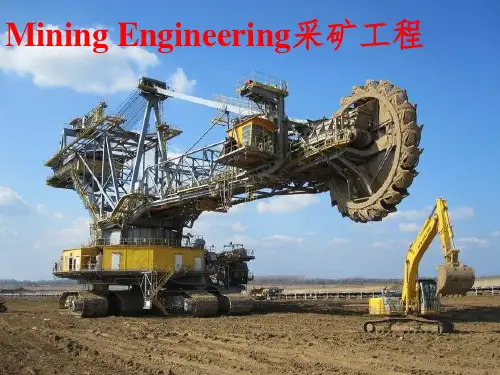
Mining Engineering采矿工程
Mining Engineering采矿工程
1
Introduction of Mining Engineering采矿工程概论
2
Mining Technology挖掘技术
3
Coal Mining Production System煤矿生产系统
4
Roadway Supporting Patterns巷道的支护方式
中国13大煤炭基地: 神东,山西北部,山西东部和内蒙古东部,云南,贵州,河南, 山东西部,山西西部,山西中部,北部和南部的安徽,河北中部, 宁夏东部,山西北部。
Mining technology挖掘技术
Blasting mining technology 爆破开采技术
.
1
2
Conventionally mechanized mining technology传统的机械化开采技术 Fully mechanized mining technology 综采技术
采矿业本身是工业的 龙头行业,承担为工 业企业提供能源及动 力的重任,在国民经 济发展中地位据重要。
Introduction介绍
According to the statistics, Chinese miner deaths each year about 6000, but certainly far more than this number, it is USA 100 times, even 10 times of India. Some people say: "the death of a American soldiers, will die 7 China miners". 对公统计,中国矿工 每年死亡人数大概有 6000,但肯定远远不 止这个数,就目前都 是美国100倍,甚至是 印度的10倍。 有人说:“死一个美 国士兵,就会死7个中 国矿工”。
选矿专业英语

1 总论采矿mining地下采矿underground mining露天采矿open cut mining, open pit mining, surface mining采矿工程mining engineering选矿(学)mineral dressing, ore beneficiation, mineral processing矿物工程mineral engineering冶金(学)metallurgy过程冶金(学)process metallurgy提取冶金(学)extractive metallurgy化学冶金(学)chemical metallurgy物理冶金(学)physical metallurgy金属学Metallkunde冶金过程物理化学physical chemistry of process metallurgy冶金反应工程学metallurgical reaction engineering冶金工程metallurgical engineering钢铁冶金(学)ferrous metallurgy, metallurgy of iron and steel有色冶金(学)nonferrous metallurgy真空冶金(学)vacuum metallurgy等离子冶金(学)plasma metallurgy微生物冶金(学)microbial metallurgy喷射冶金(学)injection metallurgy钢包冶金(学)ladle metallurgy二次冶金(学)secondary metallurgy机械冶金(学)mechanical metallurgy焊接冶金(学)welding metallurgy粉末冶金(学)powder metallurgy铸造学foundry火法冶金(学)pyrometallurgy湿法冶金(学)hydrometallurgy电冶金(学)electrometallurgy氯冶金(学)chlorine metallurgy矿物资源综合利用engineering of comprehensive utilization of mineral resources 中国金属学会The Chinese Society for Metals中国有色金属学会The Nonferrous Metals Society of China2 采矿采矿工艺mining technology有用矿物valuable mineral冶金矿产原料metallurgical mineral raw materials矿床mineral deposit特殊采矿specialized mining海洋采矿oceanic mining, marine mining矿田mine field矿山mine露天矿山surface mine地下矿山underground mine矿井shaft矿床勘探mineral deposit exploration矿山可行性研究mine feasibility study矿山规模mine capacity矿山生产能力mine production capacity矿山年产量annual mine output矿山服务年限mine life矿山基本建设mine construction矿山建设期限mine construction period矿山达产arrival at mine full capacity开采强度mining intensity矿石回收率ore recovery ratio矿石损失率ore loss ratio工业矿石industrial ore采出矿石extracted ore矿体orebody矿脉vein海洋矿产资源oceanic mineral resources矿石ore矿石品位ore grade岩石力学rock mechanics岩体力学rock mass mechanics3 选矿选矿厂concentrator, mineral processing plant 工艺矿物学process mineralogy开路open circuit闭路closed circuit流程flowsheet方框流程block flowsheet产率yield回收率recovery矿物mineral粒度particle size粗颗粒coarse particle细颗粒fine particle超微颗粒ultrafine particle粗粒级coarse fraction细粒级fine fraction网目mesh原矿run of mine, crude精矿concentrate粗精矿rough concentrate混合精矿bulk concentrate最终精矿final concentrate尾矿tailings粉碎comminution破碎crushing磨碎grinding团聚agglomeration筛分screening, sieving分级classification富集concentration分选separation手选hand sorting重选gravity separation, gravity concentration 磁选magnetic separation电选electrostatic separation浮选flotation化学选矿chemical mineral processing自然铜native copper铝土矿bauxite冰晶石cryolite磁铁矿magnetite赤铁矿hematite假象赤铁矿martite钒钛磁铁矿vanadium titano-magnetite铁燧石taconite褐铁矿limonite菱铁矿siderite镜铁矿specularite硬锰矿psilomelane软锰矿pyrolusite铬铁矿chromite黄铁矿pyrite钛铁矿ilmennite金红石rutile萤石fluorite高岭石kaolinite菱镁矿magnesite重晶石barite石墨graphite石英quartz方解石calcite石灰石limestone白云石dolomite云母mica石膏gypsum硼砂borax石棉asbestos蛇纹石serpentine阶段破碎stage crushing粗碎primary crushing中碎secondary crushing细碎fine crushing对辊破碎机roll crusher粉磨机pulverizer震动筛vibrating screen筛网screen cloth筛孔screen opening筛上料oversize筛下料undersize粗磨coarse grinding细磨fine grinding球磨机ball mill衬板liner分级机classifier自由沉降free setting沉积sedimentation石灰lime松油pine oil硫化钠sodium sulfide硅酸钠(水玻璃)sodium silicate, water glass过滤filtration过滤机filter给矿,给料feeding给矿机feeder在线分析仪on line analyzer在线粒度分析仪on line size analyzer超声粒度计ultrasonic particle sizer, supersonic particle sizer。
采矿工程专业英语词汇
Introduction (绪论)mine n. 矿山,矿井。
v. 采矿colliery n. 矿井coal mining 采煤underground mining 地下开采surface mining 露天开采reserve n. 储量coal-bearing adj. 含煤的high production and high efficiency 高产高效development n. 开拓preparation n. 准备mining method 采煤方法subside v. 下沉,沉陷subsidence n. 沉降,沉陷mining subsidence n. 开采沉陷mechanize v. 使…机械化mechanization n. 机械化Chapter 1 Basic Concepts of Mine (矿井基本概念) coalfield n. 煤田mining area n. 矿区mine field n. 井田divide v. 划分division n. 划分mine production capacity (MPC)矿井生产能力mine service life 矿井服务年限production scale of mine 井型small mine 小型矿井middle mine 中型矿井large mine 大型矿井huge mine 特大型矿井strike n. 走向dip n. 倾向dip angle 倾角workable adj. 可采的workable reserve n. 可采储量opening n. 通道,开口mine opening n. 矿山井巷passageway n. 通道shaft n. 立井roadway n. 巷道chamber n. 硐室main shaft 主立井auxiliary shaft 副立井air shaft 风井blind shaft 暗立井drawn shaft 溜井chute n. 溜煤眼adit n. 平硐drift n. 平硐crosscut n. 联络巷;石门coal crosscut煤门entry n. 平巷haulage n. 运输main haulage roadway 主要运输平巷main return-air roadway 主要回风平巷head entry 区段运输平巷tail entry 区段回风平巷slope n. 斜井rise n. 上山dip n. 下山rock rise 岩石上山coal rise 煤层上山coal haulage rise 运煤上山material transporting rise 运料上山return-air rise 回风上山men-walking rise 行人上山inclined roadway of a strip 分带斜巷inclined coal haulage roadway of a strip 分带运煤斜巷inclined material haulage roadway of a strip 分带运料斜巷development roadway 开拓巷道preparation roadway 准备巷道gateway 回采巷道pit bottom 井底车场shaft bottom 井底车场station n. 车场,车站mining district station 采区车场horizon n. 阶段level n. 水平haulage level 运输水平return-air level 回风水平mining level 开采水平interval between levels 阶段垂高mining district 采区panel n. 盘区sublevel n. 分段strip district n. 带区inclined length 斜长strike length 走向长度district sublevel区段Open-off cut n. 切眼coalface n. 采煤面working face工作面production n. 生产;产量production system 生产系统coal haulage system 运煤系统ventilation n. 通风ventilation system通风系统fresh air 新鲜风dirty air 乏风,污风refuse n. 矸石material and refuse transportation system 运料排矸系统drain v. 排水drainage system 排水系统power supply system (electric power, compressed air) 动力供应(电、压风)communication and monitoring system 通讯、监测系统drive v. 掘进excavate v. 开挖,开掘hoist v. 提升winch n. 绞车Chapter 2 Coal Mining methods (采煤方法)stope 采场mining works/units 回采工作basic operation 基本工序break v. 破碎load v. 装载haul v. 运输auxiliary operations 辅助工序roof support 顶板支护gob treatment 采空区处理auxiliary transportation 辅助运输ventilation 通风drainage 排水power supply 供电,emulsion supply 供液(乳化液)等。
采矿专业英语词汇

采矿工程专业英语1.主要建设方案the main construction scheme[:kən'strʌkʃən] [:ski:m]2.开采对象mining object [:'ɔbdʒikt]3.开采方式recovery method[:ri'kʌvəri] 或exploration pattern[:,eksplə'reiʃən] [:'pætən]4.最低开采标高the lowest elevation of mining[:,elə'veiʃən]5.设计利用储量design using reserves [:ri'zə:vs]6.可采储量workable reserves7.占压资源储量tying up reserves8.矿产资源储量mineral resources reserves [:'minərəl]9.建设规模scale of construction [:kən'strʌkʃən]10.产品方案product scheme[:'prɔdʌkt] [:ski:m]11.矿山生产规模mine production scale [:prə'dʌkʃən]12.矿山工作制度mine working system13.矿山服务年限mine life14.矿山年产量annual output of mine [:'ænjuəl]15.矿山生产能力mine production capacity[:kə'pæsiti]16.生产能力验证capacity verification[:kə'pæsiti][:,verəfi'keiʃən]17.矿石贫化率ore dilution ratio [:dai'lu:ʃən, di-] [:'reiʃiəu]18.损失率loss rate 或loss ratio19.回采率recovery [:ri'kʌvəri]20.开拓运输方案transportation scheme[:,trænspɔ:'teiʃən]21.公路开拓highway development22.汽车运输automobile transportation[:'ɔ:təməbi:l]23.运输道路haulage road[:'hɔ:lidʒ]24.最小转弯半径minimum turning radius[:'miniməm] [:'reidjəs] 或minimal curve radius[:'miniməl] [:kə:v]25.最大纵坡maximum longitudinal slope [:'mæksiməm] [:lɔndʒi'tju:dinl]26.平均纵坡average gradient [:'ævəridʒ] [:'greidi:ənt]27.路面宽road width28.路基宽width of subgrade [:'sʌbɡreid]29.线路设计track design30.防治水方案water-proof and water-control scheme31.截水沟intercepting ditch[,intə'septiŋ] [:ditʃ]32.排水沟drainage ditch [:'dreinidʒ] [:ditʃ]33.矿床开采deposit mining [:di'pɔzit]34.露天开采境界open pit mining limit35.地表境界线surface boundary line [:'baundəri]36.底部境界线floor boundary line37.水文地质条件hydrogeologic condition [haidrəudʒi'ɔlədʒi,]38.走向strike [:straik]39.倾向dip40.倾角dip angle41.开采顺序mining sequence[:'si:kwəns]42.爆破警戒blasting warning43.爆破安全规程blasting safety regulations [:,reɡju'leiʃəns]44.安全距离safe distance 或safety distance45.二次破碎recrushing46.最低开采标高the lowest elevation of mining [:,elə'veiʃən]47.采矿场要素elements of stope [:'elimənt] [:stəup]48.台阶高度bench height [:bentʃ]49.台阶坡面角bench angle50.工作帮坡角working slope angle51.清扫平台cleaning platform [:'plætfɔ:m]52.安全平台safety platform53.最小工作平台宽度minimum working platform width54.开段沟pioneer cut [:,paiə'niə]55.出入沟main access [:'ækses]56.联络道taxiway57.采矿方法mining methods58.剥采比stripping ratio ['stripiŋ] [:'reiʃiəu]59.开拓阶段development stage60.生产阶段production stage61.上行式开采upward mining62.下行式开采downward mining63.横向采掘transverse mining [:træns'vɜ:s]64.采矿工艺流程mining process [:'prəuses]65.穿孔作业perforation work [:'pɜ:fə,reit]66.潜孔钻机downhole drill ['daun,həul] [:dril]67.液压破碎锤hydraulic hammer [:hai'drɔ:lik] [:'hæmə]68.爆破作业blasting operation [:,ɔpə'reiʃən]69.多排孔微差爆破the multiple row holes millisecond blasting[:'mʌltipl] [:'mili,sekənd]70.液压挖掘机hydraulic excavator [:hai'drɔ:lik] [:'ekskə,ve i tə]71.矿用自卸汽车mining dump truck72.轮式装载机wheel loader73.胶带输送机belt conveyor [:belt] [:kən'veiə]74.剥离stripping['stripiŋ]75.露天采场坑底pit bottom [:'bɔtəm]76.顶板roof77.底板bottom78.劳动定员labor force quota [:'kwəutə]79.基建工程capital construction engineering 或capital constructionprojects [:'kæpitl]80.基建工程量capital construction volume81.采准工作firstworking82.总平面布置general layout [:'dʒenərəl] [:'leiaut]83.破碎车间crushing plant ['krʌʃiŋ] [:plɑ:nt]84.进料粒度feed size85.出料粒度discharging-material size [dis'tʃɑ:dʒiŋ] [:mə'tiəriəl]86.矿山工业场地mine industrial site [:in'dʌstriəl]87.爆炸材料库blasting material database [:mə'tiəriəl] [:'deitəbeis]88.油库oil depot [:'depəu]89.排土场dump90.供电power supply91.供水water supply92.设计依据design basis93.进度计划schedule [:'ʃedju:əl]94.基建费用capital cost [:'kæpitl] 或capital outlay95.初步设计preliminary design [:pri'liminəri]96.可行性研究报告feasibility study report [:,fi:zə'biləti]97.连续生产continuous production [:kən'tinjuəs]98.环境保护environmental protection [:en,vaiərən'mentl, -,vaiən]99.边坡稳定性slope stability [:sləup] [:stə'biliti]100.矿山复垦mine reclamation [:,reklə'meiʃən]101.水泥灰岩cement-limestone [:si'ment] [:'laim,stəʊn] 102.投资估算investment estimate [:in'vestmənt] [:'estimeit] 103.上覆岩层overlying strata [:'streitə]104.剖面图section map [:'sekʃən]105.平面图plan 或planar graph。
采矿工程专业英语词汇手册.doc
采矿工程专业英语词汇手册.doc采矿工程专业英语词汇手册(Glossary of Special English in Mining Engineering )——《采矿学》双语教学专用采矿工程专业内部讲义二零零七年九月Content目录I n t r o d u c t i o n (2)绪论 (2)C h a p t e r1B a s i c c o n c e p t s o f C o a l M i n i n g (2)第一章煤矿开采的基本概念 (2)C h a p t e r2C o a l M i n i n g m e t h o d s (3)第二章采煤方法的概念和种类 (3)Section I Mine Field Development and Mining Design第一篇井田开拓及矿井开采设计C h a p t e r3B a s i c C o n c e p t s o f M i n eD e v e l o p m e n t (4)第三章井田开拓的基本概念 (4)C h a p t e r4M i n eD e v e l o p m e n t W a y s (5)第四章井田开拓方式 (4)C h a p t e r5D e v e l o p m e n t R o a d w a y s L a y o u t (6)第五章井田开拓巷道布置 (4)C h a p t e r6L e v e l s t a t i o n (7)第六章井底车场 (4)C h a p t e r7M i n eD e v e l o p m e n t D e e p e n a n d T e c h n i c a l R e f o r m (8)第七章矿井开拓延深和技术改造 (4)Introduction (绪论)mine n. 矿山,矿井。
v. 采矿colliery n. 矿井coal mining 采煤underground mining 地下开采surface mining 露天开采reserve n. 储量coal-bearing adj. 含煤的high production and high efficiency 高产高效development n. 开拓preparation n. 准备mining method 采煤方法subside v. 下沉,沉陷subsidence n. 沉降,沉陷mining subsidence n. 开采沉陷mechanize v. 使…机械化mechanization n. 机械化Chapter 1 Basic Concepts of Mine (矿井基本概念) coalfield n. 煤田mining area n. 矿区mine field n. 井田divide v. 划分division n. 划分mine production capacity (MPC)矿井生产能力mine service life 矿井服务年限production scale of mine 井型small mine 小型矿井middle mine 中型矿井large mine 大型矿井huge mine 特大型矿井strike n. 走向dip n. 倾向dip angle 倾角workable adj. 可采的workable reserve n. 可采储量opening n. 通道,开口mine opening n. 矿山井巷passageway n. 通道shaft n. 立井roadway n. 巷道chamber n. 硐室main shaft 主立井auxiliary shaft 副立井air shaft 风井blind shaft 暗立井drawn shaft 溜井chute n. 溜煤眼adit n. 平硐drift n. 平硐crosscut n. 联络巷;石门coal crosscut煤门entry n. 平巷haulage n. 运输main haulage roadway 主要运输平巷main return-air roadway 主要回风平巷head entry 区段运输平巷tail entry 区段回风平巷slope n. 斜井rise n. 上山dip n. 下山rock rise 岩石上山coal rise 煤层上山coal haulage rise 运煤上山material transporting rise 运料上山return-air rise 回风上山men-walking rise 行人上山inclined roadway of a strip 分带斜巷inclined coal haulage roadway of a strip 分带运煤斜巷inclined material haulage roadway of a strip 分带运料斜巷development roadway 开拓巷道preparation roadway 准备巷道gateway 回采巷道pit bottom 井底车场shaft bottom 井底车场station n. 车场,车站mining district station 采区车场horizon n. 阶段level n. 水平haulage level 运输水平return-air level 回风水平mining level 开采水平interval between levels 阶段垂高mining district 采区panel n. 盘区sublevel n. 分段strip district n. 带区inclined length 斜长strike length 走向长度district sublevel区段Open-off cut n. 切眼coalface n. 采煤面working face工作面production n. 生产;产量production system 生产系统coal haulage system 运煤系统ventilation n. 通风ventilation system通风系统fresh air 新鲜风dirty air 乏风,污风refuse n. 矸石material and refuse transportation system 运料排矸系统drain v. 排水drainage system 排水系统power supply system (electric power, compressed air) 动力供应(电、压风)communication and monitoring system 通讯、监测系统drive v. 掘进excavate v. 开挖,开掘hoist v. 提升winch n. 绞车Chapter 2 Coal Mining methods (采煤方法)stope 采场mining works/units 回采工作basic operation 基本工序break v. 破碎load v. 装载haul v. 运输auxiliary operations 辅助工序roof support 顶板支护gob treatment 采空区处理auxiliary transportation 辅助运输ventilation 通风drainage 排水power supply 供电,emulsion supply 供液(乳化液)等。
采矿工程专业英语
采矿工程专业英语词汇手册(Glossary of Special English in Mining Engineering )采矿工程专业内部讲义二零零七年三月ContentChapter 3 .1 Mining method (2)Chapter 3.2 Mine preplanning (3)Chapter3.3 Mine development (4)Chapter 4.1 W all mining introduction (5)Chapter 4.2 Ground control aspects ..... (6)Chapter 4.3 Roof support system (7)Chapter 4.4 Longwall coal-getting machine (8)Chapter 4.5 Convey system (8)Chapter 4.6 Mine V etilation (10)Chapter 5 Pillaring system (11)Chapter 6 Roadway excavation and support (12)Chapter 7 Novel methods of mining…………………………………………………..……..Chapter 3 .1 Mining methodmining method 采矿方法;mining operation 采矿作业;transportation 运输;ventilation 通风;ground control 顶板管理;the cost of per ton of coal 吨煤成本;recovery 回采率;subside v. subsidence n.地表沉陷;subsidence control 地表沉陷控制cover 覆盖层;overburden 上覆地层;immediate roof 直接顶;floor 底板;dip (Pitch)倾角;hardness 硬度;strength 强度;cleavage 解理;gas,methane 瓦斯daily operation 日常工作single operation 单一工序unit operation 单元作业auxiliary operation辅助作业cutting n. 切割,掏槽;blasting n. 爆破loading n. 装煤haul v. 运输,搬运drainage n.排水power n. 动力power Supply 动力供应communication n. 通讯lighting n.照明。
采矿专业英语词汇
英语材料1采矿专业英语1 概述1 mining 采矿2 underground mining 地下采矿3 open cut mining, open pit mining, surface mining 露天采矿4 mining engineering 采矿工程5 mining technology 采矿工艺6 underground mining 地下矿山7 surface mining 露天矿山8 exploitation 开采scope of exploitation 开采范围;910 exploration 勘探11 mine feasibility study 矿山可行性研究12 mine capacity 矿山规模13 mine production capacity 矿山生产能力14 mining schedule 采矿计划15 annual mine output 矿山年产量16 mine life 矿山服务年限17 mine construction 矿山基本建设18 mine construction period 矿山建设期限19 arrival at mine full capacity 矿山达产20 mining intensity 开采强度21 rock mechanics 岩石力学22 rock mass mechanics 岩体力学2 地质1 crust 地壳,外壳mineral deposit 矿床2 mine field 矿田3 mine 矿山4 orebody 矿体blind orebody 盲矿体;buried orebody 隐伏矿体;irregular-shaped orebody 不规则矿体;marginal orebody 边缘矿体5 vein 矿脉6 ore 矿石7 grade 品位geological grade 地质品位;average grade 平均品位;cut-off grade 边界品位;economic grade 经济品位8 industrial ore 工业矿石9 extracted ore 采出矿石10 hanging wall 上盘11 footwall 下盘12 bedrock 基岩13 mineralization 成矿作用14 mining area 矿区15 outcrop 露头16 reserve 储量ore reserve 矿石储量;proved reserve 探明储量17 strike 走向18 dip 倾向dip angle 倾角;19 lead 铅20 aluminium 铝21 zinc 锌22 tin 锡23 mercury 汞24 antimony 锑25 platinum 铂3 开拓系统1 chamber 硐室2 crosscut 石门,联络巷;3 footrill 平硐4 decline 斜坡道5 entry 平巷main entry 主巷6 inset 马头门loading room 装矿硐室7 pump station 泵站8 orepass 放矿溜井9 portal 井口10 pump station 泵站11 ramp 斜坡道12 shaft 竖井main shaft 主井;auxiliary shaft 副井;ventilation shaft 通风井;intake shaft 进风井;inclined shaft 斜井shaft station 井底车场13 substation 变电所central substation 中央变电所;14 slope 斜井15 sump 水仓16 tunnel 巷道4 采矿方法1 dip 下山2 rise 上山3 drill 钻孔drilling 凿岩;drilling blasting 凿岩爆破;4 mining method 采矿方法5 parallel working 平行作业6 pillar 矿柱safety pillar 安全矿柱;7 stope 采场stoping sequence 回采顺序;stope arrangement 采场布置8 block open stoping 阶段矿房法room and pillar 房柱法shrinkage stope 留矿法9 sublevel open stoping (SLOS) 分段矿房法block caving method 阶段崩落法10 sublevel caving method 分段崩落法top slicing 分层崩落法cut-and-fill stoping 上向分层充填法drill-and-fill method stoping 上向进路充填法long-wall fill stoping 长壁充填法working face 工作面line of least resistance 最小抵抗线5 通风排水系统1 ventilation 通风ventilation system 通风系统;2 drainage 排水drainage pipeline 排水管道;3 return shaft 回风井4 intake shaft 进风井6 机械设备1 air compressor 空气压缩机2 cage 罐笼3 dump track 卸土车4 detonator 雷管5 detonating tube 导爆管6 detonating cord 导爆索7 electronic powered slusher 电耙8 electric excavator 电铲gravel pump 砂泵9 headframe 井架10 hoist house 提升机房11 landing platform 摇台roller-bit rotary rig 牙轮钻机12 skip 箕斗2商务英语1.1词汇1 deficit 赤字,不足额2 commodity 商品,货物3 concentration n. 浓度;集中;浓缩;专心;集合average concentration 平均含量consumption 消耗,消费4 emission 排放物,辐射5 equivalent adj.等价的,相等的;同意义的;n.等价物,相等物6 reclamation 复垦,再利用spot 现货,股票7 sustainability 持续性8 strike 罢工9 ultimate n.终极;根本;基本原则;adj.最终的;极限的;根本的10 versus 对抗,与……相对不常用名词1 phosphate n.[化]磷酸盐;[地]皮膜化成2 potash n.碳酸钾;草碱;苛性钾;钾化合3 uranium n. [化]铀1.2口语Care and diligence bring luck. 谨慎才能带来机遇。
选矿专业英语
1 总论采矿mining地下采矿underground mining露天采矿open cut mining, open pit mining, surface mining采矿工程mining engineering选矿(学)mineral dressing, ore beneficiation, mineral processing矿物工程mineral engineering冶金(学)metallurgy过程冶金(学)process metallurgy提取冶金(学)extractive metallurgy化学冶金(学)chemical metallurgy物理冶金(学)physical metallurgy金属学Metallkunde冶金过程物理化学physical chemistry of process metallurgy冶金反应工程学metallurgical reaction engineering冶金工程metallurgical engineering钢铁冶金(学)ferrous metallurgy, metallurgy of iron and steel有色冶金(学)nonferrous metallurgy真空冶金(学)vacuum metallurgy等离子冶金(学)plasma metallurgy微生物冶金(学)microbial metallurgy喷射冶金(学)injection metallurgy钢包冶金(学)ladle metallurgy二次冶金(学)secondary metallurgy机械冶金(学)mechanical metallurgy焊接冶金(学)welding metallurgy粉末冶金(学)powder metallurgy铸造学foundry火法冶金(学)pyrometallurgy湿法冶金(学)hydrometallurgy电冶金(学)electrometallurgy氯冶金(学)chlorine metallurgy矿物资源综合利用engineering of comprehensive utilization of mineral resources 中国金属学会The Chinese Society for Metals中国有色金属学会The Nonferrous Metals Society of China2 采矿采矿工艺mining technology有用矿物valuable mineral冶金矿产原料metallurgical mineral raw materials矿床mineral deposit特殊采矿specialized mining海洋采矿oceanic mining, marine mining矿田mine field矿山mine露天矿山surface mine地下矿山underground mine矿井shaft矿床勘探mineral deposit exploration矿山可行性研究mine feasibility study矿山规模mine capacity矿山生产能力mine production capacity矿山年产量annual mine output矿山服务年限mine life矿山基本建设mine construction矿山建设期限mine construction period矿山达产arrival at mine full capacity开采强度mining intensity矿石回收率ore recovery ratio矿石损失率ore loss ratio工业矿石industrial ore采出矿石extracted ore矿体orebody矿脉vein海洋矿产资源oceanic mineral resources矿石ore矿石品位ore grade岩石力学rock mechanics岩体力学rock mass mechanics3 选矿选矿厂concentrator, mineral processing plant 工艺矿物学process mineralogy开路open circuit闭路closed circuit流程flowsheet方框流程block flowsheet产率yield回收率recovery矿物mineral粒度particle size粗颗粒coarse particle细颗粒fine particle超微颗粒ultrafine particle粗粒级coarse fraction细粒级fine fraction网目mesh原矿run of mine, crude精矿concentrate粗精矿rough concentrate混合精矿bulk concentrate最终精矿final concentrate尾矿tailings粉碎comminution破碎crushing磨碎grinding团聚agglomeration筛分screening, sieving分级classification富集concentration分选separation手选hand sorting重选gravity separation, gravity concentration 磁选magnetic separation电选electrostatic separation浮选flotation化学选矿chemical mineral processing自然铜native copper铝土矿bauxite冰晶石cryolite磁铁矿magnetite赤铁矿hematite假象赤铁矿martite钒钛磁铁矿vanadium titano-magnetite铁燧石taconite褐铁矿limonite菱铁矿siderite镜铁矿specularite硬锰矿psilomelane软锰矿pyrolusite铬铁矿chromite黄铁矿pyrite钛铁矿ilmennite金红石rutile萤石fluorite高岭石kaolinite菱镁矿magnesite重晶石barite石墨graphite石英quartz方解石calcite石灰石limestone白云石dolomite云母mica石膏gypsum硼砂borax石棉asbestos蛇纹石serpentine阶段破碎stage crushing粗碎primary crushing中碎secondary crushing细碎fine crushing对辊破碎机roll crusher粉磨机pulverizer震动筛vibrating screen筛网screen cloth筛孔screen opening筛上料oversize筛下料undersize粗磨coarse grinding细磨fine grinding球磨机ball mill衬板liner分级机classifier自由沉降free setting沉积sedimentation石灰lime松油pine oil硫化钠sodium sulfide硅酸钠(水玻璃)sodium silicate, water glass过滤filtration过滤机filter给矿,给料feeding给矿机feeder在线分析仪on line analyzer在线粒度分析仪on line size analyzer超声粒度计ultrasonic particle sizer, supersonic particle sizer。
采矿工程专业英语(个人总结)
煤矿科技英语——1. INTRODUCTION Coal, a combustible organic rock [1] composed primarily of carbon, hydrogen, and oxygen [2]. Coal is burned to produce energy and is used to manufacture steel. It is also an important source of chemicals used to make medicine, fertilizers, pesticides [3], and other products. Coal comes from ancient plants buried over millions of years in Earth’s crust [4], its outermost layer [5]. Coal, petroleum, natural gas, and oil shale [6] are all known as fossil fuels [7] because they come from the remains of ancient life buried deep in the crust.Coal is rich in hydrocarbons [8](compounds made up of the elements hydrogen and carbon). All life forms contain hydrocarbons, and in general, material that contains hydrocarbons is called organic material. Coal originally formed from ancient plants that died, decomposed, and were buried under layers of sediment [9] during the Carboniferous Period [10], about 360 million to 290 million years ago. As more and more layers of sediment formed over this decomposed plant material, the overburden [11] exerted increasing heat and weight on the organic matter. Over millions of years, these physical conditions caused coal to form from the carbon, hydrogen, oxygen, nitrogen, sulfur, and inorganic mineral [12] compounds in the plant matter. The coal formed in layers known as seams.Plant matter changes into coal in stages. In each successive stage, higher pressure and heat from the accumulating overburden increase the carbon content of the plant matter and drive out more of its moisture content [13]. Scientists classify coal according to its fixed carbon content [14], or the amount of carbon the coal produceswhen heated under controlled conditions. Higher grades of coal have a higher fixed carbon content.NOTES TO THE TEXT[1] organic rock:有机岩[2] carbon, hydrogen, and oxygen:碳,氢和氧[3] pesticides:农药[4] Earth’s crust:地壳[5] outermost layer:最外层地层[6] oil shale:油页岩[7] fossil fuels:化石燃料[8] hydrocarbons:碳氢化合物[9] layers of sediment :沉积层[10] Carboniferous Period:石炭纪[11] overburden:覆盖岩层[12] inorganic mineral:无机材料[13] moisture content:含水量[14] fixed carbon content:固定碳含量煤矿科技英语——2. MODERN USES OF COAL Eighty-six percent of the coal used in the United States is burned by electric power plants [1] to produce electricity. When burned, coal generates energy in theform of heat. In a power plant that uses coal as fuel, this heat converts water into steam, which is pressurized to spin the shaft of a turbine. This spinning shaft [2] drives a generator that converts the mechanical energy of the rotation into electric power.Coal is also used in the steel industry. The steel industry uses coal by first heating it and converting it into coke [3], a hard substance consisting of nearly pure carbon. The coke is combined with iron ore [4] and limestone [5]. Then the mixture is heated to produce iron. Other industries use different coal gases given off during thecoke-forming process [6] to make fertilizers, solvents [7], medicine, pesticides, and other products.Fuel companies convert coal into easily transportable gas [8] or liquid fuels [9]. Coal-based vapor fuels [10] are produced through the process of gasification [11]. Gasification may be accomplished either at the site of the coalmine [12] or in processing plants [13]. In processing plants, the coal is heated in the presence of steam and oxygen to produce synthesis gas [14], a mixture of carbon monoxide [15], hydrogen, and methane [16] used directly as fuel or refined into cleaner-burning gas [17].On-site gasification [18] is accomplished by controlled, incomplete burning of an underground coal bed while adding air and steam. To do this, workers ignite the coal bed, pump air and steam underground into the burning coal, and then pump the resulting gases from the ground. Once the gases are withdrawn, they may be burned to produce heat or generate electricity. Or they may be used in synthetic gases to produce chemicals or to help create liquid fuels .Liquefaction [19] processes convert coal into a liquid fuel that has a composition similar to that of crude petroleum [20] Liquefaction. Coal can be liquefied either by direct or indirect processes. However, because coal is a hydrogen-deficient hydrocarbon [21], any process used to convert coal to liquid or other alternative fuels[22] must add hydrogen. Four general methods are used for liquefaction: (1) pyrolysis[23] and hydrocarbonization [24], in which coal is heated in the absence of air or in a stream of hydrogen; (2) solvent extraction [25], in which coal hydrocarbons are selectively dissolved and hydrogen is added to produce the desired liquids; (3) catalytic liquefaction [26], in which hydrogenation [27] takes place in the presence of a catalyst; and (4) indirect liquefaction, in which carbon monoxide and hydrogen are combined in the presence of a catalyst.NOTES TO THE TEXT[1] electric power plants:发电厂[2] spinning shaft:旋转轴[3] coke:焦炭[4] iron ore:铁矿石[5] limestone:石灰岩[6] coke-forming process:焦炭形成过程[7] solvents:溶剂[8] easily transportable gas:易输送的气体l[9] liquid fuels:液体燃料[10] coal-based vapor fuels:以媒为基础的气态燃料[11] gasification:气化[12] coalmine:煤矿[13] processing plants:加工厂[14] synthesis gas:合成煤气[15] carbon monoxide:一氧化碳[16] methane:沼气,甲烷[17] cleaner-burning gas:洁净煤气[18] on-site gasification:地下气化[19] liquefaction:液化[20] crude petroleum:原油[21] hydrogen-deficient hydrocarbon:缺氢碳氢化合物[22] alternative fuels:替代燃料[23] pyrolysis:高温分解[24] hydrocarbonization:碳氢化作用[25] solvent extraction:溶剂提取[26] catalytic liquefaction:催化液化作用[27] hydrogenation:氢化作用煤矿科技英语——3. FORMATION AND COMPONENTS OF COAL2006年8月1日12:40:0Coal is a sedimentary rock [1] formed from plants that flourished millions of years ago when tropical swamps [2] covered large areas of the world. Lush vegetation [3], such as early club mosses [4], horsetails [5], and enormous ferns, thrived in these swamps. Generations of this vegetation died and settled to the swamp bottom, and over time the organic material lost oxygen and hydrogen, leaving the material with a high percentage of carbon. Layers of mud and sand [6] accumulated over the decomposed plant matter, compressing and hardening the organic material as the sediments deepened. Over millions of years, deepening sediment layers, known as overburden, exerted tremendous heat and pressure on the underlying plant matter, which eventually became coal.Before decayed plant material [7] forms coal, the plant material forms a dark brown, compact organic material known as peat [8]. Although peat will burn when dried, it has a low carbon and high moisture content relative to coal. Most of coal’s heating value comes from carbon, whereas inorganic materials, such as moisture and minerals [9], detract from its heating value. For this reason, peat is a less efficient fuel source than coal. Over time, as layers of sediment accumulate over the peat, this organic material forms lignite [10], the lowest grade of coal. As the thickening geologic overburden gradually drives moisture from the coal and increases its fixed carbon content, coal evolves from lignite into successively higher-graded coals: subbituminous coal [11], bituminous coal [12], and anthracite [13]. Anthracite, the highest rank of coal, has nearly twice the heating value of lignite.Coal formation began during the Carboniferous Period (known as the first coalage), which spanned 360 million to 290 million years ago. Coal formation continued throughout the Permian [14], Triassic [15], Jurassic [16], Cretaceous [17], and Tertiary [18] Periods, which spanned 290 million to 1.6 million years ago. Coals formed during the first coal age are older, so they are generally located deeper in Earth’s crust. The greater heat and pressures at these depths produce higher-grade coals such as anthracite and bituminous coals. Conversely, coals formed during the second coal age under less intense heat and pressure are generally located at shallower depths. Consequently, these coals tend to be lower-grade subbituminous and lignite coals.Coal contains organic (carbon-containing) compounds transformed from ancient plant material. The original plant material was composed of cellulose [19], the reinforcing material [20] in plant cell walls [21]; lignin [22], the substance that cements plant cells together; tannins [23], a class of compounds in leaves and stems; and other organic compounds, such as fats and waxes. In addition to carbon, these organic compounds contain hydrogen, oxygen, nitrogen, and sulfur. After a plant dies and begins to decay on a swamp bottom, hydrogen and oxygen (and smaller amounts of other elements) gradually dissociate from the plant matter, increasing its relative carbon content.Coal also contains inorganic components, known as ash. Ash includes minerals such as pyrite [24] and marcasite [25] formed from metals that accumulated in the living tissues of the ancient plants. Quartz [26], clay, and other minerals are also added to coal deposits by wind and groundwater [27]. Ash [28] lowers the fixed carbon content of coal, decreasing its heating value.NOTES TO THE TEXT[1] sedimentary rock:沉积岩[2] tropical swamps:热带沼泽[3] Lush vegetation:茂盛的植物[4] club mosses:石松[5] horsetails:马尾(木贼属的一种植物)[6] layers of mud and sand:泥砂层[7] decayed plant material:腐烂的植物材料[8] peat:泥炭[9] minerals:矿物[10] lignite:褐煤[11] subbituminous coal:次烟煤[12] bituminous coal:烟煤[13] anthracite:无烟煤[14] Permian:二叠纪[15] Triassic:三叠纪[16] Jurassic:侏罗纪[17] Cretaceous:白垩纪[18] Tertiary:第三纪[19] cellulose:纤维素[20] reinforcing material:加固的材料[21] cell walls:细胞壁[22] lignin:木质[23] tannins:丹宁,鞣酸[24] pyrite:黄铁矿[25] marcasite :白铁矿[26] quartz:石英[27] groundwater:地下水[28] ash:灰分煤矿科技英语——4. COAL DEPOSITS ANDRESERVESAlthough coal deposits exist in nearly every region of the world, commercially significant coal resources occur only in Europe, Asia, Australia, and North America. Commercially significant coal deposits occur in sedimentary rock basins [3], typicallysandwiched as layers called beds or seams [4] between layers of sandstone [5] and shale [6]. When experts develop estimates of the world’s coal supply, they distinguish between coal reserves and resources. Reserves are coal deposits that can be mined profitably with existing technology—that is, with current equipment and methods. Resources are an estimate of the worl d’s total coal deposits, regardless of whether the deposits are commercially accessible. Exploration [7] geologists [8] have found and mapped the world’s most extensive coal beds. At the beginning of 2001, global coal reserves were estimated at 984.2 billion metric tons, in which 1 metric ton [9] equals 1,016 kg (2,240 lb). These reserves occurred in the following regions by order of importance: the Asia Pacific, including Australia, 29.7 percent; North America, 26.1 percent; Russia and the countries of the former Union of Soviet Socialist Republics (USSR), 23.4 percent; Europe, excluding the former USSR, 12.4 percent; Africa and the Middle East, 6.2 percent; and South and Central America, 2.2 percent.Coal deposits in the United Kingdom, which led the world in coal production until the 20th century, extend throughout parts of England, Wales, and southern Scotland. Coalfields in western Europe underlie the Saar and Ruhr valleys in Germany, the Alsace region of France, and areas of Belgium. Coalfields [10] in central Europe extend throughout parts of Poland, the Czech Republic, and Hungary. The most extensive and valuable coalfield in eastern Europe is the Donets Basin, between the Dnieper and Donrivers (in parts of Russia and Ukraine). Large coal deposits in Russia are being mined in the Kuznetsk Basin in southern Siberia. Coalfields underlying northwestern China are among the largest in the world. Mining of these fields began inthe 20th century.United States coal reserves are located in six major regions, three of which produce the majority of domestically [11] mined coal. The most productive region [12] in the United States is the Appalachian Basin, covering parts of Pennsylvania, West Virginia, Kentucky, Tennessee, Ohio, and Alabama. Large quantities of coal have also been produced by both the Illinois Basin—extending through Illinois, Indiana, and Kentucky—and the Western Interior Region—extending through Missouri, Kansas, and Oklahoma. Other commercially important U.S. coal regions include the Powder River Basin, underlying parts of Montana and Wyoming; the Green River Basin in Wyoming; the Uinta Basin, covering areas of Utah and Colorado; and the San Juan Basin, underlying parts of Utah, New Mexico and Colorado.In 2001 estimates of total U.S. coal reserves were approximately 246 billion metric tons. At the beginning of the 21st century production amounted to about 980 million metric tons each year.NOTES TO THE TEXT[1] coal deposit:煤矿床[2] reserves:储量[3] sedimentary rock basins:沉积岩盆地[4] seams:媒层[5] sandstone:砂岩[6] shale:页岩[7] exploration:勘探[8] geologist:地质学家[9] metric ton:公吨[10] coalfields:媒田[11] domestically:国内(产)地,民用地,家用地[12] productive region:生产区煤矿科技英语——5. BRIEF INTRODUCTION TO COALMININGCoal mining [1] is the removal of coal from the ground. The mining method employed to extract the coal depends on the following criteria: a. seam thickness [2], b. the overburden thickness, c. the ease of removal of the overburden, d. the ease withwhich a shaft [3] can be sunk to reach the coal seam, e. the amount of coal extracted relative to the amount that cannot be removed, and f. the market demand for the coal.The two types of mining methods are surface mining [4] and underground mining [5]. In surface mining, the layers of rock or soil overlying a coal seam are first removed after which the coal is extracted from the exposed seam. In underground mining, a shaft is dug to reach the coal seam. Currently, underground mining accounts for approximately 60 percent of the world recovery of coal.5-1 Surface MiningSurface mining is used to reach coal reserves that are too shallow to be reached by other mining methods. Types of surface mining include open-pit mining [6], drift mining [7], slope mining [8], contour mining [9], and auger mining [10].A. Open-pit MiningIn open-pit mining, or strip mining, earth-moving equipment is used to remove the rocky overburden and then huge mechanical shovels [11] scoop [12] coal up from the underlying deposit. The modern coal industry has developed some of the largest industrial equipment ever made, including shovels capable of holding 290 metric tons of coal.To reach the coal, bulldozers [13] clear the vegetation and soil. Depending on the hardness and depth of the exposed sedimentary rocks, these rocky layers may be shattered with explosives. To do this, workers drill blast holes [14] into the overlying sedimentary rock, fill these holes with explosives [15], and then blast the overburden to fracture the rock. Once the broken rock is removed, coal is shoveled from theunderlying deposit into giant earth-moving trucks [16] for transport [17].B. Drift MiningDrift mining is used when a horizontal seam [18] of coal emerges at the surface on the side of a hill or mountain, and the opening [19] into the mine can be made directly into the coal seam. This type of mining is generally the easiest and most economical type because excavation through rock is not necessary. If coal is available in this manner, it is likely to be mined.C. Slope MiningSlope mining occurs when an inclined opening is used to tap the coal seam (or seams). A slope mine may follow the coal seam if the seam is inclined and exposed to the surface, or the slope may be driven through rock strata overlying the coal to reach a seam. Coal transportation from a slope mine can be accomplished by conveyor [20] or by track haulage [21] (using a trolley locomotive [22] if the grade is not severe) or by pulling mine cars [23] up the slope using an electric hoist [24] and steel rope [25] if the grade is steep. The most common practice is to use a belt conveyor.D. Contour MiningContour mining occurs on hilly or mountainous terrain, where workers use excavation equipment to cut into the hillside along its contour to remove the overlying rock and then mine the coal. The depth to which workers must cut into the hillside depends on factors such as hill slope and coal bed thickness.E. Auger MiningAuger mining is frequently employed in open-pit mines where the thickness ofthe overburden is too great for open-pit mining to be cost-effective [26]. Open-pit mining would require the lengthy and costly removal of the overburden, whereas auger mining is more efficient because it cuts through the overburden and removes the coal as it drills. In this technique, the miners drill a series of horizontal holes into the coal bed with a large auger (drill) powered by a diesel or gasoline engine [27]. These augers are typically about 60 m (200 ft) long and 0.6 to 2.1 m (2 to 7 ft) in diameter. As these enormous drills bore into the coal seam, they discharge coal like a wood drill producing wood shavings. Additional auger lengths are added as the cutting head of the auger penetrates farther into the coal. Penetration continues until the cutting head drifts into the top or bottom of the coal seam, into a previous hole, or until the maximum torque [28] (energy required to twist an object) of the auger is reached.F. Satellite Aids [29] to Surface MiningIn the late 1990s some coal mining enterprises used technologies such as the global positioning system (GPS) [30] to help guide the positioning of mining equipment. Satellites operated by the United States Air Force Space Command and leased to companies for commercial use track the position of mining equipment against a map of a mine’s topography [31]. This map uses colors to distinguish soil that should be excavated, soil that should remain in place, and areas that should be filled in. The equipment driver observes this visual information [32] on a monitor [33] while operating the equipment. Some coal mining enterprises have used GPS to increase mining efficiency up to 30 percent.5-2 Underground MiningUnderground, or deep, mining occurs when coal is extracted from a seam without removal of the overlying strata. Miners build a shaft mine that enters the earth through a vertical opening and descends from the surface to the coal seam. In the mine, the coal is extracted from the seam by various methods, including conventional mining[34], continuous mining [35], longwall mining [36], and room-and-pillar mining [37].A. Conventional MiningConventional mining, also called cyclic mining, involves a sequence of operations that proceed in the following order: a. supporting the roof [38], b. ventilation [39], c. cutting [40], d. drilling [41], e. blasting [42], f. coal removal [43], and g. loading [44]. First, miners make the roof above the seam safe and stable by timbering [45] or by roof bolting [46], processes intended to prevent the roof from collapsing [47]. At the same time, they create ventilation openings so that dangerous gases [48] can escape and fresh air can reach the miners. Then one or more slots [49]—a few centimeters wide and extending for several meters into the coal—are cut along the face of the coal seam, also known as the wall face, by a large, mobile cutting machine [50]. The cut, or slot, provides easy access to the face and facilitates the breaking up of the coal, which is usually blasted from the seam by explosives known as permissible explosives. This type of explosive produces an almost flame-free explosion [51] and markedly reduces the amount of noxious fumes [52] in comparison with conventional explosives. The coal may then be transported by rubber-tired electric vehicles (shuttle cars) [53] or by chain (or belt) conveyor systems [54].B. Continuous MiningContinuous mining involves the use of a single machine known as a continuous miner that breaks the coal mechanically and loads it for transport. This mobile machine [55] has a series of metal-studded rotating drums [56] that gouge coal from the face of the coal seam. One continuous miner can mechanically break apart about 1.8 metric tons of coal per hour. Roof support is then installed, ventilation is advanced, and the coalface [57] is ready for the next cycle. The method used to transport the coal requires the installation of mobile belt conveyors.C. Longwall MiningThe longwall mining system uses a remote-controlled [58] self-advancing support [59] in which large blocks of coal are completely extracted in a continuous operation. Hydraulic or self-advancing jacks [60], known as chocks [61], support the roof at the immediate face as the coal is removed. As the face advances [62], the roof is allowed to collapse behind the remote-controlled, roof-building machinery [63]. Miners then remove the fallen coal. Coal recovery [64] is comparable to that attainable with the conventional or continuous mining systems.D. Room-and-Pillar MiningRoom-and-pillar mining is a means of developing a coalface and, at the same time, retaining supports for the roof. With this technique, rooms are developed from large, parallel tunnels driven into the solid coal [65], and the intervening pillars [66] of coal are used to support the roof. The percentage of coal recovered from a seam depends on the number and size of protective pillars of coal thought necessary to support the roof safely. Workers may remove some coal pillars just before closing themine.NOTES TO THE TEXT[1] coal mining:采煤[2] seam thickness:煤层厚度[3] shaft:立井[4] surface mining:地面开采[5] underground mining:地下开采[6] open-pit mining:露天矿开采[7] drift mining:平峒开采[8] slope mining:斜井开采[9] contour mining:台阶开采[10] auger mining:螺旋钻开采[11] mechanical shovels:机械铲[12] scoop:铲斗[13] bulldozer:推土机[14] blast holes:炮眼[15] explosives:炸药[16] earth-moving trucks:地面移动卡车[17] transport:运输,输送[18] horizontal seam:水平煤层[19] opening:坑道[20] conveyor:输送机[21] track haulage:轨道运输[22] trolley locomotive:架线式电机车[23] mine cars:矿车[24] electric hoist:电动提升机[25] steel rope:钢丝绳[26] cost-effective:成本效果[27] gasoline engine:汽油发动机[28] maximum torque:最大扭矩[29] satellite aids:卫星辅助[30] global positioning system (GPS):地球定位系统[31] topography:地形[32] visual information:可视信息[33] monitor:监控器,监视器[34] conventional mining:传统式开采法[35] continuous mining:连续(采煤机)式开采法[36] longwall mining:长壁式开采法[37] room-and-pillar mining:房柱式开采法[38] supporting the roof:支护顶板[39] ventilation:通风[40] cutting:截割,掏槽[41] drilling:钻眼[42] blasting:爆破,放炮[43] coal removal:出媒[44] loading:装载[45] timbering:木支架[46] roof bolting:顶板锚杆支护[47] collapsing:垮落,崩落[48] dangerous gases:危险气体[49] slot:槽,沟[50] mobile cutting machine:移动式截媒机[51] flame-free explosion:无焰爆破[52] noxious fumes:有毒烟雾[53] rubber-tired electric vehicles (shuttle cars):电动胶轮车(梭车)[54] chain (or belt) conveyor system:刮板(胶带)输送机系统[55] mobile machine:移动式机器[56] metal-studded rotating drums:金属双头螺栓式旋转滚筒[57] coalface:采煤工作面[58] remote-controlled:遥控的[59] self-advancing support:自移式支架[60] hydraulic or self-advancing jacks:液压或自移式千斤顶[61] chocks:垛式(液压)支架[62] face advances:工作面推进[63] roof-building machinery:筑顶机械[64] coal recovery:媒炭回收率[65] solid coal:实体煤[66] intervening pillars:煤房间的煤柱煤矿科技英语——6. LONGWALL MINING SYSTEMS Longwall mining has a long history of successful applications, even in thin and inclined coal seams [2]. This type of mining is more mechanized than any other method, and necessitates careful attention to the selection of the expensive equipment required. Longwall mining is a unique method with one principal variation. According to the direction of coal extraction, there are longwall advance mining [3] and longwall retreat mining [4].6-1 Longwall Advance MiningLongwall advance mining has been primarily used in the deeper underground mines where strata pressures [5] do not permit maintaining roadway [6] for long period of time.The majority of coalfields in Europe use longwall advance system of mining. The coal seam is divided into panels [7], generally 100 to 230m wide by up to 1800m long. Production may commence following a minimal capital outlay [8] for pre-production development. Yet the geological conditions [9] ahead of the advancing coalface may be uncertain, thus introducing an element of risk. Any sudden worsening of geological conditions may cause the production face to halt and an equipment capital outlay can be temporarily at a stand still. Shallow mining depths are not favored longwall advance mining; however, weak strata may require its use even though it may not suit NorthAmerican requirements for high productivity.A. Advance system with single entry [10]: The single entry is driven only a short distance ahead of the advancing face to avoid excessive frontal abutment pressures [11], The advance of roadways has been greatly improved through the use of longwall shearer [12] for roadway excavation.The main problem of the longwall advance system with single entry is maintaining the roadway behind face in the gob [13] for the life of the panel. Roadway support is provided by arches set [14]. The packs [15] are built along the gob edge for maintaining the roadway. The application of the Pump Pack [16] for pack building has reduced the difficulties relating to roadway maintenance [17].B. Advance system with double entries [18]: These have rib pillars [19] with a least width equal to or greater than one tenth of the panel depth separating panels. The ribs provide roadway protection against strata pressure deformation [20] effect. The driving of double entries in advance is integrated with the transport of coal from the longwall face. The main advantage of this system is that there is no need for roadway maintenance because one collapse is with the gob and the other in the rib is not affected by gob closure [21].The mining system requires more development work, but this is more than offset [22] by the savings in roadway maintenance.6-2. Longwall Retreat MiningLongwall retreat mining is basically the same as longwall advancing extraction, except that the coal seam is block-out [23] and then retreated in panels betweendevelopment roadways. Its advantages over advance mining are low risk and consistently high output. However, there are factors, which limit the application of retreat mining. The most important of which is the development of high stress [24] levels due to the influence of nearby workings, which affect the stability [25] of development roadways in soft strata. The life of the coalface depends upon the life of the roadway gate support. Reinforcement [26] techniques are available to assist in stabilizing the mine roadways.A. A retreat system with a single entry: this system is similar to the advance system with one entry, except that the panel is fully developed before extraction starts. There is a problem of roadway maintenance near the gob.This method has the advantages of economical use roadways and the efficient recovery of coal reserves. The mining direction is either down-dip [27] or along strike [28]. The disadvantages of the system are that the developed roadways in solid coal are liable to interaction from neighboring workings in the same seam: and the panel in extraction must be mined-out before the next one can start to avoid short circuiting ventilation.B. Integrated advance and retreat system [29]: this system is used mostly in deeper and gaseous coalmines. Single entry is used resulting in limited development and easier face-end [30] operations. Alternate faces advance in opposite directions. This method, as in other single entry longwall mining methods, re-uses the roadway of the mined-out panel for extraction of the adjacent panel. In some countries, integrated single entry system has been used to control surface subsidence strains.。