
定语从句-介词+which
定语从句之“介词+which/whom”的定语从句练习一 Underline the attributive clauses in the text that contain prep. +whom/which.(把含有介词+which/whom的定语从句下划线并翻译)1 Have you ever dreamed of playing in front of thousands of people at a concert, at which everyone is clapping and appreciating your music?2.They may start as a group of high-school students, for whom practising their music in someone's house is the first step to fame.3. Later they may give performances in pubs or clubs, for which they are paid in cash.4 The house in front of which there is a big tree was built more than 1000 years ago.5 Air, without which man can’t live, is really important.6 Recently I bought an ancient Chinese vase(花瓶), the price of which was very reasonable(合理的)二用适当的“介词+which/whom”填空:1. There is a rocket motor _______ _________ the direction of the satellite can be changed.2. What does a household look like _______ _________you have one parent who has to work, or two parents who are working full-time?3. A country’s capacity to produce wealth d epends upon many factors, _______ _________ _______ have an effect on one another.4. This is the gun _____ _______ the hunter shot the antelope.5. The athletes _______ _____ he will compete come from Greece and Czech Republic.6. He’ll never forget the d ay ____ ______ he was admitted to the Olympic Games for the first time.7. A great number of cultural relics have been found in a village ____ ______ there are lots of old temples.8. The guitar _____ _______ Dave composed our first hit is in a music museum.9. The musicians _____ ______ we have great interest toured Europe with us.10. The sun gives us heat and light, _______ _________ we can’t live.11. The student _______ _________ we were talking is the best student in our class.12. I’ll never forget t he day _______ _________ she said good-bye to me.13. Who can give me the reason __________ he hasn’t turned up yet?14. He paid the boy $10 for washing the windows, _______ _______ _____hadn’t been cleaned for at least a year. (大部分窗户)15. The man _______ _________ you shook hands just now is our headmaster.16. The room _______ _________ my family live used to be a garage.17. Did you find the pen _______ _________ I wrote just now?18. Did you find the paper _______ _________ I wrote my letter?三句型转换:1.They live in a house, whose windows are made of glass.They live in a house, ____ _________ ___ ______ are made of glass.2.He has two daughters, and both of them are college students.He has two daughters, _____ ____ ______ are college students.3.China has hundreds of islands, the largest of which is Tai Wan.China has hundreds of islands, _______ _________ the largest is Tai Wan.4. Can you think of a situation where this word is used?Can you think of a situation _______ _________ this word is used?5. China has a lot of famous writers and Lu Xun is one of them.China has a lot of famous writers, one ___ _______ is Lu Xun.五真题重现:1. Human facial expressions differ from those of animals in the degree ______ they can be controlled on purpose.A. with whichB. to whichC. of whichD. for which2. Last week, only two people came to look at the house, ______ wanted to buy it.A. none of themB. both of themC. none of whomD. neither of whom3. Eric received training in computer for one year, _____ he found a job in abig company.A. after thatB. after whichC. after itD. after this4. The gentleman _____ you told me yesterday proved to be a thief.A. whoB. about whomC. whomD. with whom5. He was educated at the local high school, ______ he went on to BeijingUniversity.A. after whichB. after thatC. in whichD. in that6. It is reported that two schools, ____ are being built in my hometown, will open next year.A. they bothB. which bothC. both of themD. both of which7. George Orwell ____ was Eric Arthur, wrote many political novels and essays.A. the real nameB. what his real nameC. his real nameD. whose real name8. Anyway, that evening, ___ I’ll tell you more about later, I ended up staying at Rachel’s place.A. whenB. whereC. whatD. which9. What surprised me was not what he said but _______ he said it.A. the wayB. in the way thatC. in the wayD. the way which10. Luckily, we’d brought a road map without ___ we would have lost our way.A. itB. thatC. thisD. which11. The English play ___ my students acted at the New Year’s party was a great success. (NMET2004)A. for whichB. at whichC. in whichD. on which12.Recently I bought an ancient Chinese vase, ___ was very reasonable.13.A. Which price B. the price of which C. its price D. the price of whose13.The two things ___ they felt very proud were Jim’s gold watch and Della’s hair.A. about whichB. of whichC. in whichD. for which14. She is a teacher of much knowledge, ____ much can be learned.A. whoB. thatC. from whichD. from whom15. I have bought two ball pens, _____ writes well.A. none of whichB. neither of whichC. none of themD. neither of them定语从句复习练习1.The journey around the world took the old sailor nine months, _____ the sailing time was 226 days.A. of whichB. during whichC. from whichD. for which3. ______ is reported in the newspapers, talks between the two countries are making progress.A. ItB. AsC. ThatD. What4.There was time I hated to go to school .A.a; that B.a; when C.the; that D.the ; when5.There are two buildings , stands nearly a hundred feet high .A.the larger B.the larger of them C.the larger one that D.the larger of which7. Playing tricks on others is _____ we should never do.A. anythingB. somethingC. everythingD. nothing8.I work in a business _________ almost everyone is waiting for a great chance.A. howB. whichC. whereD. that9. ________ is often the case, we have worked out the production plan.A. WhichB. WhenC. WhatD. As10.The factory produces half a million pairs of shoes every year , 80% are sold abroad .A.of which B.which of C.of them D.of that11. The English play _______ my students acted at the New Year's party was a great success.A. for whichB. at whichC. in whichD. on which12. There were dirty marks on her trousers ______ she had wiped her hands.A. whereB. whichC. whenD. that13. American women usually identify their best friend as someone _____ they can talk frequently.A. whoB. asC. about whichD. with whom14.—Is that the small town you often refer to?—Right, just the one you know I used to work for years.A.that B.which C.where D.what15. Many people who had seen the film were afraid to go to the forest when they remembered the scenes______ people were eaten by the tiger.A. in whichB. by whichC. whichD. that16.Her sister has become a lawyer, she wanted to be.A.who B.that C.what D.which17. The place _______ the bridge is supposed to be built should be________ the cross-river traffic is theheaviest.A. which; whereB. at which; whichC. at which; whereD. which; in which18.The schools themselves admit that not all children will be successful in the jobs ___ they are being trained. A.in that B.for that C.in which D.for which19.I walked in our garden, _______ Tom and Jim were tying a big sign onto one of the trees.A.which B.when C.where D.that21. He was educated at a local grammar school, ______ he went on to Cambridge.A. from whichB. after thatC. after whichD. from this22. Last month, part of Southeast Asia was struck by floods, from _____effects the people are still suffering.A. thatB. whoseC. thoseD. what25. I have many friends, some are businessmen .A.of them B.from which C.who of D.of whom。
知识点-介词+which引导定语从句
“介词+which”引导定语从句
【二、as与which引导定语从句的用法辨析】
4. as作从属连词用时,可以引导五种状语从句。现归纳如下:
1). as表示“当……的时候”,引导时间状语从句,多强调主 句和从句中的动作或状态同时发生,从句可放在主句前,也 可放在主句后。例如: As I waited at the stop, I heard a big noise. 当我在车站等车的时候,我听到一个很大的声响。 She rose up as he entered. 当他进来时,她站了起来。
“介词+which”引导定语从句
【二、as与which引导定语从句的用法辨析】
3. 只能用as引导的非限定性定语从句
1) 置于句首时,非限定性定语从句只能用as引导。 2) 在the same...as 结构中,意思是“像……那样的”。例如 Chongqing is not the same city as we have seen in other places. 3)在as...as结构中,意思是“像……那样的”。例如: No period in history has had as many important changes as have taken place in the past century.
“介词+which”引导定语从句
【二、as与which引导定语从句的用法辨析】
2). as表示“因为”、“由于”,引导原因状语从句,其语气 不如because强,通常为附加说明的理由,且是已知晓的原因, 主句与从句没有逻辑上的因果关系。
As she was not well, I went there alone. 因为她身体不好,所以我独自到那里去了。 As he is a tailor, he knows what to do with this material. 由于他是个裁缝,他知道怎样利用这块布料。
“介词 + which whom”引导的定语从句
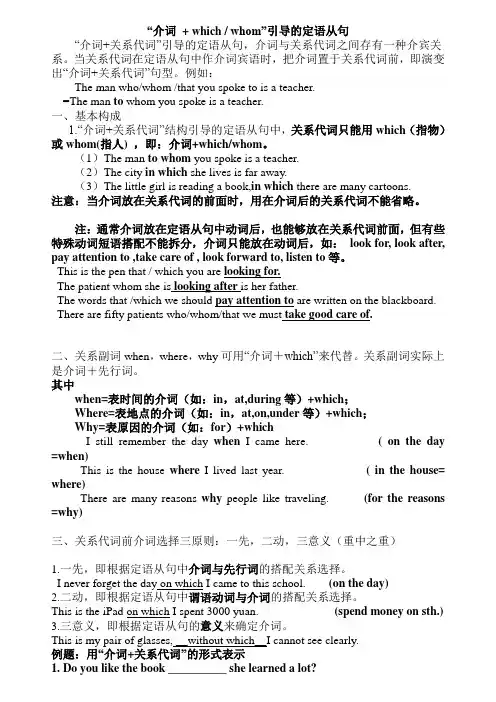
“介词+ which / whom”引导的定语从句“介词+关系代词”引导的定语从句,介词与关系代词之间存有一种介宾关系。
当关系代词在定语从句中作介词宾语时,把介词置于关系代词前,即演变出“介词+关系代词”句型。
例如:The man who/whom /that you spoke to is a teacher.=The man to whom you spoke is a teacher.一、基本构成1.“介词+关系代词”结构引导的定语从句中,关系代词只能用which(指物)或whom(指人) ,即:介词+which/whom。
(1)The man to whom you spoke is a teacher.(2)The city in which she lives is far away.(3)The little girl is reading a book,in which there are many cartoons.注意:当介词放在关系代词的前面时,用在介词后的关系代词不能省略。
注:通常介词放在定语从句中动词后,也能够放在关系代词前面,但有些特殊动词短语搭配不能拆分,介词只能放在动词后,如:look for, look after, pay attention to ,take care of , look forward to, listen to等。
This is the pen that / which you are looking for.The patient whom she is looking after is her father.The words that /which we should pay attention to are written on the blackboard. There are fifty patients who/whom/that we must take good care of.二、关系副词when,where,why可用“介词+which”来代替。
定语从句 介词+which,whom 关系副词

didn’t come yesterday.
why代替的是介词+表示原因的先行词 代替的是介词 表示原因的先行词 代替的是介词 小结: 小结: where 代替的是介词 表示地点的先行词 代替的是介词 介词+表示地点的先行词 when 代替的是介词 表示时间的先行词 代替的是介词 介词+表示时间的先行词 why代替的是介词 表示原因的先行词 代替的是介词 代替的是介词+表示原因的先行词 在从句中分别作:地点, 在从句中分别作:地点,时间和原因状语
类型一: 类型一:
on _____ 1. Is this the car ___which you spent 100,000 yuan? for _____ Is this the car ___which you paid 100,000 yuan? 2. The superstar for whom we had ___ _____ been waiting finally came.
步骤四:如果上述三个位置缺少成分, 步骤四:如果上述三个位置缺少成分,可用 which ,that, 反之用 ,where, why 反之用
A 1. May the fourth is the day __________ we Chinese people will never forget. A. which B. when C. on whichD. about which B 2. He has two sons, __________ work as doctors. A. none of whom B. both of whom C. both of them D. all of them 3. Many scientists believe that the earth is C not the only planet _____ there are lives. A. which B. in which C. where D. that
定语从句连接词which
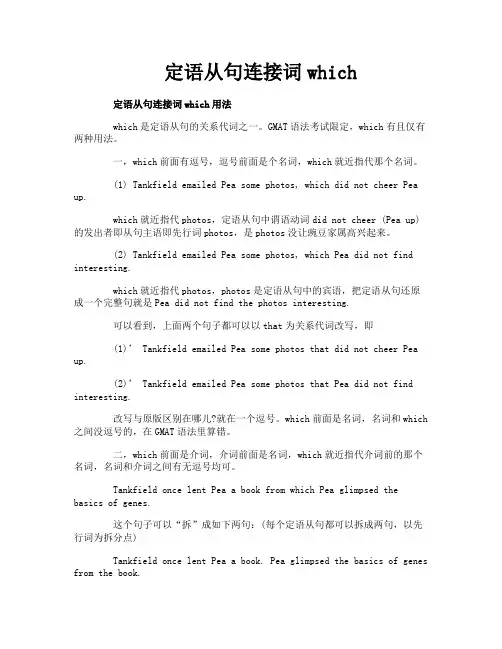
定语从句连接词which定语从句连接词which用法which是定语从句的关系代词之一。
GMAT语法考试限定,which有且仅有两种用法。
一,which前面有逗号,逗号前面是个名词,which就近指代那个名词。
(1) Tankfield emailed Pea some photos, which did not cheer Pea up.which就近指代photos,定语从句中谓语动词did not cheer (Pea up)的发出者即从句主语即先行词photos,是photos没让豌豆家属高兴起来。
(2) Tankfield emailed Pea some photos, which Pea did not find interesting.which就近指代photos,photos是定语从句中的宾语,把定语从句还原成一个完整句就是Pea did not find the photos interesting.可以看到,上面两个句子都可以以that为关系代词改写,即(1)’ Tankfield emailed Pea some photos t hat did not cheer Pea up.(2)’ Tankfield emailed Pea some photos that Pea did not find interesting.改写与原版区别在哪儿?就在一个逗号。
which前面是名词,名词和which 之间没逗号的,在GMAT语法里算错。
二,which前面是介词,介词前面是名词,which就近指代介词前的那个名词,名词和介词之间有无逗号均可。
Tankfield once lent Pea a book from which Pea glimpsed the basics of genes.这个句子可以“拆”成如下两句:(每个定语从句都可以拆成两句,以先行词为拆分点)Tankfield once lent Pea a book. Pea glimpsed the basics of genes from the book.先行词实际上是定语从句中介词的宾语,这时,需要把介词提前,避免如下表达:Tankfield once lent Pea a book, which Pea glimpsed the basics of genes from. (XXX)Tankfield once lent Pea a book that Pea glimpsed the basics of genes from. (XXX)拓展:定语从句中的`that和which用法区别that和which在从句里都可以做宾语和主语,做宾语时可以省略。
“介词+ which whom”引导的定语从句
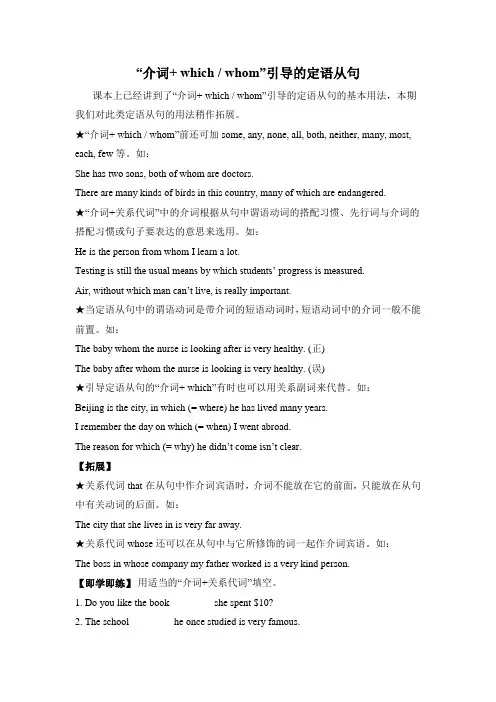
“介词+ which / whom”引导的定语从句课本上已经讲到了“介词+ which / whom”引导的定语从句的基本用法,本期我们对此类定语从句的用法稍作拓展。
★“介词+ which / whom”前还可加some, any, none, all, both, neither, many, most, each, few等。
如:She has two sons, both of whom are doctors.There are many kinds of birds in this country, many of which are endangered.★“介词+关系代词”中的介词根据从句中谓语动词的搭配习惯、先行词与介词的搭配习惯或句子要表达的意思来选用。
如:He is the person from whom I learn a lot.Testing is still the usual means by which students’ progress is measured.Air, without which man can’t live, is really i mportant.★当定语从句中的谓语动词是带介词的短语动词时,短语动词中的介词一般不能前置。
如:The baby whom the nurse is looking after is very healthy. (正)The baby after whom the nurse is looking is very healthy. (误)★引导定语从句的“介词+ which”有时也可以用关系副词来代替。
如:Beijing is the city, in which (= where) he has lived many years.I remember the day on which (= when) I went abroad.The reason for which (= why) he didn’t come isn’t clear.【拓展】★关系代词that在从句中作介词宾语时,介词不能放在它的前面,只能放在从句中有关动词的后面。
关系副词与“介词+which”(是否可互换)的区别

引导定语从句时where与in which有时可互换,有时不能互换,注意以下几点:一、关系副词与“介词+which”互换的情形当“介词+ which”在定语从句中作时间、地点和原因状语时,可以用相应的关系副词when, where 和why来替换。
1. when根据情况可以等于in which, at which, on which等。
如:The day when (=on which) she arrived was Thursday. 她到的那天是星期四。
July and August are the months when (=in which) the weather is hot. 七八月是天气很热的月份。
——摘自《英语常用词多用途词典》(金盾出版社)这种替换有时出现在非限制性定语从句中。
如:We’ll put off the picnic until next week, when (=bythen) the weather may be better. 我们将把野餐推迟到下星期,那时天气可能会好一点。
——摘自《张道真英语语法》(商务印书馆)2. where根据情况可以等于in which, at which, on which等。
如:This is the hotel where ( =in which / at which) they were staying. 这就是他们当时住的旅店。
——摘自《英语常用词多用途词典》(金盾出版社)Do you remember the place where (=at which) we had lunch? 你记得我们吃午饭的地方吗? ——摘自《英语用法指南》(外研社)这种替换有时出现在非限制性定语从句中。
如:The Tower of London, where (=in which) so many people lost their lives, is now a tourist attraction. 在伦敦塔中曾有许多人丧命,它现在是旅游胜地。
“介词+which”引导的定语从句
其 中 “ 词+ ih” 介 whc 的情 况 实 际 上 就 是whc 在 从 句 中 作 介 ih 词 宾 语 的情 况 . 是 学 生 难 点 中 的 难 点 , 以 , 文 就 这 一 个 更 所 本 问题 进行 系统 的 讲解 。 这 种定 语 从 句 仍 然 一 定 遵 循 “ 系代 词 指 代 哪 个 词 , 语 关 定 从 句 就修 饰 那 个 词 ” 一原 则 。对 于 这 类 定 语 从 句 , 们从 以 这 我 下 三 个方 面来 论 述 。 1“ 词 + hc ” 从 句 中 作 状 语 .介 w ih 在 这 种 情 况 是 最 常 见 的 。 即o是 从 句 中的 动 词 或 形 容 词 所 f 要 求搭 配 的 , 以o w i 在从 句 巾作 状 语 。这 是 , 少 数情 况 所 f hc h 在
I a mu h a h sb o a e n wr t n p ma l o e p e n s c s t i o k h sb e i e r r y frp o l t i i
t h m emaeili n w. fe u ha p ra hi e ao i ow o t tr s e 1 e l c n a po c sp d g g- h a s c l u e o . al s p r r y i
构 成 水 的 两 个元 素是 氧 和 氢 。
() p cf ie s s f i h te ea n r l s l o ta — 2 S e i cd s a e c h s b o ma i o wh mu c ec n r c
他 签 订 了一 项 协议 , 可使 他 获 得 销 售 佣 金 。 这 ② T e l g a e t c e so i in p oie e im h a u g e h r as c t r d s a m du n a s ao v
定语从句介词+which_介词+whom
for which she
paid $10?
3. Do you like the book from which she
learned a lot?
4. Do you like the book about which she
often talks? 5. He built a telescope through which he
This school which /t×hat/×/ he once studiediinn
is very famous.
Tommorrow I’ll bring here the magazine. You asked _f_o_r_the magazine.
Tommorrow I’ll bring here the magazinewhich
❖ 8. I don’t like the way __(t_h_at_/i_n_w_h_ic_h_) _ you talk to your mother.
9. The song is _t_h_e_o_n_e__(_th_a_t_/w__h_ic_h_)I like best. 10. Do you like the song _(_th_a_t_/w_h_i_ch_)_ we listened to before class?
❖ 5. Don’t get too close to the house __w_ho_s_e__ roof(屋顶) is under repair.
❖ 6. I am looking for a box in _w_h_ic_h_ I can put all my things.
❖ 7.He is the (only) one of the students who __h_as___ passed the exam.
定语从句(Ⅱ)——where,when,why,“介词+whichwhom”引导的定语从句
1、关系副词where的用法(1)where的先行词大多是地点名词,在定语从句中作地点状语从句。
This is the school where/in which my father once worked.这是我父亲曾经工作过的学校(2) where的先行词还可以是抽象名词, 如stage,case, situation,position等。
例 They have reached the stage where/at which they will separate 他们已经到了将要分手的地步了。
2、关系副词when的用法(1)when的先行词是时间名词,在定语从句中作时间状语。
例 Do you remember the day when/on which we first met each other ?你还记得我们第一次见面的那一天吗?(2)when的先行词还可以是抽象名词, 如break, interval等。
例There is a long break between the two classes when/at which we can drink some water .在两节课之间有一个长的休息时词,在这期间我们可以喝点水。
3、关系副词why的用法why的先行词是reason,在定语从句中作原因状语。
reason作先行词时,若引导词在从句中作主语或宾语,定语从句要用that或 which引导。
例 I don ' t know the reason why/for which my good friend , jack ,looks unhappy today.我不知道我的好朋友杰克为什么今天看上去不高兴。
(1) The reason why…..是why引导的定语从句,Why在从句中作原因状语,Why可替换成 for which。
(2) The reason that……是that引导的同位语从句,that不作成分,that后面的内容说明 reason的内容。
介词whichwhom”定语从句
引导词使用不当
02
在介词+which/whom引导的定语从句中,有时会出现引导词
使用不当的情况,导致句子结构不完整或产生歧义。
混淆了定语从句与其他从句的区别
03
在介词+which/whom引导的定语从句中,有时会混淆定语从
句与其他从句的区别,导致句子意思表达不准确或产生歧义。
05
练习与巩固
选择题练习
定义
定义
介词which/whom引导的定语从句是英语语法中的一种结构,其中 which/whom作为引导词,后面跟随一个完整的句子,用来修饰前面的名词或代 词,进一步说明其含义或特征。
which通常用于修饰物,而whom用于修饰人。
特点
01
which/whom引导的定语从句具 有限定性,用来限定名词或代词 的属性或特征,使句子结构更加 紧凑。
与状语从句的区别
介词+which/whom引导的定语从句与状语从句(如时间状语从句、条件状语 从句等)也不同,前者是对先行词进行修饰或限定,而后者则是对整个句子进 行补充说明或解释。
常见错误分析
介词使用不当
01
在介词+which/whom引导的定语从句中,有时会出现介词使
用不当的情况,导致句子意思表达不准确或产生歧义。
感谢观看
whom引导的定语从句例句
总结词:指代人
详细描述:whom在定语从句中通常指代人,例如"The person whom he met was his old friend."(他 遇到的那个人是他的老朋友。)
比较分析
总结词:使用区别
详细描述:which和whom的主要区别在于指代的对象不同 ,which通常指代事物,而whom通常指代人。此外,在正 式英语中,whom更常用,但在非正式英语中,which的使 用频率更高。