
人教版七年级的下册的英语Unit11学习的知识点的.doc
Unit11名词:cow 奶牛flower 花painting 油画;绘画horse 马sun 太阳robot 机器人farmer 农民museum 博物馆guide 导游;向导countryside 乡村;农村fire 火;火灾gift 礼物;赠品动词:milk 挤奶pick 采;摘grow 种植;生长;发育feed 喂养;饲养hear 听到;听见形容词:lovely 可爱的slow 缓慢的;迟缓的excellent 极好的;优秀的expensive 昂贵的interested 感兴趣的exciting 使人兴奋动物;令人cheap 廉价的;便宜的dark 黑暗的;昏暗的激动的副词:quite 相当;完全yesterday 昨天luckily 幸运地;好运地代词:anything 任何东西;任何事物everything 所有事物;一切兼类词:farm n 农场 v 务农;种田worry v&n 担心;担忧fast adv&adj快地(的)短语:milk a cow 给奶牛挤奶all in all 总的说来ride a horse 骑马be interested in对感兴趣feed chicken 喂鸡go for a walk = take a walk 去散步quite a lot(of)许多go on a trip = have a trip 参加旅行in the countryside在乡下;在农村in the dark 在黑暗中fire station 消防站come out (太阳、星星、月亮)出现;露出;出版知识点:1、 milk牛奶(名词)→milk挤奶(动词)rain雨(名词)→ rain下雨(动词)water 水(名词)→water浇水(动词)plant植物(名词)→ plant种植(动词)2、 feed 喂养;饲养Can you help me feed my dog 你能帮我喂狗吗( 1) feed to 把喂给You can feed nuts to the monkey. 你可以把坚果喂给这个猴子吃。
( 2) feed (on)用喂You can feed the monkey (on) nuts. 你可以用坚果喂猴子。
( 3) feed on以为食;以为生Cows feed on grass.奶牛以草为食。
3、不定代词:(1)做主语时谓语动词用单数(2)形容词修饰时放在后面① something某物;某事用于肯定句Something is different. 一些事不同了。
②anything 任何东西;任何事物用于否定句和疑问句Is there anything special in the room ?房间里有什么特别的东西吗?③everything 所有事物;一切Everything is OK. 一切都很好。
4、 grow 种植;生长;发育( 1)种植: We grow some strawberries in the yard. 我们在院子里种了些草莓。
( 2)生长;发育: In spring, everything begins to grow. 春天万物复苏。
( 3) grow up 长大;成长: When he grows up, he wants to be a writer. 当他长大,他想成为一名作家。
5、 learn about 学习 / 了解 / 知道的知识learn from sb 向学习I'd like to learn something about British history. 我想了解有关英国历史的知识。
He is hard-working. We should learn from him. 他很努力,我们应该向他学习。
6、 go + V-ing 类型短语go fishing 去钓鱼go camping 去野营go hiking 去远足go shopping 去购物go skating 去滑冰go swimming 去游泳go skiing 去滑雪7、 so much + 不可数名词如此多so many + 可数名词如此多There is so much water. 这有如此多的水。
We have so many friends here. 我们在这里有如此多的朋友。
8、 worry about sb/sth = be worried about 担心某人/ 某事She worries about Jim. = She is worried about Jim. 她担心Jim 。
9、on fire 着火make/build a fire 生火put out a fire 灭火The tree is on fire. 这棵树着火了。
10、excited 感到兴奋的修饰人exciting 使人兴奋的;令人激动的修饰物He is excited. 他很兴奋。
The movie is exciting. 这部电影很令人兴奋。
11、go on a trip = have a trip 去旅行go on a trip with sb 和某人一起去旅行go on a trip to + 地点去某地旅行Do you want to go/have on a trip ?你想去旅行吗?Do you want to go on a trip with me 你想和我一起去旅行吗Do you want to go on a trip to London 你想去伦敦旅行吗12、be interested in sth 对感兴趣be interested in doing sth 对做某事感兴趣Tom is interested in basketball. Tom 对篮球感兴趣。
Lisa is interested in singing and dancing. Lisa 对唱歌跳舞感兴趣。
13、interested 感兴趣的修饰人interesting 有趣的修饰物He is interested in music. 他对音乐感兴趣。
The mivie is interesting. 这部电影很有趣。
14、hear sb doing sth 听到某人正在做某事hear sb do sth 听见某人你做了某事/ 经常做某事I hear Tina singing in the classroom. 我听见Tina 正在教室唱歌。
I often hear Tina sing in the classroom. 我经常听见Tina 在教室唱歌。
15、 not at all 一点儿也不Tim doesn't like dancing at all. Tim 一点也不喜欢跳舞。
I don't like this book at all.我一点也不喜欢这本书。
16、一般过去时知识点见具体讲义1. The T-shirt is too e . Please give me the c one.2. Do you like living in the city or the c3. There are some f in the garden. They are so beautiful.4. It is very d in the room. I can't see anything.5. Didn't you h what I said ?6. My uncle is a ( farm ) .7. We worried it would rain on the way but ( luck ) it didn't.8. My father ( grow) some flowers five years ago.9. Last week I ( ride )a horse in the park.10. It was an ( excite )day.11. The house is (着火) .12. Why are you so (慢)? Hurry up !13. The (导游) explains the history of the Great Wall.14. a lot of students don't like speaking English after class.15. They (去旅行) yesterday.16. — Are you (interest ) in making model robots ?— Yes, It's so(interest ) .17. I didn't (学习) robots.18. (总的说来) , our trip was great.19. I don't like the novel (一点儿也不) .20. Would you like (散步)?21. Frank (挤奶) a cow every day.22. Mary helps me (喂) my cat.23. Look!They (摘) apples.24. My grandfather (去钓鱼) every Sunday.25. I cleaned my room (昨天) .26. Don't (担心) me.27. The rain stopped and the sun (出现) .28. I often hear the girl ( practice )the piano in this room.。
人教版七年级英语下册Unit 11单元考点知识汇总

人教版七年级英语下册Unit 11单元考点知识汇总Unit 11 How was your school trip?一、语法:一般过去时态1.概念:过去某个时间里发生的动作或状态;过去习惯性、经常性的动作、行为;常和过去的时间状语连用。
过去的时间状语:ago, yesterday, the day before yesterday, last week(year, night, month…), in 1989, just now, at the age of 5, one day, long long ago, once upon a time, etc.2.基本结构:①be动词的一般过去时态:(只有单复数的变化. 无人称变化)肯定句:主语+was/were+表语Tom was a student last year./The books were on the desk yesterday.否定形式:主语+was/were+not+表语Tom wasn’t a student last year.The books weren’t on the desk yesterday.一般疑问句:Was/Were+主语+表语Was Tom a student last year?Yes. he was./No. he wasn’t./Were The books on the desk yesterday?Yes. they were./No. they weren’t.②行为动词的一般过去时态(无人称与数的变化)肯定句:主语+动词过去式+...They/We/Tom climbed the mountains last week.否定句:主语+didn't+动词原形They/We/Tom didn't climb the mountains last week.一般疑问句:Did+主语+动词原形?Did they/you/Tom climb the mountains last week?Yes. 主语+did./No. 主语+didn't.3.动词过去式变化规则:①一般在动词原形末尾直接加上-ed。
Unit11单元知识点归纳总结人教版七年级英语下册

Unit 11 知识归纳重点短语milk a cow 给奶牛挤奶ride a horse 骑马feed chickens 喂鸡show sb. around 带领某人参观grow / pick strawberries种植 / 采摘草莓go fishing 去钓鱼 e out 出现;出版in the countryside 在乡下;在农村go to the countryside 去乡下make a model robot 制作机器人go on a school trip 参加学校旅行go on a trip = take a trip = have a trip (to...) 去旅行learn about =know about了解;知道;熟悉learn a lot about ... 了解很多关于……的知识be interested in 对……感兴趣quite a lot (of ...) 许多in the dark 在黑暗中on the farm 在农场make a fire 生火(be) on fire 着火grow up 长大fire station 消防站science museum 科学博物馆gift shop 礼品店along the way 沿途all in all=in short 总之feed on 以……为食not ... at all 根本不;完全不;一点也不be worried about = worry about... 担忧……语法知识时态:一般过去时:谓语动词过去式动词过去式变化规则(直去双改)(一)规则动词1.一般情况直接加ed;2.以不发音字母e结尾,去e再加ed,3.以一个辅音字母结尾的重读闭音节结尾,双写末尾辅音字母,再加ed;重读闭音节:重读;辅元辅(音节);该音节中元音字母不发本音4.以辅音字母+ y结尾的动词,将y变为i ,再加ed:发音规则:清辅音后读/t/;元音,浊辅音后读/d/;/t/,/d/后读/ɪd/。
(完整版)新目标人教版英语七下unit11知识点总结.doc

Unit 11 How was your school trip?一重点1 milk v 奶n.牛奶,不可数名2 feed v.去式、去分fed 喂养,养用法: feed sth.=give sth food 喂养 ...;feed sb/sth sth = feed sth to sb/sth 把某物喂某人 / 物 Please feed some grass to the cow. 3 farmer n.民,主 ---farm n. -----farming n. 事;耕作4 grow v.种植,生,育;grow up 大(成人)的程Eg I want to be a computer programmer when I grow up当.我大,我想当一个程序。
grow into 成,展成由一种情况另一种情况。
Eg The village is growing into a town. 个村庄正在展成一个城。
5 excellent 极好的;秀的。
一般用于肯定句不用于否定句;无比,不用程度副( very 等)修。
6 worry v.&n.担心,担 ; ----adj. worried 担心的,的worry about...担心; be worried about...担心7 the sun. the 用在世界上独一无二的名前。
似的用法:the earth; the moon ; the sky; the worlk.8 exciting&excited interesting&interested9 love v. --adj lovely 可的10 fast 作敏捷; quick 常指反快或表示事情在短内生或完成。
11 guide n. 游;向v.引,;操。
12 gift n.礼物;品;天,才能。
He has the math gift.他有数学天。
13 hear from 收到 ...的信hear about/of听,后+名,代,ing 形式。
人教版七年级下册 Unit 11知识点总结
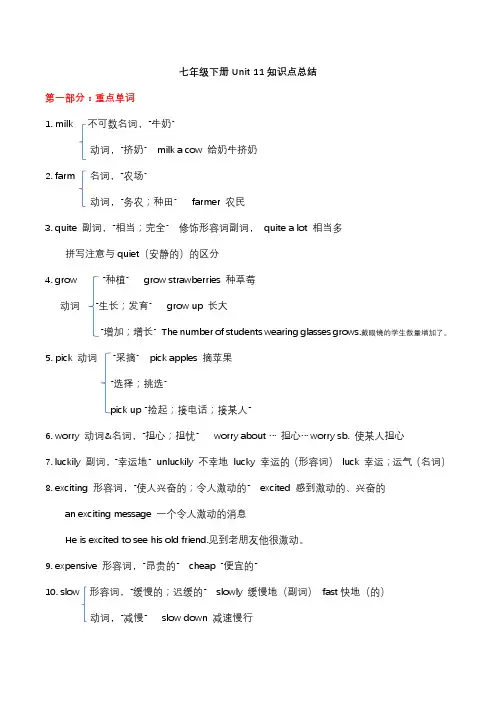
七年级下册Unit 11知识点总结第一部分:重点单词1. milk 不可数名词,“牛奶”动词,“挤奶”milk a cow 给奶牛挤奶2. farm 名词,“农场”动词,“务农;种田”farmer 农民3. quite 副词,“相当;完全”修饰形容词副词,quite a lot 相当多拼写注意与quiet(安静的)的区分4. grow “种植”grow strawberries 种草莓动词“生长;发育”grow up 长大“增加;增长”The number of students wearing glasses grows.戴眼镜的学生数量增加了。
5. pick 动词“采摘”pick apples 摘苹果“选择;挑选”pick up “捡起;接电话;接某人“6. worry 动词&名词,“担心;担忧“worry about … 担心… worry sb. 使某人担心7. luckily 副词,“幸运地“unluckily 不幸地lucky 幸运的(形容词)luck 幸运;运气(名词)8. exciting 形容词,“使人兴奋的;令人激动的“excited 感到激动的、兴奋的an exciting message 一个令人激动的消息He is excited to see his old friend.见到老朋友他很激动。
9. expensive 形容词,“昂贵的“cheap ”便宜的“10. slow 形容词,“缓慢的;迟缓的“slowly 缓慢地(副词)fast快地(的)动词,“减慢“slow down 减速慢行11. guide 名词,“导游,向导“动词,“指导“guide sb. to do … 指导某人做某事12. interested 形容词,“感兴趣的“be interested in … 对…感兴趣interesting 有趣的This is an interesting book. 这是一本有趣的书。
Unit11知识要点总结人教版英语七年级下册

excited兴奋的;激动的be / get excited about...因某事而兴奋
exciting令人兴奋的;令人激动的
复合不定副词用法:
1)不定副词前不加介词
2)形容词修饰不定副词后,放在不定副词后,放在不定副词后。
2.-ed形容词和-ing形容词
-ed形容词修饰人,-ing形容词修饰物
interested感兴趣的be interestresting有趣的
surprised吃惊的be surprised at对...感到吃惊
3.worry的用法
① vt使....担心,使发愁worry sb使某人担心
②vt担心,担忧后面常接宾语从句
③vi担心;忧虑worry about = be worried about担心....
4.fire的用法
1不可数名词,火,on fire着火make fire生火
2可数名词,火灾
四、语法点
1.复合不定副词somewhere, anywhere, nowhere, everywhere
quite
adv.非常
lovely
adj.可爱的
anything
pron.任何事
expensive
adj.昂贵的
grow
v.成长
cheap
adj.便宜的
farm
n.农场
slow
adj.缓慢的
pick
v.挑选
fast
adj.
excellent
adj.绝好的
robot
n.机器人
countryside
n.农村
听见某人正在做某事
in the sun
人教版七年级下册英语Unit11知识点

人教版七年级下册英语Unit11知识点Unit11名词:cow奶牛horse马XXX农民countryside乡村;农村动词:XXX挤奶feed喂养;饲养形容词:XXX可爱的XXX昂贵的cheap廉价的;便宜的副词:quite相当;完全代词:XXX任何东西;任何事物兼类词:farmn农场v务农;种田短语:milk a cow给奶牛挤奶ride a horse骑马feed chicken喂鸡quite a lot(of……)许多in the countryside在乡下;在农村XXX消防站常识点:1、milk牛奶(名词)→milk挤奶(动词)rain雨(名词)→rain下雨(动词)water水(名词)→water浇水(动词)plant植物(名词)→plant种植(动词)all in all总的说来be interested in对……感兴趣go for a walk = take a walk去漫步go on a trip = have a trip加入游览in the dark在黑暗中come out(太阳、星星、玉轮)呈现;暴露;出书worryv&n忧郁;担心XXX(的)everything所有事物;一切XXX昨天luckily幸运地;好运地slow迟钝的;迟钝的interested感兴趣的dark黑暗的;昏暗的excellent极好的;优秀的exciting使人兴奋动物;令人激动的pick采;摘XXX听到;听见grow种植;生长;发育flower花sun太阳XXXfire火;火警painting油画;绘画robot机器人guide导游;向导gift礼品;赠品2、feed豢养;豢养Can you help me feed my dog?你能帮我喂狗吗?(1)XXX……把……喂给……You can XXX.你可以把坚果喂给这个猴子吃。
(2)feed……(on)……用……喂……You can XXX(on)nuts.你可以用坚果喂猴子。
人教版七年级下册英语 Unit 11 语法知识点精讲(全面!)
人教版七年级下册英语 Unit 11 语法知识点精讲(全面!)11 How was your school trip?知识点大全SA语法:一般过去时一、什么是一般过去时?一般过去时是用于表述“过去”的时态。
1. 表示过去发生的动作。
2. 表示过去发生的状态。
二、一般现在时与一般过去时的共同点一般过去时的句式在结构上与一般现在时的句式结构是完全相同的。
无论是陈述句还是疑问句均是如此。
因而学好了一般现在时的知识,再学习一般过去时的知识是非常容易的。
三、一般现在时与一般过去时的区别。
区别体现在句子的谓语动词上。
因为句子的时态要通过谓语来体现。
而谓语由动词充当。
因此一般过去时中必然要出现用来“体现过去”的谓语动词。
辨析:“过去时”与“过去式”“过去时”是指的句子的时态。
本单元我们研究的是“一般过去时”。
“过去式”是指的动词的过去式,是一种拼写上的形式。
重要说明接下来介绍的一般过去时与一般现在时在陈述句,一般疑问句及特殊疑问句中的关系时所给的例句均不涉及时间状语。
(若加入了时间状语的话情况就更复杂一些,以后慢慢积累即可)语法:一般过去时的陈述句结构与一般现在时陈述句结构的关系一、主系表结构的情况。
1)肯定句。
I am a student.—> I was a student.You are young.—> You were young.I feel well.—> I felt well.She looks good.—> She looked good.2)否定句。
I am not a student.—> I was not a student.You are not young.—> You were not young.特殊说明:含有感官系动词的肯定陈述句在变为疑问句和否定句时需要当做实意动词处理。
这句话的变化例子放在后面实意动词单独作谓语的板块中出现。
总结:此类结构中,将系动词变为其过去式,句子的时态即变成了一般过去时。
人教版七年级下册英语Unit11基础知识点
人教版七年级下册英语Unit11基础知识点Unit 11 How was your school trip?【重点单词】milk v.挤奶cow n.奶牛milk a cow 给奶牛挤奶horse n.马ride a horse 骑马feed v.喂养;饲养feed chickens 喂鸡farmer n.农民;农场主quite adv.相当;安全quite a lot(of…) 许多anything pron.(常用于否定句或疑问句)任何东西;任何事物grow v.种植;生长;发育farm n.农场;务农;种田pick v.采;摘excellent adj.极好的;优秀的countryside n.乡村;农村in the countryside 在乡下;在农村yesterday n.昨天flower n.花worry v.担心;担忧luckily adv.幸运地;好运地sun n.太阳museum n.博物馆fire n.火灾fire station 消防站painting n.油画;绘画exciting adj.使人兴奋的;令人激动的lovely adj.可爱的expensive adj.昂贵的cheap adj.廉价的;便宜的slow adj.缓慢的;迟缓的fast adv&adj快地(的)robot n.机器人guide n.导游;向导gift n.礼物;赠品all in all 总的说来everything pron.一切;所有事物interested adj.感兴趣的be interested in 对……感兴趣dark adj.黑暗的;昏暗的hear(heard) v.听到;听见【重点短语】1.go for a walk去散步k a cow挤牛奶3.ride a horse骑马4.feed chickens喂小鸡5.talk with与……谈话6.take photos拍照7.quite a lot相当多8.show…around带领……参观9.learn about了解10.from…to…从……到……11.grow strawberries种植草莓12.pick strawberries采草莓13.in the countryside在乡下14.go fishing去钓鱼15.at night在夜晚16.a lot of许多;大量e out出来18.go on a school trip去学校郊游19.along the way沿线20.after that之后21.buy sth.for sb.为某人买某物22.all in all总的来说23.take a/the train乘火车24.be interested in对……感兴趣25.not…at all根本不……【重点句型】1.—Did you see any cows?你见到奶牛了吗一Yes, I did. I saw quite a lot.我见到了而且见到了很多很多2.—Did Carol take any photos?罗尔拍照片了吗?—Yes, she did.是的,她拍了。
七年级下册英语人教版unit11知识点
七年级下册英语人教版unit11知识点随着学习进入到七年级下册,学生们开始涉及到更加高阶的英语知识点。
其中,unit11则是比较重要的一个单元,以下是该单元的详细知识点介绍。
1. 现在进行时现在进行时是英语中一个描述正在进行的行为的时态。
它的构成方式是:主语+be动词(am, is, are)+动词ing形式。
例如:- I am playing basketball.- He is reading a book.- They are watching TV.2. 物品描述在英语中,我们可以通过形容词来描述物品,其中包含了物品的大小、颜色、形状等属性。
例如:a small blue round hat(一个小的蓝色的圆形帽子)。
3. 询问交通方式在日常生活中,我们常常需要询问别人如何出行。
例如:- How do you usually go to school?- Do you take a bus to work?- Is it far from your home to the subway station?4. 表示距离距离可以用来描述两个物体之间的空间间隔。
在英语中,我们可以使用单位表示距离,如:- meter:米- kilometer:千米- mile:英里5. 表示时间时间是日常生活中必不可少的一个概念。
在英语中,我们可以使用以下词汇表示时间:- morning:上午- afternoon:下午- evening:晚上- night:夜晚此外,我们也可以使用钟表数字来表示时间(如6:30)。
6. 数字表达数字在学习英语中也是非常基础的内容,包括阿拉伯数字和英文单词两种表达方式。
在阿拉伯数字中,0至9可以单独表示。
10至19则需要在前面加上“teen”来表示。
20以上的数字则需要在十位数前加上一个个位数(如22)。
而在英文单词中,0至12以及20、30、40和50都有专有的表达方式。
例如:- 0:zero- 1:one- 2:two- 10:ten- 11:eleven- 20:twenty7. 表示人的身体部位在英语中,我们也需要了解一些人体部位的表达方式。
人教版英语七年级下册Unit 11 单元知识点
一、词汇精讲1. exciting和excited ed修饰人,ing修饰物exciting是形容词,意为“令人兴奋的”,一般用来说明事物的特征。
例如:I like basketball. I think it’s very exciting.我喜欢篮球,我认为它非常令人兴奋。
excited是形容词,意为“感到兴奋的”,一般用来说明人的感受。
例如:He is very excited,because he get the first place.他非常兴奋,因为他得了第一名。
2. fast(1)fast作副词,意为“快地”,可以用来修饰动词或者动词短语。
例如:We got there so fast by subway.我们乘地铁很快到那儿。
(2)fast作形容词,意为“快的”。
例如:The man runs very fast.这个男人跑得非常快。
3. all in allall in all意为“总的来说”,常位于句首。
例如:all in all,it’s a great success.总的来说,它非常成功。
4. walk 名词,散步go for a walk = take/have a walk 走路,散步walk to + 地点名词(here/there/home不加to)5. quite与very辨析(1)quite需修饰动词、形容词、副词quite a/an + 形容词 + 单数名词“相当…的一个”(2)very常修饰形容词、副词a very + 形容词 + 单数名词“一个非常……的”quite a little + 不可数名词“相当多”quite a few + 可数名词“相当多”quite a lot “相当多”quite a lot + of + 可数或不可数“相当多”6. feed意为“喂养”,过去式fedfeed sth. to sb./sth. 把某物喂给某人或某物feed on 以………为生;以……为食feed……on/with 用……喂……7. How + be + 事物名词的用法?how意为如何,怎样●身体情况 How is your grandmother?●方式、方法 How did you come back home last night?●天气情况 How is the weather in Shanghai today?●程度 How do you like the book?8. show作动词,展示;show sth. to sb. = show sb. sth. 给某人展示某物作名词,节目;TV show电视节目;talk show访谈节目9. anything 任何东西;任何事物;常用于否定句或疑问句●anything作主语时,谓语动词用单数形式●形容词修饰不定代词something,anything时,形容词后置●something常用于肯定句中,但表示请求、建议、征求意见等,希望得到肯定回答的疑问句中常用something。