
小学英语沪教版(三年级起点)三年级上册知识点总结
2.在肯定回答 Yes,I am 中,不能把 I am 缩写成 I'm ,而否定回答一般都用缩
写形式: No,I'm not.
....*....*....
*.....
3.注意模仿录音学习单词 girl 的发音,要卷舌。
4.not 用于否定句,表示不,如: You are not a girl. 你不是女孩。
2.能够灵活运用 My...is /are... 来描述自己,如:
My hair is long. My ears are small.
3.ear 有两只,所以描述时用 ears ,可以说 My ears are big.
eye 也有两只,描述时要用 eyes,可以说 My eyes are small.
“ two
pears ”是复数,用“ are ”。 Unit 9 In my room
....*....*....*.....
知识梳理
一、字母
小学英语 沪教版 (三年
级起点 )三年 级上册
知识 点总结
小学英语 沪教版 (三年
级起点 )三年 级上册
知识 点总结
学习字母 Rr,Ss,Tt 的读音及其书写,注意书写笔顺和它们在四线 三格中的位置。
重点点拨
1.介绍自己的物品,注意它们的单复数形式,如:
单数: This is my book. (单个物品)
复数: These are my books. (多个物品)
2.询问物品是否属于别人:要分清其单复数:
单数: Is this your... ? 回答: Yes,it is ./ No, it isn't.
学会描述体貌特征: He's tall /short /fat /thin.
学会用 Is he /she... ?确认对方的姓名,如: Is she Mary?
回答: Yes, she is./No ,she isn't.
重点点拨
1.使用人称代词 he 和 she 指代人物,要注意性别。 he 他; she 她。
2.介绍别人时在 This is 后面加上人物的姓名即可。如: This is Miss Fang.
3.学会用一般疑问句 Is he / she... ?确认别人的名字,回答有两种:
肯定回答: Yes, he / she is .
否定回答: No,he/she isn't.
4.注意模仿录音学习单词 thin 的发音,要轻咬舌头后松开。
一个字母要大写。
....*....*....
*.....
4.介绍自己的名字时,用 I'm 加上名字,比如可以说 I'm Peter.
5.注意 I'm 的发音,发 m音时,要紧闭嘴巴。
Unit 2 How are you?
知识梳理
一、字母
学习字母 Cc 和 Dd 的读音及其书写,注意书写笔顺和它们在四线
指姐姐或妹妹。
....*....*....
*.....
2.认识 Peter 一家人的名字: John Brown ,Mary Brown,Sally Brown ,Peter
Brown, ....*....*....
*.....
Paul Brown 。
3.注意中文姓名和英文姓名的表达差异,中国姓名是“姓在前,名在后”,
复数: Are these your...
?回答: Yes,they are. /No, they aren't.
....*....*....
*.....
3.当别人赞扬你之后,按西方的文化,应该礼貌地道谢,回答 Thank you 。
Unit 10 Numbers
知识梳理
一、字母
学习字母 Uu,Vv,Ww的读音及其书写,注意书写笔顺和它们在四
Unit 4 My friends
知识梳理
一、字母
学习字母 Gg和 Hh 的读音及其书写,注意书写笔顺和它们在四线
三格中的位置。
二、单词
在情景中,能听、会说词汇: tall, short ,fat, thin ,friend
he
,is , my,she, this
三、句型
学会介绍姓名,如: This is Joe.
close, late, look at, open, please, the
三、句型
学会使用祈使句: Close the... ,please.
Open the...
,please.
Clean the...
,please.
Look at the...
,please.
重点点拨
1.用来表达请求或命令的句子叫做祈使句,它省略了 I ,you,he,she 等主语。
2.为了表示礼貌, 在祈使句中, 我们经常用到 please 这个词, 意思是“请……,
小学英语 沪教版 (三年
级起点 )三年 级上册
知识 点总结
小学英语 沪教版 (三年
级起点 )三年 级上册
知识 点总结
麻烦您……”,它可以放在句子开头或者结尾。如:
Close the door, please.
相当于 Please close the door.
I'm fine. Thank you.
我很好,谢谢。
学会道别: Goodbye. 再见。
重点点拨
1.见面问候除了用 How are you? 之外,还可以用 How do you do? 你好吗?
2.关于 Howare you?的回答,除了说 I'm fine.
Thank you. 之外,还可以说: ....*....*....
重点点拨
1. 学会常见的水果单词:apple,banan,a pear, orange,注意它们的单复数形式。
单数:an apple,an orange,a banan,a a pear。apple和 orange前面要用“an”。
复数: apples ,oranges, bananas, pears.
二、单词
在情景中,能听、会说词汇: chair, desk, pen, pencil, ruler, bed,
schoolbag, book, mum, these, your
三、句型
学会介绍自己的物品: This is my...These are my...
学会询问物品是否属于别人: Is this your... ? Are these your... ?
4.注意 long 和 short ,big 和 small 是反义词,要在使用中加深体会。
Unit 7 In the classroom
知识梳理
一、字母
学习字母 Mm和 Nn 的读音及其书写,注意书写笔顺和它们在四线
三格中的位置。
二、单词
在情景中,能听、会说词汇: blackboard ,door, window, clean ,
三、句型
学会打招呼: Hello. 你好。 Good morning. 早上好。
学会自我介绍: I'm... 我是……
重点点拨
1.Hello! 用于见面打招呼,问候熟人或朋友。
2.Good morning. 用于上午和别人打招呼。
3.认识人物: Peter, Alice ,Kitty, Joe 和 Miss Fy. 用来表示道歉,可以用 It's OK. 或 It's all right.
4.Very good. 用来表扬别人。
Unit 8 At the fruit shop
知识梳理
一、字母
学习字母 Oo,Pp,Qq的读音及其书写,注意书写笔顺和它们在四
线三格中的位置。
来回答。
二、单词
线三格中的位置。
二、单词
在情景中,能听、会说词汇: one, two, three, four, five, six, seven,
....*....*....
*.....
小学英语 沪教版 (三年
级起点 )三年 级上册
知识 点总结
小学英语 沪教版 (三年
级起点 )三年 级上册
三格中的位置。
二、单词
在情景中,能听、会说词汇: Mr, Mrs ,are , fine ,goodbye,
hi
,thank , you
小学英语 沪教版 (三年
级起点 )三年 级上册
知识 点总结
小学英语 沪教版 (三年
级起点 )三年 级上册
知识 点总结
三、句型
学会问候及回应: How are you? 你好吗?
小学英语 沪教版 (三年
级起点 )三年 级上册
知识 点总结
小学英语 沪教版 (三年
级起点 )三年 级上册
知识 点总结
Unit l Hello!
知识梳理
一、字母 学习字母 Aa 和 Bb 的读音及其书写,注意书写笔顺和它们在四线
三格中的位置。
二、单词
在情景中,能听、会说词汇: hello ,I ,Miss 。
小学英语 沪教版 (三年
级起点 )三年 级上册
知识 点总结
小学英语 沪教版 (三年
级起点 )三年 级上册
知识 点总结
face, big, long, look, small
三、句型
学会描述自己的脸部器官: My...is /are...
学会用 I'm...This is...
来介绍自己。
重点点拨
1.掌握表示面部器官的单词: face ,hair, eye ,ear, nose ,mouth。
*.....
(完整word版)沪教版三年级英语知识
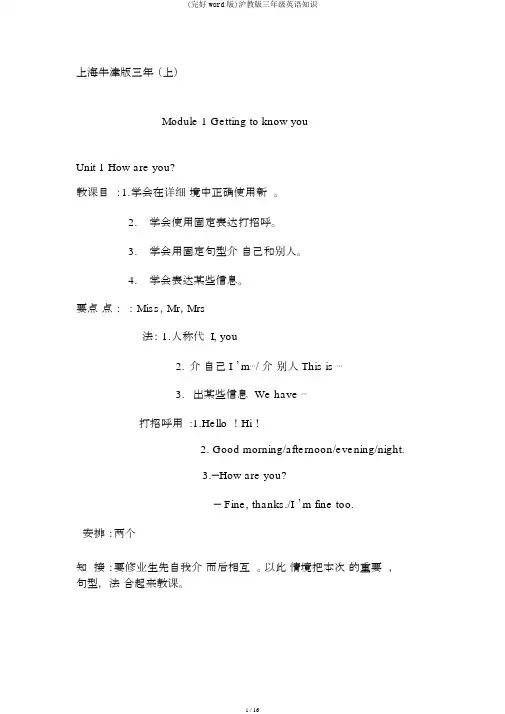
上海牛津版三年(上)Module 1 Getting to know youUnit 1 How are you?教课目:1.学会在详细境中正确使用新。
2.学会使用固定表达打招呼。
3.学会用固定句型介自己和别人。
4.学会表达某些信息。
要点点:: Miss,Mr,Mrs法: 1.人称代 I, you2.介自己 I ’m⋯/ 介别人 This is ⋯3.出某些信息 We have ⋯打招呼用 :1.Hello !Hi!2.Good morning/afternoon/evening/night.3.—How are you?— Fine, thanks./I ’m fine too.安排:两个知接:要修业生先自我介而后相互。
以此情境把本次的重要,句型,法合起来教课。
Unit 2 what ’syour name?教课目:1.学会在详细境中使用关和短。
2.学会用固定表达出某人的名字。
3.学会使用祈使句做出指示。
要点点:: stand up, sit down, open, close, door, name, book,write平时表达: --what ’s your name?--my name is⋯法: 1 人称代 your , my2祈使句stand up,sit down,look at安排:两个知接:上大家相互了,能够以上的内容渡到名字。
Unit 3 how old are you?教课目:1.学会用 wh-questions 人的年。
2.学会用固定句型人的年。
3.学会特定信息。
4.学会表达祝愿。
要点点:: one—ten ,today平时表达:年 -- how old are you ?happybirthday !--here you are--thank you. Guess!法 1.数字 one—ten2.it ’s⋯/I ’m⋯3.物主代 your4.Are you ⋯?5.祈使句 blow ⋯和定冠 the安排 : 2 个。
沪教版三年级上册英语 知识点(附参考答案)

否定句:____________________________________________________ 6、I am Danny.否定句:____________________________________________________ 7、This is my ruler.否定句:____________________________________________________ 8、Those are his robots.否定句:____________________________________________________ 9、You can go to have a look.否定句:____________________________________________________ 10、I know his name.否定句:____________________________________________________ 11、I am a student.否定句:____________________________________________________ 12、It is an apple.否定句:____________________________________________________ 13、They are my books.否定句:____________________________________________________ 14、I can see a boat.否定句:____________________________________________________ 15、Stand up.否定句:____________________________________________________16、I am in Grade 3.17、She is Yang Ling.18、We are teachers.19、I can draw a toy car.20、Jack speaks English very well.4、They can swim.一般疑问句:______________________________________________________肯定回答:_______________________否定回答:_______________________ 5、I like apples.一般疑问句:______________________________________________________肯定回答:_______________________否定回答:_______________________ 6、I am Danny.一般疑问句:______________________________________________________肯定回答:_______________________否定回答:_______________________ 7、This is my ruler.一般疑问句:______________________________________________________肯定回答:_______________________否定回答:_______________________ 8、Those are his robots.一般疑问句:______________________________________________________肯定回答:_______________________否定回答:_______________________ 9、You can go to have a look.一般疑问句:______________________________________________________肯定回答:_______________________否定回答:_______________________ 10、I know his name.一般疑问句:______________________________________________________肯定回答:_______________________否定回答:_______________________第3讲改肯定句肯定句否定句一般疑问句【知识点】1、否定句改肯定句(1)句子中有am/is/are/can时,直接把am/is/are/can后面的not去掉,其他照抄。
沪教版(三年级起点)小学英语三年级上册单元知识总结(全册)

Module 1Getting to know you一、核心词汇1. 打招呼用语hello (用于打招呼) 喂,你好hi (用于打招呼) 喂,嗨 goodbye 再见2. 人称代词I 我you 你;你们3. be动词are是am是4. 名词Miss小姐Mr先生Mrs太太boy男孩girl女孩5. 其他fine健康的;身体很好的thank谢谢no不;不是 not不是yes是;对二、核心句型1. Hello, I’m Peter. 你好,我是彼得。
解读: hello表示“你好”,是使用频率最高的日常用语之一,常用于打招呼。
举一反三: Hello, Liu Lin. 你好,刘琳。
Hello, Tom. 你好,汤姆。
Hello, Zhang Hongwei.你好,张宏伟。
一般在以下情况使用:(1)上学路上遇到同学或老师时说“Hello”。
(2)出去游玩时,发现有朋友在不远处时说“Hello”。
(3)和好朋友一起去听音乐会,你先帮他/她占了位置,当看见他/她过来找你时,你可以一边向他/她挥手,一边说“Hello”。
(4)在给别人打电话时,你可以说“Hello! This is …”。
拓展: I’m是I am的缩写形式,表示“我是……”,若后面跟名字,则用于做自我介绍。
举一反三: I’m Liu Lin. 我是刘琳。
I’m Tom. 我是汤姆。
I’m Zhang Hongwei. 我是张宏伟。
2.— How are you? 你好吗?—I’m fine. Thank you. 我很好。
谢谢。
解读: “How are you?”是日常生活中很常见的问候语,其用法如下:(1)用于询问健康情况,意为“你(身体)好吗?”(2)熟人之间的打招呼用语,意为“你好吗?”举一反三: — How are you, Jenny? 詹妮,你好吗?—I’m fine. Thank you. 我很好。
谢谢。
— How are you, Danny? 丹尼,你好吗?—I’m fine. Thank you. 我很好。
沪教牛津版英语三年级上册词组语法

沪教牛津版英语三年级上册词组语法沪教牛津版英语三年级上册是一本教材,旨在帮助学生掌握基础的英语词组和语法知识。
以下是相关参考内容:一、词组1. Hello/Goodbye- Hello, how are you?- Goodbye, see you later.2. How old are you?- I'm six years old.3. What's your name?- My name is Tom.4. Nice to meet you.- Nice to meet you too.5. What color is it?- It's red/green/blue/yellow.6. How many?- How many pencils do you have?7. Where is it?- It's on/under/in/behind/near the table.8. What do you have?- I have a book/pencil/bag.9. How do you go to school?- I go to school by bus/by bike/on foot.10. What's the weather like?- It's sunny/cloudy/windy/rainy.二、语法1. Be动词的用法- I am happy.- You are my friend.- He is a teacher.- She is a doctor.- It is a cat.- We are in the park.- They are students.2. 人称代词的用法- I am a student.- You are my friend.- He is a teacher.- She is a doctor.- We are in the park.- They are students.3. 冠词的用法- This is a pencil.- That is an apple.- I have an eraser.- She has a doll.- We are playing with a ball.4. 名词的复数形式- I have two pencils.- They are my friends.- We have three books.5. 人称代词的所有格- This is my pen.- That is your book.- It is his/her bag.- These are our toys.- Those are their bikes.6. 一般现在时的用法- I like to play soccer.- He likes to read books.- She likes to sing songs.- We like to eat ice cream.- They like to watch movies.7. 一般疑问句的构成- Do you like to dance?- Does he like to swim?- Does she like to play tennis? - Do we like to cook?- Do they like to paint?8. 物主代词的用法- This is mine.- That is yours.- It is his/hers.- These are ours.- Those are theirs.9. 数词的用法- I have one apple.- She has two cats.- They have three dogs.10. 时间状语的用法- I get up at 7 o'clock.- She goes to bed at 9 o'clock.- We have English class on Monday.- They go to the park in the morning.以上是沪教牛津版英语三年级上册的词组和语法相关参考内容。
沪教版小学三年级英语知识总结教学内容.doc

上海牛津版三年(上)Module 1 Getting to know youUnit 1 How are you?教学目:1.学会在具体境中正确使用新。
2.学会使用固定表达打招呼。
3.学会用固定句型介自己和他人。
4.学会表达某些信息。
重点点:: Miss,Mr,Mrs法: 1.人称代 I, you2.介自己 I ’m⋯/ 介他人 This is ⋯3.出某些信息 We have ⋯打招呼用 :1.Hello !Hi!2.Good morning/afternoon/evening/night.3.—How are you?— Fine, thanks./I ’m fine too.安排:两个知接:要求学生先自我介然后互相。
以此情境把本次的重要,句型,法合起来教学。
Unit 2 what ’syour name?教学目:1.学会在具体境中使用关和短。
2.学会用固定表达出某人的名字。
3.学会使用祈使句做出指示。
重点点:: stand up, sit down, open, close, door, name, book,write日常表达: --what ’s your name?--my name is⋯法: 1 人称代 your , my2祈使句stand up,sit down,look at安排:两个知接:上大家互相了,可以以上的内容渡到名字。
Unit 3 how old are you?教学目:1.学会用 wh-questions 人的年。
2.学会用固定句型人的年。
3.学会特定信息。
4.学会表达祝福。
重点点:: one—ten ,today日常表达:年 -- how old are you ?happybirthday !--here you are--thank you. Guess!法 1.数字 one—ten2.it ’s⋯/I ’m⋯3.物主代 your4.Are you ⋯?5.祈使句 blow ⋯和定冠 the安排 : 2 个。
三年级上册的全部单词沪教
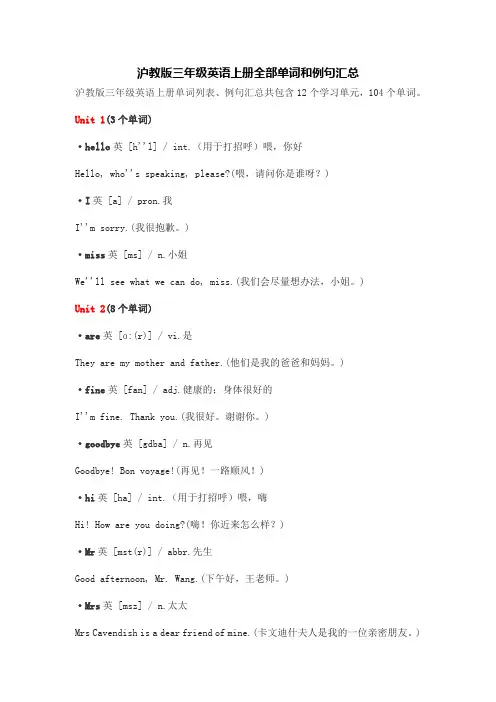
沪教版三年级英语上册全部单词和例句汇总沪教版三年级英语上册单词列表、例句汇总共包含12个学习单元,104个单词。
Unit 1(3个单词)·hello英 [h''l] / int.(用于打招呼)喂,你好Hello, who''s speaking, please?(喂,请问你是谁呀?)·I英 [a] / pron.我I''m sorry.(我很抱歉。
)·miss英 [ms] / n.小姐We''ll see what we can do, miss.(我们会尽量想办法,小姐。
)Unit 2(8个单词)·are英 [ɑ:(r)] / vi.是They are my mother and father.(他们是我的爸爸和妈妈。
)·fine英 [fan] / adj.健康的;身体很好的I''m fine. Thank you.(我很好。
谢谢你。
)·goodbye英 [gdba] / n.再见Goodbye! Bon voyage!(再见!一路顺风!)·hi英 [ha] / int.(用于打招呼)喂,嗨Hi! How are you doing?(嗨!你近来怎么样?)·Mr英 [mst(r)] / abbr.先生Good afternoon, Mr. Wang.(下午好,王老师。
)·Mrs英 [msz] / n.太太Mrs Cavendish is a dear friend of mine.(卡文迪什夫人是我的一位亲密朋友。
)·thank英 [θk] / vt.谢谢Thank you for your gift!(谢谢你的礼物!)·you英 [ju] / pron.你;你们I want you!(我需要你!)Unit 3(6个单词)·am英 [m] / vi.是Am I correct in saying this?(我这样说对吗?)·boy英 [b] / n.男孩The little boy loves to read.(这个小男孩喜欢看书。
沪教版小学英语三年级上册笔记
默写1A 1B2A 2B3A单词,两遍。
根据自己的理解,写10篇写话(至少5句话,三种句型),主题参考:自己,朋友,家庭,家庭成员,学校,文具,水果,玩具,公园,游乐场,昆虫,农场,动物,植物等3AM1U11.名字首字母要大写。
Alice Peter句子开头首字母也要大写。
He is a teacher.2. I’m=I am 缩写?/完整形式?句子中必须有动词。
用缩写?还是用完整形式?(由空格决定。
)动词分为be动词(am is are), 和实义动词(need, like, have, see, hear, sing, dance, draw.....)I am Dolly. =I'm Dolly.题目:改成一般疑问句。
一般疑问句(最显著特点:可以用Yes或者No来回答)题目:改写句子——改成一般疑问句。
(1)I am fat.(改成一般疑问句——Be动词提前)思考:①人称,问题和回答的是两个人,I和You是要互换的,跟You 搭配的是are(我和你)。
②调序:动词调到最前面去,动词是are。
③大小写要写正确,标点问句写问号。
Are you fat?(2)He is a good boy.①人称,本题不用考虑。
②调序:is放到最前面。
③大小写和标点。
Is he a good boy?(3)My name is Danny.①人称,My换成Your ②调序:is放到最前面。
③大小写和标点。
______ ______ ______ ______(4)Alice is in the classroom.①人称,本题不用考虑。
②调序:is放到最前面。
③大小写和标点。
Alice虽然放在句子中间,但是人名还是要大写。
______ ______ ______ ______ ______?(5)They are red.______ ______ ______?4.各类词汇I(同音词)eyehello(同义词) hiMum(同类词) Dad反义词,缩写形式,完整形式?关键:记清单词,读懂题目。
沪教牛津版小学英语三起点三年级上册 Unit-5-My-family知识点总结教案
TB 小初高题库
沪教牛津版小学英语三起点
T:(point to the mother in the picture) Who is she?She is Peter’s mother. Mother,mother.
Ss:Mother,mother. T:(point to the father in the picture) Who is he? He is Peter’s brother.Brother,brother. Ss:Brother,brother. T:(point to the girl t in the picture) Who is she? She is Peter’s sister.Sister,sister. Ss:Sister,sister. 2.出示 Unit 2 的 Look and Learn 中 Kitty 一家的图片,然后将这个图 片借助多媒体变成一棵 family tree,然后让学生操练家庭成员的称谓。 T:(show the right picture in “Look and learn”of Unit 2) This is a picture of the Lis(point to Mr Li in the picture)Who is he? S1:Mr Li. T:(point to Mrs Li in the picture) Who is she? S2:Mrs Li. T:(point to the boy in the picture) Who is he?Tell me his English name. S3:Ben. T:(point to the girl in the picture) Who is she? Tell me her English name. S3:Kitty. T:(show the family tree of the Lis) Look here. This is a family tree of the Lis. (point to Kitty in the picture)This is Kitty. (point to Mr Li in the family tree)This is Mr Li.He’s Kitty’s father.Father,father. Ss:Father,father. T:(point to Mrs Li in the family tree)This is Mrs Li.She’s Kitty’s Mother.Mother,mother. Ss:Mother,mother. (point to Ben in the family tree)This is Ben.He’s Kitty’s brother.Brother,brother. Ss: Brother,brother. (point to Kitty in the family tree)This is Kitty.She’s Ben’s sister. Sister,sister. Ss:Sister,sister. 3.播放 Listen and say 的录音,学生逐句跟读,初步感知新授句型
英语沪教版三年级上册单词重点表
英语沪教版三年级上册单词重点表英语沪教版三年级上册单词重点表包括以下内容:1. Unit 1: Hello- Words: hello, goodbye, hi, bye-bye, morning, afternoon, evening, night- Explanation: These words are commonly used to greet and say goodbye to someone. They also indicate different times of the day.2. Unit 2: Family- Words: family, father, mother, brother, sister, grandfather, grandmother- Explanation: These words are used to describe family members. They help children understand the concept of family and the roles family members play.3. Unit 3: Numbers- Words: one, two, three, four, five, six, seven, eight, nine, ten- Explanation: These words represent the numbers from one to ten. They help children learn how to count and recognize numbers.4. Unit 4: Colors- Words: red, orange, yellow, green, blue, purple, black, white, brown- Explanation: These words represent different colors. They help children learn how to identify and describe different colors.5. Unit 5: Animals- Words: cat, dog, fish, bird, rabbit, turtle, pig, sheep, cow, horse- Explanation: These words represent different animals. They help children learn about common animals and their names.6. Unit 6: Food- Words: apple, banana, bread, cake, milk, juice, water, hamburger, ice cream - Explanation: These words represent different types of food and drinks. They help children learn about common food items.7. Unit 7: School- Words: school, student, teacher, desk, chair, book, pencil, ruler, eraser - Explanation: These words are related to school and education. They help children learn about school supplies and the classroom environment.8. Unit 8: Body Parts- Words: head, eyes, ears, nose, mouth, teeth, hands, feet- Explanation: These words represent different parts of the body. They help children learn how to describe different body parts.9. Unit 9: Clothes- Words: hat, coat, pants, shirt, dress, shoes, socks- Explanation: These words represent different types of clothing. They help children learn how to identify and describe different items of clothing.10. Unit 10: Weather- Words: sunny, rainy, cloudy, windy, snowy- Explanation: These words describe different weather conditions. They help children learn how to identify and describe the weather.11. Unit 11:Transportation- Words: bus, car, bike, train, plane, boat, subway, taxi, truck- Explanation: These words represent different modes of transportation. They help children learn how to identify and describe various vehicles and how people and goods can be transported from one place to another.12. Unit 12: Actions- Words: run, jump, swim, walk, dance, sing, read, write, draw- Explanation: These words represent different actions that people can do. They help children learn how to talk about activities and movements in everyday life.13. Unit 13: Emotions- Words: happy, sad, angry, excited, scared, surprised, tired, shy- Explanation: These words represent different emotions that people can feel. They help children learn how to identify and talk about their own and others' feelings.14. Unit 14: Places- Words: home, school, park, hospital, library, supermarket, restaurant, zoo, museum- Explanation: These words represent different places in the community. They help children learn how to talk about locations and what activities can be done in these places.15. Unit 15: Time- Words: day, week, month, year, hour, minute, second, yesterday, tomorrow- Explanation: These words are related to the concept of time. They help children learn how to talk about the passage of time and make plans.16. Unit 16: Opposites- Words: big, small, tall, short, fat, thin, hot, cold, old, young- Explanation: These words represent opposite adjectives. They help children learn how to describe and compare things using opposite terms.17. Unit 17: Jobs- Words: doctor, nurse, teacher, driver, cook, police officer, firefighter, farmer, engineer- Explanation: These words represent different occupations. They help children learn how to talk about what people do for a living and the roles they play in society.18. Unit 18: Fruits and Vegetables- Words: apple, banana, orange, grape, watermelon, pineapple, strawberry, cherry, peach, pear- Explanation: These words represent different fruits. They help children learn how to identify and talk about various fruits and their characteristics.19. Unit 19: Toys and Games- Words: doll, car, ball, kite, puzzle, board game, card game, video game, bicycle- Explanation: These words represent different toys and games that children play with. They help children learn how to talk about their playtimeactivities and interests.20. Unit 20: Celebrations- Words: birthday, Christmas, New Year, Easter, Halloween, Thanksgiving, festival, party, celebration- Explanation: These words represent different holidays and festive occasions. They help children learn how to talk about special events, traditions, and the joy of celebrating with others.21. Unit 21: Sports- Words: basketball, soccer, volleyball, swimming, running, jumping, tennis, badminton, golf, skateboarding- Explanation: These words represent different sports and physical activities. They help children learn how to talk about sports, exercise, and recreational activities.22. Unit 22: Music- Words: song, music, singer, guitar, piano, drum, violin, trumpet, flute, concert- Explanation: These words represent different aspects of music. They help children learn how to talk about musical instruments, songs, and performances.23. Unit 23: Art- Words: painting, drawing, artist, color, paintbrush, canvas, sculpture, gallery, art, masterpiece - Explanation: These words represent different forms of art and artistic tools. They help children learn how to talk about art, artists, and the creation of artistic works.24. Unit 24: Environment- Words: nature, forest, river, mountain, ocean, animal, plant, tree, flower, environment- Explanation: These words represent elements of the natural environment. They help children learn how to talk about nature, ecosystems, and the importance of environmental conservation. 25. Unit 25: Technology- Words: computer, phone, television, internet, email, camera, video game, app, technology, digital- Explanation: These words represent different technological devices and concepts. They help children learn how to talk about technology, its uses, and its impact on daily life.26. Unit 26: Health- Words: doctor, hospital, medicine, nurse, healthy, sick, illness, vaccine, fitness, health- Explanation: These words represent aspects of health and healthcare. They help children learn how to talk about physical and mental health, medical care, and healthy lifestyles.27. Unit 27: Safety- Words: safe, danger, safety, helmet, seatbelt, fire extinguisher, first aid, emergency, accident, prevention- Explanation: These words represent concepts and tools related to safety. They help children learn how to talk about safety rules, preventing accidents, and emergency preparedness.28. Unit 28: Travel- Words: travel, trip, vacation, suitcase, passport, airplane, train, hotel, tourist, destination- Explanation: These words represent aspects of travel and vacationing. They help children learn how to talk about travel planning, transportation, and exploring new places.29. Unit 29: Culture- Words: culture, tradition, festival, costume, language, art, music, dance, cuisine, heritage- Explanation: These words represent elements of culture and cultural diversity. They help children learn how to talk about cultural traditions, customs, and the cultural heritage of different groups.30. Unit 30: Space- Words: sun, moon, star, planet, galaxy, universe, astronaut, spaceship, rocket, exploration- Explanation: These words represent objects and concepts related to space and space exploration. They help children learn how to talk about the solar system, space travel, and the mysteries of the universe.。
沪教牛津版小学英语三年级上册单元知识点归纳总结
沪教牛津版小学英语三年级上册单元知识点归纳总结Unit11. 如何同他人打招呼【课文应用】Hello,I'm Peter.你好,我是彼得。
hello 的具体使用情况∶语境(1)你早上上学时遇见老师,可以对老师说"Hello!"或"Good morning!"。
语境(2)在公园里,你看见同学正在玩游戏,你想和他/她打招呼,可以说"Hello!"语境(3)你在电影院里看电影,给好朋友留了一个位置,看见他/她走过来,为了引起他/地的注意,你可以说"Hello!"。
语境(4)在给他人打电话时,你可以说"Hello! This is…"。
2. 易混辨析 hello 与hi● hello 用于打招呼、问候或唤起对方的注意。
● hi 比hello 更随意,可以翻译成"嗨",一般用于熟人之间见面打招呼。
例∶ -Hello! 你好! -Hi! 嗨!3. 进行自我介绍的句型∶ I'm..【课文应用】Hello,I'm Peter. 你好,我是彼得。
【句型结构】I'm+姓名或其他情况.【重点解析】在向别人进行自我介绍时,经常会用到" I'm…" 句型,其主要用法如下∶● 介绍自己的姓名∶ I'm Betty. 我是贝蒂。
● 介绍自己的年龄∶I'm eleven. 我十一岁。
● 介绍自己的外貌∶ I'm tall. 我个子高。
例∶-I'm Lingling.I'm eight. I'm short. I'm from Jilin.我是玲玲。
我八岁了。
我很矮。
我来自吉林。
4. 汉语姓名在英语中的写法汉语姓名在英语中用汉语拼音拼写,姓与名要分开,而且姓与名的第一个字母都要大写,姓在前,名在后。