
ACM程序设计竞赛例题[1]
备战ACM资料习题1. 0-1背包问题在0 / 1背包问题中,需对容量为c 的背包进行装载。
从n 个物品中选取装入背包的物品,每件物品i 的重量为wi ,价值为pi 。
对于可行的背包装载,背包中物品的总重量不能超过背包的容量,最佳装载是指所装入的物品价值最高。
程序如下:#include <>void readdata();void search(int);void checkmax();void printresult();int c=35, n=10; ");printf("\n");}printf("\n");}6.素数环问题把从1到20这20个数摆成一个环,要求相邻的两个数的和是一个素数。
分析:用回溯算法,考察所有可能的排列。
程序如下:#include <>#include <>void search(int);void init(); 表示空格;’X’表示墙。
程序如下:#include <>#include <>void search(int,int);int canplace(int,int);void readdata(); Floodfill给一个20×20的迷宫和一个起点坐标,用广度优先搜索填充所有的可到达的格子。
提示:参考第2题。
2. 电子老鼠闯迷宫如下图12×12方格图,找出一条自入口(2,9)到出口(11,8)的最短路本题给出完整的程序和一组测试数据。
状态:老鼠所在的行、列。
程序如下:#include<>void readdata();a[i][j]=0; ....注:测试数据可在运行时粘贴上去(点击窗口最左上角按钮,在菜单中选则“编辑”/“粘贴”即可)。
想一想:此程序都存在哪些问题,如果openlen太小程序会不会出错,加入代码使程序能自动报出此类错误。
3.跳马给一个200×200的棋盘,问国际象棋的马从给定的起点到给定的终点最少需要几步。
Sample Input 0 0 1 1 Sample output 4状态:马所在的行、列。
程序如下:#include<>void readdata(); 独轮车独轮车的轮子上有5种颜色,每走一格颜色变化一次,独轮车只能往前推,也可以在原地旋转,每走一格,需要一个单位的时间,每转90度需要一个单位的时间,转180度需要两个单位的时间。
现给定一个20×20的迷宫、一个起点、一个终点和到达终点的颜色,问独轮车最少需要多少时间到达。
状态:独轮车所在的行、列、当前颜色、方向。
另外为了方便在结点中加上到达该点的最小步数。
程序如下:#include<>struct colornode{int row; 表示空格a[i][j]=0; ...XXXX......X (X)1 1 1 4 8 11.最长公共子序列一个给定序列的子序列是在该序列中删去若干元素后得到的序列。
确切地说,若给定序列X=<x1, x2,…, xm>,则另一序列Z=<z1, z2,…, zk>是X的子序列是指存在一个严格递增的下标序列<i1, i2,…, ik>,使得对于所有j=1,2,…,k有答如下:a) 最长公共子序列的结构若用穷举搜索法,耗时太长,算法需要指数时间。
易证最长公共子序列问题也有最优子结构性质设序列X=<x1, x2, …, xm>和Y=<y1, y2, …, yn>的一个最长公共子序列Z=<z1, z2, …, zk>,则:i. 若xm=yn,则zk=xm=yn且Zk-1是Xm-1和Yn-1的最长公共子序列;ii. 若xm≠yn且zk≠xm ,则Z是Xm-1和Y的最长公共子序列;iii. 若xm≠yn且zk≠yn ,则Z是X和Yn-1的最长公共子序列。
其中Xm-1=<x1, x2, …, xm-1>,Yn-1=<y1, y2, …, yn-1>,Zk-1=<z1, z2, …, zk-1>。
最长公共子序列问题具有最优子结构性质。
b) 子问题的递归结构由最长公共子序列问题的最优子结构性质可知,要找出X=<x1, x2, …, xm>和Y=<y1, y2, …, yn>的最长公共子序列,可按以下方式递归地进行:当xm=yn时,找出Xm-1和Yn-1的最长公共子序列,然后在其尾部加上xm(=yn)即可得X和Y 的一个最长公共子序列。
当xm≠yn时,必须解两个子问题,即找出Xm-1和Y 的一个最长公共子序列及X和Yn-1的一个最长公共子序列。
这两个公共子序列中较长者即为X和Y的一个最长公共子序列。
由此递归结构容易看到最长公共子序列问题具有子问题重叠性质。
例如,在计算X和Y的最长公共子序列时,可能要计算出X和Yn-1及Xm-1和Y的最长公共子序列。
而这两个子问题都包含一个公共子问题,即计算Xm-1和Yn-1的最长公共子序列。
我们来建立子问题的最优值的递归关系。
用c[i,j]记录序列Xi和Yj的最长公共子序列的长度。
其中Xi=<x1, x2, …, xi>,Yj=<y1, y2, …, yj>。
当i=0或j=0时,空序列是Xi和Yj的最长公共子序列,故c[i,j]=0。
建立递归关系如下:c) 计算最优值由于在所考虑的子问题空间中,总共只有θ(m*n)个不同的子问题,因此,用动态规划算法自底向上地计算最优值能提高算法的效率。
计算最长公共子序列长度的动态规划算法LCS_LENGTH(X,Y)以序列X=<x1, x2, …, xm>和Y=<y1, y2, …, yn>作为输入。
输出两个数组c[0..m ,0..n]和b[1..m ,1..n]。
其中c[i,j]存储Xi与Yj的最长公共子序列的长度,b[i,j]记录指示c[i,j]的值是由哪一个子问题的解达到的,这在构造最长公共子序列时要用到。
最后,X和Y的最长公共子序列的长度记录于c[m,n]中。
程序如下:#include<>#include<>int lcs_length(char x[], char y[]);int main(){char x[100],y[100];int len;while(1){scanf("%s%s",x,y);if(x[0]=='0') 搬桌子问题某教学大楼一层有n个教室,从左到右依次编号为1、2、…、n。
现在要把一些课桌从某些教室搬到另外一些教室,每张桌子都是从编号较小的教室搬到编号较大的教室,每一趟,都是从左到右走,搬完一张课桌后,可以继续从当前位置或往右走搬另一张桌子。
输入数据:先输入n、m,然后紧接着m行输入这m张要搬课桌的起始教室和目标教室。
输出数据:最少需要跑几趟。
Sample Input10 51 33 94 66 107 8Sample Output3分析:贪心算法,把课桌按起点从小到大排序,每次都是搬离当前位置最近的课桌。
程序如下:#include<>int main(){struct{int start;int end;}a[100];int i,j;int n,m,min,num,temp,used[100]={0};scanf("%d%d",&m,&n);for(i=0;i<n;i++)scanf("%d%d",&a[i].start,&a[i].end);tart>=temp){temp=a[i].end;used[i]=1;num++;}min++;}printf("%d",min);}1、平面分割方法:设有n条封闭曲线画在平面上,而任何两条封闭曲线恰好相交于两点,且任何三条封闭曲线不相交于同一点,问这些封闭曲线把平面分割成的区域个数。
#include <>int f(int n){if(n==1) return 2;else return f(n-1)+2*(n-1);}void main(){int n;while(1){cin>>n;cout<<f(n)<<endl;}}2、LELE的RPG难题:有排成一行的n个方格,用红(Red)、粉(Pink)、绿(Green)三色涂每个格子,每格涂一色,要求任何相邻的方格不能同色,且首尾两格也不同色.编程全部的满足要求的涂法.#include<>int f(int n){if(n==1) return 3;else if(n==2) return 6;else return f(n-1)+f(n-2)*2;}void main(){int n;while(1){cin>>n;cout<<f(n)<<endl;}}最少钱币数:【问题描述】这是一个古老而又经典的问题。
用给定的几种钱币凑成某个钱数,一般而言有多种方式。
例如:给定了6种钱币面值为2、5、10、20、50、100,用来凑15元,可以用5个2元、1个5元,或者3个5元,或者1个5元、1个10元,等等。
显然,最少需要2个钱币才能凑成15元。
你的任务就是,给定若干个互不相同的钱币面值,编程计算,最少需要多少个钱币才能凑成某个给出的钱数。
【要求】【数据输入】输入可以有多个测试用例。
每个测试用例的第一行是待凑的钱数值M(1 <= M <= 2000,整数),接着的一行中,第一个整数K(1 <= K <= 10)表示币种个数,随后是K个互不相同的钱币面值Ki(1 <= Ki <= 1000)。
输入M=0时结束。
【数据输出】每个测试用例输出一行,即凑成钱数值M最少需要的钱币个数。
如果凑钱失败,输出“Impossible”。
你可以假设,每种待凑钱币的数量是无限多的。
【样例输入】156 2 5 10 20 50 10011 2【样例输出】2Impossible/***************** 2010年5月19日*****************/#include<iostream>#include<string>using namespace std;int m[1000];int M;int p;int check() { .70,71,72,73...)【要求】【数据输入】一个整数N。
2023年acm算法竞赛试题

2023年ACM算法竞赛试题有很多,比如:
数学题:题目描述了17世纪法国数学家加斯帕在《数学的玩耍问题》中讲的一个故事,n 个教徒和n个非教徒在深海上遇险,必需将一半的人投入海中,其余的人才能幸免于难,于是想了个方法:2n个人围成一个圆圈,从第一个人开头依次循环报数,每数到第九个人就将他扔入大海,如此循环直到仅剩一个人。
编程题:题目描述了四川的ACM在都江堰举办,比赛时间很紧张,所以没来得及去公费旅个游,不过题目很棒,志愿者效率很高,比赛中途还给参赛者们发了KFC,结束后的滚榜也很刺激,友友们的队伍名一个比一个好听,体验好极了。
山东科技大学第二届ACM程序设计大赛试题

山东科技大学第二届ACM程序设计大赛试题册试题共14页,题目共计12道山东科技大学第二届ACM 程序设计大赛试题册Problem A 简单计算Description给出n 个十进制的数,找出这n 个数的二进制表示中1的个数最少的数。
Input输入的第一行为一个正整数T (1≤T ≤20),代表测试数据组数。
对于每组测试数据,输入的第一行为一个正整数n (1≤n ≤10000),第二行为n个正整数A 1、A 2、…、A n (1≤A i ≤109),每个数之间以空格分隔。
Output每组数据输出一行,先输出数据组数,再输出二进制中含1最少的数,如果存在多个数符合条件,输出最小的那个。
具体输出格式见样例输出。
Sample Input Sample Output山东科技大学第二届ACM 程序设计大赛试题册Problem B 关键字搜索Description我们的新网站具有了全新的搜索功能,使用了2个通配符“*”和“?”,其中“*”表示0或者多个小写字母,“?”代表1个字母。
当我们输入一个关键字的时候,我们在不确定的地方就使用通配符。
我们在数据库里面有多条记录,每条记录都是由小写字母组成,现在给出一个关键字,你能告诉我数据库里面有多少条与关键字相匹配的记录吗?例如: 如果关键字是j*y*m*y?,那么jiyanmoyu ,jyanmoyu ,jymyu 都是相匹配的记录。
Input第一行输入一个T (T ≤20),表示有T 组测试数据。
对于每组测试数据,第一行是输入的关键字,接下是数据库里面的所有记录的条数n ,1≤n ≤10000,每条记录的长度不超过50个小写字母。
Output对于每组测试数据,输出与关键字相匹配的总记录条数,占一行。
Sample Input Sample Output山东科技大学第二届ACM 程序设计大赛试题册Problem C 正方形Description在二维坐标轴内给出四个点,这四个点能否构成一个正方形。
acm编程比赛入门题目集

程序设计比赛试题主办方:迅翔计算机协会最少钱币数:【问题描述】这是一个古老而又经典的问题。
用给定的几种钱币凑成某个钱数,一般而言有多种方式。
例如:给定了6种钱币面值为2、5、10、20、50、100,用来凑15元,可以用5个2元、1个5元,或者3个5元,或者1个5元、1个10元,等等。
显然,最少需要2个钱币才能凑成15元。
你的任务就是,给定若干个互不相同的钱币面值,编程计算,最少需要多少个钱币才能凑成某个给出的钱数。
【要求】【数据输入】输入可以有多个测试用例。
每个测试用例的第一行是待凑的钱数值M(1 <= M <= 2000,整数),接着的一行中,第一个整数K(1 <= K <= 10)表示币种个数,随后是K 个互不相同的钱币面值Ki(1 <= Ki <= 1000)。
输入M=0时结束。
【数据输出】每个测试用例输出一行,即凑成钱数值M最少需要的钱币个数。
如果凑钱失败,输出“Impossible”。
你可以假设,每种待凑钱币的数量是无限多的。
【样例输入】156 2 5 10 20 50 10011 2【样例输出】2ImpossibleFeli 的生日礼物【问题描述】Felicia 的生日是11月1日(和Kitty是同一天生的哦)。
于是Feli请来Kitty一起过生日。
Kitty带来了最新款的“Kitty猫”玩具准备送给Feli,不过她说,这份礼物可不是白送的。
Feli要帮她一个忙,才能够得到心仪已久的玩具。
Kitty说,“Kitty猫”玩具已经卖出了n!个,n<=10^100 *_*,Kitty想知道确切的数字,而不是无聊的“一个数加个感叹号”。
Feli 听了大吃一惊。
要知道,算出n!是一个无比艰巨的任务。
Feli告诉Kitty,就算Feli算出n!,Kitty也看不下去,因为当n=20 时,计算机的长整型已经存不下了(Kitty只能接受1-9之间的数字)。
ACM试题及参考答案
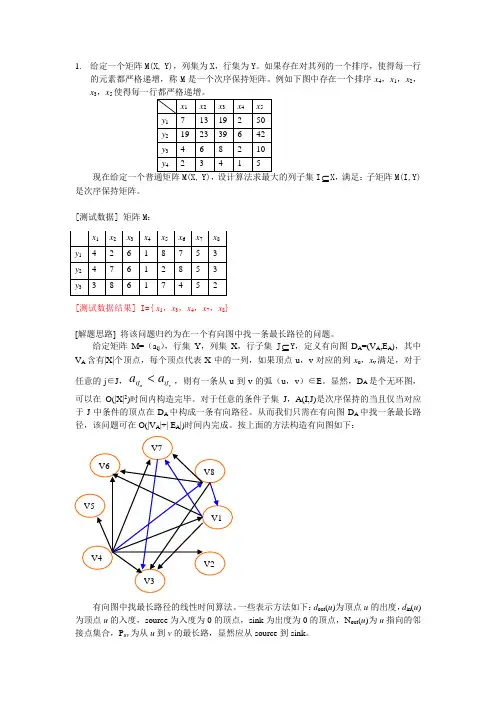
1. 给定一个矩阵M(X, Y),列集为X ,行集为Y 。
如果存在对其列的一个排序,使得每一行的元素都严格递增,称M 是一个次序保持矩阵。
例如下图中存在一个排序x 4,x 1,x 2,x 3,x 5I ⊆X ,满足:子矩阵M(I,Y)是次序保持矩阵。
[测试数据] 矩阵M :[测试数据结果] I={ x 1,x 3,x 4,x 7,x 8}[解题思路] 将该问题归约为在一个有向图中找一条最长路径的问题。
给定矩阵M=(a ij ),行集Y ,列集X ,行子集J ⊆Y ,定义有向图D A =(V A ,E A ),其中V A 含有|X|个顶点,每个顶点代表X 中的一列,如果顶点u ,v 对应的列x u ,x v 满足,对于任意的j ∈J ,u v ij ij a a <,则有一条从u 到v 的弧(u ,v )∈E 。
显然,D A 是个无环图,可以在O(|X|2)时间内构造完毕。
对于任意的条件子集J ,A(I,J)是次序保持的当且仅当对应于J 中条件的顶点在D A 中构成一条有向路径。
从而我们只需在有向图D A 中找一条最长路径,该问题可在O(|V A |+| E A |)时间内完成。
按上面的方法构造有向图如下:有向图中找最长路径的线性时间算法。
一些表示方法如下:d out (u )为顶点u 的出度,d in (u )为顶点u 的入度,source 为入度为0的顶点,sink 为出度为0的顶点,N out (u )为u 指向的邻接点集合,P uv 为从u 到v 的最长路,显然应从source 到sink 。
在每一步为每个顶点关联一个永久的或临时的标签。
v被赋了一个临时标签(v’,i v)表明在当前步,算法找出的最长的从source到v的有向路长度为i v,且经由v’而来。
v被赋了一个永久标签[v’,i v]表明从source到v的最长有向路长度为i v,且经由v’而来,通过回溯每个顶点的永久标签就可以找出最长有向路。
ACM程序大赛选拔初赛试题 - 参考答案
《解方程》参考答案:
#include <stdio.h> #include <math.h> void main() {
int a,b,c,d; float x1,x2; scanf("%d %d %d %d",&a,&b,&c,&d); if(a==0) printf("x=%.2f",(float)(d-c)/b); else {
float dr=b*b-4*a*c; c-=d; if(dr>0) {
x1=(-b-sqrt(dr))/(2*a); x2=(-b+sqrt(dr))/(2*a); printf("x1=%.2f x2=%.2f\n",x1,x2); } if(dr==0) { x1=(-b+sqrt(dr))/(2*a); printf("x=%.2f\n",x1); } if(dr<0) printf("no answer\n"); } }
3、计算器 (难度系数:★★★☆☆)
题意:输入一个没有答案的算术式子,用计算机求出输出它的结果。 输入:一个字符串形如“a#b=”(#代表运算符号)。注意:输入的字符串中 a,b 代表的数 都为自然数。而且 a,b 的范围都是从 0 到 999。 输出:字符串对应的算式的答案。答案需保留两位有效数字。若无答案则输出“error” 示例:
输出:第1 行是选出顺序,第2 行是两名幸运儿的开始位置(按升序排列),位置编号之 间用一个空格分开。
示例:
输入(只选一组) 3 5 12
输出(幸运儿的位置)
2 13 241 53 2 4 6 8 10 12 3 7 11 5 19
杭电acm练习题100例(删减版)

杭电acm练习题100例(删减版)【程序1】题目:有1、2、3、4个数字,能组成多少个互不相同且无重复数字的三位数?都是多少?1.程序分析:可填在百位、十位、个位的数字都是1、2、3、4。
组成所有的排列后再去掉不满足条件的排列。
#include "stdio.h"#include "conio.h"main(){ int i,j,k;printf("\n");for(i=1;i<5;i++) /*以下为三重循环*/for(j=1;j<5;j++)for (k=1;k<5;k++){ if (i!=k&&i!=j&&j!=k) /*确保i、j、k三位互不相同*/printf("%d,%d,%d\n",i,j,k); }getch(); }==============================================================【程序2】题目:企业发放的奖金根据利润提成。
利润(I)低于或等于10万元时,奖金可提10%;利润高于10万元,低于20万元时,低于10万元的部分按10%提成,高于10万元的部分,可可提成7.5%;20万到40万之间时,高于20万元的部分,可提成5%;40万到60万之间时高于40万元的部分,可提成3%;60万到100万之间时,高于60万元的部分,可提成1.5%,高于100万元时,超过100万元的部分按1%提成,从键盘输入当月利润I,求应发放奖金总数?#include "stdio.h" #include "conio.h"main(){ long int i;int bonus1,bonus2,bonus4,bonus6,bonus10,bonus;scanf("%ld",&i);bonus1=100000*0. 1;bonus2=bonus1+100000*0.75;bonus4=bonus2+200000*0.5;bonus6=bonus4+200000*0.3;bonus10=bonus6+400000*0.15;if(i<=100000)bonus=i*0.1;else if(i<=200000)bonus=bonus1+(i-100000)*0.075;else if(i<=400000)bonus=bonus2+(i-200000)*0.05;else if(i<=600000)bonus=bonus4+(i-400000)*0.03;else if(i<=1000000)bonus=bonus6+(i-600000)*0.015;elsebonus=bonus10+(i-1000000)*0.01;printf("bonus=%d",bonus);getch(); }====================================== ========================【程序3】题目:一个整数,它加上100后是一个完全平方数,再加上168又是一个完全平方数,请问该数是多少?#include "math.h"#include "stdio.h"#include "conio.h"main(){ long int i,x,y,z;for (i=1;i<100000;i++){ x=sqrt(i+100); /*x为加上100后开方后的结果*/y=sqrt(i+268); /*y为再加上168后开方后的结果*/if(x*x==i+100&&y*y==i+268)printf("\n%ld\n",i); }getch(); }====================================== ========================【程序4】题目:输入某年某月某日,判断这一天是这一年的第几天?#include "stdio.h" #include "conio.h"main(){ int day,month,year,sum,leap;printf("\nplease input year,month,day\n");scanf("%d,%d,%d",&year,&month,&day);switch(month) /*先计算某月以前月份的总天数*/{ case 1:sum=0;break;case 2:sum=31;break;case 3:sum=59;break;case 4:sum=90;break;case 5:sum=120;break;case 6:sum=151;break;case 7:sum=181;break;case 8:sum=212;break;case 9:sum=243;break;case 10:sum=273;break;case 11:sum=304;break;case 12:sum=334;break;default:printf("data error");break; }sum=sum+day; /*再加上某天的天数*/if(year%400==0||(year%4==0&&year%100!=0)) /*判断是不是闰年*/leap=1;elseleap=0;if(leap==1&&month>2) /*如果是闰年且月份大于2,总天数应该加一天*/sum++;printf("It is the %dth day.",sum);getch(); }====================================== ======================== 【程序5】题目:输入三个整数x,y,z,请把这三个数由小到大输出。
ACM竞赛试题集锦(2020年九月整理).doc
ACM竞赛试题集锦(2020年九⽉整理).doc取⽯⼦游戏Time Limit:1S Memory Limit:1000KTotal Submit:505 Accepted:90Description有两堆⽯⼦,数量任意,可以不同。
游戏开始由两个⼈轮流取⽯⼦。
游戏规定,每次有两种不同的取法,⼀是可以在任意的⼀堆中取⾛任意多的⽯⼦;⼆是可以在两堆中同时取⾛相同数量的⽯⼦。
最后把⽯⼦全部取完者为胜者。
现在给出初始的两堆⽯⼦的数⽬,如果轮到你先取,假设双⽅都采取最好的策略,问最后你是胜者还是败者。
Input输⼊包含若⼲⾏,表⽰若⼲种⽯⼦的初始情况,其中每⼀⾏包含两个⾮负整数a 和b,表⽰两堆⽯⼦的数⽬,a和b都不⼤于1,000,000,000。
Output输出对应也有若⼲⾏,每⾏包含⼀个数字1或0,如果最后你是胜者,则为1,反之,则为0。
Sample Input2 18 44 7Sample Output1跳蚤Time Limit:1S Memory Limit:1000KTotal Submit:198 Accepted:44DescriptionZ城市居住着很多只跳蚤。
在Z城市周六⽣活频道有⼀个娱乐节⽬。
⼀只跳蚤将被请上⼀个⾼空钢丝的正中央。
钢丝很长,可以看作是⽆限长。
节⽬主持⼈会给该跳蚤发⼀张卡⽚。
卡⽚上写有N+1个⾃然数。
其中最后⼀个是M,⽽前N个数都不超过M,卡⽚上允许有相同的数字。
跳蚤每次可以从卡⽚上任意选择⼀个⾃然数S,然后向左,或向右跳S个单位长度。
⽽他最终的任务是跳到距离他左边⼀个单位长度的地⽅,并捡起位于那⾥的礼物。
⽐如当N=2,M=18时,持有卡⽚(10, 15, 18)的跳蚤,就可以完成任务:他可以先向左跳10个单位长度,然后再连向左跳3次,每次15个单位长度,最后再向右连跳3次,每次18个单位长度。
⽽持有卡⽚(12, 15, 18)的跳蚤,则怎么也不可能跳到距他左边⼀个单位长度的地⽅。
acm编程比赛题
比赛试题主办方:迅翔计算机协会【问题描述】这是一个古老而又经典的问题。
用给定的几种钱币凑成某个钱数,一般而言有多种方式。
例如:给定了6种钱币面值为2、5、10、20、50、100,用来凑15元,可以用5个2元、1个5元,或者3个5元,或者1个5元、1个10元,等等。
显然,最少需要2个钱币才能凑成15元。
你的任务就是,给定若干个互不相同的钱币面值,编程计算,最少需要多少个钱币才能凑成某个给出的钱数。
【要求】【数据输入】输入可以有多个测试用例。
每个测试用例的第一行是待凑的钱数值M(1 <= M <= 2000,整数),接着的一行中,第一个整数K(1 <= K <= 10)表示币种个数,随后是K 个互不相同的钱币面值Ki(1 <= Ki <= 1000)。
输入M=0时结束。
【数据输出】每个测试用例输出一行,即凑成钱数值M最少需要的钱币个数。
如果凑钱失败,输出“Impossible”。
你可以假设,每种待凑钱币的数量是无限多的。
【样例输入】156 2 5 10 20 50 10011 2【样例输出】2Impossible【问题描述】Felicia 的生日是11月1日(和Kitty是同一天生的哦)。
于是Feli请来Kitty一起过生日。
Kitty带来了最新款的“Kitty猫”玩具准备送给Feli,不过她说,这份礼物可不是白送的。
Feli要帮她一个忙,才能够得到心仪已久的玩具。
Kitty说,“Kitty猫”玩具已经卖出了n!个,n<=10^100 *_*,Kitty想知道确切的数字,而不是无聊的“一个数加个感叹号”。
Feli 听了大吃一惊。
要知道,算出n!是一个无比艰巨的任务。
Feli告诉Kitty,就算Feli算出n!,Kitty也看不下去,因为当n=20 时,计算机的长整型已经存不下了(Kitty只能接受1-9之间的数字)。
于是Kitty说,你只要告诉我n!最后一位非0的数就可以了。
ACM比赛试题
The 35th ACM-ICPC Asia Regional Contest (Hangzhou)Contest SectionOctober 24, 2010Sponsored by IBM & AlibabaZhejiang Sci-Tech UniversityThis problem set should contain 10 problems on numbered 24 pages. Please inform a runner immediately if something is missing from your problem set.Problem A. Naughty fairiesDescriptionOnce upon a time, there lived a kind of fairy in the world. Those fairies could hear the voice of fruit trees, and helped people with a harvest. But people did n’t know that fruits are also those fairies’ favorite food. After the fairies ate people’s fruits, they always did something to cover it up.One day a little fairy named Lily flew into an orchard and found a large peach tree. Hungry as Lily was, she started eating without thinking until her stomach was full. In the fairy world, when a fairy ate the fruits in a fruit tree, sometimes the fruit tree would feel honored and bore more fruits immediately. That’s why sometimes the number of fruits in a tree got increased after a fairy ate fruits of that tree.But the fairies didn’t want people to find out weird things such as fruits become more or less suddenly. Lily decided to use a magic spell so that the orchard owner couldn’t find the change of the number of p eaches.Suppose there were N peaches on a tree originally and there were M peaches left after Lily was full. M may be greater than, less than or equal to N. All M peaches were visible at first, and Lily wanted to make an illusion so that exactly N peaches are visible.Lily can do 3 kinds of spell to change the total visible number of peaches:1) “PAPADOLA”:This spell would increase the number of visible peaches by one.2) “EXPETO POTRONUM”:This spell would double the number of visible peaches.3) “SAVIDA LOHA”:This spell would decrease the number of visible peaches by one. Each spell would take one minute and Lily wanted to finish as fast as possible. Now please tell Lily the least time she needs to change the number of visible peaches to N.InputThere are several test cases, ended by “0 0”.For each test case, there are only one line containing two numbers separated by a blank, N and M, the original numbers of peaches and the numbers of peaches left(0<N,M<10500).There is no leading zero.OutputFor each test case, you should output just a number K indicating the minimum time (in minutes) Lily needed to finish her illusion magic.Sample Input5 21 9986 320 0Sample Output29812Problem B. Prison BreakDescriptionRompire is a robot kingdom and a lot of robots live there peacefully. But one day, the king of Rompire was captured by human beings. His thinking circuit was changed by human and thus became a tyrant. All those who are against him were put into jail, including our clever Micheal#1. Now it’s time to escape, but Micheal#1 needs an optimal plan and he contacts you, one of his human friends, for help.The jail area is a rectangle contains n×m little grids, each grid might be one of the following:1) Empty area, represented by a capital letter ‘S’.2) The starting position of Micheal#1, represented by a capital letter ‘F’.3) Energy pool, represented by a capital letter ‘G’. When entering a n energy pool, Micheal#1 can use it to charge his battery ONLY ONCE. After the charging, Micheal#1’s batt ery will become FULL and the energy pool will become an empty area. Of course, passing an energy pool without using it is allowed.4) Laser sensor, represented by a capital letter ‘D’. Since it is extremely sensitive, Micheal#1 cannot step into a grid with a laser sensor.5) Power switch, represented by a capital letter ‘Y’. Once Micheal#1 steps into a grid with a Power switch, he will certainly turn it off.In order to escape from the jail, Micheal#1 need to turn off all the power switches to stop the electric web on the roof—then he can just fly away. Moving to an adjacent grid (directly up, down, left or right) will cost 1 unit of energy and only moving operation costs energy. Of course, Micheal#1 cannot move when his battery contains no energy.The larger the battery is, the more energy it can save. But larger battery means more weight and higher probability of being found by the weight sensor. So Micheal#1 needs to make his battery as small as possible, and still large enough to hold all energy he need. Assuming that the size of the battery equals to maximum units of energy that can be saved in the battery, and Micheal#1 is fully charged at the beginning, Please tell him the minimum size of the battery needed for his Prison break.InputInput contains multiple test cases, ended by 0 0. For each test case, the first line contains two integer numbers n and m showing the size of the jail. Next n lines consist of m capital letters each, which stands for the description of the jail.You can assume that 1<=n,m<=15, and the sum of energy pools and power switches is less than 15.OutputFor each test case, output one integer in a line, representing the minimum size of the battery Micheal#1 needs. If Micheal#1 can’t escape, output -1.Sample Input5 5GDDSSSSSFSSYGYSSGSYSSSYSS0 0Sample Output4Problem C. To Be an Dream Architect DescriptionThe “dream architect” is the key role in a team of “dream extractors” who enter other’s dreams to steal secrets. A dream architect is responsible for crafting the virtual world that the team and the target will dream into. To avoid the target noticing the world is artificial, a dream architect must have powerful 3D imagination.Cobb uses a simple 3D imagination game to test whether a candidate has the potential to be an dream architect. He lets the candidate imagine a cube consisting of n×n×n blocks in a 3D coordinate system as Figure 1. The block at bottom left front corner is marked (1, 1, 1) and the diagonally opposite block is marked (n, n, n). Then he tells the candidate that the blocks on a certain line are eliminated. The line is always parallel to an axis. After m such block eliminations, the candidate is asked to tell how many blocks are eliminated. Note that one block can only be eliminated once even if it is on multiple lines.Here is a sample graph according to the first test case in the sample input:InputThe first line is the number of test cases.In each test case, the first line contains two integers n and m( 1 <= n <= 1000, 0 <= m <= 1000).,meaning that the cube is n x n x n and there are m eliminations.Each of the following m lines represents an elimination in the following format:axis_1=a, axis_2=bwhere axis_i (i=1, 2) is ‘X’ or ‘Y’, or ‘Z’ and axis_1 is not equal to axis_2. a and b ar e 32-bit signed integers.OutputFor each test case output the number of eliminated blocks.Sample Input23 2Y=1,Z=3X=3,Y=110 2X=3,Y=3Y=3,Z=3Sample Output519Problem D. GomokuDescriptionYou are probably not familiar with the title, “Gomoku”, but you must have played it a lot. Gomoku is an abstract strategy board game and is also called Five in a Row, or GoBang. It is traditionally played with go pieces (black and white stones) on a go board (19x19 intersections). Nowadays, standard chessboard of Gomoku has 15x15 intersections. Black plays first, and players alternate in placing a stone of their color on an empty intersection. The winner is the first player to get an unbroken row of five or more stones horizontally, vertically, or diagonally.For convenience, we coordinate the chessboard as illustrated above. The left-bottom intersection is (0,0). And the bottom horizontal edge is x-axis, while the left vertical line is y-axis.I am a fan of this game, actually. However, I have to admit t hat I don’t have a sharp mind. So I need a computer program to help me. What I want is quite simple. Given a chess layout, I want to know whether someone can win within 3 moves, assuming both players are clever enough. Take the picture above for example. There are 31 stones on it already, 16 black ones and 15 white ones. Then we know it is white turn. The white player must place a white stone at (5,8). Otherwise, the black player will win next turn. After that, however, the white player also gets a perfect situation that no matter how his opponent moves, he will win at the 3rd move.So I want a program to do similar things for me. Given the number of stones and positions of them, the program should tell me whose turn it is, and what will happen within 3 moves.InputThe input contains no more than 20 cases.Each case contains n+1 lines which are formatted as follows.nx1 y1 c1x2 y2 c2......x n y n c nThe first integer n indicates the number of all stones. n<=222 which means players have enough space to place stones. Then n lines follow. Each line contains three integers: x i and y i and c i. x i and y i are coordinates of the stone, and ci means the color of the stone. If c i=0 the stone is white. If c i=1 the stone is black. It is guaranteed that 0<=x i,y i<=14, and c i=0 or 1. No two stones are placed at the same position. It is also guaranteed that there is no five in a row already, in the given cases.The input is ended by n=0.OutputFor each test case:First of all, the program should check whose turn next. Le t’s call the player who will move next “Mr. Lucky”. Obviously, if the number of the black stone equals to the number of white, Mr. Lucky is the black player. If the number of the black stone equals to one plus the numbers of white, Mr. Lucky is the white player. If it is not the first situation or the second, print “Invalid.”A valid chess layout leads to four situations below:1)Mr. Lucky wins at the 1st move. In this situation, print :Place TURN at (x,y) to win in 1 move.“TURN” must be replaced by “black” or “white” according to the situation and (x,y) is the position of the move. If there are different moves to win, choose theone where x is the smallest. If there are still different moves, choose the one where y is the smallest.2)Mr. Lucky’s opp onent wins at the 2nd move. In this situation, print:Lose in 2 moves.3)Mr. Lucky wins at the 3rd move. If so, print:Place TURN at (x,y) to win in 3 moves.“TURN” should replaced by “black” or “white”, (x,y) is the position where the Mr.Lucky should place a stone at the 1st move. After he place a stone at (x,y), no matter what his opponent does, Mr. Lucky will win at the 3rd step. If there are multiple choices, do the same thing as described in situation 1.4)Nobody wins within 3 moves. If so, print:Cannot win in 3 moves.Sample Input313 3 13 4 03 5 03 6 04 4 14 5 14 7 05 3 05 4 05 5 15 6 15 7 15 9 16 4 16 5 16 6 06 7 16 8 06 9 07 5 17 6 07 7 17 8 17 9 08 5 08 6 18 7 08 8 18 9 09 7 110 8 017 7 117 7 0Sample OutputPlace white at (5,8) to win in 3 moves. Cannot win in 3 moves.Invalid.Problem E. GunshotsDescriptionPresident Bartlet was shot! A group of terrorists shot to the crowd when President Bartlet waved to cheering people after his address. Many people were shot by the irrational bullets. Senior FBI agent Don Epps takes responsibility for this case. According to a series of crime scene investigation, including analyzing shot shells, replaying video from closed-circle television and collecting testimony by witnesses, Don keeps all the information about where and how the terrorists shot to crowd, as well as the location of every single person when the gun shoot happened. Now he wants to know how many gunshot victims are there in this case.Imagine that each target person can be regarded as a polygon (can be concave or self-intersecting) and each gunshot can be regarded as a half-line. The bullet will be stopped by the first person it shoots. A person can be shot in three ways:To simplify the problem, we assume that any two polygons can be completely separated by a line. Also each start point of the gunshot can be separated from each polygon by a line. Now given M people and N gunshots, please work out which person has been shot by each bullet.InputThere are multiple test cases in the input. The first line of the input file is an integer T demonstrating the number of test cases. (T<=10).For each test case, the first line is an integer N, representing the number of people (polygons). Following lines demonstrates the polygons. For the i th polygon (0<=i<N), the first line is an integer Q i , representing the number of edges of this polygon. In each of the following Q i lines, there are two real numbers x i and y i representing a point. Every pair of adjacent points demonstrate an edge of this polygon (i.e. (x i , y i ) to (x i+1, y i+1) is an edge, in which 0<=i<Q i -1), and (x Qi-1, y Qi-1) to (x 0, y 0) also demonstrates an edge of this polygon.PersonPerson Person 1. Normal shot 2. The bullet’s path isparallel to an edge 3. The bullet’s path is tangent to an vertexThen there is a line contains an integer M representing the number of gunshots. In the following M lines, each line contains four real numbers x, y, dx and dy, representing the start point (x, y) and direction vector (dx, dy) of that gunshot.In all test cases, we assume that 0< N<=100, 0<Q i<=1000, 0<M<=10000.OutputFor each test case, output contains M lines and the i th line demonstrates the result of the i th gunshot.If the i th gunshot shoots the j th polygon, the i th line contains “HIT j”, otherwise it contains a word “MISS” (means that it does not shoot any target). The polygons are numbered in the order of their appearance in the input file, and the numbers start from 0.At the end of each test case, please output a single line with “*****”.Sample Input1140 01 10 11 02-1 0 1 0-2 0 -1 0Sample OutputHIT 0MISS*****HintThe figure of the first case in the samples is as follows:Problem F. Rotational PaintingDescriptionJosh Lyman is a gifted painter. One of his great works is a glass painting. He creates some well-designed lines on one side of a thick and polygonal glass, and renders it by some special dyes. The most fantastic thing is that it can generate different meaningful paintings by rotating the glass. This method of design is called “Rotatio nal Painting (RP)” which is created by Josh himself.You are a fan of Josh and you bought this glass at the astronomical sum of money. Since the glass is thick enough to put erectly on the table, you want to know in total how many ways you can put it so that you can enjoy as many as possible different paintings hiding on the glass. We assume that material of the glass is uniformly distributed. If you can put it erectly and stably in any ways on the table, you can enjoy it.More specifically, if the polygonal glass is like the polygon in Figure 1, you have just two ways to put it on the table, since all the other ways are not stable. However, the glass like the polygon in Figure 2 has three ways to be appreciated.Pay attention to the cases in Figure 3. We consider that those glasses are not stable.InputThe input file contains several test cases. The first line of the file contains an integer T representing the number of test cases.For each test case, the first line is an integer n representing the number of lines of the polygon. (3<=n<=50000). Then n lines follow. The i th line contains two real number x i and y i representing a point of the polygon. (x i, y i) to (x i+1, y i+1) represents a edge of the polygon (1<=i<n), and (x n,y n) to (x1, y1) also represents a edge of the polygon. The input data insures that the polygon is not self-crossed.OutputFor each test case, output a single integer number in a line representing the number of ways to put the polygonal glass stably on the table.Sample Input240 0100 099 11 160 00 101 101 110 110 0Sample Output23HintThe sample test cases can be demonstrated by Figure 1 and Figure 2 in Description part.Problem G. Traffic Real Time Query System DescriptionCity C is really a nightmare of all drivers for its traffic jams. To solve the traffic problem, the mayor plans to build a RTQS (Real Time Query System) to monitor all traffic situations. City C is made up of N crossings and M roads, and each road connects two crossings. All roads are bidirectional. One of the important tasks of RTQS is to answer some queries about route-choice problem. Specifically, the task is to find the crossings which a driver MUST pass when he is driving from one given road to another given road.InputThere are multiple test cases.For each test case:The first line contains two integers N and M, representing the number of the crossings and roads.The next M lines describe the roads. In those M lines, the i th line (i starts from 1)contains two integers X i and Y i, representing that road i connects crossing X i and Y i (X i≠Y i).The following line contains a single integer Q, representing the number of RTQs. Then Q lines follows, each describing a RTQ by two integers S and T(S≠T) meaning that a driver is now driving on the road s and he wants to reach road t . It will be always at least one way from road s to road t.The input ends with a line of “0 0”.Please note that: 0<N<=10000, 0<M<=100000, 0<Q<=10000, 0<X i,Y i<=N, 0<S,T<=M OutputFor each RTQ prints a line containing a single integer representing the number of crossings which the driver MUST pass.Sample Input5 61 22 33 44 53 522 32 40 0Sample Output 01Problem H. National Day ParadeDescriptionThere are n×n students preparing for the National Day parade on the playground. The playground can be considered as a n×m grid. The coordinate of the west north corner is (1,1) , and the coordinate of the east south corner is (n,m).When training, every students must stand on a line intersection and all students must form a n×n square. The figure above shows a 3×8 playground with 9 students training on it. The thick black dots stand for the students. You can see that 9 students form a 3×3 square.After training, the students will get a time to relax and move away as they like. To make it easy for their masters to control the training, the students are only allowed to move in the east-west direction. When the next training begins, the master would gather them to form a n×n square again, and the position of the square doesn’t matter. Of course, no student is allowed to stand outside the playground.You are given the coordinates of each student when they are having a rest. Your task is to figure out the minimum sum of distance that all students should move to form a n×n square.InputThere are at most 100 test cases.For each test case:The first line of one test case contain two integers n,m. (n<=56,m<=200)Then there are n×n lines. Each line contains two integers, 1<=X i<=n,1<= Y i<=m indicating that the coordinate of the i th student is (X i , Y i ). It is possible for more than one student to stand at the same grid point.The input is ended with 0 0.OutputYou should output one line for each test case. The line contains one integer indicating the minimum sum of distance that all students should move to form a n×n square. Sample Input2 1682 1011 1271 1052 900 0Sample Output41Problem I. SearchlightsDescriptionThere is a piece of grids land of size n×m. Chandler and his team take responsibility to guard it. There are some searchlights on some pieces and each of them has a capability to lighten a distance towards four directions: north, south, east and west. Different searchlight has different lightening capability shown in levels. Searchlight with level k means that it can lighten k grids (including the gird that the searchlight stands in) along any of the four directions. Shown in following figure, there is a searchlight of level 3 and the shadow grids are ones that can be lightened by it. Particularly, searchlight of level 1 means that it can only lighten the grid in which the searchlight stands.Figure: A searchlight of Level 3Each searchlight has a maximum level. You can decrease a searchlight’s level to save the energy. A searchlight whose maximum level is k can be turned to level k, k-1, k-2, …, 1 and 0. Level 0 means turning off the searchlight.A grid is well-guarded if and only if at least one of the following two conditions is satisfied:1.There is a searchlight in this grid, and it is not switched to level 0 (the light is on).2.The grid is lightened by at least two searchlights. One lightens it in horizontaldirection (east or west), and another lightens it in vertical direction (north or south).Chandler asks you to help finding a solution that he can turn on some of the searchlights so that:1.All the grids are well-guarded.2.All the searchlights turned on are in a same level.3.That same level mentioned above is as small as possible.More specifically, if you choose a same level Q, then all the searchlights whose maximum level are less than Q have to be turned off. Please help him to find a solution with the minimum same level.InputThe input file contains several test cases.For each test case, the first line is two integers n and m, representing a grids land of size n×m. (0<n<=100, 0<m<=10000). Following n lines describe an n×m matrix in which a i,j means the maximum level of the searchlight in grid (i, j). a i,j can be zero, which means there is no searchlight on that grid. For all the cases, a i, j<=10000.The input file ends with a line containing two zeros.OutputFor each test case, output a single line with an integer, representing the minimum level you have found. If there is no such a solution, output “NO ANSWER!”Sampl e Input2 20 23 02 20 21 00 0Sampl e Output2NO ANSWER!Problem J. Infinite monkey theorem DescriptionCould you imaging a monkey writing computer programs? Surely monkeys are smart among animals. But their limited intelligence is no match for our human beings. However, there is a theorem about monkeys, and it states that monkeys can write everything if given enough time.The theorem is called “Infinite monkey theorem”. It states that a monkey hitting keys at random on a typewriter keyboard for an infinite amount of time will almost surely type any given text, which of course includes the programs you are about to write (All computer programs can be represented as text, right?).It’s very easy to prove this theorem. A little calculation will show you that if the monkey types for an infinite length of time the probability that the output contains a given text will approach 100%.However, the time used is too long to be physically reasonable. The monkey will not be able to produce any useful programs even if it types until the death of the universe. To verify this and ensure that our human beings are not replaceable by monkeys, you are to calculate the probability that a monkey will get things right.InputThere will be several test cases.Each test case begins with a line containing two integers n and m separated by a whitespace (2<=n<=26, 1<=m<=1000). n is the number of keys on the typewriter and the monkey will hit these keys m times. Thus the typewriter will finally produce an output of m characters.The following n lines describe keys on the typewriter. Each line has a lower case letter and a real number separated by a whitespace. The letter indicates what the typewriter will produce if the monkey hits that key and the real number indicates the probability that the monkey will hit this key. Two hits of the monkey are independent of each other (Two different hits have the same probability for a same key), and sum of all the probabilities for each key is ensured to be 1.The last line of the test case contains a word composed of lower case letters. The length of the word will be less than or equal to 10.The input will end with a line of two zeros separated by a whitespace. This line should not be processed.OutputFor each test case, output one line containing the probability that the given word will appear in the typewriter’s output. The output should be in percentage format and numbers should be rounded to two digits after the decimal point.Sampl e Input4 10w 0.25o 0.25r 0.25d 0.25word2 10a 1.0b 0.0abc2 100a 0.312345b 0.687655abab0 0Sampl e Output2.73%0.00%98.54%。
ACM程序设计试题
ACM程序设计试题1.平方数给出包含M个数字的列表,和列表中所有数字的所有质因数。
求出最长的子列表,使得子列表中所有数字的乘积是一个完全平方数。
输入输入文件包含多组测试数据。
第一行包含两个整数N , M ( 1 <= N <= 30 , 1 <= M <= 30000 ). N 是质因数的个数。
接下来一行有N个整数,给出所有的质因数。
然后一行包含M 个整数,给出列表。
输入文件结束于N = M = 0.输出对于每组数据,输出最长子列表的两个位置坐标l r。
l是该子列表在列表中的起始位置,r是结束位置。
如果多种情况都满足子列表长度最大,输出l最小的一个。
如果不存在这样的子列表输出“None”。
样例输入3 42 3 54 9 25 63 42 3 56 6 3 30 0样例输出1 31 42.母牛生小牛Problem设有一头小母牛,从出生第四年起每年生一头小母牛,按此规律,第N年时有几头母牛?Input本题有多组数据。
每组数据只有一个整数N,独占一行。
(1≤N≤50)Output对每组数据,输出一个整数(独占一行)表示第N年时母牛的数量Sample Input145Sample Output1238723.死亡迷宫背景很久以前,迷宫里住着一个恶魔。
一天,我们伟大的英雄Andy无意中踏入了这个迷宫。
不幸的是,他被困在这个迷宫当中了。
恶魔在迷宫中召唤出了许多怪物,想要阻止Andy逃脱。
在迷宫中,Andy遇到一个一位巫师。
他给了Andy迷宫的地图,并告诉他迷宫的入口很快会关闭。
Andy必须以非常快的速度到达入口,并且有足够的力气推开挡在入口的岩石。
于是,Andy带着地图一路向着出口走去……问题给出Andy和各怪物的能量, 攻击力, 防御力,和迷宫的地图,请你计算一下能量/耗时的最大值。
当Andy走到有怪物的地方时,Andy会先进行攻击,然后怪物攻击,然后Andy……当一方的能量小于等于0时攻击停止,并且小于等于0的一方死亡。