
市场营销-外文翻译
外文原文[1]Sales IncentivesThe enthusiasm and drive required in most types of sales work demand that sales employees be highly motivated. This fact, as well as the competitive nature of selling, explains why financial incentives for salespeople are widely used. These incentive plans must provide a source of motivation that will elicit cooperation and trust. Motivation is particularly important for employees away from the office who cannot be supervised closely and who, as a result, must exercise a high degree of self-discipline.Unique Needs of Sales Incentive PlansIncentive systems for salespeople are complicated by the wide differences in the types of sales jobs. These range from department store clerks who ring up customer purchases to industrial salespeople from McGraw-Edison who provide consultation and other highly technical services. Salespeople's performance may be measured by the dollar volume of their sales and by their ability to establish new accounts. Other measures are the ability to promote new products or services and to provide various forms of customer service and assistance that do not produce immediate sales revenues.Performance standards for sales employees are difficult to develop, however, because their performance is often affected by external factors beyond their control. Economic and seasonal fluctuations, sales competition, changes in demand, and the nature of the sales territory can all affect an individual's sales record. Sales volume alone therefore may not be an accurate indicator of the effort salespeople have expended.In developing incentive plans for salespeople, managers are also confronted with the problem of how to reward extra sales effort and at the same time compensate for activities that do not contribute directly or immediately to sales. Furthermore, sales employees must be able to enjoy some degree of income stability.[2]360-degree performance assessmentEnterprises exist mainly in the pursuit of profit, the pursuit of growth, and achieve sustainable business purposes. But in the course of business of raw materials, capital and equipment are required by the "person" can operate. Therefore, how to let the limited raw materials, equipment, and funds created endless profits, human resources play a very important role. A lot of human resources in enterprises, "manager" towards the success of the enterprise is at stake. The manager must often make many in the management decision-making, although the correct decision-making enterprises to be another peak, but it may be the wrong decision based company accumulated overnight. Therefore, how to understand the manager in an appropriate manner to the management, development and recognition of their request on a corporate human resources management a very important task.What is an assessmentComprehensive assessment, also known as the "360-degree performance appraisal system," the earliest known "symbol of the United States forces" model enterprise Intel first proposed and implemented. It refers to the staff themselves, supervisors, direct subordinates, peers, colleagues and even customers, the all-round perspective of the performance of individual understanding : communication skills, interpersonal, leadership and administrative capabilities : : Through this ideal performance assessment, the assessment was not only from those who own, supervisors, subordinates, colleagues and even customers to obtain feedback from a variety of angles. The feedback from these can be clearly aware of their different shortcomings, strengths and development needs, so that future career development more smoothly. I personally think : to assess the way many managers, but "360-degree evaluation - management skills" may be the best.What is self-evaluationThe so-called self-evaluation means : Let the manager's performance against its own performance in the period, or to assess their performance based on the performance and capacity of the future and set goals accordingly. When employees to do their own assessment, usually lower self-defense awareness and thereby understand his own shortcomings and thereby to strengthen, develop or add to their own inadequacies.Generally speaking, employees are usually the result of self-assessment and evaluation of different supervisors. And the evaluation of supervisors or colleagues compared regular staff will give their own high scores. Therefore, the use of self-assessment should be particularly careful. In return for the higher self-assessment, evaluation and staff should know that their self-assessment may have differences, and may form the rigid positions of the two sides, and this is the use of self-assessment should pay particular attention to the matter.Members of the evaluationMembers of the evaluation is to assess the performance of each of my colleagues that the way to achieve performance evaluation purposes. For some work, sometimes with the superior and subordinate time and communication opportunities, but not between subordinate. In such superior and subordinate contacts are short of time, have very little communication between the cases, superior to the performance assessment will be very difficult to establish. But on the contrary, among subordinates work together for a long time, they will understand each other more than superior and subordinate. At this time, among them mutual assessment, but can more objective. Moreover, the return on each other between, let them know that they can be in interpersonal communication capacity in this respect. For example, the foreign invested enterprises in Beijing a performance evaluation methods, it contains a peer evaluation. According to the company's Human Resources Manager said that in assessing the accuracy of the appraisal method, and not higher than the appraisal results for the poor. And peer evaluation forms can also fill his subordinates to assess mistakes. And the assessment results, but also for my colleagues in the eyes of their subordinates understand themselves in teamwork, interpersonal, how performance. In addition the company also said that if performanceassessment results for selected personnel, peer evaluation in this way often meet people convinced that the results.Subordinate evaluationBy the Ministry to evaluate supervisors, the traditional concept of human resources, workers seem to be a bit incredible. However, as the development of the knowledge-based economy, a growing number of companies allow employees to assess their level of competence performance, the process known as upward feedback (positive feedback). This approach to performance assessment of the development potential for the development of superior, particularly valuable. Feedback through subordinate managers, clearly aware of their need to strengthen local management capacity what? If their own understanding and direction for the evaluation of the gap between too much, can address this gap competent, in-depth understanding of these reasons. Therefore, some experts believe that human resources management, subordinate to the higher authorities for the assessment of its management will be a great benefit to the development.Customer evaluationClients in the evaluation of services, marketing, personnel of particular importance. Because only the most clear customer relations staff in customer service, marketing skills and attitude to performance. Therefore, in similar related industries, the performance assessment system in the evaluation could be included in the assessment system customers.In fact, the number of services (for example : the financial industry, catering industry, etc.) often use such performance assessment (such as the selection of best service personnel). Because service quality of service, customer service attitude by most clearly. As far as I know, many renowned domestic companies customer service department will periodically to sample the way, please assess the customer service performance of the company customer service personnel. For the evaluation ofFor the assessment of our performance evaluation is the most common way that performance is assessed by a competent implementation. As for the need to become familiar with the assessment methods, and use of performance assessment results as guidance units, the development potential of important commands weapons.[1] George Bohlander sott snell Managing Human Resources[M]. Dongbai University of Finance& Economics press 2003.10 P437-438[2] George Bohlander sott snell Managing Human Resources[M]. Dongbai University of Finance& Economics press 2003.10 P343-345外文译文[1]销售人员的激励各种类型的销售工作所必需的热情与动力要求销售人员得到高度激励。
市场营销(英文版)

formation
信息处理方式
消费者如何处理和记忆信息,如选择 性注意、记忆重构等。
态度形成与改变
探究消费者态度形成的因素,以及如 何通过营销手段改变消费者态度。
05
Digital Marketing and Social Media Marketing
Digital marketing strategy
Product positioning
Determine how your product compares to competitors and position it accordingly. Use descriptors and branding to differentiate your product from the competition.
Sales promotion
Use temporary sales and promotions to boost sales and attract customers. This can include discounts, bundle offers, or limited-time offers.
• Brand management and brand building
01
Marketing Overview
Definition and Concepts
• Definition: Marketing is the process of planning and executing the concept, pricing, promotion, and distribution of ideas, goods, and services to achieve a profitable exchange with target customers.
市场营销管理-外文翻译(可编辑)

市场营销管理-外文翻译(可编辑)市场营销管理-外文翻译外文翻译原文Title: Marketing managementMaterial Source: Marketing Management Author: Philip KotlerIn fact, we can distinguish three stages through which marketing practice might pass:1. Entrepreneurial marketing: Most companies are started by individuals who visualize an opportunity and knock on every door to gain attention. Jim Koch, founder of Boston Beer Company, whose Samuel Adams beer has become a top-selling “craft” beer, started out in 1984 carrying bottles of Samuel Adams from bar to bar to persuade bartenders to carry it. For 10 years, he sold his beer through direct selling and grassroots public relations. Today his business pulls in nearly$200 million, making it the leader in the U.S. craft beer market.22. Formulated marketing: As small companies achieve success, they inevitably move toward more formulated marketing. Boston Beer recently began a$15 million television advertising campaign. The company now employs more that 175 salespeople and has a marketing department that carries on market research, adopting some of the tools used in professionally run marketing companies.3. Coordinated marketing: Many large companies get stuck in formulated marketing, poring over the latest ratings, scanning research reports, trying to fine-tune dealer relations and advertising messages. These companies lack the creativity and passion of the guerrilla marketers in the entrepreneurial stage. Their brand and product managers need to start living with their customers and visualizing new ways to add value to their customers’ lives.The bottom line is that effective marketing can take many forms. Although it is easier to study the formulated side which will occupy most of our attention in this book, we will also see how creativity and passion can be used by today and tomorrow’s marketing managers.Marketers and ProspectsA marketer is someone who is seeking a response attention, a purchase, a vote, a donation from another party, called the prospect. If two parties are seeking to sell something to each other, both are marketers.Needs, Wants, and DemandsThe successful marketer will try to understand the target market’s needs, wants, and demands. Needs describes basic human requirements such as food, air, water, clothing, and shelter. People also have strong needs for recreation, education, and entertainment. These needs become wants when they are directed to specific objects that might satisfy the need. An American needs food but wants a hamburger, French fries, and a soft drink. A person in Mauritius needs food butwants a mango, rice, lentils, and beans. Clearly, wants are shaped by one’s society.Demands are wants for specific products backed by an ability to pay. Many people want a Mercedes; only a few are able and willing to buy one. Companies must measure not only how many people want their product, but also how many would actually be willing and able to buy it.However, marketers do not create needs: Needs that preexists marketers. Marketers, along with other societal influences, influence wants. Marketers might promote the idea that a Mercedes would satisfy a person’s need for social status. They do not, how-ever, create the need for social status.Product or OfferingPeople satisfy their needs and wants with products. A product is any offering that we can satisfy a need or want, such as one of the 10 basic offerings ofgoods,services,experi-ences,events,persons,places,properties,organizations,information,and ideas.A brand is an offering from a known source. A brand name such as McDonald’s carries many associations in the minds of people: hamburgers, fun, children, fast food, golden arches. These associations make up the brand image. All companies strive to build a strong, favorable brand image.Value and SatisfactionIn terms of marketing, the product or offering will be successful if it delivers value and satisfaction to the target buyer. The buyer chooses between different offerings on the basis of which is perceived to deliver the most value. We define value as a ratio between what the customer gets and what he gives. The customer gets benefits and assumes costs, as shown in this equation.A customer choosing between two value offerings, V1and V2, will examine the ratio V1/V2.She will favor V1 if the ratio is larger than one; she will favor V2 if the ratio is smaller than one; and she will be indifferent if the ratio equals one.Exchange and TransactionsExchange, the core of marketing, involves obtaining a desiredproduct from someone by offering something in return. For exchange potential to exist, five conditions must be satisfied:1. There are at least two parties.2. Each party has something that might be of value to the other party.3. Each party is capable of communication and delivery. Marketing Tasks 74. Each party is free to accept or reject the exchange offer.5. Each party believes it is appropriate or desirable to deal with the other party.Whether exchange actually takes place depends upon whether the two parties can agree on terms that will leave them both better off or atleast not worse off than before. Exchange is a value-creating process because it normally leaves both parties better off.Note that exchange is a process rather than an event. Two partiesare engaged in exchange if they are negotiating?trying to arrive at mutually agreeable terms. When an agreement is reached, we say that a transaction takes place. A transaction involves at least two things of value, agreed-upon conditions, a time of agreement, and a place of agreement usually a legal system exists to support and enforce compliance among of transactors. However, transactions do not require money as one of the traded values. A barter transaction, for example, involves trading goods or services for other goods or services.Note also that a transaction differs from a transfer. In a transfer, A gives a gift, a subsidy, or a charitable contribution to B but receives nothing tangible in return. Transfer behavior can also be understood through the concept of exchange. Typically, the transfer expects something in exchange for his or her gift?for example, gratitude or seeing changed behavior in the recipient. Professional fund-raisers providebenefits to donors, such as thank-you notes. Contemporary marketers have broadened the concept of marketing to include the study of transfer behavior as well as transaction behavior.Marketing consists of actions undertaken to elicit desired responses from a tar-get audience. To effecting successful exchanges, marketersanalyze what each party expects from the transaction. SupposeCaterpillar, the world’s largest manufacturer of earth-moving equipment, researches the benefits that a typical construction company wantswhen it buys such equipment. The items shown on the prospect want listin Figure 1-2 are not equally important and may vary from buyer to buyer. One of Caterpillar’s marketing tasks is to discover the relative importance of these different wants to the buyer.As the marketer, Caterpillar also has a want list. If there is a sufficient match or overlap in the want lists, a basis for a transaction exists. Caterpillar’s task is to form u-late an offer that motivatestheconstruction company to buy Caterpillar equipment. The construction company might, in turn, make a counter offer. This process ofnegotiation leads to mutually acceptable terms or a decision not to transact.Relationships and NetworksTransaction marketing is part of a larger idea called relationship marketing. Relationship marketing aims to build long-term mutually satisfying relations with key par-ties?customers, suppliers, distributors?in order to earn and retain their long-term preference and business.10 Effective marketers accomplish this by promising and delivering high-quality products and services at fair prices to theother parties over time. Relationship marketing builds strong economic, technical, and social ties among the parties. It cuts down ontransaction costs and time. In the most successful cases, transactions move from being negotiated each time to being a matter of routine.The ultimate outcome of relationship marketing is the building of a unique company asset called a marketing network. A marketing network consists of company and its supporting stake holder customers, employees, suppliers, distributorsScientists, and others with whom it has built mutually profitable business relationships. Increasingly, competition is not between companies but rather between marketing networks, with the profits going to the company that has the better network.Marketing ChannelsTo reach a target market, the marketer uses three kinds of marketing channels. Communication channels deliver messages to and receive messages from target buyers.Thenewspapers,magazines,radio,television,mail,telephone,billboards,p osters,fliers,CDs,audiotapes,and the Internet. Beyond these, communications are conveyed by facial expressions and clothing, the look of retail stores, and many other media. Marketers are increasingly adding dialogue channels e-mail and toll-free numbers to counterbalance the more normal monologue channels such as ads.The marketer uses distribution channels to display or deliver the physical product or services to the buyer or user. There are physical distribution channels and service distribution channels, which include warehouses, transportation vehicles, and various trade channels such asdistributors, wholesalers, and retailers. The marketer also uses selling channels to effect transactions with potential buyers. Selling channels include not only the distributors and retailers but also the banks and insurance companies that facilitate transactions. Marketers clearly face a design problem in choosing the best mix of communication, distribution, and selling channels for their offerings.Supply ChainWhereas marketing channels connect the marketer to the target buyers, the supply chain describes a longer channel stretching from rawmaterials to components to final products that are carried to final buyers. For example, for women’s purses starts with hides, opera tions, cutting operations, manufacturing, and the marketing channels thatbrings products to customers. This supply chain represents a value delivery system. Each company captures only a certain percentage of the total valuegenerated by the supply chain. When a company acquires competitorsor moves upstream or downstream, its aim is to capture a higher percentage of supply chain value.CompetitionCompetition, a critical factor in marketing management, includes all of the actual and potential rival offerings and substitutes that a buyer might consider. Suppose an automobile company is planning to buy steelfor its cars. The car manufacturer can buy from U.S. Steel or other U.S. or foreign integrated steel mills; can go to a small plant suchMarketing Tasks 9 as Nucor to buy steel at a cost savings; can buy aluminum for certain parts of the car to lighten the car’s weight; or can buy some engineered plastics parts instead of steel. Clearly U.S. Steel would be thinking too narrowly of competition if it thought only of other integrated steel companies. In fact, U.S. Steel is more likely to be hurt in the long run by substitute products than by its immediate steel company rivals. U.S. Steel also must consider whether to make substitute materials or stick only to applications in which steel offers superior performance.Consumer behaviorThe field of consumer behavior studies how individuals, group, and organizations select, buy, use, and dispose of goods, services, ideas, or experiences to satisfy their needs and desires. The major factors influencing buying behavior:Cultural factors. Culture is the most fundamental determinant of a person's want and behavior.Social factors. In addition to cultural factors, a consumer's behavior is influenced by such social factors as reference groups, family, and social roles and statuses.Personal factors. A buyer's decisions are also influenced bypersonal characteristics. These include the buyer's age and stage in the life cycle, occupation, economic circumstances, lifestyle, and personality and self-concept.Psychological factors. A person's buying choices are influenced by four major psychological factors-motivation, perception, learning, and beliefs and attitudes.The buying decision processMarketers have to go beyond the various influences on buyers and develop an understanding of how consumers actually make their buying decision. Specifically, marketers must identify who makes the purchase decision, and the steps in the buying process.Buying role. We can distinguish five roles people might play in a buying decision:InitiatorA person who first suggests the idea of buying the product or service.Influencer. A person who first suggests the idea of buying theproduct or service.Decider. A person who decides on any component of a buying decision: whether to buy, what to buy, how to buy, or where to buy.Buyer. The person who makes the actual purchase User. A person who consumers or uses the product or service Consumers purchase decision process will experience in five stages: the problem understanding, information collection, alternative solutions of evaluation, and buying decision.译文标题:市场营销管理资料来源:《营销管理》作者:菲利普?科特勒我们能把营销活动可能经过的历程分为三个阶段:1.企业家的营销:大多数公司都是靠一些用聪明才智谋生的个人所创建的。
市场营销外文翻译2
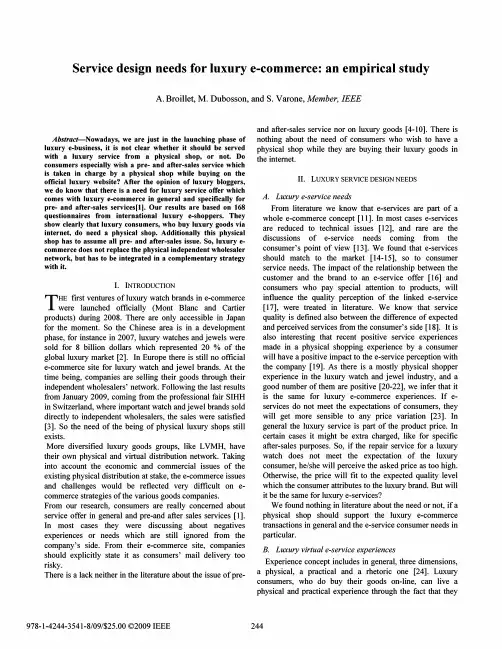
HE first ventures of luxury watch brands in e-commerce were launched officially (Mont Blanc and Cartier products) during 2008. There are only accessible in Japan for the moment. So the Chinese area is in a development phase, for instance in 2007, luxury watches and jewels were sold for 8 billion dollars which represented 20 % of the global luxury market [2]. In Europe there is still no official e-commerce site for luxury watch and jewel brands. At the time being, companies are selling their goods through their independent wholesalers' network. Following the last results from January 2009, coming from the professional fair SIHH in Switzerland, where important watch and jewel brands sold directly to independent wholesalers, the sales were satisfied [3]. So the need of the being of physical luxury shops still exists. More diversified luxury goods groups, like LVMH, have their own physical and virtual distribution network. Taking into account the economic and commercial issues of the existing physical distribution at stake, the e-commerce issues and challenges would be reflected very difficult on ecommerce strategies of the various goods companies. From our research, consumers are really concerned about service offer in general and pre-and after sales services [1]. In most cases they were discussing about negatives experiences or needs which are still ignored from the company's side. From their e-commerce site, companies should explicitly state it as consumers' mail delivery too risky. There is a lack neither in the literature about the issue of pre-
Marketing市场营销(英文版)

Marketing市场营销(英文版)Marketing, also known as marketings, is a crucial aspect of any business. It involves promoting and selling products or services to customers. Effective marketing strategies help businesses expand their customer base, increase brand awareness, and ultimately drive sales.One of the key components of marketing is understanding the target market. This involves researching and analyzing the demographics, preferences, and behaviors of potential customers. With this information, businesses can develop tailored marketing campaigns to attract the right audience. By focusing on the needs and desires of their target market, companies can ensure their marketing efforts are both effective and efficient.Another important aspect of marketing is branding. Developing a strong brand identity is essential for businesses to differentiate themselves from competitors. This is done through various elements such as logos, slogans, and brand messaging. A well-defined brand helps businesses build trust and credibility with customers, leading to increased loyalty and repeat purchases.In today's digital age, online marketing has become increasingly important. With the growing use of technology and internet, businesses have unprecedented opportunities to reach a wider audience. Online marketing strategies include social media marketing, search engine optimization (SEO), content marketing, and email marketing. These tools enable businesses to connect with customers on platforms they frequently use, increasing their visibility and engagement.Another effective marketing technique is influencer marketing.This involves collaborating with influential individuals, such as celebrities or social media personalities, to promote products or services. By leveraging the popularity and credibility of these influencers, businesses can reach a larger audience and gain credibility and trust from their followers.Marketing also involves analyzing and measuring the effectiveness of marketing campaigns. This is done through metrics such as return on investment (ROI), customer acquisition cost (CAC), and customer lifetime value (CLTV). By tracking these metrics, businesses can evaluate the success of their marketing efforts and make any necessary adjustments to optimize their strategies.In conclusion, marketing plays a vital role in business success. It helps businesses understand their target market, build strong brands, and reach a wider audience through various channels. By implementing effective marketing strategies, businesses can increase their customer base, boost brand awareness, and ultimately drive sales.在一个竞争激烈的商业环境中,有效的营销策略是企业取得成功的关键。
市场营销英语单词完整版

单元一1. marketing mix:营销组合2. market a brand:3. product:产品4. range:范围、幅度5. quality:质量6. branding:品牌化7. reputation:声誉、名望8. support:支持、支撑9. price:价格10. place:渠道11. location:位置,当地12. outlet:批发商店13. accessibility:可接近的,可得到的14. promotion:促销15. promotional mix:促销组合16. promotional tool:促销工具17. TV advertising:电视广告18. talk about:谈论19. people:人20. physical presence:实体存在21. process:处理、方法、步骤22. physical evidence:物证23. tangible:有形的24. launch:发表25. distribution:分布、分配26. delivery:交付(贸易)27. advertising:广告28. direct marketing:直接营销29. customer:顾客30. competitor:竞争者31. premium pricing:保险定价32. special deals:特殊交易单元二1. customer need:顾客需求2. solve a problem:解决问题3. meet these need:满足他们的需求4. cost to user:消费者5. perceive the cost:理解消费、认知消费6. convenience:便利7. convenient:方便的8. make an effort:作出努力9. communication:通讯10. communicate:通讯、传达11. acceptability:可接受性13.acceptable 可接受的14.socially acceptable 可被社会接受的15.fashionable 流行的16.attractive 引人瞩目的17.affordability 可购性18.legally acceptable 法律上可接受的19.accessibility 易接近,可达到20.easy to access 容易得到21.accessible 易接近的22.awareness 认识、意识、明白23.aware of:意识到,知道24.high 高度25.object 目标26.manufacturerd 制造27.high quality 高质量28.bottom end 低档的29.objective 客观的,目标的30.revenue objective 收益目标anizations 组织anize 组织33.distribution method 分配方式34.operations 操作35.promotional operation 促销办法36.attract 吸引37.attention to 对··的注意38.become aware of 使得关心39.create an interest in 创造一个兴趣点40.develop an interest 发展权益41.develop a desire 发展一个愿望42.actively want:积极想要43.prompt action:迅速采取行动44.take steps 步骤第三单元1. Carry out 实施2. SWOT analysis:SWOT分析3. Identifies:识别、确定4. Strength:优势5. Weakness:劣势6. Opportunity:机会7. Threat:威胁8. Internal factor:内部9. External factor:外部10. Exploit:开发11. Build on strength:建立优势12. Anticipate the threat:预料威胁13. Seize the new opportunity:抓住机会14. Address:处理15. Pose a serious threat:提出很大威胁16. Minimize the weaknesses: 最小化劣势17. Under threat from:来自于。
市场营销(英文版)
Marketing (English Version) In today's fastpaced business world, marketing plays a pivotal role in the success of any organization. It is theart and science of understanding customer needs and creating products or services that satisfy those needs. Effective marketing strategies can differentiate a brand, increase customer loyalty, and drive business growth. Let's delve into the key aspects of marketing and explore how it can benefit your business.Marketing (English Version)The Heart of Business GrowthAt its core, marketing is about building relationships.It's about connecting with your audience in a way that resonates with their values and aspirations. To achieve this, a holistic approach is essential, one that integrates traditional tactics with digital innovation to create a seamless and engaging customer experience.Understanding the Customer JourneySegmentation and TargetingNot all customers are created equal, and effective marketing acknowledges this diversity. Segmenting your audience based on demographics, psychographics, behaviors, or other relevant factors allows you to tailor your message todifferent groups. This targeted approach ensures that your marketing efforts are more relevant and, consequently, more effective.The Power of StorytellingStories are a universal language that can evoke emotions and create lasting memories. In marketing, storytelling is a powerful tool that can humanize your brand and make it more relatable. By crafting narratives that align with yourbrand's values and mission, you can forge a deeper connection with your audience and inspire them to take action.Leveraging Digital ChannelsMeasuring SuccessMarketing is an investment, and like any investment, it needs to be measured for return. Key performance indicators (KPIs) such as conversion rates, customer acquisition costs, and customer lifetime value provide a clear picture of your marketing efforts' effectiveness. By analyzing these metrics, you can refine your strategies, optimize your budget, and ensure that your marketing activities contribute to your business's bottom line.Continuous ImprovementMarketing (English Version)The Art of Persuasion and EngagementThe essence of marketing lies in its ability to persuade and engage. It's not just about selling products; it's about selling an experience, a lifestyle, and a vision. Here's how businesses can harness the full potential of marketing to achieve their goals.Crafting a Compelling Brand IdentityInfluencing Consumer BehaviorUnderstanding the psychology behind consumer behavior is crucial for marketers. By identifying the triggers that lead to purchasing decisions, you can design campaigns that nudge potential customers towards conversion. This involves not only the rational aspects of product features and benefits but also the emotional appeal that can often be the deciding factor in a consumer's choice.The Role of Content MarketingContent marketing is the strategic creation and distribution of valuable, relevant, and consistent content to attract and retain a clearly defined audience. It's about educating your customers, entertaining them, and providing solutions to their problems. From blog posts to videos, infographics to podcasts, highquality content can establish your brand as an authority in your industry and build trust with your audience.Collaborating with InfluencersCustomer Engagement and Retention Ethical Marketing Practices。
市场营销专业词汇中英文对照表(DOC 38页)
市场营销专业词汇中英文对照表Marketing Management营销管理New Products Development新产品开发Service Industry Marketing服务业营销Advertising广告Business Negotiation商业谈判International Marketing国际市场营销Sales Channels销售渠道Public Relationship公共关系Consumer Behavior消费者行为Systems of Management Information管理信息系统Marketing Research营销调研accesibility 可进入性accessory equipment markets 附属设备市场account management policies 客户管理策略positioning定位additions to existing product lines 现有产品线的增加administered vertical marketing systems 管理式垂直营销系统market segmentation市场细分sales promotion销售促进advertising feedback 广告反馈advertising frequency 广告频率advertising media 广告媒体advertising reach 广告接受人数advertising message 广告信息advertising source 广告信息来源agent middleman 代理商allowance 折让alteration 退换American Marketing Association 美国营销协会annual marketing plan 年度营销计划assurance 保证attitudes of consumers 消费者态度availability 可获得性/供货能力awareness (产品)知晓度/知名度baby boomers 婴儿潮出生的一代人backward channels for recycling 回收的后向渠道backward integration 后向垂直一体化banner advertisements 横幅标语广告bar codes 条形码barter 实物交易basic physical needs 基本生理需要BCG Grow-Share Matrix 波士顿增长-份额矩阵before tests 事前测试Behavior Scan Information Resources Inc. 行为扫描信息源公司behavioural analysis 行为分析behavioural hierarchies 行为层级benchmarking 基准benefit clusters 利益群体benefits 利益Benz 奔驰billing 帐单birth rate 出生率blanket purchase order 一揽子采购合同blind-paired comparison testing 双盲比较测试blue collars 蓝领bottom line 底线/盈亏一览结算线brand awareness 品牌意识/认知brand extensions 品牌扩展brand loyalty 品牌忠诚度brand mark 品牌标志brand name 品牌名称brand positioning 品牌定位brand recognition 品牌识别brand strategies 品牌战略brand 品牌branding strategy 品牌化战略branding 品牌化brand's equity 品牌的价值break-even analysis 盈亏平衡分析break-even volume 盈亏平衡产量breath of product assortment 产品线的宽度breath or diversity of product lines 产品线的宽度或多样性bribery 贿赂British Airways 英国航空公司brokers 经纪人budgeting 预算bundle 捆绑Bureau of Census 人口统计局busines strength rating 商业能力评分business plan 商业计划business position 经营地位business sector 商业部门business services markets 商业服务市场business strategies 经营战略business unit strategy 经营单位战略buyback allowances 回购折让buyback arrangements 产品返销buyers' bargaining power 买方的讨价还价能力buyers 采购者buying behavior 购买行为buying center 采购中心buying inertia 购买惯性buying intention 购买意图buying offices 连锁商店的进货中心buying power indes (BPI) 购买力指数buying situation 采购情况/类型buying task 采购任务capital gains 资本收益capital invested in product 产品投入资本Carnival 嘉年华cash cows 现金牛类cash discounts 现金折扣catalogue sales 目录销售categorization of perception 感知分类categorization 分门别类centralization 集中化chameleons/followers 变色龙/跟随者channel alternatives 可选择的营销渠道channel conflicts 渠道冲突channel decisions 渠道决策channel functions 渠道功能channel institutions 渠道组织结构channel management 渠道管理channel objectives 渠道目标channel of distribution 分销渠道channel power 渠道权力channel-control strategies 渠道控制战略channel-design decisions 渠道设计决策channel-management decisions 渠道管理决策channels of communication 传播渠道choice criteria 选择标准closing a sale 结束销售clothing retailers 服装零售商co-branding 联合品牌code of ethics (职业)道德标准coercive power 强制权cognitive dissonance 认识的不协调collection of data 数据收集collection 收款co-marketing alliances 联合营销联盟combination compensation plan 结合式薪酬方案commitment 承诺communication channels 传播渠道communication process 传播过程communication 信息交流/沟通communications media 传播媒体company personnel 公司员工comparative advertisements 比较广告comparison of brands 品牌比较compensation deals 补偿处理compensation plan 酬金方案compensation/rewards 酬金/奖励compensatory 补偿性的competition and industry evolution 竞争和行业演变competition-orientated pricing 竞争导向定价法competitive advantage 竞争优势competitive (supply-side) evolution 竞争(供方)演变competitive factors 竞争因素competitive intelligence 竞争情报/信息competitive parity promotion budgeting 竞争均势促销预算法competitive strategy 竞争战略competitive strength 竞争优势/能力competitor analysis 竞争者分析complaint handling 投诉处理component materials and parts markets 组成材料和零部件市场computerized ordering 计算机化的订购conclusive research 确定性研究conditions of demand 需求情况conflict and resolution strategies 冲突和解决战略conformance to specifications 与规格一致conformance 一致性confrontation strategy 对抗战略conjoint measurement 联合测度法conjunctive model 联合模型consumer decision-making 消费者(购买)决策consumer goods channels 消费品分销渠道Consumer Goods Pricing Act, USA 美国消费品定价法案consumer goods 消费品consumer markets 消费品市场consumer needs 消费者需求consumer packaged-goods firms 消费者包装食品公司consumer promotion 消费者促销consumer tests 消费者测试consumer/household market 消费者/家庭市场consumers' perceptions 消费者感知consumption 消费contests 竞赛contingency planning 权变计划contract construction 契约建筑业contract manufacturing 契约制造业contraction/strategic withdrawal strategy 收缩/战略性撤退战略contractual entry modes 契约式进入模式contractual vertical marketing systems 合约式垂直营销系统contribution margin analysis 边际贡献(贡献毛利)分析contributrion margin 边际贡献control strategies 控制战略convenience food stores 便利食品商店convenience goods 便利品convenience 服务的便利性Cool Whip 清凉维普co-operative advertising 合作性广告co-ordination and conflict resolution 协调与冲突解决co-production 合作生产core benefit proposition (CBP) 核心利益方案/提议corollary-data method 推定数据法corporate HQ 公司总部corporate scope 公司(经营)范围corporate strategy 公司战略corporate vertical marketing systems 公司式垂直营销系统corporate/institutional advertising 团体/社会公共机构广告corrective action 矫正行动cost analysis 成本分析cost effectiveness 成本有效性cost leadership strategy 成本领先战略cost of capital 资本成本cost of goods sold (COGS) 产品销售成本cost reductions 降低成本产品cost-and-volume relationship 成本-数量关系cost-oriented pricing 成本导向定价法cost-plus/mark-up pricing 成本加成/溢价定价法costs and benefits of marketing functions 营销职能的成本和效益costs of competitors 竞争者成本costs of distribution 分销成本countertrade 对等贸易coupons 优惠券courtesy 礼貌coverage of geographic market 地域性市场的范围coverage of relevant retailers 相关零售商的销售范围credibility 信誉credit terms 信贷条款critical assumptions 关键假设cross-elasticity 交叉弹性customary pricing 习惯性定价法customer analysis 顾客分析customer contact 顾客接触customer demand 顾客需求customer intimacy 顾客亲密度customer loyalty 顾客忠诚度customer need 顾客需要customer organization of sales force 按客户组织销售队伍customer retention 顾客维系/保留customer satisfaction 顾客满意度customer segment pricing 顾客细分市场定价customer service 顾客服务customer-oriented pricing 顾客导向定价法customers' perception 顾客感知customers' preferences 顾客偏好customers' price sensitivity 顾客的价格敏感度customizing 定制data collection 数据收集data confidentiality 数据保密data research 数据研究data sources 数据来源dealers 经销商deceptive advertisements 欺骗性广告deciders 决策者declining markets 衰退市场decoding 解码defect rate 缺陷率defender strategy 防御型战略defensive new-product development strategy 防御性新产品开发战略defensive positioning 防御性定位delivery time 交付时间delivery 配送demand characteristics 需求特征demand curve 需求曲线demand-oriented pricing 需求导向定价法demographic environment 人口统计环境department stores 百货商店dependability 可靠性deregulation 放松管制derived demand 衍生需求descriptive research 描述性研究design decisions 设计决策desired percentage mark-up on retail 预期零售利润率desired percentage return 预期回报率determinant attributes 关键属性determinants 决定因素different responses 差别反应differentiated defender strategy 差异化防御战略differentiated marketing 差异化营销differentiation over time 不同时间的差异differentiation strategy 差异化战略differentiation 差异化diffusion of innovation theory 创新扩散理论dimension 因素dimensions of quality 质量维度direct costing profitability analysis 直接成本盈利性分析direct mail 直接邮寄direct marketing via advertising media 通过广告媒体的直接营销direct marketing 直接营销direct product profitability (DPP) 直接产品盈利性/利润率direct selling 直销discount rate 贴现率discount stores 折扣商店discount 折扣discount/premium price policies 折扣/溢价策略discriminant analysis 差异分析法discriminatory adjustments 歧视价格调整discriminatory pricing adjustments 歧视定价调整disjunctive model 分离模型display space 陈列空间disposable income 可支配收入dissonance-attribution hierarchy 不和谐-归属层次结构distribution channel designs 分销渠道设计distribution channel objectives 分销渠道的目标distribution channel 分销渠道distribution decisions 分销决策distribution policies 分销策略distribution 分销distributor/store (private lables) brands 分销商/私有品牌distributors 分销商diversification 多元化divest 撤退divest 出让divestment or liquidation 收回投资或清算dividend 红利dogs 瘦狗类domestic target marketing strategies 国内目标市场定位的营销战略dropping products 放弃产品dry cleaning 干洗dual/two channel distribution systems 双重分销系统duplication (媒体)重复DuPont 杜邦公司durability 耐用性early vs late adoption 早期采购与后期采购earnings per share 每股收益economic and technological factors 经济技术因素economic power 经济权economies of scale 规模经济education services 教育服务effectiveness 有效性efficiency 效率emergency goods 急需品emotional appeals 情感诉求empathy 移情作用empirical evidence 经验性实例empowerment 授权encoding 编码end use 最终使用endorsement 赞同engineering (产品)工程设计entrepreneurial strategy 企业家战略entry strategies 进入战略environment and packaging disposal 环境与包装处理environment factors 环境因素environmental scanning 环境扫描/分析environmental strategy 环境战略establishment 机构ethical audit (公司)伦理审计ethics of marketing 营销伦理道德ethnic composition 种族构成European Community 欧共体evaluation and reward systems 评估与奖励体系evaluation and selection of supplier 评估和选择供应商evaluation of alternatives 评估替代品/各种选择evaluation of brands 品牌评估event sponsorship 事件赞助event 活动everyday low-price (EDLP) 天天低价evoked set 引发的组合evolution of market 市场演变exchange 交换exclusive dealing 独家销售exclusive distribution 独家分销executive summary 执行摘要exhibition media 展示广告媒体existing market 现有市场exit barriers 退出壁垒expansion path 扩张途径expectation measures (顾客)预期测度expectations of customers 顾客期望expected unit sales 预计产量expected value 期望价值experience curve 经验曲线experimental research 实验性研究expert power 专长权exploratory research 探索性研究export agents 出口代理(商)export jobbers 出口批发商export management company 出口管理公司export merchants 出口贸易商export 出口exporting 出口商品extended use strategy 扩大使用战略extending volume growth 扩大市场份额external data sources 外部数据来源external environment 外部环境extrapolation of past sales trends 过去销售趋势推测法facilitating agencies 辅助/中介机构factor analysis 因素分析法fads 时尚family branding 家族品牌family life cycle 家庭生命周期family structure 家庭结构farm products 农产品fast-moving consumer goods (FMCG) 快速变动的消费品fear appeals 恐惧/顾虑诉求features 特征Federal Department Stores 联邦百货商店Federal Trade Code (FTC) 联邦贸易法案FedEx (Federal Express) 联邦快递feedback data 反馈数据field test marketing 实地市场测试financing 融资fisheries 渔业fit and finish 结实度与外观fixed costs 固定成本fixed salary 固定工资flanker strategy 侧翼进攻战略flanker/fighting brand 战斗品牌flanking and encirclement strategies 侧翼进攻与围堵战略flat organizational structure 扁平的组织结构FOB origin pricing FOB产地定价法focus strategy 集中战略followers 追随者Ford 福特公司foreign middlemen 国外中间商forestry 林业formalization 形式/规范化formulate 制定fortress/position-defence strategy 防御堡垒战略Fortune 《财富》杂志forward integration 向前一体化franchise systems 特许系统franchising 特许经营free call numbers 免费电话号码free goods 免费商品freight-absorption pricing 免收运费定价法fringe benefits 小额津贴frontal attack strategy 正面进攻战略full costing profitability analysis 全成本盈利性分析full-service wholesalers 全方位服务的批发商functional competencies and resource allocation 职能能力与资源分配functional efficiency 职能效率functional organization of sales force 按销售职能组织销售队伍functional organizational structure 职能型组织结构functional performance 功能性能functional strategy 职能战略games 比赛gap 差距gatekeepers 信息传递者general behavioral descriptors 一般行为变量General Electric (GE) 通用电气General Foods Corporation 通用食品general merchandise discount chains 大众商品折扣连锁店General Motors 通用汽车geodemographics 区域人口统计特征geographic adjustments 地理调整geographic distribution 地理分布geographical organization of sales force 按地区组织销售队伍Gillette 吉列剔须刀global adjustments 全球调整global elite consumer segment 全球精英消费品市场global expansion 全球扩张global marketing control 全球营销控制global markets 全球市场global niche strategy 全球机会战略global standardization strategy 全球标准化战略global teenage segment 全球青少年市场globalization 全球化global-market expansion 全球市场扩张goals 总目标going-rate/competitive parity pricing 竞争性平价定价法goods producers 产品制造商Goodyear 固特异轮胎government agencies 政府机构government buyers 政府采购者government market 政府市场government regulation 政府管制greenhouse effect 温室效应grey market 灰色市场gross domestic product (GDP) 国内生产总值gross margin 毛利gross national product (GNP) 国民生产总值gross profit 毛利gross rating points (GRPs) 总级别指数group/category product manager 类别产品经理growing markets 成长市场growth rate of market 市场增长率growth stage of product life cycle 产品生命周期的成长阶段growth-extension strategies 增长扩张战略growth-market strategies for market leaders 市场领导者的市场增长战略growth-market strategy 成长性市场战略growth-market targeting strategy 成长性市场定位战略guarantee/warranty 保证/担保guarantees 保证Gucci 古琦(世界著名时装品牌)Haagen-Dazs 哈根达斯hard technology 硬技术Harvard Business Review 《哈佛商业评论》harvest 收获harvesting pricing 收获定价法harvesting strategy 收获战略health care 医疗保健health maintenance organizations (HMOs) (美国)卫生保健组织heavy buyer 大客户Heileman Brewing CompanyHeinz 亨氏食品helpfulness 有益性Henkel 汉高Hertz 赫兹(美国汽车租赁巨头)Hewlett-Packard 惠普公司hierarchy of strategy 战略的层次high margin/low-turnover retailers 高利润/低周转率的零售商high market share global strategy 高市场份额全球战略high-contact service system 高接触服务系统high-involvement product 高参与产品high-involvement purchase 高参与购买hight market share 高市场份额战略Hilton 希尔顿Holiday Inns 假日旅馆homogeneous market 同质市场Honda 本田household/family life cycle 家庭生命周期household 家庭hybrid technology 混合技术idea generation 创意的产生/生成ideas for new products 新产品创意/构想idea-screening process 创意筛选过程identification of segments 识别细分市场Illinois Tool Works 伊利诺斯工具厂image pricing 形象定价imitative positioning 模仿定位imitative strategy 模仿战略impact evaluation 影响评估impersonal sources 非个人的信息来源implementation and control of marketing programs 营销计划的执行和控制implementation 实施improvements in or revisions of existing products 现有产品的改良或修正impulse buying 冲动购买impulse goods 冲动购买品incentives 激励income 收入increased penetration strategy 增加渗透战略indirect costing profitability analysis 间接成本盈利性分析individual brand 个别品牌individual value 个人价值industrial goods & services 工业产品和服务industrial goods channels 工业品分销渠道industry attractiveness 行业吸引力industry attractiveness-business position matrix 行业吸引力-业务地位矩阵industry dynamics 产业动态industry evaluation 产业评估industry evolution 产业演变inelastic 缺乏价格弹性influencers 影响者infocommunications industry 信息通信行业infomercials 商业信息广告information age 信息时代information search 信息搜集information technology 信息技术information 信息informative 告知性的ingredient 成份in-home personal interview 个人家庭访谈in-house use tests 内部使用测试innovation 创新innovativeness 创新性installation 设施in-store display 店内展示in-store positioning 店内布局in-store promotion 店内促销intangibles 无形integrated marketing communication plan (IMC) 整合营销传播计划integration of perception 感知整合integration 整合Intel 因特尔intensity of market position 市场地位的集中程度intensity 集中程度intensive distribution 密集型分销interactions across multiple target markets 多目标市场间的相互作用interactive media 交互式媒体interest rates 利率internal data sources 内部数据来源internal marketing 内部营销internal organizational structure 内部组织结构international advertising 国际广告international channels 国际分销渠道international division 国际分部international marketing 国际营销international organizational design 国际组织设计internationalization of services 服务的国际化introductory stage of product life cycle 产品生命周期的推出阶段inventory level 库存水平investor relations advertising 投资关系广告issue advertising 观点广告jobbers 批发商Johnson & Johnson 强生joint ventures 合资jury of executive opinion 行政管理人员群体意见法just noticeable difference (JND) 恰巧注意到的差异just-in-time (JIT) management system 准时制管理体系just-in-time purchasing arrangements 及key account management 主要客户管理key accounts 关键客户key benefits 核心利益key environmental issue identification 确定主要的环境问题key variables 关键变量key/house accounts 关键/机构客户laboratory tests 实验室测试leapfrog strategy 蛙跳战略learning hierarchy 学习层级结构legal services 法律服务legislation 立法legitimate power 法定权level of compensation 酬金水平level of technical sophistication 技术的复杂程度Levi Strauss 李维·史特劳斯Levi's 列维斯(全球最大的牛仔服制造商)lexicographic model 词典编纂模型lifestyle 生活方式limited-service wholesalers 有限服务的批发商line extension 产品线扩展line filling 产品线填充line stretching 产品线延伸list price 订价Lloyd's of London 伦敦劳埃德保险公司localizaiton strategy 本地化战略location pricing 场所定价location 位置lodging 房屋出租logistical alliances 后勤联盟long-term memory 长期记忆lost customer 失去的顾客Louis Vuitton 路易·威登(法国著名时尚品牌)low-contact service system 低接触服务系统low-cost defender 低成本防御型low-cost position 低成本地位low-involvement hierarchy 低参与程度层级结构macro risks 宏观风险macroenvironment 宏观环境macrosegmentation 宏观细分mail-order retailers 邮购零售商maintaining market share 保持市场份额maintenance strategy 保持战略management overhead 管理费mandatory adaptation 强制性适应manufacturer brand 制造商/全国性品牌manufacturers' agents/representatives 生产商的代理商/销售代表manufacturers' export agents (MEA) 制造商出口代理manufacturers' sales offices/branches 生产商的销售办事处/分支机构manufacturing process 制造过程manufacturing 制造业market aggregation strategy 整体市场战略market attractiveness factors 市场吸引力因素market attractiveness 市场吸引力market attractiveness/business position matrix 市场吸引力/业务地位矩阵market circumstances 市场环境market demorgraphics 市场人口分布/统计特征market dimension 市场量度market entry strategies 市场进入战略market exclusion 市场排斥market expansion strategy 市场扩张战略market factors 市场因素market followers 市场跟随者market growth rate 市场增长率market hirarchy 市场等级market inclusion 市场纳入market leaders 市场领导者market measurement 市场测量market opportunity analysis 市场机会分析market oriented 以市场为导向的market position factors 市场地位因素market positioning analysis 市场定位分析market potential measurements 市场潜力测度market research 市场研究market segment 细分市场market segmentation 市场细分market share 市场份额market targeting 目标市场选择market 市场marketability 市场开拓能力market-entry strategies 市场进入战略marketing action plan 营销行动计划marketing audit 营销审计marketing channel 营销渠道marketing codes of conduct 营销行为规范marketing communication 营销沟通/传播marketing concept 营销观念marketing control 营销控制marketing decision support systems (MDSS) 营销决策支持系统marketing environment audit 营销环境审计marketing flows and functions 营销过程和职能marketing function area audit 营销功能领域的审计marketing implications of 对营销的影响marketing information system 营销信息系统marketing institutions 营销机构marketing management 营销管理marketing message 营销信息marketing mix 营销组合marketing policy 营销策略marketing productivity area audit 营销生产力领域的审计marketing program components 营销计划内容marketing program 营销计划/方案marketing relationship 营销关系marketing research 营销研究marketing strategy 营销战略market-management organizational structure 市场管理组织结构mark-up price 产品/溢价价格Marlboro 万宝路Marriott Hotel 万豪酒店mass-market penetration strategy 大规模市场渗透战略mass-market strategy 大市场战略matrix organizational structure 矩阵组织结构Matsushita 日本松下电子mature conformists 成熟的随大流者mature markets 成熟市场mature stage of product life cycle 产品生命周期的成熟阶段McDonald's 麦当劳McDonnell Douglas 麦道公司MCI电讯公司(前世界通信公司)MDSS (Marketing-Decision Support System) 市场决策支持系统measurability 可测度性measure or index 测量指标measurement criteria 计量标准media audiences 媒体受众medical and health services 医疗卫生服务Medico Containment Servicesmemory of consumers 消费者记忆Mercedes-Benz 梅赛德斯-奔驰Mercer Management Consulting 美国美智管理顾问公司merchandising 推销merchant middlemen 国内贸易中间商merchant wholesalers 商业批发商message structure 信息结构Michael Porter 迈克尔-波特micro risks 微观风险microsegmentatioin 微观细分Miller Tyding ACT, USA 米勒·泰丁法案minging 矿业Minnesota Mining and Manufacturing Company (3M) 明尼苏达矿业和制造公司Minolta 美能达miscellaneous sources 多方面来源mission 宗旨missionary selling 推销式销售Mitsubishi Heavy Industries 三菱重工modified rebuy 调整再购monosegment positioning 单一细分市场定位Monsanto 孟山都农业生物技术公司moral appeals 伦理/道德诉求morals 道德Motorola 摩托罗拉multichannel distribution 多渠道分销multidimensional scaling 多维等级法multilevel selling 多级销售multinational coporations (MNCs) 跨国公司multiple test markets 多测试市场multiple-brand strategy 多品牌战略multiple-factor index 多因素指数法multisegment positioning 多重细分市场定位mutual trust 相互信任national account management 全国性客户管理national market 国内市场National Semiconductor 美国国家半导体公司natural products 天然产品NEC 日本电子Nescafé 雀巢咖啡Nestlé 雀巢net sales 净销售额network computer (NC) 网络计算机new business selling 新业务销售new buy 购入新产品new entrants 新进入者new markets 新市场new materials 新材料New Prod screening model 新普罗德筛选模型new product lines 新产品线new products 新产品new-product development 新产品开发new-product ideas 新产品创意Newsweek 《新闻周刊》new-task buying 全新采购new-to-the-world products 世界性新产品niche penetration strategy 壁龛/机会市场渗透战略niche-market strategy 壁龛市场战略Nike 耐克Nissan 尼桑no-brand brand name 无品牌的品牌名称no-frills product 无虚饰产品noise in communication system 传播系统中的噪音non-financial rewards 非物质性奖励措施non-probability sampling 非概率抽样non-profit organization 非盈利组织non-store retailing 无店铺零售业number of stockouts 迟滞数目object-and-task method of promotion budgeting 目标-任务促销预算法objectives and strategy area audit 目标与战略领域的审计objectives 具体目标observation 观察法occupancy costs 房屋占用成本occupation/position 职业/职位odd pricing 奇/余数定价法OEM (original equipment manufacturer) 原始设备制造商oeverall quality 总体质量off-invoice discounts 发票之外的折扣offsets 抵消交易Omega 欧米加on-air testing 广播测试OPEC (Organization of Petroleum Exporting Countries) 欧佩克(石油输出国组织)opening relationships 建立关系operating supplies 生产供应品operational excellence 运作管理水平opinion leaders 意见领导者opportunity cost 机会成本opportunity identification 机会识别opportunity/threat matrix 机会/威胁矩阵order cycle time 订货周期order processing 订单处理organisational level 组织层次organizaitonal requirement planning 组织需求计划organization area audit 组织领域的审计organization buying center 组织采购中心organizational customer 组织顾客organizational direct selling 组织直销organizational markets 组织市场organizational purchasing 组织采购organzational structure 组织结构outdoor enthusiasts 户外运动爱好者out-of-home media 户外广告媒体overall cost leadership 全面成本领先overheads 日常开支overseas direct investment 海外直接投资ownership of new product 新产品所有权packaging 包装panel of experts 专家小组parentage 渊源parties involved 交换中的各方payment terms 支付条款pay-off control 支出控制penetration pricing 渗透定价Pepsi-Cola 百事可乐perceived customer value 顾客感知价值perceived quality 感知到的质量perceived value 感知到的价值percentage of sales promotion budgeting method 销售额百分比促销预算法perceptions of consumers 消费者感知/理解perceptual (product) pisitioning 感知(产品)定位perceptual map 感知图perceptual organization 感知组织perceptual vigilance 感性的警惕performance dimension 业绩标准performance evaluation 业绩评估performance measures 表现/业绩测度performance objective 绩效目标performance standards 绩效标准performance 功能perishability 非持久性personal selling 人员推销personal sources 个人的信息来源personnel development 人力资源开发persuasive 说服性的pharmaceuticals industry 医药行业physical (product) positioning 物理(产品)定位physical descriptors 物理变量physical distribution 实物分销Pillsbury 皮尔斯博瑞pioneers 先入者Pizza Hut 必胜客place utility 地点效用planning and control system area audit 计划与控制系统领域的审计point of sale information 销售点信息point-of-purhcase (POP) promotion 采购点促销point-of-sales (POS) data 销售点数据pontificator 保守派popularity 通用性population trends 人口趋势portfolio models for resource allocation 资源配置的资产组合模式position intensity 地位集中程度positioning 定位possession utility 拥有效用post-purchase dissonance 购买后的不协调post-purchase evaluation 购买后评估post-purchase/after-sale service 售后服务potential advantages 潜在优势potential customer 潜在顾客potential market 潜在市场potential target market 潜在目标市场power in distribution 分销权力power of buyers 购买者能力power of suppliers 供应商能力predatory pricing 掠夺性定价法pre-empting scarce resources 先占稀缺资源preferential treatment 特惠待遇premiums 额外奖励present competitors 现有的竞争者presenting sales message 提供销售信息pre-test market research 测试前市场研究price discrimination 价格歧视price elasticity of demand 需求的价格弹性price fixing 价格设定price leaders 价格领导者price lining 价格排列定价法price promotion 价格促销price quotation 报价price sensitivity 价格敏感度price structure 价格结构price 价格price/earnings ration 价格/收益比price-off promotions 降价促销price-setting process 定价过程pricing adjustments 定价调整pricing policies 价格策略pricing 定价primary demand 基本需求primary sources 第一类/主要数据print media 印刷媒体private/for-profit organization 私营/盈利性组织PRIZM (Potential Rating Index for Zip Markets) 按邮政区划为基础的潜力等级指数proactive new-product development strategy 进取型新产品开发战略probability sampling 概率抽样problem formulation 界定问题problem identificatioin 确定问题process management 过程管理Procter & Gamble (P&G) 宝洁公司product line 产品线product availability 产品的可获得性product category 产品类别product class 产品类别product decisions 产品决策product design 产品设计product development 产品开发product dimension or attributes 产品维度/属性product evolution 产品演变product features 产品特征product intent share 产品倾向份额product leadership 产品领导能力product life cycle (PLC) 产品生命周期product life cycle curve 产品生命周期曲线product line 产品线product manager audit 产品经理审计product offering 供应品product organizaiton of salesforce 按产品组织销售队伍product policies 产品策略product positioning 产品定位product quality 产品质量product scope 产品范围product space 产品位置product specifications 产品规格product systems 产品体系product type 产品类型product usage 产品用途product 产品product(ion)-oriented organization 产品/生产导向型组织production 生产product-line pricing adjustments 产品线定价调整product-management organizational structure 产品管理组织结构product-market entry control 产品-市场进入控制product-related behavioral descriptors 与产品相关的行为变量product's market characteristics 产品的市场特征product-use testing 产品使用测试pro-environment 环保profit impact of market strategy (PIMS) 市场战略的利润影响profitability analysis 盈利性分析profitability 盈利性/盈利能力profitable survivor strategy 有利可图的生存者战略project-company resource compatibility 项目与公司资源的协调性projected profit-and-loss statement 预计损益表projective tests 投影测试promotion decisions 促销决策promotion mix 促销组合promotion policies 促销策略promotion 促销promotional allowance 促销折让promotional effort 促销努力promotional pricing 促销定价promptness 及时性propector strategy 探索型战略prospecting for customers 寻找顾客。
市场营销英译汉
市场营销(Marketing)又称为市场学、市场行销或行销学。
简称“营销”,台湾常称作“行销”,是指个人或集体通过交易其创造的产品或价值以获得所需之物实现双赢或多赢的过程。
权威定义美国市场营销协会下的定义是:行销是创造、沟通与传送价值给顾客,及经营顾客关系以便让组织与其利益关系人受益的一种组织功能与程序菲利普·科特勒下的定义强调了营销的价值导向:市场营销是个人和集体通过创造,提供出售,并同别人交换和价值,以获得其所需所欲之物的一种社会和管理过程。
而格隆罗斯给的定义强调了营销的目的:营销是在一种利益之上下,通过相互交换和承诺,建立、维持、巩固与消费者及其他参与者的关系,实现各方的目的)。
[编辑] 新式定义台湾的江亘松在<你的行销行不行>中强调行销的变动性,利用行销的英文Marketing 作了下面的定义「什麼是行销?」就字面上来说,「行销」的英文是「Marketing」,若把Marketing 这个字拆成Market(市场)与ing(英文的现在进行式表示方法)这两个部分,那行销可以用「市场的现在进行式」来表达产品、价格、促销、通路的变动性导致供需双方的微妙关系。
<你的行销行不行>ISBN: 978-986-82609-5-5,理财文化, 2007.08 出版[编辑] 市场营销理论发展的四个阶段初创阶段(1900年—1920年)功能研究阶段(1921年—1945年)现代市场营销学形成和发展阶段(1945年—1980年)营销扩展阶段(1980年以后)[编辑] 市场与需求市场营销学中的市场可以等同于需求,即研究消费者的现实需求和潜在需求。
美国市场营销协会(AMA)的定义委员会1960年对市场提出以下的定义:“ 市场是指一种货物或劳务的潜在购买者的集合需求。
”菲利普·科特勒把市场定义为“ 市场是指某种产品的所有实际的和潜在的购买者的集合。
”[编辑] 市场的类型市场从不同角度,可以划分为不同的类型。
市场营销专业术语中英文对照标准翻译
市场营销专业术语中英文对照标准翻译在市场营销专业中,以下是一些常见的术语及其中英文对照翻译:
1. 市场营销 - Marketing
2. 目标市场 - Target Market
3. 市场细分 - Market Segmentation
4. 品牌定位 - Brand Positioning
5. 市场调研 - Market Research
6. 市场份额 - Market Share
7. 市场营销策略 - Marketing Strategy
8. 市场营销环境 - Marketing Environment
9. 市场营销 mix - Marketing Mix
10. 产品定价 - Product Pricing
11. 市场营销推广 - Marketing Promotion
12. 市场营销计划 - Marketing Plan
13. 渠道管理 - Channel Management
14. 品牌价值 - Brand Value
15. 竞争分析 - Competitive Analysis
16. 销售预测 - Sales Forecasting
17. 市场营销活动 - Marketing Campaign
18. 市场营销目标 - Marketing Objectives
19. 市场份额增长 - Market Share Growth
20. 市场定位 - Market Positioning
这些术语可以帮助您理解和沟通市场营销的概念和策略。
请注意,有时候术语的翻译可能存在一定的灵活性,具体使用时需要结合实际情境和语境进行理解。
市场营销外文翻译10
附录外文文献原文1.IntroductionMarketing continues to be a mystery to those who create it and to those who sponsor it. Often, the ad that generates record-breaking volume for a retail store one month is repeated the following month and bombs. A campaign designed by the best Madison Avenue ad agency may elicit mediocre response. The same item sells like hotcakes after a 30-word classified ad, with abominable grammar, appears on page 35 of anall-advertising shopper tossed on the front stoops of homes during a rainstorm! The mystery eludes solution but demands attention. The success of an enterprise and development of enterprises depends to a large extent on whether or not they have advanced, meet the needs of the enterprise marketing strategy. For Marketing is the definition, The well-known American scholar Philips marketing of the core marketing concept of the following description : "Marketing is individuals or groups to create, provide and exchange with other valuable products, to satisfy their own needs and desires of a social activities and management process. " In the core concept contains a number of elements: needs, desires and needs; Products or provide; V alue and satisfaction; exchange and transactions; and networking; market; Marketing and sales were a series of concept.This article is devoted to the idea that your marketing results can be improved through a better Understanding of your customers. This approach usually is referred to as the marketing concept.Putting the customer first is probably the most popular phrase used by firms ranging from giant conglomerates to the corner barber shop, but the slogan zing is often just lip service. The business continues to operate under the classic approach -- "Come buy this great product if you dedicate your activities exclusively to solving your customer's problems. The quality of services, and enterprises to cultivate customers satisfaction and loyalty, and can create enterprise value.Any marketing program has a better chance of being productive if it is timed, designed and written to solve a problem for potential customers and is carried out in a way that the customer understands and trusts. The pages that follow will present the marketing concept of putting the customer first. Marketing is a very complex subject; it deals with all the steps between determining customer needs and supplying them at a profit. In addition to some introductory material on marketing, this publication includes practical material on the marketing approaches to budgeting, layout design, and headline writing, copywriting and media analysis. So that a clear understanding of enterprise marketing strategy to improve the operations of enterprises.2.The marketing conceptMarket positioning is identifying the target market, enterprises will adopt what marketing methods, which provide products and services the target market and competitors to show distinction, thereby establishing corporate image and obtain favorable competitive position. Market positioning is a process of enterprise differentiation process, how to find the differences, identify differences and show differences. Today too many similar products, consumers how to choose Consumers buy what is the justification.On the effective positioning for a solution.Positioning is the first to propose in the advertising industry, advertising emphasized in the eyes of the public who left the location, And people often prefer preconceptions; If enterprises can target your customers mind to establish a definite position, to the consumer a reason to buy, enterprises can often compete in an advantageous position.Marketing is an economy built on science, behavioral science and modern management theory on the basis of applied sciences. It enterprise marketing activities and to study law,with full, comprehensive, practical features. As a modern enterprise "businesses" Marketing system introduced in the market economy under the conditions of the enterprises should have a sense of the market, business sense, Marketing strategies and methods. With China's economy growing prosperity, the market competition is becoming increasingly fierce; enterprises need Modern Marketing Theory as the guide. In the initial stage, a number of enterprises have marketing only as a help to product sales growth strategy and means If so far, many Chinese enterprises remain with the Department of Marketing with sales of two and one; When people realize that to meet the needs of the customer-oriented marketing concept should become an enterprise operating philosophy, and the enterprise's overall business activities have an impact, there will be a marketing position inappropriately increase the tendency For many people believe that marketing should be the decision-making levels of guiding ideology, rather than the level of implementation work. Marketing of the enterprise understanding of the position is not correct, will be marketing in the enterprise application will be affected. Marketing work is to open up markets, capture the market and expand the market work, enterprise development, and production activities should open up the market for services, a market that is the basis of the final services in the market. Marketing work is based on enterprise customers as the starting point for the reproduction process, and ensures the customer as the focus of the process of reproduction.That customer demand-oriented, according to the actual needs of customers developing marketable products, and targeted marketing of the market, and its sales to meet the needs of customers. With enterprises to become the main players in themarket, corporate marketing work more salient position, business leaders must attach great importance to it.Unfortunately, there is still a misunderstanding about the word marketing. Many people, including top executives, use it as a sophisticated term for selling. Marketing representative is commonly used in ads to recruit salespeople. Actually, marketing is a way of managing a business so that each critical business decision is made with full knowledge of the impact it will have on the customer.Here are some specific ways in which the marketing approach differs from the classic, or sales, approach to managing a business.①In the classic approach, engineers who develop the product and finally to engineers who produce it. Thus, the sales approach only ends with the customer, while the marketing approach begins and ends with the customer.②The second major difference between the sales and marketing approaches is the focus of management. The sales approach almost always focuses on volume while the marketing approach focuses on profit. In short, under the classic (sales) approach the customer exists for the business, while under the marketing approach the business exists for the customer.The marketing concept is a management plan that views all marketing components as part of a total system that requires effective planning, organization, leadership and control. It is based on the importance of customers to a firm, and states。