
西门子供应链培训材料3
Technology
• System integration • Use of e-technologies • Selection of system/ technology partners
CRM-Strategy STRATEGY Understand TECHNOLOGY Create ORGANIZATION
© Siemens ICM MP; April 2004; Confidential
Page 8
The three main application areas of CRM
Create ORGANIZATION ORGANIZATION
STRATEGY
TECHNOLOGY
Understan d Custome r value
• Raising the entry barriers for competitors by building up lasting relationships with the customers • Developing a "learning relationship" in long-term customer relationships
• Building up superior customer knowledge • Identifying target segments and developing target customer specific marketing, sales and service concepts • Focusing on the highest-value customers
CRM definition CRM objectives • Identifying the top customers and exploiting the maximum share of their expense budgets • Raising the efficiency of customer management • Establishing customer loyalty and "lifetime" relationships • Fully exploiting the potential customer segments by acquiring new customers
• Holistic approach/ top-management issue • Definition of target segments and customers • Value-based prioritization
Culture and change management
• Consolidating the customer value orientation • Management processes and incentive systems • Continuous change management and improvement processes
Retain CULTURE
Gain
© Siemens ICM MP; April 2004; Confidential
Page 6
CRM creates lasting strategic competitive advantages
"Understand" markets and customers
Traditional marketing Objectives Focus Timeframe Performance indicators Customer knowledge Product Price Sales channels Communication Generate sales Acquisition phase Short term Market share, sales Demands from customer segments Stand-alone product General discounts Traditional sales channels (multilevel) Unidirectional communication Customer relationship management Create a loyal customer Total customer life-cycle Medium to long term Share of wallet, customer profitability, customer value Individual preferences and needs Integration of products and services Price differentiation on the basis of customer loyalty "Disintermediation", multi channel management Interactive dialog with customers and communities, 24 hrs./7 day availability
Customer Relationship Management -- A Winning Customer Strategy
Seminar presentation April 2004
Agenda
• Customer Relationship Management Presentation • Break • Case 1– San Fabian Supply Company • Case 2– Solo Mobile Phone Company
product Target Market
place
price • Price strategy: e.g. charge price premium for valuable customer segment • Payment terms • Special discounts
promotion • Select of Marketing Communication vehicle to better reach target customer: TV ads, PR, Sponsorship • Events for valuable customers • VIP club
Custome r value
Organization and processes
• Customer-oriented structures and processes • Customer process/touchpoint innovation • Organizational anchoring of the CRM responsibility
© Siemens ICM MP; April 2004; Confidential
Page 5
CRM is the holistic approach to a customer-value based company orientation – four enablers set up the frame ...
"Retain" profitable customers
"Gain" profitable customers
© Siemens ICM MP; April 2004; Confidential
Page 7
Marketing-Mix are core elements of customer relationship strategy
• A survey on senior marketing executives at Fortune 1000 companies indicates a widespread frustration about the return on CRM investments
CRM in not a technology term, but instead, a strategy driven holistic management approach
Marketing-Mix provides a decision-making method for deciding how to manage the customer relationship Marketing-Mix • Differentiated product targeting different customer segment • Product customization: design, function, packaging • Service level • Effective channel strategy: one-to-one visit, call center, stores… • Various channel combination to more efficiently serve target customers
8:00-9:15 9:15-9:30 9:30-10:30 10:30-12:00
© Siemens ICM MP; April 2004; Confidential
Page 2
What is CRM in your mind?
• What is customer relationship management? • What does CRM bring to companies?
Source: Booz Allen Hamilton Survey, 2001 © Siemens ICM MP; April 2004; Confidential Page 3
2020年西门子供应链培训材料3(英文PPT3参照模板
Interactive dialog with customers and communities, 24 hrs./7 day availability
Author/Division
5
CRM is the holistic approach to a customer-value based company orientation – four enablers set up the frame ...
CRM enablers
Technology
• System integration • Use of e-technologies • Selection of system/
technology partCreate
TECHNOLOGY
Culture and change management
• A survey on senior marketing executives at Fortune 1000 companies indicates a widespread frustration about the return on CRM investments
Source: Booz Allen Hamilton Survey, 2001 Author/Division
CRM objectives
• Identifying the top customers and exploiting the maximum share of their expense budgets
• Raising the efficiency of customer management
《供应链专题》培训资料

《供应链专题》培训资料供应链专题培训资料一、什么是供应链管理?供应链管理是指通过建立和协调与供应商、生产商、分销商和零售商等各个环节之间的合作关系,以最小化成本、最大化效益,实现产品从原料采购到最终消费者手中的全过程管理。
二、供应链管理的重要性1. 提高效率:供应链管理可以帮助企业优化生产流程,减少生产和配送时间,提高生产效率和物流效率。
2. 降低成本:通过供应链管理,企业可以与供应商和分销商建立紧密的合作关系,共同降低采购成本和运输成本,从而减轻企业负担。
3. 提升服务质量:通过供应链管理,企业可以更好地控制和监督产品的生产和配送过程,提高产品的质量和服务水平,满足客户的需求。
4. 增强市场竞争力:供应链管理可以帮助企业更好地与竞争对手进行比较和分析,发现自身的优势和不足,进一步提升企业的市场竞争力。
三、供应链管理的基本原则1. 知己知彼:了解自己企业的产品特点以及竞争对手的供应链管理策略,找到自身的优势和不足。
2. 共同协作:与供应商、分销商等各个环节的合作伙伴保持密切合作,互相支持、互利共赢。
3. 信息共享:及时分享供应链上的关键信息,以便各环节能够做出合适的决策,提高整体效能。
4. 灵活应变:对供应链上的不确定因素进行快速反应,适时调整供应链策略,确保供应链流畅运转。
四、供应链管理的核心环节1. 采购管理:包括完成采购计划、选择合适的供应商、确保产品质量等环节。
2. 生产管理:包括生产计划的制定、生产过程的控制和监督、以及产品质量的把控。
3. 库存管理:包括确保库存充足但不过剩、减少库存积压、优化库存周转等环节。
4. 物流管理:包括货物配送、运输方式选择、仓储管理等环节。
五、供应链管理的挑战与解决方案1. 多级供应链的管理:多级供应链涉及到多个环节的协同管理,需要建立高效的沟通与合作机制,确保信息畅通、协调一致。
解决方案:建立供应链协同平台,通过信息化手段实现供应链各环节的实时监控和协同管理。
供应链数据分析与优化培训资料

跨部门协同作业流程梳理
01
跨部门协同作业的意义
通过跨部门协同作业,可以打破部门壁垒,提高整体运营效率,实现资
源共享和优势互补。
02
跨部门协同作业的流程
明确各部门职责和权限,建立跨部门协同作业机制和流程,包括需求提
出、方案制定、资源调配、执行监控等环节。
03
跨部门协同作业的挑战与解决方案
分析跨部门协同作业中可能遇到的沟通不畅、资源争夺、目标不一致等
建立科学的供应商评价体系,选择合适的供应商 ,确保采购物品的质量、成本和交货期。
采购方式选择
根据采购物品的特点和市场需求,选择合适的采 购方式,如集中采购、分散采购、电子采购等。
采购成本控制
通过谈判、比价等方式降低采购成本,同时关注 采购过程中的质量、交货期等因素。
04
CATALOGUE
供应链协同与整合实践
优化分析
通过数学建模和优化算法求解 最优决策方案,如线性规划、
整数规划等。
02
CATALOGUE
供应链核心数据分析
需求预测分析
01
02
03
历史销售数据
收集并分析历史销售数据 ,识别销售趋势、周期性 变化以及异常波动。
市场调研
通过市场调研了解消费者 需求、竞争对手情况以及 市场趋势,为需求预测提 供依据。
风险评估
采用定性和定量评估方法,对识 别出的风险点进行评估,确定风 险等级和影响程度,为后续的风 险应对策略制定提供依据。
风险预警机制建立及实施效果评价
风险预警机制建立
根据风险评估结果,制定相应的风险 预警指标和阈值,构建风险预警模型 ,实现实时监控和预警。
实施效果评价
通过定期的数据分析和案例研究,评 价风险预警机制的准确性和有效性, 及时调整预警参数和模型,提高预警 效果。
供应链管理的培训资料

供应链管理的培训资料一、引言供应链管理是现代企业管理中的重要组成部分,对于企业的运营和竞争力具有至关重要的影响。
为了帮助企业提升供应链管理水平,本文将就供应链管理的基本概念、重要性以及相关的培训资料进行介绍和讨论。
二、供应链管理的基本概念1. 供应链管理的定义供应链管理是指企业通过协调和管理供应链中各个环节的活动,以实现高效的物流和信息流,最终提供满足客户需求的产品或服务。
2. 供应链管理的目标供应链管理的目标是实现供应链中各个环节的协同和优化,以提高企业的运营效率、降低成本、提升客户满意度,并在竞争中获得持续的竞争优势。
3. 供应链管理的关键要素供应链管理的关键要素包括供应商管理、物流管理、库存管理、订单管理、信息管理等,这些要素相互关联、相互影响,需要进行协调和优化。
三、供应链管理的重要性1. 降低成本通过供应链管理,企业可以优化物流、减少库存、提高生产效率等,从而降低运营成本,提高企业盈利能力。
2. 提高客户满意度供应链管理可以实现及时交付、准确响应客户需求等,提高客户满意度,增强客户忠诚度,进而提升企业市场竞争力。
3. 加强合作伙伴关系供应链管理强调供应链中各个环节的协同合作,通过与供应商、分销商等合作伙伴的紧密合作,共同提升供应链整体效能。
4. 应对市场变化供应链管理使企业能够更加灵活地应对市场需求的变化,减少库存积压、降低供应链风险,提高企业的市场敏捷性。
四、供应链管理的培训资料1. 供应链管理的基础知识- 供应链管理的定义和目标- 供应链管理的关键要素和作用- 供应链管理的发展趋势和挑战2. 供应链规划与设计- 供应链战略规划- 供应链网络设计- 供应链流程优化3. 供应链协调与合作- 供应商选择和管理- 分销商选择和管理- 跨组织协同管理4. 供应链绩效评估与改进- 供应链绩效指标与评估方法- 供应链问题诊断与改进方法- 供应链创新与持续改进5. 供应链信息管理- 供应链信息系统与技术- 供应链信息共享与协同- 供应链信息安全与风险管理六、结论供应链管理是企业成功的关键要素之一,通过培训资料的学习和应用,企业可以提升供应链管理水平,实现运营效率和竞争力的提升。
西门子采购培训3
战略性采购过程: 概况
目标,分析,战略
直到合同缔结之前的选择
供货和优化
目标计划
需求分析
市场分析
供货商分析 定义资源战略 供货商的选择
谈判 合同
供货商的评估 供货商的发展
控制/ 成功比较
任务
从交易计划过 需求计算
程计算出策略 需求分析
性的采购
查明冲突
包括 采购目标 交流
制定策略性的 采购
Yes
MAKE vs BUY
No BUY
•YYeess
•MMAAKKEE •vvs s •BBUUYY
•NNoo •BBUUYY
© Siemens Management Institute, Beijing
2
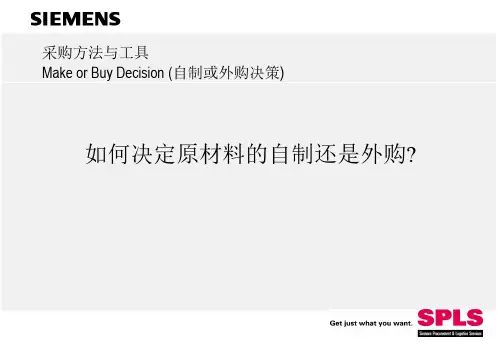
采购方法与工具
Make or Buy Decision (自制或外购决策)
自制或外购是对企业产生长期影响的一项重要决策:
供应商
生产
客户
前提: 循环周期短 可靠简易的流程 责任明确 所有权清晰
以此提高客户满意度: 缩短供货时间 提高供货可靠性 完整配送 快速安装
© Siemens Management Institute, Beijing
7
采购方法与工具
区分操作性采购和策略性采购
© Siemens Management Institute, Beijing
© Siemens Management Institute, Beijing
5
物流定义
物流是供应链里的一个环节,即计划,实施和控制有 效的材料的流动和仓储库存.这里的原材料是指物品 ,服务及信息.
© Siemens Management Institute, Beijing
西门子供应链分析
西门子供应链分析1. 引言本文旨在对西门子公司的供应链进行全面分析,以了解其运作方式、优势和挑战。
通过深入研究该公司的采购、生产和物流等方面,我们将能够获得关于其成功之道的洞察,并提出改进建议。
2. 公司概述西门子是一家德国跨国工业制造企业,在电力、自动化技术及数字化领域处于领先地位。
它拥有广泛多样的产品组合,并为各种行业提供创新解决方案。
3. 采购管理- 采购策略:包括原材料选取标准、价格谈判策略等。
- 供应商评估与选择:考虑质量控制体系、交货可靠性等因素。
- 合同管理:确保条款明晰并符合法规要求。
4. 生产过程管控- 工厂布局设计: 确定最佳设备配置和人员安排来实现高效率生产。
- 压缩周期时间: 使用精益生产方法或其他有效手段降低整个生命周期所需时间。
- 质量控制系统: 实施严格的质量管理措施以确保产品符合标准。
5. 物流与分销- 仓储和库存管理: 设计最佳物料存放位置,优化库存水平。
- 运输方式选择:考虑成本、速度和可靠性等因素来确定运输模式。
- 分销网络设计:建立高效的供应链网络以满足客户需求。
6. 持续改进- 性能评估指标: 确定关键绩效指标并进行监测与报告。
- 流程再造: 对现有业务流程进行重新设计,提升整体效率。
- 技术创新: 寻找新技术或工具来加强供应链操作。
7. 挑战及解决方案a) 全球市场波动导致采购风险增加。
解决方案包括多元化供应商来源、制定灵活采购策略等;b) 需求不稳定带来生产调整困难。
通过预测方法改善需求规划,并实行柔性生产系统;c) 复杂的国际物流环境需要更好地跟踪货物状态。
使用先进追踪技术和信息共享平台;8. 结论西门子公司的供应链管理在采购、生产和物流等方面取得了显著成就。
然而,仍存在一些挑战需要解决。
通过持续改进和创新,西门子可以进一步提高其供应链效率并保持竞争优势。
附件:本文档未涉及任何附件内容。
法律名词及注释:1. 采购策略: 公司为获取所需产品或服务而制定的计划。
供应链管理知识培训ppt课件
库存成本控制
通过合理设置安全库存、 降低库存周转率等措施, 有效控制库存成本。
库存优化技术应用案例分享
1 2
物联网技术在库存管理中的应用
利用物联网技术实现物料实时跟踪和监控,提高 库存管理精度和效率。
大数据分析在库存优化中的应用
通过大数据分析技术,挖掘库存数据中的潜在价 值,为库存优化提供决策支持。
07
供应链风险管理及应 对措施
风险识别、评估和预防机制构建
风险识别
定期梳理供应链各环节潜在风险点,包括供应商 、物流、库存、生产等方面。
风险评估
对识别出的风险进行量化和定性分析,确定风险 等级和影响程度。
预防机制
针对不同风险等级,制定相应预防措施,如优化 供应商选择、加强物流监控等。
应急预案制定和演练组织实施
提高车辆装载率
通过合理配载、减少空驶等方式提高 车辆装载率,降低单位运输成本。
加强物流信息化建设
利用信息技术手段提高物流运作效率 和管理水平,降低整体物流成本。
绿色物流理念在运输中应用
节能减排技术应用
推广使用节能型车辆和绿色包装材料,减少能源 消耗和环境污染。
废弃物回收与再利用
建立废弃物回收体系,对废旧包装物、运输工具 等进行回收再利用,减少资源浪费。
降低成本、提高效率、优化服 务等
分析内外部环境
市场需求、竞争态势、政策法 规、技术趋势等
制定供应链战略方案
基于SWOT分析,明确战略定 位和发展方向
实施供应链战略
制定实施计划、资源配置、风 险控制等
供应链网络布局规划
确定供应链网络结构
中心仓库、区域仓库、配送中心等节点布局
考虑风险因素
对供应链网络中的潜在风险进行识别和评估 ,制定应对措施
FMEA培训教材西门子
o 适当应用FMEA是一个互相作用的过程,永无 止境
PPT文档演模板
2021/8/17
8.施行FMEA的影响--RPN分值
o 不适宜将一个小组的FMEA分数和其它组的 FMEA分数进展比较,因为即使设计或过程 是一样的,但由于每个状况不一样所以打出 来的分数也会不一样
•
分 析 •现行预计的产品/过程 可能产生的失效形式
分 析
•
•对顾客或下工程的影 响
•哪些原因可能造成这 个失效形式
•可采取的对策
•是否消除
PPT文档演模板
2021/8/17
4. FMEA解决问题的逻辑思路
•项目/功能
•潜在
•要求
失效模式
•失效 潜在后果
•严 重 度
•等 级
•潜在失效 •起因/机理
方式确认建议的措施是否施行,包含但不限于:
o 评审设计、制程、图面以确认建议的措施是否已施行
o 确认各项的设计、制程、组装的变更是否已整合到相关的文件 中
o 评估设计FMEA 、过程FMEA,系统FMEA的应用以及控制方 案的合理性
PPT文档演模板
2021/8/17
•7.施行FMEA的影响--跟踪和持续改进
•纸面 •Paper
•FMEA
•硬件 •Materia
•传统形式 •Traditional
•概念 •Concept
•设计 •Design
•过程 •Process
•产品
•时间
•Produce •Time
PPT文档演模板
2021/8/17
西门子供应链培训官方资料2
sThis edition of our Bylaws for the Managing Board, prepared for the convenience of English-speaking readers, is a translation of the German original.Bylawsfor the Managing Boardof Siemens Aktiengesellschaft Version dated April 28, 2009General(1) The management of the company shall be the Managing Board's ownresponsibility. The Managing Board is under an obligation to promote the company's interests and drive sustainable growth in enterprise value.(2) The members of the Managing Board shall manage the business of thecompany in accordance with the law and in accordance with the Articles of Association and these Bylaws.(3) The Managing Board shall ensure compliance with all relevant legalrequirements and internal company policies, and promote such compliance in all Siemens companies. It shall ensure appropriate risk management and risk controlling.(4) Members of the Managing Board shall not, as a rule, be over 65 years of age.§ 2Conflicts of interest(1) When making their decisions, members of the Managing Board may not beguided by personal interests nor may they exploit for their own advantage business opportunities offered to the company. Over and above the provisions specified in § 88 German Stock Corporation Act (AktG), the members of the Managing Board shall be subject to a comprehensive prohibition on competitive activity for the period of their membership of the Managing Board and the period of their contract of employment.(2) In connection with their function, the members of the Managing Board maynot demand or accept gifts or other benefits from third parties either for themselves or for other persons, or grant unjustified benefits to third parties. (3) The members of the Managing Board are under an obligation to disclose anyconflicts of interest without delay to the Chairman of the Supervisory Board and to inform the others members of the Managing Board thereof. The Chairman of the Supervisory Board shall inform the Chairman's Committee of the Supervisory Board of the conflict of interest on the part of a member of the Managing Board when the relevant issue is presented to the Supervisory Board for a decision. All transactions between the company or an entity related to the company on one side, and members of the Managing Board or persons, companies or organizations related to members of the Managing Board on the other side, must be conducted in accordance with the standards that would apply in arm’s length transactions. If an individual transaction of this kind does not require the involvement of the Supervisory Board pursuant to § 112 German Stock Corporation Act (AktG) but the value of the transaction concerned exceeds € 25,000, the transaction shall nevertheless require the consent of the Supervisory Board.Allocation of business responsibilities(1) The responsibilities of the Managing Board shall be allocated among anumber of portfolios, these being the portfolio of the President of the Managing Board, known as- Chief Executive Office,the three Sector portfolios (Sectors),- Energy- Industry- Healthcare,and the five corporate function portfolios,- Finance and Controlling- Legal and Compliance- Human Resources (“Arbeitsdirektor” as defined in the German Codetermination Act (MitbestG))- Technology- Supply Chain Management.(2) Any other allocation of business responsibilities to the members of theManaging Board shall be derived from the business allocation plan as defined by the Supervisory Board based on a proposal by the Chairman’s Committee of the Supervisory Board. As the member of the Managing Board with responsibility for the Human Resources portfolio, the “Arbeitsdirektor” shall be appointed in accordance with the requirements of § 33 German Codetermination Act (MitbestG).(3) The Divisions, Cross-Sector Businesses and Corporate Units assigned to theindividual Managing Board portfolios and the portfolios holding authority and responsibility for the Regions shall be defined in the business allocation plan agreed by the Supervisory Board in accordance with paragraph 2.(4) Within the framework of the resolutions of the Managing Board and inconformity with the provisions for collective responsibility pursuant to Section 4, the Sector portfolio holders shall be responsible for conducting business activities in their respective Sectors. In particular, they shall be responsible for all the development, production and sales activities in these areas and for the profit or loss from their business activities.(5) In conformity with the provisions for collective responsibility pursuant toSection 4 and as defined in greater detail by the Managing Board, the duties of the corporate function portfolios shall include guidelines, monitoring andcoordinating responsibilities for all parts of the company. The heads of the Finance and Controlling, Legal and Compliance, Human Resources and Supply Chain Management portfolios shall have an unrestricted right to issue instructions in relation to their function across all parts of the company. This shall also apply – to the extent permitted by law – to the heads of units that form a separate legal entity and to the heads of Siemens companies outside Germany.(6) The detailed delineation between the Sectors and Divisions and thebreakdown of the Divisions into Business Units shall be specified by the Managing Board. The same shall also apply to the definition of Cross-Sector Businesses, Cross-Sector Services and Corporate Units. The Supervisory Board shall be informed of the definitions established in accordance with sentences 1 and 2. Within the framework of the applicable provisions of the Codetermination Law, the employee representatives are to be consulted in a timely manner prior to the sale or closing of a Business Unit.(7) The structure and reporting obligations of the Divisions and Business Unitsshall be decided by the Managing Board based on a proposal by the President of the Managing Board. The appointment and dismissal of senior management members in the Divisions and Business Units shall be decided by the Managing Board based on proposals by the President of the Managing Board. Specifically, the Managing Board shall appoint and dismiss the holders of the following senior management positions:a) Sector CFOs, Sector General Counsels, Sector Heads of HumanResources, as well as - if applicable - Sector Heads of Technology andSector Heads of Strategy,b) Division CEOs, Division CFOs, Division General Counsels as well as -if applicable - Division Heads of Human Resources,c) Business Unit CEOs and Business Units CFOs,d) Cross Sector Businesses CEOs and Cross Sector Businesses CFOs,e) Cross Sector Services CEOs,f) Heads of Corporate Units and General Counsel Corporate,g) Regional Cluster CEOs, Regional Cluster CFOs, selected CountryCEOs and Country CFOs, Regional Heads of Human Resources aswell as Regional General Counsels.(8) The appointment and dismissal of Sector CFOs, Sector General Counsels,Sector Heads of Human Resources, Sector Heads of Technology and Division CEOs pursuant to paragraph 7 shall require the approval of the Chairman's Committee of the Supervisory Board.§ 4Collective responsibility(1) The members of the Managing Board shall bear collective responsibility forthe entire management of the company. They shall work cooperatively and provide each other with information on an ongoing basis about important activities and transactions in their respective Managing Board portfolios. If a member of the Managing Board has serious misgivings about an issue in a portfolio for which another member of the Managing Board is responsible and he/she is unable to resolve these concerns in a discussion with the other Managing Board member concerned, he/she is under an obligation to present the matter to the full Managing Board for a decision. In such cases, the matter must remain pending or the action be halted until a decision is taken by the Managing Board.(2) The overall interests of the company shall have priority over the interests ofthe individual Managing Board portfolios.(3) The Managing Board shall be required to take a decision in all matters forwhich a decision by the Managing Board is prescribed by the law, Siemens’ Articles of Association or these Bylaws, specifically regardinga) fundamental issues relating to business policies and company strategy;b) annual planning and multi-year planning;c) preparation of the annual financial statements and the consolidatedfinancial statements, the management's discussion and analysis andconsolidated MD&A, and the submission of all of these documents to theSupervisory Board;d) convening of the Shareholders' Meeting;e) proposals for the agenda of the Shareholders' Meeting;f) submissions to the Supervisory Board and to the Shareholders' Meetingrequired by law or by the Siemens' Articles of Association;g) transactions that require the consent of the Supervisory Board;h) all matters that are submitted to the Managing Board by the Presidentor a member for decision.(4) A portfolio assigned to an individual member of the Managing Board shall bethat member’s own responsibility subject to the decisions taken by the Managing Board as a whole. Where activities and transactions in one Managing Board portfolio also concern one or more other portfolios, the Managing Board member concerned must reach an agreement in advance with the other Managing Board members involved. If agreement cannot be reached, each of the Managing Board members involved is under an obligation to ensure the matter is brought to the full Managing Board for a decision. In such cases, the matter must remain pending or the action be halted until a decision is taken by the Managing Board.(5) Activities and transactions in a particular Managing Board portfolio that areconsidered to be extraordinarily important for the company or associated with extraordinary economic risk shall require the prior consent of the full Managing Board. The same shall also apply to such activities and transactions for which the President or another member of the Managing Board demands a prior decision by the Managing Board.(6) A member of the Managing Board may proceed with activities andtransactions of the kind described in paragraph 4 sentence 2 and paragraph 5 without the prior consent of the Managing Board or – in the case of para-graph 4 sentence 2 – without the prior agreement of the other Managing Board members involved if the Managing Board member concerned believes, after due consideration, that the activity or transaction is required to avoid a severe, imminent disadvantage to the company. The President of the Mana-ging Board must be informed of any such activity or transaction without delay.§ 5President of the Managing Board(1) The President of the Managing Board shall be responsible for thecoordination with respect to the subject matter of all Managing Board portfolios. He/she shall endeavor to ensure that the management of all Managing Board portfolios is uniformly guided by the objectives set and approved by the Managing Board as a whole.(2) The President of the Managing Board may at any time request informationfrom the members of the Managing Board regarding issues within their respective portfolios and may specify that he/she must be kept informed from the outset about certain types of transactions. He/she may at any time also request information from a Division CEO about matters in the Division concerned; the Managing Board member responsible for the relevant Sector (Sector CEO) shall be informed accordingly. The President of the Managing Board shall be authorized to issue audit instructions to corporate audit; the head of the Finance and Controlling portfolio, who is responsible for corporate audit, shall be informed accordingly.(3) The President of the Managing Board shall represent the Managing Boardand the company in external relations, specifically involving public authorities, trade associations, economic organizations and media. This responsibility can be delegated to another member of the Managing Board in certain types of circumstances or on a case-by-case basis.(4) The President of the Managing Board shall have responsibility for leading theManaging Board in its cooperation with the Supervisory Board and its members. He/she shall keep the Chairman of the Supervisory Board regularly informed regarding the state of business and the position of the company.He/she must report to the Chairman of the Supervisory Board without delay if there are important reasons for doing so or if there are business issues that may have a significant impact on the position of the company. The Chairmanof the Supervisory Board may also at any time request from the members of the Managing Board information regarding matters in their respective portfolios; the President of the Managing Board must be informed immediately and in full regarding any such requests. A member of the Supervisory Board can – through the Chairman of the Supervisory Board – effect the provision of information regarding matters in the Managing Board portfolios from the President of the Managing Board.§ 6Meetings and decisions(1) The meetings of the Managing Board shall be convened by the President ofthe Managing Board. Any member of the Managing Board may request the convening of a meeting, specifying the matters to be discussed. The Managing Board shall decide the calendar of meetings (Board Calendar). (2) The agenda shall be distributed with the invitation to the meeting, whichshould be sent at least one week before the meeting. Proposed resolutions in connection with items on the agenda shall also be included. Any member of the Managing Board may request the addition of items to the agenda. Such a request must be made at least five days before the meeting unless the degree of urgency justifies shorter notice.(3) The President of the Managing Board shall chair all meetings. He/she shalldetermine the order in which agenda items are discussed, and the method and order of voting. He/she shall have the right to defer deliberations and decisions on individual agenda items.(4) The President of the Managing Board may determine whether persons whoare not members of the Managing Board can be admitted to a meeting to take part in the deliberations on individual agenda items. The President of the Managing Board shall determine the minutes secretary.(5) The Managing Board shall have a quorum if two thirds of its members takepart in a decision. Members of the Managing Board who are connected to a meeting by telephone or video conference shall be deemed to be present.Absent members of the Managing Board may cast their votes in writing, by telephone, by fax or by other normal means of communication (e.g. e-mail).Absent members of the Managing Board shall be informed without delay of decisions taken in their absence. Except in urgent cases, discussions and decisions regarding matters in the portfolio of an absent member of the Managing Board shall only take place with his/her consent.(6) As far as possible, decisions of the Managing Board shall be takenunanimously. If unanimity cannot be achieved, a decision shall require a simple majority of votes cast. The President of the Managing Board shall have the deciding vote in the event of equal votes for and against a proposal.(7) If so instructed by the President of the Managing Board, decisions may alsobe taken by telephone conference call, video conference, or outside meetings by the submission of votes in writing, by telephone, fax or other normal means of communication (e.g. e-mail). In derogation from paragraph 6 sentence 2, a decision of this kind can only be valid if at least two thirds of the members of the Managing Board have voted in favor of the proposal.(8) Minutes shall be taken for every meeting of the Managing Board. The minutesshall include the location and date of the meeting, the persons attending, the agenda, and the wording of decisions taken. The minutes shall be signed by the President of the Managing Board and the minutes secretary, and sent to all members of the Managing Board. The minutes shall be deemed to be approved unless an objection is lodged by a member of the Managing Board no later than at the next meeting following receipt of the minutes. Decisions of the Managing Board taken in accordance with paragraph 7 shall be entered by the President of the Managing Board in a separate record; this record shall be sent to every member of the Managing Board without delay.(9) If the President of the Managing Board is unable to carry out his/her duties,the duties for which he/she is responsible in accordance with this Section 6 shall be carried out by the member of the Managing Board appointed by the President to carry out the tasks involved. If the President of the Managing Board has not appointed any other Managing Board member as his/her deputy, or if the appointed Managing Board member is also unable to carry out the duties concerned, the duties shall be performed by the Managing Board member oldest in age. The deputy shall not be entitled to use the President’s deciding vote in accordance with paragraph 6, sentence 3.§ 7Committees of the Managing Board(1) The Managing Board may form committees to deal with certain tasks. It shallappoint one committee member as committee chairman.(2) Meetings of committees shall be held as required. Where meeting dates arenot determined in advance on the board calendar, the chairman of a committee shall convene a meeting with at least one week’s notice if he/she deems a meeting necessary or if a committee member requests a meeting and specifies the issues to be dealt with at the meeting.(3) Decisions of Managing Board committees shall require unanimity unlessotherwise stipulated in the decisions establishing such committees.(4) The rules in section 6 of these Bylaws shall apply mutatis mutandis to themeetings and decisions of the Managing Board committees.§ 8Former members of the Managing Board(1) Former members of the Managing Board shall no longer be involved in thebusiness operations of the company once they have left the Managing Board.They shall refrain from exercising any influence over the business operations of the company and from any public statements regarding such operations.The obligation on current members of Siemens’ decision-making bodies and senior managers to ensure that they do not disclose confidential information and company secrets shall also continue to apply to members of the Managing Board and Supervisory Board, and to senior managers, once they have left the company.(2) Where former members of the Managing Board hold positions on SupervisoryBoards, similar positions in companies, or positions in academic, social, cultural, professional or other organizations, they shall not occupy these positions on behalf of the company. The company shall not be responsible for any expenses and obligations arising in connection with the fulfillment of such roles.(3) In derogation from paragraph 2, an agreement can be made on a case-by-case basis for a member of the Managing Board - once he/she has left the Managing Board - to take up or continue certain positions on behalf of and in the interests of the company if there is a particular benefit for the company in the case concerned. Any such agreement must be made in writing and requires the approval of the Chairman's Committee of the Supervisory Board.(4) If an agreement is in place in accordance with paragraph 3, the formerManaging Board member involved shall be entitled to reimbursement of expenses incurred in connection with the fulfillment of the role concerned and to any necessary and reasonable support from the company. The agreement may also include provision for appropriate compensation.。
西门子供应链培训官方资料3
sThis edition of our Bylaws for the Compliance Committee, prepared for the convenience of English-speaking readers, is a translation of the German original.Bylawsfor the Compliance Committeeof the Supervisory Boardof Siemens AktiengesellschaftVersion dated April 28, 2009§ 1Composition1. The Compliance Committee comprises the Chairman of the SupervisoryBoard, two of the Supervisory Board’s shareholder representatives and three of the Supervisory Board’s employee representatives.2. The Compliance Committee shall be chaired by the Chairman of theSupervisory Board.§ 2DutiesThe Compliance Committee shall perform all of the duties assigned to it by a decision of the Supervisory Board and by these Bylaws. In particular, the Compliance Committee shall monitor the company’s adherence to statutory provisions, official regulations and internal company policies (Compliance).§ 3Meetings and voting procedures1. The Compliance Committee meets at least four times each fiscal year at theinvitation of its Chairman. Meetings of the Compliance Committee shall be convened, with at least two weeks notice, by the Chairman or, if he or she is unable to do so, by a representative, whom the Chairman has designated sufficiently in advance where possible.2. The provisions of the Bylaws for the Supervisory Board regarding theconvening, form and recording of meetings and decisions and regarding quorums and voting procedures shall apply analogously to the proceedings of the Compliance Committee. At least three Compliance Committee members must vote on a resolution in order for it to be adopted.§ 4Attendance at meetings1. The President of the Managing Board, the head of the Finance and Controllingportfolio of the Managing Board, the head of the Legal and Compliance portfolio of the Managing Board and the Chief Compliance Officer shall attend the meetings of the Compliance Committee if the Chairman of the Compliance Committee so determines in a particular case.2. The Chairman may permit other individuals, in particular members of theSupervisory Board and representatives of the independent auditors, to attend meetings of the Compliance Committee and may revoke this permission at any time.§ 5Internal procedures1. Each member of the Compliance Committee is entitled to examine allbusiness-related documents and books and all business information stored on data carriers.2. The Compliance Committee is entitled through its Chairman to obtaininformation relevant to its activities from the independent auditors, from the Managing Board and from the executive employees of the company who report directly to the Managing Board.3. To perform its duties, the Compliance Committee can call in auditors, legalspecialists and other internal and external consultants, if it so desires. The Chairman of the Committee may permit these and other respondents to attend Committee meetings. The costs shall be borne by the company.4. The Bylaws for the Compliance Committee shall be published.§ 6Reporting and explanations1. The Chairman of the Compliance Committee shall provide the SupervisoryBoard with regular reports regarding the activities of the Compliance Committee.2. The issuance and receipt of any explanations required to implement thedecisions of the Compliance Committee shall be handled by the Chairman of the Compliance Committee or, if he or she is unable to do so, by a representative, whom the Chairman has designated sufficiently in advance where possible.§ 7ConfidentialityThe members of the Compliance Committee and all other individuals who have taken part in meetings of the Compliance Committee may not disclose the information contained in the reports they receive, the contents of discussions or confidential information regarding the company – in particular, business and trade secrets – which have become known to them through their activities in connection with the Compliance Committee. This confidentiality obligation continues to apply after their activity ends and beyond the term of the Compliance Committee.。