
人教版初中英语八年级下册知识点
人教版八年级英语下册知识点归纳2020年2月Unti1 what’s the matter?【短语归纳】1.too much 太多2.lie down 躺下3.get an X-ray 做个X光检查4.take one ’s temperature 量体温5.put some medicine on ......在....上敷药6.have a fever 发烧7.take breaks /take a break 休息8.without thinking twice 没多想9.get off 下车10.take sb to the hospital 送某人去医院11.wait for等待12.to one’s surprise 使.......惊讶的13.thanks to多亏于;由于14.in time及时15.think about 考虑16.have a heart problem患有心脏病17.get into the trouble 遇到麻烦18.do the right thing做正确的事情事情19.fall down 摔倒20.put ...... on sth把...放在某物上21.get hit/sunburned 摔伤/烧伤22.be interested in 对.....感兴趣23.be used to 习惯于....24.take risks/take a risk 挑战25.lose one’s life 失去生命26.because of 因为27.run out of 用完28.cut off 切除29.get out of 从...出来30.make a decision/decisions 做决定31.be in control of 掌管;管理32.give up 放弃【用法归纳】1.need to do sth .需要去做某事2.see sb doing sth 看见某人正在做某事3.ask sb sth 询问某人某事4.4.expect sb to do sth 期望某人做某事5.agree to do sth 同意做某事6.help sb (to) do sth 帮助某人做某事7.want to do sth 想要做某事8.tell sb to do sth 告诉某人做某事9.have problems(in) doing sth 做某事有困难e sth to do sth用某物去做某事11.be/get used to doing sth 习惯于做某事12.seem to do sth 好像做某事13.keep on doing sth 继续做某事14.mind doing sth 介意做某事【语法点】1.询问某人的健康问题及遇到麻烦的表达方法2.情态动词should的用法3.不定代词的用法【精细解读】1. What' s the matter(with you)?怎么了?出什么事了?What s the trouble/ the problem/wrong with sb. sth?had a cold我感冒了。
have a cold= catch a cold= have the flu感冒have a fever发烧 have a cough咳嗽have a stomachache胃疼,肚子疼have a toothache牙疼have a headache头疼3.身体部位+ache(疼痛)构成新的复合词stomach+ache=stomachache head+ache=headachetooth+ache= toothache back+ache= backache后背痛4. much too+形容词或副词,意为太, too much+不可数名词,意为太多5. enough形容、副词足够的/地, enough放在名词后,形副后。
good enough足够好, enough money足够的钱6. lie down躺下,le躺,躺着,过去式lay;le说谎,过去式led7. maybe“或许”,常用于句首表示可能性,后加句子。
Maybe you are rightmay be,是情态动词+be的结构,意为“可能,也许”,后加名词、代词或形容词。
He may be angry8. sound like+名词代词和从句: It sounds like you don' t know the truthIt sounds likea good ideasound+形容词,“听起来,好像”, The music sounds nice.9.need需要,实义动词need+名词,需要某物need to do sth需要做某事,主语通常是人,表示人主动的动作: You need tolisten carefully during classneed doing sth主语通常是物,表示被动的动作: Your dirty clothes needwashing10. get off(the bus)下(公交车) get on上车11. agree同意,赞同洞意做某事 agree to do_同意某人的看法、观点 agreewith sb。
12 trouble问题,麻烦 be in trouble陷入困境, make trouble制造麻烦have trouble (in) doing sth.= have difficulties(n) doing sth做某事有难13. right away= right now= at once,意为立刻,马上14. run out用完,用尽 When his water run out, he knew that he wouldhave to do something to save his own life物sth. run out.某物用尽了。
人 sb. run out of sth人用尽了某物。
He runout of all his money last night15.risk(sb) to do sth.冒险去做某事 take a risk= take risks冒险16 the importance of( doing)sth(做)某事的重要性We students shouldknow the importance of (learning) EnglishImportance n.重要性), important adj重要的 unimportant ad不重要的17. decision名词决定;抉择; make a decision做决定18 be in the control of…掌管,管理 The headmaster is in the control ofthis new schoolbe out of control无法控制,无法管理【重点语法】[反身代词]英语中共有八个反身代词,在使用时应注意和它所指的相应的对象在人称、性别、数上保持一致用在某些固定短语当中。
如: look after oneself/ take care of oneself照顾自己teach oneself sth /learn sth. by onesel自学enjoy oneself玩得高兴,过得愉快help oneself to sth请自用…(随便吃/喝些……)hurt oneself摔伤自己say to onesel自言自语eave sb. by onesel把某人单独留下buy oneself sth给自己买…东西introduce oneself介绍…,.自己[提醒]1.反身代词不能单独做主语,但可以做主语的同位语,起强调作用。
如:我自己能完成作业。
(i )Myself can finish my homework. (IE) I myself can finish my homework. /I can finish my homework myself2.反身代词表示“某人自己”不能表示“某人的东西”,因为它没有所有格的开式。
表达“某人自己的(东西)“时,须要用one'sown如我用我自己的蜡笔画画。
(误) I' m drawing with myself crayons.(正I' m drawing with my own crayons[练习]1. My classmate, Li Ming, made a card forJust now.2. Bad luck! i cutwith a knife yesterday3. They tell us they can look aftervery wellMy cat can find food by5. Helpto some beef, boys6. Jenny enjoyed_ in the park yesterday afternoon7. We can finish our homework by8. The blind girl lost_-__in the beautiful music9. Xiao Hui, can you introduce10. Bill wants to teachFrench from now onUnit 2 I’ll help to clean the city parks【短语归纳】1.clean up 打扫干净2.cheer up (使)变得更高兴;振奋起来3.give out 分发4. used to 曾经......;过去........5.give away 赠送;捐赠6.set up 建立;设立7.make a difference有作为e up with 想出9.put off 推迟10.put up 张贴11.call up 打电话给12.help out 帮助.....摆脱困难13.care for 照顾;照看14.give up 放弃15.try out for 参加选拔e true 实现17.run out of 用光18.take after 与.....相像19.fix up 修理20.be similiar to 与......相似【用法归纳】1.need to do sth 需要做某事2.make plan to do sth 制定计划做某事3.ask sb (not ) to do sth 要求某人(不要)做某事ed to do sth 过去常常做某事5.decide to do sth 决定做某事6.help sb (to)do sth 帮助某人做某事7.make a difference to 对......产生影响8.make it possible for sb to do sth 使得做某事对某人来说是可能的【拓展链接】[动词+副词短语]cheer up 使高兴起来 clean up 打扫干净 put up 张贴 mix up 修理give away 赠送 give out 分发 give up 放弃 use up用光 get up 起床hand in 上交 put off 推迟 pick up 捡起 think over 仔细思考 turn down 关小音量set up 建立 set off 出发 look out 小心[动词+介词短语]look after 照顾 belong to 属于 take after 与....相像 hear from 收到.....来信hear of 听说 pay for 支付 wait for 等待[动词+副词+介词短语get out of 避免 come up with 想出 catch up with 追上赶上look forward to 期待盼望go on with 继续[动词+名词短语have a rest 休息一下 take a walk 散步 make mistakes 犯错 have a try 试一下take place 发生 tell a lie 撒谎 make a decision 做决定[动词+名词+介词短语]have a look at 看一看 make a friend with 与.....交朋友pay attention to 注意 make fun of 取笑[Be+形容词+介词短语]be late for 迟到 be angry with 生气 be fond of 喜欢 be good at 擅长be good for 对...有好处 be short of 缺乏 be similiar to 与......相似be strict with 对......严格要求 be pound of 骄傲自豪【语法点】动词不定式归纳只跟动词不定式做宾语的动词决心学会有希望( decide,learn,wish,hope)同意计划莫假装(agree,plan,pretend)忘记拒绝会失望(forget,refuse,fail)准备设法来帮忙(prepare,try,manage,help)提供请求负担起(offer,beg,afford)记得阻止理应当(remember stop,be supposed)【习题链接】1.-Tom failed the exam again-Sorry to hear that. We should do something to .A. cheer him upB.cheer on himC.cheer him onD.cheer uo him2.The boys volunteer three hours up the park near their school.A. cleaningB. to cleanC. cleanedD. with cleaning3.The woman in red a teacher.She works in a hospital now.A. used to beB. is used to beC.was used to beD.is4.The old man lives ,but he doesn’t feel .A. alone;aloneB. lonely;lonelyC.lonely;aloneD. alone;lonely5.Tina, I have something important you.A.tellingB.tellsC.tellD.to tell6.--The old man all his money to a charity.A.took awayB.put awayC.went awayD.gave away7.We all feel after hear of the news.A.excited;excitingB.exciting;excitingC.excited;excitingD.exciting;excitedUnit3 Could you please clean your room?【短语归纳】1.do the dishes 洗餐具2.take out the trash 倒垃圾3.at least 至少4.throw down扔下5.all the time 一直;反复6.in surprise 惊讶地7.as soon as 一......就......8.spend......on......在......花费(时间、金钱、精力)9. in order to 为了10.provide sth for sb 向某人提供某物11.depend on 依赖;信赖12.look after 照顾;照看13.take care of 照顾14.as a result 结果【用法归纳】1.finish doing sth 做完某事2.want sb to do sth 想要某人做某事3.try (not) to do sth 尽力(不)做某事4.let sb do sth 让某人做某事5.spend......(in) doing sth 花费......做某事6.mind doing sth 介意做某事7.learn to do sth 学习做某事8.learn how to do sth 学习怎样做某事9.The +比较级,the+比较级越......,就越.....【语法点】情态动词could 的用法表示请求与准许,could 委婉有礼貌;表示能力会不会,could只把过去表Unit 4 why don’t you talk to your parents?【短语归纳】1.too much太多(修饰不可数名词)2.hang out 闲逛3.too many 太多(修饰可数名词复数)4.get into a fight 争吵5.call sb up 给某人打电话6.talk about 谈论7.look through 浏览8.give back 归还9.be angry with sb 生某人的气10.a big deal 重要的事情11.work out 解决;算出12.get on with sb 与某人和睦相处municate with sb 与某人交流14.be worried about 担心.....15.be afraid of 害怕.....16.in front of在...前面17.not... any more 不再...18.so much/many 那么多pete with sb 与某人竞争20.cut out删除;删去21.all kinds of 各种各样pare....with.....比较;对比23.in one’s opinion 依...看24.turn down 调小【用法归纳】1.allow sb to do sth 允许某人做某事2.why don’t you do sth?为什么不做某事呢?3.why not do sth ?为什么不做某事呢?4.find sb doing sth 发现某人在做某事5.tell sb to do sth 告诉某人做某事6.refuse to do sth 拒绝做某事7.let sb do sth 让某人做某事8.offer to do sth 主动提供做某事9.not....until....直到....才...10.it’s time to do sth 该做某事了11.it +adj+to do sth 做某事是.....的12.keep on doing sth 继续做某事13.what do you think of...?你认为....怎么样?【语法点】1.Why don’t you+V.......?等提出建议的句型及常用的答语2.连词until,so that 以及although 引导的状语从句Unit5 what were you doing when the rainstorm came?【短语归纳】1.wait for 等待2.look for 寻找3.go off (闹铃)发出声音4.take a shower 洗澡5.pick up 接电话;捡起6.make sure 确信;务必7.have fun 玩的开心8.fall asleep入睡;睡觉9.die down 逐渐变弱;逐渐消失10.wake up 醒来;叫醒11.in a mess 乱七八糟12.take photos 照相13.turn on 打开14.in silence 沉默地;无声地15.take down摧毁;拆卸;记下16.tell the truth 说实话17.point out 指出18.go away 消失19.as well 也【用法归纳】1.be busy doing sth/be busy with sth 忙于(做)某事2.see sb /sth doing sth 看见某人或某物正在做某事3.begin/start to do sth 开始做某事4.try to do sth 努力去做某事5.have trouble(in)doing sth做某事有困难【语法点】过去进行时过去进行最好记,was/were+doing特定时间有暗示,过去某刻某时段肯定主语在句首,一般问句Be提前否定句式更简单,Be后只把not添Unit 6 An old man tried to move the mountains【短语归纳】1.work on 从事2.as soon as 一.......就......3.take...away 拿走,带走4.a good way to do sth 做某事的好方法5.a little bit 一点儿6.once upon a time 从前7.turn...into..变成e out出现,出版,结果是9.get married 结婚10.fall in love with sb 爱上某人11.be born 出生12.all over the world全世界13.make a plan to do sth 制定计划做某事14.along the way 沿路15.be lost 迷路16find out 找出17.learn about 了解【用法归纳】1.try to do sth 设法做某事2.finish doing sth 完成做某事3.continue to do sth 继续做某事4.make sb do sth 让某人做某事5.keep doing sth 一直做某事6.instead of doing sth 代替做某事7.be able to do能够做某事8.It takes/took.....to do sth 花费...做某事9.have no time to do sth 没有时间做某事10.become interested in doing sth 对做某事感兴趣11.can’t stop doing sth 禁不住做某事12.hear sb doing sth 听到某人正在做某事13.lead sb to somewhere 引导某人到某处14.leave sth at/in somewhere 把某物遗忘在某地 15.show sb sth 向某人展示某物【语法点】1.unless引导的条件状语从句2.so...that...引导的结果状语从句3.as soon as 引导的时间状语从句Unit7 what’s the highest mountain in the world?【短语归纳】1.take in 吸入;吞入2.in the face of 面对(问题;困难)3.at birth 出生时4.as you can see 正如你所看到的5.as far as I know 据我所知6.up to 直到7.prepare ...for...为...准备...8.fall over 摔倒9.die from 死于......10.cut down 砍倒11.take care of 照顾;照看12.or so 大约;左右13.in danger 处于危险之中【用法归纳】1.any other+名词单数其他任何一个......2.feel free to ask sb sth on ...... 就...随意问某人某事3.one of the +形容词最高级+可数名词复数最....的....之一4.what’s the+形容词最高级+名词 in the world?世界上最....的....是什么?5.protect....from/against....保护....使不受;防御6.succeed in doing sth 成功做成某事7.teach sb about sth 教某人有关.....内容8.send sb to do sth 派某人去做某事9.There be sb/sth doing.....有某人/物正在做某事【语法点】1.数词 hundred,thousand,million,billion 的用法2.形容词和副词的比较级和最高级用法比较级变化规则比较等级要变化,一般词尾加-er词尾若有哑音e,直接加r就可以一辅重读闭音节,辅音字母要双写辅音字母加y结尾,要把y改i加erUnit8 Have you read Treasure Island yet?【短语归纳】1.be full of 充满2.grow up 长大3.hurry up赶快4.bring back to sw 带回到某地5.more than 超过6.in the middle of 在....中间7.fight over 为....争吵;争斗8. think about 考虑e to realize 开始意识到10.ever since then 从那时起11.a kind of 一种12.such as 例如13.belong to 属于14.find out 找出;查出15.at the end of the day 在一天结束的时候16.be famous for 因为...而出名17. leave behind 遗忘;留下18.the importance of money and success 金钱和成功的重要性【用法归纳】1.finish doing sth 完成做某事2.arrive at/in sw 到达某地3.learn to do sth 学习做某事4.see sb doing sth 看到某人正在做某事 sb sth 给某人取名为.......6.teach sb sth 教某人某事e sth to do 用某物做某事8.love to do/doing sth 喜欢做某事9.can’t wait to do sth 迫不及待做某事10.be kind to sb 对某人友好11.hope to do sth 希望做某事12.have time to do sth 有时间做某事13have nothing to do 没什么事情可做【语法点】现在完成时Unit9 Have you ever been to a museum?【短语归纳】1.have a great time 玩的开心2.put up 搭建;支起3.in such a rapid way 用如此快速的方式4.be able to do sth 能够做某事5.a couple of 少数;几个6. on the other hand 另一方面7.three quarters 四分之三8.whether...or... 不管...还是...9.wake up 醒来10.all year round 一年到头,终年11.close to 靠近【用法归纳】1.a great way to do sth 一个做某事的好方法2.watch sb to do sth 观看某人做了某事3.It’s unbelievable that....很难相信......4.encourage sb to do sth 鼓励某人做某事5. have problem (in)doing sth 做某事很费劲6.as...as.. 和...一样7.the best time to do sth 做某事的最佳时间8.choose to do sth 选择做某事9.tell sb to do sth 告诉某人做某事【语法点】现在完成时区分:have been to 和have gone toUnit10 I’v had this bike for three years【短语归纳】1.h0w long 多长,多长时间2.not.....anymore 不再....3.welcome to ...欢迎到....4.check out 察看5.at first 起初6. no longer 不再;不复7..as for ...至于....8..to be honest 说实在的9.search for 寻找10.across from 在.....对面11.according to依据;按照12.in one’s opinion 依...看13.in order to 为了【用法归纳】1.It’s+adj(+for sb)+to do sth (对某人来说)做某事是......2.decide to do sth 决定做某事3.have been in+地点在某处待了多久5.hope to do sth 希望做某事7.one of+the +形容词最高级+可数名词复数+V单数最....的...之一是....ed to do sth 过去常常做某事9.need to do sth 需要做某事【语法点】现在完成时1.since 和for 引导状语的区别2.延续性动词和瞬间动词瞬间动词转为为延续动词表borrow-keep buy-have catch a cold-have a coldput on-wear get to know-knowget to sleep-sleep begin/start-be ongo out-be out get to /arrive/reach-be(in)die-be dead open-be open leave-be awayfinish-be over fall ill-be illjoin-be in/be a member offall asleep-be asleep make friends-be friendsCome/go-be+相应的介词 close-be closego to bed-be in bed get up-be up。
新人教版初中英语八年级英语下册
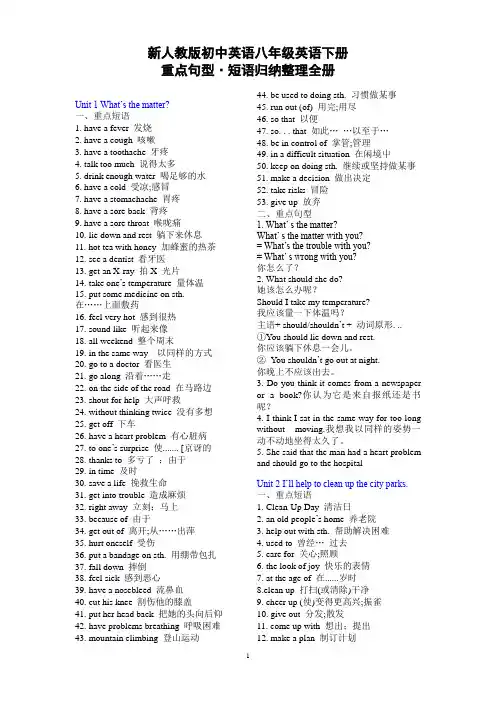
新人教版初中英语八年级英语下册重点句型·短语归纳整理全册Unit 1 What’s the matter?一、重点短语1. have a fever 发烧2. have a cough 咳嗽3. have a toothache 牙疼4. talk too much 说得太多5. drink enough water 喝足够的水6. have a cold 受凉;感冒7. have a stomachache 胃疼8. have a sore back 背疼9. have a sore throat 喉咙痛10. lie down and rest 躺下来休息11. hot tea with honey 加蜂蜜的热茶12. see a dentist 看牙医13. get an X-ray 拍X 光片14. take one’s temperature 量体温15. put some medicine on sth. 在……上面敷药16. feel very hot 感到很热17. sound like 听起来像18. all weekend 整个周末19. in the same way 以同样的方式20. go to a doctor 看医生21. go along 沿着……走22. on the side of the road 在马路边23. shout for help 大声呼救24. without thinking twice 没有多想25. get off 下车26. have a heart problem 有心脏病27. to one’s surprise 使....... [京讶的28. thanks to 多亏了;由于29. in time 及时30. save a life 挽救生命31. get into trouble 造成麻烦32. right away 立刻;马上33. because of 由于34. get out of 离开;从……出萍35. hurt oneself 受伤36. put a bandage on sth. 用绷带包扎37. fall down 摔倒38. feel sick 感到恶心39. have a nosebleed 流鼻血40. cut his knee 割伤他的膝盖41. put her head back 把她的头向后仰42. have problems breathing 呼吸困难43. mountain climbing 登山运动44. be used to doing sth. 习惯做某事45. run out (of) 用完;用尽46. so that 以便47. so. . . that 如此……以至于…48. be in control of 掌管;管理49. in a difficult situation 在闲境屮50. keep on doing sth. 继续或坚持做某事51. make a decision 做出决定52. take risks 冒险53. give up 放弃二、重点句型1. What’ s the matter?What’ s the matter with you?= What’s the trouble with you?= What’ s wrong with you?你怎么了?2. What should she do?她该怎么办呢?Should I take my temperature?我应该量一下体温吗?主语+ should/shouldn’t + 动词原形. ..①You should lie down and rest.你应该躺下休息一会儿。
人教版八下英语u8笔记

人教版八下英语u8笔记
以下是有关人教版八下英语u8的笔记,供您参考:
Unit 8 grammar
一、被动语态的构成:
被动语态由助动词be和及物动词的过去分词构成,其基本结构为“be+及物动词的过去分词”。
使用被动语态时需要根据时态和人称进行变化。
二、被动语态的时态:
被动语态有多种时态,包括一般现在时、一般过去时、一般将来时、现在进行时、过去进行时、现在完成时、过去完成时等。
具体形式如下:
1. 一般现在时:am/is/are+过去分词
2. 一般过去时:was/were+过去分词
3. 一般将来时:will be+过去分词
4. 现在进行时:am/is/are being+过去分词
5. 过去进行时:was/were being+过去分词
6. 现在完成时:have/has been+过去分词
7. 过去完成时:had been+过去分词
三、被动语态的用法:
被动语态常用于以下情况:
1. 不知道或不想指出动作的执行者。
2. 强调动作的承受者。
3. 在科技文献和新闻报道中,为了强调客观事实。
4. 在一些习惯用法中,如“It is said that…”(据说……)和“He will be invited to the party.”(他将受邀参加聚会。
)等。
四、主动语态与被动语态的转换:
将主动语态转换为被动语态的方法是将宾语变成主语,将谓语变成被动结构(be+过去分词),将原主语放在by后面,作为被动句中的宾语。
如果原主语不出现,被动句中常常以it作为形式主语。
初中英语人教版八年级下册 Unit 6知识点精析
八年级英语下册Unit6知识点精析Section A【重点单词】shoot射击;发射stone石头weak虚弱的;无力的god神;上帝bit一点;小块remind提醒;使想起silly愚蠢的;不明事理的object物体;物品hide 隐藏;隐蔽tail尾巴stick 棍;条magic有魔力的;有神奇力量的excite使激动;使兴奋Western西方国家的;(尤指)欧美的;西方的fit适合;合身couple(尤指)夫妻;两人;两件事情smile笑;微笑marry结婚【重点短语】a little bit有点儿;稍微初中英语人教版instead of代替;反而turn...into变成once upon a time从前fall in love爱上;喜欢上get married 结婚【重点句型】1.Finally, a god was so moved by Yu Gong that he sent two gods to take the mountains away.最后,天帝被愚公感动了,他派了两位神仙移走大山。
2.This story reminds us that you can never know what's possible unless you try to make it happen.这个故事提醒我们你永远不知道什么是可能的,除非你努力让它发生。
3.The new couple were so happy that they couldn't stop smiling when they got married.这对新婚夫妇如此幸福,以至于当他们结婚的时候,他们总是不停地笑。
【知识点精析】1.How Yi Shoots the Suns《后昇射日》【要点精析】shoot 此处为及物动词,意为“射击;发射”,其过去式和过去分词皆为shot,现在分词为shooting。
初中英语人教版八年级下册unit6知识点总结
八年级英语下册Unit 6知识点总结一、单词(音标)shoot [ʃu:t] v.投篮,射击,发射stone [ˈstəʊn] n.石头weak [wi:k] adj.虚弱的,柔弱的god [ɡɒd] n.上帝,神remind [rɪˈmaɪnd] v.提醒,使想起bit [bɪt] n.一点,小块a little bit 有点儿,稍微silly [ˈsɪlɪ] adj.& n.愚昧的;傻子,蠢货instead of 代替,反而turn into 变成object [ˈɒbdʒɪkt] n.物体,目标,物品hide [haɪd] v.躲藏,隐藏tail [teil] n.尾巴magic [ˈmædʒɪk] n.魔法,巫术stick [stɪk] n.& v.棍,棒;刺,戳,插excite [ɪk'saɪt] v.使激动,使兴奋Western ['westən] adj.西方的,欧美的once upon 从前stepsister [ˈstepsɪstə(r)] n.继姐(妹)prince [prɪns] n.王子fall in love 爱上,喜欢上fit [fɪt] v.适合,合身couple ['kʌpl] n.(尤指)夫妻,两人smile [smaɪl] n.& v.微笑marry [ˈmæri] v.与某人结婚get married 结婚gold [ɡəʊld] n.黄金,金币emperor [ˈempərə] n.皇帝silk [sɪlk] n.丝绸underwear [ˈʌndəwɛə] n.内衣nobody [ˈnəʊbədi] pron.无人,没有任何人,谁也不stupid ['stju:pɪd] adj.& n.愚蠢的,傻的;傻子cheat [tʃi:t] v.欺骗,愚弄stepmother [ˈstepmʌðə(r)] n.继母wife [waɪf] n.妻子husband [ˈhʌzbənd] n.丈夫whole [həul] adj.全部的,整体的scene [si:n] n.舞台,(戏剧)场景moonlight ['mu:nlaɪt] n.月光shine [ʃaɪn] v.照耀,发光bright [braɪt] adj.& adv.明亮的,发亮的;明亮地ground [graʊnd] n.地面lead [li:d] n.& v.领导,主角;带路voice [vɔis] n.嗓音brave [breiv] adj.勇敢的Claudia 克劳迪娅(女名)Journey to the West 《西游记》the Monkey King 美猴王Sleeping Beauty 《睡美人》Cinderella 《灰姑娘》Little Red Riding Hood 《小红帽》Hansel and Gretel 《韩赛尔与格雷特》(《糖果屋》)二、重点短语1.work on doing sth.致力于做某事2.as soon as ... 一……就…....3.once upon a time 从前4.continue to do sth.继续做某事5.make sth.happen 使某事发生6.try to do sth.努力做某事7.the journey to sp.......之旅8.tell the/a story 讲故事9.put on 穿10.a little bit 有点儿11.keep doing sth.坚持做某事12.give up 放弃13.instead of 代替;反而14.turn...into...使......变成......15.get married 结婚16.the main character 主要人物;主人公17.at other times 在另外一些时候18.be able to 能;会e out (书、电影等)出版20.become interested in...对……感兴趣21.walk to the other side 走到另一边去22.a fairy tale 一个神话故事23.the rest of the story 故事的其余部分24.leave sb.to do sth.让某人做某事25.make a plan to do sth.筹划/计划做某事26.go to sleep 去睡觉27.lead sb.to sp.把某人领到某地28.get lost 迷路29.change one’s plan 改变计划30.tell sb.to do sth.叫某人做某事31.in the moonlight 在月光下32.find one’ s way home 找到某人回家的路33.the next day 第二天34.send sb.to sp.派某人去某地35.so...that...如此.......以致于.......三、重点句型1.So what do you think about the story of Yu Gong? 你觉得愚公的故事怎么样?2.It doesn't seem very possible to move a mountain.把一座山给移掉好像不太可能。
八年级下册人教版英语第一单元2b知识点
八年级下册人教版英语第一单元2b知识点八年级下册人教版英语第一单元2b知识点主要包括下列内容:1. 物品询问当你想知道某个物品的名称时,可以用以下句型进行询问:“What’s this?” (这是什么?)“What are these?” (这些是什么?)“What’s that?” (那是什么?)“What are those?” (那些是什么?)例如:A: What’s this? (这是什么?)B: It’s a book. (这是一本书。
)2. 物品描述当你要描述某个物品时,可以用以下句型进行描述:“It’s + 物品名称” (它是……)“They are + 物品名称” (它们是……)例如:A: What’s that? (那是什么?)B: It’s a computer. (那是一台电脑。
)3. 物品位置当你想询问某个物品的位置时,可以用以下句型进行询问:“Where is + 物品名称?” (……在哪儿?)例如:A: Where is the pencil sharpener? (铅笔刀在哪儿?)B: It’s on the desk. (它在桌子上。
)4. 物品所有者当你想询问某个物品的所有者时,可以用以下句型进行询问:“Whose + 物品名称?” (……是谁的?)例如:A: Whose ruler is this? (这是谁的尺子?)B: It’s Lily’s. (它是莉莉的。
)这些知识点可以在日常生活中轻松应用,帮助你更快地了解和适应英语环境。
在学习英语过程中,要注重口语和听力的训练,加强交流能力,提高语言应用能力。
2024版人教版八年级下册英语单词表(含音标完整版)
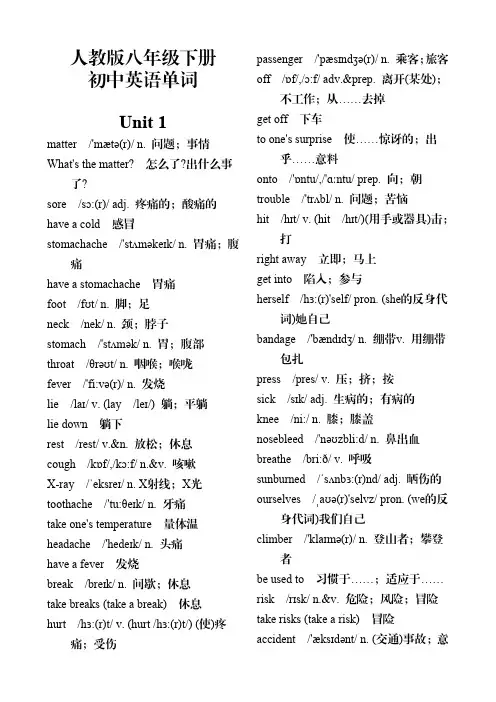
人教版八年级下册初中英语单词Unit1matter/'mætə(r)/n.问题;事情What's the matter?怎么了?出什么事了?sore/sɔ:(r)/adj.疼痛的;酸痛的have a cold感冒stomachache/'stʌməkeɪk/n.胃痛;腹痛have a stomachache胃痛foot/fʊt/n.脚;足neck/nek/n.颈;脖子stomach/'stʌmək/n.胃;腹部throat/θrəʊt/n.咽喉;喉咙fever/'fi:və(r)/n.发烧lie/laɪ/v.(lay/leɪ/)躺;平躺lie down躺下rest/rest/v.&n.放松;休息cough/kɒf/,/kɔ:f/n.&v.咳嗽X-ray/ˈeksreɪ/n.X射线;X光toothache/'tu:θeɪk/n.牙痛take one's temperature量体温headache/'hedeɪk/n.头痛have a fever发烧break/breɪk/n.间歇;休息take breaks(take a break)休息hurt/hɜ:(r)t/v.(hurt/hɜ:(r)t/)(使)疼痛;受伤passenger/'pæsɪndʒə(r)/n.乘客;旅客off/ɒf/,/ɔ:f/adv.&prep.离开(某处);不工作;从……去掉get off下车to one's surprise使……惊讶的;出乎……意料onto/'ɒntu/,/'ɑːntu/prep.向;朝trouble/'trʌbl/n.问题;苦恼hit/hɪt/v.(hit/hɪt/)(用手或器具)击;打right away立即;马上get into陷入;参与herself/hɜ:(r)'self/pron.(she的反身代词)她自己bandage/'bændɪdʒ/n.绷带v.用绷带包扎press/pres/v.压;挤;按sick/sɪk/adj.生病的;有病的knee/ni:/n.膝;膝盖nosebleed/'nəʊzbli:d/n.鼻出血breathe/bri:ð/v.呼吸sunburned/ˈsʌnbɜ:(r)nd/adj.晒伤的ourselves/ˌaʊə(r)'selvz/pron.(we的反身代词)我们自己climber/'klaɪmə(r)/n.登山者;攀登者be used to习惯于……;适应于……risk/rɪsk/n.&v.危险;风险;冒险take risks(take a risk)冒险accident/'æksɪdənt/n.(交通)事故;意外遭遇situation/ˌsɪtʃu'eɪʃn/n.情况;状况kilo/ˈki:ləʊ/(=kilogram)n.千克;公斤rock/rɒk/,/rɑːk/n.岩石run out(of)用尽;耗尽knife/naɪf/n.(pl.knives/naivz/)刀cut off切除blood/blʌd/n.血mean/mi:n/v.(meant/ment/)意思是;打算;意欲get out of离开;从……出来importance/ɪm'pɔ:(r)tns/n.重要性;重要decision/dɪ'sɪʒn/n.决定;抉择control/kənˈtrəʊl/v.限制;约束;管理;控制be in control of掌管;管理spirit/'spɪrɪt/n.勇气;意志death/deθ/n.死;死亡give up放弃nurse/nɜ:(r)s/n.护士Judy/'dʒu:dɪ/朱迪(女名)Nancy/'nænsɪ/南希(女名) Mandy/'mænde/曼迪(女名)Aron/'erən/Ralston/'rɔ:lstən/阿伦·罗尔斯顿Utah/'ju:tɑ:/犹他州(美国)Unit2clean up打扫(或清楚)干净cheer/tʃɪə/,/tʃɪr/v.欢呼;喝彩cheer up(使)变得更高兴;振奋起来give out分发;散发volunteer/ˌvɒlən'tɪə/,/ˌvɑːlən'tɪr/v.义务做;自愿做n.志愿者come up with想出;提出(主意、计划、回答等)put off推迟sign/saɪn/n.标志;信号notice/'nəʊtɪs/n.通知;通告;注意v.注意到;意识到hand out/分发call up打电话给(某人);征召used to曾经……;过去……lonely/'ləʊnlɪ/adj.孤独的;寂寞的care for照顾;非常喜欢several/'sevrəl/pron.几个;数个;一些strong/strɒŋ/,/strɔ:ŋ/adj.强烈的;强壮的feeling/'fi:lɪŋ/n.感觉;感触satisfaction/ˌsætɪs'fækʃn/n.满足;满意joy/dʒɔɪ/n.高兴;愉快owner/'əʊnə(r)/n.物主;主人try out参加……选拔;试用journey/'dʒɜ:(r)ni/n.(尤指长途)旅行;行程raise/reɪz/v.募集;征集midnight/'midnait/n.午夜;子夜alone/ə'ləʊn/adv.独自;单独repair/rɪ'peə/,/rɪ'per/v.修理修补fix/fɪks/v.修理;安装fix up修理;装饰give away赠送;捐赠take after(外貌或行为)像broken/'brəʊkən/adj.破损的;残缺的wheel/wi:l/n.车轮;轮子letter/'letə(r)/n.信;函Miss/mɪs/n.女士;小姐set up建立;设立disabled/dɪs'eɪbld/adj.丧失能力的;有残疾的make a difference影响;有作用blind/blaɪnd/adj.瞎的;失明的deaf/def/adj.聋的imagine/ɪ'mædʒɪn/v.想象;设想difficulty/'dɪfɪkəlti/n.困难;难题open/'əʊpən/v.开;打开door/dɔ:(r)/n.门carry/'kæri/v.拿;提;扛train/treɪn/v.训练;培训excited/ɪk'saɪtɪd/adj.激动的;兴奋的training/'treɪnɪŋ/n.训练;培训kindness/'kaɪndnəs/n.仁慈;善良clever/'klevə(r)/adj.聪明的;聪颖的understand/ˌʌndə(r)'stænd/v.(understood/ˌʌndə(r)'stʊd/)理解;领会change/tʃeɪndʒ/v.&n.变化;改变interest/'ɪntrəst/n.兴趣;关注;v.使感兴趣;使关注sir/sɜ:(r)/n.先生(用于正是信函中对不知名的男性收信人的称呼时,写为Sir)madam/'mædəm/n.夫人;女士(用于正是信函中对不知名的nv性收信人的称呼时,写为Madam)Mario/'mæriəʊ/,/'mɑːriəʊ/马里奥(男名)Jimmy/'dʒɪmi/吉米(男名)Unit3rubbish/'rʌbɪʃ/n.垃圾;废弃物take out the rubbish倒垃圾fold/fəʊld/v.折叠;对折sweep/swi:p/v.(swept/swept/)扫;打扫floor/flɔ:(r)/n.地板mess/mes/n.杂乱;不整洁throw/θrəʊ/v.(threw/θru:/)扔;掷all the time频繁;反复neither/'naɪðə,'ni:ðə(r)/adv.也不pron.两者都不shirt/ʃɜ:(r)t/n.衬衫as soon as一……就……pass/pɑ:s/,/pæs/v.给;递;走过;通过borrow/'bɒrəʊ/,/'bɑːrəʊ/v.借;借用lend/lend/v.(lent/lent/)借给;借出finger/'fɪŋgə/n.手指hate/heɪt/v.厌恶;讨厌chore/tʃɔ:(r)/n.杂务;乏味无聊的工作while/waɪl/conj.与……同时;当……的时候;而;然而snack/snæk/n.点心;小吃;快餐stress/stres/n.精神压力;心理负担waste/weɪst/n.浪费;垃圾v.浪费;滥用in order to目的是;为了provide/prə'vaɪd/v.提供;供应anyway/'enɪweɪ/adv.而且;加之depend/dɪ'pend/v.依靠;信赖depend on依靠;信赖develop/dɪ'veləp/v.发展;壮大independence//ˌɪndɪ'pendəns/n.独立fairness/'feənəs/,/'fernəs/n.公正性;合理性since/sɪns/conj.因为;既然prep.,conj.&adv.从……以后;自……以来neighbor/'neibə(r)/(=neighbour)n.邻居take care of照顾;处理ill/ɪl/adj.有病;不舒服drop/drɒp/,/drɑːp/v.落下;掉下independent/'ɪndɪ'pendənt/adj.独立的;自主的fair/feə/,/fer/adj.合理的;公平的unfair/ˌʌn'feə/,/ˌʌn'fer/adj.不合理的;不公正的Sandy/'sændɪ/桑迪(女名)Unit4allow/ə'laʊ/v.允许;准许wrong/rɒŋ/,/rɔ:ŋ/adj.有毛病;错误的What's wrong?哪儿不舒服?look through快速查看;浏览guess/ges/v.猜测;估计deal/di:l/n.协议;交易big deal重要的事work out成功地发展;解决get on with和睦相处;关系良好relation/rɪ'leɪʃn/n.关系;联系;交往communication/kəˌmju:nɪ'keɪʃn/n.交流;沟通argue/'ɑ:(r)gju:/v.争吵;争论cloud/klaʊd/n.云;云朵elder/'eldə(r)/adj.年级较长的instead/ɪn'sted/adv.代替;反而;却whatever/wɒt'evə/,/wɑːtevər/pron.任何;每一nervous/'nɜ:(r)vəs/adj.焦虑的;担忧的offer/'ɒfə/,/'ɑːfər/v.主动提出;自愿给予proper/'prɒpə/,/prɑːpər/adj.正确的;恰当的secondly/'sekəndlɪ/adv.第二;其次communicate/kə'mju:nɪkeɪt/v.交流;沟通explain/ɪk'spleɪn/v.解释;说明clear/klɪə/,/klɪr/adj.清楚易懂的;晴朗的copy/'kɒpi/,/'kɑːpi/v.抄袭;模仿;复制;复印return/rɪ'tɜ:(r)n/v.归还;回来;返回anymore/ˌenɪ'mɔ:(r)/adv.(常用于否定句和疑问句末)再也(不);(不)再member/'membə(r)/n.成员;分子pressure/'preʃə(r)/n.压力compete/kəm'pi:t/v.竞争;对抗opinion/ə'pɪnjən/n.意见;想法;看法skill/skɪl/n.技艺;技巧typical/'tɪpɪkl/adj.典型的football/'fʊtbɔ:l/n.(美式)橄榄球;足球cut out删除;删去quick/kwɪk/adj.快的;迅速的;时间短暂的continue/kən'tɪnju:/v.持续;继续存在compare/kəm'peə/,/kəm'mper/v.比较compare with比较;对比crazy/'kreɪzi/adj.不理智的;疯狂的push/pʊʃ/v.鞭策;督促;推动development/dɪ'veləpmənt/n.发展;发育;成长cause/kɔ:z/v.造成;引起usual/'ju:ʒʊəl/adj.通常的;寻常的in one's opinion依……看perhaps/pə(r)'hæps/adv.可能;大概;也许Cathy/'kæθi/凯茜(女名)Taylor/'teɪlə(r)/泰勒(姓)Unit5rainstorm/'reɪnstɔ:(r)m/n.暴风雨alarm/ə'lɑ:(r)m/n.闹钟go off(闹钟)发出响声begin/bɪ'gɪn/v.(began/bɪ'gæn/)开始heavily/'hevɪli/adv.在很大程度上;大量地suddenly/'sʌdənli/adv.突然;忽然pick up(=pick up the phone)接电话strange/streɪndʒ/adj.奇特的;奇怪的storm/stɔ:(r)m/n.暴风雨wind/wɪnd/n.风light/laɪt/n.光;光线;光亮report/rɪ'pɔ:(r)t/v.&n.报道;公布area/'eəriə/n.地域;地区wood/wʊd/n.木;木头window/'wɪndəʊ/n.窗;窗户flashlight/'flæʃlaɪt/n.手电筒;火炬match/mætʃ/n.火柴beat/bi:t/v.(beat/bi:t/)敲打;打败against/ə'genst/prep.倚;碰;撞asleep/ə'sli:p/adj.睡着fall asleep进入梦乡;睡着die down逐渐变弱;逐渐消失rise/raɪz/v.(rose/rəʊz/)&n.升起;增加;提高fallen/'fɔ:lən/adj.倒下的;落下的apart/ə'pɑ:(r)t/adv.分离;分开have a look看一看icy/'aɪsi/adj.覆盖着冰的;冰冷的kid/kɪd/v.开玩笑;欺骗n.小孩realize/'rɪəlaɪz/,/'ri:əlaɪz/v.理解;领会;认识到make one's way前往;费力地前进passage/'pæsɪdʒ/n.章节;段落pupil/'pju:pl/n.学生completely/kəm'pli:tli/adv.彻底地;完全地shocked/ʃɒkt/,/ʃɑ:kt/adj.惊愕的;受震惊的silence/'saɪləns/n.沉默;缄默;无声in silence沉默;无声recently/'ri:sntli/adv.不久前;最近take down拆除;往下拽;记录terrorist/'terərɪst/n.恐怖主义者;恐怖分子date/deɪt/n.日期;日子tower/'taʊə(r)/n.塔;塔楼at first首先;最初truth/tru:θ/实情;事实Allen/'ælɪn/艾伦(姓)Martin/'mɑ:(r)tɪn/Luther/'lu:θə(r)/ King/kɪŋ/马丁·路德·金Alabama/ˌælə'bæmə/亚拉巴马州(美国)Animal Helpline/'helplaɪn/动物保护热线World Trade/treɪd/Center世贸大楼(美国纽约)Unit6shoot/ʃu:t/v.(shot/ʃɒt/,/ʃɑːt/)射击;发射stone/stəʊn/n.石头weak/wi:k/adj.虚弱的;无力的god/gɒd/n.神;上帝(God) remind/rɪ'maɪnd/v.提醒;使想起bit/bɪt/n.一点;小块a little bit有点儿;稍微silly/'sɪli/adj.愚蠢的;不明事理的instead of代替;反而turn...into变成object/'ɒbdʒɪkt/,/'ɑːbdʒɪkt/n.物体;物品hide/haɪd/v.隐藏;隐蔽tail/teɪl/n.尾巴magic/'mædʒɪk/adj.有魔力的;有神奇力量的stick/stɪk/n.棍;条excite/ɪk'saɪt/v.使激动;使兴奋Western/'westə(r)n/adj.西方国家的;(尤指)欧美的;西方的(w可以小写)once upon/ə'pɒn/,/ə'pɑːn/a time从前stepsister/'stepsɪstə(r)/n.继姐(妹) prince/'prɪns/n.王子fall in love爱上;喜欢上fit/fɪt/v.适合;合身couple/'kʌpl/n.(尤指)夫妻;两人;两件事物smile/smaɪl/v.&n.笑;微笑marry/'mæri/vt.结婚get married结婚gold/gəʊld/n.金子;金币adj.金色的emperor/'empərə(r)/n.国王silk/sɪlk/n.丝绸;丝织物underwear/'ʌndəweə/,/'ʌndərwer/n.内衣nobody/'nəʊbədi/pron.没有人n.小人物stupid/'stju:pɪd/,/'stu:pɪd/adj.愚蠢的cheat/tʃi:t/v.欺骗;蒙骗n.骗子stepmother/'stepmʌðə(r)/n.继母wife/waɪf/n.妻子;太太husband/'hʌzbənd/n.丈夫whole/həʊl/adj.全部的;整体的scene/si:n/n.(戏剧或歌剧的)场;场景moonlight/'mu:nlaɪt/n.月光shine/ʃaɪn/v.(shone/ʃɒn/)发光;照耀bright/braɪt/adv.光两地;明亮地adj.明亮的;光线充足的ground/graʊnd/n.地;地面lead/li:d/v(led/led/)带路;领路voice/vɔɪs/n.声音brave/breɪv/adj.勇敢的;无畏的Claudia/'klɔ:diə/,/'klaʊdiə/克劳迪娅(女名)Journey to the West《西游记》the Monkey King/kɪŋ/《美猴王》Sleeping Beauty/'bju:ti/《睡美人》Cinderella/ˌsɪndə'relə/《灰姑娘》Little red Riding Hood/hʊd/《小红帽》Hansel/'hænsl/and Gretel/'gretl/《韩塞尔与葛雷特》(《糖果屋》)Unit7square/skweə/,/skwer/n.平方;正方形meter/'mi:tə(r)/(=metre)n.米;公尺deep/di:p/adj.深的;纵深的desert/'dezə(r)t/n.沙漠population/ˌpɒpjʊ'leɪʃn/,/ˌpɑːpjʊ'leɪʃn/ n.人口;人口数量Asia/'eɪʒə/,/'eɪʃə/n.亚洲feel free(可以)随便(做某事)tour/tʊə/,/tʊr/n.&v.旅行;旅游tourist/'tʊərɪst/,/'tʊrɪst/n.旅行者;观光者wall/wɔ:l/n.墙amazing/ə'meɪzɪŋ/adj.令人大为惊奇的;令人惊喜(或惊叹)的ancient/'eɪnʃənt/adj.古代的;古老的protect/prə'tekt/v.保护;防护wide/waɪd/adj.宽的;宽阔的as far as I know就我所知man-made/ˌmæn'meɪd/adj.人造的achievement/ə'tʃi:vmənt/n.成就;成绩southwestern/ˌsaʊθ'westə(r)n/adj.西南的;西南方向的thick/θɪk/adj.厚的;浓的include/ɪn'klu:d/v.包括;包含freezing/'fri:zɪŋ/adj.极冷的;冰冻的condition/kən'dɪʃn/n.条件;状况take in吸入;吞入(体内)succeed/sək'si:d/v.实现目标;成功challenge/'tʃælɪndʒ/v.&n.挑战;考验in the face of面对(问题、困难等) achieve/ə'tʃi:v/v.达到;完成;成功force/fɔ:(r)s/n.力;力量nature/'neɪtʃə(r)/n.自然界;大自然even though(=even if)即使;虽然ocean/'əʊʃən/n.大海;海洋the Pacific/pə'sɪfɪk/Ocean太平洋cm(=centimeter/centimetre)/'sentɪmi:tə(r)/厘米weigh/weɪ/v.重量是……;称……的重量birth/bɜ:(r)θ/n.出生;诞生at birth出生时up to到达(某数量、程度等);至多有;不多于adult/'ædʌlt/,/'ədʌlt/adj.成年的;成人的n.成人;成年动物bamboo/ˌbæm'bu:/n.竹子endangered/ɪn'deɪndʒə(r)d/adj.濒危的research/rɪˈsɜ:(r)tʃ/n.&v.研究;调查(用作名词时,重音可放在第一个音节)keeper/'ki:pə(r)/n.饲养员;保管人awake/ə'weɪk/adj.醒着excitement/ɪk'saɪtmənt/n.激动;兴奋walk into走路时撞着fall over绊倒or so大约illness/'ɪlnəs/n.疾病;病wild/waɪld/adj.野生的government/'gʌvə(r)nmənt/n.政府;内阁whale/weɪl/n.鲸oil/ɒɪl/n.油;食用油;石油protection/prə'tekʃn/n.保护;保卫huge/hju:dʒ/adj.巨大的;极多的Tenzing/'tenzɪŋ/Norgay/'nɒrgeɪ/丹增·诺尔盖Edmund/'edmənd/Hillary/'hɪləri/埃德蒙希拉里Junko/'dʒu:ŋkəʊ/Tabei/tɑː'beɪ/田部井淳子Qomolangma/'tʃəʊməʊˌlɑːŋmə/珠穆朗玛峰the Nile/naɪl/尼罗河the Caspian/'kæspiən/Sea里海(世界最大的咸水湖)the Sahara/sə'hɑːrə/撒哈拉沙漠the Yangtze/'jætŋsi/River长江the Yellow River黄河the Ming Dynasty/ˈdɪnəsti/,/ˈdaɪnəsti/明朝the Ming Great Wall明长城the Himalayas/ˌhɪməˈleɪəz/喜马拉雅山脉the Amazon/ˈæməzən/,/ˈæməzɑːn/ River亚马逊河Chengdu Research Base/beɪs/成都研究基地Unit8treasure/'treʒə(r)/n.珠宝;财富island/'aɪlənd/n.岛full of满是……的;(有)大量的;(有)丰富的classic/'klæsɪk/n.经典作品;名著page/peɪdʒ/n.(书刊或纸张的)页,面,张hurry/'hʌri/v.匆忙;赶快hurry up赶快;急忙(做某事)due/dju:/,/du:/adj.预期;预定ship/ʃɪp/n.船tool/tu:l/n.工具gun/gʌn/n.枪;炮mark/mɑ:(r)k/n.迹象;记号;分数v.做记号;打分sand/sænd/n.沙滩;沙cannibal/'kænɪbl/n.食人肉者towards/tə'wɔ:dz/,/tɔ:rdz/prep.朝;向;对着land/lænd/n.陆地;大地fiction/'fɪkʃn/n.小说science fiction科幻小说(或影片等) technology/tek'nɒlədʒi/,/tek'nɑːlədʒi/ n.科技;工艺French/frentʃ/法语pop/pɒp/,/pɑː/n.流行音乐;流行乐曲rock/rɒk/,/rɑːk/n.摇滚乐band/bænd/n.乐队country music(也作country)乡村音乐forever/fər'evə(r)/adv.永远abroad/ə'brɔ:d/adv.在国外;到国外actually/'æktʃuəli/adv.真实地;事实上ever since自从fan/fæn/n.迷;狂热爱好者southern/'sʌðə(r)n/adj.南方的modern/'mɒdn/,/'mɑːdərn/adj.现代的;当代的success/sək'ses/n.成功belong/bɪ'lɒŋ/,/bɪ'lɔ:ŋ/v.属于;归属one another互相laughter/'lɑ:ftə/,/'læftə(r)/n.笑;笑声beauty/'bju:ti/n.美;美丽million/'mɪljən/num.百万record/'rekɔ:d/,/'rekərd/n.唱片;记录/rɪ'kɔ:(r)d/v.录制;录(音) introduce/ˌɪntrə'dju:s/,/ˌɪntrə'du:s/v.介绍;引见line/laɪn/n.行;排Alex/'æleks/亚历克斯(男名) Garth/gɑː(r)θ/Brooks/brʊks/加思·布鲁克斯the Beatles/'bi:tlz/披头士乐队(英国)Treasure Island《金银岛》Alice in Wonderland/'wʌndə(r)lænd/《爱丽丝梦游仙境》Little Woman《小妇人》Olive/'ɒlɪvə(r)/,/'ɑːlɪvə(r)/Twist/twɪst/《雾都孤儿》Robinson Crusoe/'kru:səʊ/《鲁滨逊漂流记》Tom Sawyer/'sɔ:jə(r)/《汤姆·索娅历险记》Harry Potter/'pɒtə(r)/,/'pɑːtər/《哈利·波特》Nashville/'næʃvɪl/纳什维尔(美国田纳西州府)Tennessee/ˌtenə'si:/田纳西州(美国) Country Music Hall of Fame/feɪm/ Museum乡村音乐名人堂博物馆Unit9 Amusement/ə'mju:zmənt/n.娱乐;游戏Amusement park游乐场somewhere/'sʌmweə/,/'sʌmwer/adv.在某处;到某处camera/'kæmərə/n.照相机;摄影机;摄像机invention/ɪn'venʃn/n.发明物invent/ɪn'vent/v.发明;创造unbelievable/ˌʌnbɪ'li:vəbl/adj.难以置信的;不真实的progress/'prəʊgres/,/'prɑːgres/n.进步;进展rapid/'ræpɪd/adj.迅速的;快速的unusual/ʌn'ju:ʒuəl/adj.特别的;不寻常的toilet/'tɔɪlət/n.坐便器;厕所encourage/ɪn'kʌrɪdʒ/,/ɪn'kɜ:rɪdʒ/v.鼓励social/'səʊʃl/adj.社会的peaceful/'pi:sfl/adj.和平的;安宁的tea art茶艺performance/pə(r)'fɔ:(r)məns/n.表演;演出perfect/'pɜ:(r)fɪkt/adj.完美的;完全的tea set茶具itself/ɪt'self/pron.(it的反身代词)它自己collect/kə'lekt/v.收集;采集a couple of两个;一对;几个German/'dʒə:(r)mən/adj.德国的;德语的;德国人的n.德语;德国人theme/θi:m/n.主题ride/raɪd/n.供乘骑的游乐设施;短途旅程province/'prɒvɪns/,/'prɑːvɪns/n.省份thousand/'θaʊznd/num.一千thousands of数以千计的;许许多多的on the one hand...on the other hand...一方面……另一方面……safe/seɪf/adj.安全的;无危险的simply/'sɪmpli/adv.仅仅;只;不过fear/fɪə/,/fɪr/v.&n.害怕;惧怕whether/'weðə(r)/conj.不管……;还是);或者……(或者);是否Indian/'ɪndiən/adj.印度的n.印度人Japanese/ˌdʒæpə'ni:z/adj.;日本的;日本人的;日语的n.日本人;日语fox/fɒks/,/fɑːks/n.狐狸all year round全年equator/ɪ'kweɪtə(r)/n.赤道whenever/wen'evə(r)/conj.在任何……时候;无论何时spring/sprɪŋ/n.春天mostly/'məʊstli/adv.主要地;通常location/ləʊ'keɪʃn/n.地点;位置National/'næʃnəl/Science Museum国家科学博物馆International/ˌɪntə(r)'næʃnəl/Museum of Toile国际厕所博物馆Hangzhou National Tea Museum杭州国家茶博物馆Donald/'dɒnəld/,/'dɑːnəld/Duck唐老鸭Disneyland/'dɪznilænd/迪斯尼乐园Disney Cruise/kru:z/迪斯尼游轮the Terracotta/ˌterə'kɒtə/,/ˌterə'kɑːtə/ Army兵马俑the Bird's Nest/nest/鸟巢Singapore/ˌsɪŋə'pɔ:(r)/,/'sɪŋəˌpɔ:(r)/新加坡Southeast Asia东南亚Night Safari/sə'fɑːri/夜间动物园Unit10yard/jɑ:(r)d/n.院子yard sale庭院拍卖会sweet/swi:t/adj.甜蜜的;甜的;含糖的memory/'meməri/n.记忆;回忆cent/sent/n.分;分币toy/tɔɪ/n.玩具bear//beə/,/ber/n.熊maker/'meɪkə(r)/n.生产者;制订者break maker面包机scarf/skɑ:(r)f/n.围巾;披巾;头巾soft/sɒft/,/sɔ:ft/adj.软的;柔软的soft toy软体玩具;布绒玩具check/tʃek/v.&n.检查;审查check out查看;观察board/bɔ:(r)d/n.板;木板board game棋类游戏junior/'dʒu:njə(r)/adj.地位(或职位、级别)低下的junior high school初级中学clear/klɪə/,/klɪr/v.清理;清除clear out清理;丢掉bedroom/'bedru:m/n.卧室no longer不再;不复own/əʊn/v.拥有;有railway/'reɪlweɪ/n.铁路;铁道part/pɑ:(r)t/v.离开;分开part with放弃;交出(尤指不舍得的东西)certain/'sɜ:(r)tn/adj.某种;某事;某人as for至于;关于honest/'ɒnɪst/,/'ɑːnɪst/adj.城市的;老实的to be honest说实在的while/waɪl/n.一段时间;一会儿truthful/'tru:θfl/adj.诚实的;真实的hometown/'həʊmtaʊn/n.家乡;故乡nowadays/'naʊədeɪz/adv.现今;现在;目前search/sɜ:(r)tʃ/v.&n.搜索;搜查among/ə'mʌŋ/prep.在(其)中;……之一crayon/'kreɪən/n.彩色铅笔(或粉笔、蜡笔)shame/ʃeɪm/n.羞耻;羞愧;惭愧regard/rɪ'gɑ:(r)d/v.将……认为;把……视为count/kaʊnt/v.数数century/'sentʃəri/n.百年;世纪according/əkɔ:(r)dɪŋ/to依据;按照opposite/'ɒpəzɪt/,/'ɑ:pəzət/prep.与……相对;在……对面adj.对面的;另一边的especially/ɪs'peʃəli/adv.尤其;特别;格外childhood/'tʃaɪldhʊd/n.童年;幼年consider/kən'sɪdə(r)/v.注视;仔细考虑close to几乎;接近hold/həʊld/v.(held/held/,held)拥有;抓住。
人教版八下英语英语语法知识点精讲+练习
人教版八年级下册英语英语语法知识点精讲+练习(一)一般将来时一般将来时表示将来某个时间要发生的动作或者存在的状态。
通常与表示将来的时间状语连用,如tomorrow, the day after tomorrow, next year, next month, next week, in 100 years等。
be going to do(动词原形)结构:表示打算、准备做的事情或者肯定要发生的事情。
如:It is going to rain.will do结构表示将来的用法:1. 表示预见Do you think it will rain?You will feel better after a good rest.2. 表示意图I will borrow a book from our school library tomorrow.What will she do tomorrow?基本构成如下:一般疑问句构成:(1)will+主语+do…? Will Sarah come to visit me next Sunday?(2)there be 结构的一般疑问句:Will there + be …?Will there be fewer trees? Yes, there will. / No, there won’t否定句构成:will + not (won’t)+doSarah won’t come to visit me next Sunday.特殊疑问句构成:特殊疑问词+will+主语+…?What will Sarah do next Sunday?★★练一练★★根据例句,用will改写下列各句例:I don’t feel well today. (be better tomorrow)I’ll be better tomorrow.1. Gina has six classes today. (have a lot of homework tonight)_____________________________2. I’m tired now. (sleep later)_____________________________3. My parents need a new car. (buy one soon)_____________________________4. We can’t leave right now. (leave a little later)_____________________________5. The weather is awful today. (be better tomorrow)_____________________________答案:1. She’ll have a lot of homework tonight.2. I’ll sleep later.3. They’ll buy one soon.4. We’ll leave a little later.5. Maybe it’ll be better tomorrow.(二)should的用法:should用来提出建议和忠告,后边加动词原形,否定句直接在should后边加not.例如:I think you should eat less junk food.我认为你应该少吃垃圾食品。
人教版初中英语八年级下册各单元考点归纳
人教版初中英语八年级下册各单元考点归纳Unit 1 what' s the matter?1. It’s +形容词+ for sb. + to do sth. 做某事对某人来说是…的。
It’s important to do sth. 做某事很重要。
It’s important for me to eat a balanced diet.平衡饮食对我来说是很重要的.It’s easy to do sth. 做某事是容易的。
It’s easy for us to find out the an swer. 找出答案对我们来说是容易的。
2. 情态动词should的用法should是情态动词,它的基本用法是必须和其他动词一起构成谓语。
意为"应该......"。
should(应当,应该)用于所有人称,表示劝告或建议。
eg. ---I have a very bad cold. 我感冒很厉害。
---You should lie down and have a rest. 你应该躺下,多喝水。
3. maybe与may be(1)maybe是副词,译为“也许、可能”,相当于“perhaps”。
如:Maybe he can answer the question. 也许他能回答那个问题。
He maybe is from the USA, too. 他可能也来自美国。
(2)may be中的may为情态动词,译为“可能是......”。
如:He may be from the USA, too. 他可能也来自美国。
She may be our English teacher. 她可能是我们的英语老师。
4. few、a few、little、a little的区别和联系:(1)few / a few用来修饰可数名词,few表示否定意义,没有,几乎没有;a few表示肯定意义,有几个。
例如:He has few friends here, he feels lonely. 他这里没朋友,他感觉寂寞。
八年级下册人教版英语第二单元2d知识点
八年级下册人教版英语第二单元2d知识点英语作为一门重要的外语,在我们的学习生活中扮演了重要的角色。
对于初中生来说,学习英语是日常学习的重点之一。
八年级下册人教版英语第二单元2d知识点也是我们学习中的重头戏,掌握这些知识点对于我们的英语学习是至关重要的。
在本文中,我将和大家一起学习八年级下册人教版英语第二单元2d知识点,希望能对大家的英语学习有所帮助。
一、过去完成时的用法过去完成时表示在过去某个时间或动作之前已经发生了另一个动作或存在了一个状态。
它的结构是“had + 过去分词”,例如:“I had finished my homework before I went to bed.”二、虚拟语气的用法虚拟语气是表示一种假设、虚构或不可能实现的情况。
它的常用结构是:“if + 过去式,would/could/should + 动词原形;现在将来式”,例如:“If I had enough money, I would buy a car.”三、倒装语序英语中有很多种倒装语序,通常情况下是为了加强语气或者使语句更加清晰易懂。
例如:“Not only did he study En glish, but he also learned French.”四、固定搭配的用法英语中存在大量的固定搭配,掌握这些固定搭配对于我们的英语学习是非常有帮助的。
例如:“make friends”、“take part in”等。
五、情态动词的用法情态动词通常表示说话者的态度、意图、能力、推测等,它们有“can, could, may, might, must, shall, should, will, would”等。
例如:“I can swim very well.”总之,八年级下册人教版英语第二单元2d知识点是我们英语学习中的重点之一。
要想掌握这些知识点,我们需要抓住重点,勤加练习,多听多读多记多练,相信我们的英语水平一定会不断提高。
人教版八年级下册英语第二单元unit2知识点
人教版八年级下册英语第二单元unit2知识点Unit 2 What should I do?一丶重点短语1.argue v.争论;争吵argue with sb.与某人吵架I argued with my best XXX.我和我的好朋友吵架了。
2.① XXX.(用于否定句)也He doesn’t have any money。
and I don’t。
either.他没有钱,我也没有。
I can’t play chess。
She can’t。
either.我不会下国际象棋,她也不会。
② too 也(用于肯定或疑问句)I’m XXX a XXX。
too.我是老师,他也是老师。
3.ask (sb.)for sth.向某人寻求某物;要……Don't ask for food every day.Go and find some work.别天天要饭,找点儿工作做。
I don’t think you should ask your parents for some money.我想你不应向父母要钱。
4.the same as。
与……相同(注意前后两个比较对象的属性保持一致)XXX same asmy friends'.这些衣服与我朋友的一样。
Tom is the same age as Anna.=Tom is as old as Anna.汤姆和XXX一样大。
Her backpack is the same as XXX.她的背包与我的一样。
5.except除……之外;(不包孕……在内)My class has been XXX.除我之外,我的同砚都被约请了。
All the students went to the park except him.除他之外,部分同砚都去过公园了。
XXX.除了她以外,所有的学生都去美国旅行过。
注意区别:besides除……以外,还有。
(包括在内)We all went there besides him.除他去以外,我们也都去了。