
【精品】初一英语第五讲
第五讲:Module 5阅读进阶训练AName: Edward Scott School: Kelvin Stove State High School, LondonGrade 7 Term Ending May 6thSubjects:Maths He is a little weak in this, but he has tried his best to catch up withothers.Science He can work out many difficulties. Well done!English He is the best in the class. Keep it up!French His reading is really good, and he can remember many words. History He is not so good at this, but he has done better than before. Geography He knows the names of many places in the world.Music He does like pop songs, and he sings very well.Remarks (评语) He has the ability to do a lot better. More work is need next term. Class teacher IvyPrincipal M. L. MartinSchool reopens September 11th1. After reading this, we know this is ________.A. a studying planB. a teaching planC. a school reportD. a working plan2. Which of the following is not mentioned in the form?A. PE.B. Music.C. Maths.D. History.3. Edward’s best subject is ________.A. scienceB. EnglishC. geographyD. French4. Edward is not so good at ________.A. maths and historyB. science and geographyC. history and FrenchD. Music and English5. According to the form, which of the following sentences is true?A. Edward can’t sing songs very well.B. School will begin again on May 6th.C. Edward can do better if he works hard next term.D. Edward doesn’t do well in science.BElena wanted to be an artist when she grew up --- but sadly, when she was only five years old, she had a cancer.Elena spent the long days in the hospital drawing pictures. She drew many pictures of hearts and smiling families. One of her pictures was on show in a museum, right next to a Picasso painting. As she got worse she couldn’t speak; she began to communicate with her family by writing notes.Elena died in 2007, just a year after she had a cancer. Even though they knew Elena would leave them, her parents Keith and Brooke were very sad. But they soon found that she left a gift behind for them.Not long after Elena’s death, Elena’s parents were cleaning her room when they began to find notes that she wrote to them. “They were between CDs or between books on our bookshelf,” said Keith.All through her final days, Elena wrote love notes to her family, and put them in secret places throughout the house.“We started to collect them and they would all say, ‘I love you Mom, Dad and Grace.’ We kept finding them, and still to this day, we keep finding them,” Keith told the reporter.1. What did Elena want to be when she grew up?A. A teacher.B. A. doctor.C. An artist.D. A singer.2. When was Elena born?A. In 2001.B. In 2003.C. In 2006.D. In 2007.3. What did Elena leave her parents as gifts?A. CDs.B. BooksC. Money.D. Notes.4. When did Elena write the notes?A. Before she had a cancer.B. After she really got well.C. While she couldn’t speak.D. While she talked with her parents.5. Which of the following is true?A. Elena’s parents have found all the notes.B. Elena did well in drawing pictures.C. Elena’s parents didn’t know she would die.D. Elena stopped writing in her final days.C15 years ago, something was wrong with Lin Yan’s eyes and then she couldn’t see. Then Sherry went into her ___1___.Lin and her friends are getting ready to have a party to ___2___ her thanks to Sherry, who has brought Lin many ___3___ in the past years.Now Sherry is her eyes. __4___ her help, she can know more about the outside world.___5___ a long time she was afraid to go out after she couldn’t see. When she had ___6___ to do outside her home, she would go after her mother arm in arm.“With Sherry, I ___7___ without my mom for the first time last April,” Lin said. “I was very anxious at first, but Sherry made me feel ___8___. She told me about stairs and crossroads.Lin ___9___ from home to work place every morning with the help of Sherry. And when Lin wants to take a bus to a supermarket, Sherry ___10___ acts as a guide then.Lin said she didn’t know there were guide dogs until 2006, when she ___11___ a Japanese film titled Quill. It was a documentary about a guide dog which ___12___ moved her so much so that she found herself wanting to have her own guide dog.1. A. life B. work C. family D. idea2. A. have B. give C. take D. show3. A. difficulties B. joys C. happiness D. health4. A. As a result B. For example C. Because of D. Instead of5. A. In B. On C. At D. For6. A. something B. anything C. nothing D. everything7. A. went in B. went out C. went on D. went up8. A. interesting B. interested C. relaxed D. relaxing9. A. runs B. walks C. drives D. flies10. A. too B. either C. also D. neither11. A. found B. looked C. heard D. saw12. A. greatly B. quickly C. slowly D. sadlyDKids’ birthday parties are more fun than adults’ parties. You don’t have to be so serious. But there are still many things to do for a kid’s party. The passage will tell you some hows: Make a list. Write down all your child’s ideas on a piece paper and then get things ready according to the list.Get invitations. Make sure you won’t have the party at the same time as your child’s soccer game. Make sure you write down the name of each guest, so you know how many chairs, how much food and good bags, etc.Buy something. If you go to a party store, they will have everything you need, and you won’t have to go to many different stores for all your things.You need to decide whether to buy a cake or make one. Make sure to get the food ready on time. Decide what kind of food to have. You may get some pizzas, sandwiches and lunch bagswith a sandwich.You could have some drinks such as coke, coffee and juice. Having a cooler filled with small bottles of water is a good idea, too, especially during hot weather.1.The passage mainly tells us ________.A. how to have kids’ birthday partiesB. when to have kids’ birthday partiesC. where to have kids’ birthday partiesD. why to have kids’ birthday parties2. At first, we should ________ for a kid’s birthday party.A. buy somethingB. make a cakeC. get invitationsD. make a list3. Which may be the right time to have a party?A. At the same time as the kid’s soccer game.B. On the night before the kid’s English test.C. At the time when the kid is free.D. On the first day when the school year begins.4. Which is the best place to buy things for the party?A. In the supermarket.B. At the party store.C. In the nearest shop.D. In the mall.5. Which of the following is true according to the passage?A. Kids can’t eat junk food in the party.B. Mothers should make cakes for their kids.C. You may have some cold drink.D. You can’t drink cold water in cold weather.Emy evening hang-out (住所) in Baghdad lastI met eighteen-year-old Mu’min in the Baja Café,summer.Mu’min, a thin and handsome kid, was there almost every night, but still open to talking withme. I had spent time in his neighbourhood while reporting on the war for the past seven years, andwe chatted about dead militia (民兵) leaders and American soldiers we both knew.When the Americans invaded in 2003, Mu’min was eleven years old, living in West Baghdad’s district. His father was a retired police officer. Their life before the war had been good, he recalled.On one of those early days of the war, Mu’min and his father drove to the airport to take foodto his uncle, a soldier in the Republican Guard. They found him shot to death. It was the first timeMu’min ever saw a dead body.Later that year Mu’min’s father was out driving, moonlighting as a taxi driver. A bomb targeting Americans exploded, and American soldiers arrested all the men in the area. Mu’min’sfamily could not find his father. They held a funeral for him one year later. On the third and lastday of the funeral, a man who had seen Mu’min’s father in prison told the family that he wasalive.“At first we didn’t believe him. We tried to find my father in Abu Ghraib. When we went there,the Americans said that they don’t have anybody with that name.”One night, more than two years after he disappeared, Mu’min’s father showed up. He waswearing his prison clothes. His hair had turned gray. He had trouble in walking. He was thin. Hisskin was yellow and his lips were blue. His personality had changed. He would wake up at nightscreaming.The next year Mu’min, too, was imprisoned, after he took his father’s gun and chased aftersome men who were stealing his car. An American patrol (巡逻队) arrested him and accused himof being a terrorist. They put him in prison, beat him, and released him three months later.“I can’t go back to school after what happened to me,” he explained. Now he does odd jobsevery night, just one of another lost Iraqi generation.and hangs out at the café1.From the passage, we can learn that the author is ______.A. a retired police officerB. a war reporterC. an American soldierD. a taxi driver2. What can be inferred from Paragraph 1?during the past summer.A. The author lives in one caféB. Mu’min was too young to talk with the author.C. The author was talkative but unwilling to know more about the war.D. Mu’min knew little about the war but he wanted to know more from the author.3. The year when the passage was written may be close to ________.A. 2004B. 2003C. 2012D. 20114. Which of the following is true according to the passage?.A. Militia leaders and American soldiers were invited together in the Baja CaféB. Mu’min’s uncle and his father were both soldiers in the Republican Guard.C. Mu’min’s family held a funeral for his father because they thought he was dead.D. The Iraqi militia force arrested Mu’min and accused him of being a terrorist.5. Which of the following would be the best title for the passage?A. Iraq’s Death and American SoldiersB. Sufferings in the Iraq WarC. The Americans’ ScreamingD. Iraq’s Lost Generation课内知识复习单项选择1.We often have art ________ four o’clock ________ Monday afternoon.A. at; inB. at; atC. on; onD. at; on2. We ________ play football at five.A. didB. don’tC. doesD. doesn’t3. ---Do we have maths on Tuesday?---________.A. We haveB. Yes, we do.C. Yes, we don’tD. No, we do4. ---When does Tom ________ lunch?---At 12 o’clock.A. hasB. haveC. eatsD. makes5. ---________?---At seven thirty.A. What time do classes beginB. When time do classes beginC. What are classesD. How many hours are classes6. Maths and Chinese ________ my favourite lessons.A. isB. areC. haveD. be7. Mr. Hall often runs ________ the morning. But ________ morning he doesn’t.A. in; inB. at; atC. on; inD. in; on8. I have ________ at twelve and then have ________ break.A. the; aB. /; /C. /; aD. a; /9. He is tired, ________ he is happy.A. andB. withC. butD. of10. Lessons begin ________ eight o’clock and I am good ________ English.A. at; forB. at; atC. for; atD. for; for11. Some of the students are nearsighted (近视), ________ they spend too much time watching TV or playing online games.A. whenB. thoughC. becauseD. unless12. Betty likes ________ very much. She draws pictures every day.A. artB. musicC. sportD. science13. I often play ________ football in ________ afternoon.A. the; theB. a; anC. the; aD. /; the14. I like English very much, ________ I don’t like history.A. butB. andC. soD. or15. ---I like chemistry. ________ you?---I like it, too.A. What aboutB. Where areC. How areD. What are16. ---________ do you have PE?---We have it on Wednesday and Friday.A. WhyB. WhenC. WhatD. How17. Lisa is good at ________.A. drawsB. drawingC. to drawD. draw18. The water here is polluted (污染), _________ even the animals can’t drink it.A. soB. becauseC. thoughD. but19. ---________ they have any sports collections?---Yes, they ________.A. Are; areB. Do; doC. Can; doD. Do; can20. Steve Jobs was born ________ 1955 and died last year.A. onB. atC. toD. in句型转换1.We go to the park on Sundays. (改为否定句)_______________________________________________________.2.We have maths on Monday. (改为一般疑问句,并做否定回答)_________________________________________________________.3.We have chemistry at half past seven. (对画线部分提问)_________________________________________________________.4.We have a picnic on Saturday afternoon. (对画线部分提问)_________________________________________________________.5.I do my homework at 10:00 in the evening. (改为否定句)_________________________________________________________.6.We have Chinese lessons at 8:30. (对画线部分提问)_________________________________________________________.7.I play football at 4:30. (改为一般疑问句)_________________________________________________________.8. We have some classes on Friday. (改为否定句)__________________________________________________________9. I have a Chinese lesson today. (对画线部分提问)__________________________________________________________ 10. I have two lessons in the afternoon. (对画线部分提问)__________________________________________________________翻译句子1.我们上午上四节课。
最新英语人教版七年级上册第5讲第五单元教师版教案知识点归纳
最新英语人教版七年级上册第5讲第五单元教师版教案知识点归纳1. ---Do you play _____ piano in your free time? ---No, I like sports. I often play _________ soccer with my friends. A. / ; the B. the ; / C. the ; the D. a ; a2. My grandfather is very old, ________ he never stops learning.A. thanB. thoughC. butD. unless 3. They waited and waited for something _________ happen.A. exciteB. excitedC. excitingD. to excite4. ---Shall we go to the aquarium tomorrow morning?---______________.A. You’re right.B. Take it easy.C. Sounds great.D. Have fun.5. ---Let ’s go out for a picnic on Sunday.---_______________. A. Nice to meet you.B. Here you are.C. The same to you.D. Good idea.6. She has nice apples.(对画线部分提问)What ______ she ________?第五讲人教版初一上 第五单元本讲内容考点透视7. The CD sounds nice. (改为否定句) The CD ______ ________ nice. 8. Kate has a computer. (改为一般疑问句) _______ Kate ________ a computer? 9. He has a brother. (改为复数句)________ _________ _________ . 10. Does your uncle live in China? (改为肯定句)________ uncle ________ in China. 答案:1-5 BCCCD 6. does, have 7. doesn ’t sound 8. Does, have 9. They have brothers. 10. My, livesⅠ. 重点单词解析【have ,ball ,racket ,volleyball ,bat ,us ,well ,sound ,sport ,many ,more ,interesting ,boring ,fun ,relaxing ,every ,soccer ,tennis ,ping-pong ,basketball ,let ,play ,good ,we ,club ,class ,difficult ,great ,day 】 1. have◆ 拥有,占有。
(新)冀教版七年级英语上册Lesson5 课件
Word Competition
Word Competition
two pencils ____
three crayons _____
store This is a _____.
Now, close your book. Listen and try to speak out their conversations.
也可以是否定的:
“Sorry, but …/ I’m afraid….”。
your work first.
What does Danny want? Listen and circle the pictures.
Complete the mind map with classroom objects you can put in your schoolbag. pencil
Sure. Here you are.
Sorry, I don’t have any_______. May I have________, Jack?
Listen and do the actions.
一. 补全对话。 A: Hello! Hello ____ May __ B: _____! ____two pencils? I have A: Sure! ____ you ____. Here ____ are Thanks B: _______.
you can say you’re welcome. What else can
you say? You can say: no problem, no worries, not at all, my pleasure, don’t mention it, forget it or it’s nothing.
七年级英语下册Unit 5 Topic 1 Section C精品课件 最新仁爱版

1. Memorize the new words and phrases. 2. Review the present simple tense. 3. Talk about the daily activities.
Ellen listen to music watch TV
A:_W__h_a_t _d_o_e_s_E_l_le_n_u_s_u_a_l_ly__d_o_a_f_te_r_s_c_h_o_o_l?__________ B:_S_h_e__u_s_u_a_lly__li_s_te_n__s_t_o_m__u_s_ic_,_b_u_t_s_h_e__d_o_e_s_n_’t_w_a_t_c_h__T_V_.
needs cheese, meat and bread.
• 2. The girl in jeans can cook great beef.
We learn: 1. some words: begin, after, basketball, swim listen, music, library, week, once, twice
Frequency: once a week twice a week three times a week very often every day seldom never
Example: A: Do you often read books in the library? B: Yes, I do. / No, I don’t. A: How often do you come to the library? B: Three times a week.
Unit5讲义人教版英语七年级上册
U5 Do you have a soccer ball必会内容:1学会一些运动项目的名词:soccer ball, tennis, pingpong ball, volleyball等2.掌握句型:“Do you have …? Does he/she have…?3.学会用have对物品的所属进行提问与问答。
4.学会使用描述形容词对事物做出。
5.学会句型“let’s“提建议并在情景中运用。
一.单项选择。
一、单项选择。
( ) 1. The English song ______very nice. Can you guess who is singing?A. smellsB. tastesC. soundsD. feels( ) 2. Let’s ______this song together.A. singsB. singC. singingD. to sing( ) 3. ______ you have a new basketball?A. IsB. AreC. DoD. Does( ) 4. –Let’s play pingpong!–Good idea, ______ I don’t have a bat.A. soB. orC. andD. but( ) 5. Let______ have a look at your sweater.A. myB. meC. ID. mine( ) 6. I only ______that famous star ______TV.A. watch, onB. watch, inC. see, atD. see, in( ) 7. –Do you know his name?–No, I ________.A. am notB. don’tC. can’tD. do ( ) 8. Zhang Wei ______an English dictionary.A. doesn’t hasB. haveC. doesn’t haveD. don’t have( ) 9. –Can you go to the movies ______ me?–Sure. Let’s go.A. withB. forC. toD. on( ) 10. –Do you have a puter game?–_____.A. Yes, it is.B. Yes, I have.C. No, I haven’tD. Yes, I do( ) 11. –Let’s _____pingpong ball. It’s time to have class.–All right.A. aren’t playB.doesn’t playC. don’t playD. not play( ) 12. –Does Anna have a pencil case?–______.A. No, she doesn’tB. Yes, she doC. No, she doD. Yes, she doesn’t( ) 13. –Let’s go to play football.–______.A. Not at allB. Thank youC. That sounds goodD. Good luck( ) 14. –Does your brother have a soccer?–Yes, but he doesn’t play sports. He only______ them on TV.A. watchB. watchesC. look atD. looks( ) 15. –Can Sally play_____ basketball?–No, she can’t.A. theB. aC. anD. /二、用方框中所给词的适当形式填空。
七年级英语春季班讲义第5讲 Unit 5提升版(教师版)
第五讲Unit5 Why do you like pandas? 提升版单元目标总览:【知识点详解】1、Let’s see the pandas first.(1)本句是一个祈使句,句式为“Let’s do sth.”意为“让我们……吧。
”主要用来提出建议和请求, 劝对方一起做,包括听话者在内。
它的否定式是“Let’s not do sth.”,意为“让我们不做某事”。
◆Let’s play games together. 我们一起做游戏吧。
◆Let’s not tell anyone. 我们谁也别告诉。
(2)“Let us do sth.”意为“让/允许我们做某事”,表示提出请求,请对方允许,不包括听话者在内。
◆Let us go with you, my dear mother. 亲爱的妈妈,让我们和你一起去吧。
拓展:常见的其他表示建议的句式(1)Shall we…? 我们……好吗?◆Shall we go out for a walk? 我们一起去散步好吗?(2)How about/What about…? ……怎么样?◆How / What about listening to the music? 听音乐怎么样?(3)Why don’t you…? / Why not…? 为什么不……呢?◆Why don’t you go swimming? = Why not go swimming?为什么不去游泳呢?2、Because they are cute.因为他们非常可爱。
cute形容词,“聪明的,可爱的”,多指小动物聪明可爱,也可以指小女孩聪明伶俐,招人喜爱。
◆The panda is very cute. 熊猫很可爱。
拓展:cute, smart与clever 的区别3、Why do you like pandas?(1)本句是why引导的特殊疑问句,用来询问原因;它的句式是“Why + be 动词/ 情态动词/ 助动词+ 主语+ 动词?”。
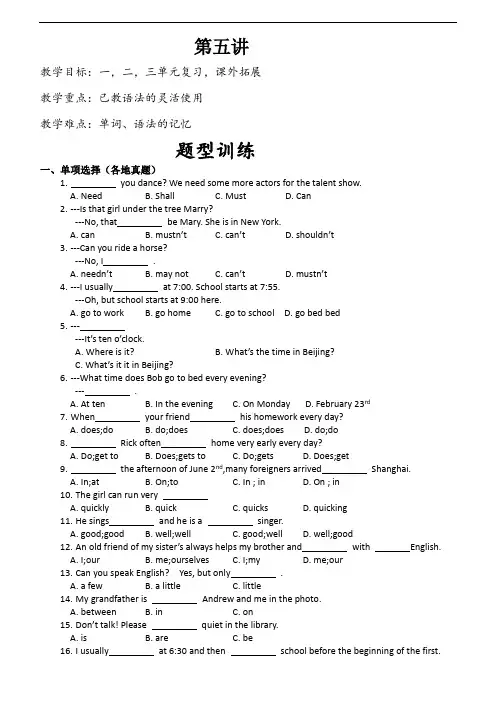
人教版七年级英语下册第五讲
第五讲教学目标:一,二,三单元复习,课外拓展教学重点:已教语法的灵活使用教学难点:单词、语法的记忆题型训练一、单项选择(各地真题)1.you dance? We need some more actors for the talent show.A. NeedB. ShallC. MustD. Can2.---Is that girl under the tree Marry?---No, that be Mary. She is in New York.A. canB. mustn’tC. can’tD. shouldn’t3.---Can you ride a horse?---No, I .A. needn’tB. may notC. can’tD. mustn’t4.---I usually at 7:00. School starts at 7:55.---Oh, but school starts at 9:00 here.A. go to workB. go homeC. go to schoolD. go bed bed5.------It’s ten o’clock.A. Where is it?B. What’s the time in Beijing?C. What’s it it in Beijing?6.---What time does Bob go to bed every evening?--- .A. At tenB. In the eveningC. On MondayD. February 23rd7.When your friend his homework every day?A. does;doB. do;doesC. does;doesD. do;do8.Rick often home very early every day?A. Do;get toB. Does;gets toC. Do;getsD. Does;get9.the afternoon of June 2nd,many foreigners arrived Shanghai.A. In;atB. On;toC. In ; inD. On ; in10.The girl can run veryA. quicklyB. quickC. quicksD. quicking11.He sings and he is a singer.A. good;goodB. well;wellC. good;wellD. well;good12.An old friend of my sister’s always helps my brother and with English.A. I;ourB. me;ourselvesC. I;myD. me;our13.Can you speak English? Yes, but only .A. a fewB. a littleC. little14.My grandfather is Andrew and me in the photo.A. betweenB. inC. on15.Don’t talk! Please quiet in the library.A. isB. areC. be16.I usually at 6:30 and then school before the beginning of the first.A. go to,get toB. get up,get toC. go to,get up17.---How do you come to the zoo?--- .A. By taxiB. That’s goodC. On Monday18.He can’t play guitar, but he can play soccer well.A. the ,/B. the ,theC. / ,the19.Mr. Wang is their teacher. He teaches math.A. themB. theirC. they20.There some money and keys in the drawer.A. isB. areC. have21.Our English teacher our school at 7:30 every day.A. arrive toB. is arriving inC. arrives at22.---What do you often do two classes?---Do homework or talk to friends.A. betweenB. fromC. to23.I don’t know .A. where she worksB. where does she workC. what she wants to be24.I work a bank and I work a clerk.A. as ,forB. for ,asC. for ,for25.The nurse usually wears uniform and helps doctors.A. anB. aC. /26. --- is it from your home to your school?---About fifteen minute’s ride.A. How longB. How farC. How soonD. How much27. ---How are you going to Chengdu to meet your friends?--- my car.A. ByB. InC. OnD. At28. My mother asked me to wait the bus stop.A. forB. onC. inD. at29. He has to take a bus to work.A. getB. to getC. gotD. gets30. There are students in the park.A. three hundredB. three hundredsC. three hundred ofD. three hundreds of31. Thanks for me to study English.A. helpB. helpsC. helpingD. to help32. It is difficult for you the money from strangers(陌生人).A. getB. getsC. gettingD. to get33. It took us three moths this work.A. to finishB. finishedC. finishingD. Finishes二、根据句意&首字母填空1.My sister can’t play the computer games t .2.We want two good m for our school club.3.Are you f today,Lily?4.I have a busy w . What about you?5.I want to d a picture.6.---How does your father u go to work?---Oh, by bus.7.I often take a s at 9:00 in the evening.8.---Where does your sister work?---She works in a s .9.Nicky is very lazy(懒惰的), so he never gets up e .10.Han Geng is a singer. He often works until 11 o at night.11.I think Lin Dan is a b player and I like him very much.12.She has a g of friends and she is happy.13.Li Xiang e every day, but he always hurts his feet(脚受伤).14.You can find a good j if(假如) you study hard now.15.My father goes to w at 7:00 in the morning.16.Zhou Jie does his h at 7:00 after dinner.17.---What time is it now?---It’s half p seven.18.We should eat vegetables and then we can have a healthy l .19.Don’t eat it. It t not good.20.Please eat q . You should go to school early.21.---Can you c your room?---Yes, I can.22.I like hamburgers a l .23.Taking a w is good for your body.24.You don’t do it. I don’t do it,e .25.We know Liu Xiang r quickly and our students like him.三、用方框中所给词的适当形式填空1.It (be) six thirty in the morning. The Greens usually (have) breakfastat this time.2.Look! His (tooth) are very nice. He brushes them well every day.3.---What Jack (do) on Sunday evening?---He usually (watch) TV with his parents.4.His sister loves (play) the piano very much.5.My father (work) very long hours every day.6.---What time does your friend get (dress)?---At eight forty.7.What time your mother (get) up on weekends?8.What a (fun) time to watch thrillers!9.My mother usually (go) to bed at twelve o’clock.10.He (not go) to school on Sundays.四、用适当的介词填空1.Mary is a good student, so she is never late school.2.I usually get early the morning.3.My sister often goes to bed nine o’clock.4.It’s not far the post office the bookstore.5.Do you have milk breakfast?五、完型填空。
Unit5讲义 人教版七年级英语上册
Unit 5 Do you have a soccer ball?知识要点1 Do you have a soccer ball?1.have have a good day “经历”I have a ball.“有”I’ll have it.“买”have sports 做运动2.have/has 的疑问句和否定句借助于do /does. 即一般疑问句:疑问句:①Do +主语(非三单)+have ….?②Does +主语(三单)+have ….?否定句:①主语(非三单)+don’t +have ….②主语(三单)+doesn’t +have ….3.注意:加了does后,谓语动词不再用单数,has改为haveShe has a dictionary. (变为否定句和一般疑问句)____________________________________________________________________________________即学即练 1I. 用have 或has 填空1.We ______ friends , parents and teachers.2.She ________ an apple.3.Do you ________ a ball?4.She doesn’t _________ a ball.5.Mary ________ a dog.II.句型转换1. He has a soccer ball. (主语改为I)_______ ________ a soccer ball.2. She has a basketball . (改否定句)She ________ ________ a basketball.3. ---Does he have a ping-pong bat? ( 作否定回答)---_______, _________ __________.4.I have two books. (变一般疑问句)_______ ______ ________ two books?5. David doesn’t play basketball every day. (改肯定句)David ________ ________ every day.知识要点2 Let’s play soccer.1.let’= let us “让,允许”①let +宾格人称代词或名词+动词原形。
人教七年级上册英语Unit5 SectionA (1a2c)公开课精品课件(28张)
Do you have a sister? Do you have a cat?
人教七年级上册英语Unit5 SectionA (1a2c)公开课精品课件(28张)
Yes, I do. No, I don’t.
Do you have a baseball?
人教七年级上册英语Unit5 SectionA (1a2c)公开课精品课件(28张)
人教七年级上册英语Unit5 SectionA (1a2c)公开课精品课件(28张)
课堂检测
人教七年级上册英语Unit5 SectionA (1a2c)公开课精品课件(28张)
人教七年级上册英语Unit5 SectionA (1a2c)公开课精品课件(28张) 人教七年级上册英语Unit5 SectionA (1a2c)公开课精品课件(28张)
1a Match the words with the things in the
picture.
1. tennis ball _a_ 2. ping-pong bat
_f_ 3. soccer ball _c_ 4. volleyball _e_ 5. basketball _d_ 6. baseball
2b Listen again and match the people with the balls.
3
2
1
4
人教七年级上册英语Unit5 SectionA (1a2c)公开课精品课件(28张)
人教七年级上册英语Unit5 SectionA (1a2c)公开课精品课件(28张)
Practice
Dale
人教七年级上册英语Unit5 SectionA (1a2c)公开课精品课件(28张) 人教七年级上册英语Unit5 SectionA (1a2c)公开课精品课件(28张)
七年级英语Unit 5 Do you have a soccer ball 人教版(新目标)知识精讲
七年级英语U n i t5D o y o u h a v e as o c c e r b a l l人教版(新目标)知识精讲-CAL-FENGHAI.-(YICAI)-Company One1七年级英语Unit 5 Do you have a soccer ball 人教版(新目标)【本讲教育信息】一. 教学内容:Unit 5 Do you have a soccer ball?二. 语言功能Talk about ownership; Make suggestions.谈论物主关系;提出建议三. 目标语言:1. Do you/ they have a soccer ball /Yes, we/they do. No, we/they don’t.2. Does she/he have tennis racketYes, she/he does. No, she/he doesn’t.3. Let’s play volleyball4. That sounds good/ interesting /fun/ boring. Good idea. OK.Sorry, I…四. 重点单词和词组:1. have(1)拥有,占有。
其主语可以指人,也可以指物,其第三人称单数形式为has。
I have a friend here. 我这儿有个朋友。
She has three dictionaries. 她有三本词典。
(2)吃,喝We have lunch at school. 我们在学校吃午饭。
He wants to have a cup of tea. 他想喝杯茶。
2. play 与不同的词搭配表示不同的意思。
(1)在球类名词前不加冠词,表示玩耍,打/踢球。
play football 踢足球play basketball/ table tennis 打篮球/乒乓球(2)在乐器前加定冠词the, 表示弹奏……play the piano/ guitar 弹钢琴/吉他3. sound 听起来连系动词,它的后面跟名词,形容词或介词短语做表语。
七年级英语Unit 5 When was he born Section A鲁教版知识精讲
七年级英语Unit 5 When was he born? Section A鲁教版【本讲教育信息】一、教学内容:Unit 5 When was he born? Section A(一)重点单词(二)重点短语(三)重点句型二、知识总结与归纳(一)重点单词1. born2. international3. record4. hiccup5. sneeze6. too… to7. national8. achievement9. perform10. gold11. championship12. bee13. cal(二)重点短语1. international sports stars 国际运动明星2. a great Chinese ping-pong player 杰出的中国乒乓球运动员3. was(were) born出生于4. the world record 世界记录5. start hiccupping / stop hiccupping 开始打嗝/停止打嗝start doing (to do) sth.开始做某事begin doing (to do) sth.开始做某事stop doing sth.停止做某事6. too… to…太……而不能……7. for example 例如8. play for 为……效力9. national team 国家队10. write music 谱写曲子11. a movie star 一个电影明星12. perform Beijing Opera 表演京剧13. the Chinese gymnast 一个中国体操运动员14. win a gold medal 赢得一块金牌15. the World Championships 世界锦标赛16. learn to ride a bicycle 学会骑自行车17. start learning English 开始学英语18. begin playing sports 开始进行体育运动19. a edy called 一部叫……的喜剧(三)重点句型1. When was he born?He was born in 1895.be born出生于(be用过去时态形式was或were,因为人的出生多为发生在过去的事,所以用一般过去时)The great pianist was born on October 10th, 1890.那位伟大的钢琴家出生在1890年10月10日。