
On Trademark Words'Translation in English 论英语商标词的翻译
On Trademark Words'Translation in English论英语商标词的翻译AbstractWith the development of economy and the continuity of the open Policy, the trade between China and foreign countries comes hourly. The international market is filled with varieties of goods. Advertisement besides high quality plays an essential role in the process of promoting sales and cultivating international markets. Trademark is a sign, symbol, and carrier that identifies the products or services of a company .To win the field in the international trade, the study on the trademark translation is not only necessary but urgent.This paper, as based on the culture differences in east and west, from the characteristics of Chinese and English trademark words, in-depth analysis of the trademark translation methods and existing problems in the trademark translation, tries to propose some trademark translation skills and principles. It also aims at advising the translators to pay attention to consumers’ cultural and psychological characteristic and translation methods while translating trademark words.Key Words:trademark formation, translation principle, translation methods.摘要随着经济的发展和改革开放的进一步深入,中国与世界各国的贸易更加频繁,国际市场上商品种类日见繁多。
如何在品种繁多的商品中脱颖而出?商品宣传就成为国际市场推销商品和进行竞争的一种重要手段。
而商标作为品牌的标志和载体,在国际贸易活动中针对其进行的翻译就尤为重要了。
本文以中西方文化差异为基础,从中英文商标的特点,深入分析商标词的翻译方法及存在问题,并提出商标翻译的翻译方法和翻译原则。
指引译者在翻译时注重消费者的文化心理特征和翻译方法。
关键词:商标组成;翻译原则;翻译方法ContentAbstract (I)摘要 (II)Contents (III)Introduction (1)1. The Origin of Trademark Words (2)2. The Principle of Trademark Translation (3)2.1 Using compliment and neutral color words............................ (3)2.2 Using the words easy to read and remember (3)2.3 Paying attention to consumer cultural and psychological characteristic (3)2.4 Being consistent with cultural and geographic style (4)3. Main Methods of Trademark Translation............................ .. (5)3.1 Transliteration (5)3.2 Free translation (5)3.3 Literal translation (5)3.4 Innovation (6)Conclusion (7)Bibliography (8)Acknowledgements (9)IntroductionWith the development of the world economy, many products were produced and enter into the international market .How can a product gain a place in the international market which is full of keen competition? Undoubtedly a well-known product should have a famous name, besides high quality.A famous trademark can add value to a product in the marketplace because it has a potentially powerful influence on consumer’s behavior.This paper discusses the characteristics of trademark language taking culture elements into consideration, further analyses existing methods and problems in trademark translation and meanwhile putting forward techniques and principles in this field.1. The Origin of Trademark Word1.1 From nameSome trademark words are borrowed from the people's name, named after the founder, such as the U.S. entertainment brand, Disney(迪斯尼)named after its founder, Walt Disney, the famous automobile brand Roll-Royce (劳斯莱斯)is to founder Charles Rolls and Henry Royce name and surname.1.2 From allusionSome trademark words are borrowed from the allusions, such as the Stature Roman is herbicide, Stature is the agricultural god Roman mythology; The world famous cosmetic brand Sahara (丝芙兰) ,she is Moss’s wife in the Biblical, she is beauty, wisdom, courage and generosity in a young woman , a symbol of elegance, happiness and freedom, and this is fashion and creative store business philosophy is identical?1.3 From the first letterSome trademark words are constitution of the acronym. those trademark words simple and easy to read ,give the impressive of a deep. Such as the clean company P & G(宝洁公司) is by the two founders of Proctor and Gamble the first letter of composition; American Enterprise 3M is a Minnesota Mining and Manufacturing from the first letter; Japan’s Electric Company NEC is equivalent to Nippon Electric Company.2. The principle of trademark translationThe translation of trademarks is a kind of cross-cultural communication activity. Every trademark implies its cultural connotation. While translating it, we must pay attention to the cultural differences and have the version co mply with the consumers’ cultural psychology, language rules and the regional culture2.1 Using compliment and neutral color wordsChinese characters, both phonetic also ideographic conducting English Translation of trademark words, the selected characters must be considered carefully, to choose Chinese consumers are increasingly seeking profits Kyrgyzstan commendatory term psychological language, otherwise, it will affect product sales. Such as: According to August 7, 1995 "International Business Daily" reported that: In 1995, Britain's Whisky (威士忌) and France's Brandy (白兰地) In Hong Kong and started dumping war as a result, "威士忌" only sold 17.15 million bottles, and "白兰地" has sold 3.5 million bottles, of the reasons lies in its Chinese translation on. Sound in the table also ideographic Chinese, the "威士忌" make us thinking "Visa is taboo," Lenovo naturally poor sales; And "Brandy" are full of poetic, it is imagination, how can the Chinese people are not like it?2.2 Using the words easy to read and rememberThe most important goal of trademark words translation is make consumers to remember the trademark represented by those goods, trademark translation should be simple and easy to remember, vivid. Such as: Hewlett - Packard is the world's largest electronic equipment and small computer manufacturers, its trademark in China's translation of the word was originally used came from the transliteration of the name "休利特- 帕卡德", this name long to reach 6 words, these six words no actual meaning, people talking, it is difficult to attract consumer, which later translated as "惠普"While Hewlett and Packard with the first letter of euphony, make some people having many association , such as" to benefit ordinary people, "the beneficialassociation, thus becoming the industry in China, a well-known brand.2.3 Paying attention to consumer cultural and psychological characteristicCultural psychology is a nation in the long process of development of cultural reproduction made of the psychological characteristics of accumulation. Culture can influence the national psychology. The same word may evoke different associations in different cultural environment. A translator must have a general idea about the target culture and respect it. Let’s take the following trademarks as examples. such as: Bowling is a popular sports, translator its ingenious translated as "保龄球", The sports could be fitness, "保龄" is similar with extend the longevity, extend the longevity and fitness in line with the psychology of consumers, who do not like it?2.4 Being consistent with cultural and geographic styleEast and West due to geographical location, ethnic origin, the natural environment, religion and other cultural backgrounds are different, people's thinking, aesthetic, consumer attitudes, value orientation and knowledge of the commodity point of view there are many differences in such areas. Translation of this trademark should not only meet consumer culture and psychology, in line with the characteristics of the national language, but also respect for the sales market consumer groups national feelings, religion, in line with the humanities, geography, and customs. such as: U.S. well-known beverage "Coca-Cola" was originally translated as "可口可腊" is difficult to the desire for domestic consumers, "可口可腊" is inexplicable, "腊" attracts people to wax associations, more "tasteless.” and replaced by "Coca-Cola," situation is very different. "可口可乐" in Chinese, brings a good association, "可口" gives us a tasty sense of the word ,"可乐" is that "bring happiness to you". In addition, the translation of the original trademark on the word very similar in pronunciation, rhythm is also consistent with, and forms, have the same aesthetic. Coke - cola translated as "可口可乐" It's really wonderful of the translation. The translation Greely, funny, short but loud, easily mass psychology to accept an immediate sensation effect?3. Main Methods of Trademark TranslationIn a narrow sense, translation is rendering of a text from the source language to the target language. It is a recreation activity, based on the original writing in the source language. Trademark translation is a highly challenging job. We should take the different history, customs, art, culture and some other factors into consideration. we could use the following four main methods of trademark translation, that is, transliteration, free translation,literal translation, innovation.3.1 TransliterationTransliteration is based on the sounds of the source language. Choosing some target words or language that sounds same or familiar to the source language to translate. Sometimes, we should use Chinese Pinyin to translate some English trademarks directly. Most of this kind of trademarks is coined words and proper names. Sometimes they do not have the concrete meaning in target language. Let’s take some translated names as examples. Audi----奥迪Cadillac-------卡迪拉克Ford-----福特Lincoln--------林肯(car)Motorola----摩托罗拉Daphne------达芙妮DuPont--------杜邦Adidas-------阿迪达斯.3.2 Free translationFree Translation is a trademark under the direct translation of its meaning for the purpose of language, translated the target language culture, trademarks and blending. Such as:"安琪儿" is girl exceptional love bike in china, "angel" means "天使" and the English "Angle" are homonyms, coupled with the bike body, "rosy clouds catches up the dream", Chinese and Western, adding to the romantic atmosphere. Homophonic pun made use of a trademark of transliteration of the word are taken into account most of the phonological effect, to read fluently, Playboy (花花公子), Crocodile (鳄鱼), Blue-Ribbon (蓝带).3.3 Literal translationLiteral translation is the most commonly used translation method in trademark translating. A prominent feature of this method is loyalty to the literal meaning of source trademarks. This method is often used to some ornate trademarks that have tangible and implied meaning. For example, car trademark “Bluebird”was often translated into“蓝鸟”directly. “Bluebird”comes from Belgian Maurice Maeterlinck’s fairy tales named as “Bluebird”symbolizing “Future happiness”. Later, it was used as the car trademark. Poet Li Shangying wrote: “蓬山此去无多路,青鸟殷勤为探看”<<无题>>。
英语论文-On International Trademark Translation

The Elementary DiscussionOn International Trademark Translation1. Introduction (2)2.The principles to be followed (4)2.1.A cultural perspective in translating brand name (4)2.1.1Adaptations to national traits and values (4)2.1.1.1. Adaptation to numbers (5)2.1.1.2. Adaptation to colors (6)2.1.1.2.1. Color of red (6)2.1.1.2.2. Color of blue (7)2.1.1.2.3. Color of white (8)2.1.1.2.5. The color of yellow (9)2.1.1.2.6. The color of purple (10)2.1.1.2.7. The color of green (11)2.1.1.3.1. Adaptations to politics and history (13)2.1.1.3.2. Differences in cultural value (13)2.1.1.3.3. Differences in logic thought (15)2.1.1.3.4. Differences of behavioral norm (15)2.1.1.3.5. Influences of the migration of language (16)2.1.3. Adaptations to extended meanings of words (17)2.2. Be connected with the original trade marks (18)2.3. Creativity (20)2.3.1. The basis of Functional Equivalence (21)2.3.2 The Functional Equivalence and pronunciation (21)2.3.3 The Functional Equivalence and surface meaning (23)2.4. Brief and novel (23)References (26)1. IntroductionAlong with rapid development of science and technology, every country in the world actively exploits international market and enlarges the international market share. The important purpose of entering the international market and cultivating name brand commodity is to well publicize the merchandise. Thus, as American author Ailisi says: “th ere can be difference between great amounts of dollars on the achievement of sale.”Practice has proved that successful trademark translation can bring the huge economic efficiency, while unsuccessful translation not only brings serious economic loss to the company or the country, but also affect the company or the national image directly.The trademark research presents the unprecedented prosperity of the trademark translation. Translators have made large quantities of achievements in scientific research; especially the Chinese translation of trademark is gratifying. The study range is exceeded gradually. It has already no longer limited the discussion of the trademark translation only in translation technique. But more and more people begin to study the problem that the trademark is translated in terms of interdisciplinary studies. Superficially speaking, the further research of trademark translation indicates that the translation should apply certain strategies to realize the transformation of trademark language. But the essence is actually the spread of the culture, because the trademark word choice and its use have reflected a nationality’s history and culture. The trademark translation is still the interdisciplinary knowledge; which involvesmore disciplines and fields such as linguistics and translating. It can be caught in one’s own trap, if the trademark translation only stays in language. Accordingly, the limited scholarly research filed of vision would affect the quality of the trademark translation. In order to do the multi-disciplinary research, the aspects of culture and the methods of translation could study the essence of the characteristics and improve the quality of the trademark translation. The research progress can not only promote the trademark practice, but also accelerate the development of the international trade at high speed.The study on translation of trademark has already started since last century, which covers a range of the theories of description, emotional appeal, aesthetic elements, moral values, etc. And it results in theory system concerning the principle as well as the approaches of trademark translation. The traditional translation maintains that translation is a process of replacing textural material with another one of equivalence. So we can say that any translation can’t be carried on well without getting to know the culture. We should pay attention to the relationship between culture and translation.2.The principles to be followed2.1.A cultural perspective in translating brand name 2.1.1Adaptations to national traits and valuesEvery nation has its own particular characteristics, moral principles and beliefs. These three aspects are regarded as a necessary part of the culture. A translator should never neglect national traits and values, which are exclusively possessed by the target consumers.There are still other examples of adaptation to national trait in brand name translation. One might have heard about the brand name “紫罗兰”. Owing to the cultural nature of trademark, a successful translation of trademark should conform to the cultural custom and psychology of the foreign custom. For example “紫罗兰” was originally translated into “posy”, and the products sell poor. The reason is the original meaning of posy is gay. So the translation of Chinese trademarks may cause cultural barrier after the commodity enters the western market.Another example is the famous perfume “Poison”produced by the French company Christian Dior in 1985. The “Poison” sold so well in western countries. It broke the record in the first two weeks after it appeared in the market. It was owned for its special design, it was regarded as mysterious and adventurous, and “mysterious and adventurous” was the common feeling of western woman consumers. As we all know, poison as a noun means substance that can cause illness or death if it taken into the human body. So we could predict that if it is translated into “毒药” or “酒”, thegentle and quiet eastern women would never choose the product. But the French company translated it into “百爱神” with the semantic transliteration method before entering the Chinese market. The translation of the name bears a similar sound to the original and conveys favorable meanings in the target language.The last example I want to take is the brand name “Gold Lion”. The original meaning of “Gold Lion” is “金狮”,but in order to satisfy people’s eager wish to be lucky and luxurious, it is translated into “金利来”. It has some effect on stimulating people to buy products.In short, in order to attain functional equivalence in brand name, a translator has to adapt his linguistic choices to national trait. Furthermore, to be a translator, for the sake of adapting values of the target culture, he has to know the difference of numbers, colors and customs between countries.2.1.1.1. Adaptation to numbersBecause of the influences of local traditional culture, religious belief and geographical environment, the meaning of figures has differences between the east and the west. For example, Chinese can take “999”, “金六福”, “三元”, “三枪”, and “十三香”as trademarks, while the occidental take “7-UP”, “Mild Seven”, and “7-Eleven” as trademarks. Thus, if these commodities are sold abroad, the trademarks like “666” and “十三香” would have trouble in Great Britain and America, because the number “6” symbolizes devil and “13” is an unlucky number in the Great Britain and America.2.1.1.2. Adaptation to colorsColors are fantastic things. They can help people to describe objects and explain people’s feeling. In the same language environment, the same color can correspond completely with the same significance. But in the different language environment, the same color word refers to the significance is totally different. Especially the language purpose can not be corresponded to different countries. This kind of word will cause misunderstanding in different environment, so it should not be ignored in translation. For example, if we translate the trademarks such as “红豆”, “蓝天”, and “白象”directly into “Red Bean”, “Blue Sky”, and “White Elephant”, it would be a Chinese way of translation. If we want to translate the trademark successfully, we should know clearly about the meaning of every color. Now we discuss the meanings of red, white, yellow, blue, green and purple.2.1.1.2.1. Color of redIn terms of emotion, red is always connected with happiness or celebration, in both western and eastern cultures. It expresses joy, ebullience and enthusiasm. For example, in English, red-letter days means Christmas day and happy day; red-blooded means full of strength and energy; red-hot used to describe the person, animal or team that is considered almost certain to win a race. In China, red stands for flourish and success. In traditional wedding party, the bride wears red clothes and bridegroom fastens a big red flower in the front of the chest. In the bridal chamber, a pair of “红双喜” would be decorated in the middle. All these things are symbols of the love. Whencelebrating a traditional festival, the Chinese would put up red lantern and play red firecracker in order to celebrate the happy event. “开门红” means good luck and win victory as soon as one’s standard is raised. “红光满面” not only means “glowing with health”but also means “beaming with joy; radiant; joyful; cheerful; delighted”and “满堂红” means all-round victory or success in every file.In addition, red stands for fire and blood in the west culture. Specifically, r ed in tooth and claw means that “involving opposition or competition that is violent and without pity;”a red to a bull means that “something is likely to make somebody very angry;”be in the red means that “to own money to your bank because you have spent more than you have in your account;”and see red means that “to be very angry.”From all the examples above, the occidental take red as an awful premonition, and danger. And this point is so different from eastern culture. For example, he turned red means he feels shame, and if it is translated it directly into “见红”, it means women bleeding before delivering.At last, red also means “get into debt or to the bad” in English. For example, red figure means “赤字”; in the red means “亏空,欠债”; red balance means “赤字差额”; red-ink entry means “赤字分录”; get out of the red means “偿清债务,有盈余”;red gold means “纯金” and red cent means“一分钱,一便士”.2.1.1.2.2. Color of blueBlue is a wonderful color, it could bring beautiful daydream to people. Blue used to describe sky and sea. For example, blue sky or blue sea means “蓝蓝的天空,蓝蓝的大海”. But when people use blue to picture sensibility, it conveys a derogatory sense. For example, in a blue mood means sad and depressed; be fall in the blues means in low spirits; black and blue means (to hit somebody until they are) cover with bruises ;a blue Monday means unlucky Monday.In addition, blue can be used to express law and shares. For example blue book means “蓝皮书”the publication of Britain Cortes; Blue law is an American law, it forbids people go into business on Sundays;blue-chip is a pop and valuable share; blue-sky law is a law about stock jobbing in America.2.1.1.2.3. Color of whiteIn both East and West, white means chasteness, goodness and innocence. For example, snow white is a pure and warm-hearted princess; white lie means a harmless or small lie, especially one that you tell to avoid hurting somebody; white man is a man who treats people fairly; a white Christmas means “银装素裹的圣诞节” in Chinese, a white girl means “一个纯洁的女孩” in Chinese and white handed means “公正廉洁” in Chinese. But white still can mean cowardice in English, as in show the white feather.Otherwise, the Chinese wear white clothes and white flowers in the funeral. But the occidental take white as a lucky color. In the wedding party, the bride wears white dress and white gloves. White symbolizes the power and position in West. For example, both white house and Whitehall means American government; white-collar means someone working in an office rather than in a factory. Furthermore, white hasanother meaning in economy. For example, white goods mean large pieces of electrical equipment in the house, such as washing machine and refrigerator etc; white war is a war with no smoke of gunpowder; white money means silver coin; white coal means water power; white sale means price cutting and the white way means brilliant shopping centre.2.1.1.2.4. The color of blackBlack means people have bad emotion. This is the same in both English and Chinese. For example, “他气得脸色铁青,”here “青” means black. And black means tribulation and misfortune in English. For example, black list means a list of the names of the people, companies, products or countries that an organization or a government considers unacceptable and that must be avoided; Black sheep means a person who is different from the rest of their family or another group, and who is considered bad or embarrassing.; a black lie means a lie that can not be forgiven; a black deed means abominable behavior; a black art means enchantment; black mail means extortion and ransom; black man means devil; black-letter day means unlucky day; all the American do not like Friday, and call it black Friday, because the economic risk in 1869 and 1873 both happen on Friday.2.1.1.2.5. The color of yellowYellow is one of the warm colors. Because of its high visibility and it is often used in hazard signs and on some emergency vehicles. Yellow is cheerful. In Chinese history, all the emperors wore yellow clothes. Anything is for emperors, it would beyellow. Moreover, for years yellow ribbons were worn as a sign of hope as women waited from their men to come marching home from war. Today, they are still used to welcome the lovers back home. Its use for hazard signs creates an association between yellow and danger, although not quite as dangerous as red.If someone is yellow it means he is a coward as yellow can have a negative meaning in some cultures. For example, yellow is mourning in Egypt and actors of the Middle Ages wore yellow to signify the dead. Yet yellow has also represented courage in Japan, merchants in India and peace in China.2.1.1.2.6. The color of purplePurple is royalty. A mysterious color, purple is associated with both nobility and spirituality. As we know that yellow symbolizes the power of emperor in China, however, purple symbolizes the power of emperor in the west. Purple robes are worn by royal members and people of authority or high rank. But it is the color of mourning of widows in Thailand, and it is the favorite color of Egypt’s Cleopatra. It has been traditionally associated with royalty in many cultures. The Purple Heart is a U. S. Military decoration given to soldiers wounded in battle.The color and material used in Elizabethan Clothing was extremely important. People who could wear the color Purple was dictated by English Laws! These were called the Sumptuary Laws. The color of Elizabethan clothes, including purple colors, provided information about the status of the man or woman who wore them. This was not just dictated by the wealth of the person, but also reflected their social. Themeaning of colors during the Elizabethan period represented many aspects of their life —the social, religious, biblical and Christian symbolism were reflected in the color of purple.2.1.1.2.7. The color of greenGreen is the color of nature. It symbolizes growth, harmony, freshness and fertility. Green has strong emotional correspondence with safety. Dark green is also commonly associated with money. Green suggests stability and endurance. Sometimes green denotes lack of experience; for example, a “greenhorn” is a novice. In heraldry, green indicates growth and hope. Green, as opposed to red, means safety, it is the color the free passage in road traffic.Green is used to indicate safety when advertising drugs, and medical products. Green is directly related to nature, so you can use it to promote “green” products. Dull and darker green are commonly associated with money, the financial world, banking, and Wall Street.2.1.1.3. Adaptation of cultureCulture is human common wealth, and the human’s existence and development differ from each other in terms of regions and races. The reasons of creating the conflict between Chinese and the western cultures are varied. But the most important point is that both sides, Chinese and western, have different cultures and different historical backgrounds.Chinese traditional culture is social ethic culture for centralization involving thehumanitarian nature. It is broad and deep with long history, and it has restrained system as well as few words with rich meanings, limpid style and easy understanding, though sometimes it just can be understood rather than to be explained. But Western culture is diverse, separable and opening.Culture shows the different creative ability and creates spirit between the east and the west, and it also shows the different history characters and special styles between east and west. We can take advantage of comparing the different cultures between the two. When we translate trademark, we could take notice of it. For example, dragon is a lucky animal in China, but in the Western culture, dragon is an evil monster. Coke in English means male organ, and it also is a taboo language in Britain. Moreover, in the some countries, people believe in Moslems, they would never use pig or dog as trademark. Japanese resent lotus and fox, but they like the oriental cherry, tortoise and dock. Englishmen do not like elephants but pandas. In Italy and Spain, we should avoid using chrysanthemum. Russians think walnuts, the peacocks and chrysanthemums are something ominous. Some countries of North African resent the pattern of the dog.In China, there is a brand name “蝙蝠”. When the company expands the business into the west, they translated the trademark into “Bat” in English. “蝠” and “福” have the same pronunciation in Chinese, and both of them symbolize lucky and happy. However, in the west, it is an ugly, blind and fiendish animal that only flies at night. It signifies death. Most foreigners believe it is a knell of death if the bat flies into house. In this case, who would buy? Moreover, the bat is usually likened to an old womanwith blind and ugly eyes in English.2.1.1.3.1. Adaptations to politics and history“The difference between Chinese and Western history and culture lies in the fact that China’s is an inward orientated culture with ethics as its core, while the western history and culture is outward orientated, with material economy as its basis.”(孙宪梅,2007,223)Politics and history, being parts of culture, have always been imposing influence upon many other culture elements. In fact, political and historical elements bring out gradual changes in almost every aspect of daily life in every country. When translating trademarks, the translator should be sensitive as well as careful enough to adapt his linguistic choices to the political status and the history of target country. If the translated brand name does not accord with the target country’s politics and history, it would hurt the feelings of the local people, or it even could result in serious trouble, not to mention to its help in the sales of the product. For example, Dunhill is translated into “登喜路”; Librivm is translated into “利必妥”; Wonderful is translated into “万德福”; and so on, “福”, “利”, “富”, “喜”, etc, are chosen to make Chinese feel happy and lucky.2.1.1.3.2. Differences in cultural valueOne of the cultural different reasons between China and west is cultural background. In Spring and Autumn and Warring periods of China emergedConfucianism, Taoism and other ideologies. As different ideologies developed and combated each other, the basic framework of Chinese civilization was established. And then Confucianism became the foundation stone of Chinese philosophy system. Confucianism's central doctrine is that of the virtue of Ren. What is Ren? Ren is translated variously as goodness, benevolence, humanity and human-heartedness. In short, Ren means affection and love. For more than two thousand years, it has molded and shaped the civilization of China and exerted a profound influence upon almost one fourth of human race. Just as DR. Sun-Yat-Sen said, therefore the old morals of loyalty and piety, affection, and love, faithfulness and righteousness, are superior to those of the foreign countries, let alone the peace and harmony. These high standards of morals are our national spirit. So when we translate trademarks, we could use some words such as “德”, “仁”, “义”, “孝”, such as “同仁堂”, and “全聚德”. It is accordant to Chinese culture.Different from China, Christianity plays an important role in the west. English speaking countries are generally considered as Christian countries where many people believe in Christianity. Christianity is the region based on the life and teaching of Jesus Christ. Jesus is the founder of Christianity. According to the doctrine of Christianity, the Trinity is the union of the three forms of God, the Son and the Holy Spirit. Jesus Christ, the son of the God and the holy book of Christianity in the Bible, which consists of the Old Testament and the New Testament. Though, the power of the church cannot compare with the past time; it still influences many aspects of people’s daily li fe. For example, there are a few important festivals in the west that isconcern with Jesus Christ. Christmas day is a festival in celebration of the birth of the Jesus Christ on Dec.25.Virgin Birth refers to the birth of Christ, which Christians believe to have been caused by God rather than by ordinary sexual union. In order to cater to western customers’ tastes, we should use some names that come from the Old Testament or the New Testament, and we should never use some words to damage the image of Jesus.2.1.1.3.3. Differences in logic thoughtThe Western view of the world is derived from the ancient Greeks who saw the world as discrete objects, and who employed systematic descriptions and analyses of nature. Western thinking typically is linear, logical, analytic, and goal oriented and deals readily with abstractions and universal principles. It is explicit; it focuses on details, specific objects and their attributes, fosters categorization, and involves critical questioning.Chinese thinking, on the other hand, derives from ancient China and India where the philosophers saw the world as continuous substances. Chinese thinking is intuitive and holistic where meanings commonly are implicit and inferred.“Literary work written explicitly may be seen as unsophisticated and culturally inappropriate by Chinese.”(Liang Hui, 2007)2.1.1.3.4. Differences of behavioral normIn cross-cultural communication often exists a phenomenon that people alwaysuse his behavioral norm to judge the rationality of the other s ide’s behavioral norm. In order to perform smoothly in cross-cultural communication, we have to discern correctly the operative behavioral norm to ensure the harmony of cross-cultural communication; people must understand each other’s behavioral norm. And the best way to understand each other’s behavioral norm is stand to the principle of doing as they do at Rome. It is the same to trademark translation.2.1.1.3.5. Influences of the migration of languagePeople usually resort to his cultural foundation to estimate or explain objective things. This kind of standard norm of culture is only explained by its specified conditions. So when people use his culture to describe another culture, they will surely suffer the failure of cross-cultural communication or will even bring the enormous economic losses. There is a top-grade cashmeres shirt, and its trademark is “双羊”in Chinese. And it is directly translated into Goats. The sales are not good; because Goat means “Lecher”,besides the meaning of an animal with horns and a hairy coat, which lives wild in mountain areas or is kept on farms for its milk or meat. Such a trademark, no matter how good the quality is, no one wants to buy it.From all the above, we could know that the associative meaning of a word often has a distinct national characteristic. For example, “白象”has positive meanings in China, but it has negative meanings in the west, because “white elephant” means a burdensome possession and uselessness in English.2.1.3. Adaptations to extended meanings of words“Language is the carrier of the culture. Being a kind of code system reflecting concrete culture, each language contains numerous words with their extended meanings far beyond the basic ones. Great care is needed in the treatment of these words and the translator should consider not only the basic meanings of words but the extended meanings of them as well. Often these words cannot be literally translated; some adjustments are necessary.” (陈向军,2007)In China, there are a lot of brands using chicken as image, such as “金鸡牌鞋油、金鸡牌闹钟”, because the chicken means diligence in Chinese culture. W hen “金鸡牌闹钟” is translated into “Gold Cock”, oversea s consumers will hang back to this trademark, becaus e “Cock” still express es the men genitals in English. The translation has harmed the commodity image and enterprise’s image,and it has left the rough impression to foreigners, they would think the translator lacks training of the language. Take “白翎牌钢笔” for instance, its English translation is “White Feather”, why is it so popular in China, but nobody shows any interest in English countries? As the proverbs goes: “to show the White Feather”, which means setting up the white flag and escaping at the last moment. Moreover, another kind of export dry cell is called the white elephant(白象), the translation is correct absolutely. However, people hardly realize a White Elephant is a fixed English phrase, which means that the heavy burden or useless burdensome thing. Besides, a brand name of bicycle is “飞鸽” that hints its performance by “飞”, and it uses “鸽” to show that Chinese love peace. It is a successful trade mark in China. Unfortunately, its English translation is “FlyingPigeon”. “Pigeon” and “dove” both mean “鸽子” in English, but the first one is hit and eaten by the hunters and the second one symbolizes peace. All the foreigners think the translation is strange, because “Pigeon” is a kind of small and weak bird. Obviously, it is another case of crabs.“杭州西湖藕粉” , which once entered into imperial palace every year and it is dedicated to the emperor as “贡粉” in history, it is the famous nourishing food in China. However, it repeatedly baffles in the international market. According to the authoritative information, the main reason is the translator translated “藕粉” directly into “Lotus Root Starch”. In English, the purpose of “powder” has already changed; it has implied “filling out” or “putting on weight”. A lot of westerners are afraid of getting fat, especially women. So it is not strange that why customer of Great Britain and America hang back to the “Lotus Root Starch”. “帆船” is a traditional export product, at first it was translated into “Junk”and suffered the same destiny as “杭州西湖藕粉”, and then the translator changed its translation into Junco, after that the sales volume has risen successfully. Besides the meaning of accident of the yacht, Junk means rubbish and tatter.2.2. Be connected with the original trade marks“Trademark is a kind of proper symbol with special meaning and function. Therefore, to translate trademark is not so easy. In addition to the surface meaning and inner meaning, what is the representation of the trademark? And what might be thought about? That is more important. In order to make all questions mentionedabove become true, we should adopt the best method from various choices in various styles. Only to do so, the consumers could get the most similar feeling as the native language consumers.”(李金峰,2007)For instance, Revlon is tr anslated into “露华浓”, which is from famous poet Labia’s poetry “清平词”, that is “云想衣裳花想容,春风扶槛露华浓”. Th e translator quoted the classical justice which was regarded as equally important and proper. And it gives people a kind of graceful and gorgeous feeling, and it is also in accord with the characteristic of women’s cosmetics. Beverage Sprite’s original meaning is “naughty child or little evil spirit”. Westerners consider it as interesting and fresh, and they want to try, but Chinese do not admit it. Now it is t ranslated into “雪碧”, which let people have a feeling that it is nice and could quench their thirst. Now, it is one of the most famous products in China.The cardinal aim of a trademark is to attract consumers’ interest. The sale merchants always have a distinct goal, that is, which kinds of people would be the main consumers for the commodity. So the translation of trademarks should comply with its characteristics, and should aim at its main consumers in both pronunciation and words choosing.“Sprite” beverage appears in Hong Kong market at the first time. According to a psychology book is wrote by Hong Kong and Macro’s which is about how to fetch the routine of the lucky, it was translated into “事必利”. As a matter of fact, the sales situation on the market of beverage is not optimistic. Renamed as “雪碧” later, the translation shows quality and utility of the goods. Subsequently, the products are。
商标 品牌 商号翻译

2018/9/22
Business English Translation
22
商号翻译练习 英汉互译
HSBC 国家电网(中国) Hong Kong & Shanghai 中国石化 Banking Corporation 中国石油天然气集团公 IBM 司(中国石油集团) International Business Machines (Corporation) 中国石油天然气股份有 Exxon Mobil Corporation 限公司
2018/9/22
壳牌石油公司 中国人寿保险有限 公司 克莱斯勒汽车公司 美国联合航空公司 会计事务所 律师事务所 咨询公司
27
Business English Translation
商号翻译专题 专门性“公司”
Houston Advertising Agency (代理性质的) Agency 公司 Pacific Container Line Line(s) (轮船、航空、 FUJI HEAVY 航运等)公司 INDUSTRIES Industries(实业、工 American Home Products 业)公司 (Corporation) Products(产品)公司
劳斯莱斯微软百事可乐宝马人头马xo商标品牌翻译方法汉译英澳柯玛冰箱熊猫电视珞珈山布联想电脑ut斯达康小灵通商标品牌翻译方法汉译英澳柯玛冰箱熊猫电视珞珈山布联想电脑ut斯达康小灵通aucmapandaluckyhilllenovoutstarcom商标品牌翻译练习英汉互译olayshouldersbenznokia润宝音箱椰风椰汁饮料海信电视三生药品商标品牌翻译练习英译汉olayshouldersbenznokia玉兰油海飞丝奔驰诺基亚商标品牌翻译练习汉译英润宝音箱椰风椰汁饮料海信电视三生药品rainbowcocowindhisensesunshine商标品牌翻译分析汉译英obesityreducingtabletslittlewhiteelephantpansy商标品牌翻译分析汉译英大鹏皮鞋轻身减肥片药品小白象儿童鞋三色堇衣服eagleslimmingpillslittleelephantviolettradenamebusinessnameprofitmakingbusinessbank500音译意译谐音valeroenergycorporationroyalbankfujixeroxco
谈中国商品名称的英译

On Translating the Chinese Brand Names into EnglishAbstract:With the increasing globalization of world economy, a great number of Chinese products flood into international market. In this competition, more and more enterprises have come to the realization that one of their most valuable assets is the brand name associated with its product. The brand name is of vital importance to a company or corporation, and to some extent, it represents the image of the enterprise itself. Therefore, increased attention has been paid to the investigation of the translation of brand names. In order to make more and better images in the international market, this paper aims to analyze the methods and skills of the translation, many examples have been taken, including successful and unsuccessful ones. Making use of the resource of study to the business can promote the development of the economy of China in the world market.Key Words: brand names; translation strategies; functional equivalence谈中国商品名称的英译摘要:随着全球化发展的不断深入,我国的产品越来越多地进入国际市场,也有越来越多的公司为了自己的品牌能更好地在国际市场上占领一席之地,他们都纷纷为自己的商品名称翻译成英文以便用于各类产品宣传。
On Translation of Chinese Brand Name 浅析中文商标名的英译
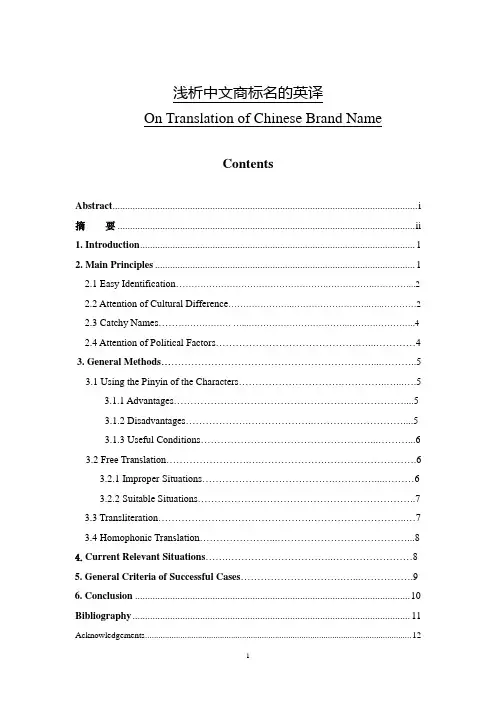
浅析中文商标名的英译On Translation of Chinese Brand NameContentsAbstract (i)摘要 ....................................................................................................................... i i1. Introduction (1)2. Main Principles (1)2.1 Easy Identification (2)2.2 Attention of Cultural Difference (2)2.3 Catchy Names (4)2.4 Attention of Political Factors (4)3. General Methods (5)3.1 Using the Pinyin of the Characters (5)3.1.1 Advantages (5)3.1.2 Disadvantages (5)3.1.3 Useful Conditions (6)3.2 Free Translation (6)3.2.1 Improper Situations (6)3.2.2 Suitable Situations (7)3.3 Transliteration (7)3.4 Homophonic T ranslation (8)4.Current Relevant Situations (8)5. General Criteria of Successful Cases (9)6. Conclusion (10)Bibliography (11)Acknowledgements (12)AbstractIn recent years, the progress of the translation on brand name-a practical branch of translation- is very remarkable. Obviously, the English-Chinese translation of brand name has developed a lot with enormous famous fruits such as Coca-cola(可口可乐),Goldlion(金利来) and Palarold(拍立得).Comparatively, the translation of Chinese products is less noticeable. A great majority of the Chinese trademark names are just translated into the pinyins of the Chinese characters, with several noted cases such as 海尔(Haier)and李宁(Lining).According to the examples collected, the author does some systematical analysis. On such basis, this article summarizes the principles and methods of the translation on brand name. The results show that if various relevant translation principles and methods are combined in the translation practices, the successful English brand names of Chinese products shall energetically promote their sales in foreign markets. Meanwhile, by several surveys on the translated Chinese products, the author finds out the general characters of successful cases, with a goal of providing reference and help illustrating in the future translation of Chinese brand name.Key words: Chinese brand name: translation; principle; method摘要近年来,商标翻译,作为翻译理论的应用领域之一,其成果十分显著,尤其是商标的英汉翻译,其成功案例比比皆是,简单通俗的例子如Coca-cola(可口可乐),Goldlion(金利来) and Palarold(拍立得)等。
On Translation of Trademarks ,下载英语.doc
On Translation of Trademarks ,下载英语-Trademark is a name used for a particular product, especially to help customers recognize it (Longman Business English Dictionary, Pearson Education Ltd, 2000). Advertising of the name of a product or trademark is a major and important way to promote sales in the market both at home and overseas. Trademarks must convey most of the information of the products, so that customers are able to gain a good understanding of their major features and use. In this way, to compose a trademark is an important part of the whole sales plan of a manufactory.A trademark is a symbol of a product in the form of one or more words (Oxford Dictionary of Business, Market House Books Ltd, 1990, 1996) It stands for the quality, function, after-sale services and other important traits of the product. So a famous trademark is also the symbol of a product. The ten most famous trademarks publicized in 1993 by a German journal are as follows: Coca Cola (America), Sony (Japan), Benz (Germany), Kodak (America), Disneyland (America), Nestle (Swiss), Toyota (Japan), McDonald’s (America), IBM (America), Pepsi-Cola (America). A good translation of a trademark is critically important.。
Translation of Trademark 商标词的翻译
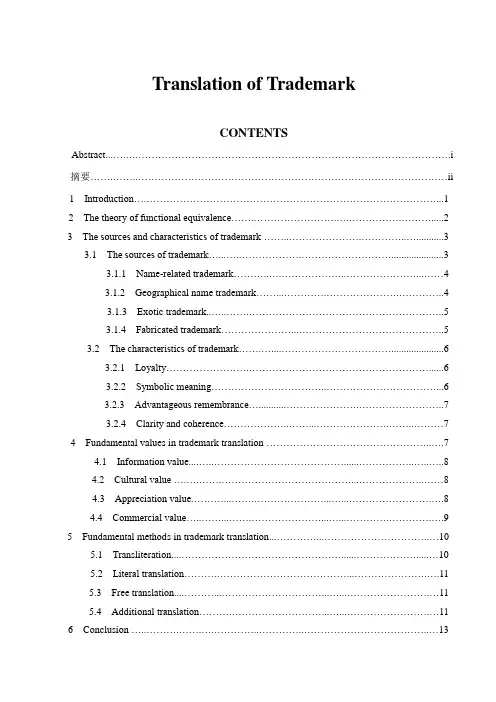
Translation of TrademarkCONTENTS Abstract (i)摘要 (ii)1 Introduction (1)2 The theory of functional equivalence (2)3 The sources and characteristics of trademark (3)3.1 The sources of trademark (3)3.1.1 Name-related trademark (4)3.1.2 Geographical name trademark (4)3.1.3 Exotic trademark (5)3.1.4 Fabricated trademark (5)3.2 The characteristics of trademark (6)3.2.1 Loyalty (6)3.2.2 Symbolic meaning (6)3.2.3 Advantageous remembrance (7)3.2.4 Clarity and coherence (7)4 Fundamental values in trademark translation (7)4.1 Information value (8)4.2 Cultural value (8)4.3 Appreciation value (8)4.4 Commercial value (9)5 Fundamental methods in trademark translation (10)5.1 Transliteration (10)5.2 Literal translation (11)5.3 Free translation (11)5.4 Additional translation (11)6 Conclusion (13)Bibliography (15)Acknowledgements (16)ABSTRACTWith the development of globalization, more and more products from China are walking into the international market. The name of trademark is of great importance in the image of a brand, so trademark translation is the fundamental task to build a worldwide brand. As a result, trademark translation seems even more urgent and important. A good trademark should be fluent to read, refreshing to see and easy to remember. The different characteristics of different language and the existence of different cultures make translation a recreation process. This paper firstly introduces the theory of Nada’s functional equivalence, and then analyzes the sources and characteristics of trademark; in addition, four basic standards should be followed in translation. They are information value, cultural value, appreciation value and commercial value. Finally this paper proposes four essential translating methods in trademark translation. They are transliteration, literal translation, free translation and additional translation. Therefore, in order to express a good trademark the four basic standards should be obeyed and the four basic translating methods should also be applied. In this way, the goal of attracting consumers will be realized as quick as possible.Key words: trademark; translation methods; value摘要随着全球化的进程加快,越来越多的中国产品进入国际市场。
英语商标词的翻译方法及文化内涵
英语商标词的翻译方法及文化内涵摘要:商标(trademark)是区别不同的商品生产者或经营者所生产或经营的商品的一种特定的标记。
商标通常是以文字、图案或符号,或者是以这二者的结合所构成。
商标的文字或文字部分一般是用一个简短的词语表示。
本文所要讨论的就是商标的文字部分的翻译原则及其文化内涵。
在国际贸易中,商标的翻译是个不能轻视的问题,因为商标不仅关系到商品的形象,而且还与商品的营销有联系。
目前,随着激烈的市场竞争,商标与产品已经形成不可分割的统一体。
在一个小小的商标里,生产者所赋予它的绝非只是商品的一个代号,它还承担着宣传产品,以产生广告效应的重任。
要在简短的词语中把商标从一种语言翻译成另一种语言,译者需要综合考虑语言、文化等各种要求。
关键词:商标词翻译方法文化内涵商标的翻译是企业形象战略中的主要组成部分,是商品进入国外市场的桥梁和有效途径。
一个好的商标常常是集体智慧的结晶,并体现于精炼的文字与醒目的图形之中。
它代表着企业的信誉,凝聚了厂商多年苦心经营的成果。
商标的形象好坏与内涵深刻与否,在一定程度上事关品牌的兴衰存亡。
如果商品品牌符合新市场中潜在客户的认可与欢迎,就能极大地推进产品的销售并很快占领市场。
而好的翻译能挖掘出商品表征与译语文化上共同的特征,就像一剂润滑油,起到加速产品的输出和弘扬企业和商品形象的作用。
但在实际翻译中完全做到信息和文化上的对等不是一件容易的事。
往往还要涉及到广告学、市场学、消费心理学与企业文化学等,是企业翻译学中的一部分。
因为中西两种文化语言的差异很大,在表达上常常是你有我无、我有你缺。
特别是由于文化背景的影响,不同的译者对很多词汇所包含的褒贬、内涵外延、情感联想和民族文化含义的理解与原文会有很大的不同,存在着文化差异。
因此,在翻译时如何进行文化移植,最大限度地体现对等?这一直是翻译人苦苦思索的问题。
一、英语商标词翻译的方法商标的翻译主要有三种方法:即音译、意译或两者相融音意结合的翻译。
3商标、品牌的翻译
• 第二步:再从英语语言文化角度考察 “Flexible Space”这个名称,我们会发现 在 “Flexible Space”形式上不像一个品 牌名,更像是一个短语。若将其连拼起来
--------------------------------------------------
Little Swan Apollo Sunflower Forever Black Swirl Wind Butterfly Sea-gull
翻译 实例
谐音联想法
英译汉的例子:
• 1) Coca-Coca • 2) 7-Up • 3) Colgate • 4) Canon • 5) Pif Paf • 6) Johnson’s • 7) Benz
翻译 实例
意译法
(意译法即按原语基本词义译写的一种方法。)
英译汉的例子:
• 1) Orient
--------
• 2) Darkie
--------
• 3) Volkswagen --------
• 4) Ivory
--------
• 5) Camel
--------
• 6) Shell
--------
从广告学的角度说,商品命名须考虑以下的因素:
• 1)是否具有新意;
• 2)能否暗示之功能和利益点 ;
如:杭州的“娃哈哈”,“娃”字暗示了主要消费对 象是小孩,“哈哈”两字包含四个“口”字,表示是 “吃”的东西,“哈哈”一词又是对这种商品的承认 和赞美。
商名的汉英翻译
KONGKA Belmerry Keon
Galanz Shinco
Baromon Liby
Hisense DOLYMY
谐音音译 P87 例5
商标词的翻译方法
❖ 长虹(电视机) ❖ 李宁(运动系列) ❖ 南孚(电池) ❖ 张小泉(剪刀) ❖ 养生堂(医药) ❖ 大宝(化妆品) ❖ 红豆(服装) ❖ 盼盼(安全门) ❖ 汇源(饮品)
Panda Little Swan Diamond
Double Star Duckling
Peace Bird Golden Lion
原商标是英语读 者所喜爱或认可 的动、植物名称 或事物名称。
Flying Horse Spring Bamboo
P87 例4
商标词的翻译方法
❖ 幸福(摩托车) ❖ 青春(浴衣) ❖ 雅致(女装) ❖ 彩虹(女装) ❖ 英雄(钢笔) ❖ 永久(自行车) ❖ 光明(奶品) ❖ 凯歌(电视) ❖ 王朝(葡萄酒)
和谐。
❖ Uniball—圆珠笔 ❖ Unicharm—妇女卫生用品 ❖ Unitool –工具公司
4. Ultra-“高级的”,“特制的”,“顶点”,用 在商标词中形容产品品质的优越。
❖ Ultra-Brite—牙膏
❖ UltraCare—化妆品
❖ Ultra-Seal—密封装置
5. –que 源自法语后缀,传达一种女性美,多用于 女性化妆品及日用品,为的是传达一种典雅柔 美的气息。
有时,厂商也利用词汇的前缀或后缀来合成商标词,这 类词也具有表达某种特殊内涵的功能。
1.前缀super 表示“超级的”,“最好的”意思。 ❖ SuperStar--音响 ❖ SuperZoom—相机 ❖ SuperSlim—减肥食品 2. 后缀-ex 用在商标词中,意为excellent“优秀的”,“精彩绝伦的”。 ❖ Kleenex 餐巾纸 ❖ Rolex 劳力士手表 ❖ Windex 家用擦窗器 3. Uni-表示universal, united, uniform 等,形容产品无所不能,独特
Unit 6 Translation of tradej marks 商标词的翻译
Part II 商标词案例分析
你能发现以上这些商标词的特点吗? 以上这些商标词有一个共同的特点,他们都来源于人名或者地名的专有名词。 人名包括公司创始人或产品发明人的姓氏、姓名全称;神话传说中的人名、影视文 学作品中的人名以及历史名人的姓名。地名包括公司所在地、商品原料产地以及文 学作品或神化传说中的虚构地名。 1,4,7,8,9,10,11,12 试找出以上商标词属于人名商标词的有:_________________________________ 2,3,5,6,13 试找出以上商标词属于地名商标词的有:_________________________________
相似或相对应的内涵。“匹克”既揭示出产品质量优良,又希望奥林匹克运动能
达到最高点;“汰渍”说明洗衣粉泡沫丰富,又暗示这种洗衣粉是一种潮流和趋 势; MAZDA 是拜火教中的光神,松田公司采用这一名称,希望能为汽车工艺带
来光明,虽然翻译而来的中文商标词失去了原商标词的文化内涵,但也为新商标
词赋予了“马”的快速、迅捷的意义联想,符合中国消费者的价值观而为中国消 费者广泛接受和喜爱。 商标词显著的商业功能使它们具有鲜明的语言特点,使得商标词在消费者中 能取得良好的共鸣和认可,达到新颖独特,激发消费者购买欲望的目的。
翻译方法:
商标翻译: 翻译方法: 商标翻译: 翻译方法: 商标翻译: 翻译方法: 商标翻译: 翻译方法:
7.回力牌(运动鞋)
音译结合
LiNing 音译结合 Robust 音译结合 founder 音意结合
8.李宁
9.乐百氏
10. 方正
Part III 单项训练与综合训练
翻译以下商标并分析翻译方法。 商标 6.象牙(香皂) 商标翻译: 商标翻译与方法 Ivory 音译结合 Warrior