
科技论文abstract写法说明
Abstract 1 Structure The structure and content of the Abstract have changed in recent decades. Before on-line publication databases such as the Science Citation Index, the Abstract was printed at the top of a research article and its function was mainly to encourage the reader to continue reading the article and to facilitate that reading by providing a brief preview. The reader and the writer didn’t consider the Abstract of a research article as an independent unit because it was not normally read without reference to the article itself.
The Internet has influenced the way that science research is communicated and the way that scientists access published research. Abstract databases allow scientists to search and scan the scientific literature and then decide which research articles they want to read in detail. Some readers simply want to know what is going on in their research area and may not be interested in the details; others may want to know details but are only interested in research articles which are directly relevant to their own research. However, if readers are going to actually read your research article, the Abstract now needs to persuade them to obtain a copy of it, not just encourage them to keep reading a paper they have already accessed. Abstracts compete for attention in on-line databases. Many more people will read the title than the Abstract, and many more will read the Abstract than the whole paper. This means that however ‘good’ and wellwritten the Abstract is, it needs to have independent validity. It should make sense as a standalone, self-contained description of the research article, and readers should be able to understand the key points and results of the research even if they never see the whole article. The Abstract, in this sense, is a representation of the research article.
Why does the unit on Abstracts come at the end of this book rather than at the beginning? In the first place, the style and the length of the Abstract depend on where you plan to submit it and that decision may be taken late in — or even after — the writing process. However, the most important reason for putting this unit on Abstracts at the end of the book is that you are in a better position to create an Abstract after you have finished writing the other sections of your paper. The content of the Abstract is derived from the rest of the article, not the other way around. Although you should not simply cut and paste whole sentences from the body of the article, the Abstract does not contain material which is not already in the paper. This means that you don’t need to create completely new sentences; once you have decided what should go in the Abstract you can select material, including parts of sentences and phrases, from the relevant sections of the paper and adapt or modify them to meet the demands of an Abstract. This also means that the Abstract is easier to write than the rest of the paper!
Does every Abstract follow the same model? No, and the title of the Abstract reflects this. Some are called Summary, some are called Background, some are called Abstract and others have no title at all. Most Abstracts are results-focused and there are basic similarities in all Abstracts, but there are two quite distinct models. The first model is similar to a summary, and is very structured. It deals with all the main subsections of the research article and can even have subtitles such as Background/Method/Results/Conclusions. The second model is more common, and focuses primarily on one or two aspect of the study, usually — but not always — the method and the results. Both models will be discussed here. Note that the models for an Abstract described here are appropriate for articles, papers, theses etc. Abstracts for conferences may not follow either of these models.
How do I know which model to choose? This decision is based on the type of research you have done and the Guide for Authors of the journal where you want to publish your research. The decision is normally determined by the journal rather than the author. If the choice is yours, then generally speaking, the more narrow and specified your research topic, the less likely you are to use the summary format. This is because in a narrow research field, most readers already know the background. The word limit set by each journal also has a significant effect on the structure and therefore also on the content of the Abstract. So as you can see, when we come to ask our three questions: How do I start the Abstract? What type of sentence should I begin with? What type of information should be in the Abstract, and in what order? How do I end this section? You already know a lot about what the Abstract should include and in what order. Here are examples of both models. Remember that Model 2 Abstracts are more common than Model 1. Start by reading the Abstract below, which is an example of a structured Abstract using the summary format (Model 1). The title of the paper is: Physical properties of petroleum reservoir fluids derived from acoustic measurements. Don’t worry if you have diffi culty understanding terms such as bubble point. Just try to get a general understanding at this stage and familiarise yourself with the structure.
科技论文格式要求

1.2 科技论文各部分格式要求科技论文各组成部分在字体、文字大小、行间距等方面要求有所不同,务必按照相应部分要求编排论文各部分内容。
1.2.1 封面封面包含三部分内容,分别为:硕士科技论文中英文题目、作者及导师信息、成文打印的日期。
1.2.5 中、英文摘要中文摘要部分的标题为“中文摘要”,用黑体三字,居中书写,单倍行距,段前空24磅,段后空18磅。
摘要内容用小四号字书写,两端对齐,汉字用宋体,外文字用Times New Roman体,标点符号一律用中文输入状态下的标点符号。
摘要中不要出现图片、图表、表格或其他插图材料。
中文摘要字数在500-700字。
一般分3段书写,第一段约占1/3的篇幅,用于介绍项目背景、意义和整体功能,第二、三段约占2/3的篇幅,其中第二段用于介绍本人的工作,明确写明“本人(独立或参与)完成了如下工作:”第三段简要说明所完成工作的应用效果。
硕士科技论文的关键词,是为了文献标引工作从硕士科技论文中选取出来用以表示全文主题内容信息的单词或术语,选取3-8个关键词,每个关键词之间用分号间隔。
英文摘要部分的标题为“Abstract”,用Arial体三号字,居中书写,单倍行距,段前空24磅,段后空18磅。
摘要内容用小四号Times New Roman体字书写,两端对齐,标点符号用英文标点符号。
英文摘要通常是中文摘要的英文版,英文摘要的结构和要求与中文摘要相同,不能出现拼写错误和语法错误,尽量使用被动语态,避免使用中国式英文。
“Key Words”与中文摘要部分的关键词对应,每个关键词之间用分号间隔。
硕士科技论文摘要的中文版与英文版要对应。
1.2.7 目录目录标题采用章标题的格式(黑体三号字,居中书写,单倍行距,段前空24磅,段后空18磅),目录的行距为固定值20磅。
避免缺乏个性化的论文目录章节,应使读者从章节目录中看出作者的工作内容。
1.2.8 正文此部分是硕士科技论文的主体,包括:1引言,2,3,……,n结论。
论文写作abstract
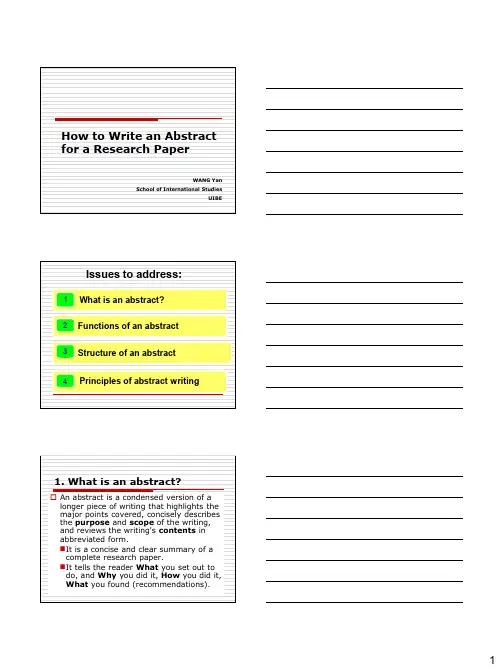
How to Write an Abstract for a Research PaperWANG YanSchool of International StudiesUIBEIssues to address:1What is an abstract?2Functions of an abstract3Structure of an abstract4Principles of abstract writing1. What is an abstract?☐An abstract is a condensed version of a longer piece of writing that highlights the major points covered, concisely describes the purpose and scope of the writing,and reviews the writing's contents inabbreviated form.⏹It is a concise and clear summary of acomplete research paper.⏹It tells the reader What you set out todo, and Why you did it,How you did it, What you found (recommendations).2. Functions of an abstract☐An abstract is used to communicate specific information from the article.☐It is aimed at introducing the subject to readers, who may then read the article to find out the author's results, conclusions, or recommendations.2. Functions of an abstract☐The practice of using key words in an abstract is vital because of today'selectronic information retrieval systems.⏹Titles and abstracts are filed electronically, andkey words are put in electronic storage.⏹When people search for information, they enterkey words related to the subject, and thecomputer prints out the titles of all the articlescontaining those key words.⏹An abstract must contain key words about whatis essential in an article so that someone elsecan retrieve information from it.3. Structure of an abstract☐The components of an abstract①Background Information②Subject Matter/Problem Statement③Purpose④Method (and Data)⑤Results / Findings⑥Conclusion / ImplicationsThe components of an abstract①Background information◆You may need to refer briefly to background toprovide a context.②Statement of the problem (subject matter):◆What problem(s) are you trying to solve?◆What is the author’s focus in this research?③Purpose of the research:◆What is the reason/purpose for doing this research?④Methods (approach and data):◆What is the main method used for the research?What is the theoretical framework?◆What is the subject scope? What data is analyzed?⑤Results (Findings):◆What did you find/invent/create?⑥Conclusion (Implications):◆What are the larger implications of your findings, esp.for the problem/gap identified in steps ①& ②?Exercise 1:A Sample Abstract(1) The dozens of studies on academic discourse carried out over the past 20 years have mostly focused on written academic prose or on academic lectures. (2) Other registers that may be more important for students adjusting to university life, such as textbooks, have received surprisingly little attention, and spoken registers such as study groups or on-campus service encounters have been virtually ignored. (3) To explain more fully the nature of the tasks that incoming international students encounter, this article undertakes a comprehensive linguistic description of the range of spoken and written registers at U.S. universities. (4) Specifically, the article describes a multidimensional analysis of register variation in the TOEFL 2000 Spoken and Written Academic Language Corpus. (5) The analysis shows that spoken registers are fundamentally different from written ones in university contexts, regardless of purpose. (6) Some of the register characterizations are particularly surprising. (7) The findings of this research may provide insights and have significant implications for pedagogy and further research.subject matter (1) The dozens of studies on academic discoursecarried out over the past 20 years have mostlyfocused on written academic prose or onacademic lectures.problem statement (2) Other registers that may be more important forstudents adjusting to university life, such astextbooks, have received surprisingly littleattention, and spoken registers such as studygroups or on-campus service encounters havebeen virtually ignored.background information(3) To explain more fully the nature of the tasks that incoming international students encounter, this article undertakes a comprehensive linguistic description of the range of spoken and written registers at U.S. universities.(4) Specifically, the article describes a multidimensional analysis of register variation in the TOEFL 2000 Spoken and Written Academic Language Corpus.purposemethod data(5) The analysis shows that spoken registers are fundamentally different from written ones in university contexts, regardless of purpose.(6) Some of the register characterizations are particularly surprising.(7) The findings of this research may provide insights and have significant implications for pedagogy and further research.findings implications Subject:written in the third person Length:short, usually 10% or less of the length of the original piece Audience:understandable to a wide audience Language:technical language of the discipline or profession Verbs:passive voice Tense:the present tense the past tense the present perfect tense 4. Principles of abstract writing4. Principles of abstract writing☐Requirements for the abstract of aBA thesis in UIBE⏹Length: 200-300 words⏹Key words: 3⏹One page of Chinese abstract and onepage of English abstractLanguage used in an abstract Background:(1) The dozens of studies on academicdiscourse carried out over the past 20years have mostly focused on writtenacademic prose or on academic lectures. (2) Other registers that may be moreimportant for students adjusting touniversity life, such as textbooks,have received surprisingly little attention, and spoken registers such as studygroups or on-campus service encountershave been virtually ignored.Language used in an abstract Background:☐Most studies in this field have addressed …☐In recent years, there has been an increasing interest in …☐… has received much attention in the field of …e.g.:As a newly developed interdisciplinary field of study, research on the development ofpragmatic competence is increasinglyattracting extensive academic interest.Purpose:(3) To explain more fully the nature of the tasks that incoming international students encounter, this article undertakes a comprehensive linguistic description ...This paperattempts to…The purpose of this paper is to …This paper isintended to…Language used in an abstract Language used in an abstract Purpose ☐The purpose/aim/objective/goal (of present study is/was to ☐The present study is /was designed/ devised/ intended to / aimed at ☐This study was performed/ conducted/ carried out/undertaken to ☐We aimed/sought to/attempted to e.g.:The aim of this study was to determine the protective function of …Methods:(4) Specifically, the article describes a multidimensional analysis of register variation...A …approach isused in this studyto examine.The study employsa … approach.Language used in an abstractMethods:☐Introduce the research process:⏹study, investigate, examine, discuss, analyze, emphasize, focus, explain☐Describe the research methods:⏹measure, estimate, calculate, test☐Introduce the uses or implications:⏹use, applyLanguage used in an abstract Results:(5) The analysis shows that spoken registers are fundamentally different from …(6) Some of the register characterizations are particularly surprising.It is found that …The resultsindicated that…The resultssuggest/show that …Language used in an abstract Results:☐Show the research results:⏹show, result, present, suggeste.g.:⏹Our results show that …⏹The results we obtained demonstrate that …⏹By means of informal mathematical arguments, simulations and a series of worked examples, we conclude that …Language used in an abstractConclusion/implications:(7) The findings of this research may provide insights and have significant implications for pedagogy and further research.It is suggested that …The paper suggests …It isrecommended that …It is concluded that …Language used in an abstract Conclusion/Implications:1) indicate the results:⏹These results suggest that …⏹These data confirm the presence of …2) support a point:⏹These results (do not) support the idea that …⏹These results fail to support the idea that …3) show uncertainty of an idea:⏹There is no evidence that …⏹It is likely/unlikely that …4) show significance of the findings:⏹be of great (some/little/no) clinical significance in …⏹It sheds light on future studies in this field.5) suggest further studies:⏹… remain to be further studied.⏹It remains to be proved that …Language used in an abstract Steps For Writing Effective Abstracts1.Reread your paper with the purpose of abstracting in mind. Look specifically for these main parts: purpose, methods, scope, results, conclusions, and recommendations.2.After you have finished rereading your paper, write a rough draft WITHOUT LOOKING BACK AT YOUR PAPER. Consider the main parts of the abstract listed in step 1. Do not merely copy key sentences from your paper.3.Revise your rough draft to correct weaknesses in organization and coherence, drop superfluous information, add important information originally left out, eliminate wordiness, and correct errors in grammar and mechanics.4.Carefully proofread your final copy.Four C's of Abstract Writing☐Complete—it covers the major parts of the project/case.☐Concise—it contains no excess wordiness or unnecessary information.☐Clear—it is readable, well organized, and not too jargon-laden.☐Cohesive—it flows smoothly between the parts.Qualities Of A Good AbstractAn effective abstract☐uses one or more well-developed paragraphs, which are unified, coherent, concise, and able tostand alone☐uses an introduction-body-conclusion structure in which the parts of the paper are discussed in order: purpose, methods, findings, conclusions☐follows strictly the chronology of the paper☐provides logical connections between materials included☐adds no new information but simply summarizes the research☐is intelligible to a wide audienceQualities Of A Good Abstract☐Accuracy —choose exact words for precise☐Specificity —be concrete☐Objectivity —succinctly summarize main points;☐Informativeness —what the research is about; how it was taken, what wasdiscovered☐Independency —must stand aloneSummary☐Writing an abstract is a sophisticated skill.To write a good abstract for your papersyou should follow a checklist consisting of: background, problem statement,purpose,method,results,and conclusion.☐Make sure that all the components of a good abstract are included in your paper.Summary☐The two main features of an abstract are its discourse structure and the language used for condensing the information.☐The secret of writing a successful abstract is in giving the most information in the leastnumber of words in a coherent structure.☐Because Readers want quick information.If it suits them, they will read on for thedetails.Exercise 2:☐Read the following abstract and find out the problems in terms ofstructure and language☐Revise the abstractDevelopmental changes in speakingvocabulary by English majorsI carried out a longitudinal study on the changes in speakingvocabulary by English majors through four years’learning, whichwas then compared with the native speakers’performance. TheEnglish learners involved in the study were 56 students who wereenrolled in a university in 2001. I asked them to complete an oraltask by producing a three-minute monologue after three minutes’preparation in a language lab. The native speakers were 15American college students who accomplished the same task asthe English learners. The developmental changes were measuredin terms of three indexes: fluency, word variations and lexicalfrequency profile. The performance on the three indexes of theEnglish majors across four years and the native speakers form acontinuum. However, Year Four students were significantly lowerin fluency and word variations than native speakers, but similar tothe native speakers in lexical frequency profile. The periodbetween Year Two and Year Three saw the most noticeableprogress. The students with different starting levels of the threeindexes varied in terms of their changes. The low-level groupmade greater progress than the middle-level group whichproduced slightly faster progress than the high-level group.Exercise 3:☐Read the selected abstracts fromsome published journal articles.☐Discuss the structure, content andlanguage of these abstracts.☐Make comments on these articles:⏹Are they well written?⏹If not, can you revise them?Assignment☐Write an abstract for your BAgraduation thesis11。
论文英文摘要要求与格式
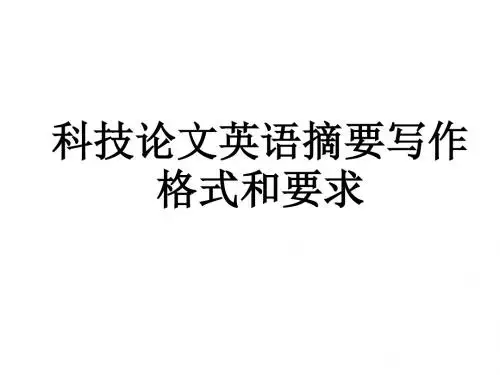
Reports of the synthesis of new dendrimers containing organometallic fragments have increased dramatically over the past few years and examples of dendrimers containing many different metals are now known. This article highlights some of the ways in which t ransition metals and their ligand systems have been incorporated into the growing number of dendrimers. Some structural details and properties of metal containing dendrimers are described , and their applications are also discussed.
避免陈泛之语,英文标题应简明朴实。中文标 题中常见的一些与内容无关的词语如浅谈、漫谈、 初探、试论等等,有的是作者出于谦虚,有的是作 者为使自己的论文显得有气魄增加点学术性和理论 性色彩,在转换为英语时常常可以略而不译。如 “关于随机系统稳定性的讨论”此处的讨论一词在 英文很难找到确切的对应语,倘若硬将其翻译成 discussion、debate 或argumentation 往往会给人 造成误解,使人觉得该文章可能是关于随机系统是 否存在稳定性的一种讨论或争论。因而英语标题中 完全可以不出现讨论而直接译为On the stability of stochastic system
科技论文摘要及其结尾的写作方法研究
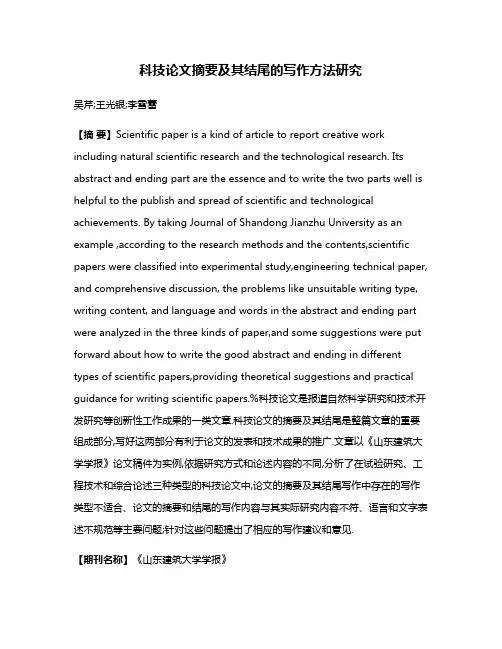
科技论文摘要及其结尾的写作方法研究吴芹;王光银;李雪蕾【摘要】Scientific paper is a kind of article to report creative work including natural scientific research and the technological research. Its abstract and ending part are the essence and to write the two parts well is helpful to the publish and spread of scientific and technological achievements. By taking Journal of Shandong Jianzhu University as an example ,according to the research methods and the contents,scientific papers were classified into experimental study,engineering technical paper, and comprehensive discussion, the problems like unsuitable writing type, writing content, and language and words in the abstract and ending part were analyzed in the three kinds of paper,and some suggestions were put forward about how to write the good abstract and ending in different types of scientific papers,providing theoretical suggestions and practical guidance for writing scientific papers.%科技论文是报道自然科学研究和技术开发研究等创新性工作成果的一类文章.科技论文的摘要及其结尾是整篇文章的重要组成部分,写好这两部分有利于论文的发表和技术成果的推广.文章以《山东建筑大学学报》论文稿件为实例,依据研究方式和论述内容的不同,分析了在试验研究、工程技术和综合论述三种类型的科技论文中,论文的摘要及其结尾写作中存在的写作类型不适合、论文的摘要和结尾的写作内容与其实际研究内容不符、语言和文字表述不规范等主要问题;针对这些问题提出了相应的写作建议和意见.【期刊名称】《山东建筑大学学报》【年(卷),期】2016(031)001【总页数】4页(P98-101)【关键词】科技论文;摘要;结尾;写作方法【作者】吴芹;王光银;李雪蕾【作者单位】山东建筑大学学报编辑部,山东济南250101;山东建筑大学学报编辑部,山东济南250101;山东建筑大学学报编辑部,山东济南250101【正文语种】中文【中图分类】G232.2科技论文是报道自然科学研究和技术开发研究等创新性工作成果的一类文章,常运用概念、判断和推理、证明或反驳等逻辑手段,对自然科学理论和科研成果进行阐述和分析[1-2]。
科技论文摘要的写作技巧
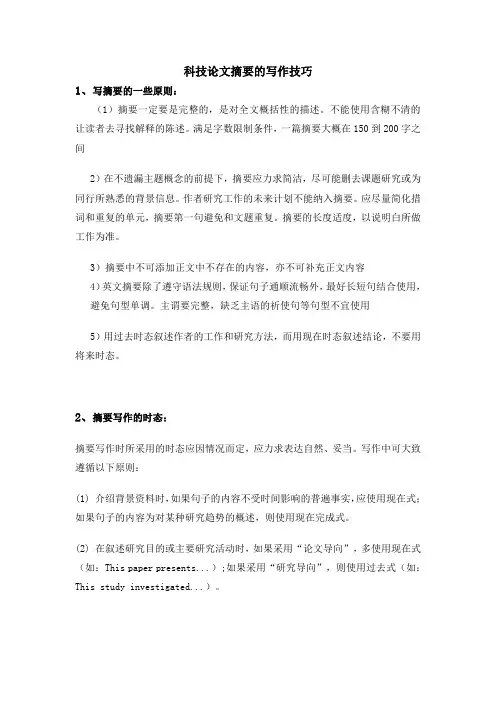
科技论文摘要的写作技巧1、写摘要的一些原则:(1)摘要一定要是完整的,是对全文概括性的描述。
不能使用含糊不清的让读者去寻找解释的陈述。
满足字数限制条件,一篇摘要大概在150到200字之间2)在不遗漏主题概念的前提下,摘要应力求简洁,尽可能删去课题研究或为同行所熟悉的背景信息。
作者研究工作的未来计划不能纳入摘要。
应尽量简化措词和重复的单元,摘要第一句避免和文题重复。
摘要的长度适度,以说明白所做工作为准。
3)摘要中不可添加正文中不存在的内容,亦不可补充正文内容4)英文摘要除了遵守语法规则,保证句子通顺流畅外,最好长短句结合使用,避免句型单调。
主谓要完整,缺乏主语的祈使句等句型不宜使用5)用过去时态叙述作者的工作和研究方法,而用现在时态叙述结论,不要用将来时态。
2、摘要写作的时态:摘要写作时所采用的时态应因情况而定,应力求表达自然、妥当。
写作中可大致遵循以下原则:(1) 介绍背景资料时,如果句子的内容不受时间影响的普遍事实,应使用现在式;如果句子的内容为对某种研究趋势的概述,则使用现在完成式。
(2) 在叙述研究目的或主要研究活动时,如果采用“论文导向”,多使用现在式(如:This paper presents...);如果采用“研究导向”,则使用过去式(如:This study investigated...)。
(3) 概述实验程序、方法和主要结果时,通常用现在式。
如:We describe a new molecular approach to analyzing ...(4) 叙述结论或建议时,可使用现在式、臆测动词或may, should, could 等助动词。
We suggest that climate instability in the early part of the last interglacial may have...3、英文摘要的语态。
采用何种语态,既要考虑摘要的特点,又要满足表达的需要。
英语论文摘要的写法

• 2) Avoid repeating the title or part of the title in the first sentence of the abstract (避免在摘 要的第一句话重复使用教学题ppt 目或题目的一部分)。12
• 摘要的作用:不阅读论文全文即能获得必要的信息; 关键的创新点、结果和意义。
• 摘要应包含以下内容:
①研究的主要内容,指明采用怎样的方法完成了哪些工作;
②获得的基本结论和新见解。
• 摘要必须十分简炼,内容亦需充分概括,一般不超出 300字。但英文摘要提倡扩展。
教学ppt
3
摘要的注意事项
➢ 应该用第三人称; ➢ 不加注释和评论; ➢ 不宜举例,不用引文; ➢ 不宜与其它研究工作比较; ➢ 不应用图表、公式、化学结构式等; ➢ 摘要中第一句话的注语,如“本文---”、“作
教学ppt
7
关键词
• 关键词是为了文献索引工作而从论文中选取出来、 用以表示全文主要信息单词或术语。一篇论文可 选取3-5个词作为关键词。
• 关键词应该是能表示论文主要内容的信息或词汇, 这些信息或词汇可以从论文标题中选,也可从论 文内容中去找。
• 关键词的作用: 1)提炼主题; 2)方便他人检索,提高检索效率和论文引用率。
• Key words: lexical variation; lexical sophistication; lexical error • 中图分类号:H319 文献标识码:B 文章编号:1004-
5112(2010)01-0040-07
如何写论文摘要
论文摘要摘要是文章的内容不加诠释和评论的简短陈述。
为了国际交流,还应有外文(多用英文)摘要。
摘要是在文章全文完成之后提炼出来的,具有短、精、完整三大特点。
摘要应具有独立性的自含性、即不阅读原文的全文.就能获得必要的信息。
摘要中有数据、有结论、是一篇完整的短文.可以独立使用,也可以引用,还可以用于工艺推广。
其内容应该包含与报告论文同等量的主要信息.以供读者确定有无必要阅读原论文全文,也可提供给文摘第二次文献采用。
摘要一般应说明研究工作目的、实验方法、结果和最终结论等.而重点是结果和结论。
中文摘要一般不宜超过300宇,外文摘要不宜超过250个实词。
除了实在迫不得已,摘要中不用图、表、化学结构式、非公知公用的符号和术语。
摘要可用另页置于题名页(页上无正文)之前,学术论文的摘要一般置于题名和作者之后,论文正文之前。
摘要又称概要、内容提要。
摘要是以提供文献内容梗概为目的,不加评论和补充解释,简明、确切地记述文献重要内容的短文。
其基本要素包括研究目的、方法、结果和结论。
具体地讲就是研究工作的主要对象和范围,采用的手段和方法,得出的结果和重要的结论,有时也包括具有情报价值的其它重要的信息。
摘要应具有独立性和自明性,并且拥有与文献同等量的主要信息,即不阅读全文,就能获得必要的信息。
摘要不容赘言,故需逐字推敲。
内容必须完整、具体、使人一目了然。
英文摘要虽以中文摘要为基础,但要考虑到不能阅读中文的读者的需求,实质性的内容不能遗漏。
为此,我国的科技期刊近年来陆续采用结构式摘要,明确写出目的、方法、结果和结论四部分。
a.目的(Objective):简明指出此项工作的目的,研究的范围。
b.方法(Methods):简要说明研究课题的基本做法,包括对象(分组及每组例数、对照例数或动物只数等)、材料和方法(包括所用药品剂量,重复次数等)。
统计方法特殊者需注明。
c.结果(Results):简要列出主要结果(需注明单位)、数据、统计学意义(P值)等,并说明其价值和局限性。
科技论文的中英文摘要写作规范
科技论文的中英文摘要写作规范1.摘要是报告、论文的内容不加注释和评论的简短陈述;2.报告、论文一般均应有摘要,为了国际交流,还应有外文(多用英文)摘要;3.摘要应具有独立性和自含性,即不阅读报告、论文的全文,就能获得必要的信息。
摘要中有数据、有结论,是一篇完整的短文,可以独立使用,可以引用,可以用于工艺推广。
摘要的内容应包含与报告、论文同等量的主要信息,供读者确定有无必要阅读全文,也供文摘等二次文献采用。
摘要一般应说明研究工作的目的、实验方法、结果和最终结论等,而重点是结果和结论。
4.中文摘要一般不宜超过200~300字,外文摘要不宜超过250个实词。
如遇特殊需要字数可以略多(为了扩大国际影响,英文摘要要尽量写长一些,可不与中文摘要一一对应。
——编辑部注)。
5.除了实在无变通办法可用以外,摘要中不用图、表、化学结构式、非公知公用的符号和术语。
6.报告、论文的摘要可以用另页置于题名页之后,学术论文的摘要一般置于题名和作者之后、正文之前。
7.学位论文为了评审,学术论文为了参加学术会议,可按要求写成变异本式的摘要。
,不受字数规定的限制。
——引自《中华人民共和国国家标准》科学技术报告、学位论文和学术论文的编写格式。
科技论文的编写格式科技论文是科技发展及现代化建设的重要科技信息源,是记录人类科技进步的历史性文件。
什么是科技论文?它与一般的科技文章有什么不同?怎样写好科技论文?这些都是广大读者感兴趣的问题。
因此,利用“读者专栏”栏目,连续刊登“科技论文的编写格式”(引自《科学技术期刊编辑教程》,以期进一步提高科技论文的整体水平。
1.什么是科技论文⑴科技论文的基本特征什么是科技论文?目前还没有完全统一的认识,但是作为科技期刊刊载的客体,不妨可以认为:在认识和改造客观世界的过程中,通过足够的,可以重复其实验(或存在某种类似做法的潜力),使他人得以评价和信服的素材论证,首先揭示出事物及其真谛,并发表于正式科技期刊或其他得到学术界正式认可形式的叙述文件可统称为科技论文。
4 学术论文摘要的模板和翻译
Abstract Sample Study
---Stylistic Features of Webchat English
• With the development of computers and the internet, webchat has become more and more popular. This particular communicative form generates some unique linguistic features which can hardly be found in other variants of English. Yet, to analyze its linguistic features from the point of view of stylistics is still a new realm. Adopting the theories of modern stylistics, this paper analyzes the English used in webchat from four levels: graphology, lexicon, syntax/grammar and context. (74 words)
摘要的理解
• 摘要是以提供文献内容梗概为目的,不 加评论和补充解释,简明、确切地记述 文献重要内容的短文。
• 摘要的基本要素:研究目的、方法、结 果和结论。
Abstract or Summary?
• Abstract: placed before the text part (usual way)
2. Describing methodology: In this move the author gives a good indication of the experimental design, including information on the data, procedures or methods used and, if necessary, the scope of the research reported.
科技论文英文摘要题名及作者与作者单位的写法
科技论文英文摘要题名及作者与作者单位的写法沈阳师范大学(自然科学版)第26卷[31]刘国平,徐政府,虞以新,等.黑龙江省虎饶林区主要库蠓种群动态的研究[J].吸血双翅目昆虫调查研究集刊,1989,1(1):110—118.AdvancesinStudiesonBloodsuckingMidgesinHeilongjiangPr0Vince(Diptera:Cerat0p0g0nidae)GUOWen一.LJUGuo-ping(1.InstituteofEntomology,ShenyangNormalUniversity,Shenyang110034,China;2.CentreforDisea~ControlandPreventionofShenyangCommand,Shenyang110034,China)Abstract:Thispaperreported2genera,45speciesofbloodsuckingmidgesandtheirdistributi oninHeilongjiangProvince.Thewetmeadowwasthepropagatingplacefor6speciesofCulicoides,egC.obsoletus,etc.Th efeatureofspatialdistributionWasalsoreported.C.obsolet"sWasthepredominantspeciesinconifer—broadleafforests.birchforest.riverbankandwoodssides.C.punctatusWasthepredominantspeciesinriverisland,forestedges,grassresidencea ndlivestockstable.Thispaper summarizedtheseasonalfluctuationanddynamicsofdayandnight.Theharmness,controlm easuresandprospectsinfutureweredescribed.Keywords:Ceratopogonidae;bloodsuckingmidge;advancesinstudies;HeilongjiangProvi nce科技论文英文摘要题名及作者与作者单位的写法这里讨论的主要是中文论文所附的英文摘要.为了国际交流,科学技术报告,学位论文和学术论文应附有外文(多为英文)摘要.原则上讲,中文摘要编写的注意事项都适用于英文摘要,但英语有其自己的表达方式,语言习惯,在撰写和编辑加工英文摘要时应特别注意.英文题名应以短语为主要形式,尤以名词短语最常见,即题名基本上由1个或几个名词加上其前置和(或)后置定语构成.短语型题名要确定好中心词,再进行前后修饰.各个词的顺序很重要,词序不当会导致表达不准.题名一般不应是陈述句,因为题名主要起标示作用,而陈述句容易使题名具有判断式的语意;况且陈述句不够精良和醒目,重点也不易突出.少数情况(评述性,综述性和驳斥性)下可以用疑问句做题名,因为疑问句可有探讨性语气,易引起读者兴趣.在能准确反映论文特定内容的前提下,字数越少越好.近年来题名趋向简洁,冠词可用可不用时均不用.目前国内大多强调只在必要时使用副题名,但国外使用副题名的比比皆是.主题名与副题名之间一般用冒号(:)分隔.另外,英文题名的大小写可以采用以下3种形式:(1)全部大写;(2)实词首字母大写,虚词小写;(3)第1个词的第1个字母大写,其余全小写.目前第2种形式较为普遍,第3种的使用似乎有增多趋势,但不论采取何种形式,整本期刊或文集应统一.中国人名按汉语拼音写;其他非英语国家人名按作者自己提供的罗马字母拼法拼写.单位名称要写全(由大到小),并附地址和邮政编码,单位英译一定采用本单位统一的译法,切不可另起炉灶.。