
2018-2019学年外研版八年级英语上册全册教案
5) How about …? 6) Why don ’ t we/you …? 7) It ’ s better not to … 3. Skills: 1) Listening and understanding familiar topics (English study). 2) Talking about problems in English study and giving advice, conducting conversations in several turns. 3) Reading and finding specific information about English study. 4) Drafting a letter asking for advice about English study, revising through pair discussion.. 4. Around the world: English online 5. Task: Writing your English study plan. 三、重点及难点 : Giving advice: 1) We/You should … 2) Let ’ s try to … 3) Why not … ? 4) It ’ s a good idea to … 5) How about … ? 6) Why don ’ t we/you … ? 7) It ’ s better not to … 四、教学设计 : Unit 1 Let ’ s try to speak Engalsismh uch as possible. Ⅰ Teaching model Listening and speaking Ⅱ Teaching method PWP approach Ⅲ Teaching aims 1. To understand conversations involving advice on learning English. 2. To get information about how to learn English from the conversation. 3. To understand the way of giving advice. 4. To practise giving advice on English learning. Ⅳ Teaching Objectives 1. Key vocabulary: pair, correct, spelling, word, practice, match, meaning, complete, sentence, dictionary, grammar, letter, look up, mistake, make a mistake, understand-understood, advice,
Module 1 How to learn English
Unit 1 Let’s try to speak English as much as possible.
一、学习目标 : A.单词和短语: pair, correct, spelling, word, practice, match, meaning, complete, sentence, dictionary, grammar, letter, look up, mistake, make a mistake, understand-understood, advice, should, possible, write down, notebook, forget-forgot, pronounce, aloud, radio, pronunciation, key, main, excellent, agree, agree with sb., vocabulary, ask for, improve, basic, time, advise, shy, conversation, quickly, natural, suggest, place B.交际用语: 1. Ready? 2. That ’ s a good idea. 3. What else? 4. Thanks a lot! 5. Excellent! 6. We should always speak English in class. 7. Let ’ s try to speak English as much as possible. 8. Why not write down the mistakes in our notebooks? 9. It ’ s a good ideapetoll sand pronounce new words aloud. 10. How about listening to the radio? 11. It ’ s better not to translate. 12. It ’ s a good idea to check new words every day. 二 . 教学目标 1. Function: Giving suggestions (English study) 2. Structure: Giving advice: 1) We/You sohuld …
should, possible, write down, notebook, forget-forgot,
pronounce, aloud, radio, key, main, excellent, agree, agree
with sb., vocabulary
2. Key structures: 1) We/You should
外研版英语八年级上册教案 全册教案
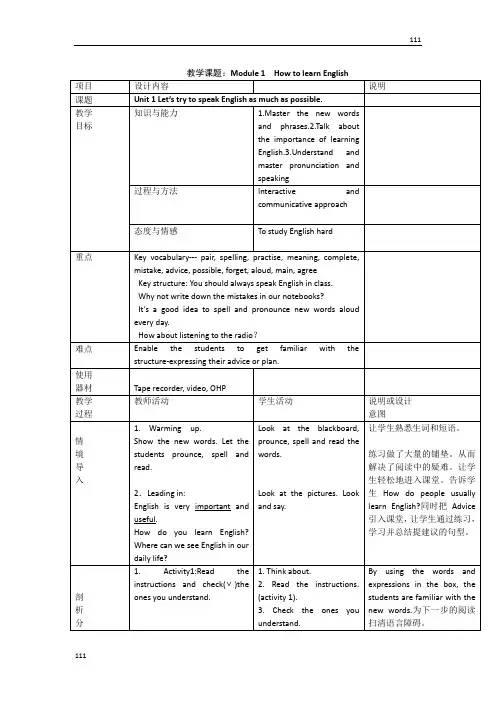
1. Think about. 2. Read the instructions. (activity 1). 3. Check the ones you understand.
说明或设计 意图 让学生熟悉生词和短语。
练习做了大量的铺垫。从而 解决了阅读中的疑难。让学 生轻松地进入课堂。告诉学 生 How do people usually learn English?同时把 Advice 引入课堂,让学生通过练习, 学习并总结提建议的句型。
1. Read the words and phrases. 2. Listen and answer the questions. (Part 2). 1. Make sentences to practice the sentence structure. And then discuss what the sentence structure is like.要学生找出 Part3 中 提出建议的句型。 2. Listen to Part 3 and complete Part 4 then practice reading the dialogue in groups. Then several should be asked to read in public. At last ask some groups to act out part3. 1. Read the dialogue together with the tape recorder. Then read the sentences of Part 5, with the tape recorder. 2. Read the sentences to let the partner check if the sentences are pronounced in a correct way. Talk about problems in learning English and give advice. Students read, write and remember.
外语教学与研究出版社初中英语八年级上册全册教学设计教案
外语教学与研究出版社初中英语八年级上册全册教学设计教案教学设计目标- 帮助学生掌握八年级上册英语的基本语法知识和词汇量- 提升学生听、说、读、写的能力- 培养学生的英语交流和表达能力- 激发学生对英语研究的兴趣和自主研究的能力教学内容安排第一单元:Meeting New Friends- 语言知识:- 重点词汇:greeting, introduce, name, age, hobby, country, etc. - 语法重点:be动词的使用和一般现在时的基本句型- 听力:听取对话并选择正确的答案- 口语:运用所学词汇和句型进行自我介绍和询问他人信息- 阅读:阅读短文并回答相关问题- 写作:写一篇关于自我介绍的短文第二单元:School Life- 语言知识:- 重点词汇:classroom, teacher, subject, homework, test, etc. - 语法重点:there be句型和物主代词的使用- 听力:听取学校活动并选择正确的回答- 口语:描述学校的不同场所和活动- 阅读:阅读有关学校生活的短文并回答相关问题- 写作:写一篇关于学校活动的日记第三单元:Hobbies and Interests- 语言知识:- 重点词汇:hobby, interest, music, sport, game, etc.- 语法重点:动词的ing形式和频度副词的使用- 听力:听取关于不同爱好和兴趣的对话并回答相关问题- 口语:谈论自己和他人的爱好和兴趣- 阅读:阅读有关兴趣爱好的文章并回答相关问题- 写作:写一篇关于自己的兴趣爱好的短文第四单元:Family and Relationships- 语言知识:- 重点词汇:family, father, mother, brother, sister, friend, etc.- 语法重点:所有格的使用和形容词的比较级- 听力:听取有关家庭和关系的对话并回答相关问题- 口语:描述自己的家人和朋友,并表达关系- 阅读:阅读有关家庭和友谊的短文并回答相关问题- 写作:写一篇关于自己家庭和朋友的介绍教学方法- 多媒体教学:利用图片、音频和视频等多媒体资源,激发学生的研究兴趣- 互动式教学:通过小组讨论、合作活动和角色扮演等形式,提升学生的参与度和表达能力- 循序渐进教学:根据学生的实际水平和能力,逐步引导学生研究新的语法知识和词汇量- 多样化评估:通过口语演示、书面作业和小测验等方式,全面评估学生的研究成果教学资源- 《外语教学与研究出版社初中英语八年级上册全册教材》- 多媒体设备和教学软件- 翻译工具和在线词典- 练册和作业本以上是本教学设计教案的内容安排和方法介绍。
外研版八年级上册英语课文(全册).pdf
Module 1 How to learn EnglishUnit 1 Let’s try to speak English as much as possible.Ms James: Welcome back, everyone! Today, we’re going to talk about good ways to learn English. Ready? Who has some advice?Lingling: We should always speak English in class.Ms James: Good! Let’s try to speak English as much as possible.Daming: Why not write down the mistakes in our notebooks?Ms James: That’s a good idea. And don’t forget to write down the correct answers next to the mistak es. What else?Lingling: It’s a good idea to spell and pronounce new words aloud every day.Ms James: Thanks a lot, Lingling. How about listening to the radio?Lingling: Yes, that’s good for our pronunciation too. But there are so many new word. Ms James: Y ou don’t need to understand every word. You just need to listen for key words and main ideas. Daming: That’s the same for reading. English stories are so interesting. I get to know a lot about the world through reading.Lingling: I think writing is also important. Why don’t we try to find some English pen friends? We can write to them. Ms James: Excellent! I agree with you.Unit 2 You should smile at her!Send your questions to Diana, the Language Doctor.Many students ask for advice about how to improve their English. Here are three basic questions. The first question is about understanding English films and songs. Li Hao from Hubei wrote, “I li ke watching English films and listening to English songs, but I can only understand a little. What ca n I do?”Watching films and listening to songs are great way to learn English! Watch and listen several tim es, and guess the meaning of the new words. Each time you will learn something new. I also advise you to talk about the films or songs with your friends.The second question is about speaking. Wang Fan from Jilin wrote, “Our school has a teacher fro m the US. I am shy and I am afraid to speak to her. What should I do?”You can say, “Hello! How are you?”“Do you like China?” These are good ways to start a conversat ion. And before you begin, you should smile at her! Remember this: Do not be shy. Just try.The third question is about vocabulary. Zhang Lei from Anhui wrote, “I write down new words, but I forget them quickly. How can I remember them?”Do not worry. It is natural to forget new words! I suggest you write four or five words a day on piec es of paper and place them in your room. Read the words when you see them, and try to use them. Module 2 My home town and my countryUnit 1 It’s taller than many other buildings.Tony: Hey, Daming! How was your weekend?Daming: Pretty good! I went to Shenzhen.Tony: Where’s Shenzhen?Daming: Well, it’s on the coast near Hong Kong. It was a small village about thirty years ago, but to day it’s a very big city.Tony: So it’s a newer city than Hong Kong?Daming: Yes, it’s a newer city. In fact, it only became important in the 1980s.It’s getting bigger and busier. Some day it will become as busy as Hong Kong, I’m sure.Tony: What’s the population of Shenzhen?Daming: It’s over ten million, I think. That’s larger than the population of many other cities in Chin a. Its streets are much wider and cleaner too. I think it’s a beautiful city.Tony: I’d like to go to there one day.Daming: Remember to visit the Diwang Tower. It’s taller than many other buildings in Shenzhen.Unit 2 Cambridge is a beautiful city in the east of England.Cambridge, London and EnglandBy Tony SmithI come from Cambridge, a beautiful city in the east of England. It is on the River Cam and has a population of about 120,000. My home is especially famous for its university. Many famous people studied here, such as Isaac Newton and Charles Darwin. There are lots of old buildings and church es to visit. Students and tourists enjoy trips along the river by boat.Cambridge is 80 kilometres from London. London is in the south of England and it is on the Riv er Thames. It has a population of about seven and a half million, so it is bigger and busier than Cam bridge. It is about 2,000 years old, and it is famous for Big Ben, Buckingham Palace and Tower Bri dge.England itself is a part of an island, and you are always near the sea. The small villages and bea ches on the coast are popular for holidays. Tourists like the areas of low and beautiful lakes in the n orth, and the hills and pretty villages in the south. Everywhere in England you will notice how gree n the countryside is.It is never very hot in summer or very cold in winter. So come and see England any time of the ye ar, but bring an umbrella with you. You will need it most days.Module 3 SportsUnit 1 Nothing is more exciting than playing tennis.Daming: Hey, Tony. Come and watch the football match on TV.Tony: OK. What’s the score?Daming: Spain scored a minute ago.Tony: Wow! That’s fast!Daming: That’s right. Last week the match on TV was so boring because no one scored at all. So thi s week’s match is already more exciting.Betty: What’s the matter with you, Tony? You look tired.Tony: I’m really tired after last night’s tennis match. And I hurt my knee.Daming: That’s too bad! Sit down and watch the match. It’s safer than playing tennis.Betty: Yes, watching is not sure about that. Nothing is more relaxing too!Tony: Well, I’m not sure about that. Nothing is more enjoyable than playing tennis.Betty: But you enjoyed watching the Olympics on TV, right?Tony: Yes, but that’s because it was cheaper than buying tickets for all the games.Daming: And staying at home was easier than going to the stadium. Oh, look at that!Tony: Oh, he missed! Oh, bad luck!Daming: Never mind. There’s still plenty of time for them to score.Unit2 This year we practice more carefully.Training hardBy Li Daming It is Saturday tomorrow, but I am going to school. I am not going for lessons, but to play football. I am in our school team and we are going to play against another sch ool next week. The practice starts at 10 am. We all arrive as early as we can so that w e have time to warm up. We are training harder than usual because the other team bea t us last year. This year we want to do better.It is more difficult to practise in winter because the days are short and the weather is cold too. It gets dark earlier, so it is important not to be late for after-school practic e.Our coach is pleased because we are playing better as a team now. Last year we w ere sometimes careless when we passed the ball and we lost to the other team in the fi nal match. What a pity! This year we practise more carefully. That means we have a b etter chance of winning.The fan club has fewer people this year. We hope to play well so that we have mo re fans to watch the matches. It is good to have our fans around. They cheer us on lou dly and we feel more confident to win the game.Module 4 Planes, ships, and trainsUnit1 He lives the farthest from schoolBetty: I was late for school today.Mum: Why? What happened?Betty: I took the bus. There was a road accident, and the traffic was very heavy. But n obody was late, except me. Maybe I should go to school by taxi.Mum: It’s the most comfortable way, but it’s also the most expensive.Betty: Then what about going by bike?Mum: That’s a good choice, but it’s a bit dangerous. There’s so much traffic. Betty: But most of my classmates ride bikes, and it’s quite safe. Don’t worry. I’ll be c arefull.Mum: How does Tony go to school?Betty: He lives the farthest from school, so he takes the underground.Mum: And what about Lingling?Betty: Her home is the closest to school, so she walks.Mum: How about Daming?Betty: He goes by bus too, the same as me. But it’s so crowded! And the traffic is hea vy.Mum: All right. You can ride your bike to school, but remember to be careful all the ti me.Unit2 What is the best way to travel?Question: What is the best way to travel from London to Amsterdam.I am planning to travel from London to Amsterdam. How long does the journey ta ke and what is the best way to travel? Could you please tell me about the trains or shi ps to get there? The more information, the better. Thanks!Best answer: There are four ways to travel.A journey by train is more relaxing than by coach, but a lot more expensive. When you go by train, buy your ticket a long time before you travel. It is usually cheaper.You can go by car and by ship across the North Sea. This is the most comfortable way to travel but also the most expensive. Book your ticket before you book your hot el. Remember that parking in Amsterdam is very expensive, so stay outside the city c entre and travel in by bus or by train.The third choice is by coach. This is usually the cheapest, but in summer the coach es sometimes get crowded! And it takes you about twelve hours to get there. However , it will not cost as much as going by train.Finally, you can fly. It is the fastest and the second cheapest, but you may have to wait for hours at the airport because of bad weather.Well, I hope this helps! Have a great trip.Module 5 Lao She TeahouseUnit 1 I wanted to see the Beijing Opera.Listen and readBetty: Lingling and I went to Lao She Teahouse last night.Tony: How was it?Betty: It was great! You know, I wanted to see Beijing Opera, so Lingling offered to t ake me there. We drank tea and watched an opera.Tony: Did you understand the opera?Betty: No, it was difficult to understand the words. But the actors and actress were ex cellent.Tony: How long did you stay?Betty: We only planned to watch for an hour, but in the end, we stayed for three hour s.Tony: Did you enjoyed it?Betty: Well, it was interesting---that’s the main thing. I hope to understand more next time.Tony: Do you often go to see Beijing Opera, Lingling?Lingling: No, I don’t. I wanted to take Betty to the teahouse because it’s famous. Tony: Who is Lao She? Betty: No idea. Ask Lingling.Lingling: Lao She is a great writer. He’s especially famous for his play Teahouse.Unit 2 It describes the changes in Chinese society.2 Read the passage and match the heading with the paragraphs.a) Lao She Teahouseb)The Story of Teahousec)Lao She1Teahouse is one of Lao She’s most famous plays. He wrote it in 1957. The play has three acts and shows the lives of common people in China from the end of the nin eteenth century to the middle of twentieth century. It tells us the story of Wang Lifa a nd the customers of his teahouse in Beijing. It describes the changes in Chinese societ y over fifty years around the beginning of the twentieth century.2Lao She was born in Beijing in 1899. His mother sent him to a teacher’s school i n 1913. After finishing school in 1918, he became a head teacher of a primary school. In 1924 Lao She left home and went to England. He taught Chinese at a college in L ondon and returned to China five years later. He wrote many plays, novels and short s tories about people’s lives, and was named “the People’s Artist”. Lao She is one of the greatest Chinese writers of the twentieth century.3At Lao She Teahouse today, customers can drink tea and eat delicious Beijing fo od. If you like the Beijing Opera, traditional music or magic shows, you can enjoy the m at the teahouse. Lao She Teahouse gives a warm welcome to everyone from all ove r the world.Module 6 Animals in dangerUnit 1 It allows people to get closer to them.Listen and read(Lingling and Betty are leaving the zoo)Lingling: Did you like the zoo?Betty: Yes! I saw the pandas at last! But I am more interested to see the pandas in the Wolong Panda Reserve, because it allows people to get closer to them.Lingling: It’s sad to think of the pandas and other animals in danger.Betty: We need to protect them better.Lingling: Yes, Many wild animals don’t have a safe place to live, because villages and farms are growing bigger and are taking away their land and forests.Betty: Also, often there isn’t enough clean water, because we’ve made it dirty. I think we all need to help animals live in peace. Look, there’s a notice.Lingling: It says,“Help! We want to save animals in danger, and we need your help.”Betty: But what can we do?Lingling: It says,“Your money pays to look after the animals.”That means we can giv e money to help protect the animals.Betty: Maybe we can raise some money at school. Let’s find out what else we can do to save as many animals as possible.Unit 2 The WWF is working hard to save them all.2 Read the passage and match the heading with the paragraphs.a)Nature parks for pandasb) WWF And animals in dangerc) The panda’s homed) An animal in danger1Pandas are in danger. There are only about 1,600 pandas living in the wild today. Zoos and research centres are looking after about 340 pandas. Pandas do not have m any babies, and baby pandas often die. The situation is getting very difficult. Scientist are doing a lot of research to help pandas produce more babies and help baby pandas live.2Pandas live in the forests and mountains of Southwest China. Each panda needs to eat a lot of bamboo every day. The bamboo forests are getting smaller, so pandas are losing their home. And there are not many pandas left.3In order to protect pandas in the wild, the government is setting up nature parks and developing other plans. The nature parks will be big and there will be more bamb oo to feed the pandas. Pandas born in zoos may go back to live in the nature parks.4The World Wild Fund for Nature (WWF) wants to protect all animals. And it cho se the panda to be its symbol. We do not want to lose tigers, elephants, or any other a nimals, so the WWF is working hard to save them all.Module7 A famous storyUnit1 Alice was sitting with her sister by the river.Tony: Hi,Lingling!Lingling: Ssh! I’m reading.Tony: Sorry! What’s the book about?Lingling: It’s about a girl called Alice. One day, Alice was sitting with her sister by the river and she saw a white rabbit with a watch. It ran past.Tony: Why was it running? Lingling: Because it was late. Tony: And where was it goi ng?Lingling: To see the Queen of Hearts. Alice followed it and fell down a hole in the ground.Tony: Yes! Then she saw the Cheshire Cat. It was sitting in a tree and smiling at ever yone.Lingling: Then Alice arrived at the March Hare’s house. He was sitting with the Mad Hatter and a mouse. They were having a tea party in the garden.Tony: And then Alice met the Queen of Hearts. She was playing a strange game!Lingling: Do you already know the book?Tony: Yes, It’s Alice’s Adventures in Wonderland. Everyone in Britain knows the stor y.Lingling: Then why did you ask me all those questions?Tony: To see if you remember the story! Ha ha….U2 She was thinking about her cat.Alice was sitting with her sister by the river and her sister was reading a book. A lice had nothing to do. Once or twice she looked into her sister’a book. “And what is a book for,” thought Alice,”without pictures or conversations?” Suddenly a white rab bit with pink eyes ran by.There was nothing strange about that. She heard the rabbit say, “Oh dear! Oh dea r! I’ll be late!” and she did not think it was strange. Then the rabbit took a watch out o f its pocket and looked at it. A rabbit with a pocket and a watch. Alice got up and ran across the field after it. She saw it go down a large rabbit hole in the ground.Then Alice went down after it, but never thought about how she was going to ge t out again. She found that she was falling down a very, very deep hole. It was too dar k for her to see anything. She was falling for a long time. While she was falling, she was thinking about her cat, Dinah. Suddenly she landed on some dry leaves…Module 8Unit1 while the lights were changing to red ,a car suddenly appearedBetty: Good morning, Ms James! You look pale. Are you all right?Ms James: Im OK, but I saw an accident. A boy was riding his bike and listening to music on the road.Daming: That’s very dangerous!Ms James: I was waiting to cross the road. While the lights were changing to red, a ca r suddenly appeared round the corner. It wasn’t going fast, but it didn’t stop. Lingling: Did the boy stop?Ms James: No. And the driver was talking on his mobile phone.Betty: So did the car hit the boy?Ms James: No, I’m glad to say. The car stopped just in time, but the boy fell off his bi ke and hurt his knee.Tony: That’s too bad.Ms James: So when youre on your bike, think about the risk of an accident! Pay atte ntion, stop at the red lights and…..what else?Betty: Don’t ride too fastDaming : Don’t ride side by side with your friends.All: Don’t listen to music!Unite 2One day, when Henry was working in a restaurant, a snake suddenly appeared and bit his hand. A few days earlier, the snake arrived from Asia in a box of bananas. It c limbed out and hid somewhere.“I was trying to pick it up when it bit me again. I threw it across the kitchen, an d it landed on a table.’’While the snake was lying on the table, Henry quickly picked up his mobile phon e and took a photo with it. Then the snake hid behind the fridge When Henry was try ing to find the snake, his hand began to hurt badly. He hurried to hospital. As the do ctors were checking him, the pain got worse . But they could not help him because t hey did not know what kind of snake bit him.As he was lying there in great pain, Henry suddenly remembered the photo. The doctors sent the photo to a zoo. As soon as they learnt what kind of snake bit him, th ey gave Henry the right medicine and he left hospital the next day.“So if a snake bites you, take out your mobile phone or camera. Take its photo, an d show the photo to the doctors ‘’, suggests Henry.“But as you know, the snake won’t smile!”Module 9 PopulationUnit1 the population of China is about 1.37 billionBetty: What are you doing?Tony: I’m preparing some notes for a report called “Our growing population.”Lingling: Well, w e re in the right place to talk about that! Beijing is a huge city with a big population that causes a lot of problems, such as too much traffic and noise. Betty: Its not only Beijing. Population increase is a big problem in many countries. D o you know how many babies are born every minute in the world?Tony: No. Can you tell me?Betty: Over 250! That makes over 131.4 million births a yearLingling: I can’t believe it!Betty: The population of China is about 1.37 billion. Thats almost one fifth of the wor ld’s population, that is, about 7 billion.Tony: Hang on a minute! I’ll write that down too!Betty: But in the future, Chinas population wont grow so fast, because families are ge tting smaller.Lingling: How do you know all this?Betty: I wrote my report yesterday!Tony: Great, thanks! Now I can write my report!Unit 2Jo is fifteen and lives in Parkville.When Jo’s grandparents first came to Parkville, it was a quiet village. They had a small house. Close to fields md hills. Parkville was near Arnwick, a city with 200,00 0 people. People from Parkville moved to Armwick to find jobs. And they needed p laces to live.However, it was expensive to live in the city centre, so the government built flats o utside the centre. Soon, Parkville became part of Arnwick.And Arnwick became a ci ty with over a million people. Jo’s family lives in one of those flats. It is very crowde d, and rubbish is also a problem.The small local school in Parkville closed down five years ago, so Jo now has to g o to a school in Arnwick with 2,000 pupils. It takes an hour to get there by bus. There is a lot of traffic and pollution. It is clear that Arnwick needs more schools, buses and hospitals. It needs fresh air clean water and better public services. It also needs mor e police to protect its people. But to do all these things, it needs more money. However, can money help solve all these problems? Do we need more big cities l ike this? In fact, this is just a story. In fact, this is just a story.But it describes what is happening all over the world. Could it be your town some day?Module 10 The weatherUnit 1 It might snowBetty: Hey, boys!Tony: Hi, Betty. Hi, Lingling, Where are you going?Betty: We’re going to the park to skate, There’s thick ice on the lake, Are you comin g with US?Tony: Are you joking? It’s really cold today.Daming: And it’s cloudy too so it might snow.Lingling: What’s the temperature?Tony: It’s between minus eight and minus two degrees! Winter is colder here than i E ngland.Daming: Is it snowy in England in December?Tony: Not usually, although this year it snowed quite a lot, Most Decembers are we a nd rainy.Daming: What’s the weather like in America in winter, Betty?Betty: We have cold winters and hot summers. It’s snowy in New York in winter. Tony: Sounds great ! I like sunny weather, and I like snow as well. But I don’t like sh owers or windy weather.Betty: Me neither, Rainy weather is terrible! I wish I were in Australia now, It’s Proba bly sunny and hot there.Lingling: You can go to Hainan lsland if you like sunny weather.Betty: One day I will.Lingling: Come on, better get going! We can skate in the park and get warm.Unit 2 The weather is fine all year round.The US is a very big country.It is about 3,000 miles from the east coast to the west coast, so choose carefully the places to see and the time to go. Bring a map because you may want to travel aroun d. New York and Washington D.C. are good places to visit in May or October, but in winter there is a lot of snow.The best time to visit New England is in September.The weather gets cooler, and the green leaves start to turn gold, then brown. Brin g your camera so you can take photos of the autumn trees.California is on the Pacific coast, and the weather is fine all year round. Take your swimming clothes because y ou might want to go swimming in the sea, even in December.In Seattle, in the northwest, it is not very cold but it rains a lot, so bring an umbrell a.In Alaska the days are long and warm in summer, but may be cool in the evening. In winter, Alaska can be very very cold. If you want to visit Alaska, you had better go i n summer. Do not forget to bring a warm sweater with you.In Texas and the southeast, it is usually very hot and sunny compared to other plac es. There are storms from time to time in summer and autumn.So when is the best time to visit the US? Any time you like!Module 11 Way of lifeUnit 1 In China, we open a gift laterBetty: Happy birthday, Lingling.Daming: Here’s your gift.Lingling: Oh, you remembered! What a surprise!Tony: You can open it!Lingling: I don’t think I should open it now. In China, we open a gift later.Betty: But back in the US, we open a gift immediately.Lingling: So what do I do?Betty: You needn’t wait!(Lingling opens her present and finds a dictionary.)Lingling: Oh, thank you. I really wanted one.Betty: We’re happy you like it.Tony: I noticed another difference. In China, you accept a gift with both hands. But in the West, we usually don’t pay much attention to that.Betty: That’s interesting! I’m interested to know all the Chinese traditions. Tell me m ore.Lingling: There are a lot. For example, in my home town, people say you mustn’t do any cleaning on the first day of the Spring Festival. And you mustn’t break anything. It’s bad luck!Daming: You must only use red paper for hongbao because red means luck. And you’d better not cut your hair during the Spring Festival month.Daming: And in the north of China, people eat lots of jiaozi!Betty: Perfect! They taste great.Tony: I like eating jiaozi too. Anyway, the Spring Festival is still over a month away. Let’s celebrate Lingling’s birthday first!Unit 2 In England you usually drink tea with milk.My experiences in England. I went to England last year. I enjoyed my stay, and I noticed something interesting with the English way of life.For example, you must sayMr or Mrs when you meet someone for the first time. When you get to know each ot her better or when they ask you to, you can just use their first names.One day we visited some friends and had afternoon tea together. Afternoon tea is n ot just a drink but a light meal at around 4 pm. We ate sandwiches and a large fruit c ake.In England you usually drink tea with milk.So I tried to drink tea with milk too. Fish and chips is the traditional food in England. You can buy it and eat it in special fi sh and chip shops on the high street, or you can take it away and eat it with your finge rs. It is delicious!At the bus stop you must not push your way onto the bus. You need to stand in a line behind the other people and wait your turn. Sometimes people are slow to get o n the bus.Once I noticed a gentleman touch a young man on the shoulder, smile politely and say, “Excuse me! Are you waiting for this bus?” He was really polite.Module 12 HelpUnit1 What should we do before help arrives?Ms James: This mornings class is about first aid, or giving someone basic medical help. Let’s imagine an accident. A boy is lying at the bottom of the stairs. He isn’t moving or making a sound. He is in pain. What can we do to help him?Betty: First of all, find out what’s wrong with him.Ms James: How do we do that?Betty: Ask him.Ms James: Ok. But he could have trouble hearing you or speaking to you.Lingling: Shout for help? Call 120?Ms James: Good idea, but what should we do before help arrives?Tony: Make him comfortable.Ms James: And how can we do that?Tony: Lift him up and sit him on a chair?Ms James: No, that could be harmful! You could drop him and hurt him even more. B etty, you must know! You did some basic medical training.Betty: Make sure he’s warm. Cover him with a coat.Ms James: That’s such good advice that you could be a doctor, Betty!Unit 2 Stay away from windows and heavy furniture.What to do in an earthquakeEarthquakes always happen suddenly, so it is difficult to warn people about them. Usually people have little or no idea about what to do during an earthquake, so here is some advice. Inside Do not jump out of high buildings. Hide under a table. Stay awa y from windows and heavy furniture. Keep clear of fires. Leave the building quickly when the ground stops shaking, but do not use the lift.Keep calm, especially when yo u are with other people. Be brave and be helpful.Outside Move away from buildings, because parts of a building may fall on you. Do not stand near street lights or under power lines. Stay away from bridges and tree s. If you are in a bus or car, stay in it.In the mountains, be careful of falling rocks.On a beach, run away from the sea and move quickly to higher ground.In short, follow what you learnt in school. You can be safe and you can also help save others。
新外研版八年级上册英语全教案
新外研版八年级上册英语全教案一、教学目标1、帮助学生掌握新外研版八年级上册英语课程的基础知识,包括词汇、语法、阅读、写作等方面。
2、提高学生英语听、说、读、写四项技能,培养他们的英语综合应用能力。
3、激发学生对英语学习的兴趣和热情,培养他们的自主学习能力。
4、帮助学生了解中西方文化差异,拓展国际视野。
二、教学内容及重点难点本册教材共分为10个单元,每个单元都有一个主题,涵盖了日常生活的各个方面,如学校生活、家庭生活、环境保护、健康生活等。
每个单元都包括听说读写四个部分,以及语言知识、语法、词汇、文化背景等知识点。
重点:掌握每个单元的重点词汇和语法结构,提高阅读理解和写作能力。
难点:正确使用目标语言进行口头和书面表达,熟悉各种文体的写作技巧,如记叙文、说明文、议论文等。
三、教学方法及教学资源1、教学方法:采用情境教学、任务型教学、合作学习等多种教学方法,以学生为中心,激发学生的学习兴趣和主动性。
2、教学资源:利用多媒体教学设备、网络资源、教学软件等多样化教学资源,丰富课堂教学内容,提高教学效果。
四、教学过程设计1、导入新课:通过提问、复习等方式导入新课,引导学生进入学习状态。
2、呈现新知:通过图片、视频等方式呈现新知识,帮助学生理解课文内容。
3、实践活动:通过小组讨论、角色扮演等方式进行实践活动,提高学生的口语表达和写作能力。
4、课堂小结:通过总结重点难点、布置作业等方式进行课堂小结,帮助学生巩固所学知识。
五、评价与反馈1、评价方式:采用形成性评价和终结性评价相结合的方式,学生的学习过程和学习成果。
2、反馈方式:及时给予学生反馈和指导,帮助学生发现自己的问题和不足,提高学习效果。
六、作业布置与课外拓展1、作业布置:根据教学内容和学生的学习情况,布置适量的作业,包括书面作业和口头作业。
2、课外拓展:鼓励学生进行课外拓展学习,如阅读英语报刊杂志、听英语歌曲等,提高他们的自主学习能力。
外研版八年级上册英语全册课件是为了配合外研版八年级上册英语教材而制作的。
外研版初中英语八年级上册全册教学设计教案可编辑
外研版初中英语八年级上册全册教学设计教案外研版初中英语八上全册教案及导学案初二英语(上)Module 1 Unit 1 教学设计教材分析:Unit 1通过听、读、说训练,初步学习给别人提建议的方法。
其中活动1要求将所给表示学习活动的词汇分类;活动2要求根据录音判断对话主题;活动3?5听读包含建议的对话并完成填表、答问等任务。
活动6学习英语中的连读法;活动7根据提示口头练习给别人提建议的方法。
教学目标:To get to know the key vocabulary.To understand the dialogue 3.To be able to talk about the problems in learning English.教学重点:Key points: translate, correct, grammar, pronunciation, spelling, try to do,Why don’t you…? How about…教学方法Listening and speaking教具准备Tape recorder教学流程Teacher’s Activity Student’s Activity1.Warming-up 1.Ask the students to introduce themselves first,2.Tell them the importance of learning English and how to learnEnglish3.Say: Now we are going to learn a lot about English, such as grammar ,pronunciation, vocabulary, and how to listen, speak, write and read English. Now please look at activity 1 on page 2Ask students to read the words aloud and try to match them with the headings. It’s best if you cantell them something about each of the item. Make sure students understand each of the items And try to include the words in activity 2 as well!. Take “Grammar” for example:T: Grammar is part of English. It helps us form words and sentences. It helps us check our speaking and writing. For example, you can say “I am Daming.”, but you cannot say “I is Daming.” That’s grammarCheck the answers by asking some students to read the wordsIntroduce themselves first.Listen to the teacher to say about the importance of learning English and how to learn English.Read the words aloud and try to match them with the headings2.In putandpractice Talk about English learningT: English is a widely-used language. People in more than one hundred countries speak English. And many more countries take English as second language. Learning English is fun, and of course not an easy job. But what is in English? What are we going to learn about English? Do you know?Encourage students to speak out what they have in mindS: We’ll learn English letters and wordsS: We’ll learn to speak EnglishS: We’ll learn how to talk to foreigners Speak out What they are going to learn about English?3.Out Put 1. Listening 2First encourage students to tell the meaning of words in activity 2 and try to give some examples for each item, and then ask them to listen to the conversations and match themT: Next we are going to listen to some short conversations. In the conversations, Daming, Lingling and Miss Li are talking about English learning. Listen carefully and try to match these conversations with the words in the box in activity 2. But before this, can you first tell me the meaning of these words?Ask students to tell the meaning of these words either in Chinese or English and then listen to the conversationsCheck the answers. Ask students to try to give the reasons why they choose the words2. Listening and reading 3?5ListeningAsk students to listen to the conversation between Ms James and her students carefully with books closed. Then ask students to listen again and finish activity 4. Check the answers with the class.ReadingAsk students to work in pairs and read the conversation repeatedlyand then ask some pairs to act out the conversation. Then ask and answer the questions in pairsListen to the conversations and match them, tell the meaning of these words either in Chinese or English and then listen to the conversations again.Listen to the tape and finish activity 4.Read the conversation repeatedly and act out the conversation in pairs. Then ask and answer the questions in pairs4. Practice Speaking 6, 7Ask students to listen to and repeat the sentences in activity 6. T: When we speak English, we often read some syllables one ending with consonant and the other beginning with a vowel together. Now listen to the recording and repeat these sentencesAfter a few minutes, ask students to work in pairs and ask and answer the questions in activity 7Sample conversation:S1: What should I do to improve your grammar?S2: You should do more exercisesS1: What else?S2: Try to read more English books and newspapersS1: I’ll try toS2: And don’t forget to read some grammar booksS1: Thanks very much 1.Repeat the sentences in activity2.Work in pairs and ask and answer the questions in activity 7.5. Feedback Give suggestions. Use should, can or I t’s a good idea to…speak English more in classlisten to China Radio Internationalread aloud in the morningwrite new words in groupsread English newspapers Finish the following exercises and have a check.6.Summing-up7.Homework Read the conversation in activity 3 repeatedlyFinish activities 1-4 on page 112 in WorkbookGrade8 Module1 Unit2上课教师学生年级初二教材《英语》(外研社)初二上册课时Module 1 Unit 2教学设计课型Reading and writing教材分析本模块为本学期的第一课,教师要充分利用这一模块的内容,培养学生学习的计划性和策略性,从而有效的指导学生学习。
(完整版)外研版八年级上册英语课文(全册),推荐文档

Module 1 How to learn EnglishUnit 1 Let’s try to speak English as much as possible.Ms James: Welcome back, everyone! Today, we’re going to talk about good ways to learn English. Ready? Who has some advice?Lingling: We should always speak English in class.Ms James: Good! Let’s try to speak English as much as possible.Daming: Why not write down the mistakes in our notebooks?Ms James: That’s a good idea. And don’t forget to write down the correct answers next to the mista kes. What else?Lingling: It’s a good idea to spell and pronounce new words aloud every day.Ms James: Thanks a lot, Lingling. How about listening to the radio?Lingling: Yes, that’s good for our pronunciation too. But there are so many new word. Ms James: Y ou don’t need to understand every word. You just need to listen for key words and main ideas. Daming: That’s the same for reading. English stories are so interesting. I get to know a lot about the world through reading.Lingling: I think writing is also important. Why don’t we try to find some English pen friends? We can write to them. Ms James: Excellent! I agree with you.Unit 2 You should smile at her!Send your questions to Diana, the Language Doctor.Many students ask for advice about how to improve their English. Here are three basic questions. The first question is about understanding English films and songs. Li Hao from Hubei wrote, “I li ke watching English films and listening to English songs, but I can only understand a little. What ca n I do?”Watching films and listening to songs are great way to learn English! Watch and listen several ti mes, and guess the meaning of the new words. Each time you will learn something new. I also advis e you to talk about the films or songs with your friends.The second question is about speaking. Wang Fan from Jilin wrote, “Our school has a teacher fro m the US. I am shy and I am afraid to speak to her. What should I do?”You can say, “Hello! How are you?” “Do you like China?” These are good ways to start a conversat ion. And before you begin, you should smile at her! Remember this: Do not be shy. Just try.The third question is about vocabulary. Zhang Lei from Anhui wrote, “I write down new words, but I forget them quickly. How can I remember them?”Do not worry. It is natural to forget new words! I suggest you write four or five words a day on piec es of paper and place them in your room. Read the words when you see them, and try to use them. Module 2 My home town and my countryUnit 1 It’s taller than many other buildings.Tony: Hey, Daming! How was your weekend?Daming: Pretty good! I went to Shenzhen.Tony: Where’s Shenzhen?Daming: Well, it’s on the coast near Hong Kong. It was a small village about thirty years ago, but to day it’s a very big city.Tony: So it’s a newer city than Hong Kong?Daming: Yes, it’s a newer city. In fact, it only became important in the 1980s.It’s getting bigger and busier. Some day it will become as busy as Hong Kong, I’m sure.Tony: What’s the population of Shenzhen?Daming: It’s over ten million, I think. That’s larger than the population of many other cities in Chin a. Its streets are much wider and cleaner too. I think it’s a beautiful city.Tony: I’d like to go to there one day.Daming: Remember to visit the Diwang Tower. It’s taller than many other buildings in Shenzhen.Unit 2 Cambridge is a beautiful city in the east of England.Cambridge, London and EnglandBy Tony SmithI come from Cambridge, a beautiful city in the east of England. It is on the River Cam and has a population of about 120,000. My home is especially famous for its university. Many famous people studied here, such as Isaac Newton and Charles Darwin. There are lots of old buildings and church es to visit. Students and tourists enjoy trips along the river by boat.Cambridge is 80 kilometres from London. London is in the south of England and it is on the Riv er Thames. It has a population of about seven and a half million, so it is bigger and busier than Cam bridge. It is about 2,000 years old, and it is famous for Big Ben, Buckingham Palace and Tower Bri dge.England itself is a part of an island, and you are always near the sea. The small villages and bea ches on the coast are popular for holidays. Tourists like the areas of low and beautiful lakes in the n orth, and the hills and pretty villages in the south. Everywhere in England you will notice how gree n the countryside is.It is never very hot in summer or very cold in winter. So come and see England any time of the y ear, but bring an umbrella with you. You will need it most days.Module 3 SportsUnit 1 Nothing is more exciting than playing tennis.Daming: Hey, Tony. Come and watch the football match on TV.Tony: OK. What’s the score?Daming: Spain scored a minute ago.Tony: Wow! That’s fast!Daming: That’s right. Last week the match on TV was so boring because no one scored at all. So thi s week’s match is already more exciting.Betty: What’s the matter with you, Tony? You look tired.Tony: I’m really tired after last night’s tennis match. And I hurt my knee.Daming: That’s too bad! Sit down and watch the match. It’s safer than playing tennis.Betty: Yes, watching is not sure about that. Nothing is more relaxing too!Tony: Well, I’m not sure about that. Nothing is more enjoyable than playing tennis.Betty: But you enjoyed watching the Olympics on TV, right?Tony: Yes, but that’s because it was cheaper than buying tickets for all the games.Daming: And staying at home was easier than going to the stadium. Oh, look at that!Tony: Oh, he missed! Oh, bad luck!Daming: Never mind. There’s still plenty of time for them to score.Unit2 This year we practice more carefully.Training hardBy Li Daming It is Saturday tomorrow, but I am going to school. I am not going for lessons, but to play football. I am in our school team and we are going to play against another sch ool next week. The practice starts at 10 am. We all arrive as early as we can so that w e have time to warm up. We are training harder than usual because the other team bea t us last year. This year we want to do better.It is more difficult to practise in winter because the days are short and the weather is cold too. It gets dark earlier, so it is important not to be late for after-school practice.Our coach is pleased because we are playing better as a team now. Last year we w ere sometimes careless when we passed the ball and we lost to the other team in the fi nal match. What a pity! This year we practise more carefully. That means we have a better chance of winning.The fan club has fewer people this year. We hope to play well so that we have mo re fans to watch the matches. It is good to have our fans around. They cheer us on lou dly and we feel more confident to win the game.Module 4 Planes, ships, and trainsUnit1 He lives the farthest from schoolBetty: I was late for school today.Mum: Why? What happened?Betty: I took the bus. There was a road accident, and the traffic was very heavy. But n obody was late, except me. Maybe I should go to school by taxi.Mum: It’s the most comfortable way, but it’s also the most expensive.Betty: Then what about going by bike?Mum: That’s a good choice, but it’s a bit dangerous. There’s so much traffic. Betty: But most of my classmates ride bikes, and it’s quite safe. Don’t worry. I’ll be c arefull.Mum: How does Tony go to school?Betty: He lives the farthest from school, so he takes the underground.Mum: And what about Lingling?Betty: Her home is the closest to school, so she walks.Mum: How about Daming?Betty: He goes by bus too, the same as me. But it’s so crowded! And the traffic is hea vy.Mum: All right. You can ride your bike to school, but remember to be careful all the t ime.Unit2 What is the best way to travel?Question: What is the best way to travel from London to Amsterdam.I am planning to travel from London to Amsterdam. How long does the journey ta ke and what is the best way to travel? Could you please tell me about the trains or shi ps to get there? The more information, the better. Thanks!Best answer: There are four ways to travel.A journey by train is more relaxing than by coach, but a lot more expensive. When yo u go by train, buy your ticket a long time before you travel. It is usually cheaper. You can go by car and by ship across the North Sea. This is the most comfortable wa y to travel but also the most expensive. Book your ticket before you book your hotel. Remember that parking in Amsterdam is very expensive, so stay outside the city centre and travel in by bus or by train.The third choice is by coach. This is usually the cheapest, but in summer the coaches sometimes get crowded! And it takes you about twelve hours to get there. However, i t will not cost as much as going by train.Finally, you can fly. It is the fastest and the second cheapest, but you may have to wa it for hours at the airport because of bad weather.Well, I hope this helps! Have a great trip.Module 5 Lao She TeahouseUnit 1 I wanted to see the Beijing Opera.Listen and readBetty: Lingling and I went to Lao She Teahouse last night.Tony: How was it?Betty: It was great! You know, I wanted to see Beijing Opera, so Lingling offered to take me there. We drank tea and watched an opera.Tony: Did you understand the opera?Betty: No, it was difficult to understand the words. But the actors and actress were e xcellent.Tony: How long did you stay?Betty: We only planned to watch for an hour, but in the end, we stayed for three hour s.Tony: Did you enjoyed it?Betty: Well, it was interesting---that’s the main thing. I hope to understand more next time.Tony: Do you often go to see Beijing Opera, Lingling?Lingling: No, I don’t. I wanted to take Betty to the teahouse because it’s famous. Tony: Who is Lao She? Betty: No idea. Ask Lingling.Lingling: Lao She is a great writer. He’s especially famous for his play Teahouse.Unit 2 It describes the changes in Chinese society.2 Read the passage and match the heading with the paragraphs.a) Lao She Teahouseb)The Story of Teahousec)Lao She1Teahouse is one of Lao She’s most famous plays. He wrote it in 1957. The play has three acts and shows the lives of common people in China from the end of the nin eteenth century to the middle of twentieth century. It tells us the story of Wang Lifa a nd the customers of his teahouse in Beijing. It describes the changes in Chinese societ y over fifty years around the beginning of the twentieth century.2Lao She was born in Beijing in 1899. His mother sent him to a teacher’s school i n 1913. After finishing school in 1918, he became a head teacher of a primary school. In 1924 Lao She left home and went to England. He taught Chinese at a college in L ondon and returned to China five years later. He wrote many plays, novels and short s tories about people’s lives, and was named “the People’s Artist”. Lao She is one of the greatest Chinese writers of the twentieth century.3At Lao She Teahouse today, customers can drink tea and eat delicious Beijing fo od. If you like the Beijing Opera, traditional music or magic shows, you can enjoy the m at the teahouse. Lao She Teahouse gives a warm welcome to everyone from all ove r the world.Module 6 Animals in dangerUnit 1 It allows people to get closer to them.Listen and read(Lingling and Betty are leaving the zoo)Lingling: Did you like the zoo?Betty: Yes! I saw the pandas at last! But I am more interested to see the pandas in the Wolong Panda Reserve, because it allows people to get closer to them.Lingling: It’s sad to think of the pandas and other animals in danger.Betty: We need to protect them better.Lingling: Yes, Many wild animals don’t have a safe place to live, because villages an d farms are growing bigger and are taking away their land and forests.Betty: Also, often there isn’t enough clean water, because we’ve made it dirty. I thin k we all need to help animals live in peace. Look, there’s a notice.Lingling: It says,“Help! We want to save animals in danger, and we need your help.” Betty: But what can we do?Lingling: It says,“Your money pays to look after the animals.”That means we can giv e money to help protect the animals.Betty: Maybe we can raise some money at school. Let’s find out what else we can do to save as many animals as possible.Unit 2 The WWF is working hard to save them all.2 Read the passage and match the heading with the paragraphs.a)Nature parks for pandasb) WWF And animals in dangerc) The panda’s homed) An animal in danger1Pandas are in danger. There are only about 1,600 pandas living in the wild today. Zoos and research centres are looking after about 340 pandas. Pandas do not have ma ny babies, and baby pandas often die. The situation is getting very difficult. Scientist are doing a lot of research to help pandas produce more babies and help baby pandas live.2Pandas live in the forests and mountains of Southwest China. Each panda needs to eat a lot of bamboo every day. The bamboo forests are getting smaller, so pandas a re losing their home. And there are not many pandas left.3In order to protect pandas in the wild, the government is setting up nature parks and developing other plans. The nature parks will be big and there will be more bamb oo to feed the pandas. Pandas born in zoos may go back to live in the nature parks.4The World Wild Fund for Nature (WWF) wants to protect all animals. And it ch ose the panda to be its symbol. We do not want to lose tigers, elephants, or any other animals, so the WWF is working hard to save them all.Module7 A famous storyUnit1 Alice was sitting with her sister by the river.Tony: Hi,Lingling!Lingling: Ssh! I’m reading.Tony: Sorry! What’s the book about?Lingling: It’s about a girl called Alice. One day, Alice was sitting with her sister by the river and she saw a white rabbit with a watch. It ran past.Tony: Why was it running? Lingling: Because it was late. Tony: And where was it go ing?Lingling: To see the Queen of Hearts. Alice followed it and fell down a hole in the ground.Tony: Yes! Then she saw the Cheshire Cat. It was sitting in a tree and smiling at ever yone.Lingling: Then Alice arrived at the March Hare’s house. He was sitting with the Mad Hatter and a mouse. They were having a tea party in the garden.Tony: And then Alice met the Queen of Hearts. She was playing a strange game!Lingling: Do you already know the book?Tony: Yes, It’s Alice’s Adventures in Wonderland. Everyone in Britain knows the sto ry.Lingling: Then why did you ask me all those questions?Tony: To see if you remember the story! Ha ha….U2 She was thinking about her cat.Alice was sitting with her sister by the river and her sister was reading a book. Alice had nothing to do. Once or twice she looked into her sister’a book. “And what is a book for,” thought Alice,”without pictures or conversations?” Suddenly a white rab bit with pink eyes ran by.There was nothing strange about that. She heard the rabbit say, “Oh dear! Oh dea r! I’ll be late!” and she did not think it was strange. Then the rabbit took a watch out of its pocket and looked at it. A rabbit with a pocket and a watch. Alice got up and ra n across the field after it. She saw it go down a large rabbit hole in the ground.Then Alice went down after it, but never thought about how she was going to ge t out again. She found that she was falling down a very, very deep hole. It was too dar k for her to see anything. She was falling for a long time. While she was falling, she was thinking about her cat, Dinah. Suddenly she landed on some dry leaves…Module 8Unit1 while the lights were changing to red ,a car suddenly appearedBetty: Good morning, Ms James! You look pale. Are you all right?Ms James: Im OK, but I saw an accident. A boy was riding his bike and listening to music on the road.Daming: That’s very dangerous!Ms James: I was waiting to cross the road. While the lights were changing to red, a ca r suddenly appeared round the corner. It wasn’t going fast, but it didn’t stop. Lingling: Did the boy stop?Ms James: No. And the driver was talking on his mobile phone.Betty: So did the car hit the boy?Ms James: No, I’m glad to say. The car stopped just in time, but the boy fell off his bi ke and hurt his knee.Tony: That’s too bad.Ms James: So when youre on your bike, think about the risk of an accident! Pay atte ntion, stop at the red lights and…..what else?Betty: Don’t ride too fastDaming : Don’t ride side by side with your friends.All: Don’t listen to music!Unite 2One day, when Henry was working in a restaurant, a snake suddenly appeared and bit his hand. A few days earlier, the snake arrived from Asia in a box of bananas. It climbed out and hid somewhere.“I was trying to pick it up when it bit me again. I threw it across the kitchen, and it l anded on a table.’’While the snake was lying on the table, Henry quickly picked up his mobile phone and took a photo with it. Then the snake hid behind the fridge When Henry was tryin g to find the snake, his hand began to hurt badly. He hurried to hospital. As the doct ors were checking him, the pain got worse .But they could not help him because they did not know what kind of snake bit him.As he was lying there in great pain, Henry suddenly remembered the photo. The doctors sent the photo to a zoo. As soon as they learnt what kind of snake bit him, th ey gave Henry the right medicine and he left hospital the next day.“So if a snake bites you, take out your mobile phone or camera. Take its photo, a nd show the photo to the doctors ‘’, suggests Henry.“But as you know, the snake won’t smile!”Module 9 PopulationUnit1 the population of China is about 1.37 billionBetty: What are you doing?Tony: I’m preparing some notes for a report called “Our growing population.” Lingling: Well, w e re in the right place to talk about that! Beijing is a huge city with a big population that causes a lot of problems, such as too much traffic and noise. Betty: Its not only Beijing. Population increase is a big problem in many countries. D o you know how many babies are born every minute in the world?Tony: No. Can you tell me?Betty: Over 250! That makes over 131.4 million births a yearLingling: I can’t believe it!Betty: The population of China is about 1.37 billion. Thats almost one fifth of the wor ld’s population, that is, about 7 billion.Tony: Hang on a minute! I’ll write that down too!Betty: But in the future, Chinas population wont grow so fast, because families are ge tting smaller.Lingling: How do you know all this?Betty: I wrote my report yesterday!Tony: Great, thanks! Now I can write my report!Unit 2Jo is fifteen and lives in Parkville.When Jo’s grandparents first came to Parkville, it was a quiet village. They had a small house. Close to fields md hills. Parkville was near Arnwick, a city with 200,00 0 people. People from Parkville moved to Armwick to find jobs. And they needed p laces to live.However, it was expensive to live in the city centre, so the government built flats o utside the centre. Soon, Parkville became part of Arnwick.And Arnwick became a ci ty with over a million people. Jo’s family lives in one of those flats. It is very crowde d, and rubbish is also a problem.The small local school in Parkville closed down five years ago, so Jo now has to g o to a school in Arnwick with 2,000 pupils. It takes an hour to get there by bus. There is a lot of traffic and pollution. It is clear that Arnwick needs more schools, buses an d hospitals. It needs fresh air clean water and better public services. It also needs mo re police to protect its people. But to do all these things, it needs more money. However, can money help solve all these problems?Do we need more big cities like this? In fact, this is just a story. In fact, this is just a s tory.But it describes what is happening all over the world. Could it be your town some day?Module 10 The weatherUnit 1 It might snowBetty: Hey, boys!Tony: Hi, Betty. Hi, Lingling, Where are you going?Betty: We’re going to the park to skate, There’s thick ice on the lake, Are you comin g with US?Tony: Are you joking? It’s really cold today.Daming: And it’s cloudy too so it might snow.Lingling: What’s the temperature?Tony: It’s between minus eight and minus two degrees! Winter is colder here than i England.Daming: Is it snowy in England in December?Tony: Not usually, although this year it snowed quite a lot, Most Decembers are we a nd rainy.Daming: What’s the weather like in America in winter, Betty?Betty: We have cold winters and hot summers. It’s snowy in New York in winter. Tony: Sounds great ! I like sunny weather, and I like snow as well. But I don’t like sh owers or windy weather.Betty: Me neither, Rainy weather is terrible! I wish I were in Australia now, It’s Prob ably sunny and hot there.Lingling: You can go to Hainan lsland if you like sunny weather.Betty: One day I will.Lingling: Come on, better get going! We can skate in the park and get warm.Unit 2 The weather is fine all year round.The US is a very big country.It is about 3,000 miles from the east coast to the west coast, so choose carefully the places to see and the time to go. Bring a map because you may want to travel aroun d. New York and Washington D.C. are good places to visit in May or October, but in winter there is a lot of snow.The best time to visit New England is in September.The weather gets cooler, and the green leaves start to turn gold, then brown. Brin g your camera so you can take photos of the autumn trees.California is on the Pacific coast, and the weather is fine all year round.Take your swimming clothes because you might want to go swimming in the sea, eve n in December.In Seattle, in the northwest, it is not very cold but it rains a lot, so bring an umbrella.In Alaska the days are long and warm in summer, but may be cool in the evening. In winter, Alaska can be very very cold. If you want to visit Alaska, you had better go i n summer. Do not forget to bring a warm sweater with you.In Texas and the southeast, it is usually very hot and sunny compared to other plac es. There are storms from time to time in summer and autumn.So when is the best time to visit the US? Any time you like!Module 11 Way of lifeUnit 1 In China, we open a gift laterBetty: Happy birthday, Lingling.Daming: Here’s your gift.Lingling: Oh, you remembered! What a surprise!Tony: You can open it!Lingling: I don’t think I should open it now. In China, we open a gift later.Betty: But back in the US, we open a gift immediately.Lingling: So what do I do?Betty: You needn’t wait!(Lingling opens her present and finds a dictionary.)Lingling: Oh, thank you. I really wanted one.Betty: We’re happy you like it.Tony: I noticed another difference. In China, you accept a gift with both hands. But i n the West, we usually don’t pay much attention to that.Betty: That’s interesting! I’m interested to know all the Chinese traditions. Tell me m ore.Lingling: There are a lot. For example, in my home town, people say you mustn’t do any cleaning on the first day of the Spring Festival. And you mustn’t break anything. It’s bad luck!Daming: You must only use red paper for hongbao because red means luck. And you’d better not cut your hair during the Spring Festival month.Daming: And in the north of China, people eat lots of jiaozi!Betty: Perfect! They taste great.Tony: I like eating jiaozi too. Anyway, the Spring Festival is still over a month away.Let’s celebrate Lingling’s birthday first!Unit 2 In England you usually drink tea with milk.My experiences in England. I went to England last year. I enjoyed my stay, and I noticed something interesting with the English way of life.For example, you must sa y Mr or Mrs when you meet someone for the first time. When you get to know each other better or when they ask you to, you can just use their first names.One day we visited some friends and had afternoon tea together. Afternoon tea is n ot just a drink but a light meal at around 4 pm.We ate sandwiches and a large fruit cake.In England you usually drink tea with milk.So I tried to drink tea with milk too. Fish and chips is the traditional food in England. You can buy it and eat it in special f ish and chip shops on the high street, or you can take it away and eat it with your fing ers. It is delicious!At the bus stop you must not push your way onto the bus.You need to stand in a line behind the other people and wait your turn. Sometimes people are slow to get on the bus.Once I noticed a gentleman touch a young man on the shoulder, smile politely and say, “Excuse me! Are you waiting for this bus?” He was really polite.Module 12 HelpUnit1 What should we do before help arrives?Ms James: This mornings class is about first aid, or giving someone basic medical help. Let’s imagine an accident. A boy is lying at the bottom of the stairs. He isn’t moving or making a sound. He is in pain. What can we do to help him?Betty: First of all, find out what’s wrong with him.Ms James: How do we do that?Betty: Ask him.Ms James: Ok. But he could have trouble hearing you or speaking to you.Lingling: Shout for help? Call 120?Ms James: Good idea, but what should we do before help arrives?Tony: Make him comfortable.Ms James: And how can we do that?Tony: Lift him up and sit him on a chair?Ms James: No, that could be harmful! You could drop him and hurt him even more. Betty, you must know! You did some basic medical training.Betty: Make sure he’s warm. Cover him with a coat.Ms James: That’s such good advice that you could be a doctor, Betty!Unit 2 Stay away from windows and heavy furniture.What to do in an earthquakeEarthquakes always happen suddenly, so it is difficult to warn people about them. Usually people have little or no idea about what to do during an earthquake, so here is some advice. Inside Do not jump out of high buildings. Hide under a table. Stay awa y from windows and heavy furniture. Keep clear of fires. Leave the building quickly when the ground stops shaking, but do not use the lift.Keep calm, especially when yo u are with other people. Be brave and be helpful.Outside Move away from buildings, because parts of a building may fall on you. Do not stand near street lights or under power lines. Stay away from bridges and tree s. If you are in a bus or car, stay in it.In the mountains, be careful of falling rocks.On a beach, run away from the sea and move quickly to higher ground.In short, follow what you learnt in school. You can be safe and you can also help save others精品文档考试教学资料施工组织设计方案精品文档考试教学资料施工组织设计方案。
最新外研版八年级英语上册全英文教案(全册 共150页)
最新外研版八年级英语上册全英文教案(全册)Module 1 How to learn EnglishUnit 1 Let’s try to speak English as much as possible.一、学习目标:A.单词和短语:pair, correct, spelling, word, practice, match, meaning, complete, sentence, dictionary, grammar, letter, look up, mistake, make a mistake, understand-understood, advice, should, possible, write down, notebook, forget-forgot, pronounce, aloud, radio, pronunciation, key, main, excellent, agree, agree with sb., vocabulary, ask for, improve, basic, time, advise, shy, conversation, quickly, natural, suggest, placeB.交际用语:1. Ready?2. That’s a good idea.3. What else?4. Thanks a lot!5. Excellent!6. We should always speak English in class.7. Let’s try to speak English as much as possible.8. Why not write down the mistakes in our notebooks?9. It’s a good idea to spell and pronounce new words aloud.10. How about listening to the radio?11. It’s better not to translate.12. It’s a good idea to check new words every day.二. 教学目标1. Function: Giving suggestions (English study)2. Structure: Giving advice: 1) We/You should…2) Let’s try to…3) Why not…?4) It’s a good idea to…5) How about…?6) Why don’t we/you…?7) It’s better not to…3. Skills: 1) Listening and understanding familiar topics (English study).2) Talking about problems in English study and giving advice, conductingconversations in several turns.3) Reading and finding specific information about English study.4) Drafting a letter asking for advice about English study, revising throughpair discussion..4. Around the world: English online5. Task: Writing your English study plan.三、重点及难点:Giving advice: 1) We/You should…2) Let’s try to…3) Why not…? 4) It’s a good idea to…5) How about…? 6) Why don’t we/you…? 7) It’s better not to…四、教学设计:Unit 1 Let’s try to speak English as much as possible.ⅠTeaching modelListening and speakingⅡTeaching methodPWP approachⅢTeaching aims1. To understand conversations involving advice on learning English.2. To get information about how to learn English from the conversation.3. To understand the way of giving advice.4. To practise giving advice on English learning.ⅣTeaching Objectives1. Key vocabulary: pair, correct, spelling, word, practice, match, meaning, complete,sentence, dictionary, grammar, letter, look up, mistake, make amistake, understand-understood, advice, should, possible, writedown, notebook, forget-forgot, pronounce, aloud, radio, key, main,excellent, agree, agree with sb., vocabulary2. Key structures: 1) We/You should…2) Let’s try to…3) Why not…? 4) It’s a good idea to…5) How about…? 6) Why don’t we/you…? 7) It’s better not to…ⅤTeaching aidsTape recorder, OHP , videoⅥTeaching StepsStep 1 Warming up1. Show some pictures of school things. Say how to learn English well.2. Read the words after the teacher.3. Introduce the new words.4. Learn the new words.Step 2 Read and check.1. Read the instructions in Activity 1and check(√) the ones you understand.1) Work in pairs. Ask and answer the questions.2) Correct the spelling.3) Listen and check the words you hear.4) Practise saying the words.5) Match the words with the meaning.6) Complete the sentences with the words in the box.3. Ask the students to check their answer with a partner.4. Call back the answer from the whole class and check the answer.Step 3 Listen and repeat.1. Ask the students to read the word and expressions in Activity2.dictionary grammar letter look up make a mistake meaning understand 2. Read through the questions.1) Which word did Daming not understand?2) What mistake did Lingling make?3) How does Daming usually check the spelling of a word?4) Why is it difficult for Daming to check the spelling of cinema?3. Play the recording and ask the students to listen to the recording carefully.4. Listen and answer the questions. Use the words and expressions from the box.5. Play the recording again, then they can check their answer with a partner.6. Call back the answer from the whole class and check the answer.Step 4 Listen and read.1. Show some pictures, and ask the students to talk about them.2. Ask the students to read the conversation silently.3. Play the recording and ask the students to listen and read the conversation.4. Read the conversation.5. Act it out.6. Learn “Everyday English”Ready?That’s a good idea.What else?Thanks a lot!Excellent!7. Tell the students how to learn English well.1) We should always speak English in class.2) Let’s try to speak English as much as possible.3) Why not write down the mistakes in our notebooks?4) Don’t forget to write down the correct answers next to the mistakes.5) It’s a good idea to spell and pronounce new words aloud every day.6) How about listening to the radio?7) How about reading English stories?8) Why don’t we try to find some English pen friends?Step 5 Writing.1. Read the conversation again.2. Ask the students to write notes about learning English.Listening : listen to the radioSpeaking : ___________________________________________________ Reading : ____________________________________________________Writing: ____________________________________________________ Learning new words: ___________________________________________3. Ask the students to check with a partner.4. Check the answers:Keys:Listening : listen to the radioSpeaking : speak English as much as possibleReading : read an English storiesWriting: write to pen friends, write down our mistakes in our notebooks, write down the correct answers next to the mistakesLearning new words: spell and pronounce new words aloud every dayStep 6 Underline the correct words and expressions.1. Ask the students to read through the passage in Activity 4.Here’s my (1) advice / notebook about learning English. Speak English (2) always / as much as possible in class, and listen to English (3) in the newspaper / on the radio. I (4) agree / forget it’s a good idea to look up new worlds in the ( 5) notebook / dictionary. You can find the (6) correct / excellent pronunciation and learn the meaning2. Underline the correct words and expressions.3. Check with a partner.4. Call back the answers from the whole class.Keys: 1. advice 2. as much as possible 3. on the radio 4. agree 5. dictionary 6. correct 5. Read the passage together.Step 7 Listen and repeat.1. Play the recording once without stopping.2. Play the recording again and ask the whole class to repeat.1) We should always speak English in class.2) Let’s try to speak English as much as possible.3) Why not write down the mistakes in our notebooks?4) It’s a good idea to spell and pronounce new words aloud.5) How about listening to the radio?3. Ask the students to listen and mark the intonation.4. Now listen again and repeat.Step 8 Work in pairs.1. Talk about problems and give advice.Problems AdviceI can’t… How / What about …?I don’t know… Why not / don’t you …?2. Read through the example with the class.—I can’t speak English well. What should I do?—Why don’t you try to talk to our classmates in English?3. Work in pairs.Step 9 Important and difficult points1 Why not write down our mistakes in our notebooks?何不在笔记本上把我们的错误记下来?Why not …? 用来表示提出某种建议,而不是询问为什么不做某事的原因,例如:Why not take a walk in the park ?何不在公园里散散步?我们还可以用下面的表达方式来提建议:Why don’t we drive to the country?我们何不开车去乡下?What / How about going to Europe for a holiday?去欧洲度假怎么样?Write down 或者put down 表示“记下,写下”。
外研版八年级英语上册全册教案(教学设计)
教案Module 11 Way of life.Unit 1 In China ,we open agift later.第49、50课时【学习目标】1、(知识与技能):1. 学习本单元的新词汇及短语,掌握它们的基本含义及用法。
2. 学习理解情态动词can,must ,need,can’t,mustn’t,needn’t的用法。
2、(过程与方法):通过自主学习和小组合作,能够听懂并描述不同国家生活方式的话题。
3、(情感、态度与价值观)激情投入,阳光展示,了解不同国家的生活方式。
【重点难点】学习重点:Key vocabulary, Key stryctures学习难点:How to enable the students to use new words and infinitives.情态动词can,must,need,c an’t,mustn’t,needn’t的用法。
【学法指导】课前在熟读单词与短文的基础上认真完成自主学习内容并能把重点单词短语熟记于Module 11 Way of life.Unit2 In England, you usuallydrink tea with milk.第51、52课时【学习目标】1、(知识与技能):掌握本单元的重点词汇短语、句型。
2、(过程与方法):通过阅读文章及小组合作,学会理解文章大意和提取细节信息的方法。
3、(情感、态度与价值观)能了解一些英国的传统习俗,在短文中获取有效信息。
让学生了解不同的国家有不同的传统习惯,要尊重文化差异。
【重点难点】学习重点:Key vocabulary, Key stryctures学习难点:How to enable the students to use new words and infinitives.情态动词can,must,need,can’t,mustn’t,needn’t的用法。
【学法指导】课前在熟读单词与短文的基础上认真完成自主学习内容并能把重点单词短语熟记于Module 11 Way of life.Unit 3 Language in use.第53课时【学习目标】1、记住M11的单词和短语,并归纳can , can’t , must , mustn’t , needn’t的用法。
外研版英语(新标准)八年级上册教案(全册)(完美版)
外研版英语(新标准)八年级上册教案Module 1 How to learn EnglishUnit 1 Let’s try to speak English as much as possible.一、学习目标:A.单词和短语:pair, correct, spelling, word, practice, match, meaning, complete, sentence, dictionary, grammar, letter, look up, mistake, make a mistake,understand-understood, advice, should, possible, write down, notebook, forget-forgot, pronounce, aloud, radio, pronunciation, key, main, excellent, agree, agree with sb., vocabulary, ask for, improve, basic, time, advise, shy, conversation, quickly, natural, suggest, placeB.交际用语:1. Ready?2. That’s a good idea.3. What else?4. Thanks a lot!5. Excellent!6. We should always speak English in class.7. Let’s try to speak English as much as possible.8. Why not write down the mistakes in our notebooks?pell and pronounce new words aloud.9. It’s a good idea to s10. How about listening to the radio?11. It’s better not to translate.12. It’s a good idea to check new words every day.二. 教学目标1. Function: Giving suggestions (English study)2. Structure: Giving advice: 1) We/You sh ould…2) Let’s try to…3) Why not…?4) It’s a good idea to…5) How about…?6) Why don’t we/you…?7) It’s better not to…3. Skills: 1) Listening and understanding familiar topics (English study).2) Talking about problems in English study and giving advice,conductingconversations in several turns.3) Reading and finding specific information about English study.4) Drafting a letter asking for advice about English study, revisingthrough pair discussion..4. Around the world: English online5. Task: Writing your English study plan.三、重点及难点:Giving advice: 1) We/You should…2) Let’s try to…3) Why not…? 4) Itgood idea to…5) How about…? 6) Why don’t we/you…? 7) It’s better no 四、教学设计:Unit 1 Let’s try to speak English as much as possible.ⅠTeaching modelListening and speakingⅡTeaching methodPWP approachⅢTeaching aims1. To understand conversations involving advice on learning English.2. To get information about how to learn English from the conversation.3. To understand the way of giving advice.4. To practise giving advice on English learning.ⅣTeaching Objectives1. Key vocabulary: pair, correct, spelling, word, practice, match, meaning,complete, sentence, dictionary, grammar, letter, look up,mistake, make a mistake, understand-understood, advice,should, possible, write down, notebook, forget-forgot,pronounce, aloud, radio, key, main, excellent, agree, agreewith sb., vocabulary2. Key structures: 1) We/You should…2) Let’s try to…3) Why not…? 4 good idea to…5) How about…? 6) Why don’t we/you…? 7) It’s better no ⅤTeaching aidsTape recorder, OHP , videoⅥTeaching StepsStep 1 Warming up1. Show some pictures of school things. Say how to learn English well.2. Read the words after the teacher.3. Introduce the new words.4. Learn the new words.Step 2 Read and check.1. Read the instructions in Activity 1and check(√) the ones you understand.1) Work in pairs. Ask and answer the questions.2) Correct the spelling.3) Listen and check the words you hear.4) Practise saying the words.5) Match the words with the meaning.6) Complete the sentences with the words in the box.3. Ask the students to check their answer with a partner.4. Call back the answer from the whole class and check the answer.Step 3 Listen and repeat.1. Ask the students to read the word and expressions in Activity2. dictionary grammar letter look up make a mistake meaning understand2. Read through the questions.1) Which word did Daming not understand?2) What mistake did Lingling make?3) How does Daming usually check the spelling of a word?4) Why is it difficult for Daming to check the spelling of cinema?3. Play the recording and ask the students to listen to the recording carefully.4. Listen and answer the questions. Use the words and expressions from the box.5. Play the recording again, then they can check their answer with a partner.6. Call back the answer from the whole class and check the answer.Step 4 Listen and read.1. Show some pictures, and ask the students to talk about them.2. Ask the students to read the conversation silently.3. Play the recording and ask the students to listen and read the conversation.4. Read the conversation.5. Act it out.6. Learn “Everyday English”Ready?That’s a good idea.What else?Thanks a lot!Excellent!7. Tell the students how to learn English well.1) We should always speak English in class.2) Let’stry to speak English as much as possible.3) Why not write down the mistakes in our notebooks?4) Don’t forget to write down the correct answers next to the mistakes.spell and pronounce new words aloud every day.5) It’s a good idea to6) How about listening to the radio?7) How about reading English stories?we try to find some English pen friends?8) Why don’tStep 5 Writing.1. Read the conversation again.2. Ask the students to write notes about learning English.Listening : listen to the radioSpeaking : ___________________________________________________ Reading : ____________________________________________________ Writing: ____________________________________________________ Learning new words: ___________________________________________3. Ask the students to check with a partner.4. Check the answers:Keys:Listening : listen to the radioSpeaking : speak English as much as possibleReading : read an English storiesWriting: write to pen friends, write down our mistakes in our notebooks, writedown the correct answers next to the mistakesLearning new words: spell and pronounce new words aloud every dayStep 6 Underline the correct words and expressions.1. Ask the students to read through the passage in Activity 4.Here’s my (1) advice / notebook about learning English. Speak English (2) always / as much as possible in class, and listen to English (3) in the newspaperew worlds in the/ on the radio. I (4) agree / forget it’s a good idea to look up n ( 5) notebook / dictionary. You can find the (6) correct / excellent pronunciation and learn the meaning2. Underline the correct words and expressions.3. Check with a partner.4. Call back the answers from the whole class.Keys: 1. advice 2. as much as possible 3. on the radio 4. agree 5. dictionary 6. correct 5. Read the passage together.Step 7 Listen and repeat.1. Play the recording once without stopping.2. Play the recording again and ask the whole class to repeat.1) We should always speak English in class.2) Let’s try to speak English as much as possible.3) Why not write down the mistakes in our notebooks?4) It’s a good idea to spell and pronounce new words aloud.5) How about listening to the radio?3. Ask the students to listen and mark the intonation.4. Now listen again and repeat.Step 8 Work in pairs.1. Talk about problems and give advice.Problems AdviceI can’t… How / What about …?I don’t know… Why not / don’t you …?2. Read through the example with the class.—I can’t speak English well. What should I do??—Why don’t you try to talk to our classmates in English3. Work in pairs.Step 9 Important and difficult points1 Why not write down our mistakes in our notebooks?何不在笔记本上把我们的错误记下来?Why not …? 用来表示提出某种建议,而不是询问为什么不做某事的原因,例如:Why not take a walk in the park ?何不在公园里散散步?我们还可以用下面的表达方式来提建议:Why don’t we drive to the country?我们何不开车去乡下?What / How about going to Europe for a holiday?去欧洲度假怎么样?Write down 或者put down 表示“记下,写下”。
外研版八年级英语上册全册精品教案【全套】
备课本外研版八年级上册英语全册教案班级______教师______日期______module 1教案Unit 2教案按住Ctrl键单击鼠标打开配套的视频动画和单词音频朗读mp3播放Unit 3教案Module2教案课后评价教案教案教案教案American scientists have discovered that some plants are able to correct mistakes in their own genetic (遗传的) material.Then show the following and tell students something about the present perfect tense.1. I've just heard the news on the radio about the space mission to Mars.2. I haven't heard about this yet.3. Has it reached Mars yet?T: In these sentences we can find the structure: have / has +pp. Can you find more sentences like these in the passage? We use the Present Perfect to say that an action happened at an unspecified time before now. The exact time is not important.Show the following.EXAMPLES:I have seen that movie twenty times.I think I have met him once before.There have been many earthquakes in California.Has there ever been a war in the United States?People have traveled to the moon.Step III Pronunciation and speakingPlay the recording. Ask students to underline the words the speaker stresses. Then check the answers. Then ask students to read after the recording and repeat the sentences.Step IV Homework1.Ask students to learn the new words and expressions in this unit.2.Ask students to write a short passage to introduce space travel.教案教案Then go through Around the world with students.Step IV Module taskT: Do you know the first Moon landing or China's first manned space travel? Please work in groups and make a poster about space travel. You can look for more photos and information on the Internet.A sample poster:Making History: China's First Human SpaceflightOct. 15, 2003, China launched an astronaut into Earth orbit. Shenzhou V takes offChina Prepares for Second Piloted Space MissionChina Launches Experimental SatelliteStep V Homework1. Ask the students to summarize what they have learned in this unit and preview the next unit.教案课后评价教案教案教案教案教案教案板书设计:过去进行时的构成:…过去进行时的用法:…词组:…课后评价教案教案八年级上册教案。