
最新译林版八年级下册英语Unit5:8B+unit5+reading
Unit 5 Good manners
Reading 1
Look at the pictures and tell us what we should and shouldn’t do in these public places.
• What do you usually do when you greet people ? • Do you start a conversation with weather when you talk with others ? • What will you do if someone is in your way ?
Read and answer:
1. How do people greet others for the first time? (L1~6)
They say “hello” or “nice to meet you” and shake hands.
2. How do people start a conversation?(L7~9)
shake
talk about always
the hand the weather, holidays music, books… age, weight or talk about money push in
don’t
say “hello” or “nice to meet you” greet others with with a kiss
They talk about the weather, holidays, music, books or something else.
3. How do people behave politely in public?(L10~22)
4. How are people polite at home?(L18~19)
Write a T if the statement is true or an F if it’s false.
1. British shake your hand when they meet you for the first time. T 2. They only usually greet people greet relatives or close friends with a kiss. F 3. British never always queue. F 4. They say “sorry” if they bump into others in T the street. 5. British don’t shout or laugh loudly F shout or laugh loudly in public. 6. They say “please” and “thank you” all the time at home. T
start a conversation
talk about the weather, holidays, music, books… avoid subjects like age, weight or money
be in public
always queue never push in before others never shout or laugh loudly
be at home be polite as well
say “please” or “thank you” all the time
Skimming(略读)
What is the saying?
When in Rome, do as the Romans do.(入乡随俗)
Task Two Scanning(扫读)
Free talk
Do you know the manners in the UK?
meet for the first time
say “hello” or “nice to meet you” shake others’ hand greet relatives or close friends with a kiss
At home (L18~19)
Байду номын сангаас
say“please” or “thank you” all the time
Complete the article according to the conversation. Good manners in the UK British people usually say “hello” or “nice to meet you” and (1) _______________ shake your hand when they meet you for the first time. They only greet (2) ________ relatives or close friends with a kiss. They like to start a (3) conversation ___________ with subjects like the weather, holidays, music or books. They (4) _____ avoid talking about age, weight or money.
Discuss in groups:
What are the good manners in different places in your school?
in the classroom in the canteen (食堂) in the hall ...
Share and report
1. Read the text frequently after class. 2. Try to find out more differences about good manners between the UK and China.
push in British people think it is rude to (5) _________ before others. They always (6) ______. queue They say “sorry” if they (7) bump __________ into you in the street. When they want you to (8) ______, move they say “excuse me”. They do not like to shout or laugh in public British people are (10) loudly (9) _________. __________ very polite at home too. They say “please” or “thank you” (11) ___________. all the time the Romans do.” “When in Rome, do as (12) ___________ When we are in a strange place, we should do as the local people do.
They queue, keep their voice down and say “sorry” or “excuse me”…
They say “please” or “thank you” all the time.
Fill in the table
do Greeting (L1~9) In public (L10~22)
queue
before others
say “sorry” if bumping into someone
“excuse me” say someone is in their way.
if
touch or
shout
push
past. loudly
keep
the voice down
or laugh
新牛津译林版八年级英语下册Unit5 Reading精品课件(共20张PPT)
Read and use the verbs(动词) to finish the form.
behave
queue
push past
bum push in touch wait p shout laugh keep say say
politely
In line In the way Voice Can you say something about manners in public?
Further thinking
Do you know any other greetings?
How do you do? What’s up? How are you doing? Good morning. Long time no see. …….
How is everything?
Start a conversation
Line8 They talk about the weather, holidays, music, books or something else. But please avoid subjects like age, weight or money.
[ə'vɔɪd] A. They talk. B. They don’t talk. Guess the meaning of a word from phrases or sentences around it.
What will you say when you______?
Meet somebody Find an somebody meet old friend Ask somebody to do something Bump into somebody for the first time Leave Get help home at home for school in the the street way in
牛津译林版八年级英语下册Unit5 Reading I精品课件

We should keep our voice down in public.
Find the detailed information and finish the table.
Good manners in the UK
Unit 5 Good manners
Translate them into English:
1. 随处扔垃圾
drop litter everywhere
2. 打断他人
cut in on others
3. 在图书馆保持安静 keep quiet in the library
4. 在公园摘花
pick flowers in the park
When in Rome, do as the Romans do. 入乡随俗
Read the conversation and answer the questions: • What is the conversation about?
Good manners in the UK. • Who is Daniel talking to?
British people think it is rude to (5) _p_u_s_h_i_n___ before others. They always (6) _q_u_e_u_e_. They say “sorry” if they (7) b__u_m_p__i_n_to__ you in the street. When they want you to (8) _m__o_v_e_, they say “excuse me”. They do not like to shout or laugh loudly (9) _i_n_p_u__b_li_c_. British people are (10) _v_e_r_y_p_o_l_it_e_ at home too. They say “please” or “thank you” (11) _a_l_l _th_e__ti_m__e_. “When in Rome, do as (12) _th_e__R_o_m__a_n_s_ do.” When we are in a strange place, we should do as the local people do.
牛津译林版八年级英语下册8BUnit5GoodmannersReading教学设计
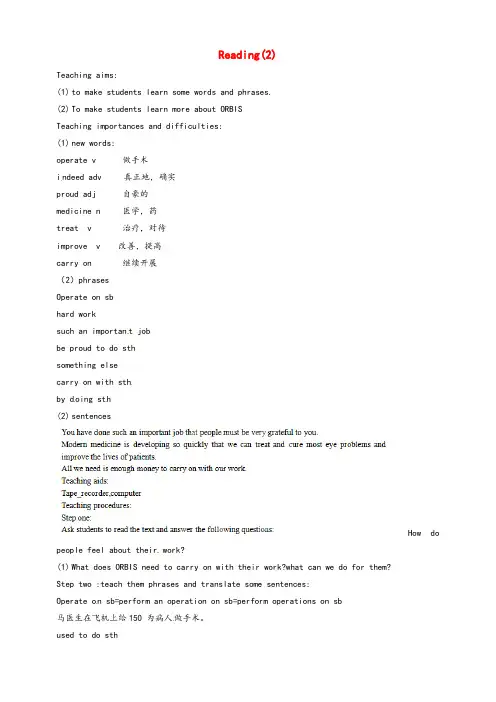
Reading(2)Teaching aims:(1)to make students learn some words and phrases.(2)To make students learn more about ORBISTeaching importances and difficulties:(1)new words:operate v 做手术i ndeed adv 真正地,确实proud adj 自豪的medicine n 医学,药treat v 治疗,对待improve v 改善,提高carry on 继续开展(2)phrasesOperate on sbhard worksuch an importan t jobbe proud to do sthsomething elsecarry on with sthby d oing sth(2)sentencesHow do people feel about their work?(1)What does ORBIS need to carry on with their work?what can we do for them?Step two :teach them phrases and translate some sentences:Operate o n sb=perform an operation on sb=perform operations on sb马医生在飞机上给150 为病人做手术。
used to do sthbe used to do sthbe used to doing sth我过去常常一天只做两或三个手术我习惯于在中饭前出去。
我们需要很迅速地工作,但喔唷经习惯了。
So…that…Such…that…。
牛津译林版8B Unit5 Good manners Welcome to the unit课件(共27张PPT)
What should they do in the lirary? They should keep quiet, keep the library clean and put the books back after reading . What shouldn't they do in the lirary? They shouldn't eat in the library. They shouldn't drop litter everywhere. They shouldn't eat there . They shouldn't write in the books.
Unit 5
Good manners
Welcome to the unit
complain (抱怨) Don't pick the flowery something about bad manners in public.
在公共场所
Please queue for your turn.
Make dialogues with your partne. You can choose the following places.
1. In the park , 2. At school (in class), 3. At school (after class), 4. In the resturant
Make a dialogue
In the cinema
chat in the cinema? A:Can we ______________( 聊天)? B:I'm afraid not .We should keep __________. quiet. A: Can we eat food in it ? drop litter everywhere. B: Yes, you can .But don't ______________ Please ___________. keep the cinema clean . A: OK. Anything else? B: Don't forget to ___________. take your litter away A: I see. Thank you .
最新牛津译林版初中英语八年级下册8BUnit5 Integrated skills课件
hospitals
museums
parks
pictures explain
useful
places around us not to do something
find our way
safe from danger
No littering
No smoking
No parking
No photos
2. What are public signs like?
3. How can public signs help us?
They are often bright in colours and have pictures on them. They can help explain things and give us useful information, such as helping us find our way, telling us about the places around us, keeping us safe from danger and warning us not to do something.
B
C
√
D
A: Can we _________ ?
Public signs
B: I’m afraid not.
A: Why not?
B: Look at the sign. It says
_______.
A: sorry, I didn’t
notice the sign just now.
Public places
Unit 5 Good manners
Integrated skills
译林版英语八年级下册Unit8Reading教案

8B Unit8 reading I Green SwitzerlandTeaching aims:To help students get the general idea of the passage;To help students master reading strategies and improve their reading abilities;To help students understand the importance of protecting the environment and live a green life.Teaching important and difficult points:To help students grasp the general idea of the passage.To improve students’ reading abilities by helping them master reading strategies.Teaching procedures:Step1. Lead inSs will be asked to talk in pairs about what should we do to live a green life.( This step is designed to call up ss’ knowledge of what they have learned in Welcome to the unit.)Step2. IntroductionIntroduce Switzerland to ss by showing them pictures.( This step is designed to arouse ss’ interest.)Step 3. New wordsTeach ss new words with pictures and games.( This step is designed to get ss fully prepared for reading the passage.)Step4. Fast readingAsk ss to scan the text and match the paragraphs and their meanings.( This step can help ss have a general idea of the text.)Step5.Careful readingTask1 Read and answer(para1)Read para1 and then answer questions.Task2 Knowledge tree(para2-4)i.Read para2 and fill in the formii.Read para3 and do matchingiii.Read para4 and do task-based readingTask 3 Recite the main bodySs will be asked to recite the main body(para2-4) according to the knowledge tree.Task 4 Read and answer(para5)Read para5 and answer questions.Step6.After readingStudents will be asked to discuss in groups of 4 about how to make Yixing greener, they can write down their advice on the exercise paper. Step7. ConsolidationSs will be required to finish the cloze on the exercise paper.( This step was designed to help ss consolidate what they have learned today.)。
牛津译林版初中英语八年级下册Unit5重点单词、短语、句型、电子书汇总
牛津译林版初中英语八年级下册Unit5重点单词、短语、句型、电子书汇总8B Unit5 Good manners【词汇拓展】1. polite adj. → politely(adv.)2. proper adj. → properly(adv.)3. loud adj. → loudly (adv.)4. say v. →saying (n.) 谚语5. discuss v. →discussion (n.)6. park v. →parking (n.) 停车7. polite adj. →impolite (反义词)8. warn v. → warning (n.)【重点短语】1. cut in on sb/sth 打断(谈话),插嘴2. drop litter everywhere 到处扔垃圾3. keep quiet 保持安静4 leave the tap running 使水龙头一直流着5. pick flowers 摘花6. obey traffic rules 遵守交通规则7. invite sb to do sth 邀请某人做某事8. keep the library clean 保持图书馆干净9. the proper way to do sth 做某事的恰当方式10. say hello to sb 向某人问好11. for the first time 第一次12. talk about 谈论13. in public 在公共场合14. laugh loudly 大声地笑15. by accident 偶然地,意外地16. greet each other 互相问候17. any time 任何时候;随时18. on one's own 单独19. join the discussion 加入到讨论中20. express oneself clearly 清楚地表达自己21. write down 写下,记下22. be busy with/doing sth 忙于(做)某事23. warn sb of sth 警告某人某事24. keep sb away from danger 使某人远离危险25. no smoking 禁止吸烟26. soon after 不久以后27. in order to 为了28.make one's dream e true 使某人的梦想成为现实29. practise doing sth 练习做某事30. the purpose of ……的目的31.above all 首要的是32. in one's way挡住某人的路【重点句子】1.霍波,你已经够大了,所以你应该学点礼貌。
译林版英语8B Unit5 Good manners全单元教案
8B Unit 5 Good mannersPeriod 1 Comic strip & Welcome to the unitTeaching aims :After learning this period , the students should be able to◆learn about kinds of knowledge of manners.◆talk about how to behave well in public in English.◆develop the students’ good behavour habits.Teaching importance :Some key words , phrases &sentences , e.g.◆politely, litter, run, pick ,turn , … /◆cut in on sb/sth, drop litter , keep quiet, pick flowers◆You are old enough to learn about manners, now, Hobo.You are never too old to learn .Don’t drop litter everywhere.Teaching procedures:Welcome to the unitStep 1 leading-inShow them some pictures and ask :Are the people doing the right or wrong things? Why do you think so?People in Pictures 2&4 are doing wrong thing because they don’t obey the rules and don’t have good manners. Write”obey” and “manners” on the Bb.Step 2 Presentation1.Present the 6 pictures and ask them to talk about who is doing right and whois doing wrong? Why?plete Part A and check the answers with the whole class..Then read thephrases.Step 3 Listening & answering1. Listen to the conversation(without looking at the books) , answer the following questions: What should we do & shouldn’t in the library ?2. Read the conversation and act in pairs. It is set in different situations such as the road, cinema ,the classroom and so on .Comic stripStep4 presentation1.What do you think of Eddie and Hobo? Do they have good manners?2.Listening and answering:Do you think Eddie really want to teach Hobo?What does Eddie teach Hobo?What does Eddie really want from Hobo?Read after the CD , and pay attention to their pronunciation and intonation . Read again in different roles .Step 5【课堂小结】Language points1.You are old enough to learn about manners, Hobo.2.don’t cut in on others. Wait politely.3.You are never too old to learn..4.Drop litter everywhere.5.Leave the tap running.6.obey the traffic rules.7.queue for your turnStep 6 Homework◆Revise the expressions we’ve learned in this period .◆Recite the comic strip fluently .◆Finish Period 1 in workbook◆Pre-learn Reading .Periods 2 Reading1Teaching aims :After learning this period , the students should be able to◆read and learn the interview about manners.◆get some information about manners in the UK◆identify specific details by answering some questions.◆d evelop the students’ ability of guessing new words’ meanings fromthe context ...Teaching importance :Some key words , phrases &sentences , e.g.◆proper, kiss, close, conversation, avoid, subject, public, push, touch, excuse..◆shake one’s hand, in public, push in, in one’s way, as well, by accident,excuse me.◆What’s the proper way to greet people there?British people only greet relatives or close friends with a kissThey will say “Excuse me”and be polite enough to wait till you move. …Teaching procedures:Step 1RevisionTalk about the pictures on Page65. then ask:Step 2PresentationLook at the pictures and learn manners in the UK ,such as:greet relatives or close friends with a kissavoid asking age, weight or moneyavoid asking age, weight or moneynever push in othersnever shout or laugh loudlysay “please” or “thank you” all the timeStep 3 Reading1.Skimming:What is the conversation about?Who is Daniel talking to?2.ScanningHow do people greet others for the first time?How do people start a conversation?How do people behave politely in public?How do people be polite at homeDo they talk about age?Step 4 Complete Part B1 & B2,then check the answers together. Step 5 Homework◆Read the conversation again and again .◆Finish Period2.in WbReading 2Teaching aims :After learning this period , the students should be able to◆learn and use the expressions to talk about manners.◆learn more about western customs.◆behave politely in public after readingStep 1 Revision & Presentation1.Recall the contents of the articles by talking about some manners in the UK.2.Free talk(Part C)How do we greet others?How do we start a conversation?Do we greet others with a kiss?Do we always queue in public?Do we shout or laugh in public?Do we push past when someone is in our way?Do we say “sorry” when we bump into someone?Do we say “please” or “thank you” at home?Step 2 Complete Part B3,and read it after checking the answers.Step 3. Learning some language points by creating some real situationsa.shake sb’s handb.greet close friends with a kissc.behave politely in publicd.push in before others /push paste.bump into someonef.in one’s wayg.as wellh.all the timei.just as the saying goesj.be polite enough to wait till you moveStep4 Practice Encourage ss to ask some questions if they have problems. Step 5 Exercises P48 in WbStep 6Homework◆Recite the conversation in pairs.◆Finish period3 in workbook◆Pre-learn Grammar .:ask them to find examples in the first two periods.Periods 4-5 Grammar(A&B)Teaching aims :After learning this period , the students should be able to◆learn how to describe a person’s personality and ability with “enough to”◆learn to use “too…to” to express a negative result.◆use the two structures correctly t o change the structuresTeaching importance :1) Some key words , phrases &sentences , e.g.◆discussion express◆make everyone laugh, on her own , express himself clearly ,be busy with ◆You are old enough to learn about manners.The UK is too far away for Jenny to go there on her own.British people are too polite to shout loudly in public.Teaching procedures:A Using” enough to”Step 1 Presentation1)Recall Ss the sentences with “enough to…”we have learnt in the first twoperiods.You are old enough to learn about manners.British people are polite enough to wait till you move.2)Guide Ss to find the same point in the structure:to be + enough = adjective + to do sth. We use this structure to describe a person’s personality and abilityGive them some more examples .Step 2 PracticeGo through the exercises in the book, then ask them to finish them. After checking the answers ,read the sentences ,loudly.B Using “too…to”Step 1 Lead-inJoin two sentences together1.British people are very polite. They do not shout loudly in public.British people are polite shout loudly in public.2. British people are very polite. They will not push past you.British people are polite push past you.Tell Ss that we use‘too…to ’to express a negative result. Sometimes we need to add “for someone”before the “to do sth”. Write the senrence on the Bb ;The UK is too far away for Jenny to go there on her own.Then read the models aloud.Step 2 Practice1) Guide Ss to do Exercise1 on p71, then ask them to finish the other exerciseson p71 alone . Check the answers and read loudly .2) Some more exercises : Translate the sentences:1.太小了而不能上学。
牛津译林版八年级英语下册Unit5 Reading课件(共20张PPT)
Do you know an old saying about Rome?
Skimming
Which country are Daniel and Jenny talking about?
The UK.
Read and choose: which can you find in the dialogue?
Ask sBoLmmFGuefMeimaoeenevietrbindptneehotahsttietdhnhnhoeslyotepemooofmtismlaworesdetstbreoadtfehfobmyrooteoidoiertemsydnbsoyedcomhdeoytohling
Show time: Role Play
greet relatives or close friends with a kiss
Further thinking
Do you know any other greetings?
How do you do? Good morning.
What’s up?
Long time no see.
How are you doing? How is everything?
touch[tʌtʃ]触摸 someone
_____ flowers
____ traffic rules
______ for your turn
______ quiet
____ litter
push[pʊʃ]推 someone
____ the tap running
right
or
wrong It’s______ to____________in public.
初中英语 牛津译林八年级下册 8B unit5 知识点梳理
8B unit5<重点短语>1.drop litter everywhere 到处扔垃圾2.cut in(on sb./sth.)打断(谈话),插嘴3.queue for your turn排队等候你的顺序4.leave the tap running 让水龙头一直开着5.greet sb.with a kiss 和某人用亲吻打招呼6.shake sb.'s hand 与某人握手7.in public 公开地,在别人面前8.push in插队,加塞9.bump into someone撞到某人10.in one's way 挡住某人的路11.as well(as)也,还有12.by accident 偶然,意外地13.join the discussion 参加讨论14.keep sb.from sth.不让某人做某事,使免受。
15.risk losing everything 冒着失去一切的危险16.above all首要的是<重点句型>1.You're old enough to learn about manners now,Hobo.霍波,现在你足够大了,该学礼仪了。
2.You're never too old to learn.活到老,学到老。
3.British people only greet relatives or close friends with a kiss.英国人只和亲戚或亲密的朋友用亲吻打招呼。
4.They talk about the weather,holidays,music,books or something else.他们谈论天气、假期、音乐、书籍或其他一些事情。
5.They think it's rude to push in before others.他们认为在别人前面插队是粗鲁无礼的。