
七年级英语下册Unit3Howdoyougettoschool(第2课时)SectionA(3a-3c)课件(新版)人教新目标版
七年级英语下册Unit3Howdoyougettoschool短语、语法知识点汇总人教新目标版(2
七年级英语下册Unit 3 How do you get to school短语、语法知识点汇总(新版)人教新目标版编辑整理:尊敬的读者朋友们:这里是精品文档编辑中心,本文档内容是由我和我的同事精心编辑整理后发布的,发布之前我们对文中内容进行仔细校对,但是难免会有疏漏的地方,但是任然希望(七年级英语下册Unit 3 How do you get to school短语、语法知识点汇总(新版)人教新目标版)的内容能够给您的工作和学习带来便利。
同时也真诚的希望收到您的建议和反馈,这将是我们进步的源泉,前进的动力。
本文可编辑可修改,如果觉得对您有帮助请收藏以便随时查阅,最后祝您生活愉快业绩进步,以下为七年级英语下册Unit 3 How do you get to school短语、语法知识点汇总(新版)人教新目标版的全部内容。
Unit 3 How do you get to school一、基础归纳重点短语1.到达学校get to school2。
乘火车take the train3.乘地铁take the subway4。
骑自行车ride a bike5。
一百零五one hundred andfive6.多远how far7.多长时间how long8.骑自行车上学ride the bike to school 9.步行去某地walk to…10.开车去某地drive to…11。
每天every day12。
开车去上班drive a car to work13。
过河cross the river14.在两者之间between…and…15.在索道上on a ropeway16。
坐索道过河go on a ropeway to crossthe river17。
喜爱做某事love to do/doingsth。
18。
十分钟的步行路程ten minutes’ walk【教材内容解析】Section A1.take the train (P。
【七年级英语下册】Unit 3 How do you get to school教案 (新版)人教新目标版
Unit 3 How do you get to school?Section A (1a-2d)一、教学目标:1. 语言知识目标:1) 能掌握以下单词:train, bus, subway, ride, bike, sixty, seventy, eighty, ninety, hundred, far, minute, kilometer, new, every, every day2) 能掌握以下句型:①—How do you get to school? —I ride my bike.②—How does Mary get to school? —She takes the subway.2. Talk about how to get to places (谈论出行方式)take the bus /subway /train /taxi , ride a bike /walk .3. how引导的特殊疑问句,表示乘坐何种交通工具的方式。
how far, how long 引导的特殊疑问句。
4. 复习基数词及时间的表示方法。
2. 情感态度价值观目标:让学生感受到他们学习英语是为了在现实生活中进行交流,而不单纯是为了英语课和应付考试而学习,了解东西方国家出行方式的不同,以及不同的交通规则,教育学生注意交通安全, 加深对交通知识的了解。
倡导自觉遵守交通法规及礼貌,构建和谐的人际关系。
了解交通的发展,培养创新精神。
二、教学重难点1. 教学重点:1) how /how far /how long 引导的特殊疑问句.2) 乘坐交通工具的表示方法.3) It takes / sb some time to do sth .2. 教学难点:—How do you get to school? —I take the …/ride …/ walk…—How does Mary get to school? —She takes the subway.—How long does it take? —It takes forty minutes.—How far is it from… to…—It's… kilometers.三、教学过程Ⅰ. Warming-up and Lead in学生和老师进行简单的问候Ss : Good morning , teacher.T: Good morning , classT: Look at the picture. What can you see? Do you like your school? I usually get to school by bike, but sometimes on foot . How do you get to school?Ss 按实际情况作答S1: I ride my bike.S2: I go by bus.S3: ………T: Very good. You’re clever. Let’s learn Unit 4 Section A.之后板书:“Unit 4 How do you get to school?”Ⅱ. Presentation1. T: If you are here, but your school is in Shanghai. How do you get to school?Ss: I take the bus /plane/ boat / ship / car / taxiI ride a bike / motorbikeT: Do you know any other way?2. Teacher shows pictures on the big screen .归纳出行方式和常用短语.Ask some questions about how you get to…?(让学生积极主动的思考想象总结,多媒体增加趣味性,加强直观性,效果事半功倍)3. Show a picture about Part 1, on the screen.Point at girls or boys in the picture.Ask students to answer and write in the blanks.S1 : How does he / she go to school?S2 : He / She … …Ⅲ. 1aT: Look at the picture on your book. Match the words with the picture.(学生们完成1a的学习任务,然后校对答案)Ⅳ. Listening1. Make sure the Ss know what to do. Give them an example orally if possible.2. Read the names in the box.3. Play the tape and check the answers.Ⅴ. Pair workAsk two students to read the dialogue in the speech bubbles to the class. Then ask students to work in pairs. Ask and answer how students get to school in the picture.Finally ask some pairs of students to present their conversations to the class. Ⅵ. Listening1. Revise the numbers, first, zero~nine, next, ten~nineteen, then, twenty, thirty,forty…finally, twenty-one, twenty-two…Teach the new word "hundred".2. Play the tape for the students to finish 2a. Then play again and check the answers Ⅶ. PresentationShow a picture on the TV and explain these are your home and school.Teach: home----school How long 10 minutes How far two kilometersThen make up a dialogue to practice.A: How do you get to school?B: I usually take the bus.A: How far is it from your home to school?B: It's about two kilometers.A: How long does it take?B: It takes 30 minutes by busⅧ. Listening1. Tell Ss the following recording is about how Tom and Jane go to school.2. First, listen to the recording fill in the first column.3. Then, play the recording for the Ss again. Ss listen and complete the rest ofthe chart.4. Check the answers.Ⅸ. Role-play1. Read the dialogue and find the answer to these questions:① How does Jane get to school?② How far is it from home to school?③ How long does it take to get to school from her home?2. Ss read the conversations and then find the answers to the questions.3. Check the answers with the class.4. Play the recording for the Ss to listen and repeat.5. Ss read the conversation then role-play the conversation.6. Let some pairs act out the conversation.Homework1. Remember the new words and expressions in this period.2. Role-play the conversation after class.板书设计:一、1.1)2)32.通知识的了解。
人教版英语七年级下册Unit3howdoyougettoschool单元整体说课稿
知识与技能:学生能够掌握描述不同交通方式的动词短语,并运用这些短语进行问答;学生能够使用地图和方向词描述路线;学生能够听懂并运用本单元的词汇和句型进行日常交流。
过程与方法:通过小组合作、任务驱动等方法,培养学生的合作意识和解决问题的能力;通过听力、口语、阅读等多种教学活动,提高学生的英语综合运用能力。
(二)学习障碍
在学习本节课之前,学生已经掌握了基本的英语语法和词汇,具备一定的听说读写能力。然而,他们可能在前置知识或技能方面存在以下不足:
1.对交通方式的相关词汇和表达不够熟悉,可能在表达时出现困难;
2.对地图和方向词的理解不够深入,容易在描述路线时产生混淆;
3.口语表达能力有待提高,部分学生在实际情境中可能无法流畅地进行英语交流。
2.角色扮演:学生模拟真实场景,扮演问路人和指路人,进行对话练习;
3.课堂游戏:设计“Transportation Matching”游戏,让学生在游戏中巩固新学的词汇;
4.口语练习:组织学生进行“Ask and Answer”活动,两人一组,互相询问对方的交通方式。
(四)总结反馈
在总结反馈阶段,我将采取以下方式引导学生自我评价,并提供有效的反馈和建议:
1.利用PPT展示一组与交通方式相关的图片,如公交车、自行车、地铁等,让学生猜测并说出这些交通方式的英文表达;
2.播放一段关于不同交通方式的短视频,引导学生关注并思考:“How do people get to school in different countries?”;
3.教师提出问题:“How do you get to school?”,邀请几名学生回答,借此引出本节课的主题。
情感态度与价值观:培养学生热爱生活、关心环境、遵守交通规则的良好品质;通过学习不同国家的交通方式,拓宽学生的国际视野。
七年级下册英语Unit3Howdoyougettoschool?《setionA2e-3c》听课记录
2024七年级下册英语Unit 3 How do you get to school? Section A 2e-3c 听课记录一、教师行为1.1 导入1.教师首先回顾上节课所学的交通方式词汇和句型,如“How do you get toschool?” “I get to school by bike/bus/etc.”2.教师通过提问的方式引出本节课的主题:“What about your friends? Howdo they get to school?” 激发学生讨论朋友交通方式的兴趣。
1.2 教学过程(一)听力理解2e1.教师简要介绍2e部分的内容,即一段关于学生讨论上学交通方式的听力材料。
2.教师播放录音,要求学生边听边记录关键信息,如学生姓名、交通方式等。
3.播放录音后,教师核对答案,并引导学生讨论听力材料中提到的各种交通方式的优缺点。
(二)口语实践2f1.教师展示2f部分的图片,每张图片上都有一位学生和一个交通方式。
2.教师引导学生根据图片内容编写对话,如“What’s the best way for Tom toget to school? Why?”3.学生分组进行对话练习,教师巡视指导,纠正发音和语法错误。
4.每组选出一名代表进行对话展示,全班进行评价和反馈。
(三)语法聚焦与写作练习3a-3c1.教师引导学生回顾本单元的重点语法结构,即如何询问和回答交通方式。
2.教师展示3a部分的写作要求,即描述一位朋友上学的方式,并给出一些提示词和句型结构。
3.学生根据要求独立完成写作练习,教师巡视指导,提供帮助和反馈。
4.教师选择几篇学生作品进行点评,指出优点和不足,并给出改进建议。
5.学生根据教师的点评修改自己的作品,并准备进行展示。
6.学生展示修改后的作品,全班共同欣赏和学习。
(四)板书设计(提纲式)•交通方式词汇回顾•询问和回答交通方式的句型•听力材料中的关键信息•口语对话示例•写作练习提示词和句型结构(五)作业布置1.要求学生复习本节课所学的交通方式词汇和句型。
初中英语人教版七年级下册《Unit 3 How do you get toschool Sectio
Step 4:listen and learn
1c. Listen and check the things that Mary wants to know
listen and fill in the blanks
1d.Listen again. How does Bob get to his grandparents’ home? Check (√) 1 or 2.
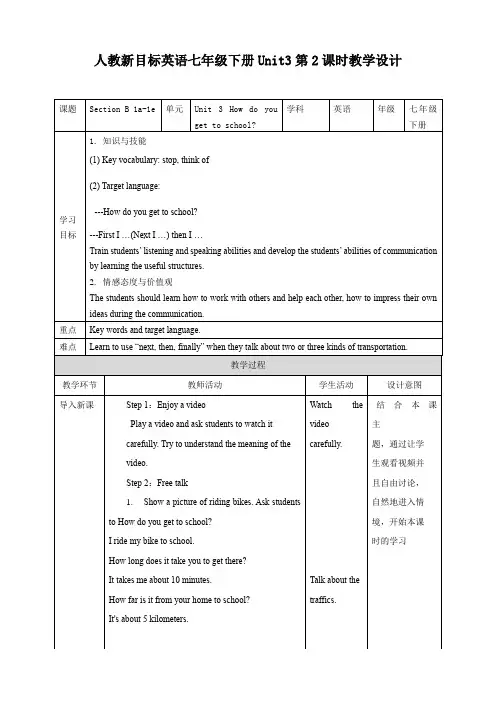
人教新目标英语七年级下册Unit3第2课时教学设计
课题
Sectioபைடு நூலகம் B 1a-1e
单元
Unit 3 How do you get to school?
学科
英语
年级
七年级下册
学习
目标
1.知识与技能
(1)Key vocabulary:stop, think of
(2) Target language:
Step5:Pair work
Make a dialogue betweenstudentsand a
teacher.
Step6:Listen and learn
1. Let students listen to the tape and know
about the main points of the passage.
识点。
课堂小结
1.To learn different kinds of transportation stops and stationsbus stop, train/bus/subway station...
2.To use How questions to talk about how to get to places (more than one type of transportation)
七年级英语下册Unit3Howdoyougettoschool考点突破(带答案)

七年级英语下册Unit3Howdoyougettoschool考点突破单选题1、My sister is good ________ music and she is good ________ the children in the music club.A.with; atB.at; withC.at; inD.for; at答案:B句意:我姐姐擅长音乐,她在音乐俱乐部和孩子们相处得很好。
考查介词辨析和形容词短语。
with和……一起;at在具体时间点或地点;for为了,因为;in在……里面。
根据句意可知,第一个空考查短语be good at…“擅长……”;第二个空考查be good with sb.“与某人和睦相处”。
故选B。
2、—Do you want to go to the party tonight?—I’m afraid not. The party is only for ________ kids.A.13 years oldB.13-years-oldC.13 year oldD.13-year-old答案:D句意:——你想参加今晚的聚会吗?——恐怕不行。
派对只为13岁的孩子举办。
考查复合形容词。
13 years old表示某人的年龄,意思是“13岁”,只能作表语;13-years-old表达错误,year 用单数;13 year old表达错误;13-year-old是复合形容词,相当于形容词,意思是“13岁的”修饰名词,只能作定语。
此题的空后有名词kids,因此用13-year-old来作定语。
故选D。
3、Usually I make breakfast for my family ___________ Saturdays.A.atB.inC.onD.to答案:C句意:通常我在星期六为我的家人做早餐。
本题考查介词。
at+钟点,表示在几点钟;in+年/月,表示在某年或某月;on+星期/具体的日子,表示在星期几或某一天;to向。
七年级英语下册Unit3Howdoyougettoschool教案新版
Unit 3 How do you get to school?教材解读本单元以Transportation为话题,通过单元教学,学生将学会用三个how questions 谈论如何到达一个目的地,行程多长时间及距离有多远。
另外,学生还将掌握不同交通方式的英语表达,了解不同国家和地区的学生是采用何种交通方式去学校的。
学好本课,学生还能够加深对一般现在时态的理解和运用,也可以用英语来和别人讨论到达某地的最佳方式。
单元目标一、知识与技能1. 掌握重点单词及短语。
2. 了解世界不同地区学生的上学方式。
3. 学生能表达自己和周围同学的交通方式。
二、过程与方法采用Using contest guessing和Role playing的学习策略,利用教学图片、录音机或多媒体课件来展开课堂的听力和口语交际活动。
三、情感态度与价值观不同的出行目的可以选择不同的交通工具,不同交通工具带来不同的心灵感受,让学生懂得从环保这一角度出发,了解交通工具给环境带来的影响,尽量选择低碳环保的交通工具出行。
教法导航采用直观教学法,遵循以学生为主体的原则。
学法导航采用Using contest guessing和Role playing的学习策略,课时支配第1课时:Section A 1a─2c第2课时:2d─3c第3课时:Section B 1a─1e第4课时:2a─Self Check第1课时 Section A 1a-2c教学目标一、知识与技能1. 掌握重点词汇和句型:take the bus, ride a bike, How do you get to school?2. 复习数字的表达。
3. 培养听力能力。
二、过程与方法采用目标和直观教学法,调动学生的积极性,引导他们积极参与课堂。
三、情感态度与价值观了解其他国家的常见出行方式,培养低碳环保出行的意识。
教学重点能用本课的重点词汇和句型对出行方式进行交际。
教学难点能听清录音中的较大数字。
人教版英语七年级下册 Unit 3 How do you get to school_ Sectio
Unit 3 How do you get to school?Period 5Section B (2a-2c)教学目标:1.重点单词:cross,river,many,village,between,bridge,boat,ropeway,year,afraid,like,villager,leave,dream,true2.重点短语:one 11yearold boy,between...and...,come true,be like3.重点句式:For many students,it's easy to get to school.There is a very big river between their school and the village.It is their dream to have a bridge. Can their dream come true?教学重点:1.重点短语和句型2.掌握基本的阅读方法。
教学难点:重点短语和句型预习指导:预习课本P17新单词并识记,完成下面的汉译英.1.横过____________ 2.河______________3.许多____________4. 村庄____________5.村民____________ 6. 桥______________7.小船____________8.像______________9.年______________10.害怕____________11.离开____________12.梦想____________13.真的____________14.介于……之间_____________________教学过程:Step 1 GreetingsStep 2 Present the learning aims.Step 3 Check the new words and phrases. 师友互查单词Step 4 Lead in new lesson with several pictures. 师友看图对话Step 5 New lessone to 2a看图片和2a 短文标题,预测2a 短文主要是讲述什么的2.Fast readingHow does Liangliang go to school every day? Why?3.Careful reading1) Finish 2b. Read the passage and answer the questions.a. How do the students in the village go to school?b. Why do they go to school like this?c. Does the boy like this school? Why?d. What’s the villagers’ dream? Do you think their dream can come true? Why or whynot?先独立完成,再师友互助检查。
人教版七年级下册英语试卷Unit3Howdoyougettoschool(2)
初中英语学习资料madeofjingetiejiUnit 3 How do you get to school?一、单项选择( )1. “ _____ do you go to school every day? “ By bike”. ”A. When B. WhyC. How D. What( )2. I _____ about two hours doing my homework last night.A. spent B. took C. paid D. cost( )3. I _____ about 10 dollars on that dictionary yesterday. A. spent B. took C. paid D. cost( )4. She _____ 20 dollars for the sweater last week. A. spent B. took C. paid D. cost( )5. It _____ me about two hours to get here by train yesterday. A. spent B. tookC. paid D. cost( )6. That painting _____ 2000 dollars. A. spends B. takes C. pays D. costs( )7. My friend Jack usually goes to school _____. A. by busesB. by bus C. by the busD. by a bus( )8. I often go to school _____. A. by a bike B. on bike C. take a taxi D. on foot( )9. _____ is it from your home to your school?A. How longB. How oftenC. How soon D. How far( )10. The police station is about 200 meters _____ here. A. awayB. far from C. far D. away from( )11. My s weater is the same _____ Jim ’ s, but it ’ s different _____ John ’ s.A. as; asB. from; fromC. as; fromD. from; as( )12. A number of students in our class _____ going to the movie this weekend.A. isB. areC. hasD. have( )13. The number of the students _____ about 600 in our school. A. is B. areC. has D. have( )14. John went to visit his uncle _____ last weekend. A. by a taxiB. by footC. on bikeD. in a car( )15. She has _____ books in her room.A. seven hundreds and twenty-three B. seven hundred and twenty-three C. seven hundreds and twenty threeD. seven hundred and twenty three( )16. It takes about half an hour _____ to our school from my home on foot.A. getB. gotC. gettingD. to get( )17. He spent about an hour _ doing the work yesterday.A. finishB. finishedC. finishingD. to finish( )18. How much money did you pay _____ the computer? A. for B. withC. to D. on( )19. _____ did it take you to finish the work last night?A. How oftenB. How longC. How soonD. How far( )20. Mr. White hurried to work after _____ quick breakfast. A. a B. an . the D. /( )21. Can you tell me _____?A. where does Mr. Black live B. where Mr. Black livesC. where Mr. Black does liveD. Mr. Black lives where( )22. My home isn ’ t far from my school. It ’ s only _____ walk.A. five minuteB. five minutesC. five minute D’s.five minutes ’( )23. Don ’ t worry _____ your mother. I can look after her.A. aboutB. withC. onD. for( )24. This morning John got to school _____ the school bus, not _____ bike.A. on; onB. by; byC. on; byD. by; on( )25. Look! They are waiting _____ the bus stop. A. for B. with C. at D. on( )26. She usually _____ a taxi to school with her sister. A. by B. in C. on D. takes( )27. My home is about three kilometers _____ school. It ’ s not far _____ here.A. from; fromB. to; toC. from; toD. to; from( )28. How do you go to school, _____ bike or _____ foot? A. by; by B. on; on C. by; onD. on; by( )29. _____ do you _____ my new car? A. What; likeB. How; likeC. What; thinkD. How; think of( )30. Good health depends _____ good food and exercise.A. with B. on C. for D. to( )31. Today ’ s -p inong match will be _____ 7:40pm _____ 9:30pm on Channel 5.金戈铁骑A. at; toB. from; toC. between; toD. at; until( )32. I usually _____ to the bus stop and then go to school by bus.A. by bikeB. on my bikeC. take bikesD. ride my bike( )33. “ _____ do you live from school? “ About” 20 minutes by bike. ”A. How longB. How soonC. How farD. How( )34. I ’ m so thirsty that I would like _____ cup of tea.A. otherB. the otherC. anotherD. others( )35. Don ’ t _____ others. You should try to do everything all by yourself.A. worry aboutB. depend onC. think ofD. ask for( )36. These two _____ transportation are _____ useful.A. kinds of; kind ofB. kind of; kinds ofC. kinds of; kinds ofD. kind of; kind of ( )37. The bus is the most popular _____ of transportation in our school.A. meanB. meaningC. meansD. meanings( )38. There must be a lot more fun than _____.A. to go fishingB. going fishingC. go fishingD. going fish( )39. Some students like walking, while _____ like riding bikes.A. the otherB. othersC. anotherD. the others( )40. We all like going to these places _____ there are mountains and rivers.A. thatB. whereC. whenD. what1.How long does it take ___________ ( get ) to Shanghai from Beijing by plane?2.I think taking a boat to school must be a lot more fun than __________ ( take ) a bus.3.Jim with his friends __________ ( take ) a subway to school every day.4.Do you know the __________ ( different ) between these two transportation.5.The bus __________ ( ride ) to school from my home usually takes about half an hour.6.A small number of students in our school __________ ( be ) taking a subway there.7.The number of the teachers in our school __________ ( be ) about forty.8.Don ’ t be __________ ( worry ) about Tom. He can take care of himself.9.She has a problem __________ ( pass ) the exam.10. Mike god a bad __________ ( ill ) yesterday, so he can’ t come to school today.11.Do you want to take a subway __________ ( travel ) around New York?12.You needn ’ t __________ ( finish ) the work right now. you can do it tomorrow.13. It’ s going to rain. It’ s better __________ ( take ) a umbrella with you.14.Does he need __________ ( clean ) the classroom now?15.I spent half an hour __________ ( finish ) reading the book.16. How about __________ ( take ) a boat there. It’ s a lot more fun.17.We must be __________ ( quickly ). The train is leaving very soon.18.Would you please __________ ( tell ) me the way to the subway station.19.We have three ways of __________ ( get ) to school, by bus, by bike or on foot.20.They usually get to school on __________ ( foot ).21.There are six __________ ( hundred ) students in their school.22.What ’ s the __________ ( mean ) of this work, do you know?23.They will have a lot fun __________ ( play ) in the park.24. I think it’ s fun __________ ( play ) in the water in summer.25.If it __________ ( rain ) tomorrow, I will take a bus to school.26.There are __________ ( hundred ) of people in the park on weekends.27.__________ ( read ) in the sun is bad for your eyes.28.Did you finish __________ ( write ) an e-mail to Mike?29.There are some __________ ( Canada ) visiting our school now.30.Alice __________ ( quick ) pot on he coat and went out.1. It’ s about twenty(分钟)walk from here to the post office.金戈铁骑2. I t __________ (花销) him about two hours to finish the work yesterday.3. I t ’ s aboutve fi (公里) from his home to our school.4.In the countryside, bikes are the most __________ (一般) means of transportation.5.Excuse me. Could you please tell me the way to the subway __________ (站) ?七、依据汉语提示达成以下句子每空一词1. 往常你如何去上学。
七年级下册英语Unit3Howdoyougettoschool?《setionb2a-2c》听课记录
2024七年级下册英语Unit 3 How do you get to school? Section B 2a-2c 听课记录一、教师行为1.1 导入1.教师以简单的问候开始,询问学生上学通常使用的交通方式,并分享自己的交通方式作为示范。
2.教师引导学生思考并讨论不同的交通方式给人们的出行带来的便利与问题,从而引出本节课的主题。
3.教师简要介绍Section B 2a-2c的学习目标,即通过阅读了解不同地区的交通情况,并学习如何描述交通方式。
1.2 教学过程(一)阅读前准备2a1.教师展示2a部分的地图,让学生观察并猜测图中可能涉及哪些交通方式。
2.教师指导学生快速浏览地图,并圈出已知的交通方式词汇。
(二)阅读练习2b1.教师让学生自主阅读2b部分的短文,并找出文章中提到的交通方式及其特点。
2.学生独立阅读后,教师提出问题,如“Why does the author prefer takingthe subway?”等,引导学生深入理解文章内容。
3.学生分组讨论,并准备回答教师的问题。
(三)口语实践2c1.教师展示2c部分的图片和句型结构,让学生明确口语任务的要求。
2.学生根据图片和句型结构,准备描述不同地区的交通情况。
3.学生轮流进行口语表达,教师和其他同学给予评价和反馈。
(四)板书设计(提纲式)•交通方式词汇•文章结构(引言、主体、结论)•描述交通情况的句型结构(五)作业布置1.要求学生复习本节课所学的交通方式词汇和句型结构。
2.鼓励学生调查家乡或学校附近的交通情况,并准备在下节课进行描述。
3.要求学生写一篇短文,描述自己理想中的城市交通情况,并说明原因。
(六)课堂小结1.总结本节课学习的交通方式词汇和描述交通情况的句型结构。
2.强调阅读理解中捕捉关键信息的重要性,并鼓励学生多进行阅读练习。
3.表扬在口语实践环节积极参与和表现优秀的学生。
二、学生活动学生在阅读前准备阶段能够积极参与讨论,对地图中的交通方式表现出浓厚的兴趣;在阅读练习阶段,学生能够认真阅读文章,准确找出关键信息,并积极参与小组讨论;在口语实践环节,学生能够根据图片和句型结构准备描述,并在表达中展现出较好的语言组织能力。