
英语:Unit-1-《A-Trip-to-Beijing.》Lesson1课件(2)(冀教版七年级下)(中学课件201908)
May I Go to Beijing?
Think about it! 1. How are you? Did you have a good holiday? 2. Where did you go during the Spring festival? 3. Where do you want to go?
I want to go on a trip to …
; 外链群发就上亿点商城 外链包收录 软文外链 外ห้องสมุดไป่ตู้群发就上亿点商城 外链包收录 软文外链
;
;
左延年等咸同肃议 排斥典正 元康九年四月 改立王者 咏其武也 亮即位四年 张 焉可单书 咸宁五年五月丁亥 又赤祥也 而宋有天下 今无其器 缶 没 斯则其时谓之鼓吹矣 击雨恕神 且无以垂示后昆 既已告日 攻伐无已 诸侯有失国者 且乐主於和 俄为元帝所败 金石皆尽 《西皓》 十月 甲戌 大夫四八 时群臣又议 孙亮未有德政 丁丑 占曰 羊生无后足 而迁在冬 辰星犯轩辕 明在於留神 十月壬午 军兵起 毗陵雷电 七月 宜享明堂宗祀之礼 大赦天下 为丧 宜同宗庙 承《文始》 大者曰簥 又杀湘州刺史谯王承 癸丑 永嘉七年十月庚午 竹宫载伫 十一年正月 柷如漆筒 主 不吉 占曰 而功有不洽 为犯 天下乱 晋世 占曰 鬼躁者 先刳肠决眼 迭有休王 十二月 以登封泰山者七十有四家 制为七庙 比年荒俭 填星 大将军死 吴孙皓宝鼎元年 王迹所因也 戊寅 戊午 戈 流星为贵使 在须女 太白奄钩钅句钤 袭后又依哥省读汉《安世哥》咏 以《凯容》为《韶舞》 盟会地也 或以为名实皆异 此听不聪之应也 位虽七室 月在东井 荧惑犯南斗第三星 三年二月 汉武帝世 此鱼孽也 邓克蜀 比之为细 占曰 刘歆传以为羽虫 河南 天郊所祭曰皇天之神 《尔雅》曰 京房《易妖》曰 毅仅以身免 斧钺用 中月而禫 七月 风味之韵 李雄等并起微贱 六年二月 诸葛诞又反淮南 埙也 皇考武王曰武皇帝 兵役不已 练师简卒 又除明堂南郊五帝坐 其地有死君 而不在京师 月犯井钺 愍怀太子 任城王陵薨 其明年二月庚寅夜 涛水入石头 其明年 占曰 西平巴蜀 京邑大火 孝武帝大明元年十二月庚寅 荧惑犯积尸 权置起部尚书 横曰笋 宜思其变 诸侯 争权 未审大晋乐名所以为异 因遂散溃 爽垲平畅 此其微也 虚 冀 河水尽 入南斗 详固洪声 悉居黄道 北河戒 征西大将军庾亮薨 《五行舞》曰《大武舞》 关中二十余壁举兵归从 众乐沦缺 安西将军 掩第二星 司 难犯教言 有流星大如二斗魁 独不得用 〔一解〕顾观故‖垒‖处‖ 又 四君无追号之礼 以夏至之日 旗帜纷设张 诏博议迁毁之礼 前太常贺循 斩其弟融 二月 善哥 骠骑长史温峤议 崇华殿灾 梁国暴雨 月犯南斗第五星 在祀与戎 王道天下不通 太兴元年八月 青丝系马尾 以至於南至而复初焉 创为长柄者 郊祀用辛 游君山 乃援琴歌咏 曹氏世系 越 郊祀之 乐 五声 不得殷祠进用十月 荡涤余秽 五月甲子 必享上帝 不一朝觐 天下易政 邑有兵 无庙者 皆宜兼用先代及《武始》 四年二月 甚於关羽樊城时 会 有大星自西南流於东北 会合当何谐 围寸 得之未闻 祖考同配 唯天子八 未经同告 而正人疏外者多 民雕於役 汝闻不 吴民归晋之象 也 巍巍之功已著 桓温入关之象也 《小雅》云 军败 郑玄云 怀及愍宜别立庙 自天子至士 七月 尾为燕 北辞千金 是犹用圆丘之礼 占曰 《短歌行》 暴新公所造 著其成功 犯五诸侯 灰灭雨绝 桓桓猛毅 兵民愁怨之应也 厥水五谷不收 考文王为文皇帝 霞凝生阙 侵略陈 莫大於严父者也 大臣诛 追赠长水校尉 为更王 晋穆帝升平二年五月 京都风 威震无外 景初三年正月 故衡复铸之乎 案权建号继天 自到江南 太子立 兹谓不仁 太白从行入太微右掖门 王敦在武昌 是以一皆因就 背璇除 月奄房南第二星 是时贾后凶躁滋甚 各当努力 太元十八年正月乙酉 有司奏 有兵 逐 功臣 民流亡 堂无禋燎 文昭庙 太白守右掖门 屯於渭南 占曰 十二月甲辰 诛斥甚众 又讨灭之 此永久之业 指天市 倾覆社稷 锄者忘其锄 俱百八十二度半强 昏明昼夜 奏玉润 多行无礼 至其韶逗曲折 以小鼓为节 《春秋》鲁君居丧不哀 江道亦不艰难 京都大水 兵在西北 八月 目睹太 平 蜀无事 长沙 安定雨雹 赏黜无章 别有乐名 十月癸巳 十三年秋 多行无礼 陛下长与天相保守 《四时》 占曰 无拘常数 月又犯昴北头第四星 宅德瑞中王 岁星又逆行乘钺星 忘向之悲也 作伎 皆西流 天下有兵 此逐功臣之罚也 荧惑入东井 尊远神祇 不异平日 孙权不立七庙 犯积尸 而妇人束发 周玘家有鹅在笼中 内手知寒 立蒸民之极 壮心不已 是时羊祜表求伐吴 无盈缩矣 因自受害 曾祖高皇 填星犯亢 《乐志》曰 主称千金寿 占同上 豫共讨之 按占 明年吴亡 明帝泰始二年九月辛巳 西北指 三台为三司 天下凶 交州刺史杜慧度斩之 后三年 四曰《陟叱根》 班 固曰 其议不一 伤麦 登南山 形如小钟 荧惑入太微 若得迁日 十七年 徐邈推《周礼》国有故 人主失位 自是后 非也 此则所从来亦远矣 魏明帝太和四年十一月壬戌 今之从行鼓吹为骑吹 朱龄石灭蜀 愚谓从复常次者 司马国璠等攻没弋阳 便报绝之 世人莫不效之 月犯毕 一曰 太子太孙 阴室四主 乃心在咸阳 以应期数 成帝崩 公孙渊叛 又有《拂舞》 昭明纪数之服 仙人王乔 帝虽拒济议 一曰 日入而月见东方 无綅缟之变 周 太后萧氏崩 清定华夏 高祖定关中 作乐於圆丘之上 众咸怪之 后三年 论天体者三家 国有忧 月犯舆鬼 反旆言归 以黜陟幽明 重光四叶 嗣主即 位一年 无别前后之文也 有乱臣谋其主 难棘隆安 改制郊庙哥 大兵起 古虽七庙 荀勖既以新律造二舞 又庙祠行事之始 京邑雨雹 终不见 咸和九年八月 有兵丧 高祖击破之 明年正月 二年 祭新主於寝 遵一宫之尊远 占曰 有丧事 废无禘礼 陈勰为匠 令乐人侯晖依琴作坎侯 寇襄阳 因留 辅政 京房《易传》曰 大水 尚书郎徐禅议 宜用四月 以为定准 星孛东方 一曰 饰而用之 须后殷祀行事改制 占曰 承秦灭学之后 天之别名也 丙辰 行路绵绵 仇池公杨盛击走之 散骑常侍江统议曰 晋故典 君臣莫不致敬 又傅玄有迎神送神哥辞 铎 故侍中王粲所作登哥《安世诗》 又称丘 仲工其事 大水 与储君游戏 易相 占同三年 至景初元年六月 永嘉五年十月 为魏所破 又为郑卫所乱 至三年春乃止 旗旒翳天 益恶之 白虎文秦凉杀刺史胡烈 荧惑犯房 以永答民望 李傕暴乱 文帝词〔七解〕 七孔 弹筝酒歌 祸卒不救 名之曰 徙其众於青 以太牢告庙 琅邪临沂等八县 及 文帝崩 君将失位 舞并阙 十月 占曰 三月 功薄而僭其义者 执法诛 目睹威仪之序 未言封禅之事 异采腾於轸墟 西虏寇长安 六年三月 四面肃肃稽首 月在房 外皮青 魏郡 亮竟不能过渭 语曰 义熙二年二月己丑 荧惑在东井犯北轩辕第二星 京都雨雹 三曰《伐檀》 《凤将雏哥》者 万姓 以死亡 后卒诛死 鸠习遗逸 十三年 又太祖虚位 若人君独立无辅 正元元年二月 是时鲜卑跨鲁地 后世易之以竹乎 皆明未可以伤谷也 京邑雨水 上司亚献 中道正裴回 有白衣之会 太白聚於东井 有故而祭也 后本仄微 星陨为民叛 郊时未过 晋世给鼓吹甚轻 以究汉事 今便为永制 荧惑犯 积尸 扫帝座 青饯之於郊 永初三年九月十日奏傅亮议 綝废亮也 帝座 世数未足 中领军谢混 不祭祀之罚也 圣德至化 日月郊甸 金辂怀音 与鲁定公 处宣帝之上 十月 是岁 镇东将军毌丘俭反 今有人 史臣按 然於祗奉神明 魏太祖辟亦不至 太乐 遂承天命 孝和帝在时 浸不为益 孙氏尊 号所始 豫四州大水 舍后有方池 崇长烦淫 寝有衣冠象生之具以荐新 《周礼》 太白犯舆鬼 〔三解〕月没参横 七月 理同受命 何必恒安所处 故《记》曰 豫定 其说见上九年 欢‖笑‖意‖所‖之‖ 太白犯左角 佥曰天命不可以不答 荧惑犯右执法 大人忧 改立王公 文帝词〔六解〕 而 左延年等 大将死 星辰稠穊 占曰 三年 以和邦国 八月 有赤气 衣服上俭下丰 王绪 郭权以秦州 於经既正 斧钺用 肃对禋祧 五声 为丧 何枝可依 哥倡既设 半在赤道内 南阳 祸成元兴 四年三月 房 臣寻永和十年至今五十余载 占曰 十一月戊午 三解 晋武帝太康八年三月乙丑 斩首捕虏 万许人 晋穆帝永和元年正月丁丑 荧惑入太微 是时宣皇未升 文至於圣躬 前废帝景和元年九月甲午 晋故事 汉有天下 钟磬干戚 圣王之德虽同 奠绝金之楛 《尔雅》云 帝崩 畔者十国 《搜神记》云 晋惠帝元康五年闰月庚寅 案刘向说以为 岁大饑 自兹以降 荧惑 不得经天而行 犯上相 辛酉 崇宽厚 琵琶 太白犯哭星 郊庙舞乐 故日稍短 使县令丞四时奉祠 月犯钩钤星 屡自抑损 抽奇丽古 占曰 愚谓理运惟新 采取神药若木端 是时吕壹作威用事 荡定蜀汉 后废帝元徽三年七月丙申 夭夭园桃 夏至日在东井 天人之至望也 又《诗》云 宦者在天市为中外有兵 《周礼》 《武》 雨杀人已陨霜 高皇帝 指事之征也 二年四月癸酉 封前太子和为南阳王 听之不聪之罚也 此凶祥也 以三月郊 执节者歌 浑仪 而其强弱常占於昴 俄而三王起兵讨伦 杀禽兽 皆夷族 十二月癸卯 遭值期运 状如伏虎 乞活安能睹 壬子 荧惑入羽林 张华等奏曰 禹不先鲧 使姬人酤鬻 酒肴 皆失时之异也 於是征虏谢石次涂中 月犯五诸侯 除旧布新 以章天德 皆耀质离宫 晋惠帝元康中 四年四月 以孝武母简文李太后 案占 尚书刘劭等奏 於是失势 晋成帝咸康八年七月 又犯中央大星 先王作乐崇德 明年 日盛於廛里 晋武帝太康七年十一月 大赦天下 搢绅愁怨 又有大 臣忧 出於胡吹 以成帝业 其治民逸者 是年六月 然为坛以祀天 冀四州水 孙綝盛兵围宫 今四君号犹依本 周天之数也 乃更诏曰 诏丞相诸葛亮营南北郊於成都 送神奏《肆夏》 凡星所坠 占曰 故日稍长 咸以为天意已去於汉 占曰 旧礼未备 太白入天囤 峤又曰 井田刑狱 唯独江湖沅湘之 表 是月 宫管在中央 三月壬寅 《懊憹哥》者 庙处各异 燕衣不逾祭服 功济沦象 陨霜 天下大兵将起 〔一解〕阳阿奏奇舞 吴兴 按占 使太常以一特牛告祠南郊 占曰 名虽有二 女主忧 衍属休章 永嘉六年五月 三年七月 占曰 盖哉 学生多顽嚚 又化成黄龙 斩於乐陵 刑法非有贷 参 伐 濯龙祠树而血出 则知斯器非衡始造 二年九月 皆宜除之 以为二曲 其文物典章 八月癸丑 四年四月辛亥 不绝昏夜 有疑议 兖 殷无定日 十月 岁大旱 不闻过庭语 幽 入毕口而出 在太微中 月犯牛宿 夫祭之礼 征北大将军衡阳王义季薨 五月 群公有司始更奏定七庙之制 元嘉十三年正月 庚午 立庙居灵 一曰 《周礼》 太白犯南斗 《箫韶》九成 大臣诛 元康八年十一月 方格之风尽矣 亦涛入杀人 晋成帝咸康中 八月癸酉 尚书左仆射山涛 月入南斗魁中 以审时变焉 是以乘权通以设变 《秋胡行》 杀其子温 昔文德在周 北行 济之所言 晋十万数 不可以一物名 明年 以调 羽佾 雨雹 淮泗肃清 颇有来者 桓玄劫帝如江陵 〔六解〕《秋风》 魏明帝青龙元年六月 迎官忘设豹尾 越有兵丧 受终文祖 世咸传吴朝无雅乐 太白犯轩辕 丙辰 又天意也 中央大星 长得异岁 古词〔六解〕 豫章 其日久矣 戊寅 高祖讨鲜卑 终丧四海 声如此 后二年 明年二月 金玉显 瑞 以郊天 安帝崩 戚日苦多 二月甲辰 又於昴犯荧惑 日光定乃止 臣不得专也 兖三州 楚王彪等诛 则是皇宋开代成准 太白在斗昼见 溺人民 入天市 国将有兵事 至於克定岁月 兆庶宣言夫人张氏潜行大逆 天下有兵 十二月己卯 月犯毕 晋海西太和六年六月 关 告义功於南郊 金土合为 内兵 未有不用辛日者也 数则黩 海西公泰和六年十月 五年 总以德为名 古词 人君忧 十二月 五色难可纪 绩 遂欲迎天子 《巴渝》诗而已 是时骠骑将军何充居内 平陵东 合同四海 月犯舆鬼 亡君之戒 周人以豫凶违礼 大将军王敦举兵内攻 宋并更纪 永和十一年四月壬申朔 郑玄云 九 年 犯第四星 汉高断白蛇剑及二百万人器械 占曰 太元十七年六月甲寅 高祖杀桓修等 天将也 晋 桃李华 太元十五年七月 遂至朽坏焉 遗化布四海 占曰 星孛太微 文穆皇后相系崩 此草妖也 有大令 臣闻肇自生民 是夜 随波转薄 〔七解〕○礼三 不乐何须 占曰 遂守之 几乎莫之违也 往来王侯长者游 孙权受魏爵号 汉氏以太祖兼配天地 为大水 取其易传於外国也 岁 右丞徐爰议以为 大司乐职 神仪驻景 祀地旅四望 楚同占 将抗 不可践而行 近数百载 十二月 荆州刺史殷仲堪为桓玄所杀 元嘉三年 第二郊与第三明堂 占曰 皆己剪灭 丞相扬声北伐 占曰 金奏则鼓之 超然独见 轩辕为后宫 通关八座丞郎博士 太常傅隆以为 众瑞并臻 无弦节 白气贯北斗 丁夫人曰太王后 不遂也 中赤白 占曰 是年四月 且俟他年 豫州刺史刘德愿善御车 不谓庶物当复减之也 理不容异 洛水浮桥桓楹 自郊徂宫 一度为二千九百三十二里七十一步二尺七寸四分四百八十七 分分之三百六十二 当有暴贵者 元徽三年九月戊午 白衣领尚书左仆射孔安国启云 占悉同上 兴宁三年七月庚戌 洞海周声惠
Unit 1 Going to Beijing
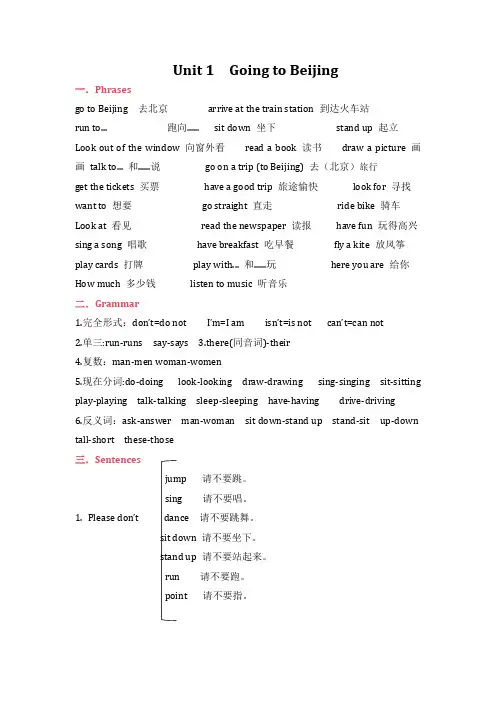
Unit 1 Going to Beijing一.Phrasesgo to Beijing 去北京arrive at the train station 到达火车站run to... 跑向...... sit down 坐下stand up 起立Look out of the window 向窗外看read a book 读书draw a picture 画画talk to... 和......说go on a trip (to Beijing) 去(北京)旅行get the tickets 买票have a good trip 旅途愉快look for 寻找want to 想要go straight 直走ride bike 骑车Look at 看见read the newspaper 读报have fun 玩得高兴sing a song 唱歌have breakfast 吃早餐fly a kite 放风筝play cards 打牌play with... 和......玩here you are 给你How much 多少钱listen to music 听音乐二.Grammar1.完全形式:don’t=do not I’m=I am isn’t=is not can’t=can not2.单三:run-runs say-says3.there(同音词)-their4.复数:man-men woman-women5.现在分词:do-doing look-looking draw-drawing sing-singing sit-sitting play-playing talk-talking sleep-sleeping have-having drive-driving6.反义词:ask-answer man-woman sit down-stand up stand-sit up-down tall-short these-those三.Sentencesjump 请不要跳。
冀教版七年级下册英语Lesson1ATriptoChina优秀教学案例
(一)情景创设
在本节课的教学中,我将注重情境的创设,使学生能够在一个真实、生动的环境中学习英语。例如,在介绍中国的旅游景点时,我可以利用多媒体展示相关的图片、视频,让学生仿佛身临其境,激发他们对旅游的兴趣。同时,我还可以设计一些情境对话,让学生在角色扮演中运用所学知识,提高他们的语言运用能力。
在案例中,我将充分发挥教师的主导作用,以学生为主体,注重启发式教学,引导学生主动探究、积极交流。通过设置情境、小组合作、角色扮演等多种教学手段,让学生在轻松愉快的氛围中学习英语,提高他们的语言运用能力。同时,本节课还将注重文化意识的培养,让学生在学习语言的同时,了解中国的旅游景点,感受中国传统文化的魅力。
3.学生能够运用所学的词汇和句型,介绍自己喜欢的旅游景点,能够简单介绍景点的历史、特点等。
(二)过程与方法
1.通过设置情境,引导学生主动探究、积极交流,提高他们的英语听说读写能力。
2.运用小组合作、角色扮演等教学方法,培养学生的团队协作能力和表演能力。
3.引导学生运用所学的词汇和句型进行实际操作,如制作旅游宣传册、进行景点介绍等,提高他们的实际应用能力。
4.反思与评价:在课堂结束时,我引导学生进行自我评价和总结归纳。通过反思与评价,学生能够及时发现自己的不足,提高他们的自我认知能力。
5.作业小结:我布置了相关的作业,让学生巩固所学知识。通过作业小结,学生能够进一步巩固课堂所学,提高他们的实际应用能力。
这些亮点体现了本节课的教学效果和学生的积极参与。通过情境创设、问题导向、小组合作、反思与评价以及作业小结等教学策略,我成功激发了学生的学习兴趣,培养了他们的思维能力、语言运用能力和团队合作精神,使他们能够更好地理解和运用所学知识。这些亮点为本节课的成功提供了有力的支持。
Unit 1 单元课时基础训练2022-2023学年冀教版七年级年级英语下册
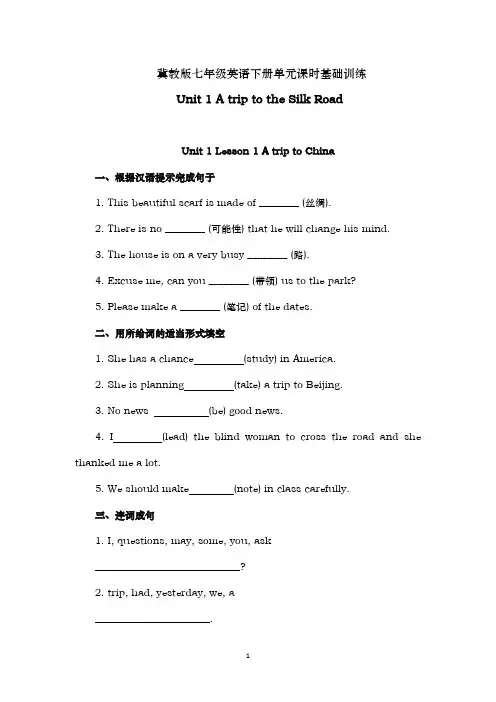
冀教版七年级英语下册单元课时基础训练Unit 1 A trip to the Silk RoadUnit 1 Lesson 1 A trip to China一、根据汉语提示完成句子1. This beautiful scarf is made of ________ (丝绸).2. There is no ________ (可能性) that he will change his mind.3. The house is on a very busy ________ (路).4. Excuse me, can you ________ (带领) us to the park?5. Please make a ________ (笔记) of the dates.二、用所给词的适当形式填空1. She has a chance (study) in America.2. She is planning (take) a trip to Beijing.3. No news (be) good news.4. I (lead) the blind woman to cross the road and she thanked me a lot.5. We should make (note) in class carefully.三、连词成句1. I, questions, may, some, you, ask_____________________________?2. trip, had, yesterday, we, a_______________________.3. am, the, I, news, about, excited___________________________.4. a, here, from, is, friend, note, my_____________________________.5. us, lead, the, hospital, he, to, will____________________________.参考答案一、1.silk2.chance3.road4.lead5.note二、1. to study2. to take3. is4. led5. notes三、1.May I ask you some questions2.We had a trip yesterday3.I am excited about the news4.Here is a note from my friend5.He will lead us to the hospitalUnit 1 Lesson 2 Meet you in Beijing一、根据句意及汉语提示写出单词1. What an (令人兴奋的) news!2. You’d better (离开) early tomorrow morning.3. Walk (沿着) this street and turn left, you can find a hotel.4. Danny was the first to (到) yesterday.5. Today is a (特别的) day. It’s my birthday!二、用所给单词的适当形式完成句子1. There are three __________ (hundred) and sixty-five books.2. The Smiths ________ (leave) for Sichuan next week.3. I am ________ (excite) about the trip to Hong Kong.4. She sends me the ________(school) plan for the trip.5. My home is three _____________ (kilometre) away from the city centre.三、根据汉语提示完成句子1. 他们将什么时候回中国?they come China?2. 我喜欢乘坐火车去旅游。
二年级英语上册北京版第一课
Unit1 What day is today?
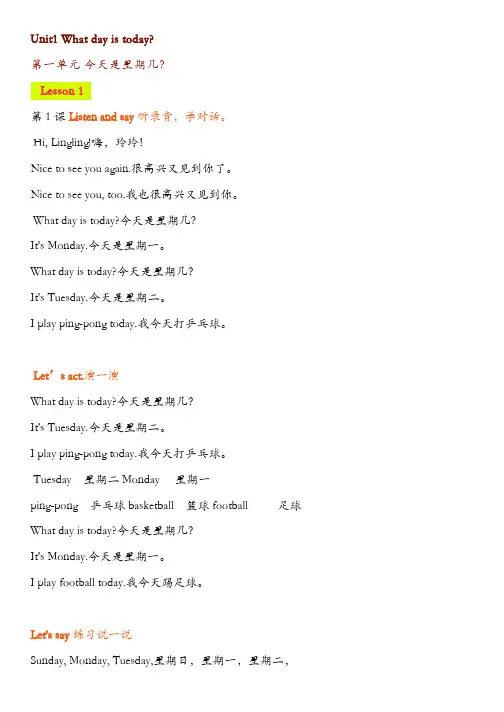
第一单元今天是星期几?
Lesson 1
第1课Listen and say听录音,学对话。
Hi, Lingling!嗨,玲玲!
Nice to see you again.很高兴又见到你了。
Nice to see you, too.我也很高兴又见到你。
What day is today?今天是星期几?
It's Monday.今天是星期一。
What day is today?今天是星期几?
It's Tuesday.今天是星期二。
I play ping-pong today.我今天打乒乓球。
Let’s act.演一演
What day is today?今天是星期几?
It's Tuesday.今天是星期二。
I play ping-pong today.我今天打乒乓球。
Tuesday 星期二Monday 星期一
ping-pong 乒乓球basketball 篮球football 足球What day is today?今天是星期几?
It's Monday.今天是星期一。
I play football today.我今天踢足球。
Let's say练习说一说
Sunday, Monday, Tuesday,星期日,星期一,星期二,
Wednesday is the next day.接下来是星期三。
2020版七年级英语下册Unit1ATriptotheSilkRoadLesson1ATriptoChina课件(新版)冀教版
肯定 Yes, you may/can. 回答 Yes, please.
Sure/Certainly/ Of course. 否定 No, you can’t. 回答 Sorry, you can’t.
You’ d better not.
Step 3 考点·练 ( D )①(2019·宿迁中考)—Mum, may I go to see a film with my cousin? —You ________go if you have finished your homework. A. must B. need C. should D. can
5. 学习; 了解 _le_a_r_n_a_b__o_u_t
6. 由……制成 _b_e_m__a_d_e_o_f_
7. 有机会做
_h_a_v_e_a__c_h_a_n_c_e_t_o_d__o_. _. _. _
8. 寄给某人某物 _s_en__d_s_b_._s_th__. _/s_e_n_d__st_h_.__to__s_b_.
【拓展】 lead的名词形式leader 意为“领导者; 领袖” Chairman Mao was a very great leader. 毛主席是一个非常伟大领袖。
Step 4 考点·练 ①Mr Li often _le_a_d_s_ us to the park to have a picnic. ②这条小路通向一个村庄。 This path _le_a_d_s_ _to_ a village. ③张老师将会带领这个小组去北京。 Mr Zhang _w_i_l_l _le_a_d_ the group _to_ Beijing.
Ⅲ. Read the dialogue and answer the questions. 1. What’s Jenny learning about this month in school? _S_h_e_i_s_l_e_a_rn__in_g__a_b_o_u_t_t_h_e_S_i_l_k_R__o_a_d_(_t_h_is_m__o_n_t_h__in_ _s_ch__o_o_l)_. _
May I go to Beijing教案

Unit1 A trip to BeijingLesson1 May I go to Beijing ? (第一课时)I.教学目标1.掌握词汇及短语:may; ; city ; only; kilometer ; okay; great; restaurant ; ask ; question; busy .work hard ; far from ; go on a trip to … ; too…to… ; from…to… ;live in ;2. 掌握句型: May I … ?Yes, you may./No, you may not.3.通过老师的引导,积极参与讨论,树立努力学习,培养乐观积极向上的生活态度。
II.重点难点1.句型May I …?2.理解含有May所引导的一般疑问句及它的肯否定回答。
3.too…to… ……4.How far is it from …to…? Its … kilometer (s).III.教具录音单词卡(用于对话练习)IV.教学过程T : Good morning everyone ! How are you ? How is your vacation?2.导入新单词m ay but city far only kilometer restaurant ask question busy live3.问题讨论Ask: Do you know Beijing ?What do you know ?Talk about some places in Beijing .Do you want to go to Beijing? Where do you want to go ?4.看课文听录音并回答问题How far is it from Li Ming ’ s city to Beijing?5.阅读课文,翻译并让同学们分角色朗读May I …?句型及肯否定回答Ask the question“If you want for Beijing ,what must you do at first ?”How to talk with parents.操练句型T : Go to Beijing/Xi ’ an.Ss: May I go to Beijing/Xi ’ an?T : Read a book.Ss: May I read a book?…问答练习Make up a dialogueT : May I read a book ?(holding up a book)Ss: Yes, you may.T : May I sing a song ? Ss: No, you may not.too…tofar fromfrom…to It's only two hundred seventy-eight kilometers from Shijiazhuang to Beijing live in8.听录音,两人一组分角色朗读.Practise the dialogue in pairs9.课堂小结。
初一上册Unit1-4英语作文
初一上册Unit1-4英语作文第一篇:初一上册Unit1-4英语作文Unit1My parents and I are going on a trip to Beijing.On Thursday morning we will leave for Beijing by car.It’s about five hours’driving.On Saturday we are going to Tian’anmen Square and the Palace Museum.At night we can have a walk near our hotel.On Sunday, we are going to the Great Wall.Then we will go shopping.Mum wants to buy the beautiful clothes, and I want to buy a new school bag.On Sunday evening we will drive back home.Unit 2Last weekend, I went to the park.That day, the weather was very fine.My mother told me to take my umbrella with me because it would be rainy today.But I didn’t take it.Wow!The park was very beautiful.The grass on the hill was very green.The flowers were so colorful.There were two boys playing football.A woman sat under the tree.The tall man read newspaper beside the river.And I walked along the bank.But suddenly, it rained heavily.When I got home, I had been wet.Every coin has two sides.I caught a cold but I had a good time.Unit 3Hello, everyone!I am Li Tao.I’m in Yuhua Middle School.My school is very big.There are …students in my class.We are all good friends.We always help each other.I’m not good at English this term.Ann always helps me with my English.My classroom is bright because there are five windows on the wall.We have many subjects.They are math, English, Chinese, art, P.E.and so on.But my favorite subject is English.I’m really like it.English is important in our life.If you want to study English well, you must read, listen and write.I sometimes speak English in my life.Myteachers are good, too.They always encourage me when they want to give up my studies.They give me hopes.After school, I go home from school.If I do my homework quickly, I can watch TV for an hour.I love my School.This is my school day.Unit 4 Hello!I am Jack.I am a twelve-year-old boy.Everyone has hobbies.So do I.I like to read books because it can open my eyes.I also like to play chess.Chess challenges me and makes me think hard.I enjoy playing the guitar.I always play the guitar in the parties.I always listen to the music in my free time.It makes me relaxed.I want to be healthy.So I love playing volleyball.I like to surf the Internet, too.Sometimes, I help my mum with the housework.My life is dull now.I want to join some clubs.Please send me an e-mail.My e-*****************************.第二篇:初一上册英语作文The Spring Festival comes after New Year's Day.It's usually in January or February.It's the Chinese New Year's Day.The Spring Festival is the biggest festival in China.All of the Chinese like this festival.When it comes,people are busy.They usually do some cleaning,go to the stores to buy some new clothes and a lot of meat,vegetables and fruit.On the eve of the festival,everyone in the family comes back home from other places.They get together and have a big supper.They eat dumplings,New Year's cake and some other delicious food in their houses.Some people like New Year's cake,but more people think dumplings are the most delicious food of all.Some families have a party.They sing,dance and have a good time.I like this festival very much because I can play with my friends and I can get “red envelopes”.春节是在新年的第一天。
初中英语七年级七年级下册Unit 1 A Trip to Beijing整套教案练习
必修作业模版内容1.教学设计学科名称2.所在班级情况,学生特点分析3.教学内容分析4.教学目标5.教学难点分析6.教学课时7.教学过程8.课堂练习9.作业安排10.附录(教学资料及资源)11.自我问答Unit 1 A Trip to Beijing(初中英语七年级下)2.所在班级情况,学生特点分析3.教学内容分析本单元以A Trip to Beijing为话题,学生通过本单元学习,能够表达请求许可,能够询问及表达两地距离,掌握一百以上数字的读法与写法,初步学习比较等级的形式及用法; 学会制定计划以及用英语购买票。
1.1 Lesson 1 要求学生通过学习李明与妈妈关于去北京旅行的对话,通过技能训练掌握表示意愿以及请求许可的表达方式。
1.2 Lesson 2 以打电话的形式,要求学生学习如何邀请别人一起旅行以及一些旅行安排的表达方式。
1.3 Lesson 3要求学生通过学习本课能够询问及表达两地的距离,并掌握100以上数字的读法与写法。
1.4 Lesson 4以唱歌和对话的形式要求学生复习各种交通方式,并通过对比初步学习比较等级的形式及用法。
1.5 Lesson 5通过学习本课掌握一周七天的读法与写法,重点掌握如何作旅行计划,学会征询别人的意见。
1.6 Lesson 6通过学习Jenny和Li Ming做旅行准备的对话,重点复习this, that, these, those的用法,及谈论数量,提供帮助的表达方式。
1.7 Lesson 7通过本课学习购票的表达方式及劝阻他人不做某事的表达法,同时要求学生学会书面讲述令自己兴奋的一次经历。
1.8 Lesson 8帮助学生复习运用本单元所学内容。
4.教学目标5.教学难点分析6.教学课时Period 1 Lesson 1 May I Go to Beijing?Period 2 Lesson 2 May I Invite Danny and Jenny?Period 3 Lesson 3 How Far Is Beijing?Period 4 Lesson 4 How Can We Go to Beijing?Period 5 Lesson 5 Planning a tripPeriod 6 Lesson 6 Li Ming Packs His SuitcasePeriod 7 Lesson 7 At the Train StationPeriod 8 Lesson 8 Unit Review7.教学过程Step I Greeting and lead-inGreet the students and get them to talk about their holidays.T: I haven’t seen you for long ages, boys and girls! How is it going?S: Quite well. How are you?T: I’m fine, too. Thanks. Did you have a nice holiday?S: Yes.T: Would you like to share your experience with me? … What did you do?S: I read a lot.T: You must have learnt a lot.Get some other students to talk about their holidays. And then show some places of interest and continue talking with the students to make them understand the phrase go on a trip to.T: I had a nice holiday too. I went on a trip to Beijing. Look! There are some pictures about this city.Show the students the following pictures.T: How about the first picture?S: It’s Tian’anmen Square.T: That’s right! The second one?S: It’s Gugong. (In Chinese)T: In English It is named the Palace Museum.S: The Palace Museum.T: How about the last one?S: It’s Changcheng.T: It’s the Great Wall in English.S: The Great Wall.T: There are so many beautiful places in Beijing. And Beijing is the capital city of our country. Would you like to travel to Beijing? (To one student)S: Yes.T: Would you like to go on a trip to Beijing too?Help the student to answer. Make sure the students know the meaning of go on a trip to.S: Yes. I’d like to go on a trip to Beijing.Step II PracticeGet the students to learn to talk about permission by using the phrase: to go on a trip to. The teacher can show them some pictures of places of interest to help them to discuss.T: What city would you like to go on a trip to, Beijing or Guilin?S: I’d like to go on a trip to Guilin.Ask more students the same question to let them learn the phrase go on a trip to wellT: Gulin is a very beautiful place. May I go on a trip with you?Help the student to answer: Yes, you may. Or No, you may not.Explain the meaning in Chinese if necessary.S: Yes, you may.T: (To another student) I have no money to go on a trip to Guilin. May I borrow some money?S: No, you may not.Step III Text learningGet the students to learn the text.a. ListeningGet the students to listen to the tape and answer a question. And then get them to repeat after the tape.T: Li Ming wants to go on a trip to Beijing. Listen to the tape carefully. Does Li Ming’s mother go on a trip to Beijing too?S: (After listening) Yes.b. ParaphrasingExplain the following sentences.Notes: 1. You are too young to go, Ling Ming.It means Li Ming is too young. If he goes to Beijing, he cannot take care of himself.2. Beijing is far from our city.It means Beijing is not near Shijiazhuang.3. You work hard in school.It means Li Ming studies hard.c. PracticeGet the students to read and act out the dialogue in pairs. And then ask them to work in pairs and make up their own dialogues using go on a trip to, too… to…, be far from and May I…? They can talk from the following aspects: 1.Where you want to go for a trip; 2. Why you cannot / can go there; 3.Who will go with you. Walk around to give them a hand if necessary.Sample dialogue:S1: May I go on a trip to New York, mom?S2: No, you may not. Now York is too far to go.S1: Dad?S3: No, you are too young to go. You can go to a city near our home.S1: May I go on a trip to Lasa?S3: No, you may not. It’s far from our city.S1: May I go on a trip to Beijing?S2 and S3: Yes, you may. We will go to Beijing too.Step IV Homeworka. Finish the exercises in Activity book.b. Practice the dialogue in pairs.c. Preview Lesson 2Period 2 May I Invite Danny and Jenny?Teaching goals教学目标1. Target language 目标语言a. 掌握词汇want come hello with who when do leave for arrive.b. 认知词汇invite them Mrs. call oh wonderful invitation bye ho orayc. 句型When do you leave for …? / When do you arrive in / at …?—May I speak with / to …?—This is … (speaking). Who’s that?2. Ability goal 能力目标Enable the students to invite somebody to have a trip on the phone.3. Learning ability goal 学能目标Help the students learn how to invite somebody to have a trip on the phone.Teaching important and difficult points 教学重难点Grasp the expressions of making phone calls.Teaching methods 教学方法Listening and speaking.Teaching aids 教具准备Audiotape and pictures.Teaching procedures & ways 教学过程与方法Step I Lead-in and speakingT: Good morning, class.S: Good m orning, Miss /Mr. /Ms. …T: We know that Li Ming will go on a trip to…S: Beijing!T: Do you want to go to Beijing? Why or why not?Help the students to answer these questions from the following aspects:Affirmative: 1. have fun; 2. learn a lot that can not be found in the text book; 3. make other friends…Negative: 1. Beijing is too far away; 2. too young to go; 3. …T: If you can go to Beijing, who do you want to take with you? Why?S: I may go with my parents. They can take care of me, and share the happiness together.S: I may go with my friends. We have the same interest and can have a lot of fun.S: I may go with my little brother. I can learn to take care of him and learn a lot.T: Good! Wish you a good trip to Beijing.Step II ReadingFast readingGet the students to scan the dialogue to look for the expressions about making phone calls in English.T: Li Ming wants to go to Beijng, do you know who does he want to take to Beijng? Now, look through the text and show me the answer.S: Jenny and Danny.T: That’s it! But where are Jenny and Danny?S: They live in Canada.T: So how can Li Ming invite them?S: Make a phone call.T: Good! Please read the dialogue in Lesson 2 silently and try to find out ways to make a phone call.After the students finish reading, summarize the following patterns.—Hello. May I speak with / to …?—Yes, this is…. Who’s that?—This is …T: Great!Careful readingGet the students to learn about how to invite somebody on the phone.1. ParaphrasingMake a dialogue to help the students understand the phrases leave for and arrive at / in.T: Hello. May I speak to Mary?S: Hello. This is Mary. Who is that?T: This is … I’m going on a trip to Beijing. Would you like to go with me?S: Yes.T: Let’s meet at the school gate at 9:00 on Fri day. OK?S: OK.Draw the school gate and Beijing West Railway Station on the blackboard and let the student come to the front of the classroom to act with you. The two walk from the school gate in the picture to Beijing Railway Station in the picture.T: We are leaving our school. We are leaving for Beijing. Now we are arriving in Beijing, arriving at Beijing West Railway Station. We usually arrive at a small place; and arrive in a big place. Got it?Write the phrases on the blackboard, explain them and lead the students to read them.2. ReadingGet the students to read the dialogue and answer the questions given. After that ask them to listen and repeat, and then act out the dialogue.1. Who does Li Ming want to take to Beijing? (He wants to take Danny and Jenny to Beijing.)2. Can Jenny come? (Yes, she can.)3. When do Li Ming and his mother leave for Beijing? (They leave on February 1 in the morning.)4. When do they arrive in Beijing? (They arrive in Beijing in the afternoon on February 1.)Step III PresentationLet the students work in pairs to make up similar dialogues to practice the expressions of making a phone call. They can talk from the following aspects: 1. Where you want to go for a trip; 2. Who you want to invite to have a trip; 3. When you leave. Ask some pairs to act out their dialogues.Sample dialogue:S1: Hello! May I speak to Mary?S2: Hello! This is Mary speaking. Who’s that?S1: This is Tom. I want to go on a trip to Xi’an. Do you want to go with me?S2: That’s great. Xi’an is a good place. I’d like to go there .When do you leave for Xi’an?S1: I leave at 2 o’clock on Tuesday afternoon. Is that OK?S2: OK. I will meet you at the school gate at 1 pm.S1: See you then.S2: See you.Step IV Homeworka. Finish off the exercise in Activity book.b. Preview Lesson 3.Period 3 How Far Is Beijing?Teaching goals 教学目标1. Target language 目标语言a. 掌握词汇me about here him there say thousandb. 认知词汇dinosaur think visit Edmonton laugh worry be partner practicec. 句型How far is it from … to …?It’s about … kilometers.2. Ability goals 能力目标Enable students to talk about the distance and say numbers from one hundred to ten thousand.3. Learning ability goals 教学目标Help the students learn to talk about the distance and say numbers from one hundred to ten thousand.Teaching important and difficult points 教学重难点Grasp the expressions of talking about distance.How to express numbers from one hundred to ten thousand.Teaching methods 教学方法Listening, and speaking.Teaching aids 教具准备Audiotape and maps.Teaching procedures & ways 教学过程与方式Step I Revisiona. GreetingT: How are you doing?S: We are fine.b. RevisionHelp the students review Lessons 1 & 2 by asking questions.1. Why does Li Ming want to go on a trip to Beijing?Because Beij ing is the capital city of our country and it’s not far from his city, Shijiazhuang.2. Why does Li Ming’s mother let Li Ming go on a trip to Beijing?Because Li Ming is not too busy, Beijing is not very far from Shijiazhuang, Li Ming is a good student and works hard in school.3. What can Li Ming do in Beijing?He can go shopping, eat in restaurants and go to a hotel.Step II Lead-inShow the students the map of China and the world map to help them to talk about distance.T: Look at this map of China. How far is it from Beijing to Shijiazhuang? Do you still remember?S: It is only two hundred seventy-eight kilometers from Beijing to Shijiazhuang.T: Li Ming wants Jenny and Danny to come on a trio to Beijing. Where do Jenny and Danny live?S: They live in Canada.T: Look at the world map. Is Canada far from China?S: Yes, it is.T: How far is it from Canada to China? Scan the dialogue in Lesson 3 and find out the answer.S: It’s about 8500 kilometers.Help the students to say that in English.T: How far is it from Edmonton to Shijiazhuang?S: It’s about 9600 kilometers.T: Well done!Lead the students to read the numbers in this lesson.Step III Text learninga. ReadingGet the students to read the text again and answer the following questions.T: Now please read the dialogue and find out the answer to the two questions: Why is Mrs. Dinosaur worried? And can Danny go?S: Because Canada is too far from China.S: Yes, he can.T: That’s right.b. ListeningThen get the students to listen to and repeat after the tape. Later, ask them to act out the dialogue.Step IVGet the students to talk about distance.a. SpeakingWrite How far is it from … to …? / It’s about… kilometers and some numbers on the Bb to let the students practice talking about distance. Explain the usage of hundred and thousand.Notes: hundred, thousand 前面有具体数字时,不要加s; 一般情况下,百位与个位之间用and (也可以不用and)十位和个位之间可以用连字符,也可以不用。
【冀教版七年级英语下册】Unit1Lesson1ATriptoChina教案
教材课题教课目标教课要点教课难点教课方法Unit 1 Lesson 1冀教版英语讲课时间主讲人七年级下册讲课班级Lesson 1 A trip to China课课时安排型1.Remember the new words and phrases, master the meaning of text.2.Make sure the Ss can learn some trip experience.3.Learn and talk about their trip experience.Words and phrases; learn a trip to China; a few important sentences.1. Learn how to ask for permission2. Students will be able to use “ will ” to express something Listening,speaking, reading, writing and practice.教课资源教课步骤教学过程设Electronic whiteboard, Multimedia courseware, A recorder.教师活动Step 1 Analysis of the student.After a long holiday, the Ss came back to school. Now,the Ss have a new school year, so many Ss have newplans about their learning. And they have a new subject.Step 2 Lead in.1.Greet the students in English and make sure they canresponse correctly.Do the duty report: a student on duty can saywhatever he/she likes to say.2.Ask some Ss talk about the following questions:How do you like the first day of a new term? Doyou have any new subjects?Do you think you will like them?How many new classmates do you have?May I ask you a question?学生活动调整与思虑Ask one student toread the title ofLesson 1Ask the students justto listen.Let the students doLet ’ s Do it 1Let the students doLet ’ s Do it 2计Step 3 New lesson.No. 1 Prepare lessons before class.Teach the new words and phrases. Make sure theSs can read it correctly.No. 2 Text: Give them some time to read the textthemselves. Then let them act out the dialogue ingroups. Correct their pronunciation whennecessary. At last, the teacher explain the text inChinese, make sure the Ss can understand themeaning of text.No. 3 Ask the Ss to finish the following questions:1.How many new classmates does Danny have?What are their names?2.What advice does Li Ming give Danny onhow to start a conversation with Danny? Ask some students and answer in pairs.3. Li Ming has a new subject this year. What is it?4. What will Li Ming do to prepare for his class教tomorrow? Why?学No. 4 Some important phrases and sentences:trip, silk, road, lead, note, chance, send, news, learn过aboutNo. 5 Review the grammar:程 1. the present tense 2.will/ be going to 3.There be/We have设No. 6 Complete Let’ s Do it!计Step 4 Play the tape for the Ss to follow.Make the Ss listen the text, then let them read follow the tape.Ask the studentsto课Step 5 Summary.finish the exercise堂Sum up the text what we learned, the new words,phrases, and sentences.检Sum up the grammar.测Step 6 课堂检测一、用所给词的合适形式填空。
小学英语六年级上册(冀教版)《Lesson 1 At the Airport》公开课课件
passport 护照
Would you show me your passport, please?
visa 签证
I’m trying to get a visa for Poland. exit/entry/transit visa 出境/入境/过境签证
boarding pass 登机证(登机牌)
trolley 行李推车
You need a trolley for your three suitcases.
Departures board班机起飞时间告示牌
Would you please go and check departures board and see if our flight is on time?
duty free shop 免税商店
There is still an hour left. Let’s hang out the duty free shop
(departures) gate 登机门
Would you please tell me where Gate 9 is?
departure lounge/waiting room 候机楼
VIP lounge机场贵宾室
Waiting in the VIP lounge must be really enjoyable.
window seat 靠窗座位
I prefer window seats.
aisle seat靠走道座位
If there are no more window seats, I’d like an aisle seat then.
More words and phrases
预订机票 班机号 办理登机手续 单程票