
外研版七年级上册M8U1教学设计
教学设计
课题
Module 8 Choosing presents
Unit 1 I always like birthday parties .
教材分析 1. 课型分析:听、说课(listening and speaking ) 2. 教材分析:本模块是外研版七年级上册Module 8,“生日”这一话题是中学生感兴趣的话题,同时这一话题还可以培养学生乐于交友、乐于参加集体活动的良好情感态度,可以帮助他们了解不同国家的生日文化。本模块的语法重点是学生能正确运用动词的第三人称单数形式以及频度副词的使用。本单元是本模块的第一单元,是听说课,话题是邀请朋友参加自己的生日聚会,教学重点是表达邀请。本单元的内容涉及中国孩子和外国孩子如何过生日,学生通过学习本课内容可以了解国外的生日文化,培养和提高跨文化交际意识。本单元的语法重点是频度副词和行为动词第三人称单数形式的正确使用。频度
副词的使用与本单元的主题密切相关,应该做为教学重点目标
之一。行为动词的第三人称单数形式的正确使用在本模块的第
二、三单元也有大量的复现和练习的机会,本节课可以做为次
重点来处理。
3. 学情分析:七年级是中学生学习英语的基础阶段,大
部分对英语学习还充满兴趣,爱说爱表达,所任教的两个教学
班的学生现在已出现了两极分化。少数同学缺乏自信,不敢在
课堂上讲英语,语音也不准确。因此,这一阶段的重要任务在
于激发并保持学生学习英语的兴趣。课堂上采用适合学生年龄
特征的灵活多样的教学方法来吸引学生的注意,努力营造教学
情境。注重对学生英语学习兴趣的培养,鼓励他们大胆说、积
极做、努力讲!本节课用Would you like to表达邀请学生在
小学已经学过,学习内容贴近学生的生活。
教学目标
语 言 知 识 目 标 功能 能用句型“Would you like to…”,发出邀请
语法 能掌握频度副词的使用及其在句中的位置
能正确运用行为动词的第三人称单数形式
词汇 card, party, present, would,always, great, cake, never, special, cut, give, sing, happy, secret.
语音 能够正确读出本课的新单词
语
言
技
能
目
标
听 能识别用“Would you like to……”句型发出的邀请;
能听懂关于如何过生日的简单描述
说 能用“Would you like to……”句型发出邀请;
能询问对方如何过生日,并做出正确的应答。
读 能读懂关于生日的对话;
写
学 习 策 略 自 学 策 略 能够通过自学了解对话大意,初步了解新单词和短语,
根据导学案做好课前预习。
合作 学习 策略 能够通过同伴或小组合作学习通过讨论完成相应的学
习题目,进一步了解对话内容。
文化意识 比较中西方生日文化的不同,培养和提高学生的跨文
化交际意识
情感态度 培养乐于交友,乐于与他人合作,健康向上的品格,并适时地进行感恩教育
教学重点 1.能用“Would you like to……”句型发出邀请; 能询问对方如何过生日,并做出正确的应答。 2.在交流过程中能正确使用动词第三人称单数形式。
教学难点 1. 能询问对方如何过生日,并做出正确的应答。
2.在交流过程中能正确使用动词第三人称单数形式。
教学媒体 多媒体课件
教学方法 Pair-work ;Group-work ;Situational approach ;Task –basedapproach 几种方法 Pair-work: 两人一组相互配合,通过你问我答的形式来引导学生学习新单词,新短语 、新句型。 Group-work: 通过你演我猜你说我猜的形式巩固学
生所学词汇,通过组内合作完成角色表演,提高学生的语
言技能。
教学思路 本单元为听说课,根据教材分析、学习目标和学情分析,本单元的教学从单词、短语、句子、再到对话,由易到难。以视听教学,合作教学,比赛等为主要形式。各个难度任务布置贯穿于教学始终,教师在每个教学环节中巧妙设置教学活动。力求使学生在活动中感知语言的运用,通过师生互动和生生互动的活动方式,促进教学目标的达
成。本节课的教学采用任务型教学法和情景交际法,以课
前听英文歌的形式导入课题,通过询问学生的过生日的习
惯和看图片学单词短语,通过听力材料,跟读对话,根据
情境给对话配音等形式达到对本课知识的掌握以及技能
的提高。
教学过程与方法 设计意图
Step 1Warming-up 课前 听英文歌 “Happy birthday to you ” 课前听歌 通过歌曲导入课题自然且能引起学生的学习
兴趣。
Step 2 Check Pre-work New words and phrases 1.谈论关于生日的图片。 2.根据录音学单词 3.看图片,学关于生日的短语 4.看表格,介绍频度副词。 检查学生的课前预习,主
要是检查学生在导学案的引导
下预习本课新单词和短语。谈
论图片引出单词,通过录音跟
读单词。同时纠正学生的语音。
谈论图片学习短语。看表格,
介绍频度副词。生动、直观、
形象,学生印象深刻。
Step 3 Listening 1.听力练习,听后回答问题 通过听力练习,自然引出下一
个环节。为下文做铺垫。
Step 4. Listen and answer 1. 看动画,听录音,判断句子正误。 2再听录音并且小声跟读。 让学生带着问题去听,更有针对性。第一层听主要是训
练学生迅速抓住关键词的能
力,第二层听是训练学生的语
音语调。本环节的设计由易到
难,多层次的听力练习,是进
行语言输入的过程,为的是使
学生得到扎实有效的听力训
练。
Step Speaking 1.小组内分角色读对话 2.看动画,小组比赛给角色配音。选出最佳小组,模仿大王 鼓励学生进行大胆的朗
读。让学生与录音作对比,听
听谁是模仿大王。通过分角色
朗读对话,引起学生对对话内
容的兴趣。通过小组比赛的形
式给角色配音,学生兴趣高涨。
Step 7:Work in pairs . 两人一组做问答练习 通过这一环节,巩固学生在本
节课所学的词汇和句型。
Step 8. Summary 总结本课所学知识,学生
能够更加清楚的了解本课所
学知识。
Step some exercises. 1.在正确的单词下面划线。 2.选择正确的单词完成句子 通过反馈练习,找出学生
的不足并加以指导。
Step 10. Enjoy a video . 观看视频,进行感恩教育. 通过观看视频,对学生进
行感恩教育,培养学生健康向
上的人格。
板书设计 Module 8 Choosing presents Unit 1 I always like birthday parties .
always usually often sometimes never
Would you like to …
Yes , I’d love to ./ Yes , I’d like to .
What do you usually /sometimes … do on your
birthday
I usually /sometimes …do on my birthday .
Do you usually … do on your birthday
Yes ,I do ./No ,I don’t .
作业布置 Homework Write a short passage(文章) about your mother’s birthday and choose a present for
her
教学反思
外研版七年级英语上册《 Unit 1 I always like birthday parties.》精品教案_14
-------外研版英语七年级上册module 8 unit 1 教学设计【教材背景】教材教育部审定(2013)义务教育教科书九年级上册外语教学与研究出版社【教案背景】本模块是围绕“生日”这一话题展开的,通过学习能使学生进一步加深对课文的理解和运用,掌握频度副词的用法,并在一定程度上练习行为动词的一般现在时态的使用。
在网络发展日新月异的今天,作为一名青年教师,更应该将网络中丰富的信息资源运用到教学中,让学生也能运用网络资源自主学习,主动参与课程的开发和利用。
所以我设计了本课的教案。
该堂课是一堂千锤百炼的成熟课,曾获得过市级课堂大赛一等奖、省研修二等奖、市级教学能手课、市级优质课、同课异构优秀课等,对网络资源进行了充分的利用和整合,取得了良好的教学效果。
【教学课题】外研版英语七年级上册Module 8 Different Habits Unit1 Tony always likes birthday parties.【教材分析】本堂课是七年级上册第八模块中的第一单元,为听说课,本节课需要一课时完成,主要侧重于培养学生的听说能力,因此在课件中运用了网络视频,大量网络图片,音乐等资源,从而唤醒学生更多的兴趣。
在课堂末尾引出“我们的生日就是母亲的受难日”,对本课进行升华。
在前几个模块,同学们已学习了“ 行为动词一般现在时态” 的用法。
本节课重点是运用所学的句型复习第三人称的行为动词的一般现在时态,能够熟练掌握并运用频度副词 (always / usually / often/ never)。
本课是围绕“生日”这一话题展开的,通过学习能使学生进一步加深对课文的理解和运用,掌握频度副词的用法。
并通过一起过生日等活动,培养学生关心同学,乐于交友,关爱父母的良好情感。
【学情分析】1.由于各种不同的原因,我校刚入学的学生在英语学习方面存在着个体差异性。
来自农村小学的学生虽学了,但支离破碎,零零落落,等同没学。
而来自城区的学生则有较好的英语基础。
外研版七年级英语上册教案Module 8 Unit 1
第一课时I always like birthday parties课时目标重点单词card n.卡片party n.晚会;聚会always adv.总是;一直great adj.太好了;巨大的;超乎寻常的cake n.蛋糕never adv.从不special adj. 特别的,特殊的cut v. 切;剪give v. 给,送sing v.唱,唱歌happy adj.唱,唱歌secret n.秘密重点短语sing Happy Birthday 唱生日快乐歌重点句子 1.Would you like to come to my birthday party? 你想来我的生日派对吗?2.I always like birthday parties. 我一直喜欢生日派对。
3.But my mother never makes a birthday party. 但是我妈妈从来没有举办过生日派对。
4.Daming’s mother sometimes makes a birthdaycake. 大明的妈妈有时候会做生日蛋糕。
5.What do you usually do at a Chinese birthdayparty? 中式生日宴会上你们通常会做什么?教学难点行为动词的一般现在时及频率副词教学过程环节1 新课导入Show the pictures about birthday party.T: Look at the pictures ,what are them?设计意图:以图片的形式进行直观教学,能很快导入课文,抓住学生的好奇心,吸引学生的学习兴趣。
环节2 学习活动1-7,并完成相应任务1.让学生看活动1中的图片,并分组讨论图片中出现的事物。
2.教师听取学生的讨论结果。
然后引入新单词,把新单词与图片中的事物联系起来。
教读学生新单词。
3.教师播放活动2的录音,让学生完成活动2 的任务。
4.让学生听活动3的录音,完成活动3下的任务。
Module+8+Unit1+教案-七年级英语外研版上册

Module 8 Unit 1 : Listening and speaking1.提前准备材料;卡片、照片、视频、邀请函、小礼物2.板书设计3.过渡语言,简洁明确4.制作pptNew words &Sentence patterns:Use adverbs of frequency to talk about birthdayEmotional objects: Show love to your parents.1.Lead-in & presentation—— the birth of meWhat you have seen from the video?导出短语同时导出频率副词不在ppt呈现在黑板上呈现蛋糕形状粉笔装饰画出气球、彩带等过渡到大明Today we have a secret boy, he wants to invite all of you to his birthday party, would you like to come?小听力导出,黑板上气球Ppt: Who has a birthday party?_________ birthday party.2.PassageMake an Invitation card(1)Find simple information from the textWhen?Where?What?At a birthday party, what do they do?超链接截音频泛听邀请函上的内容1.精听(2)Activities from the text中西方文化,做什么,中国吃什么,中西方打开礼物Group work输出:邀请函,分组,选好小组组长,36人6人一组,提前照相戴帽子变老相机,我自己,学生长大了,学生父母老了When you are 22...Your parents get older背景音乐5.Summary 气球掉下来单词短语句型情感背景音乐思维导图,学生讲Love yourselvesLove your parents3.HomeworkFinish an invitation card in EnglishMake a birthday card or a present for your parents Have a birthday party for your parents。
外研版七年级英语上册教案Module 8 Unit 1
Module 8 Choosing presentsUnit 1 I always like birthday parties.教材分析The topic of Unit 1 is to invite friends to attend their birthday party. The key point ofteaching is to give an invitation. Let students understand foreign birthday cultures, compare thedifferences between Chinese and Western birthday cultures, and cultivate and improve students'awareness of cross-cultural communication.教学目标【知识目标】Key vocabulary:card, party, present, would, always, great, cake, never, special, eat, give, sing, happy, secret, CD,cinema,concert,magazine,scarf,silk,shirt,T-shirt,choose,exercise,wear,expensive,clothes,shoes, spend, money, film, song, match, weekend, at weekends, dear, hear, hear from, afraidKey structures:1)—Would you like to come to my birthday party?—Yes, I’d like to. When is it?2) Great!3) It’s a secret.4) Daming always gets birthday presents!5) She often goes to the cinema.6) What do you usually do at a Chinese birthday party?7) We sometimes give birthday cards.8) My mother never makes a birthday cake.【能力目标】Students will know the adverbs of frequency and understand conversations involving “Daming’sbirthday”.Students will be able to pronounce the third person singular endings【情感目标】Studentswilllearntoenjoythebirthdaysinourlifeandcultivate and improve studentsawareness of cross-cultural communication.教学重难点【教学重点】The understanding of conversations involving“Daming’s birthday”.【教学难点】The verb in the third person singular form.The use of frequency adverbs in I always like birthday parties and their position in sentences.课前准备Tape recorder & Multimedia教学过程Step 1 Warming-up1. Show some pictures of birthday and say what they are.Key words:birthday, birthday card, birthday party, birthday cake, birthday presents, have a party, make a cake,eat noodles, eat birthday cake, sing Happy Birthday song…2. Match the words with the pictures.3. Read the words after the teacher.4. Introduce the new words.5. Enjoy a song: Happy birthday.【设计意图】导入新课,让学生感受浓烈的主题氛围,创设情境。
外研版七年级英语上册Module 1 Unit 1 The first English lesson教案
外研版七年级英语(上册)Module 1 Nice to meet you.Unit I The first English lesson.I. The Analysis of Teaching MaterialThis is the first English lesson for the middle school students. It teaches the Ss how to make a short self-introduction and understand others’. In this unit, the Ss also should learn some orders that are used in daily class, such as “read”, “write”, “listen”, “repeat”, “stand up”, etc.Ⅱ.The Analysis of the StudentsGenerally speaking, most of the Ss have learnt English since they was in primary schools. But they didn’t pay much attention to the importance of it. So as a teacher, we should make them interested in English, dare to speak and use it, lead them to master the proper methods of learning English.Ⅲ.Teaching Aims and Demands1. Knowledge Objects1) Key Vocabulary: first, lesson, class, student, Miss, twelve, year, thirteen,close, open, match, write, practice…2) Key Structures: I’m from…2. Ability Objects1) To understand conversations involving self-introduction;2) To give a brief self-introduction concerning name, age, and hometown.3. Moral Objects1) To be friendly to your new classmates;2) To be happy to learn English and use it bravely.IV Teaching Key and Difficult Points1. Key Vocabulary2. Making a self-introductionⅤ. Teaching MethodsInteractive approachⅥ. Teaching AidsA tape recorder; Some chalks; BlackboardⅧ. Blackboard DesignUnit 1 The first English lessonHello, …firstI’m/My name is …classI’m … years old. Listen/read/write…I’m from ……He/ She is …._______________________________________________________________________。
Unit 1 A new start(教案)2024-2025学年外研版七年级英语上册
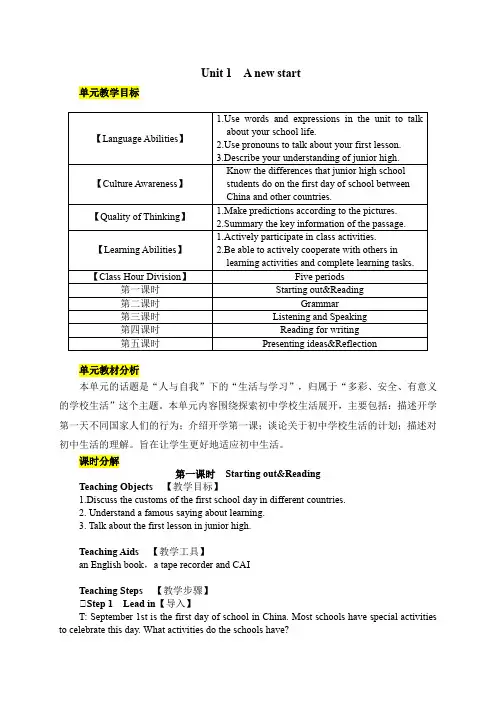
Unit 1 A new start单元教学目标单元教材分析本单元的话题是“人与自我”下的“生活与学习”,归属于“多彩、安全、有意义的学校生活”这个主题。
本单元内容围绕探索初中学校生活展开,主要包括:描述开学第一天不同国家人们的行为;介绍开学第一课;谈论关于初中学校生活的计划;描述对初中生活的理解。
旨在让学生更好地适应初中生活。
课时分解第一课时Starting out&ReadingTeaching Objects【教学目标】1.Discuss the customs of the first school day in different countries.2. Understand a famous saying about learning.3. Talk about the first lesson in junior high.Teaching Aids【教学工具】an English book,a tape recorder and CAITeaching Steps【教学步骤】★Step 1Lead in【导入】T: September 1st is the first day of school in China. Most schools have special activities to celebrate this day. What activities do the schools have?Ss:For example, have the school opening ceremony, have the flag-raising ceremony, watch the program The First Lesson produced by CCTV, have some welcome performances.Starting outPage 15,11.Ask the Ss to discuss the question: What do people do on the first day of school inRussia/ Indonesia/ France/ the USA?2.Show the four sentences on page 15 to the Ss and make sure they understand the meaning of these sentences.3.Ask the Ss to guess and match the sentences with the countries.4.Check the answers with the class.Page 15,21.Ask the Ss to answer the question: What is junior high school life like?2.Let the Ss list something about what junior high school life is like.3.Ask the Ss to complete the table.Understanding ideas(1-4)★Step 2 Pre-task【准备任务】Page 16,11.Show the questionnaire to the Ss.2.Ask the Ss to answer the following questions.①What was your first lesson at junior high?②What did you do in that lesson?③What do you think is important in learning the lesson?3.Let the Ss complete the questionnaire.Page 16,2Ask the Ss to look at the picture and the title, and then ask them to discuss the following questions.①What was the writer’s first lesson at junior high?②What did the writer do in that lesson?★Step 3 While-task【过程任务】Page 16,21.Let the Ss read the passage and answer the question: What did the writer do in his first lesson?2.Ask some students to say their answers.3.Check the answers with the class.Page 18,31.Ask the Ss to read the passage again and choose the main idea of the passage.2.Check the right answer with the class.3.Tell the way to summarize the main idea of a passage.Page 18,41.Let the Ss complete the summary with the words and expressions from the passage.2.Ask some students to say their answers.3.Check the answers with the class.★Step 4 Post-task【后续任务】Page 18,Think and share1.Ask the Ss to think about the following question.What is the meaning of the sentence from Confucius?2.Give the Ss some prompts. For example, Who did Confucius say the sentenceto? Why did he say it? What do you think about learning and thinking?3.Choose some Ss to share their answers.4.Ask the Ss to think about the following question:Do you know other famous sayings about learning?5.Let some students share their answers.6.Make appropriate supplements according to students’ share.For example, thinking without studying is useless;Reading without understanding is like chewing bark;Skill comes from diligent practice, and neglect results come from idleness;A journey of a thousand miles begins with a single step.★Step 5Language points【语言要点】1. mistake的用法mistake 作名词,意为“错误;失误”。
外研版英语七年级上册Module1 Unit One Nice to meet you 教学设
外研版英语七年级上册Module1 Unit One Nice to meet you 教学设外研版英语七年级上册module1unitonenicetomeetyou教学设外语教学与研究出版社,新标准,英语七年级,第一卷,教学设计moduleonemyclassmatesunitonenicetomeetyou一、教科书分析本模块以自我介绍为话题。
本节课是这个模块的第一课时,是一节听说课型的新授课。
这是学生进入初中的第一课,是教师向学生做自我介绍和教学生做自我介绍及相互问候的最佳时机。
本课学生的听说活动都是围绕初次见面是如何作自我介绍而展开。
学生们通过学习对话,了解如何做自我介绍。
本单元重在教会孩子通过自我介绍而与陌生人进行沟通,从而打开交流的僵局。
二、教学目标1.语言知识目标(1)目标句型:你好,我的名字,be,小姐,早上好/午后。
早上好下午好。
再见你是…人吗…?离…远吗…?2.技能目标(1)能够正确使用be动词,并且运用所学的句型作自我介绍。
(2)能够听懂,读懂,理解和复述整个对话。
(3)同学能通过有目的的听而提取有用信息。
(4)一些学生可以根据自己的实际情况调整对话内容并表演。
3.学习策略目标(1)利用多媒体,直观地展示单词和句型,并带领学生一起朗读。
(2)通过小组合作的方式,学会合作学习。
4.情感与态度目标在教学过程中,学生通过对话向他人介绍自己。
在相互介绍自己的过程中,学生们迅速地相互熟悉,感受到新集体的温暖,体验与同学合作的乐趣。
5.教学重点和难点用英语介绍进行简单的问候,并介绍自己的姓名,年龄,来自于哪里。
6.教具准备Ppt课件,课堂试题。
三、教学设计这门课是一门听说课。
在整个教学设计中,教师尽最大努力创造能启发学生思维的情境,引导学生在真实情境中学习和应用新知识。
你好,自我介绍,对话阅读,即兴表演。
这些活动使学生在应用中掌握新句子,实现语言知识向语言交际工具的转化。
初一新学期的学生需要对小学所学知识进行整理并在课堂上加以运用。
M8U1教学设计
Module 8 DiscussionUnit1 What do you suggest? 教学设计【学习目标】1. 能识别新单词suggest、quickly、excited、America、Chinese、kind、dragon。
2.掌握并运用本课重点句型what do you suggest…?how/what about…?why don′tyou…?学习如何给别人提意见。
3.通过创设情境,综合运用所学语言进行交谈,培养学生在实际生活中综合运用语言的交际能力和对语言的应变能力。
【教学重、难点】教学重点:掌握并运用本课重点句型What do you suggest运…?能口头用What/How about…? W hy don’t you …?教学难点:在真实情境中运用重点句型进行口语交际。
【教学过程】一、导入环节(一)导入新课,板书课题(1分钟)导入语:Tomorrow is my mother’s birthday, I want you to give me some advice.I hope you can give me some suggestions after we learning this class.Today we’ll learn M8U1 What do you suggest?(领读模块课题)(二)展示目标(1分钟):过渡语:Let’s read the learning goals together.1. 能识别新单词suggest、quickly、excited、America、Chinese、kind、dragon。
2.掌握并运用本课重点句型what do you sugg est…?how/what about…?W hy don’t you…?学习如何给别人提意见。
3.通过创设情境,综合运用所学语言进行交谈,培养学生在实际生活中综合运用语言的交际能力和对语言的应变能力。
外研版七年级英语上册《 Unit 1 I always like birthday parties.》精品教案_8
外研版英语七年级(上)Module8 Unit1教学设计Module 8 Choosing presentsUnit1 I always like birthday parties.一、Analysis of the materialThe topic of this module is choosing presents. The function is inviting and describing birthday parties. The grammar is adverbs of frequency. It develops listening, speaking and reading by asking and stating birthday parties . In Unit1 it talks about what we usually do on birthday.二、Analysis of the studentsThese students have come into middle school recently. They are exposed to English for the first time, so it is very important to develop their keen interest in English. It is necessary to use assistant teaching methods to arouse their attention.So in this lesson I’ll encourage them to take an active part in every activity, including individual work, pair work, group work and class work, to grasp every opportunity to communicate and coordinate with others.三、Teaching aims1. Knowledge aims:(1) Words: party, present, card, never, always, special....(2) Adverbs of frequency: always, usually, often, sometimes,never2.Ability aims(1)Develop students’ abilities of listening, speaking and reading(2)Train students’ abilities of communication3.Emotion aimsStimulate students’ interest in learning English, learn to respectothers and love others.四、Teaching keys and difficulties1. Key points of this lesson:(1)Learn some new words and phrases about birthday party(2)Learn to use the adverbs of frequency.2. Difficulties pointsThe usage of adverbs of frequency and the present tense withthe third person五、Analysis of teaching methodsAccording to the New Curriculum Standards, the main instruction aim of learn ing English is to cultivate students’ basic abilities of listening and speaking and their good sense of the English language.So in this lesson, I’ll mainly use the task-based teaching method.That is to say, I’ll let the students learn in real situation to finish the tasks by making activities, such as singing, talking,guessing games and so on.六、Teaching aidsA tape recorder, A multimedia computer system七、Teaching proceduresI’ll finish this lesson in six steps.Step1. Warming up and leading inSay to students that this class is a special class because we haveEnglish in the new classroom, and this class is the last class of theyear 2017. So the new year is coming, and people often sendpostcards and presents to each other to express their good wishes.Ask the students when else we should send postcards andpresents to others. Lead into the new lesson.Step2. Presentation and talkingShow some pictures about birthday presents and birthday partyto the students on the screen. Ask the students to guess what theyare, and talk about them. At the same time, let the students to learnthe new words and phrases in this lesson. At the other time, get ready for the listening tasks in the next step.Step3. Listening practice1.Play the recording. Ask the students to listen carefully andnumber the words on the screen in the right order. Call back theanswer from the whole class and check the answers.2. Play the recording again. The students also listen carefullyand answer two questions about the conversation.Step4. listening and reading1.Play the recording. The students listen carefully and payattention to the five adverbs of frequency. Ask them to underline them and read the sentences that contain the five words.2. Play the recording. The students read after the recording.Then ask them to complete the sentences.Through the two steps , the students can know how to use the adverbs of frequency.3.Ask the students to read the conversation in whole class andthen in pairs. Ask the students to look at the questions on thescreen and answer them.Through this activity, the students can understand the conversation very well.Step5. Speaking practiceLet the students to look at the screen. Ask them to work in pairto ask and answer like this:—What do you often / usually / always /… do on your birthday?—I often / usually / always /… on my birthday.First I do it with a student as an example. Give the students afew minutes to prepare in pairs. Then ask some pairs to talk abouttheir birthdays so that they can practise their ability of speaking. Step6. ConclusionSummarize the important points that have been learned in thisclass. Tell the students that we should send the postcards orpresents to others on their birthdays and at the festivals to expressour respects and loves to them.Homework: 1. Learn and remember the new words and expressions2.Learn and use the new structures in this unit3.Preview the contents in Unit2.Blackboard designModule8 Choosing presentsUnit1 I always like the birthday parties.always, usually, often, sometimes, never---Would you like to ...... ?---Yes, I’d love to. / I’d love to, bu t .......。
外研版七年级上册Module 8 Unit1教案
授课教师____ 授课时间_________________ 课题Module 8 Choosing presentsUnit 1 I always like birthday parties.教材分析1. 课型分析:listening and speaking2. 教材分析:本模块是外研版七年级上册Module8,它以“生日”为话题展开听、说、读、写语言知识和技能训练。
本模块的语法重点是频度副词,这些副词的使用与本模块的主题紧密相关。
教师应注意设置语境,设计交际活动,培养学生的理解能力和表达能力。
本模块第一单元的话题是邀请朋友参加自己的生日聚会,教学重点是表达邀请。
教师应该设置语境,让学生练习如何正确地发出邀请。
教学目标语言知识目标功能能用“Would you like to…?”发出邀请语法能够掌握频度副词的使用及其在句中的位置能正确运用动词第三人称的单数形式词汇基准目标:card, party, present, would, always, great, cake, never, cut, give, sing,happy选择目标:special, secret语音能够识别并正确朗读语言技能目听能够识别用“Would you like to…?”发出的邀请能够听懂关于如何过生日的简单描述说能够用“Would you like to…?”发出邀请能够询问对方如何过生日we do on birthday parties? And make a list of the things.Fourth, show them the pictures and words to check them.Finally, show them the picture in Activity1 and get them to talk about it. Then get them to complete Activity4. Call one student to read out his answer. After that, get them to read the short passage in “Around the world”Step2. Listening (Activity2)Call at least 3 students to read the four words first,then play the tape at least twice and get them to listen and number the words as they hear them.Finally, call back one student’s answers to check together. The other students must show their green or red card to express their opinions.Step3. (Activities3and 5) listen and readFirst, listen to the tape once and get them to choose the correct answer according to the conversation.Second,show them the sentences in Activity3, get two students to read them as models. Then get them to watch the cartoon, listen and then check the true sentences.After that ,call back their answers and correct the wrong ones. The others also need to show their red of green cards to express their opinions.Third, play the tape again and get them to follow the tape in three groups. ( Daming, Betty and Tony) While they are reading, pay attention the pronouciation and the stress. 习,同时也检查了预习单词的任务。