
外研版八年级英语上册Module 6 Animals in danger单元测试题含答案
Module 6 Animals in danger单元测试题Ⅰ.单项填空(每小题1分,共15分)( )1.We have helped the animals in danger ________ there are still a lot of things to do.A.so B.and C.but D.or( )2.When you move somewhere new, the first thing for you is to find a place ________.A.to live B.living inC.to living in D.live in( )3.Can you ________ her name?A.think over B.think aboutC.think hard D.think of( )4.—Marcia, could you please________my dog when I'm on vacation?—OK, sure.A.look after B.look atC.look for D.look up( )5.He lost his key.It made him ________ in the cold for one hour to wait for his wife's return.A.to stay B.stayedC.stays D.stay( )6.The young man is ________ to carry the heavy box.A.enough strong B.strong enoughC.too strong D.so strong( )7.Please ________ all these foods, Mum.I'm not hungry.A.take away B.take inC.take off D.take down( )8.Whenever you have a chance________English, you should take it.A.speak B.to speakC.spoke D.speaks( )9.When you leave, please turn off the lights ________ energy.A.save B.to saveC.saving D.saved( )10.I always tell my students ________ on the road because it's really dangerous.A.not to play B.to play notC.not playing D.not play( )11.The research centre has made a plan ________ pandas.A.help B.helpingC.to help D.helped( )12.—Jack, could you help me ________when the plane will take off on the Internet?—I'm sorry.My computer doesn't work.A.get out B.look outC.take out D.find out( )13.The parents don't allow their daughter ________ at night.A.to go out B.going outC.go out D.went out( )14.China is going to ________ a manned space station around 2020 to explore more space.A.set up B.put upC.wake up D.turn up( )15.White has always been a(n)________ of purity(纯洁) in Western culture.A.symbol B.reasonC.example D.presentⅡ.完形填空(每小题2分,共20分)Sea lions are mostly found on sandy beaches and around rocks all around the world, but mostly in Australia.Sea lions eat fish and some__16__ animals in the ocean.It can be quite dark in the ocean, __17__ sea lions can find their way around.Sea lions are good__18__.They can dive 35 feet or deeper.If they dive too deep, they can run out of air and__19__ in the water.Sea lions are great swimmers, too.They can__20__at a speed of 40 kilometres an hour.This helps them__21__ away from whales and sharks, but not from human beings(人类)!__22__ year a lot of sea lions die painfully.Thousands of sea lions are killed__23__ their skin and oil.That's__24__bad.A sea lion is a very beautiful animal! We need to keep this animal alive, always and forever! And we must__25__them from disappearing in the world, or our grandchildren may have no chance to see them.( )16.A.sour B.smallC.bad D.orange( )17.A.and B.but C.so D.or( )18.A.runners B.driversC.divers D.swimmers( )19.A.work B.sleep C.live D.die( )20.A.swim B.get C.leave D.grow( )21.A.walk B.run C.take D.look( )22.A.Each B.AnotherC.The D.That( )23.A.to B.for C.with D.on( )24.A.only B.not C.really D.just( )25.A.clean B.foundC.discover D.protectⅢ.阅读理解(每小题2分,共18分)ANorth American black bears are shy animals. They are fearful by nature, and will usually run away if they see or hear people. Because of this, it can be difficult for scientists to learn about these animals.In order to study black bears, researchers from New Jersey, the US, catch bears and use drugs to help them go to sleep. Researchers then work out the size and the weight of the bear, take blood to test for diseases, remove a tooth and take it to the lab to find out its age. From these studies, researchers want to find out how many bears live in New Jersey, how long they live, and how many babies they produce.But in Minnesota, the US, researchers study bears that are completely awake. The bears know the researchers' voices and they are not afraid of the research team. With the help of a few grapes to keep the bears busy, researchers can touch them to check their hearts, look at their teeth, and do other jobs. Researchers can also walk or sit with bears for hours and make videos to learn about their everyday life.In both places, the main purpose is the same—to make sure there is a healthy population of black bears. But the research methods and the kinds of information that researchers are able to collect are quite different.( )26.In the first paragraph, we can learn that North American black bears are ________.A.shy and fearful animalsB.not found todayC.well known to scientistsD.not afraid of people( )27.The word “remove” in the second paragraph probably means “________”in Chinese.A.拔下 B.移植 C.清洗 D.修补( )28.Which of the following may NOT be included in the New Jersey studies on bears?A.The age.B.The way of their communication.C.The weight.D.The number of babies they produce.( )29.In the Minnesota studies, researchers ________.A.can never get close to the bearsB.study the bears while they are asleepC.use grapes to make the bears fullD.learn a lot about the bears' everyday life( )30.What do the two studies have in common?A.Research places.B.The main purpose.C.Research methods.D.Collected information.BThe brown bears at Helsinki's Korkeasaari Zoo received a particular treat, thanks to the generosity of a young boy. Twelveyearold Otso Riiali donated 200 euros to the zoo to give the bears new climbing trees, without which he thought they would be in danger.Otso, from the small town of Karjalohja west of Helsinki, says he saved up the money by selling 400 bottles of homemade berry juice with the help of his grandmother. “It was hard work and my back hurt badly from all the bending in the forest while I was picking berries,”said Otso.A visit to the bear shelter a few years ago drove Otso to bring some cheer to the animals, which he said didn't seem energetic.“Otso could have kept all he made by means of selling juice for himself, but he made a decision to give part of it to help ani mals. Otso showed an unusual ability to act. He did not stop at seeing what a bad situation the bears were in. Instead, he began to act in a practical way and made it.”The zoo gladly accepted Otso's donation. However, bear caretaker Tiina Koivu mentioned that the bears' footdragging(步履蹒跚) at the time of Otso's visit was caused by the summer heat.It happens that the name Otso is also an old Finnish(芬兰的)word for bear. “I was born to be a bear lover,” said Otso with a smile.( )31.The underlined word “euros” in the first paragraph probably means a kind of ________.A.food B.treeC.animal D.money( )32.According to the passage, all of the following words can be used to describe Otso's quality EXCEPT ________.A.generous B.hardworkingC.modest D.warmhearted( )33.The right order(顺序) of what happened to Otso is ________.①The zoo accepted Otso's donation with gladness.②He made berry juice with the help of his grandmother.③He paid a visit to the bear shelter a few years ago.④He picked berries in the forest though it was hard.A.②④③① B.③④②①C.④③①② D.③④①②( )34.What's the main idea of the passage?A.Otso means bear in Finnish.B.Otso made a donation to help the bears.C.Otso could make berry juice.D.Otso visited a zoo.Ⅳ.用所给单词的适当形式填空(每小题1分,共10分)35.Lucy is very ________(interesting) in listening to pop music.36.There are about one hundred people ________(live) in the mountains.37.The problem is ________(make) a right choice.38.He thought of a new way ________(save) water.39.The bamboo forests are getting ________(small) today.40.Enjoy ________(read), children! You can get more knowledge.41.We chose Henry ________(be) chairperson.42.Giant pandas are in ________(dangerous) because people are taking away their land.43.It's difficult for pandas ________(have) many babies.44.Everyone should do something ________(help) the wild animals.Ⅴ.根据汉语意思完成句子(每小题2分,共10分)45.他带走了一大笔钱。
外研版英语八年级上册Module6《Animalsindanger》(Unit1)说课稿
外研版英语八年级上册Module 6《Animals in danger》(Unit 1)说课稿一. 教材分析《Animals in danger》是人教版英语八年级上册Module 6的一课,主要内容是讨论动物濒危的问题。
本课通过介绍一些濒危动物,让学生了解动物濒危的原因以及我们应该如何保护它们。
教材内容丰富,插图生动,激发了学生学习兴趣。
同时,本课还要求学生能够运用所学知识进行讨论和表达,提高他们的语言运用能力。
二. 学情分析八年级的学生已经掌握了基本的英语语法和词汇,具备一定的听说读写能力。
他们对于动物保护这一话题感兴趣,且有一定的社会责任感和保护意识。
但部分学生可能在表达自己的观点时存在困难,因此需要教师在教学过程中给予适当的引导和帮助。
三. 说教学目标1.知识目标:学生能够掌握濒危动物的相关词汇和表达方式,理解课文内容,了解动物濒危的原因和保护方法。
2.能力目标:学生能够运用所学知识进行讨论和表达,提高他们的语言运用能力。
3.情感目标:学生能够增强保护动物的意识,提高他们的社会责任感和关爱他人的情感。
四. 说教学重难点1.重点:学生能够掌握濒危动物的相关词汇和表达方式,理解课文内容。
2.难点:学生能够运用所学知识进行讨论和表达,特别是如何正确表达自己的观点。
五. 说教学方法与手段1.交际式教学法:通过小组讨论、pr work等形式,激发学生的学习兴趣,提高他们的语言运用能力。
2.任务型教学法:通过完成保护动物的计划任务,培养学生的团队合作意识和解决问题的能力。
3.多媒体教学手段:利用多媒体课件和视频,生动形象地展示濒危动物,增强学生的学习兴趣。
六. 说教学过程1.导入:教师通过提问方式引导学生谈论他们喜欢的动物,引出本课主题。
2.呈现:教师通过展示濒危动物的图片和视频,呈现本课的主要内容。
3.讲解:教师讲解课文内容,帮助学生理解动物濒危的原因和保护方法。
4.实践:学生进行小组讨论,讨论如何保护动物,并完成保护动物的计划任务。
外研版八年级英语上册课件-Module 6 Animals in danger
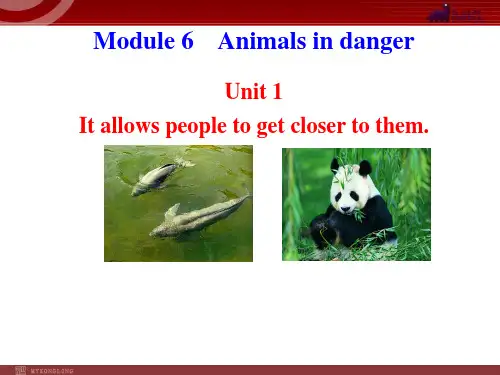
— To protect... we should ... — We need to ... to protect ...
Practice
一、根据汉语完成句子。
1. 托尼刚刚拿走了我的字典。 Tony _t_o_o_k__ _a_w_a_y_ my dictionary just now. 2. 我有许多家务活要做。 I have got lots of housework __t_o__ __d_o___. 3. 这位老人没地方住。 The old man has __n_o__ _p_l_a_c_e __t_o__ _l_iv_e_ __in__. 4. 老师已查明原因了。 The teacher has _fo_u_n__d_ _o_u_t_ the reasons.
Panda Reserve. A. Wulong B. Wolong C. Wulun 3. Our villages and farms are _______. A. growing more slowly B. growing bigger C. not growing
Complete the table.
2. We need to protect them better. 我们需要更好地保护它们。 need 的用法: 1) 作实义动词,意为“需要”。当主语是人时,用 need to do; 当主语是物时,用need doing/to be done。 We need to learn English quickly. 我们需要快速学英语。 The trees need watering/to be watered. 这些树需要浇水了。
n. 政府 n. 大自然;自然界
外研版八年级英语上册《Module6AnimalsindangerUnit2》说课稿1

外研版八年级英语上册《Module 6 Animals in danger Unit 2》说课稿1一. 教材分析《Module 6 Animals in danger Unit 2》是人教版八年级英语上册的一篇课文,本节课的话题是关于动物保护。
本节课的主要内容是让学生们通过阅读和听力练习,了解一些濒临灭绝的动物以及它们所面临的问题。
同时,本节课还要求学生们能够运用所学的知识,就动物保护问题进行讨论和交流。
二. 学情分析根据我对学生的了解,他们已经具备了一定的英语基础知识,能够进行简单的阅读和听力理解。
但是,他们的英语口语表达能力还有待提高,同时对于一些动物的名称和特点可能不是很熟悉。
因此,在教学过程中,我需要帮助学生们克服这些困难,提高他们的阅读和听力理解能力,同时也要提高他们的口语表达能力。
三. 说教学目标1.知识目标:让学生们掌握本节课的生词和短语,能够正确地朗读和拼写。
让学生们能够理解课文内容,掌握课文的结构和主旨。
2.能力目标:通过阅读和听力练习,提高学生们的故事梗概提炼能力;通过小组讨论,提高学生们的口语表达能力;通过课后作业,提高学生们运用所学知识进行写作的能力。
3.情感目标:让学生们认识到保护动物的重要性,增强他们的环保意识。
四. 说教学重难点1.教学重点:让学生们掌握课文中的生词和短语,能够正确地朗读和拼写;让学生们理解课文内容,掌握课文的结构和主旨。
2.教学难点:让学生们能够运用所学知识,就动物保护问题进行讨论和交流;让学生们能够正确地使用一般现在时进行叙述。
五. 说教学方法与手段在本节课的教学过程中,我将采用任务型教学法和交际法进行教学。
通过设计各种任务,让学生们在完成任务的过程中,自然地学习和使用英语。
同时,我还会运用多媒体教学手段,如课件、视频等,来帮助学生们更好地理解和掌握课文内容。
六. 说教学过程1.导入:通过展示一些濒临灭绝的动物的图片,引起学生们的兴趣,导入新课。
外研版八年级英语上册Module 6 Animals in danger
Module 6 Animals in danger知识点归纳【单词】1. in danger 处于危险中2. be interested in 对…… 感兴趣3. think of 想起4. take away 拿走; 带走5. look after 照顾; 照料6. find out 找出; 发现; 查明7. many kinds of 许多种......8. set up 建立; 创立【重点词汇】1.danger 危险;危害 形容词是 dangerous 短语:1) in danger =at risk 处于危险中例如: Many animals are in danger now.许多动物正处于危险中.2)out of danger 脱离危险例如: Don’t worry! He is out of danger.别担心。
他脱离危险了。
3. interested 关心的;感兴趣的短语:① be interested to do sth. 对做…… 感兴趣例如: I am interested to watch films.我对看电影感兴趣.② be interested in sth. 对…… 感兴趣例如: I am interested in films.我对看电影感兴趣.③be interested in doing sth. 对做... 感兴趣The boy is interested in seeing films.这个男孩对看电影感兴趣.4.allow 允许; 准许短语:(1)allow doing sth. 允许做某事They allowed smoking in this room only. 他们只允许在这间屋子里抽烟.(2)allow sb. to do sth. 允许某人做某事He allowed me to take his dictionary.他允许我拿走他的字典.(3)allow sb. sth.让某人拥有某物 (尤指钱或时间)例如: He allows his son too much money. 他让他的儿子拥有太多的钱.(4)allow + that ... 承认……例如: We had to allow that he was a good teacher. 我们不得不承认他是个好老师.5. enough 足够的;充分的①enough + 名词例如: I can’t believe he has enough food to eat. 我不相信他有足够吃的食物.②形容词 + enough例如: My brother is old enough to go to school. 我弟弟足够大, 可以去上学.6. notice①布告;告示例如: There is a notice. 那有个告示.②注意notice sb. doing sth. 注意某人正在做某事例如: At that time, I noticed him playing on the street. 那时, 我注意他正在街上玩.7. in order to 为了① in order to do sth “为了做某事”例如: In order to be a doctor, you have to study for five years in college.要当一名医生,你 (们) 需要在大学学习五年。
外研版英语八年级上册Module 6《Animals in danger》(Unit 3)教学设计1
外研版英语八年级上册Module 6《Animals in danger》(Unit 3)教学设计1一. 教材分析本课是外研版英语八年级上册Module 6《Animals in danger》(Unit 3),主要讲述了四种濒危动物:大熊猫、金丝猴、朱鹮和扬子鳄。
教材通过介绍这些动物的生活习性、保护现状,引导学生关注动物保护,提高环保意识。
本课包括听、说、读、写等多个方面的内容,旨在全面提高学生的英语能力。
二. 学情分析八年级的学生已经具备了一定的英语基础,能够进行简单的听、说、读、写。
但学生在动物保护方面的知识相对较弱,需要通过本课的学习,提高他们的环保意识。
同时,学生对于新知识的接受能力不同,部分学生可能需要更多的引导和鼓励。
三. 教学目标1.知识目标:学生能够掌握有关濒危动物的词汇和表达方式,如endangered, habitat, protection等。
2.能力目标:学生能够听懂、会说、会读、会写关于四种濒危动物的介绍,提高他们的英语综合运用能力。
3.情感目标:学生能够认识到动物保护的重要性,提高环保意识。
四. 教学重难点1.重点:学生能够掌握有关濒危动物的词汇和表达方式,能够用英语简单介绍四种濒危动物。
2.难点:学生能够正确使用一般现在时态描述动物的生活习性和保护现状。
五. 教学方法1.任务型教学法:通过设置各种任务,激发学生的学习兴趣,提高他们的参与度。
2.情境教学法:创设情境,让学生在真实的语境中学习英语,提高他们的语言运用能力。
3.合作学习法:鼓励学生相互合作,共同完成学习任务,培养他们的团队精神。
六. 教学准备1.准备有关濒危动物的图片、视频等教学素材。
2.设计各种任务,如填空、选择、问答等,以便在课堂上进行操练。
3.准备听力材料,让学生听懂四种濒危动物的介绍。
七. 教学过程1.导入(5分钟)利用图片、视频等素材,引导学生关注四种濒危动物,激发他们的学习兴趣。
2.呈现(10分钟)呈现教材中的听力材料,让学生听懂四种濒危动物的介绍。
外研社八年级英语上册Module6知识点

Module 6 Animals in danger一、重点词组1、at last 最后;终于2、in peace 平安地;和平;3、in danger 在危险中,有…的危险4、look after 照顾,照看(某人或某物);5、find out 找出,查出;查明,发现;6、in order to 为了…7、set up 建立;准备;二、重点句型1、But I am more interested to see the pandas in the Wolong Panda Reserve.be interested to do sth. 对做……感兴趣be interested in sth. 对……感兴趣2、…because it allows people to get closer to them.allow sb. to d o sth. 允许某人去做某事3、It’s sad to think of pandas and other animals in danger.think of 想到,想出,认为,考虑in danger 处于险境,处于危险之中4、… have a safe place to live 表示“有安全的居住地”。
to live放在名词place的后面做定语。
5、Each pandas needs to eat a lot of bamboo every day.every 和each:●every “每”“各”,指三者或三者以上的整体,含有全体之意。
●each “每一”“每个”,指两个或两个以上的每一个,着重于个别,如团体中一个的人或物。
6、In order to protect pandas in the wild, the government is setting up nature parks …set up 创建,创办in order (not) to do sth. 为了(不)做……三、重点语法点动词不定式1、不定式的形式动词不定式的基本形式是“to+动词原形”,其否定形式为not + (to)+ 动词原形。
外研版八年级英语上Module 6讲义(含导入及详细知识点)
Module 6. Animals in danger一、主题:动物(Animals)二、必背单词名词:snake 蛇neck 颈;脖子danger 危险;危害peace 和平;太平notice 布告;告示Research 研究;探讨baby 婴儿;婴孩situation 形式;情况scientist 科学家government 政府nature 大自然;自然界symbol 象征;标志动词:allow 允许;准许protect 保护;保卫grow(逐渐)变得;生长raise 筹集(钱款);抚养;养育produce 生育;繁殖set 设置;设定develop 研制;制定feed 喂养;饲养形容词:thin 薄的;细长的interested 关心的;感兴趣的enough 足够的;充分的兼类词:wild adj.野生的n.野生环境southwest n.西南adj.西南的;朝西南的三、常用短语1、in danger 处于危险中2、at last 终于;最后3、be interested to do sth 有兴趣做某事4、allow sb to do sth 允许某人做某事5、think of 想到;想出6、wild animals 野生动物7、a safe place 一个安全的地方8、take away 夺走;拿走9、in peace 和平地;平静地10、look after 照顾;照管11、raise money 筹钱12、find out 发现;查明13、in the wild 在野外14、get difficult 变的困难15、in order to 为了16、set up 开办;设立;创办;建立17、nature park 自然公园18、go back 回去19、choose……to be…… 选择……作为……20、be worried about 担心21、develop plans 制定计划22、a symbol of…… ……的标志23、feed on 以……为食24、do one‘s homework 做作业25、outside the school gate 在校门外26、on earth 在地球上27、stop sb doing sth 阻止某人做某事28、have a great time 过得很愉快四、重点句型1、动词不定式作宾语补足语的句型:……because it allows people to get closer to them.2、动词不定式作目的状语的句型:That means we can give money to help protect the animals.3、in order to 引导目的状语:In order to protect pandas in the wild, the government is setting up nature parks and developing other plans.五、模块语法1、动词不定式作宾语补足语(It allows people to get closer to them.)2、动词不定式作目的状语(Le t’s find out what else we can do to save as many animals as possible.)Module 6.Animals in danger 详细笔记1、in danger 表示“处于危险中”反义词:out of danger “脱离危险”Eg.Her life could be in danger, but the doctor said that she would be out of danger soon.她的生命可能有危险,但医生说她很快就会脱离危险。
外研版-英语-八上-外研八上Module6Animalsindanger知识讲解及练习
外研版-英语-八上-外研八上Module6Animalsindanger知识讲解及练习Module 6 Animals in danger词汇精讲1. interesting&interested这两个词都是形容词。
interesting表示某物本身有趣,强调主动,在句子中可以作定语、表语,多用来修饰物。
interested着重于被动意义,其主语一般是人。
常做表语,后接介词in,一起构成be interested in…结构,意为“对……感兴趣”。
例如:I am very interested in the interesting story.我对这个有趣的故事很感兴趣。
【拓展】英语中,带-ing的形容词,用来形容事物,指某事物的性质、特征,意为“令人……的”“让人……的”,常用事物作主语或作定语修饰物。
而带-ed的是用来形容人的,意为“感到……的”“使人……的”,其主语是人,类似的词有:exciting 令人兴奋的boring 令人厌烦的moving 令人感动的excited (人)感到兴奋的bored(人)感到厌烦的moved(人)感动的tiring 令人厌倦的surprising令人惊讶的tired(人)感到疲倦/累/厌烦的surprised(人)感到惊讶的2. grow(1)grow 作行为动词时,可以意为“种,种植”,是及物动词,后面可以直接跟宾语。
也可以意为“生长,成长”,是不及物动词,常与up构成短语,意为“长大”。
例如:My father grows vegetables by himself every year. (及物动词)我父亲每年自己种蔬菜。
The olive grows in Italy. (不及物动词)橄榄生长于意大利。
What are you going to do when you grow up? (和up连用)你长大后打算干什么?(2)grow 作连系动词,意为“逐渐变得”,后接形容词作表语。
外研版英语八年级上册Module 6《Animals in danger》(Unit 2)教学设计
外研版英语八年级上册Module 6《Animals in danger》(Unit 2)教学设计一. 教材分析《Animals in danger》是人教版英语八年级上册Module 6的第二单元,本节课主要讨论动物保护的问题。
教材通过介绍濒危动物,让学生学会谈论动物的特点以及保护动物的重要性。
内容主要包括对话和阅读材料,对话内容是围绕两个学生在讨论他们最喜欢的动物,并讨论了动物濒危的原因。
阅读材料是一篇关于大熊猫的文章,介绍了大熊猫的生活习性和保护现状。
二. 学情分析八年级的学生已经具备了一定的英语基础,能够进行简单的英语交流。
但他们在阅读和写作方面还存在一定的困难,因此需要教师耐心引导,逐步提高他们的阅读和写作能力。
此外,学生对于动物保护这个话题可能比较感兴趣,因此教师可以利用学生的兴趣,激发他们的学习积极性。
三. 教学目标1.知识目标:学生能够掌握有关动物的词汇和表达方式,如endangered, habitat, protection等;学生能够理解对话和阅读材料的内容,并能够进行简单的交流和讨论。
2.能力目标:学生能够运用所学的词汇和句型进行阅读和写作,提高阅读和写作能力。
3.情感目标:学生能够认识到保护动物的重要性,增强环保意识。
四. 教学重难点1.重点:学生能够掌握有关动物的词汇和表达方式,理解对话和阅读材料的内容。
2.难点:学生能够运用所学的词汇和句型进行阅读和写作,提高阅读和写作能力。
五. 教学方法1.任务型教学法:通过设置各种任务,让学生在完成任务的过程中学习和运用英语。
2.情境教学法:通过创设情境,让学生在真实的环境中学习和运用英语。
3.小组合作学习:通过小组讨论和合作,提高学生的参与度和合作能力。
六. 教学准备1.教师准备教材、教案、课件等教学材料。
2.学生准备课本、笔记本等学习用品。
七. 教学过程1.导入(5分钟)教师通过向学生展示一些濒危动物的图片,引导学生谈论动物保护的话题。
外研版英语八年级上册Module 6《Animals in danger》(Unit 1)教学设计
外研版英语八年级上册Module 6《Animals in danger》(Unit 1)教学设计一. 教材分析外研版英语八年级上册Module 6《Animals in danger》(Unit 1)主要讲述了濒临灭绝的动物以及人类应该采取的措施来保护它们。
本课内容紧贴学生的生活实际,有利于激发学生的学习兴趣,提高他们的环保意识。
教材以读前、读中和读后活动为主线,通过各种任务型活动,如阅读、写作、听力、口语等,使学生在掌握语言知识的同时,提高运用语言的能力。
二. 学情分析八年级的学生已经具备了一定的英语基础,能够听、说、读、写简单的英语句子。
但他们在阅读理解、词汇运用和语言表达方面还存在一定的困难。
因此,在教学过程中,教师需要关注学生的个体差异,充分调动他们的学习积极性,引导他们主动参与课堂活动。
三. 教学目标1.知识目标:学生能够掌握本课的生词、短语和句型,了解濒临灭绝的动物以及保护措施。
2.能力目标:学生能够听、说、读、写关于濒临灭绝动物的短文,提高阅读理解和写作能力。
3.情感目标:学生能够认识到保护动物的重要性,提高环保意识。
四. 教学重难点1.重点:学生能够掌握本课的生词、短语和句型,运用所学知识进行阅读理解和写作。
2.难点:学生能够正确运用情态动词和被动语态表达保护动物的观点。
五. 教学方法1.任务型教学法:通过各种任务型活动,激发学生的学习兴趣,提高他们的实践能力。
2.情境教学法:创设真实的教学情境,让学生在轻松愉快的氛围中学习英语。
3.合作学习法:鼓励学生分组讨论,培养他们的团队协作能力。
六. 教学准备1.准备相关图片、视频和音频资料,以便在课堂上进行展示。
2.设计好各个教学环节的任务和活动。
3.准备黑板、粉笔等教学工具。
七. 教学过程1.导入(5分钟)教师通过展示濒临灭绝的动物图片,引导学生谈论动物保护的话题,激发学生的学习兴趣。
2.呈现(10分钟)教师通过PPT或视频呈现濒临灭绝的动物以及保护措施,让学生了解相关背景知识。