
江苏省永丰初级中学牛津译林版八年级英语上册Unit2单元知识点归纳总结
8上Unit2单元知识点归纳总结
1.Why don’t/ doesn’t/didn’t sb do sth? = Why not do sth
表示建议的句型:Why not / Why don’t you How/ What about...
Shall we... Let’s do... You’d better do...
2.have to 不得不客观原因造成* have to +v.原
* have/has/had to do sth (时态变化)* don’t/ doesn’t /didn’t have to(否定形式)He has to finish homework before watching TV.
3.like * v. 喜欢like doing sth
* prep. 像be like doing sth / what be sb/sth like ...怎么样What will your future be like?
4.advertisemen(s) 可数n. advertise v.做广告
5.* few / a few 可数名词little / a little 不可数名词
few / little 否定(几乎没有) a few / a little 肯定(一些)
* few—fewer—fewest little—less—least
the fewest friends less free time
the least money fewer books
(at least / at most)
6.British adj.英国的n. 英国人Britain n. 英国
have a seven-day holiday (seven days’) have two weeks off两个星期的假期be on holiday go to sp for a holiday go on a trip to sp
7. practise doing sth
finish doing sth.
keep on doing sth. 继续,重复做某事
hav e fun= have a good time= enjoy oneself + v-ing
8. in Year 8 = in Grade 8 = in the 8th Grade
9.French—France—Frenchman/ Frenchwoman
10. Learning foreign languages is fun. 动名词作主语
* learn to do sth learn how to do sth→learn how to speak English
* fun adj. 愉快的n.(不可数)have fun doing sth
* learn—learner foreign—foreigner
11.during+ 一段时间在....期间
during the summer holiday during my stay in New York
12. borrow 借进borrow sth from sb
lend 借出lend sb sth = lend sth to sb
13.near the end of 在...接近结束时at the end of 在...结束时/在...尽头
in the end = at last = finally 最后
(in the beginning = at first 最初,一开始at the beginning of 在...开始时)
14. discuss v. 讨论discuss sth with sb
discussion n. have a discussion about sth with sb
15. seem 似乎,好像(系动词)
* seem + adj. / 名词短语He seems very tired. He seems (to be) a clever boy.
* seem to do sth It seems to be a little cold today.
* It seems that 从句It seems that the weather is getting cold er and colder.
16 * offer v. 主动提供offer sb sth = offer sth to sb offers offered
* offer to do sth 主动做某事She offered to lend me her umbrella.
17 A is different from B / A is the same as B
18 than usual / as usual
19 win- won-winner
20 an article by a boy 此处的by用作介词,由.....创作
21 else adj. 其它的不定代词/ 特殊疑问词+else
nothing else what else = what other things
22 the number of + n. 复.....的数量作主语时,谓语动词用单数
a number of + n.复许多.... 作主语时,谓语动词用复数
eg. A number of teachers are present today, and the number of them is 400.
The number of pandas is getting smaller and smaller/ bigger and bigger/ larger and larger.
23. half an hour for playing computer games and another half an hour for playing chess
* another此处用作adj. 意为“又一的,再一个的,另外的”
* half an hour 半小时one hour and a half / one and a half hours 一个半小时
24 adv careful- carefully beautiful-beautifully。
牛津译林版八上英语Unit2+知识点总结
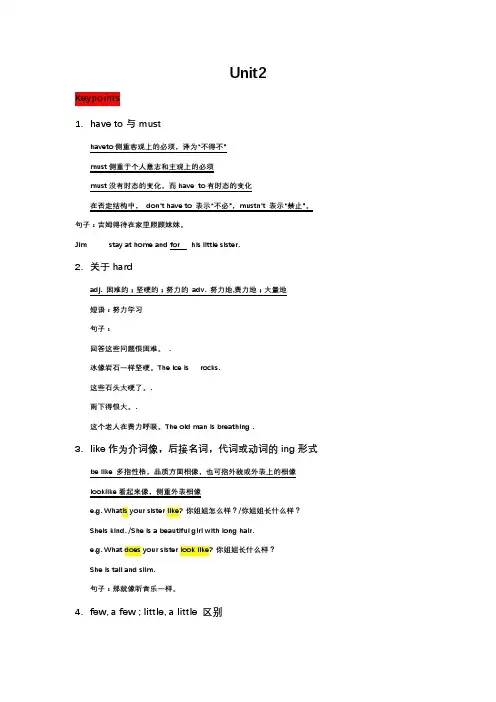
Unit2 Keypoints1.have to与musthaveto侧重客观上的必须,译为“不得不”must侧重于个人意志和主观上的必须must没有时态的变化,而have to有时态的变化在否定结构中,don't have to 表示“不必”,mustn't 表示“禁止”。
句子:吉姆得待在家里照顾妹妹。
Jim stay at home and for his little sister.2.关于hardadj. 困难的;坚硬的;努力的adv. 努力地,费力地;大量地短语:努力学习句子:回答这些问题很困难。
.冰像岩石一样坚硬。
The ice is rocks.这些石头太硬了。
.雨下得很大。
.这个老人在费力呼吸。
The old man is breathing .3.like作为介词像,后接名词,代词或动词的ing形式be like 多指性格,品质方面相像,也可指外貌或外表上的相像looklike看起来像,侧重外表相像e.g. Whatis your sister like? 你姐姐怎么样?/你姐姐长什么样?Sheis kind. /She is a beautiful girl with long hair.e.g. What does your sister look like? 你姐姐长什么样?She is tall and slim.句子:那就像听音乐一样。
4.few, a few ; little, a little 区别句子:房间里几乎没有人。
Thereareintheroom.在美国,我有几个朋友。
玻璃杯里几乎没有水。
There’s in the glass.她懂一点儿英语。
Thephysics problem is too hard, so students can work it out.A.littleB. fewC. a littleD. a few拓展:quitea few 意为5.vacation n.假期(c./u.)多用于美式英语,英式英语常用holiday短语:在度假去度假度假寒/暑假句子:你的假期怎么样?6.fall n. 秋天;瀑布(c.)句子:瀑布多美啊!7.practise vi. 练习,操练vt.后接-ing形式e.g. My sister practises playing the piano every day.拓展:practice名词“实践,练习”常作不可数名词,美式英语中亦可以作动词你如果想学好英语,就需要大量的练习。
牛津译林版八年级英语上册Unit2单词、句子知识点

牛津译林版八年级英语上册Unit2单词、句子知识点Unit 2 School lifePeriod 1 Comic strip & Welcome to the unit必背单词1. British adj. 英国的→ Britain n.英国,大不列颠2. biscuit n.< 英> 饼干→ cookie n. < 美> 饼干3. rubber n.< 英> 橡皮→ eraser n. < 美> 橡皮4. American adj. 美国的→ America n. 美国;美洲5. vacation n.< 美> 假期6. fall n.< 美> 秋天7. store n.< 美> 商店8. truck n.< 美> 卡车9. yard n.< 美> 院子10. movie n.< 美> 电影必背句子11. Because we’re cleverer than people. 因为我们比人更聪明。
12. They have to work harder. 他们要更加努力工作。
13. What’s school like? 学校是什么样子?14. I’d love to, but the school football team will practise this saturday.我愿意,但这周六学校足球队将组织训练。
Period 2 Reading必背单词1. French n. 法语→ France n.法国,法兰西→ Frenchman n. 法国人2. foreign adj.外国的→ foreigner n.外国人3. language n. 语言4. during prep.在……期间5. discuss vt. 讨论,议论→ discussion n. 讨论,谈论6. offer vt. 主动提出,自愿给予7. end vi. & vt. 结束→ ending n.结尾,结局8. baseball n.棒球9. win vt. & vi.赢得;赢,获胜→ 过去式won → 过去分词won → winner n. 获胜者,得奖者必背短语10. in Year 8 读八年级11. Reading week 阅读周12. during the week 在这一周期间13. discuss sth. with sb. 与某人讨论某事14. in class 在课堂上15. seem to do sth. 似乎/ 好像做某事16. help new students learn more about the school帮助新同学了解更多关于学校的东西17. offer sb. help 给某人提供帮助18. do sports together 一起做运动,一起进行体育活动19. play baseball 打棒球20. every time 每次,每回21. last month 上个月必背句子22. Boys and girls have lessons together.男孩和女孩在一起上课。
Unit2知识点梳理牛津译林版八年级英语上册
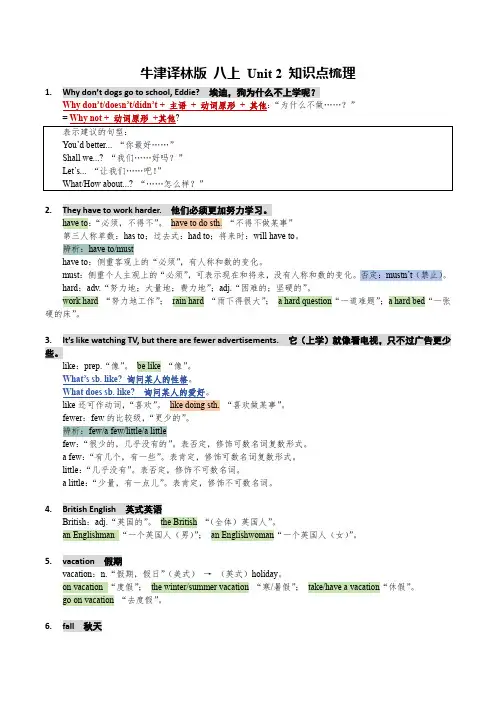
牛津译林版八上Unit 2 知识点梳理1.Why don’t dogs go to school, Eddie? 埃迪,狗为什么不上学呢?Why don’t/doesn’t/didn’t + 主语+ 动词原形+ 其他:“为什么不做……?”2.They have to work harder. 他们必须更加努力学习。
have to:“必须,不得不”。
have to do sth. “不得不做某事”第三人称单数:has to;过去式:had to;将来时:will have to。
辨析:have to/musthave to:侧重客观上的“必须”,有人称和数的变化。
must:侧重个人主观上的“必须”,可表示现在和将来,没有人称和数的变化。
否定:mustn’t(禁止)。
hard:adv.“努力地;大量地;费力地”;adj.“困难的;坚硬的”。
work hard “努力地工作”;rain hard “雨下得很大”;a hard question“一道难题”;a hard bed“一张硬的床”。
3.It’s like watching TV, but there are fewer advertisements. 它(上学)就像看电视,只不过广告更少些。
like:prep.“像”。
be like “像”。
What’s sb. like? 询问某人的性格。
“喜欢做某事”。
fewer:few的比较级,“更少的”。
辨析:few/a few/little/a littlefew:“很少的,几乎没有的”。
表否定,修饰可数名词复数形式。
a few:“有几个,有一些”。
表肯定,修饰可数名词复数形式。
little:“几乎没有”。
表否定,修饰不可数名词。
a little:“少量,有一点儿”。
表肯定,修饰不可数名词。
4.British English 英式英语British:adj.“英国的”。
the British “(全体)英国人”。
Unit2知识点牛津译林版英语八年级上册
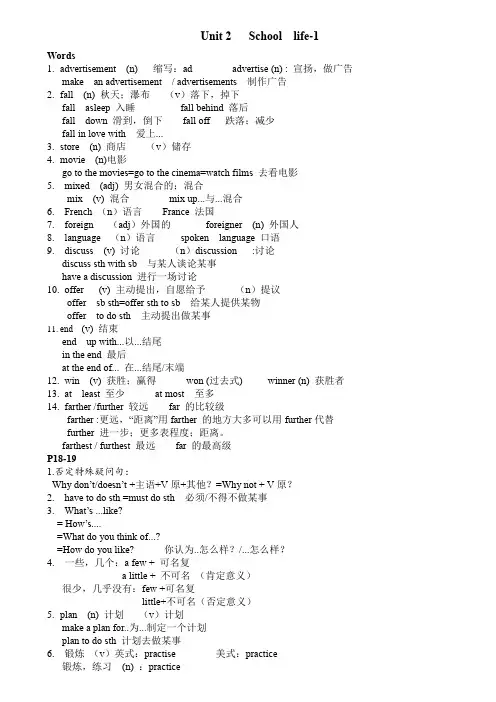
Unit 2 School life-1 Words1.advertisement (n) 缩写:ad advertise (n) : 宣扬,做广告make an advertisement / advertisements 制作广告2.fall (n) 秋天;瀑布(v)落下,掉下fall asleep 入睡fall behind 落后fall down 滑到,倒下fall off 跌落;减少fall in love with 爱上...3.store (n) 商店(v)储存4.movie (n)电影go to the movies=go to the cinema=watch films 去看电影5.mixed (adj) 男女混合的;混合mix (v) 混合mix up...与...混合6.French (n)语言France 法国7.foreign (adj)外国的foreigner (n) 外国人nguage (n)语言spoken language 口语9.discuss (v) 讨论(n)discussion :讨论discuss sth with sb 与某人谈论某事have a discussion 进行一场讨论10.offer (v) 主动提出,自愿给予(n)提议offer sb sth=offer sth to sb 给某人提供某物offer to do sth 主动提出做某事11.end (v) 结束end up with...以...结尾in the end 最后at the end of... 在...结尾/末端12.win (v) 获胜;赢得won (过去式) winner (n) 获胜者13.at least 至少at most 至多14.farther /further 较远far 的比较级farther :更远,“距离”用farther 的地方大多可以用further代替further 进一步;更多表程度;距离。
牛津译林版八年级英语上册Unit2语言点归纳总结

牛津译林版八年级英语上册Unit2语言点归纳总结牛津译林版八年级英语上册8A Unit 2 School LifeComic Strip & Welcome to the unit (P.18-P.19) 单词1.advertisement n. 广告2.British adj. 英国的3.biscuit n. <英>饼干4.lorry n. <英>卡车5.rubber n. <英>橡皮6.American adj. 美国的7.eraser n. <美>橡皮8.soccer n. <美>英式足球9.vacation n. <美>假期10.cookie n. <美>饼干11.fall n. <美>秋天12.store n. <美>商店13.truck n. <美>卡车14.yard n. <美>院子15.movie n. <美>电影词组1.have to 不得不2.work harder 工作更努力3.have some plans for the weekend 周末有些安排4.have an important match 有个重要的比赛5.this autumn 今年秋天句子1.What’s school like? 学校是什么样的?2.Where are you going? 你要去哪?3.Shall we ...? 我们...,好吗?语法British English & American EnglishReading (P.20-P.22)单词1.mixed adj. 混合的,男女混合的2.French n. 法语3.foreign adj. 外国的/doc/1d2885995.html,nguage n. 语言5.during prep.在...期间6.discuss vt. 讨论,议论7.guy n. <口>家伙8.buddy n. <口>好朋友;搭档9.offer vt. 主动提出,自愿给予10.end v. 结束11.baseball n. 棒球12.win v. 赢得;赢,获胜词组1.life in a British school 英国学校的生活2.in Year 8 在8年级3. a mixed school 一所混合学校4.have lessons together 一起上课5. a Reading Week 读书周6.during the week 在这周内7.borrow ... from... 从...借...8.bring in books and magazines from home 从家里带来书和杂志9.near the end of the week 在这周接近尾声时10.discuss the books with our classmates 和我们的同学一起讨论这些书11.in class 在课堂上12.seem to do sth 似乎做某事13.life in an American school 美国学校的生活14.in the 8th grade 在8年级15.go to the Buddy Club 去“伙伴俱乐部”16.older students 学长17.learn more about the school 更多地了解学校18.listen carefully to my problems 认真地倾听我的问题19.offer me help 给我提供帮助20.have different classes 上不同的课21.on Friday afternoon 在周五下午22.do sports together 一起运动23.twice a week 每周两次24.play baseball 打棒球25.practice hard 认真练习26.every time 每次27.win two games 赢了两场比赛/doc/1d2885995.html,st month 上个月29.the best in a competition 比赛中最好的句子1.Among all my subjects, I like French best. 在我所有的课程中,我最喜欢法语。
牛津译林版八年级英语上册Unit2知识点归纳

have fewer days off have a monthly test on each subject
18. 迅速地浏览问题
look through the questions quickly
19. 坚持用英语写关于我的日常 keep writing in English about my daily life
spend 意为花费。表示“花时间做某事”的结构有:
sb spend some time on/ doing sth; It takes/took sb some time to do sth
sb have some time for (doing) sth; sb have some time to do sth
13. 每次刻苦训练
practice hard every time
14. 一个男孩写的一篇文章
an article by a boy
15. 画得比任何其他学生好
draw better than any other student/ the other students
16. 休息更少的天数 17. 每门学科举行一次月考
(1) the number of…表示“……的数量”。作主语的中心词时,谓语动词用单数形式,后常 跟 large, small 等词作表语。如: 我们学校的学生数量非常大。
The number of the students ________ very _______ in our school.
【核心语法】
一、数量的比较。 我们常用_______________和_________________对人或事物的数量进行比较,表示“比... 多”和“比...少”。 常用_______________和_________________对人或事物的数量进行比较,表示“最多”和 “最少”。 【练一练】选用所给词组填空。
牛津译林版八年级英语上册 Unit2 School life 知识点
牛津译林版八年级英语上册Unit2 Schoollife 知识点Unit2 School life第一课时Comic strip and welcome to the unit 知识点总结1.buy sth.for sb.给某人买某物buy sth.for sb. =buy sb.sth.eg: She often buys some food for her family.=She often buys her family some food.她经常为她的家人买食物。
2. Why don't dogs go to school, Eddie 埃迪,狗为什么不去上学呢①这是一个由why引导的特殊疑问句,用于询问原因。
②Why don't you do sth. 和Why not do sth. 表示建议,两者常可互换。
eg: Why don't you go with me你为什么不跟我一起去呢Why not have a rest为什么不休息一下呢3. It's like watching TV,but there are fewer advertisements.它(上学)就像看电视,只不过广告少一些。
①like介词,像……一样。
②but 表转折,连接并列句。
③fewer 更少的,后接可数名词复数。
I'd love to,but.….我想去,但是……①可以用于对Would you like to do sth. 的回答。
eg:-Would you like to go to the concert with me tonight-I'd love to,but I have to look after my little sister at home.--今晚你想和我去听音乐会吗-我想去,但是我得在家照顾我的小妹妹。
②同义句转换I'd love to do...=I'd like to do...Unit2 School life 第二课时Reading(1) 知识点总结1. during prep.在……期间,后接名词或名词性短语。
牛津译林版八年级上册Unit 2知识点总结
Unit 2一.单词和短语1.Why don’t/ doesn’t/didn’t sb do sth? = Why not do sth表示建议的句型:Why not / Why don’t you How/ What about...Shall we... Let’s do... You’d better do...2.have to 不得不客观原因造成have to +v.原3.like * v. 喜欢like doing sth* prep. 像be like doing sthwhat be sb/sth like ...怎么样What will your future be like?4.advertisemen(s) 可数n. advertise v.做广告5.few / a few 可数名词little / a little 不可数名词few / little 否定(几乎没有) a few / a little 肯定(一些)few—fewer—fewest little—less—leastthe fewest friends the least moneyat least至少at most最多6.British adj.英国的n. 英国人Britain n. 英国have a seven-day holiday (seven days’) have two weeks off两个星期的假期be on holiday go to sp for a holiday go on a trip to sp7.practise doing sth练习做某事finish doing sth. 完成做某事keep on doing sth. 继续,重复做某事have fun= have a good time= enjoy oneself + (in)doing sth 做某事很开心8.vocation假期= holiday (英式)take a vacation 度假be on vacation 在度假9.France—French—Frenchman/ Frenchwoman10.Learning foreign languages is fun. 动名词作主语,谓语动词用单数learn to do sth learn how to do sth→learn how to speak Englishlearn—learner foreign—foreigner11.during+ 一段时间在....期间during the summer holiday during my stay in New York12.bring sb sth = bring sth to sb 把某物带给某人borrow 借进borrow sth from sb lend 借出lend sb sth = lend sth to sb13.near the end of 在...接近结束时at the end of 在...结束时/在...尽头in the end = at last = finally 最后by the end of ... 到... 为止in the beginning = at first 最初,一开始at the beginning of 在...开始时14.discuss v. 讨论discuss sth = talk about sthdiscuss sth with sb = have a discussion with sb about/on sth15. seem 似乎,好像(系动词)seem + adj. / 名词短语He seems very tired. He seems (to be) a clever boy.seem to do sth It seems to be a little cold today.* It seems that 从句It seems that the weather is getting colder and colder.16.offer v. 主动提供offer sb sth = offer sth to sboffer to do sth 主动做某事She offered to lend me her umbrella.17.fast 强调自身速度快quickly 做事动作soon 强调所花时间短18.else adj. 其它的不定代词/ 特殊疑问词+elsenothing else what else = what other things19.the number of + n. 复.....的数量作主语时,谓语动词用单数a number of + n.复许多.... 作主语时,谓语动词用复数eg. A number of teachers are here today, and the number of them is 400.The number of pandas is getting smaller and smaller/ bigger and bigger/ larger and larger.20. half an hour for playing computer games and another half an hour for playing chesshalf an hour 半小时one hour and a half / one and a half hours 一个半小时21.day-daily daily life日常生活22.through,prep. 自始至终,从头到尾look through浏览,快速查看,看穿look up 查阅look over 检查look for 寻找look out 小心look after 照顾look forward to盼望23 need 行为动词need to do / don’t need to do情态动词need do / needn’t do (无时态变化)You need to do it now. →You don’t need to do it now.(有人称时态变化)情态动词need用于回答must问句Must I do it now? —Yes, you must. / No, you needn’t. / No, you don’t have to.24.have +时间for + sth/ to do sth二.语法副词和形容词一样,也有原级、比较级和最高级。
牛津译林版八上英语Unit2单元知识汇总
U2学案一、词汇1.foreign adj. “外国的”,常用在名词前修饰名词,作定语。
a foreign language 一门外语;foreign countries外国;foreigner外国人。
Foreigners have foreign ways of life.2.during prep.“在……期间”,引导名词、代词或名词性短语,不能用来引导句子。
误:During he was in Nanjing, he visited many places.正:During his stay in Nanjing, he visited many places.3.discuss vt.及物动词,意为“讨论”,后面直接跟宾语(名词、代词、动名词或从句)而不需要用介词。
Have you discussed this problem with anyone? We discussed buying a second car.4.offer vt. “主动提出,自愿给予”,offer sb. sth.=offer sth to sb.给某人提供某物。
Please offer some coffee to me. =Please offer me some coffee.5.win vt.& vi.“赢得;赢,获胜”,其宾语是比赛、战争、奖品、金钱等名词,即race,match,game,competition,war,prize之类的词,而不能是表示人的词。
They won the match this time. He won the first prize in the surfing competition他在冲浪比赛中获得了第一名。
当赢的宾语是人或队的名称时要用beat。
We played very well, and we beat them at last.6.real adj. “真实的,真的”,指客观上存在的,而不是想象、虚构或仿造、伪造的。
牛津译林版八年级英语上册Unit2 school life单元知识点汇总
牛津译林版八年级英语上册Unit2 school life单元知识点汇总Comic strip and welcome to the unit知识详析.积累拓展➊[辨异] clever, smart,bright的区别clever表示“聪明;灵巧”时,指人或动物的脑子灵活;指做成的事物时,常含有巧妙的意思。
如:People love to see the clever monkey.人们爱看这只聪明的猴子。
smart与clever 同义,但更强调顽皮的一面。
如:You can not cheat him because he is a smart boy.你骗不了他,因为他是个聪明的男孩。
bright意为“聪明;思路敏捷”,它多用来指年轻人或小孩,常用于口语中。
如:She is rally a bright little girl.她真是一个聪明的小姑娘。
❷[辨异]must和have to(1)must没有时态和人称的变化,后面跟不带to;而have to有时态和人称的变化。
②must not 的意思是“不许,不可以” ; don't have to的意思是“不必”③must带有主观因素,意思是“一定、必须”;have to带有客观因素,意思是“不得不”。
[中考典例)----- How do you usually go to school?----My school is far away.I______take the bus to school.A. mustB. mightC. have to答案:C 解析本题考查情态动词的用法。
因为前句说的是“我的学校很远。
”所以下句是“我得乘公交车上学。
”这里是客观因素导致了我乘公交车上学,因此此处用have to来表示。
❸few用作形容词时,意思是“少数的,不多的",修饰可数名词,作定语。
其比较级和最高级是fewer和fewest. few用作不定代词时,表示否定,意思是“少数几个、几乎没有”。