
2020年人教版高中英语必修四同步课件:Unit 3 A taste of English humour Section Ⅲ
放声大笑 有一次 拾起;捡起 把……当作/看作…… 在露天;在户外 向上看;查阅 对……作出反应;回应 合计;把……加起来 小声地 乱七八糟 注意
1.“make+宾语பைடு நூலகம்宾补”结构
Instead, what he gets is another kind of answer which _m_ak_e_s_
timely help.
[能力提升]——完成句子
③玛丽正在节食,所以她对食物相当挑剔。
Mary is going on a diet, so she _i_s_ve_r_y_p_ar_ti_cu_la_r_a_bo_u_t______food.
2.occasion n.时刻;机会;原因;场合
(教材 P20)On one occasion in a restaurant he ordered a steak
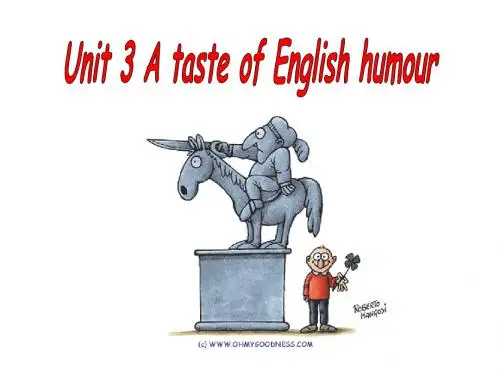
Unit 3 A taste of English humour
Section Ⅲ Learning about Language & Using Language
1 教材助读
练读文 记词汇 学翻译
2 语篇理解
通语篇 学理解 重分析
Read the text carefully and choose the best answer. 1 . In the second dialogue the customer in fact means
C.Their tent was blown away by the strong wind.
D.They quarrelled with each other about different opinions of
life.
5.The text mainly tells us
.
A.a joke made by Sherlock Holmes and Doctor Watson
答案:1~5 CBDAA
3 基础梳理
记单词 记短语 记句型
记住新知识
1.__bu_d_g_et___ n.预算;开支 2.__sl_id_e___ vt.& vi.(使)滑动;(使)滑行 重 基 n.滑;滑动;幻灯片 点 础 3.__p_an_c_a_ke____ n.烙饼;薄饼 词 词 4.__w_hi_sp_e_r___ n.耳语;低语 vt.& vi.低语;小声说 汇 汇 5.__va_s_t __ adj.巨大的;辽阔的 6._p_o_rr_id_g_e ___ n.粥;麦片粥 7.__dr_u_nk___ adj.醉的
4 要点透析
研词汇 析句型 练拓展
1.particularly adv.特殊地;特别地 (教材 P20)Children particularly would burst into laughter at
his behaviour. 尤其是孩子们看到他的表演会大笑不止。
[归纳拓展]
particular adj.
that
.
A.he doesn't know what it is now
B.he doesn't hear clearly what the waiter says
C.he is not content with the soup
D.he mistakes “bean” for “been”
2 . In the third dialogue the customer really wants to
重 _th_e_si_tu_a_ti_on_f_u_nn_y________(使事情诙谐有趣). 点 2.should have done 意为“本应该……而……” 句 What did John think Mary should _h_av_e_d_o_ne_w__ith_____(本应该 型 处理)the mess in the pan?
觉得好笑的;逗乐的 对……觉得好笑 使某人快乐 好笑的 愉悦;娱乐 使某人感到好笑的是
[基础训练]——单句语法填空/单句改错 ①The comedy was full of humour, which not only __am_u_s_ed____ (amuse) the audience, but also built up their confidence in life. ②Lucy has a great sense of humour and always keeps her colleagues __am__us_e_d ___ (amuse) with her stories. ③It amused me _t_o_th_in_k____ (think) back to my life in London. ④However amused the story is, I have to put it away and focus my attention on study this week. ___a_m_u_se_d_→_a_m_u_s_in_g_______
3.whenever 引导让步状语从句
_W__h_en_e_ve_r_y_o_u _fi_ni_sh_y_o_u_r _st_or_y________(不管你何时完成故事),
you will feel a sense of success.
联想微空间
“-ous”后缀形容词一览 ①humorous 幽默的 ②dangerous 危险的 ③mountainous 多山的 ④continuous 连续的 ⑤poisonous 有毒的 ⑥generous 慷慨的 ⑦famous 著名的
联想微空间
“作出反应”的各种表达聚焦 ①react to 对……作出反应;回应 ②respond to 响应;回应…… ③reply to 回答;答复…… ④answer to 对……作出解释
联想微空间
“粥”类食品一览 ①rice porridge 稀饭 ②mung bean porridge 绿豆粥 ③sweet potato congee 地瓜粥 ④millet congee 小米粥 ⑤pumpkin porridge 南瓜粥
3.amuse vt.使发笑;使愉快
(教材 P22)There are thousands of jokes which use “play on
words” to amuse us. 有成千上万的笑话是以“玩文字游戏”的方式来逗我们发
笑的。
[归纳拓展]
(1)amuse sb. with/by ...
1._b_u_rs_t_in_to__la_ug_h_te_r_____ 2._o_n_o_n_e_o_cc_a_si_on_____ 3._p_i_ck_u_p___ 重 4._t_re_a_t _..._a_s _...____ 点 5._in__th_e_o_pe_n_a_ir____ 短 6._l_oo_k_u_p___ 7._r_e_ac_t _to___ 语 8._a_dd__up___ 9._in__a _w_hi_sp_e_r___ 10.__in_a__m_es_s____ 11._p_a_y_a_tt_en_ti_o_n_to_____
A.In the morning.
B.At noon.
C.In the afternoon.
D.At night.
4.What happened to Sherlock Holmes and Doctor Watson?
A.Their tent was stolen by someone.
B.They quarrelled with each other about their tent.
[温馨提示] occasion 作定语从句的先行词,如果表示时间,意为“时刻, 机会”,关系副词用 when;如果表示地点,意为“场合”,关 系副词用 where。 Have you ever met with the occasion where you are mistaken? 你是否遇到过被人误解的时候? It's a cheerful occasion when my birthday arrives. 我的生日来临时是个快乐的时刻。
用/以……娱乐某人
amuse oneself
自娱自乐
It amuses sb. to do sth.
做某事使某人发笑
(2)amused adj. be amused at/by ... keep sb. amused amusing adj. (3)amusement n. to one's amusement
tartare.
有一次他在餐馆叫了一份生食鞑靼牛排。
[归纳拓展]
(1)on occasion(s)
有时;间或
on this/that occasion
这/那次
on the occasion of sth.
在……之际
have occasion to do sth.
有理由做某事
(2)occasional adj.
特殊的;特别的
n.
细节;细目
in particular (=particularly) 特别地;尤其地
be particular about
对……挑剔
[基础训练]——单句语法填空
①The boy likes anything to do with nature _i_n_ particular.
②We are _p_ar_ti_cu_l_ar_ly____(particular) grateful to him for his
B.a dialogue between Sherlock Holmes and Doctor Watson
英语必修四人教版 Unit3 A taste of English humour (共27张PPT)
Para.3 Describe the appearance of the tramp
a small black hat a moustache
very large trousers
a walking stick
worn-out shoes
Para.3
Find out some words to describe the characteristic of the tramp
• Difficult points: Help students know the differences between English and Chinese in humor.
• Teaching aids: Pictures
• Teaching procedure:
Look at the following pictures.
shoes, large trousers and a small round black hat, and
he was always carrying a walking stick.
Charlie Chaplin _s_ta_r_r_e_d_ in the film The Gold Rush. He
Optimisim Dertermination
Kindness
Para 4
1.When did the story happen? In the end of the nineteenth century 2.Why did they rush to Alaska?
In search of gold
In pairs make up a dialogue of your own and act it.
【高中】2020人教版高中英语必修四Unit3AtasteofEnglishhumour
文档从网络中收集,已重新整理排版.word版本可编辑.欢迎下载支持. 【关键字】高中Book 4 Unit 3 A taste of English humorand comprehending(for students)By Xu Benwen Dai Fengli and Xu LeileiPart 1 读前任务,反复是关键,贯穿单元全过程Word learning tips: 音形结合及时重复联想归类语境运用多感官参与和构词法A.根底词汇扫描1. 写出这些单词的意思,并反复记忆,熟练读音和意思(实验班层次的同学快速完成, 普通班同学反复细致掌握)。
humour ___________ punchline ___________ verbal _________ nonverbal ___________ mime ___________ comedy ___________ brighten __________ depressed _________ content _________ performer _________ astonish _________ astonishing _________ fortunate ________ unfortunately _______ teens __________ ordinary __________ bored __________ subtle _________ entertain __________ entertaining _________ charming _________ tramp _________ throughout __________homeless ___________moustache __________worn ____________worn-out ___________stiffly ___________failure ___________optimism __________overcome _________underdog _________snowstorm _________leather __________lace ____________chew __________mouthful _________enjoyment _________convince _________convincing _________direct _________outstanding _________confidence __________costume _________gesture _________particular _________particularly _________occasion __________budget _________actress _________slide _________amuse _________amusing _________pancake _________explanation _________detective ________mountainous ________whisper _________vast ____________rhythm __________mess ____________react ___________porridge ___________drunk ___________2. 根据英语释义从所给词中选出正确的单词填空。
高级中学人教版高中英语必修四课件:Unit 3 A Taste of English Humor

Great moments in evolution
Darwin’s theory of evolution
Mother’s Day
Telescope
Painter:
Hold on! I think I’ll finish it in about three minutes.
Betty Botter Bought Some Butter
Betty Botter bought some butter, “But”, she said, “the butter is bitter. If I put it in my batter, It will make my batter bitter. But a bit of better butter That would make my batter better.” So she bought a bit of butter, Better than her bitter butter. And she put it in her batter, And the batter was not bitter. So it was better Betty Botter Bought a bit of better butter!
Listening and taking notes
Thank Kristian and Tyler for the co-operation of making records
1. Policeman: You can’t __pa_r_k__ here. Driver: Why not?
Policeman: Read that sign. Driver: I did. It says: “_F_in_e_ for _p_a_rk_ ing”, so I _p_a_rk_ ed.
人教版英语必修四Unit3 A taste of English humor-Warming up and reading[课件]
![人教版英语必修四Unit3 A taste of English humor-Warming up and reading[课件]](https://360docs-1393072327.cos.ap-beijing.myqcloud.com/f2cda0c233d4b14e85246850.webp)
His job is
an actor
Type of acting is
mime and farce.
He died in 1977
Charlie Chaplin
in Switzerland. Reasons of success:
He could astonish and
His costume:
large trousers, worn-out shoes and small round black hat.
very wide trousers
He wore a small black hat, very wide trousers, a moustache and carried a stick that he swung in the air as he walked.
Answer the questions
Mr. Bean
• Charlie Chaplin
Gold rush
picture from
The Gold Rush
Fast reading:
1.Who is the main character of the text? What was he famous for?
The main character is Charlie Chaplin. He was famous for his nonverbal humour.
Chinese humors Pantomime Funny plays Cross talk Jokes Doggerel
English humors Nonverbal Mime and farce Verbal jokes Funny stories Funny poems
人教版高中英语必修四Unit 3《A taste of English humour》(Section 2)ppt课件1

编后语
• 常常可见到这样的同学,他们在下课前几分钟就开始看表、收拾课本文具,下课铃一响,就迫不及待地“逃离”教室。实际上,每节课刚下课时的几分 钟是我们对上课内容查漏补缺的好时机。善于学习的同学往往懂得抓好课后的“黄金两分钟”。那么,课后的“黄金时间”可以用来做什么呢?
• 一、释疑难 • 对课堂上老师讲到的内容自己想不通卡壳的问题,应该在课堂上标出来,下课时,在老师还未离开教室的时候,要主动请老师讲解清楚。如果老师已
语法指南
2.动词-ing形式做定语 (1)动词-ing形式做定语,表示其动作是所修饰的名词发出的,表示 动作正在进行。单个的动词-ing形式做定语时应放在所修饰名词 的前面;若是动词-ing短语做定语时,应放在所修饰词之后。 a smiling face一张笑脸 a leading figure一个领导人 动词-ing形式还能构成合成词做定语。例如: an easy-going man一个好相处的人 动词-ing短语做定语,常放在被修饰词的后keep,leave,have,set,catch等动词后表示宾语持续或进行 的动作,如:
Finally they got the new machine working again. 最后他们又使新机器运转起来了。 His remark left me wondering what he was driving at. 他的话使我摸不清到底是什么意思。 注意:省略to的不定式做宾语补足语,表示动作全过程,即已经发 生。 We saw the thief enter the store. 我们看见那小偷进了那家商店。
Section Ⅱ Grammar
语法指南
动词-ing形式做表语、定语和宾语补足语 1.动词-ing形式做表语 (1)动词-ing形式做表语是用来说明主语的具体内容。在这种情 况下,主语和表语通常是对等的关系,可互换位置。 The police’s job is keeping public order. 警察的工作就是维护公共秩序。 Keeping the money you pick up is stealing. 留下你捡到的钱就是偷。 注意:不定式和动词-ing形式做表语一般没有多大区别,只是不定 式做表语有时表示将来,动词-ing形式做表语表示一般抽象的情况。
高中英语人教版必修4课件:Unit3A-taste-of-English-humour
归纳拓展
(1)astonish vt.使大为吃惊,使惊讶(比 surprisastonish sb with/by doing sth用某物/通过做 某事使某人惊讶
搭配be astonished at/by doing sth对某事感到惊讶 be astonished to do sth惊讶地做某事 what astonishes sb is...令某人吃惊的是……
3.astonishing adj.(=very surprising)令人惊讶的
(教材原句 P18)You may find it astonishing that Charlie was taught to sing as soon as he could speak and dance as soon as he could walk.
⑦I found it ________ (astonish) that the young couple had a heated argument in public.
答案:①astonished us by losing much weight ②are astonished at the result ③astonished astonishing
③The old man contented himself ________ a single glass of beer.
单句改错。 ④I always r ead the content of a book fir st of all. _____________________________________________ 答案:①is content with ②to stay ③with
Unit3 A taste of English humour
2019-2020学年人教版英语必修四新素养同步讲义:Unit 3 A taste of English humour 2 Section Ⅱ Word版含
Section ⅡWarming Up & Reading—Language Pointsup to now直到现在(经典例句)Many people have struggled against poverty up to now.直到现在很多人还在与贫穷作斗争。
(1)up to+数字达到,多达……(2)It’s up to sb.to do sth. 由某人决定做某事。
(3)be up to sth. 胜任某事①Up to now only a small number of schools have been built in this area.到目前为止,这个地区仅仅建了少数几个学校。
②It is up to you to decide how much you should pay her for the job.她做这项工作应该付给她多少钱,这得由你来定。
[能力提升]——一句多译依我看来,他不适合这项工作。
①In my opinion, he is__not__up__to__the__job.②As far as I’m concerned, he is__not__fit__for__the__job.up to now 相当于so far,在句中作状语,其后接的时态一般为现在完成时。
content adj.满足的;满意的n.满足;内容;目录v t.使满足(教材P18)He made people laugh at a time when they felt depressed, so they could feel more content with their lives.在人们感到沮丧的时候,他可以使他们开怀大笑,于是人们就会对自己的生活感到更满足。
(1)feel/be content with...对……满足/满意be content to do sth. 满足于做某事(2)content oneself with 满足于①We must not be content with such a small success.我们不应该满足于这样的小成就。
人教版英语必修四Unit 3 A Taste of English Humour
direct sb. to do/ that sb. (should) do 指导/指示某人做某事 in all directions/ in every direction 四面八方
direct adv. & directly adv.& conj. direction n.
直接,径直& 直接地,立即;一…就 方向,指导,用法说明,操作指南
2020/04/13
4U3 A TASTE OF ENGLISH HUMOUR
3
2. astonishing adj. 令人惊讶的
【感悟用法】 (1) He was astonished____t_o_h__ea_r______ (hear) he had got the job. (2) To our great _a_st_o_n_i_s_h_m_e_n_t_ the boss wasn’t a_s_t_o_n_is_h_e_d__ at the a_s_t_o_n_is_h_i_n_g_
【用法总结】
feel/be content _____w_i_th___ sb./ sth. be well content ____t_o_d_o___ content oneself ____w__it_h___ sb./sth. content n.
对…满足/满意 (非常)满足于做;愿意做 满足于
6. Simple _d_i_r_e_c_ti_o_n_s_ (direct) for the model are printed on the box. 7. She is so particular ___a_b_o_u_t___ her housework that servants won’t work for
2020版高考英语人教版一轮复习练习:必修4 Unit 3 A taste of English humour(含解析)
2020版高考英语人教版一轮复习练习Unit 3 A taste of English humourⅠ.阅读理解AA trip to LondonMy family had dreamed of a trip to London for a long time.Luckily it was possible for us to realize our dream because all of us were free on the weekend.We planned to drive into Cambridge and caught the 7: 34 train to Liverpool Street Station.Then my wife and I would separate from Joan,my wife’s sister,to do different things and finally meet again for lunch.And after lunch,we would go to the concert.But we were late because of a thick London fog.The train had to move along so slowly that it was not until 10:30 that it got there.In spite of our late arrival,Joan decided that she would go to see the Crown Jewels in the Tower of London while we went shopping.It was only after her sister had disappeared into the fog that my wife realized that we hadn’t decided where we should meet for lunch.Since I had our three tickets for the concert in my pocket,this was indeed a problem.We didn’t have any mobile phones at that time.There seemed to be nothing we could do except taking a taxi to the Tower of London,and trying to find her there.Needless to say,wedidn’t find her.It was now one o’clock,and the concert began at 2:30.“Perhaps she will think of waiting outside the concert hall,” said my wife hopefully.By this time the fog was so thick that road traffic had to stop,and the only way to get there was by subway.Hand in hand we felt our way along the road to where we thought the nearest station should be.An hour later we were still trying to find it.Just when I was about to become angry,we met a blind man tapping his way confidently through the fog.With his help we found the subway station which was just fifty meters down the road.By now it was far too late to get to the concert hall before the performance began at 2:30,so we decided to return to Cambridge.It took seven hours instead of the usual two to make that journey.Nor were we able to get any food or drink on the train.We were tired andhungry.We finally reached home at ten.Opening the door we were amazed to find Joan at home; she had seen the Crown Jewels,had managed to get another ticket for the concert,and had hada wonderful dinner at a restaurant.Of course,she managed to get home,too.Oh,my god!1.What did the writer plan to do after lunch that day?A.Go to the concert.B.Return to Cambridge.C.Go shopping.D.See the Crown Jewels.2.The writer and his wife separated from Joan because .A.they were late for the concertB.Joan didn’t want to go to the concertC.there was a thick fogD.they planned to do different things until lunchtime3.Who helped the writer find the subway station?A.A taxi driver.B.A blind man.C.His wife.D.Joan.4.The writer and his wife felt on the train back home.A.quite interestedB.rather disappointedC.tired and hungryD.very enjoyable语篇解读:本文讲述作者一家周末去伦敦的旅行。
2020人教版高中英语必修四Unit3AtasteofEnglishhumour
Unit3 A Taste of English Humor 教学设计北京二中修苗苗I.General Introduction of this lessonTeaching Content: The first period of Unit 3 A Taste of English Humour in the New Senior English for China Student’s Book 4 published by People’s Education Press.II.Teaching objectivesBy the end of this lesson, students are able to:✍∙find out the punchlines in the jokes provided;✍∙write their own punchlines and jokes based on givensituations.III.Brief introduction of the instructor and the studentsThe instructor is a novice English teacher who graduated last year from Beijing Normal University with a master’s degree. The 38 students are from Class Eight, Grade One, an average class in Beijing No.2 Middle School.IV.Available materials for this lessonPPT slides, handouts, English textbook, audio filesV.Teaching proceduresStep One: Warming up (5’)T: As the title suggests, in this unit we are going to taste some English humour. But first I want you to think about one question: How many types of English humour are you familiar with? You can discuss it with your partner.Ss will be given one minute to have a discussion.T: Ok, now let’s look at two pictures which will help you work out this question. (mime and comedy)T: Besides these two types, there is still one type of humour in written forms, that is, English jokes. So today we will focus on the third type.to activate students’ background knowledge of English humour and arouse their interest.T: Now let’s taste an English joke together. After reading it, I would like you to find out the sentence that makes the story funny. And also try to explain the story in your own words.T: For this kind of sentences which makes the whole story funny, we have a name for them, that is, punchline. Ok, now let’s read the definition of punchline together.function of punchlines which lays a foundation for the next step, that is, to find out punchlines in different jokes by themselves.Step Two: Reading (5’)T: Read the four jokes on the handout and underline the punchlines in each one of them.T: Now discuss with your partner why they are funny. Try to use your own words to explain them.based on what they’ve learnt in the first part.Step Three: Reading and Matchin g (7’)T: Read the five stories and choose the best punchlines for them.T: Share your answers with your partner and discuss with each other why you choose that one.Purpose: to deepen students’ understanding of how to use punchlines to achieve a humorous effectStep Four: Listening(15’)T: Now we are going to listen to a funny story. Before listening, I would like you to read the two questions. Based on the key words from the questions, can you predict what will happen in the story?T: Now let’s listen to the tape twice and try to finish the two questions. And remember, you are supposed to act out the second answer.T: OK, we are going to listen for a third time, and after that you are going to retell the story to us. Remember to take notes.T: Do you think this story is finished?T: Right, the punchline of the story is missing. So now I want you to work in groups and create your own punchline for this story. And after that you are going to present it to the whole class.to activate students’ ability to predict the story with the help of key words from the questions, and then to cultivate their creativity to write their own punchlines.Step Five: Writing (13’)T: Now looking at the following three pictures, I would like you to work in groups and write your own funny story. And remember to create a best punchline for your story.to lead students to write their own jokes based on the pictures provided.。