
外研版 英语 八年级下册 M7-U1
3. Is 200 dollars enough? 200美元够吗?
表示金钱、时间、重量或路程的名词作 主语时,我们通常把它看成一个整体概 念,即使它形式上是复数的,谓语动词 也应该用单数形式。例如: Three months has passed since you left. 自从你离开已经过去3个月了。 Ten kilometres is not so far. 10公里不算远。
P57
Task 1
word 文档 链接
2 Listen to the dialogue and check(√) the things Betty suggests Lingling take.
1 dollars 2 shorts 3 jeans 4 T-s√ √
1. I’m making a list of things for my trip. 我正在列一张旅行所需的清单。 make a list 意为“制表;列单”。 list的意思是“清单;表”,常见的搭配有: a book list 书单,a price list 价目表, a name list 名单。如: Make a list of your favourite food. Here is the shopping list.
注意与spend的区别: spend意为“花费(时间或金钱)”,主语 是人。spend time / money (in) doing sth 意为“花费时间 / 金钱做某事”, spend time / money on sth意为“在…… 上花费时间 / 金钱”。 Practise 用spend或pay的适当形式填空。 spends half an hour playing 1. He ______ basketball every day. 2. Mr Green ______ paid a very high price for the house.
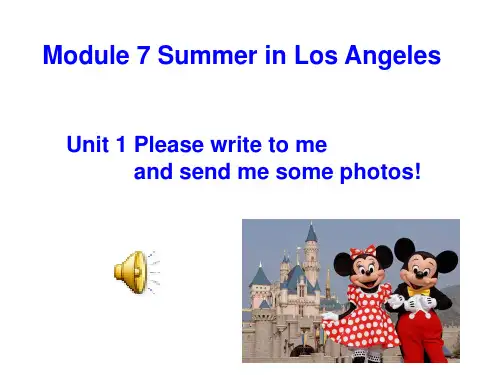
Disneyland 迪士尼乐园
China Town 唐人街
Now let’s enjoy a video to learn more about LA.
Objectives
1. To listen and understand conversations about holiday trips and future plans 2. To get specific information from a conversation on a person’s trip 3. To talk about an imaginary trip to LA 4. To learn the words and expressions
P56 Daming and Lingling are going: 1. Where They are going to LA. ___________________________ 1 They are Daming and Betty to are talking about 2. What they are going do: __________ Lingling and Daming’s plans for going to do an English course. ____________________________ the summer. 3. How long they will stay: ____________ They’ll stay Listen and complete the notes. for about four weeks. _______________________________ 4. How many students there are in the They are going in a group of 20. group: ____________________________
crazy list passport shorts total 4 trousersTask weigh weight P57 When you are planning a trip, make a (1) list of things to take. Do not go (2) ______ crazy ______ Complete the clothes. passage with the words 4 take and too many For warm countries you can keep cool with (3) ______ shorts and some in the box. light (4) trousers _______. If you travel by plane, your weigh too much. For some bag cannot (5) _______ total you flights, twenty kilos may be the (6) _______ can take. To make sure, ask the travel company for help. Remember to check the (7) _______ weight of your bag. And finally, the most important thing: passport do not forget to take your (8) ________.
6 a dictionary √ 7 passport 8 sunglasses 9 notebooks
Read and fill in the form.
Where Lingling goes When Lingling leaves How long Lingling stays
Task 2
LA at the end of July
for four weeks
notebooks, pens, a dictionary
School things to take Clothes to take Things to make sure
shorts, light trousers
1. ask the travel company about the total weight for the bags 2. take the passport& American dollars
Lingling is preparing for her trip to LA. What will you recommend to Lingling for her trip? Why? Jeans? A dictionary? Pens? Notebooks? Passport? Dollars? Shorts? T-shirts? Sunglasses? Anything else?
P57 Task 3 3 Find sentences in the conversation which suggest that… 1. Lingling wants help. Can you help me? 2. Betty is glad to offer help. How can I help? 3. Lingling asks for more help. What else? 4. Betty tells Lingling to remember something important. Oh, by the way, don’t forget to take your passport.
Words review
sunglasses homestay weigh total weight passport n. [用复数]太阳镜;墨镜 n. 家庭寄宿 v. 重量有……;重…… adj. 总的;全部的 n. 重量 n. 护照
Have you been to Los Angeles before? Now let’s enjoy some pictures.
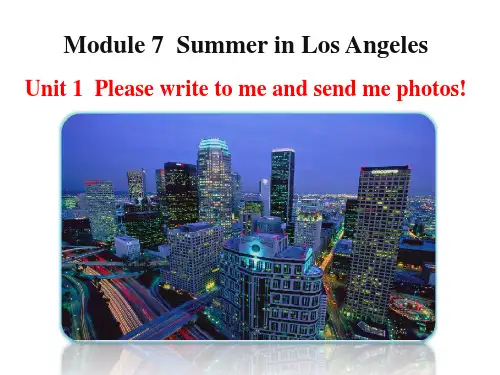
Module 7 Summer in Los Angeles
Unit 1 Please write to me and send me some photos!
Words review
list make a list crazy at the end of… n. 名单;清单 列清单 adj. 发疯的;荒唐的 在……的结尾; 在……的末端 shorts n. [用复数]短裤 trousers n. [用复数]裤子
Task 5
Translate the following phrases into English. prepare for 1. 为……做准备 ______________ make a list 2. 列清单 ______________ at the end of 3. 在……的结尾 _________________ a pair 4. 一副/双…… _________________ pay for 5. 支付……的费用 ________________ too much 6. 太(表示程度)______________ have a great time 7. 玩得开心 __________________ write to sb 8. 给某人写信 _____________________
2. If you’ve already paid for the air tickets and for homestay, it should be OK. 如果你已经付过机票钱和家庭寄宿费了, 那就应该够了。
pay for表示“支付……的费用, 为……付款”。例如: My father paid for my piano lessons. 我爸爸支付了我学钢琴的费用。
Words: list crazy shorts trousers sunglasses total passport weigh Phrases: make a list at the end of pay for… by the way Patterns: 1. Well, it sounds crazy, but I don’t know what to take. 2. When are you leaving and how long are you going to stay there? 3. Shorts are good, or you can wear light trousers.
外研版英语八年级下册Module 7 Unit1课件
It is a good chance to learn about American culture and improve my English. I really have a good time here!
Yours, Lingling
Homework
1.Retell the dialogue and write it down. 2.Polish your own conversation and write it down.
How long Lingling stays For2. 4/four weeks
School things to take Clothes to take Things to make sure
Notebooks, pens and adi3c. tionary
Shorts or light 4. trousers.
Activity 5 Listen and underline the words the speaker stresses(重读).
Tips: We always stress on nouns(名词),verbs(动词), adjectives(形容词) and adverbs.(副词)
1. What clothes should I take to LA? 2. I haven't got any sunglasses. I'll buy a pair there. 3. Many things are more expensive in America.
B: I am leaving....
A:How long will you stay there?
B: I will stay there...
外研版英语八下M7U1课件
6.如果你已经付过机票钱和家庭住宿费,那就 应该够了。 If you’ve already paid for the air tickets and for homestay, it should be OK. 这一切都可能是我们为进步付出的代价。 All this may be the price we pay for progress.
Information about my trip 1.It sounds crazy , but I don’t know what to take. 2.I’m leaving at the end of July
Betty’s advice I should take notebooks, pens and a dictionary. 3. Shorts are good, or I can wear light trousers . It will be sunny and hot there. 5. 200 dollars should be OK.
Key phrases
1.为……做准备 2.列我旅行的物品清单 3.早点儿把物品准备好 4. 听起来很荒唐 5. 在七月底 6.支付家庭寄宿费 7. 你最好询问旅行公司
8.顺便说一下 9.别忘了做…… 10. 给我寄些照片
1. prepare for … 2. make a list of things for my trip 3. get things ready earlier 4. It sounds crazy. 5. at the end of July 6. pay for homestay 7. You’d better ask the travel company 8. …by the way, … 9. Don’t forget to do 10. send me some photos
新外研版八年级下M7-U1
2. Lingling is preparing for her trip to ______. A. New York B. LA C. Beijing
Tapescript
Darning: Have you heard the news? Betty: What news?
Darning: Lingling and I are doing an English course in LA this summer!
Betty: Oh, really? That's great! How long will you stay in LA?
Darning: We are going in a group of 20, and 20人一组
we'll all stay with different families,
so it won't cost so much.
Betty: That's good to hear. I hope you have
Do you like travelling?
Do you want to travel during the summer holiday?
Do you want to have a trip in America?
Do you know Los Angeles? How much do you know about it? 柯达影院
/ʃɔ:ts/ 短裤 n. /'traʊzəz/ 裤子 n.
shorts trousers
外研版八年级下册英语M7U1
2. I like to get things ready earlier. 我喜欢早一点把东西准备好。 “get sth./sb. + 形容词” 她让我很生气。
She got me very angry.
get ready for get ready to do: prepare for:为…做准备
随着我国在各个领域对外交流的丰富留学生教育的产业化进程的加快我国政府已经发布了相关政策法规放宽了给外国人提供自有住房出租和留宿外国人的限制
Unit 1 Please write to me and send me some photos!
Do you like travelling?
What will you take for a trip? make a list 列 清单
Betty: Shorts are good, or you can wear light
s. It’ll be sunny and hot there.
Lingling: I haven’t got any sunglasses. I’ll
3.When are you leaving... 你什么时候走......
at the end of ... :“在„„的结尾;在„„的 末端”,后面接表示时间或地点的名词。 in the end :“最后、终于”=finally, at last
即学即用
in the end 1.Xiao Ming passed the exam__________. 2. At __________this month,I will finish he end of reading this book. 3.把这份电报往下传给坐在桌子末端的人们。 Pass the message down to the people at he end of the table. ___________ 4. The hospital is at __________the street. he end of
新外研版英语八年级下册M7U1优质课件
新外研版英语八年级下册M7U1优质课件一、教学内容本节课我们将学习新外研版英语八年级下册Module 7 Unit 1《In the future》的内容。
具体章节为:Section 1, 2, 3。
通过本节课的学习,学生将了解并掌握关于未来科技、生活等方面的词汇和表达方式。
二、教学目标1. 学生能够听懂、会说、会读、会写与未来科技、生活相关的词汇和表达方式。
2. 学生能够理解课文内容,把握文章结构,提高阅读能力。
3. 学生能够运用所学知识进行口头和书面表达,对未来进行预测和设想。
三、教学难点与重点1. 教学难点:词汇的准确运用和句型的熟练掌握。
2. 教学重点:阅读策略的培养和口头、书面表达能力的提高。
四、教具与学具准备1. 教具:多媒体课件、黑板、粉笔。
2. 学具:课本、练习本、彩色笔。
五、教学过程1. 导入:通过展示一组未来科技发展的图片,引导学生谈论对未来科技的期待和设想。
2. 新课内容呈现:a. Section 1:学习词汇和表达方式,了解未来科技的发展。
b. Section 2:阅读课文,掌握文章结构和主要内容。
c. Section 3:学习如何用一般将来时进行预测和表达。
3. 实践情景引入:分组讨论,让学生设想未来的学校、家庭、交通工具等,并进行口头汇报。
4. 例题讲解:针对一般将来时的用法进行讲解和练习。
5. 随堂练习:完成课本上的练习题,巩固所学知识。
六、板书设计1. 词汇:future, technology, prediction, robot, solar energy, electric car, etc.2. 句型:I think/expect/believe thatIn the future,Will there be?七、作业设计1. 作业题目:a. 根据课文内容,完成一篇关于未来科技的短文。
b. 用一般将来时,写一段话描述你对未来学校的设想。
2. 答案:见附件。
2024年外研版八年级下册英语M7U1教学课件3

2024年外研版八年级下册英语M7U1教学课件3一、教学内容本节课选自2024年外研版八年级下册英语Module 7 Unit 1的教学内容,主要涉及第1章节“Does it eat meat?”。
详细内容包括:了解动物分类,学习动物词汇,掌握一般现在时的用法,以及运用一般现在时描述动物的特征和习性。
二、教学目标1. 能够听懂并准确说出动物词汇,如elephant, tiger, panda 等。
2. 能够运用一般现在时描述动物的特征和习性。
3. 能够通过观察和思考,了解不同动物的生活习性,提高学生的观察力和思维能力。
三、教学难点与重点1. 教学难点:一般现在时的用法,以及如何描述动物的特征和习性。
2. 教学重点:动物词汇的掌握,一般现在时的运用。
四、教具与学具准备1. 教具:PPT课件、图片、录音机、磁带。
2. 学具:练习本、笔。
五、教学过程1. 导入:通过展示不同动物图片,引导学生说出动物名称,激发学生学习兴趣。
2. 新课展示:呈现PPT课件,讲解第1章节“Does it eat meat?”的内容,学习动物词汇,并引导学生用一般现在时描述动物的特征和习性。
3. 例题讲解:结合教材例题,讲解一般现在时的用法,引导学生进行实际操作。
4. 随堂练习:学生根据所学知识,完成练习册上相关习题,巩固所学内容。
5. 小组讨论:分组讨论动物的特征和习性,培养学生合作能力。
六、板书设计1. 动物词汇:elephant, tiger, panda, lion, giraffe, zebra 等。
2. 一般现在时的结构:主语+动词原形。
3. 描述动物特征和习性的句型:It has,It eats,It can七、作业设计1. 作业题目:根据所学内容,编写一段关于动物特征和习性的对话。
2. 答案示例:A: What do you know about the elephant?B: The elephant has a long trunk and big ears. It eats plants and fruits. It can walk and run.八、课后反思及拓展延伸1. 课后反思:本节课学生掌握了动物词汇和一般现在时的用法,但在实际运用中,部分学生仍存在语法错误。
外研版八下英语M7U1
Examples and Applications of Common Phrases
• Cultural exchange: This phrase refers to the process of sharing and exchanging cultural practices, values, and beliefs between different groups or individuals It is often used in the context of discussing the benefits of learning foreign languages and the importance of cultural understanding
• Language barrier: This phrase refers to the differences or misunderstandings that arise when people speak different languages try to communicate with each other It is commonly used to highlight the challenges of cross cultural communication and the importance of translation and interpretation services
Authenticity
Materials should reflect real life situations and authentic language use to enhance learners' understanding and application of the target language
外研版八下英语M7U1课件
外研版八下英语M7U1课件一、教学内容本节课选自外研版八年级下册英语教材Module 7 Unit 1,主要内容包括:第一章节“Have you ever had…”,重点介绍过去经历的描述;第二章节“Has he ever…”,讨论别人过去的经历。
二、教学目标1. 掌握并运用描述过去经历的句型,如:“Have you ever had…”,“Yes, I have./No, I haven’t.”,“Has he/she ever…”,“Yes, he/she has./No, he/she hasn’t.”等。
2. 能够运用所学句型和词汇,谈论自己和他人的过去经历。
3. 提高学生的听说能力和交际能力,使他们能够在实际情境中运用所学知识。
三、教学难点与重点1. 教学重点:描述过去经历的句型和词汇。
2. 教学难点:正确运用现在完成时描述过去经历。
四、教具与学具准备1. 教具:PPT课件、录音机、磁带。
2. 学具:课本、练习册、笔、纸。
五、教学过程1. 导入:通过展示一组图片,引导学生谈论自己的过去经历,激发学生的兴趣。
2. 呈现:呈现教材中的对话,让学生听录音并模仿,学习描述过去经历的句型和词汇。
3. 实践:分小组进行角色扮演,用所学句型和词汇描述自己和他人的过去经历。
4. 互动:学生上台展示,老师和同学给予评价和反馈。
5. 巩固:进行随堂练习,检测学生对本节课内容的掌握程度。
六、板书设计1. Module 7 Unit 1 Have you ever had…?2. 句型:Have you ever had…?Yes, I have./No, I haven’t.Has he/she ever…?Yes, he/she has./No, he/she hasn’t.3. 词汇:had, ever, experience, interesting, exciting, boring, frightening, dangerous, safe七、作业设计1. 作业题目:(1)用所给句型和词汇,写一篇短文描述你和你朋友的过去经历。
2024年外研版八下英语M7U1课件
2024年外研版八下英语M7U1课件一、教学内容本节课选自2024年外研版八年级下册英语教材M7U1,详细内容为第一单元《Cambridge is a beautiful city》。
本单元主要介绍了英国剑桥这座美丽的城市,教材分为两大部分:第一部分是对剑桥城市的概述,包括地理位置、历史背景、风景名胜等;第二部分是通过一位当地居民的视角,介绍剑桥的生活和学习环境。
二、教学目标1. 了解并掌握与剑桥城市相关的词汇和表达,如:famous for, historical, bridge, river等。
2. 能够运用一般现在时描述剑桥的地理、历史、文化特点。
3. 提高学生的阅读理解能力,通过教材内容和课外拓展资料,了解剑桥的风土人情。
三、教学难点与重点1. 教学难点:一般现在时的运用,以及对剑桥城市特点的理解。
2. 教学重点:掌握与剑桥相关的词汇和表达,以及运用一般现在时进行描述。
四、教具与学具准备1. 教具:多媒体课件、教材、黑板、粉笔。
2. 学具:笔记本、教材、课外拓展资料。
五、教学过程1. 导入:通过展示剑桥的图片,引导学生谈论对剑桥的印象,激发学生的兴趣。
2. 新课内容展示:教师讲解教材内容,引导学生学习与剑桥相关的词汇和表达。
3. 实践情景引入:分组讨论,让学生运用所学词汇和表达,描述剑桥的地理、历史、文化特点。
4. 例题讲解:讲解一般现在时的用法,并给出例句,让学生进行模仿练习。
5. 随堂练习:让学生根据教材内容和课外拓展资料,编写一段关于剑桥的介绍。
6. 小组展示:各小组展示编写的内容,其他小组进行评价和反馈。
六、板书设计1. Cambridge is a beautiful city2. 词汇:famous for, historical, bridge, river,university, church, etc.3. 句型: Cambridge is famous for It has many historical buildings, including The River Cam runs through the city,with七、作业设计1. 作业题目:请运用一般现在时,写一段关于剑桥的介绍。
2024年外研版八年级下册英语M7U1教学课件3
2024年外研版八年级下册英语M7U1教学课件3一、教学内容1. 了解世界各地传统节日及其习俗;2. 学习关于节日的词汇和表达方式;3. 提高学生的听说读写能力。
二、教学目标1. 知识目标:学生能够掌握关于节日的词汇和表达方式,了解不同国家和地区的传统节日。
2. 能力目标:学生能够运用所学知识进行节日话题的讨论,提高听说读写能力。
3. 情感目标:培养学生对世界各国文化的尊重和包容,激发他们对英语学习的兴趣。
三、教学难点与重点1. 教学难点:节日话题的讨论和表达,词汇的准确运用。
2. 教学重点:关于节日的词汇和表达方式,了解不同国家和地区的传统节日。
四、教具与学具准备1. 教具:PPT、黑板、录音机;2. 学具:课本、练习本、彩色笔。
五、教学过程1. 导入:通过展示世界各国传统节日的图片,引发学生对节日的兴趣,进入话题。
2. 新课内容:学习关于节日的词汇和表达方式,讲解课文内容,进行例题讲解。
3. 随堂练习:学生进行小组讨论,用所学知识讨论各自了解的节日,教师给予指导。
4. 听力练习:播放课文录音,学生跟随录音朗读,提高听力能力。
5. 口语练习:学生分角色扮演,模拟节日庆祝活动,进行口语交流。
六、板书设计1. M7U1 Traditional Festivals2. 主要内容:关于节日的词汇和表达方式世界各地传统节日介绍例题及答案七、作业设计1. 作业题目:以“我的最爱节日”为主题,写一篇短文,介绍该节日的起源、习俗以及自己在这个节日里的活动。
2. 答案示例:My favorite festival is the Spring Festival. Itorigins from ancient China and has a history of more than2,000 years. On this festival, people usually have a big meal, set off fireworks and give red envelopes to children. Ialways look forward to this festival because I can spend time with my family and enjoy delicious food.八、课后反思及拓展延伸1. 课后反思:本节课通过实践情景引入、例题讲解、随堂练习等多种教学活动,学生对节日的了解和词汇掌握程度有所提高。