
重大版小学英语六年级上册复习资料
小学英语六年级上册复习资料
Unit1OurTeachers
重点词汇:
young 年轻的thin瘦的;苗条的kind 好心的
old 年老的
active 活跃的
clever 聪明的
handsome
friendly
英俊的
友好的
pretty
funny
漂亮的有
趣的
相关词汇:
tall 高的short 矮的strong 强壮的beautiful美丽的
looklike 看起来像;看上去像
重点句型:
1. ---Whatdoesyourunclelooklike? 你的叔叔长什么样?
---He’stallandhandsome. 他又高又帅。
2. ---Whatdoesshelooklike? 她长什么样?
---She’sthinandpretty. 她又瘦又漂亮。
3. Heistallandstrong,alsoheisveryfriendly.他又高又壮,而且他非常友好。
Unit2MonthsofaYear
重点词汇:
January (Jan.) 一月February (Feb.) 二月March (Mar.) 三月
April(Apr.)四月May(May)五月June (Jun.) 六月July(Jul.) 七月August(Aug.)八月
September(Sept.)九月October(Oct.)十月
November(Nov.)十一月December(Dec.)十二月
first(1st)第一second(2nd)第二third (3rd) 第三fourth(4th)第四fifth (5th) 第五sixth (6th) 第六seventh(7th)第七eighth(8th) 第八ninth (9th) 第九twelfth(12th)第十二twentieth(20th)第二十
twenty-first (21th)第二十一
重点句型:
1. ---Whenistheschooltrip? 学校旅行是什么时候?
---It’sinSeptember. 它在九月份。
2. ---Whenisyourbirthday? 你的生日是什么时候?
---MybirthdayisonJune5th. 我的生日在六月五日。
Unit3OurHobbies
重点词汇:
collectingstamps 集邮climbingrocks 攀岩
keepingpets 养宠物takingphotos 照相
watchingbirds 观鸟playingchess 下象棋
makingthings 做手工growingflowers 种花
相关词汇:
hobby 爱好
singing 唱歌dancing 跳舞drawing 画画readingbooks 看书running 跑步playingtabletennis 打乒乓球
playingbasketball 打篮球playingfootball 踢足球
重点句型:
1. ---Doyouhaveanyhobbies?你有什么爱好吗?
---Yes,Ido.Ilikeclimbingrocks. 是的,我有。
我喜欢攀岩。
2. Ilikecollectingstamps. 我喜欢集邮。
3. Shelikesmakingthings. 她喜欢做手工。
4. Helikesrunningandreading. 他喜欢跑步和阅读。
Unit4AroundOurCity
重点词汇:
bybus 坐公共汽车;坐公交车
bybike 骑自行车bytrain bookstore 书店cinema 坐火车电
影院
bytaxi 坐出租车
byship坐轮船
shop 商店
onfootb
ycar
步行
坐小汽车
hospital 医院supermarket 超市
相关词汇:
how 怎样;如何byplane 坐飞机go去;走gotoschool 上学
重点句型:
1.---Howdoyougotoschool?
---Ioftengotoschoolbybus. 2. ---HowcanIgettothecinema?
---YoucangotherebyNo.906bus. 你怎样去上学?
我经常坐公共汽车上学。
我怎么到电影院?
你可以坐906路公交车去那里。
Unit5 OurHolidayPlans
重点词汇:
traveltoBeijing 去北京旅游taketennislessons 上网球课visitmyaunt 看望阿姨buybooks 买书
today 今天tomorrow 明天
thisSunday 这个星期天nextSunday 下个星期天
相关词汇:
begoingtodosth. 打算做某事;要做某事
重点句型:
1. ---Whatareyougoingtodothiswinterholiday? 这个寒假你打算做什么?
---I’mgoingtotraveltoBeijing. 我打算去北京旅游。
2. ---Areyougoingtosingsongstomorrow? 你们明天要唱歌吗?
---Yes,weare. 是的。
六上U1-U3知识清单

六年级上册Unit 13 知识清单一、单词: 表示问好的单词,如hello,hi,good morning...表示物品名称的词,如map,cup,ruler,pen...表示颜色的词,如color,red, yellow, green...二、重要短语和知识点Unit 11. good morning/afternoon/evening ! 早上好/中午好/晚上好!2. boys’ names 男孩们的名字3. girls’ names 女孩们的名字4. be fine 身体好的5. thank you 谢谢Unit 21.what is = what’s 是什么2.it is=it’s 它是3.in English 用英语4.an English book 一本英语书5.spell it 拼写它6.an orange 一个橘子7.a map/key/jacket 一张地图/一把钥匙/一件夹克衫Unit 31.what color 什么颜色2.black and white黑白相间的3.yellow and white黄白相间的4.the key 这把钥匙5.the ruler这把尺子6.the cup这个杯子7.red and white红绿相间的8.a bike一辆自行车三、句子Unit 1A:Good morning,Helen!B:Good morning, Eric!A:How are you?B:I’m fine,thanks/thank you! How are you?/And you?A:I’m fine,too./I’m OK.A:早上好,海伦!B:早上好,埃里克!A:你好吗?B:我很好,谢谢。
你呢A:我也很好。
Unit 2A:What’s this in English?B:It’s a jacket.A:What’s that in English?B:It’s an orange.A:Spell it,please.B:ORANGE.A:这个用英语怎么说?B:它是一件夹克衫。
重大版小学英语六年级上册unit2

Alice: Frank isn’t here today, but his
birthday is on July 4th.
Mr. Smith: Thank you, Alice. And Eric?
Eric:
My birthday is on January 17th.
Mr. Smith: On January 17th. OK. And Jane,
Mr. Smith: Now, Alice, how old are you?
Alice: I’m thirteen.
Mr. Smith: When is your birthday?
Alice: It’s on September 5th, Mr. Smith.
Mr. Smith: Oh, OK. And how about Frank?
_A_u_g_u_s.t 10.Halloween(万圣节) is in _N_o_v_e_m__b_e_r.
The first month of a year is second third fourth fifth sixth seventh eighth ninth tenth eleventh twelfth
1. Spring Festival (春节)is in _J_a_n_u_a_ry___ or _F_e_b_r_u_a_ry. 2. Tree Planting Day (植树节)is in _M__ar_c_h__.
3. Mother’s Day is in __M_a_y__. 4. National Day (国庆节)is in _O_c_t_o_b_e_r_. 5. Teachers’ Day is in _S_e_p_te_m__b_e.r 6. Christmas Day is in _D_e_c_e_m__b_e_r . 7. April Fool’s Day (愚人节)is in _A_p_r_il____. 8. Children’s Day (儿童节) is in _J_u_n_e____. 9. Students have summer holiday(暑假) in _J_u_ly__ and
重大版小学英语六年级上册复习资料

dancing 跳舞
drawing
画画
readingbooks
playingtabletennis
打乒乓球
打篮球
playingfootball
踢足球
看书
重点句型: 1. ---Doyouhaveanyhobbies ?
---Yes,Ido.Ilikeclimbingrocks. 2. Ilikecollectingstamps. 3. Shelikesmakingthings. 4. Helikesrunningandreading.
taketennislessons
上网球课
buybooks tomorrow
买书 明天
nextSunday
下个星期天
相关词汇: begoingtodosth.
打算做某事;要做某事
重点句型: 1. ---Whatareyougoingtodothiswinterholiday?
---I ’ mgoingtotraveltoBeijing. 2. ---Areyougoingtosingsongstomorrow?
---YoucangotherebyNo.906bus.
Unit5
OurHolidayPlans
重点词汇:
traveltoBeijing
去北京旅游
visitmyaunt
看望阿姨
today
今天
thisSunday
这个星期天
你怎样去上学? 我经常坐公共汽车上学。 我怎么到电影院?
你可以坐 906 路公交车去那里。
七月
September(Sept.) 九月
November(Nov.) 十一月
(完整word版)重大版小学英语六年级(上)复习资料
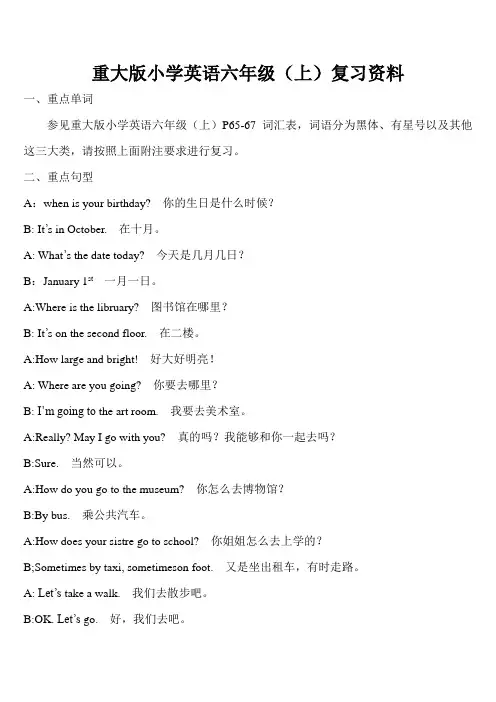
重大版小学英语六年级(上)复习资料一、重点单词参见重大版小学英语六年级(上)P65-67词汇表,词语分为黑体、有星号以及其他这三大类,请按照上面附注要求进行复习。
二、重点句型A:when is your birthday? 你的生日是什么时候?B: It’s in October. 在十月。
A: What’s the date today? 今天是几月几日?B:January 1st 一月一日。
A:Where is the libruary? 图书馆在哪里?B: It’s on the second floor. 在二楼。
A:How large and bright! 好大好明亮!A: Where are you going? 你要去哪里?B: I’m going to the art room. 我要去美术室。
A:Really? May I go with you? 真的吗?我能够和你一起去吗?B:Sure. 当然可以。
A:How do you go to the museum? 你怎么去博物馆?B:By bus. 乘公共汽车。
A:How does your sistre go to school? 你姐姐怎么去上学的?B;Sometimes by taxi, sometimeson foot. 又是坐出租车,有时走路。
A: Let’s take a walk. 我们去散步吧。
B:OK. Let’s go. 好,我们去吧。
A:What does this sign mean? 这个标志是什么意思?B: Don’t pick flowers.不要摘花。
A: It’s good to plant trees. 植树有益。
B: It’s bad to cut trees. 砍树有害。
A:We must n’t fight with each other. 我们不能打架。
B:We should love each other. 我们应当相互关爱。
六年级英语上册重点笔记

六年级英语上册重点笔记
以下是六年级英语上册的一些重点笔记,供您参考:
1. 名词:名词是表示人、事物、地点或抽象概念的名称。
名词可以分为专有名词和普通名词两大类。
专有名词是特定的人、地点或事物的名称,首字母必须大写。
普通名词表示一类人、事物或抽象概念的名称。
2. 代词:代词是用来代替名词的词。
代词有人称代词、物主代词、反身代词、指示代词等。
3. 动词:动词是表示动作或状态的词。
动词可以分为实意动词、系动词、助动词和情态动词等。
4. 冠词:冠词是用来说明名词所指的范围的虚词。
常用的冠词有定冠词“the”和不定冠词“a”或“an”。
5. 介词:介词是用来说明名词与动词之间关系的虚词。
常用的介词有in、on、at、over、under等。
6. 形容词:形容词是用来描述名词的性质或特征的词。
形容词一般放在名词前面,表示对名词的修饰或限定。
7. 数词:数词是用来表示数量或次序的词。
数词可以分为基数词和序数词两类。
8. 句子结构:英语句子结构一般为主语+谓语+宾语,其中主语和谓语是句
子的主干,宾语是句子的支干。
9. 句子类型:英语句子可以分为陈述句、疑问句和祈使句三大类。
陈述句用来陈述事实或观点;疑问句用来提出问题;祈使句用来发出命令或请求。
10. 时态:时态是用来表示动作发生的时间和方式的语法形式。
英语中常用的时态有现在时、过去时、将来时等。
六年级上册英语知识梳理笔记
六年级上册英语知识梳理笔记
一、语法
1. 一般现在时:主语+动词原形/第三人称单数形式
2. 现在进行时:主语+be 动词+现在分词
3. 一般过去时:主语+动词过去式
4. 形容词比较级和最高级:比较级+than,the+最高级
5. 情态动词:can, could, must, should
二、词汇
1. 学习了关于家庭、学校、日常活动、兴趣爱好等方面的词汇。
2. 掌握了一些常用的形容词、动词和名词。
3. 学习了一些地点、时间、数字等基本词汇。
三、句型
1. 问候与打招呼:How are you? Nice to meet you.
2. 询问与回答:What's your name? Where do you live?
3. 喜好与兴趣:I like playing football. She enjoys reading books.
4. 描述与表达:The weather is sunny. He looks happy.
四、阅读理解
1. 能够阅读简单的英文故事、短文和通知。
2. 理解主要内容和细节。
3. 回答关于阅读材料的问题。
六年级上册英语1~3单元知识点归纳
第一部分:主题介绍1. 介绍六年级上册英语1~3单元的整体内容和主题概况六年级上册英语的1~3单元主要围绕着日常生活、家庭、学校等主题展开,涵盖了日常用语、问候语、家庭成员、学校活动等内容。
这些内容对学生的英语基础知识和实际运用能力都具有重要意义。
接下来,我们将深入探讨这些知识点的具体内容和重点难点。
第二部分:知识点详解2. 介绍日常用语和常用问候语在日常生活中,人们经常使用的问候语和日常用语是非常重要的。
比如“Hello, how are you?”, “Goodmorning/afternoon/evening.”等等,这些简单的用语非常基础,但也是人们最常用的口语表达方式。
3. 家庭成员介绍在家庭主题中,学生需要学习家庭成员的称呼和介绍。
比如father, mother, brother, sister, grandmother, grandfather等等。
这些单词对于学生来说是基本的家庭成员概念,同时也对于日常生活中的交流有着重要作用。
4. 学校生活和活动介绍学校生活和活动也是学生们日常生活中的主要内容。
学生需要学习一些学校相关的单词和句型,比如school, teacher, student, class,study, play等等。
同时也需要了解一些学校活动的表达方式,比如“I like to play soccer with my friends after school.” “We have an English class every Monday.”等等。
第三部分:总结回顾5. 对知识点进行总结和回顾通过本文的介绍,我们可以看到六年级上册英语1~3单元的知识点涵盖了日常生活、家庭、学校等主题,内容丰富而实用。
学生们需要掌握的基本口语表达和词汇量很大,但也是非常基础的英语知识。
理解这些知识点不仅对学生的英语学习有帮助,也能够在日常生活中更好地应用和交流。
6. 个人观点和理解个人认为,六年级上册英语1~3单元的知识点是非常基础而实用的,对学生的英语水平提升有着重要作用。
六年级上册英语知识清单
六年级上册英语知识清单一、单词1. 动物类 (animals)cat 猫 dog 狗 pig 猪 duck 鸭 rabbit 兔子 horse 马 elephant 大象ant 蚂蚁 fish 鱼 bird 鸟 monkey 猴子 panda 熊猫 lion 狮子 tiger 老虎 fox 狐狸 squirrel 松鼠2. 颜色类 (colors)red 红 blue 蓝 green 绿 yellow 黄 white 白 black 黑 pink 粉红purple 紫 orange 橙 brown 棕3. 数字类 (numbers)one 一 two 二 three 三 four 四 five 五 six 六 seven 七 eight 八 nine 九ten 十4. 食物类 (food)rice 米饭 bread 面包 beef 牛肉 milk 牛奶 water 水 egg 鸡蛋 soup 汤cake 蛋糕 ice cream 冰淇淋 cookie 饼干 chips 薯条5. 家庭成员类 (family)father 爸爸 mother 妈妈 grandpa 爷爷 grandma 奶奶 uncle 叔叔aunt 阿姨 brother 哥哥/弟弟 sister 姐姐/妹妹6. 学习用品类 (school things)pen 钢笔 pencil 铅笔 pencil box 铅笔盒 ruler 尺子 book 书 bag 包7. 其他 (others)bed 床 sofa 沙发 table 台灯 chair 椅子 desk 书桌二、短语1. How are you? 你过得好吗?2. What’s your name? 你叫什么名字?3. My name’s … 我叫…4. Good morning! 早上好!5. Good afternoon! 下午好!6. Goodbye! 再见!7. Nice to meet you! 很高兴认识你!8. Let’s go to school! 我们一起去上学吧!9. Stand up, please! 请站起来!10. Open your book, please! 请打开你的书!。
六年级上册英语各单元知识点
六年级上册英语各单元知识点六年级上册英语共有十个单元,每个单元的知识点如下:Unit 1: Greetings and Introduction- Greetings and introductions (e.g. Hello, What's your name?)- Personal information (e.g. Name, Age, Birthday)Unit 2: Family- Family members (e.g. Father, Mother, Brother, Sister)- Describing family relationships (e.g. He is my father, She is my sister)Unit 3: School Life- School subjects (e.g. English, Math, Science)- Classroom objects (e.g. desk, chair, blackboard)Unit 4: Hobbies- Talking about hobbies (e.g. I like swimming, He likes playing soccer)- Leisure activities (e.g. playing music, dancing, painting)Unit 5: Daily Routines- Daily routine verbs (e.g. wake up, get dressed, have breakfast) - Adverbs of frequency (e.g. always, usually, sometimes)Unit 6: Food and Drinks- Food vocabulary (e.g. rice, noodles, vegetables)- Ordering food and drinks in a restaurant (e.g. Can I have a bowl of soup, please?)Unit 7: Animals- Animal vocabulary (e.g. dog, cat, rabbit, bird)- Describing animals (e.g. It has four legs, It can fly)Unit 8: Weather- Weather vocabulary (e.g. sunny, rainy, windy, snowy)- Talking about the weather (e.g. It's hot today, It's raining outside) Unit 9: Clothing- Clothes vocabulary (e.g. shirt, pants, dress)- Describing clothing (e.g. It's red, She is wearing a hat)Unit 10: Festivals and Celebrations- Common festivals and celebrations (e.g. Christmas, New Year, Birthday)- Traditions and customs during these events (e.g. decorating a Christmas tree, giving gifts)These are the main knowledge points covered in the sixth grade English textbook. Additional grammar and vocabulary may be introduced along with these topics.。
六年级上册英语复习资料
六年级上册英语复习资料Unit 1: Greetings and IntroductionsVocabulary•Greetings: hello, hi, good morning, good afternoon, good evening •Introductions: My name is _______, I’m _______ years old. Nice to meet you.Grammar•Subject pronouns: I, you, he, she, it, we, they•To be: am, is, areSentence Structures•Hello, my name is _______.•I’m _______ years old.•Nice to meet you.DialoguesDialogue 1A: Hi, my name is Lisa. What’s your name?B: Hello Lisa, nice to meet you. My name is Mike.A: Nice to meet you too, Mike.Dialogue 2A: Good morning, I’m Lily. How old are you?B: Hi Lily, I’m 11 years old.A: Nice to meet you. I’m 12 years old.Unit 2: School LifeVocabulary•School subjects: English, Math, Science, History, Art•School facilities: classroom, library, playground•School supplies: books, pens, pencils, erasers, notebooksGrammar•Present simple tense:–Positive: I/You/We/They + verb–Negative: I/You/We/They + don’t + verb–Question: Do + I/You/We/They + verb?Sentence Structures•I like _______.•I don’t like _______.•Do you like _______?DialoguesDialogue 1A: What subjects do you have at school?B: We have English, Math, Science, and History.A: That sounds interesting. Which one is your favorite?B: I like Math the most. What about you?A: I like Science.Dialogue 2A: Do you have any school supplies?B: Yes, I have books, pens, and notebooks.A: Do you like drawing?B: No, I don’t like drawing.Unit 3: Family and FriendsVocabulary•Family members: father, mother, brother, sister, grandparents •Friends: friend, best friend•Adjectives to describe people: kind, funny, smart Grammar•Possessive adjectives: my, your, his, her, our, their Sentence Structures•This is my _______.•He/She is my _______.DialoguesDialogue 1A: Who is the person in the picture?B: This is my mother.A: She looks very kind.B: Yes, she is very kind.Dialogue 2A: Who is your best friend?B: His name is Jack. He is very funny.A: That’s great.Unit 4: Daily ActivitiesVocabulary•Daily routine: wake up, get dressed, eat breakfast, go to school, have lunch, do homework, go to bed•Adverbs of frequency: always, often, sometimes, rarely, never Grammar•Present simple tense:–Positive: He/She/It + verb + s/es–Negative: He/She/It + doesn’t + verb–Question: Does + He/She/It + verb?Sentence Structures•I usually _______.•He/She always _______.•Does she _______?DialoguesDialogue 1A: What time do you usually wake up?B: I usually wake up at 7 o’clock.A: And when do you go to bed?B: I usual ly go to bed at 9 o’clock.Dialogue 2A: Does your brother do his homework every day?B: No, he rarely does his homework.A: Oh, that’s not good.Unit 5: Food and DrinksVocabulary•Food: bread, rice, noodles, chicken, beef, fish, vegetables, fruits •Drinks: water, milk, juice, tea, coffeeGrammar•Countable and uncountable nouns:–Countable: I have two _______.–Uncountable: I have some _______.Sentence Structures•I like eating _______.•I don’t like drinking _______.•Do you like eating _______?DialoguesDialogue 1A: What’s your favorite food?B: My favorite food is pizza.A: That sounds delicious.B: Yes, it’s very tasty.Dialogue 2A: Do you drink milk every day?B: No, I don’t like drinking milk.A: What do you drink then?B: I like drinking juice.ConclusionThis document serves as a review material for the content covered in the first semester of the sixth grade English course. It includes vocabulary, grammar, sentence structures, and dialogues from different units. By studying and practicing these materials, students will be able to reinforce their English language skills and prepare for future lessons.。