
人教版七年级上册英语第四单元知识点总结归纳
Unit 4 Where’s my schoolbag?
宿州市解集中学陈倩倩
1.Vocabularies
2.Phrases and sentences
Phrases: On the sofa, under the table, come on, on their bed, on your head, in his schoolbag.
Sentences:①-- Where’s the schoolbag? -- It’s under the table.
②—Where’s his pencil box? -- It’s in his schoolbag.
③-- Where’s your ruler? -- It’s on the chair.
④—Where are their keys? -- They’re on the desk.
⑤—Are the keys on the sofa? --Yes, they are.
--No, they are n’t. They’re on the table. ☆在这些句子中,不要忘掉系动词be(is、are)。
3. Key points
⑴-- Where’s the schoolbag? 我的书包在哪里?
-- It’s under the table. 它在桌子下面。
☆这是一个由疑问副词where引导的特殊疑问句。
Where:在哪里、哪儿。
通常用来询问某人或某物在什么地方。
其结构为Where+be+主语。
Be动词的单复数形式取决于后面的主语。
若主语是复数,如his backpacks, your keys 等,where后用are;若主语是单数,如her computer,my chair等,where 后则用is。
例如:--- Where is the basketball? 篮球在哪里?
☆对于特殊疑问句,我们不能用Yes 和No回答,而要用一个陈述句或短语
来作出明确的回答,说明某物在某个地方。
答句的结构是:主语+be+方位介词+冠词/代词+名词。
例如:It’s under the chair.它在椅子下面。
⑵介词in, on和under
↗介词是一种虚词,在句中不能单独作句子成分。
介词后面一般有名词、代词、冠词或相当于名词的其他词类、短语或从句作它的宾语。
介词和它的宾语构成介词词组,在句中可作状语、表语、补语等。
↗in表示“在……里”,无论在大的范围还是在小的范围内,都要用in。
如The book is in your backpack.那本书在你的书包里。
↗on表示表面上的接触,一个在另一个的上面,即“在……的上面”。
如:An apple is on the table. 一个苹果在桌子上。
↗under表示“在……下”,指在某物垂直的下方。
如:The baseball is under the desk.棒球在桌子下面。
⑶I’m Kate, and my sister is Gina.我是凯特,我的妹妹是吉娜。
▲and意思是“和、与、并、同”,通常用来连接两个并列或对称关系的词、词组或句子。
例如:I help you and you help me. 我帮助你,你帮助他。
▲and连接两个或两个以上的并列成分时,最后两个成分用and连接,其他用逗号隔开。
连接两个或两个以上的单数人称代词时,通常按照“第二人
称、第三人称、第一人称”的顺序。
例如:You, he, and I like English .我、你、他都喜欢英语。
▲and用在good,nice,fine等词之后,表示“很”.如:
The book is good and expensive.这本书很贵。
⑷I think it’s in your grandparents’ room.我认为它在你祖父母的房间里。
※该句是含有宾语从句的复合句。
It’s in your grandparents’ room作think的宾语。
英语中,用一个句子作宾语,这个句子叫做宾语从句。
例如:I think that hat is nice. 我认为那顶帽子很漂亮。
※think是动词,意为“认为;想”。
I think是发表自己的观点或判断,表示“我认为、我想”。
带有不太确切的猜测的语气,是口语中常用的委婉说法。
例如:
I think so.我认为是这样的。
※当think后的宾语从句要表示否定时,习惯上将否定词not转移到think前,称为否定前移。
例如:
I don’t think he is at school.我认为他不在学校。
※grandparents’是名词所有格形式,表示所属关系,意为“祖父母的”
它的构成方法分为单数名词和复数名词两大类,具体见课本86面。
⑸I don’t know.我不知道。
●know是动词,意为“知道、认识”。
例如:I know him.我认识他。
●在回答别人的问题时,如果不知道可以用I don’t know来回答。
使用时习惯
上在前面加上sorry,表示礼貌。
例如:
--Where are my books? 我的书在哪里?
--Sorry, I don’t know. 对不起,我不知道。
⑹I’m tidy, but Gina is not.我很井井有条,但是吉娜不是这样。
★tidy是形容词,意为“整洁的、井井有条的”。
例如:
Linda’s room is very tidy. 琳达的房间非常整洁。
★but是连词,意为“但是”,表示转折关系,用来连接两个单词或句子,其前后的词、短语或分句有相对立或对照的关系。
例如:He likes playing basketball but he doesn’t like playing ping-pong. 他喜欢打篮球,但不喜欢打乒乓球。
⑺Gina’s books are everywhere.吉娜的书到处都是。
→everywhere是复合副词,由every和where合成。
意为“处处、到处、各个地方”。
相当于“here and there”。
例如:
He wants to go everywhere in China.
他想到中国的各个地方去走一走。
→everywhere为副词,它的前面不能接副词。
例如:
The clothes(衣服) are everywhere in her room.
在她的房间里衣服到处都是。
⑻Gina always asks.吉娜总是问。
◆always是表示频率的副词,意为“总是”,其位置常在be动词之后、实义动词的前面。
例如:He is always late for class.他总是上课迟到。
◆asks是ask的第三人称单数形式。
当句子的主语是第三人称单数时,谓语动词要用第三人称单数形式。
动词第三人称单数形式的变化规则与名词单数变复数的规则基本相同。
见课本91面。
例如:She plays sports every morning.她每天上午进行体育运动。
⑼Come on, Jack!快点儿,杰克!
☆come on用于表示催促、鼓励、安慰等,此处表示催促,意为“赶快,快点儿”。
例如:Come on, it’s dark.快点儿,天黑了。
☆come on表示请求、鼓励、劝说等,意为“来吧;行啦”。
例如:Come on, Cindy.
Don’t be shy.来吧,辛迪。
别害羞。
☆用于体育竞赛等场合鼓励队员,意为“加油”。
“Come on! Come on! ” shouted the Class One students.
“加油!加油!”一班的学生大声喊道。
☆用于招呼别人,意为“来、过来”。
例如:
Come on! This way, please. 来,请走这边。
作文部分,认真复习以前讲过的范文,做到多读、多记、多背。
单词是英语的基础和核心,认真记单词。
人教版七年级英语上册1--4单元知识点总结
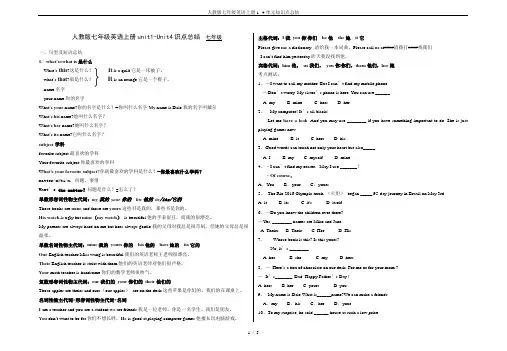
人教版七年级英语上册1--4单元知识点总结人教版七年级英语上册unit1-Unit4识点总结七年级一、句型及短语总结1.what’s=what is是什么What’s this?这是什么?It is a quilt.它是一床被子。
what’s that?那是什么?It is an orange.它是一个橙子。
name名字your name你的名字What’s your name?你的名字是什么?=你叫什么名字.My name is Dale.我的名字叫戴尔.What’s his name?他叫什么名字?What’s her name?她叫什么名字?What’s its name?它叫什么名字?subject学科favorite subject最喜欢的学科Your favorite subject你最喜欢的学科W hat’s your favorite subject?你就最喜欢的学科是什么?=你最喜欢什么学科?matter/mætə/n. 问题,事情What’s the matter?问题是什么?=怎么了?单数形容词性物主代词:my我的your你的his他的its/its/它的These books are mine and those are yours.这些书是我的,那些书是你的。
His watch is ugly but mine(my watch)is beautiful.他的手表很丑,而我的很漂亮。
My parents are always hard on me but hers always gentle.我的父母对我总是很苛刻,但她的父母总是很温柔。
单数名词性物主代词:mine我的yours你的his他的hers她的its它的Our English teacher Miss wang is beautiful.我们的英语老师王老师很漂亮。
Their English teacher is strict with them.他们的英语老师对他们很严格。
2022年人教版七年级上册英语单元知识点归纳Unit 4 Where’s my schoolbag

Unit 4Where’s my schoolbag?1.where adv.在哪里;到哪里2.3.on prep.在……上4.under prep.在……下e v.来;来到come on 快点儿6.think v.认为;想;思考7.room n.房间8.their pron.他(她、它)们的9.hat n.帽子10.head n.头11.know v.知道;了解12.radio n.收音机;无线电广播13.clock n.时钟14.tape n.磁带;录音带;录像带15.player n.播放机tape player 磁带播放机16.model n.模型17.plane n.飞机model plane 飞机模型18.tidy adj.整洁的;井井有条的→untidy adj.不整洁的;没有条理的19.but conj.但是20.our pron.我们的21.everywhere adv.处处;到处;各个地方22.always adv.总是1.—Where’s the schoolbag?书包在哪里?—It’s under the table.它在桌子下面。
2.—Are the keys on the sofa?钥匙在沙发上面吗?—No,they aren’t.They’re on the table.不,不在。
它们在桌子上。
3.I think it’s in your grandparents’ room.我认为它在你(外)祖父母的房间里。
4.—Where are the pencils?铅笔在哪里?—I don’t know.我不知道。
5.I’m Kate,and my sister is Gina.我叫凯特,我的妹妹叫吉娜。
6.I’m tidy,but Gina is not.我(爱)整洁,但吉娜却不(整洁)。
7.Gina’s books are everywhere—on her bed,on the sofa and under the chair.吉娜的书到处都是——她的床上、沙发上、椅子底下(都有)。
七年级上册英语unit4topic3笔记

七年级上册英语unit4topic3笔记以下是七年级上册英语Unit 4 Topic 3的笔记,供您参考:Topic 3 Let’s go to the zoo!Section A1. 重点单词:animal 动物zoo 动物园elephant 大象panda 熊猫lion 狮子tiger 老虎koala 考拉giraffe 长颈鹿camel 骆驼monkey 猴子snake 蛇elephant 大象bird 鸟hippo 河马crocodile 鳄鱼2. 重点句子:Let’s go to the zoo! 我们去动物园吧!I want to see elephants. 我想看大象。
They are very big. 他们非常大。
I like pandas because they are very friendly. 我喜欢熊猫,因为他们非常友好。
Koalas are very cute. 考拉非常可爱。
3. 语法重点:现在进行时态(Present Continuous Tense):表示正在进行的动作或正在发生的事情。
结构为“be动词+动词ing形式”,常用的助动词包括“am/is/are”。
例如:“I am studying English.”(我正在学习英语)。
动词ing形式的构成:一般动词在词尾加上“-ing”即可,如果是以不发音的字母e结尾的动词,需要去掉e再加上“-ing”。
如果是重读闭音节的动词,需要双写该字母然后再加“-ing”。
例如:write → writing,begin → beginning,swim → swimming。
初一四单元知识点总结

初一四单元知识点总结本单元的重点知识包括问路和指路、购物和交易以及日常生活常用语等方面的内容。
下面将对这些知识点进行总结。
问路和指路1. 问路的常用句型在问路时,我们可以使用一些固定的句型来询问路线,比如:- Excuse me, could you tell me how to get to the nearest bank?- Can you show me the way to the train station?- Where is the nearest bus stop, please?2. 指路的表达方式在指路时,我们可以使用一些词语和表达方式来告诉对方应该如何到达目的地,比如: - Go straight and turn left at the first crossing.- It's just round the corner on the right.- You can take the subway to get there.购物和交易1. 购物时的用语在购物时,我们需要学会使用一些有关购物的常用用语,比如:- How much is this shirt?- Do you have this in a larger size?- I'd like to return this pair of shoes.2. 交易中常用的表达方式在进行交易时,需要使用一些常用的表达方式来和商家进行沟通,比如:- Can I pay by credit card?- Could you give me a discount?- I'd like to exchange this for another one.日常生活常用语1. 日常用语的表达方式在日常生活中,我们需要使用一些常用的句型和表达方式来和他人进行交流,比如: - How are you doing?- What's the weather like today?- Have a nice day!2. 时间和日期的表达方式在描述时间和日期时,我们可以使用一些固定的表达方式来表达时间和日期,比如: - It's half past ten.- Today is Monday, the 5th of June.- What time is it now?以上就是初一英语第四单元知识点的总结,希望对大家的学习有所帮助。
人教版七年级英语上册unit 4 句子讲解及知识点梳理
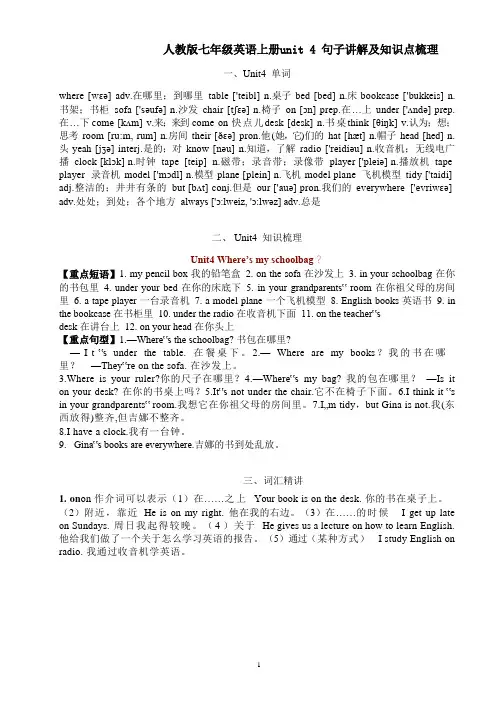
人教版七年级英语上册unit 4 句子讲解及知识点梳理一、Unit4 单词where [wɛə] adv.在哪里;到哪里table ['teibl] n.桌子bed [bed] n.床bookcase ['bukkeis] n. 书架;书柜sofa ['səufə] n.沙发chair [tʃɛə] n.椅子on [ɔn] prep.在…上under ['ʌndə] prep. 在…下come [kʌm] v.来;来到come on 快点儿desk [desk] n.书桌think [θiŋk] v.认为;想;思考room [ru:m, rum] n.房间their [ðɛə] pron.他(她,它)们的hat [hæt] n.帽子head [hed] n. 头yeah [jʒə] interj.是的;对know [nəu] n.知道,了解radio ['reidiəu] n.收音机;无线电广播clock [klɔk] n.时钟tape [teip] n.磁带;录音带;录像带player ['pleiə] n.播放机tape player 录音机model ['mɔdl] n.模型plane [plein] n.飞机model plane 飞机模型tidy ['taidi] adj.整洁的;井井有条的but [bʌt] conj.但是our ['auə] pron.我们的everywhere ['evriwɛə] adv.处处;到处;各个地方always ['ɔ:lweiz, 'ɔ:lwəz] adv.总是二、 Unit4 知识梳理Unit4 Where’s my schoolbag?【重点短语】1. my pencil box 我的铅笔盒 2. on the sofa 在沙发上 3. in your schoolbag 在你的书包里4. under your bed 在你的床底下 5. in your grandparents‟ room 在你祖父母的房间里 6. a tape player 一台录音机7. a model plane 一个飞机模型8. English books 英语书9. in the bookcase 在书柜里10. under the radio 在收音机下面11. on the teacher‟sdesk 在讲台上12. on your head 在你头上【重点句型】1.—Where‟s the schoolbag? 书包在哪里?—I t ‟s under the table. 在餐桌下。
新版人教版七年级英语上册各单元知识点
空间
form Monday to Friday 从周一到周五
form Beijing to Shanghai 从北京到上海
6.finish的用法
finish作不及物动词时,意为“完成;做好”
They start work early and finish late every day.他们每天开工早收工晚。
作及物动词,后接动词时,要用动名词形式,即finish doing sth. 表示“做完某事,
完成某事”
Jim usually finishes doing his homework before 8:00.吉姆通常在8点前做完作业。
7.thank sb for的用法:
thank sb for意为“因……而感谢某人”,for是介词,后接名词、代词或动名词,表感
谢的原因或内容。
Thank him for telling me. 谢谢他告诉我。
Thank you for helping with my English.多谢你帮我学英语。
8.for two hours的用法:
“for+一段时间”是介词短语,意为“……时间”,表示某事持续多长时间。
对其提问要用
how long
—How long will you stay in Beijing 你将在北京待多长时间?
—For about three days. 大约三天。
人教版七年级上册英语Unit 4知识点梳理及语法讲义(教师版)
七年级上册英语Unit 4知识点与语法精讲精练词汇梳理(一)完成单词梳理:名词:1. table桌子 2. bed 床 3. bookcase 书架;书柜4. sofa 沙发5. chair 椅子6. desk 书桌7. room 房间8. hat 帽子9. head 头10. radio 收音机11. clock 时钟12. tape 磁带;录音带13. player 播放机14. model 模型15. plane 飞机动词:1. come 来;来到 2. think 认为;想;思考 3. know 知道;了解代词:1. their 他(她、它)们的 2. our 我们的介词:1. on 在……上 2. under 在……下副词:1. where 在哪里;到哪里 2. everywhere 处处;到处;各个地方3. always 总是连词:1. but 但是形容词:1. tidy 整洁的;井井有条的感叹词:1. yeah 是的;对(二) 词汇变形小结:1. they (人称代词主格:他/她/它们) — them (人称代词宾格) — their (形容词性物主代词:他/她/它们的) — theirs (名词性物主代词:他/她/它们的)2. tidy (adj. 整洁的) — untidy (反义词:不整洁的)3. radio (n. 收音机) — radios (复数)4. we(人称代词主格:我们) — us (人称代词宾格) — our (形容词性物主代词:我们的) — ours (名词性物主代词:我们的)【练一练】用所给词的适当形式填空1.Look! Those are four beds (bed) in my house.rry and I are Bill’s daughters, so Bill is our (we) father.3.Those old CD players ( player) are very nice.4.Susan and Emma thank their (they) teacher for helping them find the keys.5.Tina comes (come) to the gym and plays sports.6.These rooms (room) are too small.7.Look! Your model plane is (be) on the sofa.8.The Chinese book is his (he).9.Look at my mother’s (mother) room. It’s very clean.10.These are their (they) baseballs.(三) 短语攻关:come on快点儿tape player 磁带播放机model plane飞机模型on the sofa 在沙发上in one’s schoolbag在某人的书包里under one’s bed 在某人的床下面on one’s head在某人的头上teacher’s desk 讲桌pencil box 铅笔盒computer game电脑游戏知识点梳理1. Where are my books? 我的书在哪里?【用法详解】“Where+be动词+主语?”该句型为where引导的特殊疑问句,用来询问“某人或某物在哪里?”。
最全面人教版七年级上册英语第四单元知识点归纳总结
Unit 4 Where's my schoolbag?一、词汇与短语● 重点单词A部分1.where adv. 在哪里;到哪里2.table n. 桌子3.bed n. 床4.room n. 房间5.sofa n. 沙发6.their pron. 他(她、它)们的7.chair n. 椅子8.hat n. 帽子9.on prep. 在……上10.head n. 头11.under prep. 在……下12.know v. 知道;了解e v. 来;来到14.bookcase n. 书架;书柜15.desk n. 书桌16.yeah interj. 是的;对17.think v. 认为;想;思考B部分1.radio n. 收音机;无线电广播2.tidy adj. 整洁的;井井有条的3.clock n. 时钟4.but conj. 但是5.tape n. 磁带;录音带;录像带6.our pron. 我们的7.player n. 播放机8.everywhere adv. 处处;到处;各个地方9.model n. 模型10.always adv. 总是11.plane n. 飞机● 重点短语A部分1.on the sofa 在沙发上2.in your schoolbag 在你的书包里3.under your bed 在你的床上e on 快点儿5.on their bed 在他们的床上6.on your head 在你的头上7.under the chair 在椅子下面8.on the sofa在沙发上9.grandparents' room (外)祖父母的房间B部分1.a tape player 一个磁带播放机2.a model plane 一个飞机模型3.under the radio 在收音机下面4.in the bookcase 在书柜里5.on the teacher's desk 在老师的讲桌上6.on the desk 在书桌上7.under the desk 在书桌下8.in my room 在我的房间里● 重点句子A部分1.--Are the keys on the sofa? --No, they aren't. They are on the table.钥匙是在沙发上吗? 不,不是。
人教版七年级上册英语知识点复习:第四单元
人教版七年级上册英语知识点复习:第四单元知识点对朋友们的学习非常重要,大家一定要认真掌握,为大家整理了人教版七年级上册英语知识点复习:第四单元,让我们一起学习,一起进步吧! 一.重点词组 1e of 2 .in the room 3. in the bookcase 4. on the chair 5.under the table 6. I don’t know 7. behind 在……后面 二. 重点句型. 1.Where’s the +东西? -----It’s + on in under + 介词短语 2.Where are your his her + 东西? --- They’re on in under +介词短语 三.知识点 1.介词:是用以放在名词或代词之前,表明该名词与其它词之间某种关系的一类词。
(不能单独使用,需与某一名词或代词等搭配成介宾短语)(on in under)eg: on the bed 2. 定冠词the 的用法: a. 常用在特指的单复数名词前,指某人,某物,某些人或某些物. eg: The students are boys. b . 用于双方都知道的人或物.eg: The girl is my friend. c. 上文提到的人或物,下文再次提到. eg: I have a pen. The pen is red. d. play 后跟球类名词是,不用the. 乐器前一定要用the. ( play basketball play the drums ) 3.. Here is my room. ( here is = this is ) 4.. have has : 表示“拥有” “占有”. eg: I have a computer.。
七上英语unti4知识点
七上英语unti4知识点
Unit 4的知识点包括但不限于:
1. 词汇:包括名词(如backpack、book、pencil等)、形容词(如old、new、big等)、动词(如have、need、find等)和介词(如in、on、under等)。
2. 语法:一般现在时的使用,包括主语+动词原形的结构,以及疑问句和肯定句的变换。
指示代词this和that的使用也是重要的知识点。
3. 物品位置的描述:可以使用where引导的疑问句来询问物品的位置,以
及介词on表示物品在某物的上面。
4. 动词的用法:take表示从近处带到远处,而bring表示从远处带到近处。
5. some和any的使用:some一般用于肯定句,any用于否定句和疑问句。
在表示请求、建议、征求意见等委婉语气的疑问句中,用some而不用any。
6. 名词所有格:在英语中,表达“我的”、“你的”、“他的”时,可以使用代词my、your、his等。
7. 其他语法点:比如指示代词these和those的使用。
this用于指离说话
者近的人、物,that用于指离说话者远的人、物;同时,在表达“我的”、“你的”、“他的”时,也可以使用名词所有格形式,如my backpack、your book、his pencil等。
以上内容仅供参考,建议查阅七年级英语课本或咨询英语老师,获取更准确的信息。