
人教版七年级英语上册重点词汇讲解
5Hale Waihona Puke shown.表演;(戏剧、广播、文艺或电视)节目; n.表演;(戏剧、广播、文艺或电视)节目; 例如: What television shows do you usually watch? V.展示,给……看,显示.例如: V.展示,给……看,显示.例如: John showed me his homework. The report shows a serious problem. problem.
6. About
around
(1)两者用作副词时为同义词,均可表示“大 (1)两者用作副词时为同义词,均可表示“ 约”和“周围,四周”例如: 周围,四周” We got there at about/around six. Don’ Don’t throw litter about/around. (2)用作介词时, about表示“关于”, 2)用作介词时, about表示“关于” around则表示“围绕” around则表示“围绕”.例如: Let’ Let’s talk about this problem. The moon goes around the earth.
wish/hope后都可以接不定式作宾语.例如: wish/hope后都可以接不定式作宾语.例如: I wish/hope to receive presents on my birthday. birthday. 可以说wish 可以说wish sb to do sth,但不能说hope sb to do sth,但不能说hope sth.例如: sth.例如: She wishes her son to get a good mark in the exam. wish常表示不太可能实现的,动词用过去式形式; wish常表示不太可能实现的,动词用过去式形式; hope常表示可能实现的.例如: hope常表示可能实现的.例如: I wish that I could fly. wish后可接双宾语,即wish wish后可接双宾语,即wish sb sth,而hope不 sth,而hope不 可.例如: I wish you success.
J7A
Unit7: How much are these pants? Unit8: When is your birthday? Unit9: Do you want to go to a movie?
中考考点解读
知识要点
1.名词price的用法 (1)表示价格(price)的高低常用high和 low,一般不用expensive,dear和cheap. 例如: The price of the house is too high.I can’t afford it. (2)针对price提问应用what,不可使用 how much.例如: What is the price of your computer?
练习题
1.--is the price of the notebook? ---10 yuan . A.How much B.How C.How many D.What
练习题
1.--A is the price of the notebook? ---10 yuan . A.How much B.How C.How many D.What
3.want v. 想要,要
常为及物动词,其后直接接宾语, 也可以构成结构want to do sth(想要 做某事)或want sb .to do sth(想要某 人做某事).在want后面不可以接v.ing形式.例如: 1.He wants you to see him in his office tomorrow morning. 2.I want to have a rest.
J7A
Unit10: Unit10: How much are these pants? Unit11: Unit11: When is your birthday? Unit12: Unit12: Do you want to go to a movie?
考考
读
1.Join v.加入(某个组织或团 v.加入(
7.speak talk say tell
speak说,说话(侧重于表示说的能力) speak说,说话(侧重于表示说的能力) talk谈论,谈话 talk谈论,谈话 say说(强调说的具体内容) say说 强调说的具体内容) tell告诉,告知 tell告诉,告知 例如:
The child can’t speak yet. can’ Can you say this in English? We must tell him right now. Don’ Don’t talk in class.
11.(a)few/(a)little 11.(a)few/
表示肯定 表示否定 修饰可数名词 修饰不可数名词 a few a little few little
It was too late ,There were few people in the street. I have a few friends here. There is little bread in the fridge,We must buy some. Don’ Don’t hurry ,There is little time left.
2.help n&v.帮助,协助
help用作名词时,常是不可数名 词.例如: Hearing a cry for help,he rushed out. (2) help用作动词时,其后可以接名词 /代词或to do sth作宾语;to可以省略. Please help me( to) move this table. (3)由help构成的常用结构: Help sb with sth Help sb (to) do sth (1)
2. what time
when
what time什么时候(多表示某个具体时刻) time什么时候(多表示某个具体时刻) when什么时候(所指的时间一般较长) when什么时候(所指的时间一般较长) 例如: What time do you get up in the morning? When did you get here?
2.The price of this computer is the of the three.
A.smallest B.bigest C.higest D.tallest
2.The price of this computer is the C of the three.
A.smallest B.bigest C.higest D.tallest
练习题
1.China jioned WTO on November 12,2001.(同义 12,2001.(同义 替代) A .attended B .took part in C .become a member of
6.How much
(1) How much可用于询问物品的价钱,意义 为“多少钱”.例如: How much are your pants? (2)How much也可以询问不可名词的数量, 表示“多少”.例如: How much chicken is left? (3) How much 还可以用于表示程度,可理 解为“有多少”.例如: You can’t imagine how much I’m missing my old friends.
12.be strict with sb be strict in sth
Our parents are very strict with us. The teacher is strict in his work.
13. can
表示能力,有“能,会或能够” 表示能力,有“能,会或能够”的意思.例如: ---Can you drive a car? ---Can ---Yes,I can. ---Yes,I 表允许,在口语中代替may,有“可以” 表允许,在口语中代替may,有“可以”的意 思.例如: Can I use your bike? 表示可能性,常用于否定句和疑问句.例如: Can it be true? He can’t do that. can’
体) Join in 参加(某项活动) 参加(某项活动) take part in 参加(某项工作 参加( 或集体活动) 或集体活动)
例如: 例如: Xiao Wang has join the League? Would you like to jion us? Do you want to jion us in the game? Do you take part in the spots meeting? meeting?
7.并列连词and,but 和or
并列连词指用于连接并列成分,表示 并列、转折、选择等含义的连 词. and用于表示并列关系,意思为 “和”“并且”;but用于表示转折关 系,意思为“但是”; or表示选择关 系,意思为“或”“否则”. I like orange and pears. He put on his coat and went out. Is your father a teacher or a doctor?
3.in/at/on表示时间 .in/at/on表示时间
In用在表示“年、月、季节”等名词前; In用在表示“年、月、季节” at用在表示“时刻”的名词之前; at用在表示“时刻” on用在表示“日期或星期”的名词之前. on用在表示“日期或星期”的名词之前. 例如: He was born in 1995. New term begins in September. The train will arrive at seven. New china was founded on Oct 1,1994.
2024年人教版新教材七年级英语上册Unit7单词精讲课件

2. surprise [səˈpraɪz] n. 惊奇;惊讶; v. 使感到意外 p69 ➢ 固定搭配:in surprise惊讶地 to one's surprise令某人惊讶的是 What a big surprise! 多么大的一个惊喜啊! His words surprised me. 他的话让我感到惊讶。 She looked at me in surprise. 她惊讶地看着我。 ➢ 趁热打铁: ①令我惊讶的是,他通过了考试 To my surprise , he passed the exam. ②为他举办一个惊喜派对怎么样(课文原句)
14. example [ɪɡˈzɑːmpl] n. 例子;范例 ➢ 固定搭配:15. for example例如 Here is an example. 这儿有一个例子。 For example, he is very kind.例如,他非常善良。 ➢ 趁热打铁: ①她给出了很多例子。 She gave many examples .
7. total [ˈtəʊtl] n .总数;合计adj .总的;全体的 p69 ➢ 固定搭配:in total 总共 The total of these numbers is 50. 这些数字的总和是 50。 The total cost is very high.总花费非常高。 In total, there are five books on the table.总共桌子上有五本书。 ➢ 趁热打铁: ①总共是多少?(课文原句) What's the total?
9. balloon [bəˈluːn] n. 气球 The children are playing with balloons. 孩子们在玩气球。 She tied a balloon to the chair. 她把一个气球系在椅子上。
人教版英语七年级上册Unit1 单元词汇全解

Unit1 单元词汇全解Section A1. name /neɪm/ n.名字,名称例:My English name is Ann. 我的英文名字是安。
拓展:在英语中,姓和名的排列顺序为先名字(first name/given name)后姓氏(last name/family name),这和中国人先姓氏后名字的排列顺序刚好相反。
例:—What’s Bob White’s first name?鲍勃·怀特的名字是什么?—Bob. 鲍勃。
2. nice /naɪs/ adj. 令人愉快的;宜人的常带有一定的感情色彩,含有“美好的”、“美妙的”、“美味的”、“漂亮的”等意思;也可以表示对人“友好的”,“和蔼的”的意思。
例:This is a nice quilt.这是床漂亮的被子。
It’s very nice of you. 你真好。
Nice to meet you! 见到你很高兴!3. to 常用语原形动词之前,表示该动词为不定式to是不定式的符号,其后跟动词原形。
例:I want to meet him.我想见他。
【知识拓展】too adv..也(同音词)—to—(同音词)two 二。
4. meet /mi:t/ v. 遇见;相逢meet常用于meet sb.结构中,意为“遇到某人”。
例:Nice to meet you.见到你很高兴。
【知识拓展】(l)meet→(加后缀-ing) meeting n.会议。
(2)meet的同音词为meat(肉)。
5. too /tu:/adv.也;又;太too是普通用词,多用于口语,用于肯定句中,放在句末,其前常有逗号。
另外,在简略答语里,too常用在宾格代词之后。
I like bananas, but I like oranges, too.我喜欢香蕉,可我也喜欢橘子。
—He wants to eat an apple.他想吃个苹果。
—Me too.我也想吃。
人教版七年级上册英语期末复习重点知识点解析(共十五方面)
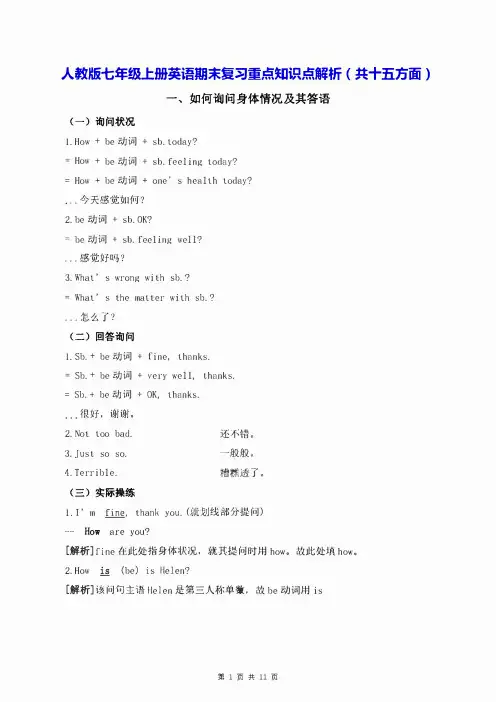
人教版七年级上册英语期末复习重点知识点解析(共十五方面)一、如何询问身体情况及其答语(一)询问状况1. H ow + be动词+sb.today?=How+ be动词+sb.feeling today?=How+ be动词+one's health today?..今天感觉如何?2. b e动词+sb.OK?= be动词+sb.feeling well?...感觉好吗?3. W hat's wrong with sb.?= W hat's the matter with sb.?...怎么了?(二)回答询问1.Sb.+ be动词+fine,thanks.= S b.+ be动词+very wel 1, thanks.= S b.+ be动词+OK,thanks.很好,谢谢。
2. N ot too bad.3.Just so so.4. T errible. (三)实际操练还不错。
一般般。
糟糕透了。
1. I'm且监,thank you.(就划线部分提问)--H ow are you?[解析]fine在此处指身体状况,就其提问时用how。
故此处填how。
2.How廷(be)is Helen?[解析]该问句主语Helen是第三人称单数,故be动词用is.、Be动词用法(一)歌谣:be动词有三个,am、is还有are;我用am,你用are,is连着他、她、它;单数名词用is,复数全部都用are。
(二)实际操练:用适当be动词填空1.I am Tony.[解析]主语为第一人称I,故后用be动词am。
2.Are you OK?[解析]该句主语为第二人称you,故be动词用are3.She is from China./ He is from China./ It is from China.[解析]此处三个句子主语均为第三人称单数,故be动词用is4.The dog is cute.[解析]该句主语t he dog为单数名词,故be动词用is5.The dogs are.cute.[解析]该句主语t he dogs为复数名词,故be动词用are三、This与that区别(一)this为指示代词,用来指代离说话人比较近的人或物that是this的对应词,用来指代离说话人比较远的人或物注意:1)回答this和that的问题时一定要用it来代替,切不可用this和that回答2) this和is不可以缩写,that和is可己缩写成that's(二)实际操练1.--What's this in English?一回答:It's a jacket.[解析]加s的回答需用口,不可以用this.2.This's a nice dog.(错误表达)This is a nice dog.(正确表达)[解析]this is不可进行缩写,故第二句子为正确表达四、颜色前是否可以有冠词a/an(一)如果"颜色”在句中作表语,则不可有冠词修饰;如果”颜色”在句中作定语,则可以有冠词修饰(二)就颜色提问时,则须用特殊疑问词组what colour(三)实际操练1. T he bag is green.[解析]此句中的green为表语,故前面不可加a/an.2. T his is a green bag.[解析]此句中的green作名词bag的定语,故前面可以有冠词a修饰3. I t's an 竺堑驻jacket.(就划线部分提问)What colour is the jacket?[解析]就颜色提问时,需要用what colour来提问,故此处为what colour五、如何询问某人的名字(一)What+be动词+人称代词+name(s)?Eg: What is her name?(二)其答语为:人称代词+name(s)+ be动词+Eg: Her name is Helen.(三)实际操练1. T heir names are Li 1�.(就划线部分提问)What are their names?[解析]提问名字时需要用what提问,故此处为what六、与first name区别:(一)last name指某人的姓;first name指某人的名;而name指某人的姓名(二)需要注意,中国姓在前名在后;而外国名在前姓在后Eg: \Vang Lingling其中\Vang为last name; Lingling为First nameEg: Jim G reen其中Green为last name; Jim为First name(三)实际操练1.Her name is Betty King.问题:What is her last name?Her last name is King.What is her first name?Her first name is Betty.[解析]Betty King为外文名词,前面为名,后面为姓。
人教版七年级英语上册重点单词短语语法
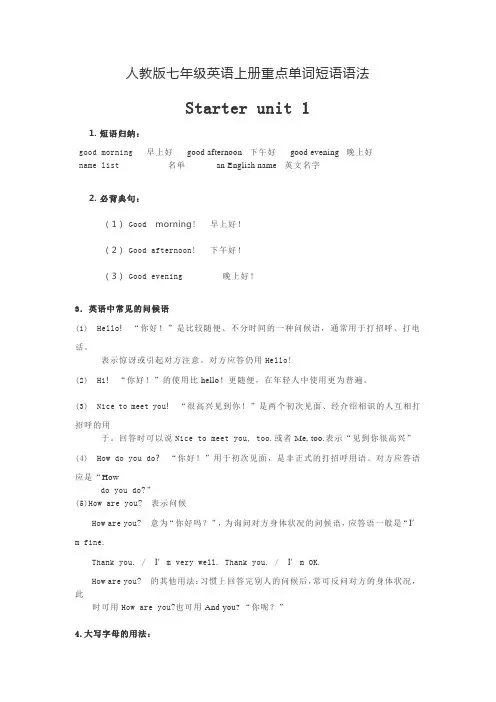
人教版七年级英语上册重点单词短语语法Starter unit 11. 短语归纳:good morning 早上好good afternoon 下午好good evening 晚上好name list 名单an English name 英文名字2. 必背典句:(1)Good morning! 早上好!(2)Good afternoon! 下午好!(3)Good evening 晚上好!3.英语中常见的问候语(1) Hello!“你好!”是比较随便、不分时间的一种问候语,通常用于打招呼、打电话。
表示惊讶或引起对方注意。
对方应答仍用Hello!(2) Hi!“你好!”的使用比hello!更随便,在年轻人中使用更为普遍。
(3) Nice to meet you!“很高兴见到你!”是两个初次见面、经介绍相识的人互相打招呼的用于。
回答时可以说Nice to meet you, too.或者Me, too.表示“见到你很高兴”(4) How do you do?“你好!”用于初次见面,是非正式的打招呼用语。
对方应答语应是“Howdo you do?”(5)How are you? 表示问候How are you? 意为“你好吗?”,为询问对方身体状况的问候语,应答语一般是“I’m fine.Thank you. / I’m very well. Thank you. / I’m OK.How are you? 的其他用法:习惯上回答完别人的问候后,常可反问对方的身体状况,此时可用How are you?也可用And you? “你呢?”4.大写字母的用法:(1) 在英语中,句子的第一个单词的第一个字母都应大写。
Sit down, please. 请坐。
(2)字母I作人称代词时,意为“我”,在句中任何位置都必须大写。
日常用语“OK”在句中任何位置都大写。
I’m a student. 我是一名学生。
Is everything OK? 一切都好吗?(3)人名、地名、国名、某国人或某种语言等专有名词的第一个字母都必须大写。
人教版七年级上册英语第一单元知识点归纳

人教版七年级上册英语第一单元知识点归纳人教版七年级上册英语第一单元知识点Unit 1 My name’s Gina.一、重点单词1. first name 名字 last name/family name 姓二、重点短语1. first name 名2. last name=family name 姓氏3. in China 在中国4. ID card 身份证三、重点句型:1. What’s your first name? 你叫什么名字?My name’s Gina. =I’m Gina. 我叫吉娜。
What’s his/her name? 他/她叫什么名字?His/Her name is Mike/Jenny. 他/她叫迈克/詹妮。
Nice to meet you. 见到你很高兴。
Are you Helen? 你是海伦吗?Yes, I am. 是的,我是。
No, I am not. 不,我不是。
What’s your telephone/phone number? 你的电话是多少?My telephone/phone number is . 我的电话是.What’s your last/family name? 你姓什么?My last/family name’s Smith. 我姓史密斯。
Two and three is five. 二加三等于五。
语法讲解代词(人称代词和物主代词)① 形容词性物主代词在句中修饰名词,其后必须加名词,否则为不正确的。
例:Myisyellow.(错误)---->Myjacketisyellow.(正确)② 人称代词及相对应的形容词性物主代词和be动词③ 主语和宾语的定义。
(1)主语表示句子主要说明的人或事,一般由名词、代词、数词、不定式充当。
例:HelikeswatchingTV.他喜欢看电视。
MaryisanEnglishgirl.玛丽是一个英国女孩。
人教版七年级英语上册Unit4 单词 知识梳理 词汇句式精讲

人教版七年级英语上册Unit4单词知识梳理词汇句式精讲Unit4 单词where [wɛə] adv.在哪里;到哪里table ['teibl] n.桌子bed [bed] n.床bookcase ['bukkeis] n.书架;书柜sofa ['səufə] n.沙发chair [tʃɛə] n.椅子on [ɔn] prep.在…上under ['ʌndə] prep.在…下come [kʌm] v.来;来到come on 快点儿desk [desk] n.书桌think [θiŋk] v.认为;想;思考room [ru:m, rum] n.房间their [ðɛə] pron.他(她,它)们的hat [hæt] n.帽子head [hed] n.头yeah [jʒə] interj.是的;对know [nəu] n.知道,了解radio ['reidiəu] n.收音机;无线电广播clock [klɔk] n.时钟tape [teip] n.磁带;录音带;录像带player ['pleiə] n.播放机tape player 录音机model ['mɔdl] n.模型plane [plein] n.飞机model plane 飞机模型tidy ['taidi] adj.整洁的;井井有条的but [bʌt] conj.但是our ['auə] pron.我们的everywhere ['evriwɛə] adv.处处;到处;各个地方always ['ɔ:lweiz, 'ɔ:lwəz] adv.总是02Unit4 知识梳理Unit4 Where’s my schoolbag?【重点短语】1. my pencil box 我的铅笔盒2. on the sofa 在沙发上3. in your schoolbag 在你的书包里4. under your bed 在你的床底下5. in your grandparents’room 在你祖父母的房间里6. a tape player 一台录音机7. a model plane 一个飞机模型8. English books 英语书9. in the bookcase 在书柜里10. under the radio 在收音机下面11. on the teacher’s desk 在讲台上12. on your head 在你头上【重点句型】1.—Where’s the schoolbag? 书包在哪里?—I t ’s under the table. 在餐桌下。
(全)人教版丨七年级英语上册Unit1重点单词及短语(附例句)
人教版丨七年级英语上册Unit1重点单词及短语(附例句)【重点单词】 ['neim] n.名字;名称My name is Li Ming.我叫李明。
2.nice ['nais] adj.令人愉快的;宜人的Nice to meet you.很高兴见到你。
3.to [tu:, tu, tə] 常用于原形动词之前,表示该动词为不定式meet [mi:t] v.遇见;相逢too [tu:] adv.也;又;太Nice to meet you, too.我也很高兴见到你。
4.your [jɔ:] pron.你的;你们的Your bike is much more expensive than mine.你的自行车比我的贵得多。
5.Ms. n.(不指名婚否)女士The Miss Liu's purse is missing .刘小姐的钱包不见了。
6.his [his] pron.他的His pencil is red.他的铅笔是红色的。
7.and [ænd, ənd] conj.和;又;而Mary and I are good friends.玛丽和我是好朋友。
her [hə:, hə] pron.她的Her hair is yellow.她的头发是黄色的。
yes [jes] interj.是的;可以Did you go to Beijing yesterday?Yes, I did.你昨天去北京了吗?是的,我做到了。
she [ʃi:, ʃi] pron.她he [hi:] pron.他He and she are both good students.他和她都是好学生。
no [nəu] interj.不;没有;不是Are you Russian?No, I'm from Sweden.你是俄罗斯人吗?不,我来自瑞典。
not [nɔt] adv.不;没有There used to be a small river here,but now there are many apple trees here.过去这里有一条小河,但是现在这里有许多苹果树。
最全面人教版七年级上册英语第一单元知识点归纳总结
Unit 1 My name f s Gina.一、词汇与短语团重点单词A部分1. name n.名字:名称2. nice adj.令人愉快的:宜人的3. to常用于词原之前,表示该动词为不定式,4. meet v.遇见;相逢5. too adv 也:又;太6. your pron.你的;你们的7. Ms.(用于女子姓氏姓名前,不指明婚否)女士8. his pron•他的9. and conj.和:又;而10. her pron.她的11. yes interj.是的;可以12. she pron.她13. he pron.他14. No adv.不:没有:不是15. not adv.不:没有B部分1. zero num.零2. one num.一3. two num.二4. three num.三5. four num.四6. five num.五7. six num.六8. seven num.七9. eight num. 7k 10. nine num.九11. ten num.十12. telephone n.电话;电话机13. number n.号码:数字14. phone n.电话;电话机15. first adj.第一16. last adj.最后的;末尾的17. friend n.朋友18. China 中国19. middle adj.中间的n.中间20. school n.学校目重点短语A部分1. your name你的名字2. her name她的名字3. his name他的名字4. my name我的名字B部分1. first name/given name 名字2. last name/family name/sumame 姓3. middle name 中名4. a middle school 一所中学/初中5. in China在中国6. my friend我的朋友7. telephone/phone number 电话号码0重点句子A部分1.Hi. My name is Gina. / I am Gina. 嗨。
(人教版)2024新版英语七年级上册Unit 1-Unit4单词讲解
1.make friends交朋友make friends with me和我交朋友2.get to know 认识;了解I got to know her last week.3.each /i:tʃ/adj.&pron.每个;各自each of them; each picture4.other /'ʌðə(r)/pron.另外的人(或物) Some pictures are better than others. adj.另外的;其他的Are there any other questions?each other 互相;彼此help each other; learn from each other5.full/fʊl/adj 完整的;满的 a full story; a cup full of waterfull name 全名Please write down your full name.6.grade /greɪd/ n年级;等级He is in Grade 2.=He is in the second grade.st name姓氏first name名字You can call him Jim Green. His first name is jim and last name is “Green”.8.classmate/kla:smeit/n.同班同学Jack and Lily are classmates.9.class teacher 班主任---Who is your class teacher? ---Miss Li.10.mistake /mɪ'steɪk/n错误;失误Everyone makes mistakes.11.country/'kʌntri/n.国家China is one of the best countries.12.same/seim/adj.相同的in the same class, look the samethe same as...与...一样;be different from与....不同13.twin/twin/n双胞胎之一adj.双胞胎之一的twin boys/girls14.both /bəʊθ/adj.& pron.两个;两个都Both of my parents are workers.Lucy and Lily are both good students.15.band/bænd/n.乐队I like the jazz band.16.pot/pɒt/n.锅Is there any tea in the pot? A coffee pot is on the table.17.a lot很;非常tofu /toufu:/ n.豆腐Does Jack like tofu a lot? Yes, he does.18.parrot/pærət/n.鹦The parrot can repeat(重复) my words.19.guitar /ɡɪ'ta:(r)/n.吉他I like playing the guitar.20.tennis /tenis/n.网球Does he often play tennis?21.post /pəʊst/n.帖子;邮政邮;发布22.even /i:vn/adv 甚至;连;愈加23.hey /hei/interj.嘿;喂24.would /wud;wod/ modalv 想(用于礼貌地邀请或向某人提供某物);将会would('d)like to 表示愿意喜欢I would like to visit my grandparents.rmation /ɪnfəˈmeɪʃən/ n.信息;消息much information(不可数名词)26.hobby /ˈhɒbi/n业余爱好Playing tennis is ine of my hobbies.27.Green/gri:n/格林UK/ju:'kei/英国US/ju:'es/美国Smith/smɪθ/史密斯Both Green and Smith like the UK and the US28.人名:Lisa /li:zə/ 莉萨Tom/tɒm/汤姆Sally /ˈsæli/ 萨莉Wood /wud/伍德Pauline /ˈpɔ:li:n/保利娜Lee /li:/李29.Sydney/ˈsɪdni/悉尼(澳大利亚城市) She comes from Sydney.30.Australia /ɒ'streɪliə/澳大利亚an Australian city一座澳大利亚的城市31.hotpot 火锅Mapo tofu 麻婆豆腐Beijing roast /rəʊst/ duck北京烤鸭32.Singapore /ˌsɪŋəˈpɔ:(r)/新加坡Coco /'kəʊkəʊ/ 科科Coco takes the train to Singapore.33.London /ˈlʌndən/伦敦(英国首都)1.mean v意思是;打算means/meant/meaningWhat does the word mean?这个单词什么意思?What does she mean by doing that? 她那样做什么意思?2.husband n.丈夫husband and wife夫妇3.bat n.球棒;球拍two ping-pong bats乒乓球拍4.play ping-pong打乒乓球= play table tennis5.every day 每天---How often do you watch TV, Mr.Li ? ---Every day.Everyday adj. 每天的everyday life日常生活6.together adv在一起;共同We study together every day.7.fishing rod 钓竿My father uses a fishing rod to fish.8.spend v花(时间钱等) a lot of/lots of大量;许多The boy in red often apends lots of time playing ping-pong.9.really adv 非常;确实;真正地(可修饰形容词,副词或动词)The book is really interesting.They are really my aunt and uncle.Your mother really loves you.10.activity n.活动do after-school/classroom activities11.chess n.国际象棋Chinese chess 中国象棋(球类和棋类钱不加the,乐器前加the)He plays Chinese chess and plays the piano as hobbies.他下中国象棋和弹钢琴作为爱好。
人教版七年级英语上册Starter Unit1-3单词_知识梳理_词汇句式精讲
Starter Unit1good [gud] adj.good [gud] adj.好的morning ['mɔ:niŋ] n.早晨;上午Good morning! 早上好!hi [hai] interj.(用于打招呼)嗨;喂hello ['hə'ləu] interj.你好;喂afternoon ['ɑ:ftə'nu:n] n.下午Good afternoon! 下午好!evening ['i:vniŋ] n.晚上;傍晚Good evening! 晚上好!how [hau] adv.怎样;如何are [ɑ:] v.是you [ju:, ju] pron.你;你们How are you? 你好吗?I [ai] pron.我am [æm, əm] v.是fine [fain] adj.健康的;美好的thanks interj.n.感谢;谢谢OK ['əu'kei] interj.adv.好;可以HB (铅笔芯)硬黑CD 光盘;激光唱片BBC 英国广播公司Alice ['ælis] 爱丽丝(女名)Bob [bɔb] 鲍勃(男名)Cindy 辛迪(女名)Dale [deil] 戴尔(男名)Eric ['erek] 埃里克 (男名)Frank [fræŋk] 弗兰克(男名)Grace [greis] 格雷丝(女名)Helen ['helin] 海伦(女名)Starter Unit2what /wɔt/ pron.&adj. 什么is /iz/ v. 是this /ðis/ pron. 这;这个in /in/ prep. (表示使用语言、材料等)用;以English /'iŋgliʃ/ n. 英语adj. 英格兰的;英语的in English 用英语map /mæp/ n. 地图cup /kʌp/ n. 杯子ruler /'ru:lə/ n. 尺;直尺pen /pen/ n. 笔;钢笔orange /'ɔrindʒ/ n. 橙子jacket /'dʒækit/ n. 夹克衫;短上衣key /ki:/ n. 钥匙quilt /kwilt/ n. 被子;床罩it /it/ pron. 它a /ə/ art. (用于单数可数名词前)一(人、事、物) that /ðæt/ pron. 那;那个spell /spel/ v. 用字母拼;拼写please /pli:z/ interj. (用于客气地请求或吩咐)请Starter Unit3color /'kʌlə/ n. (=colour) 颜色red /red/ adj.& n. 红色(的)yellow /\'jeləu/ adj.& n. 黄色(的)green /gri:n/ adj.& n. 绿色(的)blue /blu:/ adj.& n. 蓝色(的)black /blæk/ adj.& n. 黑色(的)white /wait/ adj.& n. 白色(的)purple /\'pə:pl/ adj.& n. 紫色(的)brown /braun/ adj.& n. 棕色(的);褐色(的)the /ði; ðə/ art. 指已提到或易领会到的人或事now /nau/ adv. 现在;目前see /si:/ v. 理解;明白can /kæn/ modal v. 能;会say /sei/ v. 说;讲my /mai/ pron. 我的02Starter Unit 1-3 知识梳理【重点短语】1. good morning/afternoon/evening 早上/下午/晚上好2. good night 晚安3. thank you = thanks 谢谢你4. in English 用英语5. CD 光盘,激光唱片6. BBC 英国广播公司7. NBA (美国)全国篮球协会8. P 停车场,停车位9. kg 千克,公斤10. S 小号的11. M 中号的12. L 大号的13. UFO 不明飞行物【重点句型】1. —Hi, Helen! How are you? 嗨,海伦!你好吗?—Hi, Eric! I'm fine,thanks. 嗨,埃里克!我很好,谢谢。