
2013年12月英语六级真题及答案下载(第三套)(word版)
2013年12月英语六级考试听力真题(第3套)1. M:I need to find a dentist,you said you know Dr.Smith well.do you recommend her?W:Well,I had to see her a few tLmes,but what impressed me most were the magazines in her waiting room.Q:What does the woman imply? D)。
A.Dr.Smith’s waiting room,isn’t tidy.B.Dr.Smith enjoys reading magazines.C.Dr.Smith has left a good impression on her.D.Dr.Smith may not be a good choice.2.W:I'm afraid I can't show you the apartment at the moment,because the tenant is still living in it.It’S really a lovely place with a big kitchen and a sunny window.for only$200 a month.M:Sounds good,but we realy can't rent an apartment without seeing it first.Q:What do we learn from the conversation? C)。
A.The man will rent the apartment when it is available.B.The man made a bargain with the landlady over the rent.C.The man insists on having a look at the apartment first.D.The man is not fully satisfied with the apartment.3. M:S0,that’S what's been keeping you SO busy recently!W:Yes,I've been tied up with my studies.You know I'm planning to go to the United States this comingsununer,but I'm a bit nervous about my English.Q:What is the woinan busy doing? B).A.packing up to go abroad.B.Brushing up on her English.C.Drawing up a plan for her English course.D.Applying for a visa to the United States.4.W: How did you feel when you found out you had high blood pressure?M: Shocked! The problem for me was that there were no symptoms; it seemed to have sneaked up on me.Q: What does the man mean? C)。
A.He is anxious to find a cure for his high blood pressure.B.He doesn’t think high blood pressure is a problem for him.C.Ite was not aware of his illness until diagnosed with it.D.He did not take the symptoms of his illness seriously.5.W: So, you're just back from a trip to India. What were you doing there?M: The trip was intended to bring to the world's attention the fact that AIDS is not just an African disease; it's also endangering other countries, notably, India and Thailand.Q: What was the purpose of the man's trip to India? D)A.To investigate the causes of AIDS.B.To raise money for AIDS patients.C.To rally support for AIDS victims in Africa.D.To draw attention to the spread of AIDS in Asia.6. M: It's quite clear for my visit: this is a full size, comprehensive university. So why is it still called a college?W: The College of William and Mary is the second oldest institution of higher learning in this country. We have nttrtured great minds like Thomas Jefferson and we are proud of our name.Q: What do we learn from this conversation about the College of William and Mary? A)A.l t has a very long history.B.l t is a private institution.C.It was founded by Thomas Jefferson.D.It stresses the comprehensive study of nature.7. M: Have the parts we need for the photo copying machine arrived yet?W: I ordered them last week, but something is holding them up.Q: What does the woman say about the parts needed for the photo copying machine? B)A.Th ey can’t fit into the machine.B.They have not been delivered yet.C.They were sent to the wrong address.D.They were found to be of the wrong type.8.W: The cafeteria provided many kinds of dishes for us today. Did you notice that?M: Yes, kind of rare, isn't it?Q: What does the man imply? A)A.The food served in the cafeteria usually lacks variety.B.The cafeteria sometimes provides rate food for the students.C.The students find the service in the cafeteria satisfactory.D.The cafeteria tries hard to cater to the students,needs.conversation OneW: Hello, Patrick, is that you?M: Yeah, Jane, what can I do for you?W: (9) I was calling about the apple tree that you were trimming yesterday.M: That was hard work!W: I'm sure it was. It ture looked difficult.M: Yeah, I'm glad it's finished. Hauling the branches to the front for garbage pick-up was no fun either.W: Well, I don't think you're quite finished yet, (10) some of the larger branches fell over into my yard, and I think you should come and get them.M: Listen, Jane, I don't see why I should do that. You eat all the apples that fall in your yard, and you've never complained about that before.W: Well, it's easier to pick up apples than to drag tree branches all the way to the curb. My kids pick up the apples, and the branches are just too big for them to drag.M: Well, I guess you'll just have to do it yourself, Jane.W: Patrick, I wish you would reconsider. We've always gotten along fairly well, but I think you're out of line here.The branches are your responsibility.M: Sorry, Jane, I disagree! You take the benefits of the apple tree, but refuse to deal with the bad side of it! Besides, it won't take you any time to get the branches out front !W: Get the branches off my property or ( 11 ) I'll have to sue you.M: Yeah? For what?! You're taking those law classes too seriously! I've gotta go, I have to pick up my son.W: You'll be hearing from me.M: (12) Yeah, yeah. See you in court, Jane.Questt l ms 9 to12 are based on the conversation you have just heard.9.What did the man do yesterday? B)A.He picked up some apples in his yard.B.He cut some branches off the apple tree.C.He quarreled with his neighbor over the fence.D.He cleaned up all the ga rbage in the woman’s yard.10. What did the woman ask the man to do? D)A.Trim the apple trees in her yard.B.Pick up the apples that fell in her yard.C.Take the garbage to the curb for her.D.Remove the branches from her yard.11. What did the woman threaten to do? A)A.File a lawsuit against the man.B.Ask the man for compensation.C.Have the man's apple tree cut down.D.Throw garbage into the man's yard.12. What was the man's reaction to the woman's threat? C)A.He was ready to make a concession.B.He was not prepared to go to court.C.He was not intimidated.D.He was a bit concerned.Conversation TwoM: Did you hear about the air crash that occurred in South America recently? It was quite a tragic accident!W: No, I didn't see anything in the news about it. What happened?M: A foreign airliner was attempting to land at night in a mountainous area of Argentina and flew into a hill!W: That sounds really terrible! Did anyone survive?M: No, everyone aboard, including the crew, was killed instantly.W: What were the circumstances? Were there bad weather, a fire, or engine failure?M: Apparently, there were some low clouds in the area, (13) but mostly it was just miscommuuication between the pilots and the air traffic controllers.W: Weren't they both speaking in English, the official international aviation language?M:Yes they were, but the transmission from poor quality radios was slightly distorted and the accents of the Spanish speaking controllers were so strong that the pilots misunderstood a vital instruction.W: How could a misunderstanding like that cause such a serious accident?M: The pilots were told to descend to two-two thousand feet. The instruction actually meant 22,000 feet, but they thought they heard descend to 2,000 feet. That's a huge difference, and it should have been confirmed, but it was not. Unfortunately, (14) the terrain of the mountains in Norweija extends up 20,000 feet.W: So the pilots did descend to the wrong altitude then, thinking they were follov~g the air contxoilers' instructions.M: Sadly enough,yes they did. It was a really bad mistake. Many people died as a result of the simple misunderstanding.W: (15) Wow, that's a powerful lesson on how important it can be to accurately commtmicate to each other.Questions 13 to 15 are based on the conversation you have just heard.13. .What was the cause of the tragedy? B)A.Bad weather.B.Human error.C.Breakdown of the engines.D.Failure of the communications system.14. How high are the mountains in Norweija? C)A.Two thousand feet.B.Twelve thousand feet.C.Twenty thousand feet.D.Twenty-two thousand feet.15. What lesson could be drawn from the accident? A)A.Accurate communication is of utmost importance.B.Pilots should be able to speak several foreign languages.C.Air controllers should keep a close watch on the weather. D.Cooperation between pilots and air controllers is essential.Section BPassage OneEdgar Allen Poe, an American writer, was born in 1809. His parents were actors. Edgar was a baby when his father left the family. (16) He was two years old whenhis mother died. He was taken into the home of a wealthy businessman named John Allen. He then received his new name, Edgar Allen Poe. As a young man, Poe attended the University of Virginia. He was a good student, but he liked to drink alcohol and play card games for money. As an unsldlled game player, he often lost money. (17) Since he couldn't pay off his gambling debt, he left tmiversityand began working for magazines. He worked hard, yet he was not well paid, or well known. At the age of 27, he got married. For a time it seemed that Poe would fred some happiness, but his wife was sick for most of their marriage, and died in 1847. Through all iris crises, Poe produced many stories and poems which appeared indifferent publications, yet he didn't become famous until 1845, when his poem, The Raven, was published. There is a question, however, about Poe's importance in American Literature. Some critics say Poe was one of America's best writers, and even had a great influence on many French writers, but others disagree. (18) They say Poe's work is difficult to understand and most of his writing describes many unpleasant situations and events. Edgar Allen Poe died in 1849 when he was 40 years old. (19) It is said that he was found dead after days of heavy drinking. Questions 16 to 19 are based on the passage you have just heard.16. . What happened to Edgar Allen Poe:s family, when he was only two years old?B)A.His father caught a serious disease.B.His mother passed away.C.His mother left him to marry a rich businessman.D.His father took to drinking.17. Why did Edgar Allen Poe leave the University of Virginia? C)A.He disliked being disciplined.B.He was expelled by the university.C.He couldn't pay his gambling debts.D.He enjoyed working for a magazine. 18. What do some critics say about Edgar Allen Poe? C)A.His poems are heavily influenced by French writers.B.His stories are mainly set in the State of Virginia.C.His work is difficult to read.D.His language is not refmed.19. How did Edgar Allen Poe's life come to an end? D)A.He grieved to death over the loss of his wife.B.He committed suicide for unknown reasons.C.He was shot dead at the age of 40.D.He died of heavy drinking.Passage TwoMore than fifty years ago, the United Nations declared that literacy is a basic human right. It's very important for improving the lives of individuals. However, it is estimated that 880 million adults around the world are illiterate, that is, they are unable to read or write. (20)A majority of them are women. More than 110 million school age children in the world do not attend school. Many others complete school all failed to finish their studies without learning to read or write. Many countries depend on the efforts of people who offer their time to help illiterate individuals. For example, John Mogger became concerned about the problem of illiteracy three years ago, so he started teaching five prisoners in Brazil. In his teaching, he developed a system with this group of prisoners. (22)He says his way of teaching can help anyone learn how to read and write with about thirty hours of study. To learn his system, people must first know how to write letters of the alphabet and learn which sounds they represent. (21)The system divides letters into three groups. The first group of letters can be written between two lines. The second can be written between two lines but part of the letters is above the top line. The third group has letters that are partly written below the lower line. John Mogger taught his students to write simple words from the letters, in this way, his students learned more than 700 words. Many of them can now writeto family members. They also can read newspapers and magazines.Questions 20 to 22 are based on the passage you have just heard.20. According to the speaker, which group of people makes up of the majority of the illiterate population? A)A.Women.B.Prisoners.C.Manual workers.D.School age children.21. What is the most important feature of John Mogger's method of teaching the alphabet? D)A.He taught his students how to pronounce the letters first.B.He matched the letters with the sounds familiar to the learners.C.He showed the learners how to combine the letters into simple words. D.He divided the letters into groups according to the way they are written.22. What does John Mogger say about his teaching method? A)A.It can help people to become literate within a short time.B.It was originally designed for teaching the English language.C.It enables the learners to master a language within three months.D.It is effective in teaching any alphabetical language to Brazilians.Passage ThreeFarmers usually use ploughs to prepare their fields for planting crops. Plows cut into the ground, and lift up weeds and other unwanted plants. ( 23 ) However, plowing is blamed for causing severe damage to topsoil by removing the plants that protect soil from being blown or washed away. (24) Many farmers in South Asia are now trying a process called Low Till Farming. Low Till Farming limits the use of ploughs. In this method of farming, seeds and fertilizer are put into the soil through small cuts made in the surface of the ground. Low Till Agriculture leaves much or all of the soil and remains of plants on the ground. They serve as a natural, fertilizer and help support the roots of future crops. They take in rain and allow it to flow into the soil instead of running off. It has been proved that Low Till Farming increases harvests and reduces water use, and this method reduces the need for chemical products because there are fewer unwanted plants. (25) Scientists say Low Till Farming is becoming popular in South Asia, which is facing a severe water shortage. They say the area will become depended on imported food unless water is saved through methods like Low Till Farming. Currently, more than 150 million people in South Asia depend on local rice and wheat crops. Farmers grow rice during wet weather. During the dry season they grow wheat in the same fields. Farmers are using the Low Till method to plant wheat after harvesting rice. Scientists say Low Till Agriculture is one of the best examples in the world of technologies working for both people and the environment. Questions23 to 25 are based on the passage you have just heard.23. What is the main problem caused by the usual way of plowing? C) A.The crop's blooming period is delayed.B.The roots of crops are cut off.C.The topsoil is seriously damaged.D.The growth of weeds is accelerated.24. What does the speaker say about Low Till Farming? D)A.It's a new way of applying chemical fertilizer.B.It's an improved method of harvesting crops.C.It's a creative technique for saving labor.D.It's a farming process limiting the use of ploughs.25. Where is Low Till Farming becoming popular? B)A.In areas with few weeds and unwanted plants.B.In areas with a severe shortage of water.C.In areas lacking in chemical fertilizer.D.In areas dependent on imported food.Section CAdults are getting smarter about how smart babies are. Not long ago, researchers learned that4-day-old could understand 26 addition and subtraction. Now, British research psychologist Graham Schafer has discovered that infants can learn words for uncommon things long before they can speak. He found that 9-month-old infants could be taught, through repeated show-and-tell, to27 recognize the names of objects that were foreign to them, a result that28 challenges in some ways the received wisdom that, apart from learningto29 identify things common to their daily lives, children don't begin to build vocabulary until well into their second ear. "It's no30 Secret that children learn words, but the words they tend to know are words linked to31 specific situations in the home," explains Schafer. "This is the first demonstration that we can choose what words the children will learn and that they can respond to them with an unfamiliar voice32 giving instructions in an unfamiliar setting. "Figuring out how humans acquire language may33 shed light on why some children learn to read and write later than others, Schafer says, and could lead to better treatments for developmental problems. What's more, the study of language 34 acquisition offers direct insight into how humans learn. "Language is a test case for human cognitive development," says Schafer. But parents eager to teach their infants should take note : even without being taught new words, a control group 35 caught up with the other infants within a few months. "This is not about advancing development," he says. "It's just about what children can do at an earlier age than what educators have often thought. "。
2013年12月英语六级真题(含答案)(共三套)最新排版整理

2013年12月大学英语六级考试真题(第3套)Part I Writing (30 minutes)(请于正式开考后半小时内完成该部分,之后将进行听力考试)请用黑色签字笔在答题卡1指定区域内作答作文题,在试题册上的作答无效!Part ⅡListening Comprehension(30 minutes)Part III Reading Comprehension (40 minutes)Section AQuestions 36 to 45 are based on the following passage.Cell phones provide instant access to people. They are creating a major 36 in the social experiences of both children and adolescents. In one recent U.S. survey, about half the teens polled said that their cell phone had 37 their communication with friends. Almost all said that their cell phone was the way they stayed in touch with peers, one-third had used the cell phone to help a peer in need, and about 80% said the phone made them feel safer. Teenagers in Australia, 38 ,said that their mobile phones provided numerous benefits and were an39 part of their lives; some were so 40 to their phones that the researchers considered it an addiction. In Japan, too, researchers are concerned about cell phone addiction. Researchers in one study in Tokyo found that more than half of junior high school students used their phones to exchange e-mails with schoolmates more than 10 times a day.Cell phones 41 social connections with peers across time and space. They allow young people to exchange moment-by-moment experiences in their daily lives with special partners and thus to have a more 42 sense of connection with friends. Cell phones also can 43 social tolerance because they reduce children's interactions with others who are different from them. In addition to connecting peers, cell phones connect children and parents. Researchers studying teenagers in Israel concluded that, in that 44 environment, mobile phones were regarded as "security objects" in parent-teen relationships―im portant because they provided the possibility of 45 and communication at all times.注意:此部分试题请在答题卡2上作答A) affiliatedB) attachedC) contactD) contendE) continuousF) diminishG) enduranceH) foster I) hazardous J) improved K) instantaneous L) intrinsicM) relatively N) shiftO) similarlySection BWaste Not, Want Not Feeding the 9 Billion: The Tragedy of Waste[A] By 2075, the United Nations' mid-range projection for global population is about 9.5 billion.This means that there could be an extra three billion mouths to feed by the end of the century,a period in which substantial changes are anticipated in the wealth, calorie intake and dietarypreferences of people in developing countries across the world. Such a projection presents mankind with wide-ranging social, economic, environmental and political issues that need to be addressed today to ensure a sustainable future for all. One key issue is how to produce more food in a world of finite resources.[B] Today, we produce about four billion metric tonnes of food per year. Yet due to poor practicesin harvesting, storage and transportation, as well as market and consumer wastage, it is estimated that 30-50% of all food produced never reaches a human stomach. Furthermore, this figure does not reflect the fact that large amounts of land, energy, fertilisers and water have also been lost in the production of foodstuffs which simply end up as waste. This level of wastage is a tragedy that cannot continue if we are to succeed in the challenge of sustainably meeting our future food demands. |Where Food Waste Happens[C] In 2010,the Institution of Mechanical Engineers identified three principal emerging populationgroups across the world, based on characteristics associated with their current and projected stage of economic development.• Fully developed, mature, post-industrial societies, such as those in Europe, characterised by stable or declining populations which are increasing in age.• Late-stage developing nations that are currently industrialising rapidly, for example China, which will experience declining rates of population growth, coupled with increasing affluence (富裕)and age profile.• Newly developing countries that are beginning to industrialise, primarily in Africa, with high to very high population growth rates, and characterised by a predominantly young age profile.[D] Each group over the coming decades will need to address different issues surrounding foodproduction, storage and transportation, as well as consumer expectations, if we are to continue to feed all our people.[E] In less-developed countries, such as those of sub-Saharan Africa and South-East Asia, wastagetends to occur primarily at the farmer-producer end of the supply chain. Inefficient harvesting, inadequate local transportation and poor infrastructure (基础设施)mean that produce is frequently handled inappropriately and stored under unsuitable farm site conditions.[F] In mature, fully developed countries such as the UK, more-efficient farming practices andbetter transport, storage and processing facilities ensure that a larger proportion of the food produced reaches markets and consumers. However, characteristics associated with modern consumer culture mean produce is often wasted through retail and customer behaviour. [G] Major supermarkets, in meeting consumer expectations, will often reject entire crops ofperfectly edible fruit and vegetables at the farm because they do not meet exacting marketing standards for their physical characteristics, such as size and appearance.[H] Of the produce that does appear in the supermarket, commonly used sales promotionsfrequently encourage customers to purchase excessive quantities which, in the case of perishable foodstuffs, inevitably generate wastage in the home. Overall between 30% and 50% of what has been bought in developed countries is thrown away by the purchaser.Better Use of Our Finite Resources[I] Wasting food means losing not only life-supporting nutrition but also precious resources,including land, water and energy. As a global society, therefore, tackling food waste will help contribute towards addressing a number of key resource issues.[J] Land Usage: Over the last five decades, improved farming techniques and technologies have helped to significantly increase crop yields along with a 12% expansion of farmed land use.However, a further increase in farming area without impacting unfavourably on what remains of the world's natural ecosystems appears unlikely. The challenge is that an increase in animal-based production will require more land and resources, as livestock (牲畜)farming demands extensive land use.[K] Water Usage: Over the past century, human use of fresh water has increased at more than double the rate of population growth. Currently about 3.8 trillion m3of water is used by humans per year. About 70% of this is consumed by the global agriculture sector, and the level of use will continue to rise over the coming decades.[L] Better irrigation can dramatically improve crop yield and about 40% of the world's food supply is currently derived from irrigated land. However, water used in irrigation is often sourced unsustainably.In processing foods after the agricultural stage, there are large additional uses of water that need to be tackled in a world of growing demand. This is particularly crucial inthe case of meat production, where beef uses about 50 times more water than vegetables. In the future, more effective washing techniques, management procedures, and recycling and purification of water will be needed to reduce wastage.[M]Energy Usage: Energy is an essential resource across the entire food production cycle, with estimates showing an average of 7-10 calories of input being required in the production of one calorie of food. This varies dramatically depending on crop, from three calories for plant crops to 35 calories in the production of beef. Since much of this energy comes from the utilisation of fossil fuels, wastage of food potentially contributes to unnecessary global warming as well as inefficient resource utilisation.[N] In the modem industrialised agricultural process—which developing nations are moving towards in order to increase future yields—energy usage in the making and application of fertilisers and pesticides represents the single biggest component. Wheat production takes 50% of its energy input for these two items alone. Indeed, on a global scale, fertiliser manufacturing consumes about 3-5% of the world's annual natural gas supply. With production anticipated to increase by 25% between now and 2030, sustainable energy sourcing will become an increasingly major issue. Energy to power machinery, both on the farm and in the storage and processing facilities, adds to the energy total, which currently represents about 3.1% of annual global energy consumption.Recommendations[O] Rising population combined with improved nutrition standards and shifting dietary preferences will exert pressure for increases in global food supply. Engineers, scientists and agriculturalists have the knowledge, tools and systems that will assist in achieving productivity increases. However, pressure will grow on finite resources of land, energy and water. The potential to provide 60-100% more food by simply eliminating losses, while simultaneously freeing up land, energy and water resources for other uses, is an opportunitythat should not be ignored. In order to begin tackling the challenge, the Institution recommends that:•The UN Food and Agriculture Organisat ion work with the international engineering community to ensure governments of developed nations put in place programmes that transfer engineering knowledge, design know-how, and suitable technology to newly developing countries. This will help improve produce handling in the harvest, and immediate post-harvest stages of food production.• Governments of rapidly developing countries incorporate waste minimisation thinking into the transport infrastructure and storage facilities currently being planned, engineered and built.• Governments in developed nations devise and im plement policy that changes consumer expectations. These should discourage retailers from wasteful practices that lead to the rejection of food on the basis of cosmetic characteristics, and losses in the home due to excessive purchasing by consumers.注意:此部分试题请在答题卡2上作答。
2013年12月英语六级真题(含答案共3套)
2013年12月大学英语六级考试真题(第1套)Section CDirections:There are 2 passages in this section. Each passage is followed by some questions or unfinished statements. For each of them there are four choices marked A), B), C) and D). You should decide on the best choice and mark the corresponding letter on Answer Sheet 2with a single line through the centre.Passage OneQuestions 56 to 60 are based on the following passage.Among the government’s most interesting reports is one that estimates what parents spend on their children. Not surprisingly, the costs are steep. For a middle-class, husband-and-wife family (average pretax income in 2009: $76,250), spending per child is about $12,000 a year. With inflation the family’s spending on a child will total $286,050 by age 17.The dry statistics ought to inform the ongoing deficit debate, because a budget is not just a catalog of programs and taxes. It reflects a society’s priorities and values. Our society does not—despite rhetoric(说辞) to the contrary—put much value on raising children. Present budget policies tax parents heavily to support the elderly. Meanwhile, tax breaks for children are modest. If deficit reduction aggravates these biases, more Americans may choose not to have children or to have fewer children. Down that path lies economic decline.Societies that cannot replace their populations discourage investment and innovation. They have stagnant (萧条的) or shrinking markets for goods and services. With older populations, theyresist change. To stabilize its population—discounting immigration—women must have an average of two children. That’s a fertility rate of 2.0.Many countries with struggling economies are well below that.Though having a child is a deeply personal decision, it’s shaped by culture, religion, economics, and government policy. “No one has a good answer” asto why fertility varies among countries, says sociologist Andrew Cherlin of The Johns Hopkins University. Eroding religious belief in Europe may partly explain lowered birthrates. In Japan young women may be rebelling against their mothers’ isolated lives of child rearing. General optimism and pessimism count. Hopefulness fueled Ameri ca’s baby boom. After the Soviet Union’s collapse, says Cherlin, “anxiety for the future” depressed birthrates in Russiaand Eastern Europe.In poor societies, people have children to improve their economic well-being by increasing the number of family workers and providing supports for parents in their old age. In wealthy societies, the logic often reverses. Government now supports the elderly, diminishing the need for children. By some studies, the safety nets for retirees have reduced fertility rates by 0.5 children in the United States and almost 1.0 in Western Europe, reports economist Robert Stein in the journal National Affairs. Similarly, some couples don’t have children because they don’t want to sacrifice their own lifestyles to the lime and expense of a family.Young Americans already face a bleak labor market that cannot instill (注入) confidence about having children. Piling on higher t axes won’t help, “If higher taxes make it more expensive to raise children,” says Nicholas Eberstadt of the American Enterprise Institute, “people will thinktwice about having another child.” Tha t seems like common sense, despite the multiple influences on becoming parents.注意:此部分试题请在答题卡2上作答。
2013年12月英语四级真题及答案 (3)
2013年12月英语四级真题及答案阅读理解(共两节,满分40分)第一节1. A. 考点:文章第一段提到:波多黎各遭受的破坏震撼了整个地区。
因此,根据后面提供的信息,可以推断出这次飓风对整个加勒比地区造成了广泛的破坏。
B选项只提到了波多黎各遭受的破坏,没有涉及整个加勒比地区。
2. D. 考点:文章第二段末尾提到“We love getting movie recommendations”. 因此,可以推断出他们喜欢得到关于电影的建议。
3. B. 考点:根据第一段“When it comes to the growth of cities, the 21st century is largely a story of the developing world”我们可以推断出,发展中国家的城市增长更快。
4. C. 考点:根据第二段“Those who live in cities complain of traffic jams and crowded subway cars”可以推断出,城市居民经常抱怨交通拥堵和拥挤的地铁。
5. D. 考点:根据文章第三段“In city after city, the urban population today is much larger than it has ever been in history”可以推断出城市人口比历史上任何时候都要多。
6. A. 考点:根据文章第四段“Bu this does not mean that there is no way to slow the growth of cities”可以推断出,存在减缓城市增长的方法。
7. B. 考点:根据文章最后一段“For all the challenges cities fac e, they remain attractive places to live”可以推断出,尽管城市面临很多挑战,但人们仍然愿意居住在城市。
201312CET-6(共三套)真题+参考答案
2013年12月大学英语六级考试真题(第1套)Part IDWriting(30 minutes)(请干正式开考后半小时内完成该部分,之后将迸行听力考试)Directions:For this part, you are allowed 30 minutes to write an essay on happiness by referring to the saying “Happiness is not the absence of problems, but the ability to deal with them.,,You can cite examples to illustrate your point and then explain how you can develop your ability to deal with problems and be happy. You should write at least 150 words but no more than 200 words.Part II Listening Comprehension (30 minutes)Section ADirections:/n this section, you will hear 8 short conversations and 2 long conversations. At theend of each conversation, one or more questions will be asked about what was said. Both the conversation and the questions will be spoken only once. After each question there will be a pause. During the pause, you must read the four choices marked A), B), C) and D), and decide which is the best answer. Then mark the corresponding letter on Ans^wer Sheet 1 with a single line through the centre.注意:此部分试题请在答题卡1上作答。
2013年12月英语四级真题及答案(第三套)(word版)
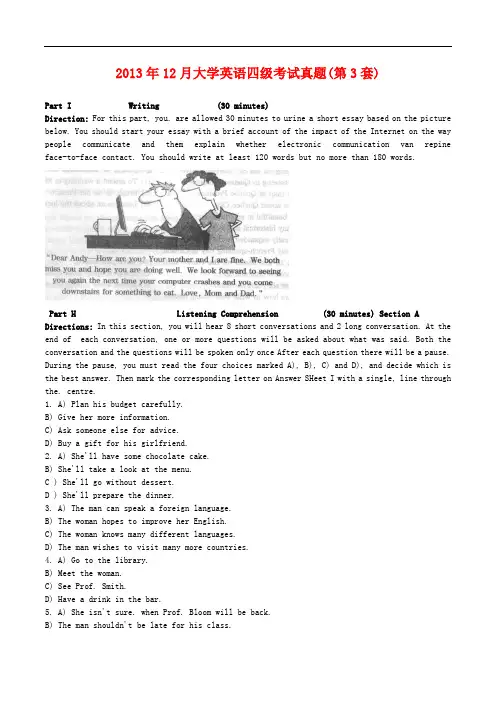
2013年12月大学英语四级考试真题(第3套)Part I Writing (30 minutes)Direction: For this part, you. are allowed 30 minutes to urine a short essay based on the picturebelow. You should start your essay with a brief account of the impact of the Internet on the way people communicate and them explain whether electronic communication van repine face-to-face contact. You should write at least 120 words but no more than 180 words.Part H Listening Comprehension (30 minutes) Section ADirections: In this section, you will hear 8 short conversations and 2 long conversation. At theend of each conversation, one or more questions will be asked about what was said. Both the conversation and the questions will be spoken only once After each question there will be a pause.During the pause, you must read the four choices marked A), B), C) and D), and decide which isthe best answer. Then mark the corresponding letter on Answer SHeet I with a single, line throughthe. centre.1. A) Plan his budget carefully.B) Give her more information.C) Ask someone else for advice.D) Buy a gift for his girlfriend.2. A) She'll have some chocolate cake.B) She'll take a look at the menu.C ) She'll go without dessert.D ) She'll prepare the dinner.3. A) The man can speak a foreign language.B) The woman hopes to improve her English.C) The woman knows many different languages.D) The man wishes to visit many more countries.4. A) Go to the library.B) Meet the woman.C) See Prof. Smith.D) Have a drink in the bar.5. A) She isn't sure. when Prof. Bloom will be back.B) The man shouldn't be late for his class.C) The man can come back sometime later.D) She can pass on the message for the man.6. A) He has a strange personality.B) He's got emotional problems.C ) His illness is beyond cure.D ) His behavior is hard to explain.7. A) The tickets are more expensive than expected.B) The tickets are sold in advance at half price.C) It's difficult to buy the tickets on the spot.D) It's better to buy the tickets beforehand.8. A) He turned suddenly and ran into a tree.B)He was hit by a fallen box from a track.C) He drove too fast and crashed into a truck.D) He was trying to overtake the truck ahead of him.Questions 9 to 11 are based on the conversation you have just heard.9. A) To go boating on the St. Lawrence River.B) To go sightseeing in Quebec Province.C) To call on a friend in Quebec City.D) To attend a wedding in Montreal.10. A) Study the map of Quebec Province.B) Find more about Quebec City.C) Brash up on her French.D) Learn more about the local customs.11. A) It's most beautiful in summer.B) It has many historical buildings.C) It was greatly expanded in the 18th century.D) It's the only French-speaking city in Canada. Questions 12 to 15 are based on the conversation you have just heard.12. A) It was about a little animal,B) It took her six years to write.C) It was adapted from a fairy tale.D) It was about a little girl and her pet.13. A) She knows how to write best-selling novels.B) She can earn a lot of money by writing for adults.C) She is able to win enough support from publishers.D) She can make a living by doing what she likes.14. A) The characters.B) The readers.C) Her ideas.D) Her life experiences.15. A) She doesn't really know where they originated.B) She mainly drew on stories of ancient saints,C) They popped out,of her childhood dreams.D) They grew out of her long hours of thinking.Section BDirections:In this section, you will hear 3 short passages. At the end of each passage, you will hear same questions, Both the passage and the questions will be spoken only once. After you hear a question, you must choose the best answer from the four choices marked A), B), C) and D ). Then mark the corresponding letter on Answer Sheet 1 with a single line through the centre. Passage OneQuestions 16 to 18 are based on the passage you have just heard.16. A) Monitor students' sleep patterns.B) Help students concentrate in class.C) Record students' weekly, performance.D) Ask students to complete a sleep report.17. A) Declining health.B) Lack of attention.C) Loss of motivation.D) Improper behavior.18. A) They should make sure their children are always punctual for school.B) They should ensure their children grow up in a healthy environment.C) They should help their children accomplish high-quality work.D) They should see to it that their children have adequate sleep.Passage TwoQuestions 19 to 22 are based on the passage you have just heard.19. A) She stopped being a homemaker.B) She became a famous educator.C) She became a public figure.D) She quit driving altogether20. A) A motorist's speeding.B) Her running a stop sign.C) Her lack of driving experience.D) A motorist's failure to concentrate.21. A) Nervous and unsure of hemelf.B) Calm and confident of herself.C) Courageous and forceful.D) Distracted and reluctant.22. A) More strict training of women drivers.B) Restrictions on cell phone use while driving.C) Improved traffic conditions m cities.D) New regulations to ensure children's safety.Passage ThreeQuestions 23 to 25 are based on the passage you have just heard.23. A) They haven't devoted as much energy to medicine as to space travel.B) There are too many kinds of cold viruses for them to identify.C) It is not economical to find a cure for each type of cold.D) They believe people can recover without treatment.24. A) They reveal the seriousness of the problem.B) They indicate how fast the virus spreads.C) They tell us what kind of medicine to take.D) They show our body is fighting the virus.25. A) It actually does more harm than good.B) It causes damage to some organs of our body.C) It works better when combined with other remedies.D) It helps us to recover much sooner.Section CDirections: In this section, you will hear a passage three times. When the passage is read for the first time, you should listen carefully for its general idea. When the passage is read for the second time, you are required to fill in the blanks with the exact words you have just heard. Finally, when the passage is read for the third time, you should check what you have written. You probably have noticed that people express similar ideas in different ways, depending on the situation they are in. This is very 26 All languages have two general levels of usage : a formal level and an informal level. English is no 27 . The difference in these two levels is the situation in which you use a 28 level. Formal language is the ldnd of language you find in textbooks, 29 , and in business letters. You would also use formal English in compositions and 30 that you write in school. Informal language is used in conversation with colleagues, family members and friends, and when we write 31 notes or letters to close friends.Formal language is different from informal language 32 . First, formal language tends to be more polite. What we may find interesting is that it usually takes more words to be polite. For example, I might say to a friend or a family member, "Close the door, please. " but to a 33 ,I probably would say,"Would you mind closing the door?"Another difference between formal and informal language is some of the 34 There are bound to be some words and phrases that 35 formal language and others that are informal. Let's say thatI really like soccer. If I'm talking to my friend, I might say "I'm just crazy about soccer !" But if I were talldng to my boss, I would probably say "I really enjoy soccer. "Part Ⅲ Reading Comprehension (40 minutes)Section ADirections: In this section, there is a passage with ten blanks. You arerequired to select one word for each blank from a list of choices given in a word bank following the passage. Read the passage through carefully before making your choices. Each choice in the bank is identified bya letter. Please mark the corresponding letter for each item on Answer Sheet 2 with a single line through the centre. You may not use any of the words in the bank more than once. Questions 36 to 45 are based on the following passage.The mobile phone is a m~gic device widely used these days. Although it has been nearly 30 years since the first commercial mobile-phone network was launched, advertisers have yet to figure out how to get their 36 out to mobile-phone users in a big way. There are 2.2 billion cell-phone users worldwide, a 37 that is growing by about 25% each year. Yet spending on ads carried over cell-phone networks l’t year 38 t o just $ 1.5 billion worldwide, a fraction of the $ 424 billion global ad market.But as the number of eyeballs glued to 39 screens multiplies, so too does the mobile phone's value as a pocket billboard (广告的). Consumers are 40 using their phones for things other than voice calls, such as text messaging, downloading songs and games, and 41 the Internet.By 2010,70 million Asians are expected to be watching videos and TV programs on mobile phones. All of these activities give advertisem 42 options for reaching audiences. During soccer's World Cup last summer, for example, Adidas used real-time scores and games to 43 thousands of fans to a website set up for mobile-phone access. "Our target audience was males aged 17 to 25 ," says Marcus Spurrell, Adidas regional manager for Asia. "Their mobiles are always on, always in their pocket--you just can't 44. cell phones as an advertising tool. " Mobile-phone marketing has become as 45 a platform as TV, online or print.A) accessingB) amountedC) approachingD) attractE) casualF) charactexsG) freshH) ignoreI) increasinglyJ) messagesK) patientlyL) tinyM) totalN) violatedO) vitalSection BDirections: In this section, you are going to read a passage with ten statements attached to it. Each statement contains information given in one of the paraffraphs. Identify the paragraph from which the information is derived. You .may choose a paragraph more than once. Each paragraph is marked with a letter. Answer the questions by marking the corresponding letter on Answer Sheet2.A Mess on the Ladder of SuccessA) Throughout American history there has almost always been at least one central economic narrative that gave the ambitious or unsatisfied reason to pack up and seek their fortune elsewhere. For the first 300 or so years of European settlement, the story was about moving outward: getting immigrants to the continent and then to the frontier to clear the prairies ( 大草原 ), drain the wetlands and build new cities.B) By the end of the 19th century, as the frontier vanished, the US had a mild panic attack. What would this energetic, enterprising country be without new lands to conquer? Some people, such as Teddy Roosevelt, decided to keep on conquering ( Cuba, the Philippines, etc. ), but eventually, in industrialization, the US found a new narrative of economic mobility at home. From the 1890s to the1960s, people moved from farm to city, first in the North and then in the South. In fact, by the 1950s, there was enough prosperity and white-collar work that many began to move to the suburbs. As the population aged, there was also a shift from the cold Rust Belt to the comforts of the Sun Belt, We think of this as an old person's migration, but it created many jobs for the young in coustruction and health care, not to mention tourism, retail and restaurants.C) For the last 20 years-from the end of the cold war through two burst bubbles in a single decade--the US has been casting about for its next economic narrative. And now it is experienc.ing another period of panic, which is bad news for much of the workforce but particularly for its youngest members.D) The US has always been a remarkably mobile country, but new data from the Census Bureau indicate that mobility has reached its lowest level in recorded history. Sure, some people are stuck in homes valued at less than their mortgages (抵押贷款), but many young people,-who don't own homes and don't yet have famih'es--are staying put, too. This suggests, among other things, that people aren't packing up for new economic opportmtities the way they used to. Rather than dividing the country into the 1 percenters versus ( 与……相对) everyone else, the split in our economy is really between two other classes: the mobile and immobile.E) Part of the problem is that the country's largest industries are in decline. In the past, it was perfectly clear where young people should go for work (Chicago in the 1870s, Detroit in the 1910s, Houston in the 1970s) and, more or less, what they'd be doing when they got there ( killing cattle, building cars,~ selling oil). And these industries were large enough to offer jobs to each class of worker, from unskilled laborer to manager or engineer. Today, the few bright spots in our economy are relatively small (though some promise future growth) and decentralized. There are great jobs in Silicon Valley, in the biotech research capitals of Boston and Raleigh-Durham and in advanced manufacturing plants along the southern 1-85 corridor. These companies recruit all over the country and the globe for workers with specific abilities. (You don't need to be the next Mark Zuckerberg, founder of Facebook, to get a job in one of the microhubs (微中心), by the way. But you will almost certainly need at least a B, A. in computer science or a year or two at a technical school. ) This newer, select job market is national, and it offers members of the mobile class competitive salaries and higher bargaining power.F) Many members of the immobile class, on the other hand, live in the America of the gloomy headlines. If you have no specialized skills, there's little reason to uproot to another state and be the last in line for a low-paying job at a new auto plant or a green-energy startup. The surprise in the census (普查) data, however, is that the immobile workforce is not limited to unskilled workers. In fact, many have a college degree.G) Until now, a B.A. in any subject was a near-guarantee of at least middle-class wages. But today, a quarter of college graduates make less than the typical worker without a bachelor's degree. David Autor, a prominent labor economist at M. I. T., recently told me that a college degree alone is no longer a guarantor of a good job. While graduates from top universities are still likely to get a good job no matter what their major is, he said, graduates from less-famous schools are going to be judged on what they know. To compete for jobs on a national level, they should be armed with the skills that emerging industries need, whether technical or not.H) Those without such specialized skills--like poetry, or even history, majors--are already competing with their neighbors for the same sorts of second-rate, poorer-paying local jobs like low-level management or big-box retail sales. And with the low-skilled labor market atomized into thousands of microeconomies, immobile workers are less able to demand better wages or conditious or to acquire valuable skills.I) So what, exactly, should the ambitious young worker of today be learning? Unfortunately, it's hard to say, since the US doesn't have one clear national project. There are plenty of emerging, smaller industries, but which ones are the most promising? (Nanotechnology's (纳米技术) momentof remarkable growth seems to have been 5 years into the future for something like 20 years now. ) It's not clear exactly what skills are most needed or if they will even be valuable in a decade. J) What is clear is that all sorts of government issues education, health-insurance portability, worker retraining--are no longer just bonuses to already prosperous lives but existential requirements. It's in all of our interests to make sure that as many people as possible are able to move toward opportunity, and, America's ability to invest people and money in exciting new ideas is still greater than that of most other wealthy countries. (As recently as five years ago, US migration was twice the rate of European Union states. ) That, at least, is some comfort ata time when our national economy seems to be searching for its next story line.46. Unlike in the past, a college degree alone does not guarantee a good job for its holder.47. The census data is surprising in that college graduates are also among the immobile workforce.48. New figures released by the government show that Americans today are less mobile than ever before.49. The migration of old people from cold to warm places made many jobs available to the young.50. America is better at innovation than most other rich nations.51. Early American history is one of moving outward.52. Young people don't know what to learn because it is hard to predict what skills are most needed or valued ten years from now.53. Computer or other technical skills are needed to get a well-paying job in high-tech, or advanced manufacturing.54. When the frontier vanished about a century ago, America found new economic mobility in industrialization.55. America today can be divided into two classes., those who move and those who don't. Section CDirections: There are 2 passages in this section. Each passage is followed by some questions or unfinished statements. For each of them there are four choices marked A ) , B), C) and D ). You should decide on the best choice and mark the corresponding letter on Answer Sheet 2 with a single line through the centre.Passage OneQuestions 56 to 60 are based on the following passage.A new study shows a large gender gap on economic policy among the nation's professional economists, a divide similar to the gender divide found in the general public."As a group, we are pro-market," says Ann Marl May, co-author of the study and a University of Nebraska economist. "But women are more likely to accept government regulation and involvement in economic activity than our male colleagues. ""It's very puzzling," says free market economist Veronique de Rugy of the Mercatus Center at George Mason University. "Not a .day goes by that I don't ask myself why there are so few women economists on the free market side. "A native of France, de Rugy supported government intervention (干预) early in her life but changed her mind after studying economics. "We want many of the same things as liberals--less poverty, more health care--but have radically different ideas on how to achieve it. "IAberal economist Dean Baker, co-founder of the Center for Economic Policy and Research, says male economists have been on the inside of the profession, confirming each other's antiregulation views. Women, as outsiders, "are more likely to think independently or at least see people outsideof the economics profession as forming their peer group," he says.The gender balance in economics is changing. One-third of economics doctorates (博士学位) now go to women. "More diversity is needed at the table when pubflc policy is discussed," May says. Economists do agree on some things. Female economists agree with men that Europe has too much regulation and that Wal-mart is good for society. Male economists agree with their, female colleagues that military spending is too high.The genders are most divorced from each other on the question of equality for women. Male economists overwhelmingly think the wage gap between men and women is largely the result of indi~fluals' skills, experience and voluntary choices. Female economists overwhelmingly disagree by a margin of 4-to-1.The biggest disagreement: 76% of women say faculty opportunities in economics favor men. Male economists point the opposite way: 80% say women are favored or the process is neutral.56. What is the finding of the new study?A) The gender divide is a big concern of the general public.B) Men and women understand economics quite differently.C) The gap between male and female economists needs to be closed.D) Male and female economists disagree widely on economic policy,57. What does Ann Mari May say about female economists?A) They are strongly against male domination in the economics profession.B) They tend to support government intervention in economic activity.C) They usually play an active role in public policy-making.D) They are mostly strong advocates of free market economy.58. What do we learn about economist Veronique de Rugy?A) She represents most female economists' standpoint.B) She devotes herself to eliminating women's poverty.C) Her study of economics changed her view on government's role in economic activitieslD) Her academic background helped her get into the inner circle of the economics profession.59. What does Ann Marl May imply about public policy, making?A) More female economists should get involved.B) It should do justice to female economists' studies.C) More attention should be paid to women's rights.D) It should aim at sustainable development.60. On what issue do male and female economists differ most?A) Government regulation.B) Job creation.C) Military spending.D) Gender equality.Passage TwoQuestions 61 to 65 are based on the following pa~age.The number of postgraduate students travelling from non-EU countries to study at UK universities has fallen for the first time in 16 years, fuelling fears that the government's immigration crackdown is discouraging thousands of the brightest students from continuing their studies in Brid.Jo Beall, British Council director of education and society, said the fall would cause alarm amongUK vice-chancellors (大学行政主管). "The sector was expecting a decline in growth, but the actual reduction in postgraduate numbers is of real concern as international-students make up the m~ority of numbers in many postgraduate courses and research teams in science, technology, engineering and mathematics. " "Attracting the brightest and most ambitious postgraduate and research students is critical if the UK is to maintain its quality reputation for research," Beall said. Universities get a third of their tuition (学费) fee revenue from non-EU students. There is growing fear among vice-chancellors that this revenue-as well as the cultural, academic and economic benefit international students bring--is being put at risk.Tim Westlake, director for the student experience at Manchester University, said students whose families relied on them working in the UK after their studies to gain experience and repay the fees werestarting to look elsewhere.Last month the home secretary, Theresa May, announced that embassy staff would interview more than 100,000 applicants in an attempt to prevent bogus (假冒的) ones entering the country. She also said immigrants were responsible for pushing up UK house prices. The comments followed the introduction of new limitations on students' right to work during and after their studies. Beall said:" Government statistics for the first time provide real evidence that the changes to UK visa regulations may have discouraged many students from applying to the UK, and in particular postgraduate students Who are so important to the UKs research output. The UK enjoys an eXcellent reputation around the world for the high quality of our education system, so the government needs to ensure that institutions have all the support they need to attract international students who make a tremendous academic, cultural and economic contribution to the UK. "61. What has caused the decline of the number of non-EU postgraduates in the UK?A) The increase in tuition and fees.B) The ever-rising living expenses.C) Changed immigration policies.D) Universities' tightened budgets62. What is UK vice-chancellors' biggest concern?A) How to obtain financial support from the government.B) How to keep the academic reputation of their institutions.C) How to prevent bogus applicants entering their universities.D) How to stimulate the creativity of their research teams.63. Why do UK universities try to attract postgraduate students from outside the EU?A) A substantial part of their revenue comes from non-EU students' tuition and fees. B) Non-EU postgraduate students are usually highly motivated.C) The number of UK postgraduate students has fallen sharply.D) Some of the postgraduate progrmnmes are specially designed for non-EU students.64. What were the expectations of some non-EU students' families?A) Their children could enjoy the UKs cultural benefits.B) Their children could find well-paying jobs upon their return.C) Their children could become established academically.D) Their children could work in the UK after graduation.65. What does Beall suggest the UK government should do?A) Allow promising international students to work in research teams.B) Revise UK visa regulations to accommodate non-EU students.C) Give universities adequate support to attract non-EU students.D) Try to address the needs of international students in the UK.Part IV Translation (30 minutes)Directions: For this part, you are allowed 30 'minutes to translate a passage from Chinese into English.You should write your answer on Answer Sheet 2.“你要茶还是要咖啡?”是用餐人常被问到的问题。
六级试卷2013年12月卷-推荐下载
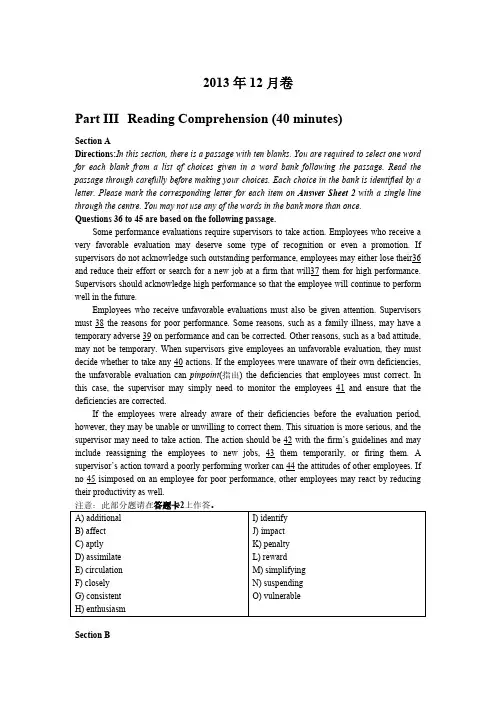
2013年12月卷Part III Reading Comprehension (40 minutes)Section ADirections:In this section, there is a passage with ten blanks. You are required to select one word for each blank from a list of choices given in a word bank following the passage. Read the passage through carefully before making your choices. Each choice in the bank is identified by a letter. Please mark the corresponding letter for each item on Answer Sheet 2 with a single line through the centre. You may not use any of the words in the bank more than once.Questions 36 to 45 are based on the following passage.Some performance evaluations require supervisors to take action. Employees who receive a very favorable evaluation may deserve some type of recognition or even a promotion. If supervisors do not acknowledge such outstanding performance, employees may either lose their36 and reduce their effort or search for a new job at a firm that will37 them for high performance. Supervisors should acknowledge high performance so that the employee will continue to perform well in the future.Employees who receive unfavorable evaluations must also be given attention. Supervisors must 38 the reasons for poor performance. Some reasons, such as a family illness, may have a temporary adverse 39 on performance and can be corrected. Other reasons, such as a bad attitude, may not be temporary. When supervisors give employees an unfavorable evaluation, they must decide whether to take any 40 actions. If the employees were unaware of their own deficiencies, the unfavorable evaluation can pinpoint(指出) the deficiencies that employees must correct. In this case, the supervisor may simply need to monitor the employees 41 and ensure that the deficiencies are corrected.If the employees were already aware of their deficiencies before the evaluation period, however, they may be unable or unwilling to correct them. This situation is more serious, and the supervisor may need to take action. The action should be 42 with the firm’s guidelines and may include reassigning the employees to new jobs, 43 them temporarily, or firing them. A supervisor’s action toward a poorly performing worker can 44 the attitudes of other employees. If no 45 isimposed on an employee for poor performance, other employees may react by reducing their productivity as well.注意:此部分题请在答题卡2上作答。
【English真题】2013年12月英语六级真题(含答案)考试历年试题训练
2013年12月大学英语六级考试真题(第3套)Part I Writing (30 minutes)(请于正式开考后半小时内完成该部分,之后将进行听力考试)Directions:For this part, you are allowed 30 minutes to write an essay on happiness by referring to the saying“Happiness is not the absence of problems, but the ability to de al with them.”You can cite examples to illustrate your point and then explain how you can develop your ability to deal with problems and be happy. You should write at least 150 words but no more than 200 words.Part II Listening Comprehension (30 minutes)Section ADirections:In this section, you will hear 8 short conversations and 2 long conversations. At theend of each conversation, one or more questions will be asked about what was said. Both the conversation and the questions will be spoken only once. After each question there will be a pause. During the pause, you must read the four choices marked A), B), C) and D), and decide which is the best answer. Then mark the corresponding letter on Answer Sheet 1with a single line through the centre.注意:此部分试题请在答题卡1 上作答。
2013年12月大学英语四级真题试卷第三套+详细解答+听力原文
2013年12月大学英语四级真题试卷(三)全部题型 1.Writing2.Listening Comprehension3. 4.Reading Com prehension5.TranslationPart I Writing1.For this part,you are allowed30minutes to write a short essay based on the picture below.You should start your essay with a brief account of the impact of the Internet on the way people communicate and then explain whether electronic communication can replace face-to-face contact.You should write at least120words but no more than180words."Dear Andy How are you?Your mother and I are fine.We both miss you and hope you are doing well.We look forward to seeing you again the next time your computer crashes and you come downstairs for something to eat.Love, Mom and Dad."Part II Listening ComprehensionSection A2.A.Plan his budget carefully.B.Give her more information.C.Ask someone else for advice.D.Buy a gift for his girlfriend.3.A.She'll have some chocolate cake.B.She'll take a look at the menu.C.She'll go without dessert.D.She'll prepare the dinner.4.A.The man can speak a foreign language. B.The woman hopes to improve her English.C.The woman knows many different languages. D.The man wishes to visit many more countries.5.A.Go to the library.B.Meet the woman.C.See Prof.Smith.D.Have a drink in the bar.6.A.She isn't sure when Prof.Bloom will be back. B.The man shouldn't be late for his class.C.The man can come back sometime later.D.She can pass on the message for the man.7.A.He has a strange personality.B.He's got emotional problems.C.His illness is beyond cure.D.His behavior is hard to explain.8.A.The tickets are more expensive than expected. B.The tickets are sold in advance at half price.C.It's difficult to buy the tickets on the spot.D.It's better to buy the tickets beforehand.9.A.He turned suddenly and ran into a tree. B.He was hit by a fallen box from a truck.C.He drove too fast and crashed into a truck. D.He was trying to overtake the truck ahead of him. 10.A.To go boating on the wrence River. B.To go sightseeing in Quebec Province.C.To call on a friend in Quebec City.D.To attend a wedding in Montreal.11.A.Study the map of Quebec Province. B.Find more about Quebec City.C.Brush up on her French.D.Learn more about the local customs.12.A.It's most beautiful in summer.B.It has many historical buildings.C.It was greatly expanded in the18th century.D.It's the only French-speaking city in Canada.13.A.It was about a little animal.B.It took her six years to write.C.It was adapted from a fairy tale.D.It was about a little girl and her pet.14.A.She knows how to write best-selling novels. B.She can earn a lot of money by writing for adults. C.She is able to win enough support from publishers. D.She can make a living by doing what she likes.15.A.The characters.B.The readers.C.Her ideas.D.Her life experiences.16.A.She doesn't really know where they originated.B.She mainly drew on stories of ancient saints.C.They popped out of her childhood dreams.D.They grew out of her long hours of thinking.Section B17.A.Monitor students'sleep patterns.B.Help students concentrate in class.C.Record students'weekly performance.D.Ask students to complete a sleep report.18.A.Declining health.B.Lack of attention.C.Loss of motivation.D.Improper behavior.19.A.They should make sure their children are always punctual for school. B.They should ensure their children grow up in a healthy environment. C.They should help their children accomplish high-quality work. D.They should see to it that their children have adequate sleep.20.A.She stopped being a homemaker.B.She became a famous educator.C.She became a public figure.D.She quit driving altogether.21.A.A motorist's speeding.B.Her running a stop sign.C.Her lack of driving experience.D.A motorist's failure to concentrate.22.A.Nervous and unsure of herself.B.Calm and confident of herself.C.Courageous and forceful.D.Distracted and reluctant.23.A.More strict training of women drivers.B.Restrictions on cell phone use while driving.C.Improved traffic conditions in cities.D.New regulations to ensure children's safety.24.A.They haven't devoted as much energy to medicine as to space travel. B.There are too many kinds of cold viruses for them to identify.C.It is not economical to find a cure for each type of cold.D.They believe people can recover without treatment.25.A.They reveal the seriousness of the problem.B.They indicate how fast the virus spreads.C.They tell us what kind of medicine to take.D.They show our body is fighting the virus.26.A.It actually does more harm than good.B.It causes damage to some organs of our body.C.It works better when combined with other remedies.D.It helps us to recover much sooner.Section CYou probably have noticed that people express similar ideas in different ways,depending on the situation they are in.This is very【B1】______All languages have two general levels of usage:a formal level and an informal level.English is no【B2】______The difference in these two levels is the situation in which you use a【B3】______level.Formal language is the kind of language you find in textbooks,【B4】______,and in business letters.You would also use formal English in compositions and【B5】______that you write in rmal language is used in conversation with colleagues,family members and friends,and when we write_【B6】_______notes or letters to close friends.Formal language is different from informal language【B7】______First, formal language tends to be more polite.What we may find interesting is that it usually takes more words to be polite.For example,I might say to a friend or a family member,"Close the door,please."but to a【B8】______,I probably would say,"Would you mind closing the door?"Another difference between formal and informal language is some of the 【B9】______There are bound to be some words and phrases that【B10】______formal language and others that are informal.Let's say that I really like soccer.If I'm talking to my friend,I might say"I'm just crazy about soccer!"But if I were talking to my boss,I would probably say"I really enjoy soccer."27.【B1】28.【B2】29.【B3】30.【B4】31.【B5】32.【B6】33.【B7】34.【B8】35.【B9】36.【B10】Part III Reading ComprehensionSection AThe mobile phone is a magic device widely used these days.Although it has been nearly30years since the first commercial mobile-phone network was launched,advertisers have yet to figure out how to get their【C1】______out to mobile-phone users in a big way.There are2.2billion cell-phone users worldwide,a【C2】______that is growing by about25%each year.Yet spending on ads carried over cell-phone networks last year【C3】_______to just$1.5 billion worldwide,a fraction of the$424billion global ad market.But as the number of eyeballs glued to【C4】______screens multiplies,so too does the mobile phone's value as a pocket billboard(广告牌).Consumers are 【C5】______using their phones for things other than voice calls,such as text messaging,downloading songs and games,and【C6】______the Internet.By 2010,70million Asians are expected to be watching videos and TV programs on mobile phones.All of these activities give advertisers【C7】______options for reaching audiences.During soccer's World Cup last summer,for example, Adidas used real-time scores and games to【C8】_______thousands of fans to a website set up for mobile-phone access."Our target audience was males aged17 to25,"says Marcus Spurrell,Adidas regional manager for Asia."Their mobiles are always on,always in their pocket-you just can't【C9】______cell phones as an advertising tool."Mobile-phone marketing has become as【C10】______a platform as TV.online or print.A)accessing F)characters K)patientlyB)amounted G)fresh L)tinyC)approaching H)ignore M)totalD)attract I)increasingly N)violatedE)casual J)messages O)vital37.【C1】38.【C2】39.【C3】40.【C4】41.【C5】42.【C6】43.【C7】44.【C8】45.【C9】46.【C10】Section BA Mess on the Ladder of SuccessA)Throughout American history there has almost always been at least one central economic narrative that gave the ambitious or unsatisfied reason to pack up and seek their fortune elsewhere.For the first300or so years of European settlement,the story was about moving outward:getting immigrants to the continent and then to the frontier to clear the prairies(大草原).drain the wetlands and build new cities.B)By the end of the19th century,as the frontier vanished,the US had a mild panic attack.What would this energetic,enterprising country be without new lands to conquer?Some people,such as Teddy Roosevelt,decided to keep on conquering(Cuba,the Philippines,etc.),but eventually,in industrialization,the US found a new narrative of economic mobility at home.From the1890s to the 1960s,people moved from farm to city,first in the North and then in the South. In fact,by the1950s,there was enough prosperity and white-collar work that many began to move to the suburbs.As the population aged,there was also a shift from the cold Rust Belt to the comforts of the Sun Belt.We think of this as an old person's migration,but it created many jobs for the young in construction and health care,not to mention tourism,retail and restaurants.C)For the last20years-from the end of the cold war through two burst bubbles in a single decade--the US has been casting about for its next economic narrative.And now it is experiencing another period of panic,which is bad news for much of the workforce but particularly for its youngest members. D)The US has always been a remarkably mobile country,but new data from the Census Bureau indicate that mobility has reached its lowest level in recorded history.Sure,some people are stuck in homes valued at less than their mortgages(抵押贷款),but many young people who don't own homes and don't yet have families—are staying put,too.This suggests,among other things,that people aren't packing up for new economic opportunities the way they used to. Rather than dividing the country into the1percenters versus(与......相对)everyone else,the split in our economy is really between two other classes: the mobile and immobile.E)Part of the problem is that the country's largest industries are in decline.In the past,it was perfectly clear where young people should go for work(Chicago in the1870s,Detroit in the1910s.Houston in the1970s)and,more or less,what they'd be doing when they got there(killing cattle,building cars,selling oil). And these industries were large enough to offer jobs to each class of worker, from unskilled laborer to manager or engineer.Today,the few bright spots in our economy are relatively small(though some promise future growth)and decentralized.There are great jobs in Silicon Valley,in the biotech research capitals of Boston and Raleigh-Durham and in advanced manufacturing plants along the southern z-85corridor.These companies recruit all over the countryand the globe for workers with specific abilities.(You don't need to be the next Mark Zuckerberg,founder of Facebook,to get a job in one of the microhubs(微中心),by the way.But you will almost certainly need at least a B.A.in computer science or a year or two at a technical school.)This newer,select job market is national,and it offers members of the mobile class competitive salaries and higher bargaining power.F)Many members of the immobile class,on the other hand,live in the America of the gloomy headlines.If you have no specialized skills,there's little reason to uproot to another state and be the last in line for a low-paying job at a new auto plant or a green-energy startup.The surprise in the census(普查)data,however, is that the immobile workforce is not limited to unskilled workers.In fact,many have a college degree.G)Until now,a B.A.in any subject was a near-guarantee of at leastmiddle-class wages.But today,a quarter of college graduates make less than the typical worker without a bachelor's degree.David Autor,a prominent labor economist at M.I.T.,recently told me that a college degree alone is no longer a guarantor of a good job.While graduates from top universities are still likely to get a good job no matter what their major is,he said,graduates fromless-famous schools are going to be judged on what they know.To compete for jobs on a national level,they should be armed with the skills that emerging industries need,whether technical or not.H)Those without such specialized skills like poetry,or even history,majors are already competing with their neighbors for the same sorts of second-rate, poorer-paying local jobs like low-level management or big-box retail sales.And with the low-skilled labor market atomized into thousands of microeconomics, immobile workers are less able to demand better wages or conditions or to acquire valuable skills.I)So what,exactly,should the ambitious young worker of today be learning? Unfortunately,it's hard to say,since the US doesn't have one clear national project.There are plenty of emerging,smaller industries,but which ones are the most promising?(Nanotechnology's(纳米技术)moment of remarkable growth seems to have been5years into the future for something like20years now.)It's not clear exactly what skills are most needed or if they will even be valuable in a decade.J)What is clear is that all sorts of government issues—education, health-insurance portability,worker retraining—are no longer just bonuses to already prosperous lives but existential requirements.It's in all of our interests to make sure that as many people as possible are able to move toward opportunity,and America's ability to invest people and money in exciting new ideas is still greater than that of most other wealthy countries.(As recently as five years ago,US migration was twice the rate of European Union states.)That, at least,is some comfort at a time when our national economy seems to be searching for its next story line.47.Unlike in the past,a college degree alone does not guarantee a good job for its holder.48.The census data is surprising in that college graduates are also among the immobile workforce.49.New figures released by the government show that Americans today are less mobile than ever before.50.The migration of old people from cold to warm places made many jobs available to the young.51.America is better at innovation than most other rich nations.52.Early American history is one of moving outward.53.Young people don't know what to learn because it is hard to predict what skills are most needed or valued ten years from now.54.Computer or other technical skills are needed to get a well-paying job in high-tech or advanced manufacturing.55.When the frontier vanished about a century ago,America found new economic mobility in industrialization.56.America today can be divided into two classes:those who move and those who don't.Section CA new study shows a large gender gap on economic policy among the nation s professional economists,a divide similar to the gender divide found in the general public."As a group,we are pro-market,"says Ann Mari May,co-author of the study and a University of Nebraska economist."But women are more likely to accept government regulation and involvement in economic activity than our male colleagues.""It's very puzzling,"says free market economist Veronique de Rugy of the Mercatus Center at George Mason University."Not a day goes by that I don't ask myself why there are so few women economists on the free market side."A native of France,de Rugy supported government intervention(干预)early in her life but changed her mind after studying economics."We want many of the same things as liberals—less poverty,more health care—but have radically different ideas on how to achieve it."Liberal economist Dean Baker,co-founder of the Center for Economic Policy and Research,says male economists have been on the inside of the profession,confirming each other's anti-regulation views.Women,as outsiders, "are more likely to think independently or at least see people outside of the economics profession as forming their peer group,"he says.The gender balance in economics is changing.One-third of economics doctorates(博士学位)now go to women."More diversity is needed at the table when public policy is discussed,"May says.Economists do agree on some things.Female economists agree with men that Europe has too much regulation and that Wal-mart is good for society.Male economists agree with their female colleagues that military spending is too high.The genders are most divorced from each other on the question of equality for women.Male economists overwhelmingly think the wage gap between men and women is largely the result of individuals'skills,experience and voluntary choices.Female economists overwhelmingly disagree by a margin of4-to-l.The biggest disagreement:76%of women say faculty opportunities in economics favor men.Male economists point the opposite way:80%say women are favored or the process is neutral.57.What is the finding of the new study?A.The gender divide is a big concern of the general public.B.Men and women understand economics quite differently.C.The gap between male and female economists needs to be closed. D.Male and female economists disagree widely on economic policy. 58.What does Ann Mari May say about female economists?A.They are strongly against male domination in the economics profession.B.They tend to support government intervention in economic activity. C.They usually play an active role in public policy-making.D.They are mostly strong advocates of free market economy.59.What do we learn about economist Veronique de Rugy?A.She represents most female economists'standpoint.B.She devotes herself to eliminating women's poverty.C.Her study of economics changed her view on government's role in economic activities.D.Her academic background helped her get into the inner circle of the economics profession.60.What does Ann Mari May imply about public policy-making?A.More female economists should get involved.B.It should do justice to female economists'studies.C.More attention should be paid to women's rights.D.It should aim at sustainable development.61.On what issue do male and female economists differ most? A.Government regulation.B.Job creation.C.Military spending.D.Gender equality.The number of postgraduate students travelling from non-EU countries to study at UK universities has fallen for the first time in16years,fuelling fears that the government's immigration crackdown is discouraging thousands of the brightest students from continuing their studies in Britain.Jo Beall,British Council director of education and society,said the fall would cause alarm among UK vice-chancellors(大学行政主管)."The sector was expecting a decline in growth,but the actual reduction in postgraduate numbers is of real concern as international students make up the majority of numbers in many postgraduate courses and research teams in science,technology,engineering and mathematics.""Attracting the brightest and most ambitious postgraduate and research students is critical if the UK is to maintain its quality reputation for research," Beall said.Universities get a third of their tuition(学费)fee revenue from non-EU students.There is growing,fear among vice-chancellors that this revenue—as well as the cultural,academic and economic benefit international students bring—is being put at risk.Tim Westlake.director for the student experience at Manchester University,said students whose families relied on them working in the UK after their studies to gain experience and repay the fees were starting to look elsewhere.Last month the home secretary,Theresa May.announced that embassy staff would interview more than100000applicants in an attempt to prevent bogus(假冒的)ones entering the country.She also said immigrants were responsible for pushing up UK house prices.The comments followed the introduction of new limitations on students'right to work during and after their studies.Beall said:"Government statistics for the first time provide real evidence that the changes to UK visa regulations may have discouraged many students from applying to the UK,and in particular postgraduate Students who are so important to the UK's research output.The UK enjoys an excellent reputation around the world for the high quality of our education system,so the government needs to ensure that institutions have all the support they need to attract international students who make a tremendous academic,cultural and economic contribution to the UK."62.What has caused the decline of the number of non-EU postgraduates in the UK?A.The increase in tuition and fees.B.The ever-rising living expenses.C.Changed immigration policies.D.Universities'tightened budgets.63.What is UK vice-chancellors'biggest concern?A.How to obtain financial support from the government.B.How to keep the academic reputation of their institutions.C.How to prevent bogus applicants entering their universities.D.How to stimulate the creativity of their research teams.64.Why do UK universities try to attract postgraduate students from outside the EU?A.A substantial part of their revenue comes from non-EU students' tuition and fees.B.Non-EU postgraduate students arc usually highly motivated.C.The number of UK postgraduate students has fallen sharply.D.Some of the postgraduate programmes are specially designed for non-EU students.65.What were the expectations of some non-EU students'families?A.Their children could enjoy the UK's cultural benefits. B.Their children could find well-paying jobs upon their return.C.Their children could become established academically.D.Their children could work in the UK after graduation.66.What does Beall suggest the UK government should do?A.Allow promising international students to work in research teams. B.Revise UK visa regulations to accommodate non-EU students.C.Give universities adequate support to attract non-EU students.D.Try to address the needs of international students in the UK.PartⅣTranslation67.“你要茶还是要咖啡?”是用餐人常被问到的问题。
2013年12月英语六级真题及答案解析(3套)
2013年12月英语六级真题及答案解析(3套)2013年12月大学英语六级考试真题(第1套)Part I Writing (30 minutes)(请于正式开考后半小时内完成该部分,之后将进行听力考试)Directions:For this part, you are allowed 30 minutes to write an essay on happiness by referring to the saying“Happiness is not the absence of problem s, but the ability to deal with them.”You can cite examples to illustrate your point and then explain how you can develop your ability to deal with problems and be happy. You should write at least 150 words but no more than 200 words.Part II Listening Comprehension (30 minutes)Section ADirections:In this section, you will hear 8 short conversations and 2 long conversations. At theend of each conversation, one or more questions will be asked about what was said. Both the conversation and the questions will be spoken only once. After each question there will be a pause. During the pause, you must read the four choices marked A), B), C) and D), and decide which is the best answer. Then mark the corresponding letter on Answer Sheet 1 with a single line through the centre.注意:此部分试题请在答题卡1 上作答。
2013年12月英语六级真题及答案汇总
>> ☆2013年12月英语六级真题答案及解析 <>>>part 1 <>>>part 2 <>>>part 3 <>>>part 4 <>>>part 5 <>>>part 6
以上就是为了广大考生发布的2013年12月英语六级真题,英语六级答案,六级真题答案解析,预祝广大考生顺利通过考试!
2013年12月英语六级考试将于12月14日举行2013年12月英语六级真题六级答案公布时间是在考试结束之后届时?无忧考网四六级考试频道会在第一时间发布2013年12月英语六级真题英语六级答案六级真题答案解析敬请考试关注
2013年12月英语六级考试将于12月14日举行, 2013年12月英语六级真题、六级答案公布时间是在考试结束之后,届时频道会在第一时间发布2013年12月英语六 级真题、英语六级答案、六级真题答案解析,敬请考试关注!预祝考生考试顺利。