
2017-2018学年高中英语 Unit 3 Under the seaSection Ⅳ Lear
Unit 3 Under the seaSection Ⅳ Learning about Language &;Using Language[原文呈现][读文清障]A NEW DIMENSION① OF LIFE19th JanuaryI'm sitting in the warm night air with a cold drink in my hand②and reflecting③on the day —a day of pure④magic! I went snorkelling⑤ on the reef offshore this morning and it was the most fantastic⑥thing I have ever done. Seeing such extraordinary beauty⑦, I think every cell⑧in my body woke up⑨. It was like discovering a whole new dimension of life.The first thing I became awareof⑩was all the vivid⑪colours surrounding⑫me —purples, reds, oranges, yellows, blues and greens. The corals were fantastic —they were shaped like fans, plates, brains, lace, mushrooms, the branches of trees and the horns⑬ of deer. And all kinds of small, neat⑭ and elegant fish were swimming in and around the corals. ①dimension/dI'menʃn/n.维(数);方面;侧面②with a cold drink in my hand 是“with+宾语+宾补”结构。
此处作宾补的是介词短语 in my hand。
③reflect/rI'flekt/vi.思考vt.映射;反射;思考④pure/pjʊə/adj.纯的;纯粹的;纯洁的⑤snorkel /'snɔːkl/vi.戴潜水通气管潜泳n.(潜水艇或潜水者的)通气管⑥fantastic adj.奇妙的,令人惊奇的⑦现在分词短语 seeing such ...作时间状语。
⑧cell/sel/n.细胞;(蜂房的)巢室⑨wake up 醒来;唤醒⑩be/become aware of对……知道、明白;意识到……⑪vivid/'vIvId/adj.生动的;鲜明的;鲜艳的⑫surround vt.环绕,围绕⑬horn n.(牛、羊、鹿等的)角;号角;喇叭;警报器⑭neat/niːt/adj.〈口〉好的;整齐的;匀称的崭新的生活空间[第1~2段译文] 1月19日我坐在温暖的夜空下,手里拿着一瓶冷饮,回忆着当天的事情——这纯粹是神奇的一天!这天上午,我戴着呼吸器在近海的珊瑚礁上潜泳,这是我从来没有过的绝妙经历。
看到这样奇特的美景,我周身的每个细胞都苏醒了,就像发现了一个全新的生活空间似的。
我首先注意到的是我周围那些鲜艳的色彩——紫色、红色、橘黄、明黄、蓝色和绿色。
那些珊瑚都是稀奇古怪的——有的形状像扇子、盘子、脑袋和彩带,有的像蘑菇、树枝和鹿角。
还有种类繁多、小巧整齐、姿态优雅的鱼穿行在珊瑚丛中,或环游于珊瑚的四周。
The fish didn't seem to mind me swimming⑮among them. I especially loved the little orange and white fish that hid in the waving long thin seaweed ⑯. And I also loved the small fishthat clean the bodies of larger fish ⑰— I even saw them get inside their mouths and cleantheir teeth! It seemed there was a surprise waiting for me around every corner⑱as I explored small caves, shelves and narrow⑲passages ⑳with my underwater flashlight ○21: the yellow and green parrotfish was hanging upside down ○22, and sucking ○23 tiny plants off the coral with its hard birdlike mouth; a yellowspotted○24 red seaslug○25 was sliding by a blue seastar; a large wiselooking○26 turtle ○27 was passing so close to me that ○28 ⑮mind (sb./sb.'s) doing sth. 介意(某人)做某事⑯seaweed /'si ːwi ːd/n .海草;海藻⑰that hid in the waving ... 和 that clean the bodies ... 均是 that 引导的定语从句,均修饰 fish 。
⑱现在分词短语 waiting for me ...作定语,修饰 a surprise 。
surprise 在此处是抽象名词具体化的用法。
⑲narrow /'nær əʊ/adj .狭窄的;有限的;狭隘的 ⑳passage n .通道;走廊;短文 ○21flashlight /'flæʃlaIt/n .闪光信号灯;手电筒;闪光灯○22upside down 上下翻转 ○23suck /s ʌk/vt .&vi .吮吸 ○24yellowspotted adj .带着黄斑点的 ○25seaslug /'si ːsl ʌɡ/n .海蛞蝓 ○26wiselooking adj .长相聪慧的 ○27turtle /'t ɜːtl/n .海龟;龟;甲鱼 ○28so ... that 引导结果状语从句。
I could have touched it.[第3段译文]在这些鱼群中游泳,它们似乎并不在乎。
我特别喜欢那些橘黄和白色相间的小鱼,它们藏在波动着的细长的海藻里。
我也喜欢那些为大鱼清洁身体的小鱼——我甚至还看到这些小鱼游进大鱼的嘴里去帮它们清洁牙齿!当我用水下探照灯探索小石洞、暗礁和狭窄通道的时候,似乎每个角落都有使我感到惊奇的东西等着我:黄绿相间的鹦嘴鱼倒挂着,用它那像鸟嘴一样的硬嘴从珊瑚上吮吸微小植物;一条带着黄斑点的红色海蛞蝓从一个蓝色的海星旁边滑行过去;一只长相聪慧的大乌龟紧贴我的身旁而过,伸手便可触及。
There were other creatures that I didn't want to get too close to ○29 — an eel ○30 with itsstrong sharp ○31 teeth, ○32with only its head showing from a hole, watching for a tasty ○33 fish(or my tasty toe !); and the giant ○34 clam ○35 half buried in some coral waiting forsomethingto swim in between ○36 its thick green lips. Then there were two grey ○37 reef sharks, eachabout one and a halfmetres long, which suddenly appeared from behind some coral ○38. I toldmyself they weren't dangerous but that didn't stop me from feeling scared todeath ○39 for amoment!The water was quite shallow ○40 but ○29that 引导的定语从句,修饰 creatures 。
○30eel /i ːl/n .鳗,鳝 ○31sharp /ʃɑːp/adj .锐利的;锋利的;敏捷的○32with only its head ...是 with 复合结构,在句中作伴随状语。
现在分词短语 watching for ... 作 showing from a hole 的状语,对其补充和说明。
○33tasty /'teIstI/adj .好吃的;可口的 ○34giant/'d ʒaI ənt/adj .巨人的;巨大的n .巨人;伟人○35clam /klæm/n .蛤 ○36 in between 在……之间 ○37grey /ɡreI/adj . &n .灰色(的) ○38which 引导非限制性定语从句,which 指代 reef sharks 。
○39(be ) scared to death 吓死了where the reef ended ○41, there was a steep ○42 drop to the sandy ocean floor. It marked a boundary ○43 and I thought I was very brave when I swam over the edge of the reef and hung there looking down into the depths of the ocean ○44. My heart was beating wildly ○45 — I felt very exposed in ○46 such deep clear water. What a wonderful, limitless world it was down there! And what a tiny spot I was in this enormous world !○47 ○40shallow /'ʃæl əʊ/adj .浅的;肤浅的;浅显的 ○41where 引导地点状语从句。
选修7 Unit 3 Under the sea
Unit 3 Under the sea Ⅰ.重要单词聚焦1.adj.每年的;按年度计算的n. 年刊;年鉴2.vt. 当场见到;目击n. 目击者;证人;证据3.n. 住所;住宿4.n. 岸;海滨5.vi.& vt. 逃避;逃跑;逃离6.vt. 拖;拉;扯annualwitnessaccommodationshorefleedrag7.adv. 其间;同时8.vt. 催促,极力主张9.vt. 放弃;遗弃;抛弃10.n. 关系;血缘关系;交往11.n. 目标,靶,受批评的对象12.vi. 映射,反射vt.& vi. 思考13.adj. 纯的;纯洁的14.adj. 意识到的;知道的15.adj. 生动的,鲜明的meantimeurgeabandonrelationshiptargetreflectpureawarevivid16.adj. 狭窄的;有限的;狭隘的17.adj. 锐利的;锋利的;敏捷的18.vt.& vi. 恐吓;受惊吓19.adj. 浅的;肤浅的;浅湿的20.n. 养老金;退休金narrowsharpscareshallowpensionⅡ.重点短语扫描1.in the 在此期间;与此同时2.be/become of 对……知道、明白;意识到……3.(be) to death 吓死了4.draw 靠近5.Hold 阻挡6.help (...) 帮助(某人)摆脱困境或危难7.upside 上下翻转meantimeawarescarednearupoutdown8.Sort 整理;分类;收拾9.at 瞄准10.be to do sth. 正要做某事outaimaboutⅢ.课文原句突破1.The first thing I became aware of was all the vivid colours surrounding me—purples,reds,oranges,yellows,blues and greens.[信息提取]be/become aware of意识到,明白,知道。
英语:Unit3_Under_the_sea教学案
Unit3 Under the sea---教学案学科英语教材名称高中英语选修七课题Unit3 Under the sea年级高二学段第一学段备课组长主备人王惠琴一、概述·“Under the sea”是高中人教版新课标英语新教材二年级选修七第三单元课文。
·本单元课文所需课时为5课时,共需200分钟,本节课是第二课时,40分钟;·“Under the sea”是一篇科普文章,中心话题为海底世界。
听说读写活动主要围绕海底植物、海底奇妙景观以及有关大海神话故事展开的。
·这节课主要培养学生的阅读、归纳能力和联想、创新思维精神。
二、教材分析本单元的中心话题为海底世界。
听说读写活动主要围绕海底植物、海底奇妙景观以及有关大海神话故事展开的。
1. Warming Up 部分以海底生物(包括动物和植物)为话题,主要讨论三个方面的问题;学生所见过的海底生物,在何处见过这些海底生物,学生最喜欢的海底生物。
2. Pre-reading 部分设计了一个读图题,图片内容为:Killer whales are attacking a baleen whale with whalers waiting by in their boat,harpoon at the ready. 由此引入阅读文章的相关背景知识:作者、职业、文体等。
3. Reading 是一篇以第一人称口吻讲述了一个名叫Old Tom的虎鲸的故事。
学生阅读此文可以了解人类如何利用鲸捕杀鲸的残酷事实,同时可以从文中学到许多描述事物和情景的生动手法。
4. Comprehending 共有3个练习就课文内容进行讨论,重点检测学生对课文深层次的理解,也以进行适当的拓展,让学生讨论是否应该关闭捕鲸站并保护鲸。
5. Learning about Language部分是词汇训练,和语法训练,通过用所给词的适当形式填空,复习V-ing 形式的被动式的用法。
高中英语必修课--Unit 3 Under the sea 语言点知识讲解及巩固练习题(含答案解析)
高中英语必修课---Unit3Under the sea语言点知识讲解及巩固练习题(含答案解析)学习目标重点词汇annual witness accommodation opposite yell pause dragdepth urge abandon target reflect scare awesome重点短语in the meantime be aware of ahead of...to death help(...)out upside down重点句型It takes sb.some time/...to do sth.的变化a time when...知识讲解重点词汇annual【原句回放】It was a time when the killer whales,or“killers”as they were then called,helped the whalers catch the baleen whales that were on their annual migration.那个时期,虎鲸(当时被称为“杀手”)帮助捕鲸人在每年须鲸迁徙时捕捉须鲸。
【点拨】annual adj.1.每年的,一年一次的the annual output年产量an annual report年度报告Steel output reached an annual figure of one million tons.钢的年产量达到100万吨。
2.按年度计算的the annual income年收入the annual rainfall【拓展】annually adv.每年地,年度地witness【原句回放】I thought,at the time,that this was just a story but then I witnessed it with my own eyes many times.当时我以为这只是一个故事罢了,但是后来我亲眼见过多次。
高中英语Unit 3 Under the sea (知识拓展)
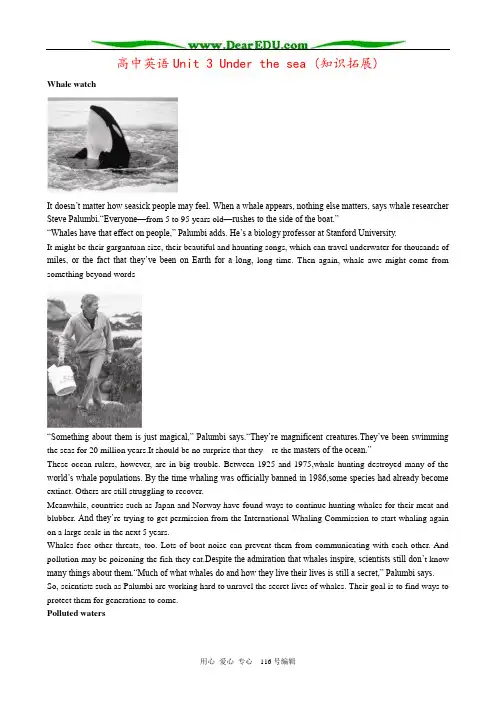
高中英语Unit 3 Under the sea (知识拓展)Whale watchIt doesn’t matter how seasick people may feel. When a whale appears, nothing else matters, says whale researcher Steve Palumbi.“Everyone—from 5 to 95 years old—rushes to the side of the boat.”“Whales have that effect on people,” Palumbi adds. He’s a biology professor at Stanford University.It might be their gargantuan size, their beautiful and haunting songs, which can travel underwater for thousands of miles, or the fact that they’ve been on Earth for a lo ng, long time. Then again, whale awe might come from something beyond words“Something about them is just magical,” Palumbi says.“They’re magnificent creatures.They’ve been swimming the seas for 20 million years.It should be no surprise that they re the masters of the ocean.”These ocean rulers, however, are in big trouble. Between 1925 and 1975,whale hunting destroyed many of the world’s whale populations. By the time whaling was officially banned in 1986,some species had already become extinct. Others are still struggling to recover.Meanwhile, countries such as Japan and Norway have found ways to continue hunting whales for their meat and blubber. And they’re trying to get permission from the International Whaling Commission to start whaling again on a large scale in the next 5 years.Whales face other threats, too. Lots of boat noise can prevent them from communicating with each other. And pollution may be poisoning the fish they eat.Despite the admiration that whales inspire, scientists still don’t know many things about them.“Much of what whales do and how they live their lives is still a secret,” Palumbi says. So, scientists such as Palumbi are working hard to unravel the secret lives of whales. Their goal is to find ways to protect them for generations to come.Polluted watersOceans act like giant conveyer belts, spreading dangerous chemicals such as DDT and dioxins around the world, says Roger Payne. He heads a whale conservation organization called Ocean Alliance.As toxins move up the food chain, from fish to whales(and people),they get more and more concentrated in muscle and fat tissue, which increases potential health hazards.Payne’s organization has sent a ship named the Odyssey on a 5year, worldwide cruise to collect data. Rese archers aboard the ship are gathering skin samples from sperm whales, then analyzing the samples for pollutants.“The first question is: How bad is it?” Payne says.“Until we can answer that, we can’t really get anywhere.”The voyage’s goal is to create a map of pollution in oceans around the world. This information should reveal something about how our waste is affecting long lived mammals like whales.Sample collection is still underway. So far, testing of 30 whale samples has revealed the presence of pollutants in every single one.If most other samples turn out to be contaminated, the findings could also be a warning to people. Seafood is the main source of animal protein for 70 percent of people on Earth, Payne says. If the seafood we eat is tainted, our health could be at stake, along with that of whales.Loud noiseChemicals are not the only kind of pollution in the ocean. Noise is also a major problem, says Christopher Clark. He’s director of Cornell University’s bioacoustics research program.In his research, Clark uses highly sensitive microphones that were originally developed by the U.S. Navy to track ships. The microphones are so sensitive that Clark calls them “the Hubble telescopes of the sea.” The Hubble Space Telescope is an orbiting instrument that has provided extremely detailed images of the universe.N ow, Clark is using these microphones to pinpoint where whales are ,how they move, and what sounds they make. Whales generate a variety of sounds, sometimes creating long and intricate melodies. No one knows what whale songs mean, but the tunes can be very complex.Some scientists suggest that whales make such noises to navigate and communicate. They might keep track of each other, tell others where food is available, and find each other to breed. I wonder if they also talk about the weather!Clark’s research has shown that whales use low frequency sound waves to communicate with each other across hundreds, even thousands of miles of water. This means that a whale off the coast of Newfoundland, way up in Northeastern Canada, can hear its friends in Puerto Rico,1600 miles away in the Caribbean.But there’s a problem. Ships make a lot of noise, and there are lots of ships out there. All of that “acoustic smog,”Clark says, has greatly reduced the ability of whales to hear each other.Cape Cod Bay on the coast of Massachusetts is a particularly extreme example, Clark says. The bay is a critical habitat for northern right whales, but the noise is persistent and the levels are very high.If there were this much noise on land, Clark says ,a government agency called the Occupational Safety and Health Administration(OSHA) would order us to wear earplugs or stay away to protect ourselves and keep from going deaf.Whales might end up leaving their homes or swimming to different depths to avoid loud noises .Such moves could create further problems, a recent study by scientists at the Woods Hole Oceanographic Institution suggests.The researchers found that whales can get “the bends” in the same way that scuba divers do when they swim too deep, stay down too long, or rise too quickly to the surface .In this ailment, bubbles of gas in the blood can cause severe pain and even death, both in people and in whales.Deep foodProtecting whales is especially important because a variety of species depend on them for survival, says Craig Smith. He’s an oceanographer at the University of Hawaii ,Manoa , and he studies “whale falls”. A whale fall is a dead whale carcass that sinks to the bottom of the ocean.The body of a 50-ton whale can sustain up to 80 years worth of life, Smith says.Using deep-sea robotic equipment, including the submersible Alvin Smith has discovered a wealth of bizarre creatures that seem to thrive only on whale falls.The blind zombie worm is one example. These odd worms feed on whalebones and grow into mats that look like fields of tall grass waving in the wind.“The communities are remarkable,” Smith says. One whale can support 3400 individual creatures that belong to more than 200 species, including mussels, sharks ,clams, and worms.“It’s among the most species rich habitats in the deep sea,” he says.A decline in whale population would mean a decrease in whale falls. As a result, many specialized species would become extinct. For example, calculations show that, if whale falls went down by 75 percent, about 30 to 40 percent of the species that depend on these falls for survival would die out.Even reducing whale falls by half would cause 15 percent of dependent speci es to disappear. That’s troubling, Smith says, because some people argue that killing 50 percent of whales would do no harm.Hunting ban(The blue whale is the largest animal thathas ever lived on earth.)Not all the news is bad news. Using informat ion buried in whale DNA, Palumbi’s research has shown that Antarctic minke whales have been thriving for as long as 2 million years. Through ice age after ice age, their numbers have continued to grow steadily. Whaling seems to be the only major threat they face.However, a complete ban on whaling may be the only way to save the world’s whale populations and all of the species that depend on them ,many researchers say. At the same time,countries such as Japan and Norway see the sale of whale blubber as a major source of income.The best thing scientists can do now, Palumbi says, is to learn as much about whales as they can in order to document the negative effects of whaling. With rapid advances in technology, the opportunities for understanding these marvelous animals seem to be better than ever before.“Learning about how whales live their lives, how they have lived their lives, and even how they die takes more than just looking at them from the surface,” Palumbi says.“It takes technology—new technology that pushes back the curtain of the ocean.” Though there’s a lot left to be discovered, new technology and new research is beginning to fill in the gaps in the secret lives of whales.。
Unit3Under the sea重点词汇
归纳拓展 (1)witness sth 目击某事的发生 witness to sth/doing sth 作证,证明某事/做某事 (2)a witness to sth 某事的证人 bear/give witness to sth 为某事作证;证明
①Over the year,she witnessed gradual changes in the class. 一年来,她见证了这个班级的逐渐变化。 ② The reporter witnessed the tsunami sweeping away all the cars and buildings as well as humans on its road. 那位记者亲眼看到海啸横扫所到之处的所有汽车、 房屋以及行人。
①He had to abandon his job because of his illness. 由于生病,他不得不放弃这份工作。 ②By no means shall we ________ the missing plane MH370. 我们绝不会放弃寻找失联的 MH370 飞机。 ③He __________________ despair for some reason. 他因某种原因陷入了绝望。
③His good health is ____________ the success of the treatment. 他的健康身体证明这种疗法是成功的。 ④The police found ________________ the murder case. 警察找到了那件谋杀案的目击者。 答案:③a witness to ④the witness to
5.sort out 分类;整理;解决(问题、困难) (教材原句 P20)On the afternoon I arrived at the station,as I was sorting out my accommodation,I heard a loud noise coming from the bay. 有天下午,我来到捕鲸站,正在整理住所的时候, 听到从海湾那边传来的一阵喧闹声。
20172018学年高中英语Unit3UndertheseaSectionⅣLearningabou
Unit 3 Under the seaSection Ⅳ Learning about Language &;Using Language[原文呈现][读文清障]A NEW DIMENSION① OF LIFE19th JanuaryI'm sitting in the warm nightair with a cold drink in my hand②and reflecting③on the day —a dayof pure④magic! I wentsnorkelling⑤ on the reef offshorethis morning and it was the mostfantastic⑥thing I have ever done.Seeing such extraordinarybeauty⑦, I think every cell⑧in mybody woke up⑨. It was likediscovering a whole new dimensionof life.The first thing I becameawareof⑩was all the vivid⑪colours surrounding⑫me —purples, reds, oranges, yellows,blues and greens. The corals werefantastic —they were shaped likefans, plates, brains, lace,mushrooms, the branches of treesand the horns⑬ of deer. And allkinds of small, neat⑭ and elegantfish were swimming in and aroundthe corals.①dimension/dI'menʃn/n.维(数);方面;侧面②with a cold drink in my hand 是“with+宾语+宾补”结构。
unit-3-under-the-sea基础知识
Unit 3Under the sea1.witness vt. 当场见到;目击;见证n. 目击者;证人;证据①He witnessed to having seen the man enter the room.他证明看到那个人进了房间。
②The police found the witness to the murder case.警察找到了那个谋杀案的目击者。
The witness(目击者)who witnessed(目击)the incident gave witness(证据)to the police and promised to be a witness(证人).[运用提升]After the explosion, the policemen did a lot of work to find out some clues from the________.A.onlookersB.viewersC.people D.witnesses2.urge vt. 催促;极力主张;驱策(3)have an urge to do sth. 迫切要求做某事①Brown urged her to reconsider her decision. 布朗极力劝说她重新考虑自己的决定。
②I urged that he(should)do his best. 我强调他要尽自己最大的努力。
③It was urged that he(should)be punished. 有人极力主张他应受到惩罚。
翻译句子(1)他极力劝她学习物理。
________________________________________________________________________(2)他们敦促我去申请工作。
________________________________________________________________________(3)她渴望当一名电影明星。
[配套K12]2017-2018学年高中英语 Unit 3 Under the seaSection
Unit 3 Under the seaSection Ⅰ Warming Up &;Reading-Pre-readingThe earth's oceans can reach depths of up to 11,000 metres.That is deep enough to cover Mt. Qomolangma! The oceansare incredibly (不能相信地) large and contain several differenthabitats. To make it easier to describe the various parts of theoceans, marine (海洋的)scientists usually divide the oceans intofive zones. Each zone is different mainly as a result of how muchsunlight reaches it.Most of the life in the ocean can be found in the first zone, whichbegins at the surface and goes down about 200 metres. Because thereis sunlight at this level, plants are able to grow.Marine animals such as dolphins, sharks, sea turtles and sealions, and of course a variety of fish, live in the sunlit (阳光照射的)part of the ocean. It is difficult to hide from other animals in this area.The second zone starts at 200 metres and goes down to about1,000 metres. Some sunlight can reach this level, but it is not enoughfor plants to grow. Because this zone is relatively dark, many of the creatures that live here are able to make light with their body. The light from these animals makes the water look like a sky with moving stars in it.The third zone of the ocean is dark. This place, about 3,000 metres deep, may not seem a likely habitat, but there are more creatures herethan one might think. Most of the animals that live here are black orred because of the lack of light.Below 4,000 metres, the temperature is near freezing and there isno light at all. In fact, the zone is so dark and empty that scientistsnamed this zone after the Greek word for “no bottom”. There is notmuch life to be found in this cold and unpleasant part of the ocean, butsome small creatures still manage to survive here despite the high water pressure.The very deepest part of the ocean is found 2,000 metres further down. At this depth, the water pressure is extremely high and life is very difficult for the few creatures that live here. Compared to the other zones, this one has very little life. Since there is no light here, some of the animals do not have eyes.Next time you look at the ocean from the beach or on a map, remember that what you are seeing is only the surface — only the beginning of the large and varied adventure.Section_ⅠWarming Up & Reading —Prereading[原文呈现][读文清障]OLD TOM THE KILLER WHALEI was 16 when I began work in June 1902 at the whaling station. I had heard of① the killers that every year helped whalers catch huge whales②. I thought, at the time, that this was just a story③but then I witnessed④it with my own eyes many times.On the afternoon I arrived at the station, as I was sorting⑤ out my accommodation⑥, I heard a loud noise coming from the bay⑦. We ran down to the shore⑧in time⑨to see an enormous animal opposite⑩ us throwing itself out of⑪ the water and then crashing⑫down again. It was black and white and fishshaped. But I knew it wasn't a fish. ①hear of 听说(=hear about)②关系代词 that 引导的定语从句,修饰the killers。
[配套K12]2017-2018学年高中英语 Unit 3 Under the sea单元小结教学案
配套K12内容资料配套K12内容资料Unit 3 Under the sea Mark and a SealMark rented an accommodation with hispension near the shore. He paid annual visitsthere to enjoy the vivid beauty in the depths ofthe pure sea.Once, with his underwater telescope andflashlight, Mark dived along the boundarybetween the steep reef and the area of seaweedconservation. Suddenly, an awesome Antarctic seal with sharp teeth appeared opposite him. Every cell in his body was scared to death. But soon, he was aware that he wasn't the target of an attack. With a neat wound in its lip caused by a shark, this grey seal was washed upside down by the tides time after time. But it tried to jog Mark as if to urge him to help it. So Mark abandonedfleeing away. With its teamwork, Mark used a net to drag the seal to the shallow water. Without a pause he helped it out after a simple operation and settled it in a narrow cave by the seaside. Every time he brought it tasty fish, it would yell and suck his hands happily. Witnesses said their anecdotesreflected a magic dimension of the relationship between humans and animals.马克和海豹马克用他的退休金在海岸边租了一处住所。
高二英语unit3-under-the-sea
How to use them?
4.drag v. We dragged the boxes of books from the road. 5.depth-deep Width-wide Length-long Height-high
Unit 3 Under the sea
Remember the following words.
1.snorkel 2.aquarium 3.baleen whale 4.oar 5.blow-hole 6.harpoon 7.flipper 8.turtle 9.anemonefish 10.sea anemone 11.tentacle 12.sea-slug 13.eel 14.clam 15.seal
二次构造柱泵https:// 二次构造柱泵
How to use them?
2.ahead of sb./ sth. 1)She was always well ahead of the rest of the class. 2)He is ahead of times in his ideas. 3.flee (from) Japan
How to use them?
1.witness n. / v. 1)The police found the witness to the murder case. 2)bear witness to… 为…作证 I will bear witness to his innocence in two days. 3)Did you witness yesterday’s accident? 4)We were witnessing the most important scientific development of the century.