
外研版七年级英语下册各模块语法知识汇总+专项练习
外研版七年级英语下册各模块语法知识汇总+专项练习
M1 形容词性和名词性物主代词专项练
物主代词分为两种:形容词性物主代词和名词性物主代词。形容词性物主代词不能单独使用,后面必须跟名词,例如:We are doing our XXX(我们正在做家庭作业。)名词性物主代词则具有名词的性质,可以单独使用,例如:My shirt is
black。but yours is white.(我的衬衫是黑色的,但你的是白色的。)名词性物主代词也可以具有“形容词性物主代词+名词”的作用,例如:Whose comb is it。It’s hers.(hers=her+comb)
下面是物主代词的对照表:
物主代词 | 形容词性 | 名词性 |
我的 | my | XXX |
你的 | your | yours |
他的 | his | his | 她的 | her | hers |
它的 | its | its |
我们的 | our | ours |
你们的 | your | yours |
他们的 | their | theirs |
需要注意的是,名词性物主代词可指一件东西,也可指很多件东西,需要根据上下文来决定。例如:
选择填空:
1.This is my teapot。It’s not __________。(your/ yours)
2.My hairdryer is on the desk。Where’s ____________?(her/
hers)
3.___________ hairdryer is not on the table。___________ is
there。(Her/ Mine)
4.Whose calculator is it?It’s __________。It’s __________
XXX)
5.Are they ___________ (your/ yours) combs。Yes。they’re
_________(our/ ours).
用所给词的适当形式填空:
1.That is not _________ kite。That kite is very small。but
_________ is very big。( I )
2.The dress is _________。Give it to _________。( she )
3."Is this your watch?" "No。it's not mine."
4."He is my brother。His name is Jack。Look。Those
stamps are his."
5."XXX?"
6."Here are many dolls。which one is hers?"
7."I can find my toy。but where's yours?"
8."Show them your kite。OK?"
9."I have a beautiful cat。Its name is Mimi。These cakes are
its."
10."Shall we have a look at that classroom。That is our
classroom."
11."She is my aunt。Do you know her job。She is a nurse."
12."Where are they。I can't find them。Let's call their
parents." 13."We don't know her name。Would you please tell us?"
14."So many dogs。Let's count them."
As for the grammar point of modal verb "can":
1.Structure: can + verb infinitive。with no change in person
or number.
1."Can I go fishing with you。Dad?" asked the child.
No。you can't。You should stay at home and do your
homework first," replied the father.
2.XXX XXX。She has worked hard to develop her language
skills.
3XXX.
4.The man XXX.
5."I'm sorry。but I XXX," said Sarah to her boss。"I have a
doctor'XXX." 2.Do you know whose nary it is。It must be Li Mei's because
his name is on it.
3."I can't。smoking。doctor." "For your health。I'm afraid
you must."
4."Is Mr。Brown driving here?" "I'm not sure。He may come
by train."
Grammar Points Summary for Grade 7.Unit 3-4: Simple
Future Tense
n:
XXX simple future XXX is used to express ns。events or
states that will happen in the future。It can also be used to express
ns or events that will XXX: XXX。the day after tomorrow。next
year。next month。next week。soon。later on。this afternoon。in + a d of time (e.g。in 2020).
XXX: There are two common structures for the simple future XXX:
1.be going to + verb: This structure is used to express XXX
do something.
Positive: Subject + be (am/is/are) + going to + verb + other
words
Negative: Subject + be (am/is/are) + not + going to + verb +
other words
n: Be (am/is/are) + subject + going to + verb + other words
XXX: I am going to study for my test tomorrow.
+ verb: This structure is used to make XXX.
Positive: Subject + will/shall + verb + other words
Negative: Subject + will/shall + not + verb + other words
n: Will/Shall + subject + verb + other words
XXX: She will visit her grandparents XXX.
Difference een will and be going to: Will is used to make XXX。Be going to is used to express
XXX do something.
1.XXX.
2.Charlie will be here next month.
1.Will be going to表示根据主观判断将来肯定发生的事情,而will表示客观上将来势必发生的事情。例如:明天下午将有一个会议。
2.Be going to含有“计划,准备”的意思,而will则没有这个意思。例如:她打算借给我她的书。下个月XXX会在这里。
3.Be going to表示有迹象要发生的事,will没有。例如:看那乌云,快要下雨了。明天会有一个足球比赛。
四、要点注意:
1.使用现在进行时表示将来的动词:go,come,arrive,leave,fly(飞往),reach(到达),stay,start,die等等。例如:这个周末我要去动物园。他将在半小时内到达这里。
2.使用一般现在时表将来的动词:come,go,arrive,leave,start,begin,return等等,表示在时间上已确定或安排好的事情。例如:火车明天上午六点开。公交车什么时候开始?它将在十分钟内开始。
3.There be句型的一般将来时:There will be / There is/ are
going to be。例如:明天将有一个足球比赛。明天将有一个足球比赛。
练:
1.There is going to be a XXX.
2.Charlie will be here next month.
改写:What is his identity/name?
what什么问事物、情况等
What time is it now?改写:Can you tell me the current time?
when何时问时间、日期等
When is your birthday?改写:On which date is your birthday?
where哪里问地点
Where is the nearest supermarket?改写:Can you tell me
where the closest supermarket is?
why为什么问原因
Why did you choose this university?改写:What was XXX
university?
外研版七年级英语下册语法专项练习测试题
外研版七年级英语下册语法专项练习测试题
外研版七年级英语下册语法专项练习测试题
Module 1 名词性物主代词
Ⅰ.用所给词的适当形式填空
1. ─Is this ______ (you) watch?
─No, it’s not ______ (I).
2. This dog is very clever. ______ (it) name is Tim.
3. That is not ______ (she) camera. ______ (she) is at home.
4. Their apples are red, but ______ (we) are green.
5. Tom can’t find ______ (he) football.
Ⅱ.单项选择
6. ─I can’t find my ruler. May I use ______?
─Sure. Here you are.
A. you
B. your
C. yours
D. yourself
7. ______ mother is a teacher, and ______ is a doctor.
A. Mine ; hers
B. Mine ; her
C. My ; he
D. My ; hers
8. The eraser is ______, and it’s not ______.
A. hers ; him
B. her ; his
C. hers ; his
D. hers ; he
9. ─Is the bike Tom’s?
─No, it isn’t. ______ is over there. A. He
B. His
C. He’s
D. His’s
10. The girl is new here. What’s ______ name?
A. she
B. she’s
C. her
英语外研版七下M1语法及单词专项练习(答案)
第 1 页 共 6 页
英语外研版七下M1语法及单词专项练习(答案)
Module1 Lost and found语法、单词专项训练51题
一、语法专项训练—单项选择31题
【例】She wants to go there_____taxi.
A. on B.in C.by D.with
【参考答案】C。
1.There_____ some flowers on my English teacher’s desk,but there_____only one on my math
teacher’s desk.
A.have;is B.have;has C.are;is D.are;are
2.I have ______interesting book.
A.a B.an C.the D.\
3.—Is this your notebook?
—No,it isn’t. Ask Bill.he is looking for_____.
A.mine B.yours C.hers D.his
4.—Do you eat ____fruit and vegetables evenyday?
—Yes,I like them_____.
A.a lot ;a lot of B. a lot of; a lot
C. a lot of; a lot of D. a lot; a lot
5.There are_____ students in Grade One in our school.
A.hundreds B.hundred C. hundreds of D. hundred of
6.We_____ the blackboard,but we can____ nothing. 第 2 页 共 6 页
(新外研版)七年级英语下册(全册)语法知识点大全(共73页)
(新外研版)七年级英语下册(全册)语法知识点大全(共73页)
Module 1 Lost and found
语法精选
1. whose 谁的
whose意为“谁的”,是表示所有关系的疑问词。其用法如下:
(1)可以用来对名词所有格或形容词性物主代词进行提问。如:
This is Tina’s/her hat.
→Whose hat is this?
(2)可以用来对名词性物主代词进行提问。如:
These pencils are mine.
→Whose are these pencils?
2. hundred与hundreds of
hundred是一个确数,表示“一百”;hundreds of是一个概数,表示“好几百的;许许多多的”。当 hundred前面有一个具体的数词时,hundred不变为复数。如:
①two hundred cows两百头奶牛
②Hundreds of people come here every day.
每天都有许多人到这里来。 注意:当hundred与of连用时,它后面的名词和它本身都用复数。如:hundreds of cows几百头奶牛
3. such as 比如;例如
such as意为“比如;例如”,用于引出多个例子。如:
I like some animals such as lions and monkeys. 我喜欢一些动物,比如狮子和猴子。
注意:for example也意为“比如;例如”,用来举例说明某一论点或情况,一般只举同类人或物中的“一个”为例,作插入语,可位于句首、句中或句末。如:
①For example, air is invisible.
例如,空气是看不见的。
②He, for example, is a good student.
例如,他就是个好学生。
③Many boys like playing basketball. Take me, for example.
(word)新外研版初一英语下册各单元语法总练习(标准答案)

(word)新外研版初一英语下册各单元语法总练习(标准答案)
1 / 221 七年级下册重点语法
Module1语法:名词性物主代词人称代词
第一人称
第二人称
第三人称
物主代词
我的
我们的
你的/你们的
他的
她的
它的
他们的
形容词性物主代词
〔置于名词前〕
名词行物主代词
一、选择填空
1、Thesearepensand________arepencils.(that,this,those)
2、Tomwassickyesterday.________iswhyhemissedschool.(That, Those,These)
3、Whichof______shirtsareTom's(These,this,that)
4、Thisdeskismine,______ishers.(those,this,that)
5、ThemapofBeijingisbetterthan________ofTianjing.(this,that,these)
6、_______(He,Her,His)nameisJack.._______(She,He,His)isacook.
7、_______(I,My,Mine)auntisanurse.______(She,He.Her)worksveryhard.
8、Pleaseshow_______(me,I,mine)theway.
9、Thebooksaren't ________(my,mine,I).________(They,It,Its)maybe_______(her,hers,your)
10、Let______(I,me,mine)tell_______(her,she,hers)howtodoit.
二、选择填空
1、Everyoneshoulddo______best.
A.itsB.onesC.his D.their
外研版英语七年级下册Module11 Unit3 语法专练 (有答案)
1 / 12
外研版七年级下册Module11 Unit3语法专练
一、单项选择。
1. As we all know, life is short but amazing. ________ it!
A. Enjoy B. To enjoy
C. Enjoying D. Enjoyed
2. —Mark, please don't play basketball on the road. It's very dangerous.
—________. I am going home at once.
A. Have a great time B. Sorry, I won't do that
C. I'd like to D. OK, with pleasure
3. Please ________ the door. It is too cold outside.
A. don't open B. doesn't open
C. open D. don't close
4. ________ this kind of peach and you will like it.
A. To try B. Trying
C. Try D. Tries 2 / 12 5. —Sorry, I'm late.
—________ tell me the bus broke down again!
A. Never to B. Not
C. Don't D. No
6. —Jack, don't always copy what others do. ________ your head, please.
—Thanks for telling me.
A. Using B. Used
C. Uses D. Use
7. —Mike, ________ run on the road. A car may hit you.
外研版七年级下册Module7语法知识点复习和练习(无答案)
Module 7 My past life
一、语法知识—— be 动词的一般过去时
学习动词 be 的一般过去时,下面有一口诀,它可以帮你们更好地掌握动词
be 的一般过去时。
be 的过去时有四巧:
一是时间状语巧,表示过去的短语要记牢;
二是形式巧,单数 was,复数 were;
三巧是否定句结构,not 紧跟 was/were;
四是疑问句式巧,was/were 向前跑(提前)。
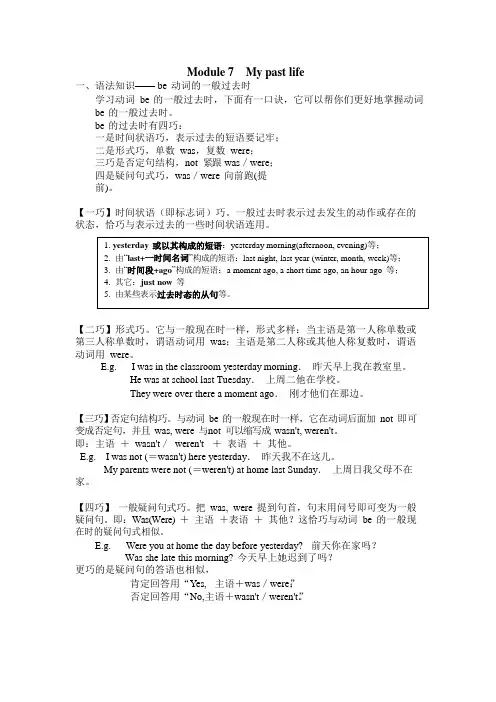
【一巧】时间状语(即标志词)巧。一般过去时表示过去发生的动作或存在的状态,恰巧与表示过去的一些时间状语连用。
【二巧】形式巧。它与一般现在时一样,形式多样:当主语是第一人称单数或第三人称单数时,谓语动词用 was;主语是第二人称或其他人称复数时,谓语动词用 were。
E.g. I was in the classroom yesterday morning. 昨天早上我在教室里。
He was at school last Tuesday. 上周二他在学校。
They were over there a moment ago. 刚才他们在那边。
【三巧】否定句结构巧。与动词 be 的一般现在时一样,它在动词后面加 not 即可变成否定句,并且 was, were 与 not 可以缩写成 wasn't, weren't。
即:主语 + wasn't/ weren't + 表语 + 其他。
E.g. I was not (=wasn't) here yesterday. 昨天我不在这儿。
My parents were not (=weren't) at home last Sunday. 上周日我父母不在
家。
【四巧】 一般疑问句式巧。把 was, were 提到句首,句末用问号即可变为一般疑问句。即:Was(Were) + 主语 +表语 + 其他?这恰巧与动词 be 的一般现在时的疑问句式相似。
E.g. Were you at home the day before yesterday? 前天你在家吗?
外研版七年级英语下学期Module1- 6语法专练 (有答案)
Modules 1-6 语法专练
Part one 代词的运用。
一 选词填空。
1 _______ name is Polly .
2 His bike is new .But _______ is old .
3 _______ coat is this ? it’s mine .
4 ______ brother is my friend .
5 Are these books __________ ?
答案:1. Her 2. hers 3. Whose 4. Your 5. yours
1 ______ crayon is this ? It’s Mike’s .
2 The book is not ______ .Is it yours ? Yes ,thank you .
3 Are these _______ gloves ,Daming ?
No ,they aren’t .
4 What’s the cat called?
_______ name is Mimi .
5 Is this the girl’s bag ?
No, it’s not _______ .
答案:1. Whose 2. mine 3. your 4. Its 5. hers
二 用所给单词的适当形式填空。
1 Lily is ________ (Lucy)sister .
2 Do you know _______ (it)name ?
3 Mike and Tom ______ (be)friends .
4 Thanks for helping ________ (I).
5 Ann’s mother is ______ (we)teacher.
6 I like his pen but I don’t like ________ (my).
外研版七年级下册英语语法专题复习(含练习)
外研版|七年级下册要点知识点梳理
语法知识点
1.词类:物主代词、神态动词 can 和方向介词短语
2.时态:一般未来时态和一般过去时态
3.句型:特别疑问句、祈使句、叹息句和选择疑问句
词类
1) 物主代词:表示所属关系的代词( 属于谁的)
单 数 复 数
人称 形容词性物主代 名词性物主代 形容性物主代 名词性物主代
词 词 词 词
第一人称 my mine our ours
第二人称 your yours your yours
his his
第三人称 her hers their Theirs
its its
形容词性物主代词和名词性物主代词的关系:
形容词性物主代词:一定和名词在一同。 My father, your teacher...
物主代词
名词性物主代词
:相当于与之相对应的形容词性物主代词
+名词。
This shirt is mine. =This is my shirt.
练习 (1)选择题。
( )1. Look at .
A. him B. he C. his
( )2. I drive to the park every day.
A. they B. their C. them
( )3. classroom is big.
A. we B. us C. Our
( )4. I love .
A. she B. her C. hers
( )5. Do you know
A. I B. my C. me
( )6. I am son.
A. they B. their C. them
( )7. This is not _____ desk.. My desk is over there.
A. I B. my C. me
( )8. -Can you spell _____ name, Harry - Sorry.
外研版七年级下册英语Module-3Making-plans知识点及练习(有答案)
1 Module 3 Making plans
重点词汇讲解
1。on Saturday morning在周六上午
【考点分析】辨析on, in, at在表示时间时的区别
on表示在具体的某一天或具体某一天的上午、下午或晚上。 on May Day在五一劳动节;
on Sunday afternoon在周日下午
in后跟年、月、季节、世纪,或泛指的上午、下午或晚上等。 in 1997 在1997年;in May 在五月;
in the morning在早上
at表示在具体的几点钟 at five o’clock 在五点;at half past six 在6:30;
at a quarter past two 在2:15
【例题】①—Hi,Susan,when is Teachers’ Day in China?
-It’s ________ September 10th . 【B】
A.in B.on C.at
D.For
②We usually have the first class________8:00 in the morning 。 【D】
A.of B.in C.on
D.at
2。else /els/adj 。 别的,其他的 adv . 另外,其他
【考点分析】 else作 形容词 时一般用在不定代词(something, anything, nobody, somebody等)或疑问代词(who, what等)之后;作 副词 时一般用在不定副词(somewhere,anywhere等)或疑问副词(where,how等)之后。
eg:I’m going to take you somewhere else 。 我将要带你去别处.
What else did he say? 他还说了些什么?
Where else did you go in the summer vacation? 暑假你还去了哪儿?
外研版七年级下册Module3 Unit3 语法专练(有答案)
不要因为长期埋头科学,而失去对生活、对美、对待诗意的感受能力。——达尔文
1 / 12
外研版七年级下册Module3 Unit3语法专练
Ⅰ.单项选择。
1. My sister ________ art when she grows up because she wants to be an
artist.
A. studies B. is going to study
C. studied D. studying
2. —Are you going to visit Center Zoo tomorrow?
—________.We're going to visit Green Zoo.
A. Yes, we are B. No, we aren't
C. Yes, we do D. No, we don't
3. —Hey, Tina.________ are you going for your vacation?
—Hmm. I think I'm going to Hong Kong.
A. How B. Where
C. Who D. What
4. Betty ________ Xi'an next week. 不要因为长期埋头科学,而失去对生活、对美、对待诗意的感受能力。——达尔文
2 / 12 A. is going B. is moving
C. is going to D. is going to go
5. He ________ have a field trip the day after tomorrow.
A. is B. does
C. is going D. is going to
6. What are you going to ________ this evening?
A. do B. does
C. doing D. did