
新目标英语教学笔记 八年级上 unit 2 What's the matter
新目标英语教学笔记八年级上unit 2What's the matter?
单元目标:1. 能够辨认身体部位。
2. 能够谈论健康状况
3. 能够提供建议。
重点单词:(略)
重点短语:1. see a doctor / dentist 看医生/牙医2. get / have a cold感冒3. have a toothache患牙痛 4. have a headache患头痛 5. have a fever发烧 6. lie down and rest 躺下休息7. drink lots of water喝大量的水8. drink hot tea with honey喝热蜂蜜茶9. be stressed out有压力10. get tired累了11. stay healthy保持健康12. on the other hand在另一方面
重点句子:
1. I have a headache. 我患有头痛。
You should go to bed. 你应该上床睡觉。
2. He has a stomachache. 他患有胃痛。
He shouldn't eat anything for 24 hours. 他不能在24小时之内吃任何东西。
3. She has a toothache. 她患有牙疼。
She should see a dentist. 她应该去看牙医。
重难点解析:
1. 动词have的用法
(1)表示"有,拥有"的意思:
eg: How many books do you have? I have two sisters. One is Lucy, the other is Lily.
(2)词组"have to"表示"必须,不得不"
eg: Does he have to be in bed by ten o'clock? The students have to clean the classrooms on school days.
(3)表示"吃,饮"的意思。
eg: What do you have for breakfast? He had some hamburgers.
(4)加上某种表示疾病的词表示"患"
eg: Do you often have colds? I'm sorry to hear that you have a sore throat?
2. "What's the matter(with sb)? "表示"...怎么了?"通常表示某人处在一种不好的境况中。
eg: -What's the matter with you? -I have a toothache.
-What's the matter with him? -He failed the exam.
3. 情态动词"should"的用法
"should"在课文中表示"应该、必须"用于表示忠告、建议等。
eg: You should drink hot tea with honey. Mrs Jones has a fever. She should drink lots of water. 与情态动词"can"一样,如果是否定句,在should后面加上not;如果是疑问句,把should 放在主语前,should没有人称的变化。
eg: Should I lie down and rest? You shouldn't drink hot coffee.
4. 后缀"-ache"表示"...病痛"
toothache牙痛stomachache 胃痛headache 头痛backache 背痛
4. "might"是情态动词,表示"可能,大概",口气要比"may"弱。
eg: Doctor Sun might be here. I'm not sure. The class might begin. We should be hurry.
You might catch a cold.
5. "too much"表示"太多",用来修饰不可数名词,与之同一意思的是"too many",它用来修饰可数名词复数。
eg: There were too many people here, so it was crowded. Don't play computer games. You spend too much time on it. I'm full, because I eat too much food.
6. "on the other hand",意思是"事情的另一面"
eg: He works very hard. On the other hand, he doesn't look after his health.
经常用在这个句型"on the one hand..., on the other hand...".
eg: On the one hand she is good at English, on the other hand she isn't good at math. eg: It's difficult to work out this math problem.。
人教版英语八年级上册Unit2课堂笔记
八年级上册Unit2课堂笔记一、单词1、have []v. 得(病);患(病)(1)表示“有,拥有”。
如:How many books do you have? 你有多少本书?(2)词组have to 表示“必须,不得不”。
短语:have a cold 感冒;have a headache头痛Each of the students has a Chinese English dictionary.▲“have a+疾病名”表示“患……病”。
eg:I have a headache. 我患有头痛。
类似的在本文中出现的固定表达还有:have a cold 患感冒have a headache (患)头痛have a stomachache (患)胃痛have a sore throat (患)咽喉痛have a sore back 背痛have a fever发烧have a toothache(患)牙痛have a backache 背痛1、weak []adj.(身体)虚弱的;无力的eg: He is weak so he can’t walk long. 他身体虚弱,因此他不能走很长的路。
1)weak 意为“身体虚弱的”。
2)weak 的反义词是strong。
3、hear [] v. 听见;听说1)常见短语:hear of....听说;hear from...收到……的来信,相当于get/receive a letter from...2)hear sb.do sth.听到某人做某事,hear是感官动词,后面接省去to的动词不定式。
如:I often hear the little girl sing in the next room.我经常听见这个小女孩在隔壁唱歌。
3)hear sb.doing sth.听见某人正在做某事I heard the man playing the piano when I passed.当我经过的时候,我听见那个男人正在弹钢琴。
八年级英语上册《Unit 2 What is the matte》教案2 人教新目标版

Unit 2 What's the matter?Section A Period 1 (1a--2c)I. Teaching objectives1.Knowledge objectives:1)To learn the names of body parts:head, nose, eye, ear, to oth, neck, stomach, back, leg, arm, foot, throat.2)To learn the names of some illness:headache, stomachache, toothache, sore throat, sore back, cold, fever.3)To ma ster the pattern:-- What's the matter? -- I have a cold.-- What's the matter? -- She has a fever.4)To use have for talking about health problems.5)To learn how to give advice with Moral should/shouldn't.2.Ability objectives:Students can talk about health and give some advice.3.Moral objectives:It's important to keep healthy.II. Teaching key points1)To learn the names of body parts and the illness.2)To use have for talking about health problems.III. Teaching difficulties1.To remember so many words.2.To tell the differences between have and has.3.To learn how to give advice with should/shouldn't..IV. Teaching methodsListening methodRecognizing methodV. Teaching aidsMulti-mediaA tape recorder.A doll for teaching the nam es of body parts.V. Teaching arrangementsStep 1. Warming upEnjoy the flash "head shoulder knees and toes".Step 2. Lead-in1.T: Do you know the parts of your body? What are they?Encourage Ss to tell the body parts using what they know.2.Show a doll. Then present and teach the names of the body parts.Step 3. Quick eyesShow slides about different parts of the body quickly and check how many words theyknow and remember.Step 4. Game1.Ask 2 groups of the Ss to stand up and play the game "Lucy says". I say "Lucy says-- Point to your nose/stomach/..."a nd the Ss listen and do it. Those Ss who don't do correctly sit down. The winners go on to play the game.2.Have 2 or 3 Ss play the role of Lucy and play the game.Step 5. Look & write (1a)1.Ss look at the picture above 1a and then write the correct letter a--m for each part of the body.2.Check the letters.3.Ss read the words together.Step 6. Presentation1.T: How many people are there in the picture? Who are they?2.T: Are they healthy? What kind of illness do they have?Present and teach the names of some il lness and the ways to show the illness with have. Then teach how to ask about the illness--What's the matter (with you)?3.Ss work in pairs. One mimes an illness and make conversations.A: What's the matter (with you)?B: I have a ...4.Get several pairs to show their own conversations.T: What's the matter with ...?Ss: He/She has a ...S tep 7. Listening (1b)1. Ss listen and look at the picture above 1a. Number the names 1--5 . Then check.2. Page 85, Section A 1b.Ss listen to the tape and repeat. Then read the conversations together.3. T: What's the matter with Judy?T: If you have a sore throat, what should you do? What shouldn't you do?Teach the word should.4. Encourage Ss to give their own advice with should/shouldn't.5. Ss look at 2a and match the problems with the advice, using what they know.6. Listen and check.(2a)7. Listen again and fill in the blanks.(2b)Step 8. Rol e play1.Pair work. One is the patient and the other is her/his friend. Make conversation like the following:A: What's the matter with you?B: I have a ...A: Maybe you should/shouldn't ...B: That's a good idea./ That sounds good./ I guess I should./...Homework1. Copy the new words.2. Do exercises on Page 3 , Homework 2 .3. Do exercises on Page 4 , Homework 1.4. Ask friends about their hea lth. Blackboard DesignUnit 2 What's the matter?Section A Period 1 (1a--1c)foot -- feet tooth--teet hmouthstomachstomachache教学反思 本课生词量大,学生不能很好地掌握部分单词的发音,要在今后的教学中创造机会,使学生反复使用、练习。
八年级英语上册 unit 2 what’s the matter重难点解析 人教新目标版

Unit 2 What’s the matter?一、本单元主要围绕身体健康状况来展开,包括询问病情,述说病情并给予合适的建议。
1.询问病情一般有以下三个句型:What’s the matter? What’s the trouble? What’s wrong?注意:如果后边带上人或物时,用with.2. 回答病情:I have a + 名词(表示病痛的)(have 随人称和时态而变化)表达患病的常见短语有: I have a cold. She has a fever. He had a toothache. 注意:表示病痛的名词构成方式有:① 表示身体部位的名词+ ache , 如 headache, stomachache, backache, toothache 等;② sore + 身体的部位,如 sore back, sore throat, sore leg, sore arm 等等。
3.给予合适的建议:should / should not do sth.应该/ 不应该做某事You should lie down and rest. You should go t o bed early. You shouldn’t eat anything. You should drink more water. You should drink hot water with honey. 等等。
二、重点单词和词组rest, headache, stomachache, illness, thirsty, problem, traditional, believe, medicine, important, moment, until, balance, ago, advice, improve , lie—lay –lying, too much, much too, a few, keep/ stay healthy, at the moment, get/ be stressed out, give advice, a balanced diet, for example, traditional Chinese doctors, lie down, see a doctor.三、重难点解析:1.ago , 放于句尾,表示。
新目标英语八年级上Unit 2重难点解析
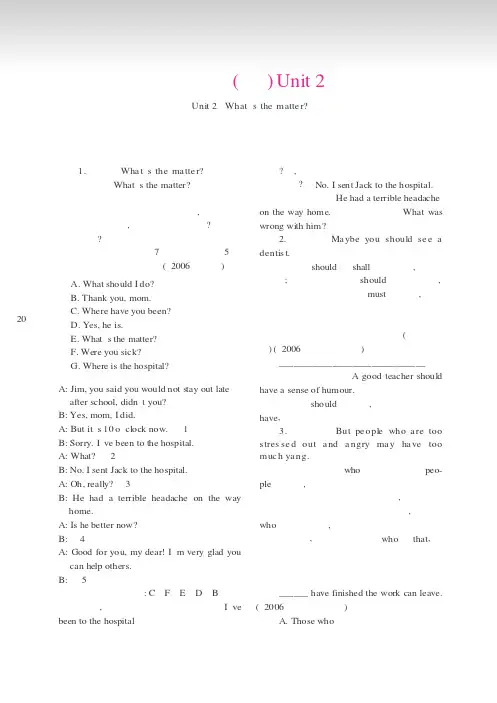
can help others. B: 5
【点拨】 答 案 为 : C—F—E—D—B 。 做 此 类 题 时 , 关 键 在 于 联 系 上 下 文 。 由 I’ve been to the hospital 可 推断 上句 是 问“ 你去 哪
儿 了? ”, 同时 也可 推 断出 下 一句 问 的是“你 生 病了 吗? ”No. I sent Jack to the hospital.也 印 证了 这一 点。由 He had a terrible headache on the way home. 可 推 断 问 句 是 What was wrong with him?
新 目 标 英 语 八 年 级 ( 上 ) Unit 2 重 难 点 解 析
Unit 2 What ’s the matte r? 山 东省 新泰 市 徐 佰
1.【原句】Wha t’s the ma tte r? 【讲 解】 What’s the matter?常 用 来 询 问 某 人患 了何 种疾 病或 遇到 了何 种麻 烦。当你 看 到别 人 气色 不好 或 面带 憔悴 时 , 可 以用 该 句 型来 询问 对 方, 意为“哪 儿不 舒 服? ”、 “ 出 什 么事 了? ”。 【真 题】 从 方框 内 7 个 选 项中 选 择 5 个 恰 当的 句子 完成 此对 话。( 2006 重 庆 市)
初 二版
B. Anyone C. The one who 【点拨】选 A。 本句 中有 两个 谓语 动词 , 根据 结构 可 看出 句意 为“ 凡是 完 成工 作 的 便 可以 走了 ”, 即 本 句包 含一 个 定语 从 句, 可 初 步 选 A 和 C; C 项 中 的 the one 为 单 数 , 与 have 搭配 不当 , 故应 排除 掉。 4.【原 句】It’s e a sy to ha ve a he a lthy lifes tyle , ... . 【讲 解】这 是 一 个 不 定 式 作 主 语 的 句 子。 不 定式 作 主语 时 , 常 用句 型 It + be + 形 容 词 或 名 词 + to do..., 其 中 的 it 是 形 式 主 语, 代 替 后 面 的不 定 式 , 以 保 持 句 子 结 构 的 均衡 。 【真题】 It ’s a good habit ______ breakfast every day(. 2006 陕西 省) A. had B. have C. has D. to have 【点拨】选 D。 从句 意“每 天吃 早餐 是个 好习 惯 ”可 知“ 吃 早 餐 ”是 句 子 的 主 语 , it 是 形式主 语, 故后 面的 动词 应当 用不 定式 。 5.【原 句】Don’t ge t s tre sse d out. 【讲 解】本句 是 祈 使 句的 否 定 形 式 。 将 祈 使 句改 为否 定 形式 时, 要在 动 词原 形 前 加 助 动 词的 否定形 式 Don’t。 【真题】 ______ (not stand) too close to the wild animals. It’s dangerous.( 2006 江 苏 省 盐 城 市) 【点 拨】填 Don’t stand。 本 句 中 没 有 主
八年级英语上册 Unit 2 What’s the matter教材全梳理 人教新目标版
【英语】八年级上册教材全梳理〔Unit 2 What’s the matter〕知识•巧学•升华巧解生词【词析】音析:字母a在闭音节中发,字母组合er发短音。
形析:mat〔席子〕+ter【例句】What’s the matter with you?你怎么了?【拓展】〔1〕同义词:trouble, problem〔2〕习惯用法:What’s the matter with y ou? 你怎么了?【词析】音析:字母a在闭音节中发,字母e不发音。
形析:形近词save〔挽救〕【例句】 Children often have a toothache.儿童常常会牙痛。
【拓展】〔1〕同义词:get〔2〕短语:have a cold/headache…感冒/头痛【词析】音析:字母c发[k],字母o发。
形析:c+old〔老的〕【例句】 People often have a cold in winter.冬天人们常常会感冒。
【拓展】〔1〕cold 用做形容词表示“寒冷的〞,如:On a cold morning he had some noodles for breakfast.在一个寒冷的早晨,他早饭吃的面条。
〔2〕cold用做名词表示“伤风感冒〞,请记住have a cold和catch a cold。
如:—What’s the matter with you?你怎么啦?—I have a cold/I catch a cold. 我感冒了。
【词析】音析:ch发[k]。
形析:stomach〔胃〕+ ache〔疼痛〕【例句】 I have a stomachache.我肚子痛。
【拓展】〔1〕ache结尾的单词表示“疼、痛〞,如:headache头痛;backache 背痛〔2〕常用短语:have a stomachache 胃痛【词析】音析:字母组合ore发。
形析:形近词score〔得分〕【例句】 I have a sore throat. I can’t speak loudly.我咽喉痛,我不能大声说话。
八年级上unit2 what is the matter知识点总结

Unit 2 What's the matter?【知识梳理】【课文解析】You must do the work with more care.你工作要再细心些。
Maybe与may bemaybe连在一起是副词,意为“可能,也许,大概”,在句中作状语,通常置于句首,也可以放在谓语动词之前;may be分写是“情态动词+动词原形”的形式,在旬中作谓语。
一Is that true?那是真的吗?一Maybe,I'm not sure.也许(可能)是,我说不准。
He may be eighteen.他可能18岁了。
Maybe your book is at home.也许你的书在家里。
The book may be in the desk.那本书可能在课桌里。
I am not feeling well.我觉得不舒服。
I'm not feeling well.是病人回答医生或回答他人询问病情时常用的回答方式之一,意为“我感到不舒服”。
I am not feeling well也可以说成I don't feel well8类似的答语还有:I feel terrible.我感到不舒服。
I feel m.我感觉生病了。
I feel even worse.我感到更糟糕了。
feel在该句中为系动词,意为“觉得,感觉”。
He feels comfortable.他觉得很舒服。
I feel cold/hungry.我感到9/觉得饿。
start to do和start doing都表示“开始做某事”,但是在以下三种情况中用start to do而不用start doing。
(1)主语是物而不是人时。
The ice started幻melt.冰开始融化了。
(2)start本身为-ing形式时。
He is just starting to write the letter.他刚刚开始写那封信。
初二英语上Unit 2知识重点 What's the matter
Unit 2 What’s the matter?1. What’s the matter? = What’s the matter with you?= What’s wrong with you?= What’s the trouble (with you)?你怎么了?有什么麻烦?2. have a cold = catch a cold 患感冒3. 原形过去式过去分词现在分词lie lied lied lyinglie lay lain lyinglay laid laid layinglie down 躺下lie to sb 对某人撒谎tell a lie 说谎A black hen lays a white egg.丑妇也能生俊儿。
(不要以貌取人)4. rest v. n. have a rest/break 休息5. see a dentist/doctor 看牙医/看医生6. should. “应该,应当”,可用来表“建议,劝告”。
情态动词,没有人称和数的变化,后接动词原形否定——shouldn’t = should not7. fell 系动词“感觉,觉得”,后接adj做表语类似的词有:look(看起来),smell(闻起来),get(变得),become(成为)8. hope / wish to do sth 希望干某事wish sb to do sth 希望某人干某事9. be tired 劳累的,疲倦的be tired of doing sth 厌烦做某事10. be stressed out 紧张的,有压力的11. go to bed 去睡觉be ill in bed 卧病在床,卧床不起12. need to do sth 需要干某事need doing sth 需要被干……,表被动need not = needn’t 不必,用作对must提问的否定回答13. for example 例如,比如说14. keep a balance (of) 保持(……的)平衡lose a balance (of) 失去平衡a blanced diet 均衡的饮食15. on the way to……在去……的路上16. too much 太多+ 不可数名词much too 太,非常+ 不可数名词too many 太多+ 可数名词复数very much 非常,修饰动词,通常位于句末17. have / take medicine 服药,吃药18. be angry with sb 对某人生气be angry at / about sth 因某事而生气19. be popular with 受……的欢迎be popular in + 地方表在什么地方受欢迎20. It is + 形容词+ for sb to do sth 表做某事对某人来说怎样21. stay healthy = keep healthy = keep fit = keep in good health 保持健康keep sb healthy 保持某人健康be in good healthy 处于健康状态22. give sb sth = give sth to sb 给某人某物give sb advice = give advice to sb 给某人建议23. (肯定)a few. 一些,几个。
八上Unit 2 What's the matter 讲解
What's the matter? 重点语法及练习一、【重要词组概览】1.have a cold 患感冒2.stressed out紧张的,有压力的3.get tired 感觉疲惫4.stay healthy 保持健康5.at the moment 此刻,现在6.on the other hand 另一方面7.get a cold 患感冒8.see a dentist 看牙医9.go to the party 去参加聚会10.make sb sick使某人不舒服11.have a sore throat 嗓子痛12.have a fever 发烧,发热13.have a toothache 牙痛14.have a backache 背痛15.have a headache 头痛16.lie down 躺下17.feel better 感觉好点18.get tired/ angry/ stressed out变得疲惫/生气/紧张,有压力19.a balance of ………的平衡20.for example 例如21.too much 太多(注意它与much too的区分)22.a balanced diet 一个均衡的饮23.a few 一些 / 少许24.stay / keep healthy 保持健康25.need to do sth. 需要做某事26.at the moment 现在 / 此刻27.host family 寄宿家庭二、【常用句型】看病需要和医生交流,这是英语口语中必不可少的内容。
从医生询问病情,病人诉说病情,到医生检查、诊断和医嘱,这些环节最常用的语句,同学们必须掌握。
1)医生询问病情的常用语句:1. What\'s wrong/the matter (with you)? 你怎么了?What\'s your trouble, young man? 年轻人, 你哪里不舒服?When did it start? 从何时开始生病的?2. How are you (feeling) now? 你现在觉得怎么样?Are you feeling better today? 你今天好些了吗?3. Have you got a headache/a cough? 你头痛/咳嗽吗?4. When did you feel unwell? 你什么时候觉得不舒服的?5. When did the pain start? 疼痛何时开始的?6. Did you sleep well? 你睡得好吗?Do you feel tired? 你觉得疲劳吗?7. How long have you been like this? 你像这样有多久了?8. Did you eat anything for breakfast? 你早饭吃了什么没有?2)病人诉说病情的常用语句:1. I don\'t feel very well. / I\'m not feeling well. 我感到不舒服。
八年级上册英语Unit2《What's the matter》知识点
八年级上册英语Unit2《What's the matter》知识点【看病的表达】1.What's the matter with you? 你怎么了?(常考句子,注意matter)=What's wrong with you?= What's the trouble with you= What's your trouble?matter 前须加定冠词the;wrong前不加任何修饰词;trouble 前可加the,也可加形容词型物主代词2.I'm not feeling well. I have a …我感觉身体不适,我得了……3. When did it start? 什么时候开始的?4. It started … ago.…前开始的。
5. That's too bad.You should / shouldn't …那太糟糕了。
你应该/不该……6. Yes, I think so. / That's a good idea. 是的,我也这样认为。
/ 好主意。
7. I hope you feel better soon. 我希望你早点好起来。
【重点短语】1. lie down 躺下2. hot tea with honey 加蜂蜜的热茶3. feel better 感觉好点4. get tired/ angry/stressed out变得疲惫/生气/紧张,有压力5. traditional Chinese doctors 传统中医6. a balance of ………的平衡(balance是一个非常重要的考点)7. for example 例如8. too much 太多(注意它和much too的区分)9. Chinese medicine 中药10. western countries 西方国家11. a balanced diet 一个均衡的饮食(balance是一个非常重要的考点)12. a few 一些 / 少许13. stay / keep healthy 保持健康14. need to do sth. 需要做某事15. at the moment 现在 / 此刻16. host family 寄宿家庭【重点句型】1. Eating Dangshen and Huangqi herbs is also good for this. 吃党参和黄芪也对这方面有益。
新目标英语八年级(上)Unit2单元知识要点归纳
Unit Two What’s the matter?一、短语1.have\has + a + 病名have a cold 感冒have a headache=have a pain in one’s head 头痛have a stomachache 胃痛have a toothache 牙痛have a backache=have a sore back背痛have a sore throat 喉痛have a fever 发烧2.lie down and rest 躺下休息She lay down on her bed.I found a wallet lying on the ground.3.see a dentist 看牙医4.hot tea with honey(不可数名词)5.should –shouldn’t (表示劝告或推荐)He should stop smoking.You shouldn’t leave a baby alone in the house.6.give (some) advice 提出建议a piece of advice7.traditional Chinese doctors 传统中医8.Chinese medicine中药9. a balance of yin and yang 阴阳平衡10.get tired 疲劳11.be stressed out 紧张12.stay healthy 保持健康二、句型、1.What’s the matter with sb?What’s wrong with sb?What’s the trouble with sb? 某人怎样了?2.He has a headache.3.I have a cold.You should drink some water. 你应该喝些水。
You should go to bed你应该去睡觉。