
高中英语 Unit13 lesson3 Guessing about people课件 北师大版必修5
2. Although her father is in the firm she got the job _o_n__h_e_r_o_w_n______.
3. He lived on a _d_e_s_er_t_e_d__ island.
11. The wall __sh__el_t_e_re_d___ the soldiers from gunfire.
12. Shut the window--- I’m _fr_e_e_z_in__g__!
give shelter to, protect
deserted
agree to marry
get engaged
that cannot be found
Complete the following sentences by using the words and expressions:
missing hear about, hear from, anxiously, fall behind, on one’s own, shiver, freeze , shelter, deserted, get engaged, get lost
A: I wonder how they got lost.
B: They may have been 2_s_e_p_a_r_a_te_d_ from the other students in that storm. Or they might have 3_f_a_l_le_n_____ behind and taken the wrong path.
A: Maybe. Or they could have gone exploring on their own and lost their way back to the group.
B: It makes me shiver just thinking of them right now. It’s so cold at the moment.
4. The book had two _m__is_s_in_g____ pages.
5. Tell him to __g_e_t_l_o_s_t_____. 6. How often do you __h_e_a_r_f_r_o_m_______ your sister?
missing hear about, hear from, anxiously, fall behind, on one’s own, shiver, freeze , shelter, deserted, get engaged, get lost
B: And one of them might be injured! I really hope the rescuers find them soon. A: Me too. Their parents must be very 7_w__o_r_r_ie_d____.
Match the words with the following:
Unit 13 People Lesson 3
Guessing about People
Listen to the tape and complete the gaps:
…
B: I can’t believe that they’ve been missing on the mountains for 3 days now! They must be so 1_f_r_ig_h_t_e_n_e_d__!
They must be 4_f_r_e_e_z_in_g____! A: They might be 5__sh__el_t_e_ri_n_g__ in a cave.
…
A: They might have 6__s_o_m__e_f_o_o_d_______ left from camping but they may not have any water.
7. I’ve just _h_e_a_r_d__a_b_o_u_t____ his dismissal.
8. They were _a_n__x_io_u_s_l_y___ waiting for them to come back safe. 9. The major world powers are afraid of __f_a_ll_in__g_b_e_h_i_n_d_ in the arms race. 10. She _s_h_i_v_e_r_ed___ at the thought of going into the dark house alone.
missing
unhappy
upset
fail to keep level with
fall behind
alone
on one’s own
tremble, esp. from cold or fear
shiver
very cold
shelter
with no one present
freezing
Unit 13 Lesson 3 Making Guesses about People

-1-
Section Ⅲ Lesson 3 Making Guesses about People 一二三四
课前篇自主预习 课堂篇合作学习
一、词义匹配
A B
1.hug a.to lose blood
课前篇自主预习 课堂篇合作学习
★考点 (2)have been waiting for...是现在完成进行时,表示动 作从过去的某一时刻开始一直持续到现在,且现在可能还在继续, 并有可能继续延续下去。
①The man has been working in the garden all the morning. 整个早上这个人一直在花园里干活。 ②I have been learning English since I was eight years old. 从八岁起,我就一直在学英语。
-3-
Section Ⅲ Lesson 3 Making Guesses about People 一二三四
课前篇自主预习 课堂篇合作学习
三、词汇拓展
1.bleed→ b lo od n.血液 2.broken→ b re ak v.打破
3.relief→ r eli ev ed adj.宽慰的
今天吃午饭时我看到她泪水流过脸颊,另外一位老师上前拥抱了 她。
★考点 句中的had tears running down her cheeks表示“让其 泪水流过脸颊”,have sb./sth.doing 表示“让某人/物持续做……”,后 面的doing作宾语补足语。这一结构的否定式表示“不能允许某人 做某事”。
他们的朋友们真的很难过,一直在焦虑地等待更多的消息。 ★考点 (1)upset adj.难过的;不高兴的;不安的 ①【高考典句】(2019·江苏)The task was so hard,and Steve,angry and upset,said he was quitting. 任务太艰巨了,史蒂夫很生气和沮丧,说他要辞职。 ②Making speeches in public always upsets me. 当众演讲总会使我感到不安。
高中英语Unit13Lesson3《MakingGuessesaboutPeople》教案北师大版必修5

Unit 13 Lesson 3 教学指导Modals一.情态动词有can,could,may,might,must,have to,shall,should,will,would,ought to,need,dare等.没有人称和数的变化,有词义,但不完整,不能单独作谓语,必须和不带to的动词不定式连用.1.can,could表示能力;客观可能性;许可;请求;表示怀疑,惊异,不相信(主要用于否定句,疑问句或感叹句).表示请求时,使用could比can语气更显得委婉客气,它们在时间上没有差别,could主要用于疑问句,不用肯定句,所以回答时要改用can.Eg :Can you finish this work tonight?Man can not live without air.Could I come to see you tomorrow? Yes, you can.Can this be true?How can you be so rude!2.may,might表示允许,请求;表示可能性(主要用于陈述句,肯定或否定,疑问句用can代替);表示祝愿否定回答用mustn’t,表示“不可以,禁止,阻止”eg:You may drive the car.Might I use your pen? No,you mustn’t.3.must,have to,ought tomust表示“必须,应该”,强调主观看法,只有现在时形式,否定式是must not. Must 开头的问句,其否定回答时要用needn’t或don’t have to代替.must还可以表示必然的结果have to着重客观需要,能用于更多时态.Ought to表示义务和责任Eg :You must come to school on time.Must we hand in our English exercise books? No,you don’t have to.The film is not interesting. I really must go now.I had to work when I was your age.You mustn’t go.You don’t have to go.4.need,dareneed表示“需要,必要”.只能用于否定句和疑问句中.Dare表示“敢”,常用于否定句,问句和条件状语从句中.5.will,wouldwill 表示请求,建议;意愿,决定,允诺;习惯性动作或某种倾向.Would表示请求,建议;过去习惯性动作或某种倾向.6.shall,shouldshall在问句中表示征求对方意见或请求(用于一,三人称);表示说话人的允诺,命令或威胁(用于二,三人称);表示决定或决心(用于第一人称)should表示劝告,建议,命令7.must ,canmust 用于肯定,表示对当前情况的推测, “一定在…,准是….”.could/can 用于否定或问句,表示对当前情况的推测, “不可能是(在)…”或“可能是(在)…”eg: You can’t be serious. Can he be serious?I hear water running. He must be having a bath.8.can ,could,may,might,must表示判断的用法比较must 用于肯定判断,表示对现在情况的肯定判断..must be +doing 表示“想必正在做某事”.might/may表示对现在情况的可能性推断.can/could用于否定或问句,表示对现在或当时情况的否定或疑问性推测eg: The light is on in the office now, so there must be someone in it,isn’t there?--Where is Li Ming now? –He must be working in his class.I’m not sure whether he will come today. He may/might be ill today.Tom has gone to Beijing,so you can’t see him in your school now.二. “情态动词+动词的完成时”的用法.1.must have done表示对过去情况的推测或估计,表示“想必或肯定(已经)做了某事”.Eg: The groud is rather wet, so it must have rained last night,didn’t it?2.may/might have done表示对过去情况的可能性推测,表示“可能/大概(已经)做一某事”. Eg:Tom may have gone to Shanghai, but I’m still not sure about it.3.can’t/couldn’t have done表示对过去情况的否定性推测,表示“不可能已经做了某事”. Eg: The ground is very dry, so it can’t have rained last night.4.should/ought have done表示过去该做某事而没有做的情况,表示说话人后悔,遗憾或责备的语气.Eg:I really regretted wasted the hours when I should have studied, but it was too late.5.shouldn’t/oughtn’t to +have done表示过去不该做某事却已做了的情况.也表示说话人后悔,遗憾或责备的语气.Eg: I’m very sorry for the words I shouldn’t have said to you at that moment.6.could have done表示本来能够做却没有做某事的责备语气.Eg: --I paid a visit to New York last month, and we stayed at a nice hotel.--Oh, you could have stayed with Barbara. She is always willing to do you a favour.7.needn’t have done表示原本不必做某事但却已做了的情况.Eg: Your home is not far form your school, so you needn’t have left in such a hurry then.8.would rather have done表示本来想做某事却未做.Eg: I would rather have come to help you with your English, but I was too busy at that time.Language points1.It’s possible that Sam doesn’t like classical music..probable,possible ,likely均表示可能性.probable比possible表示的可能性大,表“很有可能,大概”,指有实际根据或逻辑上的合情合理.likely是从外表迹象进行判断,有可能发生的事;possible指客观上有可能,但往往含有希望很小的味道;possible不能用人作主语,也不能用人构成复合宾语.possible 常用于“It is possible to do sth.; It is possible for sb.to do sth.; It is possible that…”等句型中。
Unit 13 People Lesson 3 Making Guesses about People 教学设计1-优质公开课-北师大必修5精品
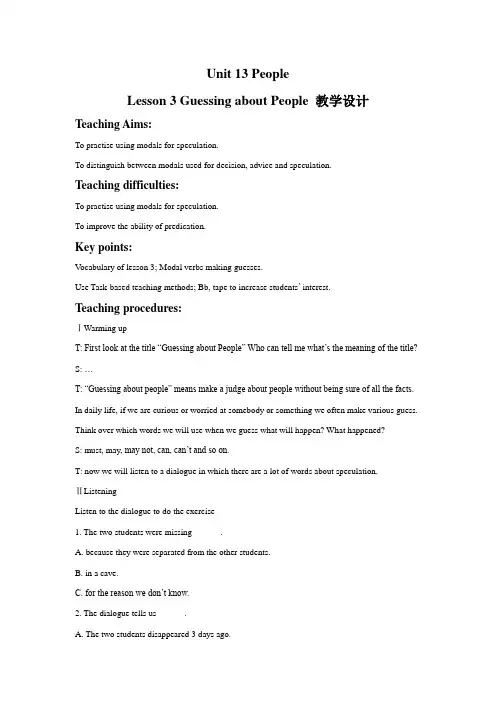
Unit 13 PeopleLesson 3 Guessing about People 教学设计Teaching Aims:To practise using modals for speculation.To distinguish between modals used for decision, advice and speculation.Teaching difficulties:To practise using modals for speculation.To improve the ability of predication.Key points:Vocabulary of lesson 3; Modal verbs making guesses.Use Task-based teaching methods; Bb, tape to increase students’ interest.Teaching procedures:ⅠWarming upT: First look at the title “Guessing about People” Who can tell me what’s the meaning of the title? S: …T: “Guessing about people” means make a judge about people without being sure of all the facts. In daily life, if we are curious or worried at somebody or something we often make various guess. Think over which words we will use when we guess what will happen? What happened?S: must, may, may not, can, can’t and so on.T: now we will listen to a dialogue in which there are a lot of words about speculation.ⅡListeningListen to the dialogue to do the exercise1. The two students were missing ______.A. because they were separated from the other students.B. in a cave.C. for the reason we don’t know.2. The dialogue tells us ______.A. The two students disappeared 3 days ago.B. My cousin know where they areC. The rescuers found them in a cottage.3. The dialogue makes various guessed except_________.A. They must be frightened.B. They both are injured.C. They might have some food to eat.Answers: 1.C 2.A 3.BT: Ca n you say out the main idea of the story in your own words?S: …T: Now let’s look at whether your story is true or not.Do the exercise 2 Listen to the dialogue again and complete the gapsPlay the cassette once for students to listen and then again for them to complete the gaps.ⅢGrammarDo the exercise 3.The two people in the dialogue make various guesses at the two missing students.They use the following sentences but you need to complete the gaps with modal verbs.Check students’ a nswers by having them read the sentences aloud. Draw their attention to the different infinitive forms after the modals.Do the exercise 4.As a class students discuss the meaning of the sentences in the table and decide if they express decision, advice or speculation.Ask students how they would express decision (is going to; is about to;) and advice (should , had better, )Do the exercise 5The grammar we learn today is modal verbs. Modal verbs can express possibility, permission, intention and guess. Now do the exercise 5. Which of the modal verbs in exercise 3 express the following.Do the exercise 6As a whole class, students discuss what the sentences 1-3 are referring to and match them with a, b and c.Guide students to analysis the modal verbs’ use in the past, in the future and now.用在肯定句中:对过去的推测:may /might have +PP(过去分词)must have +pp(过去分词)对现在的推测:must be + noun / adjmaybe/ must be + vingmust +v(原形)用在否定句中对过去的推测:can’t have + PP(过去分词)对现在的推测:can’t be + noun / adjcan’t +v(原形)Do the exercise 7, 8 and 9 to practise and consolidate modal verbs.Do some Best Choice to consolidate modal verbs1. —Do you know where David is? I couldn’t find him anywhere.--Well. He _____have gone far—his coat’s still here.A. shouldn’tB. mustn’tC. can’tD. wouldn’t2. ---Excuse me. Is this the right way to the Summer Palace?---Sorry, I am not sure. But it _____be.A. mightB. willC. mustD. can3. ---Tom graduated from college at a very young age.--- Oh, he _____have been a very smart boy then.A. couldB. shouldC. mightD. must4. ---I heard they went skiing in the mountains last winter.---- It ____ true because there was little snow there.A. may not beB. won’t beC. couldn’t beD. mustn’t be5. Jack ______yet, otherwise he would have telephoned me.A. mustn’t have arrivedB. shouldn’t have arrivedC. can’t have arrivedD. needn’t have arrived6. ---Didn’t you know that you went driving at 100 kilometers an hour, Madam?--- _____. My old car can do no more than 80, officer.A. I may not have beenB. I couldn’t have beenC. I mustn’t have beenD. I shouldn’t have beenAnswers: 1.C 2.A 3.D 4.C 5.C 6.CⅣHomeworkIt is possible that some students can’t master the use of modal verbs individually. So the teacher ask students to do the exercise 10 and 11 as written homework to find out the mistakes of students to help them. Another purpose is to save time in class and give students enough time to do well the exercise.。
2020版高中复习:unit 13 period 3 lesson 3 making guesses about people
People (look) there first,I’m sure. 我确信,人们本可以先看一下那儿的。 4.may/might be doing And one of them might (bleed) or have a broken arm or leg. 他们其中的一人可能在流血或者折断了手臂或腿。
shelter v.躲避;庇护;为……提供避难所;n.庇护,掩蔽;栖息之处 shelter from...躲避(风雨或危险) shelter...from...保护……以免…… take shelter 避难 take shelter from the rain/wind/bad weather 躲避雨/风/恶劣的天气 [语境助记] (1)The first thing he did was to find shelter from the freezing wind and snow.(2015·北京) 他做的第一件事是找到躲避寒风和大雪的地方。 (2)Because there are more places to take shelter.(2015·四川) 因为有很多地方可供避难。 (3)We took shelter from the rain in a nearby café. 我们在附近的一家咖啡馆避雨。 [题组训练] 完成句子 (1)They cared about the young girl,providing her with (食物和住处). (2)On my way to school I got caught in the storm,and I could hardly (找到躲避的地方). (3)Some parents are just too protective.They want to (保护自己的孩子免遭任何形式的危险),real or imagined. (4)These plants must (被保护起来免受) direct sunlight. 5.It’ll be a real relief when they’re found. 找到他们将是一个很大的安慰。 [归纳拓展] (1)relief n.宽慰,减轻;救济(品) (much) to one’s relief 使某人(非常)欣慰的是 in relief 如释重负;松了口气 get relief from/of 减轻,消除 (2)relieve vt.减轻,缓解 relieve sb.of sth.替某人拿重物;帮助某人减轻(负担)等 [语境助记] (1)Whatever it is,make sure it’s a relief from daily stress rather than another thing to worry about.(2016·全国Ⅱ) 无论是什么,确保它是日常压力的减轻,而不是要担心的另一件事。 (2)To our great relief,the children all arrived home safely. 孩子们都安全到家,使我们大大松了一口气。
Unit 13 People Lesson 3 Making Guesses about People 教学设计1-优质公开课-北师大必修5精品
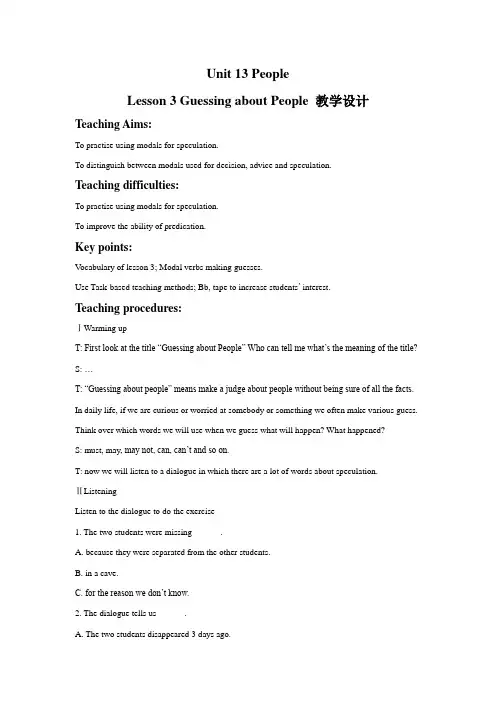
Unit 13 PeopleLesson 3 Guessing about People 教学设计Teaching Aims:To practise using modals for speculation.To distinguish between modals used for decision, advice and speculation.Teaching difficulties:To practise using modals for speculation.To improve the ability of predication.Key points:Vocabulary of lesson 3; Modal verbs making guesses.Use Task-based teaching methods; Bb, tape to increase students’ interest.Teaching procedures:ⅠWarming upT: First look at the title “Guessing about People” Who can tell me what’s the meaning of the title? S: …T: “Guessing about people” means make a judge about people without being sure of all the facts. In daily life, if we are curious or worried at somebody or something we often make various guess. Think over which words we will use when we guess what will happen? What happened?S: must, may, may not, can, can’t and so on.T: now we will listen to a dialogue in which there are a lot of words about speculation.ⅡListeningListen to the dialogue to do the exercise1. The two students were missing ______.A. because they were separated from the other students.B. in a cave.C. for the reason we don’t know.2. The dialogue tells us ______.A. The two students disappeared 3 days ago.B. My cousin know where they areC. The rescuers found them in a cottage.3. The dialogue makes various guessed except_________.A. They must be frightened.B. They both are injured.C. They might have some food to eat.Answers: 1.C 2.A 3.BT: Ca n you say out the main idea of the story in your own words?S: …T: Now let’s look at whether your story is true or not.Do the exercise 2 Listen to the dialogue again and complete the gapsPlay the cassette once for students to listen and then again for them to complete the gaps.ⅢGrammarDo the exercise 3.The two people in the dialogue make various guesses at the two missing students.They use the following sentences but you need to complete the gaps with modal verbs.Check students’ a nswers by having them read the sentences aloud. Draw their attention to the different infinitive forms after the modals.Do the exercise 4.As a class students discuss the meaning of the sentences in the table and decide if they express decision, advice or speculation.Ask students how they would express decision (is going to; is about to;) and advice (should , had better, )Do the exercise 5The grammar we learn today is modal verbs. Modal verbs can express possibility, permission, intention and guess. Now do the exercise 5. Which of the modal verbs in exercise 3 express the following.Do the exercise 6As a whole class, students discuss what the sentences 1-3 are referring to and match them with a, b and c.Guide students to analysis the modal verbs’ use in the past, in the future and now.用在肯定句中:对过去的推测:may /might have +PP(过去分词)must have +pp(过去分词)对现在的推测:must be + noun / adjmaybe/ must be + vingmust +v(原形)用在否定句中对过去的推测:can’t have + PP(过去分词)对现在的推测:can’t be + noun / adjcan’t +v(原形)Do the exercise 7, 8 and 9 to practise and consolidate modal verbs.Do some Best Choice to consolidate modal verbs1. —Do you know where David is? I couldn’t find him anywhere.--Well. He _____have gone far—his coat’s still here.A. shouldn’tB. mustn’tC. can’tD. wouldn’t2. ---Excuse me. Is this the right way to the Summer Palace?---Sorry, I am not sure. But it _____be.A. mightB. willC. mustD. can3. ---Tom graduated from college at a very young age.--- Oh, he _____have been a very smart boy then.A. couldB. shouldC. mightD. must4. ---I heard they went skiing in the mountains last winter.---- It ____ true because there was little snow there.A. may not beB. won’t beC. couldn’t beD. mustn’t be5. Jack ______yet, otherwise he would have telephoned me.A. mustn’t have arrivedB. shouldn’t have arrivedC. can’t have arrivedD. needn’t have arrived6. ---Didn’t you know that you went driving at 100 kilometers an hour, Madam?--- _____. My old car can do no more than 80, officer.A. I may not have beenB. I couldn’t have beenC. I mustn’t have beenD. I shouldn’t have beenAnswers: 1.C 2.A 3.D 4.C 5.C 6.CⅣHomeworkIt is possible that some students can’t master the use of modal verbs individually. So the teacher ask students to do the exercise 10 and 11 as written homework to find out the mistakes of students to help them. Another purpose is to save time in class and give students enough time to do well the exercise.。
高中英语Unit13PeopleLesson3《MakingGuessesaboutPeople》课件北师大版必修5
3.can/could have done 表猜测时一般用在疑问句或否定句 中,对可能性进行提问,或表示不相信或怀疑的态度,对猜测
的把握很大。如: Can/Could he have passed the exam? 他可能通过考试了吗?
I think that he couldn't/can't have gone abroad.I saw him just now.我认为他不可能出国了,我刚才还看见他了。
They can't exactly eat seeds like squirrels and sparrows do! (P12, Ex 2)他们根本不可能像松鼠和麻雀一样吃种子。
点拨 like 在此作连词,意为“如同”,引导方式状语从句。如:
I hope I can drive the car like you do. 我希望我开车开得像你一样好。 运用 完成句子
for a moment 片刻;一会儿 for the moment 暂时;目前 the moment that 一……就 运用 完成句子 (1)I really must be going home ____i_n_a__m_o_m__e_n_t __ (立即). (2)I was writing a letter ___a_t_t_h_e_m__o_m_e_n_t__ (那时)when he came in. (3)I recognized him __t_h_e_m__o_m_e_n_t_t_h_a_t_ (一……就) I saw him. (4)___F_o_r_th_e__m_o_m__e_n_t_ (目前) we are content to watch and wait.
(2)作名词,常与介词 from 搭配使用。作“避难所,提供保 护及安全的场所或事物”讲时是可数名词;作“庇护”讲时是
北师大版高二上Unit13《People》(Lesson 3)word教案
英语:Unit 13《People》教案-Lesson 3Making Guessing about People(北师大版必修5)Teaching Aims:To practise using modals for speculationTo distinguish between modals used for decision, advice and speculationTeaching difficulties:To practise using modals for speculationTeaching Aids: computer, cassetteTeaching procedures:Ⅰ. Warming upT: First look at the title “Guessing about People” Who can tell me what‟s the meaning of the title? S:T: “Guessing about people” means make a judge about people without being sure of all the facts.In daily life If we are curious or worried at somebody or something we often make various guess. Think over which words we will use when we guess what will happen? What happened?S: must, may, may not, can, can‟t and so on .T: now we will listen to a dialogue in which there are a lot of words about speculation.ⅡListeningListen to the dialogue to do the exercise1.The two students were missing ______.A.because they were separated from the other students.B. in a cave.C. for the reason we don‟t know.2. The dialogue tells us ______.A. The two students disappeared 3 days ago.B. My cousin know where they areC. The rescuers found them in a cottage.3. The dialogue makes various guessed except_________.A.They must be frightened.B.They both are injured.C.They might have some food to eat.Answers: 1.C 2.A 3.BT: Ca n you say out the main idea of the story in you own words?S:T: Now let‟s look at whether your story is true or not.Do the exercise 2 Listen to the dialogue again and complete the gapsPlay the cassette once for students to listen and then again for them to complete the gaps.Ⅲ GrammarDo the exercise 3.The two people in the dialogue make various guesses at the two missing students.They use the following sentences but you need to complete the gaps with modal verbs.Check students‟ answers by having them read the sentences aloud. Draw their attention to the different infinitive forms after the modals.Do the exercise 4.As a class students discuss the meaning of the sentences in the table and decide if they express decision, advice or speculation.Ask students how they would express decision (is going to; is about to;) and advice (should , had better, )Do the exercise 5The grammar we learn today is modal verbs. Modal verbs can express possibility, permission, intention and guess. Now do the exercise 5. Which of the modal verbs in exercise 3 express the following.Do the exercise 6As a whole class, students discuss what the sentences 1-3 are referring to and match them with a, b and c.Guide students to analysis the modal verbs‟ use in the past, in the future and now.用在肯定句中:对过去的推测:may /might have +PP(过去分词)must have +pp(过去分词)对现在的推测:must be + noun / adjmaybe/ must be + vingmust +v(原形)用在否定句中对过去的推测:can‟t have + P P(过去分词)对现在的推测:can‟t be + noun / adjcan‟t +v(原形)Do the exercise 7, 8 and 9 to practise and consolidate modal verbsDo some Best Choice to consolidate modal verbs1.—Do you know where David is? I couldn‟t find him anywhere. --Well. He _____have gone far—his coat …s still here.A.shouldn‟tB. mustn‟tC. can‟tD. wouldn‟t2 ---Excuse me. Is this the right way to the Summer Palace?---Sorry, I am not sure. But it _____be .A. mightB. willC. mustD. can3. ---Tom graduated from college at a very young age.--- Oh, he _____have been a very smart boy then.A.couldB. shouldC. mightD. must4. ---I heard they went skiing in the mountains last winter.---- It ____ true because there was little snow there.A. may not beB. won‟t beC. couldn‟t beD. mustn‟t be5. Jack ______yet, otherwise he would have telephoned me.A. mustn‟t h ave arrivedB. shouldn‟t have arrivedC. can‟t have arrivedD. needn‟t have arrived6. ---Didn‟t you know that you went driving at 100 kilometers an hour, Madam?--- _____. My old car can do no more than 80, officer.A.I may not have beenB.I couldn‟t h ave beenC.I mustn‟t have beenD.I shouldn‟t have beenAnswers: 1.C 2.A 3.D 4.C 5.C 6.CⅣ HomeworkIt is possible that some students can‟t master the use of modal verbs individually. So the teacher ask students to do the exercise 10 and 11 as written homework to find out the mistakes of students to help them. Another purpose is to save time in class and give students enough time to do well the exercise.。
北师大版高中英语必修五Unit 13《 Lesson 3 Making Guesses about People》教案 2
Unit 13 PeopleLesson 3 Guessing about People 教学设计Teaching Aims1. Knowledge Aims1) To master some important words and relative usages.2) To get familiar with the modal words that make guesses and expressions.2. Ability Aims1) To practise making simple sentences with the modal words.2) To develop the ability listening for key words.3. Emotional Aims1) To encourage Ss to care about the others’ condition.2) To help Ss make inferences according to the known information. Teaching Important Points1)Vocabulary of lesson 3; modal verbs2)know the past tense of verbsTeaching Difficult Points1) How to lead Ss to make sentences with modal verbs.2) How to lower the difficulty in listening.Teaching ProceduresStep 1. V ocabulary1.Lead Ss to pronounce the words by themselves.2.Correct the pronunciation.3.Explain some useful words.Step 2. Lead-inTask 1. Guess at the pictures1) What’s the relationship do you think between the man and the woman?→They must be couple.2) What might the main news be on TV?→It may be the news that someone has lost.3) What might happen to the students in the two balloons?→They might get lost while camping.4) Will they lose their lives according to the pictures?→They can’t die for they have some equipment.Task 2: try to make an conclusion on modal verbs, and distinguish their differences might; could, can’t, may, should, wouldStep 3. ReadingTask 3. Listen for gaps1.Read through the dialogue quickly and listen to the tape to get an idea of the situation.2.Provide the possible answers for them to lower the difficulty in listening.3.Play the cassette again for them to complete the gaps.4.Listen for the third time and check the answer.Step 4. GrammarTask 4. Presentation1.Ask them to complete the gaps in Ex.3.2.Check answers by having some Ss read and translated the sentences aloud.3.As a class, lead them to discuss what meaning do the sentences in Ex.3.4.Ask Ss how they would express decision and advice in English.5.Give them some time to finish Ex.5 and Ex.6, then check answers.6.Present them the grammar points.may /might have +PP(过去分词)must have +pp(过去分词)must be + noun / adjmay be/ must be + vingmust +v(原形)Step 5. Consolidationcan’t have + PP(过去分词)Ask Ss to consolidate the modal verbs with the help of English Weekly. Homework1.Memorize the words of lesson3.2.Finish the exercises in weekly.。
高中英语 Unit 13 Lesson 3 Making Guesses about People-
Revision
1.Why does the speaker think the French tutor might know one of the students? tears running down her cheeks, give her a hug
2. How do people feel about the accident? upset, wait anxiously, worried, can’t believe, a real relief when they are found
Discovery
3
Look at the dialogue and complete the gaps.
•I think my French tutor _m_i_g_h_t_ know … • They _m_u_s_t_ be so frightened! • They _m__a_y_ have been separated from… • Or they c_o_u__ld_ have gone exploring… • They c_a_n__’t be there. • … they _m_a_y__n_o_t_ have any water.
B: Or maybe the boss is a bad-tempered man.
Homework
1. Read P92– Grammar Summary 2 2. P58—2, 3, 4
!
Discovery
6
Decide what they are talking about.
unlimited present time
1.
I think my French tutor
高中英语unit13 lesson3 guessing about people教案北师大版必修5
Lesson 3 Guessing about PeopleTeaching Aims:To practise using modals for speculationTo distinguish between modals used for decision, advice and speculationTeaching difficulties:To practise using modals for speculationTeaching Aids: computer, cassetteTeaching procedures:Ⅰ. Warming upT: First look at the title “Guessing about People” Who can tell me what’s the meaning of the title? S:T: “Guessing about people” means make a judge about people without being sure of all the facts. In daily life If we are curious or worried at somebody or something we often make various guess.Think over which words we will use when we guess what will happen? What happened?S: must, may, may not, can, can’t and so on .T: now we will listen to a dialogue in which there are a lot of words about speculation.ⅡListeningListen to the dialogue to do the exercise1.The two students were missing ______.A.because they were separated from the other students.B. in a cave.C. for the reason we don’t know.2. The dialogue tells us ______.A. The two students disappeared 3 days ago.B. My cousin know where they areC. The rescuers found them in a cottage.3. The dialogue makes various guessed except_________.A.They must be frightened.B.They both are injured.C.They might have some food to eat.Answers: 1.C 2.A 3.BT: Ca n you say out the main idea of the story in you own words?S:T: Now let’s look at whether your story is true or not.Do the exercise 2 Listen to the dialogue again and complete the gapsPlay the cassette once for students to listen and then again for them to complete the gaps.Ⅲ GrammarDo the exercise 3.The two people in the dialogue make various guesses at the two missing students.They use the following sentences but you need to complete the gaps with modal verbs.Check students’ answers by havin g them read the sentences aloud. Draw their attention to the different infinitive forms after the modals.Do the exercise 4.As a class students discuss the meaning of the sentences in the table and decide if they express decision, advice or speculation.Ask students how they would express decision (is going to; is about to;) and advice (should , had better, )Do the exercise 5The grammar we learn today is modal verbs. Modal verbs can express possibility, permission, intention and guess. Now do the exercise 5. Which of the modal verbs in exercise 3 express the following.Do the exercise 6As a whole class, students discuss what the sentences 1-3 are referring to and match them with a, b and c.Guide students to analysis the modal verbs’ use in the past, in the future and now.用在肯定句中:对过去的推测:may /might have +PP(过去分词)must have +pp(过去分词)对现在的推测:must be + noun / adjmaybe/ must be + vingmust +v(原形)用在否定句中对过去的推测:can’t have + PP(过去分词)对现在的推测:can’t be + noun / adjcan’t +v(原形)Do the exercise 7, 8 and 9 to practise and consolidate modal verbs Do some Best Choice to consolidate modal verbs1—Do you know where David is? I couldn’t find him anywhere. --Well. He _____have gone far—his coat ‘s still here.A.shouldn’tB. mustn’tC. can’tD. wouldn’t2 ---Excuse me. Is this the right way to the Summer Palace?---Sorry, I am not sure. But it _____be .A. mightB. willC. mustD. can3. ---Tom graduated from college at a very young age.--- Oh, he _____have been a very smart boy then.A.couldB. shouldC. mightD. must4. ---I heard they went skiing in the mountains last winter.---- It ____ true because there was little snow there.A. may not beB. won’t beC. co uldn’t beD. mustn’t be5. Jack ______yet, otherwise he would have telephoned me.A. mustn’t have arrivedB. shouldn’t have arrivedC. can’t have arrivedD. needn’t have arrived6. ---Didn’t you know that you went driving at 100 kilomet ers an hour, Madam?--- _____. My old car can do no more than 80, officer.A.I may not have beenB.I couldn’t have beenC.I mustn’t have beenD.I shouldn’t have beenAnswers: 1.C 2.A 3.D 4.C 5.C 6.CⅣ HomeworkIt is possible that some students can’t mast er the use of modal verbs individually. So the teacher ask students to do the exercise 10 and 11 as written homework to find out the mistakes of students to help them. Another purpose is to save time in class and give students enough time to do well the exercise.。