
国际会议常识tms
FACILITATING NETWORKING:By sponsoring numerous annual meetings and specialty conferences, TMS maximizes the opportunities for professionals from industries, universities, and government agencies worldwide to meet face to face and exchange technical ideas and experience, offer customer/client insights, find a mentor and/or serve as one, and just plain chat with peers and colleagues.PRODUCING JOM AND OTHER PUBLICATIONS:Every TMS member receives a complimentary subscription to JOM. Formerly Journal of Metals, this highly respected monthly journal, explores traditional, innovative, and revolutionary issues in the minerals, metals, and materials fields. Designed to be of maximum and immediate benefit to readers throughout the world, JOM is on-line before the print version is mailed.TMS also publishes three other journals (Journal of Electronic Materials and Metallurgical and Materials Transactions A and B ), numerous conference proceedings volumes and textbooks, and videos designed to give materials scientists and engi-neers the latest information on scientific and applied advances in areas as diverse as electronic materials, automotive manu-facture, and extractive metallurgy.PROMOTING LIFE-LONG LEARNING:TMS is dedicated to the education of the materials science and engineering professional as well as to cultivating an interest in the field by young people.For the practicing professional, TMS and its five technical divisions sponsor continuing education courses, primarily technical but also nontechnical, to promote the education and development of current and future professionals.For student members, TMS participates on both the Accreditation Board for Engineering & Technology (ABET) and the Na-tional Council of Examiners for Engineering and Surveying (NCEES) to help, respectively, maintain the highest possible standards in the accreditation of metals and materials programs in academia and in the registration of professional engineers.TMS derives its strength from its members, who take a hands-on approach to shaping the policy, programming, and publications of the society. Guided by these volunteers, TMS serves all segments of its professional community by:—All individuals registering for the 131st Annual Meeting & Exhibition at the non-member fee will automatically receive a one-year complimentary introductory membership for 2002. Your membership will be activated upon completion of your registration form, membership application, and payment of the non-member registration fee. You will receive a membership card and new member packet immediately after the meeting.FULL MEMBER A candidate for election as full member shall be a person of integrity in activities associated with minerals extraction, pro-cessing, fabrication, or with materials applications. A candidate shall hold: (a) A baccalaureate degree in metallurgy, metallur-gical engineering, materials science, or materials engineering,and at least 3 years’ professional experience. (b) A baccalaure-ate degree in science or engineering in a discipline other than identified and at least 5 years’ professional experience. (c) A baccalaureate degree from a recognized university in a disci-pline other than (a) or (b) and whose main activities lie in, but are not limited to, the development, management, administra-tion, welfare, sales, or services to the minerals, metals and ma-terials industries, with at least 7 years’ experience. A credit in experience of one year for a masters degree or two years for a doctoral degree shall be granted.Annual dues: $90.00ASSOCIA TE MEMBER A candidate for associate member shall be a person of integrity who, while not possessing the academic or technical experience of a member, is active in fields that are sufficiently related to the advancement of, or service to, the minerals, metals or materials extraction, processing, or applications industry.Annual dues: $90.00•Five distinct technical divisions which are composed of 52 separate, highly specialized committees •Periodicals: JOM, Metallurgical and Materials Transactions A and B, Journal of Electronic Materials •Conference Proceedings, Monographs,and Textbooks •TMS OnLine & the TMS Document Ordering Center •TMS Conferences: TMS Annual Meeting &Exhibition, TMS Fall Meeting, TMS Fall Meeting for Extraction & Processing,Electronic Materials Conference,Specialty Conferences •Professional Development and Continuing Education Opportunities •Professional Registration •TMS Young Leaders •TMS Resume Referral Service LIFE MEMBER A candidate for election as life member shall be a person who qualifies as a full member or associate member and desires to only pay dues once.Dues: $1,350.00Pay dues once, effective for lifetime regardless of dues increase(s).REINSTATEMENTThose members who may have let their dues payment lapsemay reinstate in the same grade as when they left by submit-ting a new application and paying a reinstatement fee of $10.00plus current dues. If original election year is desired, back duesmust be paid to date (half the annual dues fee for each year oflapsed membership); otherwise, election year will be year ofreinstatement.The TMS membership year runs from January 1–December 31.Applications received January 1–September 30 will be processedfor the current calendar year.Applications received after September 30 will be processed forthe remainder of the current calendar year and the entire follow-ing year. Membership benefits commence upon processing; sub-scriptions commence January–December of the following year.Two weeks required for processing of complete applications sub-mitted with full payment. Incomplete applications will not be pro-cessed. Allow eight to ten weeks for subscriptions to start.The Minerals, Metals & Materials Society is a member society of the American Institute of Mining, MetallurgicalT HE VISION OF TMS IS TOBE THE PROFESSIONALSOCIETY OF CHOICEFOR THE WORLDWIDEMINERALS , METALS ANDMATERIALS COMMUNITY .•TMS Gold or Platinum MasterCard •Group Insurance •TMS Membership Directory •TMS Speakers Directory •International Healthcare Plan •Hertz Car Rental Discounts •Auto and Homeowners Program •PROinsure Program A Professional Liability/Errors and Omissions Program •PRObop Program A Professional Business Owners Package Program •Member Benefits Program Receive a 20% Rebate Buying or Selling Your Home •Nelson Financial Services Program •W AAIME Auxiliary Activities 184 THORN HILL ROADWARRENDALE , PA 15086-7514USATELEPHONE : (724) 776-9000(800) 966-4867FAX : (724) 776-3770WEB : ■VISA ■Discover ■DinersExpiration Date________________________________________________ Authorized Signature____________________________________________Aluminum Reduction Technology: Magnetics and ModellingSponsored by: Light Metals Division, Aluminum Committee Program Organizers: Martin Segatz, VAW Aluminum AG, D-53117, Bonn Germany; Halvor Kvande, Norsk Hydro ASA, Oslo N-0240 Norway; Wolfgang Schneider, VAW Aluminium AG, Research & Development Manager Cast Technology, Bonn 53177 GermanyTh ursday AM Room: 6BFebruary 21, 2002Location: Wash ington State Conv. & Trade Center Session Chair: Marc Dupuis, GeniSim, Jonquiere, Quebec G7S2M9 Canada8:30 AMMagnetohydrodynamic (MHD) Analysis of Anode Change and Lowering of Anode: A Useful Tool for Analyzing the State of an Operating Pot: J. Antille1; 1Alcan Primary Metals Group Europe, CH 3965, Chippis SwitzerlandA numerical simulation model solves the magnetohydrodynamic equations for the real geometries and bus bar arrangements of operat-ing cells. This model predicts the natural oscillation frequencies of the cell observable in cell voltage and anode currents. The model calcu-lates how an anode change and a lowered anode affect the natural frequencies. Measurements were made for a simulated anode change (simply isolating the anode), and for a real change (where material was deliberately allowed to sink and freeze to the cathode). The fluctua-tions of cell voltage and anode currents predicted were in good agree-ment with those measured in both cases, the frequency spectrum of the anode current indicating the presence or absence of bottom crust. Thus, analyzing the variations of anode current and/or cell voltage during normal operation can help in improving pot control.8:55 AMMetal Pad Roll Instabilities: N. Ligonesche1; T. Lelievre2; J. F. Gerbeau3; C. Le Bris2; C. Vanvoren1; 1Aluminium Pechiney Research Center LRF, BP 114, 73300 Saint Jean de Maurienne France; 2CERMICS, Ecole Nationale des Ponts et Chaussees, 6 & 8 ave. Blaise Pascal Cite Descartes, Champs-sur-Marne, 77455, Marne La Vallee,Cedex France; 3INRIA, Projet M3N-Rocquencourt, BP 105, F-78153 Le Chesnay, Cedex FranceThe magnetohydrodynamic (MHD) phenomena which govern the movements of fluids (cryolite and aluminium) in Hall Heroult cells are extremely complicated. Indeed, the hydrodynamic and magnetic equa-tions are closely coupled, through the Lorentz force (F = J ^ B) and the induced currents [J = (E + u ^ B)]. One of the phenomena which is observed in industrial cells and which has been much investigated over the past few years is metal pad rolling. The aim of most of the theo-retical and applied MHD studies of cell has been to understand, fore-cast and avoid this phenomenon. The originality of our approach consists in the choice of a variational formulation which is only based on the basic physical equations (Navier Stokes, Maxwell and Ohm’s law) without any simplification or linearisation and in the way the coupling between the velocity and the magnetic field is naturally taken into account. Through our simulations, we have observed the phenom-enon of metal pad rolling in a circular cell. Moreover, we have noticed that sufficiently small vertical field does not lead to instability, which shows that the nonlinear approach may usefully complement the lin-ear one and slightly correct its conclusion in some situations.9:20 AMModeling Power Modulation: Marc Dupuis1; 1GeniSim, Inc., 3111 Alger St., Jonquiere QC G7S 2M9 CanadaWith, the recent power shortage in the USA, aluminum smelters are getting strong incentive to reduce their power consumption during peak demand. This power modulation can be quite harmful to the cells if not done properly. Yet, some smelters in Brazil are now successfully managing power modulation on a routinely basis following a long and expensive learning curve. Nowadays however, efficient dynamic cell simulator can be used in order to accelerate this learning curve and reduce the risk involved in performing power modulation without enough background experience. In this paper, two dynamic models are applied to study power modulation: an ANSYS based 2D+ full cell slice thermo-electric model and a much faster “lump parameter+” model.9:45 AMThe Complex Mechanisms Inducing Anode Effects in Alu-minium Electrolysis:Helmut Vogt1; J. Thonstad2; 1 TFH Berlin-University of Applied Sciences, Berlin D-13353 Germany; 2Norwe-gian University of Science and Technology, Dept. of Matls. Techn. and Electro.,7491Trondheim, NorwayThe very fast increase in cell voltage manifesting the incipience of anode effects in industrial alumina reduction technology is the result of interactions of various processes. As evidenced by mathematical models, the decrese in wettability with decreasing alumina content, although shifting the current distribution to the side walls, raises the actual current density on the active area and affects mass transfer of reactant and product. The resulting voltage is accelerated with de-creasing wettability. The anode effect occurs as the limiting current density on the wetted area is approached. The interpretation incorpo-rates most, but not all, of the interpretations proposed during the past century.10:10 AM Break10:20 AMMethodology of the Technico-Economical Analysis of the Potroom Activity: O. O. Rodnov1; P. V. Poliakov1; A. I. Berezin1; P.D. Stont1; 1Scientific Technological Center, Light Metals, Post Box 14144, 95 Krasnoyarsky Rabochy St., Krasnoyarsk, 660025 Russia It is necessary for smelters to have expert systems of analysis, which will permit to conduct deep evaluation of the technology of aluminum electrolysis with the purpose to determine the reasons, which provoke technology disturbances, to investigate and optimize operations. We offer methodology to analyze parameters of the potroom activity. This methodology establishes dependence between changes of the con-trol actions and electrolysis parameters on one hand and amount of the produced aluminum, energy and raw materials consumption and economical figures on the other. Methodology includes 3 consecutive stages: 1. Preliminary preparation of the initial information (data base of the automatic system of management of the technological pro-cesses ASM TP), using classical statistical analysis as well as neural network technologies. This stage permit to evaluate the main depen-dences and interactions of the process. 2. Optimization of the process according to the technological criteria. We use the new method to built special simplex phase diagrams with criteria, which limits the area of optimization. Multi parametrical optimization with the purpose to investigate different regimes and to find out optimal control actions and parameters has been used. 3. Optimization according to the eco-nomical criteria including standard economical analysis where the re-sults of the previous stage are used as input data for stage 3. The parameters of a real potroom have been analyzed. It was shown that decreasing or increasing target voltage resulted in aluminum produc-tion increase. Acceptable variant can be determined by economical analysis taking into account prices for energy, fluorides and other materials.10:45 AMEffect of Current Distribution on Current Efficiency in 160KA Prebake Cells: Zeng Shuiping1; Zhang Qiuping1; Ding Weian2; 1North China University of Technology, Automation Inst., Beijing 100041 China; 2Beijing General Institute of Nonferrous Metal, Beijing 100041 China This paper investigates the relations between the CE and the current distribution in 160KA prebake cells. On the bases of the viewpoint of zone current efficiency, a mathematic model to describe their rela-tionship was established. And by use of cross design method, we simpli-fied the relation and got a algebraic equation, which is the foundation to analyze the effect of current distribution on CE. Because both the current distribution and the current efficiency are uneven, the change of current distribution causes the change of CE, but not the strict even distribution gives the best CE, which is perhaps caused by uneven magnetic distribution. The paper also gives some suggestions to im-prove the cell operation and raise the CE.11:10 AMStudy on Temperature Field and Incrustation of 160 KA Prebake Cells in the Guizhou Aluminum Smelter: Feng Naixiang1; Sun Yang1; Li Hongpeng2; Leng Zhengxu2; Feng Shaozhong2; 1Academy of Materials and Metallurgy, Northeast University, Shenyang 11006 China; 2Guizhou Aluminum Smelter, Guiyang 550014 ChinaAccording to the measured results of the cell side temperature, the temperature field in the 160kA prebake anode reduction cell and thecoefficient of heat transfer between the incrustation and electrolyte melt, liquid aluminum were calculated by using finite element method and thermal flow pipe. From the calculated results, it can be seen that the coefficient of heat transfer between the incrustation and electro-lyte melt, liquid aluminum is major. It was perhaps caused by unreason-able bus design, which can make the melt flow fast. In the present paper, the effects of using different inner lining materials and different cell voltage on the thickness of the incrustation, molecular propor-tion of electrolyte melt and current efficiency were calculated.11:35 AMFinite Element Analysis of Magnetohydrodynamics Stability of an Aluminium Reduction Cell: Wu Jiankang1; Huang Ming1; Huang Jun2; Yao Shihuang2; 1Huazhong University of Science & Tech-nology, Mech. Dept., Wuhan China 430; 2Guiyang Aluminum-Research Institute, Guiyang 550004 ChinaThis paper employed finite element method to solve eigenvalues of 2D shallow-water perturbed magneto-hydrodynamic (MHD) system for stability analysis of an aluminum reduction cell. Stability analysis of 230 KA reduction cell was carried out in this paper. A series of frequency response figures of a reduction cell, which give disturbance growth rate and corresponding frequencies, was presented. The nu-merical results indicate that the presence of magnetic field always induces instability of a few long-wave modes of interface oscillations of electrolyte bath and aluminum liquid. meanwhile, the short-wave modes are stable. It is found that the growth rates of unstable modes strongly depend on current density, vertical magnetic field, mass den-sity differences of electrolyte and molten aluminum, and liquid thick-ness of bath and molten metal. The numerical calculations confirm that the stability of reduction cell can be improved by increasing anode-cathode distance (ACD) and thickness of aluminum liquid. Aluminum Sheet and Plate Rolling & Finishing Technology and Applications: Aluminum Sheetand Plate ApplicationsSponsored by: Light Metals Division, Aluminum Association, Program Organizers: Michael H. Skillingberg, The Aluminum Association, Inc., Washington, DC 20006 USA; John P. Brandimarte, Precision Coil, Inc., Clarksburg, WV 26302-2650 USA; Karl Eminger, Alcoa, Inc., Alcoa Mill Products, Lancaster, PA 17604 USA; Seymour G. Epstein, The Aluminum Association, Inc., Washington, DC 20006 USA; Jeff J. Kadilak, Alcan, Inc., Oswego, NY 13126 USA; Leland R. Lorentzen, Nichols Aluminum, Daven-port, IA 52801 USA; Douglas N. McLeod, ARCO Aluminum, Inc., Louisville, KY 40242 USA; Ken Schreckengast, Coastal Aluminum Rolling Mills, Inc., Williamsport, PA 17701 USATh ursday AM Room: 608February 21, 2002Location: Wash ington State Conv. & Trade Center Session Chairs: Douglas N. McLeod, ARCO Aluminum, Inc., 9960 Corporate Campus Dr., Ste. 3000, Louisville, KY 40242 USA; Michael H. Skillingberg, The Aluminum Association, Inc., 900 19th St. N.W., Washington, DC 20006 USA8:30 AM InvitedAluminum Sheet for Automotive Body Applications-Chal-lenges and Opportunities: Andrew M. Sherman1; 1Ford Motor Company, 20000 Rotunda Dr., MD3182, Rm. 2160, SRL, Dearborn, MI 48121 USAOver the past 25 years, motivated by the need to reduce vehicle weight in order to increase fuel economy, the use of aluminum in production automobiles has increased by more than 150%. Current average usage is about 250 pounds per vehicle; most of this, ca. 200 pounds, is in the form of castings. Applications of sheet include heat exchangers, heat shields, trim and a limited, but growing number of body panels (hoods, deck lids, fenders). While casting applications will continue to increase, by far the largest potential for growth in the use of aluminum is for body structures and closure panels. It has been shown that both closure panels and body structures can be designed to meet all vehicle requirements and that aluminum components can be manufactured in high-volume at rates the same as steel. However, a number of limitations remain: both material cost and manufacturing cost are higher, as are lead-time and investment. In addition, the infrastructure to support widespread application of aluminum bodies needs to be developed. This talk will outline some of the technical developments necessary to address these issues and discuss the ele-ments of a long-range strategy for the cost-effective application of sheet aluminum in vehicles.9:00 AMThe Global Market for Foil: Kelly J. Driscoll1; 1CRU International, Aluminium Grp., 31 Mount Pleasant, London WC1X 0AD UKFoil is one of the principal end-uses for aluminium sheet. It has shown impressive growth rates in most developed world economies in recent years–but can that continue? In this paper we investigate his-torical trends and future growth prospects for foil production and consumption, analyse the threats to the foil market from substitution and the impact of recycling and legislation, and analyse the threats and opportunities posed by product innovation and down-gauging. We iden-tify the major opportunities for growth, innovation, and new tech-nologies.9:30 AMOpportunities for the Use of Aluminum in the Residential and Commercial Construction Markets: Richard Bus1; 1ATAS Inter-national, Inc., 6612 Snowdrift Rd., Allentown, PA 18106 USAAbstract Unavailable10:00 AM Break10:15 AMAluminum Applications in the Automotive Industry: Richard L. Klimisch1; Joseph C. Benedyk3; Michael H. Skillingberg2; 1The Alumi-num Association, Inc., Detroit Office, One Towne Sq., Ste. 230, Southfield, MI 48076 USA; 2The Aluminum Association, Inc., 900 19th St. N.W., Ste. 300, Washington, DC 20006 USA; 398 Schiller St., Lake Zurich, IL 60047 USAAn overview of recent developments and trends in the use of alumi-num in the worldwide automotive industry is presented. Applications for various vehicle systems are discussed including those for the powertrain, structure, body and chassis. Recent developments in the production and assemby of aluminum automotive components, includ-ing the areas of forming and joining, are reviewed. The implications of the rapid growth of aluminum in automobiles is discussed as related to environmental sustainability, safety and vehicle performance. Aluminum’s role in improving automotive fuel efficiency is addressed in light of the current heightened awareness of energy consumption. 10:45 AMEnabling Communications about Aluminum Mill Products via Industry Standards: Peter Pollak1; Parvaneh Shafiee1; 1The Alumi-num Association, Inc., Techl., 900 19th St., N.W., Ste. 300, Washing-ton, DC 20006 USAAluminum industry standards cover quantifiable attributes of alumi-num mill products. They provide the basis of a common language for commerce and are an indispensable tool for communicating about aluminum alloys, tempers and mill products. The Aluminum Associa-tion promulgates the basic alloy and temper designation systems, which go through the American National Standards Institute’s procedures for recognition as American National Standards. Even though there are several designation systems for different aluminum products (wrought, cast, primary, hardeners, etc), this paper focuses on standards for wrought mill products, and describes how the basic information is registered and is subsequently used in other codes and standards. Finally it covers the worldwide harmonization of aluminum industry stan-dards, and how this is facilitated through international accords between the Aluminum Association, and its foreign counterparts.11:15 AMStudies of Chemical and Physical Emissions from Welding Aluminum Alloys: Seymour G. Epstein1; 1The Aluminum Associa-tion, Inc., 900 19th St. N.W., Washington, DC 20006 USAFabrication and repair of aluminum components and structures com-monly involves the use of electric arc welding. In order to ensure the safety of the welders and others in the local environment, it is impor-tant to understand the nature of the chemical and physical emissions that are inherent to this joining process. Since aluminum is seldom used as the pure metal but is far more often alloyed with other metals to improve strength and various physical properties, the interaction of the arc and the metal being welded generates ultraviolet radiation, various metallica oxides and fumes, and gases. The exact composition of these emissions depends on the aluminum alloy(s) being welded. In order to provide needed data on welding emissions, The Aluminum Association sponsored several studies to characterize the emissions from arc welding by the metal inert gas (MIG) and tungsten inert gas (TIG) processes for various combinations of base and filler alloys. In some of the studies emissions from other processes, such as grinding and plasma arc cutting, were also investigated. In all cases the testswere conducted to provide a means of estimating the “worst case”exposures.Cast Shop Technology: CastingSponsored by: Light Metals Division, Aluminum Committee Program Organizers: David H. DeYoung, Alcoa Technical Center, Alcoa Center, PA 15069 USA; John F. Grandfield, CSIRO Australia, Preston, Victoria 3072 Australia; Wolfgang Schneider, VAW Aluminium AG, Research & Development Manager Cast Technol-ogy, Bonn 53177 GermanyTh ursday AM Room: 6AFebruary 21, 2002Location: Wash ington State Conv. & Trade Center Session Chairs: Christian Pluchon, Pechiney Group, Center Alp, BP 27, Voreppe 38341 France; Gary B. Parker, Wise Alloys LLC, Alabama Reclamation Ops., 1009 Ford Rd., Muscle Shoals, AL 35661-1119 USA8:30 AM KeynoteD.C. Casting of Aluminium Alloys-Past, Presence, Future: Wolfgang A. Schneider1; 1VAW aluminium AG, R&D, Georg v. Boeselager Str. 25, Bonn 53117 GermanyThe principles of D.C. casting of aluminium alloys were invented in 1936. Due to the importance of this process to the industry for the fabrication of semi-finished products intensive development work has taken place over the last 30 years. Increasing demands on ingot quality necessitated the development of innovative casting technologies. This has led, for example, to the introduction of air-assisted hot top moulds for the casting of extrusion ingots and electro-magnetic moulds for the casting of rolling ingots. Further techniques and tools were also developed to optimize the use of modern mould techniques and to increase the safety and reliability of the D.C. casting process. A review will be given of the history of D.C. casting and the state of the art of the process concerning casting technologies and ingot quality. Finally, future development trends and challenges will be discussed.9:00 AMThe Manufacturing, Design and Use of a New Reusable Molten Metal Distributor for Sheet Ingot Casting: Sylvain P. Tremblay1; Martin Lapointe2; 1Pyrotek High Temperature Industrial Products, Inc., 1623 Manic St., Chicoutimi, Quebec G7K 1G8 Canada; 2Aluminerie de Becancour, Inc., 5555, Pierre-Thibault St., Ville de Becancour, Que-bec G9H 2T7 CanadaIn the last decade, the molten aluminum distribution in the ingot head of DC sheet casting ingots has been achieved using mostly a combo bag made of fiberglass fabrics. Some of these fabrics are open-weave materials while others are solid fiberglass fabrics sewn together. This bag can deform and this can affect not only the distribution but also the molten metal temperature profile around the mold and at the end, the final ingot quality. This paper will review the use of a new distributor for DC sheet ingot casting. The paper is divided in two parts. The first part will deal with the principle and design of the new resusable molten aluminum distributor (ReMAD) to replace the stan-dard combo bag. Description of the ReMAD materials used, presenta-tion of water modeling and mathematical modeling experiments will complete the first part. Part two will present the test results of the ReMAD used at Aluminerie de Becancour Inc. (ABI) to cast AA-1045, AA-3003 and AA-5052. The following variables and measures will be discussed: Cast start-up, actual metal flow observations, ingot surface finish, temperature profile around the mold, ingot cut slice analyses, Podfa analyses and finally, results from the rolling plant. Comments from an operation point of view on the use of the reusable molten aluminum distributor will complete this presentation.9:25 AMOn the Mechanism of Surface Cracking in DC Cast 7XXX and 6XXX Extrusion Ingot Alloys: Steinar Benum1; Hallvard Fjaer2; Oddvin Reiso1; Dag Mortensen2; Hilde Gunn Overlie1; 1Hydro Alu-minium a.s., R&D Matls. Tech., PO Box 219, Sunndalsora N-6601 Norway; 2Institute for Energy Technology, Kjeller N-2027 Norway When applying the Hydro variant of the Show Denko gas slip tech-nology for casting of 7xxx alloys surface cracks occurred and gave a significant scrap rate in the cast house. Especially caused one alloy with 0.3 wt.% Cu problems. In order to identify the problem the casting process for this alloys were simulated by a coupled stress, thermal and fluid flow model (ALSIM/ALSPEN). The simulations were designed as a factorial trial where casting speed, ramping of the speed,casting temperature, cone height of the starting block, cooling water efficiency and primary cooling were varied systematically. The hoop stress in the surface at the temperature when 95% of the material was solidified was used as a crack sensitivity indicator. Three stages were found: (I) At the start a maximum hoop stress evolved, (II) then a minimum stress occurred (III) before the stress reached a stable level. For an AA6xxx alloy the stress was found to be zero in the stable stage while the 7xxx alloy had tension stresses during the stable stage. Based on the factorial analysis it was found that the stable stress increased with increasing casting speed and decreased with an increased primary cooling. Furthermore, the initiation and propagation of cracks are discussed based on investigations on real cracks. Here it was found that cracks tended to initiate when oxide lumps were released from the hot top.9:50 AMNature and Formation of Surface Cracks in DC Cast Ingots: Qingyou Han1; Srinath Viswanathan1; Douglas Spainhower2; Subodh K. Das3; 1Oak Ridge National Laboratory, Metals & Cer. Div., PO Box 2008, Oak Ridge, TN 37831-6083 USA; 2Logan Aluminum, Inc., PO Box 3000, Russelville, KY 42276 USA; 3Secat, Inc., 1505 Bull Lea Blvd., Lexington, KY 40511 USASurface cracks are critical defects that increase the cost and reduce the yield of the DC casting process. However, there is some debate about the nature of surface cracks in the literature. In this study, surface cracks on a 3004 alloy ingot were examined in detail. Optical microscopy showed that the crack occurred along grain boundaries. Dendrites were clearly seen on the fracture surface using Scanning Electron Microscopy. Auger analysis indicated that silicon and magne-sium were highly segregated on the fracture surface. When coupled with a simulation of the solidification of 3004 alloy, the results suggest that the surface cracks that occur during DC casting of aluminum alloys are hot tears that form above the solidus temperature, rather than cold cracks that form below the solidus temperature.10:15 AM Break10:30 AMExperimental Study of the Heat Transfer along the Surface of a Water-Film Cooled Ingot: Laszlo Istvan Kiss1; Thomas Meenken1; Andre Charette1; Yves Lefebvre2; Robert Levesque3; 1Universite du Quebec a Chicoutimi, Dept. des Sciences Appliquees, 555 blvd. de l’Universite, Chicoutimi, Quebec G7H 2B1 Canada; 2Betz-Dearborn Canada, Inc., 3451 Erindale Station Rd., Mississauga, Ontario L5A 3T5 Canada; 3Alcoa Baie-Comeau, 1001 Rt. Maritime, Baie-Comeau, Quebec G4Z 2L6 CanadaIn the recent years many research efforts have been directed toward the determination of the heat transfer coefficients between the solidi-fying ingot and cooling water during the semi-continuous casting of aluminum ingots. The present study aims to the analysis of the influ-ence of water quality and ingot properties on the cooling capacity. An experimental technique was developed to follow closely the variations of the surface heat flux without modifying the surface properties of the solid. The results are presented in the form of surface heat flux vs. surface temperature and heat transfer coefficient vs. temperature dia-grams. The correlation between the different definitions of local and average heat flux coefficients is discussed.10:55 AM CancelledThe Formation of Surface Segregates during Twin Roll Casting of Aluminium Alloys: Børge Forbord11:20 AMThixoforming Raw Material Development by Means of Opti-mized Design of Experiments (DoE): T. Noll1; B. Friedrich1; 1IME-Metallurgische Prozesstechnik und Metallrecycling, RWTH Aachen, Intzestraße 3, 52056 Aachen GermanyThixocasting and Forging belongs to modern forming processes. The process is a soft forming process in which semi solid slurries with a stiffness of “butter” can be formed under low pressure and tempera-ture substantially lower than those used for casting. Thixoforming gains an increasing interest. The automobile industry–for example–looks for process technology which connect complex parts with im-proved mechanical properties. Potential of energy- and costs-saving is not to be neglected. Although this process was already developed in 1972 by MIT (Massachusetts Institute of Technology, Cambridge) the required improvement of process stability and the introduction of suitable quality management systems must be improved. Progress in process stability should start with raw material development. The first part of this paper is a stock taking and gives an introduction into the Thixoforming process and its typical process steps. The most impor-tant technologies of raw material preparation will be presented, too.。
国际会议、国际组织

• 10、根据会议讨论的议题还可以分为专设 会议和例行会议 。
可编辑ppt
6
国际会议的历史发展
可编辑ppt
7
国际会议的程序规则
• (一)议事程序规则 • (二)国际会议的开幕 • (三)国际会议的代表 • (四)国际会议的主席 • (五)国际会议的议程 • (六)国际会议的组织形式 • (七)国际会议的位次
可编辑ppt
2
会议外交(Diplomacy by Conference)
• 是指把国际会议做为外交交涉的一种手段, 使一个国家通过参加国际会议,达到本国 外交政策的目的。
可编辑ppt
3
国际会议的类别
• 1、根据与会成员所代表的单位而定,国际会议 分政府间的和非政府间两种。
• 2、根据地理区域,可分对所有国家都开放的世 界性会议,以及属于一个区域的国家参加的区域 性会议。
• 3、按参加国家是否属于军事或政治同盟国家, 可分为同盟国家会议、中立国家会议和不结盟国 家会议。
• 4、按与会代表在国家机构所居有或担任的职务 区分,可分为首脑会议(国家元首和政府首脑参 加),外交部长会议、大使会议、专家会议等。
可编辑ppt
4
• 5、按国际会议本身的工作任务可以分为:和平会 议,即一场国际间战争结束以后,有关交战国或
可编辑ppt
28
国际条约的名称
• 条约(treaty):条约有广义和狭义两种含义。狭义
的条约专指称作条约的国际协议文件,通常用以记
录缔约国之间最基本和最主要的政治、经济或其他
16
国际组织的起源
可编辑ppt
17
3 TMS原理及应用

TMS-EMG联合使用方法 联合使用方法
• TMS与EMG/EP(肌电图诱发电位仪)联合使用, 是一种最常用的方法。 • EMG/EP连接靶肌表面, 检测确定MEP,在连续 高频刺激时,监测是否 兴奋扩撒。 • 治疗前后检测MT(皮质兴 奋性的指标),了解是否 产生了LTP/LTD
三、TMS临床检查 临床检查
开发大脑的探索
• 人类大脑有海量储存能力,大脑神经功能 细胞之间每秒可完成1000万次的链接。人 类大脑的潜能开发还不到20%。TMS为我 们挖掘潜能,制造天才提供了可能。 • 澳大利亚的悉尼大学的史莱德博士 (Snyder),是哈佛大学和麻省理工的硕 士,伦敦大学博士,封为澳大利亚“十大 创造性头脑”之一。他用试验证明TMS制 造天才,对11名志愿者有4人在低频刺激左 前颞区后绘画风格和认读能力明显提高
•
TMS与EEG联合使用 与 联合使用
1,TMS与EEG联合应用是一种发展趋势。 , 联合应用是一种发展趋势。 与 联合应用是一种发展趋势 2,可以实时测量TMS刺激部位和刺激传导, ,可以实时测量 刺激部位和刺激传导, 刺激部位和刺激传导 了解刺激效果,监测癫痫样波和刺激扩散。 了解刺激效果,监测癫痫样波和刺激扩散。 3,刺激触发 扫描, ,刺激触发EEG扫描,诱发大脑皮质同步震 扫描 如诱发睡眠样慢波。 荡,如诱发睡眠样慢波。 4,注意EEG记录 4,注意EEG记录 电极灼伤皮肤, 电极灼伤皮肤, 圆型电极可剪 成破口。 成破口。
1985年,英国Barker首先用 TMS引出运动诱发电位MEP
1992年,美国 Cadwell 研制出 重复经颅磁刺激器
TMS简单原理图 简单原理图
TMS刺激大脑的作用 刺激大脑的作用
• Activation, Inhibition, and Mapping(定位 定位) 定位 • 兴奋局部神经:产生动作电位、MEP(运动诱 兴奋局部神经:产生动作电位、 运动诱 发电位 )。 。 • 干扰大脑功能、虚拟损伤、功能定位。 干扰大脑功能、虚拟损伤、功能定位。 • 影响神经递质、激素分泌,基因表达。 影响神经递质、激素分泌,基因表达。 • 频率依赖性的可塑性、BDNF(脑源性神经营 频率依赖性的可塑性、 ( )、脑血流 脑血流、 代谢双向调节。 养因子 )、脑血流、 代谢双向调节。
国际会议国际组织课件

条约的缔结
• 缔结条约的权利是主权国家的基本权利 之一。
• 条约约文草案由各当事国全权代表进行 相互协商。
国际会议国际组织
第一次鸦片战争缔结南京条约
国际会议国际组织
条约的形式
• 条约通用书面形式,在外交史上也有个别 的条约采取口头形式。国际关系中的所谓 “君子协定”是指国家领导人或外交官之 间所达成的以善意为基础,在法律上却不 能约束所代表的国家的口头协议或谅解(偶 尔也有书面形式)。“君子协定”是表明当 事人以其权能和影响使所达成的口头协议 或谅解,在履行上得到道德上的某种保证。
国际会议国际组织
• 临时协定(modus Vivendi):指国家在 签订正式条约前就特别事项签订的临时 性的国际协议,也是一种条约的形式。
国际会议国际组织
国际条约的分类
• 1、按缔约方的多少,可分为双边条约和多 边条约。
• 2、按条约的内容分类,可分为“契约性条 约”和“立法性条约”。
• 3、按有效期限分为永久性条约、临时性条 约、无限期条约和有限期条约。
国际会议国际组织
联合国宪章雕塑
庆祝联合国宪章签署五十周年
国际会议国际组织
• 备忘录(memorandum):备忘录这一外交 通讯的形式愈来愈多地被用作条约的一种 形式。当然,它的重要性和正式程度不如 以条约和协定等为名称的条约。作为条约 形式的备忘录有时称作谅解备忘录 (memorandum of understanding),如中美 两国正式建交前从1973年至1979年初曾互 设联络处,两国于1973年4月14日签订了有 关联络处外交特权和豁免的谅解备忘录。
• 6、政治会议,为讨论国际政治问题和缔结政治性 质条约或协定的会议,如1954年讨论朝鲜问题和 印度支那问题的日内瓦会议。
国际会议资料
• 在线报名、电话报名、邮件报名
• 确认报名信息、参会费用、联系方式
• 现场报名、代理报名、团体报名
• 发送参会确认函、日程安排、会议指南
04
国际会议的文件准备与资料分发
准备会议文件与资料
会议文件准备
• 会议议程、发言稿、报告
• 协议、宣言、建议书
资料准备
• 背景资料、参考资料、研究论文
• 图片、图表、视频
制定新闻发布计划
执行新闻发布计划
• 确定发布内容、时间、地点
• 及时发布信息、回应关切
• 确定发布方式、渠道、人员
• 保持信息的准确性与一致性
与媒体建立良好的沟通渠道
建立媒体联系
提供媒体服务
• 邀请媒体代表参加会议
• 提供会议资料、图片、视频
• 与媒体建立长期合作关系
• 协助媒体进行采访、报道、直播
国际会议的重要性及影响
促进国际合作与交流
影响国际政治与经济格局
程与议题
• 交流科技成果与经验
• 推动全球问题的解决与合作
• 促进国际贸易与投资合作
• 促进文化多样性与包容性
02
国际会议的筹备与组织
确定会议主题与目标
明确会议主题
确定会议目标
处理会后媒体采访与报道
安排媒体采访
• 确定采访对象、时间、地点
• 提供采访资料、背景信息、联系方式
审核媒体报道
• 确保报道内容的准确性与客观性
• 及时回应媒体报道的问题与关切
07
国际会议的总结与评估
收集并整理会议反馈意见
收集会议反馈意见
整理会议反馈意见
• 通过问卷调查、访谈、会议记录
• 汇总反馈意见、分类整理
2018年吉林市事业单位通用知识:2017年国际会议知识点梳理

2018年吉林市事业单位通用知识:2017年国际会议
知识点梳理
【导读】
中公事业单位为大家带来事业单位考试题库及答案《备战2018事业单位统考——2017年国际会议知识点梳理》,希望可以帮助各位考生顺利备考事业单位考试。
2018年的钟声已经敲响。
接下来的复习备考当中,做好复习规划依然是一个非常重要的问题。
在过去的事业单位考试中,时政占据整个公基真题的比重一直在25%以上,而在时政考试中,经常会涉及到一些重要的会议考查,比如会议举办地点,会议主题,习近平讲话主题等等。
接下来小编带大家梳理一下2017年重要的国际会议知识点。
以上是吉林事业单位招聘信息为考生做的知识点归纳整理,供大家参考借鉴!
了解更多公告,请登录吉林事业单位招聘信息。
网址里将定期发布吉林省事业单位招聘、吉林省教师招聘、吉林省医院招聘公告。
计算机专业资料——重要国际学术会议
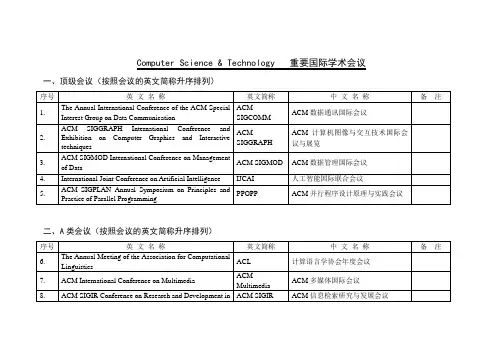
Computer Science & Technology重要国际学术会议一、顶级会议(按照会议的英文简称升序排列)序号英文名称英文简称中文名称备注1.The Annual International Conference of the ACM SpecialInterest Group on Data CommunicationACMSIGCOMMACM数据通讯国际会议2.ACM SIGGRAPH International Conference andExhibition on Computer Graphics and InteractivetechniquesACMSIGGRAPHACM计算机图像与交互技术国际会议与展览3.ACM SIGMOD International Conference on Managementof DataACM SIGMOD ACM数据管理国际会议4.International Joint Conference on Artificial Intelligence IJCAI 人工智能国际联合会议5.ACM SIGPLAN Annual Symposium on Principles andPractice of Parallel ProgrammingPPOPP ACM并行程序设计原理与实践会议二、A类会议(按照会议的英文简称升序排列)序号英文名称英文简称中文名称备注6.The Annual Meeting of the Association for ComputationalLinguisticsACL 计算语言学协会年度会议7.ACM International Conference on Multimedia ACMMultimediaACM多媒体国际会议8.ACM SIGIR Conference on Research and Development in ACM SIGIR ACM信息检索研究与发展会议Information Retrieval9.ACM/EDAC/IEEE Design Automation Conference DAC ACM/EDAC/IEEE设计自动化会议ENIX Conference on File and Storage Technologies FAST USENIX文件与存储技术会议11.International Conference on Computer Vision ICCV 计算机视觉国际会议12.IEEE International Conference on Network Protocols ICNP IEEE网络协议国际会议13.IEEE International Conference on ComputerCommunicationINFOCOM IEEE计算机通信国际会议14.ACM/IEEE International Symposium on ComputerArchitectureISCA ACM/IEEE计算机体系结构国际会议15.ACM SIGKDD Conference on Knowledge Discovery andData MiningKDD ACM知识发现与数据挖掘会议16.The Annual International Conference on MobileComputing and NetworkingMOBICOM ACM移动计算与网络国际会议17.SuperComputing SC 超级计算国际会议18.ACM International Conference on Ubiquitous Computing Ubicomp ACM普适计算国际会议19.International Conference on Very Large Data Bases VLDB 超大数据库国际会议20.International World Wide Web Conference WWW 万维网(WWW)国际会议三、B类会议(按照会议的英文简称升序排列)序号英文名称英文简称中文名称备注21.AAAI Conference on Artificial Intelligence AAAI AAAI人工智能会议22.ACM SIGMETRICS International Conference on ACM ACM计算机系统度量与模型化国际Measurement and Modeling of Computer Systems SIGMETRICS 会议 and South Pacific Design Automation Conference ASPDAC 亚洲和南太平洋地区设计自动化会议24.ACM Conference on Computer and CommunicationsSecurityCCS ACM计算机与通信安全会议puter Graphics International CGI 计算机图像学国际会议26.ACMInternational Conference on Human Factors inComputing SystemsCHI ACM计算机人机交互国际会议27.Conference on Innovative Data Systems Research CIDR 数据库系统创新研究会议28.ACM International Conference on Information andKnowledge ManagementCIKM ACM信息和知识管理国际会议29.International Conference on Computational Linguistics COLING 计算语言学国际会议30.Conference on Computer Supported Cooperative Work CSCW 计算机协同工作会议31.IEEE Conference on Computer Vision and PatternRecognitionCVPR IEEE计算机视觉与模式识别会议32.International Conference on Database Systems forAdvanced ApplicationsDASFAA 数据库系统先进应用的国际会议33.European Conference on Computer Vision ECCV 计算机视觉欧洲会议34.The European Conference on Machine Learning andPrinciples and Practice of Knowledge Discovery inDatabasesECML PKDD机器学习、数据库中知识发现的原理与实践欧洲会议35.International Conference on Extending DatabaseTechnologyEDBT 扩展数据库技术国际会议36.International Conference on the Theory and Applicationsof Cryptographic TechniquesEUROCRYPT 加密技术的理论与应用国际会议37.The Annual Conference of the European Association forComputer GraphicsEurographics 计算机图形学欧洲协会年度会议38.ACM EUROSYS Conference EUROSYS ACM欧洲计算机系统专业协会会议39.IEEE Symposium on Foundations of Computer Science FOCS IEEE计算机科学基础会议40.IEEE International Symposium on High-PerformanceComputer ArchitectureHPCA IEEE高性能计算机体系结构国际会议41.ACM International Symposium on High PerformanceDistributed ComputingHPDC ACM高性能分布式计算国际会议42.IEEE International Conference on Acoustics, Speech, andSignal ProcessingICASSP IEEE声学、语音与信号处理国际会议43.IEEE/ACM International Conference on Computer AidedDesignICCAD IEEE/ACM计算机辅助设计国际会议44.International Conference on Computer Communicationsand Networks ICCCN 计算机通信和网络国际会议45.International Conference on Distributed ComputingSystemsICDCS 分布式计算系统国际会议46.IEEE International Conference on Data Engineering ICDE IEEE数据工程国际会议47.IEEE International Conference on Data Mining ICDM IEEE数据挖掘国际会议48.IEEE International Conference on Multimedia & Expo ICME IEEE多媒体国际会议暨展览会49.International Conference on Machine Learning ICML 机器学习国际会议50.ACM/IEEE International Conference on SoftwareEngineeringICSE ACM/IEEE软件工程国际会议51.IEEE International Conference on Web Services ICWS IEEE Web服务国际会议52.IEEE Symposium on Security and Privacy IEEE S&P IEEE安全与隐私会议53.Internet Measurement Conference IMC 因特网度量会议54.International Workshop on Peer-To-Peer Systems IPTPS P2P系统的国际研讨会55.International Semantic Web Conference ISWC 语义WEB国际会议56.International Workshop on Quality of Service IWQoS 服务质量国际会议57.ACM/IFIP/USENIX International MiddlewareConferenceMiddleware ACM/IFIP/USENIX中间件国际会议58.ACM International Symposium on Mobile Ad HocNetworking and ComputingMobiHocACM移动自组织网络与计算国际会议59.InternationalConference on MobileSystems,Applications,andServicesMobiSys 移动系统、应用与服务国际会议60.The Annual Conferenceon Neural Information ProcessingSystemsNIPS 神经信息处理系统国际会议ENIX Symposium on Networked Systems Design andImplementationNSDI USENIX网络系统设计与实现会议ENIX Symposium on Operating Systems Design andImplementationOSDI USENIX操作系统设计与实现会议63.International Conference on Parallel Architectures andCompilation TechniquesPACT 并行体系结构与编译技术国际会议64.IEEE International Conference on Pervasive Computingand CommunicationsPerCom IEEE普适计算与通讯国际会议65.ThePacific Conference on Computer Graphics andApplicationsPG太平洋地区计算机图像与应用国际会议66.ACM SIGPLAN Conference on Programming Language PLDI ACM编程语言设计与实现会议Design and Implementation67.ACM SIGACT-SIGOPS Symposium on Principles ofDistributed ComputingPODC ACM分布式计算原理会议68.SIAM International Conference on Data Mining SDM SIAM数据挖掘国际会议69.ACM Conference on Embedded Networked SensorSystemsSENSYS ACM嵌入式网络传感器系统会议70.ACM-SIAM Symposium on Discrete Algorithms SODA ACM-SIAM离散算法会议71.ACM Symposium on Operating Systems Principles SOSP ACM操作系统原理会议72.ACM Solid and Physical ModelingSymposium SPM ACM固体和物理模型会议73.ACM Symposium on Theory of Computing STOC ACM计算理论会议74.Conference on Uncertainty in Artificial Intelligence UAI 人工智能中的不确定性会议75.ACM Symposium on User Interface Software andTechnologyUIST ACM用户接口软件与技术会议ENIX Annual Technical Conference USENIX ATC USENIX年度技术会议77.IEEE/WIC/ACM International Conference on WebIntelligenceWI IEEE/WIC/ACM Web智能国际会议78.International Symposium on a World of Wireless, Mobileand Multimedia NetworksWOWMOM 无线、移动和多媒体网络国际会议。
视频会议简介
第1章.视频会议简介1.1视频会议的组成部分:1.1.1视频会议整体构架图:如上图:视频会议组成部分由核心网络构件以及终端部分组成。
1.1.2核心网络构件:多点控制单元MCU。
视频控制服务器VCS以及网络管理套件TMS。
1.1.3终端部分分为:会议室视频终端、桌面终端、软终端以及特殊应用终端。
1.2视频会议方案特点1.2.1高清视频会议(1)、高清晰度性能展现高清( H.264 ,30-60帧/秒,画面上实现 720P 1280×720像素和1080P 1920×1080像素)的分辨率使每个与会者感受到栩栩如生,身临其境的图像效果。
音频采用MPEG-4 AAC-LD,频响范围高达20KHz,支持多标准宽频音频与高分辨率数据会议。
16:9宽屏视频输出,可视面积增加33%,更加符合人眼观赏习惯高清HD标准,主要包括720P(1280×720p),1080i(1920×1080i),1080P(1920×1080P)三种标准。
相比传统意义的标清会议质量,高清HD 720P和1080P大幅度提升标清会议质量,从下图中,可以清晰的看到4:3标清(QCIF/CIF/4CIF)和高清(720P)之间的图像质量差别:(2)、极致高清1080P高清(High Definition)是视频通信业界目前提供的最为领先的视频体验。
高清主要分为两种标准:720P和1080P。
TANDBERG提供业界最为领先的,也是唯一的全套1080P解决方案。
相比720P图像质量(9.5倍CIF质量),1080P图像质量(20倍CIF质量)有了大幅度的提升。
不仅仅是点对点的1080P高清视频体验,TANDBERG提供业界顶尖的1080P 高清视频会议编解码器 C90、C40、C40、C20;以及真正的高清1080P MCU:TANDBERG MSE8000,从而提供用户真正的全套高清1080P解决方案。
国际会议礼仪
一、国际性会议服务礼仪的基本准则国际性会议的服务礼仪是建立在国际会议的基本准则之上的,因此在举办国际会议时,我们的服务礼仪要遵守国际会议通用准则。
1.各国平等在国际事务中,国家不分大小、新老、强弱、种族,国家主权一律平等。
与会各国有维护本国主权尊严的权利,也有尊重别国主权的义务。
各国主权平等的原则主要体现在:(1)礼宾次序。
所谓礼宾次序,是指在国际交往活动中,出席活动的国家、团体、各国认识的位次需要按一定规则和惯例进行排列的先后次序。
礼宾次序体现出东道国对各国宾客所给予的礼遇,它直接涉及主权平等问题,稍有不慎就会引起国际争端,甚至影响国家关系。
因此,在国际会议接待中,无论是举行迎送仪式,还是吃、住的安排,或是会场座次的排放,发言的顺序等,都必须按照国际惯例或者约定俗成的办法操作。
(2)会议发言权。
所有的参会国代表是平等的,因此他们都有平等发言权,在非与会国代表自行提出放弃发言权的情况下,会议主办方不能随意剥夺任何会议成员的发言权。
同时按照国际惯例,公平的安排与会代表的发言次序。
(3)表决权。
表决权是体现各国平等的关键所在。
各与会代表可以通过投票或举手表决等不同形式表达自己的参会愿望和意图,当会议中涉及重大问题时,都应经过全体表决后才能得出结论。
(一些具体、只涉及个别国家的事务除外)2.相互尊重参加国际会议的代表来自不同的国家、种族、民族,有着各自不同的意识形态、宗教信仰和风俗习惯。
本着相互尊重、平等待人的原则进行会议磋商是符合各国代表的利益的。
作为国际会议的主办方要详细了解各国代表的不同需要,会议各个环节的安排也要从各方面照顾到与会代表的生活习惯或宗教信仰,争取做到各方与会代表都高兴而来,满意而归。
3.互惠互利作为国际会议的主办方,其目标就是想通过会议协商,多方和谈这个方式来解决一些国际问题。
当会议涉及具体国家的具体利益时,可能会引起一些国与国之间的争端,国际会议的主办方要及时协调会议进程、调整会议环节、甚至改变会议模式来促进会议的顺利进行,尽可能做到使各方面都满意。
时政热点之重要国际会议考点归纳
时政热点之重要国际会议考点归纳各地考试中,在时政热点模块特别喜欢考察一些重要的国际性会议,一般主要涉及会议的时间、地点、主题、意义以及主要成果等。
但由于会议较多,许多同学往往容易混淆,为此中公教育专门整理了2017-2018年国际国内的重要会议的常考易考点,供各位考生学习。
大家一定要特别重视在2018年在我国举行的四大主场外交活动,尽管11月首届中国国际进口博览会尚未召开,但也不排除出现在时事新闻的考题中。
各种会议,还需要考生了解其该会议的大致背景、英文简称,在考试中特别容易考到该会议的举办地点、主题、会议名称、主要成果和历史意义,需要学员重点把握。
精简版1-国际会议交流英语综合知识概要
21
Visits and Other Social Activities
• Visits to famous places, such as research institutes, universities, museums, or historical spots. • Various social events, such as banquets, parties, excursions, games,etc.
Brief Introduction of Conference
Obtaining Conference Information Keeping up Pre-/Post- conference Correspondence Reading Manuscripts Beginning and Ending the Speech Delivering the Speech Asking and Answering Questions Formality in Conference
19
Parallel Sessions (Simultaneous Sessions)
• smaller-scale meetings held simultaneously. • Important occasions for participants of a particular research group to present their papers. • A special topic is arranged for a particular session.
Meeting Conference Symposium
Congress
会议