
2014年12月英语四级真题下载英语四级真题及答案解析下载(第1套)
2014年12月英语四级真题下载||英语四级真题及答案解析下载(第1套)Part ⅠWriting标准时间30 minutes自测用时 minutesDirections:For this part, you are allowed 30 minutes to write a short essay about a campus activity that has benefited you most. You should write at least 120 words but no more than 180 words.Part ⅡListening Comprehension标准时间30 minutes自测用时 minutesSection ADirections:In this section, you will hear 8 short conversations and 2 long conversations. At the end of each conversation, one or more questions will be asked about what was said. Both the conversation and the questions will be spoken only once. After each question there will be a pause. During the pause, you must read the four choices marked A), B), C)and D), and decide which is the best answer. Then mark the corresponding letter on Answer Sheet 1 with a single line through the centre.因听力试题改革,1-8为旧题型,略。
如有需要,考生可根据前言指引前去下载。
Questions 9 to 11 are based on the conversation you have just heard.9.A)France. B)Scandinavia. C)Russia. D)East Europe.10. A)More women will be promoted in the workplace.B)More women will overcome their inadequacies.C)More women will receive higher education.D)More women will work outside the family.11.A)Try hard to protect women s rights.B)Educate men to respect women more.C)Help women acquire more professional skills.D)Spend more time changing women s attitudes.Questions 12 to 15 are based on the conversation you have just heard.12.A)In a restaurant. B)In a hotel lobby.C)At the man s office. D)At the woman s place.13. A)He is the chief designer of the latest bike model.B)He has completed an overseas market survey.C)He is the Managing Director of Jayal Motors.D)He has just come back from a trip to Africa.14.A)To select the right model. B)To get a good import agent.C)To convince the board members. D)To cut down production costs.15.A)His flexibility. B)His vision.C)His intelligence. D)His determination.Section BDirections:In this section, you will hear 3 short passages. At the end of each passage, you will hear some questions. Both the passage and the questions will be spoken only once. After you hear a question, you must choose the best answer from the four choices marked A), B),C)and D). Then mark the corresponding letter on Answer Sheet 1 with a single line through the centre.Passage OneQuestions 16 to 18 are based on the passage you have just heard.16.A)How being an identical twin influences one s identity.B)Why some identical twins keep their identities secret.C)Why some identical twins were separated from birth.D)How identical twins are born, raised and educated.17. A)Their second wives were named Linda.B)They grew up in different surroundings.C)Their first children were both daughters.D)They both got married when they were 39.18.A)They want to find out the relationship between environment and biology.B)They want to see what characteristics distinguish one from the other.C)They want to understand how twins communicate when far apart.D)They want to know whether twins can feel each other s pain.Passage TwoQuestions 19 to 21 are based on the passage you have just heard.19.A)It is especially attractive to children and the young.B)It is the first choice of vacationers on the Continent.C)It is as comfortable as living in a permanent house.D)It is an inexpensive way of spending a holiday.20.A)It has a solid plastic frame.B)It consists of an inner and an outer tent.C)It is very convenient to set up. D)It is sold to many Continental countries.21. A)A groundsheet.B)A gas stove.C)A kitchen extension. D)A spare tent.Passage ThreeQuestions 22 to 25 are based on the passage you have just heard.22.A)It covers 179 square miles. B)It is as big as New York City.C)It covers 97 square kilometers. D)It is only half the size of Spain.23.A)Its geographic features attracted many visitors.B)Its citizens enjoyed a peaceful, comfortable life.C)It imported food from foreign countries.D)It was cut off from the rest of the world.24.A)The fast development of its neighboring countries.B)The increasing investment by developed countries.C)The building of roads connecting it with neighboring countries.D)The establishing of diplomatic relations with France and Spain.25. A)They work on their farms.B)They work in the tourist industry.C)They raise domestic animals. D)They make traditional handicrafts.Section C因听力试题改革,26-35为旧题型,略。
如有需要,考生可前去“零元课”下载。
Part ⅢReading Comprehension标准时间40 minutes自测用时 minutesSection ADirections:In this section, there is a passage with ten blanks. You are required to select one word for each blank from a list of choices given in a word bank following the passage. Read the passage through carefully before making your choices. Each choice in the bank is identified by a letter. Please mark the corresponding letter for each item on Answer Sheet 2 with a single line through the centre. You may not use any of the words in the bank more than once.Questions 36 to 45 are based on the following passage.For decades, Americans have taken for granted the United States leadership position in the development of new technologies. The innovations(创新)that resulted from research and development during World War II and afterwards were 36 to the prosperity of the nation in the second half of the 20th century. Those innovations, upon which virtually all aspects of 37 society now depend, were possible because the United States then 38 the world in mathematics and science education. Today, however, despite increasing demand for workers with strong skills in mathematics and science, the 39 of degrees awarded in science, math, and engineering are decreasing.The decline in degree production in what are called the STEM disciplines (science, technology, engineering, and math)seems to be 40 related to the comparatively weak performance by U.S. schoolchildren on international assessments of math and science. Many students entering college have weak skills in mathematics. According to the 2005 report of the Business Higher Education Forum, 22 percent of college freshmen must take remedial(补习的)math 41, and less than half of the students who plan to major in science or engineering 42 complete a major in those fields.The result has been a decrease in the number of American college graduates who have the skills,43 in mathematics, to power a workforce that can keep the country at the forefront(前沿) of innovation and maintain its standard of living. With the 44 performance of American students in math and science has come increased competition from students from other countries that have strongly supported education in these areas. Many more students earn 45 in the STEM disciplines in developing countries than in the United States.A)accelerating E)coursesI)especiallyM)proceduresB)actually F)criticalJ)future N)proportionsC)closelyG)declining K)led O)spheresD)contemporaryH)degreesL)metSection BDirections:In this section,you are going to read a passage with ten statements attached to it. Each statement contains information given in one of the paragraphs. Identify the paragraph from which the information is derived. You may choose a paragraph more than once. Each paragraph is marked with a letter. Answer the questions by marking the corresponding letter on Answer Sheet 2.Ban sugary drinks—that will add fuel to the obesity war[A]On a train last Thursday, I sat opposite a man who was so fat he filled more than one seat. He was pale and disfigured and looked sick to death, which he probably was: obesity(肥胖的) leads to many nasty ways of dying. Looking around the carriage, I saw quite a few people like him, including a couple of fatty children with swollen cheeks pressing against their eyes. These people are part of what is without exaggeration an epidemic(流行病) of obesity.[B]But it is quite unnecessary: there is a simple idea—far from new—that could spare millions of such people a lifetime of chronic(长期的) ill health, and at the same time save the National Health Service(NHS) at least £14 billion a year in England and Wales. There would, you might think, be considerable public interestin it. This simple idea is that sugar is as good—or as bad—as poison and should be avoided. It is pure, white and deadly, as Professor John Yudkin described it 40 years ago in a revolutionary book of that name. The subtitle was How Sugar Is Killing Us.[C]In its countless hidden forms, in ready meals, junk food and sweet drinks, sugar leads to addiction(瘾), to hormonal upsets to the appetite, to metabolic(新陈代谢的) malfunctions and obesity and from there to type 2 diabetes(糖尿病)and its many horrible complications. If people really grasped that, they would try to kick the habit, particularly as Britain is the “fat man of Europe”. They might even feel driven to support government measures to prevent people from consuming this deadly stuff. Yet so far this idea has met little but resistance.[D]It is not difficult to imagine the vested interests(既得利益集团)lined up against any sugar control—all the food and drink manufacturers, processors, promoters and retailers who make such easy pickings out of the magic powers of sugar. Then there are the liberals, with whom I would normally side, who protest that government regulation would be yet another instance of interference in our lives.[E]That is true, but people should realize that you cannot have a welfare state without a nanny state(保姆国家), to some degree. If we are all to be responsible for one another s health insurance, through socialized medicine, then we are all closely involved in one another s health, including everyone s eating and drinking. That has already been admitted, finally, with smoking. But it has yet to be admitted with overeating, even though one in four adults in this country is obese and that number is predicted to double by the year 2050. Quite apart from anything else, obesity will cripple the NHS.[F]Recently, though, there have been signs that the medical establishment is trying to sound the alarm. Last month the Academy of Medical Royal Colleges (AMRC) published a report saying that obesity is the greatest public health issue affecting the UK and urging government to do something.[G]The report offers 10 recommendations, of which the first is imposing a tax of 20 percent on sugary drinks for at least a year, on top of the existing 20 percent value added tax. That at least would be an excellent start. The amounts of sugar in soft drinks are horrifying, and turn straight to fat. As Professor Terence Stephenson, head of the AMRC, has said, sugary soft drinks are“the ultimate bad food. You are just consuming neat sugar. Your body didn t evolve to handle this kind of thing.”[H]Precisely. The risks of eating too much fat or salt (which are very different) pale into insignificance compared with the harm done by sugar. And it is everywhere. [I]It is difficult to buy anything in a supermarket, other than plain, unprepared meat, fish or vegetables, that doesn t have a large amount of sugar in it. This has come about because the prevailing scientific views of the 1960s and 1970s ignored the evidence about sugar, and instead saw fat as the really serious risk, both to the heart and other organs, as well as the cause of obesity.[J]The fashion was to avoid fat. But finding that food with much of its fat removed is not very appetizing, food producers turned to sugar as a magic alternative flavor enhancer, often in the forms of syrups(糖浆) that had recently been developed from corn, and put it generously into most prepared foods and soft drinks.[K]This stuff is not just fattening. It is addictive. It interferes with the body s metabolism, possibly via the activity of an appetite controlling hormone. There s plenty of evidence for this, for those who will accept the truth. [L]Theoretically, people ought to make“healthy choices”and avoid overeating. But sugar additives are not easy to identify and are hard to avoid. So the snacking, over drinking and over eating that makes people fat is not really their own fault: obesity is in large part something that is being done to them. It should be stopped, or rather the government should stop it.[M]Going round my local supermarket, I am constantly astonished that it is still legal to sell all the poisons stacked high on the shelves. The problem is that they are worse than useless. They are poisonous. They are known to be addictive. Theyare known to make people obese. And giving small children sweet drinks or bottles of fake juice all day long is nothing less than child abuse.[N]Clearly, the sale of such stuff ought to be illegal. I hate to think of yet more government regulation. But a bit of tax on sweet soda and a little more health education, a bit of cooking in schools and banning vending machines (自动售货机) here and there—as suggested by the AMRC report—is not going to achieve very much. Labelling is quite inadequate. What is needed is legislation banning high levels of sugary syrups used in foods and drinks.[O]In June 2012, the then minister for public health said the government was not scared of the food industry and had not ruled out legislation, because of the costs of obesity to the NHS. However, nothing has happened yet. Why not have another Jammie Dodger biscuit and forget about it.46.Avoiding over consumption of sugar can improve people s health as well as save medical expenses.ws should be passed to make it illegal to produce overly sweet foods or drinks.48.Giving small children sweet juices to drink all the time is equal to child abuse.49.Looking around, the author found obesity quite widespread.50.The number of obese people is expected to increase quickly in the next few decades.51.If people really understood the horrible consequences of sugary foods and drinks, they would support government measures against sugar consumption.52.It would be a very good beginning to impose an additional tax on sugary drinks.53.The government has not yet taken any action to regulate sugar consumption although it indicated its intention to do so some time ago.54.Sugar is far more harmful to health than fat and salt.55.Consumers of sweet foods are not really to blame because they cannot tell what food is sugary.Section CDirections:There are 2 passages in this section. Each passage is followed by some questions or unfinished statements. For each of them there are four choices marked A), B), C) and D). You should decide on the best choice and mark the corresponding letter on Answer Sheet 2 with a single line through the centre.Passage OneQuestions 56 to 60 are based on thefollowing passage.The rise of the Internet has been one of the most transformative developments in human history, comparable in impact to the invention of the printing press and the telegraph. Over two billion people worldwide now have access to vastly more information than ever before, and can communicate with each other instantly, often using Web connected mobile devices they carry everywhere. But the Internet s tremendous impact has only just begun.“Mass adoption of the Internet is driving one of the most exciting social, cultural, and political transformations in history, and unlike earlier periods of change, this time the effects are fully global,” Schmidt and Cohen write in their new book, The New Digital Age.Perhaps the most profound changes will come when the five billion people worldwide who currently lack Internet access get online. The authors do an excellent job of examining the implications of the Internet revolution for individuals, governments, and institutions like the news media. But if the book has one major shortcoming, it s that authors don t spend enough time applying a critical eye to the role of Internet businesses in these sweeping changes.In their book, the authors provide the most authoritative volume to date that describes—and more importantly predicts—how the Internet will shape our lives in the coming decades.They paint a picture of a world in which individuals, companies, institutions, and governments must deal with two realities, one physical, and one virtual.At the core of the book is the idea that “technology is neutral, but people arent.” By using this concept as a starting point, the authors aim to move beyond the now familiar optimist vs. pessimist dichotomy(对立观点) that has characterized many recent debates about whether the rise of the Internet will ultimately be good or bad for society. In an interview with TIME earlier this week, Cohen said although he and his co author are optimistic about many aspects of the Internet, they re also realistic about the risks and dangers that lie ahead when the next five billion people come online, particularly with respect to personal privacy and state surveillance(监视).56.In what way is the rise of the Internet similar to the invention of the printing press and the telegraph?A)It transforms human history.B)It is adopted by all humanity.C)It facilitates daily communication.D)It revolutionizes people s thinking.57.How do Schmidt and Cohen describe the effects of the Internet?A)They are immeasurable.B)They are unpredictable.C)They are worldwide.D)They are contaminating.58.In what respect is the book The New Digital Age considered inadequate?A)It fails to recognize the impact of the Internet technology.B)It fails to look into the social implications of the Internet.C)It lacks an objective evaluation of the role of Internet businesses.D)It does not address the technical aspects of Internet communication.59.What will the future be like when everybody gets online?A)People will be living in two different realities.B)People will have equal access to information.C)People don t have to travel to see the world.D)People don t have to communicate face to face.60. What does the passage say about the authors of The New Digital Age?A)They leave many questions unanswered concerning the Internet.B)They are optimistic about the future of the Internet revolution.C)They have explored the unknown territories of the virtual world.D)They don t take sides in analyzing the effects of the Internet.Passage TwoQuestions 61 to 65 are based on the following passage.In 1950, a young man would have found it much easier than it is today to get and keep a job in the auto industry. And in that year the average autoworker could meet monthly mortgage (抵押贷款)payments on an average home with just 13.4 percent of his take home pay. Today a similar mortgage would claim more than twice that share of his monthly earnings.Other members of the autoworker s family, however, might be less inclined to trade the present for the past. His retired parents would certainly have had less economic security back then. Throughout much of the 1960s, more than a quarter of men and women age 65 and older lived below the poverty level, compared to less than 10 percent in 2010.In most states, his wife could not have taken out a loan or a credit card in her own name. In 42 states, a homemaker had no legal claim on the earnings of her husband. And nowhere did a wife have legal protection against family violence.Most black workers would not want to return to a time when, on average, they earned 40 percent less than their white counterparts (职位相当的人),while racially restrictive agreements largely prevented them from buying into the suburban neighborhoods being built for white working class families.Today, new problems have emerged in the process of resolving old ones, but the solution is not to go back to the past. Some people may long for an era when divorce was still hard to come by. The spread of no fault divorce has reduced the bargaining power of whichever spouse is more interested in continuing the relationship. And the breakup of such marriages has caused pain for many families.The growing diversity of family life comes with new possibilities as well as new challenges. According to a recent poll, more than 80 percent of Americans believe that their current family is as close as the one in which they grew up, or closer.Finding ways to improve the lives of the remaining 20 percent seems more realistic than trying to restore an imaginary golden age.61.What do we learn about American autoworkers in 1950?A)They had less job security than they do today.B)It was not too difficult for them to buy a house.C)Their earnings were worth twice as much as today.D)They were better off than workers in other industries.62.What does the author say about retired people today?A)They invariably long to return to the golden past.B)They do not depend so much on social welfare.C)They feel more secure economically than in the past.D)They are usually unwilling to live with their children.63.Why couldn t black workers buy a house in a white suburban neighborhood?A)They lacked the means of transportation.B)They were subjected to racial inequality.C)They were afraid to break the law.D)They were too poor to afford it.64. What is the result of no fault divorce?A)Divorce is easier to obtain.B)Domestic violence is lessened.C)It causes little pain to either side.D)It contributes to social unrest.65.What does the author suggest society do?A)Get prepared to face any new challenges.B)Try to better the current social security net.C)Narrow the gap between blacks and whites.D)Improve the lives of families with problems.Part ⅣTranslation标准时间30 minutes自测用时 minutesDirections:For this part, you are allowed 30 minutes to translate a passage from Chinese into English. You should write your answer on Answer Sheet 2.大熊猫(giant panda)是一种温顺的动物,长着独特的黑白皮毛。
2014年12月英语四级答案及解析第1套
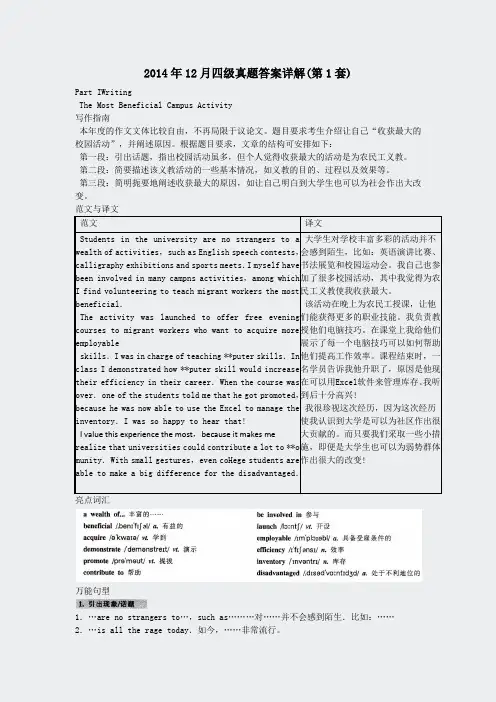
2014年12月四级真题答案详解(第1套)Part IWritingThe Most Beneficial Campus Activity写作指南本年度的作文文体比较自由,不再局限于议论文。
题目要求考生介绍让自己“收获最大的校园活动”,并阐述原因。
根据题目要求,文章的结构可安排如下:第一段:引出话题,指出校园活动虽多,但个人觉得收获最大的活动是为农民工义教。
第二段:简要描述该义教活动的一些基本情况,如义教的目的、过程以及效果等。
第三段:简明扼要地阐述收获最大的原因,如让自己明白到大学生也可以为社会作出大改变。
范文与译文范文译文Students in the university are no strangers to awealth of activities,such as English speech contests,calligraphy exhibitions and sports meets.I myself havebeen involved in many campns activities,among whichI find volunteering to teach migrant workers the mostbeneficial.The activity was launched to offer free eveningcourses to migrant workers who want to acquire moreemployableskills.I was in charge of teaching **puter skills.Inclass I demonstrated how **puter skill would increasetheir efficiency in their career.When the course wasover.one of the students told me that he got promoted,because he was now able to use the Excel to manage theinventory.I was so happy to hear that!I value this experience the most,because it makes merealize that universities could contribute a lot to **omunity.With small gestures,even coHege students areable to make a big difference for the disadvantaged.大学生对学校丰富多彩的活动并不会感到陌生,比如:英语演讲比赛、书法展览和校园运动会。
2014年12月英语四级考试真题(第1套)

2014年12月四级真题(第1套)注意:此部分试题请在答题卡1上作答。
Section BDirections: In this section, you are going to read a passage with ten statements attached to it. Eachstatement contains information given in one of the paragraphs. Identify the paragraph fromwhich the information is derived. You may choose a paragraph more than once. Eachparagraph is marked with a letter. Answer the questions by marking the correspondingletter on Answer Sheet 2.Ban sugary drinks--that will add fuel to the obesity war[A] On a train last Thursday, I sat opposite a man who was so fat he filled more than one seat. Hewas pale and disfigured and looked sick to death, which he probably was: obesity (肥胖症) leads tomany nasty ways of dying. Looking around the carriage, I saw quite a few people like him, includinga couple of fatty children with swollen cheeks pressing against their eyes. These people are part ofwhat is without exaggeration an epidemic (流行病) of obesity.[B] But it is quite unnecessary: there is a simple idea--far from new--that could spare millions of suchpeople a lifetime of chronic (长期病 ) ill health, and at the same time save the National HealthService (NHS) at least £14 billion a year in England and Wales. There would, you might think, beconsiderable public interest in it. This simple idea is that sugar is as good--or as bad--as poisonand should be avoided. It is pure, white and deadly, as Professor John Yudkin described it 40 yearsago in a revolutionary book of that name. The subtitle was How Sugar Is Killing Us.[C] In its countless hidden forms, in ready meals, junk food and sweet drinks, sugar leads to addiction(瘾), to hormonal upsets to the appetite, to metabolic (新陈代谢的) maffunctions and obesity andfrom there to type 2 d/abetes (糖尿病) and its many horrible complications, ff people really graspedthat, they would try to kick the habit, particularly as Britain is the "fat man of Europe". They mighteven feel driven to support government measures to prevent people from consuming this deadlystuff. Yet so far this idea has met little but resistance.[D] It is not difficult to imagine the vested interests (既得利益集团) lined up against any sugar control--all the food and drink manufacturers, processors, promoters and retailers who make such easypickings out of the magic powers of sugar. Then there are the liberals, with whom I would normallyside, who protest that government regulation would be yet another instance of interference in ourlives.[E] That is true, but people should realise that you cannot have a welfare state without a nanny state(保姆国家), to some degree. If we are all to be responsible for one another's health insurance,through socialised medicine, then' we are all closely involved in one another's health, includingeveryone's eating and drinking. That has already been admitted, finally, with smoking. But it has yetto be admittedwith overeating, even though one in four adults in this country is obese and thatnumber is predicted to double by the year 2050. Quite apart from anything else, obesity will cripplethe NHS.[F] Recently, though, there have been signs that the medical establishment is trying to sound the st month the Academy of Medical Royal Colleges (AMRC.published a report saying that obesity isthe greatest public health issue affecting the UK and urging government to do something.[G] The report offers 10 recommendations, of which the first is imposing a tax of20 percent on sugarydrinks for at least a year, on top of the existing 20 percent value-added tax. That at least would be'an excellent start. The amounts of sugar in soft drinks are horrifying, and turn straight to fat. AsProfessor Terence Stephenson, head of the AMRC, has said, sugary soft drinks are "the ultimate badfood. You are just consuming neat sugar. Your body didn't evolve to handle this kind of thing."[H] Precisely. The risks of eating too much fat or salt(which are very different) pale into insignificancecompared with the harm done by sugar. And it is everywhere.[I ] It is difficult to buy anything in a supermarket, other than plain, unprepared meat, fish or vegetables,that doesn't have a large amount of sugar in it. This has come about because the prevailingscientific views of the 1960s and 1970s ignored the evidence about sugar, and instead saw fat as thereally serious risk, both to the heart and other organs, as well as the cause of obesity.[J] The fashion was to avoid fat. But finding that food with much of its fat removed is not veryappetising, food producers turned to sugar as a magic alternative flavour enhancer, often in theforms of syrups (糖浆) that had recently been developed from corn, and put it generously into mostprepared foods and soft drinks.[K] This stuff is not just fattening. It is addictive. It interferes with the body's metabolism, possibly viathe activity of an appetite-controlling hormone. There's plenty of evidence for this, for those who willaccept the troth.[L] Theoretically, people ought to make"healthy choices" and avoid overeating. But sugar additives arenot easy to identify and are hard to avoid. So the snacking, over-drinldng and over-eating that makespeople fat is not really their own fault: obesity is in large part something that is being done tothem. It should be stopped, or rather the government should stop it.[M] Going round my local supermarket, I am constantly astonished that it is still legal to sell all thepoisons stacked high on the shelves. The problem is that they are worse than useless. They arepoisonous. They are known to be addictive. They are known to make people obese. And giving smallchildren sweet drinks or bottles of fake juice all day long is nothing less than child abuse.[N] Clearly, the sale of such stuff ought to be illegal. I hate to think of yet more government regulation,But a bit of tax on sweet soda and a little more health education, a bit of cooking in schools andbanning vending machines (自动售货机) here and there--as suggested by the AMRC report--is notgoing to achieve very much. Labelling is quite inadequate. What is needed is legislation banning highlevels of sugary syrups used in foods and drinks.[O] In June 2012, the then minister for public health said the government was not scared of the foodindustry and had not ruled out legislation, because of the costs of obesity to the NHS. However,nothing has happened yet. Why not have another Jammie Dodger biscuit and forget about it.注意:此部分试题请在答题卡2上作答。
2014年12月四级真题(第一套)
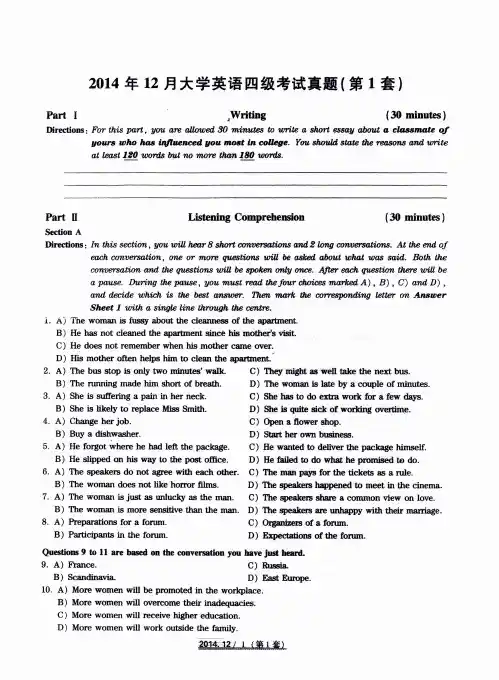
2014年12月大学英语四级考试真题(第1套)Part I ^Writing (30 minutes) Directions :For this part, you are allowed 30 minutes to write a short essay about a classmate o f yours who has influenced you most in coliege. You should state the reasons and writeat least 120 words but no more than 180words.Part n Listening Comprehension (30 minutes) Section ADirections :In this section,you will hear 8 short conversations and 2 long conversations. At the end of each conversation, one or more questions will b e asked about what was said. Both theconversation and the questions w ill b e spoken only once. After each question there wiU bea pause. During the pause, you must read the four choices marked A),B),C) and D),and decide which is the best answer. Then mark the corresponding letter on AnswerSheet 1 with a single line through the centre.L A) The woman is fussy about the cleanness of the apartmentB) He has not cleaned the apartment since his mother’s visit.C) He does not remember when his mother came over.D) His mother often helps him to clean the apartment.2. A) The bus stop is only two minutes,walk. C) They might as well take the next bus.B) The running made him short of breath.3. A) She is suffering a pain in her neck.B) She is likely to replace Miss Smith.4. A) Change her job.B) Buy a dishwasher.5. A) He forgot where he had left the package.B) He slipped on his way to the post office.6. A) The speakers do not agree with each other.D) The woman is late by a coiqple of minutes.C) She has to do extra work for a few days.D) She is quite sick of working overtime.C) Open a flower shop.D) Start her own business.C) He wanted to deliver the package himself.D) He failed to do what he promised to do. C) The man pays for the tickets as a rule.B) The woman does not like horror films. D) The speakers happened to meet in the cinema.7. A) The woman is just as unlucky as the man. C) The speakers share a common view on love.B) The woman is more sensitive than the man. D) The speakers are unhappy with their marriage.8. A) Preparations for a forum. C) Organizers of a forum.B) Participants in the forum. D) Expectations of the forum.Questions 9 to 11 are based on the conversation you have just heard.9. A) France. C) Russia.B) Scandinavia. D) East Europe.10. A) More women will be promoted in the workplace.B) More women will overcome their inadequacies.C)More women will receive higher education.D) More women will work outside the family.厂L (奠丄 _)11. A) T ry hard to protect women’s rights.B) Educate men to reject women more.C) Help women acquire more professional skills.D) Spend more time changing women's attitudes.Questions 12 to 15 are based on the conversation ymi have just heard.12. A) In a restaurant. C) At the man’s office.B) In a hotel lobby. D) At the woman’s place.13. A) He is the chief designer of the latest bike model.B) He has completed an overseas market survey.C) He is the Managing Director of Jayal Motors.D) He has just come back from a trip to Africa.14. A) To select the right model. C) To convince the board members.B) To get a good import agent. D) To cut down production costs.15. A) His flexibility. C) His intelligence.B) His vision. D) His determination.Section BDirections:In this section, you wiM hear 3 short passages. At the end of each passage, you will hear some questions. Both the passage and the questions will b e spoken only once. After youhear a question, you must choose the best answer from the four choices marked A),B) ?C) and D). Then mark the corresponding letter on Answer Sheet 1with a single linethrough the centre.Passage One 1Questions 16 to 18 are based on the passage you have just heard.16. A) How being an identical twin influences one’s identity.B) Why some identical twins keep their identities secret.C) Why some identical twins were separated from birth.D) How identical twins are bom, raised and educated.17. A) Their second wives were named Linda. C) Their first children w ere both d aughters.B) They grew up in different s urroundings. D) They both got married w hen t hey were 39.18. A) They want to find out the relationship between environment and biology.B) They want to see what characteristics distinguish one from the other.C) They want to understand how twins communicate when far apart.D) They want to know whether twins can feel each other’s pain.Passage T w oQuestions 19 to 21 are based on the passage you have just heard.19. A) It is especially attractive to children and the young.B) It is the first choice of vacationers on the Continent.C) It is as comfortable as living in a permanent house.D) It is an inexpensive way of spending a holiday.20. A) It h as a solid plastic frame. C) It is very convenient to set up.B) It consists of an inner and an outer tent. D) It is sold to many Continental countries.21. A) A g roundsheet. C) A kitchen extension.B) A gas stove. D) A spare tent.2014. 12/ 2(第1套)Passage ThreeQuestions 22 to 25 are based on the passage you have just heard.22. A) It covers 179 square miles. C) It covers 97 square kilometers.B) It is as big as New York City. D) It is only half the size of Spain.23. A) Its geographic features attracted m any ^visitors.B) Its citizens enjoyed a peaceful, comfortable life.C) It imported food firom foreign countries.D) It was cut off from the rest of the world.24. A) The fast development of its neighboring countries.B) The increasing investment by developed countries.€) The building of roads connecting it with neighboring countries.D) The establishing of diplomatic relations with France and Spain.25. A) They work on their farms. C) They raise domestic animals.B) They work in the tourist industry. D) Tliey make traditional handicrafts.Section CDirections :In this section,you will hear a passage three times. When the passage is read for the first time, you shovM listen carefully for its general idea. When the passage is read for thesecond time, you are required to fiU in the blanks with, the exact words you have justheard. Finally,when the passage is read for the third time, you should check what youhave written.“Don’t take many English courses;they won’t help you get a decent jo b.” “Sign up for management classes, so you’ll be ready to join the family business when you graduate. ”Sound 26? Many of us have heard suggestions like these 27 by parents or others close to us. Such comments often seem quite reasonable.Why, then, should suggestions like these be taken with 28?The reason is they relate to decisions you should make. You are the one who must 29tiieir consequences.One of the worst reasons to follow a particular path in life is that other people want you to. Decisions that affect your life should be your decisions—decisions you make alter you,ve considered various 30 and chosen the path that suits you best.Making your own decisions does not mean that you should 31the suggestions of others. For instance,your parents do have their own unique experiences that may make their advice helpful,and having 32in a great deal of your personal history, they may have a clear view of your strengths and weaknesses. Still, their views are not necessarily accurate. They may still see you as a child, 33 care and protection. Or they may see only your strengths. Or, in some unfortunate cases, they may 34 your flaws and shortcomings.People will always be giving you advice. Ultimately, though, you have to make your own 35•Part M Section A Directions •Reading Comprehension (40 minutes)Jn this section, there is a passage with ten blanks. You are required to select one word for e c tc h blank from a list of choices given in a word bank following the passage. Read the passage through carefully before making your choices. Each choice in the bank is identified by a letter. Please mark the corresponding letter f or each item on Answer Sheet 2 with a single line through the centre. You may not use any of the words in the bank more than once.Questions 36 to 45 are based on the foUowi吨 passage.One principle of taxation, called the benefits principle, states that people should pay taxes based on the benefits they receive from government services. This principle tries to make public goods similar to 36 goods. It seems reasonable that a person who often goes to the movies pays more in 37 for movie tickets than a person who rarefy goes. And 38 , a person who gets great benefit from a public good should pay more for it than a person who gets little benefit.The gasoline tax, for instance, is sometimes 39 using the benefits principle. In some states,40 from the gasoline tax are used to build and maintain roads. Because those who buy gasoline are the same people who use the roads, the gasoline tax might be viewed as a 41way to pay for this government service.The benefits principle can also be used to argue that wealthy citizens should pay higher taxes than poorer ones, 42 because the wealthy benefit more from public services. Consider, for example, the benefits of police protection from 43 •Citizens with much to protect get greater benefit from police than those with less to protect. Therefore,according to the benefits principle, the wealthy should 44 more than the poor to the cost of 45 the police force. The same argument can be used for many other public services, such as fire protection, national defense, and the court system.A) adapt I) providedB) contribute J) revenuesC) exerting K) similarlyD) expenses L) simplyE) fair M) theftF) justified N) totalG) maintaining0) wealthH) private:....ISection BDirections :In this section,you are going to read a passage with ten statements attached to it. Each statement contains information given in one of the paragraphs. Identify the paragraphfrom which the information is derived. You may choose a paragraph more than once.Each paragraph is marked with a letter. Answer the questions by marking thecorresponding letter on Answer Sheet 2.Growing Up ColoredA) You wouldn’t know Piedmont anymore—my Piedmont, I mean—the town in West Virginia where Ilearned to be a colored boy.B) The 1950s in Piedmont was a time to remember, or at least to me. People were always proud to befrom Piedmont—lying at the foot of a mountain, on the banks of the mighty Potomac. We knew God gave America no more beautiful location. I never knew colored people anywhere who were crazier about mountains and water, flowers and trees, fishing and hunting. For as long as anyone could remember, we could outhunt, outshoot, and outswim the white boys in the valley.C) The social structure of Piedmont was something we knew like the back of our hands. It was animmigrant town; white Piedmont was Italian and Irish, with a handful of wealthy W A SPs(盡格鲁撒 克逊裔的白人新教徒)on East Hampshire Street, and “ethnic”neighborhoods of working-class people everywhere else, colored and white.D) For as long as anyone can remember, Piedmont’s character has been completely bound up with theWestvaco paper m ill:its prosperous past and doubtM future. At first glance, the town is a typical-2014,12/ 4dyjng mill center. Many once beautiful buildings stand empty, evidencing a bygone time of spirit and pride. The big houses on East Hampshire Street are no longer proud, as they were when I wasa kid.E) Like the Italians and the Irish, most of the colored people migrated to Piedmont at the turn of the20th century to work at the paper m ill, wl^ch opened in 1888. All the colored men at the paper mill worked on “the platformM—loading paper into trucks until the craft unions were finally integrated m 1968. Loading is what Daddy did every working day of his life. Hiafs what almost eveiy colored grown-up I knew did.F) Colored people lived in three neighborhoods that were clearly separated. Welcome to the ColoredZone, a large stretched banner could have said. And it felt good in there, like walking around your house in bare feet and underwear, or snoring(打軒)right out loud on the couch in front of the T V—enveloped by the comforts of home, the warmth of those you love.G) Of course, the colored world was not so much a neighborhood as a condition of existence. Andthough our own world was seemingly self-contained, it impacted on the white world of Piedmont in almost eveiy direction. Certainly, the borders of our world seemed to be impacted on when some white man or woman showed up where he or she did not belong, such as at the black Legion Hall.Our space was violated when one of them showed up at a dance or a party. The rhythms would be off. The music would sound not quite right. Everybody would leave early.H) Before 1955,most white people were just shadowy presences in our world, vague figures of powerlike remote bosses at the mill or clerks at the bank. There were exceptions, of course, the white people who would come into our world in routine, everyday ways we all understood. Mr. Mail Man, Mr. Insurance Man, Mr. White-and-Qiocolate Milk Man, Mr. Landlord Man, Mr. Police Man:we called white people by their trade, like characters in a mysteiy play. Mr. Insurance Man would come by every other week to collect payments on college or death policies, sometimes 50 cents or less.I) “It,s no disgrace to be colored,” Hie black entertainer Bert Williams famously observed early in thecentury,“but it is awfully inconvenient ”For most of my childhood, we couldn’t eat in restaurants or sleep in hotels ? we couldn’t use certain bathrooms or ta y on clothes in stores. Mama insisted that we dress up when we went to shop. She was carefully dressed when she went to clothing stores ?and wore white pads called shields under her arms so her dress or blouse would show no sweat.“We’d like to tiy this on,,’ she’d say carefully, uttering her words precisely and properly. “We don7t buy clothes we can’t try on,”she,d say when they declined, and we’d walk out in Mama’s dignified (有尊严的)manner. She preferred to shop where we had an account and where everyone knew who she was.J) At the Cut-Rate Drug Store,no one colored was allowed to sit down at the counter or tables, with one exception:my father. I don’t know for certain why Carl Dadisman, the owner, wouldn’t stop Daddy from sitting down. But I believe it was in part because Daddy was so light-colored, and in part because, during his shift at the phone company, he picked up orders for food and coffee for the operators. Colored people were supposed to stand at the counter, get their food to go, and leave. Even when Young Doc Bess would set up the basketball team with free Cokes after one of many victories,the colored players had to stand around and drink out of p a q p e r cups while the white players and cheerleaders sat down in comfortable chairs and drank out of glasses.K) I couldn’t have been much older than five or as I sat with my father at the Cut-Rate one afternoon, e i\jo y in g ice cream. Mr. Wilson, a stony-faced Irishman, walked by. “Hello, Mr.Wilson,”my father said.“Hello, Geoi^e. ’’L) I was genuinely puzzled. Mr. Wilson must have confused my father with somebody else, but who?There weren’t any Georges among the colored people in Piedmont. “Why don’t you teli him your name, Daddy?”I asked loudly. “Your name isn't George. ”“He knows my name, boy,”my father said after a long pause. “He calls all colored people George. ”‘M) I knew we wouldn’t talk about it again; even at that age, I was given to understand that there were some subjects it didn’t do to worry to death about. Now that I have children, I realize that what distressed my father wasn’t so much the Mr. Wilsons of the world as the painful obligation to explain the racial facts of life to someone who hadn’t quite learned them yet. Maybe Mr. Wilson couldn’t hurt my father by calling him George;but I hurt him by asking to know why.46. The author felt as a boy that his life in a separated neighborhood was casual and cozy.47. There is every sign of decline at the paper mill now.48. One reason the author’s father could sit and eat at the drug store was that he didn’t look that dark.49. Piedmont was a town of immigrants from different parts of the world.50. In spite of the awful inconveniences caused by racial prejudice, the author's family managed to livea life of dignity.51. The author later realized he had caused great distress to his father by asking why he was wronglyaddressed.52. The author took pride in being from Piedmont because of its natural beauty.53. Colored people caiied white people by the business they did.54. Colored people who lived in Piedmont did heavy manual jobs a t the paper mill.55. The colored people felt uneasy at the presence of the whites in their neighborhoods.Section CDirections :There are 2 passages in this section. Each passage is followed by some questions o r i unfinished statements. For each of them there are four choices marked A), B), C) ancD). You should decide on the best choice and mark the corresponding letter on AnsweiSheet 2 with a single line through the centre.Passage OneQuestions 56 to 60 are based on the following passage.Children are a delight. They are our future. But sadly, hiring someone to take care of them w hil< you go to work is getting more e3q)ensive by the year.Earlier this month, it was reported that the cost of enrolling an infant or small kid at a childcare center rose 3%in 2012, faster than the overall cost of living. There are now large strips of the countr where daycare for an infant costs more than a tentii of the average married couplers income.This is not necessarily a new trend, but it is a somewhat puzzling one. The price of professions childcare has been rising since the 1980s. Yet during that time, pay for professional childcare worker has stood still. Actually caregivers make less today, in real terms, than they did in 1990. Considerini that labor costs are responsible for up to 80% of a daycare center’s expenses,one would expect fla wages to have meant flat prices.So who’s to blame for higher childcare costs?Childcare is a carefully regulated industry. States lay down rules about how many children e a c] employee is allowed to watch over, the space care centers need per child, and other minute details And the stricter the regulations,the higher the costs. If it has to hire a caregiver for every t w< children,it can’t really achieve any economies of scale on labor to save money when other expenses g<? e q p e n s e s .Massachusetup. In Massachusetts,where childcare centers must hire one teacher for every t hree infants, the price of care averaged more than $ 16,000 per year. In Mississippi, where centers m ust h ire one teacher for every five infants, the price of care averaged less than $ 5,000.Unfortunately, I don’t have all the daycare-center regulations handy. But I wouldn't be surprised if as the rules have become more elaborate, prices have risen. The tradeoff (交换)might be worth it in some cases ; after all, the health and safety of children should probably come before cheap service. But certainly , it doesn’t seem to be an accident that some of liie cheapest daycare available is in the least regulated South.56. What problem do parents of small kids have to face?A) The ever-rising childcare prices. C) The balance between work and family.B) The budgeting of family expenses. D) The selection of a good daycare center.57. What does the author feel puzzled about?A) Why the prices of childcare vary greatly from state to state.B) Why increased childcare prices have not led to better service.C) Why childcare workers, pay has not increased with the rising childcare costs.D) Why there is a severe shortage of childcare professionals in a number of states.58. What prevents childcare centers from saving money?A) Steady increase in labor costs. C) Lack of support from the state.B) Strict government regulations. D) High administrative e ^q p e 59. Why is the average cost of childcare in Mississippi much lower than in A) The overall quality of service is not as good.B) Payments for caregivers there are not as high.C) Living expenses there are comparatively low.D) Each teacher is allowed to care for more kids.60. What is the author’s view on daycare service?A) Caregivers should receive regular professional training.B) Less elaborate rules about childcare might lower costs.C) It is crucial to strike a balance between quality and costs.D) It is better for different states to leam from each other.P assage T w oQuestions 61 to 65 are based on the following passage.Alex Pang’s amusing new book T h e Distraction Addiction addresses those of us who feel panic without a cellphone or computer. And that, he claims, is pretty much all of us. When we're not online, where we spend four months annually, we’re engaged in the stressful work of trying to get online.T h e Distraction Addiction is not framed as a self-help book. It’s a thoughtful examination of the dangers of our computing overdose and a historical overview of how technological advances change consciousness. A w professional futurist,Pang urges an approach which he calls “contemplative (沉思 的)confuting. ” He asks that you pay full attention to “ how your mind and body interact with computers and how your attention and creativity are influenced by technology. ”Pang’s first job is to free you from the common misconception that doing two things at once allows you to get more done. What is commonly called multitasking is, in fact, switch-tasking, and its harmM effects on productivity are well documented. Pang doesn’t advocate returning to a pre-Internet world. Instead,he asks you to “ take a more ecological (生态的)view of your relationships with technologies and look for ways devices or media may be making specific tasks easier or faster but at the same time making your work and life harder. ”T h e Distraction Addiction is particularly fascinating on how technologies have changed certainfields of labor 一often for the worse. For architects, computer-aided design has become essential but i some ways has cheapened the design process. As one architect puts it, a Architecture is first an foremost about thinking…and drawing is a more productive way of thinking” than computer-aide design. Somewhat less amusing are Pang’s solutions for kicking the Internet habit. He recommends th usual behavior-modification approaches, 'familiar to anyone who has completed a quit-smokiii program. Keep logs to study your online profile and decide what you can knock out, download program like Freedom that locks you out of your browser, or take a M digital Sabbath (安息日)” “Unless you,re a reporter or emeigency-department doctor, you’ll discover that your world doesn’t fa apart when you go offline. ”61. Alex Pang’s new book is aimed for readers who _______•A) find their work online too stressfulB) go online mainly for entertainmentC) are fearful about using the cellphone or computerD) can hardly tear themselves away from the Internet62. What does Alex Pang try to do in his new book?A) Offer advice on how to use the Internet effectively.B) Warn people of the possible dangers of Internet use.C) the trend of future technological development.D) e the influence of technology on the human mind.63. What is the common view on multitasking?A) It enables people to work more efficiently.B) It is in a way quite similar to switch-tasking.C) It makes people’s work and life even harder.D) It distracts people’s attention from useful work.64. What does the author think of computer-aided design?A) It considerably cuts down the cost of building design.B) It somewhat restrains architects, productive thinking.C) It is indispensable in architects’ work process.D) It can free architects from laborious drawing.65. What is Alex Pang’s recommendation for Internet users?A) They use the Internet as little as possible.B) They keep a record of their computer use time.C) They exercise self-control over their time online.D) They entertain themselves online on off-days only.Directions : For this part,you are allowedto translate a passage from Chinese in 越来越多的中国年轻人正对旅游产生兴趣,这是近年来的新趋势。
2014年12月英语四级考试真题以及答案(第1套)
2014年12月英语四级考试真题以及答案(第1套)2014年12月英语四级考试真题以及答案(第1套)Part I Writing (30 minutes)Directions: For this part, you are allowed 30 minutes to write a short essay on the topic of "The Importance of Time Management". You should write at least 120 words but no more than 180 words.The Importance of Time ManagementTime management is an essential skill that everyone should possess. It is the process of planning and organizing how much time you spend on various activities to maximize productivity and efficiency. Effective time management can help you achieve your goals, reduce stress, and improve your overall quality of life.Firstly, time management helps you achieve your goals. By setting priorities and allocating time to each task, you can ensure that you are making progress towards your objectives. This can help you stay motivated and focused, and ultimately lead to greater success.Secondly, time management can reduce stress. When you have a lot of tasks to complete, it can be overwhelming and stressful. However, by breaking down your tasks into smaller, more manageable chunks, you can reduce the feeling of being overwhelmed and make progress towards your goals.Finally, effective time management can improve your overall quality of life. By managing your time effectively, you can create more time for the things that matter most to you, such as spending time with family and friends, pursuing hobbies, or simply relaxing.In conclusion, time management is a crucial skill that can help you achieve your goals, reduce stress, and improve your overall quality of life. By taking the time to plan and organize your activities, you can make the most of your time and achieve greater success.。
2014年12月大学英语四级考试真题及答案(第一套)
2014 年12 月英语四级考试真题试卷(1)Part I Writing (30 minutes)Directions: For this part, you are allowed 30 minutes to write a short essay about a classmate of yours who has influenced you most in college. You should state the reasons and write at least 120 words but no more than 180 words.注意:此部分试题在答题卡1 上Part II Listening Comprehension (30 minutes) Section ADirections: In this section, you will hear 8 short conversations and 2 long conversations. At the end of each conversation, one or more questions will be asked about what was said. Both the conversation and the questions will be spoken only once. After each question there will be a pause. During the pause, you must read the four choices marked A), B), C) and D), and decide which is the best answer. Then mark the corresponding letter on Answer Sheet 1 with a single line through the centre.注意:此部分试题请在答题卡 1 上作答。
2014年12月大学英语四级考试真题及答案(第一套)

2014年12月大学英语四级考试真题及答案(第一套)Passage OneQuestions 56 to 60 are based on the following passage。
The rise of the Internet has been one of the most transformative developments in human history, comparable in impact to the invention of the printing press and the telegraph。
Over two billion people worldwide now have access to vastly more information than ever before, and can communicate with each other instantly , often using Web—connected mobile devices they carry everywhere。
But the Internet’s tremendous impact has only just begun。
"Mass adoption of the Internet is driving one of the most exciting social, cultural,and political transformations in history,and unlike earlier periods of change, this time the effects are fully global," Schmidt and Cohen write in their new book The New Digital Age.Perhaps the most profound changes will come when the five billion people worldwide who currently lack Internet access get online。
2014年12月英语四级听力真题(1-3套试题-原文-答案)
2014年12月英语四级听力真题(1-3套试题-原文-答案)2014年12月英语四级听力真题第一套(试题+原文+答案) 试题Section A1.A) She will go purchase the gift herself.B) The gift should not be too expensive.C) The man is not good at balancing his budget.D) They are going to Jane’s house-warming party.2.A) It takes patience to go through the statistics.B) He has prepared the statistics for the woman.C) The woman should take a course in statistics.D) He is quite willing to give the woman a hand.3.A) The man wants to make some change in the scripts.B) The woman does not take the recording seriously.C) They cannot begin their recording right away.D) Page 55 is missing from the woman’s scripts.4.A) A significant event in July.B) Preparations for a wedding.C) The date of Carl’s wedding.D) The birthday of Carl’s bride.5.A) The man was in charge of schedulingmeetings.B) The man was absent from the weekly meeting.C) They woman was annoyed at the man’s excuse.D) The woman forgot to tell the man in advance.6.A) The woman is a marvelous cook.B) The man cannot wait for his meal.C) The woman has just bought an oven.D) The man has to leave in half an hour.7.A) Whether the man can keep his job.B) Where the man got the bad news.C) What items sell well in the store.D) How she can best help the man.8.A) The woman can sign up for a swimming class.B) He works in the physical education department.C) The woman has the potential to swim like a fish.D) He would like to teach the woman how to swim.Questions 9 to 11 are based on the conversation you have just heard.9.A) He teaches in a law school.B) He loves classical music.C) He is a diplomat.D) He is a wonderful lecturer.10.A) Went to see a play.B) Watched a soccer game.C) Took some photos.D) Attended a dance.11.A) She decided to get married in three years.B) Her mother objected to Eric’s flying lessons.C) She insisted that Eric pursue graduate studies.D) Her father said she could marry Eric right away.Questions 12 to 15 are based on the conversation you have just heard.12.A) Editor.B) Teacher.C) Journalist.D) Typist.13.A) The beautiful Amazon rainforests.B) A new railway under construction.C) Big changes in the Amazon valley.D) Some newly discovered scenic spot.A) In news weeklies.B) In newspapers’ Sunday editions.C) In a local evening paper.D) In overseas editions of U.S. magazines.15.A) To be employed by a newspaper.B) To become a professional writer.C) To sell her articles to news service.D) To get her life story published soon.Section BPassage OneQuestions 16 to 18 are based on the conversation you have just heard.16.A) Nodding one’s head.B) Waving one’s hand.C) Holding up the forefinger.D) Turning the right thumb down.17.A) Looking away from them.B) Forming a circle with fingers.C) Bowing one’s head to them.D) Waving or pointing to them.18.A) Looking one’s superior in the eye.B) Keeping one’s arms folded while talking.C) Showing the sole of one’s foot to a guest.D) Using a lot of gestures during a conversation.Passage TwoQuestions 19 to 21 are based on the passage you have just heard.19.A) They had to beg for food after the harvest.B) They grew wheat and corn on a small farm.C) They shared a small flat with theirrelatives.D) The children walked to school on dirt roads.20.A) Tour Ecuador’s Andes Mountains.B) Earn an animal income of $2,800.C) Purchase a plot to build a home on.D) Send their children to school.21.A) The achievements of the Trickle Up Program.B) A new worldwide economic revolution.C) Different forms of assistance to the needy.D) The life of poor people in developing countries.Passage ThreeQuestions 22 to 25 are based on the passage you have just heard.22.A) They are highly sensitive to cold.B) They are vitally important to our life.C) They are a living part of our body.D) They are a chief source of our pain.23.A) It has to be removed in time by a dentist.B) It is a rare oral disease among old people.C) It contains many nerves and blood vessels.D) It is a sticky and colorless film on the teeth.24.A) It can change into acids causing damage to their outer covering.B) It greatly reduces their resistance to the attacks of bacteria.C) It makes their nerves and blood vessels more sensitive to acid food.D) It combines with food particles to forma film on their surface.25.A) Food particles.B) Gum disease.C) Unhealthy living habits.D) Chemical erosion.Section CStunt people (替身演员) are not movie stars, but they are the hidden heroes of many movies. They were around long before films. Even Shakespeare may have used them in fight scenes. To be good, a fight scene has to look real. Punches must __26__ enemies’jaws. Sword fights must be fought with __27__ swords. Several actors arc usually in a fight scene. Their moves must be set up so that no one gets hurt. It is almost like planning a dance performance.If a movie scene is dangerous, stunt peopleusually __28__ the stars. You may think you see Tom Cruise running along the top of a train. But it is __29__ his stunt double. Stunt people must __30__ the stars they stand in for. Their height and build should be about the same. But when close-ups are needed, the film __31__ the star. Some stunt people __32__ in certain kinds of scenes. For instance, a stunt woman named Jan Davis does all kinds of jumps. She has leapt from planes and even off the top of a waterfall. Each jump required careful planning and expert __33__.Yakima Canutt was a famous cowboy stunt man. Among other stunts, he could jump from a second story window onto a horse’s back. He __34__ the famous trick of sliding under a moving stagecoach. Canutt also __35__ a new way to make a punch look real. He was the only stunt man ever to get an Oscar.答案1.B2.D3.C4.C5.C6.B7.A8.A9.C10.B11.D12.B13.C14.B15.C16.A17.D18.C19.A20.D21.A22.C23.D24.A25.B26. land on27. sharp28. fill in for29. probably30. resemble31. focuses on32. specialize33. timing34. invented35. figured out2014年12月英语四级听力真题第二套(试题+原文+答案)听力试题Section A1.A) He was ordered to clear the apartment by his mother last time.B) He has not cleared the apartment since his mother’s visit.C) He has cleared the apartment several times since his mother’s visiting.D) He asked his mother to clear the apartment last time.2.A) They might as well catch the coming bus.B) They will also miss the next bus.C) They might as well take the next bus.D) They hurry up to catch the coming bus.3.A) She asked for a sick leave because of neck pain.B) Mrs. Smith will take over her work for several days.C) She has to do extra work for a few days.D) Mrs. Smith was too busy to take over her work.4.A) Change her job.B) Sell her cafeteria.C) Plant flowers.D) Wash dishes.5.A) He remembered to take the package to the post office.B) He was told to have something wrong with his mind.C) He is a deliver man working in the postoffice.D) He failed to do what he promised to do.6.A) The woman has a rule to select horror films.B) The woman does not like horror films.C) The woman cares much for horror films.D) The woman like the film the man mentioned.7.A) The speakers disagree with each other about love.B) Love in the woman’s eye is happy and sweet.C) The speakers share a common view on love.D) Love hurts the man from time to time.8.A) Preparations for a forum.B) Preparations for an interview.C) Preparations for a banquet.D) Preparations for making chairs.Questions 9 to 11 are based on the conversation you have just heard.9.A) England.B) Scandinavia.C) South America.D) Scotland.10.A) More women will stay at home.B) More women will run for higher posts.C) Marriages will be abolished.D) More women will work outside the family.11.A) Spending more time improving women’s income.B) Spending more time changing men’s attitudes.C) Spending more time improving marriagequality.D) Spend more time changing women’s attitudes.Questions 12 to 15 are based on the conversation you have just heard.12.A) In a restaurant.B) In a meeting room.C) In an office.D) In a factory.13.A) He is a salesman of J.R. Motors.B) He is the boss of the restaurant.C) He is the Managing Director of J.R. Motors.D) He is the managing director of the big factory.14.A) To get a good export agent.B) To expand the factory.C) To get a good import agent.D) To design a new product.15.A) His family background.B) His reputation.C) His designing talent.D) His determination.Section BPassage OneQuestions 16 to 18 are based on the conversation you have just heard.16.A) How being an identical twin influences one’s identity.B) How twins are born and have the same identity.C) Why many identical twins make different choices.D) Why many identical twins don’t live near each other.17.A) They didn’t meet each other for 4 months.B) They grew up in different surroundings.C) They were separated when they are 39 years old.D) They all have two wives and two daughters.18.A) They want to find out the relationship between environment and biology.B) They want to find out the connection between hobby and personalities.C) They want to find out the connection between surroundings and personality characteristics.D) They want to find out the connection between communication and talents.Passage TwoQuestions 19 to 21 are based on the passage you have just heard.19.A) It isn’t one of the cheapest ways of having a holiday.B) It is the most comfortable ways of spending a holiday.C) It is the most popular ways of having a holiday.D) It is an inexpensive way of spending a holiday.20.A) It is the frame tent for two people.B) It consists of an inner and an outer tent.C) It is the kind of the outer tent with a ground sheet.D) It is comfortable with windows, kitchens and sitting rooms.21.A) A ground sheet.B) A bedroom extension.C) A kitchen extension.D) A water-proof sheet.Passage ThreeQuestions 22 to 25 are based on the passage you have just heard.22.A) It covers 179 square miles.B) It is larger than New York City.C) It is located between France and Italy.D) It only covers 197 square miles.23.A) Travelers were easy to reach the country.B) The living way of the people changed quickly.C) It has a small number of farmer population.D) It was cut off from the rest of the world.24.A) The investment of tourism from its neighboring countries.B) The lowest import fees for tourists cheapest shopping.C) The building of roads connecting it with neighboring countries.D) The permission to visit so many ancient buildings.25.A) They work in foreign business.B) They work in the tourist industry.C) They farm and raise sheep.D) They work in transportation industry.Section CDon’t take many English courses, they won’t help you get a decent job. Sign up for management classes, so you will be ready to join the family business when you graduate.Sound __26__? Many of us have heard suggestions like these __27__ by parents or others close to us. Such comments often seem quite reasonable. Why then? Should suggestions like these be taken with __28__? The reason is they relate to the decisions you should make. You are the one who must 29 their consequences. One of the worst reasons to follow a particular path in life is that other people want you to. Decisions that affect your life should be your decisions. Decisions you make after you’ve considered various __30__ and chosen the path that suits you best. Making your own decisions does not mean that you should __31__ the suggestions of others. For instance, your parents do have their own unique experiences that may make their advice helpful and having __32__ in a great deal of your personal history. They may have a clear view of your strength and weaknesses. Still, their views are not necessarily accurate.They may still see you as a child __33__ caring and protection. Or they may see only your strength, or in some unfortunate cases they may __34__ only your flaws and shortcomings. People will always be giving your advice, ultimately though, you have to make your own __35__.听力原文1.Woman: When was the last time you dusted the apartment?Man: When was the last time my mother came over?Question: What does the man imply?2.Woman: Hurry up Mark, there’s a bus coming now.Man: Why run? There’ll be another one in 2 or 3 minutes.Question: What does the man mean?3.Man: Laura, it seems that you are up to your neck in work, how come you’ve been so busy? Woman: Ms Smith has asked for a sick leave, and I have to take over her work for a couple of days.Question: What do we learn about the woman?4.Woman: Washing dishes at the cafeteria every day is really boring.Man: Why don’t you quit and deliver the flowers with me?Question: What does the man suggest the woman do?5.Woman: Rod, you said you’d take this package to the post office yesterday.Man: Oh, no, it must have slipped my mind. Question: What do we learn about the man from the conversation?6.Man: I’m not surprised that you didn’t like that movie. I find it really scary myself. Woman: So did I. I don’t care much for horror movies as a rule.Question: What do we learn from the conversation?7.Man: My life experience tells me that love is filled with happiness but it hurts you too. Woman: Your words remind me of the saying honey is sweet but the bee stings. Question: What do we learn from the conversation?8.Man: How many more chairs should I bring in for the forum, six or seven?Woman: Bring in all you can find. I’m expecting at least 20 participants. Question: What are the speakers talking about?Conversation 1Man: Do you think there’s discrimination against women in England today?Woman: Certainly, and not just in education and work either, in many other fields as well. The tax situation for women is very unfair, for example.Man: Are women better off in other countries then?Woman: It depends on the country. There’s certainly much less discrimination in Scandinavia, and maybe in America, too. Man: Do you think the position of English women will improve?Woman: In some ways it will of course. I’m sure more women will go out to work in the next 20 years. But the women have a much greater problem than this to solve.Man: What’s that?Women: The problem of men’s attitudes. We can earn more money in the future, but I’m not sure we can change men’ attitudes. You see, most men really think that women areinferior. Maybe we are physically weaker, but I don’t think this means we are inferior. Then there’s another problem.Man: Yes?Women: The problem of women’s attitudes. Lots of women are unhappy with their present situation, but most of them probably don’t want to fight for change. It could be that the women’s liberation movement has to spend more time changing women’s attitudes than it spends in changing men’s.Man: One last question, some supporters of the woman’s liberation movement believed that marriages should be abolished. You agree?Women: No, I don’t. It can’t happen. What may and should happen is that we teach men to spend more time looking after children and doing housework.9. Where are women said to be less discriminated against?10. What will happen in England in 20 years according to the conversation?11. What does the woman think the women’s liberation movement should do?Conversation 2Man: Cheers, ShirleyWomen: Cheers, Paul. What a lovely place for a business lunch. I hope I can concentrate in this heat.Man: I will sure you will when I tell you about my ideas.Woman: You know, I must say I was pleased to hear from you, but from what you said on the phone, everything is so sudden.Man: Well, my father-in-law, who is also the managing director of J.R. Motives, has given me two weeks to prepare a report on the possibility of moving into the export market. Woman: Ah, now, just one thing Paul. Have you really thought the whole idea through? Man: Of course I have.Woman: Now the key thing in the whole operation is to get a good import agent, and you say the bank will help?Man: I’m almost sure of it.Woman: Preliminary studies are very good, Paul. But if the product can’t sell, then there’s little use in expanding the factory. Man: Yes, I realize that, Shirley. But we have a very good product. The chief designer has just completed a new improved model. Woman: I know your bikes have a very good reputation here, but you have to build up a reputation and mark it in Africa.Man: Yes, of course. But the immediate problem is that my father-in-law wants a detailed report by next Monday. Two weeks isn’t enough time to prepare a report, so I need your help.Woman: OK, Paul, you’ve convinced me. I must say I admire your determination.12. Where does the conversation mostprobably take place?13. What do we learn about the men’s father-in-law?14. What does the woman think is important in the whole operation?15. What does the woman admire in the man?Passage 1Scientists know how twins were born, now though, they are trying to explain how being half of the biological pair influences a twin’s identity. They want to know why many identical twins make similar choices even when they don’t leave near each other. For example, Jim Springer and Jim Louis are identical twins. They were separated when they were only 4 months old. The two Jims grew up in different families and did not meet for 39 years. When they finally met, they discovered some surprising similarities between them. Both men were married twice, their first wives were namedLinda, and their second wives were both named Betty. Both twins named their first sons James Allen. Scientists want to know what influences are personality. They study pairs of identical twins who grew up in different surroundings, like Jim Springer and Jim Louis. These twins help scientists understand the connection between environment and biology. Researchers at the University of Minnesota, studies 350 sets of identical twins who did not grow up together. They discovered many similarities in their personalities. Scientists believed that personality characteristics such as friendliness, shyness and fears are not result of environment. These characteristics are probably inherited. Scientists continue to study identical twins because they are uncertain about them and have many questions. For example, they want to know ‘can twins really communicate without speaking’, ‘can one twin reallyfeel another twin’s pain’. Perhaps with more research, scientists will find the answers.16. What are scientists trying to explain according to the passage?17. What do we learn about the twin Jims?18. Why are scientists interested in studying identical twins raised in different families?Passage 2Today I’m going to talk about tents. Camping is still one of the cheapest ways of having a holiday. And each year, over 3 million people take camping vocations, either here in Britain or aboard, mostly on the continent. Obviously, camping can’t be as comfortable as living in a permanent house, but modern tents can be very comfortable indeed, with windows, bedrooms, kitchens and sitting rooms. The most popular tent sold in Britain is the frame tent with 2bedrooms and sleeping accommodation for 4 people. There is usually an outer tent of water-proofed fabric and a lighter inner tent or tents with a built-in ground sheet. The outer tent fits over the frame work. This is made of metal poles which are fitted together. The inner tent is attached to this frame. Generally, the inner tent is about half the area of the outer tent. The other half of the outer tent is the living area. This doesn’t usually have a ground sheet but you can buy one to fit, though it costs extra. The ordinary 4 bed frame tent doesn’t usually have a separate kitchen area, but the larger ones often do. You can buy a kitchen extension for many tents, and it’s worth buying one if you plan to stay camping in one place for more than a few days.19. What does the speaker say about camping?20. What does the passage tell us about the most popular tent sold in Britain?21. What does the speaker suggest buying if you plan to stay camping in one place for more than a few days?Passage 3Andorra, one of the smallest countries in the world, is located high in the mountains between France and Spain. The country covers only 179 square miles. That is less than half the size of New York City. High, rocky mountains surround Andorra. Until the 1930s, travelers had difficulty in reaching the country. Up until that time, people in Andorra lived in the way they had lived for centuries. Most Andorrans worked as farmers. Things did not change quickly. When roads were built from France and Spain to Andorra in the 1930s, life picked up speed. Tourist began to visit the small country. These tourists brought in a lot of money to spend while visiting. Many people in Andorra found new jobs in shops or hotels. These changeshelped to keep young people in Andorra. There were many more jobs than before the roads were built. Today tourists provided 80 to 90 percent of Andorra’s income. More than a million people visit each year. They come to view the rough mountains. They enjoy the quiet way of life. Most people are also interested in the ancient buildings. There are many shops for tourists to browse in, clothes, watches, wines and other items are sold at low prices in Andorra. Import fees are low, so tourists enjoy the inexpensive shopping. Most of the businesses in Andorra are owned by its citizens. There are not many foreign businesses. Some Andorrans still farm and raise sheep and cattle. But most are now involved with the tourist trade.22. How big does the speaker say Andorra is?23. What can be said about Andorra before the 1930s?24. What event changed the situation inAndorra?25. What do most people do in Andorra do nowadays?clozeDictation:Compound DictationDon’t take may English courses, they won’t help you get a decent job. Sign up for management classes, so you will be ready to join the family business when you graduate. Sound familiar? Many of us have heard suggestions like these put forward by parents or others close to us. Such comments often seem quite reasonable. Why then should suggestions like these be taken with caution? The reason is they relate to the decisions you should make. You are the one who must live with their consequences. One of the worst reasons to follow a particular path in life is that other people want you to. Decisions that affect your life should be your decisions. Decisions you make afteryou’ve considered various alternatives and chosen the path that suits you best. Making your own decisions does not mean that you should ignore the suggestions of others. For instance, your parents do have their own unique experiences that may make their advice helpful and having participated in a great deal of your personal history. They may have a clear view of your strength and weaknesses. Still, their views are not necessarily accurate. They may still see you as a child, and need care and protection. Or they may see only your strength or in some unfortunate cases, they may focus only on your flaws and shortcomings. People will always be giving your advice, ultimately, though you have to make your own judgments.听力答案1. 女士问男士最近一次是什么时候为公寓除尘的,应该是嫌男士家里不干净,结果男士的回答却是那得看我妈上次是什么时候来的。
2014年12月大学英语四级(第一套)听力题目+录音稿+答案
2014年12月四级(第一套)听力题目+录音稿+答案Question 1A. The man is not good at balancing his budget.B. She will go purchase the gift herself.C. The gift should not be too expensive.D. They are gonging to Jane's house-warming party. Question 2A .He is quite willing to give the woman a hand.B. It takes patience to go through the statistics.C. He has prepared the statistics for the woman.D. The woman should take a course in statistics.Question 3A. Page 55 is missing from the woman's scripts.B. They cannot begin their recording right away.C. The woman does not take the recording seriously.D. The man wants to make some changes in the scripts.Question 4A. The date of Carl's wedding.B. The birthday of Carl's bride.C. A significant event in July.D. Preparation for a wedding.Question 5A. The woman forgot to tell the man in advance.B. The man was absent from the weekly meeting.C. The woman was annoyed at the man's excuse.D.T he man was in charge of scheduling meetings.Question 6A. The woman is a marvelous cook.B. The woman has just bought an oven.C. The man has to leave in half an hour.D. The man cannot want for his meal.Question 7A. How she can best help the man.B. Where the man got the bad news.C. What items sell well in the store.D. Whether the man can keep his job.Question 8A. The woman can sign up for a swimming class.B. He works in the physical education department.C. The woman has the potential to swim like a fish.D. He would like to teach the woman how to swim.听力文字稿1. M: Take a look at this catalogue. Maybe we can find some gifts for Jane’s new house.W: OK. But remember, we can’t afford a lot.Q: What does the woman mean?2. W: I'm getting absolutely nowhere with these statistics.M: How about my going through them with you?Q: What does the man mean?3. M: We're ready to start the recording, aren’t we? Let’s begin on Page 55.W: Sorry. I'm afraid I can’t begin right now. I forgot to bring my scripts.Q: What do we learn from the conversation?4. W: Remember. Carl’s wedding is on June 26.M: Oh, thanks for reminding me. I thought it wasn’t to be until sometime in July.Q: What are the speakers talking about?5. M:Please excuse me for not attending the meeting yesterday. I'm afraid I forgot to check my schedule.W: That’s all right. We had to hold the weekly meeting as scheduled. And everything went well. Q: What do we learn from the conversation?6. W: I’ve just put our lunch in the oven and it won’t be ready for at least half an hour.M: Mmm, it smells marvelous, but what can I have right now?Q: What do we learn from the conversation?7. M: I got some bad news today. The store where I work is laying off staff.W: Are they going to let you go?Q: What does the woman want to know?8. W: John, you swim like a fish. I wish I knew how to swim.M: Why not sign up for the lessons offered by the physical education department?Q: What does the man mean?Questions 9 to 11 are based on the conversation you have just heardQuestion 9A. He teaches in a law school.B. He loves classical music.C. He is a diplomat.D. He is a wonderful lecturer.Question 10A. Went to see a play.B. Watched a soccer game.C. Took some photos.D. Attended a dance.Question 11A. She decided to get married in three years.B. Her mother objected to Eric’s flying lessons.C. She insisted that Eric pursue graduate studies.D. Her father said she could marry Eric right away.Conversation OneW: Hi, Eric. How was your weekend?M: Great! I met Maria’s parents. And we told them we want to be engaged.W: Eric, that’s wonderful. Congratulations!M: Thanks, Alice. I really like her parents too. They're very nice. Mrs. Carmona speaks four languages, and Mr. Carmona is a diplomat. In fact, he gave a speech at the law school on Saturday morning.W: Oh, that was Maria’s father? I heard his speech.M: You did?W: Well, I heard part of it. I listened to it for ten minutes and then I fell asleep. I thought I was in class. Anyway, tell me about your weekend.M: Saturday evening we saw a play. And Sunday afternoon, we watched a soccer game. Then Sunday night we all went out for dinner, Maria, her parents and me. That was the first chance we had to talk.W: Were you nervous?M: At first I was. We didn’t say much. Mr. Carmona told us some good stories about his experiences as a diplomat. And he asked me about my hobbies.W: And what did you say?M: Well, I didn’t tell him about my flying lessons. I told him about my chess playing and my classical music collection.W: Good idea. Her parents really approve of you, don’t they?M: I guess so. Maria called this morning and said: “My father told me he’d like you for a son-in-law right now.”W: That’s great.M: Not exactly. I want to get married after graduate school in about three years.Questions 9 to 11 are based on the conversation you have just heard.9. What does Eric say about Maria’s father?10. What did Eric and Maria do last Sunday afternoon?11. What do we learn from Maria’s phone call this morning?Questions 12 to 15 are based on the conversation you have just heard.Question 12A.Editor.B. Teacher.C. JournalistD. Typist.Question 13A. The beautiful Amazon rainforests.B. A new railway under construction.C. Big changes in the Amazon valley.D. Some newly discovered scenic spot.Question 14A. In news weeklies.B. In newspapers' Sunday editions.C. In a local evening paper.D. In overseas editions of U.S. magazines.Question 15A. To be employed by a newspaper.B. To become a professional writer.C. To sell her articles to a news service.D. To get her life story published soon.Conversation TwoM: You're going to wear out the computer’s keyboard.W: Oh. Hi.M: Do you have any idea what time it is?W: About 10:00 or 10:30?M: It’s nearly midnight.W: Really? I didn’t know it was so late.M: Don’t you have an early class to teach tomorrow morning?W: Yes, at 7:00. My commuter class—the students who go to work right after their lesson.M: Then you ought to go to bed.What are you writing anyway?W: An article I hope I can sell.M: Oh, another of your newspaper pieces. What’s this one about?W: Do you remember that trip I took last month?M: The one up to the Amazon?W: Well, that’s what I’m writing about. The new highway and the changes it’s making in the Amazon valley.M: It should be interesting.W: It is. I guess that’s why I forgot all about the time.M: How many articles have you sold now?W: About a dozen so far.M: What kind of newspapers buy them?W: The papers that carry a lot of foreign news. They usually appear in the big Sunday editions where they need a lot of background stories to help fill up the space between the ads.M: Is there any future in it?W: I hope so. There's a chance I may sell this article to a news service.M: Then your story would be published in several papers, wouldn't it?W: That’s the idea. And it might even be able to do other stories on a regula r basis.M: That would be great.Questions 12 to 15 are based on the conversation you have just heard.12. What is the woman’s occupation?13. What is the woman writing about?14. Where did the woman’s articles usually appear?15. What does the woman expect?Passage OneQuestions 16 to 18 are based on the passage you have just heard.Question 16A. Nodding one's head.B. Waving one's hand.C. Holding up the forefinger.D. Turning the right thumb down.Question 17A. Looking away from them.B. Forming a circle with fingers.C. Bowing one's head them.D. Waving or pointing to them.Question 18A. Looking one's superior in the eye.B. Keeping one's arms folded while talking.C. Showing the sole of one's foot to a guest.D. Using a lot of gestures during a conversation.Passage OneBody language, especially gestures, varies among cultures. For example, a nod of the head means “yes” to most of us. But in Bulgaria and Greece a nod means “no” and a shake of the head means “yes”. Likewise, a sign for OK, forming a circle with our forefinger and thumb, means zero in France and money in Japan. Waving or pointing to an Arab business person would be considered rude because that is how Arabs call their dogs over. Folded arms signal pride in Finland, but disrespect in Fiji. The number of bows that the Japanese exchange on greeting each other, as well as the length and the depth of the bows, signals the social status each party feels towards the other. Italians might think you’re bor ed unless you use a lot of gestures during discussions. Many American men sit with their legs crossed with one ankle resting over the opposite knee. However, this would be considered an insult in Muslim countries, where one would never show the sole of the foot to a guest. Likewise, Americans consider eye contact very important, often not trusting someone who is afraid to look you in the eye. But in Japan and many Latin American countries, keeping the eyes lowered is a sign of respect. To look a partner full in the eye is considered a sign of ill breeding and is felt to be annoying.Questions 16 to 18 are based on the passage you have just heard.16. What gesture do Bulgarians and Greeks use to express negative responses?17. What is likely to offend Arab business people?18. What is considered to be impolite in Muslim countries?Passage TwoQuestions 19 to 21 are based on the passage you have just heard.Question 19A. They had to beg for foot after the harvest.B. They grew wheat and corn on a small farm.C. They shared a small flat with their relatives.D. The children walked to school on dirt roads.Question 20A. Tour Ecuador's Andes Mountains.B. Earn an annual income of $2800.C. Purchase a plot to build a home on.D. Send their children to school.Question 21A. The achievements of the Trickle Up Program.B. A new worldwide economic revolution.C. Different forms of assistance to the needy.D. The life of poor people in developing countries.Passage TwoThree years ago, Puncha Maya, her husband and five children lived in a shaky flat in Southern Nepal. Every morning, the parents walked the dirt roads seeking work in the rice fields. After the harvest, the family went begging for food. Today, the Mayas own a small paper-bag making company. With the money they've earned, the Mayas have purchased a small plot, on which they grow vegetables and raise goats for additional income. In fact, the family has saved $68. This is remarkable in a country with an average annual income of $160. Grace Mbakwa, her husband and eight children once lived hand-to-mouth in Cameroon. Today, the Mbakwas run a clothing manufacturing business and own a home. They are able to send their children to school, at a costly annual sum of $2 800.The idea of starting her own business seemed impossible to Pilar Moya, a poor woman from Atahualpa high in Ecuador's Andes Mountains. Today, however, she is one of the proud owners of a bakery specializing in sweet cakes. These businesses are part of economic revolution sweeping the developing world. The sponsor is the Trickle Up Program—a non-profit organization founded by New Yorkers Glen and Mildred Leet. This organization offers people like the Mayas, the Mbakwas and Moyas modest $100 grants. Since 1979, the program has helped over 130,000 of the world’s neediest people in 90 countries win small life-saving victories over poverty. And it has turned conventional thinking about foreign aid on its head.Questions 19 to 21 are based on the passage you have just heard.19. What do we learn about Puncha Maya’s family of three years ago?20. What are the Mbakwas able to do now?21. What does the speaker mainly talk about?Passage ThreeQuestions 22 to 25 are based on the passage you have just heard.Question 22A. They are highly sensitive to cold.B. They are vitally important to our life.C. They are a living part of our body.D. They are a chief source of our pain.Question 23A. It has to be removed in time by a dentist.B. It is a rare oral disease among old people.C. It contains many nerves and blood vessels.D. It is sticky and colorless film on the teeth.Question 24A. It can change into acids causing damage to their outer covering.B. It greatly reduces their resistance to the attacks of bacteria.C. It makes their nerves and blood vessels more sensitive to acid food.D. It combines with food particles to form a film on their surface.Question 25A. Food particles.B. Gum disease.C. Unhealthy living habits.D. Chemical erosion.Passage ThreeTake care of your teeth and your teeth will take care of you. Your teeth are a living part of your body. They have nerves and blood vessels. Diseased teeth can cause pain, die and fall out. Plaque is the main enemy of healthy teeth. Everyone has plaque. It is a sticky colorless film that coats the teeth. Plaque is always forming on the teeth, especially at the gum line. If plaque is not removed, it builds up and gets under the gum line. Plaque that is left on the teeth for some time hardens; the result is tooth decay and gum disease. The bacteria in plaque live on sugar. They change sugar into acids, which break down the tooth's harder outer covering. If left untreated, decay goes deeper and deeper into the tooth. After a while, the decay reaches the nerves and blood vessels of the inner tooth. By the time this happens, the tooth has probably started to ache. In addition to tooth decay, there are also gum diseases to watch out for. The bacteria in plaque make poisons that attack the gums. Small pockets form around the teeth. The pockets trap more bacteria and food particles. Finally, the bone supporting the teeth is attacked and starts to shrink. Teeth become loose and may fall out. Adults lose most teeth this way. Keep your mouth healthy.When you brush your teeth, do a good job.Questions 22 to 25 are based on the passage you have just heard.22. What does the speaker say about our teeth?23. What does the speaker say about plaque?24. Why is sugar harmful to teeth?25. What causes adults to lose most of their teeth according to the speaker?复合式听写Stunt people(替身演员) are not movie stars, but they are the hidden heroes of many movies.They were around long before films. Even Shakespeare may have used them in fight scenes. To be good, a fight scene has to look real. Punches must (26)______ enemies' jaws. Sword fights must be fought with(27)______ swords. Several actors are usually in a fight scene. Their moves must be set up so that no one gets hurt. It is almost like planning a dance performance.If a movie scene is dangerous, stun people usually(28)______the stars. You may think you see Tom Cruise running along the top of a train. But it is(29)______ his stunt double. Stunt people must(30)______ the stars they stand in for. Their height and build should be about the same. But when close-ups are needed, the film(31)______ the star.Some stunt people(32)______ in certain kinds of scenes. For instance, a stunt woman named Jan Davis does all kinds of jumps. She has leapt from planes and even off the top of a waterfall. Each jump required careful planning and expert(33)______.Yakima Canutt was a famous cowboy stunt man. Among other stunts, he could jump from a second story window onto a horse's back. He(34)______ the famous trick of sliding under a moving stagecoach. Canutt also(35)______ a new way to make a punch look real. He was the only stunt man ever to get an Oscar.答案:Part II Listening ComprehensionSection A1.D2.B3.C4.B5.C6.A7.A8.B9.D 10.C 11.A 12.C 13.D 14.C 15.DSection B16.C 17.A 18.D 19.B 20.A 21.B 22.D 23.A 24.B 25.CSection Cnd on 27.sharp 28.fill in for 29.probably 30.resemble 31.focuses on 32.specialize 33.timing 34.invented 35.figured out。
2014年12月英语四级真题 第一套
2014年12月英语四级真题第一套【短对话听力原文】1. M: Take a look at this catalogue. Maybe we can find some gifts for Jean’s new house.W: Ok, but remember we can’t afford a lot.Q: What does the woman mean?2. W: I am getting absolutely nowhere with these statistics.M: How about my going through them with you?Q: What does the man mean?3. M: We are ready to start the recording, aren’t we? Let’s begin on Page 55.W: Sorry. I am afraid I can’t begin right now. I forgot to bring my scripts.Q: What do we learn from the conversation?4. W: Remember? Carl’s wedding is June 26.W: Oh, thanks for reminding me. I thought it wasn’t to be until sometime in July.Q: What are the speakers talking about?5. M: Please excuse me for not attending the meeting yesterday. I am afraid I forgot to check the schedule.W: That’s all right. We have to hold the weekly meeting as scheduled and everything went well.Q:What do we learn from the conversation?6. W: I’ve just put our lunch in the oven and it won’t be ready for at least half an hour.M: Mmm ... it smells marvelous, but what can I have right now?Q: What do we learn from the conversation?7.M: I got some bad news today.The store where I work is layingoff staff.W: Are they going to let you go?Q: What does the woman want toknow?8 W: John, you swim like a fish. I wish I knew how to swim.M: Why not sign up for the lessonsoffered by the physical educationdepartment?Q: What does the man mean?长对话Conversation 1W: Hi, Eric! How is your weekend? M: Great! I met Maria’s parents and we told them we want to be engaged.W: Eric, that’s wonderful! Congratulations!M: Thanks, Alice. I really like her parents, too. They are very nice. Mrs. Comona speaks four languages and Mr. Comona is a diplomat. In fact, he gave us a speech at the law school on Saturday morning.W: Oh, that was Maria’s father? I heard the speech.M: You did?W: Well, I heard part of it and listened to it for ten minutes, and then I fell asleep. I thought that wasin class. Anyway, tell me about your weekend.M: Saturday evening we saw a play. And Sunday afternoon we watched a soccer game. Then Sunday night we all went out for dinner, Maria, her parents, and me. That was the first chance we had to talk.W: Were you nervous?M: At first I was. We didn’t say much. Mr. Comona told some good stories about his experiences as a diplomat and he asked me about my hobbies.W: And what did you say?M: Well, I didn’t tell him about my flying lessons. I told him about my chess playing and my classical music collection.W: Good idea! Her parents really approval of you, don’t they?M: I guess so. Maria called this morning and said, “My father told me he’d like you for a son-in-law right now.”W: That’s great.M: Not exactly. I want to get married after graduate school in about three years.Q09: What does Eric say about Maria’s father?Q10: What did Eric and Maria do last Sunday afternoon?Q11: What do we learn from Maria’s phone call this morning? Conversation 2M: You’re going to wear out the computer’s keyboard.W: Oh, hi!M: Do you have any idea what time it is?W: About ten or ten thirty?M: It’s nearly midnight.W: Really? I didn’t know it was so late.M: Don’t you have an early class to teach tomorrow morning?W: Yes, at seven o’clock, my commuter class, the students who go to work right after their lesson.M: Then you ought to go to bed. What are you writing anyway?W: An article I hope I can sell.M: Oh, another of your newspaper pieces. What’s this one about?W: Do you remember that trip I took last month?M: The one up to the Amazon? W: Well,that’s what I’m writing about, the new highway and the changes it’s making in the Amazon valley.W: It should be interesting.W: It is. I guess that’s why I forgot all about the time.M: How many articles have you sold now?W: About a dozen so far.M: What kinds of newspaper buy them?W: The papers that carry a lot of foreign news. They usually appear in the big Sunday editions where they need a lot background stories to help fill up the space between the ads.M: Is there any future in it?W: I hope so. There’s a chance I may sell this article to a news service.M: Then your story will be published in several papers, won’t it?W: That’s the i dea. And they might even be able to do other stories on a regular basis.M: That would be great.Q12: What is the woman’s occupation?Q13: What is the woman writing about?Q14: Where did the woman’s articles usually appear?Q15: What does the woman expect?【短文理解听力原文】Passage 1Body language, especially gestures, varies among cultures.For example, a nod of the head means “yes” to most of us. But in Bulgaria and Greece a nod means “no” and a shake of the head means “yes”.Likewise, a sign for OK, forming a circle with our forefinger and thumb, means zero in France and money in Japan.Waving or pointing to an Arab business person would be considered rude because that is how Arabs call their dogs over.Folded arms signal pride in Finland, but disrespect in Fiji.The number of bows that the Japanese exchange on greeting each other, as well as the length and the depth of the bows, signals the social status each party feels towards each other.Italians might think you’re bored unless you use a lot of gestures during discussions.Many American men sit with their legs crossed with one ankle resting over the opposite knee. However, this would be considered an insult in Muslim countries, where one will never show the sole of the foot to a guest.Likewise, Americans consider eye contact very important, often not trusting someone who is afraid to look at you in the eye. But in Japan and many Latin American countries, keeping the eyes lowered is a sign of respect. To look a partner full in the eye is considered a sign of ill-breeding and is felt to be annoying.Q16: What gesture do Bulgarians and Greeks use to express negative responses?Q17: What is likely to offend Arab business people?Q18: What is considered to be impolite in Muslim countries?Passage 2Three years ago, Pantcha Maya, her husband and five children lived in a shaky flat in southern Nepal. Every morning the parents walked the dirt roads seeking work in the rice fields. After the harvest, the family went begging for food. Today the Mayas own a small paper-bag-making company. With the money they’ve earned, the Mayas have purchased a small plot on which they grow vegetables and raise goats for additional income. In fact, the family has save 68 dollars. This is remarkable in a country with an average annual income of 160 dollars.Grace Mumbka, her husband and eight children once lived hand-to-mouth in Cameroon. Today the Mumbkas run a clothing-manufacturing business and own a home. They are able to send their children to school at a costly annual sum of 2,800 dollars.The idea of starting her own business seemed impossible to Pillar Mulyaa, a poor woman form Atahualpa, high in Ecuador’s Andes Mountains. Today, however, she’s one of the proud owners of a bakery specializing in sweet cakes.These businesses are part of an economic revolution sweeping the developing world. The sponsor is the Trickle Up Program, a non-profit organization founded by New Yorkers Glen and Mildred Leet. This organization offers people likethe Maya, the Mubkas and the Moyas modest 100-dollar grants (资助). Since 1979, the program has helped over 130,000 of the world’s neediest people in 90 countries win small life-saving victories over poverty. And it has turned conventional thinking about foreign aid on its head.Q 19. What do we learn about Pantcha Maya’s family over three years ago?Q 20. What is the Mumbkas able to do now?Q 21. What does the speaker mainly talk about?Passage 3Take care of your teeth and your teeth will take care of you. Your teeth are a living part of your body. They have nerves and blood vessels. Diseased teeth can cause pain, die and fall out. Plaque(牙斑) is the main enemy of healthy teeth. Everyone has plaque. It is a sticky, colorless film that coats the teeth. Plaque is always forming on the teeth, especially at the gum(牙龈) line. If plaque is not removed, it builds up and gets under the gum line. Plaque that is left on the teeth for some time hardens. The result is tooth decay and gum disease. Thebacteria in plaque live on sugar. They change sugar into acids, which break down the tooth’s harder outer covering. If left untreated, decay goes deeper and deeper into the tooth. After a while, the decay reaches the nerves and blood vessels of the inner tooth. By the time this happens, the tooth has probably started to ache.In addition to tooth decay, there’re also gum diseases to watch out for. The bacteria and plaque make poisons that attack the gums. Small pockets form around the teeth. The pockets trap more bacteria and food particles. Finally, the bone supporting the teeth is attacked and starts to shrink. Teeth become loose and may fall out. Adults lose most teeth this way.Keep your mouth healthy. When you brush your teeth, do a good job.Q22. What does the speaker say about our teeth?Q 23. What does the speaker say about plaque?Q 24. Why is sugar harmful to teeth?Q 25. What causes adults to lose most of their teeth according to the speaker?【听力填空原文】DictationCompound DictationStunt people(替身演员) are not movie stars, but they are the hidden heroes of many movies.They were around long before films. Even Shakespeare may have used them in fight scenes. To be good, a fight scene has to look real. Punches must (26)______ enemies' jaws. Sword fights must be fought with (27)______ swords. Several actors are usually in a fight scene. Their moves must be set up so that no one gets hurt. It is almost like planning a dance performance.If a movie scene is dangerous, stunt people usually (28)______the stars. You may think you see Tom Cruise running along the top of a train. But it is (29)______ his stuntdouble. Stunt people must (30)______ the stars they stand in for. Their height and build should be about the same. But when close-ups are needed, the film (31)______ the star.Some stunt people (32)______ in certain kinds of scenes. For instance, a stunt woman named Jan Davis does all kinds of jumps. She has leapt from planes and even off the top of a waterfall. Each jump required careful planning and expert (33)______.Yakima Canutt was a famous cowboy stunt man. Among other stunts, he could jump from a second story window onto a horse's back. He (34)______ the famous trick of sliding under a moving stagecoach. Canutt also (35)______ a new way to make a punch look real. He wasthe only stunt man ever to get an Oscar.听力答案26. land on27. sharp28. fill in for29. probably30. resemble31. focuses on32. specialize/specialize33. timing34. invented35. figured out1-8. BDCC BBAA9-15. BDC ADCD16-20.BCADA21-25. CBCDA36-45. NOIKJ MHLCB46-55. FIDOK BHCLG56-60. BCBAD61-65. CBCAD【翻译】中国的互联网社区是全世界发展最快的。
2014年12月英语四级真题及答案详解
2014年12月英语四级真题及答案Part I WritingDirections: For this part, you are allowed 30 minutes to write a short essay on the following topic. You shoul d write at least 120 words but no more than 180 words.作文题一:印象最深的活动AA campus activity that has benefited most.作文题二:印象最深的课程A course that has impressed you most in college.作文题三:印象最深的同学A classmate of yours who has influenced you most in college.Part II ListeningSection AQuestion 1A.The man is not good at balancing his budget.B.She will go purchase the gift herself.C.The gift should not be too expensive.D.They are gonging to Jane's house-warming party.Question 2A.He is quite willing to give the woman a hand.B.It takes patience to go through the statistics.C.He has prepared the statistics for the woman.D.The woman should take a course in statistics.Question 3A.Page 55 is missing from the woman's scripts.B.They cannot begin their recording right away.C.The woman does not take the recording seriously.D.The man wants to make some changes in the scripts.Question 4A.The date of Carl's wedding.B.The birthday of Carl's bride.C.A significant event in July.D.Preparation for a wedding.Question 5A.The woman forgot to tell the man in advance.B.The man was absent from the weekly meeting.C.The woman was annoyed at the man's excuse.D.The man was in charge of scheduling meetings.Question 6A.The woman is a marvelous cook.B.The woman has just bought an oven.C.The man has to leave in half an hour.D.The man cannot want for his meal.Question 7A.How she can best help the man.B.Where the man got the bad news.C.What items sell well in the store.D.Whether the man can keep his job.Question 8A.The woman can sign up for a swimming class.B.He works in the physical education department.C.The woman has the potential to swim like a fish.D.He would like to teach the woman how to swim.Questions 9 to 11 are based on the conversation you have just heard. Question 9A.He teaches in a law school.B.He loves classical music.C.He is a diplomat.D.He is a wonderful lecturer.Question 10A.Went to see a play.B.Watched a soccer game.C.Took some photos.D.Attended a dance.Question 11A.She decided to get married in three years.B.Her mother objected to Eric’s flying lessons.C.She insisted that Eric pursue graduate studies.D.Her father said she could marry Eric right away.Questions 12 to 15 are based on the conversation you have just heard. Question 12A.Editor.B.Teacher.C.JournalistD.Typist.Question 13A.The beautiful Amazon rainforests.B.A new railway under construction.C.Big changes in the Amazon valley.D.Some newly discovered scenic spot.Question 14A.In news weeklies.B.In newspapers' Sunday editions.C.In a local evening paper.D.In overseas editions of U.S. magazines.Question 15A.To be employed by a newspaper.B.To become a professional writer.C.To sell her articles to a news service.D.To get her life story published soon.Section BPassage OneQuestions 16 to 18 are based on the passage you have just heard. Question 16A.Nodding one's head.B.Waving one's hand.C.Holding up the forefinger.D.Turning the right thumb down.Question 17A.Looking away from them.B.Forming a circle with fingers.C.Bowing one's head them.D.Waving or pointing to them.Question 18A.Looking one's superior in the eye.B.Keeping one's arms folded while talking.C.Showing the sole of one's foot to a guest.ing a lot of gestures during a conversation.Passage TwoQuestions 19 to 21 are based on the passage you have just heard. Question 19A.They had to beg for foot after the harvest.B.They grew wheat and corn on a small farm.C.They shared a small flat with their relatives.D.The children walked to school on dirt roads.Question 20A.Tour Ecuador's Andes Mountains.B.Earn an annual income of $2800.C.Purchase a plot to build a home on.D.Send their children to school.Question 21A.The achievements of the Trickle Up Program.B.A new worldwide economic revolution.C.Different forms of assistance to the needy.D.The life of poor people in developing countries.Passage ThreeQuestions 22 to 25 are based on the passage you have just heard. Question 22A.They are highly sensitive to cold.B.They are vitally important to our life.C.They are a living part of our body.D.They are a chief source of our pain.Question 23A.It has to be removed in time by a dentist.B.It is a rare oral disease among old people.C.It contains many nerves and blood vessels.D.It is sticky and colorless film on the teeth.Question 24A.It can change into acids causing damage to their outer covering.B.It greatly reduces their resistance to the attacks of bacteria.C.It makes their nerves and blood vessels more sensitive to acid food.D.It combines with food particles to form a film on their surface.Question 25A.Food particles.B.Gum disease.C.Unhealthy living habits.D.Chemical crosion.Section CStunt people(替身演员) are not movie stars, but they are the hidden heroes of many movies.They were around long before films. Even Shakespeare may have used them in fight scenes. To be good, a fight scene has to look real. Punches must (26)______ enemies' jaws. Sword fights must be foug ht with(27)______ swords. Several actors are usually in a fight scene. Their moves must be set up so tha t no one gets hurt. It is almost like planning a dance performance.If a movie scene is dangerous, stun people usually(28)______the stars. You may think you see Tom Cruise running along the top of a train. But it is(29)______ his stunt double. Stunt people must(30)_____ _ the stars they stand in for. Their height and build should be about the same. But when close-ups are n eeded, the film(31)______ the star.Some stunt people(32)______ in certain kinds of scenes. For instance, a stunt woman named Jan Dav is does all kinds of jumps. She has leapt from planes and even off the top of a waterfall. Each jump re-quired careful planning and expert(33)______.Yakima Canutt was a famous cowboy stunt man. Among other stunts, he could jump from a second story window onto a horse's back. He(34)______ the famous trick of sliding under a moving stagecoach. Canutt also(35)______ a new way to make a punch look real. He was the only stunt man ever to get an Oscar.Part III Reading Comprehension (40 minutes)Section AFor decades, Americans have taken for granted the XXXX development of new technologies. The inn ovations(创新)XXXX opment during World War II and afterwards were(36)_____ to the prosperity of the nation in the second half of the 20th century. Those innovations, upon which virtually all aspects of(37)_ ____ society now depend, were possible because the United States then(38)_____ the world in mathematic s and science education. Today, however, despite increasing demand for workers with strong skills in mat hematics and science, the(39)_____ of degrees awarded in science, math, and engineering are decreasing.The deeling in degree production in what are called the STEM disciplines(science, technology, engine ering, and math.)seems to be(40)_____related to the comparatively weak performance by U.S. schoolchildr en on international assessments of math and science. Many students entering college have weak skills in mathematics. According to the 2005 report of the Business Higher Education Forum, 22 percent of colleg e freshmen must take remediat(补习的)math(41)_____, and less than half of the students who plan to maj or in science or engineering(42)_____complete a major in those fields.The result has been a decrease in the number of American college graduates who have the skills, (43)_____ in mathematics, to power a workforce that can keep the country at the forefront(前言)of innovati on and maintain its standard of living. With the(44)_____ performance of American students in math and science has come increased competition from students from other countries that have strongly supported e ducation in these areas. Many more students earn(45)_____ in the STEM disciplines in developing countri es than in the United States.A.acceleratingB.actuallyC.closelyD.contemporaryE.coursesF.criticalG.decliningH.degrees I.especially J.future K.led L.met M.procedures N.proportions O.sphetesSection B Ban sugary drinks that will add fuel to the obesity war[A] On a train last Thursday, I sat opposite a man who was so fat he filled more than one seat. He was pale and disfigured and looked sick to death, which he probably was: obesity(肥胖的)leads to many nasty ways of dying. Looking around the carriage, I saw quite a few people like him, including a coupl e of fatty children with swollen checks pressing against their eyes. These people are part of what is with out exaggeration an epidemic(流行病)of obesity.[B] But it is quite unnecessary: there is a simple idea- far from new- that could spare millions of su ch people a lifetime of chronic(长期的)ill health, and at the same time save the National Health Service (NHS)at least £14 billion a year in England and Wales. There would, you might think, be considerable public interest in it. This simple idea is that sugar is as good- or as bad- as poison and should be avoid ed. It is pure, white and deadly, as Professor John Yudkin described it 40 years ago in a revolutionary b ook of that name. The subtitle was How Sugar Is Killing Us.[C] In its countless hidden forms, in ready meals, junk food and sweet drinks, sugar leads to addicti on(瘾), to hormonal upsets to the appetite, to metabolic(新陈代谢的)malfunctions and obesity and from th ere to type 2 diabetes(糖尿病)and its many horrible complication. If people really grasped that, they woul d try to kick the habit, particularly as Britain is the ― fat man of Europe‖ . They might even feel driven to support government measures to prevent people from consuming this deadly stuff. Yet so far this idea has met little but resistance.[D] It is not difficult to imagine the vested interests(既得利益集团)lined up against any sugar control - all the food and drink manufacturers, processors, promoters and retailers who make such easy pickings out of the magic powers of sugar. Then there are the liberals, with whom I would normally side, who pr otest that government regulation would be yet another instance of interference in our lives.[E]That is true, but people should realize that you cannot have a welfare state without a nanny state (保姆国家), to some degree. If we are all to be responsible for one another’s health insurance, through so cialized medicine, then we are all closely involved in one another’s health, including everyone’s eating an d drinking. That has already been admitted, finally, with smoking. But it has yet to be admitted with overeating, even though one in four adults in this country is obese and that number is predicted to double b y the year 2050.Quite apart from anything else, obesity will cripple the NHS.[F]Recently, though, there have been signs that the medical establishment is trying to sound the alar m. Last month the Academy of Medical Royal Colleges(AMRC)published a report saying that obesity is t he greatest public health issue affecting the UK and urging government to do something.[G]The report offers 10 recommendations, of which the first is imposing a tax of 20 percent on suga ry drinks for at least a year, on top of the existing 20 percent value-added tax. That at least would be a n excellent start. The amounts of sugar in soft drinks are horrifying, and turn straight to fat. As Professor Terence Stephenson, head of the AMRC, has said, sugary soft drinks are ―the ultimate bad food. You ar e just consuming neat sugar. Your body didn’t evolve to handle this kind of thing.‖[H]Precisely. The risks of eating too much fat or salt(which are very different)pale into insignificant compared with the harm done by sugar. And it is everywhere.[I]It is difficult to buy anything in a supermarket, other than plain, unprepared meat, fish or vegetabl es, that doesn’t have a large amount of sugar in it. This has come about because the prevailing scientific views of the 1960s and 1970s ignored the evidence about sugar, and instead saw fat as the really seriou s risk, both to the heart and other organs, as well as the cause of obesity.[J]The fashion was to avoid fat. But finding that food with much of its fat removed is not very app etizing, food producers turned to sugar as a magic alternative flavor enhancer, often in the forms of syrup s(糖浆)that had recently been developed from corn, and put it generously into most prepared foods and so ft drinks.[K]This stuff is not just fattening. It is addictive. It interferes with the body’s metabolism, possibly v ia the activity of an appetite-controlling hormone. There’s plenty of evidence for this, for those who will accept the truth.[L]Theoretically, people ought to make ―healthy choices‖ and avoid overeating. But sugar additives ar e not easy to identify and are hard to avoid. So the snacking, over-drinking and over eating that makes p eople fat is not really their own fault: obesity is in large part something that is being done to them. It s hould be stopped, or rather the government should stop it.[M]Going round my local supermarket, I am constantly astonished that it is still legal to sell all the poisons stacked high on the shelves. The problem is that they are worse than useless. They are poisonous. They are known to be addictive. They are known to make people obese. And giving small children swe et drinks or bottles of fake juice all day long is nothing less than child abuse.[N]Clearly, the sale of such stuff ought to be illegal. I hate to think of yet more government regulati on. But a bit of tax on sweet soda and a little more health education, a bit of cooking in schools and b anning vending machines(自动售货机)here and there —as suggested try the AMRC report —is not goin g to achieve very much. Labelling is quite inadequate. What is needed is legislation banning high levels of sugary syrups used in foods and drinks.[O]In June 2012, the then minister for public health said the government was not scared of the food industry and had not ruled out legislation, because of the costs of obesity to the NHS. However, nothing has happened yet. Why not have another Jammie Dodger biscuit and forget about it.46、Avoiding over-consumption of sugar can improve people’s health as well as save medical expenses.47、Laws should be passed to make it illegal to produce overly sweet foods or drinks.48、Giving small children sweet juices to drink all the time is equal to child abuse.59、Looking around, the author found obesity quite widespread.50、The number of obese people is expected to increase quickly in the next few decades.51、If people really understood the horrible consequences of sugary foods and drinks, they would support government measures against sugar consumption.52、It would be a very good beginning wo improve an additional tax on sugary drinks.53、The government has not yet taken any action to regulate sugar consumption although it indicated its i ntention to do so some time ago.54、Sugar is far more harmful to health than fat and salt.55、Consumers of sweet foods are not really to blame because they cannot tell what food is sugary.Section CThe rise of the Internet has been one of the most transformative developments in human history, comparable in impact to the invention of the printing press and the telegraph. Over two billion people w orldwide now have access to vastly more information than ever before, and can communicate with each o ther instantly, often using Web-connected mobile devices they carry everywhere. But the Internet’s tremen dous impacts has only just begun.―Mass adoption of the Internet is driving one of the most exciting social, cultural, and political trans formations in history, and unlike earlier periods of change, this time the effects are fully global,‖ Schmidt and Cohen write in their new book. The New Digital Age.Perhaps the most profound changes will come when the five billion people worldwide who currently lack Internet access get online. The authors do an excellent job of examining the implications of the Inter net revolution for individuals, governments, and institutions like the news media. But if the book has one major shortcoming, it’s that authors don’t spend enough time applying a critical eye to the role of Intern et businesses in these weeping changes.In their book, the authors provide the most authoritative volume to date that describes —and more importantly predicts —how the Internet will shape our lives in the coming decades. They paint a picture of a world in which individuals, companies, institutions, and governments must deal with two realities, on e physical, and one virtual.At the core of the book is the idea that ―technology is neutral, but people aren’t.‖ By using this con cept as a starting point, the authors aim to move beyond the now familiar optimist vs. pessimist dichotom y(对立观点)that has characterized many recent debates about whether the rise of the Internet will ultimatel y be good or bad for society. In an interview with TIME earlier this week, Cohen said although he and his co-author are optimistic about many aspects of the Internet, they’re also realistic about t he risks and d angers that lie ahead when the next five billion people come online, particularly with respect to personal privacy and state surveillance(监视).56、In what way is the rise of the Internet similar to the invention of the printing press and the tele graph?A.It transforms human history.B.It facilitates daily communication.C.It is adopted by all humanity.D.It revolutionizes people's thinking.57、How do Schmidt and Cohen describe the effects of the Internet?A.They are immeasurable.B.They are worldwide.C.They are unpredictable.D.They are contaminating.58、In what respect is the book The New Digital Age considered inadequate?A.It fails to recognize the impact of the Internet technology.B.It fails to look into the social implications of the Internet.C.It lacks an objective evaluation of the role of Internet businesses.D.It does not address the technical aspects of Internet communication.59、What will the future be like when everybody gets online?A.People will be living in two different realities.B.People will have equal access to information.C.People don’t have to travel to see the world.D.People don’t have to communicate face to face.60、What does the passage say about the authors of The New Digital Age?A.They leave many questions unanswered concerning the Internet.B.They are optimistic about the future of the Internet revolution.C.They have explored the unknown territories of the virtual world.D.They don’t take sides in analyzing the effects of the Internet.In 1950, a young man would have found it much easier than it is today to get and keep a job in th e auto industry. And in that year the average autoworker could meet monthly mortgage(抵押贷款)payment s on an average home with just 13.4 percent of his take-home pay. Today a similar mortgage would clai m more than twice that share of his monthly eamings.Other members of the autoworker’s family, however might be less inclined to tried the present for th e past. His retired parents would certainly have had less economic security back then. Through-out much of the 1960s,more than a quarter of men and women and women age 65 and older lived below the pover ty level, compared to less than 10 percent in 2010.In most stales, his wife could not have taken out a loan or a card in her own name. In 42 states, a homemaker had no legal claim on the earnings of her husband. And nowhere did a wife have legal prot ection against family violence.Most black workers would not want to return to a time when, on average they earned 40 percent les s than their white counterparts(职位相当的人),white racially restrictive agreements largely prevented them f rom buying into the suburban neighborhoods being built for white working –class families.Today, new problems have emerged in the process of resolving old ones, but the solution is not to go ba ck to the past. Some people may long for an era when divorce was still hard to come by. The spread of no -fault divorce has reduced the bargaining power of whichever spouse is more interested in continuing the relationship. And the breakup of such marriages has caused pain for many families.The growing diversity of family life comes with new possibilities as well as new challenges. Accordi ng to a recent poll, more than 80 percent of Americans believe that their current family is as close as th e one in which they grew up, or closer. Finding ways to imaginary golden age.61、What do we learn about American autoworkers in 1950?A.They had less job security than they do today.B.It was not too difficult for them to buy a house.C.Their earnings were worth twice as much as today.D.They were better off than workers in other industries.62、What does the author about retired people today?A.They invariably long to return to the golden past.B.They do not depend so much on social welfare.C.They feel more secure economically than in the past.D.They are usually unwilling to live with their children.63、Why couldn’t black workers buy a ho use in a whitc suburban neighborhood ?A.They lacked the means of transportation.B.They were subjected to racial inequality.C.They were afraid to break the law.D.They were too poor to afford it.64、What is the result of no-fault divorce ?A.Divorce is easier to obtain.B.Domestic violence is lessened.C.It causes little pain to either side.D.It contributes to social unrest.65 、What does the author suggest society do?A.Get prepared to face any new challenges.B.Try to better the current social security.C.Narrow the gap between blacks and whites.D.Improve the lives of families with problemsPart IV Translation翻译题一:大熊猫是一种温顺的动物,长着独特的黑白皮毛。