
牛津译林版2016-2017年度八年级下英语Unit5-6试题有答案
八下Unit 5-6试题一. 单项选择(每小题1分,共15分)( ) 1. — We must teach our children to be polite to elderly.— Yes. They should learn to treat others in more polite way.A. an; aB. the; aC. the; theD. an; the( ) 2. — Guess who I met accident in the street. Mr Lin!—Really? It’s almost ten years since I met him the last time.A. in; forB. with; atC. by; atD. by; for( ) 3. Tom failed in the test. But I am sure he will do better if he gets a second .A. changeB. chanceC. gradeD. prize( ) 4. Without his glasses, Jim’s grandpa would be as as a bat.A. deafB. sickC. blindD. disabled( ) 5. The boy was born disabilities. But he has a strong mind and he never gives up hope.A. forB. ofC. onD. with( ) 6. —You can’t park your car here, sir. Look at .— Oh, sorry. I will find another place.( ) 7. — Jacky was too nervous to himself clearly.— He was just not confident.A. talkB. expressC. shareD. tell( ) 8. — Whose is it to make our daily speech today?—It’s time for Jane to speak today.A. turnB. placeC. timeD. day( ) 9. — Boy, do you really have something important to say and have to on me?— I am sorry for interrupting you, sir.A. cut inB. pull upC. put inD. carry out( )10. Andy is always to wait for a long time without getting angry.A. too patientB. patient enoughC. enough patientD. so patient( )11. — Do you think the question too hard ?—I don’t think so. He can answer it easily.A. of Jim to answerB. of Jim to answer itC. for Jim to answerD. for Jim to answer it( )12. — Did you watch the TV show The Brain on Jiangsu TV yesterday?— Yes. was really clever a young man to walk out of a maze (迷宫).A. It; ofB. That; ofC. It; forD. That; for( )13. —task it is to be a volunteer here!— Yes. But it is meaningful to work with so many other volunteers.A. What hardB. How hardC. What a hardD. How a hard( )14. —It’s really kind of you to offer me so nice advice.—I hope that will help you.A. Never mind.B. My pleasure.C. Thanks a lot.D. Do you really mean it?( )15. — I will get 100 points in the coming test.—. You’d better start getting ready for it now.A. A friend in need is a friend indeedB. Many hands make light workC. You cannot burn the candle at both endsD. Actions speak louder than words二. 完形填空(每小题1分,共10分)Do you often feel being neglected (被忽视) by teachers and parents? 16 in China, teachers and parents always tell children 17 they should and shouldn’t do. The young only need to do what they are told. They hardly ever think 18 themselves.A 19 wrote to the magazine Teens about her family story. She was very 20 before because her father hardly played with her. After years of thinking, she finally 21 to write her father a letter, telling him about her sadness. To her 22 , her father said sorry to her. From then on, he really 23 .Sometimes, we should 24 our parents hear our voices, so that they can understand our thoughts and feelings.Don’t be afraid of spea king your mind out. 25 your suggestions are denied (否定), at least you have tried your best.( )16. A. Luckily B. Traditionally C. Finally D. Hardly( )17. A. when B. why C. how D. what( )18. A. to B. in C. on D. by( )19. A. mother B. father C. girl D. boy( )20. A. sad B. happy C. busy D. angry( )21. A. advised B. discovered C. decided D. allowed( )22. A. worry B. surprise C. interest D. wish( )23. A. changed B. wrote C. left D. played( )24. A. let B. do C. see D. fear( )25. A. Because B. Not only C. After D. Even if三. 阅读理解(每小题2分,共20分)AYou don’t need to speak French to understand the Parisians (people living in Paris). You just need to know how to make gestures (手势). A new guide has come out by French tourism (旅游业) officials, which is to help foreign visitors unders tand Parisians with a list of common gestures like “shut up” and “wait a minute”. These gestures are easy and vivid (生动的). “If you use them the next time when you’re in Paris, people will start mistaking you for a native in no time,” says the online guide at .Some of the city’s rude native people in Paris have been a headache for the tourism authorities (旅游当局) for a long time. They have tried their best to ask Parisians to be friendlier to foreign visitors. At the same time, they have decided to show visitors commonly used gestures by Parisians at . Visitors can learn and get help from there.The website includes the common gestures such as “Bof” and “Camembert”. “Bof” is used to mean “I don’t know” or “I disagree”, and“Camembert” is to tell someone to shut up.And it also includes a note. It warns visitors not to use the gestures too freely. Otherwise, they may see some even ruder Parisian expressions.( )26. The purpose of the new guide is .A. to help foreign visitors to learn French wellB. to help foreign visitors understand ParisiansC. to make a good website in ParisD. to tell people the importance of speaking French( )27. The underlined word “They” refers to (指代) .A. the rude native people in ParisB. the tourism authorities in ParisC. the commonly used gesturesD. the foreign visitors in Paris( )28. The gesture “Camembert” on the website means “”.A. I don’t knowB. Please don’t stop talki ngC. I disagreeD. Please stop speaking( )29. Which of the following is NOT true according to the passage?A. Some native Parisians are rude to foreign visitors.B. The new guide is mainly for foreign tourists.C. People in Paris will mistake you for a native if you use the gestures at .D. You can use the gestures in Paris as freely as you want.( )30. The best title for this passage is .A. How to learn FrenchB. What places to visit in ParisC. Gestures make you a ParisianD. How rude Parisians areBIf you want to be a volunteer, you have to answer the following questions. Do you want to work with people, animals or machines (机器)? Do you want to work indoors or outdoors, directly (直接地) serve people in need or serve people behind the scenes? Every year, thousands of people in the West offer (提供) volunteer service. They volunteer to help the old, the young, the weak, the sick, the disabled and the injured to solve problems.Volunteers usually help in many different ways.They may give people advice, offer friendship to the young, drive the elderly to church (if up to the driving age), tell kids about healthy lifestyle, work as helpers in schools or nursing homes, raise funds, plant trees, help out in local libraries and do many other things. Volunteering can be a few hours a week or a few hours a month. Anybody who wants to serve people in need can become a volunteer.In fact, the act of volunteering is a process of both giving and receiving. Volunteering makes it possible for volunteers to meet new people, make new friends and mix with people from all walks of life. V olunteering is a good way to try out new techniques (技术) and skills and find out what you are good at. Being a volunteer will take you on a wonderful journey and help you learn more than what you can get from books.( )31. The underlined word in Paragraph 1 may mean in Chinese.A. 直接B. 在幕后C. 在现场D. 亲自( )32. As a volunteer, only when you grow old enough can you .A. plant trees on hillsB. drive the elderly to churchC. give advice to othersD. help out in local libraries( )33. How is the second paragraph mainly developed?A. By listing examples.B. By talking about reasons.C. By asking questions.D. By listing results.( )34. It can be inferred (推断) from the passage that to be a volunteer, _______.A. you can be strongerB. you must be very strongC. you need to work very longD. you can get something useful( )35. What’s the best title of the passage?A. How to hunt for jobsB. V olunteer service in the WestC. How to make friendsD. How to work with animals四. 填空(每小题1分,共10分)A. 根据所给汉语意思,用合适的单词填空。
【牛津译林版】八年级英语下Unit 5试卷带答案
一、选择题1.My father was so tired. He as soon as he lay in bed.A.put up B.woke up C.fell down D.fell asleep2.(内江中考) They were playing soccer on the playground ______ the storm came. A.as soon as B.as long as C.when D.while3.We were very that Jim didn’t pass the exam.A.surprise B.surprising C.surprised D.surprises 4.Becky took a photo of her friends while they _________ computer games.A.play B.are playing C.were playing D.have played 5.—Lucy, I plan to drive to Qingdao by myself.—Really? ________! You are still a new driver.A.No problem B.Good idea C.Have a good time D.You are kidding 6.—Do you think Kevin can win a prize in the singing competition?—Yes! All of us think he has a good ________.A.voice B.decision C.noise D.habit 7.—Was David's mother talking on the phone ________ David was doing his homework?—Yes, she was.A.while B.after C.until D.before8._________ saying anything, she left home angrily _________ some money. A.Without; with B.With; without C.Without; without D.With; with 9.As we all know, the sun ________ in the east and sets in the west.A.travels B.raises C.rises10.I came into the room, my mother was cooking dinner for us.A.When B.Until C.After D.While 11.To his , Jenny won the first prize in the singing competition.A.surprised B.surprising C.surprise12.—You look worried. What’s the matter?— I have trouble English words.A.to remember B.remembers C.remembering D.remembered13.—What happened to Tom?—A car hit him when he ______ along the street.A.walked B.is walkingC.walks D.was walking14.—What were your family members doing ______ the heavy snowstorm came?—We were trying to play a card game at home.A.while B.whenC.as soon as D.since15.—It is raining ______.—Yes,it is a ______ rain.A.heavy;heavy B.heavy;heavilyC.heavily;heavily D.heavily;heavy16.While my father was reading a newspaper, my mother ________ a soap opera.A.will watch B.was watching C.watches D.is watching 17.Don't forget ________ thanks when other people help you.A.to accept B.say C.to say18.Mr. Black talked about his son with the teacher the phone.A.by B.on C.in D.with19.— Look! The cat ________ from the tree.— Yes.It________ the tree just now.A.is jumping down; climbed up B.is jumping down; is climbing up C.jumps down; was climbing up D.jumps down; climbed20.I have only two tickets of Kong Fu. you he can go with me.A.Either;or B.Neither;nor C.Both;and【参考答案】***试卷处理标记,请不要删除一、选择题1.D解析:D【解析】考查动词词组辨析。
2016-2017学年牛津译林版初中英语八年级下英语第五单元综合检测卷及答案
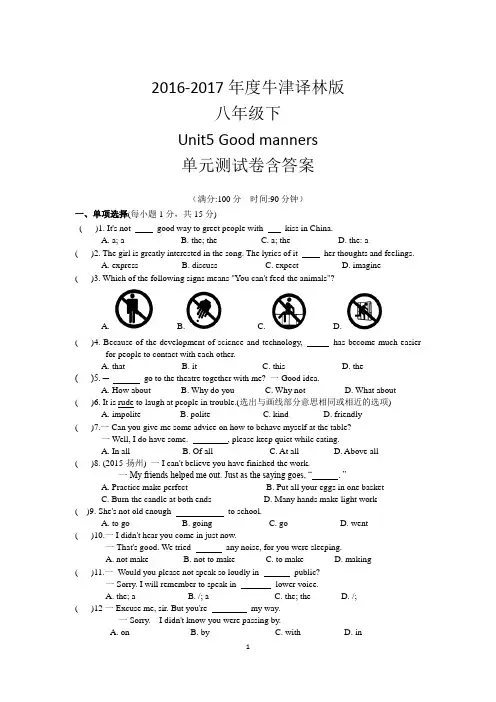
2016-2017年度牛津译林版八年级下Unit5 Good manners单元测试卷含答案(满分:100分时间:90分钟)一、单项选择(每小题1分,共15分)( )1. It's not good way to greet people with kiss in China.A. a; aB. the; theC. a; theD. the: a( )2. The girl is greatly interested in the song. The lyrics of it her thoughts and feelings.A. expressB. discussC. expectD. imagine( )3. Which of the following signs means "You can't feed the animals"?A. B. C. D.( )4. Because of the development of science and technology, has become much easier for people to contact with each other.A. thatB. itC. thisD. the( )5. ─ go to the theatre together with me? 一Good idea.A. How aboutB. Why do youC. Why notD. What about ( )6. It is rude to laugh at people in trouble.(选出与画线部分意思相同或相近的选项)A. impoliteB. politeC. kindD. friendly( )7.一Can you give me some advice on how to behave myself at the table?一Well, I do have some. , please keep quiet while eating.A. In allB. Of allC. At allD. Above all( )8. (2015·扬州) 一I can't believe you have finished the work.一My friends helped me out. Just as the saying goes, “. ”A. Practice make perfectB. Put all your eggs in one basketC. Burn the candle at both endsD. Many hands make light work( )9. She's not old enough to school.A. to goB. goingC. goD. went( )10.一I didn't hear you come in just now.一That's good. We tried any noise, for you were sleeping.A. not makeB. not to makeC. to makeD. making( )11.一Would you please not speak so loudly in public?一Sorry. I will remember to speak in lower voice.A. the; aB. /; aC. the; theD. /;( )12一Excuse me, sir. But you're my way.一Sorry. I didn't know you were passing by.A. onB. byC. withD. in( )13. The of new inventions should be to make life easier, not harder.A. ruleB. subjectC. secretD. purpose( )14一You've spelt the word wrong again, Judy.一Sorry. Maybe I am used to the mistake to think of the right one.A. soB. veryC. quiteD. too( )15.一Mrs Green. Do you think I can get an "A" in the final exam if I start working hard now?一Of course. .A. Better late than neverB. Many hands make light workC. You cannot burn the candle at both sidesD. Action speak louder than words二、完形填空(每小题1分,共10分)People in different countries have different way of doing things. Something is 1 in one country, but it may be quite impolite in another. In Britain, you mustn't lift your bowl to your 2 when you are having some liquid(液体) food. But it's 3 in China. And in Japan you even needn't worry about making 4 while you are having it. It shows that you're enjoying it. But people in Britain think it is bad manners. If you are a visitor in Mongolia, what manners do they wish 5 to have? They wish you to have a loud "burp(打隔)” 6 you finish eating. Burping shows that you like the food.In Britain, you should try not to 7 your hands on the table when you're having a meal. But in Arab(阿拉伯的)countries you must be very careful with your hands. You 8 eat with your left hand. Arabs consider(认为)it very 9 manner, eating with left hands. So when you are in other countries, 10 carefully and follow them. As a saying goes. "When in Rome, do as the Roma ns do.”( )1. A. bad B. useful C. polite D. strange( )2. A. mouth B. nose C. eyes D. finger( )3. A. same B. different C. important D. simple( )4. A. faces B. noise C. mistake. D. manners( )5.A. them B. him C. you D. her( )6. A. after B. before C. until D. in( )7. A. give B. put C. bring D. take( )8. A. needn't B. mustn't C. shouldn't D. couldn't( )9. A. good B. strange C. bad D. fantastic( )10. A. listen B. do C. watch D. hear三、阅读理解(每小题2分,共30分)(A)(2015·连云港)A Hindu saint(印度圣人)who was visiting the River Ganges to take a bath found a group of family members on the banks(河岸), shouting in anger at each other. He turned to his disciples (弟子), smiled and asked, "Why do people in anger shout at each other?"The disciples thought for a while, one of them said. "Because we lose our calm, we shout.” "But, why should you shout when the other person is just next to you? You can as well tell him what you have to say in a soft voice.” ask ed the saint.The disciples gave some other answers but none satisfied the saint.Finally the saint explained, "When two people are angry at each other, their hearts distance(疏远)a lot. To cover that distance they must shout to be able to hear each other. The angrier they are, the more strongly they will have to shout to hear each other. What happens when two people fall in love? They don't shout at each other but talk softly, because their hearts are very close.”He looked at his disciples and said, "So when you argue(争论), do not let your hearts get distant. Do not say words that distance each other more. Or else there will come a day when the distance is so great that you will not find a way to return.”( )1. Who were shouting at each other on the river banks in the passage?A. A saint and his disciples.B. A child and his parents.C. A group of family members.D. A group of bank workers.( )2. One of the disciples thinks that people shout at each other because .A. their hearts distance a lotB. heir hearts are very closeC. they dislike each otherD. they lose their calm( )3. According to the saint, when we don't agree with each other, we .A. should not argue with each otherB. should not shout at each otherC. should let our hearts get distantD. should find a way to return home(B)Some British and American people like to invite friends and colleagues(同事) for a meal at home. You should not be upset if your English friends don't invite you home. It doesn't mean they don't like you.Dinner parties usually start between 7 and 8 p. m., and end at about 11. Ask your hosts what time you should arrive. It's polite to bring flowers, chocolates or a bottle of wine as a present.Do you want to be extra(特别地)polite? Say how much you like the room or the pictures on the wall. But remember not to ask how much things cost.You'll probably start the meal with soup, or something small as a "starter"(开胃菜), next you'll have meat or fish with vegetables, and then a dessert, followed by coffee. It's polite to finish everything on your plate and to take more if you want. Some people eat bread during their meal, but not everyone does.Before they take out their cigarettes after the meal, most people usually ask, "Do you mind if I smoke here?"Did you enjoy the evening? Call your hosts next day, or write them a short "thank-you" letter. Perhaps it seems funny to you, but British and American people say "thank you, thank you, and thank you" all the time.( )4. If you aren't invited to dinner at home by English friends, .A. it shows they don't like youB. it shows they have no time to get togetherC. it shows they don't want to make friends with youD. it doesn't show they don't like you( )5. In England and America, it's not polite to .A. ask the price of a thingB. eat all the food on your plateC. talk to your hostsD. eat bread during the meal( )6. In the passage, the order of the serving of a meal is .A. dessert一meat or fish with vegetables一coffee-soupB. coffee一soup一dessert一meat or fish with vegetablesC. meat or fish with vegetables一dessert一soup一coffeeD. soup一meat or fish with vegetables一dessert一coffee( )7. Which is NOT right according to the passage?A. In England or America, it usually takes more than three hours to have a dinner party athome.B. If you are invited to go to a dinner party, you can’t arrive early.C. You mustn't smoke after a meal when you are with some American or English people.D. If you enjoyed the evening, you can write a short "thank-you" letter to your hosts orcall them next day.(C)Everyone likes gifts. Some little kids think they don't get enough gifts. Some old people think they get too many gifts. Different people like different kinds of gifts. Some presents are never too small. A little child may give his or her mother a leaf from a tree. It is enough to make her very happy.( )8. In different countries people give gifts.A. differentB. sameC. expensiveD. cheap( )9. In Japan, people sometimes give special gifts, but they aren’t .A. closedB. openedC. brokenD. expensive( )10. In , some people give money to charities instead of giving gifts.A. ChinaB. the USAC. CanadaD. Japan( )11. In Sweden, making a as a gift is enough.A. milkB. potato pieC. teaD. meal(D)What do you do in a situation like this? You're eating dinner with friends at a nice restaurant. You're having a great time when a phone rings at the table next to you. A man takes out his phone and starts talking loudly about problems he's having with his girlfriend. He talks for almost ten minutes! This happens all the time一on buses, in restaurants, everywhere!Many people find cell phones useful in their daily lives. But we've all sat next to someone talking too loudly on a cell phone. You may want to tell the loudmouth to end the conversation, but let the management take care of those noisy customers. You can only control your own behaviour. Here are a few rules.Off means off! Follow the rules of restaurants and other public places. If a sign says "turn off cell phones", don't use your phone. If you are allowed. Speak softly and for a short time and try to move away from other people.Lights off, phone off! Never make calls in a theatre or at the movies.Pay attention! Talking on a cell phone while driving is dangerous. And watch where you’re going when you're walking down the street and talking on the phone.As more people use cell phones, things are only going to get worse. So, the next time you're getting ready to make a call, stop and consider the people around you.( )12. The man talking on the cell phone loudly in the restaurant will .A. talk for half an hourB. pay more for his mealC. make other customers angryD. he driven out by the boss( )13. Some people use cell phone, in a rude way because .A. they don't consider the people around themB. some public places allow them to do soC. they are proud of having cell phonesD. cell phones are common and available everywhere( )14. According to the passage, we shouldn't make calls .A. in restaurantsB. on busesC. at the moviesD. on the streets ( )15. From the passage we can infer that .A. cell phones have become the most useful tool in our lifeB. public manners play an important role in our lifeC. cell phones lead to people's bad relationshipD. people ought to turn cell phones off in a public place四、词汇检测(共15分)A.根据句意及中文、英文或首字母提示写出单词。
译林版牛津英语八年级下册Unit 5单元测试题(有答案)
译林版牛津英语八年级下册Unit 5单元测试题班级:_______________ 姓名:_______________一、单项填空(15%)( ) 1. I can’t remember when exactly the Robinsons left _______ city. I only remember it was _______ Sunday.A. the; aB. a; theC. a; aD. the; the( ) 2. —Mum, can I help you with the cleaning?—Thank you, dear. But you are _______ now. You must wait till you are _______.A. too young; too oldB. too young; enough oldC. so young; enough oldD. too young; old enough( ) 3. There aren’t many tickets left for the match. You’d better _______ that you get one today.A. make sure ofB. make a decisionC. make sureD. make plans( ) 4. Why not leave the door _______? I think the air in the room smells bad.A. openingB. openedC. openD. to open( ) 5. —What do you think of the show in this year’s Spring Gala?—I think it’s _______. But my father thinks it’s much too _______.A. wonderful enough; boredB. enough wonderful; boringC. wonderful enough; boringD. enough wonderful; bored( ) 6. We young people shouldn’t _______ think about the failure (失败) in the past. Instead, we should be _______ to face the future.A. usually; enough braveB. seldom; enough braveC. sometimes; brave enoughD. always; brave enough( ) 7. —Mum, I’ve got a new job in Beijing! —Really? It just sounds _______ to be true.A. so wellB. too goodC. good enoughD. too well( ) 8. She was too busy at that time _______ with me. I was unhappy about that.A. to talkingB. talkingC. talkedD. to talk( ) 9. —Your 12-year-old son doesn’t know much about shopping online, _______ he?—_______, but in fact, shopping online is popular with teenagers these days.A. does; NoB. does; YesC. doesn’t; NoD. doesn’t; Yes( ) 10. You two live in the same community now. It’s too hard ________ you to avoid __________ her.A. of; meetingB. for; to meetC. for; meetingD. of; to meet( ) 11. —How many tips did Jim offer on the talk about manners? —_______. He said _______.A. Nothing; nothingB. Nothing; noneC. None; nothingD. None; none( ) 12. As we know, man’s understanding of nature is developing _______.A. at the right timeB. for the first timeC. from time to timeD. all the time( ) 13. —A homeless man won a big prize. He became rich over night. —_______.A. Better safe than sorryB. The early bird catches the wormC. Every dog has its dayD. Actions speak louder than words( ) 14. The little gi rl _______ the kite in the tree, but she was not tall enough to _______ it.A. reached for; reachB. reached for; reached outC. reached out; reached forD. reached; reached for( ) 15. —My classmates are playing on the playground. Can I join them, Miss Lin?—_______ Not until you have completed the Maths exercises.A. Why not?B. Will you?C. I hope so.D. I’m afraid not.二、完形填空(10% )On the evening of last Sunday while I was reviewing my lessons in my room, it suddenly began to rain. 1 as usual, I stopped to listen to the rhythm (韵律) of the rain. For many years, whenever it rains, I couldn’t 2 listening to it and thinking of the garden where I spent my childhood in my hometown.When I was a little girl, my family lived in a big house with a big garden in the countryside. The garden was full of flowers and 3 , with some bamboo in front of the wall. Whenever it rained, I 4 to sit in the front of the house, listening to the rhythm of the rain and watching the 5 raindrops.。
牛津译林版2017年八年级下Unit5课后考题训练含答案
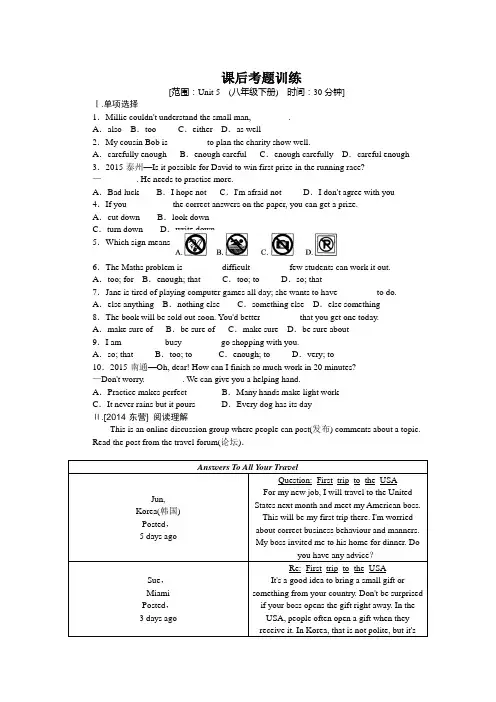
课后考题训练[范围:Unit 5(八年级下册)时间:30分钟]Ⅰ.单项选择1.Millie couldn't understand the small man, ________.A.also B.too C.either D.as well2.My cousin Bob is ________ to plan the charity show well.A.carefully enough B.enough careful C.enough carefully D.careful enough 3.2015·泰州—Is it possible for David to win first prize in the running race?—________. He needs to practise more.A.Bad luck B.I hope not C.I'm afraid not D.I don't agree with you4.If you ________ the correct answers on the paper, you can get a prize.A.cut down B.look downC.turn down D.write down5.Which sign means “No smoking”?6.The Maths problem is ________ difficult ________ few students can work it out. A.too; for B.enough; that C.too; to D.so; that7.Jane is tired of playing computer games all day; she wants to have ________ to do. A.else anything B.nothing else C.something else D.else something8.The book will be sold out soon. You'd better ________ that you get one today. A.make sure of B.be sure of C.make sure D.be sure about9.I am________ busy ________ go shopping with you.A.so; that B.too; to C.enough; to D.very; to10.2015·南通—Oh, dear! How can I finish so much work in 20 minutes?—Don't worry. ________. We can give you a helping hand.A.Practice makes perfect B.Many hands make light workC.It never rains but it pours D.Every dog has its dayⅡ.[2014·东营] 阅读理解This is an online discussion group where people can post(发布) comments about a topic. Read the post from the travel forum(论坛).Ans w ers To All Your Tra v elJun, Korea(韩国) Posted,5 days agoQuestion:_First_trip_to_the_USAFor my new job, I will travel to the United States next month and meet my American boss. This will be my first trip there. I'm worried about correct business behaviour and manners. My boss invited me to his home for dinner. Doyou have any advice?Sue,Miami Posted,3 days agoRe:_First_trip_to_the_USAIt's a good idea to bring a small gift or something from your country. Don't be surprised if your boss opens the gift right away. In theUSA, people often open a gift when they receive it. In Korea, that is not polite, but it's11.Jun posted a question in the forum, because ________.A.he got a new jobB.he would meet his bossC.his boss invited him to his home for dinnerD.he wanted to know business behaviour and manners in the USA12.What's the meaning of the underlined word “remove”?A.开除B.移开C.脱下D.去掉13.If you are invited to an American friend's home, it's NOT polite to________.A.bring a small gift from your country B.open the gift right away C.enter the house with your shoes on D.ask a person's age14.If you go to your American boss's home for dinner, you ________. A.shouldn't use your hands to eat fried chickenB.can't stand and talk in the kitchen while the host is cookingC.can't talk with all the family membersD.probably won't speak about business15.We can know from the online discussion that ________.A.different countries have different customsB.Japanese have the similar customs with AmericansC.everyone may take part in the dinner table conversation in KoreaD.only people from Korea and America can answer Jun's questionⅢ.补全对话,方框中有两个多余选项A: Hi, Lucy. 16.________ Where did you go?B: Hi, Rick. I went to the Cool City.A: Cool City? 17.________B: It's in the southwest of Guizhou. It's famous for the cool weather, especially in summer. A: Really? 18.________B: You can watch the marathon(马拉松) in August.A: Great.19.________B: You can go there by plane.A: Thank you.B∶20.________A.You're welcome.B.Long time no see!C.What's up?D.Then what can I do?E.Where is it?F.Have you ever been there before?G.How can I go there?Ⅳ.用方框中所给词或短语的适当形式填空21.It's impolite to ____________ others.22.____________,you must study harder than before.23.Go ahead. No one is ____________.24.Jim, you shouldn't ____________ in the park.25.You expect me to believe that you kicked me ____________?Ⅴ.用括号内所给词的适当形式填空26.To save water, you shouldn't leave the tap ________ (run).27.I crossed the street to avoid________ (meet) him, but he saw me and ran towards me. 28.An old ________ (say) goes, “Nothin g is impossible if you put your heart into it.”29.When the guest entered the hall, Mrs Smith stood up and greeted him ________ (polite).30.If you keep on doing things like that, you will risk ________ (lose) everything you get. Ⅵ.根据汉语意思完成句子31.我梦想成为一名像我父亲那样的医生?I ____________ becoming a doctor like my father.32.老师警告杰克不要抄袭别人的作业。
牛津译林版八年级下册英语Units 5-6 综合测试卷(Word版,含答案)

牛津译林版八年级下册英语Units 5-6 综合测试卷一、听力 (共20小题;每小题1分, 满分20分)第一部分听对话回答问题, 录音读两遍。
1. What does the girl want to do for the sick children?2. Which sign are the speakers talking about?3. What do people in the woman's country do when they meet?4. Who does Anna often help?5. What can Dale help do?A. Sell bikes.B. Fix up buses.C. Repair bikes.6. What did Lily do last weekend?A. She watched TV.B. She visited some old people.C. She cleaned up the park.7. What does Emma think they should do first?A. Do their homework.B. Come up with a plan.C. Do some volunteer work.8. Where are Tim's socks?A. In the shoes.B. Under the bed.C. On the floor.9. What does the boy's mum advise him to donate at the party?A. Some toys.B. Some clothes.C. Some books.10. What are they talking about?A. Public signs.B. Public places.C. Useful information.第二部分听对话和短文回答问题, 录音读两遍。
牛津译林版英语八年级下册(初二下学期) Unit5单元测试题含答案

牛津译林版英语八年级下册(初二下学期)U n i t5单元测试题含答案work Information Technology Company.2020YEAR八下Unit 5 单元测试题第Ⅰ卷选择题(共65分)Ⅰ. 单项选择(每小题1分,共15分)从各题后所给的A、B、C、D四个选项中选出最佳答案。
( )1. —________ do people start a conversation in China—They often say “Nihao” first.A. WhatB. HowC. WhenD. Which( )2. Please run ________, Linda, or you will miss the new film.A. quickB. slowC. quicklyD. slowly( )3. Peter is ________ careless to ________ the word correctly.A. too; spellingB. so; spellingC. too; spellD. so; spell( )4. Some Westerners like to greet people ________ a kiss.A. byB. withC. ofD. without( )5. Everyone in my class went to the mountains ________ Maria. She was ill in hospital.A. besidesB. withC. exceptD. including( )6. Please keep ________ and don’t eat anything in the library.A. noisilyB. quietC. quietlyD. noisy( )7. It’s not the ________ time to ask her to the party, because her mother is badly ill.A. usefulB. interestingC. properD. special( )8. The English guest could speak ________ Chinese, so she managed to talk with us.A. a fewB. a littleC. fewD. little( )9. I found it very useful ________ a good book.A. readB. readingC. of readingD. to read( )10. Peter is ________ to get the award of “Best Student”.A. enough excellentB. excellent enoughC. too excellentD. excellent too( )11. —Would you like to collect ________ with us in the park this Saturday —Yes, I’d love to. Let’s make it clean.A. waterB. treesC. booksD. rubbish( )12. —Can I ________ my car in the park—I’m afraid not. There are so many people in the park.A. stopB. parkC. buyD. move( )13. Miss Wang is going to visit the Great Wall ________ next week.A. some timeB. sometimesC. some timesD. sometime( )14. —Please help yourself to some meat.—________, but I’m full now.A. You’re kiddingB. I’m sorry to hear thatC. Sorry, I can’tD. Thanks a lot( )15. —Mum, Tony broke my pen again.—Forget it. ________, he’s only two years old.A. After allB. All the timeC. Not at allD. First of allⅡ. 完形填空(每小题1分,共10分)根据材料内容,从各题后所给的A、B、C、D四个选项中选出最佳答案。
牛津译林版八年级下册英语 Unit5 单元测试(有答案)
Unit5单元测试Ⅰ. 单项选择(每小题1分,共15分)( ) 1.____ is really hard for them to climb so high.A ThisB It C.That D.What( ) 2. Which of the following signs can you often see beside a lake?A. B. C. D.( ) 3. — Excuse me, sir. But you’re my way.—Sorry. I didn’t know you were passing by.A. onB. byC. withD. in( ) 4. The of new inventions should be to make life easier, not to make it harder.A. rulesB. subjectsC. secretsD. purposes( ) 5. I have spent on this job. I think I can finish it this afternoon.A. sometime; sometimeB. sometimes; some timeC. some time; sometimeD. some times; some time( ) 6. —Boy, didn’t you see people were waiting in line? Don’t in!— I am sorry, sir.A. pushB. pullC. putD. carry( ) 7. Jim always keeps the tap running he finishes washing his face.A. sinceB. whileC. asD. till( ) 8. — Sir, please put out your cigarette (香烟).— Sorry. I the sign.A. don’t noticeB. didn’t noticeC. haven’t noticedD. won’t notice( ) 9. Checking answers before handing in your paper can help you mistakes.A. makeB. provideC. avoidD. advise( )10.You’d better repair the machine I have told you. Otherwise, you may make more problems. A. like B. with C. as D. follow ( )11. Jack is always to wait for a long time without getting angry.A. too patientB. patient enoughC. enough patientD. very patient( )12. —You’ve spelt the word wrong again, Judy.— Sorry. Maybe I am _____ used to the mistake to think of the right one.A. soB. veryC. quiteD. too( )13.— Mum, can you give me some advice on how to behave myself at the table?— Well, I do have some advice. ______, please keep quiet while eating.A. After allB. Of allC. At allD. Above all( )14. — Do you think the question too hard?—I don’t think so. He can answer it easily.A. of Jim to answerB. of Jim to answer itC. for Jim to answerD. for Jim to answer it ( )15. —Mrs Green. Do you think I can get an “A” in the final exam if I start working hard now?— Of course. .A. Better late than neverB. Many hands make light workC. You cannot burn the candle at both sidesD. Actions speak louder than wordsⅡ. 完形填空(每小题1分,共10分)If people are so tired, they will fall asleep almost anywhere. We can see there are people sleeping on the bus or train on their 1 home from work in the evenings. A man is 2 the newspaper, and seconds later it seems that he is trying to eat it. Or he will fall asleep on the shoulder of the stranger 3 next to him. Another short sleep goes on in the lecture hall where a student will start snoring(打鼾) so 4 that the professor has to ask another student to shake the sleeper awake. A more embarrassing(尴尬) situation happens when a student starts falling into sleep and the weight of the head pushes(推) the arm off the 5 , and the movement carries the rest of the body along. The student wakes up on the floor with no 6 of getting there. The worst time to fall asleep is when 7 . Police reports are full of accidents that happen when people fall into sleep and go off the road. If the drivers are 8 , they will not be seriously hurt. One woman's car, for example, went into the river. She woke up in four feet of 9 and thought it was raining. When people are really 10 , nothing will stop them from falling asleep--no matter where they are.1. A. way B. route C. path D. road2. A. buying B. selling C. looking D. reading3. A. lying B. waiting C. talking D. sitting4. A. bravely B. happily C. loudly D. carelessly5. A. sofa B. desk C. shoulder D. book6. A. sense B. memory C. feeling D. dream7. A. thinking B. working C. walking D. driving8. A. lucky B. awake C. clever D. strong9. A. ground B. water C. grass D. bush10. A. lonely B. drunk C. tired D. lazyⅢ. 阅读理解(每小题2分,共10分)People use their mouths for many things. In the English language, there are many expressions using the word “mouth”. But some of them are not so nice.Sometimes, people say something to a friend or a family member. Later they regret because it hurts that person’s feelings. Or they tell the person something they didn’t mean(打算) to tell. The speaker might say: “I really put my foot in my mouth this time.”Sometimes when one person is speaking, he says the same thing that his friend is going to say. When this happens, the friend might say: “You took the words right out of my mouth!” Sometimes a person has a bad or sad experience with another person. He might say that experience “left a bad taste in my mouth.” Or the person possibly has a very frightening (可怕的) experience, like having an angry dog running after him. He might say: “I had my heart in my mouth.” Some people have lots of money because they were born into a very rich family. You might say the person “was born with a silver spoon (银勺) in his mouth”. He is the opposite of a person living from “hand to mouth”. This person is very poor and only has enough money for the most important things in life, like food.1. The underlined word “regret” may mean .A. feel sorryB. feel excitedC. feel proudD. feel surprised2. When a man says “I had my heart in my mouth”, usually he means he was .3. Your best friend Tony has said what you are going to say, you might say: “!”4. Tom says he’s living from hand to mouth. His life is _________.5. What is the main idea of this passage?_____________________________________Ⅳ. 填空(每小题1分,共10分). Everyone had a good time.2. Both of us enjoyed nice food and at the dinner.3. The teacher was angry because Tom several times when she was speaking.4. Jack was walking along the street in a hurry when he a boy.5. we sat down , the play started.B. 用所给单词的适当形式填空。
牛津译林版八年级下英语Unit5单元测试(有答案)
八年级下牛津译林版英语Unit5单元测试一.单项选择:1. School students _____ smoke because it is bad for their health and it is against the law.A. needn'tB. couldn'tC. shouldn'tD. may not2. I don't think it's _______ to have a birthday party.A. enough specialB. special enoughC. specially enoughD. enough specially3. My little brother was ______ to go to school. He needs to stay at home with my mum.A. so youngB. young enough.C. too youngD. that young4. Ben went to Canada five years ago an_______ a Chinese teacher since then.A. becameB. has becameC. wasD. has been5. -Could you come back home at three o'clock.- _______. I'll be at a meeting at that time.A. id notB. Yes. I hope soC. I think soD. I'm afraid so6. I like maths and she likes math _______.A. eitherB. as well asC. as wellD. so well7. -You are new here, _______?-Yes, I'm from Jiamusi. It's my first time I've Wuxi.A. aren't you; been toB. don't you; been toC. aren't you; been inD. don't you; gone to8. I'm sorry you've waited so long, but there’ll be some time _______ Bran gets backA. whenB. sinceC. tillD. after9. Mother often tells me to speak in a low _______ in public.A. soundB. shoutC. screamD. voice10. -Do you think it will rain tomorrow?- _______. Because farmers need rain very much.A. I think soB. I hope soC. I'm afraid soD. I'm afraid not11. You must _______ me the reason why you came so late this time.A. excuseB. explainC. explain toD. pardon12. -Excuse me, look at the sigh NO PHOTOS! -Oh, sorry. I _______ it.A. don't seeB. didn't seeC. haven't seenD. won’t see13. The sign means " _______ ", so you can't park your new Porsche here.A. No parkingB. No right turnC. You can't turn leftD. No entry14. The problem is _______ hard for me _______ work out.A. enough; to B enough; that I can't C. very; to D. too; to15. J. K. Rowling is a _______ writer. Her book Harry Potter is a great _______.A. success; successful.B. successful; successC. successfully; successD. successful; successfully二.完形填空:I was a single parent of four small children, working at a low-paid job. Money was always tight, but we had a roof over our heads, food on the table, clothes on our backs, and if not a lot, always 1 . Not knowing we were poor, my kids just thought I was strict. I‘ve always been glad about that.It was Christmas time, and although there wasn‘t2__ for a lot of gifts, we planned to celebrate with a family party. But the big__3__for the kids was the fun of Christmas__4___.They planned weeks ahead of time, asking 5 what they wanted for Christmas. Luckily, I had saved $120 for___6 to share by all five of us.The big __7 arrived. I gave each kid a twenty-dollar bill and__8__them to look for gifts about four dollars each. Then everyone scattered(散开). We had two hours to shop, and then we would 9_ back at the Santa‘s Workshop‘.Driving home, everyone was in high Christmas spirits, except my younger daughter, Ginger, who was unusually___10 . She had only one small, flat bag with a few candies --- fifty-cent candies! I was so angry, but I didn‘t say anything 11 __we got home. I called her into my bedroom and closed the door, ready to be angry again. This is what she told me:―I was looking around thinking of what to buy, and I 12_ to read the little cards on the ‗Giving Trees‘. One was for a little girl, four years old, and all she 13_ for Christmas was a doll. So I took the card off the tree and _14__the doll for her. We have so much and she doesn‘t have anything.I never felt so_15_as I did that day.1.A. little B. less C. enough D. more2.A. effort B. room C. time D. money3.A. improvement B. problem C. surprise D. excitement4.A. shopping B. traveling C. parties D. greetings5.A. the other B. each other C. one by one D. every other one6.A. toys B. clothes C. presents D. bills7.A. day B. chance C. cheque D. tree8.A. forced B. reminded C. invited D. begged9.A. draw B. stay C. move D. meet10.A. quiet B. excited C. happy D. ashamed11.A. since B. after C. while D. until12.A. forgot B. stopped C. failed D. hated13.A. wanted B. did C. got D. played14.A. made B. searched C. bought D. fetched15.A. angry B. rich C. patient D. poor三.阅读理解:AThis month,Travelers Corner has three teenagers’ experiences in year-abroad programs.A. she missed her catsB. she was too shy to speakC. she learned about some cultural thingsD. her roommate was easy-going2. Laura couldn’t have a nice long talk with her parents because_________.A. she couldn’t speak English wellB. the phone call was so expensiveC. London was too big to find a pay phoneD. her roommate kept using the telephone3. What is true about Tomomi, Laura and Adam?A. They are all good at speaking English.B. They all spent a year studying abroad.C. They all studied in the same country.D. They all hope to spend more time abroad.BVan Gogh was born in Holland(荷兰)in 1853. He enjoyed drawing as a child. His first connection(关联)with paintings came in 1869.He worked for an art dealer(经营者)in London and Paris for four years, before he became a teacher in England for a short time. He moved back to France in 1877 and soon began to paint. He didn't stay long in Paris. He was attracted(吸引)by the c010urs of the countryside and, in 1883, he moved to Ales, a small town in the south of France. There, he painted his most famous paintings.He enjoyed painting people, farms, flowers, and other natural things. Some of his most famous paintings are The Potato Eaters, The Starry Night, and some different sun flower paintings.The Starry Night is now kept in the Museum of Modern Art in New York.There is a quiet Vi11age and a tall black tree under an angry sky. Some people say that it shows a war(战争)in Van Gogh's mind between peace(和平)and anger.It was finished on June 19th,1889.Scientists say that it is a true picture of the stars on that day.He was poor most of his life. He made hundreds of paintings, but only sold one of them while he lived. He was a lonely, unhappy man and died at the early age of 37.Today, people love Van Gogh's use of colour and the emotional power(激情)of his works. Van Gogh's paintings are world famous and worth(值)millions of dollars. Museums around the world proudly(自豪地)show paintings by the great artist.4.Van Gogh began to paint in_______.A. HollandB. FranceC. LondonD. New York5.Van Gogh moved to Ales because_______.A. it was a famous sma11 townB. it was in the south of FranceC. he liked teaching in the countrysideD. he enjoyed the colours of the countryside6. In Van Gogh's The Starry Night, we can see________A. some peopleB. some flowersC. a villageD. a factory7.Van Gogh died in_______A.1890 B.1888 C.1877 D.18698.His paintings are world famous for_____________A.his poor lifeB.the high pricesC. the use of colour and the emotional powerD. the war in his mind between peace and angerCHow to say hello in Japanese depends on(取决于)when you say it. This is very much like different greetings in English at different times of the day or night. In Japanese culture, it also depends on whether(是否)you are on the phone or you are close to the person you are greeting. We don't get formal(正式)with our friends. We seldom greet them with "Good morning" or "Good evening". A "Hi" is enough.The most popular and most well-known translation for "Hello" is still "Konnichiwa", but it is not exactly how to say hello in Japanese. Perhaps it is not the most suitable word for it. Actually, the correct greeting in English for "Konnichiwa" is "Good day" or "Good noon", and I am sure you wouldn't like greeting people with a "Good day" at any time, and Japanese also don't like to say "Konnichiwa" when they want to say "Hello".Then what to do? Let's do it the way the Japanese do. Use "Ohaiyo Gonzaimasu" when it's noon and "Konbanwa" to greet somebody in the afternoon. Things are different when you are on the phone. Just say "Moshi, Moshi", which is actually similar (相似) to saying "Hello" over the phone, because one doesn't often use "Good morning" or 66Good afternoon" or "Good evening" right after picking up the phone. One invariably uses the sweet old "Hello".Next time, I'll tell you something about my life in Japan.9. How do Japanese people greet each other in the afternoon?A. By saying "Konbanwa".B. By saying "Moshi, Moshi".C. By saying "Konnichiwa".D. By saying "Ohaiyo Gonzaimasu".10. Which of the following is true according to the writer?A. Japanese people are not very friendly to each other.B. Japanese culture is similar to American culture.C. Japanese people don't like using "Konnichiwa" as a greeting for the whole day.D. People don't need to be polite to their close friends.11. The underlined word "invariably" may mean_______.A. likelyB. maybeC. alwaysD. sometimes12. From the passage we know that the writerA. is from BritainB. lived in Japan for some timeC. is working in a radio station nowD. knows both Chinese and Japanese13. The best title for the passage should be_______.A. How to Say HelloB. How to Greet Close Friends in JapaneseC. How to Greet People in JapaneseD. Some Differences between English and Japanese四.词汇运用:1. My father told me not to_______ (碰) the vase in his study. He said it was made in Qing Dynasty.2. A _______ (谚语) is a sentence that people often say and give advice or information abouthuman life and experience.3. Keep working _______ (直到) you all can work this problem out.4._______ (正如) you can see, we are in need of food and drink now.5. These pages aren't in their_______ (适当的) order.6. Reading newspaper_______ (help) us learn about the news both at home and abroad7. So far, we_______ (raise) millions of dollars for the students in poor areas.8. How heavily it_______ (rain)! We have to stay at home today.9. People in the house made a fire_______ (get) warm.10. Tom said he_______ (drive) home when suddenly the man rushed out.五.完成句子:1.你听过“活到老,学到老”吗?__________________________________________________________________________ 2.记住不要乱扔垃圾。
新牛津译林版八年级英语下册Unit 5-6单元测试(附答案)
新牛津译林版八年级英语下册Unit 5-6单元测试(附答案)______XXX’t talk with food in it.A。
XXX10.The teacher asked us_______our mobile phones during class.A。
not useB。
not usingC。
not to useD。
don’t use11.I’m sorry。
I_______XXX.A。
XXX et12.The weather in Beijing is much_______than that in Shanghai.A。
XXX13.The children were_______to see the clown at the party.A。
XXX14.The_______of the book is so interesting that I can’t。
reading it.A。
XXX15.The_______of the cake smells so good that I can’t wait to taste it.A。
XXX16.The_______of the film is about a girl who saves her village.A。
XXX17.The train is arriving at platform 3.Please_______your tickets ready.A。
XXX18.I’m sorry。
I can’t hear you clearly。
Could youplease_______?A。
XXX19.I’m afraid I can’t_______you with you r English。
I’m not good at it。
either.A。
XXX20.The_______of the new restaurant is very modern and nable.A。
牛津译林版八年级下册英语练习题:Unit 5(有答案)
8下Unit5 练习题班级________ 姓名___________ 学号___________一、词汇A 根据句意,首字母或中文提示写出所缺的单词1.He was late again today. He had no ________________(借口) for being late.2.What ______________(结论) can we draw from the conversation?3.We are busy______________(练习) speaking English.4.We shouldn’t p____________ the old in public.5.I know the meaning of the s_____________, ”practice makes perfect.”6.In class, Millie always _______________(表达) his ideas clearly.7.I like the style of his writing, but I don’t like the c_____________.8.Young children are taught road safety to _____________ road accidents.B. 用方框中所给单词的适当形式填空9. He plays the violin ____________ enough to perform at a concert.10. We look forward to ______________ from our friends soon.11. The ___________ are very polite. We should learn from them.12. If lots of people work hard together, it will make a job __________ to complete.13. I don’t want to waste ____________ time.14. This show is ________________ one I have watched.C. 用动词的正确形式填空15. The plate _____________ from her hands when someone walked past her.16. We all thought Mr. green would come to the meeting on time, but he left us____________________ for a long time.17. I noticed a little boy ____________ the classroom just now.18. The Jiangs ______________ their family trip when we went to visit them this morning.19. The rain ______________.Let’s go out to play basketball.20. The purpose of the talk is _________________ the students how to behave politely.21. We feel like _______________ some food and drink because we’ll i nvite some friends to join in a party.22. Would you please ________________ properly?二、单选题23.____ old man behind Mary is ____ university teacher.A.An; aB. The; aC. An; anD. The; an24.Giant pandas in Sichuan are in even greater ___ after Wenchuan Earthquake on 12 May 2008.A.dangerousB. dangersC. endangeredD. danger25.This English song ____ by the girls after class.A.often singsB. often sangC. is often sangD. is often sung26.Sailing on a snowy day means ____ in the sea.A. risking to lose lifeB. to risklosing life C. to risk losing D. risking losing life27.Tom’s mother is too busy ___ housework ___ him with his homework.A.doing; to helpB. to do;t o help C. doing; helping D. to do; helping 28.– I want to know if I ____ smoke here.--No, you ___. Can’t you see the sign “No Smoking” there.A. shall; won’tB. may; mustn’tC. must; can’tD. can; needn’t29.Great changes ____ since 1949.A.took placeB. have taken placeC. were taken placeD. have been taken place30.---What did Mr Li ____at the meeting?--I couldn’t hear clearly.A, say B. talk C. speak D. tell三、句型转换31.The old lady isn’t young enough to look after herself. ( 保持句意基本不变)The old lady is __________ ___________ __________ _________ after herself.32.Let’s respect local people, ___________ ____________?(补全反意疑问部分)33.I was excited. I could not write down all the points. ( 保持句意基本不变)I was __________ ____________ ___________ I couldn’t write down all the points.34.Remem ber to say “ thanks”, __________ ____________?(补全反意疑问部分)35.We are inviting him to talk about manners in the UK.(划线部分提问)___________ ____________ _____________ inviting him _____________ ___________?8下Unit5 练习题答案一、词汇A 根据句意,首字母或中文提示写出所缺的单词1. excuse2. conclusion3. practicing4. point5. saying6. expresses7. content8. avoidB. 用方框中所给单词的适当形式填空9. well 10. hearing 11. British 12. easier 13. anyone’s 14. the most successfulC. 用动词的正确形式填空15. dropped 16. waiting 17. enter 18. are discussing 19. has stopped20. to teach 21. buying 22. dress二、单选题23-27 ADDDA 28-30 BBA三、句型转换31. too old to look 32. shall we 33. so excited that 34. What are you to do。