
amazon_rainforest_亚马逊丛林
The Amazon rainforest consists four layers and each layer has its unique ecosystem and plants and animals are adapted to that. The tallest layer is called the emergent layer, which has trees of approximately 200 feet in height. The other layer is canopy which has smooth oval leaves and have pointed drip tip. This makes the flow of water easy and preventing the growth of mosses and fungi. The layer below the canopy layer is able to get only 5 per cent of sunlight and plants of this layer are uniquely adapted to survive in the shadowy layer. The lowest layer is the forest floor and is almost without any plant. Only 2 per cent of sunlight reaches here.
* /blog/content/sos-amazon-every-second-we-lose-15-acresrainforests-once-covering-14-earth-land-surface-now
*/2/hi/americas/7360258.stm
Common Squirrel Monkey (Saimiri sciureus albigena)
2.birds
More than 1500 bird species are found in the Amazon Basin
Hummingbird feeding on Heliconia flower
Owl butterfly (Caligo idomeneus)
Storage of carbon
the Amazon rainforest evergreen forests make up 10 percent of the world’s land Carbon storage.
Carbon storage of Amazon
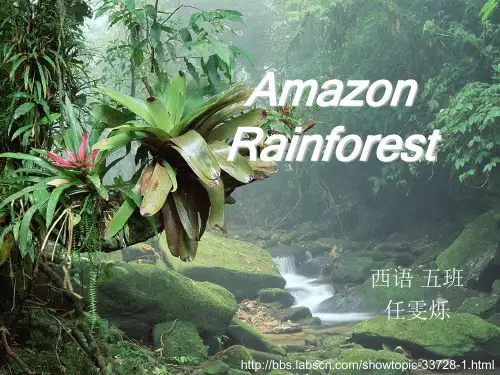
Amazon Rainforest
西语 五班 任雯烁
/showtopic-33728-1.html
The Amazon Rainforest covers over a billion acres, encompassing areas in Brazil, Venezuela, Colombia and the Eastern Andean region of Ecuador and Peru. If Amazonia were a country, it would be the ninth largest in the world. * The Amazon Rainforest has been described as the "Lungs of our Planet" because it provides the essential environmental world service of continuously recycling carbon dioxide into oxygen. More than 20 percent of the world oxygen is produced in the Amazof the world's species of plants, animals and microorganisms will be destroyed or severely threatened over the next quarter century due to rainforest deforestation. * Experts estimates that we are losing 137 plant, animal and insect species every single day due to rainforest deforestation. That equates to 50,000 species a year.
The climate in the Amazonian rainforest is warm and humid and the average temperature in the area is about 79 degree Fahrenheit. One of the prominent features of this area is the difference between the temperature during the day and during the night is greater than that of the difference between the seasons.
One hectare of rain forest may contain more than 600 species of trees and many different kinds of animals
1.mamals
More than500 species of mammal are found in the Amazon
Protect our land and water
Rainforests play a important role in keeping the soil and the conservation of water.
Eroded, bright-red soils in Betsiboka Estuary, Madagascar. (Photo courtesy of NASA/JSC)
However, these precious systems are among the most threatened on the planet. Although the precise area is debated, each day at least 80,000 acres (32,300 ha) of forest disappear from Earth.
mining
• The Amazon rainforest has abundant mineral resources
The damage to the rainforest
2
Rain forest play a vital role in lessening global warming
We are losing Earth's greatest biological treasures just as we are beginning to appreciate their true value. Rainforests once covered 14% of the earth's land surface; now they cover a mere 6% and experts estimate that the last remaining rainforests could be consumed in less than 40 years. One and one-half acres of rainforest are lost every second with tragic consequences for both developing and industrial countries. Rainforests are being destroyed because the value of rainforest land is perceived as only the value of its timber by short-sighted governments, multi-national logging companies, and land owners.
4. Amphibians
According to the record 695 amphibians has been found in Amazon rainforest
Blue poison dart frog (Dendrobates azureus)
5. Insects
Over 90% of the animal species in the Amazon are insects, A single square mile of rainforest often houses more than 50,000 insect species
Harpy Eagle at Summit Park
3.reptiles
Throughout the Amazon Rainforest, there are over three hundred reptile species
Blunt-headed tree snake
Anole lizard (Anolis sp.) in Peru
lumbering
• The rainforest has long been destroyed by commercial groups for wood materials
lumbering
• The wood is carried to the harbor along the river • Transport downstream by boat on the Amazon river
介绍亚马逊热带雨林英语作文
介绍亚马逊热带雨林英语作文The Amazon rainforest, also known as the Amazon jungle, is a vast and diverse ecosystem that covers a large portion of South America. It is home to a wide variety of plant and animal species, many of which are found nowhere else on Earth. The Amazon rainforest plays a crucial role in regulating the Earth's climate, as it absorbs a significant amount of carbon dioxide and produces a large amount of oxygen.The Amazon rainforest is often referred to as the "lungs of the Earth" because of its ability to produce so much oxygen. It is estimated that the Amazon rainforest produces about 20% of the world's oxygen. This is due to the fact that the trees and plants in the rainforest absorb carbon dioxide during photosynthesis and release oxygen as a byproduct. In addition to producing oxygen, the Amazon rainforest also helps to regulate the Earth's climate by absorbing carbon dioxide, a greenhouse gas that contributes to global warming.The Amazon rainforest is also incredibly biodiverse, meaning that it is home to a wide variety of plant andanimal species. In fact, the Amazon rainforest is the most biodiverse place on Earth, with millions of species of plants, animals, and insects living within its borders. Some of the most iconic animals that call the Amazon rainforest home include jaguars, sloths, and macaws. The rainforest is also home to thousands of species of plants, many of which have yet to be discovered and studied by scientists.Unfortunately, the Amazon rainforest is facing a number of threats, including deforestation, climate change, and illegal logging. Deforestation, in particular, is a major issue in the Amazon rainforest, as large areas of theforest are being cleared to make way for agriculture, mining, and other human activities. This not only destroys the habitat of countless plant and animal species, but it also releases large amounts of carbon dioxide into the atmosphere, contributing to global warming.In order to protect the Amazon rainforest, it is important for governments, organizations, and individuals to work together to address these threats. This can include implementing sustainable land use practices, enforcing lawsagainst illegal logging and deforestation, and supporting conservation efforts in the region. By taking action to protect the Amazon rainforest, we can help ensure that this important ecosystem continues to thrive for generations to come.亚马逊热带雨林,也被称为亚马逊丛林,是一个广阔而多样化的生态系统,覆盖了南美洲的大部分地区。
【地理】探索地球奇观:十大著名自然景点旅游推荐!

【地理】探索地球奇观:十大著名自然景点旅游推荐!自然景观是地球上最壮观、最引人入胜的奇观之一。
我们生活在一个充满了美丽和神奇之处的地球上,每一个角落都隐藏着让人叹为观止的景色。
无论是雄伟的山脉、广袤的草原、神秘的森林,还是壮丽的瀑布、绚丽的珊瑚礁,每一个自然景点都有着它独特的魅力。
现在,让我们一起来探索地球的十大著名自然景点,并为你的旅行计划添加一些推荐吧!H1:大峡谷(Grand Canyon)大峡谷被誉为地球上最壮丽的峡谷之一,位于美国亚利桑那州。
它是由科罗拉多河在数千年的侵蚀作用下形成的。
站在峡谷边缘,你将被绵延数百公里的雄伟景色所震撼。
它的各个角落都有独特的风景,如卡奇峡谷、维娜尔峡谷和北峡谷。
你可以选择步行、骑马或乘坐直升机来感受这片奇观的壮丽。
此外,大峡谷还是一个天文观测的绝佳地点,夜晚的星空让人流连忘返。
H2:尼亚加拉瀑布(Niagara Falls)尼亚加拉瀑布位于加拿大和美国边境上,是世界上最著名的瀑布之一。
它由三个瀑布组成:美国瀑布、马德拉瀑布和霍斯虎滩瀑布。
这些瀑布每分钟掉落数千万升的激流,声势浩大。
你可以乘坐观光船亲身感受到这股瀑布的威力,也可以选择悬崖边的步道饱览全景。
夜晚,尼亚加拉瀑布的灯光秀更是令人心醉神迷。
H2:亚马逊雨林(Amazon Rainforest)亚马逊雨林是地球上最大的热带雨林,覆盖了南美洲大部分地区。
它是地球上物种最丰富的地方之一,众多独特的动植物在这里栖息。
探险亚马逊雨林是一次令人难忘的经历,你可以乘坐独木舟划过茂密的丛林,观察到狮头鸟、绿剑齿虎等奇特的物种。
此外,亚马逊河也是游泳、钓鱼以及与当地居民互动的理想地点。
H3:大堡礁(Great Barrier Reef)大堡礁位于澳大利亚沿海,是全球最大的珊瑚礁系统。
它是一个绚丽多彩的生态系统,拥有数千种珊瑚、鱼类和其他海洋生物。
潜水和浮潜是探索大堡礁的最佳方式,你可以亲眼目睹到令人难以置信的生物多样性。
the+Amazon+Rainforest

The Amazon rainforestThe Amazon rainforest (in Portuguese, Floresta Amazônica or Amazônia; Spanish: Selva Amazónica or Amazonia), also known as Amazonia or Amazon jungle, is a moist broadleaf forest that covers most of the Amazon Basin of South America. This basin encompasses seven million square kilometers (1.7 billion acres), of which five and a half million square kilometers (1.4 billion acres) are covered by the rainforest. This region includes territory belonging to nine nations. The majority of the forest is contained within Brazil, with 60% of the rainforest, followed by Peru with 13%, and with minor amounts in Colombia, Venezuela, Ecuador, Bolivia, Guyana, Suriname and French Guiana. States or departments in four nations bear the name Amazonas after it. The Amazon represents over half of the planet's remaining rainforests, and it comprises the largest and most species-rich tract of tropical rainforest in the world. The Amazon rainforest was short-listed in 2008 as a candidate to one of the New7Wonders of Nature by the New Seven Wonders of the World Foundation. As of February 2009 the Amazon was ranking first in Group E, the category for forests, national parks and nature reservesHistoryThe rainforest likely formed during the Eocene era, following the evolutionary appearance of angiosperm plants. It appeared following a global reduction of tropical temperatures when the Atlantic Ocean had widened sufficiently to provide a warm, moist climate to the Amazon basin. The rain forest has been in existence for at least 55 million years, and most of the region remained free of savanna-type biomes during that time period.Following the Cretaceous–Tertiary extinction event, the extinction of the dinosaurs and the wetter climate may have allowed the tropical rainforest to spread out across the continent. From 65–34 Mya, the rainforest extended as far south as 45°. Climate fluctuations during the last 34 million years have allowed savanna regions to expand into the tropics. During the Oligocene, for example, the rainforest spanned a relatively narrow band that lay mostly above latitude 15°N. It expanded again during the Middle Miocene, then retracted to a mostly inland formation at the last glacial maximum. However, the rainforest still managed to thrive during these glacial periods, allowing for the survival and evolution of a broad diversity of species.During the mid-Eocene, it is believed that the drainage basin of the Amazon was split along the middle of the continent by the Purus Arch. Water on the eastern side flowed toward the Atlantic, while to the west water flowed toward the Pacific across the Amazonas Basin. As the Andes Mountains rose, however, a large basin was created that enclosed a lake; now known as the Solimões Basin. Within the last 5–10 million years, this accumulating water broke through the Purus Arch, joining the easterly flow toward the Atlantic.There is evidence that there have been significant changes in Amazon rainforest vegetation over the last 21,000 years through the Last Glacial Maximum (LGM) and subsequent deglaciation. Analyses of sediment deposits from Amazon basin paleolakes and from the Amazon Fan indicate that rainfall in the basin during the LGM was lower than for the present, and this was almost certainly associated with reduced moist tropical vegetation cover in the basin. There is debate, however, over how extensive this reduction was. Some scientists argue that the rainforest was reduced to small, isolated refugia separated by open forest and grassland; other scientists argue that the rainforest remained largely intact but extended less far to the north, south, and east than is seen today. This debate has proved difficult to resolve because the practical limitations of working in the rainforest mean that data sampling is biased away from the center of the Amazon basin, and both explanations are reasonably well supported by the available data.Based on archaeological evidence from an excavation at Caverna da Pedra Pintada, human inhabitants first settled in the Amazon region at least 11,200 years ago. Subsequent development led to late-prehistoric settlements along the periphery of the forest by 1250 CE, which induced alterations in the forest cover. Biologists believe that a population density of 0.2 persons/km2is the maximum that can be sustained in the rain forest through hunting. Hence, agriculture is needed to host a larger population.The first European to travel the length of the Amazon River was Francisco de Orellana in 1542。
世界上最大的雨林 世界三大雨林

世界上最大的雨林世界三大雨林简介亚马孙雨林(Amazon Rainforest),位于南美洲亚马孙盆地的热带雨林,占地700万平方公里(7亿公顷),占世界雨林面积的一半,森林面积的20%,是全球最大及物种最多的热带雨林。
亚马逊雨林(Amazon Rainforest),又译亚马孙雨林,又称亚马逊河雨林,位于南美洲亚马逊盆地的热带雨林,占地700万平方公里(7亿公顷),使这片雨林生机盎然的为亚马逊河。
雨林横越了8个国家:巴西(占森林60%面积)、哥伦比亚、秘鲁、委内瑞拉、厄瓜多尔、玻利维亚、圭亚那及苏里南,包括法属圭亚那。
其中4个国家将雨林所属州份取名亚马逊州(Amazonas)。
亚马逊雨林占世界雨林面积的一半,森林面积的20%,是全球最大及物种最多的热带雨林。
生物多样性潮湿的热带森林是物种最丰富的生物群系(biome),美洲的热带森林物种相对地比非洲及亚洲的丰富。
作为美洲中最大的热带雨林,亚马逊雨林拥有无可比拟的生物多样性。
[1]亚马逊河流经热带雨林亚马逊雨林内有250万种昆虫、数以万计的植物品种、及大约2,000种雀鸟及哺乳动物。
现时,区内已有至少40,000种植物、3,000种鱼类、1294种雀鸟、427种哺乳动物,两栖动物、378种爬行动物被科学分类。
科学家指出,单单在巴西已约有96,660至128,843种无脊椎动物。
亚马逊雨林的植物品种是全球最多种性的,有专家估计,1平方千米可能含有超过75,000种树及150,000高级植物,1平方千米可含有90,790公吨存活的植物。
亚马逊雨林是全世界最大的动物及植物生境。
全世界五分之一的雀鸟都居住于亚马逊雨林。
现时,大约有438,000种有经济及社会利益的植物发现于亚马逊雨林,还有更多的有待发现及分类。
森林砍伐森林砍伐(deforestation)是指将森林地区转变为非森林地区的活动。
超过五分之一的亚马逊雨林已经被破坏,余下的部分依然面临危机。
在1990年至2000年短短10年间,亚马逊雨林遭到破坏的面积由4,150万公顷上升至5,870万公顷——相等于葡萄牙的2倍面积,大部分遭破坏的土地被转为牧草场。
amazon forest简介英文作文
amazon forest简介英文作文The Amazon rainforest, also known as the Amazon jungle, is a large tropical rainforest that stretches across nine countries in South America. It is the largest rainforest in the world, covering approximately 5.5 million square kilometers. The majority of the Amazon rainforest is located in Brazil, with the rest spread out across Peru, Colombia, Venezuela, Ecuador, Bolivia, Guyana, Suriname, and French Guiana.The Amazon rainforest is home to an incredibly diverse array of plant and animal species. It is estimated that there are around 390 billion individual trees within the rainforest, representing approximately 16,000 different species. This rich biodiversity extends to the animal kingdom as well, with the rainforest being home to an estimated 2.5 million insect species, tens of thousands of plant species, and thousands of bird and mammal species, including iconic animals such as jaguars, sloths, and pink river dolphins.In addition to its ecological significance, the Amazon rainforest also plays a crucial role in regulating theEarth's climate. The rainforest acts as a carbon sink, absorbing large amounts of carbon dioxide from the atmosphere and helping to mitigate the impacts of climate change. It also plays a key role in the water cycle, influencing weather patterns and rainfall across the region and beyond.Unfortunately, the Amazon rainforest is facingsignificant threats from deforestation, illegal logging, mining, and agricultural expansion. These activities haveled to the destruction of large swathes of the rainforest, resulting in the loss of habitat for countless plant and animal species, as well as contributing to global carbon emissions. Efforts to conserve and protect the Amazon rainforest are ongoing, with organizations and governments working to establish protected areas, promote sustainable land use practices, and support indigenous communities who are the traditional stewards of the rainforest.亚马逊雨林,也被称为亚马逊丛林,是南美洲跨越九个国家的大型热带雨林。
amazon_rainforest_亚马逊丛林
mining
• The Amazon rainforest has abundant mineral resources
The damage to the rainforest
2
Rain forest play a vital role in lessening global warming
We are losing Earth's greatest biological treasures just as we are beginning to appreciate their true value. Rainforests once covered 14% of the earth's land surface; now they cover a mere 6% and experts estimate that the last remaining rainforests could be consumed in less than 40 years. One and one-half acres of rainforest are lost every second with tragic consequences for both developing and industrial countries. Rainforests are being destroyed because the value of rainforest land is perceived as only the value of its timber by short-sighted governments, multi-national logging companies, and land owners.
地理知识普及:世界著名自然景观介绍
地理知识普及:世界著名自然景观介绍引言地球是一个充满神奇和壮丽景观的美丽星球。
世界各地都散布着令人叹为观止的自然奇观,这些景观不仅是大自然的杰作,也是倾听大地心跳的最好方式。
在这篇文章中,我将介绍一些世界上著名的自然景观,让我们一同来探索这些美丽而耀眼的地方。
北极光(Aurora Borealis)北极光,也被称为极光,是大自然中最令人心醉神迷的景观之一。
它出现在北极附近的高纬度地区,如挪威、瑞典和冰岛等国家。
北极光是由太阳风与地球上的磁场相互作用产生的,这使得整个天空都被绚丽多彩的光线所笼罩。
它的颜色包括绿色、粉红色、紫色和蓝色等。
北极光的出现通常在寒冷的季节,而在光线最暗的时候,它们将大自然的辉煌展现得淋漓尽致。
大堡礁(Great Barrier Reef)大堡礁是澳大利亚的一处壮丽的珊瑚礁群,也是地球上最大的珊瑚礁群。
它延伸超过2,300 公里,覆盖面积达到344,400 平方公里。
这里的海底世界拥有丰富多样的珊瑚、鱼类和其他海洋生物。
大堡礁是世界上最重要的海洋生态系统之一,成千上万的人们每年慕名而来,潜水探索这片令人叹为观止的海洋世界。
然而随着全球变暖和环境破坏的威胁,大堡礁的未来也面临着巨大的挑战。
大峡谷(Grand Canyon)大峡谷位于美国亚利桑那州,是世界上最著名的峡谷之一。
这个宏伟的自然奇观由科罗拉多河在数百万年的侵蚀作用下形成。
大峡谷的长达446 公里,宽达29 公里,深度超过1.6 公里。
站在峡谷边缘,你会被每一寸土地的壮丽景色所震撼。
大峡谷的岩石层纹理展现了地球数十亿年的历史,是地质学家的宝库。
每年,成千上万的游客蜂拥而至,想要亲眼目睹这个令人惊叹的自然奇迹。
亚马逊雨林(Amazon Rainforest)亚马逊雨林是世界上最大的热带雨林,覆盖了南美洲大部分的亚马逊流域。
这片神秘而壮丽的丛林被誉为地球上的肺脏,它产生大量的氧气,而且是数以百万计物种的家园。
亚马逊雨林是地球生物多样性最为丰富的地区之一,约有40,000 种植物和1,300 种鸟类在这里生活。
亚马孙热带雨林
环境问题
1. 森林砍伐
2. 洪水泛滥
3. 气候转变 4. 干旱影响
5. 全球暖化
森林砍伐
20世纪,巴西迅速增长的人口定居在亚马孙热带雨林的各主要地区。居民伐林取木或开辟牧场及 农田,致使雨林急遽减少。90年代,巴西政府及各国际组织开始致力保护部分雨林免遭人们侵占、 开辟和毁坏。
亚马孙热带雨林作为世界上最大的雨林,具有相当重要的生态学意义,它的生物量足以吸收大量 的二氧化碳,保护亚马孙热带雨林已经成为一个重要的论题了,亚马孙热带雨林依靠亚马孙河流域 非常湿润的气候,亚马孙河和她的100多个支流缓慢地流过这片高差非常小的平原,河岸旁的巴西城 市马瑙斯距离大西洋有1600公里,但海拔只有44米。
由于开发不当和保护不利,巴西的亚马孙雨林正在遭到严重的破坏,热带雨林面积正以惊人的速度减少,森林覆 盖率已从原来的80%减少到58%,以致动植物资源遭到破坏,造成水土流失、暴雨、旱灾、土地荒漠化等一系列环境 问题。专家们说,这种情况对物种保护和全球气候的平衡有可能构成威胁。据专家估计,2000年雨林的损失达4.4万 平方千米,是巴西政府估计的三倍。亚马孙地区毁林速度惊人,平均每8秒就有一个足球场大小的森林在那里消失。 亚马孙雨林目前正遭受着历史上第二次严重破坏,这已引起巴西以及国际环保组织的密切关注。据卫星资料显示, 从1999年8月至今,已有2万多平方千米的森林消失。历史上最严重的一次毁林事件发生在1995年,当时有2.9万平方 千米的森林被毁。到目前为止,亚马孙地区被毁森林总面积已达 58.2万平方千米,比巴西巴伊亚州全州的面积还要 大。世界自然基金会警告说,如果毁林事态得不到有效控制,不久的将来,亚马孙将空留其名。 造成森林大面积减少的原因首先是近年来大量移民涌入亚马孙地区,造成农业耕地紧缺,因此亚马孙外围地区 毁林造田现象十分普遍。此外,由于缺乏有效的管理,无序采矿、修路、建房是造成大面积伐林的另一原因。与此 同时,人为或自然因素引发的大火也使森林面积不断减少。面对严峻局面,反对乱砍滥伐森林的呼声日渐强烈。环 保人士指出,森林作为陆地生态系统的主体,对养护水源、保持水土、减少旱涝灾害具有不可替代的作用,毁林将 严重破坏生态平衡,后果不堪设想。他们主张,应充分利用亚马孙地区独特的自然条件开展生态旅游,既可促进当 地经济发展,同时也保护了生态环境。
amazon forest简介英文作文
amazon forest简介英文作文The Amazon rainforest is a vast and diverse ecosystem that covers a significant portion of South America. It is the largest tropical rainforest in the world, spanning across nine countries and covering an area of approximately 2.1 million square miles. The Amazon is home to an incredible array of plant and animal life, with an estimated 10 million different species, many of which are yet to be discovered.The Amazon rainforest is often referred to as the "lungs of the Earth" due to its crucial role in the global carbon cycle. The trees and vegetation in the Amazon absorb and store vast amounts of carbon dioxide, helping to regulate the Earth's climate and mitigate the effects of climate change. However, the Amazon is also under threat from deforestation, logging, and other human activities, which have led to the destruction of large swaths of this vital ecosystem.One of the most remarkable features of the Amazon rainforest is its incredible biodiversity. The region is home to an estimated 390 billion trees, representing around 16,000 different species. These trees support a vast array of animal life, including jaguars, sloths, toucans, and countless species of insects and other invertebrates.The Amazon is also home to numerous indigenous communities, who have lived in harmony with the rainforest for centuries, relying on its resources for their sustenance and cultural traditions.Despite its immense size and importance, the Amazon rainforest is under constant threat from human activities. Deforestation, driven by the expansion of agriculture, logging, and mining, has led to the destruction of millions of acres of this vital ecosystem. This has had devastating consequences for the plant and animal life that call the Amazon home, as well as the indigenous communities who rely on the rainforest for their survival.In recent years, the rate of deforestation in the Amazon has accelerated, with the Brazilian government under pressure to take action to protect this vital resource. However, the political and economic interests that drive deforestation have made it a complex and challenging issue to address. Conservationists and environmental organizations have been working tirelessly to raise awareness about the importance of the Amazon and to push for stronger protections and sustainable management of this irreplaceable natural resource.One of the key challenges in protecting the Amazon rainforest is the sheer scale and complexity of the ecosystem. The Amazon spans multiple countries, each with their own political and economicinterests, making coordinated conservation efforts difficult. Additionally, the remote and inaccessible nature of much of the rainforest makes it challenging to monitor and enforce conservation policies.Despite these challenges, there are numerous initiatives and programs underway to protect the Amazon rainforest. These include efforts to promote sustainable forestry practices, support indigenous communities in their efforts to protect their land and resources, and invest in reforestation and restoration projects. Additionally, many countries have made commitments to reduce deforestation and greenhouse gas emissions, which will be crucial in preserving the Amazon's vital role in the global ecosystem.In conclusion, the Amazon rainforest is a truly remarkable and irreplaceable natural resource that is essential to the health of our planet. Its vast biodiversity, its role in regulating the global climate, and its importance to the indigenous communities that call it home make it a critical priority for conservation and sustainable management. While the challenges in protecting the Amazon are significant, the efforts of conservationists, policymakers, and concerned citizens around the world give us hope that we can preserve this vital ecosystem for generations to come.。
亚马逊丛林有多恐怖颠覆你的三观,看看什么是真正亚马逊
亚马逊丛林有多恐怖颠覆你的三观,看看什么是真正亚马逊据探险家和生物学家推断,一个没有野外生存经验的人,倘若走进亚马逊丛林,很难活过三个小时。
那么这片世界上最大的热带雨林,为何如此凶险惊悚?看完你就会相信。
亚马逊丛林土著1,南美的亚马逊河和亚马逊雨林亚马逊河是世界第二长河流,全长6400公里,水量世界之冠,比世界第一长河尼罗大60倍,是长江的7倍。
发源于秘鲁安第斯山脉,一路向东,注水河流达1000条之多。
流域面积705万平方公里,每年注入大西洋水量相当于全世界河流注入大洋水量1/6还多。
仅仅到中游时,河宽就已达到11公里,深99米。
下游1600公里,入海口宽达330公里,水深1600米。
什么概念?500多层楼高,比一般大海还深得多,淡水鱼就达到2000多种。
罕见的亚马逊河粉红豚亚马逊河水系横跨赤道,南北中年高温多雨。
雨林生态系统实在疯狂,横跨巴西、哥伦比亚、秘鲁、委内瑞拉、厄瓜多尔、玻利维亚、圭亚那、苏里南8个国家,总面积660万平方公里,占据了世界雨林一半。
在很多地区,头顶植物生长非常密集,99%的阳光被这些高处植物覆盖,地表一片黑暗。
猎杀凯门鳄的亚马逊森蚺潮湿闷热多雨的气候中,亚马逊雨林里蕴藏着世界上最丰富动植物资源,已发现物种就达到700万种,其中99%科学没有记载,没人去研究,也没办法研究。
一平方公里之内就生长着75,000种树,15万种高级植物,每平方公里植物总量90,750公吨。
亚马逊丛林是世界上最大动植物王国,全世界20%鸟类生活在亚马逊丛林。
因为植被实在太密集了,所以各种植被为了进行光和作用,都在竞争一样往高里长,许多植物高达60公尺以上,遮天蔽日。
底下各种灌木、乔木、藤蔓、寄生植物层层叠叠,充满生机。
亚马逊雨林植物生态体系密林中:树獭、蜂鸟、金刚鹦鹉、美洲豹、角雕、食蚁兽、树豚、美洲虎、凯门鳄、细腰猫、眼镜熊、貘、貊、金狮面绒、犰狳、巨蟒、森蚺、变色龙、蛇、鹿、水獭、各种猴子、蝙蝠、巨大蝴蝶、青蛙、蜘蛛等动物多的没办法数。