
人教PEP版小学英语六年级上册教学设计(Unit3 A.Let's talk)
教学课件说明(A.Let’s talk)
Let’s talk
一、新课导入
1.通过呈现日历,学习新词(tomorrow,next等)。
2.结合已有的知识,让学生根据图片用动词短语说说将要做什么,并加上表示时间的描述。
二、巩固练习
1.Guess:根据一组图片,猜猜图片人物将要做什么,复习动词短语。
2.展示Sarah的周末计划表格,让学生根据表格描述她的计划。
3.“Sarah想要朋友陪她一起去,于是打电话给朋友”,在此情境下,让学生根据表格进行对话练习。
三、学习新知
1.学习Let’s talk部分的对话。
先听音,在文中找出他们各自明天的计划,了解文章大致内容。
2.读对话,回答问题,并深入讲解、学习对话内容中的重点知识点,加深学生的理解与记忆。
3.Let’s read:让学生运用连读技巧读对话。
四、巩固练习
1.Role-play:让学生分角色读对话,练习对话。
2.Challenge:先呈现完整对话内容,然后分等级挑战,依次增加被遮住的对话内容,学生快读说出被遮住的对话内容。
3.学生根据表格中的课程和活动,进行对话练习。
4.学生分小组谈论“国庆节”计划。
五、Homework
课外作业的布置。
让学生回归课本,通过作业的形式,巩固本次课所学内容,并为下次课的学习做准备。
PEP小学英语六年级上册重点单词和句型练习
一、重点单词
Unit 1:
by ( ) foot( ) bike( ) bus( ) train( ) how( )
go to school() traffic()traffic light()
traffic rule()stop()wait() get to()
Unit 2
library( ) post office( ) hospital( ) cinema( ) turn( ) bookstore( ) where( ) please( )
next to( ) right ( ) left( ) straight( )
then ( )
Unit 3
next week( ) this morning( ) this afternoon( )
this evening ( ) comic book( ) post card( )
newspaper( ) buy( )
Unit 4
hobby( ) ride a bike--riding a bike( )
dive--diving( )
play the violin—playing the violin( ) make kites—making kites( ) collect stamps—collecting stamps( ) live –
lives( ) teach--teaches( ) go--goes( ) watch--watches( ) read--reads( ) does doesn’t=does not
Unit 5
singer( ) writer( ) actor( ) actress( ) artist( ) TV reporter( ) engineer( ) accountant( ) policeman( ) salesperson( ) cleaner( ) where() work()
Unit 6
rain( ) cloud ( ) sun( ) stream( ) come from( ) seed( ) soil( ) sprout ( ) plant( )
should ( ) then( )
Unit 1: ▁▁(经,乘) ▁▁(脚) ▁▁(自行车) ▁▁(公共汽车) ▁▁(火
车)
▁▁(怎样) ▁▁▁▁(上学)▁▁▁▁(交通)▁▁▁▁▁▁(交通灯)
▁▁▁▁▁▁(交通规则)▁▁(停,停车站)▁▁(等待)▁▁▁▁(到达)
Unit 2 ▁▁▁▁(图书馆) ▁▁▁▁(邮局) ▁▁▁▁(医院) ▁▁▁▁(电影
院)
▁▁(转弯) ▁▁▁▁(书店) ▁▁▁(在哪里,到哪里) ▁▁▁(请)
▁▁▁(与…相邻) ▁▁▁ (右边) ▁▁(左边) ▁▁▁(成直线地) ▁▁▁
(然后)
Unit 3 ▁▁▁▁▁(下周) ▁▁▁▁▁(今天上午) ▁▁▁▁▁(今天下午)
▁▁▁▁ (今天晚上) ▁▁▁▁(漫画书) ▁▁▁▁(明信片) ▁▁▁▁ (报
纸) ▁▁▁(购买)
Unit 4▁▁▁(爱好) ▁▁▁▁▁--▁▁▁▁▁▁(骑自行车) ▁▁▁--▁▁
▁(跳水) ▁▁▁▁▁▁—▁▁▁▁▁▁▁(拉小提琴) ▁▁▁▁▁—▁▁▁▁
▁▁▁(制作风筝) ▁▁▁▁▁▁—▁▁▁▁▁▁(集邮) ▁▁▁–▁▁▁
(居住)
▁▁▁▁--▁▁▁▁(教) ▁▁--▁▁▁(去) ▁▁▁--▁▁▁(看)
▁▁--▁▁▁(读,看) does doesn’t=▁▁▁▁
Unit 5▁▁▁▁(歌唱家,歌手) ▁▁▁▁(作家) ▁▁▁▁(男演员) ▁▁▁▁(女演员) ▁▁▁▁(画家) ▁▁▁▁(电视台记者) ▁▁▁▁(工程师) ▁▁▁(会计) ▁▁▁▁(男警察) ▁▁▁▁▁▁(销售员) ▁▁▁(工作)
▁▁▁▁(清洁工) ▁▁▁▁(在哪里,到哪里)
Unit 6▁▁▁(雨) ▁▁▁ (云) ▁▁▁(太阳) ▁▁▁▁(河,溪) ▁▁▁▁(来自,从…来) ▁▁▁(种子) ▁▁▁(土壤) ▁▁▁ (苗,芽) ▁▁▁(植物,种植) ▁▁▁(应该) ▁▁▁▁(然后)
二、单词分类
1)交通方式:
by bus, by train, by subway, by ship, by plane, by car, on foot
2)文具书籍:dictionary, newspaper, comic book, post card
3)职业:singer, writer, TV reporter, actor, actress, engineer, accountant, salesperson, policeman, policewoman,artist, cleaner
4)V-ing形式:riding a bike, collecting stamps, diving, making kites, playing the violin
5)第三人称单数形式:lives,teaches, watches, goes, does, doesn’t
6)公共场所:library,post office, cinema, hospital, science museum, bookstore
7)方位:east, west, south, north, turn left, turn right, go straight
8)交通灯; red light, yellow light, green light
9)自然:sun, cloud, rain, vapour, stream
六年级上册四会句子
1.你是怎样去上学的?▁▁▁▁▁▁▁▁
2.通常我走路去上学。
▁▁▁▁▁▁▁
3.有时候我骑自行车去。
▁▁▁▁▁▁▁▁▁▁▁▁▁▁▁▁▁▁▁
4.我怎样能到达中山公园?▁▁▁▁▁▁▁▁▁
5.你可以乘十五路车去。
▁▁▁
6 电影院在哪里?▁▁▁▁▁▁▁▁▁
7 它在医院隔壁。
▁▁▁▁▁▁▁▁▁
8 邮局在哪里?▁▁▁▁▁▁▁▁▁
13 我打算去书店。
▁▁▁▁▁▁▁▁▁▁
9 在电影院往左弯,然后直走。
它就在左边。
▁▁▁▁▁▁▁▁▁▁▁▁▁▁
10 周末你打算去干什么?▁▁▁▁▁▁▁▁▁▁▁▁▁▁▁▁▁▁▁▁▁▁
11 这周末我打算去拜访我的祖父母。
▁▁▁▁▁▁▁▁▁▁▁▁▁▁▁▁▁▁
12 今天下午你打算去哪里?▁▁▁▁▁▁▁▁▁▁▁▁▁▁▁▁▁▁▁▁▁
14 你打算去买什么?▁▁▁▁▁▁▁▁▁▁▁▁▁▁▁▁▁▁
15 我打算去买一本漫画书。
▁▁▁▁▁▁▁▁▁▁▁▁▁▁▁▁▁▁
16 你的爱好是什么?▁▁▁▁▁▁▁▁
17 我喜欢集邮。
▁▁▁▁▁▁▁
18 他也喜欢集邮。
▁▁▁▁▁▁▁▁▁▁▁▁▁▁▁▁▁▁
19 她教英语吗?不,她不教。
▁▁▁▁▁▁▁▁▁▁▁▁▁▁▁▁▁▁
20 她教数学吗?是,她教的。
▁▁▁▁▁▁▁▁▁▁▁▁▁▁▁▁▁▁
21 你妈妈是做什么的?▁▁▁▁▁▁▁▁▁▁▁▁▁▁▁▁▁▁
22 她是一名电视台记者。
▁▁▁▁▁▁▁▁▁▁▁▁▁▁▁▁▁▁
23 她在哪里工作?▁▁▁▁▁▁▁▁▁
24 她怎样去工作的?▁▁▁▁▁▁▁
25 雨来自哪里?▁▁▁▁▁▁▁▁▁▁▁▁▁▁▁▁▁▁
26 它来自云。
▁▁▁▁▁▁▁▁▁▁▁▁▁▁▁▁▁▁
27 你怎么做呢?▁▁▁▁▁▁▁▁▁▁▁▁▁▁▁▁▁▁
28 然后你应该做什么?▁▁▁▁▁▁▁▁▁▁▁▁▁▁▁▁▁▁。
小学英语人教PEP新版六年级上册Unit3a let s talk
1. Talk about your weekend plan
(1)师谈自己周末活动计划,生对照课件选正确活动,并板书be going to ,介绍用法。
(2) What about you? What are you going to do this weekend?生回答。师适时引出本课新句型Sounds
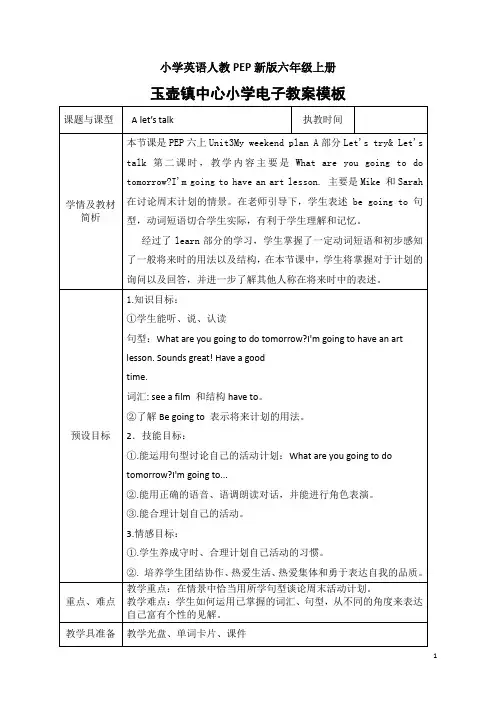
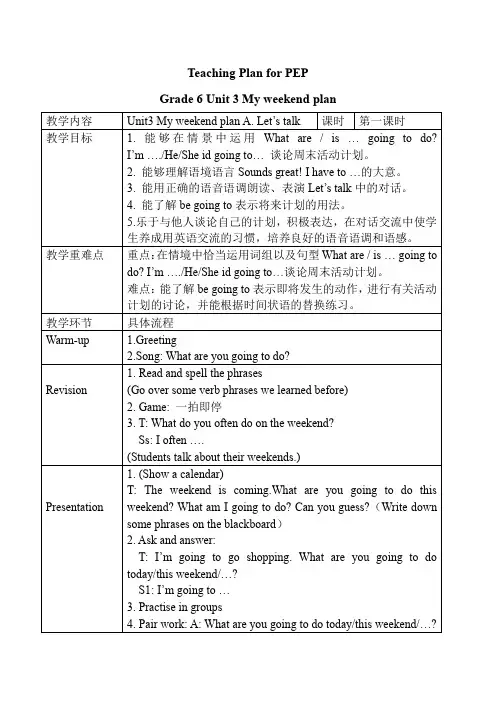
经过了learn部分的学习,学生掌握了一定动词短语和初步感知了一般将来时的用法以及结构,在本节课中,学生将掌握对于计划的询问以及回答,并进一步了解其他人称在将来时中的表述。
预设目标
1.知识目标:
①学生能听、说、认读
句型:What are you going to do tomorrow?I'm going to have an art lesson. Sounds great! Have a good
-Yeah! It’s weekend.
-Children,do you like weekends? What do you usually do on the weekend?
- What about this weekend? What are you going to do this weekend?(引出课题)
小学英语人教PEP新版六年级上册
玉壶镇中心小学电子教案模板
课题与课型
A let’s talk
执教时间
学情及教材简析
本节课是PEP六上Unit3My weekend plan A部分Let's try& Let's talk第二课时,教学内容主要是What are you going to do tomorrow?I'm going to have an art lesson.主要是Mike和Sarah在讨论周末计划的情景。在老师引导下,学生表述be going to句型,动词短语切合学生实际,有利于学生理解和记忆。
统编人教版小学英语六年级上册 U3.A.talk 教学设计
Ss:They are going to …
6. show a schedule:
T: we have lessons from Monday to Friday.
We are going to have an art/.. .class.
Consolidation and Extension
1.Role-play
2.Ask the students to make new dialogues.
3. Let’s try
a. Can Mike go swimming today?
b. Why or why not?
4. Talk about your weekend plan with your partner:
2.能够理解语境语言Sounds great! I have to …的大意。
3.能用正确的语音语调朗读、表演Let’s talk中的对话。
4.能了解be going to表示将来计划的用法。
5.乐于与他人谈论自己的计划,积极表达,在对话交流中使学生养成用英语交流的习惯,培养良好的语音语调和语感。
教学重难点
b. What is Mike going to do tomorrow?
c. What does Mike have to do now?
Listen to the tape and find the answers. Explain some points in the text. Then read it.
A. Let’s talk
What are you going to do tomorrow?
PEP小学英语六年级上册Unit3 PartA Let's talk 教学设计

PEP小学英语六年级上册Unit3 PartA Let's talk 教学设计教学目标:1. 学生能够正确使用How much与There is/are进行问答。
2. 学生能够正确地表述自己喜欢的食物、颜色及学科。
3. 学生能够在语境中理解并正确使用数字1-50。
教学重点:1. 学生掌握数字1-50的读法以及表达方式2. 学生熟练运用Let’s talk教材授课的常用表达法教学难点:1. 学生对于数字1-50的记忆和读法掌握2. 学生在日常交流中的应用能力教学准备:PPT、尺子、橡皮教学过程:Step 1 热身引导1. 老师与学生互动,引领学生进行交流。
2. 学生用英文表达自己的姓名、爱好。
Step 2 自我介绍1. 老师用PPT介绍自己,介绍老师的姓名、爱好、喜欢的食物、颜色等。
2. 学生跟着老师一起进行自我介绍。
Step 3 讲解1. 老师向学生介绍数字1-50的读法和表达方式。
2. 老师向学生介绍常用的Let’s talk表达方式。
Step 4 示范和模仿老师让学生模仿自己表述自己喜欢的食物、颜色及学科,大家尝试用Let’s talk教材授课的表达方式进行交流。
Step 5 训练练习1. 为了让学生熟练掌握Let’s talk教材授课的表达方式,老师会让学生进行练习,通过口语交流来提升学生的语言能力。
2. 老师设计口语练习题目,帮助学生锻炼表述自己喜欢的食物、颜色及学科的能力。
Step 6 知识回顾1. 老师向学生简要回顾今天学到的知识点,包括数字的表达方式和常用表达法。
2. 学生一起复习,加深对知识的印象。
Step 7 课堂练习1. 教师准备“两个人之间的交往”的师生对话篇,以验证本堂课的学习效果。
2. 学生模仿老师的示范,两个人之间用Let’s talk的方法进行交流。
Step 8 作业布置1. 布置Let’s talk作业题目,让学生复习今天所学内容。
2. 提醒学生留意数字的念法和Let’ s talk的表达。
PEP人教版六年级英语上册《Unit3_A_Let’s_talk名师教案》
教材版本:PEP小学英语六年级上册第三单元课题Unit3 My weekend plan 备课时间内容Part A Let’s try L et’s talk主备人复备教师一、课程标准1. 能根据录音模仿说话。
2. 能在教师的指导下运用最常用的日常用语谈论周末计划。
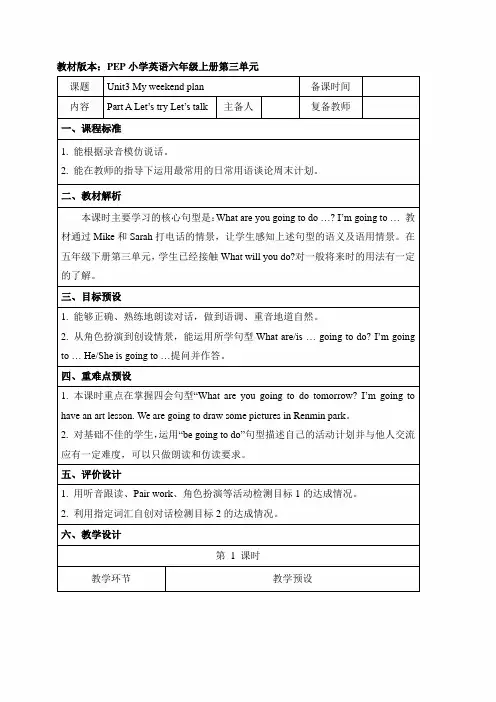
二、教材解析本课时主要学习的核心句型是:What are you going to do …? I’m going to …教材通过Mike和Sarah打电话的情景,让学生感知上述句型的语义及语用情景。
在五年级下册第三单元,学生已经接触What will you do?对一般将来时的用法有一定的了解。
三、目标预设1. 能够正确、熟练地朗读对话,做到语调、重音地道自然。
2. 从角色扮演到创设情景,能运用所学句型What are/is … going to do? I’m going to … He/She is going to …提问并作答。
四、重难点预设1. 本课时重点在掌握四会句型“What are you going to do tomorrow? I’m going to have an art lesson. We are going to draw some pictures in Renmin park。
2. 对基础不佳的学生,运用“be going to do”句型描述自己的活动计划并与他人交流应有一定难度,可以只做朗读和仿读要求。
五、评价设计1. 用听音跟读、Pair work、角色扮演等活动检测目标1的达成情况。
2. 利用指定词汇自创对话检测目标2的达成情况。
六、教学设计第 1 课时教学环节教学预设一、热身/复习(Warm-up/Revision)1. 多媒体课件播放五年级下册第一单元的歌曲My weekend, 师生齐唱。
2. “眼疾口快”教师通过多媒体出示学过的动词短语图片,学生看到快速说出单词。
3. Free talkT: What do you usually do on your weekend?S1: I usually …T: What do you often do on your weekend?S2: I often ……通过对话问答复习所学短语,为本节课打下基础。
PEP人教版英语六年级上册Unit3ALetstalk教学设计
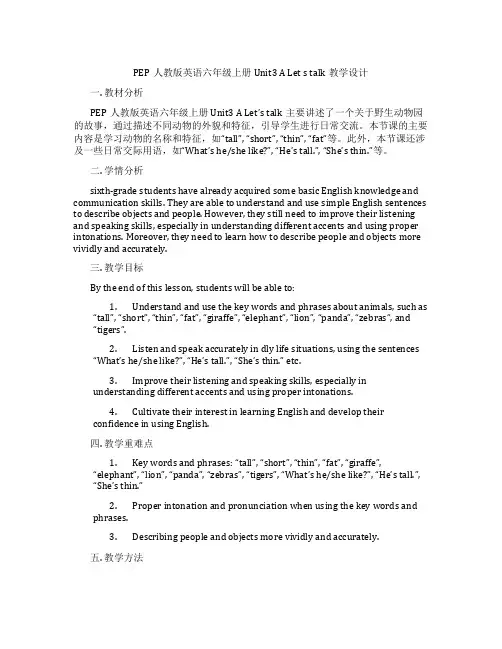
PEP人教版英语六年级上册Unit3 A Let s talk教学设计一. 教材分析PEP人教版英语六年级上册Unit3 A Let’s talk主要讲述了一个关于野生动物园的故事,通过描述不同动物的外貌和特征,引导学生进行日常交流。
本节课的主要内容是学习动物的名称和特征,如“tall”, “short”, “thin”, “fat”等。
此外,本节课还涉及一些日常交际用语,如“What’s he/she like?”, “He’s tall.”, “She’s thin.”等。
二. 学情分析sixth-grade students have already acquired some basic English knowledge and communication skills. They are able to understand and use simple English sentences to describe objects and people. However, they still need to improve their listeningand speaking skills, especially in understanding different accents and using proper intonations. Moreover, they need to learn how to describe people and objects more vividly and accurately.三. 教学目标By the end of this lesson, students will be able to:1.Understand and use the key words and phrases about animals, such as“tall”, “short”, “thin”, “fat”, “giraffe”, “elephant”, “lion”, “panda”, “zebras”, and“tigers”.2.Listen and speak accurately in dly life situations, using the sentences“What’s he/she like?”, “He’s tall.”, “She’s thin.” etc.3.Improve their listening and speaking skills, especially inunderstanding different accents and using proper intonations.4.Cultivate their interest in learning English and develop theirconfidence in using English.四. 教学重难点1.Key words and ph rases: “tall”, “short”, “thin”, “fat”, “giraffe”,“elephant”, “lion”, “panda”, “zebras”, “tigers”, “What’s he/she like?”, “He’s tall.”, “She’s thin.”2.Proper intonation and pronunciation when using the key words andphrases.3.Describing people and objects more vividly and accurately.五. 教学方法1.Audio-visual method: Use pictures, videos, and audio materials to help students better understand the content and improve their listening and speaking skills.2.Task-based language teaching: Create practical tasks for students to apply what they have learned in real-life situations, such as describing animals.3.Cooperative learning: Encourage students to work together in groups to complete tasks and practice their language skills.4.Whole-class teaching: Use questions and answers, discussions, and other interactive methods to engage all students in the classroom.六. 教学准备1.Prepare pictures, videos, and audio materials of different animals.2.Prepare worksheets for students to practice their writing and listening skills.3.Prepare flashcards with pictures and words of the key vocabulary for students to study.七. 教学过程1.Introduction (5 minutes)–Greet students and ask them questions to check their previous knowledge.–Introduce the topic of animals and lead students into the class.2.Presentation (10 minutes)–Show pictures, videos, and audio materials of different animals to help students understand the content.–Introduce the key words and phrases, and teach the sentences “What’s he/she like?”, “He’s tall.”, “She’s thin.”3.Practice (10 minutes)–Divide students into groups and give each group a worksheet to practice their listening and writing skills.–Circulate among the students to help them with their work and answer any questions.4.Consolidation (10 minutes)–Ask students to work in prs to describe a picture of an animal they like.–Encourage students to use the key words and phrases they have learned, and correct their pronunciation and intonation ifnecessary.5.Extension (10 minutes)–Give students a short passage about a zoo, and ask them to read it aloud and answer some questions about it.–Discuss the passage with the students and ask them what they think about the zoo.6.Summary (5 minutes)–Summarize the mn content of the class and ask students if they have any questions.–Remind students to review what they have learned and do their homework.7.Homework (5 minutes)–Give students a worksheet to practice their writing and listening skills.–Remind students to practice their pronunciation andintonation when在本次PEP人教版英语六年级上册Unit3 A Let’s talk的教学设计中,我以教材内容为基础,结合学生的实际情况,制定了明确的教学目标和重难点,并采用了多种教学方法,以期提高学生的英语听力、口语和描述能力。
英语人教版六年级上册Pep7 Unit3 A let's talk

Unit 3 A Let’s try &Let’s talk一、教学目标与要求:1. 能够在图片和教师的帮助下理解对话大意,并回答对话下面的问题。
2. 能够用正确的语音、语调朗读对话,并能进行角色表演。
3、能了解be going to表示即将发生的动作并在真实情境中运用所学语言进行真实交流和运用。
4、乐于与他人谈论自己的计划,积极表达,在对话交流中使学生养成用英语交流的习惯,培养良好的语音语调和语感。
二、教学重点、难点分析:1、能够用正确的语音、语调朗读对话,并能进行角色表演。
2、能了解be going to表示即将发生的动作并在真实情境中运用所学语言进行真实交流和运用。
三、教学准备:1.多媒体课件2.单词图片四、教学过程:Step1.Warming up:Let’s chant:Picture, picture, I will draw a picture.Film, film, I’m going to see a film.Homework , homework, I will do my homework . Lesson, lesson, I’m going to have a lesson.Step2. Presentation:T: good job. Now look at here. I Will and I am going toThey are the same. I Will=I am going to. Clear?S:yes.T: when do we use “I’ll”. Chinese is ok.S:…T:great. Now, look. What is it.S: it’s a calendar.T:great. Saturday and Sunday, we call them…S:weekend.T:cool. So what do you often do on the weekend.S: I often…T:great. On the weekend, I often watch a film. And I often watch TV too. What is on TV?S:…T:yes. What do they often do on weekends?S:they often…T:here is the calendar again. They are…S:weekends.T: and they are this weekend.T: what will they do this weekend? What are they going to do this weekend? Let’s go and have a look. Who is he? S:he is a reporter.T: Who is he?S: he is Fimon.T:great. Now let’s be the reporter. Let’s ask Fimon.S: what are you going to do?T:good. Listen? What do you hear?S: I am going to see a film.T: who can be the reporter? Who can be Cindy?S:…T:good job. Now let’s listen.What is Mike going to do tomorrow?S:He is going to see a film.T:cool. What is Sarah going to do tomorrow? Let’s watch. S: …T: What is Sarah going to do tomorrow?S: she’s going to have an art class.T: great. Sarah says…S:I am going to having an art class.T: what is she going to do in her class?S: draw some pictures in Renmin Park.T: sounds great. What will Mike do then?S:do homework.T:yes. He has to do homework now.Step3: practice:1.Role play2. Fill in the blank3.Let’s chant4.Let’s talkStep4: homework:1.1.Listen to the dialogue and repeat it 3 times.2.完成相关练习3.2.Find the diffience between dilogue A and dilogueB.(找一找A、B两个对话之间的不同之处)五.教育反思:。
小学英语六年级上册Unit 3 Part A Let's talk教学设计
10.Listen and imitate:音频跟读,模仿语音语调,进一步理解课文。
课文导入
音视频帮助学生理解课文
自主阅读,
培养能力
课文精读,语言点学习和运用
跟读模仿
小组合作
更好的掌握新授内容
创设情景,正确运用所学句型
对话练习,巩固单词和句型
通过游戏巩固句型
知识拓展运用
课堂练习
Summary andHomework
Summary
词汇:lesson
句型:询问某人打算/将要做什么事:
-What +be+主语+ going to do?
表达某人将要做某事
-主语+ be going to +动词原形.
Homework
1.听录音跟读let's talk部分对话并情景表演。
2.抄写talk部分对话一遍并背诵。
3.做调查,问3个人最近的计划并向小组长做出汇报。
4.完成配套练习
课堂总结
对学习成果的巩固。
6.Presentation:播放talk部分动画!理解大意.并注意语音语调,
7.Read quickly and try to find out:老师提出几个问题,学生自由阅读并尝试找出答案,
8.Presentation:和老师一起寻找答案吧!可以邀请个别学生说出自己的答案和理由。检阅学生自主阅读的能力和方法。
人教版六年级英语上册Unit_3_Atalk_设计
人教版六年级英语上册Unit 3 My weekend plan(A Let’s try Let’s talk)教学设计PEP Book7 Unit3 My weekend plan教材版本:人教版义务教育教科书六年级上册一、教学目标1. 能够掌握四会句子:What are you going to do tomorrow? I’m going to have an art lesson. We’re going to draw some pictures in Renmin Park.(幻灯片2)2. 能够独立完成Let’s try部分的练习。
(幻灯片4)3. 能够表述自己准备在将来的某个时间里干某事。
二、教学重点、难点1. 掌握四会句子What are you going to do tomorrow? I’m going to lesson. We’ re going to draw some Renmin Park.2. 运用be going to do句型描述自己的活动计划,并与他人进行交流。
三、教法与学法引导法,点拨法,小组合作法。
四、教学过程Step 1 :Warm-up利用Let’s chant复习上节课学习的词汇,进入课堂。
Step 2: PresentationLet’s tryT: It’s Saturday morning. Sarah is on the phone with Mike. Let’s listen to what they are going to do.教师先让学生看问题,画出关键词,然后播放Let’s try部分的录音,学生选择正确答案,并从听觉上进一步感知课时话题。
Let’s talk1. 教师出示图片,与学生进行如下问答:T: Look at the picture , What are they doing?S: have an art lesson.T: What are they going to do tomorrow ?S:They are going to have an art lesson tomorrow.教师引导学生回答have an art lesson. 然后板书并教读单词:tomorrow.教师指着图片问学生:What are you going to do tomorrow? 板书并教读句子:What are you going to do tomorrow? 同时教师适当讲述一般将来时的语法:一般将来时表示将来某一时刻将要发生的动作、行为或存在的状态,或将来某一段时间内经常发生的动作或状态;一般将来时的句子结构:be going to+动词原形可采用如下方式操练:T: be going to doS: be going to doT: What are you going to do?S: What are you going to do?T: What are you going to do tomorrow?S: What are you going to do tomorrow?2. 教师拿着画板,问:What are you going to do tomorrow? 引导学生回答:I’m going to have an art lesson.板书并教读句子:I’m going to have an art lesson.可采用男生问女生答再交换的形式练习句型。
人教pep六年级上册英语 Unit3 My weekend plan A Let's talk 教案
PEP小学英语六年级上册《Unit 3 My weekend plan A Let’s talk》教学设计一、教学目标1.能完成“Let’s try”部分的听力,为“Let’s talk”的学习做准备。
2.能够运用句型“What are/is … going to do?”来询问未来的活动安排。
3.能够运用句型“主语+be + going to …”来回答未来的活动安排。
4.能够用正确的语音语调朗读对话并进行角色表演。
5.能培养学生合理安排时间、计划活动的习惯。
二、教学重、难点1.重点:能听、说、认、读句型:What are you going to do tomorrow?/I’m going to have an art lesson./We’re going to draw some pictures in Renmin Park.2.难点:能够运用句型“be going to”来讨论自己的活动计划,与他人进行交流。
三、教学准备课件,人物头像,电影票道具等。
四、教学过程Step 1:Warm-up1.Enjoy a song: If you are happyT: I am very happy, because I’m going to see a film this weekend. Look, this is my cinema ticket. Do you want it? Ss: Yes!T:If you answer my questions actively and correctly. I’ll invite you to see a film .2.T: I’m going to see a film this weekend. What is she going to do this weekend? Ss:... 老师引导学生说出he,she,和they的将来时的表达方式,并让生讨论自己以及同学的周末计划。
PEP小学英语六年级上册Unit3 PartB Let's talk 教学设计
PEP小学英语六年级上册Unit3 PartB Let's talk 教学设计教学目标:1.学生能够熟练表达出对天气的简单描述和对某种气候的喜好。
2.学生能够通过模仿、练习和模拟情境进行自我表达和交际。
3.学生能够在语境中理解常见的天气用语、天气词汇及常见句式。
4.学生能够自我评价并对自己的发言加以改进,增强语言交流的自信心。
教学重点:1. 小学英语课堂的口语交际2. 对天气的简单描述和对某种气候的喜好3. 天气用语、天气词汇及常见句式教学难点:1. 天气用语的理解和应用2. 学生交际能力的培养教学准备:1. 天气用语、天气词汇及常见句式的图片或卡片。
2. 天气图、视频或其他天气展示工具。
3. 实物或图片让学生了解不同气候的特点。
4. 练习小组卡片、角色扮演卡片等教学辅助材料。
教学过程:Step1:Greetings(10分钟)1. Start with greetings to the students, then teacher and students exchange expectations for today's class.2. Sing a song to introduce the seasonal changes, asking students to explain the visuals accordingly.Step2: Presentation(15分钟)1. Show the weather icons and introduce weather vocabulary, such as sunny, cloudy, snowy, windy, raining, and explain some common phrases such as "What's the weather like today?" and "It's a nice day!"2. Introduce different types of climate and support withvisuals/photos, so that students can get an idea of how each climate is different and how people dress in each climate.Step3: Practice(30分钟)1. Pair the students up and ask them to discuss which weather type they like and dislike, this will help them practice the vocabulary they learned earlier.2. Provide students with a few sentence structures to talk about the weather, and encourage them to use the vocabulary and phrases they learned. For example, start with practicing: "What's the weather like today?", "It's a nice day!", and "Do you likesnow/rainy weather?"3. Teachers could use a weather video or actual weather tools to show the students how to describe the type of weather, as well as its effects.4. In small groups, provide the students with a prompt that requires them to have a conversation about the weather. Some prompts could include "You are going to have a picnic. What kind of weather do you want to see?" or "You are starting school tomorrow, what kind of weather do you hope for?"Step4: Group Practice(20分钟)1. Engage students in group activities in which they simulate being meteorologists or weather reporters. They should use weather icons, pictures, or even flashcards to present the weather in a specific city or region.2. In groups, students could work collaboratively on a project that involves designing and describing a weather-related game, and then presenting this game to the class.3. Use weather idiomatic expressions or proverbs to inspire students to come up with their own sayings about the weather, and then have them present their own.4. Teachers could assign classwork or homework that requires students to match the words with the pictures or create their own dialogues inspired by the weather.Step5: Conclusion(10分钟)1. Ask the students to share their thoughts on what they learned during the lesson, especially on different types of weather and how they could describe them.2. Revisit the goals and objectives outlined earlier, and review what students learned about the phrases, idioms, and expressions used to describe weather.3. End the session by using open-ended questions to challenge the students to think further about the topic of weather, such as “What are the different types of natural disasters that can come from bad weather?”教学反思:本节课主要是让小学生学习如何讨论天气,描述不同的天气状况,以及学会表达自己的气候偏好。