
2018年6月英语四级考试真题答案 ( 第2套)
2018年6月四级部分真题参考答案(完整版)
Part Ⅰ Writing
The Importance of Writing Ability and How to Develop It
As the most productive and communicative way to express ourselves, writing is attached great importance in all ages. Whether we want to improve our writing skills as a creative writer or simply perfect our skills for schoolwork, we can take some steps to learn how to be a better writer.
Firstly, in order to make our writing creative and imaginative, brainstorming is one of the key elements to build up a unique topic. Don't hesitate to take down all the ideas that come into our mind. Secondly, a good development of our writing is based on a clear structure or paragraph organization. Even a simple outline will help us see the big picture and save us hours of rewriting. Finally, diversity of vocabulary and grammar used in writing is highly recommended for the reason that one of the most common manifestations of bad writing is overuse or reuse of simple language.
To sum up, we should take practice and expand our knowledge to become a great writer. With enough hard work and scientific techniques, we will amaze not only ourselves but also anybody else.
Part Ⅱ Listening Comprehension
1. B) Scared.
2. D) It was covered with large scales.
3. A) A study of the fast-food service.
4. C) Increased variety of products.
5. C) U.S. government's approval of private space missions.
6. A) Deliver scientific equipment to the moon.
7. B) It is promising.
8. D) Lying in the sun on a Thai beach.
9. A) She visited a Thai orphanage.
10. D) His phone is running out of power.
11. C) He collects things from different countries.
12. D) Trying out a new gym in town.
13. C) A discount for a half-year membership.
14. A) The safety of weight-lifting.
15. C) She knows the basics of weight-lifting.
16. B) They often apply for a number of positions.
17. A) Get better organized.
18. B) Personalize each application.
19. B) If not forced to go to school, kids would be out in the streets.
20. D) Design activities they now enjoy doing on holidays.
21. D) Take kids out of school to learn at first hand.
22. C) It is seen almost anywhere and on any occasion.
23. D) It offers people a chance to socialize.
24. A) Their state of mind improved.
25. B) It is life.
Part III Reading Comprehension
26-35: MNCJF KLBIE
36-45: EJGCN FBLDH
46-55: BACDA CBADD
Part IV Translation
Buses used to be the main means of transportation for the Chinese people. In recent years, with the number of private cars increasing, cities have been facing increasingly severe traffic problems. To encourage more people to travel by bus, many cities have been making efforts to improve bus services. Bus facilities have been continuously renovated, and bus speed has also increased dramatically. However, bus fares are still cheap. Now, in most cities, many local elderly citizens can take a bus for free.。
2018年6月英语四级考试真题试卷附答案(完整版 第2套)
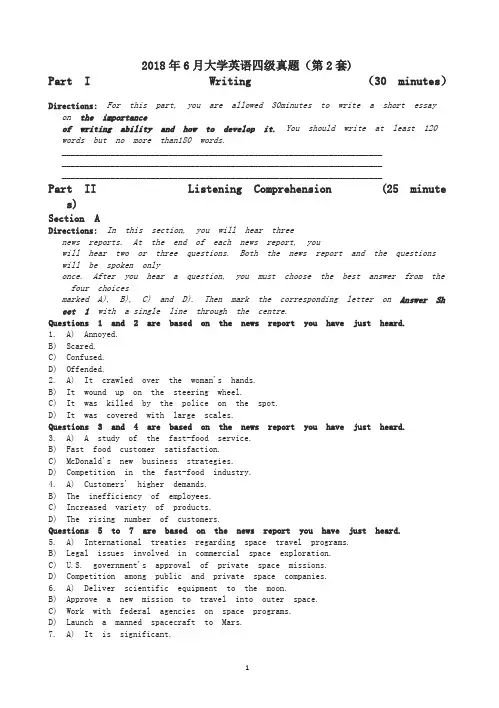
2018年6月大学英语四级真题(第2套)Part I Writing (30 minutes)Directions:For this part, you are allowed 30minutes to write a short essay on the importanceof writing ability and how to develop it.You should write at least 120 words but no more than180 words.________________________________________________________________________________________________________________________________________________________________________________________________________________________Part II Listening Comprehension (25 minute s)Section ADirections: In this section, you will hear threenews reports. At the end of each news report, youwill hear two or three questions. Both the news report and the questions will be spoken onlyonce. After you hear a question, you must choose the best answer from the four choicesmarked A), B), C) and D). Then mark the corresponding letter on Answer Sh eet 1 with a single line through the centre.Questions 1 and 2 are based on the news report you have just heard.1. A) Annoyed.B) Scared.C) Confused.D) Offended.2. A) It crawled over the woman's hands.B) It wound up on the steering wheel.C) It was killed by the police on the spot.D) It was covered with large scales.Questions 3 and 4 are based on the news report you have just heard.3. A) A study of the fast-food service.B) Fast food customer satisfaction.C) McDonald's new business strategies.D) Competition in the fast-food industry.4. A) Customers' higher demands.B) The inefficiency of employees.C) Increased variety of products.D) The rising number of customers.Questions 5 to 7 are based on the news report you have just heard.5. A) International treaties regarding space travel programs.B) Legal issues involved in commercial space exploration.C) U.S. government's approval of private space missions.D) Competition among public and private space companies.6. A) Deliver scientific equipment to the moon.B) Approve a new mission to travel into outer space.C) Work with federal agencies on space programs.D) Launch a manned spacecraft to Mars.7. A) It is significant.B) It is promising.C) It is unpredictable.D) It is unprofitable.Section BDirections:In this section, you will hear two long conversations. At the end of eachconversation, you will hear four questions. Both the conversation and the ques tions will bespoken only once. After you hear a question, you must choose th e best answer from the fourchoices marked A), B), C) and D). Then mark the corresponding letter on Answ er Sheet 1with a single line through the centre.Questions 8 to 11 are based on the conversation you have just heard.8. A) Visiting her family in Thailand.B) Showing friends around Phuket.C) Swimming around a Thai island.D) Lying in the sun on a Thai beach.9. A) She visited a Thai orphanage.B) She met a Thai girl's parents.C) She learned some Thai words.D) She sunbathed on a Thai beach.10. A) His class will start in a minute.B) He has got an incoming phone call.C) Someone is knocking at his door.D) His phone is running out of power.11. A) He is interested in Thai artworks.B) He is going to open a souvenir shop.C) He collects things from different countries.D) He wants to know more about Thai culture.Questions 12 to 15 are based on the conversation you have just heard.12. A) Buying some fitness equipment for the new gym.B) Opening a gym and becoming personal trainers.C) Signing up for a weight-loss course.D) Trying out a new gym in town.13. A) Professional personal training.B) Free exercise for the first week.C) A discount for a half-year membership.D) Additional benefits for young couples.14. A) The safety of weight-lifting.B) The high membership fee.C) The renewal of his membership.D) The operation of fitness equipment.15. A) She wants her invitation renewed.B) She used to do 200 sit-ups every day.C) She knows the basics of weight-lifting.D) She used to be the gym's personal trainer.Section CDirections:In this section, you will hear three passages. At the end of eac h passage, you willhear three or four questions. Both the passage and the questions will be spo ken only once.After you hear a question, you must choose the best answer fro m the four choices marked A),B), C) and D). Then mark the corresponding letter on Answer Sheet 1 with a single line through the centre.Questions 16 to 18 are based on the passage you have just heard.16. A) They tend to be nervous during interviews.B) They often apply for a number of positions.C) They worry about the results of their applications.D) They search extensively for employers' information.17. A) Get better organized.B) Edit their references.C) Find better-paid jobs.D) Analyze the searching process.18. A) Provide their data in detail.B) Personalize each application.C) Make use of better search engines.D) Apply for more promising positions.Questions 19 to 21 are based on the passage you have just heard.19. A) If kids did not like school, real learning would not take place.B) If not forced to go to school, kids would be out in the streets.C) If schools stayed the way they are, parents were sure to protest.D) If teaching failed to improve, kids would stay away from school.20. A) Allow them to play interesting games in class.B) Try to stir up their interest in lab experiments.C) Let them stay home and learn from their parents.D) Design activities they now enjoy doing on holidays.21. A) Allow kids to learn at their own pace.B) Encourage kids to learn from each other.C) Organize kids into various interest groups.D) Take kids out of school to learn at first hand.Questions 22 to 25 are based on the passage you have just heard.22. A) It is especially popular in Florida and Alaska.B) It is a major social activity among the young.C) It is seen almost anywhere and on any occasion.D) It is even more expressive than the written word.23. A) It is located in a big city in Iowa.B) It is really marvelous to look at.C) It offers free dance classes to seniors.D) It offers people a chance to socialize.24. A) Their state of mind improved.B) They became better dancers.C) They enjoyed better health.D) Their relationship strengthened.25. A) It is fun.B) It is life.C) It is exhausting.D) It is rhythmical.Part Ⅲ Reading Comprehension (40 minutes )Section ADirections:In this section, there is a passage with10 blanks. You are requir ed to select one word for each blank from a list of choices given in a word bank following the passage. Read thepassage through carefully before making your choices. Each choice in the ba nk is identifiedby a letter. Please mark the corresponding letter for each item on Answer Sheet 2 with asingle line through the centre. You may not use any of the words in the bank more than once.Since the 1940s, southern California has had a reputation for smog. Things are not as bad as they once were but, according to the American Lung Association, Los Angeles is still the worst city in the United States for levels of __26__ . Gazing down on the city from the Getty Center, an art museum in the Santa Monica Mountains, one would find the view of the Pacific Ocean blurred by the haze (霾). Nor is the state's bad air __27__ to its south. Fresno, in the central valley, comes top of the list in America for year-round pollution. Residents' hearts and lungs are affected as a __28__ . All of which, combined with California's reputation as the home of technological __29__ , makes the place ideal for developing and testing systems designed to monitor pollution in __30__ . And that is just what Aclima, a new firm in San Francisco, has been doing over the past few months. It has been trying out monitoring stations that are __31__ to yield minute-to-minute maps of __32__ air pollution. Such stations will also be able to keep an eye on what is happening inside buildings, including offices.To this end, Aclima has been __33__ with Google's Street View system. Davida Herzl, Aclima's boss, says they have revealed pollution highs on days when San Francisco's transit workers went on strike and the city's __34__ were forced to use their cars. Conversely, "cycle to work" days have done their job by __35__ pollution lows.A)assisted B) collaborating C) consequence D) consumers E) creatingF)detail G)domestic H) frequently I) inhabitants J) innovation K) intende dL) outdoor M) pollutants N) restricted O) sumSection BDirections:In this section, you are going to read a passage with ten statem ents attached toit. Each statement contains information given in one of the paragraphs. Identi fy theparagraph from which the information is derived. You may choose a paragraph m ore thanonce. Each paragraph is marked with a letter. Answer the questions by marking the corresponding letter on Answer Sheet 2.As Tourists Crowd Out Locals, Venice Faces 'Endangered' ListA)On a recent fall morning, a large crowd blocked the steps at one of Venice's main tourist sites, the Rialto Bridge. The Rialto Bridge is one of the four bridges spanning the Grand Canal. It is the oldest bridge across the canal, and was the dividing line between the districts of San Marco and San Polo. But on this day, there was a twist: it was filled with Venetians, not tourists.B) "People are cheering and holding their carts in the air," says Giovanni Giorgio, who helped organize the march with a grass-roots organization called Generazione '90. The carts he refers to are small shopping carts—the symbol of a true Venetian. "It started as a joke," he says with a laugh. "The idea was to put blades on the wheels! You know? Like Ben Hur. Precisely like that, you just go around and run people down."C) Venice is one of the hottest tourist destinations in the world. But that's a problem. Up to 90,000 tourists crowd its streets and canals every day—far outnumbering the 55,000permanent residents. The tourist increase is one key reason the city's population is down from 175,000 in the 1950s. The outnumbered Venetians have been steadily fleeing. And those who stick around are tired of living in a place where they can't even get to the market without swimming through a sea of picture-snapping tourists. Imagine, navigating through 50,000 people while on the way to school or to work.D) Laura Chigi, a grandmother at the march, says the local and national governments have failed to do anything about the crowds for decades, because they're only interested in tourism—the primary industry in Venice, worth more than $3 billion in 2015. "Venice is a cash cow," she says, "and everyone wants a piece."E) Just beyond St. Mark's Square, a cruise ship passes, one of hundreds every year that appear over their medieval (中世纪的) surroundings. Their massive wake creates waves at the bottom of the sea, weakening the foundations of the centuries-old buildings themselves. "Every time I see a cruise ship, I feel sad," Chigi says. "You see the mud it drags; the destruction it leaves in its wake? That hurts the ancient wooden poles holding up the city underwater. One day we'll see Venice break down."F)For a time, UNESCO, the cultural wing of the United Nations, seemed to agree. Two years ago, it put Italy on notice, saying the government was not protecting Venice. UNESCO considers the entire city a World Heritage Site, a great honor that means Venice, at the cultural level, belongs to all of the world's people. In 2014, UNESCO gave Italy two years to manage Venice's flourishing tourism or the city would be placed on another list—World Heritage In Danger, joining such sites as Aleppo and Palmyra, destroyed by the war in Syria.G) Venice's deadline passed with barely a murmur (嘟哝) this summer, just as UNESCO was meeting in Istanbul. Only one representative, Jad Tabet from Lebanon, tried to raise the issue. "For several years, the situation of heritage in Venice has been worsening, and it has now reached a dramatic situation," Tabet told UNESCO. "We have to act quickly—there is not a moment to waste."H) But UNESCO didn't even hold a vote. "It's been postponed until 2017," says Anna Somers, the founder and CEO of The Art Newspaper and the former head of Venice in Peril, a group devoted to restoring Venetian art. She says the main reason the U.N. cultural organization didn't vote to declare Venice a World Heritage Site In Danger is because UNESCO has become "intensely politicized. There would have been some back-room negotiations."I) Italy boasts more UNESCO World Heritage Sites than any other country in the world, granting it considerable power and influence within the organization. The former head of the UNESCO World Heritage Centre, which oversees heritage sites, is Francesco Bandarin, a Venetian who now serves as UNESCO's assistant director-general for culture.J) Earlier this year, Italy signed an accord with UNESCO to establish a task force of police art detectives and archaeologists (考古学家) to protect cultural heritage from natural disasters and terror groups, such as ISIS. The accord underlined Italy's global reputation as a good steward of art and culture.K)But adding Venice to the UNESCO endangered list—which is dominated by sites in developing and conflict-ridden countries—would be an international embarrassment, and could even hurt Italy's profitable tourism industry. The Italian Culture Ministry says it is unaware of any government efforts to pressure UNESCO. As for the organization itself, it declined arequest for an interview.L) The city's current mayor, Luigi Brugnaro, has ridiculed UNESCO and told it to mind its own business, while continuing to support the cruise ship industry, which employs 5,000 Venice residents.M) As for Venetians, they're beyond frustrated and hoping for a solution soon. "It's a nightmare for me. Some situations are really difficult with tourists around," says Giorgio as he navigates around a swelling crowd at the Rialto Bridge. "There are just so many of them. They never know where they are going, and do not walk in an orderly manner. Navigating the streets can be exhausting."N) Then it hits him: This crowd isn't made up of tourists. They're Venetians. Giorgio says he's never experienced the Rialto Bridge this way in all his 22 years. "For once, we are the ones who are blocking the traffic," he says delightedly. "It feels unreal. It feels like we're some form of endangered species. It's just nice. The feeling is just pure." But, he worries, if tourism isn't managed and his fellow locals continue to move to the mainland, his generation might be the last who can call themselves native Venetians.36. The passing cruise ships will undermine the foundations of the ancient buildings in Venice.37. The Italian government has just reached an agreement with UNESCO to take measures to protect its cultural heritage.38. The heritage situation in Venice has been deteriorating in the past few years.39. The decrease in the number of permanent residents in Venice is mainly due to the increase of tourists.40. If tourism gets out of control, native Venetians may desert the city altogether one day.41. UNESCO urged the Italian government to undertake its responsibility to protect Venice.42. The participants in the Venetian march used shopping carts to show they were 100% local residents.43. Ignoring UNESCO's warning, the mayor of Venice maintains his support of the city's tourism industry.44. One woman says that for decades the Italian government and local authorities have only focused on the revenues from tourism.45. UNESCO has not yet decided to put Venice on the list of World Heritage Sites In Danger. Section CDirections:There are 2 passages in this section. Each passage is followed by some questionsor unfinished statements. For each of them there are four choices marked A), B), C) andD). You should decide on the best choice and mark the corresponding letter o n Answer Sheet2 with a single line through the centre.Passage OneQuestions 46 and 50 are based on the following passage.Passage OneQuestions 46 to 50 are based on the following passage.Living in an urban area with green spaces has a long-lasting positive impact on people's mental well-being, a study has suggested. UK researchers found moving to a green space had a sustained positive effect, unlike pay rises or promotions, which only provided a short-term boost. Co-author Mathew White, from the University of Exeter, UK, explained that the studyshowed people living in greener urban areas were displaying fewer signs of depression or anxiety. "There could be a number of reasons," he said, "for example, people do many things to make themselves happier: they strive for promotion or pay rises, or they get married. But the trouble with those things is that within six months to a year, people are back to their original baseline levels of well-being. So, these things are not sustainable; they don't make us happy in the long term. We found that for some lottery (彩票) winners who had won more than £500,000 the positive effect was definitely there, but after six months to a year, they were back to the baseline."Dr. White said his team wanted to see whether living in greener urban areas had a lasting positive effect on people's sense of well-being or whether the effect also disappeared after a period of time. To do this, the team used data from the British Household Panel Survey compiled by the University of Essex.Explaining what the data revealed, he said: "What you see is that even after three years, mental health is still better, which is unlike many other things that we think will make us happy." He observed that people living in green spaces were less stressed, and less stressed people made more sensible decisions and communicated better.With a growing body of evidence establishing a link between urban green spaces and a positive impact on human well-being, Dr. White said, "There's growing interest among public policy officials, but the trouble is who funds it. What we really need at a policy level is to decide where the money will come from to help support good quality local green spaces."46.According to one study, what do green spaces do to people?A.Improve their work efficiency.B.Add to their sustained happiness.C.Help them build a positive attitude towards life.D.Lessen their concerns about material well-being.47.What does Dr. White say people usually do to make themselves happier?A.Earn more money.B.Settle in an urban area.C.Gain fame and popularity.D.Live in a green environment.48.What does Dr. White try to find out about living in a greener urban area?A.How it affects different people.B.How strong its positive effect is.C.How long its positive effect lasts.D.How it benefits people physically.49.What did Dr. White's research reveal about people living in a green environment?A.Their stress was more apparent than real.B.Their decisions required less deliberation.C.Their memories were greatly strengthened.D.Their communication with others improved.50.According to Dr. White, what should the government do to build more green spaces in cities?A.Find financial support.B.Improve urban planning.C.Involve local residents in the effort.D.Raise public awareness of the issue.Passage TwoPassage TwoQuestions 51 to 55 are based on the following passage.You probably know about the Titanic, but it was actually just one of three state-of-the-art (先进的) ocean ships back in the day. The Olympic class ships were built by the Harland & Wolff ship makers in Northern Ireland for the White Star Line company. The Olympic class included the Olympic, the Britannic and the Titanic. What you may not know is that the Titanic wasn't even the flagship of this class. All in all, the Olympic class ships were marvels of sea engineering, but they seemed cursed to suffer disastrous fates.The Olympic launched first in 1910, followed by the Titanic in 1911, and lastly the Britannic in 1914. The ships had nine decks, and White Star Line decided to focus on making them the most luxurious ships on the water.Stretching 269.13 meters, the Olympic class ships were wonders of naval technology, and everyone thought that they would continue to be so for quite some time. However, all suffered terrible accidents on the open seas. The Olympic got wrecked before the Titanic did, but it was the only one to survive and maintain a successful career of 24 years. The Titanic was the first to sink after famously hitting a huge iceberg in 1912. Following this disaster, the Britannic hit a naval mine in 1916 and subsequently sank as well.Each ship was coal-powered by several boilers constantly kept running by exhausted crews below deck. Most recognizable of the ship designs are the ship's smoke stacks, but the fourth stack was actually just artistic in nature and served no functional purpose. While two of these ships sank, they were all designed with double hulls (船体) believed to make them "unsinkable", perhaps a mistaken idea that led to the Titanic's and the Britannic's tragic end.The Olympic suffered two crashes with other ships and went on to serve as a hospital ship and troop transport in World War I. Eventually, she was taken out of service in 1935, ending the era of the luxurious Olympic class ocean liners.51.What does the passage say about the three Olympic class ships?A.They performed marvellously on the sea.B.They could all break the ice in their way.C.They all experienced terrible misfortunes.D.They were models of modern engineering.52.What did White Star Line have in mind when it purchased the three ships?A.Their capacity of sailing across all waters.B.The utmost comfort passengers could enjoy.C.Their ability to survive disasters of any kind.D.The long voyages they were able to undertake.53.What is said about the fourth stack of the ships?A.It was a mere piece of decoration.B.It was the work of a famous artist.C.It was designed to let out extra smoke.D.It was easily identifiable from afar.54.What might have led to the tragic end of the Titanic and the Britannic?A.Their unscientific designs.B.Their captains' misjudgment.C.The assumption that they were built with the latest technology.D.The belief that they could never sink with a double-layer body.55.What happened to the ship Olympic in the end?A.She was used to carry troops.B.She was sunk in World War I.C.She was converted into a hospital ship.D.She was retired after her naval service.Part IV Translation (30 minutes )Directions: For this part, you are allowed 30minutes to translate a passag e from Chinese into English. You should write your answer on Answer Sheet 2.公交车曾是中国人出行的主要交通工具。
2018年6月英语四级真题及答案解析和听力原文(卷二)
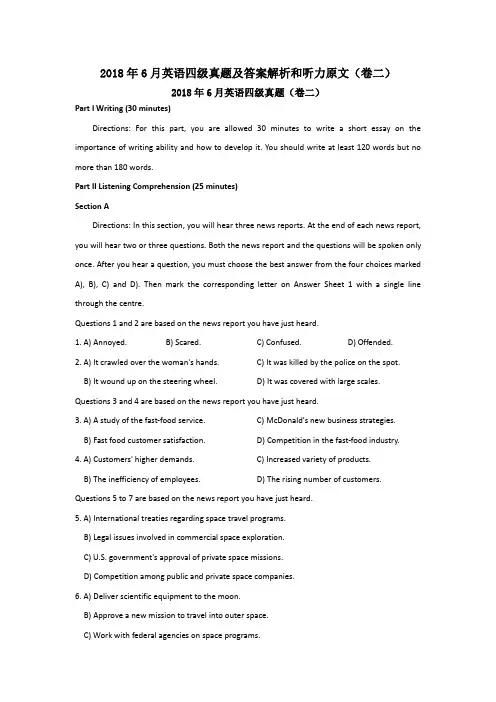
2018年6月英语四级真题及答案解析和听力原文(卷二)2018年6月英语四级真题(卷二)Part I Writing (30 minutes)Directions: For this part, you are allowed 30 minutes to write a short essay on the importance of writing ability and how to develop it. You should write at least 120 words but no more than 180 words.Part II Listening Comprehension (25 minutes)Section ADirections: In this section, you will hear three news reports. At the end of each news report, you will hear two or three questions. Both the news report and the questions will be spoken only once. After you hear a question, you must choose the best answer from the four choices marked A), B), C) and D). Then mark the corresponding letter on Answer Sheet 1 with a single line through the centre.Questions 1 and 2 are based on the news report you have just heard.1. A) Annoyed. B) Scared. C) Confused. D) Offended.2. A) It crawled over the woman's hands.B) It wound up on the steering wheel. C) It was killed by the police on the spot.D) It was covered with large scales.Questions 3 and 4 are based on the news report you have just heard.3. A) A study of the fast-food service.B) Fast food customer satisfaction. C) McDonald's new business strategies.D) Competition in the fast-food industry.4. A) Customers' higher demands.B) The inefficiency of employees. C) Increased variety of products.D) The rising number of customers.Questions 5 to 7 are based on the news report you have just heard.5. A) International treaties regarding space travel programs.B) Legal issues involved in commercial space exploration.C) U.S. government's approval of private space missions.D) Competition among public and private space companies.6. A) Deliver scientific equipment to the moon.B) Approve a new mission to travel into outer space.C) Work with federal agencies on space programs.D) Launch a manned spacecraft to Mars.7. A) It is significant. B) It is promising. C) It is unpredictable. D) It is unprofitable. Section BDirections: In this section, you will hear two long conversations. At the end of each conversation, you will hear four questions. Both the conversation and the questions will be spoken only once. After you hear a question, you must choose the best answer from the four choices marked A), B), C) and D). Then mark the corresponding letter on Answer Sheet 1 with a single line through the centre.Questions 8 to 11 are based on the conversation you have just heard.8. A) Visiting her family in Thailand.B) Showing friends around Phuket. C) Swimming around a Thai island.D) Lying in the sun on a Thai beach.9. A) She visited a Thai orphanage.B) She met a Thai girl's parents. C) She learned some Thai words.D) She sunbathed on a Thai beach.10. A) His class will start in a minute.B) He has got an incoming phone call. C) Someone is knocking at his door.D) His phone is running out of power.11. A) He is interested in Thai artworks.B) He is going to open a souvenir shop. C) He collects things from different countries.D) He wants to know more about Thai culture.Questions 12 to 15 are based on the conversation you have just heard.12. A) Buying some fitness equipment for the new gym.B) Opening a gym and becoming personal trainers.C) Signing up for a weight-loss course.D) Trying out a new gym in town.13. A) Professional personal training.B) Free exercise for the first week. C) A discount for a half-year membership.D) Additional benefits for young couples.14. A) The safety of weight-lifting.B) The high membership fee. C) The renewal of his membership.D) The operation of fitness equipment.15. A) She wants her invitation renewed.B) She used to do 200 sit-ups every day. C) She knows the basics of weight-lifting.D) She used to be the gym's personal trainer.Section CDirections: In this section, you will hear three passages. At the end of each passage, you willhear three or four questions. Both the passage and the questions will be spoken only once. After you hear a question, you must choose the best answer from the four choices marked A), B), C) and D). Then mark the corresponding letter on Answer Sheet 1 with a single line through the centre.Questions 16 to 18 are based on the passage you have just heard.16. A) They tend to be nervous during interviews.B) They often apply for a number of positions.C) They worry about the results of their applications.D) They search extensively for employers' information.17. A) Get better organized.B) Edit their references. C) Find better-paid jobs.D) Analyze the searching process.18. A) Provide their data in detail.B) Personalize each application. C) Make use of better search engines.D) Apply for more promising positions.Questions 19 to 21 are based on the passage you have just heard.19. A) If kids did not like school, real learning would not take place.B) If not forced to go to school, kids would be out in the streets.C) If schools stayed the way they are, parents were sure to protest.D) If teaching failed to improve, kids would stay away from school.20. A) Allow them to play interesting games in class.B) Try to stir up their interest in lab experiments.C) Let them stay home and learn from their parents.D) Design activities they now enjoy doing on holidays.21. A) Allow kids to learn at their own pace.B) Encourage kids to learn from each other. C) Organize kids into various interest groups.D) Take kids out of school to learn at first hand.Questions 22 to 25 are based on the passage you have just heard.22. A) It is especially popular in Florida and Alaska.B) It is a major social activity among the young.C) It is seen almost anywhere and on any occasion.D) It is even more expressive than the written word.23. A) It is located in a big city in Iowa. B) It is really marvelous to look at.C) It offers free dance classes to seniors. D) It offers people a chance to socialize.24. A) Their state of mind improved.B) They became better dancers. C) They enjoyed better health.D) Their relationship strengthened.25. A) It is fun. B) It is life. C) It is exhausting. D) It is rhythmical.Part ⅢReading Comprehension (40 minutes)Section ADirections: In this section, there is a passage with ten blanks. You are required to select one word for each blank from a list of choices given in a word bank following the passage. Read the passage through carefully before making your choices. Each choice in the bank is identified by a letter. Please mark the corresponding letter for each item on Answer Sheet 2 with a single line through the centre. You may not use any of the words in the bank more than once.An office tower on Miller Street in Manchester is completely covered in solar panels. They are used to create some of the energy used by the insurance company inside. When the tower was first 26 in 1962, it was covered with thin square stones. These small square stones became a problem for the building and continued to fall off the face for 40 years until a major renovation was 27 . During this renovation the building's owners, CIS, 28 the solar panel company, Solarcentury. They agreed to cover the entire building in solar panels. In 2004, the completed CIS tower became Europe's largest 29 of vertical solar panels. A vertical solar project on such a large 30 has never been repeated since.Covering a skyscraper with solar panels had never been done before, and the CIS tower was chosen as one of the "10 best green energy projects". For a long time after this renovation project, it was the tallest building in the United Kingdom, but it was 31 overtaken by the Millbank Tower.Green buildings like this aren't 32 cost-efficient for the investor, but it does produce much less pollution than that caused by energy 33 through fossil fuels. As solar panels get 34 , the world is likely to see more skyscrapers covered in solar panels, collecting energy much like trees do. Imagine a world where building the tallest skyscraper wasn't a race of 35 , but rather one to collect the most solar energy.A. cheaperB. cleanerC. collectionD. competedE. constructedF. consultedG. dimensionH. discoveredI. eventuallyJ. heightK. necessarily L. production M. range N. scale O. undertaken Section BDirections: In this section, you are going to read a passage with ten statements attached to it. Each statement contains information given in one of the paragraphs. Identify the paragraph from which the information is derived. You may choose a paragraph more than once. Each paragraph is marked with a letter. Answer the questions by marking the corresponding letter on Answer Sheet 2.As Tourists Crowd Out Locals, Venice Faces 'Endangered' List[A] On a recent fall morning, a large crowd blocked the steps at one of Venice's main tourist sites, the Rialto Bridge. The Rialto Bridge is one of the four bridges spanning the Grand Canal. It is the oldest bridge across the canal, and was the dividing line between the districts of San Marco and San Polo. But on this day, there was a twist: it was filled with Venetians, not tourists.[B] "People are cheering and holding their carts in the air," says Giovanni Giorgio, who helped organize the march with a grass-roots organization called Generazione '90. The carts he refers to are small shopping carts—the symbol of a true Venetian. "It started as a joke," he says with a laugh. "The idea was to put blades on the wheels! You know? Like Ben Hur. Precisely like that, you just go around and run people down."[C] Venice is one of the hottest tourist destinations in the world. But that's a problem. Up to 90,000 tourists crowd its streets and canals every day—far outnumbering the 55,000 permanent residents. The tourist increase is one key reason the city's population is down from 175,000 in the 1950s. The outnumbered Venetians have been steadily fleeing. And those who stick around are tired of living in a place where they can't even get to the market without swimming through a sea of picture-snapping tourists. Imagine, navigating through 50,000 people while on the way to school or to work.[D] Laura Chigi, a grandmother at the march, says the local and national governments have failed to do anything about the crowds for decades, because they're only interested in tourism—the primary industry in Venice, worth more than $3 billion in 2015. "Venice is a cash cow," she says, "and everyone wants a piece."[E] Just beyond St. Mark's Square, a cruise ship passes, one of hundreds every year that appear over their medieval (中世纪的) surroundings. Their massive wake creates waves at thebottom of the sea, weakening the foundations of the centuries-old buildings themselves. "Every time I see a cruise ship, I feel sad," Chigi says. "You see the mud it drags; the destruction it leaves in its wake? That hurts the ancient wooden poles holding up the city underwater. One day we'll see Venice break down."[F] For a time, UNESCO, the cultural wing of the United Nations, seemed to agree. Two years ago, it put Italy on notice, saying the government was not protecting Venice. UNESCO considers the entire city a World Heritage Site, a great honor that means Venice, at the cultural level, belongs to all of the world's people. In 2014, UNESCO gave Italy two years to manage Venice's flourishing tourism or the city would be placed on another list—World Heritage In Danger, joining such sites as Aleppo and Palmyra, destroyed by the war in Syria.[G] Venice's deadline passed with barely a murmur (嘟哝) this summer, just as UNESCO was meeting in Istanbul. Only one representative, Jad Tabet from Lebanon, tried to raise the issue. "For several years, the situation of heritage in Venice has been worsening, and it has now reached a dramatic situation," Tabet told UNESCO. "We have to act quickly—there is not a moment to waste."[H] But UNESCO didn't even hold a vote. "It's been postponed until 2017," says Anna Somers, the founder and CEO of The Art Newspaper and the former head of Venice in Peril, a group devoted to restoring Venetian art. She says the main reason the U.N. cultural organization didn't vote to declare Venice a World Heritage Site In Danger is because UNESCO has become “intensely politicized”. There would have been s ome back-room negotiations."[I] Italy boasts more UNESCO World Heritage Sites than any other country in the world, granting it considerable power and influence within the organization. The former head of the UNESCO World Heritage Centre, which oversees heritage sites, is Francesco Bandarin, a Venetian who now serves as UNESCO's assistant director-general for culture.[J] Earlier this year, Italy signed an accord with UNESCO to establish a task force of police art detectives and archaeologists (考古学家) to protect cultural heritage from natural disasters and terror groups, such as ISIS. The accord underlined Italy's global reputation as a good steward of art and culture.[K] But adding Venice to the UNESCO endangered list—which is dominated by sites in developing and conflict-ridden countries—would be an international embarrassment, and couldeven hurt Italy's profitable tourism industry. The Italian Culture Ministry says it is unaware of any government efforts to pressure UNESCO. As for the organization itself, it declined a request for an interview.[L] The city's current mayor, Luigi Brugnaro, has ridiculed UNESCO and told it to mind its own business, while continuing to support the cruise ship industry, which employs 5,000 Venice residents.[M] As for Venetians, they're beyond frustrated and hoping for a solution soon. "It's a nightmare for me. Some situations are really difficult with tourists around," says Giorgio as he navigates around a swelling crowd at the Rialto Bridge. "There are just so many of them. They never know where they are going, and do not walk in an orderly manner. Navigating the streets can be exhausting."[N] Then it hits him: This crowd isn't made up of tourists. They're Venetians. Giorgio says he's never experienced the Rialto Bridge this way in all his 22 years. "For once, we are the ones who are blocking the traffic," he says delightedly. "It feels unreal. It feels like we're some form of endangered species. It's just nice. The feeling is just pure." But, he worries, if tourism isn't managed and his fellow locals continue to move to the mainland, his generation might be the last who can call themselves native Venetians.36. The passing cruise ships will undermine the foundations of the ancient buildings in Venice.37. The Italian government has just reached an agreement with UNESCO to take measures to protect its cultural heritage.38. The heritage situation in Venice has been deteriorating in the past few years.39. The decrease in the number of permanent residents in Venice is mainly due to the increase of tourists.40. If tourism gets out of control, native Venetians may desert the city altogether one day.41. UNESCO urged the Italian government to undertake its responsibility to protect Venice.42. The participants in the Venetian march used shopping carts to show they were 100% local residents.43. Ignoring UNESCO's warning, the mayor of Venice maintains his support of the city's tourism industry.44. One woman says that for decades the Italian government and local authorities have only focused on the revenues from tourism.45. UNESCO has not yet decided to put Venice on the list of World Heritage Sites In Danger. Section CDirections: There are 2 passages in this section. Each passage is followed by some questions or unfinished statements. For each of them there are four choices marked A), B), C) and D). You should decide on the best choice and mark the corresponding letter on Answer Sheet 2 with a single line through the centre.Passage OneQuestions 46 and 50 are based on the following passage.Living in an urban area with green spaces has a long-lasting positive impact on people's mental well-being, a study has suggested. UK researchers found moving to a green space had a sustained positive effect, unlike pay rises or promotions, which only provided a short-term boost. Co-author Mathew White, from the University of Exeter, UK, explained that the study showed people living in greener urban areas were displaying fewer signs of depression or anxiety. "There could be a number of reasons," he said, "for example, people do many things to make themselves happier: they strive for promotion or pay rises, or they get married. But the trouble with those things is that within six months to a year, people are back to their original baseline levels of well-being. So, these things are not sustainable; they don't make us happy in the long term. We found that for some lottery (彩票) winners who had won more than £500,000 the positive effect was definitely there, but after six months to a year, they were back to the baseline."Dr. White said his team wanted to see whether living in greener urban areas had a lasting positive effect on people's sense of well-being or whether the effect also disappeared after a period of time. To do this, the team used data from the British Household Panel Survey compiled by the University of Essex.Explaining what the data revealed, he said: "What you see is that even after three years, mental health is still better, which is unlike many other things that we think will make us happy." He observed that people living in green spaces were less stressed, and less stressed people made more sensible decisions and communicated better.With a growing body of evidence establishing a link between urban green spaces and apositive impact on human well-being, Dr. White said, "There's growing interest among public policy officials, but the trouble is who funds it. What we really need at a policy level is to decide where the money will come from to help support good quality local green spaces."46. According to one study, what do green spaces do to people?A) Improve their work efficiency. C) Help them build a positive attitude towards life.B) Add to their sustained happiness. D) Lessen their concerns about material well-being.47. What does Dr. White say people usually do to make themselves happier?A) Earn more money.B) Settle in an urban area. C) Gain fame and popularity.D) Live in a green environment.48. What does Dr. White try to find out about living in a greener urban area?A) How it affects different people.B) How strong its positive effect is. C) How long its positive effect lasts.D) How it benefits people physically.49. What did Dr. White's research reveal about people living in a green environment?A) Their stress was more apparent than real.B) Their decisions required less deliberation. C) Their memories were greatly strengthened.D) Their communication with others improved.50. According to Dr. White, what should the government do to build more green spaces in cities?A) Find financial support.B) Improve urban planning. C) Involve local residents in the effort.D) Raise public awareness of the issue.Passage TwoQuestions 51 to 55 are based on the following passage.A letter written by Charles Darwin in 1875 has been returned to the Smithsonian Institution Archives(档案馆)by the FBI after being stolen twice.“We realized i n the mid-1970s that it was missing,” says Effie Kapsalis, head of the Smithsonian Institution Archives. “It was noted as missing and likely taken by an intern, from what the FBI is telling us. Word got out that it was missing when someone asked to see the letter for research purposes,” and the intern put the letter back.“The intern likely took the letter again once nobody was watching it.”Decades passed. Finally the FBI received a tip that the stolen document was located very close to Washington, D.C. Their art crime team recovered the letter but were unable to press charges because the time of limitations had ended. The FBI worked closely with the Archives todetermine that the letter was both authentic and definitely Smithsonian’s property.The letter was written by Darwin to thank an American geologist, Dr. Ferdinand Vandeveer Hayden, for sending him copies of his research into the geology of the region that would become Yellowstone National Park.The letter is in fairly good condition, in spite of being out of the care of trained museum staff for so long. “It was luckily in good shape,” says Kapsalis, “and we just have to do some minor things in order to be able to unfold it. It has some glue on it that has colored it slightly, but nothing that will prevent us from using it. After it is repaired, we will take digital photos of it and that will be available online. One of our goals is to get items of high research value or interest to the public online.”It would now be difficult for an intern, visitor or a thief to steal a document like this. “Archiving practices have changed greatly since the 1970s,” says Kapsalis, “and we keep our high value documents in a safe that I don’t even have access to.”51.What happened to Darwin's letter in the 1970s?A) It was recovered by the FBI. C) It was put in the archives for research purposes.B) It was stolen more than once. D) It was purchased by the Smithsonian Archives.52.What did the FBI do after the recovery of the letter?A) They proved its authenticity.B) They kept it in a special safe. C) They arrested the suspect immediately.D) They pressed criminal charges in vain.53.What is Darwin's letter about?A) The evolution of Yellowstone National Park.B) His cooperation with an American geologist.C) Some geological evidence supporting his theory.D) His acknowledgement of help from a professional.54.What will the Smithsonian Institution Archives do with the letter according to Kapsalis?A) Reserve it for research purposes only.B) Turn it into an object of high interest. C) Keep it a permanent secret.D) Make it available online.55.What has the past half century witnessed according to Kapsalis?A) Growing interest in rare art objects.B) Radical changes in archiving practices. C) Recovery of various missing documents.D) Increases in the value of museum exhibits.Part IV Translation (30 minutes)Directions: For this part, you are allowed 30 minutes to translate a passage from Chinese into English. You should write your answer on Answer Sheet 2.过去,乘飞机出行对大多数中国人来说是难以想象的。
(完整版)2018年6月大学英语四级真题(第二套)

2018年6月大学英语四级真题(第2套)Part I Writing (30 minutes)Directions:For this part, you are allowed 30minutes to write a short essay on the importance of writing ability and how to develop it. You should write at least 120 words but no more than 180 words.________________________________________________________________________ ________________________________________________________________________ ________________________________________________________________________Part II Listening Comprehension (25 minutes)Section ADirections: In this section, you will hear three news reports. At the end of each news report, you will hear two or three questions. Both the news report and the questions will be spoken only once. After you hear a question, you must choose the best answer from the four choicesmarked A), B), C) and D). Then mark the corresponding letter on Answer Sheet 1 with asingle line through the centre.Questions 1 and 2 are based on the news report you have just heard.1. A) Annoyed.B) Scared.C) Confused.D) Offended.2. A) It crawled over the woman's hands.B) It wound up on the steering wheel.C) It was killed by the police on the spot.D) It was covered with large scales.Questions 3 and 4 are based on the news report you have just heard.3. A) A study of the fast-food service.B) Fast food customer satisfaction.C) McDonald's new business strategies.D) Competition in the fast-food industry.4. A) Customers' higher demands.B) The inefficiency of employees.C) Increased variety of products.D) The rising number of customers.Questions 5 to 7 are based on the news report you have just heard.5. A) International treaties regarding space travel programs.B) Legal issues involved in commercial space exploration.C) U.S. government's approval of private space missions.D) Competition among public and private space companies.6. A) Deliver scientific equipment to the moon.B) Approve a new mission to travel into outer space.C) Work with federal agencies on space programs.D) Launch a manned spacecraft to Mars.7. A) It is significant.B) It is promising.C) It is unpredictable.D) It is unprofitable.Section BDirections:In this section, you will hear two long conversations. At the end of each conversation, you will hear four questions. Both the conversation and the questions will bespoken only once. After you hear a question, you must choose the best answer from the fourchoices marked A), B), C) and D). Then mark the corresponding letter on Answer Sheet 1with a si ngle line through the centre.Questions 8 to 11 are based on the conversation you have just heard.8. A) Visiting her family in Thailand.B) Showing friends around Phuket.C) Swimming around a Thai island.D) Lying in the sun on a Thai beach.9. A) She visited a Thai orphanage.B) She met a Thai girl's parents.C) She learned some Thai words.D) She sunbathed on a Thai beach.10. A) His class will start in a minute.B) He has got an incoming phone call.C) Someone is knocking at his door.D) His phone is running out of power.11. A) He is interested in Thai artworks.B) He is going to open a souvenir shop.C) He collects things from different countries.D) He wants to know more about Thai culture.Questions 12 to 15 are based on the conversation you have just heard.12. A) Buying some fitness equipment for the new gym.B) Opening a gym and becoming personal trainers.C) Signing up for a weight-loss course.D) Trying out a new gym in town.13. A) Professional personal training.B) Free exercise for the first week.C) A discount for a half-year membership.D) Additional benefits for young couples.14. A) The safety of weight-lifting.B) The high membership fee.C) The renewal of his membership.D) The operation of fitness equipment.15. A) She wants her invitation renewed.B) She used to do 200 sit-ups every day.C) She knows the basics of weight-lifting.D) She used to be the gym's personal trainer.Section CDirections:In this section, you will hear three passages. At the end of each passage, you will hear three or four questions. Both the passage and the questions will be spoken only once.After yo u hear a question, you must choose the best answer from the four choices marked A),B), C) and D) . Then mark the corresponding letter on Answer Sheet 1 with a single line through the centre. Questions 16 to 18 are based on the passage you have just heard.16. A) They tend to be nervous during interviews.B) They often apply for a number of positions.C) They worry about the results of their applications.D) They search extensively for employers' information.17. A) Get better organized.B) Edit their references.C) Find better-paid jobs.D) Analyze the searching process.18. A) Provide their data in detail.B) Personalize each application.C) Make use of better search engines.D) Apply for more promising positions.Questions 19 to 21 are based on the passage you have just heard.19. A) If kids did not like school, real learning would not take place.B) If not forced to go to school, kids would be out in the streets.C) If schools stayed the way they are, parents were sure to protest.D) If teaching failed to improve, kids would stay away from school.20. A) Allow them to play interesting games in class.B) Try to stir up their interest in lab experiments.C) Let them stay home and learn from their parents.D) Design activities they now enjoy doing on holidays.21. A) Allow kids to learn at their own pace.B) Encourage kids to learn from each other.C) Organize kids into various interest groups.D) Take kids out of school to learn at first hand.Questions 22 to 25 are based on the passage you have just heard.22. A) It is especially popular in Florida and Alaska.B) It is a major social activity among the young.C) It is seen almost anywhere and on any occasion.D) It is even more expressive than the written word.23. A) It is located in a big city in Iowa.B) It is really marvelous to look at.C) It offers free dance classes to seniors.D) It offers people a chance to socialize.24. A) Their state of mind improved.B) They became better dancers.C) They enjoyed better health.D) Their relationship strengthened.25. A) It is fun.B) It is life.C) It is exhausting.D) It is rhythmical.Part ⅢReading Comprehension (40 minutes)Section ADirections: In this section, there is a passage with10 blanks. You are required to select one word for each blank from a list of choices given in a word bank following the passage. Read the passage through carefully before making your choices. Each choice in the bank is identified by a letter. Please mark the corresponding letter for each item on Answer Sheet 2 with asingle line through the centre. You may not use any of the words in the bank more than once.Since the 1940s, southern California has had a reputation for smog. Things are not as bad as they once were but, according to the American Lung Association, Los Angeles is still the worst city in the United States for levels of __26__ . Gazing down on the city from the Getty Center, an art museum in the Santa Monica Mountains, one would find the view of the Pacific Ocean blurred by the haze (霾). Nor is the state's bad air __27__ to its south. Fresno, in the central valley, comes top of the list in America for year-round pollution. Residents' hearts and lungs are affected as a __28__ . All of which, combined with California's reputation as the home of technological __29__ , makes the place ideal for developing and testing systems designed to monitor pollution in __30__ . And that is just what Aclima, a new firm in San Francisco, has been doing over the past few months. It has been trying out monitoring stations that are __31__ to yield minute-to-minute maps of __32__ air pollution. Such stations will also be able to keep an eye on what is happening inside buildings, including offices.To this end, Aclima has been __33__ with Google's Street View system. Davida Herzl, Aclima's boss, says they have revealed pollution highs on days when San Francisco's transit workers went on strike and the city's __34__ were forced to use their cars. Conversely, "cycle to work" days have done their job by __35__ pollution lows.A) assisted B) collaborating C) consequence D) consumers E) creatingF) detail G)domestic H) frequently I) inhabitants J) innovation K) intendedL) outdoor M) pollutants N) restricted O) sumSection BDirections:In this section, you are going to read a passage with ten statements attached toit. Each statement contains information given in one of the paragraphs. Identify theparagraph from which the information is derived. You may choose a paragraph more than once. Each paragraph is marked with a letter. Answer the questions by marking the corresponding letter on Answer Sheet 2.As Tourists Crowd Out Locals, Venice Faces 'Endangered' ListA) On a recent fall morning, a large crowd blocked the steps at one of Venice's main tourist sites, the Rialto Bridge. The Rialto Bridge is one of the four bridges spanning the Grand Canal. It is the oldest bridge across the canal, and was the dividing line between the districts of San Marco and San Polo. But on this day, there was a twist: it was filled with Venetians, not tourists.B) "People are cheering and holding their carts in the air," says Giovanni Giorgio, who helped organize the march with a grass-roots organization called Generazione '90. The carts he refers to are small shopping carts—the symbol of a true Venetian. "It started as a joke," he says with a laugh. "The idea was to put blades on the wheels! You know? Like Ben Hur. Precisely like that, you just go around and run people down."C) Venice is one of the hottest tourist destinations in the world. But that's a problem. Up to 90,000 tourists crowd its streets and canals every day—far outnumbering the 55,000 permanent residents. The tourist increase is one key reason the city's population is down from 175,000 in the 1950s. The outnumbered Venetians have been steadily fleeing. And those who stick around are tired of living in a place where they can't even get to the market without swimming through a sea of picture-snapping tourists. Imagine, navigating through 50,000 people while on the way to school or to work.D) Laura Chigi, a grandmother at the march, says the local and national governments have failed to do anything about the crowds for decades, because they're only interested in tourism—the primary industry in Venice, worth more than $3 billion in 2015. "Venice is a cash cow," she says, "and everyone wants a piece."E) Just beyond St. Mark's Square, a cruise ship passes, one of hundreds every year that appear over their medieval (中世纪的) surroundings. Their massive wake creates waves at the bottom of the sea, weakening the foundations of the centuries-old buildings themselves. "Every time I see a cruise ship, I feel sad," Chigi says. "You see the mud it drags; the destruction it leaves in its wake? That hurts the ancient wooden poles holding up the city underwater. One day we'll see Venice break down."F) For a time, UNESCO, the cultural wing of the United Nations, seemed to agree. Two years ago, it put Italy on notice, saying the government was not protecting Venice. UNESCO considers the entire city a World Heritage Site, a great honor that means Venice, at the cultural level, belongs to all of the world's people. In 2014, UNESCO gave Italy two years to manage Venice's flourishing tourism or the city would be placed on another list—World Heritage In Danger, joining such sites as Aleppo and Palmyra, destroyed by the war in Syria.G) Venice's deadline passed with barely a murmur (嘟哝) this summer, just as UNESCO was meeting in Istanbul. Only one representative, Jad Tabet from Lebanon, tried to raise the issue. "For several years, the situation of heritage in Venice has been worsening, and it has now reached a dramatic situation," Tabet told UNESCO. "We have to act quickly—there is not a moment to waste."H) But UNESCO didn't even hold a vote. "It's been postponed until 2017," says Anna Somers, the founder and CEO of The Art Newspaper and the former head of Venice in Peril, a group devoted to restoring Venetian art. She says the main reason the U.N. cultural organization didn't vote to declare Venice a World Heritage Site In Danger is because UNESCO has become"intensely politicized. There would have been some back-room negotiations."I)Italy boasts more UNESCO World Heritage Sites than any other country in the world, granting it considerable power and influence within the organization. The former head of the UNESCO World Heritage Centre, which oversees heritage sites, is Francesco Bandarin, a Venetian who now serves as UNESCO's assistant director-general for culture.J) Earlier this year, Italy signed an accord with UNESCO to establish a task force of police art detectives and archaeologists (考古学家) to protect cultural heritage from natural disasters and terror groups, such as ISIS. The accord underlined Italy's global reputation as a good steward of art and culture.K)But adding Venice to the UNESCO endangered list—which is dominated by sites in developing and conflict-ridden countries—would be an international embarrassment, and could even hurt Italy's profitable tourism industry. The Italian Culture Ministry says it is unaware of any government efforts to pressure UNESCO. As for the organization itself, it declined a request for an interview.L) The city's current mayor, Luigi Brugnaro, has ridiculed UNESCO and told it to mind its own business, while continuing to support the cruise ship industry, which employs 5,000 Venice residents.M)As for Venetians, they're beyond frustrated and hoping for a solution soon. "It's a nightmare for me. Some situations are really difficult with tourists around," says Giorgio as he navigates around a swelling crowd at the Rialto Bridge. "There are just so many of them. They never know where they are going, and do not walk in an orderly manner. Navigating the streets can be exhausting."N) Then it hits him: This crowd isn't made up of tourists. They're Venetians. Giorgio says he's never experienced the Rialto Bridge this way in all his 22 years. "For once, we are the ones who are blocking the traffic," he says delightedly. "It feels unreal. It feels like we're some form of endangered species. It's just nice. The feeling is just pure." But, he worries, if tourism isn't managed and his fellow locals continue to move to the mainland, his generation might be the last who can call themselves native Venetians.36. The passing cruise ships will undermine the foundations of the ancient buildings in Venice.37. The Italian government has just reached an agreement with UNESCO to take measures to protect its cultural heritage.38. The heritage situation in Venice has been deteriorating in the past few years.39. The decrease in the number of permanent residents in Venice is mainly due to the increase of tourists.40. If tourism gets out of control, native Venetians may desert the city altogether one day.41. UNESCO urged the Italian government to undertake its responsibility to protect Venice.42. The participants in the V enetian march used shopping carts to show they were 100% local residents.43. Ignoring UNESCO's warning, the mayor of Venice maintains his support of the city's tourism industry.44. One woman says that for decades the Italian government and local authorities have only focused on the revenues from tourism.45. UNESCO has not yet decided to put Venice on the list of World Heritage Sites In Danger. Section CDirections:There are 2 passages in this section. Each passage is followed by some questions or unfinished statements. For each of them there are four choices marked A), B), C) andD). You should decide on the best choice and mark the corresponding letter on Answer Sheet2 with a single line through the centre.Passage OneQuestions 46 and 50 are based on the following passage.Passage OneQuestions 46 to 50 are based on the following passage.Living in an urban area with green spaces has a long-lasting positive impact on people's mental well-being, a study has suggested. UK researchers found moving to a green space had a sustained positive effect, unlike pay rises or promotions, which only provided a short-term boost. Co-author Mathew White, from the University of Exeter, UK, explained that the study showed people living in greener urban areas were displaying fewer signs of depression or anxiety. "There could be a number of reasons," he said, "for example, people do many things to make themselves happier: they strive for promotion or pay rises, or they get married. But the trouble with those things is that within six months to a year, people are back to their original baseline levels of well-being. So, these things are not sustainable; they don't make us happy in the long term. We found that for some lottery (彩票) winners who had won more than £500,000 the positive effect was definitely there, but after six months to a year, they were back to the baseline."Dr. White said his team wanted to see whether living in greener urban areas had a lasting positive effect on people's sense of well-being or whether the effect also disappeared after a period of time. To do this, the team used data from the British Household Panel Survey compiled by the University of Essex.Explaining what the data revealed, he said: "What you see is that even after three years, mental health is still better, which is unlike many other things that we think will make us happy." He observed that people living in green spaces were less stressed, and less stressed people made more sensible decisions and communicated better.With a growing body of evidence establishing a link between urban green spaces and a positive impact on human well-being, Dr. White said, "There's growing interest among public policy officials, but the trouble is who funds it. What we really need at a policy level is to decide where the money will come from to help support good quality local green spaces."46.According to one study, what do green spaces do to people?A.Improve their work efficiency.B.Add to their sustained happiness.C.Help them build a positive attitude towards life.D.Lessen their concerns about material well-being.47.What does Dr. White say people usually do to make themselves happier?A.Earn more money.B.Settle in an urban area.C.Gain fame and popularity.D.Live in a green environment.48.What does Dr. White try to find out about living in a greener urban area?A.How it affects different people.B.How strong its positive effect is.C.How long its positive effect lasts.D.How it benefits people physically.49.What did Dr. White's research reveal about people living in a green environment?A.Their stress was more apparent than real.B.Their decisions required less deliberation.C.Their memories were greatly strengthened.D.Their communication with others improved.50.According to Dr. White, what should the government do to build more green spaces in cities?A.Find financial support.B.Improve urban planning.C.Involve local residents in the effort.D.Raise public awareness of the issue.Passage TwoPassage TwoQuestions 51 to 55 are based on the following passage.You probably know about the Titanic, but it was actually just one of three state-of-the-art (先进的) ocean ships back in the day. The Olympic class ships were built by the Harland & Wolff ship makers in Northern Ireland for the White Star Line company. The Olympic class included the Olympic, the Britannic and the Titanic. What you may not know is that the Titanic wasn't even the flagship of this class. All in all, the Olympic class ships were marvels of sea engineering, but they seemed cursed to suffer disastrous fates.The Olympic launched first in 1910, followed by the Titanic in 1911, and lastly the Britannic in 1914. The ships had nine decks, and White Star Line decided to focus on making them the most luxurious ships on the water.Stretching 269.13 meters, the Olympic class ships were wonders of naval technology, and everyone thought that they would continue to be so for quite some time. However, all sufferedterrible accidents on the open seas. The Olympic got wrecked before the Titanic did, but it was the only one to survive and maintain a successful career of 24 years. The Titanic was the first to sink after famously hitting a huge iceberg in 1912. Following this disaster, the Britannic hit a naval mine in 1916 and subsequently sank as well.Each ship was coal-powered by several boilers constantly kept running by exhausted crews below deck. Most recognizable of the ship designs are the ship's smoke stacks, but the fourth stack was actually just artistic in nature and served no functional purpose. While two of these ships sank, they were all designed with double hulls (船体) believed to make them "unsinkable", perhaps a mistaken idea that led to the Titanic's and the Britannic's tragic end.The Olympic suffered two crashes with other ships and went on to serve as a hospital ship and troop transport in World War I. Eventually, she was taken out of service in 1935, ending the era of the luxurious Olympic class ocean liners.51.What does the passage say about the three Olympic class ships?A.They performed marvellously on the sea.B.They could all break the ice in their way.C.They all experienced terrible misfortunes.D.They were models of modern engineering.52.What did White Star Line have in mind when it purchased the three ships?A.Their capacity of sailing across all waters.B.The utmost comfort passengers could enjoy.C.Their ability to survive disasters of any kind.D.The long voyages they were able to undertake.53.What is said about the fourth stack of the ships?A.It was a mere piece of decoration.B.It was the work of a famous artist.C.It was designed to let out extra smoke.D.It was easily identifiable from afar.54.What might have led to the tragic end of the Titanic and the Britannic?A.Their unscientific designs.B.Their captains' misjudgment.C.The assumption that they were built with the latest technology.D.The belief that they could never sink with a double-layer body.55.What happened to the ship Olympic in the end?A.She was used to carry troops.B.She was sunk in World War I.C.She was converted into a hospital ship.D.She was retired after her naval service.Part IV Translation (30 minutes)Directions: For this part, you are allowed 30minutes to translate a passage from Chinese into English. You should write your answer on Answer Sheet 2.公交车曾是中国人出行的主要交通工具。
20186月英语四级考试真题试题附答案解析[(完整版)第2套]
![20186月英语四级考试真题试题附答案解析[(完整版)第2套]](https://360docs-1393072327.cos.ap-beijing.myqcloud.com/4101abfcad51f01dc281f188.webp)
Part I Writing (30minutes)Directions: For this part, you are allowed 30minutes to write a short essay o n the importanceof writing ability and how to develop it. You should write at l east 120 words but no more than180 words.______________________________________________________________ ________________________________________________________________________ ________________________________________________________________________ __________Part II Listening Comprehension (25minutes)Section ADirections: In this section, you will hear threenews reports. At the end of each news report, youwill hear two or three questions. Both the news report and t he questions will be spoken onlyonce. After you hear a question, you must ch oose the best answer from the four choicesmarked A), B), C) and D). Then m ark the corresponding letter on Answer Sheet 1 with asingle line through the centre.Questions 1 and 2 are based on the news report you have just heard.1. A) Annoyed.B) Scared.C) Confused.D) Offended.2. A) It crawled over the woman's hands.B) It wound up on the steering wheel.C) It was killed by the police on the spot.D) It was covered with large scales.Questions 3 and 4 are based on the news report you have just heard.3. A) A study of the fast-food service.B) Fast food customer satisfaction.C) McDonald's new business strategies.D) Competition in the fast-food industry.4. A) Customers' higher demands.B) The inefficiency of employees.C) Increased variety of products.D) The rising number of customers.Questions 5 to 7 are based on the news report you have just heard.5. A) International treaties regarding space travel programs.B) Legal issues involved in commercial space exploration.C) U.S. government's approval of private space missions.D) Competition among public and private space companies.6. A) Deliver scientific equipment to the moon.B) Approve a new mission to travel into outer space.C) Work with federal agencies on space programs.D) Launch a manned spacecraft to Mars.7. A) It is significant.B) It is promising.C) It is unpredictable.D) It is unprofitable.Section BDirections: In this section, you will hear two long conversations. At the end of each conversation, you will hear four questions. Both the conversation and the questions will bespoken only once. After you hear a question, you must c hoose the best answer from the fourchoices marked A), B), C) and D). Then mark the corresponding letter on Answer Sheet 1with a single line through th e centre.Questions 8 to 11 are based on the conversation you have just heard.8. A) Visiting her family in Thailand.B) Showing friends around Phuket.C) Swimming around a Thai island.D) Lying in the sun on a Thai beach.9. A) She visited a Thai orphanage.B) She met a Thai girl's parents.C) She learned some Thai words.D) She sunbathed on a Thai beach.10. A) His class will start in a minute.B) He has got an incoming phone call.C) Someone is knocking at his door.D) His phone is running out of power.11. A) He is interested in Thai artworks.B) He is going to open a souvenir shop.C) He collects things from different countries.D) He wants to know more about Thai culture.Questions 12 to 15 are based on the conversation you have just heard.12. A) Buying some fitness equipment for the new gym.B) Opening a gym and becoming personal trainers.C) Signing up for a weight-loss course.D) Trying out a new gym in town.13. A) Professional personal training.B) Free exercise for the first week.C) A discount for a half-year membership.D) Additional benefits for young couples.14. A) The safety of weight-lifting.B) The high membership fee.C) The renewal of his membership.D) The operation of fitness equipment.15. A) She wants her invitation renewed.B) She used to do 200 sit-ups every day.C) She knows the basics of weight-lifting.D) She used to be the gym's personal trainer.Section CDirections: In this section, you will hear three passages. At the end of each p assage, you willhear three or four questions. Both the passage and the questi ons will be spoken only once.After you hear a question, you must choose the best answer from the four choices marked A),B), C) and D). Then mark the c orresponding letter on Answer Sheet 1 with a single linethrough the centre.Questions 16 to 18 are based on the passage you have just heard.16. A) They tend to be nervous during interviews.B) They often apply for a number of positions.C) They worry about the results of their applications.D) They search extensively for employers' information.17. A) Get better organized.B) Edit their references.C) Find better-paid jobs.D) Analyze the searching process.18. A) Provide their data in detail.B) Personalize each application.C) Make use of better search engines.D) Apply for more promising positions.Questions 19 to 21 are based on the passage you have just heard.19. A) If kids did not like school, real learning would not take place.B) If not forced to go to school, kids would be out in the streets.C) If schools stayed the way they are, parents were sure to protest.D) If teaching failed to improve, kids would stay away from school.20. A) Allow them to play interesting games in class.B) Try to stir up their interest in lab experiments.C) Let them stay home and learn from their parents.D) Design activities they now enjoy doing on holidays.21. A) Allow kids to learn at their own pace.B) Encourage kids to learn from each other.C) Organize kids into various interest groups.D) Take kids out of school to learn at first hand.Questions 22 to 25 are based on the passage you have just heard.22. A) It is especially popular in Florida and Alaska.B) It is a major social activity among the young.C) It is seen almost anywhere and on any occasion.D) It is even more expressive than the written word.23. A) It is located in a big city in Iowa.B) It is really marvelous to look at.C) It offers free dance classes to seniors.D) It offers people a chance to socialize.24. A) Their state of mind improved.B) They became better dancers.C) They enjoyed better health.D) Their relationship strengthened.25. A) It is fun.B) It is life.C) It is exhausting.D) It is rhythmical.Part Ⅲ Reading Comprehension (40minutes)Section ADirections: In this section, there is a passage withten blanks. You are require d to select one word foreach blank from a list of choices given in a word bank following the passage. Read thepassage through carefully before making your choices. Each choice in the bank is identified by a letter. Please mark the cor responding letter for each item on Answer Sheet 2 with asingle line through t he centre. You may not use any of the words in the bank more than once.Since the 1940s, southern California has had a reputation for smog. Things are not as bad asthey once were but, according to the American Lung Associa tion, Los Angeles is still the worstcity in the United States for levels of 26 . Ga zing down on the city from the Getty Center, anart museum in the Santa Moni ca Mountains, one would find the view of the Pacific Oceanblurred by the haze (霾). Nor is the state's bad air 27 to its south. Fresno, in the centralvalley, co mes top of the list in America for year-round pollution. Residents' hearts and lungsare affected as a 28 . All of which, combined with California's reputati on as the home oftechnological 29 , makes the place ideal for developing and testing systems designed tomonitor pollution in 30 . And that is just what A clima, a new firm in San Francisco, has beendoing over the past few months. It has been trying out monitoring stations that are 31 to yield minute-to-minu te maps of 32 air pollution. Such stations will also be able to keep aneye on what is happening inside buildings, including offices.To this end, Aclima has been 33 with Google's Street View system. Davida He rzl, Aclima'sboss, says they have revealed pollution highs on days when San Francisco's transit workerswent on strike and the city's 34 were forced to us e their cars. Conversely,"cycle to work"days have done their job by 35 pollution lows.A) assisted B) collaborating C) consequence D) consumers E) creating F) det ail G)domestic H) frequently I) inhabitants J) innovation K) intended L) ou tdoor M) pollutantsN) restricted O) sumSection BDirections: In this section, you are going to read a passage with ten statemen ts attached toit. Each statement contains information given in one of the par agraphs. Identify theparagraph from which the information is derived. You ma y choose a paragraph more thanonce. Each paragraph is marked with a letter. Answer the questions by marking thecorresponding letter on Answer Sheet 2.As Tourists Crowd Out Locals, Venice Faces 'Endangered' ListA) On a recent fall morning, a large crowd blocked the steps at one of Venice' s main touristsites, the Rialto Bridge. The Rialto Bridge is one of the four brid ges spanning the Grand Canal.It is the oldest bridge across the canal, and w as the dividing line between the districts of SanMarco and San Polo. But on thi s day, there was a twist: it was filled with Venetians, nottourists.B)"People are cheering and holding their carts in the air," says Giovanni Giorgio, who helped organize the march with a grass-roots organization called Gener azione '90. The carts herefers to are small shopping carts—the symbol of a tr ue Venetian. "It started as a joke," hesays with a laugh."The idea was to put blades on the wheels! You know? Like Ben Hur.Precisely like that, you just go around and run people down."C) Venice is one of the hottest tourist destinations in the world. But that's a p roblem. Up to90,000 tourists crowd its streets and canals every day—far outn umbering the 55,000permanent residents. The tourist increase is one key re ason the city's population is downfrom 175,000 in the 1950s. The outnumb ered Venetians have been steadily fleeing. Andthose who stick around are tir ed of living in a place where they can't even get to the marketwithout swimmi ng through a sea of picture-snapping tourists. Imagine, navigating through50, 000 people while on the way to school or to work.D) Laura Chigi, a grandmother at the march, says the local and national gove rnments havefailed to do anything about the crowds for decades, because the y're only interested in tourism—the primary industry in Venice, worth more t han $3 billion in 2015. "Venice is a cash cow,"she says,"and everyone wants a piece."E) Just beyond St. Mark's Square, a cruise ship passes, one of hundreds ever y year thatappear over their medieval (中世纪的) surroundings. Their massive wake creates waves atthe bottom of the sea , weakening the foundations of the centuries-old buildings themselves. "Every time I see a cruise ship, I feel sad," Chigi says."You see the mud it drags; the destruction it leaves in its wake? That hurts t he ancient wooden poles holding up the cityunderwater. One day we'll see Ve nice break down."F) For a time, UNESCO, the cultural wing of the United Nations, seemed to ag ree. Two yearsago, it put Italy on notice, saying the government was not protecting Venice. UNESCOconsiders the entire city a World Heritage Site, a great honor that means Venice, at thecultural level, belongs to all of the world's pe ople. In 2014, UNESCO gave Italy two years tomanage Venice's flourishing to urism or the city would be placed on another list—WorldHeritage In Danger, j oining such sites as Aleppo and Palmyra, destroyed by the war in Syria.G) Venice's deadline passed with barely a murmur (嘟哝) this summer, just as UNESCO wasmeeting in Istanbul. Only one represen tative, Jad Tabet from Lebanon, tried to raise the issue."For several years, the situation of heritage in Venice has been worsening, an d it hasnow reached a dramatic situation," Tabet told UNESCO."We have to act quickly—there isnot a moment to waste."H) But UNESCO didn't even hold a vote."It's been postponed until 2017," says Anna Somers,the founder and CEO of T he Art Newspaper and the former head of Venice in Peril, a group devoted to restoring Venetian art. She says the main reason the U.N. cultural organizatio ndidn't vote to declare Venice a World Heritage Site In Danger is because UN ESCO hasbecome "intensely politicized. There would have been some back-ro om negotiations."I) Italy boasts more UNESCO World Heritage Sites than any other country in t he world,granting it considerable power and influence within the organizatio n. The former head of theUNESCO World Heritage Centre, which oversees her itage sites, is Francesco Bandarin, aVenetian who now serves as UNESCO's as sistant director-general for culture.J) Earlier this year, Italy signed an accord with UNESCO to establish a task fo rce of police artdetectives and archaeologists (考古学家) to protect cultural heritage from natural disastersand terror groups, suc h as ISIS. The accord underlined Italy's global reputation as a goodstewar d of art and culture.K) But adding Venice to the UNESCO endangered list—which is dominated by sites indeveloping and conflict-ridden countries—would be an international e mbarrassment, andcould even hurt Italy's profitable tourism industry. The Italian Culture Ministry says it is unaware of any government efforts to press ure UNESCO. As for the organization itself, it declined a request for an inter view.L) The city's current mayor, Luigi Brugnaro, has ridiculed UNESCO and told it to mind its ownbusiness, while continuing to support the cruise ship industry, which employs 5,000 Veniceresidents.M) As for Venetians, they're beyond frustrated and hoping for a solution soo n."It's a nightmare for me. Some situations are really difficult with tourists aro und," says Giorgio ashe navigates around a swelling crowd at the Rialto Bridg e."There are just so many of them.They never know where they are going, and do not walk in an orderly manner. Navigatingthe streets can be exhausting."N) Then it hits him: This crowd isn't made up of tourists. They're Venetians. G iorgio says he'snever experienced the Rialto Bridge this way in all his 22 yea rs."For once, we are the oneswho are blocking the traffic," he says delightedly. "It feels unreal. It feels like we're someform of endangered species. It's just nice. The feeling is just pure." But, he worries, iftourism isn't managed and hi s fellow locals continue to move to the mainland, his generationmight be the l ast who can call themselves native Venetians.36. The passing cruise ships will undermine the foundations of the ancient b uildings inVenice.37. The Italian government has just reached an agreement with UNESCO to t ake measures to protect its cultural heritage.38. The heritage situation in Venice has been deteriorating in the past few ye ars.39. The decrease in the number of permanent residents in Venice is mainly due to theincrease of tourists.40. If tourism gets out of control, native Venetians may desert the city altog ether one day.41. UNESCO urged the Italian government to undertake its responsibility to p rotect Venice.42. The participants in the Venetian march used shopping carts to show they were 100% localresidents.43. Ignoring UNESCO's warning, the mayor of Venice maintains his support of the city'stourism industry.44. One woman says that for decades the Italian government and local author ities have onlyfocused on the revenues from tourism.45. UNESCO has not yet decided to put Venice on the list of World Heritage Si tes In Danger.Section CDirections: There are 2 passages in this section. Each passage is followed by s ome questionsor unfinished statements. For each of them there are four cho ices marked A), B), C) andD). You should decide on the best choice and mark the corresponding letter on Answer Sheet2 with a single line through the cen tre.Passage OneQuestions 46 and 50 are based on the following passage.Living in an urban area with green spaces has a long-lasting positive impac t on people's mental well-being, a study has suggested. UK researchers found moving to a green spacehad a sustained positive effect, unlike pay rises or promotions, which only provided a short-term boost. Co-author Mathew White, from the University of Exeter, UK, explained that thestudy showed people li ving in greener urban areas were displaying fewer signs of depression or an xiety. "There could be a number of reasons," he said,"for example,people do many things to make themselves happier: they strive for promotion or pay rises,or they get married. But the trouble with those t hings is that within six months to a year,people are back to their original bas eline levels of well-being. So, these things are notsustainable; they don't mak e us happy in the long term. We found that for some lottery (彩票) winners who had won more than £500,000 the positive effect was definit ely there, butafter six months to a year, they were back to the baseline." Dr. White said his team wanted to see whether living in greener urban areas had a lasting positive effect on people's sense of well-being or whether the ef fect also disappeared after aperiod of time. To do this, the team used data fro m the British Household Panel Surveycompiled by the University of Essex. Explaining what the data revealed, he said:"What you see is that even after three years,mental health is still better, whi ch is unlike many other things that we think will make ushappy." He observed that people living in green spaces were less stressed, and less stressedpeopl e made more sensible decisions and communicated better.With a growing body of evidence establishing a link between urban green sp aces and apositive impact on human well-being, Dr. White said,"There's growing interest among publicpolicy officials, but the trouble is who f unds it. What we really need at a policy level is todecide where the money wi ll come from to help support good quality local green spaces."46. According to one study, what do green spaces do to people?A) Improve their work efficiency.B) Add to their sustained happiness.C) Help them build a positive attitude towards life.D) Lessen their concerns about material well-being.47. What does Dr. White say people usually do to make themselves happier?A) Earn more money.B) Settle in an urban area.C) Gain fame and popularity.D) Live in a green environment.48. What does Dr. White try to find out about living in a greener urban area?A) How it affects different people.B) How strong its positive effect is.C) How long its positive effect lasts.D) How it benefits people physically.49. What did Dr. White's research reveal about people living in a green envir onment?A) Their stress was more apparent than real.B) Their decisions required less deliberation.C) Their memories were greatly strengthened.D) Their communication with others improved.50. According to Dr. White, what should the government do to build more gre en spaces incities?A) Find financial support.B) Improve urban planning.C) Involve local residents in the effort.D) Raise public awareness of the issue.Passage TwoQuestions 51 to 55 are based on the following passage.You probably know about the Titanic, but it was actually just one of three stat e-of-the-art (先进的) ocean ships back in the day. The Olympic class ships were built by the Har land &Wolff ship makers in Northern Ireland for the White Star Line com pany. The Olympic classincluded the Olympic, the Britannic and the Titanic. W hat you may not know is that the Titanicwasn't even the flagship of this class. All in all, the Olympic class ships were marvels of seaengineering, but they s eemed cursed to suffer disastrous fates.The Olympic launched first in 1910, followed by the Titanic in 1911, and lastly the Britannic in1914. The ships had nine decks, and White Star Line decided to focus on making them themost luxurious ships on the water.Stretching 269.13 meters, the Olympic class ships were wonders of naval tec hnology, andeveryone thought that they would continue to be so for quite so me time. However, allsuffered terrible accidents on the open seas. The Olymp ic got wrecked before the Titanic did,but it was the only one to survive and maintain a successful career of 24 years. The Titanicwas the first to sink after famously hitting a huge iceberg in 1912. Following this disaster,the Britanni c hit a naval mine in 1916 and subsequently sank as well.Each ship was coal-powered by several boilers constantly kept running by ex hausted crewsbelow deck. Most recognizable of the ship designs are the shi p's smoke stacks, but thefourth stack was actually just artistic in nature and served no functional purpose. While twoof these ships sank, they were all de signed with double hulls (船体) believed to make them"unsinkable", perhaps a mistaken idea that led to t he Titanic's and the Britannic's tragic end.The Olympic suffered two crashes with other ships and went on to serve as a hospital ship andtroop transport in World War I. Eventually, she was taken o ut of service in 1935, ending theera of the luxurious Olympic class ocean lin ers.51. What does the passage say about the three Olympic class ships?A) They performed marvellously on the sea.B) They could all break the ice in their way.C) They all experienced terrible misfortunes.D) They were models of modern engineering.52. What did White Star Line have in mind when it purchased the three ships?A) Their capacity of sailing across all waters.B) The utmost comfort passengers could enjoy.C) Their ability to survive disasters of any kind.D) The long voyages they were able to undertake.53. What is said about the fourth stack of the ships?A) It was a mere piece of decoration.B) It was the work of a famous artist.C) It was designed to let out extra smoke.D) It was easily identifiable from afar.54. What might have led to the tragic end of the Titanic and the Britannic?A) Their unscientific designs.B) Their captains' misjudgment.C) The assumption that they were built with the latest technology.D) The belief that they could never sink with a double-layer body.55. What happened to the ship Olympic in the end?A) She was used to carry troops.B) She was sunk in World War I.C) She was converted into a hospital ship.D) She was retired after her naval service.Part IV Translation (30minutes)Directions: For this part, you are allowed 30minutes to translate a passage fr om Chineseinto English. You should write your answer onAnswer Sheet 2.公交车曾是中国人出行的主要交通工具。
2018年6月英语四级真题答案及解析(卷二)

we can take some steps to learn how to be a better writer.
③④⑤分别用 Firstly、rstly, in order to make our writing creative and imaginative enough, 具体列举提高写作能力的方法。 brainstorming is one of the key elements to build up a unique topic. Don't ⑥用 To sum up 总结全文,并指出勤奋和
范文点评:
高分范文
精彩点评
The Importance of Writing Ability and How to Develop It
①开门见山,指出写作的重要性:写作是
①As the most productive and communicative way to express ourselves, 表达自我最有成效和最具沟通性的方式。
首先,为了使自己的文章足够有创意和想象力,头脑风暴是建立一个独特的话题的关键因素之一。不管脑海中 有什么样的想法,不要犹豫,把它们都记下来。其次,一篇好文章的发展建立在清晰的结构和段落组织之上。即使 一个简单的提纲都会帮助我们看到整体情况,并且会节省我们数小时重写的时间。最后,写作中极为推荐使用丰富 的词汇和语法,因为糟糕的文章其中一个最常见的表现就是大量或重复使用简单的语言。
imaginative 富有想象力的
⑥To sum up, becoming a great writer takes knowledge and practice,but outline 纲要,梗概
with enough hard work and scientific techniques,we will amaze not only a variety of 各种各样的
[四级必备]20186月英语四级考试真题和考试答案解析-精选.pdf
![[四级必备]20186月英语四级考试真题和考试答案解析-精选.pdf](https://360docs-1393072327.cos.ap-beijing.myqcloud.com/3d0424c281c758f5f61f67fc.webp)
2018 年 6 月英语四级考试真题及考试答案(卷二)
【 写作 】
【题干】 Directions: For this part, you are allowed 30 minutes to write a short
essay on the importance of writing ability and how to develop it
. 120-180 words.
【答案】 Writing is a skill tested in all major standardized educational tests, including CET-4/6, TOEFL, IELTS, and so on. But there has been no shortage of reports from different sources that a large proportion of students, especially college students, have ill-performed writing skills, earning relatively low scores in tests as well as on school assignments.
Questions 1 and 2 are based on the news report you have just heard.
专业技术 . 整理分享
WORD 资料 .可编辑
1. What is the news report mainly about
?
2. Why did Paula Pierce give Clint Buffington the reward
2018年6月英语四级真题答案解析(卷二)
writing is highly recommended for the reason that one of the most common communicative 表达能力的
manifestations of bad writing is the overuse or reuse of simple language.
总而言之,成为一个好的作者需要知识储备和勤加练习,但是只要我们付出足够的努力,并且遵循科学的方法, 最终我们都会写出让自己和别人都感到惊艳的作品。
Part II Listening Comprehension
Section A News Report One
Kelly Swisher, an Arkansas woman, escaped injury and managed to safely stop her car after a 4-foot-long rat snake came out from under her car seat and slid across her feet as she was driving down the highway. Rat snakes aren’t poisonous or a threat to people generally. (1)But the woman says the snake she encountered Thursday terrified her out of her wits. (2) “It was rough, with big scales,” said Swisher, who was on her way to pick up her friend at the airport when it happened. “I don’t know whether I had my hands on the steering wheel or not. I am not the most flexible person in the world, but I can guarantee my knees were up next to my ears.” She said the snake first slid back under the seat, and she hoped it would stay there until she was able to get off the high way and stop. “That didn’t work out,” she said. “Here he comes, and he wound up in my back seat before I could finally get off the road, stop and get out of the car.” She called for help. And Washington
2018年6月大学英语四级考试真题(第二套)
2018年6月四级考试真题(第二套)PartⅠ Writing (30 minutes)Directions:For this part, you are allowed 30 minutes to write a short essay on the importance of writing ability and how to develop it. You should write at least 120 words but no morethan 180 words.Part Ⅱ Listening Comprehension (25 minutes) Section ADirections:I n this section, you will hear three news reports. At the end of each news report, you will hear two or three questions. Both the news report and the questions will be spoken onlyonce. After you hear a question, you must choose the best answer from the four choicesmarked A), B), C) and D). Then mark the corresponding letter on Answer Sheet 1 with asingle line through the centre.Questions l and 2 are based on the news report you have just heard.1. A) The return of a bottled message to its owner’s daughter.B) A New Hampshire man’s joke with friends on his wife.C) A father’s message for his daughter.D) The history of a century-old motel.2. A) She wanted to show gratitude for his kindness.B) She wanted to honor her father’s promise.C) She had been asked by her fathedr to do so.D) She was excited to see her father’s handwriting.Questions 3 and 4 are based on the news report you have just heard.3. A) People were concerned about the number of bees.B) Several cases of Zika disease had been identified.C) Two million bees were infected with disease.D) Zika virus had destroyed some bee farms.4. A) It apologized to its custormers. C) It lost a huge stock of bees.B) It was forced to kill its bees. D) It lost 2.5 million dollars.Questions 5 to 7 are based on the news report you have just heard.5. A) It stayed in the air for about two hours.B) It took off and landed on a football field.C) It proved to be of high commercial value.D) It made a series of sharp turns in the sky.6. A) Engineering problems. C) Inadequate funding.B) The air pollution it produced. D) The opposition from the military.7. A) It uses the latest aviation technology. C) It is a safer means of transportation.B) It flies faster than a commercial jet. D) It is more environmentally friendly.Section BDirections: I n this section, you will hear two long conversations. At the end of each conversation, you will hear four questions. Both the conversation and the questions will be spoken only once.After you hear a question, you must choose the best answer from the four choices markedA), B), C) and D). Then mark the corresponding letter on Answer Sheet 1 with a singleline through the centre.Questions 8 to 11 are based on the conversation you have just heard.8. A) It seems a depressing topic. C) It has little impact on our daily life.B) It sounds quite alarming. D) It is getting more serious these days.9. A) The man doesn’t understand Spanish. C) They don’t want something too noisy.B) The woman doesn’t really like dancing. D) They can’t make it to the theatre in time.10. A) It would be more fun without Mr.Whitehead hosting.B) It has too many acts to hold the audience’s attention.C) It is the most amusing show he has ever watched.D) It is a show inappropriate for a night of charity.11. A) Watch a comedy. C) Book the tickets online.B) Go and see the dance. D) See a film with the man.Questions 12 to 15 are based on the conversation you have just heard.12. A) Most of her schoolmates are younger than she is.B) She simply has no idea what school to transfer to.C) There are too many activities for her to cope with.D) She worries she won’t fit in as a transfer student.13. A) Seek advice from senior students. C) Participate in after-school activities.B) Pick up some meaningful hobbies. D) Look into what the school offers.14. A) Give her help whenever she needs it. C) Find her accommodation on campus.B) Accept her as a transfer student. D) Introduce her to her roommates.15. A) She has interests similar to Mr. Lee’s. C) She has chosen the major Catherine has.B) She has become friends with Catherine. D) She has just transferred to the college.Section CDirections: I n this section, you will hear three passages. At the end of each passage, you will hear three or four questions. Both the passage and the questions will be spoken only once. Afteryou hear a question, you must choose the best answer from the four choices marked A), B),C) and D). Then mark the corresponding letter on Answer Sheet 1with a single linethrough the centre.Questions 16 to 18 are based on the passage you have just heard.16. A) To investigate how being overweight impacts on health.B) To find out which physical drive is the most powerful.C) To discover what most mice like to eat.D) To determine what feelings mice have.17. A) When they are hungry. C) When they smell food.B) When they are thirsty. D) When they want company.18. A) They search for food in groups.B) They are overweight when food is plenty.C) They prefer to be with other mice.D) They enjoy the company of other animals.Questions 19 to 21 are based on the passage you have just heard.19. A) Its construction started before World War I.B) Its construction cost more than $40 billion.C) It is efficiently used for transport.D) It is one of the best in the world.20. A) To improve transportation in the countryside.B) To move troops quickly from place to place.C) To enable people to travel at a higher speed.D) To speed up the transportation of goods.21. A) In the 1970s. C) In the 1950s.B) In the 1960s. D) In the 1940s.Questions 22 to 25 are based on the passage you have just heard.22. A) Chatting while driving. C) Driving under age.B) Messaging while driving. D) Speeding on highways.23. A) A gadget to hold a phone on the steering wheel.B) A gadget to charge the phone in a car.C) A device to control the speed of a vehicle.D) A device to ensure people drive with both hand.24. A) The car keeps flashing its headlights.B) The car slows down gradually to a halt.C) They are alerted with a light and a sound.D) They get a warning on their smart phone.25. A) Installing a camera.B) Using a connected app.C) Checking their emails.D) Keeping a daily record.Part Ⅲ Reading Comprehension (40 minutes)Section ADirections: I n this section, there is a passage with ten blanks. You are required to select one word for each blank from a list of choices given in a word bank following the passage. Read thepassage through carefully before making your choices. Each choice in the bank isidentified by a letter. Please mark the corresponding letter for each item on Answer Sheet2with a single line through the centre. You may not use any of the words in the bankmore than once.Neon (霓虹) is to Hong Kong as red phone booths are to London and fog is to San Francisco. When night falls, red and blue and other colors 26 a hazy (雾蒙蒙的) glow over a city lit up by tens of thousands of neon signs. But many of them are going dark, 27 by more practical, but less romantic, LEDs (发光二极管).Changing building codes, evolving tastes, and the high cost of maintaining those wonderful old signs have businesses embracing LEDs, which are energy 28 , but still carry great cost. “To me, neon represents memories of the pa st,” says photographer Sharon Blance, whose series Hong Kong Neon celebrates the city’s famous signs. “Looking at the signs now I get a feeling of amazement, mixed with sadness.”Building a neon sign is an art practiced by 29 trained on the job to mold glass tubes into 30 shapes and letters. They fill these tubes with gases that glow when 31 . Neon makes orange, while other gases make yellow or blue. It takes many hours to craft a single sign.Blance spent a week in Hong Kong and 32 more than 60 signs; 22 of them appear in the series that capture the signs lighting up lonely streets—an 33 that makes it easy to admire their colors and craftsmanship. “I love the beautiful, handcrafted, old-fashioned 34 of neon,” says Blance. The signs do nothing more than 35 a restaurant, theater, or other business, but do so in the most striking way possible.A) alternative I)photographedB) approach J)professionalsC) cast K)qualityD) challenging L) replacedE) decorative M)stimulateF) efficient N)symbolizesG) electrified O)volunteersH) identifySection BDirections: In this section, you are going to read a passage with ten statements attached to it. Each statement contains information given in one of the paragraphs. Identify the paragraphfrom which the information is derived. You may choose a paragraph more than once.Each paragraph is marked with a letter. Answer the questions by marking thecorresponding letter on Answer Sheet 2.New Jersey School District Eases Pressure on Students, Baring an Ethnic DivideA) This fall, David Aderhold, the chief of a high-achieving school district near Princeton, New Jersey,sent parents an alarming 16-page letter. The school district, he said, was facing a crisis. Its students were overburdened and stressed out, having to cope with too much work and too many demands.In the previous school year, 120 middle and high school students were recommended for mental health assessments and 40 were hospitalized. And on a survey administered by the district, students wrote things like, “I hate going to school,” and “Coming out of 12 years in this district, I have learned one thing: that a grade, a percentage or even a point is to be valued over anything else.”B) With his letter, Aderhold inserted West Windsor-Plainsboro Regional School District into anational discussion about the intense focus on achievement at elite schools, and whether it has gone too far. At follow-up meetings, he urged parents to join him in advocating a “whole child”approach to schooling that respects “social-emotional development” and “deep and meaningful learning” over academics alone. The alternative, he suggested, was to face the prospect of becoming another Palo Alto, California, where outsize stress on teenage students is believed to have contributed to a number of suicides in the last six years.C) But instead of bringing families together, Aderhold’s letter revealed a divide in the district, whichhas 9,700 students, and one that broke down roughly along racial lines. On one side are white parents like Catherine Foley, a former president of the Parent-Teacher-Student Association at her daughter’s middle school, who has come to see the district’s increasingly pressured atmosphere as opposed to learning. “My son was in fourth grade and told me, ‘I’m not going to amount to anything because I have nothin g to put on my résumé,”’ she said. On the other side are parents like Mike Jia, one of the thousands of Asian-American professionals who have moved to the district in the past decade, who said Aderhold’s reforms would amount to a“dumbing down” of his chil dren’s education. “What is happening here reflects a national anti-intellectual trend that will not prepare our children for the future,” Jia said.D) About 10 minutes from Princeton and an hour and a half from New York City, West Windsor andPlainsboro have become popular bedroom communities for technology entrepreneurs, researchers and engineers, drawn in large part by the public schools. From the last three graduating classes, 16 seniors were admitted to MIT. It produces Science Olympiad winners, classically trained musicians and students with perfect SAT scores.E) The district has become increasingly popular with immigrant families from China, India and Korea.This year, 65 percent of its students are Asian-American, compared with 44 percent in 2007. Many of them are the first in their families born in the United States. They have had a growing influence on the district. Asian-American parents are enthusiastic supporters of the competitive instrumental music program. They have been huge supporters of t he district’s advanced mathematics program, which once began in the fourth grade but will now start in the sixth. The change to the program, in which 90 percent of the participating students are Asian-American, is one of Aderhold’s reforms.F) Asian-American students have been eager participants in a state program that permits them to takesummer classes off campus for high school credit, allowing them to maximize the number of honors and Advanced Placement classes they can take, another practice that Aderhold is limiting this school year. With many Asian-American children attending supplementary instructional programs, there is a perception among some white families that the elementary school curriculum is being sped up to accommodate them.G) Both Asian-American and white families say the tension between the two groups has grownsteadily over the past few years, as the number of Asian families has risen. But the division has become more obvious in recent months as Aderhold has made changes, including no-homework nights, an end to high school midterms and finals, and an initiative that made it easier to participate in the music program.H) Jennifer Lee, professor of sociology at the University of California, Irvine, and an author of TheAsian American Achievement Paradox, says misunderstandings between first-generation Asian-American parents and those who have been in this country longer are common. What white middle-class parents do not always understand, she said, is how much pressure recent immigrants feel to boost their children into the middle class. “They don’t have the same chances to get their children internships (实习职位) or jobs at law firms,” Lee said. “So what they believe is that their children must excel and beat their white peers in academic settings so they have the same chances to excel later.”I) The issue of the stresses felt by students in elite school districts has gained attention in recent yearsas schools in places like Newton, Massachusetts, and Palo Alto have reported a number of suicides.West Windsor-Plainsboro has not had a teenage suicide in recent years, but Aderhold, who has worked in the district for seven years and been chief for the last three years, said he had seen troubling signs. In a recent art assignment, a middle school student depicted(描绘) an overburdened child who was being scolded for earning an A, rather than an A+, on a math exam.In the image, the mother scolds the student with the words, “Shame on you!” Further, he said, the New Jersey Education Department has flagged at least two pieces of writing on state English language assessments in which students expressed suicidal thoughts.J) The survey commissioned by the district found that 68 percent of high school honor and Advanced Placement students reported feeling stressed about school “always or most of the time.” “We need to bring back some balance,” Aderhold said. “You don’t want to wait until it’s too late to do something.”K) Not all public opinion has fallen along racial lines. Karen Sue, the Chinese-American mother of a fifth-grader and an eighth-grader, believes the competition within the district has gotten out of control. Sue, who was born in the United States to immigrant parents, wants her peers to dial it back. “It’s become an arms race, an educational arms race,” she said. “We all want our kids to achieve and be successful. The question is, at what cost?”36. Aderhold is limiting the extra classes that students are allowed to take off campus.37. White and Asian-American parents responded diff erently to Aderhold’s appeal.38. Suicidal thoughts have appeared in some students’ writings.39. Aderhold’s reform of the advanced mathematics program will affect Asian-American studentsmost.40. Aderhold appealed for parents’ support in promoting an all-round development of children,instead of focusing only on their academic performance.41. One Chinese-American parent thinks the competition in the district has gone too far.42. Immigrant parents believe that academic excellence will allow their children equal chances tosucceed in the future.43. Many businessmen and professionals have moved to West Windsor and Plainsboro because of thepublic schools there.44. A number of students in Aderhold’s school district were found to have stress-induced mentalhealth problems.45. The tension between Asian-American and white families has increased in recent years.Section CDirections: There are 2 passages in this section. Each passage is followed by some questions or unfinished statements. For each of them there are four choices marked A), B), C) and D).You should decide on the best choice and mark the corresponding letter on Answer Sheet2 with a single line through the centre.Passage OneQuestions 46 to 50 are based on the following passage.Living in an urban area with green spaces has a long-lasting positive impact on people’s mental well-being, a study has suggested. UK researchers found moving to a green space had a sustained positive effect, unlike pay rises or promotions, which only provided a short-term boost. Co-author Mathew White, from the University of Exeter, UK, explained that the study showed people living in g reener urban areas were displaying fewer signs of depression or anxiety. “There could be a number of reasons,” he said, “for example, people do many things to make themselves happier: they strive for promotion or pay rises, or they get married. But the trouble with those things is that within six months to a year, people are back to their original baseline levels of well-being. So, these things are not sustainable; they don’t make us happy in the long term. We found that for some lottery(彩票) winners who had won more than £500,000 the positive effect was definitely there, but after six months to a year, they were back to the baseline.”Dr. White said his team wanted to see whether living in greener urban areas had a lasting positive effect on people’s sense of well-being or whether the effect also disappeared after a period of time. To do this, the team used data from the British Household Panel Survey compiled by the University of Essex.Explaining what the data revealed, he said: “What you see is that even after three years, mental health is still better, which is unlike many other things that we think will make us happy.” He observed that people living in green spaces were less stressed, and less stressed people made more sensible decisions and communicated better.With a growing body of evidence establishing a link between urban green spaces and a positive impact on human well-being, Dr. White said, “There’s growing interest among public policy officials, but the trouble is who funds it. What we really need at a policy level is to decide where the money willcome from to help support good quality local green spaces.”46. According to one study, what do green spaces do to people?A) Improve their work efficiency.B) Add to their sustained happiness.C) Help them build a positive attitude towards life.D) Lessen their concerns about material well-being.47. What does Dr. White say people usually do to make themselves happier?A) Earn more money. C) Gain fame and popularity.B) Settle in an urban area. D) Live in a green environment.48. What does Dr. White try to find out about living in a greener urban area?A) How it affects different people. C) How long its positive effect lasts.B) How strong its positive effect is. D) How it benefits people physically.49. What did Dr. White’s research reveal about people living in a green environment?A) Their stress was more apparent than real.B) Their decisions required less deliberation.C) Their memories were greatly strengthened.D) Their communication with others improved.50. According to Dr. White, what should the government do to build more green spaces in cities?A) Find financial support. C) Involve local residents in the effort.B) Improve urban planning. D) Raise public awareness of the issue. Passage TwoQuestions 51 to 55 are based on the following passage.You probably know about the Titanic, but it was actually just one of three state-of the-art (最先进的) ocean ships back in the day. The Olympic class ships were built by the Harland & Wolff ship makers in Northern Ireland for the White Star Line company. The Olympic class included the Olympic, the Britannic and the Titanic. What you may not know is that the Titanic wasn’t even the flagship of this class. All in all, the Olympic class ships were marvels of sea engineering, but they seemed cursed to suffer disastrous fates.The Olympic launched first in 1910, followed by the Titanic in 1911, and lastly the Britannic in 1914. The ships had nine decks, and White Star Line decided to focus on making them the most luxurious ships on the water.Stretching 269.13 meters, the Olympic class ships were wonders of naval technology, and everyone thought that they would continue to be so for quite some time. However, all suffered terrible accidents on the open seas. The Olympic got wrecked before the Titanic did, but it was the only one to survive and maintain a successful career of 24 years. The Titanic was the first to sink after famously hitting a huge iceberg in 1912. Following this disaster, the Britannic hit a naval mine in 1916 and subsequently sank as well.Each ship was coal-powered by several boilers constantly kept running by exhausted crews below deck. Most recognizable of the ship designs are the ship’s smoke stacks, but the fourth stack was actually just artistic in nature and served no functional purpose. While two of these ships sank, they were all designed with double hulls(船体) believed to make them “unsinkable”,perhaps a mistaken idea that led to the Titanic’s and the Britannic’s tragic end.The Olympic suffered two crashes with other ships and went on to serve as a hospital ship and troop transport in World War I. Eventually, she was taken out of service in 1935, ending the era of the luxurious Olympic class ocean liners.51. What does the passage say about the three Olympic class ships?A) They performed marvellously on the sea.B) They could all break the ice in their way.C) They all experienced terrible misfortunes.D) They were models of modern engineering.52. What did White Star Line have in mind when it purchased the three ships?A) Their capacity of sailing across all waters.B) The utmost comfort passengers could enjoy.C) Their ability to survive disasters of any kind.D) The long voyages they were able to undertake.53. What is said about the fourth stack of the ships?A) It was a mere piece of decoration.B) It was the work of a famous artist.C) It was designed to let out extra smoke.D) It was easily identifiable from afar.54. What might have led to the tragic end of the Titanic and the Britannic?A) Their unscientific designs.B) Their captains’ misjudgment.C) The assumption that they were built with the latest technology.D) The belief that they could never sink with a double-layer body.55. What happened to the ship Olympic in the end?A) She was used to carry troops. C) She was converted into a hospital ship.B) She was sunk in World War I. D) She was retired after her naval service.Part Ⅳ Translation (30 minutes)Directions: For this part, you are allowed 30 minutes to translate a passage from Chinese into English. You should write your answer on Answer Sheet 2.过去,乘飞机出行对大多数中国人来说是难以想象的。
20186月英语四级考试真题试题附答案解析[(完整版)第2套]
. WORD 格式整理 . .Part I Writing (30 minutes )Directions : For this part, you are allowed 30 minutes to write a short essay o n the importanceof writing ability and how to develop it. Youshould write at l east 120 words but no more than180 words.________________________________________________________________________________________________________________________________________________________________________________________________________________________Part II Listening Comprehension (25 minutes )Section ADirections : In this section, you will hear threenews reports. At the end of each news report, youwill hear two or three questions. Both the news report and the questions will be spoken onlyonce. After you hear a question, you must choose the best answer from the four choicesmarked A), B), C) and D). Then mark the corresponding letter on Answer Sheet 1 with asingle line through the centre.Questions 1 and 2 are based on the news report you have just heard .1.A) Annoyed.B) Scared.C) Confused.D) Offended.2.A) It crawled over the woman's hands.B) It wound up on the steering wheel .C)It was killed by the police on the spot.D)It was covered with large scales.Questions 3 and 4 are based on the news report you have just heard .3. A) A study of the fast-food service.B) Fast food customer satisfaction .C)McDonald's new business strategies.D)Competition in the fast-food industry.. .专业知识分享 . .. WORD 格式整理 . .4. A) Customers' higher demands. B) The inefficiency of employees. C) Increased variety of products.D) The rising number of customers.Questions 5 to 7 are based on the news report you have justheard .5. A) International treaties regarding space travel programs. B) Legal issues involved in commercial space exploration . C) U.S.government's approval of private space missions. D) Competition among public and private space companies.6. A) Deliver scientific equipment to the moon.B) Approve a new mission to travel into outer space. C) Work with federal agencies on space programs.D) Launch a manned spacecraft toMars.7. A) It is significant. B) It is promising . C) It is unpredictab le . D) It is unprofitabl e .Section BDirections : In this section, you will hear two long conversations. At the end of each conversation, you will hear four questions. Both the conversationandthe questions will bespoken only once. After you hear a question, you must c hoose the best answer from the fourchoices marked A), B), C) and D). Then mark the corresponding letter on Answer Sheet 1with a single line through th e centre.Questions 8 to 11 are based on the conversation you have just heard .8. A ) Visiting her family in Thailand. B) Showing friends around Phuket. C) Swimming around a Thai island. D) Lying in the sun on a Thai beach.9.A) She visited a Thaiorphanage. B) She met a Thaigirl's parents. C) Shelearned some Thai words. D)She sunbathed on a Thai beach.10.A) His class will start in a minute.. .专业知识分享 . .. WORD 格式整理 . .B)He has got an incoming phone call.C)Someone is knocking at his door.D)His phone is running out of power.11. A) He is interested in Thai artworks.B) He is going to open a souvenir shop.C)He collects things from different countries.D)He wants to know more about Thai culture.Questions 12 to 15 are based on the conversation you have just heard .12. A) Buying some fitness equipment for the new gym.B)Opening a gym and becoming personal trainers.C)Signing up for a weight-loss course.D)Trying out a new gym in town.13.A) Professional personaltraining. B) Free exercise forthe first week.C) A discount for a half-year membership.D)Additional benefits for youngcouples. 14. A) The safety ofweight-lifting.B)The high membership fee.C) The renewal of his membership.D) The operation of fitness equipment.15. A) She wants her invitation renewed.B)She used to do 200 sit-ups every day.C)She knows the basics of weight-lifting.D)She used to be the gym's personal trainer.Section CDirections : In this section, you will hear three passages. At the end of each p assage, you willhear three or four questions. Both the passage and the questi ons will be spoken only once.After you hear a question, you must choose thebest answer from the four choices marked A),B), C) and D). Then mark the c orresponding letter on Answer Sheet 1 with a single linethrough the centre.Questions 16 to 18 are based on the passage you have just heard .16. A) They tend to be nervous during interviews.B)They often apply for a number of positions.C)They worry about the results of their applications.. .专业知识分享 . .. WORD 格式整理 . .D) They search extensively for employers' information.17. A) Get better organized .B)Edit their references.C)Find better-paid jobs.D)Analyze the searchingprocess. 18. A) Providetheir data in detail.B) Personalize each application .C) Make use of better search engines.D) Apply for more promising positions.Questions 19 to 21 are based on the passage you have just heard .19.A) If kids did not like school, real learning wouldnot take place. B) If not forced to go to school, kidswould be out in the streets.C) If schools stayed the way they are, parents were sure to protest .D)If teaching failed to improve, kids would stay awayfrom school. 20. A) Allow them to play interestinggames in class.B) Try to stir up their interest in lab experiments.C)Let them stay home and learn from their parents.D)Design activities they now enjoy doing onholidays. 21. A) Allow kids to learn attheir own pace.B)Encourage kids to learn from each other.C)Organize kids into various interest groups.D)Take kids out of school to learn at first hand.Questions 22 to 25 are based on the passage you have just heard .22. A) It is especially p opular in Florida and Alaska.B) It is a major social activity among the young.C) It is seen almost anywhere and on any occasion.D) It is even more expressive than the written word.23. A) It is located in a big city in Iowa.B) It is really marvelous to look at.C)It offers free dance classes to seniors.D)It offers people a chance tosocialize. 24. A) Their state ofmind improved.B)They became better dancers.C)They enjoyed better health.D) Their relationship strengthened .. .专业知识分享 . .. WORD 格式整理 . .25.A) It isfun. B) Itis life.C) It isexhausting. D)It isrhythmical.Part Ⅲ ReadingComprehension (40 minutes )Section ADirection s : In this section, there is a passage withten blanks. You are required to select one word foreach blank from a list of choices given in a word bankfollowing the passage. Read thepassage through carefully before making yourchoices. Each choice in the bank is identifiedby a letter. Please markthe corresponding letter for each item on Answer Sheet 2 with asingle line through the centre. You may not use any of the words in the bank morethan once.Since the 1940s, southern California has hada reputation for smog. Thingsare not as bad asthey once were but, according to the American Lung Associa tion, Los Angeles is still the worstcity in the United States for levels of26 . Gazing down on the city from the Getty Center, anart museum in the Santa Monica Mountains, one would find the view of the Pacific Oceanblurred by the haze ( 霾 ). Nor is the state's bad air 27 to its south. Fresno, in the centralvalley, comes top of the list in America for year-round pollution . Residents' hearts andlungsare affectedas a 28 . All of which, combined withCalifornia's reputation as the home oftechnological 29 , makes the place ideal for developing andtesting systems designed tomonitor pollutionin 30 . And that is justwhat Aclima, a new firm in San Francisco, has beendoing over the past few months.It has been trying out monitoring stations that are 31 to yield minute-to-minute maps of 32air pollution . Such stations will also be able to keep aneye onwhat is happening inside buildings, includingoffices.To this end, Aclima has been 33 with Google's Street View system. Davida He rzl, Aclima'sboss, says they have revealed pollution highs on days whenSanFrancisco's transitworkerswent on strike and the city's 34 were forced to use their cars. Conversely,"cycle to work"days have done their job by 35 pollution lows.A) assisted B) collaboratingC) consequence D) consumers E) creating F) detail G) domestic H) frequently I) inhabitantsJ) innovation K) intendedL)outdoor M) pollutantsN) restricted O) sum. .专业知识分享 . .. WORD 格式整理 . .Section BDirections : In this section, you are going to read a passage with ten statements attached toit. Each statement contains information given in one of the par agraphs. Identify theparagraph from which the information isderived. You ma y choose a paragraph more thanonce. Eachparagraph is marked with a letter. Answer the questions bymarking thecorresponding letter on Answer Sheet 2.As Tourists Crowd Out Locals , Venice Faces 'Endangered' ListA)On a recent fall morning, a large crowd blocked the steps atone of Venice' s main touristsites, the Rialto Bridge. TheRialto Bridge is one of the four bridges spanning the Grand Canal.It is the oldest bridge across the canal , and w as the dividing line between the districts of SanMarco and San Polo. But on this day, there was a twist : it was filled with Venetians, nottourists.B)"People are cheering and holding their carts in the air," says Giovanni Giorgio, who helped organize the march with a grass-roots organization called Gener azione '90. The carts herefers to are small shopping carts —the symbol of a tr ue Venetian. "It started as a joke," hesays with a laugh."The idea was to put blades on the wheels! You know? Like Ben Hur.Preciselylike that, you just go around and run people down."C) Venice is one of the hottest tourist destinations in the world. But that's a p roblem. Up to90,000 tourists crowd its streets and canals every day — far outn umbering the 55,000 permanent residents. The tourist increase is one key re ason the city's population is downfrom 175,000 in the 1950s. The outnumb ered Venetians have been steadily fleeing. Andthose who stick around are tir ed of living in a place where they can't even get to the marketwithout swimming through a sea of picture-snapping tourists. Imagine,navigating through50, 000 people while on the way to school orto work.D)Laura Chigi, a grandmother at the march, says the local andnational gove rnments havefailed to do anything about the crowdsfor decades, because they're only interested intourism — the primary industry in Venice, worth more than $3 billion in 2015. "Venice is acash cow,"she says, "and everyone wants apiece."E) Just beyond St. Mark's Square, a cruise ship passes, one of hundreds every year thatappear overtheir medieval ( 中世纪的) surroundings. Their massive wake creates waves atthe bottom of the sea, weakening the foundations of the centuries-old buildings themselves. "Every time I see a cruise ship, I feel sad,"Chigi says."You see the mud itdrags; the destruction it leaves in its wake? That hurts the ancient wooden poles holding up the cityunderwater. One day we'll see Ve nice break down."F)For a time, UNESCO, the cultural wing of the United Nations, seemed to ag ree. Two yearsago, it put Italy on notice, saying the government was not prot. .专业知识分享 . .. WORD 格式整理 . .ecting Venice. UNESCOconsiders the entire city a World HeritageSite, a greathonor that means Venice, at thecultural level, belongs to all ofthe world's people. In 2014, UNESCO gave Italy two years tomanage Venice'sflourishing tourism or the city would be placed on another list —WorldHeritage InDanger, joining such sites as Aleppo and Palmyra, destroyed by thewar in Syria.G) Venice's deadline passed with barely a murmur ( 嘟哝) this summer, just as UNESCO wasmeeting in Istanbul. Onlyonerepresen tative , Jad Tabet from Lebanon, tried to raise the issue."For several years, the situation of heritage in Venice has beenworsening, and it hasnow reached a dramatic situation," Tabet told UNESCO."We have to act quickly — there isnot a moment towaste."H) But UNESCO didn't even hold a vote."It's been postponed until 2017," says Anna Somers,the founder andCEO of The Art Newspaper and the former head of Venice inPeril, a group devoted to restoring Venetian art. She says the main reason the U.N. culturalorganizationdidn't vote to declare Venice a World Heritage Site In Danger isbecause UNESCO hasbecome "intensely politicized. There would have been someback-roomnegotiations."I) Italy boasts more UNESCO World Heritage Sites than any othercountry in the world,granting it considerabl e power and influence within theorganization. The former head of theUNESCO World Heritage Centre, whichoversees heritage sites, is Francesco Bandarin, aVenetian who now serves asUNESCO's assistan t director -general for culture.J) Earlier this year, Italy signed an accor d with UNESCO to establish a taskforce of police artdetectives andarchaeologists ( 考古学家) to protec tcultural heritage from natural disastersand terror groups, suc h as ISIS. The accor d underlined Italy's globa l reputation as a goodstewar d of art and culture.K) But adding Venice to the UNESCOendangered list— which is dominated by sites indeveloping and conflict -riddencountries — would be an internationalembarrassment , andcould even hurtItaly'sprofitable tourism industry. TheItalian Culture Ministry says itis unaware of any government effortsto pressure UNESCO. As for the organization itself, it declined arequest for aninterview .L) The city's current mayor, Luigi Brugnaro, has ridiculed UNESCO andtold itto mind its ownbusiness, while continuing to support the cruiseship industry,which employs 5,000Veniceresidents.M) As for Venetians, they're beyond frustrated andhoping for a solution soo n."It's a nightmarefor me. Some situations are really difficultwith tourists around," says Giorgio ashe navigates around a swelling crowd at the Rialto Bridge."There are just so many of them.They never know where they are going, anddo not walk in an orderlymanner. Navigatingthe streets can beexhausting.". .专业知识分享 . .. WORD 格式整理 . .N) Then it hits him: This crowd isn't made up of tourists. They'reVenetians. Giorgio sayshe'snever experienced the Rialto Bridge this way in all his 22 yea rs."For once, we are the oneswho are blocking the traffic," he saysdelightedly."It feels unreal. It feels like we're someform of endangered species . It's justnice. The feeling is just pure." But, he worries, iftourism isn'tmanaged and his fellow locals continue to move to the mainland, his generationmight bethe last who can call themselves native Venetians.36. T he passing cruise ships will underminethe foundations of the ancient b uildingsinVenice.37. T he Italian government has just reached an agreement with UNESCO to take measures to protect its culturalheritage.38. The heritage situation in Venice has been deteriorating in the pastfew years.39. T he decrease in the number of permanent residents in Venice is mainly due to theincrease oftourists.40. I f tourism gets out of contro l , native Venetians may desert thecity altogether one day.41. UNESCO urged the Italian government to undertake its responsibilitytoprotect Venice.42. T he participants in the Venetian march used shopping cartsto show they were 100% localresidents.43. I gnoring UNESCO's warning, the mayor of Venice maintains his support ofthe city'stourism industry.44. O ne woman says that for decades the Italian government andlocal author ities have onlyfocused on the revenues from tourism.45. U NESCO has not yet decided to put Venice on the list of WorldHeritage Si tes In Danger.Section CDirections : There are 2 passages in this section. Each passage is followed by some questionsor unfinished statements. For each of them there are four cho ices marked A), B), C) andD). You should decide on the bestchoice and mark the corresponding letter on Answer Sheet2 with asingle line through the cen tre.Passage OneQuestions 46 and 50 are based on the following passage .Living in an urban area with green spaces has a long- lasting positive impac t on people's mental well-being, a study has suggested. UK researchers found moving to a green spacehad a sustained positive effect, unlike pay rises or promotions, which only provided a short-term boost . Co-author Mathew Whit. .专业知识分享 . .. WORD 格式整理 . .e, from the University of Exeter, UK, explained that thestudy showed people living in greener urban areas were displaying fewersigns of depression or anxiety . "There could be a number of reasons," he said,"for example,people do many things to make themselves happier:they strivefor promotion or pay rises,or they get married. But the trouble with those things is that within six months to a year,people are back to their original baseline levels of well-being. So, these things are notsustainable; they don't make us happy in the long term. We found that for some lottery ( 彩票) winners who had won more than £500,000 the positive effect was definitely there, butafter six months to a year, they were back to thebaseline."Dr. White said his team wanted to see whether living ingreener urban areashad a lasting positive effect on people's sense of well-being or whether the effect also disappeared after aperiod of time. To do this, the team used data from the British Household Panel Surveycompiled by the Universityof Essex.Explaining what the data revealed,he said:"What you see is that even after threeyears, mental health is still better, which is unlike many other things that we think will make ushappy." He observed that people living in green spaces were less stressed, and less stressedpeople made more sensible decisions and communicated better.With a growing body of evidence establishing a linkbetween urban green spaces and apositive impact on human well-being, Dr. White said,"There's growing interest among publicpolicy officials, but thetrouble is who funds it. What we really need at a policy level is todecide wherethe money will come from to help support good quality local green spaces."46. According to one study, what do green spaces do to people?A) Improve their work efficiency .B) Add to their sustained happiness.C)Help them build a positive attitude towards life.D)Lessen their concerns about material well-being.47.W hat does Dr. White say people usually do to make themselveshappier? A) Earn more money.B) Settle in an urban area.C) Gain fame and popularity .D) Live in a green environment .48. What does Dr. White try to find out about living in a greener urban area?A) How it affects different people.. .专业知识分享 . .. WORD 格式整理 . .B)How strong its positive effect is.C)How long its positive effect lasts.D)How it benefits people physically.49. What did Dr. White's research reveal about people living in agreenenvironment ?A)Their stress was more apparent than real.B) Their decisions requiredless deliberation . C) Their memories weregreatly strengthened .D)Their communication with others improved.50.A ccording to Dr. White, what should the government do tobuild more gre en spaces incities?A) Find financial support.B) Improve urban planning.C) Involve local residents in the effort.D) Raise public awareness of the issue .Passage TwoQuestions 51 to 55 are based on the following passage .You probably know about the Titanic, but it was actually just one of three state-of-the-art ( 先进的) ocean ships back in the day. The Olympic class ships were built by the Harland &Wolff ship makers in Northern Ireland for the White StarLine company. The Olympic classincluded the Olympic, the Britannic and theTitanic. What you may not know is that the Titanicwasn't even the flagship ofthis class.All in all, the Olympic class ships were marvels ofseaengineering, but they seemed cursed to suffer disastrous fates.The Olympic launched first in 1910, followed by the Titanic in1911, and lastlythe Britannic in1914. The ships had nine decks, and White StarLine decidedto focus on making them themost luxurious ships on the water.Stretching 269.13 meters, the Olympic class ships were wonders of naval technology, andeveryone thought that they would continue to be so for quite some time. However, allsuffered terrible accidents on the open seas.The Olympic got wrecked before the Titanic did,but it was the only one to survive andmaintain a successful career of 24 years. The Titanicwas the firstto sink aft erfamously hitting a huge iceberg in 1912. Following this disaster ,the Britannic hit a naval mine in 1916 and subsequently sankas well.. .专业知识分享 . .. WORD 格式整理 . .Each ship was coal-powered by several boilers constantly kept running by ex hausted crewsbelow deck. Most recognizable of the ship designs are the shi p's smoke stacks, but thefourth stack was actually just artistic in nature and served no functional purpose. While twoof these ships sank, they were all de signed with double hulls ( 船体) believed to make them"unsinkable", perhaps a mistaken idea that led to the Titanic's and the Britannic's tragic end.The Olympic suffered two crashes with other ships and went on to serve as a hospital ship andtroop transport in World War I. Eventually, she was taken out of service in 1935, ending theera of the luxurious Olympic class ocean lin ers.51.W hat does the passage say about the three Olympicclass ships? A) They performed marvellously on the sea.B) They could all break the ice in their way.C) They all experienced terrible misfortunes.D) They were models of modern engineering.52. What did White Star Line have in mind when it purchased the three ships?A) Their capacity of sailing across all waters.B) The utmost comfort passengers could enjoy.C) Their ability to survive disasters of any kind.D)The long voyages they were able toundertake. 53. What is said about thefourth stack of the ships?A) It was a mere piece of decoration .B)It was the work of a famous artist.C)It was designed to let out extra smoke.D) It was easily identifiable from afar.54. What might have led to the tragic end of the Titanic and the Britannic?A) Their unscientific designs.B) Their captains' misjudgment .C) The assumption that they were built with the latest technology.D) The belief that they could never sink with a double- layer body.55.W hat happened to the ship Olympic inthe end? A) She was used to carry troops.B) She was sunk in World War I.C) She was converted into ahospital ship. D) She was retiredafter her naval service.. .专业知识分享 . .. WORD 格式整理 . . Part IV Translation(30 minutes )Directions : For this part, you are allowed 30 minutesto translate a passagefrom Chineseinto English. You should write your answer onAnswer Sheet2.公交车曾是中国人出行的主要交通工具。
2018年6月份-英语四级真题答案(完整版)
2018年6月份,英语四级真题答案(完整版)四级听力理解答案听力新闻第1套1。
A) The return of a bottled message to its owner’s daughter。
2。
B)She wanted to honor her father’s promise.3. B) Several cases of Zika disease had been identified.4。
C) It lost a huge stock of bees.5. A) It stayed in the air for about two hours。
6. C) Inadequate funding.7。
D)It is more environmentally friendly.听力新闻第2套1. B) Scared。
2。
D) It was covered with large scales.3。
A)A Study of the fast—food service.4. C)Increased variety of products。
5. C) US government’s approval of private space missions.6. A)Deliver scientific equipment to the moon。
7。
B)It is promising。
听力长对话第1套8. A)It seems a depressing topic.9。
D)They can’t make it to the theatre in time.10。
C)It is the most amusing show he has ever watched。
11. B) Go and see the dance。
12。
D)She worries she won't fit in as a transfer student。