
Task19-2appraisal
ACCA
Task 19-2 Performance appraisal
Instructor: Alice
Contents
Appraisal interviews
Barriers to effective appraisal
How effective is the appraisal scheme
Appraisal interviews
Prepare
Time/venue
Review feedback reports Interview
Listen
Be fair
Collaborate
Appraisal interviews
Plan
Gain commitment
Agree
Summarise Report
Finish appraisal report,
with agreed conclusions
Follow up
Take agreed action
Monitor progress
Appraisal interviews
Three types of approach to appraisal interviews
‘Tell and sell’
•Deliver assessment and ‘sell’ (gain acceptance of) improvement plan.
•Requires human relations skills to criticise and motivate constructively.
Appraisal interviews
Three types of approach to appraisal interviews ‘Tell and listen’
•Deliver assessment and invite response.
•More opportunity for counselling.
Appraisal interviews
Three types of approach to appraisal interviews
‘Problem-solving’
•Invite employee to identify and discuss work problems, areas for improvement.
•Replaces judgement with collaborative creative thinking and proactive development.
Example question
In an appraisal interview, the manager tells the subordinate how he has been assessed -good and bad-and then gives him a chance to put questions, suggest improvement targets, explain shortcomings and identify problems.
Using Maier's classification, what is the name given to this approach to appraisal interviewing?
A.Tell and sell
B.Tell and listen
C.Problem solving
D.Sell and listen
Barriers to effective appraisal
Common problems with appraisals
•Confrontation: used for a showdown, no development •Judgement: bias, defensive on both sides, awkward negative feedback •Chat: no clear purpose, not taken seriously, waste of time •Bureaucracy: form filling exercise
•Unfinished business: deals with most recent issues only
•an annual event
Example question
Which of the following is not a barrier to effective appraisal?
A.Appraisal is seen as a way of wrapping up unfinished business
for the year
B.Appraisal is seen as conforming to Human Resource procedures
C.Appraisal is seen as an opportunity to raise workplace problems
and issues
D.Appraisal is seen as an annual event
How effective is the appraisal scheme Is appraisal perceived as fair, relevant and important?•Monitor appraiser/appraisee attitudes
•Use surveys and feedback forms, interviews
How effective is the appraisal scheme
Has appraisal been effective in achieving:
•Performance improvement: monitor individual/unit results •Employee training: monitor training provision and outcomes •Management succession: monitor promotions, succession plans
•Employee commitment: monitor HR indicators –staff turnover, absenteeism, discipline
How effective is the appraisal scheme
Is appraisal an efficient, cost-effective use of managerial time/effort?
•Cost-benefit* analysis
•*Qualitative + quantitative benefits
Example question
Which of the following are meaningful criteria for measuring the effectiveness of an appraisal scheme?
I.Serious intent
II.Fairness
III.Efficiency
IV.Co-operation
V.Results
A (ii), (iii) and (v) only
B (iii) and (v) only
C (i), (ii), (iii) and (iv) only
D (i), (ii), (iii), (iv) and (v)
Review
Appraisal interviews
Barriers to effective appraisal
How effective is the appraisal scheme
You’re a Champion! Thanks for staying with us. You have finished this task.。
100个最流行的管理词汇
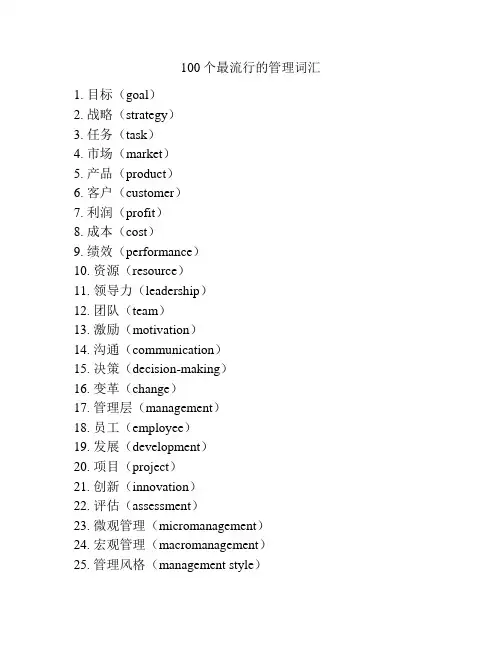
100个最流行的管理词汇1. 目标(goal)2. 战略(strategy)3. 任务(task)4. 市场(market)5. 产品(product)6. 客户(customer)7. 利润(profit)8. 成本(cost)9. 绩效(performance)10. 资源(resource)11. 领导力(leadership)12. 团队(team)13. 激励(motivation)14. 沟通(communication)15. 决策(decision-making)16. 变革(change)17. 管理层(management)18. 员工(employee)19. 发展(development)20. 项目(project)21. 创新(innovation)22. 评估(assessment)23. 微观管理(micromanagement)24. 宏观管理(macromanagement)25. 管理风格(management style)26. 组织(organization)27. 策略执行(strategy execution)28. 市场占有率(market share)29. 风险管理(risk management)30. 供应链(supply chain)31. 市场调研(market research)32. 竞争优势(competitive advantage)33. 绩效管理(performance management)34. 战略规划(strategic planning)35. 数据分析(data analysis)36. 技术创新(technological innovation)37. 人力资源(human resources)38. 财务管理(financial management)39. 协作(collaboration)40. 项目管理(project management)41. 品牌管理(brand management)42. 领导力发展(leadership development)43. 市场营销(marketing)44. 战略联盟(strategic alliance)45. 绩效评估(performance evaluation)46. 市场定位(market positioning)47. 创新管理(innovation management)48. 组织文化(organizational culture)49. 资源分配(resource allocation)50. 风险评估(risk assessment)51. 组织结构(organizational structure)52. 项目评估(project evaluation)53. 市场策略(market strategy)54. 盈利能力(profitability)55. 成本控制(cost control)56. 领导能力(leadership skills)57. 团队合作(teamwork)58. 人才管理(talent management)59. 绩效奖励(performance rewards)60. 组织效能(organizational effectiveness)61. 市场份额(market share)62. 风险规避(risk avoidance)63. 竞争分析(competitive analysis)64. 供应链管理(supply chain management)65. 营销策略(marketing strategy)66. 人员发展(staff development)67. 绩效目标(performance goals)68. 全员参与(employee engagement)69. 创新文化(culture of innovation)70. 内部控制(internal control)71. 团队管理(team management)72. 人力资本(human capital)73. 财务规划(financial planning)74. 项目执行(project execution)75. 品牌定位(brand positioning)76. 绩效管理系统(performance management system)77. 营销渠道(marketing channels)78. 技术创新能力(technological innovation capability)79. 人员激励(employee motivation)80. 绩效考核(performance appraisal)81. 战略发展(strategic development)82. 市场导向(market orientation)83. 风险控制(risk control)84. 竞争优势分析(competitive advantage analysis)85. 供应链优化(supply chain optimization)86. 营销计划(marketing plan)87. 人力资源管理(human resource management)88. 财务分析(financial analysis)89. 项目执行评估(project execution evaluation)90. 品牌推广(brand promotion)91. 绩效改善(performance improvement)92. 组织发展(organizational development)93. 财务报表(financial statements)94. 项目规划(project planning)95. 市场细分(market segmentation)96. 风险管理系统(risk management system)97. 竞争对手分析(competitor analysis)98. 供应链协调(supply chain coordination)99. 营销策略执行(marketing strategy implementation)100. 人才培养(talent cultivation)。
HR术语缩写
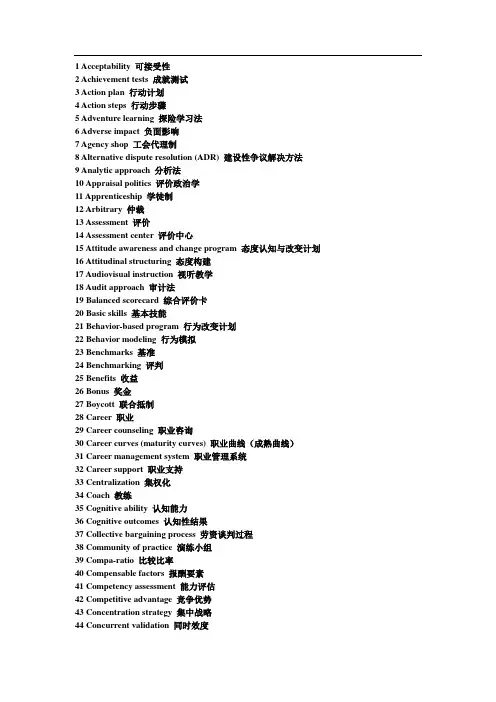
1 Acceptability 可接受性2 Achievement tests 成就测试3 Action plan 行动计划4 Action steps 行动步骤5 Adventure learning 探险学习法6 Adverse impact 负面影响7 Agency shop 工会代理制8 Alternative dispute resolution (ADR) 建设性争议解决方法9 Analytic approach 分析法10 Appraisal politics 评价政治学11 Apprenticeship 学徒制12 Arbitrary 仲裁13 Assessment 评价14 Assessment center 评价中心15 Attitude awareness and change program 态度认知与改变计划16 Attitudinal structuring 态度构建17 Audiovisual instruction 视听教学18 Audit approach 审计法19 Balanced scorecard 综合评价卡20 Basic skills 基本技能21 Behavior-based program 行为改变计划22 Behavior modeling 行为模拟23 Benchmarks 基准24 Benchmarking 评判25 Benefits 收益26 Bonus 奖金27 Boycott 联合抵制28 Career 职业29 Career counseling 职业咨询30 Career curves (maturity curves) 职业曲线(成熟曲线)31 Career management system 职业管理系统32 Career support 职业支持33 Centralization 集权化34 Coach 教练35 Cognitive ability 认知能力36 Cognitive outcomes 认知性结果37 Collective bargaining process 劳资谈判过程38 Community of practice 演练小组39 Compa-ratio 比较比率40 Compensable factors 报酬要素41 Competency assessment 能力评估42 Competitive advantage 竞争优势43 Concentration strategy 集中战略44 Concurrent validation 同时效度45 Consumer price index, CPI 消费者价格指数46 Content validation 内容效度47 Continuous learning 持续学习48 Contributory plan 投入计划49 Coordination training 合作培训50 Core competencies 核心竞争力51 Criterion-related validity 效标关联效度52 Critical incident 关键事件53 Critical incident method 关键事件法54 Cross-cultural preparation 跨文化准备55 Cross-training 交叉培训56 Cultural environment 文化环境57 Cultural shock 文化冲击58 Customer appraisal 顾客评估59 Data flow diagram 数据流程图60 Database 数据库61 Decentralization 分散化62 Decision support systems 决策支持系统63 Defined-benefit plan 养老金福利计划64 Defined-contribution plan 资方养老金投入计划65 Delayering 扁平化66 Depression 沮丧67 Development planning system 开发规划系统68 Differential piece rate 差额计件工资69 Direct costs 直接成本70 Discipline 纪律71 Disparate impact 差别性影响72 Disparate treatment 差别性对待73 Diversity training 多元化培训74 Downsizing 精简75 Downward move 降级76 Efficiency wage theory 效率工资理论77 Electronic performance support system (EPSS) 电子绩效支持系统78 Employee empowerment 员工授权79 Employee leasing 员工租借80 Employee survey research 雇员调查与研究81 Employee wellness programs (EWPs) 雇员健康修炼计划82 Entrepreneur 企业家83 Equal employment opportunity (EEO) 公平就业机会84 Essay method 书面方式85 Ethics 道德86 Expatriate 外派雇员87 Expert systems 专家系统88 External analysis 外部分析89 External growth strategy 外边成长战略90 External labor market 外部劳动力市场91 Factor comparison system 因素比较法92 Feedback 反馈93 Flexible benefits plans (cafeteria plans) 灵活的福利计划(自助福利方案)94 Flextime 灵活的时间95 Forecasting (劳动力供求)预测96 Formal education programs 正规教育计划97 Frame of reference 参照系98 Functional job analysis, FJA 职能工作分析99 Gain sharing plans 收益分享计划100 Globalization 全球化101 Goals 目标102 Goals and timetables 目标和时间表103 Graphic rating-scale method 图式评估法104 Group-building methods 团队建设法105 Group mentoring program 群体指导计划106 Hay profile method 海氏剖析法107 High-leverage training 高层次培训108 High-performance work systems 高绩效工作系统109 Hourly work 计时工资制110 Human capital 人力资本111 Human resource information system (HRIS) 人力资源信息系统112 Human resource management 人力资源管理113 Human resources planning, HRP 人力资源计划114 Indirect costs 间接成本115 Individualism/collectivism 个人主义/集体主义116 Input 投入117 Instructional design process 指导性设计过程118 Internal analysis 内部分析119 Internal growth strategy 内部成长战略120 Internal labor force 内部劳动力121 Internet 互联网122 Internship programs 实习计划123 Interview 面试124 Intraorganizational bargaining 组织内谈判125 Job analysis 工作分析126 Job classification system 工作分类法127 Job description 工作描述128 Job design 工作设计129 Job enlargement 工作扩大化130 Job enrichment 工作丰富化131 Job evaluation 工作评价132 Job experiences 工作经验133 Job involvement 工作认同134 Job posting and bidding 工作张贴和申请135 Job progressions 工作提升136 Job ranking system 工作重要性排序法137 Job rotation 工作轮换138 Job satisfaction 工作满意度139 Job specification 工作规范140 Job structure 工作结构141 Key jobs 关键工作142 Labor market 劳动力市场143 Labor relations process 劳动关系进程144 Leaderless group discussion 无领导小组讨论法145 Learning organization 学习型组织146 Long-term-short-term orientation 长期-短期导向147 Maintenance of membership 会员资格维持148 Management by objectives, MBO 目标管理149 Management forecasts 管理预测150 Management prerogatives 管理特权151 Manager and / or supervisor appraisal 经理和/或上司评估152 Managing diversity 管理多元化153 Markov analysis 马克夫分析法154 Mediation 调解155 Mentor 导师156 Merit guideline 绩效指南157 Minimum wage 最低工资158 Motivation to learn 学习的动机159 Needs assessment (培训)需要评价160 Negligence 疏忽161 Nepotism 裙带关系162 Ombudsman 调查专员163 On-the-job training, OJT 在职培训164 Opportunity to perform 实践的机会165 Organizational analysis 组织分析166 Organizational capability 组织能力167 Orientation 导向培训168 Outplacement counseling 重新谋职咨询169 Output 产出170 Outsourcing 外包171 Panel interview 小组面试172 Pay-for-performance standard 按绩效的报酬标准173 Pay grade 工资等级174 Pay level 工资水平175 Pay-policy line 工资政策线176 Pay structure 工资结构177 Peer appraisal 同事评估178 Performance appraisal 绩效评价179 Performance feedback 绩效反馈180 Performance management 绩效管理181 Performance planning and evaluation (PPE) 绩效规划与评价系统182 Perquisites 津贴183 Person analysis 个人分析184 Person characteristics 个人特征185 Personnel selection 人员甄选186 Point system 积分法187 Position analysis questionnaire, PAQ 职位分析问卷调查188 Power distance 权力差距189 Predictive validation 预测效度190 Profit sharing 利润分享191 Promotion 晋升192 Protean career 多变的职业193 Psychological contract 心理契约194 Psychological support 心理支持195 Range spread 工资范围跨度196 Readability 易读性197 Readiness for training 培训准备198 Reasoning ability 推理能力199 Recruitment 招募200 Reengineering 流程再造201 Relational database 关联数据库202 Reliability 信度203 Repatriation 归国准备204 Replacement charts 替换表205 Request for proposal (REP) (培训)招标书206 Return on investment (ROI) 投资回报207 Role ambiguity 角色模糊208 Role analysis technique 角色分析技术209 Role play 角色扮演210 School-to-work 从学校到工作211 Selection 甄选212 Self-appraisal 自我评估213 Self-efficacy 自信心214 Situational interview 情景面试215 Skill-based pay 技能工资216 Skill inventories 技能量表217 Specificity 明确性218 Spot bonus 即时奖金219 Staffing tables 人员配置表220 Strategic choice 战略选择221 Strategic congruence 战略一致性222 Strategic human resource management (SHRM) 战略性人力资源管理223 Strategy formulation 战略形成224 Strategy implementation 战略执行225 Task analysis 任务分析226 Team leader training 团队领导培训227 360-degree feedback process 360度反馈过程228 Total quality management (TQM) 全面质量管理229 Training 培训230 Training administration 培训管理231 Training outcomes 培训结果232 Transaction processing 事务处理233 Trend analysis 趋势分析234 Utility 效用235 Utility analysis 效用分析236 Validity 效度237 Verbal comprehension 语言理解能力238 Vesting 既得利益239 Virtual reality 现实虚拟240 Voicing 发言241 Wage and salary survey 薪资调查242 Wage-rate compression 工资压缩243 Web-based training 网上培训244 Work permit/ work certificate 就业许可证245 World Wide Web 万维网246 Yield ratio 成功率那是心与心的交汇,是相视的莞尔一笑,是一杯饮了半盏的酒,沉香在喉,甜润在心。
【毕业论文】恶意代码分析实例

【毕业论文】恶意代码分析实例恶意代码实例分析2011 年 5 月1目录1虚拟环境及所用软件介绍 (1)1.1虚拟环境介绍 ..................................................................... (1)1.1.1 Vmware Workstation7.1.4 .................................................................. (1)1.1.2 Gost XP SP3 装机版YN9.9................................................................... .. 11.2 检查软件介绍 ..................................................................... .. (1)1.2.1 ATool1.0.1.0 ................................................................ .. (1)1.2.2 Regmon 7.04 汉化版...................................................................... . (1)1.2.3 FileMon 7.04 汉化版 ..................................................................... .. (2)1.2.4 TCPView3.04.................................................................... .. (2)1.2.5procexp.exe ............................................................ . (2)1.2.6 IceSword 1.22 中文版 ..................................................................... (2)2 木马冰河分析与检测 ......................................................................32.1 木马冰河V2.2介绍 ..................................................................... ....................... 3 2.2 样本分析 ..................................................................... (3)2.2.1 进程监测 ..................................................................... .. (3)2.2.2 文件监测 ..................................................................... .. (3)2.2.3 注册表监测...................................................................... . (4)2.2.4系统通信端口监测 ..................................................................... ................ 5 2.3 样本外部特征总结 ..................................................................... ......................... 5 2.4 木马清除方法 ..................................................................... .. (5)3 xueranwyt.exe木马分析与监测 (7)3.1 木马xueranwyt.exe介绍...................................................................... .............. 7 3.2 样本分析 ..................................................................... (7)3.2.1进程监测 ..................................................................... (7)3.2.2 文件监测 ..................................................................... .. (7)3.2.3 注册表监控...................................................................... . (8)3.2.4 端口监测 ..................................................................... ............................. 8 3.3 样本外部特征总结 ..................................................................... ......................... 8 3.4 解决方案 ..................................................................... (9)4 2.exe木马分析与监测 (10)4.1 木马样本2.exe介绍...................................................................... ................... 10 4.2 样本分析 ..................................................................... . (10)4.2.1 进程监控 ..................................................................... (10)4.2.2 文件监控 ..................................................................... (10)4.2.3 注册表监控...................................................................... .. (11)4.2.4 端口检测 ..................................................................... ........................... 11 4.3 样本外部特征总结 ..................................................................... ....................... 12 4.4 解决方案 ..................................................................... . (12)25 红蜘蛛样本分析与检测 (13)5.1 样本介绍 ..................................................................... ..................................... 13 5.2 样本分析 ..................................................................... . (13)5.2.1 进程检测 ..................................................................... (13)5.2.2 文件检测 ..................................................................... (13)5.2.3 注册表监控...................................................................... .. (14)5.2.4 端口监控 ..................................................................... ........................... 14 5.3 样本外部特征总结 ..................................................................... ....................... 14 5.4 解决方案 ..................................................................... . (15)6 031gangsir.ch.exe样本分析 (16)6.1 样本介绍 ..................................................................... ..................................... 16 6.2 样本分析 ..................................................................... . (16)6.2.1 进程监控 ..................................................................... (16)6.2.2 文件监控 ..................................................................... (16)6.2.3 注册表监控...................................................................... .. (17)6.2.4 端口监控 ..................................................................... ........................... 17 6.3 样本特征总结 ..................................................................... .............................. 17 6.4 解决方案 ..................................................................... . (18)7 .exe样本监测与分析 (19)7.1 样本简介 ..................................................................... ..................................... 19 7.2 样本分析 ..................................................................... . (19)7.2.1 进程监控 ..................................................................... (19)7.2.2 文件监控 ..................................................................... (19)7.2.3 注册表监控...................................................................... .. (20)7.2.4 端口监控 ..................................................................... ........................... 20 7.3 样本外部特征总结 ..................................................................... ....................... 20 7.4 解决方案 ..................................................................... . (21)8 .exe样本监测与分析 (22)8.1 样本信息介绍 ..................................................................... .............................. 22 8.2 样本分析 ..................................................................... . (22)8.2.1进程监控 ..................................................................... . (22)8.2.2 文件监控 ..................................................................... (22)8.2.3 注册表监控...................................................................... .. (22)8.2.4 端口监控 ..................................................................... ........................... 23 8.3 样本外部特征总结 ..................................................................... ....................... 23 8.4解决方案 ..................................................................... .. (24)9 .exe样本分析与监测 (25)9.1 样本简介 ..................................................................... ..................................... 25 9.2 样本分析 ..................................................................... . (25)39.2.1 进程监控 ..................................................................... (25)9.2.2 文件监控 ..................................................................... (25)9.2.3 注册表监控...................................................................... .. (26)9.2.4 端口监控 ..................................................................... ........................... 26 9.3 样本外部特征总结 ..................................................................... ....................... 26 9.4 解决方案 ..................................................................... . (26)10 ................................................................. (27)10.1 样本简介 ..................................................................... ................................... 27 10.2 样本分析 ..................................................................... .. (27)10.2.1 进程监控 ..................................................................... . (27)10.2.2 文件监控 ..................................................................... . (27)10.2.3 注册表监控...................................................................... (28)10.2.4 端口监控 ..................................................................... ......................... 28 10.3 样本外部特征总结 ..................................................................... ..................... 28 10.4 解决方案 ..................................................................... .. (29)11 NetThief12.9样本分析与检测 (30)11.1 样本简介 ..................................................................... ................................... 30 11.2 样本分析 ..................................................................... .. (30)11.2.1 进程监控 ..................................................................... . (30)11.2.2 文件监控 ..................................................................... . (30)11.2.3 注册表监控 ..................................................................... . (30)11.2.4 端口监控 ..................................................................... ......................... 31 11.3 样本外部特征总结 ..................................................................... ..................... 31 11.4 解决方案 ..................................................................... .. (31)41虚拟环境及所用软件介绍1.1虚拟环境介绍1.1.1 Vmware Workstation 7.1.4恶意代码具有很强的破坏性和传播性,为了系统的安全,所以实例的分析均在虚拟机下进行。
PERFORMANCE-APPRAISAL-FORM(企业绩效考核)

PERFORMANCE APPRAISAL FORM1. This review is for the period from 1st Nov 2009 to 31st Oct 20102. Approved recommendations to be made effective from_____________ Name: _______________________________________ Emp_Code: ___________________________________ Designation: __________________________________ Grade/Category: _______________________________ Qualification: __________________________________ Division / Department:__________________________Date of joining:_________________________________ Date of Last review:_____________________________ Present CTC : _________________________________APPRAISAL GUIDELINES :01. The appraisal rating form ‘contains factors that are relevant in performing an employee job.02. Base your ratings and judgment on the entire period covered and not upon isolated/recentincident.03. Consider only one factor at a time. Do not let your rating in one trait influence your rating ofanother.04. Base your judgment on the requirements of the job and the performance of the appraisee in it.05. The Superior of the employee shall be the reporting Officer and the immediatesupervising superior/officer shall be the reviewing Officer.06. Whenever the shift duty operation is involved, the concerned Shift-in-charge shall be the reporting officer.07. While assessing, the Reporting Officer and Reviewing Officer shall give the scores for all theindividual points that are mentioned below the factors.08. Upon completion, review and check your scores & overall rating.09. The rating for factor analysis is as follows80 & above70 and above & below 79 60 and above & below 69 50 and above & below 59 Below 50 ‘O’ – OUTSTANDING‘A’ – VERY GOOD‘B’ – GOOD‘C’ – SATISFACTORY ‘D’ – UNSATISFACTORY10. Concrete evidence / Justification is necessary in support of “Outstanding” or Unsatisfactory rating.11. Guide Note to attendance (Including leave approved)No. of Days ofAttendanceMarksA) OUTSTANDING 300 & Above 20B) VERY GOOD 285 – 299 16C) GOOD 275-284 12D) SATISFACTORY 240-274 8E) POOR Below 239 0Page-1PERFORMANCE APPRAISAL FORM Name :________________________________________Emp_Code: ___________________________________Page 2The head of the Department in consultation with the Manager/ Section incharge to review and to give the over all rating and recommendations. Reporting Officer Reviewing HODOBSERVATION BY HR DEPARTMENT。
人力资源管理英文词汇
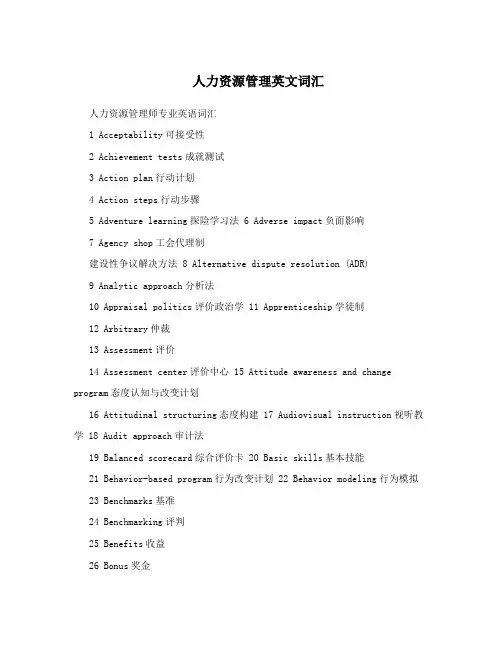
人力资源管理英文词汇人力资源管理师专业英语词汇1 Acceptability可接受性2 Achievement tests成就测试3 Action plan行动计划4 Action steps行动步骤5 Adventure learning探险学习法6 Adverse impact负面影响7 Agency shop工会代理制建设性争议解决方法 8 Alternative dispute resolution (ADR)9 Analytic approach分析法10 Appraisal politics评价政治学 11 Apprenticeship学徒制12 Arbitrary仲裁13 Assessment评价14 Assessment center评价中心 15 Attitude awareness and change program态度认知与改变计划16 Attitudinal structuring态度构建 17 Audiovisual instruction视听教学 18 Audit approach审计法19 Balanced scorecard综合评价卡 20 Basic skills基本技能21 Behavior-based program行为改变计划 22 Behavior modeling行为模拟23 Benchmarks基准24 Benchmarking评判25 Benefits收益26 Bonus奖金27 Boycott联合抵制28 Career职业29 Career counseling职业咨询30 Career curves (maturity curves) 职业曲线(成熟曲线)31 Career management system职业管理系统 32 Career support职业支持33 Centralization集权化34 Coach教练35 Cognitive ability认知能力36 Cognitive outcomes认知性结果 37 Collective bargaining process劳资谈判过程38 Community of practice演练小组 39 Compa-ratio比较比率40 Compensable factors报酬要素 41 Competency assessment能力评估 42 Competitive advantage竞争优势 43 Concentration strategy集中战略 44 Concurrent validation同时效度 45 Consumer price index, CPI消费者价格指数 46 Content validation内容效度47 Continuous learning持续学习48 Contributory plan投入计划49 Coordination training合作培训 50 Core competencies核心竞争力51 Criterion-related validity效标关联效度 52 Critical incident关键事件53 Critical incident method关键事件法 54 Cross-cultural preparation 跨文化准备 55 Cross-training交叉培训56 Cultural environment文化环境 57 Cultural shock文化冲击58 Customer appraisal顾客评估59 Data flow diagram数据流程图60 Database数据库61 Decentralization分散化62 Decision support systems决策支持系统 63 Defined-benefit plan养老金福利计划 64 Defined-contribution plan资方养老金投入计划 65 Delayering 扁平化66 Depression沮丧67 Development planning system开发规划系统 68 Differential piece rate差额计件工资 69 Direct costs直接成本70 Discipline纪律71 Disparate impact差别性影响72 Disparate treatment差别性对待73 Diversity training多元化培训74 Downsizing精简75 Downward move降级76 Efficiency wage theory效率工资理论 77 Electronic performance support system (EPSS) 电子绩效支持系统78 Employee empowerment员工授权79 Employee leasing员工租借80 Employee survey research雇员调查与研究 81 Employee wellness programs (EWPs) 雇员健康修炼计划 82 Entrepreneur企业家83 Equal employment opportunity (EEO) 公平就业机会 84 Essay method书面方式85 Ethics道德86 Expatriate外派雇员87 Expert systems专家系统88 External analysis外部分析89 External growth strategy外边成长战略 90 External labor market外部劳动力市场 91 Factor comparison system因素比较法 92 Feedback反馈93 Flexible benefits plans (cafeteria plans) 灵活的福利计划(自助福利方案)94 Flextime灵活的时间95 Forecasting (劳动力供求)预测96 Formal education programs正规教育计划 97 Frame of reference参照系98 Functional job analysis, FJA职能工作分析 99 Gain sharing plans收益分享计划100 Globalization全球化101 Goals目标102 Goals and timetables目标和时间表 103 Graphic rating-scale method 图式评估法 104 Group-building methods团队建设法 105 Group mentoring program群体指导计划 106 Hay profile method海氏剖析法107 High-leverage training高层次培训 108 High-performance work systems高绩效工作系统 109 Hourly work计时工资制110 Human capital人力资本111 Human resource information system (HRIS) 人力资源信息系统112 Human resource management人力资源管理 113 Human resources planning, HRP人力资源计划 114 Indirect costs间接成本115 Individualism/collectivism个人主义/集体主义 116 Input投入117 Instructional design process指导性设计过程118 Internal analysis内部分析119 Internal growth strategy内部成长战略 120 Internal labor force内部劳动力 121 Internet互联网122 Internship programs实习计划123 Interview面试124 Intraorganizational bargaining组织内谈判 125 Job analysis工作分析126 Job classification system工作分类法 127 Job description工作描述128 Job design工作设计129 Job enlargement工作扩大化130 Job enrichment工作丰富化131 Job evaluation工作评价132 Job experiences工作经验133 Job involvement工作认同134 Job posting and bidding工作张贴和申请 135 Job progressions工作提升136 Job ranking system工作重要性排序法 137 Job rotation工作轮换138 Job satisfaction工作满意度139 Job specification工作规范140 Job structure工作结构141 Key jobs关键工作142 Labor market劳动力市场143 Labor relations process劳动关系进程 144 Leaderless group discussion无领导小组讨论法 145 Learning organization学习型组织 146 Long-term-short-term orientation长期-短期导向 147 Maintenance of membership会员资格维持 148 Management by objectives, MBO目标管理 149 Management forecasts管理预测 150 Management prerogatives管理特权 151 Manager and / or supervisor appraisal经理和/或上司评估152 Managing diversity管理多元化 153 Markov analysis马克夫分析法154 Mediation调解155 Mentor导师156 Merit guideline绩效指南157 Minimum wage最低工资158 Motivation to learn学习的动机 159 Needs assessment (培训)需要评价160 Negligence疏忽161 Nepotism裙带关系162 Ombudsman调查专员163 On-the-job training, OJT在职培训 164 Opportunity to perform实践的机会 165 Organizational analysis组织分析 166 Organizational capability组织能力 167 Orientation导向培训168 Outplacement counseling重新谋职咨询 169 Output产出170 Outsourcing外包171 Panel interview小组面试172 Pay-for-performance standard按绩效的报酬标准173 Pay grade工资等级174 Pay level工资水平175 Pay-policy line工资政策线 176 Pay structure工资结构177 Peer appraisal同事评估178 Performance appraisal绩效评价 179 Performance feedback绩效反馈180 Performance management绩效管理 181 Performance planning and evaluation (PPE) 绩效规划与评价系统182 Perquisites津贴183 Person analysis个人分析184 Person characteristics个人特征 185 Personnel selection人员甄选186 Point system积分法187 Position analysis questionnaire, PAQ职位分析问卷调查188 Power distance权力差距189 Predictive validation预测效度 190 Profit sharing利润分享191 Promotion晋升192 Protean career多变的职业 193 Psychological contract心理契约 194 Psychological support心理支持 195 Range spread工资范围跨度 196 Readability易读性197 Readiness for training培训准备 198 Reasoning ability推理能力199 Recruitment招募200 Reengineering流程再造201 Relational database关联数据库 202 Reliability信度203 Repatriation归国准备204 Replacement charts替换表205 Request for proposal (REP) (培训)招标书 206 Return on investment (ROI) 投资回报 207 Role ambiguity角色模糊208 Role analysis technique角色分析技术 209 Role play角色扮演210 School-to-work从学校到工作211 Selection甄选212 Self-appraisal自我评估213 Self-efficacy自信心214 Situational interview情景面试 215 Skill-based pay技能工资216 Skill inventories技能量表217 Specificity明确性218 Spot bonus即时奖金219 Staffing tables人员配置表220 Strategic choice战略选择221 Strategic congruence战略一致性 222 Strategic human resource management (SHRM) 战略性人力资源管理223 Strategy formulation战略形成 224 Strategy implementation战略执行 225 Task analysis任务分析226 Team leader training团队领导培训 227 360-degree feedback process 360度反馈过程 228 Total quality management (TQM) 全面质量管理229 Training培训230 Training administration培训管理 231 Training outcomes培训结果232 Transaction processing事务处理 233 Trend analysis趋势分析234 Utility效用235 Utility analysis效用分析236 Validity效度237 Verbal comprehension语言理解能力 238 Vesting既得利益239 Virtual reality现实虚拟240 Voicing发言241 Wage and salary survey薪资调查 242 Wage-rate compression工资压缩 243 Web-based training网上培训 244 Work permit/ work certificate就业许可证 245 World Wide Web万维网246 Yield ratio成功率。
Performance Management and Appraisal人力资源中绩效管理评估
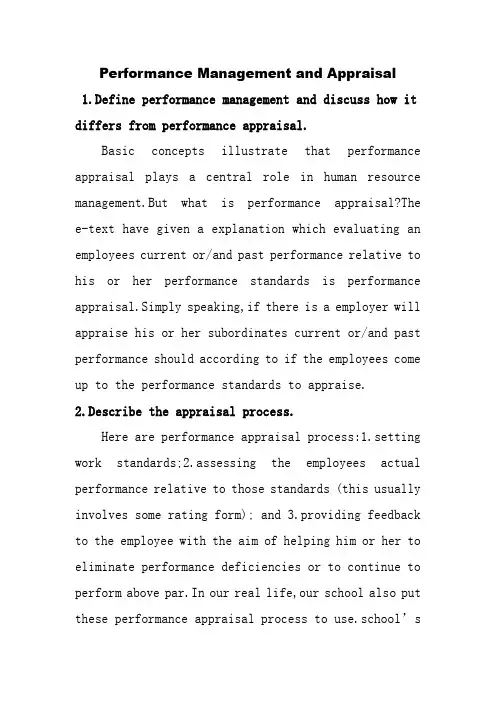
Performance Management and Appraisal1.Define performance management and discuss how it differs from performance appraisal.Basic concepts illustrate that performance appraisal plays a central role in human resource management.But what is performance appraisal?The e-text have given a explanation which evaluating an employees current or/and past performance relative to his or her performance standards is performance appraisal.Simply speaking,if there is a employer will appraise his or her subordinates current or/and past performance should according to if the employees come up to the performance standards to appraise.2.Describe the appraisal process.Here are performance appraisal process:1.setting work standards;2.assessing the employees actual performance relative to those standards (this usually involves some rating form); and 3.providing feedback to the employee with the aim of helping him or her to eliminate performance deficiencies or to continue to perform above par.In our real life,our school also put these performance appraisal process to use.school’ssupervisor will set work standards to assess the teachers actual performance.Finally the supervisor will provide feedback to teachers to help them to know their weaknesses and strengths.The school will award high performing teachers to create a form of friendly competition.When it comes to why appraise performance,to my point of view,all reasons come to a word is fair.The e-textbook shows it’s beneficial for both supervisors and subordinates to apply performance appraisal.It can avoid the supervisors to subjectively judge the subordinates.On the other hand,subordinates will understand their deficiencies and strengths.The importance of continuous feedback means when a supervisor see a performance problem,he or she would better take actions immediately.Similarly,when your subordinates make mistakes you the time to feedback is immediately.The technique people apply in daily life is universal.Teachers or parents may continuous feedback to you immediately when you make mistakes.What is performance management? In my opinion on the basis of the e-book which illustrate,for reachingthe organizations goals,individuals and teams will take part in identifying,measuring,and developing the performance continuously as well as it is a continuous process.The performance management aims to promote continuously the performance of individuals,department and organizations.3.Set effective performance appraisal standardsFirst of all,why should define the employees goals and performance standards?As far as I can see,there are contact with these two impacts.When supervisors do the performance appraisal,they must decide what to measure and it is typical to set measurable goals for each expectation the supervisors have for the employee to form effective performance appraisal standards.In this way,supervisor can do the appraisal effectively.So how to set effective goals?The answers have given by e-textbook are as follows,1.Assign specific goals.2.Assign measurable goals.3.Assign challenging but doable goals.4.Encourage participation.In our senior schools,every year headmasters those teach graduating class will receive an different education quota about how many students should get thefirst-batch and second-batch.The school will apply these effective goals to set effective education quota,for make sure the education goals of school.4.Who Should Do the Appraising?From the e-textbook,the immediate supervisor’s appraisal is the heart of most appraisal processes.They can directly observe and evaluate his or her subordinates performance.However,relying only on supervisors appraisals isn’t always advisable because there is always some danger of bias for or against the employee.So there are several options we can use.It including peer appraisal,it means the colleague can appraise each other.Rating committees,the employee’s immediate supervisor and 3 or 4 other supervisors can make up a group to do the appraisal.Self-ratings,employees’self-ratings conjunction with supervisors’rating.Appraisal by subordinate,obviously,managers will receive feedback from their employees.360°feedback.In our daily life,the 360°feedback is the most commonly used.The employer will evaluate his or her employees’ comprehensive ability and skills.5.Techniques For Appraising Performance.Managers usually apply many approaches to appraisal their employees.And there are many useful options can managers choose.While reading in this part,I can not help thinking what advantages these appraising performance techniques are.I can probably understand these techniques can avoid many errors while appraising performance.6.Dealing With Appraisal Problems And Interview.。
绩效考核外文文献及其译文
The Dilemma of Performance AppraisalPeter Prowse and Julie ProwseMeasuring Business Excellence,V ol.13 Iss:4,pp.69 - 77AbstractThis paper deals with the dilemma of managing performance using performance appraisal. The authors will evaluate the historical development of appraisals and argue that the critical area of line management development that was been identified as a critical success factor in appraisals has been ignored in the later literature evaluating the effectiveness of performance through appraisals.This paper willevaluatethe aims and methodsof appraisal, thedifficulties encountered in the appraisalprocess. It also re-evaluates the lack of theoretical development in appraisaland move from he psychological approachesof analysistoamorecritical realisation ofapproaches before re-evaluating the challenge to remove subjectivity and bias in judgement of appraisal.13.1IntroductionThis paper will define and outline performance management and appraisal. It will start by evaluating what form of performance is evaluated, then develop links to the development of different performance traditions (Psychological tradition, Management by Objectives, Motivation and Development).It will outline the historical development of performance management then evaluate high performance strategies using performance appraisal. It will evaluate the continuing issue of subjectivity and ethical dilemmas regarding measurement and assessment of performance. The paper will then examine how organisations measure performance before evaluation of research on some recent trends in performance appraisal.This chapter will evaluate the historical development of performance appraisal from management by objectives (MBO) literature before evaluating the debates between linkages between performance management and appraisal. It will outline the development of individual performance before linking to performance management in organizations. The outcomes of techniques to increase organizational commitment, increase job satisfaction will be critically evaluated. It will further examine the transatlantic debates between literature on efficiency and effectiveness in the North American and the United Kingdom) evidence to evaluate the HRM development and contribution of performance appraisal to individual and organizational performance.13.2 What is Performance Management?The first is sue to discuss is the difficulty of definition of Performance Management. Armstrong and Barron(1998:8) define performance management as: A strategic and integrated approach to delivering sustained success to organisations by Improving performance of people who work in them by developing the capabilities of teams And individual performance.13.2.1 Performance AppraisalAppraisal potentially is a key tool in making the most of an organisation’s human resources. The use of appraisal is widespread estimated that 80–90%of organizations in the USA and UK were using appraisal and an increase from 69 to 87% of organisations between 1998 and 2004 reported a formalperformance management system (Armstrong and Baron, 1998:200).There has been little evidence of the evaluation of the effectiveness of appraisal but more on the development in its use. Between 1998 and 2004 a sample from the Chartered Institute of Personnel and Development (CIPD, 2007) of 562 firms found 506 were using performance appraisal in UK.What is also vital to emphasise is the rising use of performance appraisal feedback beyond performance for professionals and managers to nearly 95% of workplaces in the 2004 WERS survey (seeTable 13.1).Clearly the use of Appraisals has been the development and extension of appraisals to cover a large proportion of the UK workforce and the coverage of non managerial occupations and the extended use in private and public sectors.13.2.2 The Purpose of AppraisalsThe critical issue is what is the purpose of appraisals and how effective is it ?Researched and used in practice throughout organizations? The purpose of appraisals needs to be clearly identified. Firstly their purpose. Randell (1994) states they are a systematic evaluation of individual performance linked to workplace behaviour and/or specific criteria. Appraisals often take the form of an appraisal interview,usually annual,supported by standardised forms/paperwork.The key objective of appraisal is to provide feedback for performance is provided by the linemanager.The three key questions for quality of feedback:1. What and how are observations on performance made?2. Why and how are they discussed?3. What determines the level of performance in the job?It has been argued by one school of thought that these process cannot be performed effectively unless the line manager of person providing feedback has the interpersonal interviewing skills to providethat feedback to people being appraised. This has been defined as the “Bradford Approach” which places a high priority on appraisal skills development (Randell, 1994). This approach is outlined in Fig. 13.1 whichidentifies the linkages betweeninvolving,developing, rewarding and valuing people at work..13.2.3 Historical Development of AppraisalThe historical development of performance feedback has developed from a range of approaches.Formal observation of individual work performance was reported in Robert Owens’s Scottish factory inNew Lanarkin the early 1800s (Cole, 1925). Owen hung over machines a piece of coloured wood over machines to indicate the Super intendent’s assessment of the previous day’s conduct (white forexcellent, yellow, blue and then black for poor performance).The twentieth centuryled to F.W. Taylor and his measured performance and the scientific management movement (Taylor, 1964). The 1930sTraits Approaches identified personality and performance and used feedback using graphic rating scales, a mixed standard of performance scales noting behaviour in likert scale ratings.This was used to recruit and identify management potential in the field of selection. Later developments to prevent a middle scale from 5 scales then developed into a forced-choice scale which forced the judgement to avoid central ratings.The evaluation also included narrative statements and comments to support the ratings (Mair, 1958).In the 1940s Behavioural Methods were developed. These included Behavioural Anchored Rating Scales (BARS); Behavioural Observation Scales (BOS); Behavioural Evaluation Scales (BES); critical incident;job simulation. All these judgements were used to determine the specific levels of performance criteria to specific issues such as customer service and rated in factors such asexcellent,average orneeds to improve or poor.These ratings are assigned numerical values and added to a statement or narrative comment by the assessor. It would also lead to identify any potential need for training and more importantly to identify talent for careers in linemanagement supervision and future managerial potential.Post1945 developed into the Results-oriented approaches and led to the development of management by objectives (MBO). This provided aims and specific targets to be achievedand with in time frames such as pecific sales, profitability,and deadlines with feedback on previous performance (Wherry, 1957).The deadlines may have required alteration and led to specific performance rankings of staff. It also provided a forced distributionof rankingsof comparative performance and paired comparison ranking of performance and setting and achieving objectives.In the 1960s the developmentof Self-appraisal by discussion led to specific time and opportunity for the appraisee to reflectively evaluate their performance in the discussion and the interview developed into a conversation on a range of topics that the appraise needed to discuss in the interview. Until this period the success of the appraisal was dependent on skill of interviewer.In the 1990s the development of 360-degree appraisal developed where information was sought from a wider range of sources and the feedback was no longer dependent on the manager-subordinate power relationship but included groups appraising the performance of line managers and peer feedback from peer groups on individual performance (Redman and Snape, 1992). The final development of appraisal interviews developed in the 1990s with the emphasis on the linking performance with financial reward which will be discussed later in the paper.13.2.4 Measures of PerformanceThe dilemma of appraisal has always to develop performance measures and the use of appraisal is the key part of this process. Quantitative measure of performance communicated as standards in the business and industry level standards translated to individual performance. The introduction of techniques such as the balanced score card developed by Kaplan and Norton (1992).Performance measures and evaluation included financial, customer evaluation, feedback on internal processes and Learning and Growth. Performance standards also included qualitative measures Which argue that there is an over emphasis on metrics of quantitative approach above the definitions of quality services and total quality management.In terms of performance measures there has been a transformation in literature and a move in the 1990s to the financial rewards linked to the level of performance.The debates will be discussed later in the paper.13.3 Criticism of AppraisalsCritiques of appraisal have continued as appraisal shave increased in use and scope across sectors and occupations. The dominant critique is the management framework using appraisal as an orthodox technique that seeks to remedy the weakness and propose of appraisals as a system to develop performance.This “orthodox” approach argues there are conflicting pur poses of appraisal (Strebler et al, 2001). Appraisal can motivate staff by clarifying objectives and setting clear future objectives with provision for training and development needs to establish the performance objective. These conflicts withassessing past performance and distribution of rewards based on past performance (Bach, 2005:301).Employees are reluctant to confide any limitations and concerns on their current performance as this could impact on their merit related reward or promotion opportunities(Newton and Findley, 1996:43).This conflicts with performance as a continuum as appraisers are challenged with differing roles as both monitors and judges of performance but an understanding counsell or which Randell(1994)argues few manager shave not received the raining to perform.Appraisal Manager’s reluctance to criticise also stems from classic evidence fromMcGregor that managers are reluctant to make an egative judgement on an individual’s performance a sit could be demotivating,leadto accusationsoftheirown supportand contributiontoindividual poor performance and to also avoid interpersonal conflict (McGregor, 1957).One consequence of this avoidance of conflict is to rate all criterion as central and avoid any conflict known as the central tendency.In a study of senior managers by Long neckeretal.(1987),they found organisational politics influenced ratings of 60 senior executives.The findings were that politics involved deliberate attempts by individuals to enhance or protect self-interests when conflicting courses of action are possible and that ratings and decisions were affected by potential sources of bias or inaccuracy in their appraisal ratings (Longeneckeret al., 1987).There are methods of further bias beyond Longenecker’s evidence. The polit ical judgements and they have been distorted further by overrating some clear competencies in performance rather than being critical across all rated competencies known as the halo effect and if some competencies arelower they may prejudice the judgment acrossthe positive reviews known as the horns effect (ACAS, 1996).Some ratings may only cinclude recent events and these are known as the recency effects. In this case only recent events are noted compared to managers gathering and using data throughout the appraisal period .A particular concern is the equity of appraisal for ratings which may be distorted by gender ,ethnicity and the ratings of appraisers themselves .A range of studies in both the US and UK have highlighted subjectivity in terms of gender (Alimo-Metcalf, 1991;White, 1999) and ethnicity of the appraise and appraiser(Geddes and Konrad, 2003). Suggestions and solutions on resolving bias will be reviewed later.The second analysis is the radical critique of appraisal. This is the more critical management literature that argues that appraisal and performance management are about management control(Newton and Findley, 1996;Townley, 1993). It argues that tighter management control over employee behaviour can be achieved by the extension of appraisal to manual workers, professional as means to control. This develops the literature of Foucault using power and surveillance. This literature uses cases in examples of public service control on professionals such a teachers (Healy, 1997) and University professionals(Townley, 1990).This evidence argues the increased control of public services using appraisal as a method of control and that the outcome of managerial objectives ignores the developmental role of appraisal and ratings are awarded for people who accept and embrace the culture and organizational values . However, this literature ignores the employee resistance and the use of professional unions to challenge the attempts to exert control over professionals and staff in the appraisal process (Bach, 2005:306).One of the different issues of removing bias was the use of the test metaphor (Folgeretal.,1992).This was based on the assumption that appraisal ratings were a technical question of assessing “true” performance and there needed to be increased reliability and validity of appraisal as an instrument to develop motivation and performance. The sources of rater bias and errors can be resolvedby improved organisational justice and increasing reliability of appraiser’s judgement.However there were problems such as an assumption that you can state job requirements clearly and the organization is “rational” with objectives that reflect values and that the judgment by appraisers’ are value free from political agendas and personal objectives. Secondly there is the second issue of subjectivity if appraisal ratings where decisions on appraisal are rated by a “political metaphor”(Hart le, 1995).This “political view” argues that a appraisal is often done badly because there is a lack of training for appraisers and appraisers may see the appraisal as a waste of time. This becomes a process which managers have to perform and not as a potential to improve employee performance .Organisations in this context are “political” and the appraisers seek to maintain performance from subordinates and view appraises as internal customers to satisfy. This means managers use appraisal to avoid interpersonal conflict and develop strategies for their own personal advancement and seek a quiet life by avoiding censure from higher managers.This perception means managers also see appraisee seeks good rating and genuine feedback and career development by seeking evidence of combining employee promotion and pay rise.This means appraisal ratings become political judgements and seek to avoid interpersonal conflicts. The approaches of the “test” and “political” metaphors of appraisal are inaccurate and lack objec tivity and judgement of employee performance is inaccurate and accuracy is avoided.The issue is how can organisations resolve this lack of objectivity?13.3.1 Solutions to Lack of Objectivity of AppraisalGrint(1993)argues that the solutions to objectivity lies in part with McGregor’s (1957) classic critique by retraining and removal of “top down” ratings by managers and replacement with multiple rater evaluation which removes bias and the objectivity by upward performance appraisal. The validity of upward appraisal means there moval of subjective appraisal ratings.This approach is also suggested to remove gender bias in appraisal ratings against women in appraisals (Fletcher, 1999). The solution of multiple reporting(internal colleagues, customers and recipients of services) will reduce subjectivity and inequity of appraisal ratings. This argument develops further by the rise in the need to evaluate project teams and increasing levels of teamwork to include peer assessment. The solutions also in theory mean increased closer contact with individual manager and appraises and increasing services linked to customer facing evaluations.However, negative feedback still demotivates and plenty of feedback and explanation by manager who collates feedback rather than judges performance andfail to summarise evaluations.There are however still problems with accuracy of appraisal objectivity asWalker and Smither (1999)5year studyof 252 managers over 5 year period still identified issues with subjective ratings in 360 degree appraisals.There are still issues on the subjectivity of appraisals beyond the areas of lack of training.The contribution of appraisal is strongly related to employee attitudes and strong relationships with job satisfaction(Fletcher and Williams, 1996). The evidence on appraisal still remains positive in terms of reinvigo rating social relationships at work (Townley,1993)and the widespread adoption in large public services in the UK such as the national health Service (NHS)is the valuable contribution to line managers discussion with staff on their past performance, discussing personal development plans and training and development as positive issues.One further concern is the openness of appraisal related to employee reward which we now discuss.13.3.2 Linking Appraisals with Reward ManagementAppraisal and performance management have been inextricably linked to employee reward since the development of strategic human resource management in the 1980s. The early literature on appraisal linked appraisal with employee control (Randell, 1994;Grint, 1993;Townley, 1993, 1999) and discussed the use of performance related reward to appraisals. However therecent literature has substituted the chapter titles employee “appraisal” with “performance management”(Bach, 2005; Storey, 2007) and moved the focus on performance and performance pay and the limits of employee appraisal. The appraisal and performance pay link has developed into debates to three key issues:The first issue is has performance pay related to appraisal grown in use?The second issue is what type of performance do we reward?and the final issue is who judges management standards?The first discussion on influences of growth of performance pay schemes is the assumption that increasing linkage between individual effort and financial reward increases performance levels. This linkage between effort and financial reward increasing levels of performance has proved an increasing trend in the public and private sector (Bevan and Thompson, 1992;Armstrong and Baron, 1998). The drive to increase public sector performance effort and setting of targets may even be inconsistent in the experiences of some organizational settings aimed at achieving long-term targets(Kessler and Purcell, 1992;Marsden, 2007). The development of merit based pay based on performance assessed by a manager is rising in the UK Marsden (2007)reported that the: Use of performance appraisals as a basis for merit pay are used in65 percent of public sector and 69 percent of the private sector employees where appraisal covered all nonmanagerial staff(p.109).Merit pay has also grown in use as in 1998 20% of workplaces used performance related schemes compared to 32% in the same organizations 2004 (Kersley et al., 2006:191). The achievements of satisfactory ratings or above satisfactory performance averages were used as evidence to reward individual performance ratings in the UK Civil Service (Marsden, 2007).Table 13.2 outlines the extent of merit pay in 2004.The second issue is what forms of performance is rewarded. The use of past appraisal ratings as evidence of achieving merit-related payments linked to achieving higher performance was the predominant factor developed in the public services. The evidence on Setting performance targets have been as Kessler (2000:280) reported “inconsistent within organizations and problematic for certain professional or less skilled occupations where goals have not been easily formulated”. There has been inconclusive evidence from organizations on the impact of performance pay and its effectiveness in improving performance. Evidence from a number of individual performance pay schemes report organizations suspending or reviewing them on the grounds that individual performance reward has produced no effect in performance or even demotivates staff(Kessler, 2000:281).More in-depth studies setting performance goals followed by appraisal on how well they were resulted in loss of motivation whilst maintaining productivity and achieved managers using imposing increased performance standards (Marsden and Richardson, 1994). As Randell(1994) had highlighted earlier, the potential objectivity and self-criticism in appraisal reviews become areas that appraisees refuse to acknowledge as weaknesses with appraisers if this leads to a reduction in their merit pay.Objectivity and self reflection for development becomes a weakness that appraises fail to acknowledge as a developmental issue if it reduces their chances of a reduced evaluation that will reduce their merit reward. The review of civil service merit pay (Makinson, 2000)reported from 4major UK Civil Service Agencies and the National Health Service concluded that existing forms of performance pay and performance management had failed to motivate many staff.The conclusions were that employees found individual performance pay divisive and led to reduced willingness to co-operate with management ,citing managerial favorites and manipulation of appraisal scores to lower ratings to save paying rewards to staff (Marsden and French, 1998).This has clear implications on the relationship between line managers and appraises and the demotivational consequences and reduced commitment provide clear evidence of the danger to linking individual performance appraisal to reward in the public services. Employees focus on the issues that gain key performance focus by focusing on specific objectives related to key performance indicators rather than all personal objectives. A study of banking performance pay by Lewis(1998)highlighted imposed targets which were unattainable with a range of 20 performance targets with narrow short term financial orientatated goals. The narrow focus on key targets and neglect of other performance aspects leads to tasks not being delivered.This final issue of judging management standards has already highlighted issues of inequity and bias based on gender (Beyer, 1990; Chen and DiTomasio, 1996; Fletcher, 1999). The suggested solutions to resolved Iscrimination have been proposed as enhanced interpersonal skills training are increased equitable use of 360 degree appraisal as a method to evaluate feedback from colleagues as this reduces the use of the “political metaphor”(Randell, 1994;Fletcher, 1999).On measures linking performance to improvement require a wider approach to enhanced work design and motivation to develop and enhance employee job satisfaction and the design of linkages between effort and performance are significant in the private sector and feedback and awareness in the public sector (Fletcher and Williams, 1996:176). Where rises be in pay were determined by achieving critical rated appraisal objectives, employees are less self critical and open to any developmental needs in a performance review.13.4 ConclusionAs performance appraisal provides a major potential for employee feedback that could link strongly to increasing motivation ,and a opportunity to clarify goals and achieve long term individual performance and career development why does it still suffers from what Randell describes as a muddle and confusion which still surrounds the theory and practice?There are key issues that require resolution and a great deal depends on the extent to which you have a good relationship with your line manager . Barlow(1989)argued `if you get off badly with your first two managers ,you may just as well forget it (p. 515).The evidence on the continued practice of appraisals is that they are still institutionally elaborated systems of management appraisal and development is significant rhetoric in the apparatus of bureaucratic control by managers (Barlow, 1989). In reality the companies create, review, change and even abolish appraisals if they fail to develop and enhance organisational performance(Kessler, 2000). Despite all the criticism and evidence the critics have failed to suggest an alternative for a process that can provide feedback, develop motivation, identify training and potential and evidence that can justify potential career development and justify reward(Hartle, 1997).绩效考核的困境Peter Prowse and Julie Prowse摘要本文旨在用绩效考核方法来解决绩效管理的困境。
人力资源专业词汇中英文对照
十一、报酬与福利 1 报酬:(compensation) 2 直接经济报酬:(direct financial compensation) 3 间接经济报酬:(indirect financial compensation) 4 非经济报酬:(no financial compensation) 5 公平:(equity)
四、人力资源计划:(Human Resource Planning,HRP)
1
1 战略规划:(strategic planning) 2 长期趋势:(long term trend) 3 要求预测:(requirement forecast) 4 供给预测:(availability forecast) 5 管理人力储备:(management inventory) 6 裁减:(downsizing) 7 人力资源信息系统:(Human Resource Information System,HRIS) 五、招聘:(recruitment) 1 员工申请表:(employee requisition) 2 招聘方法:(recruitment methods) 3 内部提升:(Promotion From Within ,PFW) 4 工作公告:(job posting) 5 广告:(advertising) 6 职业介绍所:(employment agency) 7 特殊事件:(special events) 8 实习:(internship) 六、选择:(selection) 1 选择率:(selection rate) 2 简历:(resume) 3 标准化:(standardization) 4 有效性:(validity) 5 客观性:(objectivity) 6 规范:(norm) 7 录用分数线:(cutoff score) 8 准确度:(aiming) 9 业务知识测试:(job knowledge tests) 10 求职面试:(employment interview)
202206月英语四级考试真题及答案
202206月英语四级考试真题及答案2022年6月英语四级考试真题及答案Part I Listening Comprehension (30 minutes) Section A1. A) At a library.2. C) Summer vacation plans.3. B) She attended a conference.4. B) They discuss a famous author.5. A) They are taking different classes.Section B6. A) It is a popular tourist destination.7. B) Buying tickets online.8. C) Searching for information about a play.9. A) Choosing activities for a vacation.10. B) One of the speakers is unfamiliar with the city. Section C11. C) Requesting a loan extension.12. B) An overdue library book.13. A) It was due yesterday.14. C) By cash or credit card.15. B) Making a reminder phone call.Part II Reading Comprehension (40 minutes) Section A16. A) It is home to a UNESCO World Heritage site.17. B) Finding inspiration from the local environment.18. C) It helps improve residents' living standards.19. D) Boosting cultural exchanges among people.20. D) To revitalize traditional culture.Section B21. D) Offering consultation services.22. C) Considering its historical value.23. A) He has a unique approach to appraisal.24. B) It provides valuable information.25. A) Consumers' growing interest in authenticity.Section C26. C) Limiting the use of plastic bags.27. B) It is encouraging.28. D) Collecting plastic waste from oceans.29. A) It can help reduce land-based waste.30. C) Research on microplastic pollution.Part III Writing (60 minutes)Writing Task 1Directions: For this part, you are allowed 30 minutes to write a short essay on the topic of Online Learning: Pros and Cons. You should write at least 150 words following the outline given below.1. Introduction: state the topic.2. Pros: convenience, flexibility, accessibility.3. Cons: lack of face-to-face interaction, potential distractions, technical issues.4. Conclusion: personal opinion and recommendation.Writing Task 2Directions: For this part, you are allowed 30 minutes to write an argumentative essay on the topic of Should College Education Be Free? You should write at least 250 words following the outline given below.1. Introduction: state the issue.2. Arguments in favor of free college education.3. Arguments against free college education.4. Conclusion: personal opinion and justification.Overall, the 2022 June English four-level exam covered a wide range of topics, from travel plans to environmental protection. The Listening Comprehension section tested students' ability to understand spoken English in various contexts, while the Reading Comprehension section assessed their comprehension of written passages. The Writing section required students to express their ideas clearly and logically on two different topics. With thorough preparation and practice, students can improve their English proficiency and achieve success in the exam.。
PERFORMANCE APPRAISAL
CHAPTER SEVEN: PERFORMANCE APPRAISAL第七章绩效考评CHAPTER OBJECTIVES本章目标第一节绩效考评概述AN BRIEF INTRODUCTON TO PERFORMANCEAPPRAISAL1. The Significance of Performance Appraisal2. Roles (作用) of Performance Appraisal3. Principle of Performance Appraisal4. Who Performance AppraisalPERFORMANCE APPRAISAL PROCESS第二节绩效考评的过程1. Preparation: To establish the criteria and standardfor each position2. Conducting Performance Appraisal3.To Coach (辅导阶段)4.To improveTYPES OF APPRAISAL INSTRUMENTS第三节绩效考评的方法1.Alternation Ranking Scale2.Forced Distribution Method.(强制分布法)3.Paired comparison Method(配对比较法)4.GRAPHIC RATING SCALES(量表法)5.BEHAVIORALLY ANCHORED RATING SCALES(行为锚定法)6.Critical Incident Method(关键事件法)7.MANAGEMENT-BY-OBJECTIVES(目标管理法)FEEDBACK INTERVIEW第四节绩效考评的面谈EXERCISES作业Reference参考文献CHAPTER OBJECTIVES(本章目标)After you learn this chapter, you should be able to:1. To cite the various objectives of performance appraisal.2. To identify the basic consideration in selecting standards for appraisal3. To identify and discuss the major performance appraisal method.4. To identify the different approaches to performance appraisal interview.5.To describe the types of errors those are commonly found in performance appraisalAN BRIEF INTRODUCTON TO PERFORMANCE APPRAISAL (第一节绩效考评概述)CASE:“ Why did Zhang jump ship?”After graduated from the college, Zhang was recruited to be a salesman in Company Z .In the first two years, his performance was not so satisfactory because of lacking experience. But at the end of the third year, His performance was greatly improved.Last year, Zhang did a very good job, and he accomplished his sale-volume at the end of September. But the sales manager didn’t show any response to it, so Zhang felt quite disappointed. Zhang left the company in October since the company had no formal appraisal system. In the Company z, an HR professional appraised employees only based on informal conversations between the HR professional and the employees’ supervisor. This system yields no information regarding employee strengths and weaknesses. To make matter worse, this system provided no information regarding company expectation, leaving the employees in the dark as to what they needed to do to achieve favorable performance.In this chapter we turn to discuss performance appraisal programs, which are among the most helpful tools an organization can use to maintain and enhance competitive advantage and facilitate progress toward organization goals.Performance appraisal (绩效评估) refers to a formal, structured system for measuring, evaluating, an employee’s job-related attributes, behavior, and outcomes.1. The Significance of Performance AppraisalIt may understand at first glance that performance appraisals are used for evaluating who is doing a good job and who is doing a bad one. The significance of performance appraisals can be reviewed from the point of employees as well as the organization’s. The following are just a sample of those significance.For Employees a. Understand more clearly about their own duties, tasks and requirements.b. Understand more about what the organization expects from them and their future goals for achieving high performance.c. Employees who are performing well can receive formal recognition (认可)for their performance.d. To provide Employees with the opportunity to participate in performance appraisal.For Organizationa. To provide the supervisor with a means of identifying the strengths and weaknesses of an employe e’s performance.b. To provide a format enabling managers and employees to jointly establish future development and growth plan for the employees.c. To establish a communication channel between managers and employees.d. To express what managers wish to expect from employees.2. Roles (作用) of Performance AppraisalIn HRM activities, a lot decisions have to be based on performance appraisal process, which implies that performance appraisal provides input into all aspects of HRM. The interrelationship between the performance appraisal function and other major HR functions is shown in following Figure:Training: It can determined which employee needs more training and what should be trained (培训内容)b. Administrative decisions: It helps the organization to decide who should be receive pay raises, promoted, laid off, transferred.c. Rewards: It provides basis for judging Pay System (薪酬制度) and pay adjustment.d. Motivation: It encourages initiative, develops a sense of responsibilities, and stimulates efforts to perform better.e. HR planning: Performance appraisal data can also be used in HR planning, in determining the relative worth of jobs under a job evaluation program.f. Selection: It can be used to validate selection tool such as a testing program.3. Principle of Performance Appraisala. Transparency (透明):A supervisor should communicate appraisal criteria (评估项目)or dimension, appraisal procedures, results openly with employees.b. Objectiveness(客观): Employees’ outcome must be assessed by supervisors fairly without inserting their own Likes or dislikes.c. Practical(实用): The appraisal scheme should be simple but practical.d. Training(培训): Supervisor should be trained how to apply appraisal standards, when making judgments.e. Clear performance standards: It must be so clear that employees know exactly when the company expects of them,f. Relented: Appraisal form must exclude criteria that are irrelevant to job performance.g. Difference (差别化): The result of appraisal must be able to reflect the difference between high and low performers.4. Who Performance Appraisala. Appraisal by supervisor (主管评估) The superior knows the subordinate’sperformance better. He knows his ability and behaviors and attitude. However, appraisal by supervisor has drawbacks. Supervisor appraisal has been the traditional approach to evaluating an employee’s performance. Supervisor has the power to reward and pu nish.b. Peer Appraisals (同事评估) Some companies use it to replace or supplement the appraisal given by supervisor. The co-worker who is at an individual’s side all day has an excellent opportunity to observe the individual’s behavior and even can observe the o ther facets of the employee’s behavior that his supervisor can not because employees often be have differently when the boss is present.c. Self-Appraisal (自评)A worker knows clearly what he has done. Self-appraisal can reduce the defensive of the employee and make the employee to evaluate his performance with his responsibility.d. Subordinate Appraisal(下属评价)Subordinates are in a good position to evaluate their managers since they are in frequent contact with many performance-related behaviors. Those performance dimensions judged most appropriate for subordinate appraisals include leadership, oral communication, delegation of authority, coordination of team efforts, and interest in subordinates.e. Customers (客户评估) Some companies like restaurants will ask the customers to assess their employees’ performance.E. 360-Degree Feedback(360度评估)Performance information is collected all round an employee, from his or her supervisors, subordinates, peers, and internal or external customers; this approach is increasingly popular. It is generally used for management and career development.PERFORMANCE APPRAISAL PROCESS(第二节绩效考评的过程)1. Preparation: To establish the criteria and standard for each positiona.Types of Performance Criteria (考评项目)Criteria are dimensions against which the performance of an employee team or a work unit is evaluated.Trait-based criteria: They focus on the personal moral character, value and work attitude such as team-sprit, locality, initiative or creativity of an employee.Behaviour-based criteria: They focus on how the work is performed. With behaviour clearly defined, an employee is more likely to exhibit the acts that lead to peak performance. Behaviour is difficult to be measured in figures or amounts. As a matter of fact, an organization generally uses frequency to describe the employee s’ behavior.Outcome-based criteria: They focus on what was produced rather than on how it was produced. (focus on output and contribution which can be reflected in quality, quantity, efficiency). This kind of criteria can be easily measured. It doesn’t c are how the result achieved. Aresult-at-all-cost may plague outcome-based appraisal.Unfortunately, when used alone, any one of these performance criteria is deficient for accurately evaluating performance. Thus, many organizations use several criteria in making judgments about an employee’s performance.Realistic, measurable, clearly understood performance standards benefit both the organization and the employee. It is important to establish standards before the work is performed so that all involved will understand the level of accomplishment expected.b.To set performance standard Ensure that the targets set are in the smart model.Specific means that they are transparent and not open to dispute.Targets should be measurable so that all sides can agree when they are achieved or not. Thirdly, Targets should be agreed and achievable. If employees disagree with the target because they find them too difficult to achieve, then they may set out to prove this by determining to fail.Fourthly, targets should be realistic and relevant, which makes them more attractive to all parties. Finally, they should be time-related, so that it is clear at what point they should be achieved.An organization may use three approaches to performance evaluations. The first evaluates employees against preestablished common criteria or standards, similar to the way many professors evaluate students’ performance.The second evaluation approach is based on individualized performance criteria and standards. Performance goals for each individual are derived from the overall departme nt’s performance requirements for a specified period. Each employee may have unique performance goals (criteria and standards), and each employee is evaluated on the basis of how well he or she meets those goals.A third evaluation approach entails rankin g one employee’s performance against the performance of other employees.2. Conducting Performance AppraisalAfter an appraisal system is designed, must be properly implemented. Managers are chiefly responsible for implementation; they must complete the real ratings for employees and provide feedback to employees.One of the key objectives of feedback is to improve employee performance by giving them constructive criticism, when necessary, to make them aware of their shortcomings.3.To Coach (辅导阶段)After completing performance Appraisal, some employees’ result may turn out to be comparatively dissatisfactory which may be resulted from lacking knowledge or skills. In reality, it is supervisor’s responsibility to establish a performan ce improvement plan as follows.4.To improveThe supervisor must evaluate whether the employees have improved their outcome or not after caring out the plan for some time.TYPES OF APPRAISAL INSTRUMENTS(第三节绩效考评的方法)1.Alternation Ranking ScaleFor the trait you are measuring, list all the employees you want to rank. Put the highest-rankingemployee’s name on line 1. Put the lowest-ranking employee’s mane on line 10. Then list the next highest ranking on line 2, the next lowest ranking on ling 9, and so on Continue all names are on the scale.Highest-ranking employeeLowest –ranking employee2..Forced Distribution Method.(强制分布法)The forced distribution method is similar to grading on a curve. With this method, predetermined percentages of rates are placed in performance categories. For example, you may decide to distribute employees as follows:5% high performers20% high-average performers50% average performers20% low-average performers5% low performers3..Paired comparison Method(配对比较法)The paired comparison method helps make the ranking method more precise. For every trait (quantity of work, quality o f work, and so on), every subordinate is paired with and compared to4.GRAPHIC RATING SCALES(量表法)A graphic rating scale (GRS) presents a list of traits (e.g., cooperativeness, adaptability, maturity,motivation). Each trait is accompanied by a five or seven-point rating scale. The points along the scale are defined by numbers and/or descriptive words or phrases that indicate the level of performance.Many organizations use graphic rating scales because they are practical and cost little to develop. But Graphic rating scales do present a number of problems. Such scales do not effectively direct behavior; that is, the rating scale does not clearly indicate what a person must do to achieve a given rating. Another problem with GRS is the points on the rating scale are not clearly defined. An example of GRS is showed as followsEvaluate the worker on each quality using the following ratting scale:5=Outstanding; one of the best workers you have known4=Good; meets all job standards; exceeds some3=Adequate; meets all job standards2=Needs improvement; needs improvement in some way1=Unsatisfactory; not acceptableA. Dress and appearanceB. Self-confidenceC. DependabilityD. Tact and diplomacyE. AttitudeF. CooperationG. EnthusiasmH. Knowledge1_________2________3________4________5_________1_________2________3________4________5_________1_________2________3________4________5_________1_________2________3________4________5_________1_________2________3________4________5_________1_________2________3________4________5_________1_________2________3________4________5_________1_________2________3________4________5_________5.BEHAVIORALLY ANCHORED RATING SCALES(行为锚定法)A behaviorally anchored rating scale (BARS), is a combination of a graphic rating scale, and Critical Incident Method. It requires appraisers to rate employees on their traits. The typical BARS includes seven or eight traits, referred to as ―dimensions,‖ each anchored by a seven-or nine-point scale.6.Critical Incident Method(关键事件法)With the critical incident method, the supervisor keeps a record good or bad or so, the supervisor and subordinate meet and discuss the latter’s performance using the specific incidents as examples.This method has several advantages. It provides you with specific hard example true facts of good and poor performance for explaining the appraisal. A BARS anchors each trait with examples of specific job behaviors that reflect varying levels of performance. An example is shown in Exhibit below.DIMENSION: CLASSROOM TEACHICG SKILLSOutstanding7 ·The instructor answers students questions in a clear, concise, and accurate manner.6 ·The instructor uses examples when trying to emphasize a point.54 ·The instructor exhibits a number of annoying habits when lecturing.3 ·The instructor singles out students in class for unreasonable criticism.2Extremely Poor 1The greatest strength of BARS is to let employees know what types of behaviors are expected of them and gives appraisers the opportunity to provide behaviorally based feedback.The failure of BARS may lie in the difficulty raters experience when trying to select the one behavior on the scale that is most indicative of the employees performance level. Sometimes an employee may exhibit behaviors at both ends of the scale, so the rater would not know which rating to assign.7.MANAGEMENT-BY-OBJECTIVES(目标管理法)Management-by-objectives (MBO) is a management system designed to achieve organizational effectiveness by steering each empl oyees behavior toward the organization’s mission. The MBO process includes goal setting, planning, and evaluation.GOAL SETTING Goal setting starts at the top of the organization. The goal then cascades down through the organizational hierarchy to the level of the individual employee.In most instances individual goals are mutually set by employees and their supervisors, at which time mine how goal attainment will be measured. As will as to identify potential obstacles to reaching goals and devise strategies to overcome these obstacles.EVALUATION In the final phase, the employee’s success at meeting goals is evaluated against the agreed-on performance standards.MBO lets people know what is expected of them so that they can spend their time and energy in ways that maximize the attainment of important organizational objectives.But MBO presents several potential problems, it does not specify the behaviors required to reach them. This may be a problem for some employees, especially new ones.MBO also tends to focus on short-term goals.The successful achievement of MBO goals may be partly affect by some factors which are outside the worker’s control.Common appraisal problemHalo Effect :It means that the rating of a subordinate on one trait influences the way the person is rated on other traits. Managers may rate employees on the basis of their personal relationships rather than by an objective measure of their competencies and abilities.Central Tendency :It refers to a tendency to rate all employees above average.Leniency or Strictness: Some supervisors tend to rate all subordinates consistently high or low Recency Error: Some supervisors tend to be too influenced by an event that happened a few days or weeks ago that is fresh in their mind.Bias :It refers to the tendency to allow individual differences such as age, race, and sex to affect the appraisal rating employees receive.FEEDBACK INTERVIEW (第四节绩效考评的面谈)Before the InterviewAdequate preparation, including giving notice, reviewing the job description and choosing the right place.During the InterviewListen and questionConcentrate on performance not personalityBe specific about specificDon’t impose your ideasDon’t be instructiveAfter the InterviewMonitor progressFollow-up any issuesEXERCISES (作业)QURSTION1.. What is meant by the term ―relevance‖ in the context of performance appraisal? And what canan organization do to ensure its rating instruments are relevant?2. What are some of the causes of inaccurate ratings? How can ratings be made more accurate?3. Why are graphic rating scales so frequently used? What are major problems associated with their use?4. Discuss the advantages and disadvantages associated with the use of MBO as a performance appraisal technique.5. Why are peer ratings sometimes used to supplement supervisory ratings? What are some problems associated with their use?6. What steps can an organization take to help ensure that its appraisal system is a fair one?7.What sources could be used to evaluate the performance of people working in the following jobsa. Taxi driverb. GMc. HR Managerd. Lathe operatorA spokesperson for each group should present the group’s responses.8.Suppose you are the HR manager of Foshan University, how you should develop a performance appraisal system for teachers. Please follow the steps as below■ Gain support for system: gain support of President and seek employee input when developing the system■ Develop rating instruments: instrument o f choice depends on practicality, cost, and the nature of jobs being evaluated■ Chose raters: supervisors, peers, self, and 360-degree feedback■ Determine when appraisals will be given■ Include safeguards to ensure fairness: should include an u pper-management review and an appeals system,A spokesperson for each group should present the group’s responses.CASE STUDY华夏银行商业信贷部的绩效评估华夏银行商业信贷部总共有4名出纳员,其中一名是资深出纳员马丽,部门主管张岚负责信贷部的工作,已经有3年了。