
Unit5 Do you have a soccer ball第二课时
Unit5 Do you have a soccer ball?
Period 2 SectionA Grammar Focus---3c
【学习目标】
1.知识目标:
1)掌握单词let,play,well,sound,good,
2)掌握句型Let’s play soccer./That sounds good.
2.技能目标:学会用Let’s…句型提建议并在情景中运用。
3.情感目标:通过阅读有关运动的文章和对话,使学生更加热爱体育活动,培养协作精神。
【预习内容】
(一)通过预习,翻译下列句子:
1.他们有一个电脑吗??是的,他们有。
.
2.他有一个英式足球吗? .
3.她没有乒乓球拍。
.
4.我们一起打篮球吧。
.
5.那听起来不错。
.
(二)预习之后的疑问是
【学习过程】
1.朗读Grammar Focus中的句子,复习重点句型。
2.按要求完成3a。
3.完成3b的内容:用do和does填空,然后结组练习这部分的对话。
4.谈论3c的图画,并与同伴编新对话。
【探究新知】
1.Let’s play basketball.
a) 这个句型表示说话人的建议,句中的let''s 表示“让我们”,它是let us 的缩写形式。
另外,let还可以构成词组“let+人+动词原形让某人做某事”。
例如:Let me help
you.
b) play在球类运动的名词前,名词不用冠词。
例如:play volleyball 打排球
2. Well, Let’s play volleyball.
a)此句中的well 为语气词,表示说话人的语气,翻译为“嗯”。
b)well还有好的意思。
well和good这两个词都有“好”的意思。
well是副词,常用来修饰动词;good是形容词,表示戏剧、电视、书籍等某种东西的内容好,修饰人时也表示人品好,和睦、亲切。
例如:She studies well.她学习好。
He is a good st udent.他是一位好学生。
3. That sounds good.
a)句中的sound为系动词,意为“听起来”,其后接形容词good作表语。
b)sound 还可以作作名词,意为“声音”,是一个常用词。
the sound of the water 流水声
【当堂作业】完成对话
A: Let’s basketball.
B: Oh , i t’s boring(枯燥).
A: Well, let’s play .
B: That good. Do you have a tennis ?
A: Yes, I . you have a ball?
B: Yes. I do.
A: go and play.。
Unit5.2 Do you have a soccer ball?(Section B)-七年级英语人教版(上册)(解析版)
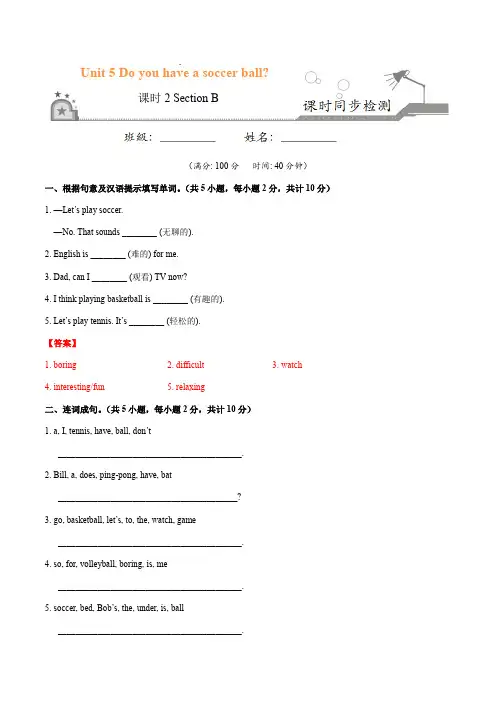
Unit 5 Do you have a soccer ball?课时2 Section B(满分: 100分时间: 40分钟)一、根据句意及汉语提示填写单词。
(共5小题,每小题2分,共计10分)1. —Let’s play soccer.—No. That sounds ________ (无聊的).2. English is ________ (难的) for me.3. Dad, can I ________ (观看) TV now?4. I think playing basketball is ________ (有趣的).5. Let’s play tennis. It’s ________ (轻松的).【答案】1. boring2. difficult3. watch4. interesting/fun5. relaxing二、连词成句。
(共5小题,每小题2分,共计10分)1. a, I, tennis, have, ball, don’t__________________________________________.2. Bill, a, does, ping-pong, have, bat_________________________________________?3. go, basketball, let’s, to, the, watch, game__________________________________________.4. so, for, volleyball, boring, is, me__________________________________________.5. soccer, bed, Bob’s, the, under, is, ball__________________________________________.【答案】1. I don’t have a tennis ball2. Does Bill have a ping-pong bat3. Let’s go to watch the basketball game4. V olleyball is so boring for me5. Is Bob’s soccer ball under the bed三、根据汉语意思完成句子,每空一词。
Unit5 Do you have a soccer ball教学设计
Unit5 Do you have a soccer ball?Section B 2 (2a-2c)一、教学目标:1. 掌握下列词汇: watch TV, student, sport, play sports, to, same, love, with, them, only, like, easy, after, class, classmate2. 阅读有关体育用品收藏的小短文,并能获得相关信息。
3. 通过阅读有关运动的文章和对话, 使学生更加热爱体育活动并培养一种适合自己的体育爱好。
二、教学重难点1. 教学重点:引导学生进行阅读训练,来掌握行为动词一般现在时的肯定句、否定句的结构,尤其是单三形式的变化。
2. 教学难点:行为动词一般现在时的肯定句、否定句的结构,尤其是单三形式的变化。
三、教学过程Ⅰ. RevisionMake conversations.play computer games interestingplay volleyball boringwatch TV relaxingplay basketball difficultfunⅡ. BrainstormTry to list as many ball games as you can.Ⅲ. Writing1. Find the sports words in the unit. Write them in the correct column.2. Make a report to your partner first.S1: I have a soccer ball, a volleyball, two tennis balls, three ping-pong bat…I don't have a basketball, a tennis bat, a baseball bat…3. Exchange the chart with your partner. Report yourpartner's sports collection.S2: He has a soccer ball, a volleyball, two tennis balls, three ping-pong bat…He doesn't have a basketball, a tennis bat, abaseball bat…Ⅳ. Reading1. Our school magazine made a survey about sports collection. This is the survey results. Read the passageand answer the question:Do you have a soccer ball?2. Ss read the passage quickly and find the answer to the question.3. Check the answer. Let some students say their answer and say why?(指导:在读短文时,应重点抓住soccer ball,通过对比文中的信息,从而轻松地就能知道答案。
新人教版七年级上册英语第五单元精选练习题附标准答案
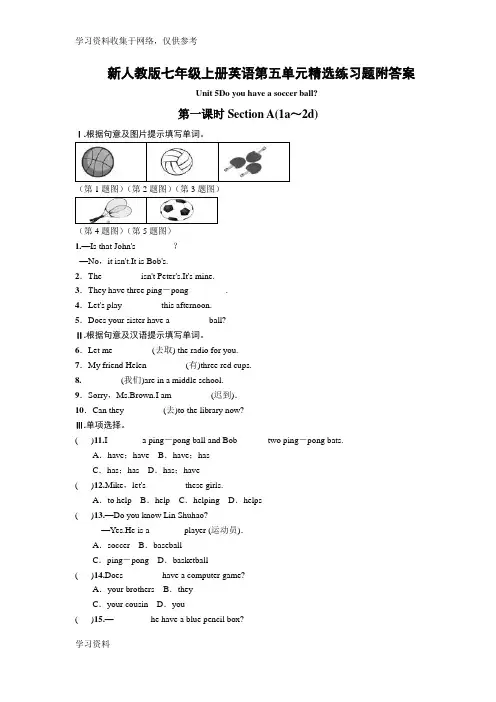
新人教版七年级上册英语第五单元精选练习题附答案Unit 5Do you have a soccer ball?第一课时Section A(1a~2d)Ⅰ.根据句意及图片提示填写单词。
(第1题图)(第2题图)(第3题图)(第4题图)(第5题图)1.—Is that John's ________?—No,it isn't.It is Bob's.2.The ________ isn't Peter's.It's mine.3.They have three ping-pong ________.4.Let's play ________ this afternoon.5.Does your sister have a ________ ball?Ⅱ.根据句意及汉语提示填写单词。
6.Let me ________ (去取) the radio for you.7.My friend Helen ________ (有)three red cups.8. ________ (我们)are in a middle school.9.Sorry,Ms.Brown.I am ________ (迟到).10.Can they ________ (去)to the library now?Ⅲ.单项选择。
( )11.I________a ping-pong ball and Bob_______two ping-pong bats.A.have;have B.have;hasC.has;has D.has;have( )12.Mike,let's ________ these girls.A.to help B.help C.helping D.helps( )13.—Do you know Lin Shuhao?—Yes.He is a________player (运动员).A.soccer B.baseballC.ping-pong D.basketball( )14.Does ________ have a computer game?A.your brothers B.theyC.your cousin D.you( )15.—________ he have a blue pencil box?—No,he ________.A.Does;don't B.Do;don'tC.Do;doesn't D.Does;doesn'tⅣ.按要求完成下列句子,每空一词。
Unit 5 Do you have a soccer ball 七年级上课文原文及重点
Unit 5 Do you have a soccer ball?Part 1 Words and Expressionsdo /duː/ (第三人称单数形式does /dʌz/) aux v.用于构成否定句和疑问句v.做;干have /hæv/ v.有tennis /'tenɪs/ n. 网球ball /bɔːl/ n.球ping-pong /'pɪŋpɔŋ/ n. 乒乓球bat /bæt/ n. 球棒;球拍soccer /'sɒkə(r)/ n. (英式)足球soccer ball (英式)足球volleyball /'vɒlibɔːl/ n.排球basketball /'bɑːskɪtbɔːl/ n.篮球hey /heɪ/ interj.嘿;喂let /let/ v. 允许;让us /ʌs/ pron. (we的宾格)我们let’s = let us 让我们(一起)go /gəʊ/ v.去;走we /wiː/ pron.我们late /leɪt/ adj. 迟到has /hæz/ v. (have的第三人称单数形式) 有get /get/ v.去取(或带来);得到great /greɪt/ adj.美妙的;伟大的play /pleɪ/ v. 参加(比赛或运动);玩耍sound /saʊnd/ v.听起来好像interesting /'ɪntrəstɪŋ/ adj.有趣的boring /'bɔːrɪŋ/adj.没趣的;令人厌倦的fun /fʌn/ adj.有趣的;使人快乐的n.乐趣;快乐difficult /'dɪfɪkəlt/ adj. 困难的relaxing /rɪ'læksɪŋ/ adj.轻松的;令人放松的watch /wɒtʃ/ v.注视;观看TV /,tiː'viː/ n. (=television /'telɪvɪʒn/)电视;电视机watch TV看电视same /seɪm/ adj. 相同的love /lʌv/ v. & n. 爱;喜爱with /wɪð/ prep.和……在一起;带有;使用sport /spɔː(r)t/ n. 体育运动them /ðəm/ pron. (they的宾格) 他(她、它)们only /'əʊnli/ adv.只;仅like /laɪk/ v. 喜欢;喜爱easy /'iːzi/ adj.容易的;不费力的after /'ɑːftə(r)/prep. & conj.在……之后class /klɑːs/ n.班级;课classmate /'klɑːsmeɪt/ n.同班同学Bill /bɪl/比尔(男名)Part 2:Texts课文(一)Cindy:Hey, Helen, let’s go! We’re late!Helen: OK.Cindy: Do you have the baseball?Helen: Yes, I do. It’s in my bag.Cindy: And where’s our baseball bat?Helen: Bill has it.Cindy: Oh, yeah. And do you have your jacket?Helen: Oh, no, I don’t. It’s on the chair. Let me get it. Cindy: And your hat, too!Helen: OK, I have my jacket and hat. Let’s go!Structure1. Do you have a baseball?Yes, I do./No, I don’t. I have a volleyball.2. Do you have a ping-pong bat?Yes, I do./No, I don’t. I have a ping-pong ball.3. Does she have a tennis ball?Yes, she does./No, she doesn’t. She has a baseball.4. Does he have a soccer ball?Yes, he does./No. he doesn’t. He has two ping-pong bats. 5. Do they have a basketball?句型:—Do/Does sb. have…?—Yes, sb. do / does.—No, sb. don’t / doesn’t.Write each word in the correct place in the chart.将方框中的单词填入表格中正确的位置。
Unit 5 Do you have a soccer ball?Section A(第二课时)教案 (新版)人教新目标版
Unit 5 Do you have a soccer ball?第二课时 2d-3c Grammar Focus教学目标1.Get the students to learn how to greet people.2.Teach the words let, us. Get the students to know the full form of let’s .3. Get the students to learn to say Let’s play a soccer ball.教学内容New words: hey, let, us, let’s=let us, go, we, late, has, get, great, play, sound — Do you have a ping-pong ball?— Yes, I do.— Do you have a ping-pong bat?—No, I don’t.—Does he have a tennis ball?—Yes, he does. / No, he doesn’t.—Do they have a basketball?—Yes, they do .No, they don’t.教学过程I. Warming- up and revisionSing ABC song.Greeting (Say hello between the teacher and the Ss)Divide the class into Group A and B. Draw two baby birds on the blackboard as their symbols, tell the students that each time they answer questions right, they can get one or more points for their group and draw one or more clouds below the ir bird, at the end of the class, the group which gets more clouds wil l be the winner today. Say, “One, two, three!” Get the whole class sit straight, thus announce the beginning of the competitionReview introductionPlay the “Word train” game. Get a group of students ask and answer questions one by one.T: Good morning. I’m Diana. Do you have a ping-pong ball?S1: Yes, I do.(Then S1 turn around and greet S2 in the same way.)Review :1.球类,及球拍有关的单词。
七年级英语下册《Unit5 Do you have a soccerball》课件2 人教新目标版

B: Yes, I do. I have a …/
No, I don’t. I don’t have a …
Report: I have a …, but I don’t have
a … Jim is my friend. He has a…, but he doesn’t have a…
1a
Match the words with the things in the picture.
1. tennis ball __ a 2. ping-pong bat __ f c 3. soccer ball __ e 4. volleyball __ d 5. basketball __ 6. baseball bat __ b
Game: Who has the best eyes? 谁的眼睛最亮?
Lead in
have 有
I have a ruler.
I have a tennis ball
Make sentences with have.(用have说句子)
I don’t have a ruler.
I don’t have a volleyball.
Learning
• • • • • • • • soccer ball 英式足球 basketball 篮球 volleyball 排球 baseball 棒球 baseball bat 棒球棒 ping-pong ball 乒乓球 ping-pong bat 乒乓球拍 tennis ball 网球
But he doesn’t have a computer game. doesn’t +动词原形
Does she have a schoolbag? Yes, she does.
Unit 5 Do you have a soccer ball_教案
Unit 5 Do you have a soccer ball?Section A Grammar focus and 3a-3c一、Teaching aims and demandsKnowledge and skills :1.掌握句型Let’s play soccer. That sounds good. Do you play volleyball?2. 熟练掌握词汇let, us, play, well, sound, great3.能正确运用Let’s …来向别人提出建议。
4.能使用That sounds …/I don’t have …回答别人的建议。
Teaching process and methods:通过教师讲解,对话展示,图片描述,自主探究等活动,熟练使用Grammar focus重点句型。
Emotional attitudes and values:在询问物品所属关系中获得英语学习的乐趣,逐步培养学生们对英语学习的兴趣并养成良好的收藏习惯。
二、教学重点:1.掌握句型:Let’s play soccer. That sounds good. Do you play volleyball? Have 和has的句型。
2. 熟练掌握词汇let, us, play, well, sound, great3.能正确运用Let’s …来向别人提出建议。
4.能使用That sounds …/I don’t have …回答别人的建议。
三、教学难点:1.训练学生在不同情景下运用所学句型来询问物品所属关系的能力。
2.能在实际生活中运用所学句型询问物品所属关系。
四、教学方法:运用自主探究、合作交流法、小组合作、情景交际等教学方法。
五、教学准备:ppt, exercises,a computer and some balls六、教学过程设计:Step 1 RevisionFirst,the teacher show a basketball,a volleyball and a ping pong ball and ask the questions: What’s this in English? Do you have a basketball?According to the pictures ,let students answer the questions. Do you have a tennis racket? Where is the tennis racket? Does Tom have .......? Does Mary have........? Step2 Study new words and expressions.Great,play ,sound,Let’s play...., That sounds goodStep 3 Practice words and expressions in pairs.1.A: Do you have a volleyball ? B: Yes, I do.A: Let’s play volleyball. B: That sounds good /great.2.Show some pictures ,then let students ask and answer in pairs.A: Does he / she have a .....? B: Yes, he /she has a ....A: Does he / she have a .....? B: No, he /she doesn’t have a ....Step 4 Study Grammar FocusLet students read these sentences and remember them,then let students fill the blanks according to Chinese.Step 5 According to the pictures ,let students study the sentences: I have a ....,but I don’t have a ..... She has a ....,but she doesn’t have a.... He has a... but he doesn’t have a...Step 6 总结have /has用法(学生总结,教师补充)have和has与主语搭配:(肯定句)I SheWe HeYou have … It has…They The boyTony and Jenny Jenny可见,现在时态里,主语为第三人称单数时用has,其余人称都用have。
七年级英语上册Unit5Doyouhaveasoccerball教案人教版
Unit 5 Do you have a soccer ball?The First PeriodSection A (1a-2d)Ⅰ.Teaching aims:1.Knowledge aims:(1)Keywords:do,have,tennis,ball,soccer,volleyball,basketball,let,us,go,we,late,has,ge t(2)Key phrases:soccer ball,let’s go,be late(3)Important sentences:A:Do you have a ping-pong bat?B:Yes,I do.A:Do you have a ping-pong ball?B:No,I don’t.2.Ability aims:Talk about different kinds of balls.3.Emotion aims:Make students fall in love with ball sports.II.Important points:Train students’ listening and speaking skills.III.Difficult points:Ask and answer questions using “do” or “does”.IV.Teaching processStep 1 Warming up1.Show a volleyball to the class.T:What’s this in English?Ss:It’s a volleyball.T:Yes,you are right.How do you spell it?Ss:V-O-L-L-E-Y-B-A-L-L,volleyball.Show students other objects,such as basketball,tennis ball,soccerball ,baseball,ping-pongbat...Teach students new words in the same way.2.Work on 1a.①Please look at the picture in 1a.There are some balls in it.Do you know what kindof balls theyare?Match the words with the things in the picture.②Teacher checks the answers.③Look at the key structure.—Do you have a ping-pong bat?—Yes,I do.—Do you have a ping-pong ball?—No,I don’t.Read the words and dialogue after the teacher and then read it together.Step 2 ListeningWork on 1b,2a,2b.1.Play the recording for the first time.Students only listen.2.Play the recording again and ask students to do 1b,2a,2b.3.Check the answers in 1b,2a,2b.Step 3 PairworkWork on 1c.Practice the conversation with your partner. Then ask and answer questions about the things in 1a.A: Do you have a ping-pong bat?B: Yes,I do.A: Do you have a ping-pong ball?B: No,I don’t.Work on 2c.Ask and answer questions about the people in 2a.A:Does Jane have a tennis ball?B:No,she doesn’t.Ask some pairs to act out their conversation.Step 4 Role-playWork on 2d.Let students read the conversation after the teacher,and then practice the conversation with theirpartners.Teacher asks some pairs to act out the conversation in front of the class.Language points1.have的用法(1)have为实义动词,意为“有”,常用句型为sb. have/has +sth.,表示“某人有某物”,当主语为第三人称单数时,have用其单三形式has。
人教版新目标版七年级英语上册 Unit 5 Do you have a soccer ball?第2课时 Section A2a—2d教案
录音机、磁带、课本,教学案
知识
链接
法
情境教学和合作学习法。
教学过程
Step 1 Warming up and lead-in
T:Do you have a pen ?
S1: Yes, I do
T: Do you have a baseball?
S1:Do you have a cup?
S2:Yes,I do
S1:Do you have a soccer ball?
S2:No, I do
3.After doing this, devide the class into two groups, Make conversations in groups
S1:No ,I dont’
T:How many sports things do you know?
Ss:Basketball,baseball/…
2. In this procedure, students will learn how to talk about ownership
Ask two students to work in pairs like this
T:Look at the pictures in 2b and name them. What are these?
(Point at the baseball, basketball,volleyball,football.)
Ss:They are…
T:There are four children in the conversations. Who are they? Please listen and find the answer.
七年级英语上册unit5-Do-you-have-a-soccer-ball教学设计
Unit5 Do you have a soccer ball?(SectionB2a~2c)Ⅰ.教学整体设计思路本课主要采用任务型教学模式,利用多媒体(PPT)以及畅言系统中的电子白板设计一些阅读任务,通过略读、细读、跳读等阅读策略快速获取信息,从而达到读懂叙述运动和体育用品的短文。
Ⅱ.教学背景分析教材分析本课是一节阅读课。
活动2a~2c的内容是一个整体:2a 巩固词汇,为下一步的阅读做好铺垫,要求学生根据自己所拥有的体育用品的情况,将单元中出现的有关词汇进行分类巩固句型I have…。
2b~2c要求学生阅读校刊上一则有关体育用品调查报告,并完成不同的阅读任务。
这要求学生能够根据图意预测文章大意,通过谈论球类运动,让孩子们体会与朋友共度快乐时光的愉悦心情.在教学过程中,注意对学生阅读技巧和语篇分析能力的培养。
学情分析在本课阅读前,学生通过对SectionA和SectionB的部分学习,对表达自己拥有体育用品情况的词汇和句型已经比较熟悉。
因此学生在朗读短文前,会比较容易预测篇章的大意,为学生理解文章奠定基础。
文章中有个别新词汇或语言结构,会造成学生理解上的障碍。
另外,本课也出现了许多名词复数,在口头训练时要提醒学生注意词尾加s。
在读前设计适当的任务,为阅读理解扫除障碍。
本课2c的设计也是为巩固第三人称单数时的陈述句要注意动词变成三单形式,对学生来说,也是很大难点。
但该部分学习内容很容易引起学生们的共鸣,极易引起学生表达的欲望。
Ⅲ.教学目标分析nguage goals:(1)Key words and phrases:正确理解和使用词汇:same, but, with, sports, them, only, like, easy, after , classmates , 并了解词组go to the same school, with our friends, watch… on TV, after class, play ping-pong的意义.(2)Key sentences:I don’t have a soccer ball, but my brother Alan does.I have two soccer balls, three volleyballs, four basketballs and five baseballs and bats.2.Ability goals:通过略读、细读、跳读等阅读策略快速获取信息,完成相关的阅读任务,能够读懂叙述运动和体育用品的短文。