
【全】Unit 9 Have you ever been to a museum179页
2a. Look at the map of the town. Listen and circle the places you hear.
2b. Listen again and circle T for true or F for false. Conversation 1
1. Tina went to the space museum last year. T/F 2. John has never been to the space museum. T/F 3. They are going to take the subway. T/F
talk about? 2. What do you think is the most interesting thing about each museum?
Ken: The most interesting museum I‘ve ever been to is the American Computer Museum. They have information about different computers and who invented them. The old computers were much bigger. It‘s unbelievable that technology has progressed in such a rapid way! I‘ve also learned that there was a special computer. It could play chess even better than humans. I wonder how much more computers will be able to do in the future.
1955, the 1st one,
Los Angeles
1971, the 2nd one, Florida
1982, 3rd one, Tokyo
1992, the 4th one, Paris
2004, the latest one, Hong Kong
This is the gate of Disneyland! -Have you ever been to …? -Yes, I have. I have been to…./ No, I haven’t./ Never.
Anna: So, what did you do on the weekend?
Jill:
I camped in the mountains with some
friends. We put up a tent and cooked outside.
Anna: That sounds fun. I‘ve never been camping. Jill: You should try it!
by bike. T/F
Conversation 3
1. Frank had a great time at the water park. T/F
2. Frank‘s friend has never been to the water
park. T/F
3. Frank and his friend are going skating. T/F
迪斯尼乐园旁边有一条10米宽的河流,游客可乘船游览。河流 两岸森林茂密,不时传来阵阵猿鸣声。岸边有走动的大象,河里 经常有鲨鱼和海豹的出没。听起来挺原始的。不过,这些人和鸟 兽多数是人造的,由电子仪器控制。
乐园内也有dining room,shop, movie house, coffee house 等公共场 所。整个游乐园仿佛是洛杉矶的一座卫星城,被视为现代游乐场 所的奇迹。迪斯尼游乐园吸引了世界著名各地众多的游客,是孩 子们心目中的天堂。
cup of tea with beautiful tea sets. Watching the tea preparation is just as enjoyable as drinking the tea itself. I‘ve finally realized why my grandpa loves drinking tea and collecting tea sets.
1. Which three museums do the students talk about? The American Computer Museum; The International Museum of Toilets; The Hangzhou National Tea Museum. 2. What do you think is the most interesting
2c. Look at the map in 2a and make conversations about the places.
A: Have you ever been to the space museum? B: Yes, I have. How about you? A: No, I haven‘t. B: Oh, it‘s fantastic. Let‘s go tomorrow. A: OK. How are we going to get there? B: We can take the subway.
Amy: I‘ve recently been to a very unusual museum in India, the International Museum of Toilets. I just couldn‘t believe my eyes when I saw so many different kinds of toilets there. The museum teaches people about the history and development of toilets. It also encourages governments and social groups to think about ways to improve toilets in the future.
Conversation 3
A: Have you ever been to Disneyland?
B: No, I've never been there.
A: Neither have I. Let's go!
B: I'd really love to , but I don't have any money.
Conversation 2
1. Linda has been to the amusement park. T/F
2. Linda went to the amusement park
yesterday. T/F
3. Linda is going to the amusement park again
water park _____ 2
3 zoo _____
1 amusement park _____
1b. Listen. Have these students ever been to these places? Check (✓) the boxes.
Science History Art Nature Space museum museum museum museum museum Claudia Sarah
Conversation 2
A: Have you ever been to the water park? B: No, I haven't. But I'm going there next week.
Would you like to come?
A: Sure. How will we get there? B: We can ride our bikes.
3a. Three students talk about the most interesting museums they have ever been to. Read the magazine article and answer the questions.
1. Which three museums do the students
Linlin: Last year I went to the Hangzhou National Tea Museum. It‘s a relaxing and peaceful place near a lake. The tea art performances show how to make a perfect
趣味阅读
迪斯尼乐园
Disneyland 是世界著名的游乐园,美国第一个Disneyland 坐落在 Los Angeles(洛杉矶)郊区,是美国动画片制作家Walt Disney设计 创建的。 游乐园中有中世纪的城镇,原始的木筏和18世纪流行的画廊, 还有热带的原始森林。在卡通馆里,Mickey Mouse, Donald Duck, Snow White(白雪公主)等卡通明星热情接待着游客。
✓ ✓ ✓
✓ ✓
✓
1c. Ask and answer questions about the places in 1b.
A: Let‘s go somewhere different today. B: OK. Where do you want to go? A: Have you ever been to the space museum? B: No, 1 haven‘t. How about you? A: ...
A: Let‘s go skating instead.
人教新目标英语八年级下册讲义—Unit 9 Have you ever been to a ……

新目标八年级下册Unit 9 Have you ever been to a museum ?讲义一、重点单词1. amusement n. 娱乐; 游戏2. somewhere adv. 在某处; 到某处3. camera n. 照相机; 摄影机; 摄像机4. invention n. 发明物5. invent v. 发明; 创造1. unbelievable adj. 难以置信的; 不真实的2. progress n. 进步; 进展3. rapid adj. 迅速的; 快速的4. unusual adj. 特别的; 不寻常的5. toilet n. 坐便器; 厕所6. encourage v. 鼓励7. social adj. 社会的8. peaceful adj. 和平的; 安宁的9. performance n. 表演; 演出10. perfect adj. 完美的; 完全的11. itself pron.(it的反身代词) 它自己12. collect v. 收集; 采集13. German adj. 德国的; 德语的; 德国人的n. 德语; 德国人14. theme n. 主题15. ride n. 供乘骑的游乐设施; 短途旅程16. province n. 省份17. simply adv. 仅仅; 只; 不过18. fear v. & n. 害怕; 惧怕19. whether conj. 不管......;还是); 或者......(或者); 是否20. Indian adj.印度的 n. 印度人21. Japanese adj.;日本的; 日本人的; 日语的n. 日本人; 日语22. equator n. 赤道23. whenever conj. 在任何......时候; 无论何时24. spring n. 春天25. mostly adv. 主要地; 通常26. location n. 地点; 位置二、短语归纳1.at night在夜晚2.in a more natural environment在一个更加自然的环境中3.all year round 全年4.be far from 离……远5.in the dark 在黑暗中6.in the past 在过去7.have been to sp. 去过某地8.science museum 科学博物馆9.history museum 历史博物馆10.amusement park 游乐园11.go somewhere different 去不同的地方12.go skating 去滑冰13.take the subway 坐地铁14.a great way to spend a Saturday afternoon一个过周六下午的好方法15.all the old movie cameras所有的古老的电影摄影机16.learn about sth.解有关……的情况17.on the weekend 在周末18.camp in the mountains 在大山里露营19.put up a tent搭帐篷20.in such a rapid way 以如此迅猛的方式21.different kinds of各种各样的22.development of toilets 厕所的发展23.social groups 社会团体24.the tea art performances茶艺表演25.make a perfect cup of tea with beautiful tea sets用漂亮的茶具沏一杯完美的茶26.a nice place to enjoy tea 一个品茶的好地方27.thousands of 数以千计的28.International Museum of Toilets国际厕所博物馆29.the Terracotta Army 兵马俑30.Southeast Asia东南亚31.Night Safari 夜间动物园32.three quarters 四分之三33.an English-speaking country一个讲英语的国家34.have problem doing sth. 做某事很困难35.during the daytime在白天36.a couple of times 好几次37.right now 现在;目前38.an amusement park with a special theme一个有特别的主题的游乐园39.walk around the park 在公园里到处走40.hear of 听说41.take a ride兜风42.another province另一个省43.the Bird’s Nest鸟巢44.encourage sb. to do sth.鼓励某人做某事45.on the one hand... on the other hand.一方面,另一方面三、句型集萃1.a great way to do sth一个做某事的好办法2.It’s unbelievable that很难相信……3.watch sb do sth.看某人做了某事4.encourage sb to do sth鼓励某人做某事5.as..as和。
八年级英语下册 Unit 9 Have you ever been to a muse
Sarah
√
√ √
1c Ask and answer questions about the places in 1b.
A: Let's go somewhere different today. B: OK. Where do you want to go? A: Have you ever been to the space
Listen. Have these students ever been to these places? Check (√) the
1b
boxes.
Claudia Science museum
History museum
Art museum
√
Nature museum √
Space museum √
park.
TF
Linda went to the amusement
park yesterday.
TF
Linda is going to the amusement
park again by bike.
TF
Conversation 3
Frank had a great time at the water park. Frank's friend has never been to the water park. Frank and his friend are going skating.
Conversation 1
Tina went to the space museum
last year.
TF
John has never been to the space
museum.
人教版新目标Unit9 Have you ever been to a museum全单元精品课件
我姐姐没出过国, 我也没有。
Lily likes playing the piano. So has her brother.
Lily喜欢弹钢琴, 她弟弟也喜欢。
I am not new here. Neither is Tom.
我不是新来的, Tom也不是。
4. 注意区别so在完全倒装句和不完全倒装句中 的用法。 so+助动词+主语 完全倒装, 表示“也……‖ so+主语+助动词 不完全倒装, 表示“确实如此” 如: Mary has gone to Singapore. So has Emily. Mary去新加坡了, Emily也去了。 -- Dracula likes spicy food. -- So he does. -- Dracula喜欢吃辣的。 -- 是的, 确实如此。
Unit 9
Have you ever been to a museum?
Summer vacation is coming,
Where do you want to go? I want to go… Do you want to go to…?
你曾经去 过…吗?
Have you ever been to the Great Wall ? Yes I have. /No, I haven‘t.//No, never.
Grammar Focus
Review
现在完成时由主语+have/has+过去分词构成。
其主要用法如下:
结构: 主语+ have / has + 动词的过去分词 一般疑问句: have / has … ?
Yes, I have. No, I haven‘t. Yes, she has. No, she hasn‘t.
人教版英语八年级下册Unit 9 Have you ever been to a museum知识点总结及单元测试卷(附答案)
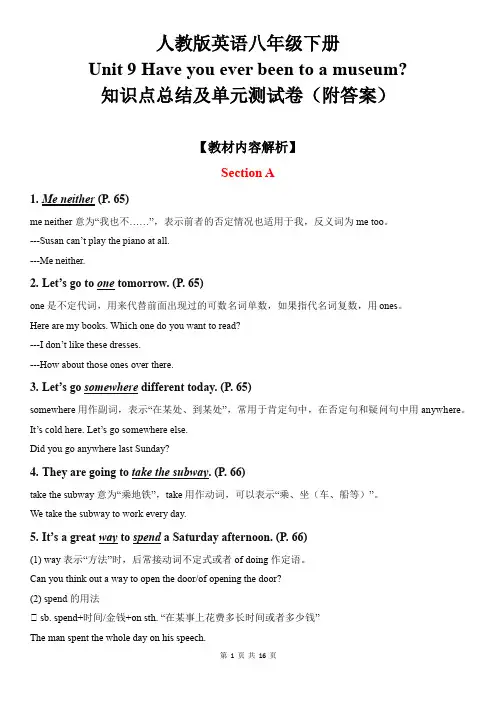
人教版英语八年级下册Unit 9 Have you ever been to a museum?知识点总结及单元测试卷(附答案)【教材内容解析】Section A1.Me neither (P. 65)me neither意为“我也不……”,表示前者的否定情况也适用于我,反义词为me too。
---Susan can’t play the piano at all.---Me neither.2.Let’s go to one tomorrow. (P. 65)one是不定代词,用来代替前面出现过的可数名词单数,如果指代名词复数,用ones。
Here are my books. Which one do you want to read?---I don’t like these dresses.---How about those ones over there.3.Let’s go somewhere different today. (P. 65)somewhere用作副词,表示“在某处、到某处”,常用于肯定句中,在否定句和疑问句中用anywhere。
It’s cold here. Let’s go somewhere else.Did you go anywhere last Sunday?4.They are going to take the subway. (P. 66)take the subway意为“乘地铁”,take用作动词,可以表示“乘、坐(车、船等)”。
We take the subway to work every day.5.It’s a great way to spend a Saturday afternoon. (P. 66)(1) way表示“方法”时,后常接动词不定式或者of doing作定语。
Can you think out a way to open the door/of opening the door?(2) spend的用法① sb. spend+时间/金钱+on sth. “在某事上花费多长时间或者多少钱”The man spent the whole day on his speech.The family spent 10,000 dollars on their trip.① sb. spend+时间+(in) doing sth. “花费多长时间做某事”The boy has spent two hours playing the computer games.【拓展】辨析spend, pay, take和cost6.We put up a tent and cooked outside. (P. 66)put up意为“搭建”,还可以表示“举起、张贴”。
人教版英语八下U9Have you ever been to a museum 讲义
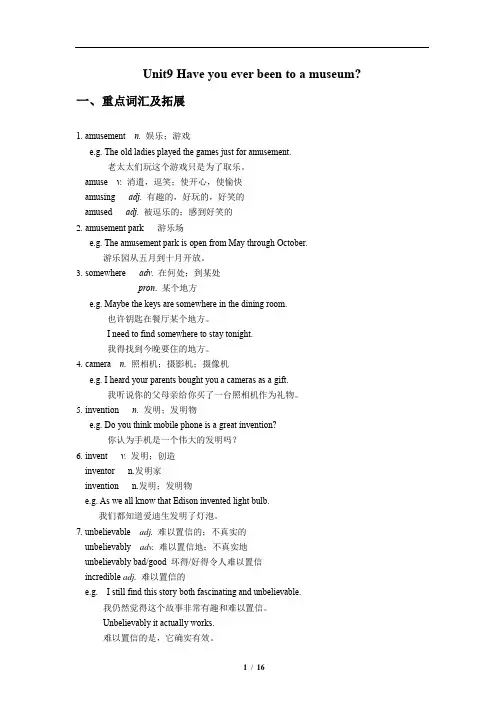
Unit9 Have you ever been to a museum?一、重点词汇及拓展1. amusement n. 娱乐;游戏e.g. The old ladies played the games just for amusement.老太太们玩这个游戏只是为了取乐。
amuse v. 消遣,逗笑;使开心,使愉快amusing adj. 有趣的,好玩的,好笑的amused adj. 被逗乐的;感到好笑的2.amusement park 游乐场e.g. The amusement park is open from May through October.游乐园从五月到十月开放。
3.somewhere adv. 在何处;到某处pron. 某个地方e.g. Maybe the keys are somewhere in the dining room.也许钥匙在餐厅某个地方。
I need to find somewhere to stay tonight.我得找到今晚要住的地方。
4.camera n.照相机;摄影机;摄像机e.g. I heard your parents bought you a cameras as a gift.我听说你的父母亲给你买了一台照相机作为礼物。
5.invention n.发明;发明物e.g. Do you think mobile phone is a great invention?你认为手机是一个伟大的发明吗?6.invent v.发明;创造inventor n.发明家invention n.发明;发明物e.g. As we all know that Edison invented light bulb.我们都知道爱迪生发明了灯泡。
7. unbelievable adj. 难以置信的;不真实的unbelievably adv. 难以置信地;不真实地unbelievably bad/good 坏得/好得令人难以置信incredible adj. 难以置信的e.g. I still find this story both fascinating and unbelievable.我仍然觉得这个故事非常有趣和难以置信。
unit9-Have-you-ever-been-to-a-museum(1)
1. 我去过北京两次。 2.Ih_a_ve____b_e_e_n___ _t_o___ Beijing twice. 3.2. 大声读书是一种学习英语的好方法。 4.Reading aloud ias _g_o_o_d_w_a_y_ _t_o__ learn English. 5.3. 昨天他没有去那,我也没去。 6.He didn’t go there yesterday. 7M.__e___ _n_e_it_h_e_r___. =Neither did I.=I didn’t go there, either.
again by bike.
T /F
Conversation 3 Frank had a great time at Water park. TF Frank’s friend has never been to Water park. TF Frank and his friend are going skating.
【归纳拓展】 neither的用法小结 作副词, 常用于短语“neither. . . nor. . . ”, 连接并列成分, 意为 “既不……也不……”, 当连接并列主语时使用就近原则。
Neither I nor my mother _l_ik_e__s(like) red.
我和妈妈都不喜欢红色。
1a Which of these places would you like to visit? Rank them from 1 to 5.
space museum 太空博物馆
__History museum 历史博物馆
art museum
艺术博物馆
water park
水上公 园
zoo
动物 园
河南省八年级英语下册Unit9Haveyoueverbeentoamuseum必考知识点归纳
河南省八年级英语下册Unit9Haveyoueverbeentoamuseum必考知识点归纳单选题1、The Great Wall is a place of interest. All of us ________ there before.A.has beenB.have beenC.has goneD.have gone答案:B句意:长城是个名胜古迹。
我们所有人以前都去过那里。
考查现在完成时。
have/has been表示去过某地又回来了;have/has gone表示去了某地还没回来。
主语“All of us”是复数,用have而不用has,排除AC;根据before可知应该是去过,现在已经回来,用have been而不用have gone,排除D。
故选B。
2、—I have ________ been to Tibet. How about you?—Me. neither.A.neverB.everC.already答案:A句意:--我从没去过西藏。
你呢? --我也没有去过。
根据neither “我也没有去过”提示,可知问句是没去过,never从不,ever曾经,already已经;故选A。
3、David has never been to Australia, ________?A.hasn’t heB.doesn’t heC.has heD.does he答案:C句意:大卫从未去过澳大利亚,是吗?考查反义疑问句。
题干中“has never been”是现在完成时,助动词为has,never表否定。
反义疑问句中如果陈述句为否定,反义疑问句的后半部分应用肯定疑问句。
故选C。
4、— ________ you ever ________ to Hong Kong?— Yes, only once.A.Did; goB.Have; goneC.Do; goD.Have; been答案:D句意:——你去过香港吗?——是的,只有一次。
人教八下Unit 9 Have you ever been to a museum课文及听力翻译(PDF版)
') 6( '%0 G40163&" H)45*'01 I*(0*4- $%0; %&/0 6",)14&'6)" &2)*' +6,,010"' 3)45*'01( &"+ @%) !"#$"%$& !""#$"%& '%04- $%0 )9+ 3)45*'01( @010 4*3% 267701- .'!( '"($)!$#*()$ #$"'!"()%#&*( '%&' '03%")9)7; %&( +,-.,$//$& " +,&'-,./ " +,(%-,$/ 6" (*3% & ,*+!& ",0 @&;< .!/0 &9() 90&1"0+ '%&' '%010 @&( & (5036&9 3)45*'01- .' 3)*9+ 59&; 3%0(( 0/0" 20''01 '%&" %*4&"(- . @)"+01 %)@ 4*3% 4)10 3)45*'01( @699 20 &290 ') +) 6" '%0 ,*'*10!4;! . ! /0 1030"'9; 200" ') & /01; '"'/'*) $" " 12%)2&( 4*(0*4 6" ."+6&J '%0 0"%$,"* %!-"*) #3"%&#$""0*"&( 1'/$'2 -3 4-!)$%/ " %+4(&%- . K*(' 3)*9+" ! ' 20960/0 4; 0;0( @%0" . (&@ () 4&"; +6,,010"' =6"+( ), ')690'( '%010- $%0 4*(0*4 '0&3%0( 50)590 &2)*' '%0 %6(')1; &"+ +0/09)540"' ), ')690'(- .' &9() $" 5-',*.$/ &" " 5$,&6)4 4" " 5,%,46)4 7)/01" 40"'( &"+ /-5!*) " /&'*( 71)*5( ') '%6"= &2)*' @&;( ') 6451)/0 ')690'( 6" '%0 ,*'*10L6"96"!L&(' ;0&1 . @0"' ') '%0 M&"7?%)* N&'6)"&9 $0& I*(0*4- .' ! ( & 109&O6"7 &"+ +$*5$3') "+)%/7( 59&30 "0&1 & 9&=0- $%0 '0& &1' +$,3-, 2*"5$/ +&%,&"7+% % ,&8&"/4 (%)@ %)@ ') 4&=0 & +$,3$5% "+,% % ,&745% 3*5 ), '0& @6'% 20&*'6 ,*9 '0& (0'(- C&'3%6"7 '%0 '0& 5105&1&'6)" 6( K*(' &( 0"K);&290 &( +16"=6"7 '%0 '0& !%/$)3 4%"/.(7- .!/0 ,6"&99; 10&96?0+ @%; 4; 71&"+5& 9)/0( +16"=6"7 '0& &"+ 5-))$5%!". 5& " (.5%- '0& (0'(-
【人教英语】八下Unit 9 Have you ever been to a museum课文重难点详解 Section A
【人教英语】八下Unit+9+Have+you+ever+been+to+a+museum课文重难点详解+Section+ASection A1.—Have you ever been to a science museum?你曾经去过科学博物馆吗?— Yes,I have. 是的,去过。
【解析1】ever 曾经(用于现在完成时。
ever用于疑问句、否定句)—Have you ever seen the film?—No, never.【解析2】have/has been to / have / has gone to / have/ has been in 辨析:⑴have/ has been to + 地名“曾经去过某地”, 现在已经回到原地。
He has been to England twice.他曾经去过英国两次。
(现在已经不在英国了)Have you ever been to the Great Wall?你到过长城吗?(现在已经不在长城上)⑵have gone to“已经去某地了”,说话时该人不在现场。
He has gone to England。
他已去英国了。
(已经不在说话的地方,到达英国或者在去英国的路上)( ) Mary isn’t here. She has ____ the shop.A. been toB. went toC. gone toD. /【2013江苏中考1】A number of tourists ____ Yangzhou many times because it is such a beautiful city.A. have been toB. has been toC. has gone toD. have gone to⑶have been in +地点待在某地,常与时间段搭配。
I have been in Shanghai for three years.2. Me neither 我也没有。
河南省八年级英语下册Unit9Haveyoueverbeentoamuseum解题方法技巧
河南省八年级英语下册Unit9Haveyoueverbeentoamuseum解题方法技巧单选题1、—Hi, Tom! _________ you ever _________ the Bird’s Nest?—Yes, I have. It’s fantastic.A.Have; been toB.Have; gone toC.Did; go to答案:A句意:——嗨!汤姆!你去过鸟巢吗?——是的,我去过。
那太棒了!考查现在完成时。
由答语“Yes, I have.”可知,问句用现在完成时,排除C项;have been to表示“曾经去过某地(现在已经回来了)”;have gone to表示“去了某地(还没有回来)”。
分析语境可知,此处是问“你曾经去过鸟巢吗?”,应用have been to。
故选A。
2、—Do you like English?—Yes, but I think__________ is a great challenge to learn the language well.A.thatB.thisC.it答案:C句意:——你喜欢英语么?——是的,但是我认为把语言学好是一种挑战。
考查代词。
that那个;this这个;it它。
think后是省略that的宾语从句,不定式“to learn the language well”是从句的真正的主语,此处用it做宾语从句的形式主语。
故选C。
3、—Where’s your English teacher?— She ________ to Beijing. She’ll be back in a week.A.has beenB.has goneC.goesD.went答案:B句意:——你的英语老师在哪儿?——她去了北京。
她将在一周后回来。
考查动词时态。
have been to…“去过某地”;have gone to…“去了某地”,根据“She’ll be back in a week.”可知,她去了北京,现在不在这儿,用“have/has gone to +地点”来表示。