
直译和意译在中文菜名翻译中的应用
・104・ 哈尔滨职业技术学院学报 2012年第3期 Journal of Harbin Vocational & Technical College
一、引言
直译和意译一直是翻译史上讨论的中心话题。
早在罗马帝国时期,西方最早的翻译理论家西塞罗就区分了“作为解释员”和“作为演说家”的翻译。
他实际上提出了翻译的两种基本方法,并因此而开拓了翻译理论和方法研究的园地。
至此,西方翻译理论家便围绕着直译与意译展开了讨论。
时至今日,这依然是翻译理论家探讨的热点话题之一。
不同的文体翻译,适合不同的翻译方法。
中文菜名作为中国传统饮食文化的重要组成部分,直接反映了中国文化的丰富内涵,因此中文菜名翻译的优劣直接影响着西方人对中国饮食文化的理解。
直译或是意译的正确选择和应用,不仅为菜肴本身增色添彩,而且对中国饮食文化的传播,中西方饮食文化的交流都起到了促进作用。
二、中西方饮食文化的差异
中国是大陆文化,而西方是海洋文化,这种不同的生成背景,包括地域地貌、气候气象、自然生态、风土民俗以及历史文化等差异而形成了显著区别。
中国饮食文化博大精深,西方饮食则精致巧妙。
“中西两种文化具有不同的文化背景,而不同的文化背景必然会
使人们产生不同的饮食文化”。
[1]
中西语言的差异,特
别是饮食文化的差异,必然会反映到对中文菜名的翻译中。
(一)中西方饮食观念的差异
[收稿日期]2012-03-16[作者简介]李敏(1982-),女,三门峡职业技术学院语言与艺术系助教师。
中图分类号:H315.9 文献标识码:A 文章编号:1008—8970—(2012)03—0104—02
西方是一种理性饮食观念。
不论食物的色、香、味、形如何,而营养一定要得到保证,讲究一天要摄取多少热量、维生素、蛋白质等。
而中国饮食则要求色、香、味、形俱全,尤以味最突出,其次才是营养搭配。
中国的饮食更追求美性。
(二)中西方饮食内容的差异1.选料差异
西方人认为菜肴是充饥的,所以在选料上偏高热量型材质。
而中国的菜肴是“吃味”的,所以中国烹调在选料上也显出极大的随意性:许多西方人视为弃物的东西,在中国都是极好的原料。
2.烹饪方式差异
中餐的烹饪方式及其多样,例如有烧、烩、焖(braise);炖、煨(stew);煎、炸、酥(deep-fry);爆、炒、熘、滑(stir-fry,quick-fry);干炒、干煸(sauté);煮(boil)、涮(instant-boil)、白灼(scalded);烧、烤、焙(roast,barbecue,broil);蒸(steam)腌(pickle)卤(halogen)熏(smoke)酱(marinate)酿(stuffed)等。
而西餐的烹饪方式则较为简单。
3.菜品名称差异
西菜的名称比较直接,一目了然,注重实际,突出菜品原料。
中菜的名称则更赋予艺术性,常用四字格,注重音节在字词和词组间的平衡感。
四字格在声调、音韵、节奏等方面的音乐美,赋予了中文菜名的美感。
直译和意译在中文菜名翻译中的应用
李 敏
(三门峡职业技术学院, 河南 三门峡 472000)
摘要:直译和意译这两种翻译方法的选择一直是翻译理论家长期讨论的话题之一。
在不同的文体翻译中,灵活的选择适
当的翻译方法,对于读者更深层次地理解文本的内涵起到了纽带的作用。
本文通过对中西方饮食文化差异下中文菜名翻译的分析,来探讨直译和意译在中文菜名翻译中的选择和应用。
关键词:直译和意译;饮食文化差异;中文菜名翻译
・105・ 哈尔滨职业技术学院学报 2012年第3期 Journal of Harbin Vocational & Technical College
三、中文菜名的分类及翻译对策
(一)直译法
用直译法对中文菜名进行翻译,会比较直观,便于人们理解,易于接受,“这类菜名特点是真实地描述了菜肴的原料、制作方法及特点……翻译时一般采取‘直译’法,直接译出该菜肴的原料,烹调方法和菜肴的特点”。
[2]对此,主要分以下几种类型:
1.主料型(菜品名称由主要原料和制作方法构成)
如:炖牛肉(Stewed beef); 西红柿炒鸡蛋(stir-fried egg and tomato)。
中文菜名大部分是以主要原料命名的,这一类型的菜名翻译采用直译法。
烹饪方法的过去分词形式加上原料名称即可。
2.口感型(菜品名称由主要原料和口感构成)
如:鱼香肉丝(fish-flavored shredded pork);脆皮鸡(crispy chicken)。
这一类型的菜名主要体现出菜品的口味,采用直译法。
用形容口感的过去分词或形容词加上主要原料翻译。
3.名称型
地名,如:北京烤鸭 (Beingjing roast duck);
沙河米粉 (Shahe rice noodles);
人名,如:东坡肉(braised dong po pork);
麻婆豆腐(Mapo Tofu (stir-fried tofu in hot sauce)。
在地名类型的翻译中,直接用地名加主要原料。
而涉及到人名的菜品,虽然采用了直译,但又有意译的影子,既具有中国特色,又可以被外国人所理解。
4.烹饪用具型
如: 八珍火锅(eight delicacies hot pot)。
(二)意译法
1.传说型
叫花鸡 roast whole chicken wrapped in mud (jiaohua ji,named so because it is a begger who first cookedit this way quite accidentally)。
有个传说,当年乾隆皇帝微服出访江南,不小心流落荒野。
有一个叫花子看他可怜,便把自认为美食的“叫花鸡”送给他吃。
乾隆困饿交加,自然觉得这鸡异常好吃。
吃毕,便问其名,叫化头不好意思说这鸡叫“叫花鸡”,就胡吹这鸡叫“富贵鸡”。
乾隆对这鸡赞不绝口。
叫花子事后才知道这个流浪汉就是当今皇上。
这“叫花鸡”也因为皇上的金口一开,成了“富贵鸡”。
流传至今,也成了一道登上大雅之堂的名菜。
这一类型的菜名,不仅要译出主要原料和烹饪方法,还要简要介绍菜品的来历才能让外国人所理解和接受。
2.形象型
龙虎斗 (the dragon fighting with the tiger-stewedsnake and wild cat) 狮子头 (Lion's head-braised meat-balls in brown sause)。
这一类型的菜名十分形象生动,借用中国传统文化中的寓意赋予菜品新的含义。
如龙、虎在中国传统文化中都是权利和力量的化身。
这道菜是用蛇肉烧猫肉的名菜,菜品借用了蛇与龙,猫于虎的形似,龙虎的象征意义来命名,既恰当又大气。
因此翻译时采用意译,不仅译出菜品的字面意思,而且所用原料,烹饪方法也应译出,让外国人真正理解这道菜所蕴含的意义。
总之,“采用直译法可尽量充分地传达原菜名的艺术色彩,采用意译法可辅助说明菜肴的原料、制作方法,以达到写实与写意互补的功效”。
[3]此外,除了直译和意译法外,有少量的菜名采用音译加注释法。
这一类型的菜品从名称本身英译不能被理解,所以采用音译加注释的方法。
四、结语
中国的菜品名称大部分都包含着丰富的文化信息。
正所谓“Because cultural differences do exist,peoplefrom other cultural backgrounds may view Chinese cui-sine names in a different way. For this reason, the trans-lation of Chinese dish names is closely connected tocultures of both source language and target language……meanwhile,Chinese culture can be reflected in the trans-lation of cuisine names”。
[4]准确恰当的菜名翻译,不仅要求全面地理解中西方饮食文化的差异,而且要选择合适的翻译方法。
中文菜名翻译中直译和意译的正确选择和应用,以及其他翻译技巧的使用,能更好的体现出菜品自身的特点及内涵。
【参考文献】
[1]孙圆媛.浅析中国菜菜名英文翻译的误译、滥译现象[J].知识经济,2010,(7):138.
[2]梁红卫.中餐菜谱的英译名浅析[J].福建行政学院福建经济管理干部学院学报,1999,(4):46.[3]夏雨.关于中菜名修辞色彩的翻译[J].山西师大学报(社会科学版),2006,(S1):152.
[4]张昆鹏.从文化角度谈中式菜名的英译策略[D].河北师范大学,2010:3—4.
(责任编辑:董涛)。
论中餐菜名英译中的问题和解决方法
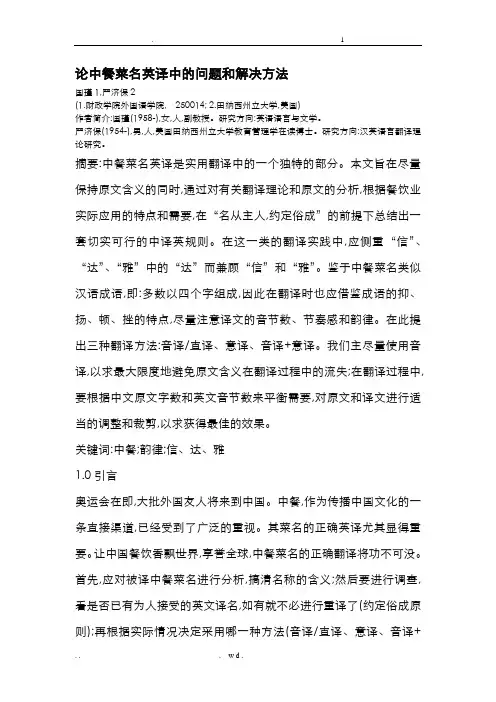
论中餐菜名英译中的问题和解决方法国瑾1,严济保2(1.财政学院外国语学院, 250014; 2.田纳西州立大学,美国)作者简介:国瑾(1958-),女,人,副教授。
研究方向:英语语言与文学。
严济保(1954-),男,人,美国田纳西州立大学教育管理学在读博士。
研究方向:汉英语言翻译理论研究。
摘要:中餐菜名英译是实用翻译中的一个独特的部分。
本文旨在尽量保持原文含义的同时,通过对有关翻译理论和原文的分析,根据餐饮业实际应用的特点和需要,在“名从主人,约定俗成”的前提下总结出一套切实可行的中译英规则。
在这一类的翻译实践中,应侧重“信”、“达”、“雅”中的“达”而兼顾“信”和“雅”。
鉴于中餐菜名类似汉语成语,即:多数以四个字组成,因此在翻译时也应借鉴成语的抑、扬、顿、挫的特点,尽量注意译文的音节数、节奏感和韵律。
在此提出三种翻译方法:音译/直译、意译、音译+意译。
我们主尽量使用音译,以求最大限度地避免原文含义在翻译过程中的流失;在翻译过程中,要根据中文原文字数和英文音节数来平衡需要,对原文和译文进行适当的调整和裁剪,以求获得最佳的效果。
关键词:中餐;韵律;信、达、雅1.0引言奥运会在即,大批外国友人将来到中国。
中餐,作为传播中国文化的一条直接渠道,已经受到了广泛的重视。
其菜名的正确英译尤其显得重要。
让中国餐饮香飘世界,享誉全球,中餐菜名的正确翻译将功不可没。
首先,应对被译中餐菜名进行分析,搞清名称的含义;然后要进行调查,看是否已有为人接受的英文译名,如有就不必进行重译了(约定俗成原则);再根据实际情况决定采用哪一种方法(音译/直译、意译、音译+意译)。
为了最大限度地体现原文的含义,要尽量采用音译/直译。
钱钟书先生在翻译《诗词》时遇到“不是得罪了‘诗’,就是得罪了‘译’”(孔庆茂,1995:189)的问题有极大的参考意义;多数中餐菜名和汉语成语类似,即:是由四个字组成的。
我们主英文译名要体现中文的文化特点———节奏和韵律,也就是说英文译文的总音节数要和原文的字数基本相等,或最多相差一个到两个音节。
美食英文翻译及部分翻译方法附带新疆地方美食翻译英语PPT解析

2 以烹制方法开头的菜名翻译时可以采用 烹制方法的相应动词,在加上菜肴采用的主 料。
• 炖牛肉 Stewed Beef • 炒鸡丁 Stir Fried Chicken Dices • 葱爆羊肉 Quick Fried Lamb with Scallion in Ginger Sauce • 清蒸桂鱼 Steamed Mandarin Fish • 凉拌海蛰 Jellyfish in Soy Sauce • 红烧蹄筋 Braised Pork Tendon in Brown Sauce • 水煮鱼 Fish Filets in Hot Chili Oil
The English translation of Chinese dish name 中国菜名的英译 Mistranslation analysis误译实例
1) “驴打滚”: “rolling donkey”(翻滚的驴子) Glutinous Rice Rolls with Sweet Bean Flour.
6.具有中国特色并且也被外国人接受的传 统食品
• 本着推广汉语和中国文化的原则,宜全部使用汉语 拼音,另外,具有中国特色并且也被外国人接受的, 但使用的是地方语言拼写或音译拼写的菜名,也保 留其拼写方式. • 馄饨、饺子、 • 锅贴 Steamed or Fried Meat Dumpling、 • 油条Fried Sticks、 • 粽子 Glutinous Riceball、汤圆和佛跳墙 • Steamed Abalone with Shark’s Fin and Fish Maw in Broth
Special and Famous Cuisine in China
group member:Emma
中国传统小吃英文译名小试
浅释中菜名的翻译方法与技巧

浅释中菜名的翻译方法与技巧姓名:石岳欣班级:英本2042 学号:200407116 序号:18摘要:饮食文化是中国传统文化的重要组成部分。
外国友人在品尝中国美食的同时,更想了解每道菜的原料、制作方法、特点、来源等,而菜单的准确译名在传播中国饮食文化上起着关键的作用。
中餐菜肴品种繁多,文化内涵丰富,这给中餐菜名的英译造成了很大的困难。
中式菜名的英译要凭借其命名理据进行翻译。
同时也要遵循避虚就实、舍繁就简的翻译原则。
本文将会对中餐菜单的英译要求以及中餐菜单英译方法和技巧方面做一些探讨。
并结合示例对归纳出的像直译、意译,音译及音译加释义等几种具体实用的英译方法做出分析和解释。
关键词:中餐菜单英文译名翻译原则翻译方法意译意译音译音译加释义Abstract:The Chinese food is well known in the world as one important part of traditional Chinese culture, which theforeign tourists would like to enjoy whenever they visit China.And the foreigners also want to know how and withwhat raw material the Chinese food is cooked while theyenjoy it. So the English translation of Chinese Menusplays an important role in spreading traditional Chineseculture. It’s difficult to translate the names of Chinesedishes into English because of the variety of Chinesedishes and the richness of their inner cultures. TheEnglish translation of Chinese dishes names greatlydepend on the motivation of naming them 。
中文菜谱常见翻译方法
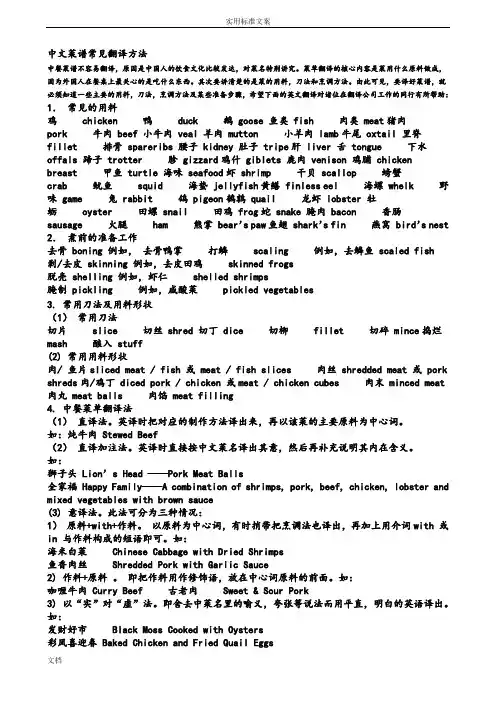
中文菜谱常见翻译方法中餐菜谱不容易翻译,原因是中国人的饮食文化比较发达,对菜名特别讲究。
菜单翻译的核心内容是菜用什么原料做成,因为外国人在餐桌上最关心的是吃什么东西。
其次要讲清楚的是菜的用料,刀法和烹调方法。
由此可见,要译好菜谱,就必须知道一些主要的用料,刀法,烹调方法及某些准备步骤,希望下面的英文翻译对诸位在翻译公司工作的同行有所帮助:1.常见的用料鸡 chicken 鸭 duck 鹅 goose 鱼类 fish 肉类 meat猪肉pork 牛肉 beef 小牛肉 veal 羊肉 mutton 小羊肉 lamb牛尾 oxtail 里脊fillet 排骨 spareribs 腰子 kidney 肚子 tripe肝 liver 舌 tongue 下水offals 蹄子 trotter 胗 gizzard鸡什 giblets 鹿肉 venison 鸡脯 chickenbreast 甲鱼 turtle 海味 seafood虾 shrimp 干贝 scallop 螃蟹crab 鱿鱼 squid 海蛰 jellyfish黄鳝 finless eel 海螺 whelk 野味 game 兔 rabbit 鸽 pigeon鹌鹑 quail 龙虾 lobster 牡蛎 oyster 田螺 snail 田鸡 frog蛇 snake 腌肉 bacon 香肠sausage 火腿 ham 熊掌 bear’s paw鱼翅 shark’s fin 燕窝 bird’s nest 2.煮前的准备工作去骨 boning 例如,去骨鸭掌打鳞 scaling 例如,去鳞鱼 scaled fish 剥/去皮 skinning 例如,去皮田鸡 skinned frogs脱壳 shelling 例如,虾仁 shelled shrimps腌制 pickling 例如,咸酸菜 pickled vegetables3. 常用刀法及用料形状(1)常用刀法切片 slice 切丝 shred 切丁 dice 切柳 fillet 切碎 mince捣烂mash 酿入 stuff(2) 常用用料形状肉/ 鱼片sliced meat / fish 或 meat / fish slices 肉丝 shredded meat 或 pork shreds肉/鸡丁 diced pork / chicken 或meat / chicken cubes 肉末 minced meat 肉丸 meat balls 肉馅 meat filling4. 中餐菜单翻译法(1)直译法。
中国菜名的翻译方法
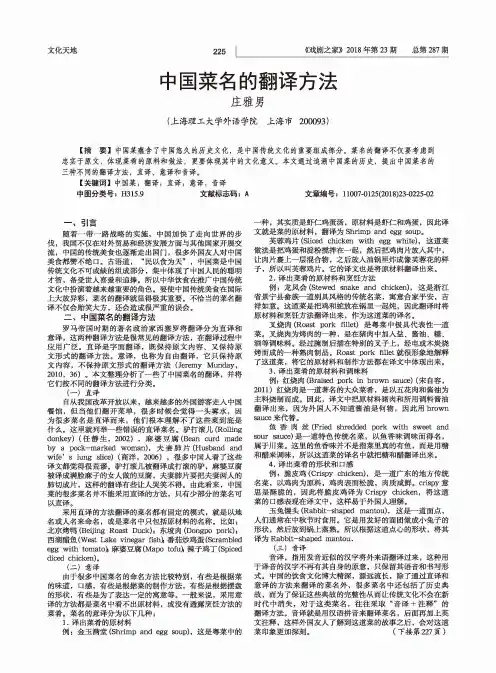
中国菜名的翻译方法庄雅男(上海理工大学外语学院上海市200093)【摘要】中国菜蕴含了中国悠久的历史文化,是中国传统文化的重要组成部分。
菜名的翻译不仅要考虑到 忠实于原文,体现菜肴的原料和做法,更要体现其中的文化意义。
本文通过追溯中国菜的历史,提出中国菜名的 三种不同的翻译方法,直译、意译和音译。
【关键词】中国菜,翻译,直译,意译,音译中图分类号:H315.9 文献标志码:A文章编号:11007-0125(2018)23-0225-02引言随着一带一路战略的实施,中国加快了走向世界的步 伐,我国不仅在对外贸易和经济发展方面与其他国家开展交 流,中国的传统美食也逐渐走出国门,很多外国友人对中国 美食都赞不绝口。
古语道,“民以食为天”,中国菜是中国 传统文化不可或缺的组成部分,集中体现了中国人民的聪明 才智,备受世人喜爱和追捧。
所以中华饮食在推广中国传统 文化中扮演着越来越重要的角色。
要使中国传统美食在国际 上大放异彩,菜名的翻译就显得极其重要。
不恰当的菜名翻 译不仅会贻笑大方,还会造成很严重的误会。
二、中国菜名的翻译方法罗马帝国时期的著名政治家西塞罗将翻译分为直译和 意译,这两种翻译方法是很常见的翻译方法,在翻译过程中 应用广泛。
直译是字面翻译,既保持原文内容、又保持原 文形式的翻译方法。
意译,也称为自由翻译,它只保持原 文内容,不保持原文形式的翻译方法(Jeremy Munday, 2010, 36)。
本文整理分析了一些了中国菜名的翻译,并将它们按不同的翻译方法进行分类。
(一) 直译自从我国改革开放以来,越来越多的外国游客走入中国 餐馆,但当他们翻开菜单,很多时候会觉得一头雾水,因为很多菜名是直译而来,他们根本理解不了这些菜到底是 什么。
这里就列举一些错误的直译菜名。
驴打滚儿(Rolling donkey)(任静生,2002),麻婆豆腐(Bean curd made by a pock-marked woman),夫妻肺片(Husband and wife’s lung slice)(商洋,2006),很多中国人看了这些 译文都觉得很荒谬。
中国菜名的翻译策略

中国菜名的翻译策略STRATEGIES FOR THE TRANSLATION OFCHINESE DISH NAME摘要在中国,烹饪是一门古老的艺术。
早在3000多年前,中国人就已经知道如何美味调配酸、甜、苦、辣、咸这五味。
在清朝年间,一些海外华人在英国和其他国家开设了中国餐馆,从那时起中国菜开始名扬世界,中国餐馆也遍布世界许多国家和地区。
中国菜做工精细,品种多样,被世界不同民族的人们所喜爱。
随着世界全球化的不断发展,中国菜会成为越来越多的国际友人了解中国的一个重要窗口。
中国菜名本是汉语自身的问题,其文化含义也非常清楚,但是当我们将中国菜名译成英文,介绍给外国人时,就出现了语际问题。
相应地,中国菜名的文化含义也就变成了一个跨文化问题,因为翻译是一个跨文化和跨语言的问题,我们必须考虑到两种语言和两种文化的差异。
本篇论文从理论和实践两个角度分析了翻译策略,指出如何正确的翻译中国菜名,并详细讨论了一些特殊菜名。
归纳总结翻译中餐菜名的通用方法:直译法,直译加注法,意译法,同时强调了文化在翻译和交流中的重要作用。
关键词:奈达的翻译理论;中国菜名的翻译;翻译策略;跨文化交际1 IntroductionChinese dishes are known for their variety and abundance. The dishes can be classified into four major cuisines, namely, Northern Cuisine, Sichuan Cuisine, Jiangzhe Cuisine and Southern Cuisine.With more and more contact with the world, Chinese food has become one of cultures symbolizing our country. As one part of our country’s culture, it has a long history and rich culture essences. When foreigners taste our delicious food, they also want to know the name essence of the dish, the raw material, and the cooking ways. Therefore, the translation of Chinese dish names plays a very important role in introducing dishes and spreading our diet culture. A well-translated dish name will help attract customers and inspire their desire for taste; while a dish name translated improperly sometimes will bring negative effect or ever lead to spoilage of the image of the dish.In following paper, we will discuss specific strategies for the translation of Chinese dish names from theoretical and practical perspectives. There are mainly three approaches in translating Chinese dish names: literal translation, literal translation with notes, and liberal translation.2 The Theory Applied to Translation of Chinese Dish Names2.1 Eugene NidaEugene A .Nida, a famous American translator of the Bible, is well known for his works in semantic structure and translation theory. Nida’s theory of translation developed from his own practical work in the 1940s onwards when he was translating and organizing the translation of the Bible. His theory generally contains two concepts: Formal Equivalence and Dynamic Equivalence.2.2 Eugene Nida’s theory of translation2.2.1 Formal equivalence translationFormal Equivalence is defined by Nida as one of “two different types of equivalence”,which “focuses attention on the message itself, in both form and content”. Formal equivalence is thus the “quality of a translation in which the features of the form of source text have been mechanically reproduced in the receptor language” (Nida&Taber, 1969\1982: 201). The aim of a translator who is striving for formal equivalence is to allow ST to speak “in its own terms” rather than to attempt to adjust it to the circumstances of the target culture; in practice this means, for example, using “Formal Equivalents” rather than “Functional Equivalents” wherever possible, not joining or splitting sentences, and preserving formal indicators such as punctuation marks and paragraphs breaks (Nida, 1964: 165). The frequent result ofsuch strategies is of course that, because of differences in structure between SL and TL, a translation of this type “distorts the grammatical and stylistic patterns of the receptor language, and hence distorts the message” (Nida&Taber, 1969\1982:201). For this reason, it is frequently necessary to include explanatory notes to help the target reader (Nida, 1964:166). So a general tendency towards formal than dynamic equivalence is characterized by, for example, a concern for accuracy and a preference for retaining the original wording wherever possible. In spite of its apparent limitations, however, formal equivalence is sometimes the most appropriate strategy to follow: besides frequently being chosen for translating biblical and other sacred texts, it is also useful for Back-Translation and for when the translator may for some reason be unwilling to accept responsibility for changing the wording of TT (Hatim&Hason, 1990:7).2.2.2 Dynamic Equivalence TranslationDynamic Equivalence is based on what Nida called “the principle ofequi valent effect” where “the relationship between receptor and message should be substantially the same as that which existed between the original receptors and the message” (1964:159). The message has to be modified to the receptor’s linguistic needs and cul tural expectation and “aims at complete naturalness of expression”. He defines the goal of dynamic equivalence as seeking “the closest natural equivalent to the SL message” (1969:12).In other words, a dynamically equivalent translation is one which has been produced in accordance with the three fold process of Analysis, Transfer 2, and Restructuring (Nida&Taber, 1969\1982:200); formulating such a translation sill entail such procedures as substituting TL items which are more culturally appropriate for obscure ST items, making linguistically implicit ST information explicit, and building in a certain amount of Redundancy to aid compression. In a translation of this kind one is therefore not so concerned with “matching the receptor language message with the s ource language message”; the aim is more to “relate the receptor to modes of behavior relevant within the context of his own culture” (Nida,1964:159).Nida&Taber argue that a “high degree” of equivalence of response is needed for the translation to achieve its purpose, although they point out that this response can never been identical with elicited by the original (Nida&Taber,1969\1982:24).2.3 Comments on the TheoryNida played an important role in pointing the road away from strict word-for-word equivalence. His introduction to the concepts of formal and dynamic equivalence is crucial in introducing a receptor-based (or reader-based) orientation to translation theory. However, both the principle of equivalent effect and the concept of equivalence have come to be heavily criticized for a number of reasons. Lefevere (1993:78) consider equivalent or response to be impossible. One of Nida’s fiercest critics is Edwin Gentzler, who denigrates Nida’s work for its theological andproselytizing stand point with the concept that dynamic equivalence serves the purpose of converting the receptors, no matter what their culture, to the dominant discourse and ideas of Protestant Christianity. However, Nida has “achieved what few of his predecessors attempted” and his in fluence in translation studies spans five decades and has left an indelible mark in the field of translation (Munday, 2001:43).3 Cross- cultural Communication3.1 Relationship between Culture and translationWhen learning a language, a saying is “learni ng a language is a kind of learning the culture and habit of the country where the language is spoken”. In translation, we may say that translating a source language text is a kind of translating the source language culture and habit of the country where the source language is spoken.3.1.1 The Definition of CultureWhat does the word” culture” mean? It may mean many things. For example, we sometimes say that people who are able to read and write or who know about art, music and literature are cultured. For different people, the word has a different meaning.In fact, culture is really a large and evasive concept, very complex and difficult to define. It is said that there have been at least over 150 definitions of culture, but none of them seems to be able to tell us everything about culture. The following definitions are just some of the well-known ones.“Culture may be defined as what a society does and thinks” (Sapir, 1921).“What really binds men together is their culture—the ideas and the standards they have in common”(R. Benedict, 1935).“Culture is man’s medium; there is not one aspect of human life that is not touched and altered by culture. This means personality, how people express themselves, including shows of emotion, the way they think, how they move, how problems are solved, how their cities are planned and laid out, how transportation systems function and are organized, as well as how economic and government systems are put together and function”.(Edward T. Hall, 1959)3.1.2 The Definition of TranslationTranslation is also an incredibly broad notion which can be understood in many different ways.As Jakobson defines translation as “an interpretation of verbal signs by means of some other language” (1959\1966:233). An approach based on the importance ofpreserving the effect of the original is reflected in Nida&taber’s definition: “translation consists in reproducing in the receptor language the closest national equivalent of the source-language message, first in terms of meaning and secondly in terms of style”(Nida&taber,1982:12). Vermeer, rejecting notions of translation as a two-stage process of decoding and recording, offers a similarly non-normative definition of translation as “information about a source text in another language” (1982:97). This approach engenders a view of translation in which the way a TT functions in a specific cultural context is paramount: “translation is the production of a functional target text that is specified according to the intended or demanded function of the target text(translation skopos)”(Nord,1991:28 ).3.1.3 Relationship between Culture and TranslationHere we will introduce another term “cross-cultural translation”. This term refers to types of translation which function as a tool for cross-cultural or anthropological research, or indeed to any translation which is sensitive to cultural as well as linguistic factors.Most translators recognize that each language contains elements which are derived from its culture, that every text is anchored in a specific culture, and that conventions of text production and reception vary from culture to culture (Koller, 1979\1992:59-60). An awareness of such issues can at times make it more appropriateto think of translation as a process which occurs between languages. Skopos Theory, Thick Translation and Translational Action are all examples of this type of approach.In other words, a cross-cultural translation is one in which additions are made which cannot be directly derived from the original ST wording; these might take the form of ideas culturally foreign to ST, or even elements which are simply included to provide necessary background information.3.2 Cultural Connotation Embodied in Chinese Dish NamesIn the following, we’l l discuss the translation of Chinese dish names. Eating is also a culture. All individuals must eat in order to survive—but what people eat, when they eat, and the manners in which they eat are all patterned by culture.Chinese dishes are known for their variety and abundance. As one part of our country’s culture, Chinese dish has a long history and rich culture essences. Many cultural connotations are embodied in Chinese dish names. Some interesting stories or legendary stories are contained in the background of a dish name. Furthermore, some special dish names have become a symbol of city or our country.Take “Beijing roast duck” for example. It is a carefully prepared dish. Selected ducks are fed at regular intervals so that they will gain more flesh. The ducksare roasted slowly so that the skin becomes crispy and brown, and the flesh juicy and tender. To eat them, the meat is carefully cut into bite-sized pieces and accompanied by a special Chinese sauce with spring onion, which is then rolled in paper-thin pan cakes before eaten. This dish has become a symbol food of Beijing or even our country. Most foreigners all taste it when they come to <st1:country-regionw:st="on">China, when foreigners hear “Beijing roast duck”, they can easily associate it with Beijing.Take “Beggar’s Chicken” for another example. We called this dish “Beggar’s Chicken” for there is an interesting story. A beggar stole a chicken and kindled a fire by a river bank to eat it. Before it was finished cooking, he heard his pursuers. He doused the fire and buried the chicken in the ground, hoping to come back to it later. He did, dug it up, and found it to be quite succulent. So “Beggar’s Chicken” is added to the list of Chinese dishes. ( 陈小慰,2006:221)In order to deliver more information to readers, translators often add some background information to Chinese dish names, it also sounds interesting for foreigners.4 Strategies for the Translation of Chinese Dish NameTranslation is an art, a bilingual art, which is considered as the cultural bridge and media between two languages. As there exist wide differences in vocabulary andculture between <st1:country-region w:st="on">China and Western countries, translation is no easy job, especially the translation of some traditional Chinese dish names. Therefore, in order to keep the flavor of the original Chinese dish and the beauty of language as well as cater for all the foreigners, translation skills should be reasonably employed in the process of translating, such as the following three.4.1 Literal TranslationLiteral translation can be defined in linguistics as translation “made on a level lower than is sufficient to convey the content unchanged while observing TL norms”. (Bark hudarov, 1969:10 ). In a similar vein Catford also offers a definition based on the notion of the UNIT OF TRANSLATION: he argues that literal translation takes world-for-world translation as its starting point, although because of the necessity of confirming to TL grammar, the final TT may also display group-group orclause-clause equivalence. (1965:25)In translating Chinese dish names, by literal translation, the translator can keep the original form of Chinese dish names without causing confusion in meaning. What’s more, it introduces the raw material to foreigners and avoids some troubles between two different diets. The most important point lies in the function of keeping the full flavor of Chinese Dish.We will discuss this translation according to three different structures:(a)cooking method +raw material烧鹅roast goose涮羊肉instant boiled mutton脆皮锅酥肉deep fried pork(b)cooking method +raw material +with +ingredients酿豆腐bean curd stuffed with minced pork糖醋排骨spareribs with sweet and sour sauce干烧明虾fried prawns with pepper sauce(c)cooking method +raw material +and + raw material虾仁扒豆腐stewed shelled shrimps and bean curd凤肝虾仁fried shelled shrimps and chicken liver红烧什肉虾仁豆腐fried bean curd, shelled shrimps and missed meat withbrown sauceThe feature of these Chinese dish names is actually describing materials, cooking methods and features of dishes.The notion of literal translation has been formalized by Nida as formal equivalence. It was defined by Nida as one of “two different types of equivalence”, which “focuses attention on the message itself, in both form and content” (1964:159). Readers can understand easily when they see the dish names, because this translation embodies the original information of the dishes.4.2 Literal Translation with NotesGood literal translation can help foreigners to acquire the direct information of Chinese dish, including raw material, flavor, and so on. But sometimes literal translation without any notes will puzzle readers so that trouble will be naturally produced. As Nida said, “ Since no two languages are identical, either in the meanings given to corresponding symbols or in which such symbols are arranged in phrases and sentences, it stands to reason that there can be no absolute correspondence between languages . Hence there can be no fully exact translation” (1966:156). So this kind of translating skill, literal translation with notes, may supply notes to Chinese dish names, for example, raw material, sources, background, special meaning, etc, thus may strengthen the comprehension of Chinese dish for foreigners, and deliver a more exact information of the dish and Chinese diet culture.Let’s see the following examples:(1)龙虎斗The dragon fighting with the tiger—Stewed snake and wild cat [注:在广东,“龙虎斗”是一道用蛇肉烧猫肉的名菜](2)佛跳墙Buddha-Jumps-Over-the Wall (This is Fujian’s Number1 special dish, carefully prepared with Shark’s fin, abalone and more than 20 other ingredients. This delicious dish is so tempting that even a Buddha will give up his sutra and jump over the wall for a taste of this irresistible dish).( 陈小慰,2006:219)(3)狮子头Lion’s head—pork meat balls(4)全家福Happy family—A combination of shrimps, pork, beef, chicken, lobster and mixed vegetables with brown sauce.(5)龙凤配Dragon&Phoenix—Two separate dishes characterize this distinctive plate. On one side, lobster meat in Sichuan chili sauce, which is inviting. On the other is house special chicken, which never fails in delighting.(6)左宗鸡General Tso’s chicken—A mouth watering dish made with large chunks of marinated chicken, sauteed with scorched red chili peepers in special, tangy sauce. (顾维勇,2005:94)(7)太平燕Fuzhou-style wonton and duck egg soup—The wrapper of the wonton is made of meat and sweet potato starch instead of flour and the dish is most often served on joyous occasions such as weddings and New Year’s Eve which is supposed to bring peace and good luck.Example (1) adopts “literal translation with notes”. Obviously, it is better than “literal translation” in this case. We can easily understand the dish—its material. If we directly adopt “literal translation”, it should be translated to “The dragon fighting with the tiger”. Such translation probably gives readers scare and surprise, “what’s this?” And it also doesn’t deliver the exact information of the dish; it can not correspond to the standard of translation. “A text which is not obviously a translation in the traditional sense is thus created. Here, we must in the first place define translation. Translation consists of providing, in the receptor language, the closest naturalequivalent of the source language message, first in terms of meaning and secondly in terms of style.”(Nida,1984). With the notes, readers could acquire more and exact information about this dish.Examples (3) (4) (5) (6) all belong to this case, that is to say, literal translation with notes about material of dish.Example (2) is a little different from the above examples. It not only describes the basic information of raw material, but also tells us an interesting legendary story. In this case, it not only expresses the exact information, but also adds some tastes for the dish.Example (7) is another similar case; it adds some notes about raw material and related cultural customs. It provides readers such information, which can help readers understand the culture and taste at proper occasion.In some sense, this method is better than literal translation. Literal translation “distorts the grammatical and stylistic patterns of the receptor language, and hence distorts the message” (Nida&Taber, 1969\1982:201). For this reason it is frequently necessary to include explanatory notes to help the target reader (Nida, 1964:166). So we suggest that if for linguistic or cultural reasons the source can not be transcribed, we had better make accommodations, for example, add some notes rather than translate it literally. It can achieve a more exact and vivid result.4.3 Liberal TranslationA type of translation in which more attention is paid to producing a naturally reading TT than to preserving the ST wording in fact; also known as sense-to-sense translation. Linguistically it can be defined as translation “made on a level highe r than it necessary to convey the content unchanged while observing TL norms.”(Bark hudarov, 1969:11). Free translation is thus generally more “TL- oriented” than literal translations.When there exists dissimilarity or great differences between Chinese dish names and essence of the dish, free translation can be employed. In this case, readers can easily understand the essence of the dish.Here Chinese dishes can be divided into two kinds in this translation(a)According to raw materials.蚂蚁上树(油炸的绿豆面条)—Fried Mung Bean Noodle乌龙睡雪(海参肚中装上馅,再加蛋清蒸制)—Steamed Stuffed Sea Cucumbers with Egg-white百年好合(用莲子和百合炖成的汤菜)—Lotus Seeds and Lily Pulp四系双发(四个冷拼小菜)—Four Plates of Wonderful Food霸王别姬(甲鱼炖鸡汤)—Soft-shelled Turtle and Chicken Soup (b)According to place names.肉燕—Wonton of Fuzhou Style金陵盐水鸭—Nanjing Salted Duck宫爆鸡丁—Fried Diced Chicken in Sichuan Style麻婆豆腐—Bean curd Sichuan Style石狮牛肉羹—Beef Broth of Sailt Fujian StyleIn (a), Chinese dish names sound wonderful, but if we translate themword-to-word, readers can not know what the dish is. That is to say, this translation can not deliver clear information to readers. As Doctor Nida views “in general it is best to speak of functional equivalence in terms of a range of adequacy”. In this case, the translators should make some adjustments in order to achieve the closest natural equivalence. In the west, there is an interesting saying: A translation is like a woman; if it is faithful, it is not beautiful; if it is beautiful, it is not faithful. Maybe here is a good example.In (b), most of these dishes are famous local food, and they represent the local diet culture. So when we translate this kind of food, this method is better. Through this translation, readers can know relate diet culture and remember this food easily. Take “金陵盐水鸭” for example, for Chinese, we all know that “金陵” is another name of “南京”, but for foreigners, they are familiar with the latter place more than the former, so we translate it to “Nanjing salted duck”, it can enlarge the information of the dish.From the above examples, it is not hard to see that free translation seems better than literal translation when we translate Chinese Dish Names, because one ofthe most important principles of translation is transferring actual information to readers. For Ch inese dish, the most readers want to know is what the food is. “Eugene A. Nida applies the communication theory and information theory to translation research, regarding that translation is communication.”(谭载喜,1999:XVIII).Information theory has been widely influential in the process of translation. In other word, translation is a complicated process of language transfer and information transmission. The essence of translation is to transmit the information carried in one language to another language. It conforms to Nida’s “Functional equivalence”. Function equivalence follows the principle of equivalent, that is, the relationship between the receptor and the message should aim at being the same as that between the original receptor and the source language message. It attempts to render receptor words from one language to another, and caters to receptor linguistic competence and cultural needs.For foreigners, they do not know much about Chinese culture and Chinese food. So we should take an action so that they can quickly and easily get the information of dish they want to know. That is to say, we should describe the material of food clearly, avoiding some unnecessary rhetoric, and choosing some ordinary and popular words.5 ConclusionGenerally speaking, the translation of Chinese dishes is challenging, demanding a great deal of translation practice and broad knowledge about our diet culture. From this paper, we may know the basic strategies for Chinese dish names. Firstly, the translator should master the basic principle of translation. Secondly, the translator should de familiar with national culture of different countries. Thirdly, the translator can employ above-mentioned translating skills flexibly in the process of Chinese dish translation.. For the aim of making more foreigners understand the Chinese dish and communicate the diet culture, a good translator should study both language and cultures concerned well.BIBLIOGRAPHY[1] Catford, J.C. A Linguistic Theory of Translation: An Essay in Applied Linguistics[M].London: Oxford University, 1965.[2] Munday, J. Introdusing Translation Studies: Theories and Applications [M].London: Taylor and Francies, 2001 .[3] Nida & Charles R. Taber. The Theory and Practice of Translation [M]. Leiden: E. J. Brill,1969.[4] Nida, E. A. Toward a Science of Translation [M]. Leiden: E. J. Brill, 1964.[5] Nida. Language, Culture, and Translating [M]. Shanghai: Shanghai Foreign LanguageEducation Press, 1993.[6] Shuttleworth, M. & M. Cowie, Dictionary of Translation Studies [Z]. Manchester:St. Jerome Publishing, 1999(reprinted).[7] 陈小慰. 新编实用翻译教程[M]. 经济科学出版社, 2006.[8] 顾维勇. 实用文体翻译[M]. 国防工业出版社, 2005.[9] 李和庆、黄皓、薄振杰. 西方翻译研究方法论[M]. 北京大学出版社, 2005.[10] 刘法公. 商贸汉英翻译专论[M]. 重庆出版社, 1999.[11] 谭载喜. 翻译学[M]. 武汉: 湖北教育出版社, 1999.[12]许力生. 跨文化交际英语教程[M]. 上海外语教育出版社, 2004.ABSTRACTIn <st1:country-region w:st="on">China, cooking is an ancient art. As early as over 3,000 years ago, Chinese people already knew how to deploy acid, sweet, bitter, pungent and salty flavor. At Qing dynasty, a number of overseas Chinese set up some Chinese restaurants in English and other countries. Since then, Chinese restaurants areall over the world. Chinese cuisine, of fine work and wide variety, is favorited by the world people of different nationalities. With the continuous development of globalization, Chinese cuisine will become an important window, through which more and more international friends can understand <st1:country-region w:st="on">China better.Chinese dish names is Chinese own problems, their cultural meaning is very clear. But when translate Chinese dish names to English and introduce to the foreiigners, we meet the language issue. Correspondingly, the cultural meaning of Chinese dish names has become a cross-cultural and cross-language issue, we must take into account both language and cultural differences.This paper analyses translation strategies from theoretical and practical perspectives by pointing out how to properly translate Chinese dish names, with a discussion of some specific dish names. And then summarizes a common approach of Chinese dish names: literal translation, literal translation with notes, and liberal translation. Meanwhile, we emphasize the importance of culture in translation and communicationKey words: Eugene Nida’s theory of translation, the translation of Chinese dish names, translation strategies, cross-cultural communicationACKNOWLEDGEMENTSIt was really a laborious task to accomplish a B.A thesis. Many people gave me support and help in the process of writing the paper. I’d like first to express my deepest gratitude to my supervisor, Associate Professor Sun Xiaolei, who generously gave me his kindly help and instructions during the whole process of mypaper-writing. Then I’d like to give my many thanks to my teacher Zhang Yuanyuan, who has shown much consideration for my composition. Finally, I would like to express my thanks to my friends, Chen Leilei and Wan Rui, who have generously offered their help with my computerization。
论中式菜名英译中的功能对等
论中式菜名英译中的功能对等【摘要】中式菜肴品种繁多,其菜名花样百出,文化内涵丰富,这给中式菜名的英译造成了很大的困难。
本文分析了中式菜名的几大特点,并从奈达的功能对等角度出发,对不同的菜名归纳总结了几种翻译方法:直译法、意译法和注释法,说明了中式菜名的翻译需力求达到功能对等,并以此作为检验翻译实践的标准。
【关键词】菜名功能对等翻译【中图分类号】H315.9 【文献标识码】A 【文章编号】1674-4810(2011)13-0039-02一引言1.中式菜名英译的现状随着中国经济的飞速发展,中国国际化的日益深入,有越来越多的外国朋友来到中国。
尤其是2008年奥运会和2010年世博会的成功举办,吸引了一批又一批的国际友人来亲身感受中国,其中就包括感受中国的饮食文化。
这使得很多人开始关注菜谱翻译问题。
如“宫保鸡丁”在某些地方被翻译成“Government abuse chicken”(政府虐待鸡);“口水鸡”翻译成“Watering chicken”(流口水的鸡);“夫妻肺片”被译为“Husband and wife’s lungs lice”(丈夫和妻子的肺切片)等等,着实埋没了博大精深的中国饮食文化,而且很有可能吓跑顾客。
笔者现居住的地方海南,因国际旅游岛的缘故也越来越受国际游客的追捧。
但通过笔者与外国朋友交谈,发现很多外国朋友对就餐一事很是无奈,往往抱着“吃饱就行”的心态,还有很多人因为看不懂中国菜单而放弃吃中国菜,选择了西餐,这不能不说是一种损失。
笔者也发现很多当地食物的英译确实存在着很大问题,如“椰子饭”往往译成“Coconut rice”(椰子•米饭),不明所以;而当地特色小吃“清补凉”则被直接译成“Qing Buliang”,在笔者看来,除非另外加以解释,否则根本没有达到交流的目的。
中国食文化源远流长,各式菜肴命名时也五花八门,在翻译时应充分考虑严复先生提出的信、达、雅三项准则,使中式餐饮成为吸引外国朋友的一道风景。
美食英文翻译及部分翻译方法附带新疆地方美食翻译英语解析
? 四川水饺Sichuan Boiled Dumpling
? 北京烤鸭Beijing Roasted Duck
5.含有喻意夸张等含义的菜名:以实对虚 法“也就是舍去中菜名里的喻义、夸张等 说法而用平直明白的英语译出。
? 彩凤喜迎春 Baked Chicken and Fried Quail Eggs( 烤鸡鹌鹑蛋)
饮食文化翻译的方法 1.直译法 2.音译法 3.意译法
? 菜名的主要命名类别:
? 1.以主料开头的菜名 ? 2.以烹制方法开头的菜名 ? 3.以口感开头的菜名 ? 4.以人名或地名命名的菜肴 ? 5.含有喻意夸张等含义的菜名 ? 6.具有中国特色并且也被外国人接受
的传统食品
1.以主料开头的菜名:直译法,中间加连词and或 以原料为中心词,加上用介词with或in与作料构 成的短语
? 宫保鸡丁: Diced Chicken with Peanuts, Pepper and Scallion
? 海米白菜: Chinese Cabbage and Dried Shrimps
? 鱼香肉丝: Shredded Pork and Garlic Sauce/Fish-flavored Shredded Pork
烤羊肉串: mutton cubes roasted [r?ust](烤,炙,烘)
on a skewer [skju?]
(串肉扦)
Kebabs [k?‘bɑb烤](肉串) can be found in the streets
and bazaars [b?'zɑ:]
(巴扎) throughout Xinjiang.
Salted duck egg
浅谈中国菜名俄译方法
浅谈中国菜名俄译方法作者:郑慧来源:《启迪与智慧·教育版》2018年第02期【摘要】中国是一个饮食文化非常发达的国家,随着中俄两国联系的日益密切,越来越多的俄罗斯人来到中国,浅谈中国菜谱翻译成俄语方法,对于传播中国饮食文化,促进经济发展,中俄文化的交流有着深远的意义。
【关键词】菜肴名称翻译;菜肴名称;文化交流滨海边疆区与吉林省相毗邻,在一定程度上影响着吉林省的饮食行业。
因此翻译中国菜肴以及延边当地特色的菜肴是有意义的。
翻译时,可以视时间、地点等客观情况进行必要的介绍,让外国客人了解中国菜所包含的丰富文化,让他们更深入地了解中国。
从严复提出的“信达雅”,及国外翻译学界提及最多的等值标准和等效标准。
这些翻译标准总的来说,译文在意思上说要忠实原文,在表达上要顺通自然,符合译语表达习惯,并在此基础上体现中国菜肴的特点。
因此,要熟练掌握中国菜名俄译技巧。
一、直译:指原汁原味地翻译原文的本意,考虑每一个字,源语中的每一个字、词在目标语中对应地进行翻译这样,俄罗斯人能轻松愉快地理解原文的真正含义。
在翻译菜名中可分为以下几种情况:1.形容词+制作食材。
烤鸡:жаренаякурица意大利蔬菜汤:итальянскийовощнойсуп红烧龙虾:жареныйлангуст2.烹饪方法+制作食材с чем(辅助食材)洋葱烤猪扒:жареные свиные рёбрышки с луком清炒四季豆:жареные бобы со специями葱墨鱼:жареная каракатица с китайской приправой3.烹饪方法+制作食材в чём(口味)加酱爆鹿筋:жареные сухожилия оленя в соевом соусе拔丝苹果:яблоки в карамели红烧鲤鱼:жареный сазан в соевом соусе4.烹饪方法+制作食材под чём红焖猪蹄:тушёные свиные ноги под красным соусом红烧鲨鱼:жареная акула под красным соусом叉烧肉:свинина под кисло-сладким соусом5.菜名(食材)+из чём烤西冷牛扒:бифштекс из филе говядины八宝饭:пудинг из клейкого риса炒米粉:жареная лапша из рисовой муки6.菜名+(в чём /на чём)香菇蒸滑鸡:курица с грибаминапару清蒸龙虾:лангустнапару桑拿虾:креветки в сауне7.汤类+食材из чём/счем乌鸡水鱼汤:бульон из чёрной курицы с черепахой鸡汁野菌汤:бульон с дикими грибами海龟汤:суп из морской черепахи根据以上的分类归纳,(1)对于烹饪方式中的炖、烧、扒、焖、烩等加水后慢火煮的用тушить(тушёный)表示;炒、炸、熘、煎、爆、煸等用жарить(жареный)表示;煮、熬等用варить(варёный)蒸等用паровой 或напарить表示;熏用коптить(копчёный)表示。
英语翻译中直译和意译的应用研究
43海外文摘OVERSEAS DIGEST 海外文摘2021年第3期总第838期No.3,2021Total of 8380引言语言是文化的载体,我国与其他国家在历史文化、风俗习惯等方面存在差异,这使得语言的表达形式也不同。
在翻译英语时,译者要充分考虑到文化的因素,让翻译更为准确,在翻译的过程中要遵循信、达、雅的原则,注重译文与目标语言的习俗相结合,熟练地运用翻译方法和技巧,其中,直译和意译就是两种基本的翻译方法。
1直译的介绍1.1直译的概念直译指的是在翻译时不仅要保持原文的形式,还要保持原文的内容,能够将原文的意思准确而完整的表达出来[1]。
也要保留原文的一些语言形式,如修辞手法、词语、句子结构等,如此译出的文章通俗易懂,也符合语言的规范,这就是直译。
1.2直译的应用直译要将忠实原文放在第一位,将忠实原文的形式放在第二位,最后保证译出的文章具有通俗性和流畅性。
在应用方面,首先,直译在翻译实践中经常被翻译者所使用,这种方法不仅能够传达原文的精神和内容,还会让读者更好地理解原文的意思。
如果翻译的内容符合汉语的表达方式,则要尽量使用直译的方法。
在英语习语中,许多翻译都是采取直译的方法。
如“armed to the teeth”表达的是“武装到牙齿”。
其次,直译并不是机械地翻译,而是尽量要遵循信、达、雅的翻译原则。
由于中文与英语在语言表达方面存在差异,逐字进行翻译有时会歪曲意思,直译注重的是准确、全面地阐明原文的意思,不会随意删除或增加原著的思想和情感,要使原著的文章保持原有的风格,充分考虑原文作者的情感[2]。
2意译的介绍2.1意译的概念译者在翻译的过程中,采取直译的方法行不通时,就要改变原文的句子结构,对原文的意思使用不同的汉语语言形式表达出来[3]。
为了达成这一目标,译者要充分理解原文的内容和情感,为其重新遣词造句,用通顺的汉语来表达原文的意思,这种方法就被称为直译。
2.2意译的应用一般来说,意译比直译更难,它要求译者要深入分析原文,充分理解原文作者所要表达的思想意图,能够透过表面看到本质,理清原文的深层结构,也要有很强的判断能力和推理能力[4]。