
译林版四年级英语下册第三单元4B Unit3 教案
Unit3 My dayI The background information本单元主要内容是谈论我的一天。
教学重点是句型如When do you get up/…?I usually… at…在二年级教材中,学生已学过morning, afternoon 等词,在教学时,可以适当利用这些词,或以旧引新,或拓展延伸,做到新旧知识的融会贯通。
根据学生的年龄特点,教师可以采用游戏的方式,让学生在愉悦轻松的氛围中掌握所学知识。
II Teaching aims and learning objectives这节课学完后学生应达到的目标一、能听懂、能理解、会读课文。
二、能听懂、会说、会读单词usually, go to school, in the morning, in the evening, in the afternoon, go home, homework, watch TV, have four lessons, have lunch, play football, do my homework, have dinner, go to bed, every day三、初步理解、会读句型:When do you get up/…?I usually… at… .用今天所学的内容,在实际生活能用英语表述自己一天的生活III Focus of the lesson and predicted area of difficulty一、能听懂、会说、会读句型::When do you get up/…?I usually…at…在语境中的正确运用。
二、能听懂、会说、会读单词:go to school, usually, in the morning,have lunch, go home, do my homework, have dinner, watch TV,go to bed三、掌握字母e和字母组合ee在单词中的读音IV Teaching aidsPPT,头饰V Teaching proceduresStep1 Greeting and warm upT: Good morning, class.Ss: Good morning.T: Do you like games? Let’s play a game: Yeah, yeah, yeah, or No,no ,no.1.It’s Monday today.2.We have 4 lessons in the morning.3.We have a PE lesson in the afternoon.4.I like Music.5.I go to school every day.6.It’s six o’clock. It’s time for English class.Step2 Presentation1.Show six clocks, review the time6:15 7:05 11:45 5:00 6:20 10:00T: What time is it? It’s six fifteen in the morning…. (复习时间,并将钟面贴在黑板)Guess: What do I usually do at 6:15 in the morning?Ss: get up/have breakfast…T: I usually get up at 6:15板书:I(usually)…at…Teach: usuallyWhen do you get up?Ss: I get up at…2.In the same way to teach:go to school at 7:05have lunch at 11:45have dinner at 6:20go to bed at 10:003. T: I do different things at different time.(Chant)I get up at six fifteen.I go to school at seven o five.I have lunch at eleven fifteen .I go home at five.I have dinner at six twentyI go to bed at ten.So this is my day.揭题:Unit 3 My day4. Talk in groups. Make a new chant, say something about your day.Step3 Story timeT: We’re having an English lesson and we’re talking about our days.Mike is talking about his day too. Let’s listen to Mike, try to findout Mike’s activities in the morning.(Part1)Ss listen and then choose the pictures.(出示五幅图:起床、看电视、上学、睡觉、吃午饭,学生听第一段,根据Mike的介绍选出早上的活动)1.Listen again and match(再听一遍介绍,出现三个钟面,将Mike的活动与时间配对)2.T: What else does Mike do in the morning?Ss: have lessonsT: Yes. And how many lessons does he have in the morning.Ss: Four.T: So Mike has four lessons in the morning.(Part2)1.T: How many lessons does Mike have in the afternoon? And what elsedoes Mike do in the afternoon? Let’s listen again, and try to answer.Q1. How many lessons does Mike have in the afternoon?Q2. What else does Mike do in the afternoon?Teach: go homedo my homeworkIn the afternoon: have lessons/play football/go2.Listen and read Part 2(Part3)1.Read Part3 by selves, try to fill in the blanks.2. Talk in groups: When does Mike do these things? Say like this:…at…3.Listen and read Part3Step 4 Consolidation1.Read in three.2.Act as Mike, choose one part and talk about your activity.(三人一小组,扮演Mike,选择早、中、晚其中一个时间说说自己的活动)VI Homework1.Listen and read the story, try to recite it.2.Describe your day to your family, then write it down. Blackboard design:Unit 3 My dayI IIIV VT: 1.2.o’clock?(出示图片剪影)Guess!Ss: He gets up at seven.3. (出示另一个钟面)Teach:go to school in the same way.And what about this one?Ss: go to schoolTeach: get up/ go to school3.T: What does Mike usually do in the afternoon? Show two pictures.Ss: He …Teach:play football at four/go home at four forty in the afternoon.4:Show three pictures(have dinner/watch TV/go to bed)How about in the evening or at night? Please talk in groups. Then teachthese phrases according to their answers:Have dinner at six thirteenWatch TV at seven in the eveningGo to bed at nine at night4.Retell Mike’s day according to these picturesStep 3 Fun time1.Show a timetable and finish it.T: Do you want to know something about my day? You can ask me like this:Teach: When do you…?Ss: When do you get up?T: I get up at six in the morning.Ss ask ,T answers and draw the clocks.2.T: Look ,this is my day.(Introduce the T’s day)How about yours?3.Ss draw and write.上台展示自己的完成情况:S1:When do you get up? S2: I get up at 6:30. )Step 4 Show timeTalk: My happy dayToday is…I…at…Blackboard designUnit 3 My dayWhen do you in the afternoonin the eveningat nightI usually…at…Teaching reflection:(课型:新授设计:授课时间:月日)I Teaching contentSound time and Rhyme timeII Teaching aims and learning objectives这节课学完后学生应达到的目标一、能熟练地听懂、会说、会读单词:school, subject, see, Chinese,Maths, Art, Music,timetable, PE, Science, fun, playground。
译林版四年级英语4Bunit3精品教案
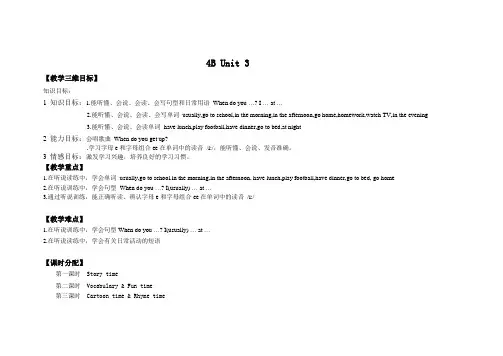
4B Unit 3【教学三维目标】知识目标:1 知识目标:1.能听懂、会说、会读、会写句型和日常用语When do you …? I … at …2.能听懂、会说、会读、会写单词usually,go to school,in the morning,in the afternoon,go home,homework,watch TV,in the evening3.能听懂、会说、会读单词have lunch,play football,have dinner,go to bed,at night2 能力目标:会唱歌曲When do you get up?.学习字母e和字母组合ee在单词中的读音/i:/,能听懂、会说、发音准确。
3 情感目标:激发学习兴趣,培养良好的学习习惯。
【教学重点】1.在听说读练中,学会单词usually,go to school,in the morning,in the afternoon, have lunch,play football,have dinner,go to bed, go home2.在听说训练中,学会句型When do you …? I(usually) … at …3.通过听说训练,能正确听读、辨认字母e和字母组合ee在单词中的读音/i:/【教学难点】1.在听说训练中,学会句型When do you …? I(usually) … at …2.在听说读练中,学会有关日常活动的短语【课时分配】第一课时 Story time第二课时 Vocabulary & Fun time第三课时 Cartoon time & Rhyme time第四课时 Sound time, Checkout time, Ticking time & Happy Reading 第五课时 Practice & Revision【主备人】。
四年级下册英语教案-Unit3 My day Story time |译林版(三起)
四年级下册英语教案-Unit3 My day Story time |译林版(三起)教学目标1.学习家务事相关的英语词汇和表达。
2.听懂并掌握一篇短文的内容。
3.学习运用一些日常用语表达自己的活动安排。
4.学会撰写日记,记录自己的日常活动。
教学重点1.学习家务事相关的英语词汇和表达。
2.听懂并掌握一篇短文的内容。
教学难点1.学习运用一些日常用语表达自己的活动安排。
2.学会撰写日记,记录自己的日常活动。
教学准备1.教师准备教学课件,包括图片、PPT等。
2.学生准备听力练习材料。
教学过程Step 1 课前导入1.教师给学生出示图片,问学生如何用英语描述图片中的场景。
2.学生相互交流并展示描述结果,教师指导correct。
Step 2 学习新知1.教师出示图片,教授家务活动的英语表达。
2.教师介绍文中重点内容,学生跟读并记忆。
3.教师播放录音,要求学生认真听取并理解录音内容。
Step 3 听音练习1.教师播放录音,要求学生听懂录音中的内容。
2.教师放慢语速,逐段播放录音,要求学生回答相关问题。
3.学生跟读并复述录音内容。
Step 4 日记书写1.教师介绍日记的写作方式和注意事项。
2.学生撰写自己的日记,记录当天的活动,并尝试使用新学习的家务活动英语表达。
3.学生逐一互相交流并描述自己的日记内容。
Step 5 课堂讨论1.学生分组讨论课文中的知识点,并互相分享自己对学习的认识和理解。
2.教师指导学生灵活运用所学知识,共同挖掘和发掘出更多的语言表达方式。
教学拓展1.教师引导学生拓展日常生活中其他活动的英语表达方式。
2.学生自主查寻相关英语渎职知识和素材,并与同学分享其他学习资源。
教学评价1.学生的听力理解能力和表达能力的表现。
2.学生使用家务活动英语表达的准确程度。
3.学生使用日记记录自己生活的书写水平。
课后作业1.跟读拓展练习材料,提高听力和口语技能。
2.撰写自己的日记记录生活详细内容,并注意使用英语表达。
四年级下册英语说课稿-Unit 3 My day Period 3-译林版三起

四年级下册英语说课稿-Unit 3 My day Period 3-译林版三起一、教材分析《译林版三起》四年级下册英语Unit 3的主要内容是让学生学会询问和描述自己每天的活动。
本课时为Period 3,主要教学目标为学生能够用所学的句型来询问和描述别人的每天活动,并能听懂日常活动的表述。
具体的教学内容包括以下方面:1.词汇get up, eat breakfast, go to school, have English class, have math class, have PE class, have music class, have art class, go home, do homework, watch TV, go to bed2.句型•What do you do at 7:30?•I eat breakfast at 7:30.•What class do you have at 9:00?•I have English class at 9:00.二、教学目标1.知识目标学生能够听懂和说出目标句型。
学生能够掌握并使用本课所学的词汇。
2.能力目标学生能够用所学的句型询问和描述别人的每天活动。
学生能够通过听力训练有效提升自己的听力水平。
3.情感目标培养学生热爱学习英语的兴趣。
通过本课的学习使学生体验到用英语交流的乐趣。
三、教学重点和难点1.教学重点使学生熟练掌握目标句型。
培养学生用所学的句型询问和描述别人的每天活动的能力。
2.教学难点让学生能听懂日常活动的表述。
培养学生发散思维和口语表达能力。
四、教学过程1.导入环节通过投影展示今日日程表,介绍今天的教学内容。
2.语言输入环节通过教师展示图片和对话,引出目标句型和词汇。
3.语言训练环节运用板书上的单词和目标句型,进行语言训练,在口头和书面表达上进行训练,让学生全面掌握所学内容。
4.语言输出环节分组进行小组活动,让学生运用所学的句型描述和询问别人的日常活动,每组表现一定要有评价和改进。
江苏省译林英语4B4B Unit3教案
Unit 3 My day一、单元教材分析(一) 单元整体情况分析本单元主要围绕一天中什么时间起床、上学、上课、吃饭、娱乐、睡觉而展开,涉及到的重点句型是:When do you …? I have/do/play/go to/…这些句型在前两单元的学习中学生都有学到,另外,这些内容与学生的日常生活也是基本一致的。
所以,在本单元的教学中导入新课、创设情境相对比较容易。
教师在课堂上要努力调动学生学习英语的兴趣,让学生能够包课堂所学知识应用于实际生活中。
(二) 各板块情况分析Story time本板块可以分为两个教学小环节。
Story time 1~3是第一部分,剩余的又是一小部分。
但这两个部分讲的其实是同一内容。
前者是以句子和图片的形式来展现My Day;后者则是通过短语和配图来展现My Day。
这两部分内容共同展现了“我”上午、下午和晚上的活动。
在教学的时候,从19页内容入手,让学生看图学短语,并试着用英语句子表达My Day。
然后学习第18页的句子,学习如何用英语句子表达“我”的一天。
Fun tim e 本板块有两个小部分,分别是Draw and write和Ask and answer。
Ask and answer 是让学生运用“When do you…? I …”的句式来就一天中各个时间段的活动进行对话。
Cartoon time本板块内容是Bobby的一个梦,在梦里Bobby饿了,后来看到一个大蛋糕。
这部分内容涉及到的一个句型是:What can you …? I can…因为这部分漫画内容很有趣,学生会感兴趣,可以在教学的时候鼓励学生模仿图片进行情境模拟演练,以此来帮助学生掌握学习内容。
Sound time本板块的教学内容主要是为了让学生通过听单词me, she, green, sleep, three的发音学习字母e和ee的发音。
在教学时,可以采用听、说的方法让学生仔细辨识e和ee的发音情况。
小学四年级下册英语 4bunit3教案 4b unit3

Unit 3 What’s your job?一、教学目的、要求:1.能听得懂、会说、会读和会拼写a policeman, a policewoman, a waiter, a waitress, a driver, a worker, an engineer,a farmer, a postman, a cook。
2.能听得懂、会说和会读日常交际It’s cold today, isn’t it? Guess! What do you want to be? I want to be …3.听得懂、会说、会读和会写句型What’s your/his/her job? I’m/He’s/She’s a … What are their jobs? They’re … How old are you/is he/she? I’m/He’s/She’s a …4.了解辅音字母dr和tr在单词中的读音。
5.能有表情地演唱歌曲They sing happily.二、教学重、难点:1.教能听得懂、会说、会读和会拼写a policeman, a policewoman, a waiter, a waitress, a driver, a worker, an engineer,a farmer, a postman, a cook。
2. 听得懂、会说、会读和会写句型What’s your/his/her job? I’m/He’s/She’s a … What are their jobs? They’第1页共22页re … How old are you/is he/she? I’m/He’s/She’s a …三.教学准备:挂图、录音机、磁带、幻灯片、实物投影机等。
四. 教学进度:6教时第一教时一、教学目的、要求:1. 掌握四会:a policeman, a policewoman, a waiter, a waitress, a driver, a worker, an engineer, a farmer,a postman, a cook二、教学重、难点:1. 掌握不定冠词的用法三、教学准备:挂图、录音机、磁带、幻灯片第2页共22页第3页共22页第4页共22页第二教时一.教学目的、要求:四会:What’s your /his /her job? I’m /He’s /She’s a /an … What are their jobs ? They’re …第5页共22页How old are you /is he /she ? I’m / He’s /She’s …二.教学重、难点:特殊疑问句的用法三.教学准备:录音机、磁带第6页共22页第7页共22页第8页共22页第9页共22页第三教时一.教学目的、要求:四会:What’s your /his /her job ? I’m /He’s /She’s a /an … What are their jobs ? They’re …三会:Guess !二.教学重、难点:第10页共22页your his her their 的用法。
译林英语四下教案Unit 3 My day 第三课时
译林英语四下教案Unit 3 My day 第三课时Unit 3 My DayLesson 3 What’s for Lunch?Teaching Aims:1. To enable the students to know about different food and drinks.2. To enable the students to learn how to use“have/has” to describe food and drinks.3. To enable the students to use “What do you have for lunch/dinner/breakfast?” to ask and answer about meals.4. To enable the students to develop their speaking and listening skills.Teaching Procedures:Step 1 Warm-up1. Greetings2. Review the vocabulary related to meals (breakfast, lunch, dinner)3. Ask the students to read the story named “The Very Hungry Caterpillar” in groups of four and answer the questions about it.Q1: What did the caterpillar eat on Monday?Q2: What did the caterpillar eat on Tuesday?Q3: What did the caterpillar eat on Wednesday?Q4: What did the caterpillar eat on Thursday?Q5: What did the caterpillar eat on Friday?Q6: What did the caterpillar eat on Saturday?Q7: What did the caterpillar eat on Sunday?Step 2 Presentation1. Introduce the new vocabulary related to food and drink and the usage of the “have/has” structure.food: cake, egg, apple, bread, cheese, sandwichdrink: milk, water, juice, tea2. Teach the “What do you have forlunch/dinner/breakfast?” sentence pattern to the students.3. Let the students carefully listen to the audio recording and follow them to read the text.Step 3 Practice1. Ask the students to practice the “What do you have for lunch/dinner/breakfast?” sentence pattern in pairs and choose their favorite food and drink to share with their partner.2. Ask the students to look at the pictures and complete the sentences with the correct words.Example: I have an apple for breakfast.3. Ask the students to practice the dialogue in pairs and act it out.A: What do you have for lunch?B: I have a sandwich and some juice.A: What do you have for dinner?B: I have some bread, cheese, and tea.Step 4 Production1. Ask the students to draw their favorite food anddrink on a piece of paper and introduce them to their classmates.2. Divide the class into groups of four and ask them to plan a menu for lunch and dinner for a day. Encourage the students to communicate and exchange their ideas in English.Step 5 Conclusion1. Summarize what the students have learned in this class: the vocabulary related to food and drink, the usageof “have/has,” and the sentence pattern of “What do you have for lunch/dinner/breakfast?”2. Give the students some homework, such as writing a menu for breakfast with the learned words, and prepare for the next class.Step 6 Extension1. Play a game named “Guess the Food.” Divide theclass into two teams and ask one student to think of a food, let both teams ask four “yes/no” questions to guess the food.2. Play a game named “Memory Challenge.” Show the students some pictures of food and drink, let them memorizeand try to remember as many as possible, and write them down in 60 seconds.Teaching Reflection:This lesson is designed for Grade 4 students. Through watching a video or listening to a dialogue, students can easily acquire new words related to food and drink, whichis an effective method for language acquisition. Then, they can apply the structure of “have/has” to describe food and drink in English. The sentence pattern of “What do you have for lunch/dinner/breakfast?” is also a basic conversational tool for students to communicate with others in the real world. In addition, the activities of drawing and menu planning can stimulate students’ creativity, and the games can make the class more interesting and interactive. This class is aimed to help students develop their communicative competence and intercultural awareness, which are two essential aspects of language learning.。
小学四年级下册英语 4B Unit 3 What’s your job教学设计牛津英语
●教学重难点
Can know, say, read and write the sentences.
2.Students use "What's your/his/her job? I'm/He's/She's a .. How old are you/is he/she? I'm/He's/She's a …to express.
●作业与训练
课内
1.Act out part E 2. Do a survey 3.sing a song
Picture 2: What's your job ? I'm a policewoman.
Picture 5: What's his job ? He's a postman.
Picture 6: What's her job? She's a waitress.
Step4Read and say
课外
1.Copy the new words 2.read the new words after the tape
情况反馈
Good!
●板书设计
Unit 3 What’s your job?
What’s your job\her job\his job?
I’m \He’s\She’s…
a policeman, a policewoman , a waiter, a waitress, a driver, a worker。
T: How are you?
S: Fine.
T: How old are you?
新译林版4Bunit3教案
T: (Show a picture of Bobby on page15. ) Bobby gets up at six every day. Do you know when does Bobby have dinner every day?
Ss: At five/six…?
4.Ask and answer in pairs(同桌各自询问对方的timetable。并两人一组上台展示自己的完成情况:S1:When do you get up? S2: I get up at 6:30. )
二.Cartoon time
T: From your dialogue, we know you get up at six in the morning. And you go to school at seven thirty every day. I think you have good habits, right? And so is Bobby.
一. Fun time
1.Show a timetable and finish it.
T: Do you want to know something about my day? You can ask me like this:
Teach: When do you…?
Ss: When do you get up?
Well, boys and girls, let’s learn the story together.
3. Listen and repeat.
T:指导朗读。
Ss: Read together
4.Act in two.
Step3 Consolidation
牛津译林版小学四年级下册4B第三单元my day公开课全套教学课件
1. Why is Bobby sad?
A. He is hungry.
B. He’s ill(生病).
2. It's________ o'clock now.
A. five
B. six
C. seven
3.What can you see over there,Bobby ?
I can see_________.
Tip:看到时间快速大声读出来,碰到动作大胆勇 敢做出来吧!You can !
Game time(游戏时间)
6:15
7:40 5:30
Review
--Mike’s day
I … at …
Activities
__g_e_t__u__p__
go to school
_h_a_v_e__l_u_n_c_h play football
Story time
Watch the cartoon and try to find out Mike’s activities in the morning.
看动画,试着找出迈克一天的活动 都有哪些。
have lunch get up go to school
do my homework
2. 用英语介绍自己一天的生活,说给父母朋 友听。
Sound time&Song time&Checkout time&Ticking time
Talking time(谈论时间)
Find the daily activities in a time sequence!
按照时间顺序给一天做的事排序!
go home
play football
译林版四年级英语下册第三单元4BUnit3教案
译林版四年级英语下册第三单元4BUnit3教案Unit3 My dayI The background information本单元主要内容是谈论我的⼀天。
教学重点是句型如When do you get up/…?I usually… at…在⼆年级教材中,学⽣已学过morning, afternoon 等词,在教学时,可以适当利⽤这些词,或以旧引新,或拓展延伸,做到新旧知识的融会贯通。
根据学⽣的年龄特点,教师可以采⽤游戏的⽅式,让学⽣在愉悦轻松的氛围中掌握所学知识。
II Teaching aims and learning objectives这节课学完后学⽣应达到的⽬标⼀、能听懂、能理解、会读课⽂。
⼆、能听懂、会说、会读单词usually, go to school, in the morning, in the evening, in the afternoon, go home, homework, watch TV, have four lessons, have lunch, play football, do my homework, have dinner, go to bed, every day三、初步理解、会读句型:When do you get up/…?I usually… at… .⽤今天所学的内容,在实际⽣活能⽤英语表述⾃⼰⼀天的⽣活III Focus of the lesson and predicted area of difficulty⼀、能听懂、会说、会读句型::When do you get up/…?I usually…at…在语境中的正确运⽤。
⼆、能听懂、会说、会读单词:go to school, usually, in the morning,have lunch, go home, do my homework, have dinner, watch TV,go to bed三、掌握字母e和字母组合ee在单词中的读⾳IV Teaching aidsPPT,头饰V Teaching procedures Step1 Greeting and warm up T: Good morning, class.Ss: Good morning.T: Do you like games? Let’s play a game: Yeah, yeah, yeah, or No, no ,no.1.It’s Monday today.2.We have 4 lessons in the morning.3.We have a PE lesson in the afternoon.4.I like Music.5.I go to school every day.6.It’s six o’clock. It’s time for English class.Step2 Presentation1.Show six clocks, review the time6:15 7:05 11:45 5:00 6:20 10:00T: What time is it? It’s six fifteen in the morning…. (复习时间,并将钟⾯贴在⿊板)Guess: What do I usually do at 6:15 in the morning?Ss: get up/have breakfast…T: I usually get up at 6:15板书:I(usually)…at…Teach: usuallyWhen do you get up?Ss: I get up at…2.In the same way to teach:go to school at 7:05have lunch at 11:45have dinner at 6:20go to bed at 10:003. T: I do different things at different time.(Chant)I get up at six fifteen.I go to school at seven o five.I have lunch at eleven fifteen .I go home at five.I have dinner at six twentyI go to bed at ten.So this is my day.揭题:Unit 3 My day4. Talk in groups. Make a new chant, say something about your day. Step3 Story timeT: We’re having an English lesson and we’re talking about our days. Mike is talking about his day too. Let’s listen to Mike, try to findout Mike’s activities in the morning.(Part1)Ss listen and then choose the pictures.(出⽰五幅图:起床、看电视、上学、睡觉、吃午饭,学⽣听第⼀段,根据Mike的介绍选出早上的活动) 1.Listen again and match(再听⼀遍介绍,出现三个钟⾯,将Mike的活动与时间配对)2.T: What else does Mike do in the morning?Ss: have lessonsT: Yes. And how many lessons does he have in the morning.Ss: Four.T: So Mike has four lessons in the morning.(Part2)1.T: How many lessons does Mike have in the afternoon? And what else does Mike do in the afternoon? Let’s listen again, and try to answer.Q1. How many lessons does Mike have in the afternoon?Q2. What else does Mike do in the afternoon?Teach: go homedo my homeworkIn the afternoon: have lessons/play football/go2.Listen and read Part 2(Part3)1.Read Part3 by selves, try to fill in the blanks.2. Talk in groups: When does Mike do these things? Say like this:…at…3.Listen and read Part3Step 4 Consolidation1.Read in three.2.Act as Mike, choose one part and talk about your activity.(三⼈⼀⼩组,扮演Mike,选择早、中、晚其中⼀个时间说说⾃⼰的活动)VI Homework1.Listen and read the story, try to recite it.2.Describe your day to your family, then write it down. Blackboard design: Unit 3 My dayI IIIV V T: 1. 2.o’clock?(出⽰图⽚剪影)Guess!Ss: He gets up at seven.3. (出⽰另⼀个钟⾯)Teach:go to school in the same way.And what about this one?Ss: go to schoolTeach: get up/ go to school3.T: What does Mike usually do in the afternoon? Show two pictures. Ss: He …Teach:play football at four/go home at four forty in the afternoon.4:Show three pictures(have dinner/watch TV/go to bed)How about in the evening or at night? Please talk in groups. Then teach these phrases according to their answers:Have dinner at six thirteenWatch TV at seven in the eveningGo to bed at nine at night4.Retell Mike’s day according to these picturesStep 3 Fun time1.Show a timetable and finish it.T: Do you want to know something about my day? You can ask me like this: Teach: When do you…?Ss: When do you get up?T: I get up at six in the morning.Ss ask ,T answers and draw the clocks.2.T: Look ,this is my day.(Introduce the T’s day)How about yours?3.Ss draw and write.上台展⽰⾃⼰的完成情况:S1:When do you get up? S2: I get up at 6:30. ) Step 4 Show timeTalk: My happy dayToday is…I…at…Blackboard designUnit 3 My dayWhen do you in the afternoonin the eveningat nightI usually…at…Teaching reflection:(课型:新授设计:授课时间:⽉⽇)I Teaching contentSound time and Rhyme timeII Teaching aims and learning objectives这节课学完后学⽣应达到的⽬标⼀、能熟练地听懂、会说、会读单词:school, subject, see, Chinese,Maths, Art, Music,timetable, PE, Science, fun, playground。