
牛津译林版七年级下英语第一单元时态练习卷(含答案)
牛津译林版七年级下英语第一单元时态练习卷
1. Look! My sister (chat) with his friend on the phone.
2.My mother often (cook) dinner in the kitchen .
3._______ Jenny_______ (share) a bedroom with her sister?
4. She (telephone) you when she has time.
5.My brother (get) the first place in the match last week
6.My mother (hope) she can live in a big house some day.
lions of people (watch) the basketball match this weekend .
8.Don't talk. The teachers (have) a meeting in the next room now.
9. It (take) me an hour to water the garden yesterday.
10. She often (invite) my friends to watch films at the weekend.
11.Each student (have) an English book on the desk.
12.;How long you (spend) on your homework yesterday?
13.Tom, (not, play) puter games any more. It’s time for bed.
14.I (receive) a letter full of love from my parents on my sixteenth birthday
15.The cat (enjoy) eating favourite food.
16.Please be quiet. My child __________(sleep) now
17.Your aunt (live) on the ninth floor of the building .
18. Millions of people (e ) to China to visit the Great Wall next year. 19. They (read) about homes from different countries.
20.Lucy's brother (enjoy) chatting with friends on the Internet.
21.Andy es from England, and he (speak) English.
22. Tomorrow (be) my uncle’s fortieth birthday.
23.Look!Tom (look) at the flowers through the window.
24.Tom with his family (visit) a small town now.
25.Who (be)always the first to get to the classroom every afternoon?
26.My mother (ask) me not to watch TV last night.
27.Everyone in our family ________ (like) watching films.
28. Her mother often (watch) videos on Sundays.
29. Share things with others, and you (get) more than before.
30. My sister often (sit) here and look out at the beach.
31.My living room (look) big and beautiful.
32.She hopes she (visit) the UK next year.
33.If she wants to eat here, she (have) to know how to use forks and knives.
34.There (not,be)a sports meeting in our school next week.
35.My boss (send) me a message to tell me the time of the meeting.
36.It’s so cloudy. I think it (rain) this afternoon.
37.Look, my sister _(read) English in the garden.
38.There (be)a sports meeting in our school last week.
39.My best friend (practice) dancing every day.
40. Look! They (swim) in the middle of the river. 41.They (have) a school trip next week.
42. We (arrive) in Tokyo on the afternoon of March 3.
43.Finally, Tom and his parents (arrive) in Beijing.
44.— we (go) to the museum this weekend?
—That’s a good idea .
45.My mother (plant) vegetables on the farm now.
参考答案
1.is chatting 2.cooks 3.Does, share 4.will telephone 5.got
6.hopes 7.will watch 8.are having 9.took 10.invites
11.has 12. did spend 13. don't,play 14.received 15. is enjoying
16. is sleeping 17. lives 18.will e 19.are reading 20.enjoys
21.speaks 22.will be 23. is looking 24.is visiting 25. is
26.asked 27. likes 28. watches 29.will get 30.sits
31.looks 32. will visit 33.has 34.won’t be 35. sent
36.is going to rain 37. is reading 38.was 39. practices 40.are swimming
41.will have 42 will arrive 43.arrived 44.Shall,go 45.is planting
牛津译林版七年级英语上册unit8单元练习卷(含答案)
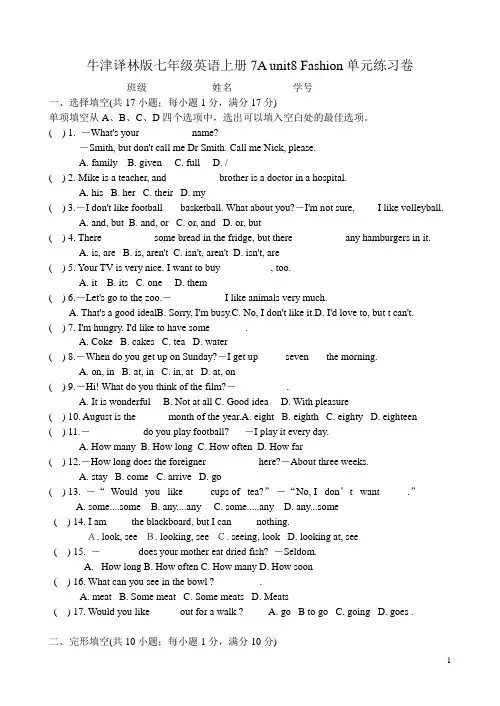
1 牛津译林版七年级英语上册7A unit8 Fashion单元练习卷
班级_____________姓名____________学号____________
一、选择填空(共17小题;每小题1分,满分17分)
单项填空从A、B、C、D四个选项中,选出可以填入空白处的最佳选项。
( ) 1. -What's your__________ name?
-Smith, but don't call me Dr Smith. Call me Nick, please.
A. family B. given C. full D. /
( ) 2. Mike is a teacher, and__________ brother is a doctor in a hospital.
A. his B. her C. their D. my
( ) 3.-I don't like football___ basketball. What about you?-I'm not sure,____ I like volleyball.
A. and, but B. and, or C. or, and D. or, but
( ) 4. There__________ some bread in the fridge, but there __________any hamburgers in it.
A. is, are B. is, aren't C. isn't, aren't D. isn't, are
( ) 5. Your TV is very nice. I want to buy__________, too.
A. it B. its C. one D. them
( ) 6.-Let's go to the zoo.-__________ I like animals very much.
牛津译林版 七年级下册 第一单元词汇运用专项练习(含答案)
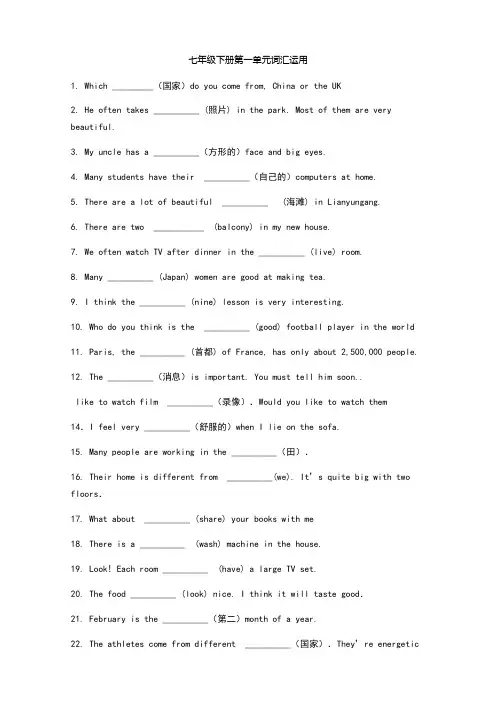
七年级下册第一单元词汇运用
1. Which _________(国家)do you come from, China or the UK
2. He often takes __________ (照片) in the park. Most of them are very
beautiful.
3. My uncle has a __________(方形的)face and big eyes.
4. Many students have their __________(自己的)computers at home.
5. There are a lot of beautiful __________ (海滩) in Lianyungang.
6. There are two ___________ (balcony) in my new house.
7. We often watch TV after dinner in the __________ (live) room.
8. Many __________ (Japan) women are good at making tea.
9. I think the __________ (nine) lesson is very interesting.
10. Who do you think is the __________ (good) football player in the world
11. Paris, the __________ (首都) of France, has only about 2,500,000 people.
12. The __________(消息)is important. You must tell him soon..
like to watch film __________(录像).Would you like to watch them
牛津译林版七年级英语上第三单元单元测试卷含答案
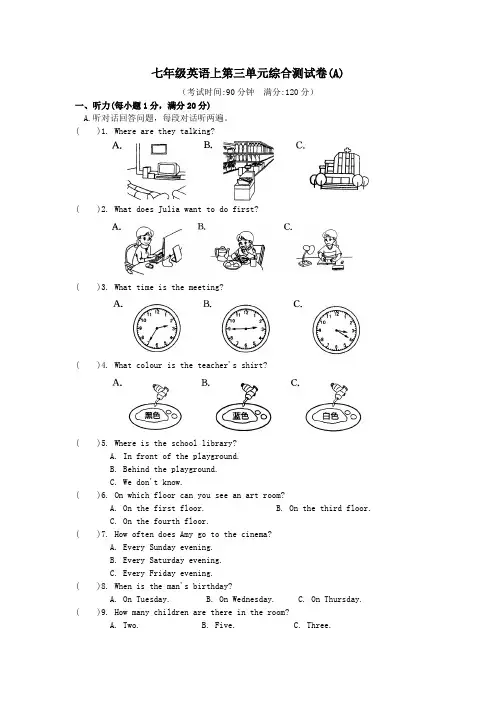
七年级英语上第三单元综合测试卷(A)
(考试时间:90分钟 满分:120分)
一、听力(每小题1分,满分20分)
A.听对话回答问题,每段对话听两遍。
( )1. Where are they talking?
( )2. What does Julia want to do first?
( )3. What time is the meeting?
( )4. What colour is the teacher's shirt?
( )5. Where is the school library?
A. In front of the playground.
B. Behind the playground.
C. We don't know.
( )6. On which floor can you see an art room?
A. On the first floor. B. On the third floor.
C. On the fourth floor.
( )7. How often does Amy go to the cinema?
A. Every Sunday evening.
B. Every Saturday evening.
C. Every Friday evening.
( )8. When is the man's birthday?
A. On Tuesday. B. On Wednesday. C. On Thursday.
( )9. How many children are there in the room?
牛津译林版英语七年级下册Unit8Reading(Ⅱ)同步练习

牛津译林版英语七年级下册Unit8Reading(Ⅱ)同步练习
学校:___________姓名:___________班级:___________考号:___________
一、汉译英:单词/短语
一、将下列短语译成英语
1.不惹麻烦____________________________________
2.喜欢打仗____________________________________
3.直到永远____________________________________
4.从不叫或咬____________________________________
5.不得不____________________________________
6.……. 与……押韵____________________________________
7.到处找我____________________________________
8.躲在椅子底下____________________________________
9.制造麻烦____________________________________
10.害怕他____________________________________
二、用所给单词的正确形式填空
二、用所给动词的适当形式填空
11.___________ (not bubble)just like a goldfish.
12.A cat is ___________(difference)from a dog.
13.I only feed my dog ___________(two)a day.
14.She is old enough to take care of ___________(she).
15.I often see my dog ___________(run)after a ball.
牛津译林版英语七下Unit 3《Welcome to Sunshine Town》(Welcome

牛津译林版英语七下Unit 3《Welcome to Sunshine Town》(Welcome to the unit)说课稿
一. 教材分析
《Welcome to Sunshine Town》是牛津译林版英语七年级下册Unit 3的一篇阅读文章,主要介绍了一个名为Sunshine Town的地方,通过描述那里的环境、设施和人们的生活,让学生了解一个理想的生活环境。本文语言简单易懂,贴近生活,富有生动性,有利于激发学生的学习兴趣。
二. 学情分析
针对七年级的学生,他们已经具备了一定的英语基础,能够进行简单的英语交流。但他们在阅读理解方面还存在一定的困难,需要通过教师的引导和帮助,提高阅读理解能力。此外,学生对新鲜事物充满好奇,喜欢通过图片、视频等直观手段进行学习,因此在教学过程中,我将会运用多种教学手段,激发学生的学习兴趣。
三. 说教学目标
1. 知识目标:学生能够掌握文章中的关键词汇和句型,理解文章的主旨大意。
2. 能力目标:学生能够运用所学词汇和句型进行简单的口语交流,提高阅读理解能力。
3. 情感目标:学生能够了解并欣赏美好环境,激发他们对美好生活的向往。
四. 说教学重难点
1. 重点:文章中的关键词汇和句型的学习和运用。
2. 难点:对文章细节内容的理解和把握,以及情感目标的达成。
五. 说教学方法与手段
1. 交际法:通过情景模拟、角色扮演等方式,让学生在实际语境中运用所学知识。
2. 任务型教学法:引导学生参与各种任务,激发他们的学习兴趣,提高实践能力。
3. 多媒体教学法:运用图片、视频等直观手段,帮助学生更好地理解文章内容。
六. 说教学过程 1. 导入:通过展示图片,引导学生谈论他们喜欢的城市或小镇,激发学生对本文的兴趣。
2. 阅读理解:学生自主阅读文章,回答相关问题,教师引导学生讨论,帮助他们理解文章内容。
3. 词汇学习:教师讲解文章中的关键词汇和句型,学生进行口语练习。
译林牛津高二英语模块七unit 3 Grammar and usage 基础练习(含答案)
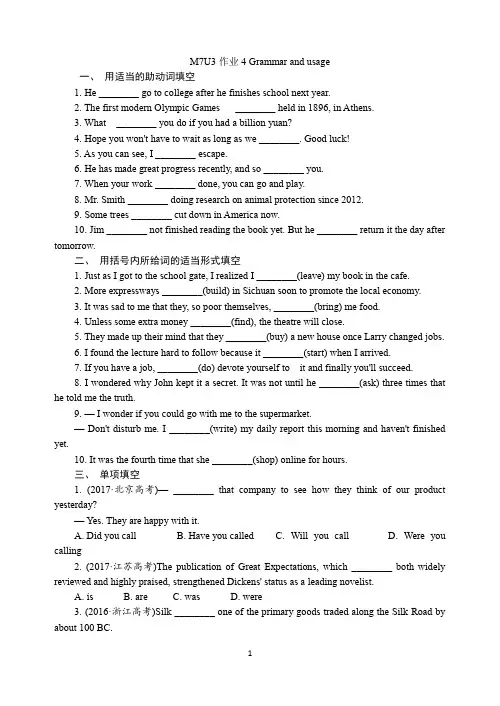
1 M7U3作业4 Grammar and usage
一、 用适当的助动词填空
1. He ________ go to college after he finishes school next year.
2. The first modern Olympic Games ________ held in 1896, in Athens.
3. What ________ you do if you had a billion yuan?
4. Hope you won't have to wait as long as we ________. Good luck!
5. As you can see, I ________ escape.
6. He has made great progress recently, and so ________ you.
7. When your work ________ done, you can go and play.
8. Mr. Smith ________ doing research on animal protection since 2012.
9. Some trees ________ cut down in America now.
10. Jim ________ not finished reading the book yet. But he ________ return it the day after
tomorrow.
二、 用括号内所给词的适当形式填空
1. Just as I got to the school gate, I realized I ________(leave) my book in the cafe.
2. More expressways ________(build) in Sichuan soon to promote the local economy.
Unit 1 第3课时 -八年级英语下册同步课时练习题(牛津译林版,含答案)
八年级英语下册同步课时练习题(牛津译林版)
Unit 1 Past and present
第3课时 grammar
1.这位英语老师教了你们两年了吗?
________ the English teacher ________ you for two years?
2.自从 “双减”政策实行以来,我们有更多空闲时间参加课外活动。
We ________ ________ more fee time to take part in after-school activities since the “double
reduction” policy was carried out.
3.迄今为止我们已经学习了十首英文歌。
________ ________ we have learned 10 English songs.
4.我们自从加入同一个俱乐部就成了好朋友。
We ________ good friends since we ________ the same club.
5.你已经决定去哪里度假了吗?
________ you ________ where to go on vacation?
6.So far we ________ five hundred English words.
A.learn B.have learned C.learned D.learns
7.Julia’s father ________ to hospital last month. He ________ there three times.
A.went; had gone B.has gone; has been C.went; has been D.has been; had gone
8.— Do you know Lydia very well?
— Sure. We ________ friends since we were very young.
牛津译林版 英语 7B Unit2 语法一般将来时学案设计+练习(含答案)
一般将来时 专题练
【Grammar points】
Ⅰ. 基本概念
➢ 概念
一般将来时通常表示将来某一时刻发生的动作或状态,或将来某一段时间内经常发生的动作或所处的状态。
➢ 结构
①【will / shall + 动词原形】
一般将来时由will/shall+动词原形构成,多用于征求意见或建议。
一般说来,shall用于第一人称,will用于第二、第三人称
*在现代英语中,shall常用will代替,可以说I will go./We will go.
● 肯定句:主语+shall / will + 动词原形(+其他)
【例】I/ We shall go to Paris by plane next week.
我/ 我们下周将乘飞机去巴黎。
● 否定句:主语+shall/ will not + 动词原形(+其他)
【例】She will not come back next week. 下周她不会回来。
I will/ shall的缩写形式为 I’ll;I will not 缩写为I won’t ;
I shall not的缩写为I shan’t 。*肯定回答中不用缩写形式。
● 一般疑问句:Shall/ Will+主语 + 动词原形(+其他)? 例词 肯定式 否定式 疑问
be动词 I/We shall be...
You
They will be...
He/She/It I/We shall not be...
You
They will not be...
He/She/It Shall I/we be...?
you
Will they be...?
he/she/it
实义动词(do) I/We shall do...
You
They will do...
He/She/It I/We shall not do...
牛津译林版英语七下Unit 5《Amazing things》(Reading 1)说课稿
牛津译林版英语七下Unit 5《Amazing things》(Reading 1)说课稿
一. 教材分析
《Amazing things》是人教版牛津译林英语七年级下的阅读课。文章介绍了一位澳大利亚收集奇特物品的老人,他收集了很多奇怪的东西,包括一条鳄鱼,一只鹦鹉,一只猴子等等。这篇文章是一篇夹叙夹议的文章,通过讲述这位老人的故事,引导学生学会珍惜和尊重生命。文章语言简单,但情节生动有趣,能够激发学生的学习兴趣。
二. 学情分析
学生在学习这篇课文之前,已经学习了有关动物的单词和句型,如cat, dog,
fish等,并掌握了基本的阅读技巧,如快速阅读,寻读等。但学生在阅读过程中可能会对一些生词和短语的理解有困难,如“collection”, “unique”等,需要教师的引导和帮助。
三. 说教学目标
1. 知识目标:学生能够掌握文章中的生词和短语,如“collection”,
“unique”等,并能够正确运用所学知识进行阅读和表达。
2. 能力目标:学生能够通过阅读文章,提高自己的阅读理解能力,并能够运用所学知识进行口语表达和写作。
3. 情感目标:学生能够理解并尊重生命,学会珍惜身边的一切。
四. 说教学重难点
1. 教学重点:学生能够掌握文章中的生词和短语,并能够正确运用所学知识进行阅读和表达。
2. 教学难点:学生能够理解文章的主旨大意,并对文章进行深入的分析和解剖。
五. 说教学方法与手段
1. 教学方法:采用任务型教学法,让学生在完成任务的过程中,掌握知识,提高能力。
2. 教学手段:利用多媒体课件,图片,卡片等辅助教学,提高学生的学习兴趣和参与度。
六. 说教学过程
1. 导入:通过展示一些奇怪的物品,如鳄鱼,鹦鹉等,吸引学生的注意力,并引导学生谈论对这些物品的看法。 2. 阅读:学生自读文章,教师提问引导学生理解文章内容,并对文章进行深入的分析和解剖。
3. 讨论:学生分组讨论,分享自己对文章的理解和感受,并尝试用英语进行表达。
牛津译林版英语七上Unit 1《This is me》(Welcome to the unit)教学
牛津译林版英语七上Unit 1《This is me》(Welcome to the unit)教学设计
一. 教材分析
牛津译林版英语七上Unit 1《This is me》主要介绍了关于自我介绍和描述人物特征的交际用语。通过本单元的学习,学生能够掌握一些基本的交际用语,如介绍自己的姓名、年龄、外貌特征等,同时能够运用所学的词汇和句型来描述他人的特征。本单元的主要语言点包括:形容词和名词的用法,一般现在时态的运用,以及一些常用交际用语的表达方式。
二. 学情分析
七年级的学生已经具备了一定的英语基础,能够听懂并运用一些简单的英语交际用语。但他们在语言表达上还存在一定的困难,尤其是在描述人物特征方面。因此,在教学过程中,需要注重培养学生的语言表达能力和交际能力。
三. 教学目标
1. 知识目标:学生能够掌握本单元的重点词汇和句型,并能运用到实际交际中。
2. 能力目标:学生能够用英语进行自我介绍,并能够描述他人的外貌和性格特征。
3. 情感目标:通过小组合作和互动交流,学生能够增强自信心,提高团队合作意识。
四. 教学重难点
1. 重点:本单元的重点词汇和句型的掌握,以及一般现在时态的运用。
2. 难点:描述人物特征的表达方式,以及如何运用所学的词汇和句型进行实际交际。
五. 教学方法
1. 任务型教学法:通过设定各种真实的交际任务,让学生在完成任务的过程中运用所学知识。
2. 合作学习法:通过小组讨论、互动交流,培养学生的团队合作能力和语言表达能力。
3. 情境教学法:创设各种真实的语境,让学生在特定的语境中运用所学知识。
六. 教学准备 1. 教学课件:制作多媒体课件,包括图片、视频等教学资源。
2. 教学道具:准备一些人物特征的图片或实物,用于展示和练习。
3. 练习题:设计一些相关的练习题,用于巩固所学知识。
七. 教学过程
1. 导入(5分钟)
利用一些人物特征的图片或视频,引导学生进行观察和思考,激发他们的学习兴趣。然后提问:“Can you introduce yourself?”,让学生进行自我介绍,为接下来的学习活动做铺垫。