
四川省成都市二年级上学期英语期中考试试卷
四川省成都市二年级上学期英语期中考试试卷
姓名:________ 班级:________ 成绩:________
小朋友,带上你一段时间的学习成果,一起来做个自我检测吧,相信你一定是最棒的!
一、请把对应的大小写字母匹配。
(5分) (共1题;共5分)
1. (5分)将下列字母相对应的大小形式匹配。
⑴X________ A. y
⑵Z________ B. x
⑶Y________ C. z
⑷M________ D. r
⑸R________ E. m
二、判断图片与单词是否相符(6分) (共6题;共6分)
2. (1分) Good afternoon.
3. (1分) Look!That monkey is fat.
4. (1分)— Have some fish, please.
— Thank you.
5. (1分)Australia
6. (1分)一What's she doing?
一She's eating breakfast.
7. (1分) Keep your desk clean.
三、读一读,选一选。
根据情景选择正确的句子。
(5分) (共5题;共5分)
8. (1分)你看到一本很有趣的书,你可以说:________
A . That's good exercise.
B . That's a nice picture.
C . What an interesting book!
9. (1分)— What's your name?
—
A . Me too!
B . Bye,Miss White.
C . My name is Mike.
10. (1分)—Does he live in Sydney?
—________
A . Yes,he doesn't.
B . No,he doesn't.
C . No,he does.
11. (1分)—What are they doing?
—________
A . They're playing five-stones.
B . They're playing hide-and-seek.
12. (1分)—Do you like _____?
— Yes,I_______.
A . lions;do
B . lion;do
C . panda;don't
四、读一读,根据图片选出正确答案(4分) (共4题;共4分)
13. (1分)—A gift for you.
—Thank you.
A .
B .
14. (1分)
A . cloudy
B . sunny
15. (1分) It's green. It's a .
A . leaf
B . leafs
C . leaves
16. (1分) (2018三上·浙江期末)
A . bear
B . bird
参考答案
一、请把对应的大小写字母匹配。
(5分) (共1题;共5分)
1-1、
二、判断图片与单词是否相符(6分) (共6题;共6分)
2-1、
3-1、
4-1、
5-1、
6-1、
7-1、
三、读一读,选一选。
根据情景选择正确的句子。
(5分) (共5题;共5分) 8-1、
9-1、
10-1、
11-1、
12-1、
四、读一读,根据图片选出正确答案(4分) (共4题;共4分)
13-1、
14-1、
15-1、
16-1、。
2024年人教版小学二年级英语(上册)期中考卷及答案
一、选择题(每题1分,共5分)1. What color is the sun?A. RedB. BlueC. YellowD. Green2. How many days are there in a week?A. 5B. 6C. 7D. 83. What is the opposite of "up"?A. DownB. LeftC. RightD. Forward4. Which animal says "moo"?A. CatB. DogC. CowD. Horse5. How many seasons are there in a year?A. 2B. 3C. 4D. 5二、判断题(每题1分,共5分)1. The capital of China is Beijing. ( )2. The moon is bigger than the sun. ( )3. Water is made up of hydrogen and oxygen. ( )4. A triangle has three sides. ( )5. The Earth is flat. ( )三、填空题(每题1分,共5分)1. The sky is usually ________ during the day.2. A ________ is a place where you can buy things.3. The sun rises in the ________ and sets in the ________.4. An apple is a type of ________.5. The number after 9 is ________.四、简答题(每题2分,共10分)1. What are the four seasons in a year? Name them.2. How many letters are there in the English alphabet?3. What is the difference between a square and a rectangle?4. Name three animals that live in the sea.5. What is the capital of France?五、应用题(每题2分,共10分)1. If you have 5 apples and you give 2 to your friend,how many apples do you have left?2. If you have 10 pencils and you lose 3, how manypencils do you have left?3. If you have 8 stickers and you give 4 to your sister, how many stickers do you have left?4. If you have 7 crayons and you lose 2, how many crayons do you have left?5. If you have 6 toys and you give 3 to your brother, how many toys do you have left?六、分析题(每题5分,共10分)1. Compare and contrast the shapes of a circle and a square.2. Explain the difference between a solid and a liquid.七、实践操作题(每题5分,共10分)1. Draw a picture of your favorite animal.2. Write a short sentence about your favorite color.八、专业设计题(每题2分,共10分)1. 设计一个简单的英语单词拼写游戏,包括游戏规则和所需材料。
二年级上英语期中试卷-外研版(一起)(含答案)
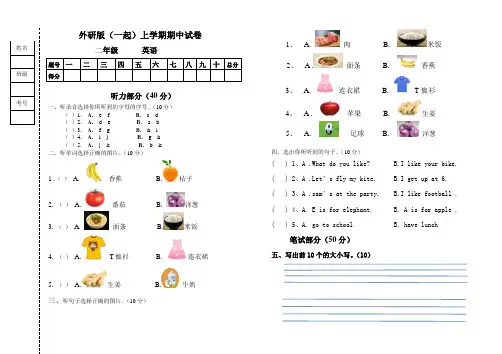
外研版(一起)上学期期中试卷二年级英语题号一二三四五六七八九十总分得分听力部分(40分)一、听录音选择你所听到的字母的序号。
(10分)()1. A. e f B. c d()2. A. d e B. a b()3. A. f g B.h i()4. A.i j B. g h()5. A.j k B. b k二、听单词选择正确的图片。
(10分)1 .()A. 香蕉 B.桔子2. ()A. 番茄 B. 洋葱3.()A. 面条 B.米饭4. ()A.T恤衫 B. 连衣裙5. ()A.生姜 B.牛奶三、听句子选择正确的图片。
(10分)1、 A. 肉 B. 米饭2、 A .面条 B. 香蕉3、 A. 连衣裙 B. T恤衫4、 A . 苹果 B. 生姜5、 A. 足球 B. 洋葱四、选出你所听到的句子。
(10分)( ) 1、A .What do you like? B.I like your bike. ( ) 2、A .Let’s fly my kite. B.I get up at 6. ( ) 3、A .sam’s at the party. B.I like football . ( ) 4、A. E is for elephant. B. A is for apple . ( ) 5、A. go to school B. have lunch 笔试部分(50分)五、写出前10个的大小写。
(10)姓名班级考号六、将下列单词与相应的图片连线。
(10)meat rice sweets noodles ice cream七、选择正确答案,将其序号填入题前括号里。
(20)()1、I _____ like noodles. A.do B. not C.don’t ( ) 2、I have ___ ice cream. A.a B.an C.the( ) 3、Some rice ____ you. A.of B. for C.and( ) 4、____ you good boy? A. are B. is C. am( ) 5、She ____ tomatoes. A.like B.likes C.the( ) 6、I have some ___ . A.tomatoes B.tomato C.tomatos ( ) 7、E is for _____? A. bat B. elephant C. duck ( ) 8、F is for _____? A. frog B. apple C.pig( ) 9、H is for _____? A. head B. elephant C. dress ( ) 10、J is for _____? A.fruit B. jug C. duck八、选出下列每组单词中不同类的一项。
最新小学二年级上学期期中考试英语试题
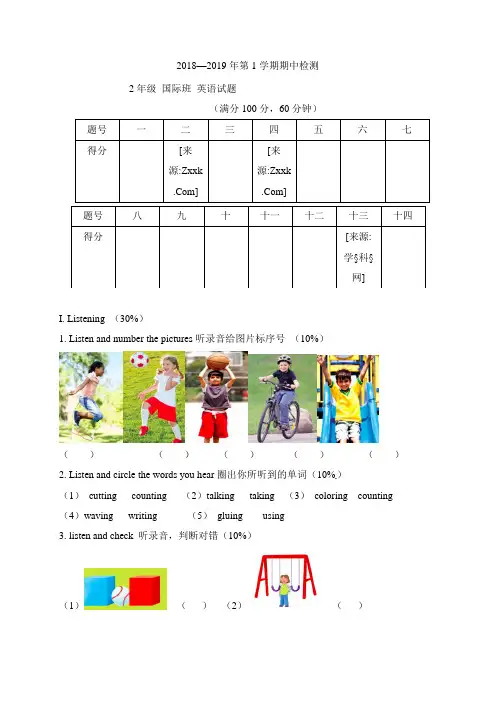
2018—2019年第1学期期中检测2年级国际班英语试题(满分100分,60分钟)题号一二三四五六七得分[来源:Zxxk.Com][来源:Zxxk.Com]I. Listening (30%)1. Listen and number the pictures听录音给图片标序号(10%)()()()()()2. Listen and circle the words you hear圈出你所听到的单词(10%)(1)cutting counting (2)talking taking (3)coloring counting (4)waving writing (5)gluing using3. listen and check 听录音,判断对错(10%)(1)()(2)()题号八九十十一十二十三十四得分[来源:学§科§网](3)()(4)()(5)()II.Writing (70%)4. Fill in the blanks填写单词所缺的字母(5%)(1) c__ tting paper (2) g__uing shapes (3) play on the sl__de(4) __it a baseball (5) __sing the comput er5. Look at the pictures , write the words 看图写词(10%)(1)______ to a story (2) ______ pencils(3) ______about the pictures (4)______(5) _______[来源:]6. Read the words then match 读单词连线(10%)writing pencilshit a papercounting namescutting the computer gluing bike using to a story jump baseball ride rope read shapes listening books7. Write the numbers 写出所给数字的相邻数字的英文单词 (10%) ______twenty______. ______fifty______. _____eighty______ ______ninety_______ , _______forty_______8. Sorting the words into the correct rooms 把下列物品归类 (10%) Living room:______________________ Bedroom:_______________________ Dining room:_____________________ Kitchen:_____________ Bathroom:__________________9. Read the sentences fill in the blank with “do/does”, “like/likes ”用“do/does”和“like/likes”填空(10%)(1)What ____ Steven like to do? He_______ to listen to music.[来源:Z*xx*] (2) What____ Lucy and lily like to do? They ______ to play games. (3) What ____ she like to do? She _____ to ride her bike. (4) What _____ your father like to do? He ______ to read books. (5) What _____ you like to do? I _____ to watch TV .10. Complete the sentences 将下列句子补充完整 (10%) (1) What ______ they doing? They are listening. (2) What ______ he doing? _______ cutting.(3) What _______ _______doing? She’s singing. (4) What _______ _______doing? He is playing soccer.chair, table, sofa, tub, dresser, closet, stove, sink, refrigerator, bed(5) What _____ ______doing? They are reading.(6) What _____ your grandma doing? She is sleeping.11. Read the dialogue then answer the questions (5%)Peter: This is a nice playground.Maria: Yes, it is. What do you like to do?Peter: I like to play soccer. My sister likes to jump rope. Maria: I like to play jump rope too.(1)What does Peter like to do ? ___________________________(2)What does Maria like to do?___________________________(3)What do you like to do? _______________________________。
小学二年级英语期中考试试卷及答案

二年级英语上册期中考试试卷班级姓名分数听力部分(40分)一.听录音,圈出你听到的单词。
(10分)1. boy girl man2. father mother brother3. tall thin big4. grandfather handsome grandmother5. short pretty friend二、听录音,用数字1、2、3、4、5为下列图片排列顺序。
(10分)( ) ( ) ( ) ( ) ( ) 三.听录音,选出你听到的句子(只填A, B)。
(10分)()1 A. This is my sister. B. This is my brother.()2 A. My name is Joy. B. His name is Binbin.()3 A. He is a boy. B. She is a girl.()4 A. Who’s he? B. Who’s she?()5 A. What does she look like? B. What does he look like? 四.听录音,用1、2、3、4、5为下面的句子排序。
()1. A boy.()2. What does he look like?()3. Boy or girl?()4. Dad, I have a new classmate.()5. He is tall.笔试部分(60分)五.英汉连线。
(10分)big boy pretty grandmother classmate美丽的奶奶,外婆同班同学大的男孩六.为下列词语分类(只填单词前面的序号)。
(10分)。
1. brother2.handsome3.sister4.big5.short6. mother7.tall8.father9.pretty 10.grandfather家庭成员: _________________________________________人物外形特征:______________________________________七.情景交际。
【精编】小学二年级英语上册期中试卷
【精编】小学二年级英语上册期中试卷一、听力部分(20分)1. 请听录音,选出你听到的单词。
( ) ( ) ( ) ( )2. 请听录音,选出你听到的句子。
( ) ( ) ( ) ( )3. 请听录音,选出你听到的对话。
( ) ( ) ( ) ( )二、词汇部分(20分)1. 请选出与画线单词意思相近的单词。
( ) ( ) ( ) ( )2. 请选出与画线单词意思相反的单词。
( ) ( ) ( ) ( )3. 请根据汉语意思,选出正确的英文单词。
( ) ( ) ( ) ( )三、语法部分(20分)1. 请选出正确的时态。
( ) ( ) ( ) ( )2. 请选出正确的语态。
( ) ( ) ( ) ( )3. 请选出正确的句型。
( ) ( ) ( ) ( )四、阅读理解部分(20分)1. 请阅读短文,回答问题。
( ) ( ) ( ) ( )2. 请阅读对话,回答问题。
( ) ( ) ( ) ( )3. 请阅读图表,回答问题。
( ) ( ) ( ) ( )五、写作部分(20分)1. 请根据所给图片,写一段描述。
2. 请根据所给话题,写一篇短文。
3. 请根据所给问题,写一封回信。
【精编】小学二年级英语上册期中试卷一、听力部分(20分)1. 请听录音,选出你听到的单词。
( ) ( ) ( ) ( )2. 请听录音,选出你听到的句子。
( ) ( ) ( ) ( )3. 请听录音,选出你听到的对话。
( ) ( ) ( ) ( )二、词汇部分(20分)1. 请选出与画线单词意思相近的单词。
( ) ( ) ( ) ( )2. 请选出与画线单词意思相反的单词。
( ) ( ) ( ) ( )3. 请根据汉语意思,选出正确的英文单词。
( ) ( ) ( ) ( )三、语法部分(20分)1. 请选出正确的时态。
( ) ( ) ( ) ( )2. 请选出正确的语态。
( ) ( ) ( ) ( )3. 请选出正确的句型。
( ) ( ) ( ) ( )四、阅读理解部分(20分)1. 请阅读短文,回答问题。
人教pep小学二年级英语上册期中考试试卷及答案 (附听力材料)
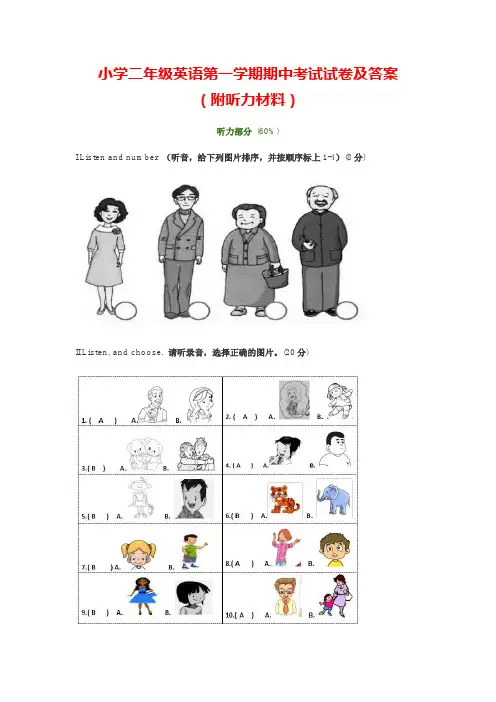
小学二年级英语第一学期期中考试试卷及答案(附听力材料)听力部分(60%)I.Listen and number (听音,给下列图片排序,并按顺序标上1-4)(8分)II.Listen, and choose. 请听录音,选择正确的图片。
(20分)III.Listen and circle.请听录音,圈出听到的图片。
(12分)IV. Listen and connect. 请听录音,用线连接你所听到的内容。
(10分) V.看图,听故事When I was little,给图片标顺序号。
(10分)读写部分(40%)VI.找出不属于同一类的一项。
(10分)()1.A.big B.handsome C.her D.short()2.A.brother B.grandfather C.sister ()3.A.look B.monkey C.tiger D.bird()4.A.apple B.egg C.fish D.kite()5.A.I B.man C.he D.sheⅦ.连词成句我最棒!(10分)1.mother She’s my ( . )________________________________________________ 2.is Who she ( ? )________________________________________________ 3.is Yaoyao a girl ( . )________________________________________________4.is He handsome ( . )________________________________________________5.What she does like look ( ? )________________________________________________VIII.看图,判断下列单词与图片是否一致。
小学二年级上学期期中英语试卷含答案(共3套,部编版)
小学二年级上学期期中英语试卷含答案(共3套,部编版)第一套试卷一、听力部分(共20分)1. Listen and choose the correct picture. (根据你听到的内容,选出相应的图片。
)(5分)2. Listen and choose the correct answer. (根据你听到的内容,选出正确的答案。
)(5分)1. A. Tom B. Tim C. Amy2. A. 5 B. 6 C. 73. A. Blue B. Green C. Red4. A. Bike B. Bus C. Car5. A. Cat B. Dog C. Bird3. Listen and fill in the blanks. (听音,完成句子。
)(5分)1. My name is ________.2. I am ________ years old.3. I like ________.4. Listen and number. (听音,给下列图片标序号。
)(5分)二、笔试部分(共80分)1. Look, read and choose. (读一读,选一选。
)(5分)1. I ________ a girl.A. isB. amC. are2. ________ name is Tom.A. IB. MyC. You3. I am ________ years old.A. sevenB. eightC. nine4. ________ like apples.A. IB. WeC. They5. This is ________ pen.A. aB. anC. the2. Read and choose the correct answer. (读短文,选择正确的答案。
)(10分)Tim: Hello, I'm Tim. I'm from London. Help me answer some questions, please.Tom: OK.Tim: How old are you?Tom: I am seven.Tim: What is your favorite color?Tom: My favorite color is blue.Tim: Do you like apples?Tom: No, I don't like apples. I like oranges.Tim: Thank you for your help, Tom.1. Where is Tim from?A. New YorkB. LondonC. Beijing2. How old is Tom?A. sixB. sevenC. eight3. What is Tom's favorite color?A. redB. blueC. yellow4. Does Tom like apples?A. Yes, he does.B. No, he doesn't.C. We don't know.5. What does Tom like?A. ApplesB. OrangesC. Bananas3. Read and circle the correct answer. (读短文,圈出正确的答案。
2024-2025学年四川省成都市四川大学附属中学高二上学期期中考试英语试卷
2024-2025学年四川省成都市四川大学附属中学高二上学期期中考试英语试卷Missing Pieces Project: Add Your Pieces to the Big PictureAll over England are places with stories to tell: from buildings to battlefields, some on your doorstep, others just a day trip away. Their stories are still being written, and they won't be complete until you share your side.The Missing Pieces Project invites you to share your pictures and stories of the unique, significant and memorable places on the National Heritage List for England. The List is a register of all nationally protected his toric buildings and sites across England. Your view of a place is as unique as you are, so every snapshot and story you add is an important piece of the picture. And the more pieces of the picture we have, the better we can work together to protect what makes these places special. Whether you have a connection to a place already or you' re discovering it for the first time, your views add important new pieces to the picture.Images: from phone snaps to scans of old photos and architects' drawings, from wide angles to close-upsStories: from memories of holidays, school trips and family events to information about grand openings and transformationsPhotos must be ones you took yourself, from public land or rights of way, or with permission from the landowner. To add an historic image, you must have the rights to it. See the Missing Pieces Project terms and conditions for more information.Sign in and make a difference.1. What is the purpose of the Missing Pieces Project?A.To create fine art pieces. B.To preserve historic places.C.To promote a story contest. D.To teach photography skills.2. How can you contribute to the project?A.By scanning a portrait of a great architect.B.By taking a picture of a newly- built museum.C.By writing a special story of your trip to France.D.By sharing memories of a protected English site.3. What is required for a photo taken on a private land?A.Quality information. B.Public permission.C.The owner's support. D.A right background.In medical school and throughout his career as a neonatologist, William Cashore was often asked to read and correct others’ work. Little did they know that he was a spelling champion, with atrophy(奖品) at home to prove it. Cashore won the Scripps National Spelling Bee in 1954 at age 14. Now 84, he’s the oldest living champi on of the contest, wh ich dates back to 1925. As contestants from this year’s competition headed home, he reflected on his experience and the effect it had on him.Cashore credits his parents for helping him prepare for his trip to Washington, D. C. , for the spelling bee. His mother was an elementary school teacher and his father was a lab technician with a talent for taking words apart and putting them back together.When the field narrowed to two competitors, the other boy misspelled “uncinate”, which means bent like a hook. Cashore spelled it correctly, then clinched the title with the word “transept”, an architectural term for the transverse part of a cross- shaped church.Cashore, who was given $500 and an encyclopedia set, enjoyed a brief turn as a celebrity. He didn’t br ag about his accomplishment after returning to Pennsylvania, but the experience quietly shaped him in multiple ways. “It gave me much more s elf-confidence and also gave me a sense that it’s very important to try to get things as correct as possible,” he said. “I’ve always been that way, and I still feel that way. If people are careless about spelling and writing, you wonder if they’ re careles s about their thinking.”“Preparing for a spelling bee today requires more concentration and technique than it did decades ago,” Cashore said. “The vocabulary of the words are far, far more technical. The English language, in the meantime, has imported a great many words from foreign languages which were not part of the English language when I was in eighth grade,” he added.4. What can we learn about Cashore from the first two paragraphs?A.He is the best ever spelling champion. B.He prepared alone for the spelling bee.C.He used his spelling ability to help others. D.He preferred to show off his spelling talent.5. What does the word “clinched” underlined in paragraph 3 refer to?A.Won. B.Declined. C.Removed. D.Gave. 6. How did the spelling bee competition affect Cashore?A.It helped him start his career. B.It strengthened his confidence.C.It limited his way of thinking. D.It brought him lasting popularity.7. What should we do to prepare for today’s spelling bee according to Cashore?A.Learn multiple languages. B.Go abroad for language study.C.Be a remarkable technician. D.Try to improve relevant skills.Social relationships are important to human happiness. But once relationships are formed, some will naturally wax and wane (兴衰), with many of us losing touch with friends and family that we were once close with.Across seven studies, the psychologists examined the attitudes of almost 2,500 participants to reconnecting with lost friendships, the barriers and reasons for doing so, and whether targeted interventions could encourage them to send that first message to an old friend.The psychologists set out-to measure this hesitance to reconnect by getting participants to rate their willingness to immediately carry out a range of activities, including calling or texting a friend they had lost touch with. They found that participants were as unwilling to reach out to an old fiend as they were to strike up a conversation with a stranger—or even to pickup rubbish.The top reported barriers included fears th at one’s old friend might not want to hear from them, that it would be too awkward after all this time, and feeling guilty. An excuse of being too busy—both the old friend and the participant—was the lowest cited reason for not reaching out.Notably, the psychologists found that participants believed there were only a few logical reasons to get in touch, with the fiend’s birthday reported as the most convincing. Reconnecting over the memory of a shared experience was the second most reported reason. Participants were least likely to consider getting in touch with an old friend to ask them a favour.As part of the research, the psychologists tested targeted interventions and they found that practising social connection with current networks by first sending a message to a warm friend was the most successful strategy, boosting reach out rates by over two thirds.But an expert explained: “Interestingly, despite people telling us that a key barrier to making contact with an old fiend was concerns over how the message might be received, the intervention that we designed to help overcome this anxiety had little effect.” The expert adds: “We know from decades of research that social relationships are a key source of happiness and meaning in our lives.”8. What is the primary focus of the psychologists research?A.The benefits of maintaining friendships.B.The process of forming new friendships.C.The attitudes towards reconnecting with old friends.D.The reasons for losing contact with long lost friends.9. What did the psychologist find regarding people’s willingness to reach out to old friends?A.Most participants were eager to reconnect.B.Participants hesitated to contact old friends.C.Participants preferred to reach out to ask for favors.D.Being too busy was the main reason for not reaching out.10. How does the expert think of the result of their intervention on social anxiety?A.Unsatisfactory. B.Unidentifiable. C.Predictable. D.Far-reaching.11. What’s the best title for the text?A.Gaining Happiness Through Social Ties B.The Pathways to Meaningful ConnectionD.Reviving Pre-existing Close Friendships C.To Strike up a Conversation with aStrangerCan artificial intelligence be made to tell the truth? Probably not, but the developers of large language model(LLM) chatbots should be legally required to reduce the risk of errors, says a team of ethicists (伦理学家). “What we’re just trying to do is to create a structure to get the companies to put a greater emphasis on truth or accuracy when they are creatin g the systems,” says Brent Mittelstadt at the University of Oxford.LLM chatbots, such as ChatGPT, generate human-like responses to users’ questions, based on statistical analysis of vast amounts of text. But although their answers usually appear convincing, they also tend to have “hallucination”. “We have these really, really impressive generative AI systems, but they get things wrong very frequently, and as far as we can understand the basic functioning of the systems, there’s no fundamental way to revamp that,” says Mittelstadt.This is a “very big problem” for LLM systems, given they are being rolled out to be used in a variety of contexts, such as government decisions, where it is important they produce factually correct, truthful answers, and are honest about the limitations of their knowledge, he says.To address the problem, Mittelstadt and his colleagues propose a range of measures. They say large language models should react in a similar way to how people would when asked factual questions. That mea ns being honest about what you do and don’t know. “It’s about doing the necessary steps to actually be careful in what you are claiming,” says Mittelstadt. This seems like a praiseworthy aim, but Eerke Boiten at De Montfort University, UK, questions whethe r the ethicists’ demand is technically practical. “I don’t understand how they expect legal requirements to mandate what I see as fundamentally technologically impossible,” he says.Mittelstadt and his colleagues do suggest some more straightforward steps that could make LLMs more truthful. The models should link to sources, he says — something that many of them now do to evidence their claims, while the wider use of a technique known as “retrieval enhanced generation” to come up with answers could limit th e likelihood of “hallucinations”.12. What is the main concern of the ethicists regarding LLM chatbots?A.The enormous development cost. B.The ethical decisions made by AI.C.Its inability to guarantee truthfulness. D.Its efficiency in processing texts.13. What does the underlined word “revamp” in paragraph 2 probably mean?A.Ignore. B.Fix. C.Discover. D.Escape.14. What is Eerke Boiten’s attitude towards the ethicists’ proposals for LMs?A.Tolerant. B.Conservative. C.Enthusiastic. D.Skeptical.15. Which of the following is suggested as a step to make LLMs more truthful?A.Linking to relevant sources. B.Using more complex data statistics.C.Encouraging user interaction. D.Reducing the size of the languagemodels.Travelling with friends can be an amazing experience where you could make lifelong memories or it could ruin your friendship. 16 Here are some rules you should follow to make sure your next trip with friends goes as smoothly as possible.17 Sure, you a nd your friends probably have some similar interests, but that’s not always the case. In an effort to keep everyone happy, go over travel plans and expectations ahead of time. Have each person categorize activities or sights into “must-see”, “want to see” and “would go if we have time”. Plan accordingly and make sure everyone can see some of their top attractions.Communicate and respect each other. Everyone has personal preferences when travelling— from getting the bed closest to the bathroom or sitting in the airplane’s window seat. But sometimes things don’t go as you like. In this case, share your requirements directly with your travel companions. 18 Have a conversation when problems arise, for communication is the key.Don’t disappear. When travelling with a group — or even just one other person — you may want some alone time. That’s completely fine, but make sure your friends know where you are and have a way of contacting you. 19Get off your phone. Of course, your friends will understand if you need to take a call from a family member, or in the event of a work emergency, but other than that, try to stay off your phone. 20 After all, the appeal of this type of trip is to spend time with friends. Just enjoy it!Lowe was facing a nightmare. His five-year-old son Tyler ________ from such a severe dental problem that he needed to have a(n)________ immediately. Lowe and his wife brought Tyler to Children’s Hospital Colorado in Denver.“As we sat in the waiting room, we felt ________. And the way in which my wife was clinging to he r son just made the ________ of the situation heavier. ”Lowe remembered.When a nurse called the family back, Lowe’s ________ only grew. A young doctor walked into the room and told them that he would be in ________ of the surgery. As the doctor began to explain how it would proceed, Lowe’s mind ________ the worst possible outcome.But then the doctor did something beyond ________. He looked at both Lowe and his wife in the eye, put a hand on each of their shoulders, and ________ them, “Today, your son is my son.” Lowe said he would never forget what the young doctor said, which was very helpful and meaningful. His ________ fear gave way to calm.After the surgery was over, the doctor came back out to the family. “He ________ us with a big smile on his fac e and said our son is just fine, and you can see him here in a few minutes.” Lowe________.After the surgery, Tyler made a quick ________ and led a normal life again. The Whole family felt so lucky to meet such a ________ doctor and Lowe explained that words ________ to express how grateful he and his wife both were for what the doctor said and did that day.21.A.survived B.escaped C.suffered D.arose22.A.operation B.look C.exam D.check23.A.relieved B.restless C.conscious D.attentive24.A.extent B.amount C.range D.gravity25.A.emotion B.relief C.terror D.joy26.A.charge B.progress C.possession D.place27.A.set off B.turned up C.took over D.went to28.A.decisions B.control C.expectations D.description 29.A.inspired B.comforted C.judged D.shocked30.A.slight B.precious C.groundless D.previous31.A.headed B.approached C.consulted D.appealed32.A.recalled B.reviewed C.reminded D.responded33.A.cure B.discovery C.treatment D.recovery34.A.open-minded B.short-sighted C.warm-hearted D.good-tempered 35.A.failed B.intended C.managed D.attempted阅读下面短文,在空白处填入1个适当的单词或括号内单词的正确形式。
人教版小学英语二年级(上)英语期中试卷
二年级英语期中试卷Name________ Score________一.Listening section(听力部分)40%I.Listen and choose.(听单词,选出所听到的单词。
10%)1.( ) A. brother B. sister C. uncle2.( )A. bread B. candy C. honey3.( )A. lion B. quail C. tiger4.( )A. skirt B. vest C. coat5.( )A. aunt B. fruit C. zipII.Listen and choose.(听句子,选出正确的图片。
10%)1.( ) This is my mother. A.B.2.( ) I like doughnut.A. B.3.( ) It’s a nest.A.B.4.()This is my sweater. A. B.5.() Is this your watch? A.B.III.Listen and number.(听句子,给图片人物表序号。
10%)( ) ( ) ( ) ( ) ( )IV.Listen and match.(听句子,连线。
10%)1. Do you like grapes? He’s my uncle.2. What ’s this? Yes, it is.3. Is this your uniform? I t’s a nest.4. How old are you? No, I don ’t. I like apples.5. Who ’s this man? I ’m seven.二. Writing section(笔试部分)60%I.Read and choose.(看图片,选择正确的单词。
14%)( ) 1. A. parrot () 2. B. mango () 3. C. cake () 4. D. owl () 5. E. bread ( ) 6. F. zip () 7.G. vestII. Read and match.(将字母,图片和单词连线。
2024年人教版小学二年级英语(上册)期中试卷及答案
2024年人教版小学二年级英语(上册)期中试卷及答案一、选择题(每题1分,共5分)1. Which word means "hello" in English?A. GoodeB. Thank youC. HelloD. Good morning2. What color is the sky?A. RedB. BlueC. GreenD. Yellow3. Which animal says "woof"?A. CatB. DogC. CowD. Chicken4. How many days are there in a week?A. 5B. 6C. 7D. 85. Which word means "big" in English?A. SmallB. TallC. BigD. Short二、判断题(每题1分,共5分)1. The sun is yellow. ( )2. Apples are red. ( )3. Elephants have four legs. ( )4. There are 12 months in a year. ( )5. The moon is round. ( )三、填空题(每题1分,共5分)1. The sky is ________.2. A ________ says "moo".3. I have two ________.4. There are ________ days in a week.5. A ________ is a big animal.四、简答题(每题2分,共10分)1. What is your favorite color? Why?2. How many fingers do you have on one hand?3. What do you like to eat for breakfast?4. Can you count from 1 to 10?5. What is your favorite animal? Why?五、应用题(每题2分,共10分)1. If you have 3 apples and I give you 2 more, how many apples do you have?2. If there are 5 birds in the tree and 3 more fly away, how many birds are left?3. If you have 4 pencils and I take 1 away, how many pencils do you have left?4. If there are 7 flowers and you give 3 to your friend, how many flowers do you have left?5. If you have 6 books and I give you 2 more, how many books do you have?六、分析题(每题5分,共10分)1. Look at the picture and describe what you see.2. Listen to the sound and tell me what animal it is.七、实践操作题(每题5分,共10分)1. Draw a picture of your favorite animal.2. Write the alphabet from A to Z.八、专业设计题(每题2分,共10分)1. 设计一张关于“我的家庭”的英语海报,包括家庭成员的名称和对应的英语单词。