
高一英语Unit3 Amazing people教学设计 牛津英语
高一英语Unit3 Amazing people教学设计Reading: The curse of the mummy (comprehension)By Li Chen on Dec 26, 2006Aims and requirements♦ Read an article about a famous explorer and an article about a Chinese astronaut♦ Listen to a list of requirements♦ Talk about famous people and unknown places, and introduce a person♦ Write a biographical article♦ Interview a professionalSummary of the passageThe passage is about a famous explorer who, with the assistance of Lord Carnarvon, led a team to Egypt and made some unexpected discoveries in tombs. It still remains a mystery how one of his discoveries led to illness and death for many of his team members.ProceduresStep 1: Leading-in1) Do you still remember something from our discussion on Egypt in Unit 1 and Unit 2?We talked about Toby traveling in Egypt and people’s curiosity about how the pyramids were built.Though we don’t know exactly how people at that time built them, we are quite sure of one thing, that is, all the pyramids were built for kings and queens. They expected to be buried there after their death. In spite of the harsh conditions, the Egyptians created this wonder of the world with their hands. It’s said the pyramids are as magnificent as a palace inside.2) Have you ever read or thought about what is inside the pyramids?3) Are there any people buried in them?4) What do people nowadays call those buried in tombs?5) What are mummies and how are they made?6) Apart from mummies, are there any treasures inside the tombs of the pyramids?7) Have the tombs ever been robbed of treasures by people?8) What happened to these people after they entered the tombs?9) Were they rich overnight?10)What may explain the disasters that happened to those people?Step 2: Fast reading for general ideas1.Pay attention to the Reading strategy first before skimming the passage.1) The article you are going to read is about a famous explorer who worked in Egypt. Read the article and make connections between the title and the explorer. Use your imagination and express your opinions freely with each other.What might be the connections between ‘The curse of the mummy’ and the famous explorer?Why does the writer choose ‘The curse of the mummy’ as its title here? Do you think the title can grab your attention and arouse your interest?From your point of view, what might be dealt with in the following article? Can something like the explorer’s hobbies, his experiences of adventures, his achievements be covered in the article?2) You’ve done a good job, expressing your opinions about the relationship between the title and the explorer and predicting the main contents of the article. That’s great. But to be more specific, can you anticipate what might be covered in the first paragraph of the article?3)Please read the first paragraph and discuss how the first paragraph agrees or disagrees with your predictions.W hat’s the first paragraph about? Is it the beginning of a story?What does the writer tell us about the explorer in the first paragraph?What words do you think are useful for you to predict the ideas included in the passage?Now you may find the first paragraph serves as a general introduction of Howard Carter, andWhat are the following paragraphs likely to do?Will they give specific examples to support thegeneral description of Howard Carter?Exchange your ideas with your partners and then check your prediction by reading the following paragraph.5) Now let’s focus on Reading strategy to review the skills of how to predict information in an article.2.Skim the passage and complete the three questions in Part A.Step 3: Detailed reading for important information1.Now please reread the passage and identify which statements are true and which are false. Thencomplete Part C1 on P44 individually.2.Part C2 on P44. Match the summaries of the paragraphs in the article3. While reading please identify the relationships between these characters and try to retell the passage according to the following diagram.1. interviewA---the spokesman of Howard CarterB---a journalistB will ask A the following questions:1) What kind of person do you think Howard Carter is? Why?2) To be a qualified explorer, what kind of personality do you think he/she should have?3) Do you think the personality of Howard Carter has had a positive effect on his discoveries?4) As for students, what sorts of personalities does a student have to possess?5) Compared with the amazing persons such as Mother Teresa, Bill Gates, Beethoven, Zhang Heng, doyou think Howard Carter is as great as them?6) Do you think the mummy’s curse really exists? Why?Step 5: Homework1. Parts D and E on P44 and P45.2. Write a summary about Howard Carter in a few sentences.。
Unit 3 Amazing people 教案
Unit 3 Amazing people 教案Unit 3 Aazing peple 教案(Language pints)ele t the unit:1 have an effet n 对…有影响effet(n), effetive (ad), _effetivel _(adv) eg Alhli drin an _have a bad effet n__ ur health 对你的健康有害The gvernent atin _had n effets n the trade ibalane 对…无影响be f n effet 无效,没有作用,不中用arr sth int effet 使生效,实现put sth int effet 实行,实施e int effet 开始生效Reading:1 urius(1) urius ad 好奇的;求知欲强的;奇特的hildren are urius abut everthing arund the I a urius t n hat he saidI’urius h he ill d it It is urius that she left ithut saing gdbe归纳用法:_ be urius abut be urius t d _be urius +-lause It is urius that (2) uriusl adv 好奇地;稀奇古怪地Philip led uriusl at the peple 他好奇地看着人们。
(3) urisit n [u]好奇感, 求知欲,好奇心in/ ith urisit 好奇地(相当于uriusl);ut f/ fr urisit 出于好奇心1) Philip led at the peple in/ith urisit 他好奇地看着人们。
2) He ept asing e nuerus questins abut it ut f / fr urisit出于好奇,对那事他问了我许多问题。
Unit 3 Amazing people(讲练)教学设计

Unit 3 Amazing people(讲练)教学设计一、过去完成时的形式及用法过去完成时的形式为had done。
其用法如下:1.过去完成时表示在过去某一时间或动作之前已经发生或完成了的动作。
它表示句子中描述的动作发生在“过去的过去”,可图示为:这个过去的某一时间可以用by, before等介词短语或一个时间状语从句来表示,也可以用一个表示过去的动作来表示,还可通过上下文来表示。
到六点钟为止他们已经工作八小时了。
By six o’c lock they had worked for eight hours.在他们到达之前电影已经开始了。
Before they arrived here, the film had already started.我到广州时,他在那里已经很长时间了。
When I came to Guangzhou, he had been there for a long time.注意:在before, after, as soon as等引导的从句中,由于这些连词本身已经表示出时间先后,所以可以用过去时来代替过去完成时。
Many people left for home before the film ended.电影尚未放完,许多人就起身回家了。
【高考典例】(2014北京卷)I found the lecture hard to follow because it _______ when I arrived.A. startedB. was startingC. would startD. had started答案D解析句意:我发现这个讲座很难跟上趟,因为我到的时候,它就开始了,根据句意可知这个报告是在我到达之前就开始的,而句中我到达使用了arrived,而报告是在这之前发生的,所以使用过去完成时故D 正确2.表示由过去的某一时刻开始,一直延续到过去另一时间的动作或状态,常和for, since构成的时间状语连用当公交车来的时候,我在车站已等了20分钟。
高中英语 Unit 3《Amazing People-Reading》教案3 牛津译林版必修2

Unit 3 Amazing PeopleReadingI Pre-reading discussionTalk about some amazing people1. Who are they?2. What do you know about them?3. What useful changes have they made to the way we live today?4. Do you have a hero? Who and why?II Presentation of the reading passage with the picture of Howard Carter (see ppt)III Reading strategy ---PredictionPredict information in advance with the help of the title1.What might be the connection between the title ‘The curse of the mummy’and Howard Carter?2. What might be dealt with in the passage?3. Read the first paragraph and make the prediction more specific1). Read the first paragraph and see if it agrees with their anticipation.2).Predict what the following paragraphs are likely to discuss with thehelp of the information in the first paragraph.IV Reading1. Read the rest of the passage and check their anticipation.2. Read and find the main idea of each paragraph. Match the summaries with the right paragraphs (see ppt)1).There is a scientific reason why people died after entering the tomb.2). Howard Carter did not go to school and later became an explorer.3). Lord Carnarvon died after Carter had opened the tomb.4). Harward Carter discovered the tomb of King Tutankhamun.5). A short introduction of H oward Carter’s life story.6).The mystery of Tutankhamun’s tomb has never been fully explained.7). More people died after Carter’s discovery.8). People keep wondering why so many people died and have suggested allsorts of possibilities.3. Read and divide the passageHow many parts can this passage be divided into according to the content?What’s the main idea of each part?--Four1)Brief introduction about Howard2)His most amazing discovery.3)Consequences of the discovery.4)Different explanations of the consequences.4.Reading for details about each part1) The first partHoward Carter’s personalityHis schoolingHis discovery2) Detailed reading about his greatest discoveryFinish the following diagram (see ppt)Characters Who was he? How did he W hen did hedie? die?Lord CarnarvonGeorge GouldArthur MaceRichard Bethell3) What other coincidences happened?The pet bird eaten by a snakeLights in Cairo went outThe dog died at the same time4) Reading for different explanationsa. Coincidenceb. The result of the mummy’s cursec. Viruses breathed ind. A mysteryV Follow-up discussion1. What do you suppose led to the deaths of so many people?2. To be a successful explorer, personality is very important.What personality do you think you should have if you want to explore space alone like Yang Liwei?Language points1.Set sail (from/for) : to begin a trip by seaColumbus set sail from Barcelona for India in 1492.Zheng He set sail for the west seven times between 1405 and 1433..go for a sailIt’s real fun to go for a sail in the Mediterranean.Go sailing2. The tomb contained more riches, gold and jewels…riches: wealthWhich do you think is more valuable, health or riches?So riches mean nothing to you when you are ill.Jewel: often used in its plural form-- jewelsShe is too poor to buy jewels/jewellery.People usually buy jewels at the jeweller’s.jewellery: u.nGold jewllery is no longer in fashion now.3. We emptied the tomb of everything.Empty: (v) to remove everything that is in a containerDon’t forget to empty the waste paper basket classroom after cleaning the classroom every day.Empty sth. of sth.I emptied my handbag of everything, but still couldn’t find my key4. Upon entering the tomb,Upon= On (doing sth/sth)Rewrite the following sentences1) When he arrived at the platform, he found the train had just started. Upon/ On arrivingUpon /On his arrival2) She was full of joy when she saw her son take his first step.Upon/On see her son take his first step,…5. If breathed in, they can result in illness or even death.If breathed in=If the viruses are breathed inRewrite the following sentences1)You are dead if you are caught cheating in exams.If caught cheating in exams, …2)If it is possible, will you evade school on Saturday.If possible,…6. They can result in illness or even death.result in: make something happen; cause; lead to;Heavy rains may result in floodingThe earthquake in Tangshan in 1976 resulted in more than 240,000 deaths and 160,000 injuries.Translation exercise1.豪华客轮(the luxury liner)泰坦尼克号在一片欢呼声中起航, 驶向大洋彼岸,最后却长眠于洋底。
高中英语 Unit 3 Amazing people教学设计 牛津译林版牛津版高一英语教案

Unit 3 Amazing people教学目标:1. 掌握本单元的基本词汇,包括中英文和词性的转换,能在阅读中读懂文章。
2. 掌握基本短语,包括介词短语,动词短语,常用词的固定搭配。
3. 掌握基本句型,并根据所学句型能够翻译句子。
4. 掌握常见的动词时态和语态的基本用法,搞清楚一些时态的区别,记住一些在特定时态语态中使用的常见词或表达,并能够做一些基本练习。
curse诅咒,咒语,诅咒,咒骂mummy 木乃伊explorer 探险家brave 勇敢的adventurous 喜欢冒险的,冒险的artist 艺术家bright 聪明的,伶俐的curious 好奇的,求知欲强的sail 航行,风帆set sail 启航Egyptian 埃及的,埃及人的,埃及人gold 黄金preserve 保存,保护,保持discovery发现valley山谷,峡谷riches(复数)财富as well as 也,以及empty 倒空,空的right away 立刻,马上strangely 奇怪地,莫名其妙地present 在场的,出席的fever发烧,发热secretary 秘书shortly 不久,很快within 在。
之内,不超过coincidence 巧合,碰巧scientific 科学的virus 病毒fresh 新鲜的disturb 打扰,扰乱result 结果,导致illness疾病examine检查,考察,仔细观察certain 确定的,肯定的fully 完全地,彻底地,充分地finally 最后,终于pay off 成功,带来好结果ancient 古代的,远古的compare 比较express 表达,表示childhood 童年,孩童时代aeroplane 飞机organize 组织base基地,大本营,底部,基础,以。
作基础contact 联系,接触maker 制作者,制造商a great deal of 许多,大量的survivor 幸存者captain 船长warning 警告,提醒iceberg 冰山survive 幸存,生还westerner 西方人once 一旦orbit 轨道,绕。
高中英语 Unit3 Amazing people Word power教学设计 牛津译林版必修2

单元:Unit 3 Amazing people板块:Word powerThoughts on the design:本节课主要是以听、说为主的词汇教学课。
主要从两个方面帮助学生扩大有关职业方面的词汇量:1、通过构词法中的派生法变成表示一些职业的词汇,也就是说在一些动词、名词、形容词等后加后缀,如-er、-or、-ist等,帮助学生对所学过的单词进行归纳,从中发现规律,同时,根据这些规则向他们介绍更多的符合这些规则的生词; 2、根据本单元的有关职业话题,引申出更多的有关生词。
Teaching aims:After learning “word power”, the students will be able to master words, especially words for jobs. Besides, the students can enlarge their vocabulary by learning word formation of nouns about jobs. At the same time, the students will know more about jobs.Teaching procedures:Step1 Lead-inBrainstorming. Show some pictures of people who , teacher, doctor, singer, model, painter, photographer and driver)2. What other jobs do you know?(The answer depends on what the students know and answer.)[Explanation]通过看一些图片,让学生猜出图片中人物的工作,不仅让学生热身,而且让他们对本课时的内容有初步的了解,以便成功地导入主题。
高中英语 Unit3 Amazing people-grammar and usage精品教案 牛津
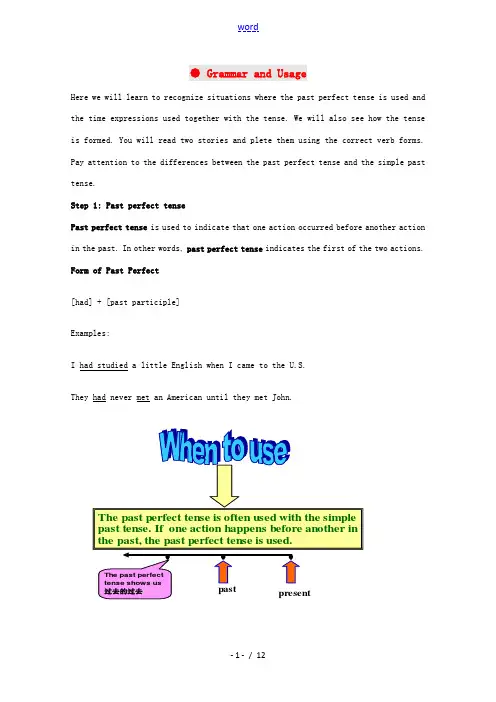
● Grammar and UsageHere we will learn to recognize situations where the past perfect tense is used and the time expressions used together with the tense. We will also see how the tense is formed. You will read two stories and plete them using the correct verb forms. Pay attention to the differences between the past perfect tense and the simple past tense.Step 1: Past perfect tensePast perfect tense is used to indicate that one action occurred before another action in the past. In other words, past perfect tense indicates the first of the two actions. Form of Past Perfect[had] + [past participle]Examples:I had studied a little English when I came to the U.S.They had never met an American until they met John.used with time expressions such as when, after, before, as soon as,until, by, for and alreadyCarter opened KingTutankhamun ’stomb Then a few months after Carter had openedthe tomb, Lord Carnarvon fell ill with a feverand died.Lord Carnarvon diedPast PresentNote : When you are using a verb tense with more than one part such as Past Perfect (had met), adverbs often e between the first part and the second part (had never met). USE 1pleted Action Before Something in PastThe Past Perfect expresses the idea that something occurred before another action in the past. It can also show that something happened before a specific time in the past.Examples:I had never seen such a beautiful beach before I went to Kauai.Had you ever visited the U.S. before your trip in 1992?Yes, I had been to the U.S. once before in 1988.USE 2Duration Before Something in the Past(Non-continuous Verbs)With Non-progressive Verbs and some non-progressive uses of Mixed Verbs, we use the Past Perfect to show that something started in the past and continued up until another action in the past.Examples:We had had that car for ten years before it broke down.By the time Alex finished his studies, he had been in London for over eight years. IMPORTANT Specific Times with the Past PerfectUnlike the Present Perfect, it is possible to use specific time words or phrases with the Past Perfect. Although this is possible, it is usually not necessary.EXAMPLE:She had visited her Japanese relatives once in 1993 before she moved in with them in 1996.If the Past Perfect action did occur at a specific time, the Simple Past can be used instead of the Past Perfect when before or after is used in the sentence. The words before and after actually tell you what happens first so the Past Perfect is optional. Both sentences below are correct.EXAMPLE:She had visited her Japanese relatives once in 1993 before she moved in with them in 1996.She visited her Japanese relatives once in 1993 before she moved in with them in 1996. HOWEVERIf the Past Perfect action did not happen at a specific time, Past Perfect MUST be used at all times. pare the two sentences below.EXAMPLE:She had never seen a bear before she moved to Alaska. CorrectShe never saw a bear before she moved to Alaska. Not CorrectACTIVE / PASSIVE FORMSof Past PerfectEXAMPLESGeorge had repaired many cars before he received his mechanics license. ACTIVE Many cars had been repaired by George before he received his mechanics license. PASSIVEStep 2: Practice1. Read Point 1 on page 48 to see which action happens first in the sentence given.Note that the past perfect tense is often used with the simple past tense. If one action happens before another in the past, the past perfect tense is used. So these two tenses are often used together.Look at the diagram in Point 1 first, and then read the example sentence. Note how the past perfect tense is used with the simple past tense.2. Read the following two sentences to see how the predicate is changed when the sentence is turned from the direct speech into the indirect speech.Toby said, “I will/shall not be in London next week.〞Toby said that he would not be in London the next week.Next let’s look at another two sentences:Toby said, “I went to Africa a month ago.〞Toby said that he had gone to Africa a month before.So you see if a sentence which uses the simple past tense in the direct speech is changed into the indirect speech, it will use the past perfect tense. Now go overPoint 2 on page 48.3. Go over Point 3 to see in what situation the past perfect tense can be used.4. Please talk about what time expressions can be used with the past perfect tense and how the tense is formed. Then we’ll go over Points 4 and 5 on page 48.Step 3:Present perfect or past perfect?We’ve learned both the present perfect tense and the past perfect tense, but do you know when to use the present perfect and when the past perfect.1. Please go over the guidelines and the example sentences on page 51 and identify the differences between the present perfect tense and the past perfect tense. Look at the examples:Howard Carter is one of the most famous explorers the world has ever known.Not long after the tomb had been opened, people in Carter’s team began to fall ill and die strangely.Now from the following diagrams you can see the different times of each example sentence given.Howard Carter became famousFuturePast PresentPresentPastThe tomb had People began to fallbeen opened. ill and die strangely.2. Please read the following two sentences and identify the differences between them: Toby said, “I have stayed in Africa for more than a month.〞Toby said that he had stayed in Africa for more than a month.Note that when we change a sentence from the direct speech into the indirect speech like this, the tense will be changed from the present perfect tense to the past perfect tense.Step 4: Consolidation1. Go over the notes about Amelia Earhart on Page 49 to see who she was and what happened to her and then plete the story.1.Please read Part B on page 50 and plete the passage using the simple past tenseor the past perfect tense.2.Look at the four pictures with sentences in the direct speech. Then plete thearticle using the past perfect tense by changing the sentences into the indirect speech.4. To know more clearly about the differences between the simple past and the past perfect, do Part C1 on page 98 in Workbook.5. Fill in the blanks with proper forms of the verbs.(1)I asked him to let me drive as he ___________ for hours. (drive)(2) Since you ________ the rules, you can correct these grammatical mistakes byyourselves. (learn)(3) They _______ because their schoolbags are still in their desk. (not leave)(4) Mr Bell,, who I ___________ to London, still lives in Liverpool. (think, move)(5) When the noise _______ down, the schoolmaster began his speech. (die)(6) It _________ cold this year, I wonder when it is going to get warmer. (be)(7) I _________ cakes. That’s w hy my hands are all covered with flour. (make)(8) When I got back, they _______ down most of the houses in the street. (pull)(9) It was not until I _________ your letter that I knew the truth. (read)(10)The lady has been to the shop several times, but she ___________ anything. (buy,never)Step 5: Grammar execisesI. Relative items in recent years’ college entrance examinations:1.All morning as she waited for the medical report from the doctor, hernervousness______.A. has grownB. is growingC. grewD. had grown2.The news came as no surprise to me. I _______ for some time that the factory wasgoing to shut down.A. had knownB. knewC. have knownD. know3.I thought Jim would say something about his school report, but he _______ it.A. doesn’t mentionB. hadn’t mentionedC. didn’t mentionD. hasn’tmentioned4.I arrived late; I ______ the road to be so icy.A. wouldn’t expectB. haven’t expectedC. hadn’t expectedD. wasn’texpecting5.My mind wasn’t on what he was saying so I’m afraid I ______ half of it.A. was missingB. had missedC. will missD. missed6.The crazy fans _______ patiently for two hours, and they would wait till the moviestar arrived.A. were waitingB. had been waitingC. had waitedD. would wait7.He kept looking at her, wondering whether he ______ her somewhere.A. sawB. has seenC. seesD. had seen8.---George and Lucy got married last week. Did you go to their wedding?---No. I _______. Did they have a big wedding?A. was not invitedB. have not been invitedC. hadn’t bee n invitedD.didn’t invite9. I ______ Bill this morning, but I ______ him since.A. have seen; haven’t seenB. saw; haven’t seenB. saw; didn’t see D. had seen; haven’t seen10. ---Dad, do you know I had long been looking forward to your staying with me forthe last weekend?---Sorry, son. I ______, but I was just too busy.A. had really wanted toB. have planned toC. have intended toD. had hopedme to11. He _________ more that 5,000 English words when he entered the university at theage of 15.A. has learnedB. would have learnedC. learnedD. had learned12. When the old man ______ to walk back to his house ,the sun _____ itself behindthe mountain.A.started ;had already hidden B.had started ;had already hiddenC.had started ;was hiding D.was starting; hid13. The young girl sitting next to me on the plane was very nervous. She before.A. hasn't flownB. didn't flyC. hadn't flownD. wasn't flying14. I was giving a talk to a large group of people, the same talk I_______ to a dozen other groups.A. was givingB. am givingC. had givenD. have given15. John, a friend of mine, who got married only last week, spent $3,000 more than he _______ for the wedding.A. will planB. has plannedC. would planD. had plannedII. Filling the blanks with proper tense.〔Simple Past / Present Perfect / Past Perfect〕1. When I (arrive) ______home last night, I discovered that Jane (prepare) ______a beautiful candle-lit dinner.2. Since I began acting, I (perform) ______in two plays, a television mercial anda TV drama. However, I (speak, never even) _______publicly before I came to Hollywood in 1985.3. By the time I got to the office, the meeting (begin, already) ______without me. My boss (be) _____furious with me and I (be) ______fired.4. When I (turn) _____the radio on yesterday, I (hear) ______a song that was popular when I was in high school. I (hear, not) ______the song in years, and it (bring) _____back some great memories.5. When Jack (enter) ______the room, I (recognize, not) ______him because he (lose) ______so much weight He looked totally different!6. The Maya established a very advanced civilization in the jungles of the Yucatan; however, their culture (disappear, virtually) _____by the time Europeans first (arrive) ______in the New World.7. I (visit) ______so many beautiful places since I (e) ______to Utah. Before moving here, I (hear, never) _______of Bryce Canyon, Zion, Arches or Canyonlands.。
高中英语(unit3 Amazing people)Welcome to the unit教案 牛津
课题:wele to the unit
【教学目标】
1、Talk about famous people in the world.
2、Make the students know the fact that they will succeed as long as they work hard.
2.Bill Gates started Microsoft, the biggest puter technology pany in the world.He is chairman of Microsoft Corporation and the worldwide leader in software, services and solutions
【教学重点】
Make the Ss free to talk in and after class about the amazing people.
【教学难点】Help students finish the task of speaking.
【教 具】The multimedia and the blackboard
4.Zheng He was a Hui Chinese mariner, explorer, diplomat and fleet admiral, who made the voyages collectively referred to as the travels of "Eunuch Sanbao to the Western Ocean" (Chinese:三保太监下西洋) or "Zheng He to the Western Ocean", from 1405 to 1433. The voyages helped expand foreign interest in Chinese goods such as silk and porcelain.
高一英语Unit3 Amazing people教学设计 牛津英语
高一英语Unit3 Amazing people教学设计Reading: The curse of the mummy (comprehension)By Li Chen on Dec 26, 2020Aims and requirements♦ Read an article about a famous explorer and an article about a Chinese astronaut♦ Listen to a list of requirements♦ Talk about famous people and unknown places, and introduce a person♦ Write a biographical article♦ Interview a professionalSummary of the passageThe passage is about a famous explorer who, with the assistance of Lord Carnarvon, led a team to Egypt and made some unexpected discoveries in tombs. It still remains a mystery how one of his discoveries led to illness and death for many of his team members.ProceduresStep 1: Leading-in1) Do you still remember something from our discussion on Egypt in Unit 1 and Unit 2?We talked about Toby traveling in Egypt and people’s curiosity about how the pyramids were built. Though we don’t know exactly how people at that time built them, we are quite sure of one thing, that is, all the pyramids were built for kings and queens. They expected to be buried there after their death. In spite of the harsh conditions, the Egyptians created this wonder of the world with their hands. It’s said the pyramids are as magnificent as a palace inside.2) Have you ever read or thought about what is inside the pyramids?3) Are there any people buried in them?4) What do people nowadays call those buried in tombs?5) What are mummies and how are they made?6) Apart from mummies, are there any treasures inside the tombs of thepyramids?7) Have the tombs ever been robbed of treasures by people?8) What happened to these people after they entered the tombs?9) Were they rich overnight?10)What may explain the disasters that happened to those people?Step 2: Fast reading for general ideas1.Pay attention to the Reading strategy first before skimming the passage.1) The article you are going to read is about a famous explorer who worked in Egypt. Read the article and make connections between the title and the explorer. Use your imagination and express your opinions freely with each other.What might be the connections between ‘The curse of the mummy’ and the famous explorer?Why does the writer choose ‘The curse of the mummy’ as its title here? Doyou think the title can grab your attention and arouse your interest? From your point of view, what might be dealt with in the following article? Can something like the explorer’s hobbies, his experiences of adventures, his achievements be covered in the article?2) You’ve done a good job, expressing your opinions about the relationship between the title and the explorer and predicting the main contents of the article. That’s great. But to be more specific, can you anticipate what might be covered in the first paragraph of the article?3)Please read the first paragraph and discuss how the first paragraph agrees or disagrees with your predictions.W hat’s the first paragraph about? Is it the beginning of a story?What does the writer tell us about the explorer in the first paragraph? What words do you think are useful for you to predict the ideas included in the passage?Now you may find the first paragraph serves as a general introduction of Howard Carter, and please pay attention to the key words in the first paragraph on the blackboard:4) With the help of the key words, you may predict the content of the paragraphs that follow.What are the following paragraphs likely to do?Will they give specific examples to support thegeneral description of Howard Carter?Exchange your ideas with your partners and then check your prediction by reading the following paragraph.5) Now let’s focus on Reading strategy to review the skills of how to predict information in an article.2.Skim the passage and complete the three questions in Part A.Step 3: Detailed reading for important information1.Now please reread the passage and identify which statements are true andwhich are false. Then complete Part C1 on P44 individually.2.Part C2 on P44. Match the summaries of the paragraphs in the article3. While reading please identify the relationships between these characters and try to retell the passage according to the following diagram.Step 4: Post-reading activities1. interviewA---the spokesman of Howard CarterB---a journalistB will ask A the following questions:1) What kind of person do you think Howard Carter is? Why?2) To be a qualified explorer, what kind of personality do you think he/sheshould have?3) Do you think the personality of Howard Carter has had a positive effecton his discoveries?4) As for students, what sorts of personalities does a student have to possess?5) Compared with the amazing persons such as Mother Teresa, Bill Gates,Beethoven, Zhang Heng, do you think Howard Carter is as great as them?6) Do you think the mummy’s curse really exists? Why?Step 5: Homework1. Parts D and E on P44 and P45.2. Write a summary about Howard Carter in a few sentences.。
牛津译林版必修二Unit 3《Amazing people》word教案1
长沙市耀华中学高一英语模块二教学案Unit 3 Amazing peopleClass _________ Name _____________Period 1 Welcome to the unit and reading (1)Teaching aims: To arouse the students’ interest in talking about amazing people in the world. Important points: Get to know some amazing people in the world and learn about their great achievements..Teaching procedure:Step 1 Discussion:1. Who do you admire(崇敬,敬佩) most in your life? Why?2. Are you familiar with the following people? Who are they?__________ ____________ _____________ ____________ _____________ ____________Do you think they are worth admiring? Why?_______ I _________. Because they all _______ _________ our world through their __________ and _______.So we call them ___________ _____________.(了不起的人,令人叹为观止的人物)Step 2 MatchCan you match these amazing people with their great achievements?( )1. Bill Gates A. He is the great leader of the Chinese people, who led the Chinesepeople to found a new China---- the People’s Republic of China.(中华人民共和国)( )2. Mao zhedong B. He started one of the most famous computer companies in theworld---Apple and has made the most popular pad computers andmobile phones—ipad and iphone, which are regarded as (被认为是)the revolution(革命) of personal computers.( )3. Mother Teresa C. He opened up relations between China and the outside world.( )4. Zheng He D. He started one of the biggest IT companies in the world---- Microsoftand has developed a great number of softwares(软件), which havechanged the way people work and live.( )5. Beethoven E. He was one of the greatest musicians of all time.(有史以来)( )6. Steve Jobs F. She won a Nobel Peace Prize for her work among the poor people of India.Step 3 Discussion:Why are they able to make such great achievements? What do they have in common(共同的)? Pick out the common characters of these amazing people.( )1. Never give up ( )6. Overcome(克服) all the difficulties theymet( )zy and weak in their character(他们在品质上).( )7. They work only for themselves.( )3. Have made great contributions (做出巨大贡献)in different filelds( )8. Loved and respected by people( )4. Lack of wisdom and courage(缺乏智慧和勇气) ( )9. Have extrordinary persverance.(非凡的毅力)( )5. Have great aims (伟大的目标) and worked hardin order to achieve it ( )10. Changed our world through their thoughtsand actionsDo you want to become an amazing person? What should you do?Homework; Preview the passage on page 42 and 43.长沙市耀华中学高一英语模块二教学案Unit 3 Amazing peopleClass _________ Name _____________Period 2-3 ReadingTeaching aims: 1. To improve the students’ reading skill: How to predict information.2. To understand the main idea of the passage and detailed information by skimming andscanning.Important points: the main idea of the passage and detailed information.Step 1. Prediction.Now let’s get to know another amazing person.Please go through the first paragraph of the text on page 42 and 43 quickly and find out who is the amazing person mentioned in it.The amazing person mentioned in the text is _____________________, who is one of the most famous _____________in the ________________.What can you predict from the the title and the 1st paragraph the passage is about?The passage is about his amazing ____________________.Step 2 SkimmingSkim the passage and find out the answers to the following questions:1) What an amazing discovery did Howard Carter make?He discovered the ____________ of __________________________, which contained a lot of____________ , as well as the __________ of the king2) What happened to some of the team members after the tomb was opened?Some of the team members ________________.3) Have the explanations of “the curse of mummy” been fully accepted by people today?. _______, they __________.Step 3 ScanningRead the text again, more carefully and give the main idea of each paragraph:( ) P1 A.There’s a scientific reason why people died after entering the tomb. ( ) P2 B. Carter didn’t go to school and later became an explorer.( ) P3 C. Lord Carnarvon died after Carter had opened the tomb.( ) P4 D. Carter discovered the tomb of King Tutankhamun.( ) P5 E. A short introduction of Carter’s life story.( ) P6 F. The mystery of Tutankhamun’s tomb has never been fully explained. ( ) P7 G. More people died after Carter’s discovery.( ) P8 H. People keep wondering why so many people died and have suggested all kinds of explanations.Step 4 Detailed information:1. Howard Carter’s education:He _______ go to ____________, but learnt to _________ from his ___________3.The death of Carter’s teammates:Character Connection with Carter and the tomb How did he die?the bird Carter’s 1)________________ was 2)__________ by a 3)________ Lord Carnarvon Provided 4)___________ for Carter’s team. wasalso 5)__________ when the tomb was opened.6)_____________ with 7) ___________ George Gould Carn arvon’s 8)______, too 9)________ the tomb had a 10)_____________________Richard Bethell Carter’s 11)_________, entered the tomb as well died of 12)___________________ Arthur Mace Team member Not mentioned4. Different explanations of the death of Carter’s teammates:1) ___________________________ 2) ________________________ 3)_____________________________Conclusion: “The curse of the mummy” remains a _________________ to this day.5. Summary:Part 1(para1-3): Howard Carter’s _____________ and his _____________________Part 2(para4-5): ___________________after the discovery of the tomb.Part 3(para6-8): ________________________ about the deathsStep 5 useful phrases:Homework: complete Ex D and E on page 44 and 45.长沙市耀华中学高一英语模块二教学案Unit 3 Amazing peopleClass _________ Name _____________Period 4-5 Language pointsTeaching aims: 1.Encourage the students to improve their reading ability by focusing on language points.2.Learn how to use the key words and expressions which appearin the text.Teaching important points: the key words and expressions in the text.Teaching procedure:Step 1 Revision1. Check homework.2. Review the text on page 42 and 43 and fill in the blanks with the words in the passage. discovery, discoveries, mummy, riddle, however, died, treasure, explorer, puzzled, tomb, curse, explanationsHoward Carter, a well-known 1)______________, made many amazing 2)_______________ during his life.One of his most amazing discoveries is the 3)____________ of King Tutankhamun, where he not only found a great deal of 4)___________ but also the 5)___________ of the king.6)____________, a series of unfortunate things occurred shortly after the 7)____________ of the tomb----- his lucky pet bird and some of his teammates 8)____________ one by one, which 9)_____________ people all over the world. Different 10)_______________ spread among people. One of the most terrifying explanations was “the 11)__________ of the mummy”. But till today, “the curse of the mummy” remains a 12)_______________.Step 2 Language points:1. He was bright and curious about the world outside his hometown. (L 5-6)“curious” means “eager to learn / know”好奇的be curious about sth. 对……好奇be curious to do sth. 好奇地做某事curiously enough …奇怪的是,……(口语,常放句首)1) They __________ very ___________ ___________ (对……好奇)the people who lived in the island.2) He _____ always __________ ______ ________ ______ (好奇的去弄明白find out) how everything works.3) ____________ ______________, a year later exactly the same thing happened to me again.2. In 1891, at the age of 17, he set sail for Alexandria, Egypt. (L6-7)“set sail for” means “to travel to somewhere by boat”. 启航前往1) We ________ __________ from Dover ____________ Ostend. 我们乘船从Dover出发前往Ostend.2) My dream is that I _______ ______ ________ _______ Australia one day.我的梦想是有一天启航去到澳大利亚。
高中英语 unit3 amazing peopleword power精品教案 牛津译林版必修
高一英语精品教案:Unit3 Amazing people-word power(牛津译林版必修2)Boys and girls, look at the screen, please. Can you tell us their jobs?( model, farmer, composer, driver, worker, teacher, air hostess and soldier) Word power in this unit deals with different expressions related to jobs. Try to increase your vocabulary by learning rules of word formations, such as adding suffixes to verbs, nouns and adjectives to form nouns. Practice and reinforce new vocabulary by doing the exercises. Try to acquaint yourselves with these different expressions and express opinions about your favorite jobs.Step 1: Brainstorming1. make a list of jobs you are familiar with. Then exchange your opinions about the reasons for your favorite jobs.list of jobs__________________your favorite job _______________reasons for the favorite job______________2. Think of rules for word formation you know and try to give examples of these rules.For example:beauty→beautiful strange→strangely operate→operationcomfortable→uncomfo rtable speech→speechlessStep 2: Vocabulary learning1. Please look at the rules for word formation listed in the book. And try your best to think of more words that fit the rules. For example:+ er bank→banker compose→composer think→thinker+or educate→educator edit→editor sail→sail or+ ant assist→assistant serve→servant depend→dependant+ ist art→artist chemistry→chemist science→scientist+ ian music→musician history→historian technique→technician3. Focus on Part B and try to guess the meanings of all the words. I’ll give you some explanations first:A principal is a person who is in charge of a university, college or school.A composer is a person who writes music.A sculptor is a person who has the talent of making solid objects representing people or animals out of stone, wood, clay, etc.An accountant is a person whose job is to keep and check financial accounts.4. Complete Part B together. Any different answers are welcome.Step 3: Vocabulary extension1. Focus on Part C and complete it individually. Don’t forget to give your reasonsup a specific job. As yo u mentioned, you’d like to be a teacher. Then, in your opinion, what qualities should you possess in order to be a teacher? Do you think it’s easy to be a good teacher?3. Please read the article in Part A in Writing on page 103 in Workbook to learn how to write an article to describe a person. Then do Part B on the same page.Step 4: ExercisesA. Give the noun form of the following word to express the occupation or station.(1) examine (2) art (3) build (4) chemistry (5) conduct (6) dance(7) design (8) beg (9) dive (10) invent (11) translate (12) physics (13) lead (14) library (15) employ (16) piano (17) prison (18) sail(19) serve (20) discover (21) technique (22) win (23) visit (24) operateB. Choose the proper words for the blanks.(1) west, western, westernerSome _______ forms of greeting are not used in the East.A ______ may find that traveling in Asian counties is quite an experience.(2) compose, composer, compositionBeethoven was one of the greatest ______ in the world.He played a piano piece of his own _______.(3) advertise, advertiser, advertisementIf you want to sell your house, you may put an ______ in a newspaper.Factories often ______ their goods on TV or over the radio.An _______ always uses various means to attract the public attention.(4) create, creative, creation, creatorThe invention of steam engine led to the ______ of modern machine.It is essential to develop a student’s _______ ability.第十三章:干燥通过本章的学习,应熟练掌握表示湿空气性质的参数,正确应用空气的H–I 图确定空气的状态点及其性质参数;熟练应用物料衡算及热量衡算解决干燥过程中的计算问题;了解干燥过程的平衡关系和速率特征及干燥时间的计算;了解干燥器的类型及强化干燥操作的基本方法。