
外研版七年级下册M11unit1 Body Language
What can you learn from this conversation? • Body language is very important in our daily life, and people do different things in different countries. When we are visiting other countries, we should follow their customs. That is to say,
Indian
America American
New Zealand New Zealander
Japan Japanese
Russia Russian
Let’s show some different ways of body languages to greet问候 each other in different countries.
请两位同学根据卡片上的内容表演不同国家的不同问候 方式,其他同学请猜出是哪个国家。
Activity1 Match the pictures with the words and expression.
bow
kiss
shake hands smile
Activity 2 Listen and match the pictures with the nationality.
_________________________.
表达礼貌
bow
shake hands
hug
kiss
smile Touch noses wave the hand
? ?
body languages to show politeness
?
?
?
?
?
Country / nationality
China
Britain British
Chinese India
T
Listen again and check nationalities that are mentioned in the recording Russian Chinese Japanese American French British German Indian
Now complete the table with the correct form of the words from the box.
不同方式
In China
Shake hands and smile sometimes nod our heads
In Russia
Kiss three times, left, right, left
In US
Shake hands and some kiss or hug each other
India kiss Russia together touch visitor
In China, Chinese people shake hands and smile.
kiss when American people shake hands and sometimes _____ they meet InIndia ______,people put their hands_________ together and _____. visitors nod their heads.
They use body language to communicate with each other.
彼此交流
Thinking
How to use body language?
Clap hands
bye-bye
stop
Come in, please.
nod
Well-done
Do you know how many body languages to show politeness?
In ________,people kiss each other three times Russia
Maori people ______ touch noses.
What do people usually do when they meet?
In China, Chinese people….. In Japan, Japanese people…… In India,…..
bow
British
French
kiss
shake hands smile
German
Japanese
Russian
Listen and check the true sentence
Russian teachers will visit 1. Some Japanese F Lingling’s school. know Russian people 2. Lingling doesn’t knows usually kiss each other when they meet. F 3.People in different countries do different things when they meet.
In India
Put their hands together and nod their heads
In New Zealand Maori People
Touch nΒιβλιοθήκη sesIn Japanbow
Two students act different body languages to greet each other in different countries according to the paper, and other students must guess which country it is.
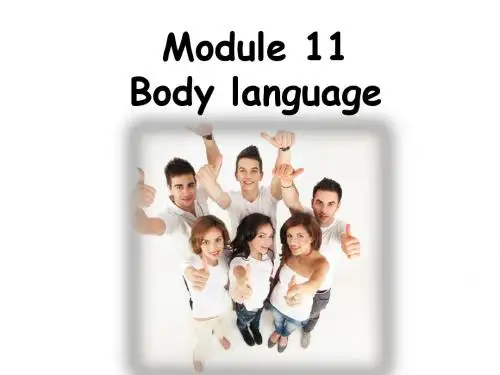
Module 11 Body Language
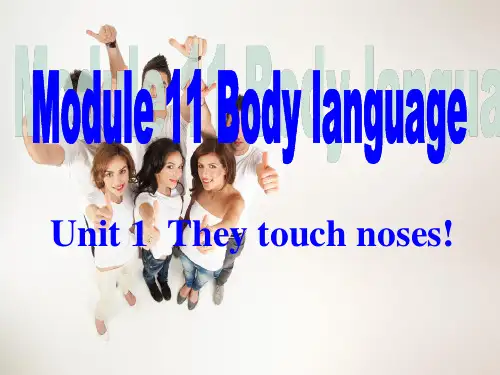
Unit 1 They touch noses
杨倩 乐山外国语学校
Can you guess what they mean?
Body language
Thousands of Hands Kwan-yin千手观音
They are deaf and damp (聋哑), so how can they dance very well?
(完整word)2013新外研版七年级下英语M11课文及单词

Module 11 Body languageUnit 1 They touch noses!Lingling: We’re going to have some Russian teachers at school tomorrow, and I’m welcoming the visitors. How do I do that?Betty: Lingling, you know, in Russia, people usually kiss three times, left, right, left.Lingling: What! No, I didn’t know that. We Chinese often shake hands and smile when we meet visitors, and sometimes we nod our heads . But we neverkiss. Only parents and children do that.Betty: That’s because people do different things in diff erent countries. Lingling: So what do people in the US usually do when they meet?Betty: In the US some people shake hands, and some kiss or hug each other. In India people put their hands together and nod their heads. And do yourknow what Maori people in New Zealand do when they meet? Lingling: No, What do they do?Betty: They touch noses!Unit2 Here are some ways to welcome them.Body language around the worldby Wang Lingling Our new foreign students are going to arrive very soon, and here are some ways to welcome them.How close do you stand when you talk to a friend? You can stand too close to people in the Middle East but don’t stand too close to North American! Give them more personal space.How about touching people? Chinese girls often walk arm in arm with their friends. South American sometimes hold your arm when they talk to you, so you can’t move away! But in Britain many people don’t like other people to touch them at all. Do you look at people when you ta lk? In some places, it isn’t polite to look at people when they talk, but in other countries it isn’t polite to look somewhere else. In Britainand the US, people usually look at each other when they talk.And how do you say goodbye? That’s easy, wave to s ay goodbye. But be careful! In Greece, it’s not at all polite! In fact, it’s very rude!Module 11bow[baʊ]v. 鞠躬; 弯腰kiss [kɪs]v. & n. 吻; 亲吻shake [ʃeɪk]v. ( shook ) 摇晃shake hands握手smile [smaɪl]v. & n.微笑British['brɪtɪʃ]adj. 英国的; 英国人的German['dʒɜːmən]n. 德国人; 德语adj. 德国的; 德国人的;德语的Japanese [,dʒæpə'ni:z]n. 日本人; 日语adj. 日本的; 日语的;日本人的Russian ['rʌʃ(ə)n] n. 俄罗斯人; 俄语adj. 俄罗斯的; 俄罗斯人的; 俄语的visitor ['vɪzɪtə] n. 游客; 观光者Russia ['rʌʃə] 俄罗斯what [wɒt]int. 什么(表示惊奇)nod[nɒd] v. 点(头)head [hed]n. 头; 头部hug [hʌg]v. 拥抱; 紧抱each[iːtʃ]pron. 各个; 每个each other互相; 彼此India ['ɪndɪə]印度together [tə'geðə]adv. 一起; 共同Maori ['mauri]adj. 毛利人的touch[tʌtʃ] v. 触摸; 接触nose [nəʊz]n. 鼻子finger ['fɪŋgə]n. 手指foot[fʊt] n. (pl. feet) 脚; 足knee[niː]n. 膝盖leg[leg]n. 腿mouth [maʊθ]n. 嘴; 口body['bɒdɪ] n. 身体; 躯干foreign['fɒrɪn] adj. 外国的North American 北美人personal['pɜːs(ə)n(ə)l] adj. 个人的arm[ɑːm]n. 臂; 手臂arm in arm臂挽臂地South American南美人hold [həʊld]v. ( held ) 握着; 使不动move[muːv] v. 移动Britain['brɪt(ə)n]不列颠; 英国not at all 一点也不polite [pə'laɪt]adj. 礼貌的somewhere['sʌmweə]adv. 某处; 某个地方wave [weɪv]v. 挥(手); 招(手); 摆(手)fact [fækt]n. 事实; 细节in fact事实上rude[ruːd]adj. 粗鲁的; 无礼的bring [brɪŋ]v. ( brought ) 带来。
外研七年级下英语M11 U1
Body language Stop! Come here. You are very good. It’s OK. Bye-bye.
shake hands kiss
smile
hug each other
body language
bow touch noses
摇头
hands
2
smile/smaɪl /v . & n . 微笑 into the room with a smile on her face.
eg:She walked
她面带微笑走进房间。 辨析 smile 与laugh
表示不出声的“微笑” Her friend smiled at her . smile smile at sb. 对某人微笑
1. Read the dialogue fluently. 2. Finish the paper carefully.
·your best friend’s parents
· your favourite film star
· a visitor to your school
魔法 记忆
· an American
· a Russian —What do you do and say when you meet your teacher in the morning? —I smile and say good morning .
Russian way
American way
Maori people
A1: Match the pitures with the words and expressions.
外研版七年级下m11基础知识
MODULE 11 Body Language 基础知识1、body language 身体语言2、touch noses 碰鼻子3、nod one’s head 点头4、shake hands 握手shake hands with…和…握手5、That’s because那是因为……We didn’t go for a picnic. That’s because the weather was bad. 我们没有去野餐。
那是因为天气很糟糕。
The weather was bad. That’s why we didn’t go for a picnic. 天气很糟糕。
那就是我们没有去野餐的原因。
6、each other 互相所有格形式:each other’seach+ 名词单数每个……each of 后面接复数名词或代词复数,但做主语的时候,谓语要用单数。
Each of boys has to take one. 每一个男孩必须拿一个7、touch 作动词是,意为:接触、触摸、打动作名词时,意为:接触、联系、关系be/get in touch with 和…取得/保持联系keep in touch with 和…保持联系8、foreign student 外国学生9、stand close to 站得近10、talk to 与……交谈talk with 和……交谈talk about 谈论11、not at all 一点也不, 没关系12、say goodbye 道别say goodbye to 向…道别,向…分手say hello to 和…打招呼say sorry to 向…道歉13. put … together 把……放在一起14. It’s polite to do sth 做某事是礼貌的It’s + adj.+ to do sth 做某事是……此结构的形容词:easy, important, difficult, interesting15、in fact 事实上16. wave to sb 向某人招手wave goodbye/wave to say goodbye 招手道别17、be late for class 上课迟到be late to do sth 做…迟到18、move away 离开,搬走move on 继续移动move about 开来走去19、arm in arm 臂挽臂hand in hand 手拉手face to face 面对面shoulder to shoulder 肩并肩20、be careful 小心be careful with/of 小心对待21、class rule 班规school/family rule 校规/家规22、be rude to sb 对某人粗鲁23、stand in line 站成一排24、enter the lab alone 独自进入实验室25、on time 准时,按时in time 及时26、hold on to 抓紧hold on 等一会儿hold one’s breath 屏住呼吸hold a meeting 开会take/catch hold of 抓住hold hands 手拉手hold back 阻止27、the way to do sth…做某事的方式,方法28. all right 好,形,不错29. remember to do sth 记得要做某事remember doing sth 记得做过某事30. personal space 私人空间31. like doing sth/ like to do sth 喜欢做某事like sb to do sth 喜欢某人做某事32. bring, take与carrybring 表示“拿来,带来”,指从别处把某人或某物带到说话人所在之处,经常和介词to连用take 表示“带走,拿走”,指从说话人所在地把某人或某物带走或拿走,经常和介词with 连用carry仅表示“携带,带着”,不含方向性。
外研版英语七年级下册Module 11 Body languageUnit 1

Unit 1They touch noses!第一课时Ⅰ.根据句意及汉语提示写出单词1.The students over there are (德国人). They came to our school last year.2.Tom can speak (俄语) and English.3.His friend comes from (印度). He speaks English very well.4.Do you know the (英国的) actor?Most of his films are popular in the UK.5.Maori people usually (触碰) noses when they meet.Ⅱ.用方框中所给单词或短语的适当形式填空6.If you don't speak English in America, you can use to make people under-stand you.7.If you agree with me, you can your heads or say “Yes”.8.We should learn from at school.9.Thousands of from different places come to our city every day.10.He has a friend and the friend can speak English too.Ⅲ.根据本单元对话内容回答下列问题11.Where are the new teachers from?12.What do Chinese people usually do when they meet visitors?13.Do Chinese people kiss each other when they meet?14.What do American people do when they meet?15.Do Maori people touch noses when they meet?Ⅳ.单项选择()16.The twins are in the same , but in different .A.class; gradeB.grade; classesC.grades; classD.classes; grade()17.The girl never goes out at night.That's she is afraid of darkness.A.whyB.becauseC.whatD.how()18.They can speak Chinese and .A.BritishB.IndiaC.GermanD.Russia()19.—Are they ?—Yes, they are.A.RussiaB.JapaneseC.GermanyD.IndiaⅤ.根据汉语意思完成句子20.我正在欢迎来宾。
外研社七下英语body languageM11Unit1公开课
Japanese people
bow
People from different countries
do different things when they meet.
Do you remember …?
Chinese American Russian Japanese Indian
Match the pictures with the words and expression from the box.
Unit 1 They touch noses!
What are they doing?
meet friends/visitors at the airport
What do you do when you meet the visitor? I...
Chinese people often
shake hands and smile
4. Maori people in New Zealand t____ noses when they ow meet. 5. They b__ to their king every morning.
II. 根据今天所学内容,完成短文。
In China _____, people shake hands and smile when they meet visitors. In ______________, America/the US people shake hand and sometimes kiss. In India _____, people put their hand together and nod their heads. In ______, Russia people usually kiss three times. In ____________, New Zealand Maori people touch noses.
_新版外研社七年级下 M11 body language Unit 1they touch noses

when they meet (6) ________. visitors
People in different countries may use different body language to express the same meaning and feelings. When you speak with people from other countries, try to understand and respect their body language.
bow
[dʒəˈp æ n] Japan 日本 [ˈd ʒæ pəˈn iːz] Japanese 日本的;日本人
Where are they from? British Britain They are from______ . They are__________. How do they greet people when they meet? They shake hands.
•a Indian
•Maori people
— What do you do and say when
you meet your teacher in the
morning?
— I smile and say good morning. 1. What do you usually do and say when they meet ...? 2. How do you greet your teacher when you meet her?
meet?
They will touch noses.
Now complete the table with the correct form of the words from the box.
初中英语外研版七年级下册《Module11Unit1》教学课件PPT
2)Miss Yang is shaking hands with my
bother.
摇晃
总结shake 的用法(1)_____s_h__ake hand with sb
(2) 和某人握手________________ 3)我的爸爸正在is 跟一个德sh国ak人in握g手。hands
Mwy iftahther __G__e_r_m_ a_n_______ _________ _______a
1. 请把那些红苹果放在一起。 Please ___p__u_t_ those red appletsog__e_t_h__e_r_.
2. 他们经常点头当他们碰面的时候。 They oftenn__o_d_____ __t_h_e__ir__ _h__e_a_d__swhen they
meet. T3h.a那t’是s因为b她e不ca会us打e 篮球。
________ ________ she can’t play basketball. 4. 见到朋友s时ha我ke们通常h握an手d。s
__________.
4)我很高兴因为周杰伦刚才和我握手s了ho。ok
I haamndsos hapwpiythbecaumseeJay Chou _______
________ ________ ______ just now.
PART 02
教学过程
2. three times 三次 一次___o__n_c_e___
Module 11 Unit One Body language
外研版初中英语七年级下册课件
教学目标
目
教学过程
录
教学重点
拓展练习
PART 01
教学目标
Module11BodyLanguage知识点总结七年级英语下册
外研七下M11知识点(单词+短语+语法)M11 Body LanguagePart One Key Words1.Russian (adj.) 俄罗斯的;俄语的;俄罗斯人的(n.) 俄罗斯人,俄语Russia (n.) 俄罗斯【类似单词】Nation——People【拓展】“国人”变复数规律:①大多数是直接在词尾加s eg: IndiaIndianIndians①单复数同形eg:ChineseJapanese①将man改成men eg:FrenchmanFrenchmen2.shake (v.) 摇晃【词形变化】shakeshookshaken【用法】shake hands with sb 和某人握手【原句】We Chinese often shake hands and smile when we meet visitors, and sometimes we nod our heads.(课本P66)3.smile (v.&n.) 微笑【短语】(v.) smile at sb. 对某人微笑(n.) with a smile面带微笑【拓展】辨析smile、laugh【原句】We Chinese often shake hands and smile when we meet visitors, and sometimes we nod our heads.(课本P66)4.time (n.) [C] 次数[U] 时间5.hug (v&n.) 拥抱6.Together (adv.) 一起,共同【短语】① put....together 把...放在一起① get together 聚会7.Each other 互相,彼此【拓展】①所有格形式:each other’s①each (pron.) 每个,各个指两者或两者以上中的每个,在句中作主语、宾语、同位语等①each of .... ....中的每一个,该结构作主语时,谓语动词用单数。
外研版英语七年级下册《Module11BodylanguageUnit1》说课稿
外研版英语七年级下册《Module11 Body language Unit 1》说课稿一. 教材分析外研版英语七年级下册《Module11 Body language Unit 1》的主要内容包括:听力、对话、语法、阅读和写作等部分。
本节课的主要内容是学习身体语言在日常交流中的应用。
通过本节课的学习,学生能够掌握一些基本的身体语言表达,如微笑、点头、摇头等,并能在日常生活中正确运用这些身体语言,提高交际效果。
二. 学情分析根据我对学生的了解,他们在学习过程中对英语充满热情,具备一定的听、说、读、写能力。
但部分学生在理解和运用身体语言方面存在困难,因此,在教学过程中需要关注这部分学生的学习需求,帮助他们更好地掌握和运用所学知识。
三. 说教学目标1.知识目标:学生能够掌握日常生活中常用的身体语言表达,如微笑、点头、摇头等。
2.能力目标:学生能够在日常生活中运用所学身体语言,提高交际效果。
3.情感目标:培养学生对英语学习的兴趣,增强自信心,提高团队合作意识。
四. 说教学重难点1.重点:学生能够正确理解和运用日常生活中常用的身体语言。
2.难点:学生能够在实际交流中灵活运用身体语言,提高交际效果。
五. 说教学方法与手段1.情境教学法:通过设定日常生活中的情境,让学生在实际语境中学习和运用身体语言。
2.任务型教学法:引导学生参与各种实践活动,提高他们在实际交流中运用身体语言的能力。
3.合作学习法:鼓励学生分组讨论、合作完成任务,培养团队合作意识。
4.多媒体教学手段:运用课件、视频等多媒体资源,丰富教学内容,提高学生的学习兴趣。
六. 说教学过程1.导入:通过展示一组图片,让学生猜测图片中人物的心情,引出本节课的主题——身体语言。
2.Presentation:教师讲解日常生活中常用的身体语言,如微笑、点头、摇头等,并通过示范让学生模仿练习。
3.Practice:学生分组进行角色扮演,运用所学身体语言进行交流,教师巡回指导。
外研版英语七年级下册Module 11 Body language Unit1 课件
C. Some American teachers. D. Some Maori techers.
(C ) 2. What will Maori people do when they meet?
A. They will bow and smile. B. They will kiss three times.
v. 鞠躬,弯腰 v. & n. 吻,亲吻
v. 摇晃shook[ʃʊk] 握手 v. & n. 微笑
British['brɪtɪʃ] adj. 英国的,英国人的 German['dʒɜːmən] n. 德国人;德语 adj. 德国(人)的;德语的 Japanese[,dʒæpə'ni:z] n. 日本人;日语 adj. 日本(人)的;日语的
American people shake hands and sometimes
(2)_k_i_s_s__or hug each other
When the meet
(7)_v_i_s_i_t_o_r_s__
In(3) India , people (4) put their hands togetherand
In (5)_________, people kiss each other three times
Maori people (6) _______ noses
Post-reading Task1: Watch read and complete the table.
In China, people (1) shake hands and smile
In China, people (1)
and smile
American people shake hands and sometimes (2)______or each other