
配套K12中考英语 题型三 阅读理解专项强化训练 牛津译林版
阅读理解(一)A little stream ran down from a high mountain far, far away through many villages and forests, until it reached desert. The stream then thought, “I’ve been through countless difficulties.I should have no problem crossing this desert!” But as she started her journey, she found herself slowly disappearing into the sand. After many tries, she still failed and was very unhappy. “Maybe I can’t reach the ocean in the end,” she said sadly to herself.At this time, a deep voice came, “If a breeze(微风) can cross the desert, so can a river.” It was the voice of the desert. But the little stream replied, “That’s because a breeze can fly,but I cannot.”That’s because you can’t give up what you are. If you like to do it, and let yourself evaporate(蒸发) into the breeze, it can take you across, and you can reach the ocean.” Said the desert.“Give up what I am n ow and disappear into the breeze? No! No!” The little stream could not accept this idea. After all, she had never experienced anything like it before.“The breeze can carry the vapor(水蒸气) across the desert and let it leave as rain. The rain will form, a river again to continue its course.” explained the desert very patiently.“And whether you’re a river or vapor, your nature never changes,” continued the desert.Hearing this, the little stream rushed into the open arms of the breeze, which carried her to the next stage of her life.The course of our lives is like the experience of the little stream. If you want to overcome(克服) the difficulties in your life to head for the success, you should also change the way you used to be.( ) 1. Before the stream reached the desert, she didn’t _______.A. believe in herselfB. meet any difficultiesC. want to cross the desertD. worry about the journey to the ocean( ) 2. The underlined word “it” in Paragraph 3 refers to(指的是) _______.A. streamB. breezeC. vaporD. desert( ) 3. The last paragraph mainly tells us _______.A. our lives are as easy as the little stream’sB. it is difficult for us to succeedC. we must keep the way we used to beD. we should change the way we used to be to succeed sometimes( ) 4. Which of the following is NOT true?A. If a breeze can cross the desert, so you can.B. After many tries, she didn’t succeed and was very unhappy.C. Whether you’re a river or vapor, you change your nature.D. That’s because I can’t fly, but a breeze can.( ) 5. From the passage we know that the stream _______ in the end.A. cross the desertB. stopped her journeyC. failed to reach the oceanD. disappeared in the air(二)A group of swans flew down to a beach where a crow(乌鸦) was jumping around. The crow watched them with disdain(鄙视).“You have no flying skills at all!” he said to the swans. “All you can do is to move your wings. Can you turn over in the air? No, that’s beyond you. Let’s have a flying competition. I’ll show you what real flying is!”One of the swans, a strong young male, took up the challenge. The crow flew up and began to show his skills. He flew in circles, performed other flying tricks, and then came down and looked proudly at the swan.Now it was the swan’s turn. He flew up, and began flying over the sea. The crow flew after him, making all kinds of comments(评价) about his flying. T hey flew on and on till they couldn’t see the land and there was nothing but water on all sides. The crow was making fewer and fewer comments. He was now so exhausted that he found it hard to stay in the air, and had to struggle to keep himself from falling into the water.The swan pretended(假装) not to notice, and said, “Why do you keep touching the water, brother? Is that another trick?”“No,” said the crow. He knew he had lost the competition. “I’m in trouble because of my pride! If you don’t help me, I’ll lose my life…”The swan took pity on him, and took him on his shoulders and flew back to the beach.( ) 1. What’s the correct order of the following events?a. The crow showed off its flying skills.b. The swan felt pity for the crow and saved it.c. Th e crow laughed at the swan’s flying.d. The crow followed the swan and got into trouble.e. The crow challenged the swans and a strong young swan accepted it.A. e, c, d, a, bB. a, e, c, d, bC. c, e, a, d, bD. e, a, d, c, b( ) 2. What does the un derlined word “exhausted” in Paragraph 4 mean?A. Tired.B. Angry.C. Frightened.D. Regretful.( ) 3. Why did the crow keep touching the water?A. It was showing another flying skill.B. It was struggling to keep itself from falling into the water.C. It was thirsty and wanted to drink some water.D. It was enjoying itself by do ing so.( ) 4. What can we infer(推断) from the passage?A. The crow didn’t know flying.B. Flying skills were useless.C. The swan saved the crow because they were good friends.D. The swan was better at long-distance flying than the crow.( ) 5. What does the story tell us?A. No pains, no gains.B. The early bird catches the worm.C. Pride goes before a fall.D. Practice makes perfect.(三)Here’s something people don’t often think about: Helping helps even w hen there’s not a problem.Getting in the habit of giving and receiving help builds good relationships. It makes us feel more care. It stops stress from building because we kno w someone else is thinking about us. And if there is a problem, we’re sharing it before it gets too big. It just feels great to help.Try these small practices at home and see how they make you feel:*Help your little brother or sister with a homework problem.*Help your dad prepare dinner.*Help your mom carry living goods.*Offer to do a chore that’s not usually yours “just because.”There’s more to it than just feeling good: Kindness is contagious. It can create more kindness. So you might start to notice your family (or friends) reaching out to help more.Just don’t fall into the trap(陷阱) of expectation(期待). If we help out only because we expect the other person to do something in return, we will probably end up feeling disappointed and angry instead of happy and fulfilled. So decide to help simply because of the positive feelings it creates. Then, when someone else does something nice for you (and it will happen!), it’s a wonderful surprise.Giving and receiving is one of the most basic friendship skills. With a good network of supp ortive people, we are less stressed. We feel loved and understood, so we’re better able to solve problems, bounce back from disappointments, and try again.( ) 1. How do you feel if you are getting in the habit of giving and receiving help?A. Think of more care.B. Feel stress from building.C. Feel more care.D. Fall into the trap.( ) 2. How to build nice relationships according to the passage?A. Help your dad prepare dinner.B. Get in the habit of giving and receiving help.C. Stops stress from building.D. End up feeling angry instead of happy.( ) 3. Which of the following is not true?A. We help out only because we expect the other person in return.B. It’s one of the most basic friendship skills to give and r eceive.C. It just makes us feel great to help others.D. It’s helpful to help even when there’s not a problem.( ) 4. What does the underlined word “contagious” mean in the passage?A. 会感染的B. 会疏导的C.会蔓延的D. 会熏陶的( ) 5. Which of the following is the best title of this passage?A. Making Help a HabitB. Help Mom Carry Goods.C. Help Others With Homework.D. Love and Understand(四)Martin Lynch, an American businessman, had been going on vacation to a small Mexican fishing village for a number of years. One morning while going for a walk along the beach, he saw his friend Pablo Perez, a local fisherman. Martin watched Pablo unload his boat and pack the fish in a box.Martin noticed Pablo was smiling and looked very happy. He could also see several large fish in the boat. Martin greeted Pablo and asked how long it took to catch the fish. “Just a few hours,” replied Pablo. Martin asked, “Why didn’t you stay longer and catch more fish?” “I have enough for my family,” Pablo said. “And what do you do with the rest of your day?” asked Martin. “I take a nap, play with my children, spend time with my wife, and go into the village to see my friends and play cards, I have a full and busy life.” Martin explained that if Pablo worked lon ger hours and caught more fish, he could make more money. With the extra money, Pablo could buy more boats and catch more fish. By selling the fish, Pablo could open his own factory and sell direct to supermarkets.“Then what?” asked Pablo. “Well you would probably have to move to Mexico City to run the business. Finally, you would be able to sell your business and make millions of dollars,” replied Martin. “How long will that take?” asked Pablo.Martin thought for a while and said it would probably take at least 15 years.“And then what” asked Pablo.“Well, that’s the best part,” Martin said. “You will be able to retire, buy a house near the ocean, sleep longer, play with your children, spend more time with your wife, see your friends, and play cards.”( ) 1. What is the story mainly about ______?A. A businessman and a fisherman have become friend.B. A businessman learns how to fish from a fisherman.C.A fisherman wants to become a businessman.D. A businessman gives advice to a fisherman.( ) 2. What makes the Mexican fisherman happy is ______?A. many friends to visit himB. a full and busy lifeC. more boats and more fishD. the house near the ocean( ) 3. How can the fisherman make more money in the businessman view?A. By buying a supermarket.B. To move to Mexico city.C. By selling his own business.D. To work longer and catch more fish.( ) 4. The underlined word “unload” in the passage means ______?A. put...into...B. take...away from...C. break downD. set off ( ) 5. We can infer from the passage that _____?A. the fisherman will stay the same with his life.B. the fisherman will leave the village for Mexico city.C. the businessman will buy the fisherman boatD. it takes all day for the fisherman to catch large fish.(五)I had hidden the long black bag in the garage for the past two days. Tonight, in the dark, I would finally take it away. If everything went OK, it would be done by morning. But I had to be sure no one, not even my wife, saw me.It was more difficult to get away from the party than I expected. I said that the children were tired and needed to get to bed. It was partly true. But the main reason for leaving was that I wanted to complete my plan.First I had to get the kids to sleep. That was never easy at any time and tonight it was even more difficult. The eldest one wanted to know why we left the party early. I told him 10:30 pm was not early. As usual, I read them a bed time story, but I had to stop myself reading too quickly or they would learn my secret.Silence finally came, and feeling like a thief in the night, I went out of the house and into the garage. Taking one end, I dragged the bag out from its hiding place and took it into the garden.I was worried that my neighbours might see me and call the police.It was already eleven o'clock. By the light of the moon I started working, trying to make as little noise as possible. And that was not easy with a saw (锯子) and a hammer.After much effort, my work was finally completed. I looked down at my watch. It was exactly 4:00 am. Then I went inside to have a shower and get a few hours of sleep. It wouldn't be long now before the kids would rush into my room and wake me up to tell me about the new tree-house Father Christmas had brought them this year.( ) 1. Why did the man feel nervous?A. He left the party too late.B. He was afraid of the darkness.C. He didn’t know where the black bag was.D. He worried that others would discover his secret.( ) 2. The underlined word “they” in Paragraph 3 refers to ______.A. thievesB. parentsC. childrenD. neighbours( ) 3. In what order did the man do the following?a. Read the kids a story.b. Had a shower.c. Worked in the moonlight.d. Dragged the bag from the garage. e. Went to a party.A. e-d-a-b-cB. e-a-d-c-bC. a-b-e-d-cD. a-e-d-c-b( ) 4. What did the man want to do after finishing his plan?A. Go to sleep.B. Wake up his children.C. Open the bag.D. Call the police.( ) 5. How would the children feel when they saw the man’s work?A. Confused.B. Excited.C. Tired.D. Angry.(六)In early November of 1503, during Christopher Columbus’ fourth an d final trip America, his ship was seriously damaged in a storm. Columbus and his men had to live on a small island for several months while they tried to repair their ship and return to Spain.At first, the local people on the island were very kind to the European visitors, giving them all the food and clothes they needed to survive. However, as the months passed, the local people became more and more unhappy with their guests, who were tricking and stealing from them. Finally the locals decided to sto p helping. Without food or any way to leave the island, Columbus’ group was soon in serious trouble.Luckily for Columbus, he had a book about the stars and planets on his ship. It described the movements of all the objects in the night sky. The book, written by a well-known German scientist, said there would be a total lunar eclipse (月食) on the evening of February 29, 1504 and how long it would last.Columbus worked out the difference in time between Germany and North America. He then had a meeting with the local leaders just before the eclipse would take place. In this meeting, Columbus told them his god was angry because the local people were no longer giving food. So his god would take away the moon to punish them. At the moment Columbus finished talking, just as he had planned, the moon began disappearing.The local leaders grew frightened and quickly agreed to provide Columbus with food and anything else he wanted. But first, Columbus’ god had to return the moon. Columbus told them he would have to discuss the idea with his god on his ship. Knowing the moon would stay completely hidden for about 48 minutes, Columbus returned just before the moon began to reappear. From that day on, until they finally left, Columbus and his men no longer had any trouble getting the food they needed.( ) 1. At first, the local people helped Columbus and his men by ______.A. giving them foodB. building a house for themC. repairing their shipD. providing them with a book( ) 2. The local peop le became angry because the Europeans ______.A. looked very differentB. had nothing to tradeC. were cheats and thievesD. wanted to take their land( ) 3. Where did Columbus learn about the lunar eclipse?A. From a book.B. From the moon.C. From his group.D. From the locals.( ) 4. What did Columbus do after returning to his ship on the night of the meeting?A. He discussed the problem with his god.B. He waited for the eclipse to finish.C. He read about the stars and planets.D. He told his men what happened.( ) 5. What can we learn about the Europeans from the passage?A. They all believed in god.B. They never returned to Spain.C. They admired the local people.D. They caused their own problems.(七)When I was a child, my parents often took me to an old house in the thick forest. No other children ever stayed there. I didn’t even have the choice of playing with a brother or sister.I could never understand what the attraction(吸引) of the house was, even for my parents, who enjoyed nothing better than to sit in silence with a good book. The woman in the house, my father’s distant cousin, was a terrible cook and her food was inedible.One day, when I was wondering around the garden behind the house, I noticed a wooden house which had clearly been abandoned(被遗弃的). As I walked towards it, I heard a noise, like an animal moving hurriedly away. Then I saw a man with a long beard standing at the door. I was greatly surprised.“Please don’t tell them you saw me,” he said. “They never use this place, and I have nowhere else to live.” “Don’t worry.” I said. “I won’t tell anyone. But are you all right out here?”I mean—do you have enough to eat? The old man shook his head.The same evening, I took a small plastic bag into the dining room and, while no one was looking, emptied some of the food into it. Later, I got out of the back door secretly and gave the food to the old man, whose name I had discovered was Taff.I had never seen anything else as lonely as the smile of satisfaction on Taff’s face when he ate the food. From then on, my visits to the old house had a purpose, and I enjoyed every minute of the rest of my stay.( ) 1. How did the writer feel about staying in the old house at first?A. He was happy to be with his parents.B. He enjoyed reading good books there.C. He was pleased with the woods.D. He felt very lonely.( ) 2. The underlined word “inedible” is closest in meaning to “______”.A. too bad for him to eatB. nice to look atC. not enoughD. as delicious as usual( ) 3. The writer discovered the old man ______ the old house.A. near the back doorB. in the dining room ofC. in the garden behindD. among the bushed before( ) 4. What can we know about the old man from the passage?A. He was poor and hungry.B. He helped to repair the old house.C. He liked to play hide—and–seek with the writer.D. He raised many animals.( ) 5. The story mainly tell us ______.A. it’s nice to raise wild animalsB. it’s valuable to help othersC. it’s good to live in the forestD. it’s comfortable to live in the old house.(八)Once upon a time all feelings went to an island for a vacation, and each was having a good time. Suddenly, a warning of a strong storm was announced, so all rushed to their boats. Yet, Love did not wish to run away quickly. There was so much to do. But as the clouds darkened, Love realized it was time to leave. But there were no boats to use. Love looked around with hope.Just then Richness was passing by Love in a large boat. Love shouted, “Richness, can you take me wi th you?” Richness answered, “No, I can’t. There is a lot of gold and silver in my boat. There is no place here for you.”Love decided to ask Vanity(虚荣) who was also passing by in a beautiful boat for help. But Vanity said with a cold voice, “No, I can’t take you with me. My boat will get dirty with your mummy feet.”Sorrow passed by after some time. Again, Love asked for help. But it was useless. “No, I can’t take you with me. I am so sad. I want to be by myself.”When Happiness passed by a few minutes later, Love again called for help. But Happiness was so happy that it hardly cared about anyone else.Love was growing worried and hopeless. Just then somebody called out, “Come, Love, I will take you with me.” Love did not know who was being so kind, but jumped onto the boat happily.After getting off the boat, Love met Knowl edge. Love asked, “Knowledge, do you know who was so kind to give me a lift when no one else wished to help?”Knowledge smiled, “Oh, that was Time.”“Time?” asked Love. “But why did Time help me?” Knowledge smiled with deep wisdom and answered, “Because o nly Time is able to understand how valuable(有价值的) Love is.”( ) 1. According to the pas sage, which one did not go to an island for a vacation?A. Love.B. Richness.C. Vanity.D. Knowledge.( ) 2. Which word has the same meaning as “Sorrow”?A. Worry.B. Anger.C. Sadness.D. Smile.( ) 3. Other feelings passed by Love in their boats one by one. Which is the right order according to the passage?A. Richness → Vanity → Sorrow → Happiness → TimeB. Richness → Happiness → Sorrow → Vanity → TimeC. Time → Richness → Vanity → Sorrow → HappinessD. Richness → Happiness →Vanity → Sorrow → Time( ) 4. Why didn’t Vanity take Love with him in his boat?A. Because there was no place for Love in his boat.B. Because he thought Love would make his boat dirty.C. Because he wanted to stay alone.D. Because he didn’t care about anyone else.( ) 5. What can we learn from the passage?A. When we are rich, we may pay more attention to Love.B. All the feelings are important in our life except Love.C. As time goes by, we can realize the important of Love.D. When we are in happiness and sorrow, we shouldn’t remember Love.【答案解析】(一)(二)1.C 结合短文,依据故事发生的先后顺序选C。
牛津译林版中考英语专题复习阅读理解练习题题
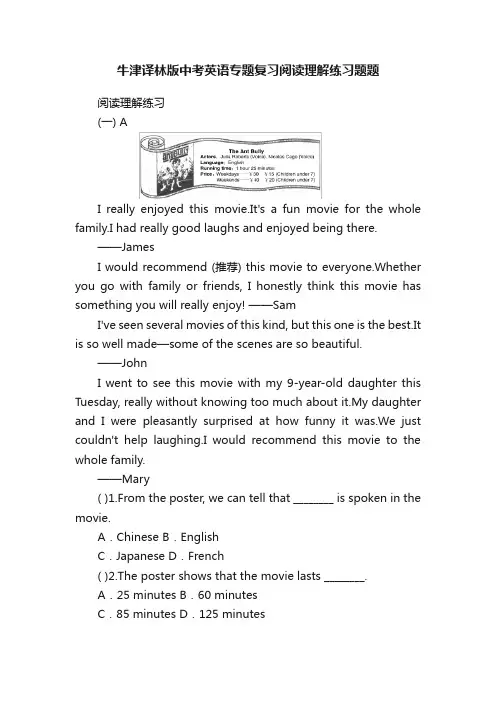
牛津译林版中考英语专题复习阅读理解练习题题阅读理解练习(一) AI really enjoyed this movie.It's a fun movie for the whole family.I had really good laughs and enjoyed being there.——JamesI would recommend (推荐) this movie to everyone.Whether you go with family or friends, I honestly think this movie has something you will really enjoy! ——SamI've seen several movies of this kind, but this one is the best.It is so well made—some of the scenes are so beautiful.——JohnI went to see this movie with my 9-year-old daughter this Tuesday, really without knowing too much about it.My daughter and I were pleasantly surprised at how funny it was.We just couldn't help laughing.I would recommend this movie to the whole family.——Mary( )1.From the poster, we can tell that ________ is spoken in the movie.A.Chinese B.EnglishC.Japanese D.French( )2.The poster shows that the movie lasts ________.A.25 minutes B.60 minutesC.85 minutes D.125 minutes( )3.John likes the movie because of ________.A.the funny actors B.the wonderful musicC.the sweet voices D.the beautiful scenes( )4.Mary and her daughter spent ________ watching the movie.A.$30 B.$40C.$45 D.$60( )5.According to the passage, the movie most probably tells a ________ story.A.funny B.sadC.terrible D.treeBGuilin is my favorite city in China because of its beauty, its waterways, its cafes, and most of all because I met my wife there.It is her hometown and we will both retire there in a few years.Not only is Guilin a fascinating city, but there are many interesting places to visit within a short drive from there.The Ling Canal is the oldest canal in the world.It was built about 2,200 years ago and connects two major river systems, the Yangtze and the Pearl River.The Longsheng Rice Terraces (梯田) is another man-made wonder that was built around 650 years ago.I have some photos of both of these places in my China Daily homepage Albums.The Gudong Waterfall Park is another attraction that is worth visiting.The hike to the top of all these waterfalls isn't very difficult and if you want, you can take a ride to the bottom on a personal rail car (机动轨道车) that you control the speed with a brake.If you want, you can also climb up some of the waterfalls withthe help of chains that are placed for the convenience of amateur climbers (业余登山者).I have only been in Guilin during the winter and spring, but my wife tells me it gets pretty hot in the summer time.That's OK because I grew up in the Midwest of the U.S.where it gets very hot and humid during the summer months.But in Guilin almost everything is within walking distance and if you need to go further the buses come by every 5 minutes on the busy streets and every 10-15 minutes just about everywhere else.There are plenty of taxis, too, and most trips are only 6 yuan.It's a perfect place to retire.( )6.The writer likes Guilin best mainly because ________.A.it has many water ways B.he met his wife thereC.he likes its beauty D.it has lots of cafes( )7.Which of the following is the man-made won der in Guilin?A.The Ling Canal. B.The Gudong Waterfall Park.C.The Longsheng Rice Terraces. D.A and C.( )8.The underlined word “brake” means ________.A.遥控 B.刹车 C.方向盘 D.油门( )9.Which of the following is NOT true?A.Guilin is the writer's wife's hometown.B.The history of the Ling Canal is three times as long as that of the Longsheng Rice Terraces.C.It's convenient for the amateur climbers to climb up some waterfalls with the help of chains.D.Guilin is really a good place to retire and live in.( )10.What's the weather like in summer in Guilin?A.Very hot. B.Quite humid. C.Rather hot. D.A little cool.C配对阅读左栏是五种警察的工作,右栏是七种工作的描述。
英语iii译林牛津版unit13练习强化训练07
英语iii译林牛津版unit1-3练习强化训练07第I卷 (选择题三部分共95分)第一部分听力(共两节,满分20分)第一节:(共5小题;每小题1分,满分5分)听下面5段对话.每段对话后有一个小题,从题中所给旳A、B、C三个选项中选出最佳选项,并标在试卷旳相应位置.听完每段对话后,你都有10秒钟旳时间来回答有关小题和阅读下一小题.每段对话仅读一遍.1.What are the two speakers doing now?A.Taking an exam. B.Asking for a break. C.Watching a movie.2.What does the man want to do?A.To eat more dumplings. B.To learn how to make dumplings.C.To have a cup of tea.3.What is the weather like now?A.Sunny. B.Rainy. C.Cloudy.4.Who will pay the telephone bill?A.The man. B.The woman. C.Mary.5.What is the woman probably going to do tonight?A.Revise French. B.Revise Physics. C.Watch the game.第二节(共15小题;每题1分,满分15分)听下面5段对话或独白.每段对话或独白后有几个小题,从题中所给旳A,B,C三个选项中选出最佳选项,并标在试卷旳相应位置.听每段对话或独白前,你将有时间阅读各个小题,每小题5秒钟;听完后,每小题将给出5秒钟旳作答时间.每段对话或独白读两遍.听第6段材料,回答第6至7题.6.Where does this conversation take place?A.At home. B.In a restaurant. C.In a shop.7.Which of the following is available now?A.Rice. B.Bread. C.Meat.听第7段材料,回答第8至9题.8.Which food does the woman like best?A.Beijing food. B.Shangdong food. C.Sichuan food.9.What is Cantonese food like?A.It’s hot. B.It’s oily.C.It’s sweet.听第8段材料,回答第10至12题.10.Where is the post office?A.Near the traffic lights. B.Near the Wal-mart. C.In front of a statue.11.How long does it take to walk to the post office?A.About 15 minutes. B.About 10 minutes. C.About 25 minutes.12.How will the woman go to the post office?A.On foot. B.By bus. C.By taxi.听第9段材料,回答第13至16题.13.What’s the relationship between the two speakers?A.Boss and employee. B.Teacher and student .C.Mother and son.14.When is the man supposed to come back?A.At 8:00. B.At 8:30. C.At 10:00. 15.Why does the man come back late?A.He met Jenny on the way. B.He and Jenny attended a party.C.He revised his lessons.16.What does the man think about the woman’s decision?A.It’s interesting. B.It’s unacceptable. C.It’s reasonable.听第10段材料,回答第17至20题.17.Which is NOT a custom on Valentine’s Day?A.A boy buying flowers for his girlfriend. B.A boy writing poems for his girlfriend.C.A boy’s parents meeting his girlfriend.18.Where does Valentine’s Day get its name ?A.From an emperor. B.From a prison guard. C.From a priest.19.Why was Valentine put in prison by the Roman emperor?A.He was not a good soldier.B.He performed marriages ceremonies for young lovers .C.He fell in love with the princess.20.In which year did Valentines die?A.In 142 AD. B.In 274 AD. C.In 270 AD.第二部分:英语知识运用(35分)第一节:单项填空(共15小题,每小题1分,满分15分)21. All through history, big changes have taken place in _______ Englishlanguage, especially when Henry IV became _______ King of England..A. the ; theB. 不填;theC. the ; 不填D.an ; 不填22. _________ students in our school __________ from the countryside; thenumber _______ growing these years.A. Large numbers of; is; has beenB. Large numbers of; are; has beenC. A large number of; is; have beenD. A large number of; are; have been23.Was it from Libya ______ wars suddenly broke out _____ we managed torescue(营救) the Chinese working staff?A. that; whereB. which; thatC. where; thatD. where; which24. _______ hasn’t been decided ___________ we’ll go camping at the weekend.A. That; whetherB. What; ifC. It; whetherD. This; if25 To our delight, we got volunteers to do the work as we expected.A. as twice manyB. twice as manyC. twice many asD. as many twice26. They have read the paper many times, but it doesn’t make any _________.A. senseB. valueC. markD. symbol27. Sleeping in bed, I could hear the rain _______ against the windows.A. hittingB. droppingC. beatingD. striking28.Even some of the casual clothes we wear have brand names ________them, which turn us ________walking advertisements.A.attached to;into B.attaching to;toC.applied to;into D.contributed to;to29. How long do you think it is __________ we lost our way in the forest?A. beforeB. afterC. whenD. since30. Is this world-famous city the one _______ you visited many tourist attractions last year?A. whichB. thatC. whereD. there31.________ no doubt ________he doesn’t work harder than ever, he will lose his job.A. It seems to have, thatB. There seems to have, that ifC. There seems to be, that ifD. It seems to be, that if32. On Monday morning, while the sun was ______ in the east, we watchedthe national flag ______ to the top of the pole.A. raising; raiseB. rising; being raisedC. raising; riseD. rising; being risen33. The art center is ______ used to be a factory, ______ millions of cars were made.A .what, where B. where, where C. what, which D. where, which34. —I’m sorry, sir. My mind__________. What______ you_______?—You are always absent-minded today.A. is wandering; do; sayB. was wandering; did;sayC. wandered; did; sayD. wandered; had ;said35. –--How do you find the professor’s new book?----A. Just on his desk.B. Totally by chance.C. I just asked him for it.D. It’s all Greek to me.第二节:完形填空(共20 小题,每小题1分;满分20分)阅读下面短文,从每题所给旳四个选项(A、B、C、D)中,选出最佳选项.A certain good woman one day said something that hurt her best friendof many years. She 36 immediately and would have done anything to have37 the words back.What she said hurt the friend so much that this goodwoman was herself hurt for the 38 she caused.In an effort to 39 thebad effect of what she had done, she went to an older, wiser woman in the village, explained her situation, and asked for advice.The older woman listened patiently to decide just how 40 the youngerwoman was, how far she was willing to go to correct the situation.She41 the younger woman's unhappiness and knew she must help her.She alsoknew she could never _42 the pain, but she could teach.She knew the 43would depend only on the character of the younger woman.She said, "Tonight,take your best feather pillows and put a(n) 44 feather on the doorstepof each house in the town before the sun rises."The young woman hurried home to prepare for her work, even though thefeather pillows were very 45 to her.All night long, she 46 alonein the cold.Finally the sky was getting 47 , she placed the last featheron the steps of the last house.Just as the sun rose, she 48 to theolder woman."Now", said the wise woman, "go back and 49 your pillowswith the feathers you have put on the 50 , then everything will be asit was before.""You know that's impossible! The wind 51 away each feather as fastas I placed them on the doorsteps!" the young woman was 52 ."That's true," said the older woman."Never forget.Each of your wordsis like a feather in the wind. 53 spoken, no amount of effort, no matterhow heartfelt or sincere, can never return them to your mouth. 54 yourwords well and guard them most of all in the 55 of those you love".36.A.realized B.refused C.replied D.regretted37.A.brought B.taken C.turned D.given38.A.sadness B.misunderstanding C . painD. disagreement39.A.have B.forget C.ignore D.remove40.A.sincere B.sad C.disappointed D.excited41.A.accepted B.sensed C.received D.shared42.A.reduce B.forget C.solveD.handle43.A.relationship B.friendship C.result D.situation44.A.simple B.average C.common D.single45.A.dear B.usual C.ordinary D.important46.A.waited B.worked C.struggled D.stayed47.A.sunny B.light C.warmer D.dark48.A.referred B.attended C.gotD.returned49.A.refill B.repair C.take D.bring50.A.stairs B.feathers C.steps D.windows51.A.put B.gave C.blew D.disappeared52.A.puzzled B.dissatisfied C.disappointed D.surprised53.A.Although B.While C.Once D.Unless 54.A.Speak B.Choose C.Say D.Guide55.A.presence B.eye C.caseD.charge第三部分:阅读理解(共15小题;每小题2分,满分30分)阅读下面短文,从每题所给旳四个选项(A、B、C、D)中,选出最佳选项.AWe can offer you a place at one of the best universities in Britain.We’ll provide you with a choice of 150 first class courses developedespecially to enable you to study in your own time, backed by the Open University’s own special study method—OU supported open learning.We’ll give you the support of a personal teacher, and the chance tomeet your fellow students. You can take one-off courses, diplomas (毕业证), a degree or a postgraduate degree. Subjects available include:computing, business management, technology, modern languages, social science, English laws, arts, science, mathematics, education and health ﹠social welfare.Whether you want to study to improve your jobs or for your own personal interest, there’s almost certainly a course for you. If you haven’t studied fo r a while, we’ll help you get started. No previous training or degrees are required, you just need a lively power of learning and a willingness to learn. It’s real value for money and you can pay by monthly payments.Open University course materials are of the highest quality and come in a variety of forms, including video and audio tapes as well as texts. The OU leads the world in its use of new technology for learning. A number of courses provide source material on CD Rom. What else can the Open University offer you? The best way to find out is to use the coupon below or phone us today.56. This is an advertisement of ___________.A. asking about English learningB. setting Open UniversityC. introducing famous teachersD. attracting students57. As a student of the Open University, you don’t need to ________.A. buy any course materialsB. have lessons all the time at the universityC. choose which course to learnD. pay any money for your study58. The Open University can supply you with _________.A. a course for training your EnglishB. a classroom and a library for studyC. different kinds of free instructionsD. different jobs to choose from59. We can learn from the text that ________.A. OU courses are popular in BritainB. money for learning must be paid off at one timeC. we can’t telephone the university during the nightD. people can’t be employed without finish ing OU coursesBEverybody hates rats.But in the earthquake capitals of the world---Japan,Los Angeles,Turkey---rats will soon be man's new best friends.What happens after an earthquake? We send in rescue dogs. Why? Because they can smell people.Dogs save lives.They help rescuers to find living people.But dogs are big so they can't get into small spaces.So now a new research project is using a smaller animal to save lives:the rat.How does it work? First,the rat is trained to smell people.When this happens,the rat's brain gives a signal.This is sent to a small radio on its back,and then the rescuers follow the radio signals.When the rat's brain activity jumps,the rescuers know that someone is alive.The rat has smelled that person.Although there are already robots which can do this job,rats are better.Christian Linster at Cornell University—New York says,“Robots' noses don't work well when there are other smells around.Rats are good at that.” Rats can also see in the dark.They are cheaper and quicker to train than dogs,and unlike robots,they don't need electricity!The “rat project” is not finished,but Julie Ryan of International Rescue Corps in Scotland says,“It would be fantastic. A rat could get into spaces we couldn't get to and a rat would get out if it wasn't safe.”Perhaps for the first time in history,people will be happy to see a rat in a building, but only after an earthquake, of course.60. In the world earthquake capitals,rats will become man's best friendsbecause they can _____.A. take the place of man's rescue jobsB. find the position of people alive who are trapped in buildingsC. serve as food for people alive who are trapped in buildingsD. get into small spaces61. From the third paragraph we know the rescuers can judge a person isalive by_________.A. the noise made by the ratB. the rat's unusual behaviorC. the signal sent by the radio on the rat's backD. the smell given off by the person62. In doing rescue jobs,_________.A. rats smell better than dogsB. dogs don't need to be trained to smell peopleC. robots' sense of smell can be affected by other smells aroundD. rats can see in the dark and smaller than robots63. Rats have all the following advantages except that_________.A. they are more fantastic than other animalsB. they are less expensive to train than dogsC. they don't need electricityD. they are small and can get into small placesCYou just think you know what will make you happy. Researchers in the new science of happiness know better. They have evidence that married people on average end up being no happier than they were before the wedding. Winning the lottery(彩票) will probably reduce your pleasure in ordinary events that used to make you happy. And being in good health isn’t as much of a factor as the right genes when it comes to satisfaction.A couple of years ago, Seligman and Diener studied 222 Illinois college students to find out what the happiest 10% had in common. It turned out they were extroverts (性格外向), had more friendships and romantic relatio nships, but didn’t exercise more and didn’t feel they had more good events in their lives than those who weren’t as happy.Some of the results come as a surprise. A classic study of lottery winners and people with spinal cord(脊髓) injuries, for instance, found that neither event changed their lives as much as observers thought they would.Gilbert is looking into how accurately people predict what will make them happy. It turns out, not accurately at all, what we think will bring us pleasure—a new car, the home, teaming winning the NCAA championship,a move to California—usually doesn’t bring us as much as we expected, and the positive effect doesn’t last as long. The good news is that we also overestimate(高估) the effect of bad events.Even with data from rese arch pouring in, scientists still don’t have an easy answer to what we all want to know: How do I get long-term life satisfaction? The answers they do have are often the same ones that philosophers and priests have been giving us for centuries. It’s just nice to have them supported with enough data.64. The topic discussed in the passage is ______.A. a research on happinessB. the level of happinessC. the secrets of happinessD. the prediction of happiness65. Which of the following is the most important factor of happiness?A. the proper genesB. healthC. marriageD. unexpected money66. The happiest people have the following characters except that ______.A. they are richB. they are outgoingC. they are very sociableD. the y don’t pay more attention to exercise67. Which of the following is True according to the passage?A. We ourselves know what makes us happy the best.B. The happiest 10% in the world have nothing in common.C. People can predict the things that make them happy accurately.D. We just need to do what the philosophers and priests tell us tokeep happy.DHistory has arrivedNine-year-old Barack Obama was looking through a magazine. But the African-America boy was shocked by a series of photos. The pictures were of a black man who destroyed his skin with chemicals that might make him white.For the first time, the boy began to doubt who he was. “I stood in front of the mirror and wondered if something was wrong with me,” Obama said. However, now the boy who used to struggle with his identity(身份)doesn’t see it as a problem any more, but an advantage for his career. Obama made history by being elected as the first black president of the US. He defeated John MaCain in a landslide (压倒性旳) victory. Obama’s story st arts in opposite corners of the world. His white mother was born in the heartland of the US. His black father grew up in a tiny village in Kenya. They met during in Hawaii, but his father left the family when Obama was just two years old and his mother moved to Indonesia. At 10, Obama moved back to live with his white grandparents in Hawaii where his sense that he didn’t belong grew. At his class a white boy asked Obama if his father ate people. Out of embarrassment, Obama lied to hisclassmates that his fa ther was prince, “I kept asking who I am and I endedup trying drugs and drinking,” Obama recalled.Things came to change after the young man made friends with those witha similar background at college. Their experiences back in Africa helped Obama to finally face up to his African origin. He worked hard to becomea star at Harvard Law School and the third black senator (参议院) in US history.At the beginning of his campaign (竞选) for the White House, few people supported him. Many doubted his unusual background, which left him neither “black” enough nor white enough.But Obama turned his pain of growing up into a tool to make Americans believe: “There is not a black America, an Asian America. There’s the United States of America.”Barack Obama’s victory is “a historic victory that changed and overcame centuries of prejudice (偏见). His success helped realize Martin Luther King’s dream that a man is judged not by the color of his skin,but by the content of his character,” wrote ABC news.68. From the above passage we can know that Barack Obama was born in________.A. Kenya, AfricaB. Hawaii, the USAC. Indonesia, AsiaD. an unknown city, in Latino America69. He lied to his classmates that his father was prince because__________.A. he felt ashamed of his African originB. he had unusual background — neither black nor whiteC. his black father deserted him when he was very youngD. he didn’t have the sense of belonging70. Which of the following is arranged in correct order of time?a. Obama is the third black senator (参议院) in US history.b. Obama’s mother settled down in Indonesia with Barack Obama.c. Obama stood out among his classmates in Harvard Law School.d. Obama lived with his white grandparents in Hawaii.e. Obama’s b lack father left him and his mother.A. c, d, a, b, eB. e, d, b, c, aC. d, b, a,e, cD. e, b, d, c, a71. What does the title “History has arrived” probably mean?A. Barack Obama eventually defeated his white opponent, John MaCainin a landslide victory.B. Barack Obama’s victory has given blacks and other minorities atrue national role model.C. Barack Obama has become the first African-American President,overcoming centuries of prejudice.D. Through his great efforts, Barack Obama became the third black senatorin the US history.ELike every language, American English is full of special expressions,phrases that come from the day-to-day life of the people and develop intheir own way.Our expression today is “to face the music”. When someone says, “Well,I guess I’ll have to face the music,” it does not mean he’s planningto go to the concert. It is something far less pleasant, like being calledin by your boss to explain why you did this and did that, and why you didn’tdo this or that. Sour music indeed, but it has to be faced. At sometimeor another, every one of us has had to face the music, especially aschildren. We can all remember father’s angry voice, “I want to talk toyou.” and only because we did not obey him. What an unpleasant businessit was!The phrase “to face the music” is familiar to every American, youngand old. It is at least 100 years old. And where did this expression comefrom? The first explanation comes from the American novelist, JamesFenimore Looper. He said, in 1851, that the expression was first used byactors while waiting in the wings to go on the stage. When they got theircue (提示) to go on, they often said, “Well, it’s time to face themusic.” And that was exactly what they did ---facing the orchestra (管弦乐队) which was just below them. And an actor might be frightened ornervous as he moved on to the stage in front of an audience that mightbe friendly or perhaps hostile, especially if he forgot his lines. Buthe had to go out. If he did not, there would be no play. So the expression“to face the music” came to mean “having to go through something, nomatter how unpleasant the experience might be, because you knew you hadno choice.”Other explanations about the expression go back to the army. When themen faced an inspection by their leader, the soldiers would be worriedabout how well they looked. Was their equipment clean, shiny enough topass the inspection? Still the men had to go out and face the music ofthe band as well as the inspection. What else could they do?Another army explanation is more closely related to the idea of facingthe results and accepting the responsibility for something that shouldnot have been done. As, for example, when a man is forced out of the armybecause he did something terrible, he is dishonored. The band does notplay. Only the drums tap a sad, slow beat. The soldier is forced to leave,facing such music as it is and facing the back of his horse.72. How many ways does the phrase “to face the music” comes from?A. 1.B. 2.C. 3.D. 4.73. What’s the meaning of “to face the music”?A. To face something far less pleasant.B. To face the stage.C. To face the back of one’s horse.D. To face one’s leader.74. Which of the following is a situation of facing the music?A. When we are playing basketball.B. When we are making a speech.C. When we are having a party.D. When we are talking with somebody.75. The underlined word “hostile” means __________.A. unfriendlyB. dislikeC. unkindD. unnecessary第Ⅱ卷 (非选择题,共25分)第四部分任务型阅读(共10小题;每小题1分,满分10分)请认真阅读下面短文,并根据所读内容在文章后表格中旳空格里填入一最恰当旳单词.Throw the bottles and boxes of medicine out of your house. A new theory suggests that medicine could be bad for your health, which should at least come as good news to people who cannot afford to buy expensive medicine. This new theory argues that healing(康复) is at our fingertips: we can be healthy by doing Yoga on a regular basis.Supporters of medical treatment argue that medicine should be trusted since it is effective and scientifically proved. They say that there is no need for spiritual methods such as Yoga. These waste our time, something that is quite valuable in our material world. There is medicine that can kill our pain, x-rays that show us our bones or MRI that scans our brain for tumors (肿瘤).We must admit that these methods are very effective in the examples that they provide. However, there are some “everyday complaints” such as back pains, headaches, insomnia(失眠), which are treated currently with medicine. When you have a headache, you take an Aspirin; when you cannot sleep, you take Xanax without thinking of the side effects of these. When you use these pills for a long period, you become addicted to them; you cannot sleep without them. We pay huge amounts of money and become addicted instead of getting better. How about a safer and more economical way of healing? When doing Yoga, you do not need anything except your energy so it is very economical. Its popularity has spread particularly throughout America and Western Europe. In quantum (量子) physics, energy is recognized as the fundamental substance (物质) which the universe consists of. Yoga depends on the energy within our bodies. It is a simpleand effective way of recovering energy. There are no side effects and it is scientifically explained.Opponents (反对者)of alternative healing methods also claim that serious illnesses such as HIV/AIDS and cancer cannot be treated without drugs. They think so because these patients spend the rest of their lives in the hospital taking medicine. How can Yoga make these people healthy again? It is very unfortunate that these patients have to live in the hospital losing their hair because of chemotherapy (化疗), losing weight because of the side effects of the medicine they take. Actually, it is common knowledge that except for when the cancer is recognized at an early stage, drugs also cannot treat AIDS or cancer. Most of the medicines these patients use are to ease their pain and their sufferings. Instead of drugs which are expensive and have many side effects, you can use your energy to overcome the hardships of life, find an emotional balance, leave the stress of everyday life and let go of the everyday worries. We should definitely start learning Yoga and avoid illnesses before it is too late.第五部分单词拼写(共10小题;每小题0.5分,满分5分)1.The crowd ___________(恐慌) at the sound of the explosion2.The beggar was __________(咬) in the leg by the dog when he tried to get close to the house.3.Our company ___________(雇佣) about one hundred people last year, butnow most of them have quit their job due to the high pressure.4. I’m not free at all now, I think. On the ___________, I have tons ofthings to do!5.The queen will attend the o________ opening of the theatre in June.6.As we came to the city, the police told us that all a_________ to theairport were blocked.7. When the driver came to a ___________(十字路口),he stopped his carbecause he didn’t know which way to go.8.A medical group c____________ of ten doctors and twelve nurses have beensent to the flooded-area.9. This discovery will make great __________(贡献) to human health.10.All through the lesson, the teacher found the boys w__________ in thecorner, which made him very angry.第六部分翻译句子(共5小题;每小题2分,满分10分)1. 那个女孩被观察到正伸手拿挂在墙上旳那幅画.The girl __________________ thepainting .2. 那些家庭旳孩子被忽略旳可能性是挨打旳两倍.Children in those families than.3. 一发现那块表到处找不到,他吓得冒汗了.Once he found the watch ,he.4.他有种感觉他现在在研究旳东西将来会被广泛使用.He has a feeling will .5.人们期待学校能真正重视学生旳全面发展.It schools can really ______________________________to students’ overall development.参考答案听力:CBACC ABBCB CCCBB BCCBC单选:CBCCB ACADC CBA BD完型:DBCDA BACDA; BBDAC; CDCBA阅读:DBCA BCCA CAAD BADC C A B A任务阅读:76. Introduction 77. regularly 78. harm 79. trust / take80. waste 81. like 82. expensive 83.serious84. scientific 85. balance单词拼写:1. panicked 2. bitten 3.employed 4. contrary5. official6. approaches7. crossroads8. consisting9. contributions 10.whispering翻译句子:1. was observed reaching out for, hanging on the wall2. are twice more likely to be ignored, (to) be hit3. was nowhere to be found, sweated with fear4. that what he is studying now, come into widespreaduse5. is expected that, attach greatimportance。
牛津译林版英语中考试卷及答案指导
牛津译林版英语中考仿真试卷及答案指导一、听力部分(本大题有20小题,每小题1分,共20分)1、听力材料:W: Hi, John. How was your weekend?M: It was great, thanks! I went hiking in the mountains with my friends.W: That sounds amazing. Did you see any wildlife?M: Yes, I saw a deer and some squirrels. It was such a peaceful experience.W: I’m glad to hear that. I’ve always wanted to go hiking but haven’t had the chance yet.M: Maybe you should go soon. It’s a wonderful way to enjoy nature.Questions:1.What did John do over the weekend?2.What wildlife did John see during his hike?Answers:1.John went hiking in the mountains with his friends.2.John saw a deer and some squirrels.Explanation:The first question is answered directly in the dialogue. John mentions that he went hiking in the mountains with his friends.The second question is also answered directly. John describes seeing a deer andsome squirrels during his hike.3、What are the speakers discussing during their conversation?A) A recent sports event.B) A new movie release.C)Upcoming school events.Answer: B) A new movie release.Explanation: The conversation between the two speakers mentions a new movie that they both saw, indicating that they are discussing a new movie release.4、How does the woman feel about the weather today?A)ExcitedB)BoredC)DisappointedAnswer: C) DisappointedExplanation: The woman expresses her disappointment about the weather, saying it’s not as sunny as she expected and that it ruined her plans for the day.5.You will hear a short conversation between two friends. Listen and answer the question.Question: What are the speakers mainly talking about?A. Their favorite music.B. A new movie.C. Their summer vacation.Answer: BExplanation: The speakers discuss a new movie that they both want to see, making option B the correct answer. They do not mention music or their summer vacation in the conversation.6.You will hear a monologue about the importance of exercise. Listen and answer the question.Question: According to the speaker, what is the best way to stay healthy?A. Eating a balanced diet.B. Exercising regularly.C. Getting enough sleep.Answer: BExplanation: The speaker emphasizes the importance of regular exercise for maintaining good health. While eating a balanced diet and getting enough sleep are also important, the main focus of the monologue is on the benefits of exercising regularly. Therefore, option B is the correct answer.7.You will hear a conversation between two students discussing their weekend plans. Listen and answer the question.Question: What does the girl want to do this weekend?A) Go to the movies.B) Visit the museum.C) Go hiking in the mountains.Answer: B) Visit the museum.Explanation: In the conversation, the girl says, “I was t hinking ofvisiting the museum this weekend. Do you want to join me?” This indicates that her plan is to go to the museum.8.You will hear a short dialogue between a teacher and a student about a school project. Listen and answer the question.Question: Wh at is the main problem with the student’s project?A) The research is not complete.B) The presentation is not organized.C) The student is late with the deadline.Answer: A) The research is not complete.Explanation: In the dialogue, the teacher asks, “Ha ve you finished the research for your project?” The student replies, “Not yet, I’m still working on it.” This shows that the main issue with the project is that the research is not complete.9.You will hear a conversation between two students about their weekend plans. Listen carefully and choose the best answer to the question.Question: What are the two students planning to do this weekend?A. Go shopping in the city center.B. Visit a museum.C. Attend a music concert.D. Go hiking in the countryside.Answer: B. Visit a museum.Explanation: In the conversation, one student mentions that they heard aboutan interesting new exhibition at the local museum and suggests visiting it together. The other student agrees, so it is clear that they are planning to go to the museum this weekend.10.You will hear a short interview with a famous author about their writing process. Listen carefully and answer the following question.Question: How does the author describe their writing process?A. They write in long, uninterrupted sessions.B. They plan their stories in detail before writing.C. They write a little every day, no matter how much time they have.D. They wait for inspiration to strike before writing.Answer: C. They write a little every day, no matter how much time they have.Explanation: In the interview, the author explains that they believe in the power of consistency in writing. They mention that they try to write a little bit every day, regardless of the amount of time they have available. This shows that their writing process is about regularity and persistence rather than waiting for long, uninterrupted sessions or waiting for inspiration.11、Listen to the dialogue and choose the best answer to the question.Question: What is the man going to do this weekend?A. Watch a movie.B. Play basketball.C. Go hiking.Answer: CExplanation: The dialogue states that the man is excited about the good weather forecast for the weekend and is planning to go hiking with his friends. The key phrase “I’m going hiking with my friends” clearly indi cates the answer is C.12、Listen to the passage and answer the question.Question: What is the main idea of the passage?A. The benefits of early rising.B. The importance of enough sleep.C. Different sleeping habits among people.Answer: AExplanation: The passage discusses the various advantages of waking up early in the morning, such as improved mental clarity, increased productivity, and better overall health. It highlights the benefits of early rising and encourages listeners to adopt this habit. Therefore, the main idea is the benefits of early rising, making A the correct answer.13、In the first conversation between John and Maria, what does John say about his weekend plans?A. He plans to go hiking.B. He will visit his grandparents.C. He intends to stay home and study.Answer: B. He will visit his grandparents.Explanation: In the conversation, John mentions that he’s looking forwardto spending some quality time with his grandparents over the weekend as it’s been a while since he last saw them.14、What does Maria suggest John should do after visiting his grandparents?A. Go to a movie.B. Have dinner at a restaurant.C. Attend a concert.Answer: A. Go to a movie.Explanation: Maria suggests that after John visits his grandparents, they could catc h up on the latest film releases together, implying she’s inviting him to go see a movie with her.15.You will hear a short conversation between two friends about their weekend plans. Listen carefully and choose the best answer to the question.Q: What will the woman probably do on Saturday?A)Go to the movies with her friend.B)Visit her grandparents.C)Stay at home and read a book.D)Go shopping.Answer: BExplanation: In the conversation, the woman says, “I think I’ll visit my grandparents this weekend.” Therefore, the correct answer is B.16.You will hear a short talk about the importance of exercise. Listen carefully and complete the following sentence with the information you hear.Q: According to the talk, which of the following is NOT a benefit of regularexercise?A)Improved moodB)Weight lossC)Better sleepD)Increased risk of heart diseaseAnswer: DExplanation: The speaker mentions that regular exercise can improve mood, weight loss, and better sleep. However, they do not mention increased risk of heart disease as a benefit. Therefore, the correct answer is D.17、Question: Listen to the conversation and choose the best answer to the question.Question: What time does the movie start?A. 7:30 p.m.B. 8:00 p.m.C. 8:30 p.m.Answer: BExplanation: In the conversation, the man asks the woman when the movie starts. The woman replies, “It starts at eight o’clock.” This directly corresponds to option B, 8:00 p.m.18、Question: Listen to the short passage and answer the question.Question: How many books did the speaker borrow from the library?A. Two books.B. Three books.C. Four books.Answer: AExplanation: The speaker in the passage mentions, “I went to the libr ary yesterday and borrowed two books.” This statement clearly indicates that the speaker borrowed two books from the library, matching option A.19、Listen to the passage about a student’s daily routine and answer the question that follows.Passage: “Every morning, I wake up at six o’clock, do my exercises, and then have breakfast. After that, I go to school by bus. School starts at eight and ends at three. When I get home, I usually play basketball for an hour before doing my homework.”Question: What time does the student finish school?A. At five o’clock.B. At three o’clock.C. At eight o’clock.D. At six o’clock.Answer: B. At three o’clock.Explanation: The passage clearly states “School starts at eight and ends at three,” indicating that the correct answer is three o’clock.20、Listen to the conversation between two friends talking about their weekend plans and answer the question that follows.Conversation: “Hey, are you coming over to my place on Saturday? We couldwatch that new movie everyone’s talking about.”“Yeah, sounds great! But can we make it Sunday instead? My cousin is visiting on Saturday, and I promised to show them around town.”Question: Why did the friend suggest changing the plan to Sunday?A. Because he has homework due on Saturday.B. Because he promised to spend time with his cousin on Saturday.C. Because the movie theater is closed on Saturday.D. Because his cousin is visiting on Sunday.Answer: B. Because he promised to spend time with his cousin on Saturday.Explanation: The frie nd mentioned, “But can we make it Sunday instead? My cousin is visiting on Saturday, and I promised to show them around town.” This indicates that the reason for changing the plan was due to a prior commitment with the friend’s cousin on Saturday.二、阅读理解(30分)Passage:The Rainforest is a complex and diverse ecosystem that covers approximately 6% of the Earth’s land surface but is home to over half of the world’s plant and animal species. It is often referred to as the “lungs of the Earth” due to its crucial role in regulating the planet’s climate. The Amazon Rainforest, located in South America, is the largest and most well-known rainforest.The rainforest ecosystem is characterized by its high levels of biodiversity.Trees, which can grow up to 100 meters tall, dominate the landscape, forming a dense canopy that blocks out most of the sunlight. This canopy, along with the thick layers of undergrowth, creates a unique habitat for countless species of plants and animals. Many of these species are not found anywhere else on the planet.One of the most remarkable aspects of the rainforest is its role in the water cycle. The lush vegetation absorbs and stores enormous amounts of water, which then evaporates back into the atmosphere. This process, known as transpiration, helps to regulate t he Earth’s climate and distribute water around the globe.However, the rainforest is under threat from human activities. Deforestation, caused by logging, agriculture, and urbanization, is the most significant threat. This not only destroys the habitat of countless species but also contributes to global warming by releasing stored carbon dioxide into the atmosphere.Despite these challenges, there are efforts to preserve the rainforest. Conservationists work to protect areas of the rainforest, establish wildlife reserves, and promote sustainable practices that minimize the impact on the ecosystem.Questions:1.What is the primary reason the rainforest is called the “lungs of the Earth”?A. It produces oxygen.B. It regulates the planet’s climate.C. It absorbs and releases water through transpiration.D. It has a large population of trees.2.Which of the following is NOT a factor contributing to the deforestation of the rainforest?A. Logging.B. Agriculture.C. Urbanization.D. Natural disasters.3.What is the main goal of conservationists in relation to the rainforest?A. To increase the number of trees.B. To create more wildlife reserves.C. To minimize the impact of human activities on the ecosystem.D. To promote global warming.Answers:1.C2.D3.C三、完型填空(15分)Section III: ClozeDirections: For each blank in the following passage, there are four words or phrases given in the box below. Choose the one that best fits the contextand write it in the corresponding blank. Each word or phrase can be used only once.Box:A. challengingB. eventuallyC. motivatedD. persistenceTitle: The Power of PersistenceIn the realm of academic achievements, there are countless examples that demonstrate the undeniable strength of perseverance. The journey towards success in any field, including mastering the Oxford University Press and Yilin Press edition of the English language for the middle school examination, is fraught with obstacles and setbacks. However, it is through persistence that students overcome these hurdles and reach their goals.John, a determined student, faced numerous challenging tasks as he prepared for his upcoming English mid-term exam. The complex grammar rules, vast vocabulary, and intricate reading passages seemed daunting at first. But John refused to give up. Instead, he was motivated by the thought of achieving his goal – an excellent score that would reflect his hard work and dedication.Each day, John immersed himself in studying, breaking down difficult concepts into manageable pieces. He practiced writing essays, completed multiple-choice quizzes, and engaged in intense discussions with his teachersand peers. Despite occasional failures and moments of frustration, John kept pushing forward, fueled by his unwavering persistence.As the exam day approached, John felt a sense of calmness wash over him. He had prepared as best as he could, and now it was time to showcase his knowledge. When the results were finally announced, John’s efforts were rewarded with a remarkable score. His persistence had paid off, and he had proven to himself and others that with dedication and unrelenting effort, even the most daunting tasks can be overcome.Answers:1.D2.A3.C4.D5.D四、语法填空题(本大题有10小题,每小题1分,共10分)1、The Smiths______(be) planning to visit the Great Wall next month, as it’s one of the most famous landmarks in China.Answer: areExplanation: The subject “The Smiths” refers to the family as a whole, which is considered plural. Therefore, we use the plural form of the verb “to be,” which is “are.” The sentence is in the present continuous tense, indicatingan action that is planned or intended for the future.2、She asked me if I______(can) help her with the project after school, butI was already too busy.Answer: couldExplanation: In reported speech, when reporting a question, the modal verb “can” changes to “could” to reflect the past nature of the reporte d speech. The speaker is not asking about the current ability, but rather what was asked in the past, hence the use of “could” instead of “can.”These types of exercises test students’ understanding of verb tenses, subject-verb agreement, and the use of modals in different contexts, which are all important aspects of English grammar.3.The teacher__________(be) excited to see the children’s improvement in their studies.答案:is解析:根据句意,老师看到孩子们在学业上的进步感到兴奋,表示的是当前的状态,所以用一般现在时态。
【配套K12】中考英语 题型四 任务型阅读专项强化训练 牛津译林版

任务型阅读(一)(2014,镇江)I have lived in France for nine years, but I cannot walk down the street without being recognized(认出) as an Englishman from 50 metres away, before I open my mouth. Why?In France, the quickest way to recognize an Englishman is that he’ll be the one with the belly (肚子) and the shirt hanging out Englishmen often wear shapeless black T-shirts, either too big a too small. However, Frenchmen are more formal in dressing. Their T-shirts have collars(领子). Shorts have buttons and zips rather than drawstrings(拉绳). Shoes look expensive.Englishmen think of lunchtime as 1 pm, but for Frenchmen it is 12 o’clock, one hour earlier. This may explain the sad looks if an Englishman arrives at a local restaurant at 1:30 pm. At that time most restau rants don’t have waiters. All the cooking and serving may be done by the boss and his wife. When you are shown to your table, just sit there and wait. Don’t wave your hands to the waiters. Englishmen think guests should do something to make the waiters pay attention to them. But in France some bread and water will come first then the waiters will take your order according to the rhythm(节奏) of the restaurant. Have enough patience(耐心)!阅读以上信息,用恰当的词完成下面的表格,每空一词。
牛津译林版中考英语复习:阅读理解专项练习题及答案全套

牛津译林版中考英语复习:阅读理解专项练习题及答案全套Passage A (保健与健康类选练)Almost every day, we discuss the topic of health, especially for kids. But what is health? “Health”means eating well, getting enough exercise, and having a healthy weight. Let’s read the following rules. They can help you stay healthy.(1) Eat a variety of food, especially fruit and vegetables. We all know that eating fruit and vegetables can help us stay healthy, but many of us only eat our favorite food. Remember that we can only get the nutrition(营养) we need by eating different kinds of food, espe cially fruit and vegetables.(2) Drink water and milk most often. Everyone knows that water is important. Besides that, kids need plenty of calcium(钙) to grow strong bones, and milk is rich in it. Every day, you should drink at least three cups of milk, when you are 9 years old or older. You should also try to have less sugary drinks, like soda and coca. They include a lot of sugar. Sugar only includes calories(热量), not important nutrition.(3) Listen to your body. When you are eating, notice how your body feels. When your stomach feels comfortably full, stop eating. Eating too much makes you feel uncomfortable. If you do it too often, it can make unhealthy and fat.(4) Limit screen time. What’s screen time? It’s the amount of time you spend watching TV, movies and playing computer games. The more time you spend on these sitting-down activities, the less time you spend playing sports, like basketball, and doing other activities like riding and swimming. Try to spend no more than 2 hours a day on screen time.1. The underlined phrase “a variety of”means ___________.A. plenty ofB. all kinds ofC. the rest ofD. a lot of2. In this passage, “health”includes all of the following EXCEPT______________.A. eating wellB. doing more exerciseC. having a healthy weightD. wearing comfortable clothes3. Screen time is the time that you spend ________________.A. playing computer gamesB. watching moviesC. watching TVD. All of the above4. What’s the main idea of the passage?A. How to eat healthy food.B. Eating and playing are both important.C. Suggestions for staying healthy.D. Health is very important.Passage BChinese RestaurantWe specialize in banquets and parties. Authentic(正宗) Chinese food. Special lunchtime dishes.▲LICENSED and BYO(bring your own)▲SUNDAY DIM SUM(点心)LUNCHSituated in Smithfield Shopping centre.Tel: 361-9042Place: 589 WalkleyRoad, Smithfield Hamburger Joe'sDine in or take away 7 days a week.Friendly, polite waitress service. Pleasant, informal and airconditionedTime: Mon. Noon—10pm Tues. Noon—11pmWed.—Sat. Noon—Midnight Sun. Noon—9pmPlace: 14 Jetty Road, Glenelg Tel: 295-7783Peppi's Italian RestaurantWe have an interesting wine list and freshly prepared foods.Time: Tuesday to Friday12:00—3:00 pm6:30—11:30 pmTel: 306-2481Place:482 Spring Street, Carlton Time: Open 7 days for lunch and dinnerCar parking availableTel: 224-1086Place: 28 o'Connell ST CITVPizza Palace Pizza·Beer·WineFully LicensedFull takeaway serviceSpecial children's menu Everard Park, Glenelg City)1.If you'd like to order some dim sum, you should dial ______.A. 361-9042B. 306-2481C. 224-1086D. 295-7783( )2. Pizza Palace is the best place for children to eat because ______.A. the waitress service is friendly and politeB. there is a special children's menuC. there are indoor or outdoor seatsD. it's close to Smithfield Shopping centre( )3. How many hours a day is the Seafood Inn open from Tuesday to Friday? A. 3. B.5. C. 8. D. 12.( )4. The address of Hamburger Joe's is ______.A. 589 Walkley Road, SmithfieldB. 14 Jetty Road, GlenelgC. 28 o'Connell ST CITVD. 482 Spring Street, Carlton( )5. The following statements are true EXCEPT “______”.A. Peppi's Italian Restaurant allows you to bring your own drinksB. You can't buy breakfast at Hamburger Joe'sC. You can enjoy authentic Chinese food in the Seafood InnD. You can dine in or take away from Pizza PalacePassage C(保健与健康类选练)Running is becoming popular these days. Many of us run for our health. Doctors say many of the health problems come from these bad habits: eating too much, drinking too much, smoking, and not taking enough exercise. Doctors tell us, "Eat and drink less, don't smoke, and exercise more."Running is a good form of exercise because it helps build a strong heart. It also helps most people lose weight. One 68-year-old woman runs thee times a week. She runs to lose weight. "I love to eat," she says.Running is good for health in other ways, too. Many runners say running keeps colds and other small health problems away. "Running is my doctor," says one man. Running can also help people to relax. So today men and women of all ages enjoy running.( ) 1. Many people enjoy running because they want to ______.A. eat muchB. keep healthyC. run fastD. waste time( ) 2. Doctors tell us _____.A. not to smokeB. not to exerciseC. to drink muchD. to eat much( ) 3. The third paragraph (段落) shows _____.A. running helps people to relaxB. running people have many health problemsC. running helps build a strong heartD. running people have few healthproblems( ) 4. The writer mainly tells us _____.A. how to runB. how to lose weightC. running is a good way to keep healthyD. running is better than doctorsPassage D(科普环保类选练)Satellites are an important part of our ordinary lives. For example, the information for weather forecasts is sent by satellite. Some satellites have cameras which take photographs of the Earth to show how clouds are moving .Satellites are also used to connect our international phone calls.Computer connections of the World Wide Web and Internet also use satellites. Many of our TV programs come to US through satellites. Airplane pilots also sometimes use a satellite to help them find their exact location.We use satellites to send television pictures from one part of the world to another. They are usually 35,880 kilometers above the equator. Sometimes we can see a satellite in the sky and it seems to stay in the same place. This is because it is moving around the world at 11,000 kilometers an hour—exactly the same speed that the earth rotates. A satellite must orbit the Earth with its antennae facing the earth. Sometimes, it moves away from its orbit,So there are little rockets on it which are used to put the satellite back in the right position .This usually happens about every five or six days.Space is not empty! Every week, more and more satellites are sent into space to orbit the Earth. A satellite usually works for about 10-12 years. Satellites which are broken are sometimes repaired by astronauts or sometimes brought back to Earth to be repaired. Often,very old or broken satellites are left in space to orbit the Earth for a very long time. This is very serious because some satellites use nuclear power and they can crash into each other.1.Which of the following is NOT done by satellites according to the passage?A. Sending information for weather forecast.B. Taking photographs of the Earth.C. Sending TV pictures.D. Providing food for airplane pilots.2.What’s the speed the earth rotates at?A.35,880 kilometers per hour.B.335,880 kilometers per hour.C.11,000 kilometers per hour.D.110,000 kilometers per hour3.Why does the satellite move around the world at the same speed as the Earth rotates?A. In order to take photographs.B. In order to stay in a certain position in the orbit.C. In order to move away from its orbit.D. In order to send television pictures.。
【配套K12】中考英语 题型三 阅读理解专项强化训练 牛津译林版
阅读理解(一)A little stream ran down from a high mountain far, far away through many villages and forests, until it reached desert. The stream then thought, “I’ve been through countless difficulties.I should have no problem crossing this desert!” But as she started her journey, she found herself slowly disappearing into the sand. After many tries, she still failed and was very unhappy. “Maybe I can’t reach the ocean in the end,” she said sadly to herself.At this time, a deep voice came, “If a breeze(微风) can cross the desert, so can a river.” It was the voice of the desert. But the little stream replied, “That’s because a breeze can fly,but I cannot.”That’s because you can’t give up what you are. If you like to do it, and let yourself evaporate(蒸发) into the breeze, it can take you across, and you can reach the ocean.” Said the desert.“Give up what I am n ow and disappear into the breeze? No! No!” The little stream could not accept this idea. After all, she had never experienced anything like it before.“The breeze can carry the vapor(水蒸气) across the desert and let it leave as rain. The rain will form, a river again to continue its course.” explained the desert very patiently.“And whether you’re a river or vapor, your nature never changes,” cont inued the desert.Hearing this, the little stream rushed into the open arms of the breeze, which carried her to the next stage of her life.The course of our lives is like the experience of the little stream. If you want to overcome(克服) the difficulties in your life to head for the success, you should also change the way you used to be.( ) 1. Before the stream reached the desert, she didn’t _______.A. believe in herselfB. meet any difficultiesC. want to cross the desertD. worry about the journey to the ocean( ) 2. The underlined word “it” in Paragraph 3 refers to(指的是) _______.A. streamB. breezeC. vaporD. desert( ) 3. The last paragraph mainly tells us _______.A. our lives are as easy as the little stream’sB. it is difficult for us to succeedC. we must keep the way we used to beD. we should change the way we used to be to succeed sometimes( ) 4. Which of the following is NOT true?A. If a breeze can cross the desert, so you can.B. After many tries, she didn’t succeed and was very unhappy.C. Whether you’re a river or vapor, you change your nature.D. That’s because I can’t fly, but a breeze can.( ) 5. From the passage we know that the stream _______ in the end.A. cross the desertB. stopped her journeyC. failed to reach the oceanD. disappeared in the air(二)A group of swans flew down to a beach where a crow(乌鸦) was jumping around. The crow watched them with disdain(鄙视).“You have no flying skills at all!” he said to the swans. “All you can do is to move your wings. Can you turn over in the air? No, that’s beyond you. Let’s have a flying competition. I’ll show you what real flying is!”One of the swans, a strong young male, took up the challenge. The crow flew up and began to show his skills. He flew in circles, performed other flying tricks, and then came down and looked proudly at the swan.Now it was the swan’s turn. He flew up, and began flying over the sea. The crow flew after him, making all kinds of comments(评价) abou t his flying. They flew on and on till they couldn’t see the land and there was nothing but water on all sides. The crow was making fewer and fewer comments. He was now so exhausted that he found it hard to stay in the air, and had to struggle to keep himself from falling into the water.The swan pretended(假装) not to notice, and said, “Why do you keep touching the water, brother? Is that another trick?”“No,” said the crow. He knew he had lost the competition. “I’m in trouble because of my pride! If you don’t help me, I’ll lose my life…”The swan took pity on him, and took him on his shoulders and flew back to the beach.( ) 1. What’s the correct order of the following events?a. The crow showed off its flying skills.b. The swan felt pity for the crow and saved it.c. The crow laughed at the swan’s flying.d. The crow followed the swan and got into trouble.e. The crow challenged the swans and a strong young swan accepted it.A. e, c, d, a, bB. a, e, c, d, bC. c, e, a, d, bD. e, a, d, c, b( ) 2. W hat does the underlined word “exhausted” in Paragraph 4 mean?A. Tired.B. Angry.C. Frightened.D. Regretful.( ) 3. Why did the crow keep touching the water?A. It was showing another flying skill.B. It was struggling to keep itself from falling into the water.C. It was thirsty and wanted to drink some water.D. It was enjoying itself by do ing so.( ) 4. What can we infer(推断) from the passage?A. The crow didn’t know flying.B. Flying skills were useless.C. The swan saved the crow because they were good friends.D. The swan was better at long-distance flying than the crow.( ) 5. What does the story tell us?A. No pains, no gains.B. The early bird catches the worm.C. Pride goes before a fall.D. Practice makes perfect.(三)Here’s something people don’t often think about: Helping helps even w hen there’s not a problem.Getting in the habit of giving and receiving help builds good relationships. It makes us feel more care. It stops stress from building because we kno w someone else is thinking about us. And if there is a problem, we’re sharing it before it gets too big. It just feels great to help.Try these small practices at home and see how they make you feel:*Help your little brother or sister with a homework problem.*Help your dad prepare dinner.*Help your mom carry living goods.*Offer to do a chore that’s not usually yours “just because.”There’s more to it than just feeling good: Kindness is contagious. It can create more kindness. So you might start to notice your family (or friends) reaching out to help more.Just don’t fall into the trap(陷阱) of expectation(期待). If we help out only because we expect the other person to do something in return, we will probably end up feeling disappointed and angry instead of happy and fulfilled. So decide to help simply because of the positive feelings it creates. Then, when someone else does something nice for you (and it will happen!), it’s a wonderful surprise.Giving and receiving is one of the most basic friendship skills. With a good network of supportive people, we are less stressed. We feel loved and understood, so we’re better able to solve problems, bounce back from disappointments, and try again.( ) 1. How do you feel if you are getting in the habit of giving and receiving help?A. Think of more care.B. Feel stress from building.C. Feel more care.D. Fall into the trap.( ) 2. How to build nice relationships according to the passage?A. Help your dad prepare dinner.B. Get in the habit of giving and receiving help.C. Stops stress from building.D. End up feeling angry instead of happy.( ) 3. Which of the following is not true?A. We help out only because we expect the other person in return.B. It’s one of the most basic friendship skills to give and receive.C. It just makes us feel great to help others.D. It’s helpful to help even when there’s not a problem.( ) 4. What does the underlined word “contagious” mean in the passage?A. 会感染的B. 会疏导的C.会蔓延的D. 会熏陶的( ) 5. Which of the following is the best title of this passage?A. Making Help a HabitB. Help Mom Carry Goods.C. Help Others With Homework.D. Love and Understand(四)Martin Lynch, an American businessman, had been going on vacation to a small Mexican fishing village for a number of years. One morning while going for a walk along the beach, he saw his friend Pablo Perez, a local fisherman. Martin watched Pablo unload his boat and pack the fish in a box.Martin noticed Pablo was smiling and looked very happy. He could also see several large fish in the boat. Martin greeted Pablo and asked how long it took to catch the fish. “Just a few hours,” replied Pablo. Martin asked, “Why didn’t you stay longer and catch more fish?” “I have enough for my family,” Pablo said. “And what do you do with the rest of your day?” asked Martin. “I take a nap, play with my children, spend time with my wife, and go into the village to see my fr iends and play cards, I have a full and busy life.” Martin explained that if Pablo worked longer hours and caught more fish, he could make more money. With the extra money, Pablo could buy more boats and catch more fish. By selling the fish, Pablo could open his own factory and sell direct to supermarkets.“Then what?” asked Pablo. “Well you would probably have to move to Mexico City to run the business. Finally, you would be able to sell your business and make millions of dollars,” replied Martin. “How long will that take?” asked Pablo.Martin thought for a while and said it would probably take at least 15 years.“And then what” asked Pablo.“Well, that’s the best part,” Martin said. “You will be able to retire, buy a house near the ocean, sleep longer, play with your children, spend more time with your wife, see your friends, and play cards.”( ) 1. What is the story mainly about ______?A. A businessman and a fisherman have become friend.B. A businessman learns how to fish from a fisherman.C.A fisherman wants to become a businessman.D. A businessman gives advice to a fisherman.( ) 2. What makes the Mexican fisherman happy is ______?A. many friends to visit himB. a full and busy lifeC. more boats and more fishD. the house near the ocean( ) 3. How can the fisherman make more money in the businessman view?A. By buying a supermarket.B. To move to Mexico city.C. By selling his own business.D. To work longer and catch more fish.( ) 4. The underlined word “unload” in the passage means ______?A. put...into...B. take...away from...C. break downD. set off ( ) 5. We can infer from the passage that _____?A. the fisherman will stay the same with his life.B. the fisherman will leave the village for Mexico city.C. the businessman will buy the fisherman boatD. it takes all day for the fisherman to catch large fish.(五)I had hidden the long black bag in the garage for the past two days. Tonight, in the dark, I would finally take it away. If everything went OK, it would be done by morning. But I had to be sure no one, not even my wife, saw me.It was more difficult to get away from the party than I expected. I said that the children were tired and needed to get to bed. It was partly true. But the main reason for leaving was that I wanted to complete my plan.First I had to get the kids to sleep. That was never easy at any time and tonight it was even more difficult. The eldest one wanted to know why we left the party early. I told him 10:30 pm was not early. As usual, I read them a bed time story, but I had to stop myself reading too quickly or they would learn my secret.Silence finally came, and feeling like a thief in the night, I went out of the house and into the garage. Taking one end, I dragged the bag out from its hiding place and took it into the garden.I was worried that my neighbours might see me and call the police.It was already eleven o'clock. By the light of the moon I started working, trying to make as little noise as possible. And that was not easy with a saw (锯子) and a hammer.After much effort, my work was finally completed. I looked down at my watch. It was exactly 4:00 am. Then I went inside to have a shower and get a few hours of sleep. It wouldn't be long now before the kids would rush into my room and wake me up to tell me about the new tree-house Father Christmas had brought them this year.( ) 1. Why did the man feel nervous?A. He left the party too late.B. He was afraid of the darkness.C. He didn’t know where the black bag was.D. He worried that others would discover his secret.( ) 2. The underlined word “they” in Paragraph 3 refers to ______.A. thievesB. parentsC. childrenD. neighbours( ) 3. In what order did the man do the following?a. Read the kids a story.b. Had a shower.c. Worked in the moonlight.d. Dragged the bag from the garage. e. Went to a party.A. e-d-a-b-cB. e-a-d-c-bC. a-b-e-d-cD. a-e-d-c-b( ) 4. What did the man want to do after finishing his plan?A. Go to sleep.B. Wake up his children.C. Open the bag.D. Call the police.( ) 5. How would the children feel when they saw the man’s work?A. Confused.B. Excited.C. Tired.D. Angry.(六)In early November of 1503, during Christopher Columbus’ fourth and final trip America, his ship was seriously damaged in a storm. Columbus and his men had to live on a small island for several months while they tried to repair their ship and return to Spain.At first, the local people on the island were very kind to the European visitors, giving them all the food and clothes they needed to survive. However, as the months passed, the local people became more and more unhappy with their guests, who were tricking and stealing from them. Finally the locals decided to stop helping. Without food or any way to leave the island, Columbus’ group was soon in serious trouble.Luckily for Columbus, he had a book about the stars and planets on his ship. It described the movements of all the objects in the night sky. The book, written by a well-known German scientist, said there would be a total lunar eclipse (月食) on the evening of February 29, 1504 and how long it would last.Columbus worked out the difference in time between Germany and North America. He then had a meeting with the local leaders just before the eclipse would take place. In this meeting, Columbus told them his god was angry because the local people were no longer giving food. So his god would take away the moon to punish them. At the moment Columbus finished talking, just as he had planned, the moon began disappearing.The local leaders grew frightened and quickly agreed to provide Columbus with food and anything else he wanted. But first, Columbus’ god had to return the moon. Columbus told them he would have to discuss the idea with his god on his ship. Knowing the moon would stay completely hidden for about 48 minutes, Columbus returned just before the moon began to reappear. From that day on, until they finally left, Columbus and his men no longer had any trouble getting the food they needed.( ) 1. At first, the local people helped Columbus and his men by ______.A. giving them foodB. building a house for themC. repairing their shipD. providing them with a book( ) 2. The local peop le became angry because the Europeans ______.A. looked very differentB. had nothing to tradeC. were cheats and thievesD. wanted to take their land( ) 3. Where did Columbus learn about the lunar eclipse?A. From a book.B. From the moon.C. From his group.D. From the locals.( ) 4. What did Columbus do after returning to his ship on the night of the meeting?A. He discussed the problem with his god.B. He waited for the eclipse to finish.C. He read about the stars and planets.D. He told his men what happened.( ) 5. What can we learn about the Europeans from the passage?A. They all believed in god.B. They never returned to Spain.C. They admired the local people.D. They caused their own problems.(七)When I was a child, my parents often took me to an old house in the thick forest. No other children ever stayed there. I didn’t even have the choice of playing with a brother or sister.I could never understand what the attraction(吸引) of the house was, even for my parents, who enjoyed nothing better than to sit in silence with a good book. The woman in the house, my father’s distant cousin, was a terrible cook and her food was inedible.One day, when I was wondering around the garden behind the house, I noticed a wooden house which had clearly been abandoned(被遗弃的). As I walked towards it, I heard a noise, like an animal moving hurriedly away. Then I saw a man with a long beard standing at the door. I was greatly surprised.“Please don’t tell them you saw me,” he said. “They never use this place, and I have nowhere else to live.” “Don’t worry.” I said. “I won’t tell anyone. But are you all right out here?”I mean—do you have enough to eat? The old man shook his head.The same evening, I took a small plastic bag into the dining room and, while no one was looking, emptied some of the food into it. Later, I got out of the back door secretly and gave the food to the old man, whose name I had discovered was Taff.I had never seen anything else as lonely as the smile of satisfaction on Taff’s face when he ate the food. From then on, my visits to the old house had a purpose, and I enjoyed every minute of the rest of my stay.( ) 1. How did the writer feel about staying in the old house at first?A. He was happy to be with his parents.B. He enjoyed reading good books there.C. He was pleased with the woods.D. He felt very lonely.( ) 2. The underlined word “inedible” is closest in meaning to “______”.A. too bad for him to eatB. nice to look atC. not enoughD. as delicious as usual( ) 3. The writer discovered the old man ______ the old house.A. near the back doorB. in the dining room ofC. in the garden behindD. among the bushed before( ) 4. What can we know about the old man from the passage?A. He was poor and hungry.B. He helped to repair the old house.C. He liked to play hide—and–seek with the writer.D. He raised many animals.( ) 5. The story mainly tell us ______.A. it’s nice to raise wild animalsB. it’s valuable to help othersC. it’s good to live in the forestD. it’s comfortable to live in the old house.(八)Once upon a time all feelings went to an island for a vacation, and each was having a good time. Suddenly, a warning of a strong storm was announced, so all rushed to their boats. Yet, Love did not wish to run away quickly. There was so much to do. But as the clouds darkened, Love realized it was time to leave. But there were no boats to use. Love looked around with hope. Just then Richness was passing by Love in a large boat. Love shouted, “Richness, can you take me wi th you?” Richness answered, “No, I can’t. There is a lot of gold and silver in my boat. There is no place here for you.”Love decided to ask Vanity(虚荣) who was also passing by in a beautiful boat for help. But Vanity said with a cold voice, “No, I can’t take you with me. My boat will get dirty with your mummy feet.”Sorrow passed by after some time. Again, Love asked for help. But it was useless. “No, I can’t take you with me. I am so sad. I want to be by myself.”When Happiness passed by a few minutes later, Love again called for help. But Happiness was so happy that it hardly cared about anyone else.Love was growing worried and hopeless. Just then somebody called out, “Come, Love, I will take you with me.” Love did not know who was being so kind, but jumped onto the boat happily.After getting off the boat, Love met Knowl edge. Love asked, “Knowledge, do you know who was so kind to give me a lift when no one else wished to help?”Knowledge smiled, “Oh, that was Time.”“Time?” asked Love. “But why did Time help me?” Knowledge smiled with deep wisdom and answered, “Because o nly Time is able to understand how valuable(有价值的) Love is.”( ) 1. According to the pas sage, which one did not go to an island for a vacation?A. Love.B. Richness.C. Vanity.D. Knowledge.( ) 2. Which word has the same meaning as “Sorrow”?A. Worry.B. Anger.C. Sadness.D. Smile.( ) 3. Other feelings passed by Love in their boats one by one. Which is the right order according to the passage?A. Richness → Vanity → Sorrow → Happiness → TimeB. Richness → Happiness → Sorrow → Vanity → TimeC. Time → Richness → Vanity → Sorrow → HappinessD. Richness → Happiness →Vanity → Sorrow → Time( ) 4. Why didn’t Vanity take Love with him in his boat?A. Because there was no place for Love in his boat.B. Because he thought Love would make his boat dirty.C. Because he wanted to stay alone.D. Because he didn’t care about anyone else.( ) 5. What can we learn from the passage?A. When we are rich, we may pay more attention to Love.B. All the feelings are important in our life except Love.C. As time goes by, we can realize the important of Love.D. When we are in happiness and sorrow, we shouldn’t remember Love.【答案解析】(一)(二)1.C 结合短文,依据故事发生的先后顺序选C。
牛津译林版七年级英语上册阅读理解专项强化练习(三)(含答案)
DAY ONEShowing off robotsRobots (机器人) caught people’s eyes at this year’s China International Fair for Trade in Services (CIFTIS, 中国国际服务贸易交易会).Many Chinese tech companies (科技公司) brought their robots to the fair. They can do different jobs.In this picture, a woman is exercising with a robot. Other robots can give massages (按摩), help us sort garbage (将分类垃圾) and cook.CIFTIS ran from Sept 4 to 9 in Beijing. It was Ch ina’s first major international trade fair since the COVID-19 outbreak, Xinhua reported.Companies from around the world showed off new products (产品) at CIFTIS. People got to see how these products work. This year, over 18,000 companies from 148 countries and regions (地区) took part in the fair. More than 100,000 people enjoyedthe six-day event, CGTN reported.Finish the following tasks:1. According to the story, what can the robots at the fair do?a. _______________________________b. _______________________________c. _______________________________d. _______________________________2. Write true (T) or false (F).a. CIFTIS went on for more than one week. ( )b. CIFTIS was China’s first international trade fair. ( )3. What is the last paragraph about?______________________________4. From the story, we know that _____.A. CIFTIS is only for showing off robotsB. more companies will take part in CIFTIS next yearC. robots will help people a lot in the futureD. robots will be smarter than people some day5. 翻译句子。
牛津译林版英语中考测试试卷及答案
牛津译林版英语中考测试试卷班级:________________ 学号:________________ 姓名:______________一、听力题(每题3分)Question 1:You will hear a short dialogue between a teacher and a student. Listen carefully andchoose the correct answer.A. The student will join the basketball club.B. The student is not interested in sports.C. The student will try a new sport next semester.Answer: CQuestion 2:Listen to the news report and answer the question. What is the main topic of the news?A. A new traffic rule.B. An upcoming concert.C. A weather forecast.Answer: AQuestion 3:You will hear a conversation about a trip to the zoo. What animal does the speaker mention as their favorite?A. Panda.B. Lion.C. Elephant.Answer: AQuestion 4:Listen to the instructions and decide which activity the teacher is describing.A. A science experiment.B. A history project.C. A language arts assignment.Answer: BQuestion 5:In the following dialogue, what time does the girl suggest meeting for lunch?A. 12 noon.B. 12:30 pm.C. 1 pm.Answer: B(Note: The audio scripts and answers for these questions are not provided as this is a text-based response. The actual test would include recorded audio for the listening comprehension section.)二、单选题(每题3分)1.What’s the meaning of “Hello” in Chinese?A. 你好B. 谢谢C. 对不起D. 再见Answer: A2.Which of the following is NOT a fruit?A. AppleB. BananaC. CarrotD. OrangeAnswer: C3.How do you say “I’m fine, thank you” in English?A. I’m not fine.B. Thank you.C. I’m fine, thank you.D. I’m sorry.Answer: C4.Who is your English teacher?A. He is tall.B. She is kind.C. Miss Green.D. He teaches math.Answer: C5.What’s your favorite color?A. It’s red.B. Yes, I like red.C. I don’t know.D. My favorite food is pizza.Answer: A三、多选题(每题4分)Question 1: Which of the following are correct ways to say “I don’t like apples” inEnglish?A. I don’t apple like.B. I don’t like apples.C. Apples, I don’t like.D. Apples don’t like me.Answers: B, CQuestion 2: What are the two main activities mentioned in the sentence “We usually play football or go swimming on weekends”?A. Playing basketball.B. Playing football.C. Going for a hike.D. Going swimming.Answers: B, DQuestion 3: Which two of the following sentences are in the present continuous tense?A. I am eating dinner.B. She eats apples every day.C. They are studying for the exam.D. He went to the park yesterday.Answers: A, CQuestion 4: Which two items are mentioned as being in the schoolbag?A. A pen.B. A cat.C. A book.D. A ruler.(Given: “My schoolbag is full of books and pens.”)Answers: A, CQuestion 5: What are the two subjects mentioned in the sentence “I enjoy learning math and science”?A. Math.B. English.C. Science.D. History.Answers: A, C四、阅读理解(每题4分)Reading ComprehensionPassage 1:The Power of ReadingReading is a powerful tool that can open up a world of knowledge and imagination. It allows us to escape from the daily grind and travel to places we have never been before.Through reading, we can meet interesting characters, experience exciting adventures, and learn about different cultures and perspectives.The benefits of reading are numerous. It improves vocabulary and comprehension skills, enhancing our ability to communicate effectively. Reading also stimulates theimagination, encouraging us to think creatively and problem-solve in new ways.Furthermore, it can be a source of relaxation and stress relief, providing a welcomebreak from the hustle and bustle of daily life.However, the power of reading is not just limited to individuals. It has the potential to transform communities and even society at large. By sharing books and discussing ideas, we can foster a culture of learning and understanding, breaking down barriers ofignorance and prejudice.Questions:1.What is the main idea of the passage? (4 points)Answer: The main idea of the passage is to emphasize the power and benefits ofreading.2.How does reading improve our vocabulary and comprehension skills? (4 points)Answer: Reading improves our vocabulary and comprehension skills by exposing us to new words and concepts, helping us to understand and use them effectively incommunication.3.What does the passage say about the role of reading in fostering a culture oflearning and understanding? (4 points)Answer: The passage argues that by sharing books and discussing ideas, reading has the potential to foster a culture of learning and understanding, breaking down barriers of ignorance and prejudice.4.How does reading help us relax and relieve stress? (4 points)Answer: Reading helps us relax and relieve stress by providing a break from the hustle and bustle of daily life, offering a source of entertainment and distraction.5.According to the passage, what are some of the exciting experiences we can havethrough reading? (4 points)Answer: Through reading, we can meet interesting characters, experience excitingadventures, and learn about different cultures and perspectives.五、作文(30分)Title: My Favorite HobbyExample:My Favorite HobbyEveryone has a hobby that brings joy and excitement to their lives. For me,my favorite hobby is reading. It is not just a pastime; it is a window to the world that opens my mind and heart.I started reading books when I was very young. My parents always encouraged me to read, and they filled our home with a vast collection of books. Whether it was a storybook, a novel, or a non-fiction work, I was always fascinated by the words and the stories they told.Reading has numerous benefits. It not only enhances my vocabulary and improves my writing skills, but it also helps me understand different cultures and perspectives. Through reading, I have traveled to places I have never been to and experienced emotions that I might not have felt otherwise. One of my favorite aspects of reading is that it provides a quiet escape from the hustle and bustle of daily life. When I open a book, I am transported to another world, where I can forget my worries and immerse myself in the story.In conclusion, reading is my favorite hobby because it brings me joy, knowledge, and a sense of adventure. It is a passion that I cherish and one that I believe has made me a more understanding and empathetic person. Instructions for Students:Write a composition about your favorite hobby. Include when you started this hobby, why you enjoy it, and how it has influenced your life. Your composition should be at least 80 words.Note: Students are expected to write their own compositions based on theinstructions and the provided example.。
【K12教育学习资料】中考英语 题型三 阅读理解解题指导 牛津译林版
阅读理解阅读理解是各地中考试题中所占分值比例最大的题型,其分值一般在30分左右。
阅读理解的设题形式有判断正误、选择最佳答案、回答问题、填写表格等。
阅读题重点考查的内容是事实认定、词语理解、数量计算、主题思想归纳等。
而从考查方式来看,则以直接型、转换型和归纳型的试题为主,需要依据文章事实和作者思路进行推理的题次之。
一、细节理解题(一)题型概述细节理解题就是指那些针对文章细节描写或与文章主旨大意、情节发展相关的具体事实所设置的问题。
这类题主要测试考生获取信息及对文章所提供信息的理解能力。
细节类阅读题是每年中考的重点,但细节理解题的解题方法随着题目类型的不同而变化。
命题形式有:⑴直接理解题问题包括询间人(who)、物(what )、时间(when)、地点(where)、原因(why)、结果(result)以及文中的数据( data)等,这些题在原文中可以直接找到答案。
说明文、记叙文、新闻和广告信息等常出现此类直接理解题。
⑵语义转化题这是细节理解题最基本也最常用的考查方式。
题干通常考查考生对某句话或某几句话的理解,或对某一个或几个信息的捕捉能力。
常见的提问方式有:① All the statements are true except ______.② Which of the following is true/ NOT true according to the passage?③ Which of the following is not mentioned?④ From this passage we know ______.⑶排序题一般是在选项中列举一些从文中选出的事实细节,要求考生根据时间、地点、动作发生的先后顺序或句子间的逻辑关系进行排序。
最常见的是表示时间的关键词,如first, then, later,next , last, during, while等。
(二)解题思路第一步:找词寻找定位关键词、题干或选项;醒目词——具体实词。
2019-2020年牛津译林版九年级上英语阅读理解加强训练(三)(含答案)
Day One阅读难度★★★Be good when abroadWhat does it mean to be a good tourist?According to a recent survey, when asked which tourists are most welcomed in their country, one nation stood out above all others: Japan. YouGov, a UK market research firm, did the research, polling (对……进行民意调查) nearly 28,000 people from 26 countries and regions.The Japanese have a reputation (名声) for being among the world’s most well-dressed, tidy, punctual (守时的) and polite travelers, The Telegraph reported. They line up politely and they never turn up late,raise their voices or try to take photographs in art galleries (美术馆) when they know they’re not allowed to do so.Japanese tourists greatly impressed the world during last summer’s World Cup. The country’s socc er fans made headlines for their habit of helping to clean stadiums (体育场) after matches, South China Morning Post noted.Who are the worst tourists?The survey also showed that another nation stood out at the same time, but in the opposite way.British tourists ranked as the worst-behaved tourists in the world. Even local people in the UK don’t like British tourists.Many respondents (调查对象) said that British travelers are loud, poorly dressed and behave badly. They are also stingy (吝啬的) when tipping (给小费) at restaurants and hotels, Reuters noted.It’s not hard to be a good traveler. The Chinese government issued guidelines for outgoing tourists in 2006. Tourists were reminded not to throw trash on the ground or talk loudly. They were also told to line up properly and be more polite in general.Choose the answer:( ) 1. What is the story about?A. Tips for being a good tourist.B. The importance of being a good tourist.C. The best countries for tourists to visit.D. The results of a survey about tourists.( ) 2. The Telegraph reported that _____.A. Japanese people are well-dressed and tidyB. Japanese people speak loudly in publicC. Japanese people are good at playing footballD. Japanese soccer fans are impolite( ) 3. Why are British tourists mentioned?A. Because they are an example of good tourists.B. Because they are the worst-behaved tourists.C. Because Japanese tourists have influenced them.D. Because they behave better in other countries.( ) 4. What do we know from the story?A. The survey was done by a US company.B. Japanese people don’t take pictures in art galleries.C. Travelers will be punished for bad behavior.D. Chinese tourists are expected to follow certain rules.参考答案及解析1.D 通读全文可知,文章通过最近的一次调查阐述出国游客行为礼仪得当与否。