
一般过去时&现在完成时练习题
语法篇之-----------现在完成时1.什么是现在完成时?表示过去发生的动作对现在造成的影响或结果。
表示说话之前发生的动作,可能发生过一次,也可能发生过多次。
2.与一般过去时的区别?一般过去时是过去某一特定时间你做的事情,你就是在描述你过去那时侯在干吗现在完成时是从现在为起点,除了你可以从since,for中看出这是完成时以外,这个时态代表的是一个时间段中,她已经做了什么。
另外这个时态强调的是对现在的影响,或者可以影响到现在的行为。
3. 现在完成时的构成助动词Have (has) +动词的过去分词4.过去式和过去分词的区别?一、形式上的区别1、规则动词的过去式和过去分词没有区别,基本都是在动词后面加上ed。
2、不规则动词的过去式和过去分词有些不一样,但也有不少是一样的。
比如read,它的过去式和过去分词和动词原形是一样的,只是读音有所区别。
二、意义上的区别动词的过去式和过去分词实际上都是用来描述一个“已经发生的行为”,区别只是着重点不同,过去式着重点在“行为本身”,相当于汉语的“~了”。
过去分词着重点在“行为的结果或影响”,也就是说动词的过去分词主要是用于说明相当于汉语“已~”或“被~”这样的概念。
4.现在分词的构成?规则动词的过去式和过去分词是一样,不规则动词的过去式、过去分词如下表不规则动词过去式、过去分词表(1) AAA型(动词原形、过去式、过去分词同形)cost(花费)cost costcut(割) cut cuthit(打) hit hithurt(伤害) hurt hurtlet(让) let letput(放) put putread(读) read read(2) AAB型(动词原形与过去式同形)beat(跳动) beat beaten(3) ABA型(动词原形与过去分词同形)become(变成) became becomecome(来) came comerun(跑) ran run(4) ABB型(过去式与过去分词同形)dig(挖) dug dugget(得到) got gothang(吊死) hanged hangedhang(悬挂) hung hunghold(抓住) held heldshine(照耀) shone shonesit(坐) sat satwin(赢) won wonmeet(遇见) met metkeep(保持) kept kept sleep(睡) slept slept sweep(扫) swept sweptfeel(感觉) felt feltsmell(闻) smelt smelt leave(离开) left leftbuild(建设) built built lend(借出) lent lentsend (传送) sent sentspend(花费) spent spentlose(丢失) lost lost burn(燃烧) burnt burntlearn(学习) learnt learnt sell(卖) sold soldtell(告诉) told toldmean(意思)meant meantcatch(抓住)caught caughtteach(教) taught taught bring(带来)brought brought fight (战斗) fought foughtbuy(买) bought boughtthink(想) thought thoughthear (听见)heard heardsay(说) said saidfind(找到) found foundhave/has(有) had hadmake(制造) made madestand(站) stood stoodunderstand(明白)understood understood现在完成时练习题一、用since和for填空1.______two years2. _______two years ago3. _______last month4. _______ 19995._______yesterday6._______ 4 o’clock7. _______ 4 hours 8._____an hour ago9. _______we were children 10._____ lunch time11. _______she left here12. He has lived in Nanjing_______the year before last.13. I’ve known him ______ we were children.14. Our teacher has studied Japanese ______ three years.15. She has been away from the city ______ about ten years.16. It’s about ten years __________ she left the city.二、对划线部分提问1) I have been there for two days.__________ _________ __________ you __________ __________ ?2) My father has lived here since 2000._________ _________ __________ your father _________ __________?3) He left here yesterday._________ ________ he _________ __________?4) They bought a book two hours ago.__________ ___________ they __________ a book三、用have(has) been 或have(has) gone 填空。
A: Where ____________ Li Fei ___________?B: He ____________ to Hainan Island.A: How long ___________ he ___________ there?B: He _____________ there for three days.A: When will he come back , do you know?B: I’m afraid he won’t come back recently.A: Could you tell me the way to Hainan Island?B: Sorry, I _________ never ___________ there.A: How many times ___________ Li Fei __________ to that place?B: He _____________ there only once.三.用never, ever, already, just, yet, for, since填空1. I have _______ seen him before, so I have no idea about him.2. Jack has _________ finished his homework.3. Mr. Wang has taught in this school ________ ten years.4. “Have you ________ seen the film?” “No, I have ________ seen it.”5. “Has the bus left _______?” “Yes, it has _________ left.”七. 用适当的时态填空:1.She’s _____________ (live) here ever since she was ten.2.Both of them ________________ (be) in Hongkong for ten days.3.Both of them ____________ (come) to Hongkong ten days ago.4. Half an hour __________ (pass) since the train __________ (leave).5. Mary________(lose) her pen. ________ you _______(see) it here and there?6. _________ you _____ (find) your watch yet?7. ---Are you thirsty? ---No I _________just _________ (have) some orange.8. We ---- already _________ (return) the book.9. ________ they _______ (build) a new school in the village?10. I _____________(not finish) my homework . Can you help me?11. My father _____ (read) the novel twice.12. I _________ (buy) a book just now.13. I _________ (lost ) my watch yesterday.14. My father ___________ (read) this book since yesterday语法篇之-----------一般过去时1. 什么是一般过去时?一般过去时:简单地说是表示过去发生的动作或存在的状态。
常常和表示过去的时间状语连用。
比如 yesterday, last Monday 等。
2. 一般过去时时怎样构成的? 实义动词过去式的句式。
①肯定式:主语+动词过去式+其它。
如:They went to the park yesterday.②否定式:主语+did not(didn't)+动词原形+其它。
如:They didn't watch TV last night.③一般疑问句:Did+主语+动词原形+其它? 肯定回答:Yes ,主语+did.否定回答:No ,主语+didn't.如:Did they have a meeting two days ago? Yes ,they did. / No ,they didn't.④特殊疑问句:特殊疑问词+did+主语+动词原形+其它? 如:What time did you finish your homework?3.一般过去时中的动词过去式怎样构成? 规则动词过去式的变化可速记为直、去、双、改四字诀。
一般过去时与过去完成时的区别

一般过去时与过去完成时的区别一般过去时和过去完成时都是英语中表示过去的时态,但它们在使用和表达上有着不同的区别。
本文将从不同的角度来探讨一般过去时和过去完成时的区别。
一、时间概念1. 一般过去时:一般过去时用来表示过去某个具体的动作或状态。
常常与表示过去的时间状语连用,如:yesterday(昨天)、last week(上周)、in 1999(在1999年)、three days ago(三天前)等。
2. 过去完成时:过去完成时用来表示过去某个动作或状态在另一个过去的时间点之前已经完成。
通常有两个动作或状态,其中一个发生在另一个之前。
常常与表示过去的时间状语连用,如:before(之前)、after(之后)、by the time(到…之时)等。
二、动词形式1. 一般过去时:一般过去时的谓语动词通常是由动词的过去式构成。
例如:play(玩)- played(玩过);go(去)- went(去过);study(学习)- studied(学习过)等。
2. 过去完成时:过去完成时的谓语动词通常是由助动词 had 和动词的过去分词构成。
例如:have(有)- had (曾有);eat(吃)- eaten (吃过);write(写)- written(写过)等。
三、用法1. 一般过去时:一般过去时用来描述过去的动作或状态,强调动作或状态的完成。
例如:I watched a movie last night.(昨晚我看了一部电影。
)He lived in Beijing for ten years.(他在北京住了十年。
)2. 过去完成时:a. 表示过去某个动作在另一个过去的时间点之前已经完成。
例如:I had finished my homework by the time he arrived.(他到达时,我已经完成了作业。
)b. 表示过去某个动作在过去某个时间点之前已经完成,但没有明确指出这个时间点。
例如:She had already left when I arrived.(我到达时她已经离开了。
一般过去时

三.一般过去时(simple past tense)1.概念一般过去时表示过去某一时刻,某一段时间发生的动作或存在的状态。
一般过去时用动词的过去式表示。
2.构成一般过去时用动词的过去式表示。
be的过去式有was,were两种; have 的过去式是had;规则动词的过去式在动词词尾加-ed,具体构成规则如下:1)一般情况,动词后加ed,例词work-worked,clean-cleaned,play-played,wash-washed2)以不发音的e结尾,-d,例词live-lived,move-moved,hope-hoped,arrive-arrived 3)以辅音字母+y结尾,变y为 i再加-ed,例词study-studied,carry-carried,cry-cried,identify-identified 4)以辅音字母结尾的重读闭音节,双写最后一个辅音字母加-ed,例词plan-plannedstop-stopped,beg-begged,grab-grabbed 3.用法 (1) 表示发生在过去的动作或存在的状态。
如:He went shopping with his friends last week.They arrived ten minutes ago.He became a hotel manager ten years ago.Did you go to the concert last night?(2) 表示在过去经常发生的动作或习惯动作。
如:He visited his grandparents once a month last year.She usually went to work by car last year.When I was at school, I always went to school by bus.4.如何识别一般过去时常见的标志词有:1). yesterday, the day before yesterday.2). last week / year / month / term …(简称last系列)3). two hours ago, three years ago, a moment ago…(简称ago系列)4). in / on + 过去的年/月/日,如 in 1999, on April, 20055). just now, once upon a time, one day…5.易错点例析:(1)——Your phone number again? I _________ quite catch it.——It’s 4331577A. didn’tB. couldn’tC. don’tD. can’t(2)——Mr. Smith isn’t coming tonight.——But he _________.A. promisesB. promisedC. will promiseD. had promised(3) ——Hey, look where you are going!——Oh, I’m terribly sorry. _________.A. I’m not noticingB. I wasn’t noticingC. I haven’t noticedD. I don’t notice(4) ——Oh it’s you ! I _________ you.——I’ve had my hai r cut.A. didn’t realizeB. haven’t realizedC. didn’t recognizeD. don’t recognized(5) ——Since you’ve agreed to go, why aren’t you getting ready?——But I _________ that you would have me start at once.A. don’t realizeB. didn’t realizeC. hadn’t realizedD. haven’t realized(6) ——It’s twelve o’clock, I think I must be off now.——Oh, really? I _________ it at all.A. don’t realizeB. haven’t realizedC. didn’t realizeD. hadn’t realizedKey:ABBCBC6.中考真题及模拟(2009朝阳区一模)He went into his room, _______ the light and began to work.A. has turned onB. will turn onC. turns onD. turned on(2009海淀一模)——What’s the best food have you had in Beijing, Alex?——Roast duck! I _________to a famous restaurant to have it last week.A. have goneB. goC. will goD. went(2009宣武区一模)——Do you know how many gold medals the 23-year-old Michael Phelps _____________at the 2008 Summer Olympic Games?——Eight.A. winB. winsC. wonD. has won(2008北京)We were in Qingdao last week and __________ great fun there.A. will haveB. have hadC. hadD. have(2007北京)——What did you do after school yesterday?——I _________basketball with my friends.A. playB. playedC. will playD. am playing(2005北京)---Hi, Kate. You look tired. What’s the matter?---I ______well last night.A. didn’t sleepB. don’t sleepC. haven’t sleptD. won’t sleep (2008四川泸州)Yesterday,Tony’s family _________ a good time.A. hasB. haveC. had(2007湖南湘潭)I’m sorry you’ve missed the train. It _______10 minutes ago.A. leftB. has leftC. had left(2007福州)——Mr Green, __________you________ Three Lanes and Alleys(三坊七巷)last Sunday?——No, but I’ll visit them next week.A. will; go toB. have; been toC. did; go toD. have; gone to (2007浙江)——What did the teacher say just now?——He __________us not to play computer games all day.A. tellsB. toldC. has toldD. is told(2007江西)——Inventors have changed the way we live.——So they are famous for the great things they _________.A. doB. didC. are doingD. had done(06江西)——Where’s the cake I made this morning?——We _______ it, mum. Can you make another one for us?A. ateB. eatC. will itD. were eating。
一般过去时
一般过去时一.一般过去时口诀:1.一般过去时并不难,表示过去动作、状态记心间。
2.动词要用过去式,时间状语句末站。
3.否定句很简单,didn't 站在动词原形前,其它部分不要变。
4.一般疑问句也好变,did放在句子前,主语、动原、其它部分依次站。
5. 特殊疑问句也简单,疑问词加一般疑问句记心间。
6. 最后一条请注意,动词过去二.一般过去时的结构(可分三类不同的结构)概念:一般过去时用来表示过去某一时间内发生的动作或存在的状态以及过去习惯性、反复性的动作。
谓语动词要用动词的过去式,常和表示过去的时间状语连用,如yesterday昨天、last night昨晚、last week上周、last year去年等。
Be动词的一般过去时在没有实义动词的句子中使用be动词,am is 的过去式为was; are的过去式为were肯定句式:主语+ be(was , were) + 其它.否定句式:主语+ be(was , were) + not + 其它.一般疑问句:Be(was , were) + 主语+ 其它?注:在这种构成中,be动词有人称和数的变化,即要根据主语选用was / were。
Be动词分为单数和复数,was是表示单数,were是表示复数。
2实义动词的一般过去时态肯定句要使用动词的过去式,否定句和疑问句要使用助动词do和does 的过去式did.肯定句式:主语+ 动词(过去式)+ 其它否定句式:主语+ didn’t + 动词(原形)+ 其它【did not = didn’t】一般疑问句:Did + 主语+ 动词(原形)+ 其它【do , does的过去时均为did】?注 1. did和didn’t 是构成一般过去时的助动词,其特点是要在其后跟动词的原形。
2. 实意动词do的一般过去时I do my homework every day.(用yesterday改写句子)I did my homework yesterday.I didn’t do my homework yesterday.(否定句)Did you do your homework yesterday?Yes ,I did. /No, I didn’t.(一般疑问句)3情态动词的一般过去时态情态动词的过去式:can→could , may→might , must→must ,will-would,should-should。
一般过去时
一般过去时一般过去时是用来描述过去发生的动作或状态的时态。
动词要使用过去式,并且常常与表示过去的时间状语一起使用,例如yesterday、last night、last week、last year等。
一般过去时可以分为三种不同的结构。
第一种结构是使用be动词的一般过去时态,用来描述过去某一时间内的状态或存在的动作。
在这种结构中,be动词有人称和数的变化,即要根据主语选用was或were。
第二种结构是使用实义动词的一般过去时态,用来描述过去的动作。
在这种结构中,肯定句要使用动词的过去式,否定句和疑问句要使用助动词do和does的过去式did。
第三种结构是使用情态动词的一般过去时态,用来描述过去的可能性或建议。
这种结构中,情态动词不需要变化,而是在其后加上动词的原形。
需要注意的是,在构成一般过去时的助动词did和didn't后面要跟动词的原形,而且do和does的过去时均为did。
因此,在使用一般过去时时,需要注意动词的形式和助动词的使用。
例如,原句“XXX.”可以改写为“XXX.”,否定句为“I didn’t do XXX.”,一般疑问句为“Did you do your homework yesterday?”,回答可以是“Yes。
I did.”或“No。
I didn’t.”。
1.情态动词的过去式为can→could。
may→might。
must→had to。
will→would。
should→should have。
2.特殊疑问句的构成形式有三种:a。
特殊疑问词+be过去式+主语+其他?b。
特殊疑问词+情态助动词过去式+主语+动词原形+其他?c。
特殊疑问词+do/does过去式+主语+动词原形+其他?例如:What was your former name?(你以前叫什么名字?)Why was he late for school last Monday?(上星期一他为什么迟到?)What could she do twenty years ago?(20年前她能做什么?)3.一般过去时的判断标志词包括:yesterday,the day before yesterday,last + 时间,this morning + 时间 + ago,just now,a moment ago,in + 过去的时间。
一般过去时的讲解
1.一般过去时(1)一般过去时的概念、结构以及用法一般过去时用来表示过去某一时间内发生的动作或存在的状态以及过去习惯性、反复性的动作。
谓语动词要用动词的过去式,常和表示过去的时间状语连用,如yesterday 昨天、last night昨晚、last week上周、last year去年,等。
For personal use only in study and research; not for commercial use◆一般过去时主要表示过去的动作或状态。
在句子中由主语+动词的过去式来表达。
1.He walks to school. (一般现在时)2.He walked to school. (一般过去时)例1.中的动词walks时现在式, 由于主语是第三人称单数he,因此原因的walk必须加上“s”,表示目前习惯性、经常性动作。
可译为“他现在经常步行上学”。
例2.中的动词walked是过去式,过去式是叙述过去事情的动词形式,所以这句话时表示的是过去的某时,例如昨天、上周或学生时代等过去的某一时间,这句可译为“他曾经步行上学”。
(2)一般过去时的几种结构1.be 动词的过去式am与is的过去式是wasare的过去式是werebe 动词的过去时的句型如下:∙肯定句:主语+be动词的过去式(was were)~∙否定句:主语+ be动词的过去式(was, were)+ not ~∙疑问句: be动词的过去式(was, were)+ 主语~?○He was busy yesterday. (肯定句) 他昨天很忙。
○He was not busy yesterday. (否定句) 他昨天不忙。
○Was he busy yesterday? (疑问句) 他昨天忙吗?(1)be动词过去时的肯定句Mike was in the United States last year. 麦克去年在美国。
be 动词的现在式和过去式: There is (are ) 的句型用于一般过去时需把is ,are 变为它们的过去式:There was (were) …(2)be动词过去式的否定句He was not in Canada last year. 他去年不在加拿大。
一般过去时
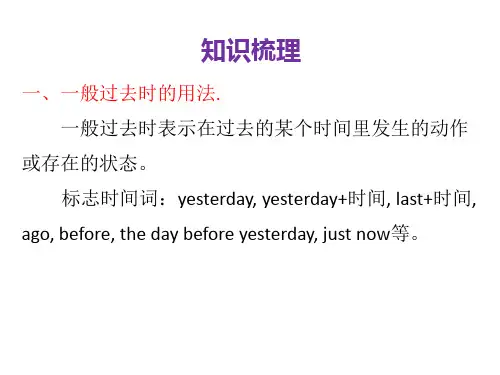
6. My mother __d_id_n_'_t_d_o___(not do) housework
yesterday. 7. There _w__e_r_e_n_o_t_/_w_e_r_e_n_'t__(be not) any hospitals in my hometown(家乡) in 1940. 8. There _w__a_s_(be) a football match on TV yesterday evening, but I _h__a_d_(have) no time to watch it. 9. The sun _g_o_e_s_(go) up in the east and _s_e_t_s_(set)
3.一般疑问句:Be动词 / Did+主语+动词原形+其 他?
如:Were you in school last Friday? Did your mother cook dinner last night? Did you wash your clothes last Sunday?
4.特殊疑问句:特殊疑问词+一般疑问句? 如:I was at home yesterday. → Where were you yesterday?
六、用所给单词的适当形式填空。 It 1.___w_a_s__ (be) sunny last weekend. I 2. __w__e_n_t _(go) to the park with my friends. There 3. ___a_r_e__(be) many trees, a lake and some mountains in the park. We 4. _p__la_y_e_d_(play)games and 5. _cl_im__b_e_d_(climb) a mountain. We 6. __h_a_d___(have) a lot of fun. How happy we 7.__w__e_re__ (be)!
一般过去时详解
基本概念一般过去时(simple past tense)表示过去某个时间里发生的动作或存在的状态,常和表示过去的时间状语连用,如:yesterday,last night,in 1990,two days ago 等。
一般过去时也表示过去经常或反复发生的动作,常和often,always等表式频率的时间状语连用。
过去习惯性、经常性的动作、行为;过去主语所具备的能力和性格。
时间状语Ago(two hours ago(一段时间+ago),yesterday(句子开头或结尾),the day before yesterday,last week,last(year,night,month…),具体时间(如Jan.fourth),just now,at the age of,one day,long ago,once upon a time,and so on,this morning.long long ago(很久以前)。
1.直接加ed:work—— worked look——looked play——played,2.以不发音e结尾的单词,直接加d:live ——lived hope——hoped use——used,3 以辅音字母+y结尾的,变y为i加ed:study—— studied carry——carried worry——worried,4以元音字母+y结尾的,直接加ed:enjoy ——enjoyed play——played5 以重读闭音节结尾的,双写最后的辅音字母+ed:stop——stopped plan——planned不规则变化的动词过去式:have---had are---were get---got say---said feel---felt do/does---didis---was基本结构主语+动词过去式+其他否定形式:①was/were+not;②在行为动词前加didn't,同时还原行为动词一般疑问句①Did+主语+do+其他?②Was\Were+主语+ do sth例句:She often came to help us in those days.I didn't know you are so busy.特殊疑问句疑问词+did+主语+动词原形+其他一般过去式的构成形式肯定式疑问式否定式疑问否定式I worked Did I work?I did not work Did I not work?He(she,it) worked Did he(she,it) work? He (she,it)did not work Did he(she,it)not work? We worked Did we work? We did not work Did we not work?You worked Did you work? You did not work Did you not work? They worked Did they work? They did not work Did they not work?用法(1)一般过去时表示在过去某个特定时间发生,也可以表示过去习惯性、经常性的动作。
时态详解:一般过去时
时态详解:一般过去时一、一般过去时的定义一般过去时表示过去某一时候或某一段时间所发生了的事情或存在的状态。
常与过去时间yesterday, this morning, just now, a moment ago, in May, last night / year / week, once upon a time, the other day, in the past 等连用。
如:What did you do yesterday? 昨天你干了什么?I met Lin Tao this morning. 今天上午我会到了林涛。
I was there a moment ago. 刚才我在那儿。
二、一般过去时的应用1. 一般过去时表示过去(1)表示过去发生的动作或存在的状态:He bought the computer five years ago. 这电脑是他五年前买的。
It was then a small fishing village.那时它只是一个小渔村。
(2)表示过去经常性或习惯性的动作:We often played together when we were children.我们小时候常在一起玩。
注:表过去习惯性的动词,也可用used to或would:He used to go to work by bus. 他过去常乘公共汽车去上班。
2. 一般过去时表示现在(1)在宾语从句中,由于时态呼应的关系,可用一般过去时表示现在:I didn’t know you were here.我不知道你在这儿。
(were实际上指现在)I didn’t know you were so busy.我没想到你这么忙。
(were实际上指现在)(2)表示客气委婉的现在I wondered if you were free this evening. 不知您今晚是否有空。
I thought you might like some flowers. 我想您也许想要些花。
一般过去时 时间状语
一般过去时的时间状语简介一、一般过去时的概念一般过去时表示过去某个时间发生的动作或存在的状态,通常表示过去的事实或经历,不涉及现在的情况。
例如:He lived in Beijing for ten years. 他在北京住了十年。
She bought a new dress yesterday. 她昨天买了一件新裙子。
一般过去时也可以表示过去经常反复发生的动作,常和often, always, sometimes等频率副词连用。
例如:He often played football with his friends when he was young. 他年轻时经常和朋友们踢足球。
二、一般过去时的构成一般过去时的肯定句和否定句的构成方法是在动词原形后加-ed或不规则变化,否定句在动词前加did not。
例如:动词原形过去式肯定句否定句work worked I worked hard.I did not work hard.study studied He studied English.He did not study English.go went She went to the park.She did not go to the park.see saw They saw a movie.They did not see a movie.一般过去时的一般疑问句和特殊疑问句的构成方法是在句首加did或疑问词+did,动词用原形。
例如:动词原形过去式一般疑问句特殊疑问句work worked Did you work hard?What did you work on?study studied Did he study English?How did he study English?go went Did she go to the park?Where did she go?see saw Did they see a movie?What movie did they see?三、一般过去时的用法一般过去时常和表示过去的时间状语连用,如yesterday, last week, ago等。
一般过去时的定义和用法
一般过去时的定义和用法1. 一般过去时的基本概念一般过去时,这个名字听起来就像是我们在学校里最讨厌的语法规则之一,但实际上,它可是我们讲故事、分享回忆时的超级好帮手哦!简单来说,一般过去时用来描述发生在过去的事情,通常这些事情已经结束了。
比如,你昨晚吃了什么,或者上周末做了什么?这些问题的答案就得用一般过去时来回答。
这样的话,听起来就像是我们正在翻阅一本旧相册,逐一回忆那些美好的瞬间。
1.1. 形成规则要是你想让自己在使用一般过去时的时候不出错,首先得明白它的形成规则。
一般来说,动词在过去时态下会有不同的变化。
比如,规则动词一般加上ed,像“play”变成“played”。
但小心,有些动词可不乖,它们是“不规则动词”,变化就像是变魔术一样,让人眼花缭乱,比如“go”变成“went”,“eat”变成“ate”。
所以,掌握这些动词的过去式可得多下功夫啊,简直就像是学习一门新语言!1.2. 用法解析说到用法,其实一般过去时的用途可真不少!首先,它用来讲述过去的事实,像是“我去年去了北京”这样的句子,就用得上一般过去时。
而且,回忆起以前的趣事时,也要用这个时态,比如“我们小时候常常一起玩”。
还有啊,当你想说一件事情的持续时间,比如“我在那家公司工作了五年”,这也是一般过去时在发威!总之,它的用法就像是万金油,几乎无处不在,真是个不错的伙伴!2. 一般过去时的具体例子我们来聊聊一些生动的例子吧,让大家更直观地感受一下一般过去时的魅力。
想象一下,你跟朋友在聊天,突然问:“嘿,你上次旅行去哪儿了?”朋友兴奋地回答:“哦,我去年去的那个小岛简直太美了!”听,这个“去了”就是一般过去时,立刻把你带回了那个阳光灿烂的假期。
然后,朋友接着说:“我们每天都在海滩上晒太阳,还吃了很多海鲜。
”你是不是感觉像是在旁边看他们的旅行录像?没错,这就是一般过去时的魔力。
2.1. 叙述过去的故事一般过去时还特别适合讲故事。
试想一下,若你想给朋友分享一个搞笑的故事:“那天我走在路上,突然看到一只狗追着一只猫,结果猫跳上了树,狗却撞上了电线杆!”哇,这个故事可真有趣,且所有的动作都用了一般过去时,听起来流畅又自然,仿佛你正在给大家讲一个生动的情景。