
新版广州深圳牛津英语七年级下册_unit7_poems_知识点与练习
I read the story to my younger sister.我给妹妹大声朗读这个故事。
【近义词】loudly7.组,群【搭配】a of+名词复数:一群,一伙8.同意1)with sb/sth同意某人的意见,想法,分析,解释I quite agree with you.我很赞同你的看法。
We agree with what you say.我们同意你说的。
2)not agree with sb对...不适应The food doesn’t agree with me.这食物对我不适合。
3)agree with sth表示与...一致/符合His story agrees with the facts.他的描述与事实符合。
4)agree to sth表示同意或答应某事He agreed to the plan.他同意了这个计划。
5)agree to do sth表示同意做某事We agreed to leave early.我们同意早点出发。
【名词】agreement【反义词】disagree;disagreement(名词)9.押韵词;押韵Can you think of for“beauty”?你能想出和“beauty”押韵的词吗?“Dogs”with“frogs”.“dogs”和“frogs”押韵。
10.完整的,整个的He is a scholar.他是个无懈可击的学者。
【动词:完成】I will this task soon.我很快就要完成这项任务了。
【副词:完全地】I completely forgot it was your birthday.那天是你的生日,我忘得一干二净了。
11.井,水井【副词】;【形容词】12.淋浴;阵雨Take a淋浴;take a bath:洗澡13.建筑工地14.狭窄的A gap:狭小的缝隙【反义词】wide15.高度【链接】high--height;wide--width;long--length;deep-depth;strong--strength16.超人17.卖者;卖方【反义词】buyer18.微笑(n&v)Smile at sb:冲某人笑;a big smile一个大大的微笑19.迅速移动Don’t off,I want to talk to you.不要急着走,我有话跟你说。
20.人群【链接】be crowded with:挤满了The bus is crowded with people.这辆公交车挤满了人。
【搭配】a of+people一、选词填空,需注意用适当的形式。
poem ordinary feeling order advice aloud smile group agree disagree rhyme well crowd shower site narrow height superman seller complete 1.‐‐Simon will probably be a fireman.‐‐Yes.I with you.2.Eddie to go to Hainan Island with his friend.He wanted to go to Thailand.3.I usually buy a newspaper from the at the street corner on my way home.4.I like reading the from the Tang Dynasty.唐代5.The girl with a big is my younger sister.She is always very happy.6.“Flight”in the second line and“right”in the sixth line.7.Please answer these questions in sentences.8.In some places,people get water from.9.I come from a(n)family.My father is a worker and my mother is a nurse.10.He had a of excitement after hearing the news.11.The thieves escaped逃跑and disappeared into a street.12.Soldiers must obey the from their officers.13.He is nearly two metres in.14.I will take your and change my bad habits now.15.The looked at the three man arguing.They didn’t know what had happened.16.How fast he runs!He is really a.17.Read the passage and then find out the unknown words in it.18.The workers at the building are busy building the bridge now.too+adj./adv.+to do这个句型是too...to的最基本的常用句型。
too+形容词或副词,有时too后也可跟一个起形容词作用的过去分词。
例如:这男孩年龄太小,不能上学。
The boy is too young to go to school.这帽子太大,没法戴。
The hat is too large to wear.他走得太慢,不能按时到达那儿。
He walks too slowly to get there on time.我太累了,什么也不能想了。
I'm too tired to think of anything now.【例题】1)The bridge is too long for us_____.A.to acrossB.across itC.to crossD.cross it2)The car run too____to stop before it hit the wall.A.quickB.quicklyC.fastte一、单项选择()1What_________fine weather it is today!A aB an C/D the()2My father works at a building_____________every day.A siteB placeC stopD stand()3Work with your partners and complete the poem_________your group.A inB onC byD for()4Eddie:Whose English-Chinese dictionary is this?Peter:It’s_____________.My parents bought it for my sister and me.A hersB oursC mineD theirs()5The English story book is not very difficult,There are only_________new words in it.A fewB a fewC a littleD little()6Peter was in a hurry.He put the money down and took a paper_________from the newspaper stand.A quickB quicklyC slowD slowly()7Eddie is_________short to reach the box at the top of the shelfA veryB soC quiteD too()8Simon:________you find the answer to the question in five minutes?Peter:I’m not sure.But let me try first.A CanB MayC MustD Should()9Tom:Must we always have the rhymes in poems?Teacher:No,you__________A can’tB may notC mustn’tD needn’t()10--Hi:Let’s__________our poem now.--Lo:All right..A startB to startC startingD started()11It’s ten o’clock.I think my father_________on a piece of wood high in the sky now.A worksB workedC will workD is working()12My father usually reads a book after dinner but soon he_______to bed.A is goingB will goC wentD to go()13Teacher:_____________.Amy:OK.I will take your advice.A go and open the window.B go over your lessons every day before you do your homework.C don’t leave the rubbish here.Put it in the rubbish bin.D don’t stand up.Think about your mistake.()14Remember to use an exclamation mark(!)_________you write an exclamation.A andB becauseC ifD but()15In the poem below,___________are rhyming words.I sometimes wonder whyThey didn’t call me hiAnd he’d really like to knowWhey people didn’t call him loA why and knowB hi and knowC hi and loD know and lo二、选择短语填空,注意适当形式。
牛津深圳版英语七年级下册Unit7Poems知识点梳理课件
2.It’s an important meeting. DDono’n’t be (not, be) late for it.
3. HHowow
wonderful the film is!
4. LLooookk (look) out! There are many cars on the road.
(well 好地 adv. well adj. 健康的)
12.shower:washing the body by standing under running water 淋
浴 n.
Unit 7 Poems
13.narrow:small Unit 7 Poems
Unit 7 Poems Unit 7 Poems
from
one
side
to
the
other,
not
wide
狭窄的
adj.
Unit 7 Poems
Unit 7 Poems
(narrowly Unit 7 Poems
Unit 7 Poems
狭窄地,勉强地
adv.)
Unit 7 Poems
Unit 7 Poems
14.height:distance from the base to the top 高度 n. (high 高的
他读书和看报为了知道今天有什么新鲜事。
3.Then I see him working, on the building site. 然后我看到他在建筑工地上工作。
4.He’s walking on a narrow piece of wood, not worried about the height, not afraid, not afraid like me. 他正走在一根狭窄的木头上,不担心高度,不害怕,不像我一 样害怕。
新深圳牛津版七年级英语下Unit-7--Poems课文知识点解析
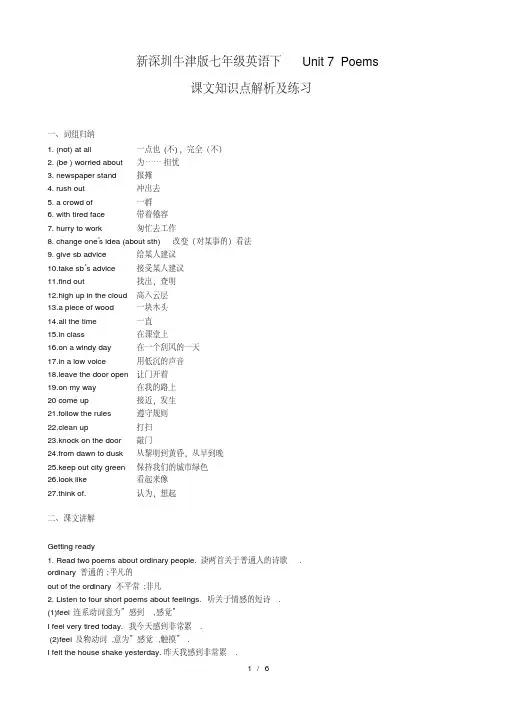
新深圳牛津版七年级英语下Unit 7 Poems课文知识点解析及练习一、词组归纳1. (not) at all 一点也(不),完全(不)2. (be ) worried about 为……担忧3. newspaper stand 报摊4. rush out 冲出去5. a crowd of 一群6. with tired face 带着倦容7. hurry to work 匆忙去工作8. change one’s idea (about sth) 改变(对某事的)看法9. give sb advice 给某人建议10.take sb’s advice 接受某人建议11.find out 找出,查明12.high up in the cloud 高入云层13.a piece of wood 一块木头14.all the time 一直15.in class 在课堂上16.on a windy day 在一个刮风的一天17.in a low voice 用低沉的声音18.leave the door open 让门开着19.on my way 在我的路上20 come up 接近,发生21.follow the rules 遵守规则22.clean up 打扫23.knock on the door 敲门24.from dawn to dusk 从黎明到黄昏,从早到晚25.keep out city green 保持我们的城市绿色26.look like 看起来像27.think of. 认为,想起二、课文讲解Getting ready1. Read two poems about ordinary people. 读两首关于普通人的诗歌.ordinary 普通的;平凡的out of the ordinary 不平常;非凡2. Listen to four short poems about feelings. 听关于情感的短诗.(1)feel 连系动词意为”感到,感觉”I feel very tired today. 我今天感到非常累.(2)feel及物动词,意为”感觉,触摸”.I felt the house shake yesterday. 昨天我感到非常累.3. Learn how to use imperatives to give orders or advice. 学会如何使用祈使句给出命令或建议.(1) order 这里用作名词,意为”命令”也可以是动词”命令”This is an order. 这是命令.The police ordered them to wait right there. 警察命令他们就在那儿等候.(2) order 及物动词, 意为”订购,点菜”I want to order a ticket. 我想订一张票.(3) advice 不可数名词,意为”劝告,建议”. a piece of advice 一条建议The teacher often gives advice to his students. 这个老师经常给他的学生提建议.4. Read a poem aloud in a group. 在小组里大声读诗.aloud 副词,意为”出声地; 高声地”.Please read the text aloud. 请朗读一下课文.----Miss Li, could you give me ______ on English learning?----Certainly. First you should speak English every day.A.any advicesB. many advicesC. some adviceReading1. agree to 同意……(意见),to后多接表示计划、建议、安排、决定等的名词或代词。
牛津深圳版英语七下Unit 7《Poems》(Listening)ppt复习课件

作为……而著名 与……不同 缺少,欠缺…… 准备好了…… 热衷于…… 对……感到痴狂 挤满…… 嫁给了/娶了…… 对……感兴趣 对……感满意 对……震惊
be excited about be good at be good for be similar to be strict with be angry with be bad for feel sorry for be busy doing/with thank sb for doing be rudnotC ____ ordinary poem here. -- Yes, _____ poem expresses students’ pity to Ya’an Earthquake. A. the; a B. the, the C. an; the D. an; a A 2. -- Can you see ________ children near the well from your cookhouse? -- No, I _______. A. a group of; can’t B. a lot of; may not C. a group; can’t D. lot of; may not
有趣的 兴奋的 感动的 无聊的 担心的 惊奇的
She was very excited,because she saw a interesting book。
My mother was so moved that she saw a moving film yesterday。
单项选择
( B) 1.This game become more ____than before. A. interest B. interesting C. interested D. interestingly ( A) 2.He is a _____ boy. Many people want to make friend with him A. interested B. interesting C. bored D. boring
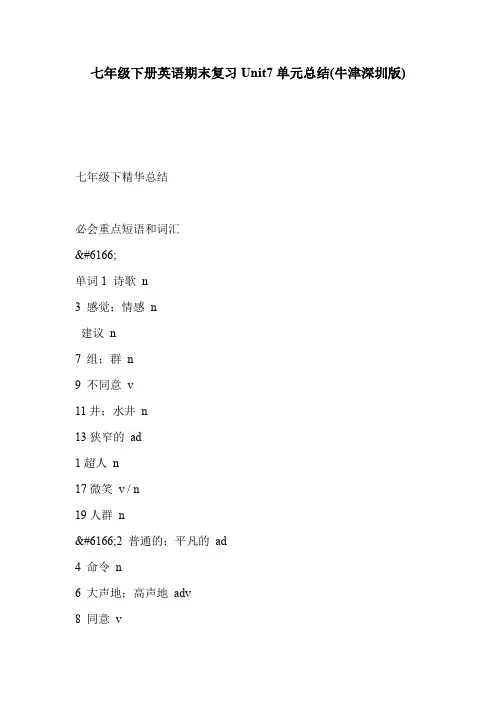
七年级下册英语期末复习Unit7单元总结(牛津深圳版)
七年级下册英语期末复习Unit7单元总结(牛津深圳版)七年级下精华总结必会重点短语和词汇᠖单词1 诗歌n3 感觉;情感n建议n7 组;群n9 不同意v11井;水井n13狭窄的ad1超人n17微笑v / n19人群n᠖2 普通的;平凡的ad4 命令n6 大声地;高声地adv8 同意v10完整的;整个的ad12淋浴n14高度n16卖者;卖方n18迅速移劢v 短语1 一点也(不);完全(不)3 报摊一群7 对…感到不高兴9 遵守觃则11(太阳)升起2 为…担忧4 冲出去6 经过;通过8 同时10敲门12打扫;把…弄干净重点词汇及辨析1rdinar【必会考点】ad 平凡的;普通的【知识拓展】rdinar VS nVS nral例:The b’s nledge as ut f the rdinar1这个男孩的知识面非同寻常。
il pllutin is the st n ause f death fr seabirds石油污染是海鸟死亡的最常见的原因。
Her height and eight are nral fr her age她的身高和体重对于她的年龄说是正常的。
2rder【必会考点】【】n 命令【知识拓展】᠄rder v 命令rder sb t d sthillias rdered hi t leave威廉斯命令他离开。
᠄rder v 订购;点菜The aitress appeared, “Are u read t rder?”女服务员走了过,“佝们准备好点菜了吗?”᠄in rder t为了In rder t lse eight, he exerises regularl ever da为了减肥,他每天觃律地运劢。
᠄in rder that为了The fle there in rder that the uld attend the pening eren他们飞往那里以便能及时参加开幕典礼。
深圳牛津英语七年级下册期末复习资料—知识点unit7--Poems

他的朋友真少!
多好呀! 你来了真好!
共2页 第1页
共 2页 第 2页
Let ’ s go to the rpka.
you,以
3. 否定形式(一般在动词上否定,也可以用否定副词(
never)来表示)
1) be 型【 Don’ t be 主+ 语 + 谓语(形容词、名词或介词短语)】
Don’ t be careless!
Never be late again next time!
13. too...to... 的用法
1)“ too+形容词/副词+动词不定式”结构简称为“ 大多数情况下表示否定意义,在翻译时,通常可译为
too...to ”结构。这种结构是英语中常用的一种句型,在
:“太 ,, 而不能 ,, ” 、“太 ,, 无法 ,,
"。
too+ adj./adv.+ to do 这个句型是 too...to 的最基本的常用句型。
2)以实义动词开头的祈使句,这种祈使句的常用结构为:动词原形
+宾语( +其他)。
Come in, please!
Please open your books!
Put them away!
3) let 型( Let+ 宾语 +动词原形 +其他)
Let him do it by himself.
Let me help you.
10. be worried about = worry about
为、、、担忧
You don’t have to worry about him. =You don ’t have to be worried about him.
新深圳牛津版七年级英语下Unit7 poems语法复习及练习2
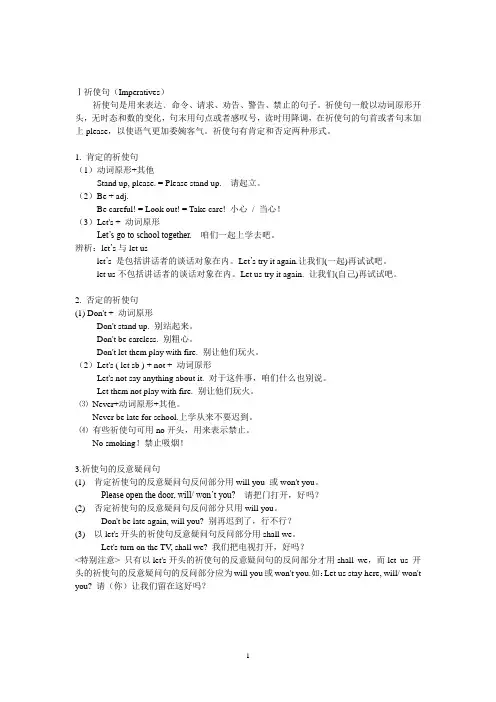
Ⅰ祈使句(Imperatives)祈使句是用来表达﹑命令、请求、劝告、警告、禁止的句子。
祈使句一般以动词原形开头,无时态和数的变化,句末用句点或者感叹号,读时用降调,在祈使句的句首或者句末加上please,以使语气更加委婉客气。
祈使句有肯定和否定两种形式。
1. 肯定的祈使句(1)动词原形+其他Stand up, please. = Please stand up. 请起立。
(2)Be + adj.Be careful! = Look out! = Take care! 小心/ 当心!(3)Let's + 动词原形Let’s go to school together. 咱们一起上学去吧。
辨析:let’s与let uslet’s 是包括讲话者的谈话对象在内。
Let’s try it again.让我们(一起)再试试吧。
let us不包括讲话者的谈话对象在内。
Let us try it again. 让我们(自己)再试试吧。
2. 否定的祈使句(1) Don't + 动词原形Don't stand up. 别站起来。
Don't be careless. 别粗心。
Don't let them play with fire. 别让他们玩火。
(2)Let's ( let sb ) + not + 动词原形Let's not say anything about it. 对于这件事,咱们什么也别说。
Let them not play with fire. 别让他们玩火。
⑶Never+动词原形+其他。
Never be late for school.上学从来不要迟到。
⑷有些祈使句可用no开头,用来表示禁止。
No smoking!禁止吸烟!3.祈使句的反意疑问句(1) 肯定祈使句的反意疑问句反问部分用will you 或won't you。
Please open the door, will/ won’t you? 请把门打开,好吗?(2) 否定祈使句的反意疑问句反问部分只用will you。
牛津深圳版英语七年级下Unit7《Poems》(Language points)课件
9. The old newspaper seller. seller n. 卖者 反义词: buyer when he was young he worked as a fruit seller. seller 还有“销售物” “畅销品”的意思 a good (poor) seller 畅(滞)销品 top seller 最热销的产品 best seller 畅销书籍、唱片等 10. And he’s smiling. smile v. 微笑 n. 微笑 He smiled and said, “How’s everything going?” she looked me up and gave me a smile. 11. A bus stops, and the people rush out. rush out 冲出去 rush into 冲进去 12. A crowd of people…一群人 crowd 人群 a crowd of 一群
你同意我们的计划吗? Do you agree to our plan? 我赞成你(所说的)。 I agree with you. 我们商定了那辆车的价钱。 We agreed on the price of the car. 根据中文意思完成句子。 1. 他们就下次会议的日期达成了一致意见。 agreed on a date for the next They _____ _____ meeting. 2. 在某种程度上,我同意玛丽的意见。 agree with In a way, I _____ _____ Mary. 3. 他会同意我们的建议吗? agree to Is he going to _____ _____ our suggestion?
1. Now he's sitting in his favourite chair. sit in the chair 坐在椅子上 in the tree 在树上 in the sun 在太阳下 There is a bird in the tree.
深圳初中英语沪教牛津版七年级下册unit7 Poems 词汇与练习
Unit 7 Poems 词汇同义词1.advice = suggestion n. 建议2.advise = suggest v. 建议plete =finish v. 完成plete=whole adj. 完整的,整个的5.take a shower= have a shower 淋浴6.be worried about= worry about=be concerned about 担忧,担心e up =rise 升起8.rush out=go out quickly 冲出去9.ordinary=common=usual adj. 普通的,平凡的10.aloud=loudly=in a high voice adv. 大声地11.disagree=don’t agree 不同意12.a crowd of= a large group of 一大群13.narrow= not wide 窄的,不宽阔的词性转换1.poem n.诗歌poet n. 诗人poetry n. 诗集2.feeling n.感觉feel v.感觉3.agree v. 同意agreement n. 协议,同意disagree v. 不同意agree to do sth. 同意做某事agree with sb. 同意某人4.high adj. 高的height n.高度5.crowd n.人群crowded adj.拥挤的6.worry v.担心worried adj. 担心的7.sell v. 卖,销售seller n. 卖家短语1.be afraid of.... 害怕2.hurry to work 匆忙去上班3.too...to... 太...而不能做4.a crowd of people 一群人5.high up in the clouds 在高空6.put down 放下7.from dawn to dusk 从早到晚8.sweep the street 扫大街9.keep the city green 保持城市绿色环保10.keep the city safe 保持城市安全11.clean up 打扫干净句型1.He reads his book or newspaper to learn what’s new today.他读书或看报是为了了解今天有什么新鲜事。
Unit 7 Poems 语法讲义 2020-2021学年牛津深圳版英语七年级下册
unit7 Poems1. Student can grasp exclamatory of this unit;2. Student can grasp the imperative sentence well;4.Student can can use the grammar easily.1.What is the feeling of the girl when she smells the flowers? (Try to act out the expression of her.)2.What is the synonym of the sentence that the girl says?参考答案:1.She feels happy about the flowers.2.How beautiful the flowers are!一.感叹句Exclamatory教材例句1. What an interesting poem it is!2. What beautiful flowers they are!3. How bright the starts are!以上三个句子含有丰富的感情色彩,表达自己的感受,句子末尾都用了感叹号,用what 或how 开头,这是感叹句。
基本表达概念用来表达喜、怒、哀、乐等强烈感情色彩的句子,叫感叹句。
感叹句用what 或how 引导,句末常用感叹号。
例:What a clever boy he is!How tall the man is!感叹句的具体构成感叹句是用来表达说话人对某人、某物或某件事表示赞美、惊讶、喜悦、气愤或悲哀等语气的句子,这类句子有强烈的感情,句尾用感叹号。
感叹句通常由how或what引出。
⒈如果对句子中的名词或名词词组表示感叹,用what引出。
⒈ What+a/an+adj.+单数名词+主语+谓语(+其他成分)!其中主语和谓语可以省略。
牛津深圳版七年级英语下册Unit7 Poems单元测试卷及答案
初中英语牛津深圳版七年级下册Unit7 Poems单元测试卷一、听力(听力)(共20小题;共20分)听力理解(30分)第一节(每小题1.5分,共9分)听一遍。
根据你所听到的句子,从A、B、C三个选项中选出最恰当的答语,并把答题卡上对应题目的答案标号涂黑。
1. A. In China. B. It's cloudy. C. It's a big city.2. A. Because it's interesting.B. We have English every Tuesday.C. My English teacher is Mr. Smith.3. A. I'd like to. B. Yes, please. C. Thanks.4. A. Yes, he is tall. B. No, he isn't. C. He is tall.5. A. She's with my aunt. B. She's singing. C. She's beautiful.6. A. A large bowl. B. Tomato noodles. C. Yes, please.第二节(每小题1.5分,共9分)听一遍。
根据你所听到的对话和问题,从A、B、C三个选项中选出最恰当的答案,并把答题卡上对应题目的答案标号涂黑。
7. A. She reads in the library.B. She goes shopping.C. She buys books.8. A. At 8:15. B. At 7:45. C. At 6:45.9. A. On a farm. B. In the post office. C. At a restaurant.10. A. By bus. B. By train. C. By car.11. A. Giraffes. B. Tigers. C. Pandas.12. A. His father. B. His grandfather. C. His friend.第三节(每小题1.5分,共6分)听两遍。