
解析2020年普通高等学校招生全国统一考试(新高考I卷) 英语
机密★启用前2020年普通高等学校招生全国统一考试英语注意事项:1.答卷前,考生务必将自己的姓名、准考证号填写在答题卡上。
2.回答选择题时,选出每小题答案后,用铅笔把答题卡上对应题目的答案标号涂黑。
如需改动,用橡皮擦干净后,再选涂其他答案标号。
回答非选择题时,将答案写在答题卡上。
写在本试卷上无效。
3.考试结束后,将本试卷和答题卡一并交回。
试卷总评2020年山东高考英语试卷(新高考Ⅰ卷)难度继续保持稳定,同时又全面考查学生的核心价值、学科素养、关键能力、必备知识,兼具基础性、综合性、应用性和创新性,进一步凸显了高考“立德树人、服务选才、引导教学”的功能定位。
1.体现立德树人的时代特征,促进德智体美劳全面发展坚持德育为先,如语篇续写的内容充满正能量,积极向上,为学生树立好榜样。
D篇阅读、写作第一节都积极引导学生关注体育运动,形成健康生活的理念。
B篇阅读以及语法填空引导学生在真实的生活中感受劳动的辛苦和光荣,引导学生热爱劳动,尊重劳动,认同劳动。
2.落实考试内容改革要求,强化关键能力考查试卷结构进一步优化,强调关键能力的考查。
写作部分启用新题型,突出综合性和创新性。
第一部分阅读(共两节, 满分50分)第一节(共15小题;每小题2.5分, 满分37.5分)阅读下列短文,从每题所给的A、B、C、D四个选项中选出最佳选项。
APOETRY CHALLENGEWrite a poem about how courage, determination, and strength have helped you face challenges in your life.Prizes3 Grand Prizes:Trip to Washington, D.C.for each of three winners, a parent and one other person of the winner's choice.Trip includes round-trip air tickets, hotel stay for two nights, and tours of the National Air and Space Museum and the office of National Geographic World.6 First Prizes:The book Sky Pioneer:A Photobiography of Amelia Earhart signed by author Corinne Szaboand pilot Linda Finch.50 Honorable Mentions:Judges will choose up to 50 honorable mention winners, who will each receive a T-shirt in memory of Earhart's final flight.RulesFollow all rules carefully to prevent disqualification.■Write a poem using 100 words or fewer.Your poem can be any format, any number of lines.■Write by hand or type on a single sheet of paper.You may use both the front and back of the paper.■On the same shee t of paper, write or type your name, address, telephone number, and birth date.■Mail your entry to us by October 31 this year.【文章大意】本文是一则诗歌比赛征集作品的广告。
介绍了诗歌比赛的奖项设置以及比赛的具体要求。
1.How many people can each grand prize winner take on the free trip?A.Two.B.Three.C.Four.D.Six.【解析】选A。
细节理解题。
根据3 Grand Prizes后的第一句话...for each of three winners, a parent and one other person of the winner's choice.可知获奖者可以另外带两个人去旅行,故选A。
2.What will each of the honorable mention winners get?A.A plane ticket.B.A book by Corinne Szabo.C.A special T-shirt.D.A photo of Amelia Earhart.【解析】选C。
细节理解题。
根据50 Honorable Mentions后的内容...who will each receive a T-shirt...可知选C。
3.Which of the following will result in disqualification?A.Typing your poem out.B.Writing a poem of 120 words.ing both sides of the paper.D.Mailing your entry on October 30.【解析】选B。
细节理解题。
根据Rules后面的内容Write a poem using 100 words or fewer.可知B项不符合要求,会导致作品不符合参赛条件。
BJennifer Mauer has needed more willpower than the typical college student to pursue her goal of earning anursing degree.That willpower bore fruit when Jennifer graduated from University of Wisconsin-Eau Claire and became the first in her large family to earn a bachelor's degree.Mauer, of Edgar, Wisconsin, grew up on a farm in a family of 10 children.Her dad worked at a job away from the farm, and her mother ran the farm with the kids.After high school, Jennifer attended a local technical college, working to pay her tuition(学费), because there was no extra money set aside for a college education.After graduation, she worked to help her sisters and brothers pay for their schooling.Jennifer now is married and has three children of her own.She decided to go back to college to advance her career and to be able to better support her family while doing something she loves: nursing.She chose the UW-Eau Claire program at Ministry Saint Joseph's Hospital in Marshfield because she was able to pursue her four-year degree close to home.She could drive to class and be home in the evening to help with her kids.Jennifer received great support from her family as she worked to earn her degree: Her husband worked two jobs to cover the bills, and her 68-year-old mother helped take care of the children at times.Through it all, she remained in good academic standing and graduated with honors.Jennifer sacrificed(牺牲)to achieve her goal, giving up many nights with her kids and missing important events to study.“Some nights my heart was breaking to have to pick between my kids and studying for exa ms or papers,” she says.However, her children have learned an important lesson witnessing their mother earn her degree.Jennifer is a first-generation graduate and an inspiration to her family — and that's pretty powerful.【文章大意】文章讲述了一个在农场长大的女子高中毕业后一边工作一边读完技术学校,并供弟弟妹妹完成学业,成家后又重返校园攻读学位,不仅为孩子树立了榜样,也成为家族的荣耀。
4.What did Jennifer do after high school?A.She helped her dad with his work.B.She ran the family farm on her own.C.She supported herself through college.D.She taught her sisters and brothers at home.【解析】选C。
精品解析:2020年山东省高考英语试卷(新高考全国Ⅰ卷)(原卷版)
2020年普通高等学校招生全国统一考试英语第一部分听力(共两节,满分30分)第一节 (共5小题;每小题1.5分,满分7.5分)1.What is the woman waiting to do?A.Go to a local concert.B.Watch a TV program.C.Finish her homework.2.What are the speakers mainly talking about?A.The weather of this summer.B.A plan for the coming summer.C.The environmental protection.3.What is the woman doing now?A.Painting a picture.B.Drinking hot water.C.Repairing her brush.4.How far is the nearest hotel?A.Eight kilometers away.B.Five kilometers away.C.Three kilometers away.5.What is the probable relationship between the speakers?A.Manager and chefB.Guide and traveler.C.Waiter and customer.第二节(共15小题;每小题1.5分,满分22.5分)听第6段材料,回答第6和第7两个小题。
6.Where are the cups?A.In the plastic bag.B.In the new basket.C.In the box with the plates.7.Why are the speakers unable to cook anything?A.They forgot the frying pan.B.They left their food behind.C.They couldn't get any water.听第7段材料,回答第8和第9两个小题。
2020年各地高考英语听力整理(7套)含答案听力原文
2020年普通高等学校招生全国统一考试(全国卷I)英语第一部分听力(共两节,满分30分)第一节(共5小题;每小题1.5分,满分7.5分)听下面5段对话。
每段对话后有一个小题,从题中所给的A、B、C三个选项中选出最佳选项。
听完每段对话后,你都有10秒钟的时间来回答有关小题和阅读下一小题。
每段对话仅读一遍。
例:How much is the shirt?A. £19.15.答案是C o1.W here are the speakers?A. At a swimming pool.2.W hat will Tom do next?A.Turn down the music.B.£9.18.B.In a clothing shop.B. Postpone the show.C. £9.15.C. At a school lab.C.Stop practicing.3.What is the woman busy doing?A.Working on a paper.B.Tidying up the office.anizing a party.4.When will Henry start his vacation?A. This weekend.B. Next week.C. At the end of August.5.What does Donna offer to do for Bill?A. Book a flight for him.B. Drive him to the airport.C. Help him park the car.第二节(共15小题;每小题1.5分,满分22.5分)听第6段材料,回答第6、7题。
6.Why does Pete call Lucy?A. To say that he'll be late.B. To tell her about his work.7.When is Pete going to see Lucy?A. At 6:00 pm.B. At 6:45 pm.听第7段材料,回答第8至10题。
2020年普通高等学校招生全国统一考试[新高考全国卷Ⅰ]试题及答案解析
![2020年普通高等学校招生全国统一考试[新高考全国卷Ⅰ]试题及答案解析](https://360docs-1393072327.cos.ap-beijing.myqcloud.com/14432faaf78a6529657d535c.webp)
但是沿革地理并不等于历史地理学,二者不仅有量的不同,而且有质的区别。就研究内容而言,前者主要是疆域政区、地名和水道的变迁,后者却涉及地理学的各个分支。就研究的性质而言,前者一般只是对现象的描述和复原,很少涉及变化的原因,后者则不仅要复原各种以往的地理现象,而且要寻找它们变化发展的原因,探索背后的规律。由于产生于西方的现代地理学在中国的传播很迟,加上我国缺乏全面系统的科学基础,中国沿革地理虽然早已成为专门学问,却一直未形成新的学科。历史地理学则有自己独立的学科体系和理论,是现代地理学的一部分。
在这个城里,有个家的人真是有福啊。他们还能够像四百年前的祖先们那样安居乐业,不必操心左邻右舍的德行,都是世交啦。有一位绕过曲曲弯弯的小巷,提着在龙井市场买来的水淋淋的草芽(一种建水特有的水生植物,可食,滚油翻炒数秒起锅,甜脆)、莴笋、茄子、青椒、豆腐、毛豆、肉糜、茭瓜……一路上寻思着要怎么搭配,偶尔向世居于此的邻居熟人搭讪,彼此请安。磨磨蹭蹭到某个装饰着斗拱飞檐门头的大门前(两只找错了窝的燕子拍翅逃去),咯吱咯吱地推开安装着铜质狮头门环的双开核桃木大门,抬脚跨过门槛。绕过照壁,经过几秒钟的黑暗,忽然光明大放,回到了曾祖父建造的花香鸟语、阳光灿烂的天井。从供销社退休已经三十年的祖母正躺在一把支在天井中央的红木躺椅上,借着一棵百年香樟树的荫庇瞌睡呢。
成书于公元1世纪的《汉书·地理志》对见于典籍记载的重要地理要素,包括古国、历史政区、地名、河流、山岭、古迹等都做了记载和简要考证,并不局限于西汉一朝。作者班固比较充分地利用已有的地理记载和地理研究成果,使得中国历史地理学研究初具雏形。同样,成书于公元6世纪的《水经注》也从传世的数百种地理著作中搜集整理了大量史料,并做了深入的考证和研究。今天,我们之所以还能知道先秦的某一个地名在现在的什么地方,能知道秦汉以降的疆域范围,能够大致了解黄河早期的几次改道,都离不开这两种著作。
2020安徽高考英语试题答案逐题解析
2020年普通高等学校招生全国统一考试英语试卷解析【本试卷重难点分析】A篇是一篇应用文,内容为景点信息提取。
题目难度低,定位原文即可找到答案。
B篇是一篇夹叙夹议的文章,长难句较多,26题有些难度,首先要认识四个选项。
C篇作为一篇说明文,句子和逻辑相对简单,但是有一些专有名词,其中28题题目需要一定的分析和理解,选项中的四个情感态度词也要认识,难度系数稍高。
D篇阅读难度较大,为科技类说明文,主要论述因为植物能给人类带来积极的影响,所以科学家通过改变植物的内部结构,使其能发光,从而节省资源。
其中一题为细节题,定位明显,但其余三题考察了推理判断题,主旨大意题,最佳标题题,考查类型齐全,难度较大,要求学生在有一定词汇量储备的基础上,分析长难句,理解透文章原意,容易失分。
七选五文章结构为常考类型,总体来说不难,基本考核点为上下文过渡句、段落主题句和段尾句,只要理解好文章主旨大意,掌握好上下文联系,合理分析关键词即可,其中38题需要学生精准掌握上下句之间的过渡关系,清晰分别干扰选项,抓取选项和文中合适关键词。
本篇完形填空难度中等偏上,是一篇夹叙夹议文,话题是家庭教育,难点主要体现在对句意的理解以及对上下文之间的逻辑把握,动词辨析,介词短语也要注意。
这就要求考生做题时在理解句意的基础上,考虑到文章的整体性,注意上下文的连贯和呼应。
学生的易错题可能集中在46,53,58题。
这次的语法填空遵循全国一卷的的标准,动词类考察较多,难度中等,考点都是平时比较常见的填空类型,其中64、67、68题为易错题。
本篇改错更加侧重动词的考查,8大词性都有涉及,整体上难度适中。
其中76题比较容易改错,需要考生足够细心且理解了文章大意,结合上下文的语境。
牢记改错题的考点分布,避免同一考点重复修改,而需要修改的错误却被遗憾地漏掉了。
第一部分听力(满分30分)听力(共20小题,每题1.5分,满分30分)参考答案:1-5:BCCAB6-10: ABACB11-15: BCACA16-20: CBAAC第二部分阅读理解(满分40分)第一节(共15小题,每题2分,满分30分)A【文章分析】本文是一篇应用文,介绍了旅游景点的相关信息。
2020年普通高等学校招生全国统一考试(新高考全国卷Ⅰ)(山东卷)英语听力试题及答案

绝密★启用前考试时间:2020年7月8日15:00-17:00 2020年普通高等学校招生全国统一考试(山东卷)
(新高考全国卷Ⅰ)
英语听力试题
(第一次)
试卷总分150分,考试时间120分钟
第一部分听力(共两节,满分30分)
做题时,先将答案标在试卷上。
录音内容结束后,你将有两分钟的时间将试卷上的答案转涂到答题卡上。
第一节(共5小题;每小题1.5分,满分7.5分)
听下面5段对话。
每段对话后有一个小题,从题中所给的A、B、C三个选项中选出最佳选项。
听完每段对话后,你都有10秒钟的时间来回答有关小题和阅读下一小题。
每段对话仅读一遍。
例:How much is the shirt?
A. £19.15.
B. £9.18.
C. £9.15.
答案是C。
1. Where does the conversation take place?
A. At a store.
B. At a gym.
C. At home.
2. How will David get to the club?
A. By car.
B. By train.
C. By bike.
3. What is Jane studying?
1。
2020高考全国卷Ⅰ英语(答案精析)
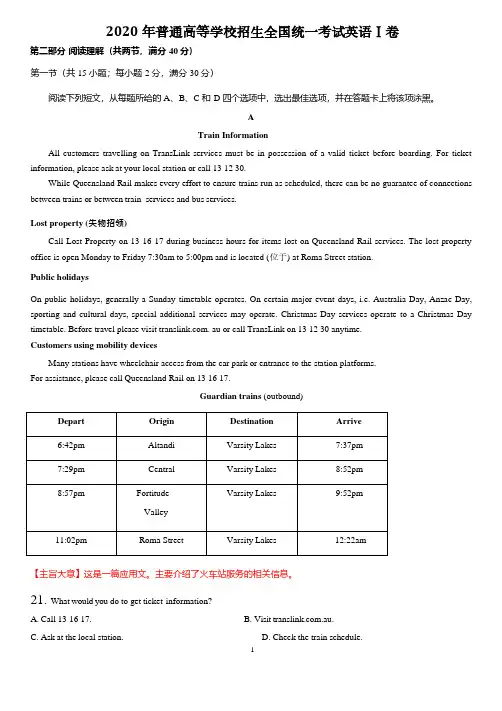
2020 年普通高等学校招生全国统一考试英语Ⅰ卷第二部分阅读理解(共两节,满分40 分)第一节(共15 小题;每小题2 分,满分30 分)阅读下列短文,从每题所给的A、B、C 和D 四个选项中,选出最佳选项,并在答题卡上将该项涂黑。
ATrain InformationAll customers travelling on TransLink services must be in possession of a valid ticket before boarding. For ticket information, please ask at your local station or call 13 12 30.While Queensland Rail makes every effort to ensure trains run as scheduled, there can be no guarantee of connections between trains or between train services and bus services.Lost property (失物招领)Call Lost Property on 13 16 17 during business hours for items lost on Queensland Rail services. The lost property office is open Monday to Friday 7:30am to 5:00pm and is located (位于) at Roma Street station.Public holidaysOn public holidays, generally a Sunday timetable operates. On certain major event days, i.e. Australia Day, Anzac Day, sporting and cultural days, special additional services may operate. Christmas Day services operate to a Christmas Day timetable. Before travel please visit . au or call TransLink on 13 12 30 anytime.Customers using mobility devicesMany stations have wheelchair access from the car park or entrance to the station platforms.For assistance, please call Queensland Rail on 13 16 17.Guardian trains (outbound)【主旨大意】这是一篇应用文。
2020山东高考英语试题及答案解析(word版)
绝密★启用前2020年普通高等学校招生全国统一考试英语(供山东使用)注意事项:1. 答卷前,考生务必将自己的姓名、准考证号填写在答题卡和试卷指定位置上。
2.回答选择题时,选出每小题答案后,用铅笔把答题卡上对应题目的答案标号涂黑。
如需改动,用橡皮擦干净后,再选涂其他答案标号。
回答非选择题时,将答案写在答题卡上,写在本试卷上无效。
3. 考试结束后,将本试卷和答题卡一并交回。
第一部分阅读(共两节,满分50分)第一节(共15小题;每小题2.5分,满分37.5分)阅读下列短文,从每题所给的A、B、C和D四个选项中,选出最佳选项。
APOETRY CHALLENGEWrite a poem about how courage, determination, and strength have helped you face challenges in your life.Prizes3 Grand Prizes: Trip to Washington, D.C. for each of three winners, a parent and one other person of the winner's choice. Trip includes round-trip air tickets, hotel stay for two nights, and tours of the National Air and Space Museum and the office of National Geographic World.6 First Prizes: The book Sky Pioneer: A Photobiography of Amelia Earhart signed by author Corinne Szabo and pilot Linda Finch.50 Honorable Mentions: Judges will choose up to 50 honorable mention winners, who will each receive a T-shirt in memory of Earhart's final flight.RulesFollow all rules carefully to prevent disqualification.■ Write a poem using 100 words or fewer. Your poem can be any format, any number of lines.■ Write by hand or type on a single sheet of paper. You may use both the from and back of the paper. ■ On the same sheet of paper, write or type your name, address, telephone number, and birth date.■ Mail your entry to us by October 31 this year.1.How many people can each grand prize winner take on the free trip?A. Two.B. Three.C. Four.D. Six.2.What will each of the honorable mention winners get?A. A plane ticket.B. A book by Corinne Szabo.C. A special T-shirt.D. A photo of Amelia Earhart.3.Which of the following will result in disqualification?A. Typing your poem out.B. Writing a poem of 120 words.C. Using both sides of the paper.D. Mailing your entry on October 30.BJennifer Mauer has needed more willpower than the typical college student to pursue her goal of earning a nursing degree. That willpower bore fruit when Jennifer graduated from University of Wisconsin-Eau Claire and became the first in her large family to earn a bachelor's degree.Mauer, of Edgar, Wisconsin, grew up on a farm in a family of 10 children. Her dad worked at a job away from the farm, and her mother ran the farm with the kids. After high school, Jennifer attended a local technical college, working to pay her tuition (学费), because there was no extra money set aside for a college education. After graduation, she worked to help her sisters and brothers pay for their schooling.Jennifer now is married and has three children of her own. She decided to go back to college to advance her career and to be able to better support her family while doing something she loves: nursing. She chose the UW-Eau Claire program at Ministry Saint Joseph's Hospital in Marshfield because she was able to pursue her four-year degree close to home. She could drive to class and be home in the evening to help with her kids. Jennifer received great support from her family as she worked to earn her degree: Her husband worked two jobs to cover the bills, and her 68-year-old mother helped take care of the children at times.Through it all, she remained in good academic standing and graduated with honors. Jennifer sacrificed (牺牲) to achieve her goal, giving up many nights with her kids and missing important events to study. "Some nights my heart was breaking to have to pick between my kids and studying for exams or papers." she says. However, her children have learned an important lesson witnessing their mother earn her degree. Jennifer is a first-generation graduate and an inspiration to her family - and that's pretty powerful.4.What did Jennifer do after high school?A. She helped her dad with his work.B. She ran the family farm on her own.C. She supported herself through college.D. She taught her sisters and brothers at home.5.Why did Jennifer choose the program at Ministry Saint Joseph's Hospital in Marshfield?A. To take care of her kids easily.B. To learn from the best nurses.C. To save money for her parents.D. To find a well-paid job there.6.What did Jennifer sacrifice to achieve her goal?A. Her health.B. Her time with family.C. Her reputation.D. Her chance of promotion.7.What can we learn from Jennifer's story?A. Time is money.B. Love breaks down barriers.C. Hard work pays off.D. Education is the key to success.CIn the mid-1990s, Tom Bissell taught English as a volunteer in Uzbekistan. He left after seven months, physically broken and having lost his mind. A few years later, still attracted to the country, he returned to Uzbekistan to write an article about the disappearance of the Aral Sea.His visit, however, ended up involving a lot more than that. Hence this book, Chasing the Sea: Lost Among the Ghosts of Empire in Central Asia, which talks about a road trip from Tashkent to Karakalpakstan, where millions of lives have been destroyed by the slow drying up of the sea. It is the story of an American travelling to a strange land, and of the people he meets on his way: Rustam, his translator, a lovely 24-year-old who picked up his colorful English in California, Oleg and Natasha, his hosts in Tashkent, and a string of foreign aid workers.This is a quick look at life in Uzbekistan, made of friendliness and warmth, but also its darker side of society. In Samarkand, Mr. Bissell admires the architectural wonders, while on his way to Bukhara he gets a taste of police methods when suspected of drug dealing. In Ferghana, he attends a mountain funeral (葬礼) followed by a strange drinking party. And in Karakalpakstan, he is saddened by the dust storms, diseases and fishing boats stuck miles from the sea.Mr.Bissell skillfully organizes historical insights and cultural references, making his tale a well-rounded picture of Uzbekistan, seen from Western eyes. His judgment and references are decidedly American, as well as his delicate stomach. As the author explains, this is neither a travel nor a history book, or even a piece of reportage. Whatever it is, the result is a fine and vivid description of the purest of Central Asian traditions.8.What made Mr Bissell return to Uzbekistan?A. His friends' invitation.B. His interest in the country.C.His love for teaching.D. His desire to regain health.9.What does the underlined word "that" in paragraph 2 refer to?A. Developing a serious mental disease.B. Taking a guided tour in Central Asia.C. Working as a volunteer in Uzbekistan.D. Writing an article about the Aral Sea.10.Which of the following best describes Mr Bissell's road trip in Uzbekistan?A. Romantic.B. Eventful.C. Pleasant.D. Dangerous.11.What is the purpose of this text?A. To introduce a book.B. To explain a cultural phenomenon.C. To remember a writer.D. To recommend a travel destination.DAccording to a recent study in the Journal of Consumer Research, both the size and consumption habits of our eating companions can influence our food intake. And contrary to existing research that says you should avoid eating with heavier people who order large portions (份), it's the beanpoles with big appetites you really need to avoid.To test the effect of social influence on eating habits, the researchers conducted two experiments. In the first, 95 undergraduate women were individually invited into a lab to ostensibly (表面上)participate in a study about movie viewership. Before the film began, each woman was asked to help herself to a snack.An actor hired by the researchers grabbed her food first. In her natural state, the actor weighed 105 pounds. But in half the cases she wore a specially designed fat suit which increased her weight to 180 pounds.Both the fat and thin versions of the actor took a large amount of food. The participants followed suit, taking more food than they normally would have. However, they took significantly more when the actor was thin.For the second test, in one case the thin actor took two pieces of candy from the snack bowls. In the other case, she took 30 pieces. The results were similar to the first test: the participants followed suit but took significantly more candy when the thin actor took 30 pieces.The tests show that the social environment is extremely influential when we're making decisions. If this fellow participant is going to eat more, so will I. Call it the "I'll have what she's having'' effect. However, we'll adjust the influence. If an overweight person is having a large portion, I'll hold back a bit because I see the results of his eating habits. But if a thin person eats a lot, I'll follow suit. If he can eat much and keep slim, why can't I?12.What is the recent study mainly about?A. Food safety.B. Movie viewership.C. Consumer demand.D. Eating behavior.13.What does the underlined word ''beanpoles" in paragraph 1 refer to?A. Big eaters.B. Overweight persons.C. Picky eaters.D. Tall thin persons.14.Why did the researchers hire the actor?A. To see how she would affect the participants.B. To test if the participants could recognize her.C. To find out what she would do in the two tests.D. To study why she could keep her weight down.15.On what basis do we "adjust the influence" according to the last paragraph?A. How hungry we are.B. How slim we want to be.C. How we perceive others.D. How we feel about the food.第二节(共5小题;每小题2.5分,满分12.5分)阅读下面短文,从短文后的选项中选出能填入空白处的最佳选项。
2020年山东省高考(新高考全国Ⅰ卷)真题 英语试卷(解析版)
50 Honorable Mentions:Judges will choose up to 50 honorable mention winners who will each receive a T-shirt in memory of Earhart’s final flight.
【3题详解】
细节理解题。根据最后一部分中的”Follow all rules carefully to prevent disqualification. Write a poem using 100 words or fewer”可知,所写的诗字数不能超过100字。否则,将会被取消资格。故结合选项,B选项(写一首120字的诗)是会被取消资格的。故选B。
3.考试结束后, 将本试卷和答题卡一并交回。
第一部分 阅读(共两节, 满分50分)
第一节(共15小题:每小题2.5分, 满分37.5分)
阅读下列短文, 从每题所给的A、B、C、D四个选项中选出最佳选项。
A
POETRY CHALLENGE
Write a poem about how courage, determination, and strength have helped you face challenges in your life.
【2题详解】
细节理解题。根据Prizes部分中第三段”50 Honorable Mentions: Judges will choose up to 50 honorable mention winners, who will each receive a T-shirt in memory of Earhart's final flight”可知,每位优秀奖获奖者都将获得一件纪念埃尔哈特最后一次飞行的T恤。故选C。
2023年普通高等学校招生全国统一考试英语(新课标Ⅰ卷)(含答案)
2023年普通高等学校招生全国统一考试(新课标Ⅰ卷)英语学科本试卷共12页。
考试结束后,将本试卷和答题卡一并交回。
注意事项:1.答题前,考生先将自己的姓名、准考证号码填写清楚,将条形码准确粘贴在考生信息条形码粘贴区。
2.选择题必须使用2B铅笔填涂;非选择题必须使用0.5 毫米黑色字迹的签字笔书写,字体工整、笔迹清楚。
3.请按照题号顺序在答题卡各题目的答题区域内作答,超出答题区域书写的答案无效;在草稿纸、试卷上答题无效。
4.作图可先使用铅笔画出,确定后必须用黑色字迹的签字笔描黑。
5.保持卡面清洁,不要折叠,不要弄破、弄皱,不准使用涂改液、修正带、刮纸刀。
第一部分听力(1-20 小题)在笔试结束后进行。
第二部分阅读(共两节,满分50分)第一节 (共15小题;每小题2.5分,满分37.5分)阅读下列短文,从每题所给的A、B、C、D四个选项中选出最佳选项。
ABike Rental &Guided ToursWelcome to Amsterdam, welcome to MacBike. You see much more from the seat of a bike!Cycling is the most economical, sustainable and fun way to explore the city, with its beautiful canals, parks, squares and countless lights. You can also bike along lovely landscapes outside of Amsterdam.Why MacBikeMacBike has been around for almost 30 years and is the biggest bicycle rental company in Amsterdam. With over 2,500 bikes stored in our five rental shops at strategic locations, we make sure there is always a bike available for you. We offer the newest bicycles in a wide variety, including basic bikes with foot brake (刹车), bikes with hand brake and gears(排挡), bikes with child seats, and children's bikes.PricesThe 2.5-hour tour covers the Gooyer Windmill, the Skinny Bridge, the Rijksmuseum, Heineken Brewery and much more. The tour departs from Dam Square every hour on the hour, starting at 1:00 pm every day. You can buy your ticket in a MacBike shop or book online.1. What is an advantage of MacBike?A. It gives children a discount.B. It of offers many types of bikes.C. It organizes free cycle tours.D. It has over 2,500 rental shops.2. How much do you pay for renting a bike with hand brake and three gears for two days?A.€15.75.B.€19.50.C.€22.75.D.€29.50.3. Where does the guided city tour start?A. The Gooyer, Windmill.B. The Skinny Bridge.C. Heineken Brewery.D. Dam Square.BWhen John Todd was a child, he loved to explore the woods around his house, observing how nature solved problems. A ditry stream, for example, often became clear after flowing through plants and along rocks where tiny creatures lived. When he got older, John started to wonder if this process could be used to clean up the messes people were making.After studying agriculture, medicine, and fisheries in college, John went back to observing nature and asking questions. Why can certain plants trap harmful bacteria (细菌)? Which kinds of fish can eat cancer-causing chemicals? With the right combination of animals and plants, he figured, maybe he could clean up waste the way nature did. He decided to build what he would later call an eco-machine.The task John set for himself was to remove harmful substances from some sludge(污泥). First, he constructed a series of clear fiberglass tanks connected to each other. Then he went around to local ponds and streams and brought back some plants and animals. He placed them in the tanks and waited. Little by little, these different kinds of life got used to one another and formed their own ecosystem. After a few weeks, John added the sludge.He was amazed at the results. The plants and animals in the eco-machine took the sludge as food and began to eat it!Within weeks, it had all been digested, and all that was left was pure water.Over the years, John has taken on many big jobs. He developed a greenhouse-like facility that treated sewage (污水) from 1,600 homes in South Burlington. He also designed an eco-machine to clean canal water in Fuzhou,a city in southeast China.“Ecological design”is the name John gives to what he does.“Life on Earth is kind of a box of spare parts for the inventor,”he says.“You put organisms in new relationships and observe what’s happening. Then you let these new systems develop their own ways to self-repair.”4. What can we learn about John from the first two paragraphs?A He was fond of traveling. B. He enjoyed being alone.C. He had an inquiring mind.D. He longed to be a doctor.5 Why did John put the sludge into the tanks?A. To feed the animals.B. To build an ecosystem.C. To protect the plants.D. To test the eco-machine.6. What is the author's purpose in mentioning Fuzhou?A. To review John's research plans.B. To show an application of John's idea.C. To compare John's different jobs.D. To erase doubts about John's invention.7. What is the basis for John's work?A. Nature can repair itself.B. Organisms need water to survive.C. Life on Earth is diverse.D. Most tiny creatures live in groups.CThe goal of this book is to make the case for digital minimalism, including a detailed exploration of what it asks and why it works, and then to teach you how to adopt this philosophy if you decide it's right for you.To do so,I divided the book into two parts. In part one,I describe the philosophical foundations of digital minimalism, starting with an examination of the forces that are making so many people's digital lives increasingly intolerable, before moving on to a detailed discussion of the digital minimalism philosophy.Part one concludes by introducing my suggested method for adopting this philosophy:the digital declutter.This process requires you to step away from optional online activities for thirty days. At the end of the thirty days,you will then add back a small number of carefully chosen online activities that you believe will provide massive benefits to the things you value.In the final chapter of part one,I’ll guide you through carrying out your own digital declutter. In doing so,I’ll draw on an experiment I ran in 2018 in which over 1,600 people agreed to perform a digital declutter. You’ll hearthese participants’stories and learn what strategies worked well for them, and what traps they enc ountered that you should avoid.The second part of this book takes a closer look at some ideas that will help you cultivate(培养)a sustainable digital minimalism lifestyle. In these chapters,I examine issues such as the importance of solitude(独处) and the necessity of cultivating high-quality leisure to replace the time most now spend on mindless device use. Each chapter concludes with a collection of practices, which are designed to help you act on the big ideas of the chapter.You can view these practices as a toolbox meant to aid your efforts to build a minimalist lifestyle that words for your particular circumstances.8. What is the book aimed at?A. Teaching critical thinking skills.B. Advocating a simple digital lifestyle.C. Solving philosophical problems.D. Promoting the use of a digital device.9. What does the underlined word“declutter”in paragraph 3 mean?A. Clear-up.B. Add-on.C. Check-in.D. Take-over.10. What is presented in the final chapter of part one?A. Theoretical models.B. Statistical methods.C. Practical examples.D. Historical analyses.11. What does the author suggest readers do with the practices offered in part two?A. Use them as needed.B. Recommend them to friends.C. Evaluate their effects.D. Identify the ideas behind them.DOn March 7,1907, the English statistician Francis Galton published a paper which illustrated what has come to be known as the “wisdom of crowds”effect. The experiment of estimation he conducted showed that in some cases, the average of a large number of independent estimates could be quite accurate.This effect capitalizes on the fact that when people make errors, those errors aren't always the same. Some people will tend to overestimate, and some to underestimate. When enough of these errors are averaged together,they cancel each other out, resulting in a more accurate estimate. If people are similar and tend to make the same errors, then their errors won't cancel each other out. In more technical terms, the wisdom of crowds requires that people’s estimates be independent. If for whatever reasons, people’s errors become correlated or dependent, the acc uracy of the estimate will go down.But a new study led by Joaquin Navajas offered an interesting twist(转折) on this classic phenomenon. The key finding of the study was that when crowds were further divided into smaller groups that were allowed to have adiscussion, the averages from these groups were more accurate than those from an equal number of independent individuals. For instance, the average obtained from the estimates of four discussion groups of five was significantly more accurate than the average obtained from 20 independent individuals.In a follow-up study with 100 university students, the researchers tried to get a better sense of what the group members actually did in their discussion. Did they tend to go with those most confident about their estimates? Did they follow those least willing to change their minds? This happened some of the time, but it wasn’t the dominant response. Most frequently, the groups reported that they “shared arguments and reasoned together.”Somehow,these arguments an d reasoning resulted in a global reduction in error. Although the studies led by Navajas have limitations and many questions remain the potential implications for group discussion and decision-making are enormous.12. What is paragraph 2 of the text mainly about?A. The methods of estimation.B. The underlying logic of the effect.C. The causes of people's errors.D. The design of Galton's experiment.13. Navajas ’ study found that the average accuracy could increase even if .A. the crowds were relatively smallB. there were occasional underestimatesC. individuals did not communicateD. estimates were not fully independent14. What did the follow-up study focus on?A. The size of the groups.B. The dominant members.C. The discussion process.D. The individual estimates.15 What is the author's attitude toward Navajas'studies?A. Unclear.B. Dismissive.C. Doubtful.D. Approving.第二节 (共5小题;每小题2.5分,满分12.5分)阅读下面短文,从短文后的选项中选出可以填入空白处的最佳选项。
2020年全国普通高等学校招生统一考试英语试卷 全国新高考Ⅰ卷 (含答案)
2020年全国普通高等学校招生统一考试试卷全国新高考Ⅰ卷英语注意事项:1. 答卷前, 考生务必将自己的姓名、准考证号填写在答题卡上。
2. 回答选择题时, 选出每小题答案后, 用铅笔把答题卡上对应题目的答案标号涂黑。
如需改动, 用橡皮擦干净后, 再选涂其他答案标号。
回答非选择题时, 将答案写在答题卡上, 写在本试卷上无效。
3. 考试结束后, 将本试卷和答题卡一并交回。
第一部分阅读(共两节, 满分50分)第一节(共15小题:每小题2.5分, 满分37.5分)阅读下列短文, 从每题所给的A、B、C、D四个选项中选出最佳选项。
APOETRY CHALLENGEWrite a poem about how courage, determination, and strength have helped you face challenges in your life.Prizes3 Grand Prizes:Trip to Washington, D.C. for each of three winners, a parent and one other person of the winner's choice. Trip includes round-trip air tickets, hotel stay for two nights, and tours of the National Air and Space Museum and the office of National Geographic World.6 First Prizes:The book Sky Pioneer:A Photobiography of Amelia Earhart signed by author Corinne Szabo and pilot Linda Finch.50 Honorable Mentions:Judges will choose up to 50 honorable mention winners, who will each receive a T-shirt in memory of Earhart's final flight.RulesFollow all rules carefully to prevent disqualification.■Write a poem using 100 words or fewer. Your poem can be any format, any number of lines.■Write by hand or type on a single sheet of paper. You may use both the front and back of the paper.■On the same sheet of paper, write or type your name, address, telephone number, and birth date.■Mail your entry to us by October 31 this year.1. How many people can each grand prize winner take on the free trip? ()A. Two.B. Three.C. Four.D. Six.2. What will each of the honorable mention winners get? ()A. A plane ticket.B. A book by Corinne Szabo.C. A special T-shirt.D. A photo of Amelia Earhart.3. Which of the following will result in disqualification? ()A. Typing your poem out.B. Writing a poem of 120 words.C. Using both sides of the paper.D. Mailing your entry on October 30.BJenifer Mauer has needed more willpower than the typical college student to pursue her goal of earning a nursing degree. That willpower bore fruit when Jennifer graduated from University of Wisconsin-Eau Claire and became the first in her large family to earn a bachelor's degree.Mauer, of Edgar, Wisconsin, grew up on a farm in a family of 10 children. Her dad worked at a job away from the farm, and her mother ran the farm with the kids. After high school, Jennifer attended a local technical college, working to pay her tuition(学费), because there was no extra money set aside for a college education. After graduation, she worked to help her sisters and brothers pay for their schooling.Jennifer now is married and has three children of her own. She decided to go back to college to advance her career and to be able to better support her family while doing something she loves: nursing. She chose the UW-Eau Claire program at Ministry Saint Joseph's Hospital in Marshfield because she was able to pursue her four-year degree close to home. She could drive to class and be home in the evening to help with her kids. Jenifer received great support from her family as she worked to car her degree: Her husband worked two jobs to cover the bills, and her 68-year-old mother helped take care of the children at times.Through it all, she remained in good academic standing and graduated with honors. Jennifer sacrificed(牺牲)to achieve her goal, giving up many nights with her kids and missing important events to study. “Some nights my heart was breaking to have to pick betw een my kids and studying for exams or papers,” she says. However, her children have learned an important lesson witnessing their mother earn her degree. Jennifer is a first-generation graduate and an inspirationto her family-and that's pretty powerful.4. What did Jennifer do after high school? ()A. She helped her dad with his work.B. She ran the family farm on her own.C. She supported herself through college.D. She taught her sisters and brothers at home.5. Why did Jennifer choose the program at Ministry Saint Joseph's Hospital in Marshfield? ()A. To take care of her kids easily.B. To learn from the best nurses.C. To save money for her parents.D. To find a well-paid job there.6. What did Jennifer sacrifice to achieve her goal? ()A. Her health.B. Her time with family.C. Her reputation.D. Her chance of promotion.7. What can we learn from Jenifer's story? ()A. Time is money.B. Love breaks down barriers.C. Hard work pays off.D. Education is the key to success.CIn the mid-1990s, Tom Bissell taught English as a volunteer in Uzbekistan. He left after seven months, physically broken and having lost his mind. A few years later, still attracted to the country, he returned to Uzbekistan to write an article about the disappearance of the Aral Sea.His visit, however, ended up involving a lot more than that. Hence this book, Chasing the Sea: Lost Among the Ghosts of Empire in Central Asia, which talks about a road trip from Tashkent to Karakalpakstan, where millions of lives have been destroyed by the slow drying up of the sea. It is the story of an American travelling to a strange land, and of the people he meets on his way: Rustam, his translator, a lovely 24-year-old who picked up his colorful English in California, Oleg and Natasha, his hosts in Tashkent, and a string of foreign aid workers.This is a quick look at life in Uzbekistan, made of friendliness and warmth, but also its darker side of society. In Samarkand, Mr Bissell admires the architectural wonders, while on his way to Bukhara he gets a taste of police methods when suspected of drug dealing. In Ferghana, he attends a mountain funeral(葬礼)followed by a strange drinking party. And in Karakalpakstan, he issaddened by the dust storms, diseases and fishing boats stuck miles from the sea.Mr Bissell skillfully organizes historical insights and cultural references, making his tale a well-rounded picture of Uzbekistan, seen from Western eyes. His judgment and references are decidedly American, as well as his delicate stomach. As the author explains, this is neither a travel nor a history book, or even a piece of reportage. Whatever it is, the result is a fine and vivid description of the purest of Central Asian traditions.8. What made Mr Bissell return to Uzbekistan? ()A. His friends' invitation.B. His interest in the country.C. His love for teaching.D. His desire to regain health.9. What does the underlined word “that” in paragraph 2 refer to? ()A. Developing a serious mental disease.B. Taking a guided tour in Central Asia.C. Working as a volunteer in Uzbekistan.D. Writing an article about the Aral Sea.10. Which of the following best describes Mr Bissell's road trip in Uzbekistan? ()A. Romantic.B. Eventful.C. Pleasant.D. Dangerous.11. What is the purpose of this text? ()A. To introduce a book.B. To explain a cultural phenomenon.C. To remember a writer.D. To recommend a travel destination.DAccording to a recent study in the Journal of Consumer Research, both the size and consumption habits of our eating companions can influence our food intake. And contrary to existing research that says you should avoid eating with heavier people who order large portions (份), it's the beanpoles with big appetites you really need to avoid.To test the effect of social influence on eating habits, the researchers conducted two experiments. In the first, 95 undergraduate women were individually invited into a lab to ostensibly(表面上)participate in a study about movie viewership. Before the film began, each woman was asked to help herself to a snack. An actor hired by the researchers grabbed her food first. In her natural state, the actor weighed 105 pounds. But in half the cases she wore a specially designed fat suit which increased her weight to 180 pounds.Both the fat and thin versions of the actor took a large amount of food. The participants followed suit, taking more food than they normally would have. However, they took significantly more when the actor was thin.For the second test, in one case the thin actor took two pieces of candy from the snack bowls. In the other case, she took 30 pieces. The results were similar to the first test: the participants followed suit but took significantly more candy when the thin actor took 30 pieces.The tests show that the social environment is extremely influential when we're making decisions. If this fellow participant is going to eat more, so will I. Call it the “I’ll have what she's having” effe ct. However, we'll adjust the influence. If an overweight person is having a large portion, I'll hold back a bit because I see the results of his eating habits. But if a thin person eats a lot, I'll follow suit. If he can eat much and keep slim, why can't I?12. What is the recent study mainly about? ()A. Food safety.B. Movie viewership.C. Consumer demand.D. Eating behavior.13. What does the underlined word "beanpoles" in paragraph 1 refer to? ()A. Big eaters.B. Overweight persons.C. Picky eaters.D. Tall thin persons.14. Why did the researchers hire the actor? ()A. To see how she would affect the participants.B. To test if the participants could recognize her.C. To find out what she would do in the two tests.D. To study why she could keep her weight down.15. On what basis do we "adjust the influence" according to the last paragraph? ()A. How hungry we are.B. How slim we want to be.C. How we perceive others.D. How we feel about the food.第二节(共5小题:每小题2. 5分, 满分12. 5分)阅读下面短文, 从短文后的选项中选出可以填入空白处的最佳选项。